HOA Voted to Cut Down My Windbreak—48 Hours Later, Their Own Insurance Investigation Pointed Back at the Board
PART 2
The sound of that first saw went through me in a way I wasn’t prepared for.
I had heard chainsaws thousands of times in my life. On military installations, disaster sites, storm cleanup details, road-clearing projects. A chainsaw was a tool. Noise, fuel, teeth, purpose.
That morning it sounded personal.
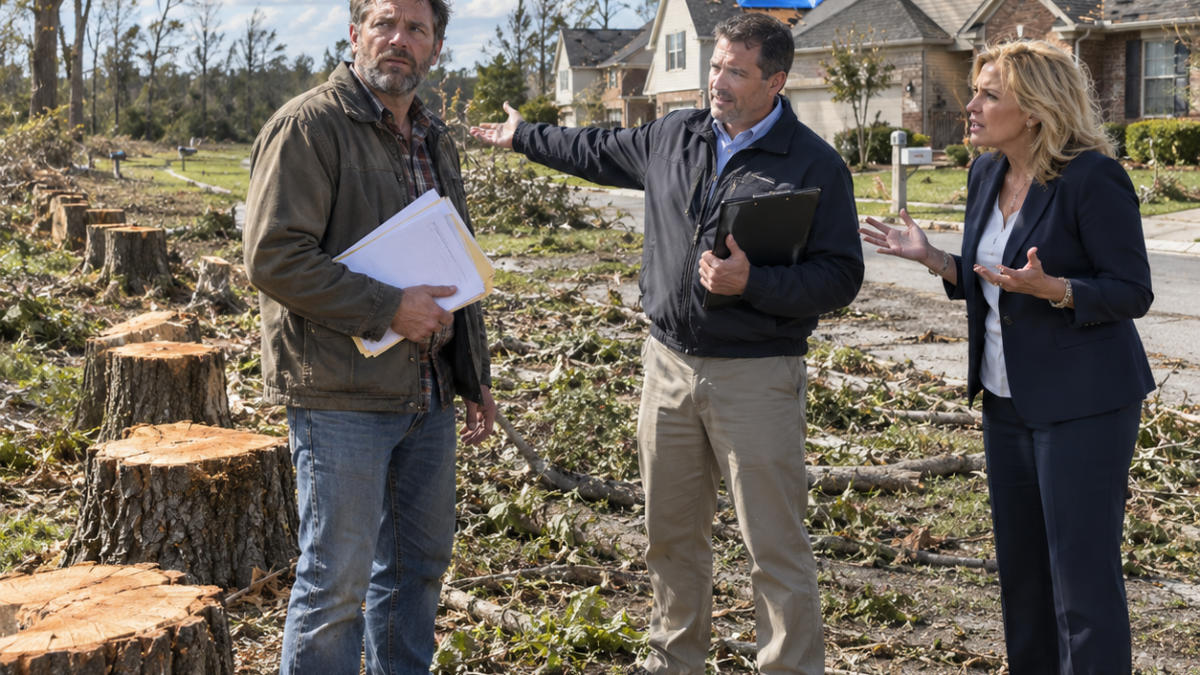
The worker cut a wedge into the trunk while the foreman stood several yards away, still looking unhappy.
Karen stood on the pavement with the clipboard tucked beneath one arm.
I kept filming.
“State your name for the record,” I told the foreman.
Karen snapped, “Oh, stop being theatrical.”
I ignored her.
The foreman looked at my phone.
“Mike Rawlins.”
“And your company?”
“Parker Tree and Land.”
“You understand I have expressly denied permission for your crew to enter my property?”
He exhaled.
“Yes.”
Karen stepped forward.
“The HOA has authorized this work.”
Mike looked toward her, then back at me.
“You heard her.”
“I did.”
I panned the camera toward Karen.
“And you’re directing them to proceed?”
Her eyes narrowed.
“Yes, Sergeant Henderson. I am.”
“Despite the recorded exemption I handed you?”
“Yes.”
“Despite the survey?”
“Yes.”
“Despite the engineering warning?”
She laughed.
“Your private little report doesn’t override a community vote.”
I let the silence after that sentence sit on the recording.
Then I lowered the phone enough to watch the first cypress fall.
The men had attached a rope to guide it away from the fence. The trunk leaned slowly, branches trembling high above us, and for one irrational second I wanted the tree to refuse.
It didn’t.
Wood obeys physics.
The trunk split at the hinge and came down with a deep, cracking rush.
The ground shook beneath my boots.
Karen actually clapped.
Once.
Twice.
“Finally,” she said.
I zoomed in on her.
She noticed.
“Get that camera out of my face.”
“You’re standing at the boundary of my property directing people to remove my trees.”
“I’m on the road.”
“And I’m recording from mine.”
Her mouth tightened.
Then she turned her attention back to the crew.
The second tree went down.
Then the third.
By the fifth, the workers had found their rhythm.
Cut.
Rope.
Crack.
Impact.
Limb.
Chip.
What had taken years to grow disappeared in minutes at a time.
Sarah had been gone twelve years by then.
Cancer.
Slow at first, then terribly fast.
She had helped me plant some of those trees when we were both young enough to believe twenty years was an impossibly long time.
On the first planting weekend, she had stood beside me holding a hose while I measured spacing.
“You’re making them too precise,” she told me.
“They need to be staggered.”
“They’re trees, Jack. They don’t know formation.”
“They will when the wind hits.”
She laughed.
“I married a man who can turn landscaping into a military operation.”
Later, when the trees were ten feet tall, she strung Christmas lights along the first hundred feet because she said they looked like “our private green wall.”
By the time she became sick, they were high enough to rustle above our bedroom windows.
The morning the HOA cut them down, I found myself remembering her standing in muddy boots with that hose.
I almost stopped filming.
Then Karen called to the crew.
“Make sure you get all of them.”
That brought me back.
I lifted the phone again.
For three hours, I documented everything.
I filmed the workers crossing the surveyed boundary.
The cut chain on my gate.
Tire tracks from their skid steer.
Branches falling across a section of fence.
The wood chipper swallowing green limbs by the dozen.
Karen stayed for roughly the first hour.
At one point she sat in her golf cart drinking from a large plastic cup while the crew worked.
When half the windbreak was gone, she looked across the open ground toward Oak Creek Meadows.
“There,” she said. “Doesn’t that look better?”
I looked at the subdivision.
For the first time since its construction, I could see nearly every west-facing roof in the first row.
“You may want to remember that view.”
Karen smirked.
“Is that another threat?”
“No.”
I looked toward the plains.
“It’s an observation.”
She left shortly afterward.
The crew continued.
Mike Rawlins barely spoke.
When the final cypress fell, the change was immediate.
I had expected the property to look empty.
I had not expected it to feel different.
The day was not particularly stormy. Winds were running perhaps fifteen miles per hour from the west.
For twenty years, that had meant movement in the tops of the cypress and a softer breeze near the house.
Now the wind crossed the open county road, swept through the cleared tree line, and hit me full in the chest.
Dust lifted from disturbed ground.
Loose leaves spiraled across the driveway.
One of the crew’s empty fuel cans rolled several feet before a worker stopped it with his boot.
Mike noticed.
So did I.
He walked over after they loaded the final saw.
“Mr. Henderson.”
“Yes?”
“I’m sorry about this.”
I looked toward the stumps.
“Then why did you do it?”
His face tightened.
“Because she signed the liability statement, and my boss told me to finish the contract.”
“You knew I was objecting.”
“I did.”
“You read the engineer’s cover letter.”
“Yes.”
“And you crossed the property line anyway.”
He looked down.
“I’ve got employees. Payments. A company owner breathing down my neck.”
“That explains your decision.”
I looked at him.
“It doesn’t make it mine.”
He nodded.
“I understand.”
As he walked away, I saw a clipboard lying near one of the stumps.
“Mike.”
He turned.
“You forgot something.”
He came back, picked it up, then frowned.
“That’s not mine.”
It was a carbon copy from the work packet.
The bottom included Karen’s handwritten statement accepting responsibility for the work and directing the contractor to proceed despite my objection.
Mike stared at it.
Then he looked at me.
“Keep it.”
“You sure?”
“Yes.”
He walked back to his truck.
That piece of paper eventually became one of the most important documents in the entire case.
At the time, it just went into a plastic sleeve.
I had spent too much of my adult life around investigations to trust memory.
People remember themselves better than they behaved.
Paper doesn’t.
Video doesn’t.
So I built a file.
The recorded covenant.
My deed and survey.
The arborist’s report.
The original wind engineering assessment.
The HOA notices.
The vote language.
Certified mail receipts.
My video.
Karen’s signed authorization.
Photographs of every stump.
Measurements of tire ruts and fence damage.
Before-and-after images from the same locations.
I copied the video onto two hard drives.
One went into my gun safe.
One went to my bank safe-deposit box.
Then I called Ben Carter.
Ben had handled several property matters for me over the years. He was about fifteen years younger than I was and had a way of sounding mildly irritated even when he was happy.
He answered on the fourth ring.
“Carter.”
“Ben, it’s Jack Henderson.”
“What did your HOA president do now?”
“They cut the trees.”
Silence.
“All of them?”
“Enough to destroy the windbreak.”
“On your parcel?”
“Yes.”
“After receiving the covenant?”
“Yes.”
“The survey?”
“Yes.”
“Your engineer’s report?”
“Yes.”
Another pause.
“Tell me you recorded it.”
“Three hours.”
I heard him exhale.
“Send me everything. Do not call Karen. Do not answer Karen. Do not attend another meeting without talking to me first.”
“I wasn’t planning to.”
“Jack.”
“Yes?”
“If anyone from the board comes to your property, record them.”
“Already doing it.”
“That’s why I like old engineers.”
I emailed the file.
His response came less than an hour later.
The message was short.
I have reviewed enough to act. Preserve originals. Do not communicate with them directly. Call me tomorrow morning.
Below that, he added:
Also, that handwritten authorization is extraordinary.
I slept badly that night.
Not because I was worried about Karen.
Because the house sounded wrong.
For decades I had slept with the soft, constant hiss of wind moving through cypress needles.
Now gusts hit the west wall directly.
A storm window rattled.
Something metallic clicked against the workshop.
At 1:30 in the morning, I got up and walked outside with a flashlight.
The night air pushed at my shirt.
The stumps looked pale in the beam.
I stood where the trees had been and looked east.
Lights from Oak Creek Meadows glowed across the drainage easement.
Dozens of houses.
Families asleep.
Children.
Retirees.
People who had voted yes.
People who had voted no.
People who had never voted at all.
I was still angry.
But anger was becoming secondary to something else.
Concern.
The engineer’s model had not been created to frighten anyone.
It had been created because I understood enough about wind loading to know I might be biased about my own trees.
So I had paid someone qualified to tell me whether I was wrong.
He told me I wasn’t.
Now the windbreak was gone.
I called my property insurer the next morning.
Not to file a weather claim.
To notify them that a protective landscape feature had been intentionally removed by a third party and that I believed the risk profile of my property had changed.
The representative initially sounded confused.
“You’re saying someone removed trees?”
“Three hundred mature cypress in two rows.”
“Storm damage?”
“No. Contractors.”
“Your contractors?”
“No.”
There was a pause.
“Sir, I’m going to transfer you to a senior claims specialist.”
That was how I met Frank Leary.
Frank asked better questions.
Were the trees documented?
Yes.
Insured as landscaping?
To an extent.
Was there evidence they had a protective function?
Engineering report.
Were they removed without my permission?
Video.
Had the responsible party been warned?
Repeatedly.
“Send me everything,” Frank said.
“That seems to be the phrase of the week.”
“What?”
“Nothing. I’ll send it.”
My next call was to Dr. Alister Finch, the civil engineer who had prepared the wind study.
He remembered the property immediately.
“Please don’t tell me they removed the cypress.”
“They removed the cypress.”
Silence.
Then a slow, professional sigh.
“When?”
“Yesterday.”
“What are winds doing now?”
“Steady from the west. Nothing severe.”
“I want field instruments out there.”
“That’s why I’m calling.”
He assembled a team within a day.
They installed anemometers on my property and, with permission, on public easement areas behind the first rows of houses.
They also placed pressure sensors at selected locations.
One of his younger engineers, Priya Shah, spent most of the morning checking equipment.
She looked toward the stumps.
“How tall were they?”
“Fifty-five to sixty feet, depending on the section.”
She whistled.
“And dense?”
“Two staggered rows.”
“That’s a significant roughness change.”
“You sound like Dr. Finch.”
“He trained me.”
The measurements began.
The results started coming almost immediately.
Even under ordinary winds, gust speeds downwind were significantly higher than the pre-removal model predicted for sheltered conditions.
Dr. Finch called two evenings later.
“Our original analysis may have been conservative.”
“How much?”
“I don’t want to give you a final percentage until we have more data.”
“Give me the unofficial answer.”
“Jack.”
“Alister.”
He sighed.
“Roofline gust exposure in the westernmost homes appears materially elevated. Some locations are seeing rapid pressure changes that concern me more than the average wind speed.”
“The gust factor.”
“Exactly.”
“How bad?”
“Bad enough that I’d like the HOA to preserve all construction and roof-maintenance records for the homes in that corridor.”
I wrote that down.
Then he said something I remembered later.
“A windbreak isn’t a magic wall. It doesn’t eliminate storms. But you removed a major friction element from the upwind terrain. In severe straight-line winds, that matters.”
“I know.”
“I’m telling you because people will oversimplify this later.”
He was right.
The legal complaint Ben filed focused first on what we could prove without any storm.
Trespass.
Property damage.
Interference with my possessory rights.
Fence damage.
Destruction of valuable mature trees.
The tree company was served first.
That was strategic.
Ben wanted their insurer involved before the HOA had time to coordinate stories with the contractor.
Within days, Parker Tree and Land’s carrier appointed counsel.
Mike Rawlins gave a recorded statement.
Then, through the litigation process, a sworn deposition.
He did not help Karen.
He didn’t need to embellish.
He simply told the truth.
Mr. Henderson told us not to enter.
He showed me the survey.
He showed me the recorded HOA exemption.
He gave me an engineering report.
I told Ms. Miller I wasn’t comfortable proceeding.
She told me the HOA would accept liability.
She wrote that on the authorization.
She threatened breach-of-contract action if we left.
My employer instructed us to proceed.
Ben called me after the deposition.
“He was very good.”
“For us?”
“For the truth.”
“That’s what I mean.”
“He also confirmed she clapped.”
I closed my eyes.
“That part matters less than the signature.”
“To a judge, maybe.”
Ben paused.
“To a jury, people remember clapping.”
Two days later, the weather forecast began to change.
In Texas, you learn not to panic every time a weather app paints your county red.
Spring brings severe storms.
Hail.
Tornado watches.
High winds.
Most warnings pass with a few branches down and a lot of television coverage.
But the pattern forming that week caught my attention.
A strong upper-level system.
Warm Gulf moisture.
A sharp cold front.
Meteorologists began discussing the potential for a widespread damaging-wind event.
Then the word derecho appeared.
I had seen the effects of derechos before.
Not tornado damage.
Something broader.
Miles of trees and structures hit by a fast-moving wall of wind.
The National Weather Service started highlighting seventy-mile-per-hour gust potential.
Then eighty.
Some models suggested localized gusts above ninety.
I called Dr. Finch.
“You watching?”
“Yes.”
“What do the instruments say?”
“Nothing unusual yet.”
“What do you recommend?”
“Secure your property.”
“I mean for the neighborhood.”
He was quiet.
“People should follow official severe-weather guidance. As for the altered exposure, we have enough preliminary data to state that removal of the windbreak increased wind speeds and gust loading in the western corridor.”
“In writing?”
“I can issue an interim memorandum.”
“Do it.”
I called Ben.
He listened.
Then said, “We need to notify the board.”
“I was already planning to.”
“Not as revenge.”
“I know.”
“Not with dramatic language.”
“I know.”
“Jack, I’m serious.”
“So am I.”
I drafted the notice with Dr. Finch’s memorandum attached.
It stated three things clearly.
The windbreak had been removed.
Post-removal measurements indicated increased wind exposure in the first rows of Oak Creek Meadows.
Severe straight-line winds were forecast.
Residents should follow official weather instructions and secure outdoor items.
For the board, Ben added a preservation notice and explicit warning that its prior decision could become relevant to any subsequent damage analysis.
We sent the board copies electronically and by certified mail.
I also delivered copies to homeowners nearest the western edge.
I did knock on doors.
That was one thing I changed from the original impulse.
People deserved context.
David Collins opened his door before I could knock twice.
David had been the neighbor who slipped the meeting notice into my mailbox weeks earlier.
He looked at the paper.
“Is this about the storm?”
“Yes.”
His wife came to the door behind him.
I pointed toward the west.
“The forecast is serious. Bring in anything loose. Patio furniture, grills, toys. If you have a garage, use it.”
David looked at the engineering memorandum.
“You think our houses are in danger because of the trees?”
“I think your exposure is higher than it was before. I can’t tell you what the storm will do.”
He nodded.
“That’s fair.”
A woman two doors down was less receptive.
“You’re trying to scare us because you lost the vote.”
“I’m giving you an engineer’s measurement.”
“Karen said you’re suing the association.”
“I am.”
“Then why should we trust this?”
“You shouldn’t trust me.”
I handed her the memorandum.
“Trust the weather service and make your own decision.”
She took it.
That was enough.
Karen reacted exactly as Ben predicted.
She called the notices “litigation propaganda” in an HOA email.
She told residents the association’s counsel considered my claims disputed.
She reminded everyone that severe storms were “a normal part of Texas life.”
That statement was technically true.
It was also beside the point.
By Saturday afternoon, the sky had changed.
Anyone who has spent enough years on the plains knows there are days when the atmosphere feels wrong before anything happens.
The air was heavy.
Still in strange intervals.
Then abruptly gusty.
Clouds stacked on the western horizon.
Weather radios began sounding.
A severe thunderstorm warning was issued.
Then another.
Reports came in from counties to the west.
Eighty-mile-per-hour winds.
Power poles down.
Roofs damaged.
The storm line was moving fast.
I secured the workshop.
Closed storm shutters.
Checked the generator.
Brought my dogs, Ranger and Tess, inside.
I had built the house with reinforced framing and a standing-seam steel roof rated well beyond typical residential construction.
Still, I checked everything twice.
Around three in the afternoon, my phone buzzed.
David.
Is it here yet?
I called him.
“Ten or fifteen minutes, maybe less.”
“We’re inside.”
“Stay away from west-facing windows.”
“Got it.”
He hesitated.
“Jack?”
“Yes?”
“I’m sorry about the vote.”
“This is not the time.”
“I know.”
“Get your family into the interior hallway.”
I hung up.
The first gust hit before the rain.
That is what I remember most.
No warning drop.
No gradual build.
One second the trees around the distant creek were moving.
The next, the whole landscape seemed to flatten eastward.
Wind hit the house with a low, structural boom.
Ranger barked.
Tess disappeared beneath the kitchen table.
I moved to an interior observation point where I could see through protected glass without standing directly in front of it.
The sky went nearly black.
Then debris started flying.
Leaves first.
Then trash.
Then pieces of material too large to identify.
Across the open easement, shingles on the nearest Oak Creek Meadows roofs began lifting.
Not individual tabs.
Sheets.
A west-facing roof near David’s house rippled in a way that made my stomach tighten.
Then an entire section peeled loose.
Black underlayment flashed beneath it.
Vinyl siding came next.
A white panel ripped away from one home and disappeared down the street.
A patio umbrella cartwheeled thirty feet through a backyard.
A trampoline lifted, struck a fence, and folded around it.
Power failed.
My generator started automatically.
The storm roared.
There is no other good word for it.
A sustained, mechanical roar with higher screams layered inside it whenever air found an edge, gap, vent, gutter, or loose panel.
My house held.
I could feel pressure changes.
But the frame remained steady.
The old windbreak would not have made Oak Creek Meadows invincible.
Nothing could.
Some damage likely would have occurred regardless.
But as I watched the western row absorb the direct impact, I understood exactly what Finch had meant.
The margin was gone.
Every system has margins.
Engineers live in them.
Safety factors.
Redundancy.
Buffers.
The HOA had removed one because Karen thought it was ugly.
The worst winds lasted less than an hour.
It felt like half a day.
When the roar finally weakened, heavy rain followed.
I waited until the lightning moved farther east.
Then I put on boots and a raincoat.
The neighborhood looked stunned.
Fence sections lay flat.
Decorative trees were snapped.
Roofing material covered the street.
One garage door had buckled inward.
A shed had moved several feet off its foundation.
I walked toward David’s house.
He stood in his driveway in the rain.
A blue tarp was already being pulled over part of his roof by his brother-in-law.
David looked at me.
His face was gray.
“Sarge.”
I stopped.
“You okay?”
“Family’s okay.”
“That’s what matters.”
He looked up.
Nearly a quarter of the west side of his roof had lost shingles and underlayment.
Water was entering near the attic vent.
“You told us.”
I said nothing.
He looked at the open western boundary.
“You told every one of us.”
“This storm would have damaged things either way.”
“That’s not the point.”
“No.”
It wasn’t.
I kept walking.
Families were emerging.
Checking cars.
Calling relatives.
Taking photographs.
No one was talking about landscaping anymore.
When I reached Karen’s street, I saw her house immediately.
Her roof had lost a wide patch of shingles on the western slope.
A gutter hung loose.
Her front flower beds had been flattened.
She stood on the lawn with her phone pressed to one ear.
Rain ran down her face.
She saw me.
For a second, anger appeared.
Then something else replaced it.
Fear.
Not fear of me.
Fear of scale.
She looked past me toward the damaged houses.
I knew that expression.
It was the moment someone realizes a problem is no longer containable.
She lowered the phone.
“You enjoying this?”
The question shocked me.
“Karen.”
“Don’t.”
She pointed toward my house in the distance.
“Your place is fine.”
“It’s reinforced.”
“Of course it is.”
“This isn’t what I wanted.”
She laughed bitterly.
“You warned everybody. Now you get to be right.”
I stepped closer, but stayed on the sidewalk.
“People’s homes are damaged.”
“I can see that.”
“Then call the board and tell them to notify their liability carrier immediately.”
Her eyes narrowed.
“You don’t give me orders.”
“No.”
I looked at the missing section of her roof.
“Storms do that.”
Then I walked away.
The next morning Oak Creek Meadows woke beneath blue tarps.
Roofing crews started arriving before breakfast.
So did adjusters.
Temporary repair companies.
Utility crews.
Tree contractors.
Emergency restoration vans.
Insurance claims opened by the dozens.
My own insurer sent Frank Leary.
He arrived around ten.
He drove slowly down the neighborhood street before turning onto my property.
When he got out, he looked back toward Oak Creek Meadows.
“Your house looks untouched.”
“Not untouched.”
I pointed toward scratches on a west-facing metal panel and damage to one section of gutter.
Frank stared at the neighborhood.
“I was expecting much worse from your file.”
“So was I.”
He walked around the house.
Checked the roof from the ground with binoculars.
Photographed minor damage.
Then I took him to the tree line.
Or what used to be the tree line.
Frank stood among the stumps.
“How many?”
“Just under three hundred across both rows.”
“Age?”
“Most around twenty years.”
“Height?”
“Fifty-five to sixty feet.”
He looked toward the subdivision.
“That was dense?”
“Very.”
He pulled a notebook from his bag.
“Start at the beginning.”
So I did.
The development agreement.
My exemption.
Karen’s campaign.
The arborist report.
The engineering report.
The vote.
The driveway confrontation.
The contractor.
The handwritten indemnification.
The video.
The new wind measurements.
The certified storm warning.
Frank took notes for almost two hours.
When I played the video of Karen signing the work order after the foreman tried to withdraw, his expression changed.
Not anger exactly.
Professional alarm.
“She accepted liability in writing?”
“That’s her handwriting.”
“And the contractor has confirmed this?”
“Under oath.”
Frank wrote something.
Then I showed him Dr. Finch’s preliminary post-removal measurements.
Frank read slowly.
“Have other carriers seen this?”
“Not from me.”
“They will.”
“What happens now?”
He closed the report.
“Your landscaping claim is one thing. The neighborhood losses are another. Your insurer can pursue responsible third parties for what they caused. Other carriers can do the same.”
“Subrogation.”
He looked at me.
“You’ve done this before.”
“Different contexts.”
Frank nodded toward the damaged roofs.
“If the evidence supports that removal of the windbreak materially increased losses, every carrier paying claims out there will want to know why.”
That was more realistic than the revenge fantasy people later told about Oak Creek Meadows.
Insurance companies did not simply wake up and decide every storm claim was somebody else’s problem.
Most homeowners still had coverage subject to deductibles, policy terms, depreciation, and exclusions unrelated to the HOA.
Emergency mitigation was funded.
Some roofs were repaired.
Some disputes arose over whether entire roofs needed replacement or only sections.
But behind the scenes, something more important was happening.
The carriers were investigating causation.
And once several adjusters saw the same pattern, they started talking.
Damage was severe along the western exposure.
Less severe farther east.
Construction quality played a role.
Roof age played a role.
Installation quality mattered.
So did the storm itself.
But Dr. Finch’s data added another factor that was impossible to ignore.
A major upwind windbreak had been intentionally removed days before the event after written warnings that removal could increase wind loads.
Frank called me three days later.
“Jack, I need permission to share your engineering reports with counsel retained by several carriers.”
“Ben needs to approve it.”
“Of course.”
“What are they looking at?”
“Potential recovery against the HOA and its liability insurers.”
“Because of the trees?”
“Because of the decision-making process.”
That distinction mattered.
The storm caused the wind.
Karen did not cause the derecho.
The HOA did not create the weather.
No serious engineer or lawyer claimed they did.
The question was whether the board had knowingly removed a protective feature and thereby increased foreseeable damage.
That was a much harder question.
It was also a much more dangerous one for the board.
Homeowners started receiving letters.
Not blanket denials.
Not all identical.
Some were reservation-of-rights notices.
Some explained coverage.
Some advised that the carrier intended to investigate third-party liability.
Some stated that the insurer might seek recovery from the HOA or contractor after paying covered losses.
A few homeowners with difficult policy issues were told portions of their claims might not be covered and that they should preserve potential claims against responsible third parties.
The language varied.
One paragraph appeared repeatedly.
The carrier was investigating whether removal of the western windbreak by or at the direction of Oak Creek Meadows Homeowners Association materially contributed to the extent of wind damage.
That sentence hit the neighborhood harder than anything I could have said.
David brought his letter to my house.
He placed it on the kitchen table.
“They’re blaming the HOA.”
“They’re investigating the HOA.”
“It says they may pursue them.”
“Yes.”
David sat.
His roof damage estimate had come to nearly forty thousand dollars once interior water mitigation was included.
Insurance would cover much of it after his deductible, but his family was displaced from two rooms while repairs were underway.
His little girl had started crying every time the weather radio beeped.
“That vote,” he said.
I looked at him.
“I voted yes.”
“I know.”
“I thought they were trimming brush.”
“That was how the resolution was written.”
“I still voted.”
“David.”
He rubbed his face.
“I should’ve asked.”
“That’s different from ordering a crew onto private land after being warned.”
“But we gave her the vote.”
I sat across from him.
“Then learn from it.”
He looked up.
“That’s all?”
“What do you want me to say?”
“I don’t know.”
“Guilt won’t fix your roof.”
He gave a tired laugh.
“That sounds like you.”
“Probably.”
Within forty-eight hours, letters and carrier emails were circulating through the neighborhood.
People compared wording.
Screenshots went into group chats.
Someone created a folder containing my original meeting documents.
My engineering report was uploaded.
Then the arborist report.
Then the HOA vote language.
Then the video clip.
I did not upload the clip of Karen clapping.
Someone else did.
I never found out who.
By the end of the day, it had been watched hundreds of times inside the community.
The atmosphere changed.
Before the storm, Karen’s narrative had been simple.
Jack Henderson is angry because his trees were removed.
After the storm, homeowners saw a different timeline.
Jack warned the trees reduced wind exposure.
Jack presented engineering.
The board rejected it.
The HOA voted using vague language.
Karen ordered the crew onto exempt private property.
The contractor hesitated.
Karen signed responsibility.
The trees were removed.
Two days later a major windstorm hit.
Engineers documented increased exposure.
Insurance investigators were now examining the HOA’s decision.
Cause and effect was still a technical and legal question.
But trust was no longer one.
Karen had lost it.
An emergency meeting was called.
Not by her.
By homeowners using the petition provision in the bylaws.
The clubhouse had storm damage and could not hold the expected crowd, so they rented the auditorium at a nearby high school.
Ben told me not to speak unless necessary.
“You are already the most persuasive person in the room,” he said.
“I’m not giving a speech.”
“Exactly.”
I stood near the back wall.
Nearly every seat was occupied.
Some people had folders.
Others held insurance letters.
A few held photographs of damaged homes.
Karen sat at a table onstage with three other board members.
She looked different.
Smaller.
Not physically.
In authority.
She tapped the microphone.
“Everyone, please settle down.”
The room quieted only slightly.
“I know there has been a tremendous amount of misinformation circulating since the storm.”
A man in the third row laughed loudly.
Karen stiffened.
“Our attorneys are reviewing the situation. The board is also working with insurance representatives, and I want everyone to understand that this was an unprecedented weather event.”
A man named Tom Alvarez stood.
Tom was a commercial roofer.
His own roof had lost a large west-facing section.
“No one says you caused the storm.”
Karen looked relieved for approximately one second.
Tom held up a packet.
“We’re saying you removed the protection after you were warned.”
Applause erupted.
Karen raised her voice.
“The trees were legally designated as a community hazard.”
I heard myself speak before I intended to.
“By whom?”
Heads turned toward me.
Karen’s eyes locked on mine.
I stayed against the back wall.
“Who legally designated them a hazard?”
She pointed toward me.
“This is exactly what I’m talking about. Mr. Henderson has pursued a personal vendetta—”
“Answer the question,” Tom said.
Someone else shouted, “Show us the report.”
Karen looked toward the other board members.
None moved.
A woman in the front row stood.
“My name is Carol Barnes.”
I knew her house.
First row.
Severe roof damage.
She held up an insurance letter.
“My adjuster asked me whether the HOA had an engineering study before removing those trees.”
Karen leaned toward the microphone.
“Our management professionals reviewed—”
“Was there an engineer?”
Karen hesitated.
Carol repeated it.
“Was there an engineer?”
One of the board members, Susan Pike, whispered something to Karen.
Karen ignored her.
“We had professional landscape consultation.”
The room erupted.
Tom Alvarez shouted, “A landscaper?”
Another homeowner called, “You ignored an engineer for a landscaper?”
Karen hit the microphone with her palm.
“This meeting will come to order.”
Nobody listened.
Then David Collins stood.
He was not loud.
That was why people stopped.
David held the warning I had delivered before the storm.
“My house has thirty-eight thousand dollars in documented damage.”
He looked down.
“My insurance company is covering most of the structural work, but they’ve notified us that they intend to investigate recovery against the HOA.”
He unfolded the paper.
“Two days before the storm, Jack gave this to my family.”
He read the notice.
No embellishment.
No commentary.
Just the facts.
Post-removal wind data.
Forecast severe gusts.
Elevated exposure.
Secure property.
Follow National Weather Service guidance.
When he finished, David looked toward Karen.
“You said he was fearmongering.”
Karen’s jaw tightened.
“I said his litigation campaign was creating unnecessary panic.”
“You had these notices removed from some doors.”
“I removed unauthorized material from HOA-controlled surfaces.”
“They were on our front doors.”
A murmur spread.
David continued.
“He warned us before the trees came down.”
Then he held up the letter.
“He warned us again before the storm.”
He looked at the other board members.
“Which one of you warned us?”
Silence.
Susan Pike looked down.
The treasurer, Mark Denson, leaned back from the table.
Karen said, “David, emotions are running high.”
“No.”
His voice remained calm.
“My roof is open. My daughter sleeps in our bedroom because she’s scared of wind. My insurance company is investigating whether your decision increased our loss.”
He pointed toward me.
“And the man you called a liar is the only person in this whole mess who gave us a written warning.”
Nobody applauded this time.
The room was too quiet.
That silence hurt Karen more.
She tried to recover.
“Mr. Henderson has filed a lawsuit against the association. Anything he says needs to be understood in that context.”
I stayed where I was.
Ben stood beside me.
He whispered, “Don’t.”
“I’m not.”
Then a woman named Denise Walker stood.
Her husband used a wheelchair.
Their roof damage had forced them into a hotel while repairs were performed.
“We are paying two thousand dollars out of pocket for our deductible,” she said. “We have temporary housing limits. We have missed work. My husband’s medical equipment had to be moved.”
Her voice broke.
“You were told.”
Karen looked at her.
“I am sorry your family is dealing with this.”
“No.”
Denise shook her head.
“Don’t do that.”
“Do what?”
“Talk like you’re not part of it.”
Karen’s face hardened.
“I did not cause a derecho.”
“No one said you did.”
Denise pointed toward the screen where someone had projected a still frame from my engineering report.
“You decided you knew better than the people who study this.”
One homeowner after another stood.
An elderly widow whose ceiling had collapsed in one bedroom.
A young couple who had just closed on their house six months earlier.
A father whose fenced backyard was now open because three fence lines had failed.
Not every loss was caused by the missing windbreak.
Everyone understood that by then.
But Karen had created a new category of anger.
Preventable exposure.
The final turn came from her own treasurer.
Mark Denson leaned toward his microphone.
“Karen, I need to ask you something in front of the membership.”
She turned.
“Not now.”
“Yes. Now.”
He held a folder.
“Did Jack Henderson provide you an engineer’s report before the removal vote?”
Karen stared at him.
“You know he did.”
“I know now.”
A murmur went through the room.
Mark continued.
“Was the full report distributed to the board?”
Karen said nothing.
Susan Pike looked up sharply.
Mark repeated the question.
“Did you send us the full engineering report?”
Karen’s face went pale.
“I summarized his position.”
“That’s not what I asked.”
She shifted in her chair.
“The board had enough information to make a decision.”
Mark opened the folder.
“I never saw this.”
Susan reached for it.
“Neither did I.”
The fourth board member, Glen Porter, shook his head.
“I saw the arborist page after the meeting. Not this.”
Karen’s voice rose.
“You all knew what we were voting on.”
Mark slammed his hand against the table.
“We voted on an aesthetic and safety resolution. You told us legal had cleared the authority issue.”
“They had.”
Ben murmured beside me, “That will be interesting in discovery.”
Mark looked toward the audience.
“I want the record to reflect that I did not receive this engineering report before the vote.”
Karen turned on him.
“You’re trying to save yourself.”
“I am trying to tell the truth.”
That was the moment her board broke.
Once the other directors realized Karen might have filtered information, their loyalty disappeared.
The membership petitioned for removal.
A formal recall vote was scheduled according to the bylaws and state requirements.
Karen fought it for a week.
She sent emails.
Blamed outside agitators.
Accused insurance companies of exploiting a disaster.
Suggested I had manipulated wind data.
Dr. Finch responded to that last accusation with a letter explaining the instruments, locations, calibration records, and methodology.
Karen stopped mentioning the data.
The recall vote was overwhelming.
She was removed.
So were the other directors, though Mark and Susan received considerably more sympathy after cooperating with the investigation.
The new interim board did three things immediately.
They notified the HOA’s liability carrier.
They retained independent counsel.
And they hired their own engineering firm.
That last decision mattered most to me.
I did not want Oak Creek Meadows relying only on my expert.
Their engineer, Dr. Nina Patel, spent days reviewing storm records, roof construction, terrain, Finch’s instrumentation, historical imagery, and the removed tree line.
Her conclusions were nuanced.
The derecho was the primary weather event.
Some homes had construction vulnerabilities unrelated to the windbreak.
Some roof failures likely would have occurred even if the trees remained.
But the removed windbreak had materially reduced upstream roughness and increased exposure for portions of the western corridor.
In several modeled locations, the absence of the trees likely increased peak pressures enough to worsen otherwise repairable damage.
That was the sentence the insurers cared about.
Not that Karen caused the storm.
That her decision likely increased insured losses.
Subrogation notices followed.
Multiple carriers sought recovery from the HOA, its liability insurer, and the tree company.
The HOA’s general liability carrier initially issued a reservation of rights.
Its attorneys argued about whether the board’s conduct fell within covered negligence or intentional-act exclusions.
The directors-and-officers carrier began its own investigation.
Karen’s handwritten liability acceptance became a problem.
So did the video.
So did the missing engineering report from the board packet.
So did emails uncovered during discovery.
One message from Karen to the management company became infamous.
The manager had asked whether the association should obtain an independent engineering opinion before removing the trees.
Karen replied:
We do not need to waste community money validating Henderson’s scare tactics. Once the trees are gone, this issue ends.
Ben read that email aloud in his office.
Then he put it down.
“Cases rarely give you sentences this clean.”
I stared at the printout.
“She really wrote that?”
“From her HOA account.”
“Before the vote?”
“Three days.”
He handed me another email.
Karen to a fellow board member:
Do not circulate Henderson’s full report. It will confuse residents and encourage him.
I felt something colder than anger.
She had not merely disagreed.
She had intentionally prevented people from seeing information because it weakened her preferred outcome.
“That goes to the homeowners?”
“Eventually.”
Ben leaned back.
“But your case is separate. Remember that.”
My property-damage case moved faster than the broader insurance fight.
The tree company’s carrier wanted out.
Parker Tree and Land faced clear exposure because its crew crossed a disputed boundary after direct notice.
The company owner testified he had never seen my covenant or engineering report before the morning of removal.
Mike had called him from the site.
The owner told him to follow the signed HOA authorization.
A bad decision.
But not as deliberate as Karen’s.
The company agreed to a substantial settlement contribution.
The HOA’s insurer followed.
The valuation of the trees became complicated.
You cannot simply buy three hundred twenty-year-old cypress, drop them into holes, and recreate two decades of growth.
An arboricultural appraiser calculated replacement and restoration value.
The number was considerably higher than Karen had ever imagined when she called them ugly.
Fence repairs.
Soil compaction.
Loss of landscape function.
Restoration planning.
Legal expenses.
All entered the negotiations.
Ben showed me the final settlement proposal.
It was more money than I expected.
“There’s a confidentiality clause on the exact amount.”
“I don’t care about telling people the number.”
“There is also no admission of liability from the carriers.”
I laughed.
“Of course.”
“Jack, this gets your land restored and ends your individual case.”
“What about Karen?”
“She is still involved in the broader HOA matters.”
“And the homeowners?”
“Separate claims. Separate recovery efforts.”
I looked at the settlement.
I thought about Sarah.
The planting weekends.
The shade.
The sound of cypress in winter.
Money did not replace that.
But refusing money would not bring it back either.
“Accept.”
Ben nodded.
“I think that’s wise.”
Then he said, “You know what surprised me?”
“What?”
“You never asked how much of it could come directly from Karen.”
“I want my property restored.”
“You’re not interested in ruining her?”
“No.”
He studied me.
“That is not the same energy you had the first week.”
“No.”
I looked toward his window.
“I watched families put tarps on their houses. Revenge gets less entertaining when innocent people are paying too.”
The broader litigation lasted much longer.
Homeowners formed a legal committee.
Carriers pursued recovery.
The HOA’s insurer negotiated.
The contractor’s carrier contributed what it could.
The association faced deductibles, uncovered costs, legal expenses, and emergency assessments.
Some homeowners sued individually for losses not fully covered by insurance.
Others joined a coordinated action.
Karen was named in several claims based on alleged breaches of fiduciary duty, misrepresentation, and actions outside reasonable board authority.
Not every dramatic allegation survived.
Courts are not revenge machines.
Lawyers argued.
Some claims were dismissed.
Others settled.
The final consequences were less cinematic than people later described online.
No judge appeared and instantly seized Karen’s retirement account.
No insurance company declared an entire neighborhood uninsured because of one vote.
No sheriff marched her out of a clubhouse.
Reality moved slower.
More painfully.
Depositions.
Motions.
Coverage letters.
Mediation.
Settlement conferences.
Assessments.
Repair invoices.
But reality also had a way of becoming unavoidable.
The association’s liability settlement required substantial governance reforms.
The HOA paid significant amounts toward uncovered homeowner losses and insurer recovery claims.
The board’s decision triggered higher future insurance costs.
The special assessment was large enough to make every household feel it.
That created another hard truth.
Karen had made the worst decisions.
But a community had elected the board and approved the vague resolution.
People had delegated power without asking enough questions.
At one meeting, a resident stood and demanded that none of the assessment be charged to people who voted against the tree removal.
The new association attorney explained gently that HOA obligations do not disappear based on how individual members voted.
A groan moved through the room.
Arthur Bell, an older homeowner who had opposed Karen from the beginning, leaned toward me.
“That’s going to make democracy unpopular.”
“It may make reading ballots more popular.”
He smiled.
“Optimist.”
Karen’s personal situation deteriorated.
Legal bills accumulated.
Her homeowners carrier repaired her storm damage, but she still had a deductible and interior costs.
Her reputation inside Oak Creek Meadows collapsed.
The woman who once walked into meetings with people automatically making room for her began entering through side doors.
Neighbors stopped asking her opinion.
Some stopped speaking to her entirely.
I didn’t encourage that.
I also didn’t prevent it.
She came to my property one afternoon about five months after the storm.
I was supervising stump grinding along the old windbreak line.
A contractor had removed perhaps twenty of the largest stumps when I noticed her at the gate.
She did not enter.
That was new.
“Jack.”
I turned off my hearing protection.
“What do you need?”
She looked tired.
Not defeated.
Tired.
Her hair was pulled back instead of styled.
No clipboard.
No HOA polo shirt.
Just jeans and a gray top.
“Can we talk?”
I walked toward the gate but stayed inside.
“What about?”
“The lawsuits.”
“Talk to Ben.”
“I don’t want to talk to your lawyer.”
“Then don’t talk about the lawsuits.”
She looked behind me at the empty strip of soil.
“You’re replanting?”
“Yes.”
“With settlement money.”
“Partly.”
She laughed without humor.
“So you got paid.”
I felt the old anger stir.
“Is that why you came?”
“I came because my lawyer says your video is one of the reasons they won’t drop me from the homeowners’ claims.”
“My video shows what happened.”
“It shows one moment.”
“It shows three hours.”
“You edited what people saw.”
“I didn’t release the full video.”
“Someone released the part where I clapped.”
“I know.”
“You expect me to believe it wasn’t you?”
“Yes.”
She stared at me.
For once, I decided not to end the conversation immediately.
“Why did you clap?”
Her face changed.
“What?”
“You’ve had months to think about it. Why did you clap?”
She looked away.
“I was angry.”
“At me?”
“Yes.”
“Because?”
“You treated me like I was stupid.”
“I told you the trees had a function.”
“You talked to me like a soldier giving orders.”
That landed more than I wanted it to.
I thought back.
Had I?
Maybe.
Not because she was a woman.
Not because she was HOA president.
Because once I believed the technical facts were clear, I had little patience for anyone refusing them.
Sarah used to call that my “briefing voice.”
Karen continued.
“You walked into that meeting with reports and charts and acted like the rest of us were children.”
“I brought evidence.”
“You brought a verdict.”
“That’s not the same thing.”
“It felt the same.”
I was quiet.
Then I said, “You could have hired another engineer.”
She looked at me.
“I know.”
“You could have delayed the vote.”
“I know.”
“You could have given the board my full report.”
She looked down.
“I know.”
It was the first time I heard her say those words without defense attached.
I waited.
Karen rubbed her hands together.
“I thought if I gave them your report, you would win.”
There it was.
Not engineering.
Not safety.
Winning.
“So you withheld it.”
“Yes.”
The word was almost too quiet to hear.
“Why were the trees so important to you?”
She gave a bitter little laugh.
“They weren’t.”
I stared.
“What?”
“Not at first.”
She looked toward the houses.
“When we bought our home, the agent talked about sunset views. My husband loved the lot because of the west-facing patio.”
“The development was built after my trees.”
“I know that now.”
“You knew it then.”
“I knew there were trees.”
I almost interrupted.
She raised one hand.
“I’m not saying I was right.”
So I let her continue.
“The first year, I asked you whether you’d trim them.”
“You asked me to top sixty-foot cypress.”
“I didn’t understand what that meant.”
“I explained it.”
“You said no.”
“Yes.”
“And that should have been the end of it.”
“Yes.”
She swallowed.
“But then every time something came up with your property, you had another exemption. Another document. Another reason the rules didn’t apply to you.”
“The rules legally didn’t apply.”
“I know.”
“But?”
She looked embarrassed.
“It made me feel powerless.”
I stared at her.
All of this.
Three hundred trees.
Millions in damage and claims.
A neighborhood torn apart.
Because my existence outside her authority bothered her.
Karen seemed to read my expression.
“I know how that sounds.”
“Do you?”
“Yes.”
She looked toward the cleared line again.
“I thought the trees proved the HOA was weak.”
“They were trees.”
“I know.”
The absurdity of that answer hit both of us.
For a second, neither spoke.
Then she said, “I am sorry.”
Not “I’m sorry this happened.”
Not “I’m sorry people misunderstood.”
Just:
“I am sorry.”
I had imagined that apology.
In those first days after the cutting, I had imagined receiving it publicly.
In front of the board.
Maybe in court.
I thought it would feel like something.
Victory.
Relief.
Vindication.
Instead it felt small.
Human.
Too late, but human.
“I accept that you’re sorry,” I said.
She looked at me.
“That’s not forgiveness.”
“No.”
“Will you ever?”
“I don’t know.”
She nodded.
“That’s fair.”
Before she left, she looked at the line of prepared planting holes.
“What are you putting in?”
“Cypress again, but not all Leyland. Finch and the arborist recommended more species diversity.”
She almost smiled.
“Still building a wall?”
“Windbreak.”
“Right.”
She walked away.
That was the last private conversation we ever had.
Karen put her house on the market the following spring.
Not because a court ordered her out.
Not because she became penniless overnight.
The truth was simpler.
Oak Creek Meadows had become a place where every street reminded her what happened.
She and her husband were separating.
The legal bills were significant.
Her house still had a patched section of roofing that never quite matched.
She sold below what she had hoped to get.
Some proceeds went toward legal obligations under a settlement.
Some did not.
She did not leave destitute.
Consequences are not always total destruction.
Sometimes they are living with a smaller life after your choices make the old one impossible.
On moving day, I saw her at the curb.
A truck was loaded.
Her husband was not there.
She looked toward my property.
By then the new windbreak had begun.
I did not replace three hundred trees with sixty-foot specimens as the original story people liked to repeat later claimed.
That would have been horticulturally reckless, staggeringly expensive, and unlikely to succeed.
Instead, the restoration team designed a layered windbreak.
Mature but transplantable evergreens.
Younger cypress.
Native eastern red cedar.
Live oak in strategic locations.
Shrubs to reduce low-level wind.
Two staggered primary rows with a third partial row where exposure was greatest.
It would take years to become what Sarah and I had originally grown.
That was all right.
Good things often do.
Karen looked at the new plantings.
Then she saw me.
We exchanged a small nod.
No wave.
No final confrontation.
No speech.
She got into her car.
Drove away.
And Oak Creek Meadows started figuring out what came next.
The new board president was Maria Alvarez, Tom’s wife.
She had been one of Karen’s quieter critics and had never wanted office.
That was partly why people trusted her.
Her first meeting lasted three hours.
Not because she enjoyed meetings.
Because she insisted residents actually read the revised governance rules line by line.
No board member could withhold material expert reports from fellow directors.
Material safety decisions required qualified professional review.
Emergency powers were narrowed.
Conflict-of-interest rules were strengthened.
Ballot wording had to state plainly what action residents were authorizing.
No more “vegetation management initiative” when the actual proposal was removing three hundred mature trees.
At one point Arthur Bell raised his hand.
“So the new rule is we have to say what we’re actually voting on?”
Maria smiled.
“That’s the idea.”
“Revolutionary.”
People laughed.
It felt good.
The insurance recovery process continued.
Carriers settled portions of their subrogation claims.
The HOA liability carrier funded part.
The contractor’s insurer contributed within limits.
Association reserves were depleted.
A special assessment filled some gaps.
Insurance premiums went up for years.
Nobody liked that.
But something else changed.
Neighbors began paying attention.
Budget meetings that once drew twelve residents now drew fifty.
People asked questions about reserves.
Contracts.
Engineering.
Insurance.
Maintenance.
Authority.
Not because everyone had become an HOA enthusiast.
Because they had learned how expensive apathy could be.
David Collins became one of the most active residents.
That surprised both of us.
One afternoon he came over while I was planting low shrubs along the restored tree line.
“You know what my wife calls you?”
“I’m afraid to ask.”
“The most expensive civics teacher in Texas.”
I laughed.
“I didn’t send your assessment.”
“No, but we all got the lesson.”
His roof had been fully repaired by then.
Upgraded shingles.
Improved edge fastening.
Additional clips in vulnerable roof sections.
Dr. Patel had helped the community create a voluntary wind-hardening guide.
David had followed nearly every recommendation.
“How’s your daughter?” I asked.
“Better.”
“Still afraid of storms?”
“She asks to check radar now.”
“That can go either way.”
“I know.”
He crouched beside one of the new cedars.
“She named the weather radio.”
“What?”
“Beepy.”
I stared at him.
“Children have terrible naming standards.”
“She was four.”
“No excuse.”
David laughed.
Then became quiet.
“I still think about the vote.”
“So do I.”
“I never read the full resolution.”
“Most people didn’t.”
“That doesn’t make it better.”
“No.”
He pulled a weed from beside the cedar.
“Next election I read everything.”
“That is better.”
The physical recovery took nearly two years.
Roofs were replaced.
Fences rebuilt.
Trees replanted.
Insurance fights resolved.
Homes sold.
New families moved in.
The western edge of Oak Creek Meadows looked different.
More fortified.
Less decorative.
Some residents installed impact-rated shingles.
Others upgraded garage doors.
Several planted smaller windbreaks on their own parcels after consulting arborists.
The HOA partnered with county emergency management for an annual severe-weather workshop.
Dr. Finch spoke at the first one.
He stood in the clubhouse beside a screen showing airflow diagrams.
He had warned me in advance.
“No revenge speech.”
“I wasn’t planning one.”
“You’re sitting in the front row looking pleased.”
“I like diagrams.”
He rolled his eyes.
During the presentation, he explained wind in plain language.
Terrain matters.
Vegetation matters.
Building shape matters.
Connections matter.
Maintenance matters.
No single feature guarantees survival.
A windbreak can reduce exposure without making a house storm-proof.
A strong roof can fail if installation is poor.
A well-built house can still be struck by debris.
Risk is layered.
Protection should be too.
That became the philosophy of the rebuilt neighborhood.
Layers.
Better roofs.
Better landscape planning.
Better communication.
Better governance.
No single person deciding they knew everything.
When Finch finished, Maria stood.
“I think we owe Jack Henderson some thanks.”
I immediately shook my head.
She ignored me.
“He warned us before the trees were removed.”
Applause began.
I hated it.
Not the gratitude.
The framing.
I stood.
Maria handed me the microphone.
I looked across the room.
Some faces I knew.
Some were new.
David sat with his wife and daughter.
Denise Walker sat beside her husband.
Arthur Bell leaned back with his arms folded.
I said, “I appreciate it.”
Then I paused.
“But if you remember this as a story where one stubborn old man was right and everyone else was wrong, you’ll miss the useful part.”
The room quieted.
“I had experience with wind. That did not make me the final authority. That’s why I hired an engineer.”
I pointed toward Finch.
“He had data. Karen could have hired another engineer. The board could have paused. Residents could have demanded the report before voting. The contractor could have walked away.”
Mike Rawlins had taught me that too.
“There were a dozen places where this could have stopped.”
I looked around.
“The failure wasn’t one bad decision. It was a chain of people choosing convenience over one more question.”
Nobody clapped immediately.
Good.
I didn’t want applause.
Then Arthur called from the back.
“Can we still blame Karen a little?”
Laughter erupted.
I smiled.
“A little.”
That was probably the first time the whole neighborhood laughed about it.
My windbreak grew.
Slowly.
The first year, the transplanted trees looked almost awkward against the open sky.
Too much space between crowns.
Too much daylight.
The second year, new growth filled some gaps.
The third year, I began hearing the sound again.
Wind in needles.
Not the roar of an unbroken gust.
A layered whisper.
One evening I stood at the western edge with Ranger beside me.
Tess had died the previous winter.
Old age.
Peacefully, in the kitchen where she used to hide during storms.
Ranger was slower too.
He sniffed the mulch around a young cedar, then sat.
The sun was dropping behind the plains.
Oak Creek Meadows glowed beyond the windbreak.
Not hidden.
Not yet.
I thought about Sarah.
I wished she could see it.
Not the lawsuits.
Not Karen leaving.
Not the meetings.
The trees.
She would have criticized my spacing.
She always did.
I walked back toward the house.
On the porch sat a small package.
No return name.
Inside was a framed photograph.
Sarah and me, twenty years younger, standing beside the original saplings.
She held the hose.
I held a shovel.
I recognized the photograph, but I had no idea who had taken it.
Beneath it was a note.
Found this while cleaning out old neighborhood photos. Thought you should have it.
—David
I sat down.
For a long time I looked at Sarah’s face.
She was laughing at something outside the frame.
The saplings barely reached our shoulders.
I remembered that day.
Heat.
Mud.
A broken sprinkler fitting.
Sarah telling me I had bought too many trees.
Me telling her there was no such thing.
I ran my thumb along the edge of the frame.
The settlement check had not restored that.
The removal of Karen had not restored it.
No court could.
That was the part anger had hidden from me in the beginning.
I had not only lost trees.
I had lost twenty years of shared time embedded in them.
You can replace a landscape function.
You cannot replace history.
But you can continue it.
The following morning, I carried the photograph outside.
I found a young cypress near the center of the new windbreak.
One that had struggled the first year but was thriving now.
I dug a small hole a few feet away.
David happened to walk over while I worked.
“What are you planting?”
“Nothing.”
I placed a small weatherproof metal marker in the ground.
It carried only two words.
FOR SARAH.
David read it.
He didn’t say anything for a moment.
Then he nodded.
“Good spot.”
“Yes.”
We stood there listening to the wind.
A few weeks later, another severe-weather system approached.
Not a derecho.
A spring squall line.
Forecast gusts around sixty miles per hour.
The neighborhood prepared differently this time.
Patio furniture came inside.
Trash cans were secured.
Weather radios were tested.
Maria sent one email containing links to official county guidance.
No drama.
No speeches.
No one drove around pretending the HOA could control weather.
The storm arrived after midnight.
I woke to wind against the house.
For several seconds, my body reacted before my mind did.
I was back in that afternoon.
Flying shingles.
Roaring air.
Open tree line.
Then I heard something else.
The new windbreak.
The upper branches moved hard.
But the lower air around the house was softer.
Not calm.
Reduced.
Exactly what it was supposed to be.
I checked the anemometer Finch had convinced me to keep.
Then I laughed at myself.
Sarah would have rolled her eyes.
“Of course you bought a rain gauge too,” I could almost hear her say.
Technically, I had bought a full weather station.
I decided not to argue with a dead woman.
The next morning, Oak Creek Meadows had a few branches down.
One section of fence leaned.
No roofs opened.
No major damage.
David texted me a photograph of Beepy the weather radio sitting on his kitchen counter.
WE SURVIVED.
I wrote back:
Beepy performed with distinction.
He replied:
She’s requesting promotion.
Years passed.
The new trees thickened.
Children who had been toddlers during the derecho rode bicycles beneath them.
Some of the people who had fought about the vote moved away.
New residents heard the story in fragments.
Usually exaggerated.
One version claimed Karen personally drove a bulldozer onto my property.
Another claimed I had secretly owned the insurance company.
Arthur told everyone I controlled the weather.
I tried correcting him once.
He said, “That’s exactly what someone who controls weather would say.”
So I stopped.
The official records remained less entertaining.
Recorded exemption.
Unauthorized removal.
Engineering warnings.
Severe storm.
Documented exposure changes.
Insurance investigations.
Liability settlements.
Governance reform.
Real life rarely fits neatly into revenge stories.
Karen was wrong.
Deeply wrong.
She abused a position she should have treated as a responsibility.
But the storm didn’t care about justice.
It damaged people who had done nothing.
It damaged people who voted no.
It damaged people who didn’t know what a windbreak was.
That was why I never came to enjoy the part where everyone said I had been right.
Being right after a preventable disaster is a poor prize.
The satisfying part came later.
Maria calling me because the HOA wanted advice before planting along a drainage corridor.
David helping an elderly neighbor install hurricane clips.
Denise organizing emergency contact lists for residents with mobility needs.
Arthur showing up at meetings with a pen and actually reading the packets.
Insurance premiums gradually stabilizing as roofs improved.
The association rebuilding its reserves.
The windbreak growing high enough that sunset views became partially screened again.
No one complained.
That last part made me smile.
One afternoon, Maria came to my gate.
The trees behind me were twenty-five to thirty feet in places now.
“Can I ask you something?”
“Depends.”
“The HOA is updating its landscape plan.”
I waited.
“We want to formally recognize the western windbreak as a community protective feature.”
I stared at her.
“You understand it’s still my property.”
“Yes.”
“You don’t get maintenance authority.”
“We don’t want it.”
“You don’t get cutting authority.”
“Definitely not.”
“What exactly do you want?”
Maria handed me a draft.
It was simple.
The HOA would acknowledge the privately owned windbreak’s documented environmental benefit.
Any future development or landscaping proposal potentially affecting it would trigger notice and engineering review.
My exemption remained untouched.
I read it twice.
“This would have made Karen furious.”
Maria smiled.
“That is not why we wrote it.”
“I know.”
I handed it back.
“Looks reasonable.”
“We also want to contribute annually to the cost of professional wind-health assessment.”
“No.”
“Jack.”
“My trees.”
“They protect our houses.”
“My trees.”
She folded her arms.
“You are the most difficult generous person I know.”
“I’m not generous.”
“You spent half your settlement restoring something that benefits people who voted to destroy it.”
“That benefited my land too.”
“Exactly.”
I pointed toward her draft.
“Keep your money. Spend it on roof inspections for people who can’t afford them.”
Maria considered that.
“Deal.”
The program started the next year.
Subsidized roof assessments for elderly and low-income homeowners.
That probably prevented more future damage than anything I did.
The tenth anniversary of the derecho arrived quietly.
Local television mentioned the storm in a weather retrospective.
Oak Creek Meadows appeared for three seconds in old footage.
Blue tarps.
Broken fences.
A reporter standing beside a damaged roof.
Then the segment moved on.
I watched from my kitchen.
Ranger was gone by then.
The house was quieter.
I had retired from almost everything except finding projects.
The trees were tall.
Not sixty feet yet.
But close enough that the west side of my property once again felt enclosed.
Late that afternoon, David walked over.
His daughter Emma was fourteen now.
The toddler who once cried during weather warnings had joined her school’s science club.
She carried a small handheld anemometer.
“Mr. Henderson,” she said, “Dad says your trees changed the wind.”
“Your dad oversimplifies.”
David shrugged.
“She’s used to me.”
Emma looked toward the cypress.
“Can I do a project on them?”
“What kind?”
“Measure wind speed on both sides.”
I smiled.
“Dr. Finch is going to love you.”
“Who’s Dr. Finch?”
“A man who has been waiting ten years for someone your age to ask that question.”
We spent the next month helping Emma design a basic experiment.
Nothing fancy.
Wind measurements at matched times.
Multiple locations.
Temperature.
Direction.
Gusts.
She made graphs.
Her conclusion was modest.
Wind speed on the sheltered side was generally lower during westerly conditions.
At the school science fair, she titled it:
THE TREES BETWEEN US AND THE WIND.
That title got me.
She won second place.
I told her first place was corrupt.
She said the first-place student built a robotic hand.
“Fine,” I said. “That’s pretty good.”
Afterward, David and I stood beside her display.
A photograph of the original cypress appeared in one corner.
Another showed the stumps.
A third showed the restored windbreak.
David pointed toward the old image.
“Hard to believe.”
“Yes.”
“You ever miss the original ones?”
“Every day.”
He nodded.
Then pointed toward the new trees.
“These are getting there.”
“No.”
He looked at me.
“They’re not supposed to.”
He frowned.
I explained.
“They’re not replacements anymore.”
The first windbreak belonged to one period of my life.
Sarah.
Retirement.
Building the house.
The new one belonged to another.
Loss.
Mistakes.
Neighbors.
Recovery.
Trying to make them identical would mean pretending nothing happened.
David understood.
“Fair enough.”
That evening, I returned home as the sun dropped behind the western plains.
Wind moved through the upper branches.
Soft.
Steady.
Filtered.
I walked toward Sarah’s marker.
The cypress beside it had grown thick enough that its lowest branches nearly touched the ground.
I brushed a hand over the needles.
For years I had thought the story ended when Karen left.
Then I thought it ended when the lawsuits settled.
Or when the roofs were repaired.
Or when the HOA changed.
I was wrong.
Places don’t end their stories that neatly.
Neither do people.
Karen’s decision became part of Oak Creek Meadows.
So did the storm.
So did the mistake of the residents who voted without reading carefully.
So did the contractor who crossed a boundary because his boss told him to.
So did the board members who let one president filter the facts.
And so did everyone who helped build something better afterward.
I used to think protection meant building something strong enough that nothing could get through.
That was the combat engineer in me.
Concrete.
Steel.
Barriers.
Redundancy.
The windbreak taught me something different.
Protection can bend.
It can move.
It can absorb pressure rather than pretending pressure does not exist.
And sometimes the best protection isn’t a wall at all.
It’s enough people willing to ask one more question before somebody reaches for the chainsaw.
The sun disappeared.
Porch lights came on across Oak Creek Meadows.
A lawn mower stopped somewhere in the distance.
Children shouted near the cul-de-sac.
Normal neighborhood sounds.
Then a stronger gust crossed the county road.
I heard it hit the western face of the windbreak.
The branches leaned.
Needles hissed.
Trunks flexed.
On the eastern side, where I stood, the air arrived softer.
Not gone.
Not defeated.
Just reduced by thousands of branches doing quietly what they had been planted to do.
I looked toward Sarah’s marker.
Then toward the roofs beyond the trees.
Years earlier, Karen had stood on my driveway and told me the community had spoken.
She had believed a vote could change ownership.
That authority could change engineering.
That confidence could change physics.
The storm taught us otherwise.
But the lesson that lasted was not that Karen lost.
It was that the neighborhood finally learned to listen before deciding what needed to be destroyed.
I turned toward the house.
Behind me, the trees continued moving in the wind.
And for the first time in a long time, that sound no longer reminded me of what had been cut down.
It sounded like something growing back.
[END OF STORY]
:::








