HOA Voted to Cut Down My 100-Year-Old Apple Trees—Then Scientists Revealed They Were the Last of Their Kind
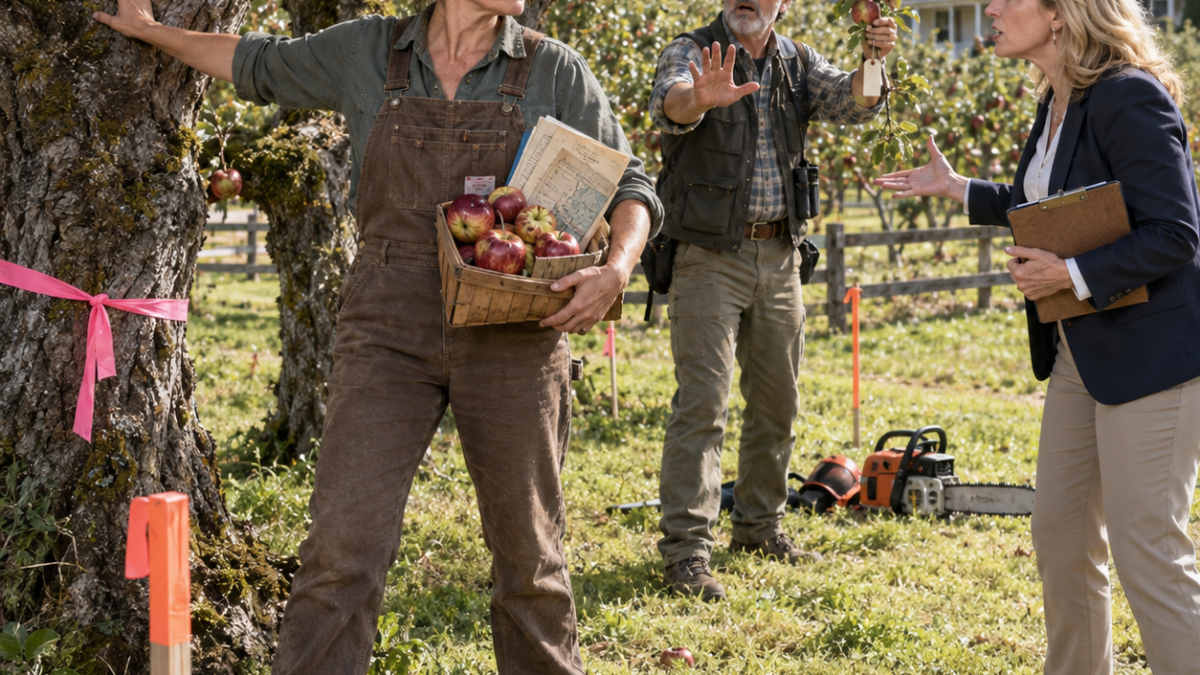
The HOA gave me thirty days to cut down the two apple trees my great-grandfather planted in 1922, or they promised escalating fines and a lien against the land my family had protected for more than a century.
Their president called the trees “unapproved fruit-bearing flora,” an eyesore that attracted pests and threatened the appearance of her perfectly manicured neighborhood.
I almost told her what those twisted old branches meant to my family—but something told me to collect evidence first, because there was one question about those apples nobody in my family had ever been able to answer.
The violation notice arrived on thick cream paper.
Official logo.
Article number.
Section number.
Thirty-day deadline.
I stood on the back porch reading it while the two old trees moved gently in the Carolina wind.
They weren’t beautiful in the way Karen Albright understood beauty.
Their trunks were thick and scarred.
Some branches twisted downward before reaching toward the sun again.
Lightning had split part of the larger tree when I was eight.
My grandfather had bolted the trunk together and wrapped it with burlap.
It survived.
So had the smaller tree beside it.
For more than a hundred years.
My great-grandfather Elias planted them when he bought the ten acres in 1922.
My grandfather tended them.
My father tended them.
I grew up climbing them.
Every October, they produced strange apples unlike anything sold in stores—dark purple skins that became nearly black when fully ripe, crisp reddish flesh, and a flavor that tasted like cider, blackberry, spice, and cold autumn air.
Dad called them Grandpa Elias’s mystery apples.
Nobody knew the variety.
We only knew they belonged to us.
Then Meadow Creek Estates arrived.
By the time I retired from the Army and returned home with my wife Sarah, the farmland surrounding our property had become streets of beige siding, ornamental pears, identical mailboxes, and lawns cut like putting greens.
Our ten acres remained in the middle.
Old farmhouse.
Barn.
Split-rail fence.
Vegetable garden.
And those two trees.
I tried to make peace with the HOA.
I paid dues.
Read the rules.
Filed forms.
Kept my grass trimmed.
When Karen objected to the original fence my great-grandfather had built, I showed her the records and she backed down.
But she never forgot.
For months, I watched her golf cart slow beside my property whenever she passed.
Her eyes always went toward the apple trees.
Then the letter came.
Sarah stepped onto the porch behind me.
“What is it?”
I handed it to her.
She read the first paragraph.
Her face changed.
“They want the trees gone?”
“Yes.”
“They can’t.”
“They think they can.”
She looked across the yard.
The larger tree had just started budding.
Every spring, my father used to stand beneath it and say the same thing.
*Still got another year in her.*
Dad had been gone six years.
Some mornings, those trees were the closest thing I had left to hearing his voice.
Sarah touched my arm.
“What are you going to do?”
“Appeal.”
“And if they say no?”
I folded the violation notice.
“Then I find out exactly what authority they think they have.”
The next HOA meeting lasted forty-five minutes before Karen finally recognized me.
I stood.
“Jack Ryder, 112 Old Mill Road. I’m formally appealing the removal order concerning my apple trees.”
Karen smiled from behind the board table.
“Mr. Ryder, the board already reviewed the matter.”
“They were planted before Meadow Creek existed.”
“That doesn’t exempt them.”
“They’ve been there more than a century.”
“Age is not approval.”
A few people shifted uncomfortably.
I kept my voice calm.
“Can you show me the provision specifically prohibiting pre-existing agricultural trees?”
Karen flipped through the covenant binder.
“Article Seven, Section Three. All landscaping must conform to the approved plant list.”
“So a plant list written roughly five years ago retroactively condemns trees planted in 1922?”
“The rules are the rules.”
“And you’ve already voted?”
“Yes.”
“Without hearing from me?”
Her smile disappeared.
“The decision is final.”
She lifted the gavel.
“Thirty days, Mr. Ryder.”
Then she struck the table.
“Next item.”
I sat down slowly.
Across the room, a nervous accountant named Peterson met my eyes.
He gave the smallest nod.
Not encouragement.
Recognition.
He knew what it felt like to be targeted.
That night, I converted our spare bedroom into a workspace.
Scanner.
Whiteboard.
County maps.
HOA records requests.
Old deeds.
Photographs.
And before going to bed, I clipped three small pieces of new growth from the apple trees, sealed them carefully, and prepared two packages.
One went to a federal plant-genetics repository.
The other went to Dr. Alister Finch, an old horticulture professor I hadn’t spoken to in years.
On the note, I wrote only:
**Al—family mystery. Any idea what these are?**
Two weeks later, my phone rang.
I answered beside the larger tree.
The voice on the other end was almost breathless.
“Jack, where did you get these?”
I put my hand against the old bark.
“Why?”
There was a long silence.
Then Dr. Finch said something that made the entire HOA fight suddenly feel very, very small.
PART 2
“Jack,” Dr. Finch said again, more slowly this time, “I need you to tell me exactly where those samples came from.”
I looked up through the branches.
Morning sunlight filtered through the first pale leaves.
“From the two apple trees behind my house.”
“Grafted trees?”
“I assume so. They’ve been here as long as anyone in my family remembers.”
“How long?”
“My great-grandfather planted them around 1922.”
Another silence.
I heard papers moving on the other end.
Then a chair scrape.
“Do not cut them.”
I almost laughed.
“That’s the problem, Professor.”
“No, Jack. I am not speaking figuratively. Do not prune heavily. Do not remove major limbs. Do not let anyone apply chemicals without documentation. And for the love of God, do not let anybody cut those trees down.”
The urgency in his voice killed my smile.
“What did you find?”
He inhaled.
“When your package arrived, I thought you’d sent me an unusual local seedling.”
“That’s what we always assumed.”
“I started with morphology. Bark pattern. Bud spacing. Spur formation. Leaf serration.”
He was speaking faster now.
“Then I saw the pigment profile you described in the fruit photographs.”
“What about it?”
“Jack, very few old American apples develop that dark a skin while maintaining red pigmentation in the flesh.”
I put my palm flat against the trunk.
“Is it known?”
“Yes.”
His voice became almost reverent.
“That’s what’s extraordinary.”
I waited.
“The Blackheart Pippin.”
The name meant nothing to me.
“Never heard of it.”
“Most people haven’t because as far as pomology is concerned, it no longer exists.”
I frowned.
“What do you mean?”
“We thought it was extinct.”
I laughed because the alternative was simply standing there speechless.
“An apple doesn’t go extinct like an animal.”
“A cultivated variety absolutely can.”
He explained.
Apples grown from seed do not reliably reproduce the parent variety.
To preserve a specific cultivar, people graft living wood from one tree onto compatible rootstock.
Lose every living grafted specimen and the variety is gone.
Its genetics disappear with it.
“Blackheart Pippin appears in nineteenth-century orchard catalogs,” Finch continued. “There are references going back earlier under regional names. It was prized for storage, cider, color, and what old writers called a vinous flavor.”
“That sounds like ours.”
“I know.”
“What happened to it?”
“Disease. Orchard consolidation. Fire blight. Commercial varieties replacing older local cultivars. The last reliably documented planting we know of disappeared in Virginia in the 1890s.”
I looked at the trees.
They suddenly seemed older.
Not physically.
Historically.
Every scar became evidence of survival.
“So how sure are you?”
“I compared your material with preserved herbarium records and archival descriptions. Then I ran preliminary genetic markers.”
“How sure?”
He exhaled.
“Enough that I called you before breakfast.”
“That isn’t a percentage.”
“Fine. I am convinced enough that if you let someone put a chainsaw into those trees before we finish verification, I will personally drive to North Carolina and beat you with an orchard ladder.”
I smiled despite myself.
“Good to hear retirement has mellowed you.”
“I’m serious.”
“So am I.”
I told him about Karen.
The violation.
The board vote.
The thirty-day deadline.
For perhaps five seconds, Dr. Alister Finch—who could lecture for two hours without pausing over the genetic origins of European cider apples—said absolutely nothing.
Then:
“They want to do what?”
“Remove both trees.”
“For landscaping conformity?”
“Yes.”
“That is the stupidest sentence anyone has spoken to me this year, and I teach undergraduates.”
I laughed.
“I need documentation, Al.”
His tone immediately changed.
Professional.
“Of course.”
“Everything you’ve found.”
“Yes.”
“Historical references.”
“Yes.”
“Genetic analysis.”
“Yes.”
“Conservation significance.”
“Yes.”
“And something explaining why the trees can’t simply be replaced if they’re destroyed.”
“Jack, I can write that sentence in letters large enough to see from space.”
“I’d prefer notarized university letterhead.”
He laughed once.
“Still military.”
“Still effective.”
“I’ll send it.”
Then he became serious again.
“We also need propagation material.”
“Scions?”
“Yes. Multiple samples. Dormant wood if available, active tissue, eventually fruit and seed for research. But the immediate priority is preservation.”
“I understand.”
“No.”
His voice softened.
“I don’t think you do yet.”
I waited.
“Your family may have unknowingly kept an extinct American fruit variety alive for a century.”
I looked toward the farmhouse.
My grandfather’s porch.
My father’s barn.
The old split-rail fence.
All the things Meadow Creek considered rustic.
Outdated.
Nonconforming.
My great-grandfather had planted two mystery apples and simply refused to let them die.
His son continued.
Then my father.
Then me.
No grant.
No university.
No botanical garden.
No scientific program.
Just a family pruning branches, spreading compost, wrapping trunks after storms, and saving enough fruit to make pies every October.
I swallowed.
“My dad would’ve loved this.”
“You said he maintained them?”
“Until he died.”
“Then he’s part of the preservation history.”
That almost broke my voice.
I looked away.
“Send the report.”
“You’ll have it.”
When I hung up, I stayed beneath the tree for a long time.
Sarah found me there.
She carried two mugs of coffee.
“Who was that?”
“Finch.”
“And?”
I took the mug but didn’t drink.
“You remember Dad calling these Elias’s mystery apples?”
“Of course.”
“They have a name.”
Her face brightened.
“Really?”
“Blackheart Pippin.”
“That sounds dramatic.”
“It gets more dramatic.”
I told her.
At first, she smiled.
Then she realized I wasn’t joking.
Her eyes moved toward the branches.
“These?”
“Yes.”
“The two trees Karen wants gone?”
“Yes.”
“The last ones?”
“Possibly the last known living specimens.”
Sarah looked at me.
Then at the trees.
Then back at me.
Finally she said:
“Oh, Karen is in so much trouble.”
For the first time in two weeks, I laughed from my stomach.
But the relief didn’t last.
Because Karen didn’t know.
And until the science was fully documented, I didn’t want her to know.
I had learned something in the Army.
Information has value partly because of timing.
Reveal too early, and an adversary adapts.
Reveal when their decision is already documented, and the same information becomes evidence.
I wasn’t trying to create a trap for entertainment.
I was trying to ensure that if Karen escalated after being warned about my underlying property rights, no one could later claim this had been an innocent misunderstanding.
The HOA records arrived three days later.
Seven years.
Financial statements.
Meeting minutes.
Violation logs.
Vendor invoices.
Architectural correspondence.
The management company had clearly hoped volume would discourage me.
They delivered a cardboard box heavy enough to strain my back.
To me, it looked like Christmas.
Sarah stood in the doorway of the spare room.
“You’re smiling at accounting records.”
“I have concerns about what retirement has done to you.”
“Come help.”
“No.”
“You used to do bookkeeping.”
“I love you, Jack.”
“That sounds like a no.”
“It is.”
I started with enforcement logs.
Names.
Dates.
Violations.
Fine amounts.
Outcome.
Then I added variables.
Board relationships.
Location.
Repeat enforcement.
Waivers.
Warnings.
Within two nights, a pattern emerged.
Peterson—the accountant who nodded at me during the meeting—had been fined $1,000 because his exterior trim was “Arctic White” rather than “Heritage Eggshell.”
A friend of Karen’s had an obvious unapproved satellite dish for fourteen months.
No fine.
Sergeant Miguel Garcia had received lien threats after leaving a boat in his driveway during maintenance.
The treasurer stored his own fishing boat in plain view for nine days.
No enforcement.
A widow named Mrs. Greene had been cited over a bird feeder.
A family on Sycamore Lane had received escalating notices over a cedar swing set because the approved list specified composite recreational equipment.
The rules were real.
The enforcement wasn’t equal.
Then I reached the financials.
I was not an accountant, but I had spent enough of my military career reconciling budgets to recognize when numbers deserved questions.
Community landscaping expenses had risen sharply.
Several invoices listed work performed in common areas, but descriptions referenced plantings and irrigation zones I couldn’t identify.
Pool repair assessment.
$36,000 collected.
Contractor invoice in the file:
$12,400.
Where had the rest gone?
Maybe there was an explanation.
Reserve transfer.
Additional work.
Engineering.
I did not assume corruption.
I marked it.
QUESTION.
Then came landscaping photographs attached to one vendor invoice.
I stared at them.
Karen’s house.
The stone border near her front walk.
New hydrangeas.
I enlarged the scan.
Invoice description:
**Meadow Creek North Entrance Enhancement.**
That was not the north entrance.
I had driven past Karen’s house enough times to recognize her mailbox.
I called Sarah.
She came in.
“What?”
I pointed.
“Where is this?”
She leaned toward the screen.
“Karen’s front yard.”
“That’s what I thought.”
She looked at the invoice.
“Oh.”
One suspicious invoice does not prove theft.
But it justified scrutiny.
I created a binder.
SELECTIVE ENFORCEMENT.
FINANCIAL QUESTIONS.
PROPERTY RIGHTS.
TREE SCIENCE.
TIMELINE.
Across the cover I wrote:
MEADOW CREEK.
Not Karen.
That distinction mattered.
This was bigger than one personality.
If a system let one person turn discretionary power into personal punishment, removing the person without fixing the system would simply leave the weapon waiting for the next hand.
Dr. Finch’s report arrived Friday.
Twenty pages.
University letterhead.
Notarized.
Genetic tables.
Historical plates.
Descriptions from orchard catalogs.
A nineteenth-century watercolor of a nearly black apple.
I held the reproduction beside the photograph of our fruit from the previous fall.
The resemblance was extraordinary.
The report’s conclusion was careful.
Scientific writing usually is.
The two Ryder specimens were “consistent in morphology and preliminary genetic profile with the historically documented cultivar commonly known as Blackheart Pippin.”
Further analysis was recommended.
But Finch also wrote:
**If identity is confirmed, these trees represent material of exceptional genetic, horticultural, and cultural significance. Destruction before propagation would constitute an irreversible loss.**
Then valuation.
Not market price.
You cannot meaningfully price the last living representatives of a genetic lineage the way you price ornamental pears.
But for conservation and insurance purposes, Finch estimated replacement-equivalent research and preservation value well into seven figures per specimen.
Sarah read that section.
“Karen called them an eyesore.”
“Yes.”
“How much did the board value them at?”
“Negative four thousand.”
She looked at me.
“What?”
“They plan to charge me for cutting them down.”
Sarah sat.
For a few seconds, neither of us spoke.
Then I heard my father’s voice in memory.
*Still got another year in her.*
I touched the report.
“She’s not touching them.”
That afternoon I went to see Peterson.
He was kneeling beside flower beds.
He looked over his shoulder before inviting me onto the patio.
“You’re still fighting the tree order?”
“Yes.”
“Karen says you’re refusing mediation.”
“She never offered mediation.”
He frowned.
“She said at coffee yesterday that you rejected multiple compromises.”
“What compromises?”
“I don’t know.”
There it was.
Narrative.
Karen was already writing the public version.
I opened the enforcement binder.
“Your trim fine.”
His face changed.
“How do you know about that?”
“Association records.”
I showed him.
Then the satellite-dish case.
Board friend.
No citation.
Then the boat.
Then another.
Peterson went from nervous to furious in about eight minutes.
“I knew it.”
“What?”
“She hates me.”
“Why?”
“My son practices drums in our garage. Within permitted hours.”
He laughed bitterly.
“After I refused to stop him, suddenly my trim was unacceptable.”
“Can you prove motive?”
“No.”
“Then we don’t claim motive.”
He stared at me.
“You sound like a lawyer.”
“I’m trying not to need one.”
“Good luck with that.”
He was right.
My next call went to David Martinez.
We had served together years earlier before Dave entered the JAG Corps.
Now he practiced real estate litigation in Charlotte.
He listened to everything.
HOA.
Trees.
Deed.
Records.
Blackheart Pippin.
He interrupted only once.
“Wait.”
“Yes?”
“You’re telling me the trees may be the last surviving examples of a cultivar believed extinct for more than a century?”
“Yes.”
“And Karen doesn’t know?”
“Not yet.”
“Please don’t tell her.”
I smiled.
“That was my thought.”
“Send me your deed.”
I did.
He called back the next evening.
Not excited this time.
Focused.
“Jack, your tree case is stronger than you realize.”
“Because they’re historic?”
“Even without that.”
He had pulled the subdivision plat.
My ten acres were not incorporated into Meadow Creek in the ordinary way.
The development had been drawn around the pre-existing Ryder tract.
An outparcel.
Our family land retained its original legal description.
The HOA had accepted dues from us for shared amenities and had treated us as members, but that did not automatically give the association unlimited architectural power over a pre-existing tract.
“How much authority do they have?” I asked.
“Enough that I wouldn’t ignore them. Not enough that I’d let them cut century-old agricultural trees without a fight.”
Then he told me about the deed covenant.
Recorded in 1922.
I had read the old deed but never appreciated one paragraph.
Elias Ryder had reserved for himself and his heirs the right to cultivate, harvest, preserve, and sell agricultural products from the property, expressly including orchards, fruit-bearing trees, vines, and other perennial crops.
“Runs with the land?” I asked.
“That’s our argument.”
“Stronger than the HOA plant list?”
“Much older recorded instrument. Different chain. They cannot casually erase a vested agricultural use with a modern landscaping rule.”
My great-grandfather had protected farming rights because in 1922, people worried future owners might restrict use.
He could not have imagined Karen.
But he had prepared for her anyway.
I smiled.
“What do we do?”
“Send notice.”
“Trees?”
“No.”
Dave understood immediately.
“Keep Finch confidential for now.”
His letter cited the agricultural covenant.
The outparcel issue.
The trees’ pre-existing agricultural use.
It warned the HOA that physical entry or destruction would be contested.
No Blackheart Pippin.
No valuation.
No scientific bombshell.
We sent it certified.
The deadline approached.
Three days.
Two.
Then on the morning before the deadline, I walked outside and found an orange stake in my front lawn.
A laminated notice.
A-1 TREE PROFESSIONALS.
**SCHEDULED REMOVAL: 9:00 A.M. TOMORROW**
Two nuisance fruit trees.
Contracting party:
Meadow Creek Homeowners Association.
Estimated charge:
$4,000.
To be assessed against homeowner.
I read it once.
Then called Dave.
“They hired a crew.”
He went silent.
“What time?”
“Nine.”
“Do not remove the notice.”
“I wasn’t going to.”
“Do not confront Karen.”
“Fine.”
“Do not threaten the tree company.”
“Understood.”
“I’m filing.”
“Restraining order?”
“Yes, but timing may be close.”
Then his voice changed.
“Jack?”
“Yes?”
“Now tell Finch.”
The phone calls took less than an hour.
Dr. Finch:
“I’ll be there.”
“You’re in New York.”
“I am aware of geography.”
“Tomorrow morning?”
“I’ll fly tonight.”
The State Historical Preservation Office had already received preliminary material from Finch.
Director Eleanor Vance answered personally.
When I explained that the HOA had scheduled removal before final scientific verification, her voice hardened.
“We will have a representative present.”
“You don’t need to—”
“Yes.”
Then Maria Sanchez.
I had met her during a veteran agriculture program interview.
“Maria, you want a strange story?”
“How strange?”
“HOA versus apple trees.”
“That’s not strange.”
“Trees may be the last known specimens of a variety believed extinct for 120 years.”
Silence.
Then:
“What time?”
“Eight forty-five.”
“Address?”
I gave it.
Finally, neighbors.
No dramatic language.
No call for confrontation.
I texted Peterson, Garcia, and a handful of others.
**Tomorrow, 8:30. My property. HOA tree crew scheduled for 9. Please come only as witnesses. No arguments. Bring phones.**
Sergeant Garcia replied first.
**Understood.**
Peterson:
**I’ll be there.**
Mrs. Greene:
**Can I bring coffee?**
That one made me smile.
Sarah barely slept.
At midnight I found her standing beneath the trees.
Moonlight through the branches.
“What are you doing?”
“Looking.”
“At what?”
“At them.”
She put her hand on the larger trunk.
“What if something goes wrong tomorrow?”
“It won’t.”
“You don’t know.”
“No.”
She looked at me.
“What if the crew starts cutting before anyone stops them?”
“I’ll tell them they don’t have permission.”
“What if Karen orders them?”
“I’ll repeat it.”
“What if they ignore you?”
“The lawyer is filing. Historical office is coming. Finch is coming. News is coming.”
“That isn’t what I asked.”
I knew.
“If somebody physically starts cutting?”
“Yes.”
“I call law enforcement.”
“You don’t try to stop them yourself.”
“Sarah—”
“Promise.”
I looked at her.
“Promise.”
She nodded.
Then looked up.
“My favorite is the smaller tree.”
“Why?”
“Because everybody pays attention to the big one.”
I smiled.
“Underdog?”
“She survived too.”
We stayed there another minute.
Then went inside.
By 8:30 the next morning, my yard had become something I never wanted it to be.
A stage.
Peterson sat in a folding chair holding coffee.
Garcia stood near the driveway.
Mrs. Greene had actually brought a thermos.
Several neighbors stayed on the public roadside.
Phones ready.
Nobody shouted.
Nobody carried signs.
At 8:43, a dark SUV arrived.
Maria Sanchez.
Camera operator.
She walked toward me.
“You weren’t exaggerating about the crowd.”
“It grew organically.”
“Where are the famous trees?”
I pointed.
Her camera operator immediately started filming.
At 8:49, Eleanor Vance arrived from the state preservation office.
She didn’t waste time with me.
She walked directly to the trees.
Slowly.
Almost ceremonially.
She touched the bark.
“These are extraordinary.”
“You know them?”
“I know Finch’s report.”
She stepped back.
“If identification holds, this becomes a serious preservation matter.”
“Can you stop removal?”
“We issued an emergency provisional preservation notice early this morning based on the submitted evidence.”
She opened her briefcase.
A document.
“That doesn’t resolve your HOA dispute. But damaging the trees while the designation is pending could expose whoever does it to substantial consequences.”
“Good.”
At 8:56, a rental car pulled up.
Dr. Finch climbed out.
Tweed jacket.
Wrinkled shirt.
Hair that looked like he had stuck his head out an airplane window despite flying commercial.
He hugged me.
Then completely ignored everyone and hurried to the trees.
“Good God.”
He circled the larger one.
Examined graft unions.
Spurs.
Leaves.
He spoke to himself.
“Same growth habit.”
He looked at me.
“You have fruit photographs?”
“In the binder.”
“I’ve seen them.”
“I know.”
“I want originals.”
“Later.”
At precisely nine, the tree-service truck arrived.
Chipper behind it.
Two workers stepped down.
They saw the crowd.
Then the camera.
Then Finch.
One man checked the address.
“You Jack?”
“Yes.”
“We’re here for two apple removals.”
“Who hired you?”
“HOA.”
“Those are my trees.”
He nodded awkwardly.
“Yeah. We were told it was authorized.”
“It is not.”
Then Karen arrived.
Golf cart.
Powder-blue pantsuit.
Clipboard.
Of course.
She slowed when she saw Maria’s camera.
Then Finch.
Then Eleanor.
Uncertainty appeared.
Only briefly.
She parked.
“Gentlemen.”
The workers turned.
“You may begin.”
I stepped forward.
“Karen, you received written notice that the board’s authority over these trees is disputed and that my deed contains a prior agricultural covenant.”
She smiled.
“Your attorney’s little history lesson doesn’t change the bylaws.”
“It changes your right to enter my property.”
“You’re in violation.”
Maria stepped closer.
“Ms. Albright?”
Karen turned toward the microphone.
You could almost see her decision.
She could refuse.
Or she could perform.
Karen always chose performance.
“I am Karen Albright, president of the Meadow Creek Homeowners Association.”
Maria nodded.
“Why is the HOA ordering these trees removed?”
“They are not approved landscaping. They produce fruit that attracts insects and rodents. Their condition is inconsistent with community standards.”
“What about their age?”
“Age is irrelevant.”
Dr. Finch turned slowly.
I had seen that expression years earlier when a student once confused rootstock with cultivar during a conference workshop.
“Madam,” he said.
Karen looked at him.
“And you are?”
“Dr. Alister Finch.”
No recognition.
“Professor of pomology.”
Still nothing.
“At Cornell University.”
A few neighbors reacted.
Karen’s posture changed slightly.
Finch walked toward us carrying a folder.
“What you call unapproved landscaping is very likely one of the most important rediscoveries in modern American fruit conservation.”
Karen stared.
“They’re apple trees.”
“Yes.”
His voice sharpened.
“Which is rather the point.”
Maria moved the microphone.
“What variety?”
Finch looked toward the camera.
“Blackheart Pippin.”
He opened his report.
“A historically documented American cultivar considered lost for more than a century.”
A murmur moved through the neighbors.
Karen gave a short laugh.
“This is absurd.”
Finch continued as though she had not spoken.
“Preliminary genetic work, morphology, historical descriptions, and surviving archival records strongly support identification.”
He pointed toward the trees.
“These may be the last surviving original specimens known anywhere.”
Silence.
Even the tree workers stopped moving.
Maria looked at Karen.
“Were you aware of this?”
“No, because it’s obviously some last-minute story Mr. Ryder invented.”
Finch’s head snapped toward her.
I stepped between the argument before it started.
“Al.”
He stopped.
Eleanor Vance stepped forward.
“Ms. Albright?”
Karen looked at her.
“I am Eleanor Vance with the State Historical Preservation Office.”
She handed Karen a document.
“As of 7:42 this morning, these specimens are under provisional emergency preservation review.”
Karen looked down.
“What does that mean?”
“It means no one should alter, remove, damage, chemically treat, or destroy them while our designation process is pending without appropriate authorization.”
Karen’s face reddened.
“You cannot override private HOA covenants.”
“This is not a landscaping dispute from our perspective.”
Eleanor’s voice stayed calm.
“It is preservation of potentially unique biological and agricultural heritage.”
The tree-service foreman walked over.
“Ma’am?”
Karen turned.
“What?”
“We’re not cutting.”
“What do you mean?”
“I mean we’re not cutting these.”
“I hired you.”
“You hired us to remove nuisance apple trees.”
“That is what they are.”
He glanced toward Finch.
“Lady, that professor just said they might be the last ones on Earth.”
Finch corrected him automatically.
“Last known specimens of the cultivar.”
“Whatever.”
He pointed.
“I’m not putting those through a chipper.”
Karen’s face darkened.
“You signed a contract.”
“Contract doesn’t say extinct tree.”
“They are not extinct!”
Finch sighed.
“The variety was believed extinct. The specimens are obviously alive. That is the entire significance.”
Several neighbors laughed.
Karen spun toward them.
“None of this changes the violation!”
Then Sergeant Garcia spoke.
He hadn’t moved from the driveway.
“You’re really still trying to cut them?”
Karen pointed at him.
“This does not concern you.”
“It concerns everyone now.”
Peterson stood.
“What about my trim, Karen?”
She stared.
“What?”
“My trim was worth a thousand-dollar fine while Stan’s house has peeling fascia. Explain that.”
“This is not the time.”
Mrs. Greene lifted her voice.
“My bird feeder.”
Another homeowner:
“The cedar swing set.”
Another:
“My work van.”
Someone else:
“The pool assessment.”
Karen looked around.
The camera turned toward the residents.
Years of private frustration suddenly had witnesses.
She tried to regain control.
“You people have no idea what it takes to maintain standards!”
Maria asked:
“Ms. Albright, did your board vote to remove these trees after Mr. Ryder notified you of a prior recorded agricultural covenant?”
Karen looked at me.
Pure fury.
“This is a conspiracy.”
I took a document from Dave’s binder.
“Karen.”
She snapped toward me.
“This is a cease-and-desist notice.”
“I don’t care.”
“I recommend that you do.”
“You have been a problem since the day you decided your ancient farm somehow makes you special.”
That line landed harder than she knew.
I looked toward the farmhouse.
Then the trees.
“My family was here before Meadow Creek.”
“And now you live in Meadow Creek.”
“No.”
I held her eyes.
“Meadow Creek lives around us.”
For once, she had no immediate answer.
The tree-service foreman waved his crew back.
“We’re leaving.”
Karen’s voice rose.
“I am ordering you to complete the job!”
“No.”
“I will sue your company.”
“Have your lawyer call ours.”
The chipper started.
The truck drove away.
Karen stood in my yard with the preservation notice in one hand and her clipboard in the other.
Her authority had just failed publicly.
Not because I shouted louder.
Because everyone finally saw its limit.
Maria moved toward her.
“Ms. Albright, any comment?”
Karen looked directly into the camera.
“This entire spectacle is harassment orchestrated by one disgruntled homeowner who believes his family history makes him above community rules.”
Peterson laughed bitterly.
Then he said:
“You used HOA landscaping money at your house.”
Karen froze.
That was not part of the tree story.
Not yet.
Maria’s eyes moved instantly toward him.
“What?”
Peterson held up copies from my records binder.
“I’m an accountant.”
His hands shook, but he kept talking.
“I reviewed invoices Jack obtained under our records rights.”
Karen marched toward him.
“You have no authorization to disclose financial information.”
“Association members do.”
“That is confidential.”
“No.”
Peterson’s voice strengthened.
“It’s our money.”
Maria looked at me.
I shook my head slightly.
I did not want unverified claims turned into television conclusions.
So I stepped forward.
“We have financial questions that should be reviewed independently.”
Maria understood.
“Not accusations?”
“Questions supported by records.”
Karen pointed at me.
“See? This is what he does. He poisons people.”
Mrs. Garcia spoke from behind her husband.
“You called us transients.”
Karen turned.
“I did not.”
“You told me families on temporary military orders don’t have the same long-term investment in property values.”
Garcia’s jaw tightened.
“You threatened a lien over my boat after I helped your son-in-law repair your sprinkler system for free.”
Karen looked around.
No allies.
Her board members were absent.
Her usual audience had become witnesses against her.
She climbed into her golf cart.
Maria asked one more question.
“Were you aware the trees might have conservation significance before scheduling removal?”
Karen slammed the accelerator.
The golf cart lurched away.
Nearly hit her own landscaping.
Nobody cheered.
That surprised me.
There was relief.
Disbelief.
A few laughs.
But no celebration.
Because most of these people were not trying to destroy Karen.
They were discovering they no longer had to fear her.
That was different.
Finch waited until the commotion settled.
Then he walked back to the larger tree.
He placed both hands against the trunk.
“Jack.”
“Yes?”
“We need scions.”
I laughed.
“That’s your response?”
“We just almost watched a century of genetics go into a wood chipper. Yes, that’s my response.”
“Fine.”
“And controlled propagation.”
“Yes.”
“And tissue archiving.”
“Yes.”
“And fruit sampling this fall.”
“Yes.”
He looked at me.
“You’re taking this remarkably well.”
“My HOA president just tried to erase my great-grandfather’s orchard with a landscaping rule.”
“Fair.”
Eleanor joined us.
“The emergency review gives us breathing room.”
“How long?”
“Long enough to document.”
“Can they challenge it?”
“Of course.”
“Will they?”
She looked toward the street where Karen disappeared.
“I suspect the HOA has other problems now.”
She was right.
Maria’s story aired that evening.
The first image was not Karen.
It was the apple trees.
Wide trunks.
Twisted branches.
New green leaves.
Then a close-up of the 1922 deed.
Then Finch holding the archival illustration.
Maria’s narration was measured.
A dispute between a homeowner and HOA had uncovered what scientists believed could be an extremely rare historic apple cultivar.
Then the footage of Karen calling them an eyesore.
Then the tree crew leaving.
Then residents speaking.
Peterson discussed inconsistent enforcement.
Garcia described lien threats.
Mrs. Greene showed her bird-feeder notice.
Maria ended with a question rather than a verdict:
How much power should an HOA have over a century-old property—and what happens when the rules threaten something irreplaceable?
By midnight, the story was everywhere locally.
By morning, larger outlets were calling.
I declined most interviews.
Finch did not.
He loved talking about apples more than any human being loved talking about anything.
The Blackheart Pippin story spread into horticulture circles.
Then preservation groups.
Then cider makers.
Then heritage orchard communities.
People emailed photographs of old trees hoping theirs might be the same.
The federal repository accelerated testing.
Within weeks, additional genetic analysis strengthened Finch’s identification.
The Blackheart Pippin was back.
Not in a museum.
Not as a painting.
Alive.
Growing behind my house.
That should have been the end of the HOA fight.
It wasn’t.
The next morning, Dave Martinez filed suit.
Not because Karen’s tree crew succeeded.
Because the attempt had crossed a line.
Declaratory judgment.
Property rights.
Injunctive relief.
Harassment.
Breach of fiduciary duty allegations based on selective enforcement.
Claims against the association.
And where legally supportable, claims against individuals for conduct outside proper board authority.
Dave refused to make theatrical arguments.
That was one reason I trusted him.
“We don’t sue for twenty million because a television story made everybody angry,” he told me.
“Good.”
“We establish actual damages, legal exposure, and the value of the threatened asset.”
“What about Finch’s valuation?”
“Useful.”
“Seven figures per tree.”
“That does not mean a jury writes you a two-million-dollar check because nobody cut them.”
“I know.”
“Good.”
He smiled.
“You’re disappointing to litigate for.”
“I’ll survive.”
The more immediate disaster for Karen came from inside Meadow Creek.
Peterson requested a special financial review.
He was no longer nervous.
Numbers had given him confidence.
Sergeant Garcia started collecting signatures for a special membership meeting.
The bylaws required twenty-five percent.
They had that in hours.
Then fifty percent.
Then more.
Karen sent a community email.
She called the news story misleading.
She described the preservation designation as a “temporary publicity maneuver.”
She accused me of “weaponizing outside organizations against neighborhood self-governance.”
That email added more signatures.
Her own board began cracking.
Stan, the vice president, resigned first.
His statement said he had relied on Karen’s representations regarding the tree dispute and had not been provided with all relevant property documents before voting.
The secretary resigned the next day.
The treasurer requested independent counsel.
Then Meadow Creek’s management company announced it was reviewing its relationship with the board.
The insurer issued what Dave described as a reservation-of-rights notice.
“Meaning?”
“They may defend certain claims for now while preserving the right to deny coverage for intentional or excluded conduct.”
“Karen knows?”
“Oh, she knows.”
The power dynamic had changed.
For years, Karen threatened homeowners with costs they couldn’t afford.
Now she faced the possibility that some of her own decisions might not be protected the way she assumed.
Still, I didn’t feel victorious.
I felt tired.
One evening Sarah found me beneath the smaller apple tree.
Again.
“You spend a lot of time out here now.”
“I always did.”
“Not like this.”
I looked at the branches.
“Finch says this one may be genetically identical to the big one.”
“Clone?”
“Grafted from the same source, probably.”
“So great-grandpa planted siblings?”
“Something like that.”
Sarah touched the bark.
“Do you ever think about whoever gave him the scions?”
“Yes.”
“A traveler, right?”
“That’s the family story.”
“Did Elias know what they were?”
“No idea.”
Maybe the traveler knew.
Maybe not.
Maybe a farmer carried cuttings wrapped in wet cloth across two states without realizing he was carrying the final thread of a disappearing cultivar.
History often survives because ordinary people don’t know they are holding history.
They simply care for something.
That thought humbled me.
The recall meeting took place three weeks later.
The clubhouse couldn’t hold everyone.
Nearly every household sent someone.
A neutral mediator attended because the association’s legal situation had become too sensitive for the existing board to run its own removal process.
Dave sat near the back.
I asked him not to speak unless procedure required it.
“This isn’t my trial,” I told him.
“Good.”
“It’s theirs.”
Karen arrived late.
No golf cart.
Black dress.
No powder-blue suit.
No visible clipboard.
She walked through the room while conversations stopped around her.
She sat at the front.
The mediator opened the meeting.
Single agenda item.
Recall of Karen Albright as president and director.
Member comments.
Garcia stood first.
Uniform?
No.
Jeans.
Work shirt.
But twenty years in the military teaches posture that doesn’t disappear.
“My name is Miguel Garcia. 412 Aspen Court.”
Karen stared straight ahead.
“I believe in rules.”
That surprised some people.
“Rules are necessary. Standards can be useful. Order matters.”
He paused.
“But rules are legitimate only when applied fairly.”
Applause started.
He raised a hand.
“Please.”
The room quieted.
“My family was called temporary. We were threatened with a lien over a boat that remained in our driveway for maintenance while a board member did the same thing without consequence.”
Karen shifted.
“I don’t want revenge.”
Garcia looked directly at her.
“I want leadership that understands authority is a responsibility, not a privilege.”
He sat.
Peterson stood next.
He carried spreadsheets.
Of course.
“My name is Daniel Peterson.”
He adjusted his glasses.
“I am an accountant.”
Somebody laughed.
He smiled nervously.
“For once, that may be relevant.”
Then he presented numbers.
Not accusations.
Numbers.
Pool assessment.
Collected amount.
Known invoices.
Unreconciled balance.
Landscaping expenditures.
Related-party questions.
Selective fine revenue.
Legal-cost increases.
“What I am asking,” he concluded, “is why members had to fight to see their own financial records.”
Silence.
Then Mrs. Greene.
Bird-feeder woman.
She looked terrified walking to the microphone.
Karen had probably counted on that fear for years.
Mrs. Greene put both hands around the stand.
“My husband died nine years ago.”
Her voice shook.
“He built my bird feeder.”
She swallowed.
“When I received the fine, I removed it.”
I had not known that.
“I put it in my garage.”
Her eyes filled.
“I haven’t watched cardinals from my kitchen window since.”
Something changed in the room.
Rules about landscaping are abstract.
Loneliness isn’t.
“My husband isn’t coming back.”
She looked at Karen.
“But I would like my bird feeder back.”
Applause rose.
Not wild.
Warm.
Mrs. Greene cried.
Garcia’s wife hugged her when she sat down.
One by one, people spoke.
Cedar swing set.
Wrong trim.
Work van.
Garden border.
Holiday wreath.
Mailbox numbers.
Some complaints were minor.
Some enforcement had probably been technically valid.
That wasn’t the point anymore.
The pattern was.
Karen had turned correction into intimidation.
Finally the mediator asked if Karen wished to respond.
She stood.
For one moment, I thought she might apologize.
Maybe losing power had created perspective.
I was wrong.
“I have given years of unpaid service to this community.”
Her voice was thin.
Controlled.
“You are all very comfortable attacking me now because one man manufactured a media circus over two diseased old trees.”
The room reacted.
Finch, seated near Eleanor, actually gasped.
Karen continued.
“I enforced standards you all agreed to.”
Several people shook their heads.
“You wanted clean streets.”
A voice:
“Yes.”
“You wanted property values.”
Another:
“Not like this.”
“You wanted somebody to do the work none of you were willing to do.”
That one was partly true.
The room quieted.
Karen looked around.
“You let me handle every complaint. Every vendor. Every violation. Every argument. And now you sit here pretending you had nothing to do with it.”
There was uncomfortable truth there.
Karen had become powerful partly because everyone else had surrendered participation.
I respected the point.
Then she ruined it.
“You need people like me.”
The room changed.
“No,” Arthur said from the second row.
He was one of the neighborhood’s oldest residents.
“You needed us to believe that.”
The mediator called the vote.
Hands.
One after another.
Rows.
Left side.
Right side.
Back wall.
Nearly every hand.
148 in favor of removal.
Two opposed.
One belonged to Karen.
The other to her sister.
The mediator read the tally.
“Karen Albright is removed as president and director of the Meadow Creek Homeowners Association effective immediately.”
Applause exploded.
Karen stood.
Picked up her purse.
Walked out.
I did not clap.
Sarah looked at me.
“Why not?”
“Because tomorrow we still have an HOA.”
She understood.
Removing someone is easy compared with rebuilding the culture that allowed them to happen.
Peterson became treasurer.
He looked physically ill when nominated.
That was a good sign.
Garcia became vice president.
Someone nominated me for president.
I stood immediately.
“No.”
Laughter.
“I spent twenty years following orders and giving them. I’m done.”
More laughter.
Then I nominated Eleanor Vance.
Preservation director.
Retired attorney before that.
Calm.
Practical.
Already lived in Meadow Creek.
She stared at me.
“You could have warned me.”
“You would’ve said no.”
“I may still.”
The room chanted her name.
She sighed.
“Fine.”
Elected unanimously.
Her first speech lasted thirty-two seconds.
“I promise to be boring.”
Huge applause.
“I will follow the documents.”
More.
“I will ask counsel when I don’t know.”
More.
“And anyone who hears me use the words ‘absolute authority’ has permission to escort me from the building.”
The room laughed.
That was the beginning of Meadow Creek’s recovery.
The new board settled my dispute quickly.
Violation withdrawn.
Every fine canceled.
Written acknowledgment of the agricultural covenant and the Ryder tract’s special status.
A heritage-preservation amendment added to the bylaws.
No historically significant pre-existing tree, structure, landscape feature, or agricultural element could be altered through ordinary aesthetic enforcement without documented review.
The settlement covered my legal expenses and reasonable damages from harassment.
I did not demand millions.
The trees were alive.
That mattered more than a theoretical valuation.
Karen’s personal exposure continued separately.
So did the state investigation into association finances.
And unlike neighborhood rumors, investigators had subpoena power.
The landscaping invoice mattered.
So did several related transactions.
The pool assessment.
Reimbursements.
Vendor relationships.
It took months.
Real investigations do.
No dramatic arrest at the clubhouse.
No handcuffs while everyone applauded.
Paperwork.
Interviews.
Bank records.
Depositions.
Then consequences.
Karen eventually entered a plea resolving charges related to misuse of association funds.
She avoided incarceration under the final arrangement, but received years of probation, restitution exceeding $50,000, and restrictions preventing her from holding positions involving fiduciary control during the term.
My civil claims against her were resolved separately.
She paid.
Her insurance did not solve every problem for her.
Neither did the HOA.
Her lawyers cost money.
Her social position disappeared.
Eventually a FOR SALE sign appeared in front of her house.
I saw it during a walk.
I stopped.
For months, part of me had imagined that sign.
I thought it would feel like justice.
Instead, I felt almost nothing.
Arthur happened to be walking his dog.
He followed my eyes.
“Satisfying?”
“Not really.”
“Disappointed?”
“No.”
He nodded.
“Good.”
“What’s good about it?”
“It means you got what you actually wanted.”
I looked toward the distant top of our apple trees.
Maybe.
Karen moved away in early spring.
No farewell.
No neighborhood spectacle.
Truck.
Boxes.
Empty house.
Then a new family bought it.
Within six months, nobody referred to it as Karen’s house.
Just the Millers’ place.
That, I think, was the real end of her power.
Not punishment.
Irrelevance.
Meanwhile, the trees became busier than our house.
Cornell researchers.
State horticulturists.
Federal plant-genetics staff.
Extension agents.
Historians.
Cider makers.
The first goal was redundancy.
You do not rediscover a cultivar and leave its entire future standing in one North Carolina backyard where lightning, disease, storms, or one angry person with a chainsaw could end it.
Finch established propagation protocols.
Dormant scions were collected carefully.
Some went to university orchards.
Some to the national germplasm repository.
Some to controlled heritage orchards.
Grafts took.
Not all.
Enough.
The first successful new Blackheart Pippin graft produced leaves the following spring.
Finch called me as though announcing a grandchild.
“Jack!”
“What?”
“We have growth!”
“Good morning to you too.”
“Bud break on seven grafts.”
“That good?”
“That is magnificent.”
Seven became twenty.
Then dozens.
Within two years, more than a hundred propagated trees existed in protected collections and trial orchards.
For the first time since before my great-grandfather was born, Blackheart Pippin no longer depended on one property.
That gave me peace in a way no court order could.
The federal researchers confirmed several unusual genetic traits.
Some disease tolerance.
Interesting pigmentation.
Potential value for breeding programs.
Finch became insufferably famous in a very small corner of the fruit world.
I told him so.
“I was famous before.”
“No one knew you.”
“Pomologists knew me.”
“That is my point.”
He called me an uncultured infantryman.
I reminded him I was Quartermaster Corps.
He said that made it worse.
Sarah loved every minute.
The first autumn after the rediscovery, the trees produced heavily.
Dark apples hung from branches like burgundy lanterns.
Finch insisted we record everything.
Harvest dates.
Weight.
Sugar levels.
Acidity.
Storage performance.
Flavor.
That last category attracted volunteers.
We held the first tasting at our kitchen table.
Finch cut one apple.
Crimson flesh.
The room smelled faintly of berry, wine, and spice.
He handed me a slice.
I hesitated.
Not because I hadn’t eaten them before.
I had eaten hundreds.
As a boy, I picked them straight from the tree and wiped them on my shirt.
But now the moment felt ceremonial.
Sarah noticed.
“It’s still an apple.”
I smiled.
“That’s what Karen said.”
Finch groaned.
“Please don’t ruin this.”
I bit.
Crunch.
Tart first.
Then sweetness.
Berry.
Cinnamon.
Almost cider-like.
Exactly childhood.
My father’s kitchen.
My grandfather’s barn.
October leaves.
Dirty hands.
I closed my eyes.
“You okay?” Sarah asked.
I nodded.
“Dad was right.”
“About what?”
“They get better after the first cold night.”
Finch immediately wrote something down.
“Of course he did.”
I laughed.
“You’re taking notes on my dead father?”
“I’m taking notes on one hundred years of undocumented orchard knowledge.”
That sentence hit me.
Undocumented.
Science values records.
Families preserve things differently.
Stories.
Habits.
Rules never written.
My grandfather never published a paper.
But he knew which limbs to thin.
When to harvest.
Which apples stored longest.
Dad knew where the roots ran shallow.
Which side needed irrigation in drought.
My great-grandfather knew enough to plant two trees instead of one.
Without them, there would be nothing for Finch to sequence.
The university asked whether we would consider dedicating part of our land to a conservation orchard.
Sarah and I discussed it for weeks.
Ten acres sounded large until you started dividing it into family space, old barn, garden, trees, research area.
I worried about privacy.
Visitors.
Traffic.
Liability.
Then I thought about Elias.
A man who accepted mystery scions from a traveler.
He had shared what he had.
Eventually we agreed.
Two acres.
Carefully fenced.
Appointment-only research access.
No public traffic without advance events.
The new board approved everything unanimously.
Then Eleanor called me.
“Jack.”
“Yes?”
“We have another proposal.”
“That tone worries me.”
“Harvest festival.”
“No.”
“You haven’t heard it.”
“I have enough strangers discussing my apples.”
“Neighborhood only.”
“No press?”
“Not invited.”
“No politician speeches?”
“Absolutely not.”
“No giant banner with my face?”
“Now I’m tempted.”
“Eleanor.”
She laughed.
“Fine.”
That autumn, Meadow Creek held its first harvest festival on our property.
I expected maybe forty people.
Nearly two hundred came through during the day.
Long picnic tables.
Hay bales.
Cider.
Pie contest.
Children painting small wooden apple crates.
Garcia drove a tractor pulling a hay wagon.
Peterson ran the grill with an apron reading **AUDIT THIS**.
That was Sarah’s gift.
Mrs. Greene brought her bird feeder.
Not because we needed one.
She placed it near the edge of the orchard.
Cardinals arrived before noon.
I watched her watch them.
That mattered more to me than anything Karen paid.
The cedar swing-set family brought their kids.
Nobody checked the wood species.
Arthur sat beneath the shade with lemonade.
The community that once avoided eye contact now stayed until sunset.
Dr. Finch gave a lecture under a tent.
I tried to hide.
He called me forward.
“Jack Ryder.”
I shook my head.
Everyone looked.
Sarah pushed me.
“Traitor.”
“Go.”
Finch held up one Blackheart Pippin.
Its skin looked almost black against his hand.
“When we talk about extinction, we often imagine dramatic loss.”
He spoke differently than he did in classrooms.
Slower.
“Forests burned. Species hunted. Habitats destroyed.”
He looked toward the two parent trees.
“But cultivated plants usually disappear quietly.”
An orchard gets sold.
A farmer dies.
A new variety becomes fashionable.
One last tree falls in a storm.
Nobody notices.
“No headline.”
He held the apple higher.
“No funeral.”
The crowd was silent.
“This apple disappeared from scientific record for more than a century.”
He turned toward me.
“But it did not disappear from this family.”
I felt my throat tighten.
“They didn’t preserve it because a university told them to.”
Finch continued.
“They preserved it because their father preserved it. And his father before him.”
He pointed toward the trees.
“Sometimes conservation begins long before anybody realizes conservation is happening.”
Sarah took my hand.
Finch smiled.
“And sometimes history survives because stubborn people refuse to cut down old things merely because somebody newer finds them inconvenient.”
That got applause.
I looked at Eleanor.
She looked suspiciously pleased.
Later, I found Finch near the larger tree.
“You planned that line.”
“Which?”
“Stubborn people.”
“Scientific observation.”
“You’re impossible.”
“I saved your apple’s reputation.”
“I saved the apple.”
He smiled.
“Fair.”
As the sun lowered, families began leaving.
Paper cups.
Blankets.
Tired children.
The orchard grew quiet.
Sarah and I stayed outside.
I picked one perfect apple.
Same tree my great-grandfather had planted first.
I held it in both hands.
The skin was cool.
Dark.
Waxy.
I smelled wine and spice.
Sarah watched.
“What?”
“Nothing.”
“You’re doing the emotional soldier thing.”
“I don’t have an emotional soldier thing.”
“You absolutely do.”
I bit.
The flesh cracked.
Dark red.
Juice ran across my thumb.
For a moment, I was ten years old.
Dad stood below the ladder.
Grandpa sat on the porch.
Everything gone was present.
That is what legacy does.
Not immortality.
Presence.
It lets someone touch what another person touched.
Taste what they tasted.
Stand beneath the same branches.
That was why Karen’s order hurt before I knew the trees were rare.
The scientific discovery raised the stakes.
It did not create their value.
They already mattered.
Karen simply never asked.
That became the central lesson of everything that followed.
A board can read a landscaping list.
It cannot automatically read meaning.
The old rosebush may mark a wedding.
The ugly fence may have been built by someone’s grandfather.
A vegetable garden may feed a family.
An apple tree may carry genetics the world lost a century ago.
Good governance requires enough humility to ask before destroying.
Under Eleanor, Meadow Creek became slower.
That sounds bad.
It wasn’t.
Slower meant someone asked questions.
A violation notice no longer went out because one person disliked something.
There was review.
Context.
Notice.
Conversation.
Most disputes disappeared before fines.
Financial records went online.
Peterson became merciless about receipts.
At one meeting, Garcia requested reimbursement for $38.17 in neighborhood-watch supplies.
Peterson returned his form.
“Missing receipt.”
Garcia stared at him.
“I bought batteries.”
“Receipt.”
“Daniel.”
“Receipt.”
“You know me.”
“I do.”
“Sergeant Garcia.”
“Yes.”
“Vice president.”
“Yes.”
“Receipt.”
The room laughed.
Garcia brought it next meeting.
That was culture change.
Not replacing favorites with new favorites.
Applying rules even to friends.
My relationship with the HOA changed too.
I still paid agreed dues tied to shared services.
Dave formalized exactly which covenants applied to our outparcel and which did not.
No more ambiguity.
My agricultural rights were acknowledged.
The trees received heritage protection.
Our old split-rail fence remained.
I repainted our shutters without asking anyone.
Dark green.
Sarah chose the color.
Eleanor saw them during a walk.
“Unapproved.”
I stared.
She waited three seconds.
Then laughed.
I nearly had a heart attack.
“You’re not funny.”
“I disagree.”
“You promised boring.”
“Retired.”
Karen’s criminal and civil consequences took much longer.
People wanted a dramatic ending.
The truth was paperwork.
Investigators verified some questionable spending.
Other rumors proved exaggerated.
That mattered.
Not every accusation was true simply because Karen had behaved badly.
The pool money had partly been placed into a reserve account that the old board documented poorly.
Some landscaping expenses were legitimate.
Others were not.
Payments benefiting Karen’s personal property became part of the state case.
The final restitution figure exceeded fifty thousand dollars across disputed expenditures and related matters.
Her plea agreement included probation and repayment.
No dramatic prison sentence.
Some residents were disappointed.
I wasn’t.
Accountability is not entertainment.
The goal is not maximum suffering.
It is correction.
Repayment.
Loss of improper authority.
Prevention of recurrence.
My personal civil case ended confidentially except for terms permitting me to say the dispute was resolved.
I will say this:
The settlement did not buy the orchard.
No amount would have.
It paid costs.
Recognized harm.
Ended litigation.
Then I went home.
Karen eventually moved several states away.
Rumor said she chose a neighborhood without an HOA.
I never verified it.
I hope it was true.
Not because it would be ironic.
Because maybe she needed to remember what living beside people felt like when you could not control their flowers.
Years passed.
The Blackheart Pippin population grew.
University orchard.
Federal repository.
State heritage farm.
Private preservation partners.
Commercial nurseries eventually received tightly controlled propagation material once preservation goals were secure.
The first time I saw a nursery catalog listing **BLACKHEART PIPPIN — HERITAGE APPLE**, I stared at the page for five minutes.
Sarah found me.
“What?”
I handed it over.
She smiled.
“Thirty-nine dollars.”
“Apparently priceless has a retail price.”
“Rootstock extra.”
“Capitalism.”
We ordered one.
She thought that was hilarious.
“We have the mother trees.”
“I want to know if they ship the right variety.”
“Quality control?”
“Exactly.”
The sapling arrived healthy.
We planted it near the conservation orchard.
Not because we needed another.
Because there was something satisfying about buying back what the world once thought lost.
Finch laughed when I told him.
“You paid for your own apple?”
“Research.”
“You are ridiculous.”
“Still planted correctly.”
“Send photographs.”
Of course.
As the original trees aged, preservation became more important.
The larger tree developed a hollow section.
Arborists braced two limbs.
The smaller tree had fungal damage one wet year.
Both recovered.
But for the first time in our family history, losing one tree would no longer mean losing the variety.
That felt like completing a duty I had inherited without knowing it.
One summer evening, my son Matthew visited with his daughter Emma.
Emma was seven.
She climbed the same low branch I used to climb.
I stood beneath her.
“Don’t go higher.”
“Grandpa, you said you climbed to the top.”
“That was different.”
“How?”
“I was irresponsible.”
Matthew laughed.
“That is not how you told the story when I was a kid.”
“Parenting evolves.”
Emma picked a small unripe apple.
I winced.
“Not ready.”
She smelled it.
“Why are they black?”
“They aren’t yet.”
“They will be?”
“Dark purple.”
“Daddy says these are famous.”
“Botanists think they’re important.”
“Are you famous?”
“No.”
Matthew coughed theatrically.
I ignored him.
Emma looked at the tree.
“Why didn’t people know about them?”
“Because sometimes things disappear from records without disappearing from the world.”
She frowned.
“That doesn’t make sense.”
“It will.”
Then she asked:
“Did your grandpa plant them?”
“My great-grandfather.”
“Did he know I would climb them?”
I smiled.
“No.”
“But he planted them anyway.”
“Yes.”
She looked pleased.
“I think he planted them for me.”
Children have a way of simplifying legacy better than academics.
Maybe Elias did.
Not specifically.
But when you plant a tree that may outlive you, you plant partly for people you will never meet.
That autumn Emma helped pick apples.
She stained her face red.
Exactly like I did.
Sarah photographed her.
Later that night, she put the picture beside an old photograph of me at roughly the same age.
Same tree.
Same dark fruit.
Different century.
I stared.
“That’s the whole thing,” Sarah said.
“What?”
“Why you fought.”
I nodded.
Not HOA.
Not Karen.
Not science.
Continuity.
The fight had become famous because the trees were rare.
But I would have fought even if Finch told me they were ordinary.
Maybe less publicly.
Maybe with less outside attention.
But I would have fought.
Because no committee should destroy a family’s century-old trees under a generic plant list without asking whether those trees predate the rule and carry legitimate value.
That principle mattered independent of rarity.
The rarity simply made Karen’s mistake impossible to ignore.
At the fifth Meadow Creek Harvest Festival, Eleanor retired from the board.
Peterson had long since become president, despite swearing he never would.
He was surprisingly good.
Still nervous before meetings.
Still obsessive with spreadsheets.
Still terrified of public speaking.
Maybe that helped.
Leaders who feel no anxiety about power worry me now.
Garcia became chair of the neighborhood-watch committee.
Mrs. Greene ran a bird-counting table at the festival.
Her feeder hung openly in her yard.
The Garcia family had transferred once, then returned after Miguel retired.
They bought a house two streets away.
“Transients,” he joked.
The cedar swing set eventually rotted.
The family replaced it.
With cedar again.
Nobody cared.
That year, Finch attended the festival using a cane.
He had slowed.
His mouth had not.
He gave the same history lecture but shorter.
At the end, he called Emma forward.
She was twelve by then.
He handed her a Blackheart Pippin.
“Your family’s job,” he told her, “is not to own this apple.”
Emma looked at me.
“What?”
Finch smiled.
“It is to pass it on.”
She nodded.
Very serious.
“I can do that.”
I believed her.
After everyone left, Finch and I sat beneath the mother tree.
He looked up.
“You know she’s declining.”
“Which?”
“The older one.”
I knew.
Growth had slowed.
Two branches had died back.
Arborist reports were cautious.
“She’s 100-plus.”
“Trees don’t care about our sentimentality.”
“No.”
“We have thousands of buds now.”
“I know.”
“Dozens of secure collections.”
“I know.”
“The genetics are safe.”
“I know.”
He looked at me.
“You’re still going to take it hard.”
“Yes.”
He nodded.
“Good.”
“Good?”
“Means you understood the difference between preservation and replacement.”
I looked at him.
“A graft isn’t this tree.”
“Exactly.”
Science could preserve the cultivar.
Not the individual.
That tree had felt my great-grandfather’s hands.
My grandfather’s ladder leaned against it.
Dad tied its storm split.
I fell out of it at nine and lied about how I broke my wrist.
Matthew carved a tiny initial into one branch before I caught him.
Emma climbed it.
No genetic clone would carry those events.
A variety can survive.
A tree can still die.
Both truths mattered.
Two winters later, an ice storm broke one major limb.
The arborist stabilized the rest.
The larger Blackheart produced one final heavy crop that autumn.
Then the following spring, half the canopy failed to leaf.
We knew.
I refused to remove it immediately.
Finch didn’t pressure me.
Neither did the arborist.
We let the living sections finish the season.
That October, I harvested forty-three apples.
I counted.
The final crop from Elias’s first tree.
We used some for research.
Some for grafting despite already having secure material.
Some for cider.
Some for pies.
I kept one on the kitchen table until it softened.
Then Sarah said:
“You have to eat it.”
“I know.”
“You’re treating it like a relic.”
“It is.”
“No.”
She picked it up.
“It’s an apple.”
Same thing she had told me years earlier.
She cut it in half.
Handed me a piece.
We ate.
Sweet.
Tart.
Wine.
Berry.
Spice.
Home.
The tree came down the following winter.
By choice.
Professionally.
Only after the arborist determined structural failure could threaten the smaller mother tree.
I stood outside while the crew worked.
Different tree company.
Different circumstances.
No HOA.
No camera.
No Karen.
Just necessity.
The foreman cut sections carefully.
We saved usable wood.
Finch wanted some for the university archive.
I had a carpenter make a bench from another section.
We placed it beneath the surviving mother tree.
Small brass plaque.
Nothing dramatic.
**ELIAS RYDER’S TREE
PLANTED 1922
IT KEPT THE STORY ALIVE**
Emma helped screw the plaque into place.
“Grandpa?”
“Yes?”
“This isn’t sad.”
I looked at the stump.
“A little.”
“No.”
She pointed toward the conservation orchard.
Rows of young Blackheart Pippins.
Then toward the road.
More had been planted throughout the region.
“It has babies everywhere.”
I laughed through tears.
“Yes.”
“So it did its job.”
Maybe that is the best definition of legacy I have ever heard.
It did its job.
The remaining original tree still stands today.
Older.
Supported.
Watched carefully.
Nobody expects immortality.
But Blackheart Pippin is no longer one storm away from extinction.
It exists in multiple states.
Research orchards.
Heritage collections.
Private farms.
Maybe someday ordinary backyards.
The variety survived long enough to escape dependence on our family.
That is what saving something really means.
Not keeping it forever.
Making sure it can continue without you.
Meadow Creek changed in the same way.
At first, residents depended on a handful of people who stood up to Karen.
Me.
Peterson.
Garcia.
Eleanor.
Arthur.
Then those people stepped back.
Others learned.
New homeowners arrived who never knew Karen.
They inherited transparent budgets.
Appeal procedures.
Conflict-of-interest rules.
Heritage protections.
A culture where disagreement did not automatically become disloyalty.
The community no longer needed the original rebels.
That meant we succeeded.
The annual harvest festival became tradition.
No longer because of the HOA war.
Children born years later just thought Meadow Creek had always celebrated apples.
That makes me happy.
Some adults still tell the story.
Usually exaggerated.
They say Karen arrived with chainsaws herself.
Not true.
They say federal agents surrounded the orchard.
Definitely not true.
They say the trees were valued at ten million dollars each.
Also not true.
Stories grow.
Apples do too.
When someone asks me what really happened, I say:
An HOA used a landscaping rule without understanding what it was regulating.
A family tree turned out to be scientifically significant.
The board escalated after being warned.
The homeowners finally started paying attention.
Everything else followed.
The satisfying part isn’t that Karen lost.
The satisfying part is what survived.
The trees.
The agricultural covenant my great-grandfather recorded.
The neighbors who stopped being afraid.
The money recovered.
The bird feeder returned to Mrs. Greene’s yard.
The Blackheart Pippin propagated into safety.
The community becoming something worth belonging to.
One October evening, long after the court filings were closed and Karen’s name stopped appearing in neighborhood conversations, Sarah and I sat on Elias’s bench beneath the remaining mother tree.
Children were leaving the festival.
Sticky hands.
Paper cups.
Caramel.
Laughter.
Emma, now older, was helping Finch’s graduate students pack apple samples.
The sun lowered behind the barn.
Sarah leaned against me.
“You remember the first letter?”
“Yes.”
“Still have it?”
“Of course.”
“You keep everything.”
“Evidence.”
“Sentimental hoarding.”
“Documentation.”
She laughed.
The old tree dropped an apple.
It landed softly in the grass.
I picked it up.
Dark purple.
Nearly black.
Perfect.
Sarah smiled.
“You going to analyze it?”
“No.”
“Photograph?”
“No.”
“Archive?”
“No.”
“What then?”
I rubbed the skin against my shirt.
Then bit into it.
She laughed.
“That’s better.”
The flesh was crimson.
Crisp.
Same flavor.
A hundred years condensed into one bite.
I looked across the orchard.
Young trees in straight rows.
Beyond them, Meadow Creek houses.
Some beige.
Some blue now.
One yellow door.
Vegetable gardens.
Play equipment.
Bird feeders.
People living instead of performing compliance.
Karen had believed a community became strong when everything matched.
She was wrong.
A monoculture looks orderly.
It is also fragile.
Ask any agricultural scientist.
Resilience comes from diversity.
Different genetics.
Different strengths.
Different responses to stress.
Communities work the same way.
You do not build resilience by cutting down everything that refuses to look identical.
Sometimes the crooked thing at the edge of the lawn is exactly what will save you later.
Sometimes an ancient apple carries disease resistance modern breeders need.
Sometimes the quiet accountant becomes the watchdog who protects everyone’s money.
Sometimes the military family you called transient becomes your most reliable neighbor.
Sometimes the widow afraid to hang a bird feeder becomes the person who teaches a whole room what courage sounds like.
And sometimes two ugly trees stand unnoticed for a century until one arrogant letter forces someone to finally ask what they are.
I never thanked Karen.
I don’t intend to.
She didn’t discover the Blackheart Pippin.
She nearly destroyed it.
But conflict has consequences nobody plans.
Her attempt to erase the trees forced me to document them.
Documentation brought Finch.
Finch brought science.
Science brought propagation.
Propagation saved the variety.
That doesn’t excuse Karen.
It simply reminds me that good things can grow from bad ground if someone tends them carefully.
My great-grandfather understood that better than I ever will.
He planted two trees.
He did not know what would happen.
He did not know a subdivision would surround his farm.
He did not know an HOA president would call his orchard illegal.
He did not know scientists would one day fly across the country because of fruit he planted.
He did not know his great-great-granddaughter would sit beneath those branches.
He planted anyway.
That is faith.
Not religious faith necessarily.
Agricultural faith.
The belief that something worth starting may matter long after you are gone.
Today, the original violation notice is framed.
Not in the house.
In the small research shed beside the conservation orchard.
Finch insisted.
I wanted the scientific report framed.
He wanted the HOA notice.
“Why memorialize stupidity?”
I asked.
“Because context matters.”
He pointed toward it.
“That paper nearly ended the cultivar.”
Then toward the orchard.
“And indirectly helped spread it farther than it had been in a century.”
Under the notice is a photograph of the first successful propagated Blackheart graft.
Below that, the 1922 deed covenant.
Then a photograph of Elias Ryder.
Weathered face.
Suspender straps.
Standing beside two young apple trees.
The same trees.
Small enough then to put both hands around the trunks.
On festival days, people stop at that wall.
Most read the scientific material.
Some laugh at the HOA notice.
I usually watch from a distance.
The best moment comes when they walk outside afterward.
They look at the surviving mother tree differently.
That shift matters.
Before information, it is an old apple tree.
After information, it becomes history.
Nothing about the tree changed.
Only understanding.
That was Karen’s failure from the beginning.
She saw first.
Judged immediately.
Never learned.
The world is full of things that look ordinary until somebody takes the time to understand them.
People too.
Years after the conflict, Peterson told me something.
We were standing beside the grill at the harvest festival.
“You know what I regret?”
“What?”
“That first meeting.”
“What about it?”
“When Karen told you the decision was final.”
“I remember.”
“I wanted to stand up.”
“Why didn’t you?”
“I was scared.”
He looked embarrassed even after all those years.
“Of a fine?”
“Of becoming next.”
I nodded.
“That was reasonable.”
“No.”
He shook his head.
“It was understandable. Not reasonable.”
Then he smiled.
“I learned the difference.”
Peterson became one of the strongest presidents Meadow Creek ever had.
Not because he never felt fear.
Because he remembered what fear did.
He made room for dissent.
At budget meetings, he actively asked:
“Who disagrees?”
At first, nobody answered.
Then people learned he meant it.
That is leadership.
Not eliminating opposition.
Inviting information you may not like before making a decision.
Karen never asked who disagreed.
She counted silence as consent.
That mistake eventually cost her everything she cared about.
I think about that whenever I look at the surviving tree.
Silence is not proof that nothing is wrong.
Sometimes silence means people are afraid.
Sometimes it means history has been forgotten.
Sometimes it means the last known specimen of something irreplaceable is growing quietly behind a farmhouse while everybody else assumes it is just another old tree.
The job is to notice.
My Army years taught me observation.
My family taught me stewardship.
The HOA fight taught me something else.
Documentation can protect memory.
We now have records for everything.
The tree’s genetics.
Its propagation lineage.
Historical photographs.
Harvest notes.
Elias’s deed.
Grandpa’s orchard journal after we discovered it in a trunk.
Dad’s handwritten pruning calendar.
All digitized.
All copied.
All stored in more than one place.
No more accidental extinction.
No more relying on one family memory.
Emma jokes that our family finally joined the twentieth century in the twenty-first.
She’s right.
Last year, she asked whether one day the farm would be hers.
“That depends.”
“On what?”
“What you want.”
“I want the trees.”
“The land is more than trees.”
“I know.”
“What if you live somewhere else?”
“I can still protect them.”
I smiled.
“Good answer.”
She looked toward the conservation orchard.
“Can I sell apples?”
“Your great-great-great-grandfather specifically protected that right.”
“Really?”
I showed her the covenant.
She read it.
Slowly.
Then looked at me.
“He wrote this a hundred years ago?”
“Yes.”
“For us?”
“For whoever came after.”
She smiled.
“That’s cool.”
Cool.
Elias would have liked that.
We stood beneath the remaining mother tree.
Emma touched its bark.
“Do you think it knows?”
“Knows what?”
“That everybody thought it was extinct.”
“No.”
“That it’s famous?”
“No.”
“That Karen tried to kill it?”
I laughed.
“Definitely not.”
“What does it know?”
“Sunlight. Rain. Cold. Heat. Soil.”
She thought.
“Apples.”
“Yes.”
“Maybe that’s enough.”
Maybe.
Humans assign stories.
Trees simply live them.
The Blackheart Pippin does not know it survived extinction.
It simply kept budding every spring because someone pruned it, watered it, and did not cut it down.
That is perhaps the final lesson.
Survival rarely feels heroic while it is happening.
It looks like maintenance.
Ordinary care.
Year after year.
My great-grandfather did not save a species in one dramatic act.
He planted.
My grandfather pruned.
My father protected.
I documented.
Finch propagated.
Researchers distributed.
Each step ordinary on its own.
Together, survival.
The same happened in Meadow Creek.
One homeowner questioned a fine.
Another shared records.
Another signed a petition.
Another stood at a microphone.
Another volunteered for the board.
Another demanded a receipt.
No single action rebuilt the community.
All of them did.
Karen wanted to cut down my heritage apple trees because they did not fit her approved list.
In the end, the list disappeared.
She disappeared.
Her power disappeared.
The trees did not.
One became hundreds.
The family history she treated as an inconvenience became part of state agricultural history.
The “unapproved fruit-bearing flora” became the centerpiece of an annual festival.
The land she wanted standardized became a conservation orchard.
And the neighbors she kept divided became people who actually knew one another.
That is the ending I carry with me.
Not Karen’s plea deal.
Not the restitution.
Not the recall vote.
Not the television camera catching her face when Dr. Finch said “last known specimens.”
Those moments were dramatic.
They were satisfying.
But victory is not humiliation.
Victory is continuation.
A branch grafted onto new rootstock.
A child biting into a fruit her ancestors tasted.
A widow rehanging a bird feeder.
A neighborhood learning to question power before obeying it.
An old tree surviving long enough for its story to be understood.
Last October, just before sunset, I walked alone to the surviving mother tree.
The festival was over.
Tables folded.
Cars gone.
Paper lanterns moving in the breeze.
One apple remained within reach.
I picked it.
Held it against the light.
Skin nearly black.
Faint bloom.
Perfect weight.
I thought of Elias.
Grandpa.
Dad.
All the hands that had picked that fruit before mine.
Then I thought of the orange removal notice.
Thirty days.
Cut them down.
Rules are rules.
I smiled.
Then I bit into the apple.
Crisp.
Wine-dark flesh.
Sweetness.
Acid.
Blackberry.
Cinnamon.
Earth.
A flavor the world had lost and found again.
Behind me, I heard Sarah walking across the grass.
“You saving me any?”
I handed her the apple.
She took a bite.
We stood together under the branches.
Young Blackheart Pippins filled the conservation orchard beyond us.
Dozens here.
Hundreds elsewhere.
Safe.
The old tree moved gently above our heads.
Still alive.
Still bearing.
Still rooted exactly where my great-grandfather planted it.
Karen had given me thirty days to erase a hundred years of family history.
Instead, her threat forced us to save it for the next hundred.
And as the last light slipped behind the Carolina hills, I understood something my family had probably known all along.
Real communities are not manufactured through uniformity.
They are grown.
Slowly.
Imperfectly.
With deep roots.
With room for different branches.
With people willing to protect what matters even when someone with a clipboard insists it doesn’t belong.
The Blackheart Pippin survived because generations of my family never needed permission to love it.
Now it will never need us alone again.
That is enough.
That is the victory.
That is home.








