HOA Tried to Seize My Sunflower Field for Solar—They Didn’t Know the State Paid Me $90,000 a Season
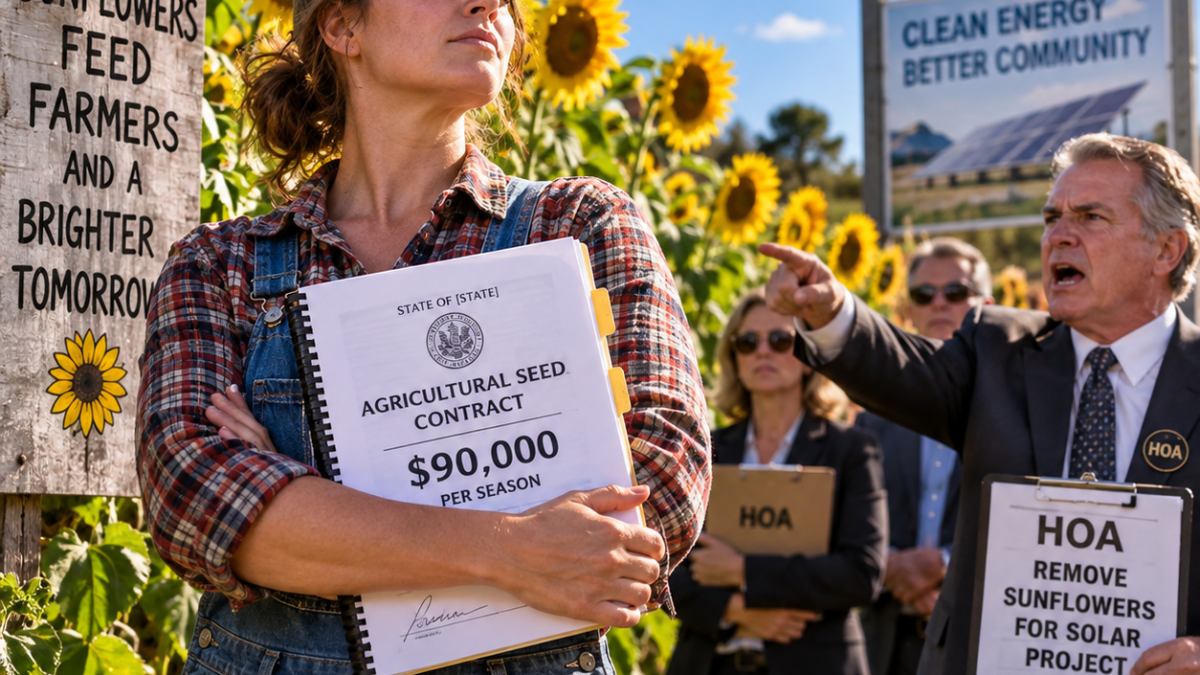
The HOA president stood beside my sunflower field and told me I had thirty days to clear ten acres of “weeds” because her board had voted to take the land for a community solar project.
She offered me $20,000 for soil that produced a $90,000 state-contracted harvest every season, then threatened fines and a lien when I refused.
I could have explained exactly what was growing behind me—but the two nervous board members standing beside her convinced me it would be smarter to let Karen keep putting everything in writing.
“Your little hobby farm is an eyesore, Mr. Thompson.”
Karen Whitmore stood just outside my fence with a clipboard pressed against her chest.
Behind her, ten acres of sunflowers rolled down the valley like a green ocean just beginning to turn gold.
They were three weeks from full bloom.
Karen called them weeds.
I rested one hand against the warm hood of my John Deere.
“Say that again.”
She mistook my calmness for confusion.
“The board voted unanimously to acquire this parcel for community improvement.”
“Acquire?”
“The solar initiative.”
“This is my land.”
She sighed.
“Technically, the acreage falls within the geographical boundary identified in the original Oak Meadows development documents.”
“Technically, I hold the deed.”
“Our attorney has reviewed the covenants.”
“Has he reviewed state property law?”
One of the board members beside her looked down.
Karen didn’t.
“We have an acquisition provision for underutilized parcels.”
I looked over my shoulder.
Thousands of sunflowers stood in perfectly spaced rows.
Underutilized.
That almost made me laugh.
Those plants weren’t ornamental flowers.
They were Titan 7.
A specialized sunflower hybrid developed through the state university and Department of Agriculture for drought tolerance, oil yield, rapid maturation, and biofuel research.
The seeds were proprietary.
My contract required strict planting records, isolation distances, soil testing, yield documentation, and controlled harvest.
At the end of every season, the state purchased every qualifying pound of seed.
Base contract value:
$90,000.
And Karen wanted to bulldoze it.
“What exactly are you offering?” I asked.
She brightened.
Apparently she thought we had reached the bargaining stage.
“Twenty thousand dollars.”
“For ten acres?”
“It’s a generous figure considering the parcel’s current condition.”
I stared at her.
“Current condition.”
She gestured toward the field.
“Overgrown agricultural vegetation. Heavy insect activity. Seasonal machinery. Frankly, it lowers the visual standard of Oak Meadows.”
Behind her, a monarch butterfly landed on one of the first yellow blooms.
I almost admired the timing.
Karen continued.
“The solar installation would transform this into productive green infrastructure.”
“It’s already productive.”
“Sunflowers are not infrastructure.”
“No.”
I nodded.
“They’re agriculture.”
She gave me a thin smile.
“The distinction is irrelevant.”
That sentence told me everything I needed to know.
I had spent my last decade in the Army Corps of Engineers learning that people usually get into serious trouble right after deciding distinctions are irrelevant.
Property lines.
Contract terms.
Jurisdiction.
Load limits.
Environmental restrictions.
Small words until somebody ignores them.
Then they become expensive.
Karen extended a folder through the fence.
“Thirty days.”
I took it.
Inside was a preliminary acquisition notice.
Cease-and-desist order for unauthorized commercial activity.
$1,000 landscaping fine.
$500 fine for my tractor.
Another $2,000 for refusing prior HOA directives.
Then the $20,000 offer.
I looked up.
“You fined my tractor?”
“It’s an unauthorized commercial vehicle visible from a residential street.”
“This was a farm before your subdivision existed.”
“The community has evolved.”
“The deed hasn’t.”
Her jaw tightened.
“Mr. Thompson, nobody wants conflict.”
“Then don’t create one.”
One board member finally looked at me.
There was fear in his face.
Not fear of me.
Fear of where Karen was taking them.
I folded the papers.
“Anything else?”
“If you refuse voluntary acquisition, the board will pursue every remedy available under the covenants.”
“Including?”
“Liens. Legal costs. Enforcement.”
“And clearing the field?”
“If necessary.”
I looked toward the sunflowers.
My daughter Sarah had helped me plant the first test rows five years earlier.
She was sixteen now.
That field paid our bills, funded her college savings, and supported research I believed might matter long after I was gone.
Karen saw wasted land.
I saw a promise I had made to myself after leaving the Army—that whatever I built next would grow instead of explode.
I met her eyes.
“Send every threat in writing.”
Her smile returned.
“Oh, I intend to.”
“Good.”
She turned toward her golf cart.
I watched the board members follow her.
Then I looked at the folder in my hand.
Karen thought she had just given me thirty days to surrender ten acres.
What she had actually given me was evidence.
And I was about to find out why she wanted my land badly enough to risk everything for it.
PART 2
My daughter found me at the dining-room table that evening.
Sarah dropped her backpack beside a chair and looked at the documents spread across the oak surface.
She was sixteen, too observant for my comfort and too much like her mother had been at that age.
“What happened?”
“HOA.”
“That explains the face.”
“What face?”
“The one where you’re technically calm but somebody is about to receive a twelve-page response.”
I pushed the acquisition notice toward her.
She read.
Her eyebrows climbed.
“They’re taking the sunflower field?”
“They believe they are.”
“For solar panels?”
“Yes.”
She read the $20,000 valuation.
Then looked at me.
“That doesn’t even cover one season.”
“Correct.”
“Do they know about the state contract?”
“They will.”
Sarah flipped another page.
“They fined the tractor?”
“Yes.”
She stared through the kitchen window toward the massive John Deere parked beside the equipment shed.
“For existing?”
“Apparently.”
“That seems aggressive.”
“That is the diplomatic word.”
She sat.
“Can they actually take the land?”
“No private HOA has eminent-domain power.”
“You sound sure.”
“I am.”
“Then why are you worried?”
Good question.
I leaned back.
“Because people who misunderstand their authority can still cause damage before somebody stops them.”
I had seen that lesson in places far more dangerous than Oak Meadows.
Authority matters.
So does perceived authority.
A person with a clipboard, letterhead, and enough confidence can make reasonable people surrender rights they actually possess.
Karen had built her entire presidency around that principle.
But she had picked an unusual target.
I had spent twenty years learning that the way you defeat a bad position is not by shouting that it’s bad.
You document it.
Map it.
Understand the resources behind it.
Then remove every place it can hide.
The next morning I called Dave Sterling.
Dave had served with me in the Third Engineer Brigade before leaving active duty for law school.
He now handled contracts and property litigation.
He answered with:
“If this is about your tractor again, I told you not to buy anything requiring its own weather system.”
“It’s not the tractor.”
“Shame.”
“My HOA claims eminent domain.”
Silence.
Then laughter.
Actual laughter.
“Dave.”
“I’m sorry.”
He kept laughing.
“They what?”
“They want ten acres for a solar farm.”
“Your ten?”
“The sunflower parcel.”
“The state-contract parcel?”
“Yes.”
That stopped him.
“Oh.”
“They sent paperwork.”
“I’m coming.”
He arrived the following morning.
City sedan.
Expensive shoes.
Coffee he complained was too strong.
He sat at my table and read everything.
The HOA declaration.
My deed.
Original title report.
State contract.
Property-tax map.
Old subdivision filings.
He didn’t speak for almost an hour.
Sarah sat nearby doing calculus homework and pretending she wasn’t listening.
Finally Dave placed Karen’s acquisition notice on the table.
“Technical legal analysis?”
“Please.”
“This is nonsense.”
Sarah looked up.
“Can you say that in lawyer?”
Dave pointed at her.
“I like this kid.”
Then he turned back to me.
“An HOA is a private association. It cannot invoke governmental eminent domain because Karen found an impressive phrase in a covenant.”
“What about their acquisition clause?”
“It allows the association to negotiate purchases of parcels offered for common use under specified circumstances. It does not let them confiscate somebody’s deeded farm.”
He tapped another document.
“And your pre-existing agricultural use predates Oak Meadows.”
“That was my understanding when I bought.”
“Your understanding is correct.”
He looked at the state contract.
“Five-year pilot.”
“Yes.”
“Ninety thousand base purchase each harvest?”
“Yes.”
“Performance bonuses?”
“When yield targets are exceeded.”
“Proprietary seed?”
“State-controlled.”
Dave slowly smiled.
“Does Karen know any of this?”
“She knows it’s a working farm.”
“That wasn’t my question.”
“Probably not.”
“Good.”
Sarah frowned.
“Why good?”
Dave looked at her.
“Because people behave more honestly when they don’t realize the consequences have gotten bigger.”
She considered that.
“That sounds manipulative.”
“It’s litigation.”
“Same thing?”
I coughed.
Dave ignored me.
“We’re not trapping anybody. We’re going to notify every board member exactly why Karen’s position is wrong. After that, whatever they choose to do is theirs.”
That distinction mattered.
Dave drafted our response.
First:
My land was privately deeded and taxed.
Second:
The HOA had no eminent-domain authority.
Third:
The farm’s agricultural use existed before the subdivision.
Fourth:
The sunflower program operated under a contract with the State Department of Agriculture.
Fifth:
Any entry onto the field without permission would constitute trespass.
Sixth:
Any destruction of the crop could expose responsible parties to claims far beyond the crop’s ordinary market value because the seed belonged to a controlled state research program.
We attached the contract’s cover page and a letter from Dr. Ann Evans at the Department of Agriculture confirming the program.
No drama.
No threats about millions.
Just notice.
Then Dave did something Karen didn’t expect.
He emailed it to every director individually.
Not merely the HOA management address.
“Why?” Sarah asked.
“No one later says Karen never showed them.”
Dave clicked send.
“Everybody now owns the information.”
Two days later, the answer arrived.
Karen doubled the fines.
She added a charge for “continued commercial misuse.”
She described my state contract as a private business arrangement irrelevant to community authority.
And she threatened a lien within fifteen days.
Sarah read the letter.
“She didn’t answer anything.”
“No.”
“She just increased the numbers.”
“Yes.”
“Can people do that?”
“They can print almost anything.”
She stared at me.
“Are you angry?”
“Yes.”
“You don’t look angry.”
“That took training.”
The truth was, I was furious.
The field was not merely income.
Five years earlier, when I purchased forty acres, it was because I needed somewhere to start again.
My wife had died two years before my retirement.
Cancer.
Fast.
Brutal.
One season we were arguing about whether to repaint the kitchen.
The next I was learning which hospital elevator led to oncology.
Sarah was eleven.
By the time I left the Army, she and I had become a two-person unit trying to figure out a life neither of us had planned.
The farm gave us something forward-facing.
Soil tests.
Fencing.
Irrigation.
Equipment repairs.
Weather.
Work.
No one asks a field how you are feeling.
It simply asks whether you showed up.
The Titan 7 project arrived at exactly the right time.
I had spent years corresponding with university agronomists while deployed.
Plants fascinated me because they were engineering problems that happened to be alive.
Water.
Nutrients.
Temperature.
Disease pressure.
Genetics.
Yield.
After retirement, Dr. Evans encouraged me to submit a pilot proposal.
The state wanted experienced operators willing to grow a high-oil sunflower hybrid for biofuel seed multiplication.
Thirty acres of my farm remained conventional rotation.
Ten acres had the perfect isolation and soil profile for Titan 7.
The first season Sarah planted several rows with me.
She complained the entire time.
“Why does every seed have to be this exact distance apart?”
“Uniformity.”
“Plants don’t own rulers.”
“Planters do.”
“You’re impossible.”
Three months later she stood in a sunflower field taller than she was.
She stopped complaining.
The state bought every seed we harvested.
Next year, again.
The field became a local landmark.
People photographed it.
Children stopped along the county road.
Pollinators filled the air.
Then Oak Meadows rose beside us.
The developer had actually used photographs of our field in early marketing materials.
**COUNTRY LIVING MINUTES FROM THE CITY.**
Funny.
People pay a premium for rural views and then sometimes spend years trying to eliminate everything rural.
For two years we coexisted.
Then Karen won the board presidency.
At first, her letters were almost funny.
Grass-height notice.
Agricultural field.
Violation.
I ignored it.
Then tractor visibility.
Agricultural property.
Ignored.
Then accusations of unmanaged vegetation.
Ignored.
I had made a mistake.
By treating ridiculous letters as harmless, I allowed Karen to interpret silence as weakness.
Now she had graduated from criticizing my field to trying to take it.
Dave’s advice was simple.
“Document everything.”
So I did.
Four high-resolution cameras.
Fence line.
Equipment shed.
Field entrance.
Rear boundary.
Audio where state law allowed and clear signage.
PRIVATE PROPERTY.
VIDEO AND AUDIO MONITORING IN USE.
Sarah watched me install the final camera.
“This feels intense.”
“It is insurance.”
“Against Karen?”
“Against disagreement about what happened.”
She nodded.
“Evidence.”
“Exactly.”
We also started watching Karen’s public narrative.
Sarah found the private Oak Meadows Facebook group through friends who lived there.
Karen controlled it.
The solar project dominated the page.
Renderings showed gleaming panels.
Trees.
Walking path.
Benches.
A sign reading:
**OAK MEADOWS COMMUNITY SOLAR GARDEN**
Not one post explained that the proposed location belonged to me.
Instead:
“Underutilized common area.”
“Pest-producing field.”
“Unmanaged parcel.”
“Future green-energy centerpiece.”
Sarah saved screenshots.
One evening she called me to the laptop.
“Dad.”
“What?”
“Look.”
Karen had written:
**The selected area currently provides no measurable benefit to Oak Meadows homeowners.**
I stared at it.
“No measurable benefit.”
Sarah scrolled down.
Maria Collins, a mother two streets inside the development, had commented:
**Is this the sunflower field? My kids love that view.**
Karen replied:
**The board is evaluating an underused parcel currently containing invasive agricultural vegetation.**
“Invasive,” Sarah said.
“Titan 7 is not invasive.”
“I know.”
“We harvest every plant.”
“I know.”
“It’s ridiculous.”
Sarah looked at me.
“You’re arguing with a screenshot.”
“Fair.”
But the screenshot mattered.
Karen wasn’t simply mistaken.
She was constructing a version of reality in which my property was already theirs.
That made her dangerous.
I started walking the public sidewalk beside Oak Meadows in the evenings.
Not campaigning.
Talking.
George Holloway was the first.
Retired civil engineer.
Seventy-two.
Border collie named Molly.
He stopped beside the field.
“These yours?”
“Every row.”
“Beautiful.”
“Wait three weeks.”
“I’ve watched them every year.”
He pointed.
“What variety?”
“Titan 7.”
I explained.
Oil yield.
Drought resistance.
State research.
Biofuel.
His entire face changed.
“You’re producing seed stock?”
“Yes.”
“For the state?”
“Yes.”
“I thought this was a flower farm.”
“No.”
He laughed.
“Karen says it’s weeds.”
“I heard.”
His smile faded.
“She says solar is going there.”
“She says many things.”
George looked at me carefully.
“Is that your land?”
“Yes.”
“Not HOA?”
“Deeded to me.”
He stopped walking.
“Then how is the board building solar?”
“That is the current mystery.”
Over the next week, I had similar conversations.
Maria’s children loved the flowers.
Another resident was an amateur photographer.
A beekeeper from two blocks away told me the field transformed his summer honey flow.
Not everyone supported me.
Some wanted solar.
I understood that.
Community solar could be valuable.
My objection wasn’t solar energy.
It was theft disguised as sustainability.
That became important later.
I told everyone the same thing.
“I’m not against panels.”
“Then what are you against?”
“Panels on land the HOA doesn’t own.”
Simple.
Meanwhile, Karen’s fifteen-day lien deadline passed.
Nothing appeared on the county records.
Dave checked.
“They blinked.”
“For now.”
“Yes.”
“Why?”
“Because threatening a lien and recording a fraudulent lien are different levels of stupidity.”
Then the surveyors came.
White van.
Apex Land Surveyors.
Two men.
Orange vests.
Tripod.
GPS receiver.
Paint.
I walked down before they crossed the fence.
“Morning.”
“Morning.”
The older man checked his work order.
“We’re staking solar layout.”
“Where?”
He pointed into my sunflower field.
“This parcel.”
“No.”
He frowned.
“Oak Meadows Parcel B.”
“This is Thompson Farm.”
He checked again.
“Work order says Oak Meadows common land.”
“Work order is wrong.”
He looked uncomfortable.
“Buddy, I just survey what they tell me.”
“I understand.”
I pointed toward the county monument at the corner.
“My deed line is there. Fence runs with it. You do not have my permission to enter.”
He sighed.
“You need to argue with your HOA.”
“They are not my authority on ownership.”
He started toward the fence.
I changed tone.
Not loud.
Just clear.
“Stop.”
He stopped.
“You enter after notice, I call the sheriff. You place stakes or paint, we document the trespass. You’re not the dispute, and I don’t want you caught in it.”
His partner looked at the camera pole.
Then the sign.
“Are we being recorded?”
“Yes.”
The older surveyor stared at the field.
Then his work order.
“You’re serious.”
“Very.”
He took out his phone.
Called his office.
Two minutes later he returned.
“We’re leaving.”
“Thank you.”
“Your HOA is going to be angry.”
“They already are.”
Camera Two captured everything.
Clear audio.
Clear video.
Surveyors identifying Oak Meadows as client.
Work order identifying my parcel as common land.
My notice.
Their departure.
That video changed the entire fight.
I sent it to Dave.
Then Dr. Evans.
Her response came fifty-one minutes later.
**Jack, do not allow entry. State counsel is being notified. This program represents protected state investment and contractual obligations. I will contact you shortly.**
She called before dinner.
“What exactly did the HOA receive from us previously?”
“Your letter confirming the contract.”
“They ignored it?”
“Yes.”
“Do they understand the seed is proprietary?”
“I believe so.”
“Apparently not enough.”
“Ann.”
“Yes?”
“I don’t want the state turning this into a political spectacle.”
“This is not politics.”
“I know.”
“This is contract protection.”
“Good.”
“Our lawyers will write the board.”
“Fine.”
“And probably the Attorney General’s office.”
I closed my eyes.
“That seems escalatory.”
“They sent surveyors onto land holding state-controlled germplasm after written notice.”
Point taken.
Three days later, Oak Meadows received the letter.
Dave obtained a copy.
State letterhead.
Department of Agriculture.
Copies:
Commerce.
Attorney General.
State university program office.
It described the Titan 7 contract.
State investment.
Seed ownership and handling.
Research continuity.
Consequences of crop destruction.
Then the paragraph that broke the board.
Any intentional interference after notice could trigger claims against the HOA and potentially against individual participants where the law allowed.
George called me that evening.
“What did you do?”
“What?”
“Half the neighborhood has the state letter.”
“How?”
“No idea.”
“Wasn’t me.”
“I believe you.”
“Karen?”
“No. Karen is furious it leaked.”
He lowered his voice.
“People are scared.”
“Of me?”
“Of paying for her fight.”
That mattered.
Karen had sold solar as savings.
Now homeowners were being told the project might produce litigation instead.
People started asking questions.
Real questions.
Where did the project originate?
Who selected the contractor?
What engineering study had been done?
How much would it cost?
What was the payback period?
Who actually owned the parcel?
George requested procurement records.
The HOA delayed.
That made him more suspicious.
Dave said:
“Follow the money.”
He hired an investigator to search public corporate records.
It took less than two days.
SunSource Solutions LLC.
Formed eleven months earlier.
Registered owner:
Gary Peterson.
Karen Whitmore’s brother-in-law.
I stared at the screen.
“How sure?”
“Public filings.”
“Experience?”
“Minimal operating history.”
“Solar?”
“Couldn’t find completed projects.”
“Contract amount?”
“Four hundred eighty-six thousand dollars.”
“No bid?”
“Records suggest sole-source selection.”
I leaned back.
There it was.
The solar project had always felt disproportionate.
Now I understood why Karen was willing to burn political capital over ten acres she didn’t own.
It wasn’t merely her legacy.
Her family stood to benefit.
Still, I wouldn’t call that proof of criminal conduct.
Related-party contracts can be legal if disclosed and properly approved.
The important question was disclosure.
George requested meeting minutes.
No disclosure.
Conflict statement?
None located.
Competitive bids?
None.
Board vote?
Closed session.
Dave looked at me.
“Now we know motive.”
“Maybe.”
He smiled.
“You’re annoyingly cautious.”
“I learned from you.”
“Don’t insult me.”
Karen called an emergency community meeting.
Her email described “outside interests” threatening Oak Meadows.
She portrayed the state as bullying volunteers.
She called my farm a private commercial venture standing in the way of lower energy bills.
No mention of Gary.
No mention of SunSource.
No mention that she was his sister-in-law.
I read the email twice.
Then told Sarah:
“She gave us the meeting.”
“What does that mean?”
“She chose the audience.”
Sarah smiled.
“And you have the documents.”
“Exactly.”
The clubhouse was packed.
People stood along the walls.
Karen wore a red blazer.
Two board members sat beside her.
Neither looked happy.
George sat near the front.
Maria behind him.
I chose the third row.
Dr. Evans had told me earlier she might attend.
I assumed she wouldn’t.
State officials generally dislike HOA meetings almost as much as normal people.
Karen began.
“My friends and neighbors…”
Sarah whispered:
“That’s never a good start.”
I almost smiled.
Karen described vision.
Sustainability.
Energy independence.
Community progress.
Then she described me.
“Mr. Thompson refuses reasonable cooperation.”
Reasonable.
Twenty thousand dollars for ten acres generating ninety thousand dollars every harvest.
“He places his personal financial interests ahead of hundreds of families.”
People shifted.
“He has brought state bureaucrats into what should be a private community matter.”
More shifting.
“He has threatened this association with litigation.”
I stood only when she said:
“This land has always been intended for community use.”
“Karen.”
She stopped.
“This isn’t open comment.”
“Then when is it?”
“After the board presentation.”
“Your presentation is about my property.”
She smiled.
“Sit down.”
George stood.
“I move that Mr. Thompson be heard now.”
Karen’s expression tightened.
“George—”
A second homeowner:
“Second.”
Then another:
“Let him talk.”
The room turned.
Karen understood.
“Five minutes.”
I walked forward.
No projector.
Just paper.
“My name is Jack Thompson.”
I looked around.
“First, I’m not opposed to solar energy.”
That surprised people.
“If Oak Meadows wants panels on land Oak Meadows owns, that is none of my business.”
A man nodded.
“My objection is to using my land.”
I held up my deed.
“This ten-acre parcel is titled and taxed to me.”
Then the state contract.
“This field is not unused.”
I paused.
“It produces proprietary Titan 7 sunflower seed under a State Department of Agriculture contract.”
Karen interrupted.
“Which is irrelevant to the covenants.”
I looked at her.
“It pays ninety thousand dollars per season before performance incentives.”
The room changed.
George knew.
Most did not.
Someone said:
“Ninety thousand?”
“Yes.”
I held up Karen’s purchase offer.
“The HOA offered twenty thousand dollars total.”
A low rumble.
Karen grabbed the microphone.
“The number reflects undeveloped land valuation, not speculative commercial income.”
Dave had told me exactly how to respond.
“The value can be debated.”
I nodded.
“Ownership cannot.”
That line landed.
Then George rose.
“Ask about SunSource.”
Karen’s face changed.
There.
Small.
But visible.
I turned toward her.
“Actually, Karen, I was getting there.”
I held up the corporate filing.
“Who owns SunSource Solutions?”
Silence.
“Karen?”
She adjusted the microphone.
“The contractor was selected based on qualifications.”
“That isn’t the question.”
One board member shifted away from her.
I continued.
“Who owns the company?”
A woman in the back called:
“Answer him.”
Karen’s face reddened.
“This is character assassination.”
“No.”
I held up the page.
“This is the Secretary of State’s corporate registry.”
George stood.
“It says Gary Peterson.”
Murmurs.
“Who is Gary Peterson?” someone asked.
George looked at Karen.
“Her brother-in-law.”
The room exploded.
Questions.
Shouting.
“Is that true?”
“No bids?”
“Half a million dollars?”
“You didn’t tell us?”
Karen raised both hands.
“Quiet!”
Nobody quieted.
She hammered the gavel.
Eventually the room settled enough for her to speak.
“There is nothing illegal about doing business with someone you know.”
Correct.
I spoke before the crowd twisted that into guilt.
“That is true.”
Karen looked surprised.
I continued.
“The issue is disclosure, bidding, and whether the board acted in the association’s interest.”
George held up the minutes.
“Where’s the disclosure?”
Karen pointed toward him.
“You are not an attorney.”
“No.”
“Then stop pretending—”
The clubhouse door opened.
Dr. Ann Evans walked in.
Behind her was a man in a dark suit.
Ann was sixty, compact, silver-haired, and carried herself like someone accustomed to defending agricultural budgets in rooms filled with politicians.
She walked down the center aisle.
Karen stopped speaking.
Ann reached the front.
“Jack.”
“Dr. Evans.”
Then she turned toward the room.
“My name is Dr. Ann Evans, State Department of Agriculture.”
The man beside her introduced himself as a representative from the Attorney General’s office.
The room went silent.
Ann did not perform.
That was what made her effective.
“The Titan 7 program on Mr. Thompson’s property is a state-supported agricultural research and seed-production project.”
She looked toward Karen.
“Your board received written notice.”
Karen crossed her arms.
“We disagree with the state’s interpretation.”
“Of your authority to seize private land?”
“Our covenants contain acquisition provisions.”
The AG representative finally spoke.
“Those provisions do not confer eminent-domain authority.”
Karen’s face lost color.
He continued.
“Our office is separately reviewing information concerning the proposed SunSource contract and representations made during the procurement process.”
A gasp.
Karen turned toward her fellow directors.
One looked genuinely ill.
The other stared at the table.
Dr. Evans continued.
“The state prefers not to litigate with homeowners associations.”
That almost sounded kind.
Then:
“But destruction or seizure of the Titan 7 crop after notice would interfere with a multi-year state program.”
She paused.
“We will protect that investment.”
Karen stared at me.
“You orchestrated this.”
“No.”
“You brought them here.”
“I told the state what you were doing to its crop.”
“It’s your crop!”
Dr. Evans corrected her.
“The production acreage is Mr. Thompson’s. The proprietary seed program is governed by his contract with us.”
Karen’s frustration broke.
“This is ridiculous. It’s a field of flowers.”
And there it was.
The sentence that exposed the entire problem.
She had never bothered to understand what she was trying to destroy.
I took out my phone.
“One more thing.”
Dave had cleared the recording legally because of my posted surveillance and applicable rules.
I played the fence-line conversation.
Karen’s recorded voice filled the clubhouse.
**Your little hobby farm is an eyesore and an embarrassing waste of prime community land.**
Then:
**Thirty days to clear your weeds or we will.**
Several people shook their heads.
Then the later recording from another confrontation:
**I’ll bulldoze that ugly weed patch myself if I have to.**
I stopped playback.
Silence.
Not triumph.
Just silence.
George stood.
“I want an independent audit.”
Applause.
Another homeowner:
“And the solar contract suspended.”
More applause.
Then:
“Recall the board.”
Karen grabbed the microphone.
“You people are panicking because of propaganda!”
Maria Collins stood.
“No.”
Karen stared.
Maria was not a habitual dissenter.
That mattered.
“You told us the land was common property.”
“It falls within—”
“No.”
Maria shook her head.
“You said common property.”
Karen said nothing.
“My children love that field.”
Maria continued.
“I supported solar because I thought we owned the land and the numbers worked.”
She looked around.
“I still support solar.”
Then back at Karen.
“I don’t support stealing somebody’s farm to give a contract to your family.”
That ended the meeting.
Not legally.
Emotionally.
The room was gone.
Karen knew it.
Her board knew it.
The recall petition began before people reached the parking lot.
By midnight, enough signatures had been collected to compel a special vote.
By morning, twice enough.
Then the resignations started.
First board member:
Immediate resignation.
Second:
Resignation and statement claiming he had relied on Karen’s representation that the field was legally available for acquisition.
Karen remained.
For twenty-four hours.
Then SunSource became the center of an investigation.
The Attorney General requested records.
The management company provided them.
The contract was suspended.
It turned out SunSource was a newly formed company with little evidence of completed utility-scale solar work.
That fact alone didn’t prove fraud.
But combined with the undisclosed family relationship, closed-door procurement, and misrepresentations about land ownership, it created questions the board could no longer answer privately.
Karen resigned.
Her email blamed “an increasingly hostile environment.”
No apology.
No acknowledgement.
Just departure.
But Oak Meadows wasn’t finished.
A special election put George Holloway in as interim president.
His first call was to me.
“Jack?”
“Yes?”
“We owe you an apology.”
“You owe me a corrected legal record.”
Pause.
“Engineer.”
“Retired.”
“Same disease.”
I smiled.
“What are you proposing?”
“Formal rescission of every fine.”
“Good.”
“Written acknowledgment that your agricultural use predates the HOA.”
“Good.”
“No land-acquisition language applied to privately owned outparcels without voluntary sale.”
“Better.”
“And…”
He hesitated.
“What?”
“Would you come to the meeting?”
“Why?”
“Because people need to hear this ended.”
“It hasn’t.”
“What else?”
“The state investigation.”
“I mean between us.”
That made me pause.
Between the farm and the neighborhood?
Maybe he was right.
“I’ll come.”
The meeting felt different before it started.
No red blazer.
No gavel theatrics.
George had a legal pad.
He looked terrified.
Perfect.
He read the apology.
Plain language.
Oak Meadows had no authority to exercise eminent domain.
The field belonged to me.
The agricultural use was protected as pre-existing.
The board had acted on incorrect legal assumptions.
The fines were void.
The solar project was canceled.
Then he looked toward me.
“I’m sorry.”
I nodded.
“Accepted.”
People applauded.
I raised one hand.
“Before we celebrate too much, solar wasn’t the problem.”
The room quieted.
“Karen’s process was.”
I looked around.
“If this community still wants solar, find property you own. Get competitive bids. Disclose relationships. Publish the financial model. Let homeowners vote with real information.”
George smiled.
“That sounds suspiciously like volunteering.”
“No.”
Laughter.
“Absolutely not.”
That was the beginning of something better.
Oak Meadows eventually installed solar panels.
Not on my farm.
On the clubhouse roof, pool facility, and a small legitimately owned utility parcel near the entrance.
Three bids.
Public analysis.
No secret relatives.
It generated less electricity than Karen’s grand plan.
It also required stealing zero acres.
I called that an improvement.
Meanwhile, the Titan 7 season continued.
But the conflict had cost me.
Survey interruptions.
Meetings.
Legal work.
Sleepless nights.
For the first time in five seasons, I worried we might miss optimal harvest timing.
Sarah noticed.
“You’re checking moisture every three hours.”
“Four.”
“You checked at two in the morning.”
“That was dew.”
“That sentence is why normal people don’t farm.”
I looked at her.
“Want to help calibrate the combine?”
She grabbed her boots.
Harvest started at dawn.
The field had turned from gold to brown.
Heavy seed heads bowed toward the earth.
State technicians arrived.
Dr. Evans came personally for the first yield test.
The combine moved through the first rows.
Seed poured into the hopper.
Black.
Dense.
Healthy.
Moisture within spec.
Oil analysis later came back above target.
Yield:
Best season yet.
Dr. Evans called me.
“Congratulations.”
“Numbers?”
She told me.
I sat on the tailgate of my truck.
Then laughed.
“What?”
“After all that, the plants had a good year.”
“Stress can do strange things.”
“Not recommending HOA harassment as an agronomic input.”
“Agreed.”
The base payment arrived.
Ninety thousand dollars.
Then the performance bonus.
Ten percent.
Dr. Evans had added what she jokingly called a resilience clause to the renewal negotiations.
The state extended the program another five years.
Sarah was beside me when the renewal email arrived.
She read it twice.
“Five years?”
“Yes.”
“So the field stays?”
“As long as we perform.”
She looked toward the rows.
Then smiled.
“Good.”
“What?”
“I applied to State.”
“I know.”
“Agricultural science.”
I froze.
“You said environmental engineering.”
“I changed it.”
“When?”
“Two months ago.”
“Because of this?”
“Partly.”
She walked toward the field.
I followed.
“When Karen called the sunflowers weeds, I realized she didn’t understand anything growing here.”
Sarah ran her fingers across a dry stalk.
“Then Dr. Evans came in and understood everything.”
“That’s her job.”
“I know.”
“I want that job.”
I looked at my daughter.
For years, I worried farming had forced too much adulthood onto her.
Her mother died.
I retired.
We moved.
New school.
New land.
New life.
She had learned irrigation before driving.
Now she was choosing the science behind it.
“You don’t have to follow me.”
She rolled her eyes.
“I’m not.”
“No?”
“You grow the seed.”
She smiled.
“I’m going to design it.”
That may have been the proudest moment of the entire fight.
Not Karen resigning.
Not the state letter.
Not the crowd turning.
My daughter finding a future in the thing I had almost lost.
Oak Meadows changed too.
Karen had run the Facebook group like private territory.
George opened administration to three moderators.
Meeting minutes went online.
Contracts over a threshold required competing bids.
Related-party transactions required written disclosure.
Owners could inspect records without being treated like insurgents.
The page became boring.
Barbecue announcements.
Lost dogs.
Recommendations for plumbers.
Photos of storms.
Gardening questions.
Exactly as a neighborhood page should be.
Maria Collins approached me that summer.
“My kids keep asking whether they can see the field.”
“From the road?”
“No.”
She smiled.
“They want to walk through.”
Normally, absolutely not.
Research field.
Controlled access.
But harvest was months away and Dr. Evans had been pushing public education.
So we planned one afternoon.
Not a tourist attraction.
A controlled edge-of-field event.
The new HOA called it Sunflower Saturday.
I hated the name.
Sarah loved it.
Families gathered near the fence.
A university extension educator explained pollination.
A local beekeeper brought an observation hive.
Dr. Evans talked about biofuel.
I explained why no one could walk between research rows without permission.
Children painted small pots.
Each left with a common sunflower seedling—not Titan 7.
That distinction mattered.
One boy looked over the field.
“Are these yours?”
“The land is.”
“The flowers?”
“Complicated.”
He frowned.
“The state owns parts of the research program.”
He looked deeply offended by legal nuance.
“So yes or no?”
I smiled.
“I grow them.”
He accepted that.
Near sunset, Maria found me.
“Thank you.”
“For what?”
“This.”
She pointed toward children painting flowerpots.
“Karen told us this field was separating the neighborhood from progress.”
“And?”
Maria looked toward the rows.
“Turns out it was connecting us to something we didn’t understand.”
That sentence stayed with me.
Borders are strange.
My fence had been a battle line for months.
Then the same fence became where neighbors gathered to learn.
Nothing physical changed.
Only the relationship.
The Attorney General’s investigation lasted longer.
As investigations do.
Rumors moved faster than evidence.
Some residents claimed Karen would go to prison.
Others claimed the entire solar contract was a fictional shell.
Reality was less cinematic.
Records showed serious procurement failures.
Undisclosed family relationships.
Misrepresentations.
Weak board controls.
SunSource had little relevant project history despite being positioned for a nearly half-million-dollar contract.
Whether every bad decision was criminal was for investigators to determine.
I stayed out of speculation.
Eventually the contract remained void.
The association recovered certain expenditures.
Regulators imposed consequences connected to governance failures.
Civil matters followed.
Karen and her husband sold their Oak Meadows home.
I saw the moving truck one morning.
Sarah and I were servicing irrigation.
“You going to watch?”
“No.”
“You sure?”
“Yes.”
She smiled.
“Growth.”
“Don’t start.”
“I’m serious.”
“So am I.”
Truthfully, there had been a time when I imagined enjoying that moment.
Karen leaving.
Defeated.
But by then, the emotion had burned off.
She was no longer the center of my life.
That was victory.
A bully wants attention almost as much as control.
The most complete defeat is becoming irrelevant.
The new family who bought Karen’s house came by six weeks later.
They brought a pie.
No idea why.
Maybe Oak Meadows had become that kind of neighborhood.
The husband introduced himself.
“Caleb.”
“Jack.”
“My wife says we should apologize.”
“For what?”
“Apparently we bought the villain’s house.”
I laughed.
“The house didn’t do anything.”
He looked relieved.
“Good.”
His wife asked whether they could plant native flowers.
“Ask George.”
She looked confused.
“I thought you wrote the new rules.”
“No.”
“I helped explain the old mistake.”
Different thing.
At the next HOA meeting, George presented a proposed bylaw.
Pre-existing farms and agricultural activities would be expressly recognized.
No board could claim land-acquisition powers beyond lawful voluntary transactions.
No agricultural parcel could be reclassified as common area through internal resolution.
Related-party contracts had disclosure requirements.
The membership approved it.
Then someone nominated me for the board.
I stood.
“No.”
Laughter.
George pointed.
“See? This man has learned nothing about civic duty.”
“I served twenty years.”
“Different government.”
“I’m retired from all governments.”
Someone shouted:
“You’re still under the Department of Agriculture.”
“Contractor!”
More laughter.
That feeling was new.
Months earlier, HOA meetings meant anxiety.
Now people could disagree and laugh.
Rules still existed.
There were still complaints.
Someone still cared too much about trash cans.
But nobody wielded liens as casual weapons.
George made mistakes.
He admitted them.
Once, his board sent a violation to the wrong address.
The homeowner came to the meeting.
George said:
“We screwed up.”
Then rescinded it.
Meeting moved on.
I remember sitting there almost amazed.
Four words.
We screwed up.
Karen could have saved herself months of disaster with some version of those words.
Why are they so difficult for people in power?
Maybe because authority creates a dangerous illusion.
If people obey you often enough, you begin to confuse compliance with correctness.
Then any challenge feels like disrespect.
That was Karen’s real collapse.
Not solar.
Not SunSource.
Not the sunflowers.
She had made being right inseparable from being president.
So when evidence showed she was wrong, protecting the office required denying reality.
Sarah started university the following fall.
I drove her to campus despite her insistence she could manage herself.
She tolerated me carrying one box.
Only one.
Her dorm room overlooked a parking lot.
No flowers.
She complained immediately.
“You could plant something.”
“Dad.”
“Window box.”
“Dad.”
“Hydroponics.”
She stared.
“I’m going to lock you out.”
I raised my hands.
Before leaving, she hugged me.
Longer than usual.
“Take care of the field.”
“You’re coming home in three weeks.”
“Still.”
“I will.”
She stepped back.
“And don’t start another war with the HOA while I’m gone.”
“No promises.”
She narrowed her eyes.
“Dad.”
“Kidding.”
Mostly.
Driving home alone hurt.
The farm felt too quiet that evening.
For years, every decision had included Sarah.
School bus.
Homework.
Planting.
Harvest.
Dinner.
Now her room was empty.
I walked the sunflower boundary near sunset.
The new season was just stubble.
Wind moved through it.
George waved from the sidewalk.
I waved back.
Simple.
Neighborly.
I thought about the $90,000 figure Karen mocked as a hobby.
Money mattered.
Of course.
The contract paid mortgage costs.
Equipment.
College savings.
Seed infrastructure.
But if the fight had only been about money, I might eventually have sold.
The deeper issue was meaning.
That field was the first thing Sarah and I built after grief rearranged our family.
Every row represented choosing to continue.
Karen had looked at it and seen vacant land.
That’s what arrogance often is.
Mistaking what you do not understand for something without value.
The following season Titan 7 expanded into a new trial.
Drought.
The state wanted comparative irrigation data.
Dr. Evans arrived with graduate students.
One of them was Sarah.
I stared.
“What are you doing here?”
“Internship.”
“You didn’t tell me.”
“Dr. Evans said not to.”
I looked at Ann.
She smiled.
“Operational security.”
“Traitor.”
Sarah wore a State University field shirt and carried a soil-moisture sensor.
She looked absurdly professional.
“What’s first?” she asked.
“You know this field.”
“Today I’m here as research staff.”
“Fine.”
I pointed.
“Plot C sensor calibration.”
She walked away.
Dr. Evans stood beside me.
“She’s good.”
“I know.”
“You’re not allowed to scare off her professors.”
“I haven’t.”
“You emailed one about an irrigation-model assumption.”
“It was wrong.”
Ann sighed.
“Jack.”
“What?”
“She’ll survive without artillery support.”
“Probably.”
By late July, the field exploded gold again.
Oak Meadows families still stopped for photos.
This time they asked.
We created a designated roadside viewing area outside the research boundary.
George’s idea.
The HOA paid for a small gravel pull-off on its own land.
No trespassing.
No crop damage.
Everyone happy.
There was no giant sign naming me.
My condition.
Instead:
**TITAN 7 RESEARCH FIELD
PLEASE VIEW FROM DESIGNATED AREA
POLLINATORS AT WORK**
I liked that.
The second Sunflower Saturday became bigger.
Still controlled.
Children learned seed anatomy.
University students demonstrated oil extraction.
A renewable-energy professor brought a small biodiesel demonstration.
That was my favorite irony.
The farm Karen tried to destroy for solar became the neighborhood’s real education about renewable energy.
Not either-or.
Solar and biofuel.
Panels and crops.
Technology does not require theft.
Progress does not require pretending existing people and purposes do not matter.
The state contract renewed again.
The ninety-thousand-dollar figure became almost secondary because newer research grants supported expanded trials.
I never told Karen.
There was nobody to prove anything to.
Years later, somebody sent me a screenshot of an old Oak Meadows Facebook post.
Karen’s original solar announcement.
**Repurposing an unused common area.**
I stared at it.
Then deleted it.
The field outside was blooming.
Sarah, now in graduate school, was working on oil-yield genetics.
George was retired from HOA service.
Maria had become president.
Yes, Maria.
The mother who initially supported Karen’s solar plan.
She turned out to be excellent.
That mattered.
People should be allowed to change their minds.
Maria never pretended she had opposed Karen from the beginning.
At her first meeting as president she said:
“I believed a version of the project because I didn’t ask enough questions.”
Then:
“My job now is to make it easier for all of you to ask them.”
That may have been the healthiest thing Oak Meadows ever heard from a president.
One summer afternoon, Maria walked to my fence.
“Problem.”
“HOA?”
“Yes.”
I groaned.
“What now?”
“Kids want a sunflower maze.”
“No.”
“Expected that.”
“Research crop.”
“I know.”
“They’ll destroy experimental rows.”
“I know.”
“Then why ask?”
She smiled.
“Because the HOA owns four acres near the clubhouse.”
I stared.
“You want to plant common sunflowers.”
“Yes.”
“A maze.”
“Yes.”
“On property you actually own.”
She laughed.
“We’ve evolved.”
I helped design irrigation.
Of course I did.
The maze opened that September.
Sarah accused me of joining the enemy.
“I advised.”
“You designed half of it.”
“Technical assistance.”
“You attended three planning meetings.”
“Against my will.”
“They fed you barbecue.”
“Compensation.”
She laughed.
The sunflower maze became annual.
Common varieties.
Tall.
Bright.
No proprietary genetics.
Children ran through paths.
Oak Meadows raised money for the local food bank.
The HOA that once tried to take my field for a green-energy vanity project ended up growing its own sunflowers on land it actually owned.
That is a much better ending than destroying the HOA.
Institutions can learn.
If people force them to.
I kept Karen’s first acquisition letter in a file.
Not framed.
Not displayed.
Just filed.
Once, Sarah found it.
She was home from graduate school.
“You kept this?”
“Records.”
She unfolded it.
Twenty thousand dollars.
She whistled.
“She really offered twenty grand.”
“Yes.”
“You should frame it beside a harvest payment.”
“Petty.”
“Correct.”
“No.”
She looked at the field.
“Remember when we planted the first season?”
“You complained for seven hours.”
“I was eleven.”
“You complained with unusual stamina.”
“I thought farming was stupid.”
“I remember.”
She smiled.
“Then Mom died.”
I looked at her.
We rarely said it that directly.
Not because we avoided her.
Because grief had stopped needing constant naming.
Sarah continued.
“I think this place saved you.”
I looked toward the rows.
“Maybe.”
“It saved me too.”
That caught me.
She looked down.
“When everything was weird, there was always something to do.”
I nodded.
“Yes.”
“You couldn’t just lie in bed because irrigation didn’t care.”
“No.”
“And plants are…”
She searched for the word.
“Honest.”
Exactly.
Seeds do not flatter you.
They do not care about titles.
They respond to conditions.
Good soil.
Water.
Genetics.
Sun.
Management.
Reality.
Karen’s entire leadership style had depended on forcing reality to match her story.
Fields became weeds.
Private property became common land.
Nepotism became vision.
Questions became disloyalty.
But crops don’t work that way.
If the soil nitrogen is low, calling it adequate does not raise yield.
If a parcel is privately deeded, calling it common doesn’t transfer ownership.
Facts eventually collect their debt.
That was what happened.
One August evening, a storm came through.
Strong winds.
Heavy rain.
A section of Titan 7 lodged badly near the south end.
I was out at sunrise assessing damage.
Maria walked over from the neighborhood.
“How bad?”
“Maybe eight percent.”
“That a lot?”
“Enough to annoy me.”
“Can we help?”
I almost said no.
Then remembered how much had changed.
“After the field dries, maybe.”
Two days later, Oak Meadows volunteers showed up.
Not inside restricted research plots.
Dr. Evans would have murdered me.
They helped clear storm debris from the perimeter.
Repaired fencing.
Moved broken limbs.
Brought food.
George came with tools.
Maria’s kids carried water.
The beekeeper checked hives.
No one issued an order.
No board motion.
Just neighbors.
At lunch, I stood beside the tractor eating a sandwich.
George looked across the field.
“Remember when this was supposed to be our solar farm?”
“Never your land.”
He smiled.
“Still sensitive.”
“Accurate.”
He raised his hands.
“Your sunflower field.”
“Better.”
Then he said:
“Glad you didn’t sell.”
“So am I.”
“If Karen had offered a fair price?”
I thought about it.
“Back then?”
“Yes.”
“No.”
“Why?”
I looked at the rows.
“Wrong season of life.”
He nodded.
Some things have a market value.
Some things don’t.
That distinction doesn’t make them priceless in court.
It makes them personal.
The state contract eventually crossed its tenth season.
Dr. Evans announced a small ceremony.
I refused.
She held it anyway.
State officials.
University staff.
Oak Meadows representatives.
Sarah beside me.
They presented a plaque.
I hated it.
Sarah loved it.
Ann spoke.
“Ten years ago, this pilot was designed to determine whether Titan 7 could perform reliably under commercial field conditions.”
She looked at me.
“Mr. Thompson provided more than land.”
I whispered to Sarah:
“Here comes exaggeration.”
She elbowed me.
Ann continued.
“He provided disciplined records, adaptive management, and perhaps most importantly, stubbornness.”
Everyone laughed.
“That same stubbornness proved useful when the research acreage was threatened.”
I stared at her.
“She promised not to mention that.”
Sarah whispered:
“No, she didn’t.”
Ann smiled.
“The lesson is not that government contracts defeat HOAs.”
More laughter.
“The lesson is that agricultural land has value people often fail to see when they view it only as empty space awaiting development.”
That I agreed with.
Then Sarah spoke.
I did not know she was scheduled.
Betrayal everywhere.
She stood at the podium.
“When I was eleven, my dad made me plant sunflowers.”
I muttered:
“Made?”
People laughed.
“I hated it.”
More laughter.
“My mother had died.”
The room changed.
“My dad had just retired.”
She looked at me.
“We were both pretending we knew what came next.”
My throat tightened.
“The field gave us a next thing.”
She paused.
“A row. Then another. Then irrigation. Then harvest.”
I looked down.
“When the HOA tried to take it, everyone focused on the money.”
Ninety thousand dollars.
Contract.
Research.
State liability.
“All of that mattered.”
She looked toward the flowers.
“But the part nobody could put in the legal letters was that those ten acres were where my father and I learned how to be a family of two.”
That nearly broke me.
Sarah continued.
“Now I work in plant genetics because of this field.”
She smiled.
“So I guess he won.”
I shook my head.
“Never doubted it.”
She laughed.
“Dad lies.”
Afterward, people came to congratulate us.
I escaped toward the edge of the crop.
Sarah followed.
“You okay?”
“Fine.”
“You’re crying.”
“Allergies.”
“Sunflowers?”
“Obviously.”
She put her arm around me.
“Mom would’ve liked this.”
“Yes.”
“She would’ve made fun of your plaque.”
“Absolutely.”
We stood quietly.
That was the final transformation of the story for me.
For years, when I thought about Karen, I remembered anger.
Fence line.
Clipboard.
Thirty days.
Weeds.
Then I remembered the meeting.
SunSource.
State officials.
Her resignation.
Later, those memories faded.
What stayed was Sarah’s speech.
The field was never really about fighting.
It was about rebuilding.
That is why I’m grateful we won without becoming what Karen accused us of.
I didn’t take Oak Meadows down.
The residents took their community back.
They still have an HOA.
They still have rules.
They also have transparency.
They built solar.
They built a sunflower maze.
They work with the farm instead of treating it as an obstacle.
That matters.
Karen eventually became a story new homeowners barely believed.
One resident moved in five years after she left.
At Sunflower Saturday, he asked George:
“Is it true the old president tried to eminent-domain Jack’s farm?”
George said:
“Yes.”
The man stared.
“Can an HOA do that?”
“No.”
“Then why did she think she could?”
George looked toward me.
“Confidence.”
I added:
“And nobody had told her no often enough.”
The man laughed.
Simple explanation.
Probably the right one.
Today, Oak Meadows sits on one side of my fence.
My farm sits on the other.
The boundary is clear.
Legally.
Physically.
Emotionally.
And because the boundary is respected, it no longer feels hostile.
That is another thing people misunderstand.
Good boundaries don’t separate good neighbors.
They make good neighbors possible.
You know what is mine.
I know what is yours.
Then whatever we share is voluntary.
That is the difference between cooperation and coercion.
Karen wanted cooperation at the point of a lien.
It was never cooperation.
The new Oak Meadows learned to ask.
Can the kids visit?
Can we photograph the blooms?
Can your extension educator speak?
Can you help with our maze?
Sometimes I say yes.
Sometimes no.
Both answers are respected.
That is community.
One evening in late July, I walked the field after sunset.
The sunflowers faced west, their heads dark silhouettes against the orange sky.
Titan 7 stood almost seven feet tall in the best rows.
Bees worked the last blooms.
Oak Meadows porch lights came on one by one beyond the fence.
No golf cart.
No clipboard.
No threats.
Sarah was home for the weekend.
She joined me carrying two bottles of water.
“Good stand?”
“Excellent.”
“Oil projections?”
“Strong.”
“Disease?”
“Low.”
She nodded like the scientist she had become.
Then she looked toward the neighborhood.
“Solar output probably strong too.”
“Traitor.”
“Renewable energy is renewable energy.”
“I support solar.”
“You say that every time.”
“Because everyone assumes I don’t.”
She laughed.
We walked.
Halfway down the row she stopped.
“Dad.”
“Yes?”
“You know what Karen never understood?”
“A long list.”
“She thought only one thing could be useful.”
I looked at her.
She pointed toward Oak Meadows.
“They needed energy.”
Then the field.
“The state needed seed.”
Then herself.
“I needed this.”
Simple.
Correct.
Good land can support multiple futures.
But not if someone decides theirs is the only one that matters.
At the far end of the field, I touched one heavy flower head.
Seeds forming tightly in the disk.
A few weeks later, the combine would cut it.
The state would buy the harvest.
Research would continue.
Some seed would support future breeding.
Some knowledge might outlive me.
Karen had seen disposable flowers.
She had almost destroyed a decade-long chain of work because she never bothered to understand what the crop was.
That lesson became the story I told most often.
Not “Veteran beats HOA.”
Not “State crushes Karen.”
Those make entertaining headlines.
But they miss the useful point.
Ask what something is before deciding what it should become.
An empty lot may be drainage.
An ugly ditch may prevent flooding.
A meadow may be habitat.
A weathered barn may hold history.
A field of sunflowers may be a contracted seed-production program.
And a quiet homeowner who does not argue with your first letter may not be weak.
He may simply be gathering documents.
The original $20,000 acquisition offer remains in my file cabinet.
Sometimes new agricultural students visiting the farm ask to see it.
I show them.
They laugh.
I tell them not to.
“Why?”
“Because overconfidence is easiest to recognize after somebody else makes the mistake.”
Then I show them the state contract.
Deed.
Title map.
Procurement record.
I explain what Karen failed to do.
Due diligence.
Those students will become agronomists.
Planners.
Consultants.
Farm managers.
Maybe regulators.
I want them remembering that before they call land “underutilized.”
Because land is never just blank space.
It is owned.
Worked.
Remembered.
Contracted.
Ecological.
Economic.
Personal.
Sometimes all at once.
Years after everything, George and I sat near the fence during the neighborhood sunflower festival.
He was fully retired from the board.
Happy.
“You ever miss fighting us?”
“No.”
“Not even a little?”
“No.”
“You were good at it.”
“I was better at farming.”
He looked at the Titan 7 field.
“Fair.”
Then he raised his cup toward the Oak Meadows sunflower maze in the distance.
“Funny ending.”
“What?”
“We wanted your flowers gone for solar.”
“You did not.”
“Our board.”
“Important distinction.”
“Fine.”
He corrected himself.
“Karen wanted your flowers gone.”
“Yes.”
“Now the neighborhood grows its own every year.”
I smiled.
“That is funny.”
“Think she knows?”
“I hope not.”
“Why?”
“Because this has nothing to do with her anymore.”
George considered that.
Then nodded.
“That may be the meanest thing you’ve ever said.”
Maybe.
But I meant it without cruelty.
Karen no longer deserved a permanent role in what Oak Meadows became.
People should not have to keep their worst leader alive forever just to prove they overcame her.
Eventually, healing means the story stops revolving around the person who caused the damage.
Oak Meadows did that.
So did I.
On the tenth anniversary of Titan 7, Sarah and I walked the fence after everyone left.
The festival lights were going dark.
The sunflowers moved gently in the night breeze.
She pointed toward the old section where Karen had stood with her clipboard.
“Right there?”
“Yes.”
“What exactly did she say?”
“Called it a hobby farm.”
Sarah laughed.
“Then weeds.”
“She had range.”
“And thirty days?”
“Yes.”
“To clear everything.”
“Yes.”
Sarah shook her head.
“Ninety thousand dollars a season.”
“That was the contract then.”
“More now.”
“Don’t brag.”
“I’m the scientist. I can brag.”
We stopped.
Moonlight over the rows.
I thought of my wife.
Of eleven-year-old Sarah pressing seeds into soil.
Of my first harvest.
Of Karen’s acquisition notice.
Surveyors at the fence.
Dr. Evans walking into the clubhouse.
George finally standing up.
Maria changing her mind.
SunSource collapsing.
The new board apologizing.
Sarah going to college.
The state renewal.
All of it grew from the same ten acres.
And maybe that is why I no longer call what happened a war.
Wars end with winners and losers.
This ended with something being cultivated.
The state kept its research field.
I kept my land.
Sarah found her profession.
Oak Meadows built legitimate solar.
Neighbors learned to govern themselves.
Children got a sunflower maze.
Even the conflict produced something useful.
Karen wanted my field because she thought progress required replacing what was already there.
She was wrong.
Real progress began when everybody finally understood what was there in the first place.
I picked one mature sunflower seed from a dried head and rolled it between my fingers.
Small.
Black.
Ordinary-looking.
Inside it sat genetics, oil potential, years of research, and the next season.
That was the thing Karen never understood.
She looked at ten acres and saw empty space.
I looked at one seed and saw a future.
She had thirty days on a piece of HOA stationery.
I had a deed, a state contract, a daughter who knew how to take screenshots, neighbors willing to ask questions, and ten acres of roots already deep in the ground.
Karen’s threat disappeared.
The fines disappeared.
The fake acquisition disappeared.
Her solar contract disappeared.
Eventually, even her name disappeared from most conversations.
The field did not.
Every summer it turns gold again.
Every harvest the state trucks arrive.
Every season the research moves forward.
And on the other side of the fence, Oak Meadows lights come on after sunset—some of them now powered by solar panels installed legally on land the community actually owns.
I like that ending.
Not because I stopped solar.
I didn’t.
Not because I ruined Karen.
Her own decisions did that.
I like it because everyone ended up with something better than what she tried to force.
Oak Meadows got renewable energy.
The state kept its sunflower program.
My daughter found her calling.
I kept my farm.
And the boundary that once felt like a battlefield became exactly what a property line should be:
A line showing where respect begins.
Karen tried to take my sunflowers for solar.
Instead, the community learned that sustainability without consent is just another form of taking.
My Titan 7 field still stands.
The contract that once paid $90,000 a season kept growing.
The research survived.
And when those flowers turn toward the sun every July, thousands of golden heads all facing the same light, I sometimes think about the day Karen called them weeds.
Then I look at everything that grew afterward.
And I smile.
Because she was wrong about the land.
Wrong about the contract.
Wrong about her authority.
But most of all, she was wrong about those sunflowers.
They were never an eyesore.
They were the future.
And they were already exactly where they belonged.








