HOA Tried to Condemn My Well House as an Eyesore Then a Drought Hit and I Was the Only One Water
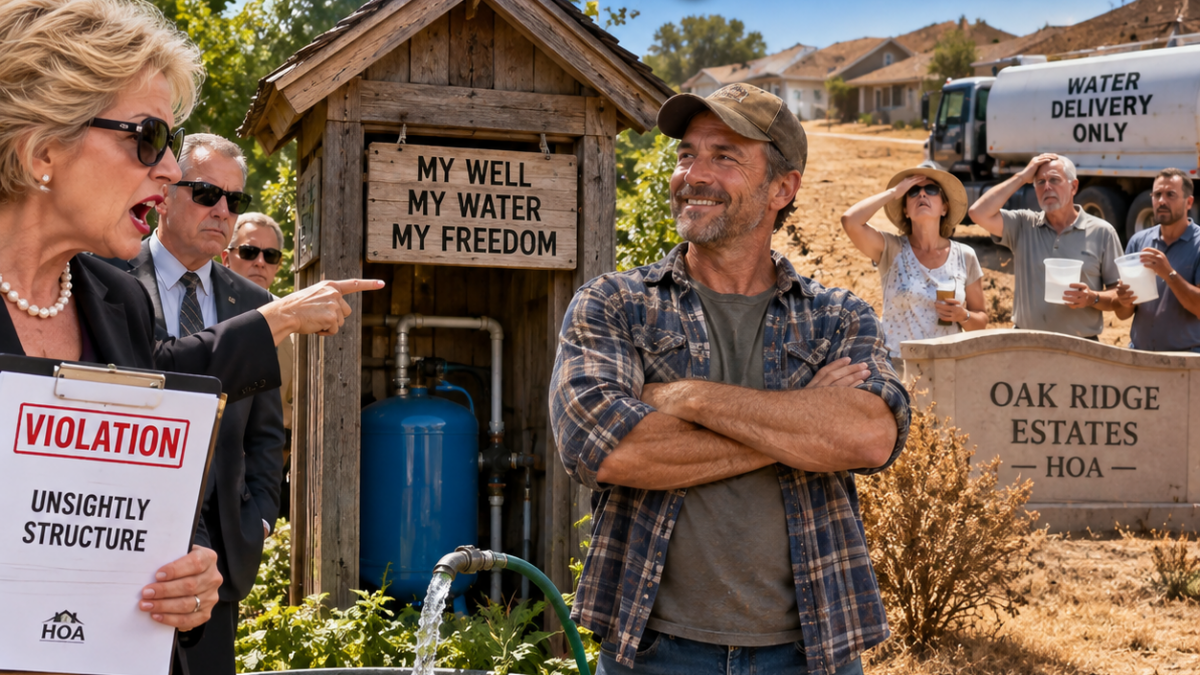
PART 2
By the time I got home from the hearing, the anger had burned down into something more useful.
I put the folder on my dining room table.
Then I made coffee.
That probably sounds ridiculous.
Someone had just threatened to take ten thousand dollars from me and tear down a structure protecting my water supply, and my response was to make coffee.
But twenty years in the Army Corps had taught me something.
Panic makes you move.
Discipline makes you move in the right direction.
I sat down with a yellow legal pad and wrote one sentence across the top.
WHAT AUTHORITY DO THEY ACTUALLY HAVE?
Then I started digging.
I downloaded every version of the Crestwood Meadows covenants I could access.
I printed the bylaws.
I printed the architectural standards.
I printed five years of board minutes.
By midnight, my dining room looked like a law office had exploded inside it.
The next morning, I found the first crack.
The rule Karen had cited—Section C7—had been adopted six months earlier at a special meeting.
According to the minutes, the vote had been three to zero.
Karen.
Bob.
Carol.
Two other board members were absent.
That alone wasn’t unusual.
What interested me was the meeting date.
I checked the bylaws.
Any meeting involving an amendment to architectural restrictions required fourteen days’ notice to homeowners.
I went back through archived emails.
The notice for Karen’s meeting had gone out less than forty-eight hours beforehand.
Tuesday morning.
Ten o’clock.
When most residents were at work.
I smiled for the first time in days.
The woman threatening me over compliance hadn’t complied with her own rules.
I called my daughter.
Sarah worked as a paralegal in the city.
She answered on the third ring.
“Hey, Dad.”
“Got a minute?”
“For you? Always.”
I told her everything.
Karen.
The well house.
The ten-thousand-dollar assessment.
The hearing.
Then I explained what I’d found in the bylaws.
Sarah went quiet.
That usually meant her professional brain had switched on.
“Send me everything.”
“You’re busy.”
“Send me everything.”
I did.
Twenty minutes later, she called back.
“Dad?”
“Yeah?”
“Don’t demolish a nail.”
I laughed.
“Wasn’t planning to.”
“Good. And don’t yell at them. Don’t threaten them. Don’t give them anything they can characterize as harassment.”
“I know.”
“No, you know engineering. I know people who weaponize paperwork.”
“Fair.”
“Document every interaction. Dates, times, letters, emails. If somebody comes onto your land, photograph it. If anything gets damaged, photograph that too.”
Then she said something I didn’t appreciate until later.
“And talk to your neighbors.”
“I generally avoid doing that.”
“I know.”
“It’s why I bought three acres.”
She laughed.
“I’m serious, Dad. Bullies like this survive because every victim thinks their problem is isolated. Find out whether yours is.”
The first fines appeared on my next HOA statement.
$10,000.
Then $100 per day.
I mailed my regular dues on time and wrote clearly in the memo line that the payment applied only to undisputed assessments.
Sarah helped me draft a formal challenge.
We sent it certified.
No response.
Then strange things started happening.
My newspaper disappeared twice.
My trash cans were dragged across the road on collection morning.
Someone reported my pickup for being parked six inches too close to my own driveway edge.
Then one Thursday morning I stepped outside and found a professionally printed sign planted in my front lawn.
FUTURE SITE OF COMMUNITY GREEN SPACE.
I pulled it out.
For a long moment, I stood there holding it.
They weren’t merely planning to force the well house down.
They were already pretending the land beneath it belonged to them.
I put the sign in my garage instead of throwing it away.
Evidence.
Three days later, I found a semicircle of dead grass along my eastern fence.
Not dried grass.
Dead grass.
Yellow, brittle and sharply defined.
I’d spent enough time supervising construction projects to know what ordinary heat stress looked like.
This wasn’t ordinary.
Something had been sprayed.
That changed things.
Paperwork was one kind of fight.
Coming onto my property was another.
That weekend, I installed cameras.
One covered the driveway and well house.
One watched the eastern fence.
Another covered the back acreage.
Night vision.
Motion detection.
Local recording.
Cloud backup.
Sarah called while I was climbing down the ladder.
“What are you doing?”
“Improving my documentary record.”
“You’re installing cameras.”
“Exactly.”
“Please tell me you’re not turning your property into Fort Knox.”
“Fort Knox has worse landscaping.”
She sighed.
“Dad.”
“I promise I’m behaving.”
Six nights later, at 2:17 in the morning, one of those cameras caught a man approaching my fence.
I watched the footage twice.
Then a third time.
The figure wore a hooded sweatshirt and carried a garden sprayer.
He looked both directions.
Then he pushed the nozzle through my fence and sprayed the exact strip where the dead grass had appeared.
When he turned, the hood slipped back.
I recognized him.
Howard Henderson.
Retired accountant.
Two houses down.
Member of Karen’s landscape committee.
I sat back in my office chair.
For the first time since this started, I felt something colder than anger.
Disappointment.
Howard had waved to me for years.
I’d helped him jump-start his Buick one winter.
Now he was sneaking around my property at two in the morning spraying chemicals onto my lawn.
I saved three copies of the video.
One went to Sarah.
She called immediately.
“Go to the police.”
“Not yet.”
“Dad.”
“I have him on video. He’s not going anywhere.”
“That isn’t the point.”
“I know. But I want to know why.”
“You already know why.”
“No. I know who benefits. I don’t know who gave the order.”
Sarah exhaled slowly.
“You’re building a bigger case.”
“I am.”
“Just don’t get so focused on the operation that you forget these are neighbors.”
That sentence stayed with me.
Because the next morning, I started knocking on doors.
My first stop was Maureen Gable’s house.
Mrs. Gable was seventy-eight and had lived there longer than almost anybody.
Her husband had died six years earlier.
She answered wearing gardening gloves.
“Frank?”
“Morning, Maureen.”
“Everything all right?”
“Can I ask you something about the HOA?”
Her expression changed immediately.
Fear.
Not irritation.
Fear.
That told me more than any answer.
She invited me inside.
Her violation had been a peeling mailbox post.
Not collapsing.
Not unsafe.
Peeling.
Karen had sent two warning letters and then imposed a $2,000 fine.
Mrs. Gable had paid a contractor to repaint the post because she was afraid the HOA would put a lien on her house.
“My Social Security doesn’t stretch the way it used to,” she told me.
“How much did the contractor charge?”
“Eight hundred.”
“For a mailbox?”
“He replaced some wood.”
Her eyes dropped.
“I know I should’ve fought it. But after Harold died, I just…”
She stopped.
“You didn’t do anything wrong.”
“She told me I was contributing to neighborhood decay.”
I felt my jaw tighten.
Maureen’s house was immaculate.
Her flower beds were hand weeded.
Her curtains were always clean.
The idea that anybody had made this woman feel ashamed of her home infuriated me more than my own ten-thousand-dollar fine.
My next stop was the Garcia house.
Luis and Elena Garcia had two children and had moved in the year before.
Their violation involved grass.
They’d installed drought-tolerant turf.
It required less irrigation.
It stayed healthier in heat.
It was also slightly darker than the approved Kentucky bluegrass.
Karen had ordered them to remove it.
“What did that cost?” I asked.
Luis stared at me.
“Almost six grand.”
“You replaced healthy grass?”
“Every inch.”
“Why?”
“Because they were charging us $150 a day.”
Elena folded her arms.
“We took out a loan.”
That word landed hard.
A loan.
For grass.
I walked home slowly.
Over the next two weeks, Sarah’s theory proved correct.
The Taylors had been ordered to remove a handcrafted birdhouse Mrs. Taylor’s late father had made.
Another family had been fined over a child’s basketball hoop.
A widower had been ordered to remove a vegetable bed because tomatoes were visible from the sidewalk.
A young mother received violation letters because her toddler’s plastic playhouse wasn’t an approved earth tone.
Nobody had fought.
They had paid.
Complied.
Apologized.
And most importantly, kept quiet.
Karen hadn’t built authority.
She had built isolation.
So I started breaking it.
The first gathering took place at my kitchen table.
I invited the Garcias, Maureen Gable and the Taylors.
Nothing formal.
Coffee.
Tea.
A bowl of tomatoes from my garden.
For the first twenty minutes, I hardly spoke.
I let them talk.
Luis described signing the landscaping loan papers while his daughter asked why they were destroying the grass she’d helped plant.
Mrs. Taylor cried when she talked about the birdhouse.
“My dad built it the year before he died,” she said. “He carved the little roof himself.”
Maureen stared at her cup.
“I thought I was the only one she talked to that way.”
Nobody answered immediately.
Because all of us had thought the same thing.
I finally opened my folder.
“I don’t think any of this is accidental.”
I showed them Section C7.
Then the meeting notice.
Then the bylaw requiring fourteen days.
Luis leaned closer.
“So the rule wasn’t legally adopted?”
“At minimum, there’s a serious procedural challenge.”
I turned another page.
“That’s not all.”
I’d requested financial statements.
Karen had resisted until Sarah helped me cite the association’s own disclosure obligations.
When the records finally arrived, they were interesting.
Legal spending had nearly tripled under Karen.
More interesting was a recurring payment to a company called Pristine Environments LLC.
Landscaping consultation.
Aesthetic enforcement.
Property remediation.
The fees totaled tens of thousands of dollars.
Luis had already looked up the company.
He slid his phone across the table.
“Gerald Dobson.”
“Who’s that?” Mrs. Taylor asked.
“Karen’s brother-in-law.”
The room went silent.
Maureen whispered, “Oh my God.”
I nodded.
“Our dues are paying a company owned by her family.”
“For what?” Elena asked.
“That,” I said, “is what we’re going to find out.”
Then I showed them Howard Henderson’s video.
Watching it alone had made me angry.
Watching my neighbors react made it worse.
Mrs. Taylor covered her mouth.
Luis stood.
“That’s criminal.”
“It may be.”
“We need the sheriff.”
“We will.”
“When?”
“When it matters most.”
Luis frowned.
I understood his frustration.
But I wasn’t interested in one vandalism charge while Karen stayed in power.
I wanted sunlight on the entire operation.
So we organized.
Not a rebellion.
Not officially.
We called ourselves the Concerned Homeowners Committee.
Mrs. Taylor organized documents.
Luis analyzed finances.
Maureen contacted longtime residents.
Sarah helped draft challenges.
I built the timeline.
Then, on one Monday morning, five thick certified envelopes arrived at the management company.
Each challenged fines.
Each requested hearings.
Each demanded records.
Each cited specific provisions of the HOA’s own governing documents.
Each requested disclosure of contracts involving Pristine Environments.
Two days later, Karen called me.
“Mr. Peterson.”
She didn’t say hello.
“Karen.”
“This coordinated campaign of harassment ends now.”
“Requesting records is harassment?”
“You know exactly what you’re doing.”
“I do.”
“You are encouraging residents to undermine this board.”
“No. I’m encouraging residents to read.”
Her voice hardened.
“Our attorneys are prepared to act.”
“That’s their job.”
“We may pursue damages.”
“For reading?”
“For interference.”
I almost laughed.
Instead, I said, “Then I suggest your attorneys read Section C7’s meeting notice.”
Silence.
It lasted only two seconds.
But it told me everything.
She knew.
“You’re making a serious mistake.”
“No, Karen. I think I’m finally correcting one.”
I hung up.
The next morning, another certified letter arrived.
Thirty-day demolition deadline.
Final notice.
The association claimed it was “evaluating contractor access.”
That phrase caught my attention.
Contractor access.
I called Sarah.
“Can they physically tear it down?”
“Not legally without a long list of problems.”
“I know about property law. I’m asking something else.”
I had spent the previous night reading county health regulations governing private wells.
Buried in the language was the protection I needed.
Registered potable wells had to be protected against contamination, surface runoff and physical damage.
The well house wasn’t cosmetic.
It was part of that protective system.
Destroying it without proper health-department review could create a public health violation.
I contacted the county.
A water-systems inspector named Daniel Reeves agreed to visit.
He walked around the structure, checked my registration, examined the wellhead and nodded.
“This building’s old.”
“That’s what everybody keeps telling me.”
He smiled.
“Old doesn’t mean illegal.”
“Can an HOA order it removed?”
“They can order you to paint it pink for all I care. But nobody should expose this wellhead or alter the protective enclosure without permits and proper sanitary controls.”
“Can you put that in writing?”
He looked at me.
“You expecting trouble?”
“Yes.”
Two days later, I had a county letter.
I sent copies to the HOA.
The management company.
And their law firm.
My message was short.
Any unauthorized attempt to damage or remove the well house would be immediately reported to county health officials and law enforcement as interference with a registered private water system.
Karen went silent.
No more demolition letters.
The well-house fines disappeared from the next statement.
She never admitted defeat.
People like Karen rarely do.
They simply retreat from one battlefield and attack somewhere else.
And she did.
The Garcias suddenly received two new violations.
Mrs. Taylor received another notice.
Maureen got cited because one shrub extended four inches over an imaginary landscaping boundary.
Karen couldn’t break me, so she punished anyone standing beside me.
That was when I started wanting more than victory.
I wanted her gone.
Then summer changed everything.
By late July, the heat had become oppressive.
Not ordinary heat.
The kind that seemed to press downward from the sky.
Day after day passed without rain.
The hills turned pale.
Creeks shrank.
The reservoir level dropped.
Local news stations started using phrases like “historic drought.”
Then came the restrictions.
Stage One.
Stage Two.
Finally Stage Three.
Outdoor municipal watering was prohibited.
No sprinklers.
No washing cars.
No filling pools.
No watering decorative lawns.
The county mailed warnings.
People who ignored them faced fines and possible shutoffs.
Within two weeks, Crestwood Meadows changed color.
Karen had spent years trying to make every yard identical.
Now nature did it for her.
Every lawn turned brown.
Kentucky bluegrass curled and died.
Hydrangeas wilted.
Rose bushes dropped leaves.
The entrance landscaping looked exhausted.
Even Karen’s enormous front yard became yellow and brittle.
Mine stayed green.
Not perfectly green.
I wasn’t interested in wasting water.
But my trees survived.
My garden survived.
The patch of grass around my house survived.
Because my water didn’t come from the shrinking reservoir.
It came from several hundred feet underground.
From the well inside the ugly cinder-block building Karen had wanted destroyed.
The irony was impossible to miss.
Every evening, I heard the pump running.
A low mechanical hum.
For years, it had been background noise.
Now it sounded different.
Steady.
Reassuring.
Alive.
One evening, I was watering my vegetable beds when I noticed Elena Garcia standing near the driveway.
She had two five-gallon buckets.
She looked embarrassed.
“Frank?”
I shut off the hose.
“What’s wrong?”
“My kids planted a sunflower.”
I waited.
“They started it from a seed at school. It’s almost as tall as Mateo now.”
She laughed nervously.
“It’s stupid.”
“No, it isn’t.”
“It hasn’t had water in days.”
She looked toward the buckets.
“Could I buy some from you?”
“Buy?”
“I don’t want charity.”
I walked over, picked up both buckets and carried them to the spigot.
“You’re not buying water from me for a child’s sunflower.”
I filled them.
Elena’s eyes became wet.
“Thank you.”
“Tell Mateo I expect to see that sunflower when it blooms.”
The next night, someone else came.
Howard Henderson.
The man from my camera footage.
He stood at the bottom of the driveway holding two watering cans.
For a second neither of us spoke.
He knew that I knew.
I could see it.
“Frank.”
“Howard.”
He removed his cap.
“My wife’s azaleas are dying.”
I stared at him.
Thirty years, he explained.
His wife had planted them when they bought the house.
She was sick.
Not terminally ill, but weak enough that she rarely came outside anymore.
Those flowers were one of the few things she could still see from her chair by the window.
Howard swallowed.
“I wondered if maybe…”
He couldn’t finish.
Every ugly instinct in me wanted to say no.
I wanted to remind him about 2:17 a.m.
I wanted to ask what chemical he’d sprayed.
I wanted him to feel powerless for once.
Then I remembered Sarah’s warning.
These were still neighbors.
I took his watering cans.
“Bring them up.”
His head snapped toward me.
“What?”
“Bring them up, Howard.”
I filled both.
He watched the water pouring into them.
“Frank…”
I shut off the spigot.
“I haven’t forgotten.”
His face fell.
“I know.”
“But your wife’s flowers didn’t poison my grass.”
His eyes filled.
He nodded.
“Thank you.”
The next night, four families came.
Then seven.
The Taylors wanted water for the Japanese maple planted after Mrs. Taylor’s father died.
A family on Willow Lane had a newly planted oak dedicated to a stillborn child.
Maureen wanted enough to keep her herb garden alive.
I gave it to them.
Not unlimited amounts.
Not enough to waste on whole lawns.
Enough to save things that mattered.
Trees.
Gardens.
Flowers connected to memories.
People brought containers.
We filled them at dusk.
They started talking while they waited.
Neighbors who had barely waved at each other now held hoses for one another.
Teenagers carried buckets for elderly residents.
Luis built a simple spreadsheet to keep usage reasonable.
What had started as a favor became something else.
Community.
And every evening the line formed beside the structure Karen had called an abomination.
I never mentioned that fact.
I didn’t need to.
Everyone saw it.
Then Karen sent the email.
EMERGENCY COMMUNITY MEETING.
The subject concerned “landscape deterioration.”
I laughed when I read the agenda.
She intended to propose fines for brown lawns.
During a government watering ban.
Luis called me.
“Tell me I’m reading this wrong.”
“You’re reading it right.”
“She wants to fine people because they’re obeying drought restrictions?”
“Apparently.”
“Frank.”
“Yeah?”
“I think she’s lost her mind.”
“No.”
I looked out my window toward the line beside my well.
“I think she’s losing control.”
The clubhouse was packed the night of the meeting.
Standing room only.
I’d never seen that many residents attend anything.
Karen sat at the front between Bob and Carol.
She looked tired.
Not weak.
Tired.
There is a difference.
Weak people sometimes reconsider.
Tired tyrants usually double down.
She struck the gavel.
“This emergency meeting will come to order.”
People quieted.
She began with a speech about hardship.
Shared sacrifice.
Property values.
The importance of preserving Crestwood Meadows’ reputation.
Then she revealed her proposal.
Any property with more than fifty percent dead or brown turf would pay a $200 monthly landscape remediation assessment.
The money would supposedly be used for future reseeding.
For several seconds, nobody spoke.
Then a man near the back said, “You’re going to fine us because we’re not allowed to water?”
Someone laughed.
Another person shouted, “Are you serious?”
Karen banged the gavel.
“This is not optional commentary.”
That was my moment.
I stood.
“Point of order.”
Her eyes found me immediately.
“Mr. Peterson, sit down.”
“Bylaw 4.2 gives homeowners the right to address proposed new business before a vote.”
The room quieted.
Karen’s face tightened.
Bob whispered something to her.
She knew I was right.
“You have three minutes.”
“I’ll be concise.”
I walked toward the front.
Luis already had his laptop connected to the projector.
Karen noticed.
“What is that?”
“Financial records.”
The first spreadsheet appeared behind her.
Forty thousand dollars in legal expenses.
Then payments to Pristine Environments.
I faced the crowd.
“These figures come directly from association records.”
Murmurs spread.
Luis stood.
“This board has nearly tripled legal expenditures in two years while aggressively pursuing homeowners for minor aesthetic violations.”
He changed slides.
Pristine Environments LLC.
Owner: Gerald Dobson.
Karen’s brother-in-law.
The room erupted.
Karen stood.
“This is a legitimate vendor.”
“Was the relationship disclosed?” Luis asked.
“Yes.”
“Where?”
Karen hesitated.
Luis continued.
“We reviewed the minutes. We found no recorded conflict-of-interest disclosure.”
Bob looked suddenly fascinated by the table.
Carol whispered, “Karen?”
Karen turned on her.
“Don’t.”
I took the floor again.
“This board fined Mrs. Gable over a mailbox.”
Maureen stood slowly.
People turned toward her.
“They called my home community decay,” she said.
Her voice trembled.
But she kept speaking.
“I paid because I was afraid.”
Elena Garcia stood.
“We borrowed six thousand dollars to replace drought-resistant grass because Karen didn’t like the color.”
Mrs. Taylor rose next.
“They made me destroy my father’s birdhouse.”
One by one, people spoke.
Not screaming.
Testifying.
And with every story, Karen seemed smaller.
She struck the gavel.
“This meeting is being hijacked by a coordinated group of malcontents!”
“No,” I said.
I looked around the clubhouse.
“This meeting is finally being attended by the people paying for it.”
Applause broke out.
Karen shouted over it.
“You have no evidence of misconduct!”
I looked at Luis.
He pressed a key.
The projector went black.
Then the security footage appeared.
Timestamp.
2:17 a.m.
Eastern fence.
Howard Henderson walked onto the screen.
He removed the sprayer.
He pushed the nozzle through my fence.
He sprayed.
A collective gasp moved through the room.
Howard was sitting near the aisle.
He lowered his head.
Karen froze.
I faced her.
“This man served on your landscape committee.”
Howard suddenly stood.
His hands shook.
“Tell them,” I said quietly.
Karen shouted, “Howard, don’t you dare—”
That was the worst possible thing she could have said.
Every person in the room heard it.
Howard looked at her.
Then at me.
Then at the neighbors.
“She told me Frank was destroying property values.”
Karen’s face drained.
“That’s a lie.”
“She said if I helped document deterioration around his property, she’d make my driveway violations disappear.”
“Howard!”
“You told me to make the grass look neglected.”
The room exploded.
Karen hammered the gavel uselessly.
“You’re confused!”
Howard shook his head.
“No.”
His voice cracked.
“For once, I’m not.”
I could have destroyed him in that moment.
Instead, I stayed quiet.
Howard had done something wrong.
But confession mattered.
Karen’s power had always depended on everyone believing obedience was safer than truth.
Howard had just proved otherwise.
I waited until the noise subsided.
Then I said, “There’s one more issue.”
The room settled.
“Water.”
Everybody looked toward me.
“Right now, people in this neighborhood are watching trees, gardens and landscaping die because the reservoir is under emergency restrictions.”
Karen folded her arms.
“What does this have to do with board governance?”
“Everything.”
I turned toward the residents.
“My well isn’t connected to the municipal system.”
Heads nodded.
Most already knew.
“The same well this board tried to disable by forcing me to demolish its protective structure.”
A voice in the crowd said, “That’s the well we’re getting water from.”
“Yes.”
Karen’s eyes narrowed.
I continued.
“I’ve been sharing water informally. That can continue for a while. But if this drought gets worse, we need a fair system.”
People leaned forward.
“So here’s my proposal.”
I paused.
“Recall this board.”
Absolute silence.
Karen stared at me.
“Excuse me?”
“Recall the current board.”
“You don’t have the authority.”
“I don’t need it.”
I held up the bylaws.
“The homeowners do.”
Mrs. Taylor opened a folder.
Inside were recall petition forms Sarah had helped us prepare.
Karen’s expression finally changed.
Not anger.
Fear.
I continued.
“Elect an interim board. Conduct an independent audit. Rescind improperly adopted aesthetic rules. Review fines issued under those rules.”
Then I looked around the room.
“And if that happens, I’ll pay to install a multi-spigot distribution manifold on my property so every household can receive a controlled emergency water allocation from my well for the duration of this drought.”
For one heartbeat, nothing happened.
Then Maureen stood.
She started clapping.
Luis joined her.
Then Elena.
Then the Taylors.
Within seconds, nearly the entire clubhouse was on its feet.
The applause wasn’t polite.
It was thunderous.
Karen shouted something I couldn’t hear.
Nobody cared anymore.
Mrs. Taylor walked down the first row with the petition.
People signed.
Second row.
More signatures.
Third row.
Karen grabbed her purse.
“This meeting is adjourned.”
Nobody moved.
She struck the gavel again.
“Adjourned!”
Luis looked at her.
“With respect, Karen, I don’t think you’re running this meeting anymore.”
That was the moment her presidency ended.
Not officially.
That came later.
But power is strange.
Sometimes a title remains after authority has disappeared.
Karen still had the gavel.
She just didn’t have the room.
Within forty-eight hours, more than eighty percent of homeowners had signed the recall petition.
Bob resigned first.
His letter said he wanted to “reduce division.”
Carol resigned six hours later.
Karen lasted another day.
Her resignation email was four paragraphs long.
She blamed misinformation.
Personal attacks.
Hostile factions.
Outside interference.
She never mentioned the financial records.
She never mentioned Howard.
She never mentioned my well.
Then she resigned effective immediately.
I read the email twice.
Sarah called that night.
“How does victory feel?”
I sat on my porch.
“Quieter than I expected.”
“You won.”
“We won.”
“Dad.”
“What?”
“Enjoy it for five minutes.”
I smiled.
“Fine.”
She laughed.
“Five.”
“All right.”
I leaned back and listened to the cicadas.
For five minutes, I allowed myself to feel good.
Then we got to work.
The interim board consisted of Elena Garcia, Tom Taylor and a retired schoolteacher named Evelyn Brooks.
Their first meeting was held one week later.
No secret Tuesday morning session.
No forty-eight-hour notice.
Every homeowner received proper notification.
The room was packed again.
The first vote rescinded Section C7.
Unanimous.
The second suspended aesthetic fines issued under Karen’s disputed amendments.
Unanimous.
Then Tom Taylor read each major case aloud.
“Maureen Gable. Mailbox post.”
Rescinded.
Maureen cried.
“Garcia residence. Turf species.”
Rescinded.
Luis squeezed Elena’s hand.
“Taylor residence. Birdhouse.”
Rescinded.
Mrs. Taylor closed her eyes.
Then Tom looked at me.
“Peterson residence. Well house.”
A few people laughed.
Tom smiled.
“Rescinded with prejudice.”
Applause filled the room.
The board also adopted an explicit grandfather clause protecting legally permitted structures that predated the HOA’s architectural rules.
Then came the audit.
That part wasn’t dramatic.
Audits rarely are.
Boxes.
Invoices.
Contracts.
Bank statements.
But the results mattered.
Pristine Environments had received thousands of dollars through a contracting process with inadequate disclosure.
Some expenses were legitimate.
Others were questionable enough that the board referred the matter to its attorney and appropriate state authorities.
Nobody walked out in handcuffs.
Life isn’t always that theatrical.
But Karen’s brother-in-law lost the contract.
Several payments were challenged.
Insurance representatives became involved.
And the HOA recovered enough money through settlements and credits to replenish a large portion of its depleted operating reserve.
More importantly, the board changed the procurement rules.
Related-party contracts had to be disclosed.
Competitive bids became mandatory above a set threshold.
Meeting notices had to be documented.
Homeowners received access to monthly expense reports.
Power became boring again.
That’s one of the healthiest things that can happen to power.
Meanwhile, the drought worsened.
So I kept my promise.
A licensed plumbing contractor helped install a six-spigot manifold near my driveway.
Flow regulators.
Backflow protection.
Timers.
A lockable main valve.
The new board coordinated collection hours.
Every household received a modest daily allocation.
Enough for priority plants, young trees and household emergency use if necessary.
Nobody was allowed to fill pools.
Nobody washed cars.
Nobody watered entire lawns.
The point wasn’t keeping Crestwood Meadows beautiful.
The point was keeping living things alive.
Something changed during those evening water hours.
People talked.
Really talked.
They brought folding wagons.
Children helped carry containers.
Teenagers volunteered to deliver water to elderly neighbors.
Somebody started leaving lemonade on a table near the manifold.
Maureen brought cookies.
One evening I saw Luis helping Bob—the former board member—load containers into his SUV.
That surprised me.
Bob looked embarrassed.
Luis just said, “They’re heavy.”
That was it.
No speech.
No revenge.
Just help.
I began to understand something.
Karen had taught us to see each other as inspectors.
Potential complainers.
Potential rule breakers.
The drought forced us to see each other as neighbors again.
Howard came by regularly.
At first he collected water only for his wife’s azaleas.
Then one evening he stayed behind.
“Can we talk?”
I closed the valve.
“Sure.”
He looked older than I remembered.
“My wife knows.”
“About the lawn?”
He nodded.
“She made me tell her.”
I waited.
“She was furious.”
“I imagine so.”
“She asked what kind of man sneaks around poisoning another man’s property because he’s scared of an HOA fine.”
He rubbed his face.
“I didn’t have an answer.”
“Howard, Karen didn’t make you do it.”
“I know.”
That mattered.
No excuse.
No shifting blame.
“I was weak,” he said. “And I was scared. She’d been threatening us about the driveway and the shed. I kept telling myself it was just weed killer. That you wouldn’t even know.”
“I knew.”
“I know.”
Silence stretched between us.
“I’ll pay for the grass.”
“No.”
“Frank—”
“The grass grew back.”
“Then let me pay for something.”
I looked toward the water station.
“Help the older residents carry their containers.”
He blinked.
“That’s it?”
“That isn’t nothing.”
From then on, Howard showed up every evening.
He carried buckets for Maureen.
Fixed a wheel on Mrs. Taylor’s cart.
Replaced a cracked hose fitting.
He didn’t talk much.
He didn’t need to.
Apologies matter.
Changed behavior matters more.
I never pressed vandalism charges.
Some people told me I should have.
Maybe they were right.
But I had what I wanted.
Not revenge against Howard.
Accountability.
He had admitted what he’d done publicly.
He’d lost trust.
Then he spent months rebuilding it.
Karen was different.
She never apologized.
For several weeks after resigning, she remained inside her large beige house with the blinds closed.
Her roses died.
Her lawn turned brown like everyone else’s.
One evening I saw her standing outside looking toward the line of neighbors collecting water from my property.
For a second, our eyes met across the road.
I wondered if she’d come over.
If she had brought two buckets and asked politely, I would have filled them.
I mean that.
Water isn’t a weapon.
But she never came.
Pride can make a person choose thirst over humility.
By October, rain finally appeared in the forecast.
The first storm came overnight.
I woke around three in the morning to the sound of water hitting the roof.
Not the mechanical hum of my pump.
Rain.
Real rain.
I got out of bed and stepped onto the covered porch.
Across Crestwood Meadows, gutters overflowed.
Dry soil darkened.
Leaves trembled under the downpour.
I stood there barefoot in the cool air and laughed.
The next morning, children were jumping in puddles.
Neighbors stood outside drinking coffee.
Maureen called me.
“Frank, look at my garden.”
Her rosemary had survived.
So had the Garcia children’s sunflower.
That sunflower had become ridiculous.
Nearly nine feet tall.
Mateo made me come see it.
“You saved it,” he said.
“No.”
I pointed at him.
“You carried the water.”
“But it was your water.”
I looked at the flower.
“Maybe it was everybody’s.”
A month later, a real-estate sign appeared in Karen’s yard.
FOR SALE.
Nobody celebrated publicly.
That would’ve been cruel.
But people noticed.
Her house sold before Christmas.
The moving truck arrived on a gray morning.
I was repairing a hinge on the well-house door when Karen’s SUV pulled out of her driveway for the last time.
She slowed near my property.
For half a second I thought she might stop.
She didn’t.
I watched her drive away.
I expected satisfaction.
Instead, I felt tired.
Sarah came for dinner that weekend.
We sat near the fireplace.
“You okay?” she asked.
“Yeah.”
“You don’t look victorious.”
“I don’t feel victorious.”
“Why?”
I thought about it.
“Because she wasted so much.”
“Money?”
“More than that.”
I looked toward the dark window.
“She could’ve been useful.”
Sarah nodded.
“She was organized. Persistent. She knew everybody. She could’ve been a good HOA president.”
“But?”
“She cared more about being obeyed than being useful.”
Sarah smiled faintly.
“There’s your lesson.”
“I didn’t know we were looking for one.”
“Stories always have one.”
The following spring, I turned my attention to the well house.
The building looked rough.
Karen hadn’t been entirely wrong about that.
Paint peeled near the foundation.
One corner needed patching.
The steel door was faded.
So I spent a weekend fixing it.
Not because the HOA ordered me.
Because I wanted to.
I patched the mortar.
Scraped away old paint.
Primed the blocks.
Then I chose a deep forest green.
Tom Taylor stopped by while I was painting.
“You know the approved palette is beige.”
I stared at him.
He stared back.
Then he laughed.
“I’m kidding.”
“You’re about three seconds away from getting painted.”
He raised both hands.
“Forest green looks good.”
It did.
I planted a climbing rose beside the south wall.
That was my private joke.
Karen’s roses had died during the drought.
Mine eventually climbed halfway up the old cinder block.
The well house didn’t become beautiful in the conventional sense.
It still had no decorative shutters.
No fake stone facade.
No architectural flourishes.
It looked sturdy.
Purposeful.
Honest.
Exactly what it had always been.
The new board asked whether they could install a small plaque beside the community water manifold.
I almost refused.
Then I read what they wanted engraved.
CRESTWOOD MEADOWS EMERGENCY WATER POINT
BUILT THROUGH NEIGHBORHOOD COOPERATION
No mention of me.
No mention of Karen.
No mention of the fight.
I approved it.
That seemed right.
Over time, Crestwood Meadows became a different place.
Not perfect.
We still had an HOA.
We still had rules.
People still argued about parking and fences and noise.
But the rules became narrower.
Clearer.
Safety mattered.
Drainage mattered.
Shared property mattered.
Whether someone’s mailbox was the wrong shade of brown generally didn’t.
Maureen painted hers bright blue the following summer.
Nobody fined her.
Mrs. Taylor rebuilt the birdhouse using her father’s original pieces.
Luis replaced part of his lawn with the same drought-tolerant grass Karen had forced him to remove.
This time half the neighborhood copied him.
And when the county issued another mild drought advisory two years later, we didn’t panic.
We already had a plan.
The manifold was tested every spring.
The well was inspected.
Usage rules were posted.
The neighborhood had learned the difference between appearance and resilience.
Sometimes people walking past my property still ask about the green concrete building.
“What’s that?”
I usually smile.
“My well house.”
It sounds simple.
And it is.
But every time I open that steel door and hear the pump engage, I remember Karen standing at my property line with her clipboard.
Thirty days, Mr. Peterson.
She had believed the building was worthless because it wasn’t pretty.
She thought value could be measured by conformity.
Matching colors.
Approved grass.
Decorative standards.
Then the rain stopped.
And suddenly nobody cared whether the blocks matched my house.
They cared about what was inside.
Water.
Life.
Independence.
The thing Karen had tried hardest to remove became the thing her community needed most.
For a long time, I thought that was the revenge.
I thought the perfect ending was Karen watching neighbors line up beside the building she’d condemned.
But I was wrong.
Revenge would’ve been letting her roses die.
Revenge would’ve been turning Howard away.
Revenge would’ve been standing behind my fence with thousands of gallons beneath my feet while everyone else suffered.
What happened instead was better.
We shared.
And every bucket carried away from my property weakened the kind of fear Karen had used to control people.
Every conversation in that line rebuilt something she’d spent years breaking.
Every neighbor who helped another carry water proved that communities are held together by cooperation, not intimidation.
Karen lost because she wanted authority.
The rest of us won because we finally chose responsibility.
Years later, Maureen’s blue mailbox is still standing.
The Garcia family’s drought-resistant lawn still looks slightly different from everyone else’s.
Mrs. Taylor’s birdhouse hangs proudly beside her porch.
Howard still lives two doors down.
His wife’s azaleas survived.
So did their marriage, though he once told me it took her a long time to forgive him.
Mateo’s giant sunflower is long gone, but the Garcias saved its seeds.
Every spring, a few new sunflowers appear along their back fence.
And the old well house remains exactly where it has stood since 1981.
Cinder block.
Steel door.
Forest-green paint.
Climbing roses.
Useful.
Unfashionable.
Indestructible.
Sometimes on hot summer evenings, I sit on my porch and hear children riding bicycles past the water station.
I hear neighbors talking across yards.
I hear sprinklers running when restrictions allow them.
And beneath all of it, faint but steady, comes the hum of my pump.
Karen once heard that sound and imagined an eyesore.
I hear it now and remember a neighborhood learning, one bucket at a time, what actually makes a community worth protecting.
Not perfect lawns.
Not identical houses.
Not threatening letters.
People.
Especially the ones willing to share what they have when everyone else is running dry.
And that is why I never tore down my well house.
I didn’t save it because I was stubborn.
I saved it because it belonged to my home.
I just never imagined that one day, in the middle of the worst drought Crestwood Meadows had seen in decades, that ugly little building would help save everybody else’s too.
Within forty-eight hours, more than eighty percent of Crestwood Meadows had signed the recall petition.
That number mattered.
Karen could dismiss me as a disgruntled homeowner.
She could call Luis Garcia a troublemaker.
She could dismiss Maureen Gable as confused, Howard Henderson as dishonest, and Mrs. Taylor as overly sentimental about a birdhouse.
But she couldn’t dismiss eighty percent of the neighborhood.
Bob resigned first.
His email arrived at 8:13 on Thursday morning.
He claimed he wanted to step away because the board had become “unnecessarily divisive.”
Not one word about the illegal meeting notice.
Not one word about the contracts.
Not one word about sitting silently while Karen tried to fine an elderly widow over peeling paint.
Carol resigned before lunch.
Her message was shorter.
She wrote that recent events had caused her to “reconsider her ability to serve effectively.”
Then everyone waited for Karen.
Nothing came Thursday.
Nothing came Friday morning.
At three that afternoon, I was beside the well house checking the pressure gauge when my phone buzzed.
Luis.
“You see it?”
“See what?”
“She resigned.”
I wiped my hand on my jeans and opened my email.
There it was.
Four paragraphs.
Karen blamed misinformation.
She blamed hostility.
She blamed a “small but aggressive faction” for poisoning community trust.
She accused homeowners of failing to appreciate the unpaid sacrifices she’d made.
The one thing she never did was accept responsibility.
At the bottom was a single sentence.
Effective immediately, I resign as president and director of the Crestwood Meadows Homeowners Association.
I read it twice.
The pump hummed behind the steel door.
I expected to feel triumphant.
Instead, I felt something closer to exhaustion.
Ten thousand dollars in threatened fines.
Weeks of harassment.
A dead patch of lawn.
Neighbors frightened in their own homes.
Thousands of dollars wasted on lawyers.
And for what?
Because one woman couldn’t tolerate an old concrete well house.
Sarah called that evening.
“Congratulations.”
“I didn’t do it alone.”
“I know.”
“I mean it.”
“Dad, accepting five seconds of credit won’t kill you.”
I smiled despite myself.
“All right. Five seconds.”
“Starting now.”
I looked across my property.
The sun was dropping behind the oaks.
At the edge of the driveway, six neighbors were filling containers from my outdoor spigot.
Maureen sat on a folding chair while Mateo Garcia helped carry one of her buckets.
Howard Henderson stood several yards away, waiting quietly with two watering cans.
I thought about Karen’s resignation.
Then I thought about that little line of people.
“My five seconds are over,” I said.
Sarah laughed.
“What are you thinking about?”
“Water.”
“Of course you are.”
“The recall solved the board problem. It didn’t solve the drought.”
That became the next job.
The interim board formed the following week.
Nobody ran a campaign.
Nobody printed glossy flyers.
People were tired of personalities.
They wanted competence.
Elena Garcia agreed to serve.
Tom Taylor volunteered.
The third member was Evelyn Brooks, a retired middle-school principal who had lived in Crestwood Meadows for eighteen years and possessed the rare ability to make grown adults stop arguing simply by looking over the top of her glasses.
Their first decision was simple.
Everything would happen in public.
Every meeting notice went out properly.
Agendas were posted in advance.
Financial documents were made available.
No surprise votes.
No hidden amendments.
No special sessions scheduled when people were at work.
The clubhouse filled for the first meeting.
Karen’s chair sat empty at the center of the long table.
Nobody moved it.
Evelyn simply sat somewhere else.
That small gesture told me more about the new board than any speech could have.
“We are not replacing one ruler with another,” she said after calling the meeting to order. “We are restoring an association.”
The first item was Section C7.
The aesthetic amendment Karen had used against me.
Tom read the notice history into the record.
Then he read the fourteen-day requirement.
Then he made the motion.
“All in favor of rescinding Section C7 and any penalties issued solely under its authority?”
Three hands went up.
Unanimous.
A strange sound came from behind me.
I turned.
Maureen Gable was crying.
Not dramatically.
She had one hand pressed to her mouth, and tears were slipping down her cheeks.
Elena saw her.
“Mrs. Gable?”
Maureen shook her head.
“I’m all right.”
She wasn’t.
Not yet.
The next item was outstanding aesthetic penalties.
Tom went through them individually.
“Gable residence. Mailbox post.”
Evelyn looked toward Maureen.
“Recommended action: rescind the fine and issue reimbursement for any penalty amounts already collected.”
Maureen stared at her.
“You’re giving it back?”
“If it was improperly assessed, yes.”
Maureen lowered her head.
Two thousand dollars may not sound life-changing to everyone.
To a widow living on a fixed income, it was.
“Garcia residence,” Tom continued. “Drought-tolerant turf.”
Luis squeezed Elena’s hand.
“Rescind penalties.”
Tom looked at them.
“Additionally, because the Association required removal of landscaping under a procedurally defective rule, legal counsel recommends negotiating reimbursement for documented replacement expenses.”
Luis went still.
“You mean the six thousand?”
“We mean we’re going to examine it,” Evelyn said. “We can’t promise a number tonight. But yes.”
Elena began crying.
Their daughter, sitting beside them, whispered, “Mom?”
Elena bent and kissed the top of her head.
“Happy tears.”
Then came the Taylors.
Birdhouse.
Fine rescinded.
And finally—
“Peterson residence. Detached private well enclosure.”
People chuckled.
Tom looked at me.
“Frank, anything you’d like to say before we vote?”
“No.”
“You sure?”
“I’ve said enough.”
He grinned.
“Recommended action: rescind all well-house violations, remove all fines and explicitly grandfather legally permitted structures predating the association.”
Evelyn raised her hand.
“So moved.”
Elena seconded.
Three votes.
Done.
Someone clapped.
Then everyone did.
I looked down at my hands.
It should have felt like the biggest victory of the night.
It didn’t.
The biggest victory was Maureen knowing she’d get her money back.
It was Luis realizing the debt Karen had forced onto his family might finally be addressed.
It was Mrs. Taylor learning she could put her father’s birdhouse back where she wanted it.
My building had survived.
Their dignity had taken longer.
The financial audit began two weeks later.
An independent forensic accountant named Rachel Monroe was hired.
Rachel was in her forties, spoke quickly and had a talent for making people nervous simply by asking them to explain an invoice twice.
She requested three years of bank statements.
Vendor contracts.
Board approvals.
Reimbursements.
Legal invoices.
Credit-card records.
Within ten days, the picture became uglier.
Not everything Karen had done was illegal.
That distinction mattered.
I didn’t want rumor replacing evidence.
But the evidence was bad enough.
Pristine Environments LLC—her brother-in-law’s company—had been paid far above what comparable firms charged.
Some work was legitimate.
They had maintained common landscaping.
They had repaired irrigation.
They had performed seasonal cleanup.
But several invoices were vague.
“Compliance remediation.”
“Visual integrity correction.”
“Special enforcement services.”
One invoice corresponded almost exactly with the week that sign appeared in my yard announcing the future community green space.
Another covered “vegetation treatment services” during the same period Howard poisoned my grass.
Rachel didn’t accuse anyone publicly.
She didn’t need to.
At the next meeting she stood before a packed room and said, “There are sufficient irregularities to justify referral to legal counsel and appropriate oversight authorities.”
Karen wasn’t there.
Neither was her brother-in-law.
For the first time in years, our HOA hired lawyers to protect homeowners instead of threaten them.
The Association demanded records from Pristine Environments.
Insurance carriers became involved.
Negotiations began over questionable payments.
Eventually, part of the money came back.
Not all of it.
Real life rarely delivers perfect restitution.
But enough was recovered that the operating reserve stopped looking like an empty bucket.
The new board also refunded several families for penalties that should never have been collected.
Maureen received her check on a Tuesday.
I know because she walked directly from her mailbox to my house.
She held the envelope with both hands.
“Frank.”
I was sitting on the porch repairing an old hose nozzle.
“What happened?”
She handed me the check.
I looked at it.
Two thousand dollars.
Her lower lip trembled.
“They gave it back.”
“They should have.”
“I thought I’d never see it again.”
She sat beside me.
For a moment neither of us spoke.
Then she said, “Harold would’ve fought them.”
Her late husband.
I had only known him briefly.
Quiet man.
Always wore suspenders.
“You fought them too.”
“No.”
She looked at the check.
“I paid.”
“You survived.”
She turned toward me.
“That’s different.”
“Sometimes surviving until somebody can stand beside you is the fight.”
Her eyes filled.
She reached over and squeezed my hand.
That afternoon, she painted her mailbox.
Blue.
Bright blue.
Not navy.
Not an approved muted coastal blue.
The kind of blue you’d see on a child’s box of crayons.
I stopped my truck beside her driveway.
“Maureen.”
She looked guilty for half a second.
“Yes?”
“You miss a spot.”
She threw the paintbrush at me.
It landed three feet short.
I hadn’t laughed that hard in months.
The drought, meanwhile, refused to end.
By mid-August, the reservoir had fallen to a level nobody remembered seeing.
The county extended emergency restrictions.
Foundation companies began warning homeowners that extreme soil shrinkage could damage slabs.
Young trees across town started dying.
Fire crews issued burn warnings.
The landscape had stopped being merely ugly.
It was becoming dangerous.
My well remained stable.
That frightened me almost as much as it reassured me.
No aquifer is infinite.
I didn’t want Crestwood Meadows treating my water as a miracle that required no management.
So I hired a licensed well contractor to test the system.
He checked static water level.
Recovery rate.
Pump capacity.
Water quality.
Then we sat at my kitchen table.
“You can supply more than your house needs,” he said.
“How much more?”
He wrote some numbers.
“Safely? Enough for controlled emergency distribution. Not enough for everyone to pretend there’s no drought.”
“That’s what I expected.”
“If people start filling swimming pools, you’ll have problems.”
“They won’t.”
“You sure?”
“I’ve met people.”
He laughed.
“Fair answer.”
We designed a distribution manifold.
Six hose bibs along a reinforced line near the property boundary.
Backflow preventers.
Individual shutoffs.
Flow regulators.
A master meter.
Nothing improvised.
Nothing dangerous.
The Army Corps hadn’t cured me of overengineering.
The contractor looked at my sketch.
“You really want six?”
“I want eight.”
“You said six.”
“I changed my mind.”
“Why?”
“Redundancy.”
He stared at me.
“You engineers are exhausting.”
We installed eight.
The new HOA paid for part of the permitting and testing.
I paid for the equipment.
People argued with me about that.
Luis especially.
“This is serving the whole neighborhood.”
“My well.”
“Our hoses.”
“My manifold.”
“Our drought.”
It went on until Elena told both of us to shut up.
The compromise was that I purchased the hardware while the Association covered inspections and ongoing emergency maintenance.
Collection hours were established.
Six to eight in the evening.
Households registered for a daily allowance.
No lawn irrigation.
No vehicle washing.
Priority went to drinking-water emergencies, foundation protection under professional guidance, young trees and high-value permanent plants.
The night we opened the manifold, forty families showed up.
Nobody pushed.
Nobody complained.
People waited.
And they talked.
That’s what I remember most.
Not the buckets.
The conversations.
For years, Karen’s HOA had turned everyone suspicious.
Was your neighbor going to report your trash can?
Complain about your fence?
Photograph your garden?
Measure your grass?
Now those same people stood in line exchanging advice about tomatoes.
A teenager named Caleb started pulling a wagon through the neighborhood collecting containers from residents who couldn’t lift them.
Another kid volunteered to help Maureen.
Mrs. Taylor brought lemonade.
Someone set up folding chairs.
A man I’d barely spoken to in eight years brought me a plate of barbecue ribs.
“You look hungry.”
“I always look hungry.”
“Good.”
By the third week, the emergency water point had become the social center Karen’s expensive clubhouse had never managed to become.
One evening, Howard approached me after everyone else had left.
His wife’s azaleas were still alive.
So was my memory of him spraying my lawn.
He stood beside the manifold with his hands in his pockets.
“I need to tell you the whole thing.”
I said nothing.
“Karen didn’t tell me what chemical to use.”
I looked at him.
“She told me your yard was becoming noncompliant.”
“Howard.”
“I know.”
“Don’t sanitize it.”
His face tightened.
He nodded.
“She said if there was documented deterioration on your property, the board could strengthen the case that your place was hurting neighborhood appearance.”
“And you decided to create deterioration.”
“Yes.”
“Why?”
He looked toward his house.
“My driveway had an oil stain.”
I waited.
“She’d already warned me twice. Then there was the shed behind the house. My wife keeps gardening tools in it. Karen said both were violations.”
“So she threatened you.”
“Yes.”
“And you poisoned my grass.”
“Yes.”
His answer was almost a whisper.
“I was afraid.”
“So was Maureen.”
He flinched.
“So were the Garcias.”
“I know.”
“So was everybody.”
“I know.”
I stepped closer.
“But not everybody came onto my property at two seventeen in the morning.”
His eyes filled.
“No.”
We stood there.
I wanted to be furious.
Part of me was.
Another part saw an old man who had allowed fear to turn him into exactly what Karen needed.
An obedient accomplice.
“My wife found out,” he said.
“How?”
“I told her after the meeting.”
“How’d that go?”
A bitter laugh escaped him.
“She didn’t speak to me for three days.”
“Smart woman.”
“She said something I can’t get out of my head.”
“What?”
“She said, ‘Howard, if Frank had done that to our yard, you would’ve called the police before sunrise.’”
I nodded.
“She was right.”
“Yes.”
He pulled an envelope from his pocket.
Inside was a check.
Five hundred dollars.
“For your lawn.”
I handed it back.
“Frank, please.”
“I don’t want your money.”
“I need to do something.”
“You do.”
He waited.
“Tomorrow night, come here at five-thirty.”
“Why?”
“Maureen’s having trouble carrying her containers.”
He stared at me.
“You want me to help her?”
“I want you to spend the rest of this drought making yourself useful.”
His face crumpled slightly.
“I can do that.”
“Good.”
He was there at five-twenty.
And almost every evening after that.
At first people avoided him.
They knew what he’d done.
He never complained.
He carried buckets.
Fixed carts.
Changed hose washers.
Delivered water to two elderly couples.
When Mrs. Taylor’s wagon lost a wheel, Howard rebuilt the axle.
Nobody announced his rehabilitation.
Nobody voted to forgive him.
Trust returned slowly.
The way it usually does.
One action at a time.
Karen took the opposite path.
Her house sat near the center of the development, a large beige two-story with stone columns and a curved driveway.
During her presidency it had been the model property.
Perfect lawn.
Perfect shrubs.
Perfect roses.
The drought ruined all of it.
Her turf turned brown.
The shrubs curled.
The roses she’d once bragged about during garden tours became sticks.
She could have come to my well.
She never did.
One evening, I saw her standing near her driveway while neighbors walked toward my property with buckets.
She watched them.
Then she looked at me.
There were maybe seventy yards between us.
Still, I could feel the resentment.
I wondered whether I should walk over.
Offer water.
Not because she’d earned it.
Because that was the principle I’d chosen.
Water wasn’t leverage.
It wasn’t a political weapon.
I took three steps toward the road.
Then Karen turned and went inside.
That was the closest we came to speaking after her resignation.
Later, Tom told me she’d complained to the county about my distribution system.
She claimed I was operating an illegal utility.
The irony was almost beautiful.
County inspectors came.
I greeted them at the driveway.
“Morning.”
“You Frank Peterson?”
“Unfortunately.”
One inspector smiled.
“We received a complaint.”
“I figured.”
They examined everything.
Permits.
Well registration.
Backflow prevention.
Water-quality test.
Meter.
Usage plan.
The older inspector stared at the manifold.
“You design this?”
“With a contractor.”
“I can tell.”
“That bad?”
“That overbuilt.”
“Thank you.”
“That wasn’t a compliment.”
“It is to an engineer.”
They found one labeling issue.
I corrected it before they left.
The complaint died that afternoon.
A week later, Karen reported us again, this time alleging that the lines of residents were creating a traffic hazard.
The sheriff’s office sent a deputy.
He arrived at seven in the evening.
Instead of a traffic emergency, he found twelve people with watering cans, two children pulling wagons, Maureen offering cookies and Howard directing cars away from the road.
The deputy ate two cookies.
Then he left.
That was Karen’s final shot.
After that, she disappeared from public view.
The rains finally came in October.
At 2:53 one morning, thunder woke me.
I lay there listening.
At first I thought it was wind.
Then came the sound I’d almost forgotten.
Rain against the roof.
Heavy.
Steady.
Beautiful.
I walked onto the porch barefoot.
The yard shone beneath the security light.
Water ran down the driveway.
The old oaks moved gently in the storm.
Across the street, porch lights came on.
People stepped outside.
No umbrellas.
No jackets.
Just neighbors standing in the rain.
Luis walked into his front yard and raised both arms.
I laughed.
Somebody down the street shouted.
Another person cheered.
After months of restrictions and dust and brown lawns, grown adults stood in the middle of a thunderstorm like children.
The rain didn’t erase everything immediately.
The reservoir needed months to recover.
Some trees were gone.
Lawns required reseeding.
The drought had left cracks in foundations and scars in gardens.
But the emergency was breaking.
Two weeks later, collection hours at my well ended.
On the final evening, maybe thirty people showed up anyway.
Nobody needed water.
They brought food.
Maureen brought a cake.
Written in blue icing were four words:
LONG LIVE THE EYESORE.
I stared at it.
Luis nearly fell over laughing.
“You did this?”
“Maureen did.”
I looked at her.
The seventy-eight-year-old widow shrugged.
“I’ve become rebellious.”
We ate cake beside the well house.
Children ran across the grass.
Howard sat with his wife beneath one of my oak trees.
Elena passed around photographs of Mateo’s sunflower.
It had bloomed enormous and bright before finally drooping in early fall.
She had saved the seeds.
“I thought we’d plant some next year,” she said.
“Plant a lot.”
“We are.”
That night, after everybody left, I stood beside the well house alone.
The manifold was shut down.
The neighborhood was quiet.
I put my hand against the old cinder block.
Months earlier, Karen had stood in almost that exact spot and called it an abomination.
Thirty days, Mr. Peterson.
She had been so certain.
That memory no longer made me angry.
It almost made me sad.
Because Karen had lived in a community filled with good people and somehow saw only violations.
She saw Maureen’s mailbox and noticed peeling paint.
She saw the Garcia lawn and noticed the wrong shade of green.
She saw Mrs. Taylor’s birdhouse and noticed it wasn’t from an approved catalog.
She saw my well house and noticed ugly concrete.
She never asked what any of those things meant to the people who owned them.
A month later, the FOR SALE sign appeared in front of her house.
Nobody said anything to me.
They didn’t need to.
I noticed it while driving home from the hardware store.
Karen’s house sold before Christmas.
The moving truck came on a cold Tuesday.
I watched from my property while boxes disappeared through her front door.
Near noon, Karen came outside.
She looked smaller than I remembered.
No clipboard.
No golf cart.
No board surrounding her.
Just a woman standing in front of a house she was leaving.
She got into her SUV.
At the intersection beside my property, she stopped.
Her window came down.
For the first time in months, she spoke to me.
“You got what you wanted.”
I walked toward the road.
“What do you think I wanted?”
“You wanted me gone.”
“At the end? Yes.”
She looked away.
“You humiliated me.”
“No.”
Her head snapped back.
“You did that yourself.”
Her face hardened.
I continued before she could answer.
“I wanted you to leave my well house alone. Then I wanted you to stop frightening people. Everything after that was your choice.”
“You turned them against me.”
“They were never yours.”
That landed.
I could see it.
I wasn’t proud of hurting her.
But it was true.
A community isn’t property.
People aren’t subjects.
An elected title doesn’t make neighbors belong to you.
Karen rolled up her window.
Then she drove away.
I never saw her again.
The following spring, I repainted the well house.
I scraped away the old beige.
Patched the mortar.
Fixed the hinges.
Then I rolled on two coats of deep forest green.
Tom Taylor wandered over halfway through.
“You know,” he said, studying the wall, “technically the approved exterior accessory palette favors neutral earth tones.”
I lowered the roller.
“Tom.”
He started laughing.
I pointed it at him.
“I have enough paint to cover a human being.”
“Forest green is perfect.”
“That’s what I thought.”
Beside the southern wall, I planted a climbing rose.
Not as revenge.
At least that’s what I told myself.
Maybe there was a little revenge in it.
By summer, the rose had begun climbing the cinder block.
Maureen’s mailbox remained bright blue.
The Taylors rebuilt the birdhouse from pieces they’d stored in their garage.
Luis installed drought-resistant turf again.
This time, half the neighborhood asked him where he’d bought it.
Howard’s wife’s azaleas flowered.
He sent me a photograph.
No message.
None was necessary.
And beside my driveway stood the emergency manifold.
Clean.
Inspected.
Ready.
The board asked to install a plaque.
I resisted at first.
“I don’t need my name on anything.”
“We weren’t going to put your name on it,” Evelyn said.
“Good.”
She showed me the wording.
CRESTWOOD MEADOWS EMERGENCY WATER POINT
BUILT THROUGH NEIGHBORHOOD COOPERATION.
I read it twice.
“That’s fine.”
“High praise from Frank Peterson.”
“Don’t get emotional.”
She laughed.
Years have passed now.
The neighborhood isn’t perfect.
No neighborhood is.
People still argue over parking.
Dogs bark.
Teenagers leave basketball hoops in inconvenient places.
Somebody inevitably forgets trash day.
The HOA still exists.
But nobody trembles when they receive an envelope from it.
That’s the difference.
Rules are discussed.
Conflicts are handled openly.
Budgets are published.
Related-party contracts require disclosure.
And the phrase “visual continuity of the streetscape” has become something of a running joke.
Every spring, Mateo Garcia plants sunflowers using seeds descended from the one we saved during the drought.
Every year, they appear along the back fence.
Tall.
Bright.
Completely noncompliant with anything Karen would have designed.
I love them.
On quiet summer evenings, I still sit on my porch.
Sometimes the well pump engages.
A low mechanical hum comes from behind the green cinder-block walls.
Most people wouldn’t notice it.
I always do.
That sound reminds me of the afternoon Karen stood at my property line and told me my well house was worthless.
She thought appearance determined value.
Then the rain stopped.
And everything she believed important turned brown.
The decorative landscaping.
The uniform lawns.
The roses.
The carefully controlled image of Crestwood Meadows.
What remained valuable was something ugly.
Concrete blocks.
A steel door.
A pump.
A pipe disappearing hundreds of feet into the ground.
Water.
For a long time, I thought Karen losing her presidency was the ending.
Then I thought watching her house go up for sale was the ending.
It wasn’t.
The real ending was Maureen’s blue mailbox.
The Garcia sunflowers.
Howard carrying buckets for the woman he’d once been too afraid to defend.
Children hauling water to elderly neighbors.
A plaque that didn’t have anybody’s name on it.
The ending was a neighborhood finally understanding that community isn’t created by forcing everybody to look the same.
It’s created when people decide that somebody else’s problem matters to them.
Karen wanted conformity.
What we needed was trust.
She wanted obedience.
What saved us was cooperation.
And that’s why, after everything was over, I never tore down the old well house.
I didn’t replace it with stone veneer.
I didn’t hide it behind a decorative fence.
I didn’t change what it was to make anyone more comfortable.
I repaired it.
I painted it.
I planted a rose beside it.
And I left it standing.
Because sometimes the thing everyone calls ugly is only ugly until the day they desperately need what it’s protecting.
Karen threatened me with $10,000 to destroy mine.
Months later, her neighbors stood beside it carrying empty buckets.
And I filled every one I could.
That was better than revenge.
That was victory.








