HOA TRIED TO ABSORB MY 160-ACRE FAMILY HOMESTEAD INTO THEIR RULES—THEN MY 1892 LAND GRANT MADE THEIR LAWYER GO PALE AND WALK OUT
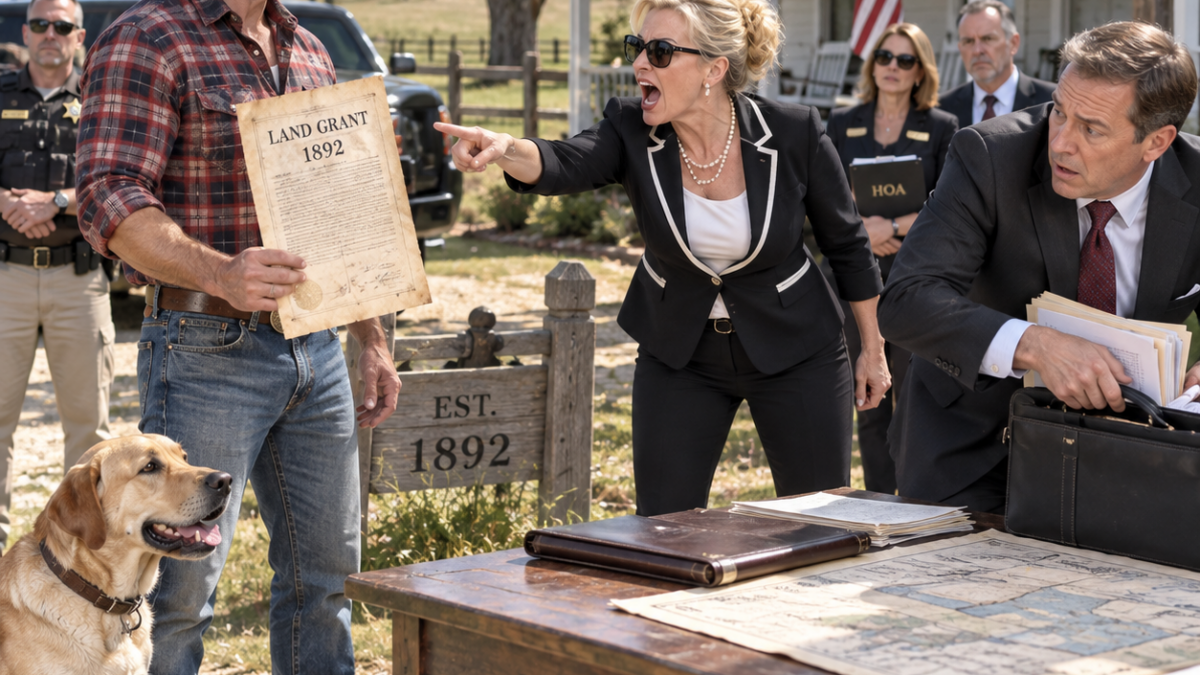
The HOA president stood beside my grandfather’s 1968 Ford F-250 and told me the land my family had owned for more than a century now belonged under her rules.
She already had a tow truck waiting, a lien notice prepared, and enough confidence to believe ten acres of my homestead could somehow be “absorbed” into a subdivision that hadn’t existed when my grandfather was born.
I could have stopped her that afternoon, but something about the paper on her clipboard made me decide that letting her continue might expose a much bigger mistake than either of us understood.
“That is your final warning, Mr. Miller,” Karen Peterson said.
She tapped her clipboard as though it were a judge’s gavel.
“Either that vehicle is moved into an HOA-approved structure today, or I authorize its removal as abandoned refuse.”
I looked past her at my grandfather’s truck.
Calling it abandoned was almost funny.
The old Ford had been parked beside our barn for nearly thirty years, and I had spent most of the previous winter bringing it back to life. The original 390 V8 still started with that deep mechanical rumble I remembered from childhood. I had rebuilt the brakes, replaced the fuel lines, polished the faded paint, and left one small patch of patina on the bumper because my grandfather’s hands had touched it thousands of times.
It was not junk.
It was family.
Karen would never understand the difference.
Behind her, a tow truck waited on the shoulder of the county road.
The driver watched us without expression.
I had spent twenty years in the Army Corps of Engineers. I had dealt with contractors, inspectors, commanders, government lawyers, foreign officials, and enough paperwork to bury a small building.
Yet I had never heard a phrase quite as ridiculous as the one Karen had used five minutes earlier.
“Provisionally absorbed.”
That was how she described my land.
My 160 acres had been in the Miller family since 1892, when my great-great-grandfather received the original homestead grant. The farmhouse stood on a low rise above the creek. The barn had survived storms, droughts, two fires, three generations of stubborn men, and one tornado that removed half its roof.
The stone wall marking our eastern boundary had stood longer than every house in Whispering Pines Estates combined.
Whispering Pines was new.
A developer had purchased the adjoining farmland and transformed it into rows of expensive houses, landscaped entrances, decorative streetlights, and carefully approved shades of beige.
I did not care.
People were allowed to live differently.
That principle apparently worked in only one direction.
Karen claimed a “survey correction” had placed the ten acres containing my farmhouse, barn, and truck within the HOA’s jurisdiction.
“That’s not how property law works,” I told her.
She smiled.
“The county signed the preliminary development plat.”
“My family owned this land before your development had a name.”
“Historic ownership does not exempt you from current community standards.”
I almost admired the confidence.
Almost.
I pointed toward the stone wall.
“That is the boundary.”
“Walls can move.”
“Not without moving the land.”
Her face tightened.
She flipped several pages on her clipboard.
“Page forty-seven. Section eight, subsection B. Vehicles visible from common areas must be maintained in operable condition and stored inside an approved structure.”
“The truck runs.”
“It has visible rust.”
“Surface patina.”
“The architectural committee disagrees.”
“The architectural committee has no authority here.”
Karen raised the small radio clipped to her belt.
“For the final time, Mr. Miller. Will you comply?”
That was when years of military habit took over.
Do not react.
Observe.
Identify the objective.
Understand what the other side believes.
Karen believed she had documentation.
More importantly, she wanted me angry enough to make a mistake.
So I did the last thing she expected.
I smiled.
“You know what, Karen?”
Her eyes narrowed.
“You have your paperwork. You’re obviously convinced you’re right.”
She straightened.
“I am.”
“Then go ahead.”
Her expression changed.
“What?”
“Tow it.”
Even the tow driver looked at me.
Karen hesitated only a second before raising the radio.
“Remove the vehicle.”
The truck backed toward my driveway.
Chains came out.
Metal clanged against metal.
I stood with my hands in my pockets while the driver hooked my grandfather’s Ford.
Every instinct in me screamed to stop him.
But I kept thinking about one thing.
If Karen was willing to steal a truck while claiming ten acres of my family’s homestead belonged to her HOA, I wanted to know exactly what document had made her brave enough to try.
As the Ford disappeared down the county road, Karen wrote something on her clipboard and smiled.
She believed she had just proved who controlled my land.
Three days later, an envelope arrived that told me exactly how far she intended to take that lie.
PART 2
The envelope was thick enough to feel expensive.
WHISPERING PINES ESTATES HOMEOWNERS ASSOCIATION was embossed across the top in dark green lettering, beneath a gold logo of three perfectly symmetrical pine trees.
I carried it into the farmhouse and placed it on the old oak dining table.
That table had belonged to my grandparents.
Before that, according to family stories, it belonged to my great-grandparents.
Harvests had been planned around it.
Bills had been paid around it.
My grandmother had rolled pie dough across one end while my grandfather sat at the other repairing carburetor parts on newspaper.
Now I opened Karen Peterson’s declaration of war on the same scarred wood.
The first page was a bill.
$1,000 — VEHICLE ABATEMENT AND REMOVAL.
$500 — VEHICLE STORAGE NONCOMPLIANCE.
$500 — LANDSCAPE INCONSISTENCY.
$500 — INITIAL INFRACTION PROCESSING.
TOTAL DUE: $2,500.
I actually laughed.
Then I reached the second page.
The laugh stopped.
“Notice of Assessment Lien.”
I read it twice.
Karen claimed Whispering Pines Estates had placed a lien against my property for the unpaid violations.
My property.
One hundred sixty acres that had passed through generations of Millers.
Land my grandmother had protected through drought, medical bills, bad cattle years, and developers waving checks larger than anything she had ever seen.
I remembered one of those developers sitting in her kitchen when I was younger.
He wanted the eastern acreage.
Grandma listened politely while he explained how much money she could make.
When he finished, she looked out toward the pasture.
“My husband is buried on that hill,” she said.
The developer had no answer.
Neither did I.
That memory came back as I held Karen’s lien notice.
The truck was one thing.
The land was another.
My grandfather’s Ford carried memories.
The homestead carried all of us.
I felt anger rise fast enough to make my hands shake.
For several minutes I imagined driving directly to Karen’s house.
Her address was printed at the bottom of the HOA letterhead.
I could picture the conversation.
Her opening the door.
Me placing the fraudulent lien notice in front of her.
Demanding she remove it.
Demanding my truck.
Demanding an explanation.
That was exactly what I did not do.
After twenty years in the Corps of Engineers, I had learned that anger creates movement but rarely creates strategy.
Karen had paperwork.
Fine.
I would get better paperwork.
I went upstairs to the small bedroom I had converted into an office.
I opened the bottom drawer of an old metal filing cabinet and removed a fresh legal pad.
At the top I wrote:
WHISPERING PINES.
Then beneath it:
PROPERTY.
TRUCK.
LIEN.
AUTHORITY.
MONEY.
The last word came almost automatically.
Money.
Because organizations often reveal themselves through money.
Before touching the HOA finances, though, I needed my truck.
The tow company’s number appeared on the invoice.
I called.
A man answered with a voice that sounded as tired as an old diesel engine.
“County Tow and Recovery.”
“I’m calling about a 1968 Ford F-250 removed from the Miller property three days ago.”
A pause.
“Oh. Yeah. Old green Ford?”
“That’s the one.”
“Still here.”
Relief moved through me so quickly I had to sit down.
“Has anything been done to it?”
“No.”
“Good. Don’t touch it.”
The man’s tone changed.
“Who is this?”
“John Miller. Owner.”
“HOA said you abandoned it.”
“The HOA lied.”
Silence.
I continued.
“They had no legal authority to remove anything from my property.”
“They gave us paperwork.”
“I have the county plat, deed chain, title history, and the original homestead grant. My parcel is outside Whispering Pines.”
“They said there was a boundary correction.”
“There isn’t.”
Another pause.
Longer this time.
“They already paid the tow.”
“With what?”
“That isn’t really—”
“With what?”
The man sighed.
“HOA credit card.”
I wrote that down.
“Listen carefully. I’m not interested in making your company part of this fight if you were misled.”
“I was.”
“Then don’t make it worse. Do not sell, scrap, move, alter, or release that truck to anyone else. I will be there this afternoon with the ownership documents.”
“What about storage?”
“There will be no storage charge.”
“Sir—”
“You were hired to remove a vehicle from land your customer did not own or control. You can discuss payment with the person who hired you.”
The silence told me he knew I had a point.
Finally he said, “Bring the documents.”
I arrived an hour later.
The tow yard sat behind a chain-link fence on the industrial edge of town.
Mud.
Old cars.
Two wreckers.
A faded Coke machine.
The owner introduced himself as Ray.
He looked at the binder under my arm.
“You came prepared.”
“I usually do.”
We stood beside his pickup.
I spread out the county plat.
Then my current deed.
Then the prior deed.
Then the old parcel map.
Finally, because I wanted no argument, I showed him a certified reproduction of the original Miller homestead patent.
Ray leaned over the papers.
His finger traced the eastern boundary.
“So the stone wall really is the line.”
“Yes.”
“And Whispering Pines ends here.”
“Yes.”
He picked up Karen’s work order.
“She told me ten acres had been incorporated after a survey correction.”
“There is no correction.”
Ray scratched his jaw.
“She paid ahead.”
“You mentioned that.”
“Whole thing came from the HOA card.”
“How much?”
He told me.
I wrote that down too.
Ray noticed.
“Look, Mr. Miller, I’m not trying to steal anybody’s truck.”
“I believe you.”
“That woman came in here with HOA letterhead, maps, authorization numbers. Looked official.”
“Karen’s very good at looking official.”
He exhaled.
“What do you want?”
“My Ford.”
“No storage?”
“No storage.”
“Fine.”
He held up both hands.
“I want out of this.”
We walked to the rear lot.
There sat my grandfather’s truck.
For an irrational second, seeing it behind that fence made me feel like I was visiting somebody in jail.
The faded green paint looked wrong among wrecked sedans and totaled SUVs.
A chain still hung loose beneath the frame.
I ran my hand across the hood.
No new dents.
No scratches.
I opened the door.
The cab smelled the same.
Old vinyl.
Oil.
Dust.
A faint trace of my grandfather’s pipe tobacco that could not possibly still exist after all those years but somehow did in my memory.
I climbed behind the wheel.
Turned the key.
The V8 caught on the second revolution.
That familiar low rumble filled the yard.
Ray looked almost relieved.
“Runs better than half the stuff people drive in here.”
“I told Karen that.”
“Guess she didn’t care.”
“No.”
I looked at him through the open window.
“One question.”
“Sure.”
“Did she tell you to scrap it?”
Ray hesitated.
Then nodded.
“After thirty days if you didn’t pay.”
I felt something inside me go cold.
Not impound.
Not move.
Dispose.
Karen had been willing to destroy a family heirloom to prove a point.
“Thank you.”
“For what?”
“Being honest.”
I drove the Ford home.
When the tires crossed the old stone-wall line, I felt a ridiculous amount of relief.
I parked it beside the barn in precisely the same spot.
Then I took a picture.
Date.
Time.
Location.
The picture went into the file.
Two days later, Karen escalated.
The letter came from a law firm.
The name looked like something from a bad legal joke, but the threat was serious enough.
The firm accused me of intimidating an HOA official and interfering with a legitimate towing contract.
It demanded $2,500 in fines plus $1,000 in legal fees.
If I refused, the letter threatened foreclosure.
Foreclosure.
On a homestead outside their association.
I placed the letter into a plastic sleeve.
Then called Colonel Jacob Riley.
Jake had been my commanding officer during part of my Army career.
Later he became a friend.
After retirement, he used the GI Bill to finish law school and built a small civil practice in the state capital.
His personality had changed very little.
He still approached conflict with the enthusiasm of a man being offered dessert.
“John Miller,” he said when he answered. “I assumed you were dead.”
“I texted you Christmas.”
“That proves nothing.”
“I need a lawyer.”
“Now I’m listening.”
I explained everything.
The development.
Karen.
The imaginary boundary adjustment.
The Ford.
The tow.
The lien.
The law firm.
Jake stayed mostly silent.
When I finished, he laughed.
Not a polite laugh.
The kind that made me move the phone away from my ear.
“What?”
“Oh, John.”
“What?”
“You found yourself a small-town dictator.”
“She’s threatening foreclosure.”
“That part is my favorite.”
“I’m glad you’re enjoying this.”
“You own the land outright?”
“Yes.”
“No HOA deed restriction?”
“No.”
“No recorded declaration?”
“No.”
“No annexation agreement?”
“No.”
“You have the plat?”
“Yes.”
“Title chain?”
“Yes.”
“Original patent?”
“Certified copy.”
Jake whistled.
“And they filed a lien?”
“They say they did.”
“We’ll verify.”
“What about their legal letter?”
“Do nothing.”
“Nothing?”
“Nothing to them.”
“That doesn’t sound like you.”
“Don’t confuse inactivity with inaction.”
His voice became serious.
“We verify the lien. We document the tow. We review the plat. And we let their lawyer keep writing if he’s foolish enough.”
“What should I do?”
“You said something about suspicious HOA spending.”
I looked at the notes beside me.
“Yes.”
“Tell me.”
I explained the meeting minutes.
Rising fines.
Vague community-enhancement assessments.
A $50,000 security upgrade despite the gated entrance already having an automated system.
The HOA credit card used for my tow.
Jake was silent.
Then:
“There’s your seam.”
“What?”
“Karen’s personal behavior may be outrageous, but institutional money is where board members start caring.”
“I’m not an HOA member. I can’t request records.”
“Find somebody who is.”
Jake knew I had spent years working in environments where information mattered.
“You need residents.”
“I suspected that.”
“Then stop thinking like an angry landowner.”
“What should I think like?”
“A reconnaissance officer.”
“I was an engineer.”
“Close enough.”
After we hung up, I drove the old Ford into town.
Not because I needed anything.
I wanted to think.
The hood vibrated slightly at idle.
My grandfather had taught me to drive in that truck.
I was fourteen.
Too short to be comfortable with the clutch.
He took me down a dirt road and said, “Don’t fight the machine. Listen to it.”
I stalled three times.
He never raised his voice.
Eventually I learned.
Thirty-five years later, I realized I was doing the same thing with Karen.
Stop fighting the noise.
Listen.
What did the system tell me?
Karen controlled people through isolation.
If I wanted to stop her, I needed the people she had isolated.
The first family I approached was Tom and Sarah Davidson.
Their house sat near the front of Whispering Pines.
I had noticed a small sign in their flower bed.
Nothing aggressive.
A simple hand-painted message about kindness and inclusion.
In a neighborhood where decorative objects apparently required committee approval, the sign looked rebellious.
Tom answered the door.
“Can I help you?”
“I’m John Miller. Farm next door.”
His expression changed immediately.
“The truck.”
News traveled fast.
“Yes.”
He glanced toward the street.
Then opened the door wider.
“Come in.”
Sarah joined us at the kitchen island.
I told them the story.
Not dramatically.
I showed the plat.
The lien letter.
Karen’s attorney letter.
The tow work order.
Tom’s face hardened.
When I finished, Sarah said one word.
“Playset.”
I looked at her.
Tom rubbed his jaw.
“Our son Leo turned seven last year.”
Sarah’s eyes dropped toward the backyard.
“We bought him a wooden playset.”
“What happened?”
“Karen.”
Of course.
They had submitted paperwork.
The stain was not on the approved list.
Sierra Redwood instead of Canyon Brown.
The difference, judging from the photographs, was almost imaginary.
Karen issued a $500 fine.
Tom challenged it.
The committee denied the appeal.
Then they submitted a second application for another playset.
Denied.
Reason: preserving the “serene adult-oriented visual character” of the subdivision.
I stared at Tom.
“There are children living here.”
“I know.”
“Your HOA restricts playground equipment because the neighborhood is adult-oriented?”
“Karen does.”
Sarah went upstairs and returned carrying a thick folder.
Their folder.
Letters.
Fines.
Satellite dish.
Grass cut too short.
Package left on porch.
Outdoor toy visible.
One violation was issued because their trash bin remained outside twenty-four minutes past the approved retrieval time.
Sarah’s eyes filled as she talked.
“At first we fought everything.”
“What changed?”
“People stopped talking to us.”
Tom answered.
“Karen made an example of us at meetings.”
“She read our violations publicly,” Sarah said. “She said residents who refused standards were making everyone else pay for their selfishness.”
“Did anybody defend you?”
Tom laughed without humor.
“No.”
I thought of Karen standing in my pasture.
That confidence had not appeared overnight.
It had been rewarded for years.
“She isolated you.”
Sarah nodded.
“That’s exactly what it felt like.”
“You’re not isolated anymore.”
They both looked at me.
I told them what Jake had said.
Members had inspection rights over association finances.
Tom was a data analyst.
That changed his posture immediately.
“Which records?”
“All of them, potentially. Bank statements. Vendor invoices. Credit cards. Assessments. Depending on your governing documents and applicable law, we make the request properly.”
“We asked once.”
“What happened?”
“They said the books were being audited.”
“How long ago?”
“Eight months.”
I smiled.
Tom noticed.
“What?”
“That sounds useful.”
We drafted a formal records request.
Certified mail.
Specific records.
Specific dates.
Citing the association’s own bylaws.
Tom signed it.
The next day, it went out.
Our first alliance had formed.
The Hendersons came next.
Ed and Margaret Henderson were in their late seventies.
I found them standing beneath one of the largest oak trees in Whispering Pines.
The tree looked sick.
Dead branches.
Dark lesions in the bark.
Leaves thinning at the crown.
Margaret held an envelope.
Karen.
Of course.
Their oak had been designated a heritage tree.
Removing it or significantly pruning it required architectural approval.
They hired an arborist after noticing fungal disease.
The arborist recommended immediate treatment and removal of several large dead limbs before they fell.
Karen’s committee denied the work.
Reason: excessive pruning would negatively affect the canopy.
Then Karen fined them for failing to maintain the tree in healthy condition.
Ed ignored the committee and hired the arborist to remove the dangerous branches.
Karen fined them again.
The penalties grew.
Legal fees followed.
Now the association was threatening collection against the house.
Margaret cried as she told me.
“We bought this place to retire.”
Ed stared at the tree.
“I’m seventy-eight. I spent forty years paying mortgages. Now a woman with a clipboard is threatening our house because I wouldn’t let a rotten branch fall on somebody.”
I felt anger again.
Different this time.
Not hot.
Organized.
“Do you have everything?”
Ed looked at me.
“Everything what?”
“Every letter. Every arborist report. Every photograph. Every receipt.”
Margaret nodded.
“We saved it.”
“Good.”
“Why?”
“Because you are not fighting this alone anymore.”
That evening our first meeting happened at the Miller farmhouse.
Me.
Tom and Sarah Davidson.
Ed and Margaret Henderson.
Five people around the same oak table where I had opened Karen’s lien notice.
Sarah Davidson looked around.
“This feels illegal.”
“It isn’t,” Tom said.
“That doesn’t make it feel less like a conspiracy.”
Margaret smiled for the first time all evening.
“We are too old to be conspirators.”
Ed looked at her.
“Speak for yourself.”
We started laughing.
That mattered.
Fear hates laughter.
Then we got serious.
Tom’s records request had been delivered.
Karen had ten days under the association’s own rule to respond.
Jake was reviewing the Henderson case.
Sarah Davidson had another idea.
“We need to let other people know.”
“How?” Tom asked.
“Not door to door. They’ll be scared.”
She was a graphic designer.
She proposed a simple private website.
Whispering Pines Unfiltered.
No gossip.
No anonymous personal attacks.
Documented stories.
Resident verification.
Relevant bylaws.
Financial questions.
A secure way for homeowners to realize their experiences were not isolated.
Tom could build it.
Sarah could design it.
I would help organize evidence.
Within a week, the site existed.
It looked professional.
Calm.
Almost boring.
That was intentional.
Karen thrived on portraying opposition as emotional troublemakers.
We would give her documents.
Sarah created small cards.
“Tired of arbitrary rules? You are not alone.”
Website address.
No names.
No accusations.
We distributed them legally on permitted community bulletin areas and directly to residents who agreed to take them.
The response stunned us.
Forty-eight hours later, the site filled with stories.
A nurse fined because her trash can remained outside while she worked an emergency shift.
A couple fined while on their honeymoon because their lawn service missed a week.
A veteran ordered to remove a support ribbon magnet from his vehicle because it was not an approved exterior decoration.
A widow cited for wind chimes.
A family fined for children’s chalk drawings on their driveway.
A homeowner penalized because Christmas lights remained up three days past the deadline after he developed pneumonia.
Small things.
Individually almost ridiculous.
Together, terrifying.
Because the pattern was not about aesthetics.
It was about obedience.
One message came from a woman who said Karen had stood outside her house measuring grass with a ruler.
Another resident posted a photograph.
There was Karen.
Kneeling beside a lawn.
Ruler in hand.
Sarah Davidson stared at the screen.
“You couldn’t invent this woman.”
The site did more than collect complaints.
People began helping each other.
If a nurse worked late, somebody rolled in her trash bins.
If an elderly homeowner needed branches cleared, neighbors showed up.
If a family traveled, somebody checked their lawn.
Karen’s system worked partly because residents faced every rule alone.
Community broke that system.
Then Tom received the response to his financial-record request.
The envelope came from Karen’s law firm.
Tom brought it to my farmhouse unopened.
“You read it.”
“It’s your letter.”
“I don’t care.”
He pushed it across the table.
I opened it.
The firm acknowledged the request.
Then claimed production of records would be excessively burdensome.
They estimated compilation labor, administrative review, copying, and professional accounting time at $7,500.
Payable in advance.
Tom slumped into the chair.
“We’re done.”
“No.”
“John, I don’t have seventy-five hundred dollars for a fishing expedition.”
I pulled the HOA bylaws toward me.
I had read them so often I knew where to look.
Section 11.4.
Members may inspect and copy association records during reasonable business hours upon written notice.
Then subsection B.
The association shall maintain its records in organized and accessible form at its principal office.
I pushed the pages toward Tom.
“Read those together.”
He did.
His forehead creased.
“They’re charging for gathering records they are required to keep accessible.”
“Yes.”
Sarah leaned forward.
“So the fee proves they aren’t complying with their own recordkeeping rule?”
“Or they are using an artificial charge to block inspection.”
Tom sat upright.
“That’s actually worse.”
“Exactly.”
I called Jake.
He laughed for almost a full minute.
“Are lawyers supposed to enjoy other lawyers making mistakes this much?”
“Yes.”
“What now?”
“Now I send them a letter explaining that their $7,500 ransom note is evidence.”
“For what?”
“Bad faith, potentially. And depending on state statute, we pursue an order compelling access.”
He paused.
“John?”
“Yeah?”
“Keep the original envelope.”
“Already filed.”
“I love you.”
“Don’t make it weird.”
The legal pressure began building.
At the same time, Whispering Pines Unfiltered grew.
Then a message appeared from a user named Bookkeeper.
I worked for the HOA management company. What Karen is doing is worse than fines. I have records.
I read it twice.
Then contacted the user through the secure channel Tom had created.
Her name was Angela Ruiz.
Former accounts employee.
She agreed to meet Jake first.
Not me.
Smart.
Jake later called.
“You sitting down?”
“I am now.”
“The woman is credible.”
“What does she have?”
“Credit-card statements.”
I looked at the window.
“Karen’s?”
“HOA discretionary card in Karen’s name.”
“What’s on it?”
There was silence.
Then Jake started listing charges.
Luxury spa.
High-end restaurant.
Gasoline.
Online shopping.
Home electronics.
Landscaping.
“Community expenses?”
“Some of them are labeled that way.”
“But?”
“The addresses and merchants tell a different story.”
“What about the $50,000 security upgrade?”
Jake exhaled.
“That is interesting.”
The HOA books reportedly described several expenses under that project.
Angela believed a portion was used for equipment installed at Karen’s private house.
Home theater and integrated security components.
Then Jake said:
“And there’s the tow.”
“My Ford?”
“HOA credit card.”
I leaned back.
Ray had told me that already.
Now we had the statement.
Actual association funds had been used to remove my private property from land Karen did not control.
“How much money are we talking?”
“We do not know yet.”
“Enough for criminal charges?”
“Stop.”
“What?”
“That’s not your determination.”
His tone was suddenly sharp.
“You are not the prosecutor.”
“I know.”
“This is where people ruin good cases. They start deciding conclusions before investigators do.”
“So what do we do?”
“We preserve Angela’s material. We verify what we can. Then proper authorities get it.”
“What about the HOA?”
“The homeowners deserve to know their money may have been misused.”
“May have.”
“Good. You’re learning.”
For several days, the evidence sat like a live wire.
We did not post it publicly.
We did not leak it.
We prepared.
The bylaws provided a path.
Twenty-five percent of homeowners could force a special membership meeting.
Whispering Pines Unfiltered had already verified more than one hundred residents.
Sarah drafted the petition.
Tom organized signing sessions.
The Hendersons hosted one.
Others volunteered.
Within three days, more than half the community signed.
The petition was delivered to the management company, Karen, and legal counsel.
Special meeting required.
Karen responded with an email accusing unnamed residents of attempting a hostile takeover.
That helped us.
Nothing energizes homeowners like being told that attending their own association meeting is a hostile takeover.
We had thirty days.
We used every one.
Tom analyzed the spending records Angela had supplied.
Sarah built slides.
We kept them simple.
One charge at a time.
Date.
Amount.
Merchant.
HOA description.
Independent supporting evidence where available.
No jokes.
No dramatic music.
No memes.
Evidence did not need decoration.
One slide compared a luxury spa charge to the same month a single mother received multiple penalties over her yard.
Another showed home-electronics purchases associated with the supposed security upgrade.
Another showed landscaping services billed as community enhancement while available records pointed toward work at Karen’s residence.
Then came the tow payment.
My grandfather’s Ford.
Paid with dues from Whispering Pines residents.
The Hendersons’ nephew, Daniel, had recently passed the bar and knew parliamentary procedure better than anyone on Karen’s board.
He volunteered to help residents enforce their meeting rights.
We also contacted a local investigative reporter.
Carefully.
No sensational allegations.
We told her homeowners had called a special meeting regarding documented financial irregularities and governance disputes.
She came.
Then I made one last trip.
The county archives.
The original 1892 Miller land grant was stored there.
I had seen certified reproductions my whole life.
Never the original.
The archivist brought it to a reading table.
Yellowed parchment.
Flowing script.
Old seal.
My family name written by somebody who had been dead for more than a century.
I felt unexpectedly emotional.
My great-great-grandfather had received the land when the surrounding area was barely settled.
Whatever politics and history surrounded that grant belonged to another century.
But this document represented continuity.
He had stood somewhere on the same ridge.
My grandfather had farmed it.
My grandmother had protected it.
Now I was fighting over it with an HOA president who had been in the county three years.
I read carefully.
Most of the language was archaic.
Then I found the clause.
Right of way.
Perpetual.
Unobstructed passage and agricultural conveyance across contiguous parcels associated with access to the homestead.
I stopped.
Read it again.
Then requested the related historical maps.
The archivist helped me match the description.
The old access route crossed land now included in Whispering Pines.
More specifically, the historical corridor ran near what had become the subdivision’s entrance and common amenities.
I called Jake from the parking lot.
“You’re going to enjoy this.”
“That usually means trouble.”
I told him.
He became quiet.
“Send me the document.”
I did.
Twenty minutes later he called back.
“John.”
“Yes?”
“This is real.”
“How useful?”
“Potentially very.”
“That sounds disappointingly lawyer-like.”
“I’m a lawyer.”
“What does it mean?”
“It means nobody says anything dramatic until I complete the title analysis.”
“But—”
“No hay balers through swimming pools.”
I smiled.
“You know me too well.”
Two days later Jake confirmed the basic point.
The old easement had survived subsequent transfers in some form and had not been properly extinguished.
The exact practical scope would require legal interpretation.
But it was serious enough that Whispering Pines’ counsel would immediately understand the title risk.
The document did something even more important.
It destroyed Karen’s story that my land had somehow been swallowed by the new development.
My property was not a forgotten remnant.
It was the older estate carrying historical rights that the development had been built around.
The special meeting arrived.
The clubhouse was overflowing.
People lined the walls.
The reporter stood near the back with a cameraman.
Karen sat at the front.
Beige suit.
Pearls.
Gavel.
Her architectural committee allies sat beside her.
The HOA attorney sat near one end of the table.
I recognized his name from the threatening letter.
He looked bored.
He would not look bored for long.
Karen struck the gavel.
“This unnecessarily called special meeting will come to order.”
Murmurs rolled through the room.
She began reading the agenda.
Individual homeowner complaints.
She intended to handle each grievance separately.
Divide.
Dismiss.
Move on.
Tom stood.
“Madam President, motion to amend the agenda.”
Karen stared.
“Out of order.”
Daniel Henderson rose.
“With respect, it is not.”
“Who are you?”
“Daniel Henderson. Attorney and member-designated parliamentarian candidate.”
Karen’s face tightened.
“We have not appointed a parliamentarian.”
“Correct.”
He looked toward the room.
“That is why there will be a motion.”
Sarah Davidson immediately seconded.
Karen struck the gavel.
“You cannot hijack—”
A homeowner shouted, “Vote!”
Another followed.
Then another.
Daniel calmly explained the procedure.
Appointment of an independent parliamentarian went to the membership.
Hands rose.
Overwhelming.
Karen lost the first vote.
Two minutes into the meeting.
Daniel took a position at a side table.
Tom moved to amend the agenda.
Financial management first.
Seconded.
Karen objected.
Membership voted.
Passed overwhelmingly.
The lights dimmed.
First slide.
Spa charge.
Fine notice.
Gasps.
Second.
Electronics expense.
Security-project description.
Third.
Landscaping.
Fourth.
Restaurant charges.
Then gasoline.
Then shopping.
Then my tow.
People started shouting.
“My dues paid for that?”
“She used HOA money to tow property outside the neighborhood?”
“What else did she buy?”
Karen slammed the gavel.
“This presentation is fabricated!”
Tom stopped.
The room quieted.
Karen stood.
“These people have manipulated records. They are disgruntled homeowners working with an outside agitator.”
She pointed at me.
“There he is. John Miller. The man who has spent months attacking this community because he refuses basic standards.”
I stayed seated.
That irritated her more.
“These documents are stolen.”
A voice came from the rear doorway.
“No, they aren’t.”
Everyone turned.
Angela walked in.
Dark suit.
Folder against her chest.
Nervous but steady.
Karen’s face changed.
Angela approached the front.
“My name is Angela Ruiz. I worked on the Whispering Pines account through the management company.”
Karen said nothing.
“I processed expenses.”
The HOA attorney sat forward.
Angela continued.
“I retained copies of certain records after raising concerns internally. Those copies have been provided to counsel and appropriate authorities. The statements shown tonight are consistent with the records I handled.”
Karen finally spoke.
“You were fired.”
“I resigned.”
“For misconduct.”
“No.”
Angela’s voice strengthened.
“I resigned because I would not keep categorizing personal expenses as community expenses.”
The room erupted.
The reporter moved closer.
Karen’s attorney stood.
“Ms. Ruiz, I strongly advise—”
Angela turned toward him.
“You don’t represent me.”
He stopped.
That was when I walked forward.
Not because we needed more drama.
Because one part of the story still had to be corrected.
Karen had built her power over me on the claim that my ten acres somehow fell inside Whispering Pines.
Without that lie, there was no truck tow.
No lien.
No fines.
No foreclosure threat.
I carried the certified archive copy in a protective tube.
Karen saw it.
Her expression hardened.
“You.”
“Yes.”
“You caused this.”
“No.”
“You poisoned these people against me.”
I stepped to the front.
“I showed them documents.”
“You’ve been trying to destroy this association since the day I enforced the covenants.”
“That’s the problem.”
I looked at the residents.
“My property was never subject to those covenants.”
The HOA lawyer rubbed his forehead.
He had already seen the plat.
But not this.
I unrolled the certified land-grant copy.
“This is the original 1892 patent associated with the Miller homestead.”
The room quieted.
Even Karen.
“My family’s land predates Whispering Pines by generations.”
I pointed toward the relevant descriptions.
“The county’s own development plat recognizes our boundary. There was never any provisional absorption.”
Karen opened her mouth.
I raised my hand.
“And there’s something else.”
The HOA lawyer stood.
He stepped closer.
I showed him the easement clause.
His eyes moved quickly.
Then slower.
Then he read it again.
“What is that?” Karen demanded.
The lawyer did not answer.
“Counsel?”
He looked at me.
“You had this reviewed?”
“Yes.”
“Title counsel?”
“Yes.”
“Historical chain?”
“Yes.”
He closed his eyes briefly.
Karen’s voice sharpened.
“What does it say?”
The lawyer stared down at the page.
Finally:
“It appears to reserve an access easement benefitting the Miller homestead.”
“Across what?”
Nobody answered.
I did.
“Across land now forming part of Whispering Pines.”
Residents began murmuring.
Karen laughed.
“That’s absurd.”
Her lawyer shook his head.
“No.”
The room became silent.
He pointed toward the document.
“If this interest was never properly released or extinguished, then it may remain a title encumbrance.”
Karen stared at him.
“Speak English.”
He did.
“The development may have been built subject to Mr. Miller’s historical right of access.”
A man near the back said, “You mean through our neighborhood?”
“Potentially.”
I looked at Karen.
“You spent months claiming your HOA had rights over my property.”
I touched the land grant.
“It turns out my property has older documented rights involving yours.”
The irony moved through the room almost physically.
Somebody laughed.
Then somebody else.
Karen did not.
“What can he do?” she asked the lawyer.
“That depends on the exact scope and enforceability.”
“Can he drive through here?”
The lawyer hesitated.
“That may be part of the historical purpose.”
I leaned toward him.
“I have no intention of driving hay equipment through somebody’s pool party.”
A few people laughed.
“But I do intend to protect my homestead.”
The lawyer’s face had gone pale.
He looked at Karen.
Then at the board members beside her.
Then at Angela.
Then at the projector displaying the expense records.
He slowly gathered his folder.
Karen noticed.
“What are you doing?”
He cleared his throat.
“My firm needs to reassess its position.”
“You represent this HOA.”
“We represent the association. Not individual directors facing allegations of personal misconduct.”
Her face collapsed.
“You wrote the lien letter.”
“Based on information provided by association leadership.”
“You threatened foreclosure.”
“Again, based on representations about jurisdiction that now appear to require substantial review.”
Karen leaned toward him.
“You cannot leave.”
He closed his briefcase.
“I can and I am advising the board that separate counsel may be necessary immediately.”
He walked out.
Not running.
But close enough that everyone understood.
The sight of Karen’s own lawyer withdrawing was more damaging than anything I could have said.
For years she had taught residents that paperwork made her powerful.
Now paperwork was dismantling her.
The room erupted.
“Remove her!”
“Vote!”
“Where’s our money?”
Karen slammed the gavel until Daniel Henderson calmly took it from the table.
“The membership will come to order.”
She stared at him.
“You cannot touch that.”
“The board has lost control of the meeting.”
“I am president!”
“For the moment.”
That line went through the room like electricity.
A motion was made.
Removal of Karen Peterson and the two directors most closely involved in her enforcement and financial decisions.
Seconded.
Karen tried to speak.
Daniel gave her the same opportunity anyone else received.
Three minutes.
She stepped toward the microphone.
For the first time since I met her, she looked uncertain.
“I have spent three years protecting this community.”
Someone shouted, “From our children?”
Daniel raised a hand.
Silence.
Karen continued.
“Property values have increased under my leadership.”
Another homeowner called, “So have your spa bills.”
The room laughed.
Karen flushed.
“This is mob rule.”
Tom stood.
“No.”
His voice was calm.
“This is the membership.”
He looked around.
“People you were supposed to serve.”
The vote happened.
Nearly unanimous.
Karen and her two allies opposed.
Everyone else supported removal.
The gavel no longer belonged to her.
Her title no longer belonged to her.
For several seconds she simply sat.
Then she stood.
“You will regret this.”
Nobody answered.
That must have hurt most.
Her threats had finally become background noise.
A temporary board was elected.
Tom Davidson agreed to serve as interim president.
Margaret Henderson became one of the directors.
A retired accountant volunteered as treasurer.
Their first vote froze discretionary spending.
Second vote authorized an independent forensic audit.
Third vote suspended collection of disputed fines and liens until review.
The room applauded.
Karen started toward the exit.
Then the clubhouse doors opened.
Two sheriff’s deputies entered.
The celebration stopped instantly.
They walked toward Karen.
She froze.
One deputy spoke quietly.
“Karen Peterson?”
“Yes.”
“We need to speak with you regarding an investigation into association funds.”
“This is outrageous.”
“You can discuss that with investigators.”
“Am I being arrested?”
The deputy’s expression did not change.
“You are being taken into custody pursuant to a warrant.”
The room went still.
Karen looked at Angela.
Then Tom.
Then me.
Her face twisted.
“You.”
She pointed.
“This is you.”
“No.”
“You did this.”
I shook my head.
“You used their money.”
“You came here and destroyed everything.”
“No, Karen.”
My voice stayed quiet.
“You kept making choices.”
The deputies escorted her out.
I did not smile.
I had imagined that moment during some of my angrier nights.
In imagination, victory felt hot.
Triumphant.
In real life, it felt heavy.
A fifty-eight-year-old woman had convinced herself that a volunteer neighborhood position made rules optional for her.
Now two deputies were walking her past residents whose money she was accused of taking.
There was satisfaction.
But also waste.
So much unnecessary damage because somebody could not hear the word no.
The local news ran the meeting that night.
The reporter had everything she needed.
Homeowners.
Documents.
Angela’s statement.
Karen’s removal.
The land dispute.
The arrest.
Whispering Pines became the story everybody in town discussed.
I hated that part.
I had spent twenty years in government service without ever wanting my face on television.
Now people recognized me at the hardware store.
One man slapped my shoulder near the plumbing aisle.
“You’re the land-grant guy!”
I nearly dropped a box of fittings.
“I have a name.”
“My wife loves what you did.”
“Thank you.”
“Drive the tractor through their pool.”
“I am not doing that.”
“You should.”
Jake enjoyed every second.
“You’re famous.”
“I hate you.”
“You always did.”
Criminal investigators and forensic accountants took over the financial side.
I stayed out.
That was important.
Rumors grew faster than facts.
Some residents said Karen stole half a million dollars.
Others said one million.
Somebody online claimed she owned a secret condo in Florida.
Jake told everyone to stop speculating.
Eventually investigators documented misuse exceeding $200,000 across several years, according to the final case records in the story that followed.
Personal expenses.
Improper reimbursements.
Mischaracterized purchases.
Karen ultimately entered a plea to felony charges tied to embezzlement and electronic transactions involving association funds.
The sentence was three years.
Restitution ordered.
Her house was eventually sold as part of the financial fallout.
I never attended sentencing.
Tom asked if I wanted to.
“No.”
“Why not?”
“Because I’m finished with her.”
That surprised him.
It surprised me too.
The anger had carried me a long way.
But anger is fuel.
You do not build a home out of gasoline.
Whispering Pines had repairs to make.
The new board started with amnesty.
Every outstanding discretionary fine issued under Karen’s administration was reviewed.
Many were voided.
Improper liens removed.
The Henderson foreclosure threat disappeared.
Ed cried when the release arrived.
Not Margaret.
Ed.
He came to my farmhouse with the letter folded carefully inside his shirt pocket.
“It’s gone.”
“I heard.”
“Our house is clear.”
“That’s good.”
He stared at me.
“I thought we were going to lose it.”
“You didn’t.”
He nodded.
Then hugged me.
Ed was not a hugging man.
I stood there with my arms awkwardly around him until he let go.
“Don’t tell anybody.”
“Never happened.”
Margaret’s oak tree received proper treatment.
The new board hired the arborist the Hendersons had originally recommended.
Some branches came down.
Treatment began.
Nobody died from the altered canopy.
The tree survived.
The Davidsons installed a new playset.
Leo chose the color.
Bright red.
Not Sierra Redwood.
Not Canyon Brown.
Red.
I helped Tom assemble it.
Halfway through, he looked at the structure.
“Karen would have a stroke.”
“Don’t build things based on Karen.”
“You’re right.”
Leo climbed up.
“Dad?”
“Yeah?”
“Can I paint part blue?”
Tom looked at me.
I shrugged.
“Your yard.”
He smiled.
“Blue it is.”
Children returned to the community pool.
Decorations appeared.
Garden gnomes.
Flags.
Holiday lights.
A flamingo that George would have considered an act of war.
People disagreed about taste.
Nobody collapsed.
The Unfiltered website changed too.
For months it had been resistance headquarters.
Tom proposed shutting it down.
Sarah disagreed.
“Change it.”
Into what?
A community site.
Minutes.
Budgets.
Events.
Local services.
Lost pets.
Movie nights.
Volunteer projects.
The secret resistance forum became the official neighborhood information hub.
That felt right.
The thing built to expose division became infrastructure for cooperation.
Tom hated being HOA president.
That made him perfect.
He called me one evening.
“People are arguing about mailbox styles.”
I laughed.
“I’m serious.”
“Welcome to leadership.”
“How did Karen enjoy this?”
“Different personality.”
“Can I resign?”
“You’ve been president six weeks.”
“I understand her now.”
“Careful.”
“I said understand. Not sympathize.”
He sighed.
“A homeowner wants neon green.”
“Mailbox?”
“Door.”
“Is neon green prohibited?”
“I don’t know.”
“Read the rule.”
“You’re not helpful.”
“I’m extremely helpful.”
The new board rewrote the worst sections.
Objective standards.
Appeals.
Conflict-of-interest disclosures.
Spending approval thresholds.
No unilateral president authority.
Financial records online.
Competitive bidding for major contracts.
Limits on fines.
And a rule that made everyone laugh when it passed:
No enforcement action shall be taken against nonmember property without documented legal authority reviewed by counsel.
They informally called it the Miller Rule.
I threatened to sue if they named it officially.
They believed me.
The law firm that had threatened foreclosure came under scrutiny too.
Bar complaints followed.
Its lawyers insisted they had acted based on information Karen provided.
The dispute eventually settled without the dramatic destruction residents initially wanted.
Jake approved.
“Why not destroy them?” Tom asked.
“Because institutions are full of people.”
Jake answered before I could.
“You correct incentives. You compensate harm. You report misconduct. You don’t burn everything because one part failed.”
Tom looked toward me.
“Is he always like this?”
“Worse.”
Then there was the land grant.
My easement.
The weapon I had never wanted.
Whispering Pines’ new attorney completed a full title review.
The historical right created uncertainty around the common area.
Not necessarily the apocalyptic scenario Karen’s old attorney feared in the heat of the meeting.
But real enough.
Developers should have addressed it before building.
They did not.
The new HOA needed certainty.
So did I.
Jake proposed a settlement.
Not money.
Boundaries.
The agreement acknowledged permanently that the Miller homestead—full 160 acres—was outside Whispering Pines and could never be subjected to its covenants, assessments, architectural control, or annexation without explicit consent from the owner.
In exchange, I agreed to limit the exercise of the historical right of way so existing community structures would not be disrupted.
No tractor through the pool.
No hay baler through movie night.
Whispering Pines gave me a gate card for practical access to the main road.
The deal benefited everyone.
We signed it at my dining table.
Tom on behalf of Whispering Pines.
Me on behalf of the Miller property.
Jake beside us.
Sarah Davidson took a photograph.
Tom looked at the document.
“Peace treaty.”
“Pretty much.”
“You realize how weird this whole year has been?”
“I’ve been trying not to.”
He signed.
Then passed me the pen.
I thought of Karen saying walls can move but paperwork is forever.
She had almost been right.
Good paperwork can outlive everyone in the room.
Bad paperwork can collapse in an afternoon.
I signed.
Jake notarized everything.
Done.
The county updated its parcel records.
A woman from the assessor’s office came out to confirm the boundary.
When her sedan turned into my driveway and I saw the clipboard, my shoulders tightened involuntarily.
She stepped out.
“Mr. Miller?”
“Yes.”
“I’m with the county assessor.”
I laughed.
She looked confused.
“Something funny?”
“Long story.”
She turned out to be pleasant.
She reviewed the stone wall.
Survey markers.
Historical maps.
New agreement.
“No dispute anymore,” she said.
“Good.”
“We’re correcting the parcel notes.”
“Permanently?”
“As permanent as county records get.”
“That’s enough.”
She smiled.
“Beautiful truck.”
I looked toward the barn.
Grandpa’s Ford gleamed in the sunlight.
After getting it back, I finally had the bumper re-chromed.
For a while I resisted.
That patina was part of its history.
Then I remembered something Grandpa used to say.
“Preserving something doesn’t mean freezing it.”
So I restored it.
Not to show Karen.
Not to prove anything.
Because it deserved care.
The chrome looked like a mirror.
I could see myself in it.
Older.
Gray at the temples.
More tired than when this started.
But peaceful.
One evening, I drove the Ford through Whispering Pines.
Legally.
Not as revenge.
Tom invited me to the community barbecue.
My gate card had arrived.
The main entrance opened.
For a second, I thought about the absurdity.
Karen had tried to tow this exact truck because she claimed it violated her neighborhood’s standards.
Now residents waved as I drove it toward the clubhouse.
Kids pointed.
George—not my neighbor George, but another resident I had met during the movement—asked if I could park it near the barbecue.
“Why?”
“Looks cool.”
I laughed.
The rust bucket had become decoration.
Tom was grilling burgers.
Sarah organized tables.
Leo ran past wearing a superhero cape.
The Hendersons sat beneath an umbrella.
Margaret’s laugh carried over the crowd.
The pool was full of children.
Loud children.
Karen’s serene adult atmosphere had not survived.
Thank God.
Tom handed me a beer.
“You know what I hate?”
“Your job?”
“That too.”
He pointed around.
“I actually like the HOA now.”
“That sounds dangerous.”
“I know.”
“It can be useful.”
He stared at me.
“You said that?”
“Yes.”
“I need witnesses.”
“Don’t get excited.”
I looked around.
“An association can maintain common property. Coordinate things. Help neighbors solve problems.”
“But?”
“The second it forgets it serves people, it becomes a problem.”
Tom nodded.
“So how do we make sure it doesn’t happen again?”
“You don’t.”
“That’s encouraging.”
“You build systems that make abuse harder.”
“Term limits.”
“Yes.”
“Open books.”
“Yes.”
“Appeals.”
“Yes.”
“People showing up.”
“Most important.”
Tom looked at the crowd.
“People stopped showing up under Karen.”
“I know.”
“They thought it didn’t matter.”
“That’s how it starts.”
He was quiet.
Then raised his bottle.
“To showing up.”
I tapped mine against it.
“To showing up.”
Leo climbed onto the playset built near the common lawn.
Bright red.
Blue stripe.
Completely unapproved under the old regime.
Tom watched him.
“We voted to eliminate color restrictions on playsets.”
“Bold leadership.”
“Lost three nights of sleep.”
“You’re joking.”
“I wish.”
I laughed.
Normal disagreement.
That was the victory.
Not everyone happy.
Not everyone agreeing.
People arguing without fear.
People voting.
Rules applied consistently.
Records visible.
Power temporary.
A community instead of a kingdom.
My role faded naturally.
That pleased me.
For months people called before every meeting.
What should we do?
What do you think?
Can you read this?
Eventually fewer calls came.
That was good.
Liberation that depends forever on one person is not liberation.
I went back to the farmhouse.
Restoration work.
Pasture.
Barn.
Creek.
The life I had originally retired for.
I rebuilt the west porch.
Repaired the barn roof.
Cleared invasive brush along the creek.
Planted two dozen new oaks.
Some evenings I sat with the original 1892 grant copy on the table.
Not because I needed legal protection anymore.
Because I thought about Jedediah Miller.
What would he think?
He knew nothing about HOAs.
Nothing about subdivisions.
Nothing about community websites or electronic transactions.
But boundaries?
Those he understood.
Land?
He understood.
Neighbors?
Absolutely.
My grandmother once told me Jedediah had a saying that survived in the family.
“Leave a place stronger than you found it.”
Maybe she invented it.
Grandmothers are allowed to improve history.
Either way, I liked it.
Whispering Pines was stronger.
My homestead was protected.
That was enough.
One spring morning the Hendersons came to visit.
Margaret carried a small branch.
Leaves.
Healthy green.
“The oak.”
I smiled.
“It’s recovering?”
“The arborist says yes.”
Ed looked embarrassed by her excitement.
“He says trees are slow.”
“They usually are.”
Margaret held the branch carefully.
“I wanted you to see.”
“Why?”
“Because you told us it was never about the tree.”
I remembered.
“It wasn’t.”
She smiled.
“But saving it still matters.”
She was right.
We walked toward the barn.
Ed stopped beside Grandpa’s Ford.
“That the famous truck?”
“Unfortunately.”
“Can I see under the hood?”
I opened it.
Two old men and one slightly younger old man spent twenty minutes discussing an engine designed before any of us had reasonable opinions about technology.
Margaret eventually shouted from the porch.
“Are you three coming inside?”
Ed called back.
“Soon.”
She rolled her eyes.
That felt normal too.
The criminal case ended months later.
Karen accepted the plea.
Three years.
Restitution.
Her home sold.
I learned because Tom called.
“You want the details?”
“No.”
“You sure?”
“Yes.”
“What if—”
“Tom.”
He stopped.
“Okay.”
A few minutes later he said:
“You really are done.”
“I told you.”
“I don’t know if I could be.”
“You will.”
“How?”
“When your life gets more interesting than your anger.”
Silence.
“That’s annoyingly wise.”
“I’m old.”
“You’re not that old.”
“Hang up.”
I went back to painting the porch.
Weeks later, a moving truck left Karen’s former house.
New family moved in.
Two children.
Dog.
The new owners painted their front door dark blue.
Nobody objected.
A playset appeared.
Yellow slide.
The neighborhood survived.
I never met Karen again.
That was fine.
Not every story needs one final confrontation.
We had already had ours.
Her paper against mine.
Her authority against history.
Her control against community.
In the end, the most powerful document in the room was not the HOA covenant she waved at me.
It was not her lien.
Not her lawyer’s threat.
Not even Angela’s financial statements.
It was the land grant.
A piece of paper nobody in Whispering Pines had thought mattered anymore.
One hundred thirty years old.
Fragile enough that the archivist made me wear gloves to handle it.
Yet it carried more legal weight than all Karen’s modern letterhead combined.
That irony stayed with me.
New institutions sometimes assume old things are weak because they are old.
Old farmhouse.
Old truck.
Old stone wall.
Old deed.
Old man who refuses to move.
But age can mean endurance.
The farmhouse survived.
The Ford survived.
The wall survived.
The grant survived.
And so did the idea behind all of them.
Some boundaries deserve respect.
Late that summer, Whispering Pines held its first annual community picnic under the new board.
They invited me.
I went reluctantly.
Tom announced awards.
Best garden.
Volunteer of the year.
Most improved common space.
Then he called my name.
I froze.
Sarah Davidson laughed.
“You have to go.”
“For what?”
“Go.”
Tom stood near the microphone.
“We created one additional recognition.”
“Oh no.”
“Honorary neighbor.”
People applauded.
I walked forward.
Tom handed me a small wooden plaque.
WHISPERING PINES
HONORARY NONMEMBER
PERMANENTLY OUTSIDE OUR JURISDICTION
I stared at it.
The crowd laughed.
Even Jake, who had driven in for the picnic, nearly spilled his drink.
“That is legally inaccurate,” I said into the microphone.
Tom grinned.
“We had counsel review it.”
“Then fire counsel.”
More laughter.
I carried the plaque home.
Hung it in the barn.
Beside Grandpa’s old license plate.
It remained there as a joke.
But also a reminder.
Not of Karen.
Of what came afterward.
Sarah Davidson once asked if I regretted letting Karen tow the Ford that first day.
I thought carefully.
Emotionally?
Yes.
Watching that truck disappear was one of the hardest parts.
Strategically?
No.
The tow forced Karen to commit herself to the lie.
Then the lien.
Then legal threats.
Then association spending.
Each escalation created evidence.
Had I shouted her off the property that first afternoon, maybe she would have retreated quietly.
Maybe she would have tried again later.
Maybe nobody inside Whispering Pines would ever have learned what was happening to their money.
But I would never tell someone to sacrifice property just to build a case.
We got lucky.
The truck was safe.
The tow company cooperated.
Nobody was hurt.
What I learned was simpler.
Sometimes the strongest response to abuse is not the loudest one.
It is the response that makes the truth visible.
Karen’s greatest strength had been controlling stories.
Tom and Sarah were irresponsible homeowners.
The Hendersons neglected their tree.
Nurses leaving trash cans outside were disrespectful.
Children’s playsets damaged community character.
My Ford was abandoned junk.
My farm had somehow become part of her HOA.
Every story put Karen in the role of responsible protector and everyone else in the role of problem.
Evidence reversed the roles.
That was why Whispering Pines Unfiltered mattered.
Not because it attacked her.
Because it let people compare reality.
One story can be dismissed.
Fifty matching stories become a pattern.
One strange charge may be bookkeeping.
Dozens become questions.
One person saying “Karen lied” sounds personal.
County plats, receipts, credit-card statements, and archived grants do not have feelings.
They simply sit there.
Waiting.
The last official paperwork arrived in autumn.
County records confirmed the corrected boundary notation.
The updated title documents recognized our agreement with Whispering Pines.
The fraudulent HOA lien had long since been removed.
Jake sent me a final packet.
On top was a sticky note.
YOU’RE FREE. TRY NOT TO START ANOTHER REVOLUTION.
I called him.
“That is unprofessional.”
“So is getting your grandfather’s truck stolen by an HOA.”
“Fair.”
“You owe me whiskey.”
“Why?”
“I told you the finances were the seam.”
“I found Angela.”
“You found the residents who found Angela.”
“Technicality.”
“I’ll accept bourbon.”
We argued another five minutes.
Friends do that.
That evening, I took the final packet to the barn.
Placed it in the cabinet beside the old land records.
Then closed the drawer.
Operation Whispering Pines was over.
I walked outside.
Grandpa’s Ford sat beneath the barn light.
The chrome bumper reflected orange from the sunset.
I started it.
Drove across the pasture.
Stopped near the stone wall.
Beyond it, the rooftops of Whispering Pines rose through the trees.
I could hear faint laughter from somewhere near the pool.
A dog barked.
A lawn mower ran.
A basketball bounced.
No gavel.
No shouted violations.
No tow truck.
Just neighbors.
I switched off the engine.
Silence settled around the Ford.
My hand rested on the steering wheel.
I thought of Grandpa.
Grandma.
Jedediah.
Every person who had kept this land long enough for me to inherit responsibility for it.
That word mattered.
Responsibility.
Not ownership alone.
Karen thought authority meant the right to control.
My family taught me something different.
If something is yours to care for, you protect it.
You do not use it to make yourself important.
That was the difference between stewardship and power.
I protected the homestead.
Tom protected the community.
Angela protected the truth.
The Hendersons protected their tree.
Sarah and Tom Davidson protected their child’s right to feel at home.
Even Ray at the tow yard, eventually, protected himself by admitting he had been misled and giving the truck back.
Nobody did everything.
Everybody did enough.
That is how systems change.
Not because one hero arrives.
Because isolated people realize they are not isolated.
I climbed out of the Ford.
Walked to the stone wall.
Some of the rocks had been stacked by people whose names I would never know.
I placed one hand on the rough surface.
Karen had once told me:
“Walls can move. Paperwork is forever.”
I smiled.
The wall had not moved.
Her paperwork had disappeared.
Maybe that was the best joke in the whole story.
The next morning, I found Tom at my front gate.
“What are you doing here?”
“Official HOA business.”
I groaned.
He held up two coffees.
“Peace offering.”
I let him in.
We sat on the porch.
He looked toward the pasture.
“Board approved the movie night.”
“Congratulations.”
“And community garden.”
“Good.”
“And a rule change.”
I stared at him.
“What now?”
“We eliminated the requirement that every front door stay within the old neutral palette.”
“Anarchy.”
“That’s what Margaret said.”
“What color is she painting hers?”
“Purple.”
I nearly spit coffee.
“She’s seventy-nine.”
“Apparently seventy-nine-year-old women like purple.”
“Karen would—”
I stopped.
Tom noticed.
“What?”
“Nothing.”
“You were going to say Karen would hate it.”
“Yes.”
He smiled.
“Me too.”
Then we both let the thought go.
That was how I knew the story was really finished.
Karen no longer deserved space in every happy moment.
She had become history.
Not forgotten.
Just no longer present.
Months turned into years.
The playsets faded in weather.
Children grew.
Boards changed.
Tom eventually refused another term.
Exactly as he should.
New residents arrived who knew Karen only as a story people told when discussing why the bylaws were so careful about financial transparency.
My homestead remained outside.
Always would.
Occasionally a new Whispering Pines resident saw my fields and asked:
“Is that part of the community?”
Someone would answer:
“No. That’s the Miller place.”
Simple.
Respectful.
Enough.
On the anniversary of the special meeting, Sarah Davidson organized a barbecue.
Not officially commemorating anything.
Unofficially, everybody knew.
Leo was older.
He had almost outgrown the playset that started their rebellion.
He sat beside me on the deck.
“Mr. Miller?”
“John.”
“My dad says you saved the neighborhood.”
“Your dad exaggerates.”
“He says Karen stole your truck.”
“That part is closer.”
“And you had a magic deed.”
I laughed.
“Not magic.”
“Dad says the lawyer ran away.”
“He walked quickly.”
Leo thought.
“What was on the paper?”
“A very old agreement.”
“Why did it beat the HOA rules?”
I considered how to explain property history to a child.
Then chose something simpler.
“Because the HOA was pretending it had more power than it actually had.”
He nodded.
“Like when kids make up rules in games?”
“Pretty much.”
“And your paper was the real rule?”
“In that situation, yes.”
He seemed satisfied.
Then ran off to play.
Tom came outside carrying plates.
“What did he ask?”
“About the magic deed.”
“Oh.”
“I blame you.”
“Local mythology.”
“Stop telling children I defeated evil with parchment.”
“You did.”
“No.”
“Fine. Certified parchment.”
We laughed.
I looked at the neighborhood.
Normal.
That remained the best ending.
No palace.
No final victory parade.
No monuments.
Just normal.
People living without fear of opening mail.
An old couple sleeping in a house no longer threatened by a fraudulent lien.
A kid climbing a red-and-blue playset.
A nurse whose neighbor pulled in her trash bin after a long shift.
Budgets anyone could read.
Meetings residents could challenge.
A purple front door.
My old truck gleaming beyond the stone wall.
And my family land untouched.
If someone had told me on the day Karen first arrived that all of this would begin with her calling my grandfather’s Ford “abandoned refuse,” I would have laughed.
But systems often reveal their deepest flaws through small acts.
She could not tolerate one truck.
Because the truck represented something she could see but not control.
Then the truck led to the land.
The land led to the lie.
The lie led to the lien.
The lien led to the lawyer.
The lawyer led to the bylaws.
The bylaws led to the books.
The books led to Angela.
Angela led to the meeting.
And the meeting led back to 1892.
One straight line.
All because Karen could not accept the stone wall.
My grandmother used to say land remembers.
As an engineer, I never liked sentimental statements about inanimate things.
Land does not literally remember.
Records do.
Families do.
Communities do.
The stone wall remembered in the only way stone can.
By remaining where it was placed.
The county archive remembered in ink.
The Ford remembered through every scratch my grandfather left.
And I remembered the responsibility that came with all of it.
One winter evening, I sat at the oak table with coffee.
The house was quiet.
I opened the drawer where I kept the certified land-grant copy.
Not because I needed it.
I simply wanted to look.
The flowing nineteenth-century handwriting seemed almost impossible beside my laptop and phone.
A piece of paper older than cars had helped save a truck.
Older than HOAs, zoning boards, websites, credit cards, and suburban developments.
I ran my finger near the edge of the protective sleeve.
Then put it away.
Outside, snow had begun falling.
A light dusting covered the stone wall.
Whispering Pines’ holiday lights glowed beyond it.
Some white.
Some blue.
One house had enough colored lights to be visible from space.
Nobody fined them.
I laughed.
Then I heard the Ford’s metal cooling in the barn.
Everything where it belonged.
That was the final lesson Karen never understood.
Peace is not sameness.
Order is not obedience.
Community is not control.
Property rights are not determined by who speaks the loudest.
And leadership is not a crown.
For a while, Karen Peterson believed a clipboard gave her the right to rewrite one hundred thirty years of history.
She believed a modern HOA could reach across an old stone wall and claim my barn, my truck, and ten acres of family land because she said it could.
In the end, the document that stopped her was older than her house, older than her subdivision, and older than almost every institution she tried to hide behind.
But the paper alone did not defeat her.
People did.
People who read.
People who documented.
People who finally spoke to each other.
People who stopped paying fines just to avoid humiliation.
People who asked where the money went.
People who voted.
People who showed up.
And when it was over, I did not take control of Whispering Pines.
I did not exercise the old easement to punish them.
I did not demand their clubhouse.
I did not drive my tractor through their pool party.
I went back across the stone wall.
Back to my farmhouse.
Back to my barn.
Back to the Ford.
Back to the life I had wanted before Karen ever appeared.
Because the point of defending freedom is not to gain power over the person who threatened it.
The point is to go home afterward and live.
One evening, Tom joined me on the porch.
Sunset lit the fields gold.
He pointed toward the stone wall.
“You ever think about tearing that down?”
“No.”
“Why?”
“It’s useful.”
“Fence?”
“Reminder.”
“Of Karen?”
I shook my head.
“Of where responsibility ends.”
He thought about that.
Then raised his coffee.
“To good fences.”
I tapped my cup against his.
“And better neighbors.”
Down by the barn, my grandfather’s Ford caught the last sunlight on its restored chrome bumper.
For a second, it shone like a mirror.
Beyond the wall, children laughed somewhere in Whispering Pines.
The sound carried across my hay field.
No one was measuring it.
No one was fining it.
No one was trying to control it.
The war had started because one woman believed my history could be erased with a line in an HOA rulebook.
It ended because the truth had been sitting quietly in the county archive for more than a century, waiting for somebody to read it.
And as the sun dropped behind the oaks, I realized the best part was not that Karen had lost.
It was that the rest of us finally understood what was ours to protect—and what was never ours to control.
The homestead was still mine.
The neighborhood was finally theirs.
And the stone wall between us no longer looked like a battle line.
It looked like exactly what it had always been.
A boundary respected by good neighbors.








