PART 2: HOA Tore Out My Family’s Boundary Markers—Then a Federal Survey Put 20 Feet of Their Main Road on My Land
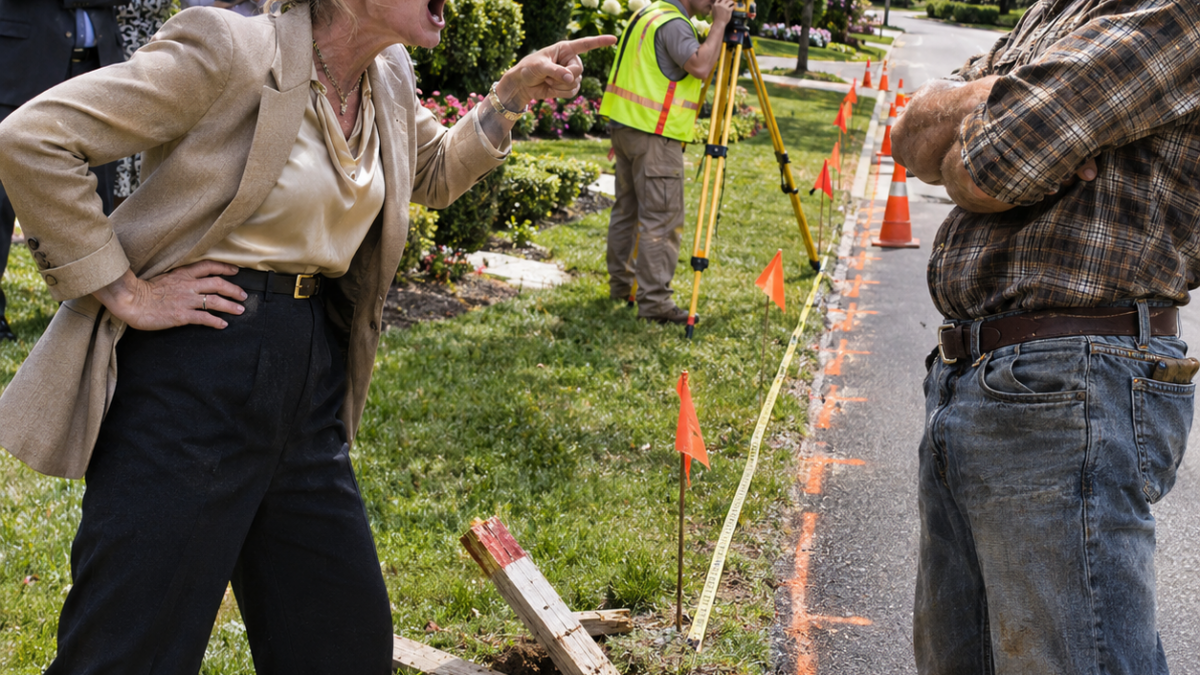
PART 2
## **The Seventy-Two Hours**
I called my son that night.
Ben Harrison had inherited my patience and Sarah’s ability to explain unpleasant truths without sounding like he enjoyed them.
He was also a property lawyer.
That helped.
“Dad,” he said after I finished, “tell me you’re exaggerating.”
“I wish.”
“She intends to remove recorded monuments?”
“Four of them.”
“On your parcel?”
“Yes.”
“And she put that in writing?”
“Yes.”
There was silence.
Then:
“Do not stop them.”
That was not the answer Sarah expected.
She was sitting across from me at the kitchen table.
Her eyebrows rose.
I put Ben on speaker.
“You want him to let them destroy our property?” she asked.
“I want Dad to document them completing an intentional act after being warned.”
I nodded.
Exactly.
Ben continued.
“Dad, photograph every monument now.”
“Already planning to.”
“Wide shots, close shots, coordinates, county plat references.”
“Got it.”
“If you can establish the exact existing locations before removal, even better.”
“I have handheld GPS equipment.”
“Of course you do.”
Sarah smiled.
Ben added:
“Set cameras where they’re visible enough that nobody can later claim secret recording issues.”
“Done.”
“And don’t confront the workers.”
“What if they ask me something?”
“Tell them the land is yours and that you object. Once. Calmly.”
“That risks stopping them.”
“If they stop, good. If they proceed after actual notice, better evidence.”
“Understood.”
Sarah leaned toward the phone.
“You two sound disturbingly excited.”
“I’m a lawyer, Mom.”
“And he’s a retired colonel.”
“Exactly.”
She sighed.
“I married into something.”
## **My Father’s Marker**
The next morning, I walked the perimeter.
Four primary monuments.
The first stood near the Prestwick entrance road.
Rusty iron pipe rising about eight inches from the soil.
My grandfather had helped a county surveyor set it decades earlier.
Dad used to clear weeds around it by hand.
I remembered being maybe thirteen, carrying a hoe while he worked.
“Why do we care about an ugly pipe?” I’d asked.
Dad wiped sweat from his forehead.
“Because someday someone might decide this land would look better if the line moved.”
At thirteen, I laughed.
Dad didn’t.
“People don’t usually steal land with guns, son.”
“How do they steal it?”
“One little assumption at a time.”
I ran my hand across the rusted metal.
Almost sixty years later, Dad’s warning had become embarrassingly literal.
I photographed the marker.
Measured.
Recorded.
Then the second.
Third.
Fourth.
By late afternoon, I had hundreds of images.
GPS coordinates.
Measurements tied to permanent features.
Copies of the county plat.
Historical photographs.
I even took soil samples, not because Ben asked for them, but because thirty years of engineering had trained me to collect more evidence than I expected to need.
Sarah watched me label bags.
“You know a normal person would’ve just called the sheriff.”
“Sheriffs deal with current conduct.”
“This is current.”
“Not until they touch the markers.”
“And when they do?”
“We’ll have proof.”
She looked at the neat row of labeled evidence.
“I don’t know whether to be impressed or frightened.”
“Both are reasonable.”
## **Nine O’Clock**
The contractors arrived almost exactly on schedule.
9:00 a.m.
Old pickup.
Magnetic sign:
**DAVE’S DISCOUNT LANDSCAPING & REMOVAL**
Not exactly the licensed survey-restoration team Karen had implied.
Two men climbed out.
One lit a cigarette.
The other checked a work order.
I zoomed in from the window.
Prestwick Commons logo.
Work authorization.
**Remove four rusted metal obstructions along perimeter greenbelt.**
Obstructions.
My grandfather’s boundary markers had been renamed into permission.
Sarah stood beside me.
“That’s them?”
“Yes.”
“Are you really not going outside?”
“I will.”
“When?”
“After they make clear what they’re doing.”
The man with the cigarette kicked the first marker.
Then walked to the truck.
He returned carrying chain.
A come-along winch.
My stomach tightened.
I went outside.
Not fast.
Not angry.
I stopped twenty feet away.
“Gentlemen.”
They looked over.
The older one said:
“Morning.”
“You’re on private property.”
He glanced at his paper.
“We’re removing these pipes for Prestwick.”
“They’re registered survey monuments.”
He frowned.
“We just have a work order.”
“I’m the landowner. I’m notifying you that I object to their removal.”
The cigarette man shrugged.
“You’ll have to take that up with the HOA.”
“I have.”
The older man shifted uncomfortably.
“You saying these are yours?”
“Yes.”
“They told us common area.”
“They’re wrong.”
For a moment, I thought they’d leave.
Then the cigarette man looked at his partner.
“We’ve already been paid.”
That sentence told me everything.
I raised my phone.
“Understood.”
He stared.
“You filming?”
“Yes.”
“Why?”
“So nobody has to remember this differently later.”
He muttered something.
Then wrapped the chain around the marker.
Sarah remained inside.
I could feel her watching.
The winch tightened.
Metal groaned.
Earth cracked.
The pipe leaned.
Then came free with a wet sucking sound.
A hole opened where it had stood for more than six decades.
Something inside me hurt.
Not rationally.
It was an iron pipe.
Replaceable.
But I had watched Dad clear around that pipe.
Watched my grandfather point to it in old photographs.
Now some stranger threw it into the back of a truck.
Clang.
Karen arrived before they reached the second marker.
Golf cart.
Sunglasses.
Smug smile.
She parked twenty yards away.
Didn’t approach me.
Just watched.
I made sure the camera captured her.
Marker two came out.
Then three.
Then four.
Karen gave the workers a little wave.
And drove away.
No conversation.
No apology.
No hesitation.
The contractors left four holes behind.
## **The Empty Corners**
After the truck disappeared, I walked the perimeter again.
The land looked strangely wrong.
A survey monument is small.
Its absence shouldn’t change fifty acres.
But it did.
Each hole felt like punctuation removed from a sentence.
I called Ben.
“They did it.”
“All four?”
“All.”
“Karen there?”
“On video.”
“Workers?”
“Faces, truck, work order, removal.”
“Good.”
I looked at the empty hole.
“It doesn’t feel good.”
Ben’s voice softened.
“I know, Dad.”
For a moment, he wasn’t my lawyer.
He was the grandson of the man who had protected those markers.
“You remember Grandpa showing you the northeast corner?” I asked.
“Yeah.”
“He’d make me walk it every spring.”
“He made me walk it too.”
I smiled despite myself.
“Then let’s put them back properly.”
“We will.”
## **The Demand Letter**
Ben’s letter was careful.
No rage.
No theatrical threats.
It explained that the HOA had deliberately destroyed recorded survey monuments after notice.
It cited applicable state law.
It demanded two things.
First:
No further entry onto my property.
Second:
Within thirty days, Prestwick Commons must hire a licensed surveyor at its own expense to reestablish the lawful monument positions and install permanent replacements.
Reasonable.
Clean.
Cheap compared with litigation.
We sent it certified.
Karen signed for it.
Then ignored us.
Twenty-five days later, she responded personally.
Her letter said the board stood by its action.
It called the markers:
**unsightly and hazardous debris.**
Then came the sentence Ben later said he’d frame if professional ethics allowed it.
**The board considers this matter closed.**
But Karen wasn’t finished.
A second page notified me that Prestwick Commons had fined my property $500 for four unapproved excavations along the community greenbelt.
I read it twice.
Then called Ben.
“They fined me.”
“For what?”
“The holes.”
Silence.
Then laughter.
He laughed so hard he had to put the phone down.
“This isn’t funny.”
“Dad.”
“They ripped the markers out.”
“I know.”
“They made the holes.”
“I know.”
“And now they’re fining me.”
“I know.”
He finally caught his breath.
“I’m sorry.”
“You don’t sound sorry.”
“This is retaliatory conduct on paper. She has signed it.”
I looked toward the empty corners.
“What next?”
Ben became serious.
“Now we stop asking them to behave.”
## **An Old Friend**
I called David Chen.
Not my lawyer.
Different David.
Dave Chen had served with me in the Corps of Engineers.
One of the best geodetic surveyors I’d ever known.
After military retirement, he moved into federal cadastral work with the Bureau of Land Management.
He answered:
“Chen.”
“Dave.”
There was a pause.
“Jack Harrison?”
“Still alive.”
“That remains disputed.”
We caught up.
Then I explained.
By the end, his tone had changed.
“They physically removed original monuments?”
“Yes.”
“Recorded?”
“Yes.”
“Your parcel traces to an original federal patent?”
“I believe so.”
“How old?”
“Late nineteenth century.”
He went quiet.
“Interesting.”
“What?”
“Some parcels derived directly from federal land patents can support a federal dependent resurvey when there is a serious dispute over the original patent boundary.”
My pulse changed.
“You’re saying BLM could survey it?”
“I’m saying there’s a process.”
“How official?”
“Jack, if it qualifies, we’d be retracing the federal patent boundary from original control.”
I smiled.
Dave heard it.
“Don’t start celebrating.”
“I didn’t.”
“You’re smiling.”
“How could you know?”
“I served with you for fifteen years.”
Then he added:
“It’s not quick.”
“Fine.”
“Not necessarily cheap.”
“Fine.”
“Requires documentation.”
“Dave.”
“Right. Stupid thing to say to you.”
## **The Federal Patent**
Ben and I spent weeks assembling the application.
Original 1888 patent.
Chain of title.
County records.
Historic surveys.
Photographs.
Karen’s notice.
Video of removal.
Our demand letter.
Her refusal.
Her fine for the holes.
The argument was simple.
The original monuments had been intentionally destroyed.
An adjoining entity was asserting a conflicting boundary.
A dependent resurvey was necessary to reestablish the original federal patent line.
While the application moved through bureaucracy, Karen became worse.
That surprised me.
I thought someone on her board would eventually talk sense into her.
Instead, removing my markers seemed to convince her she’d won something.
## **Prestwick Under Karen**
Violation letters multiplied.
An eighty-two-year-old widow named Mrs. Gable was fined because rose bushes extended slightly toward the sidewalk.
The Martinez family was cited for a brightly colored children’s slide.
The Patels received an order to repaint their blue front door.
Tom Avery, a retired firefighter, was told to remove a bird feeder because it attracted “undesirable wildlife.”
Apparently birds had not received HOA approval.
One evening I ran into Tom.
“Heard about your feeder.”
He stared.
“I’m sixty-eight years old.”
“Yes.”
“I fought structure fires for thirty-one years.”
“I know.”
“And now a woman in a golf cart is telling me cardinals lower property values.”
I laughed.
He didn’t.
Then he did.
Barely.
“She does this to everyone,” he said.
“That matters.”
“How?”
“Because she wants everyone believing they’re alone.”
Tom looked at me carefully.
“What are you planning?”
“Dinner.”
## **The Barbecue**
Sarah cooked enough for an infantry platoon.
Tom came.
The Patels.
The Martinez family.
Mrs. Gable’s son.
A few others.
At first, it was normal.
Burgers.
Beer.
Small talk.
Then I opened my laptop.
Played the video.
Karen watching the contractors rip out the monument.
Nobody spoke.
Then I showed the fine for the holes.
Tom said:
“You’ve got to be kidding.”
Mrs. Patel leaned forward.
“She fined you for what her workers did?”
“Yes.”
Then I asked:
“Who else has a story?”
That opened the floodgate.
Fine notices came out of purses.
Photos from phones.
Emails.
Threats.
Appeals denied without hearings.
Rules residents couldn’t locate in the actual bylaws.
I opened a binder.
Name.
Address.
Issue.
Documentation.
We built files.
One household at a time.
At the end of the night, Mr. Patel asked:
“What do we do?”
“Nothing public.”
Tom frowned.
“Nothing?”
“For now.”
I closed the binder.
“We document.”
“That’s it?”
“Her power depends on confusion. Facts cure confusion.”
Tom smiled.
“Colonel’s building a case.”
I didn’t deny it.
## **The White Envelope**
Three months after my call with Dave Chen, a certified envelope arrived bearing the seal of the Department of the Interior.
I opened it at the kitchen table.
Sarah watched my face.
“Well?”
“Approved.”
She exhaled.
A BLM Cadastral Survey team would conduct a dependent resurvey to reestablish the original patent boundaries.
Fieldwork in four weeks.
A copy of the notice had been served on Prestwick Commons.
Sarah smiled.
“Think Karen understands what that means?”
“No.”
“How do you know?”
“Because if she understood boundaries, we wouldn’t be here.”
## **Federal Survey Day**
At eight in the morning, two white federal SUVs arrived.
Four survey professionals stepped out.
Field vests.
Equipment cases.
No drama.
No golf cart.
Marcus Thorne led the team.
Weathered face.
Efficient handshake.
“Colonel Harrison.”
“Marcus.”
“We’ve reviewed the record.”
“And?”
He smiled slightly.
“We’ll tell you after we measure.”
That was exactly the answer I wanted from a professional.
They began with distant control points.
Original sectional corners.
Historic references.
High-precision GNSS receivers.
Robotic total station.
Ground-penetrating radar where necessary.
It was beautiful work.
Not because of technology.
Because of discipline.
No assumptions.
No “everybody knows the line is here.”
Measure.
Check.
Repeat.
## **Karen Meets the Federal Government**
She arrived before lunch.
Golf cart.
Angry enough that I could see her jaw working from across the field.
She stopped near Marcus.
“What are you doing?”
Marcus continued adjusting equipment.
She raised her voice.
“I asked you a question.”
He looked up.
“Federal cadastral resurvey.”
“This is Prestwick Commons property.”
“That question is part of what we’re resolving.”
“I am HOA president.”
“Okay.”
The word devastated her more than an argument would have.
She produced papers.
“Our attorneys—”
Marcus handed her a federal work notice.
“Your registered agent received this.”
She skimmed it.
“You cannot trespass on community property.”
“We’re operating under federal survey authority.”
“I demand you leave.”
Marcus’s expression cooled.
“Ma’am, please remain outside our active work area.”
“You don’t understand who you’re speaking to.”
He paused.
Then said:
“I understand exactly who I’m speaking to.”
Karen looked around.
Neighbors were watching.
She needed control back.
“I will call law enforcement.”
Marcus nodded.
“You may.”
Then added:
“If anyone interferes with an authorized federal survey, our office can address that through federal channels.”
Her expression changed.
No shouting after that.
She drove her golf cart back fifty feet.
Parked.
And spent two hours watching professionals measure the land she had already decided she understood.
## **Three Days**
The BLM team worked for three days.
They found evidence of the original corners.
Compared monuments.
Reconstructed record geometry.
Worked near Prestwick’s entrance.
Again.
And again.
On the third afternoon, Marcus came to my door.
“Can we walk?”
Sarah joined us.
We crossed toward the entrance road.
Marcus stopped near one of the old marker locations.
“Your grandfather’s survey was remarkably good.”
I felt a small surge of pride that made no rational sense.
“Meaning?”
“Meaning the historic record position is essentially where your family said it was.”
Sarah smiled.
“So Karen was wrong?”
Marcus looked toward the asphalt.
“That’s not the interesting part.”
He opened his tablet.
Satellite image.
Red line.
I stared.
The line did not follow the landscaped edge beside Prestwick’s entrance road.
It ran into the road.
Far into it.
“How far?”
“Roughly twenty feet through this stretch.”
I looked at him.
“Twenty feet?”
He nodded.
“The developer’s road alignment crossed the patent boundary.”
Marcus pointed down the roadway.
“Lane, curb, gutter, part of the median landscaping.”
He enlarged the map.
“And portions of the entrance monument.”
Sarah whispered:
“Oh my God.”
Marcus continued.
“Preliminary field evidence indicates the encroachment continues for close to a quarter mile.”
I stared at a road I had driven past thousands of times.
Twenty feet of it was mine.
Not metaphorically.
Not emotionally.
Legally.
And Karen had ripped out the monuments defining that fact because she thought they were ugly.
## **It Got Worse**
The official preliminary report arrived a week later.
Ben came over immediately.
We spread the map across my father’s old oak table.
The encroachment area was shaded red.
Road.
Sidewalk.
Drainage infrastructure.
Then Ben stopped.
“What is this?”
Utility easements.
Main water line.
Sewer main.
Fiber.
Buried beneath the same strip.
He looked at me.
“Dad.”
“I see it.”
“You own the corridor.”
“Yes.”
“Their main entrance sits on it.”
“Yes.”
“And utilities.”
“Yes.”
Ben leaned back.
“This changes everything.”
I felt no triumph yet.
Just weight.
Because a boundary dispute involving a decorative flower bed is one thing.
A boundary dispute involving sewer, water, fiber, and access for a whole neighborhood is something else.
Ben said:
“In theory, we could seek an injunction.”
“I know.”
“They would panic.”
“I know.”
“We could force immediate negotiations.”
“I know.”
Then he looked at me.
“You’re not going to cut them off.”
“No.”
He smiled.
“I didn’t think so.”
“People live there.”
“Exactly.”
I looked at the map.
“My problem is Karen.”
“Then don’t punish the neighborhood.”
That became the rule for everything afterward.
## **The Second Letter**
We didn’t reveal the survey immediately.
Instead, Ben sent one more letter.
Polite.
Almost friendly.
It referenced Karen’s statement that my old markers were invalid.
Then asked:
**Please provide the official recorded survey upon which Prestwick Commons relied when determining the boundary between HOA common property and the Harrison parcel.**
Thirty days.
Simple.
If they believed the markers were wrong, they should have a document showing why.
They didn’t.
We knew that now.
But Karen didn’t know what we knew.
That mattered.
## **The Special Assessment**
Two weeks later, notices appeared throughout Prestwick.
**EMERGENCY SPECIAL MEETING**
Legal threat.
Property defense.
Potential special assessment.
Karen had taken the bait.
She would rather ask a hundred homeowners for money than admit she didn’t have a survey.
The meeting was scheduled ten days before our production deadline expired.
The night before, I invited our alliance over.
This time, I showed them the federal map.
Silence.
Tom stared.
“That’s our entrance road.”
“Part of it.”
“On your land?”
“Yes.”
Mrs. Patel covered her mouth.
“What happens to our houses?”
“Nothing if I can help it.”
“What about water?”
“I am not shutting anyone’s water off.”
The tension eased slightly.
Tom looked at me.
“So what are we doing tomorrow?”
“Questions.”
He frowned.
“Questions?”
“Karen needs a villain.”
I tapped the map.
“If I walk in waving this, she gets one.”
Mr. Patel nodded slowly.
“She’ll say you’re stealing the road.”
“Exactly.”
“So we make her explain herself first.”
“Yes.”
We assigned questions.
Tom:
Why doesn’t the HOA already possess a survey?
Mrs. Patel:
Where is the approved front-door color list?
Mrs. Gable’s son:
Which bylaw regulates rose-bush distance?
Others:
Appeals.
Fine procedures.
Board authority.
No shouting.
No insults.
Let Karen answer.
Or fail to.
## **The Emergency Meeting**
The clubhouse was packed.
Close to a hundred residents.
Karen sat in the center.
Beside her:
Gary, timid board member.
Brenda, permanent scowl.
Karen struck the gavel.
“Our community faces an unprecedented hostile legal threat.”
I sat in the back.
She continued.
“Jack Harrison is attempting to seize part of Prestwick Commons.”
Murmurs.
“He has demanded documents and threatened litigation that could jeopardize property values.”
Not exactly.
“He is claiming ownership of a portion of our main road.”
That interested me.
Somebody must have guessed.
Or perhaps preliminary information had leaked.
Karen continued.
“To protect your homes, the board proposes a $500 one-time legal defense assessment.”
People exploded.
Five hundred dollars.
Immediately.
For a fight they barely understood.
Karen raised her voice.
“If we fail to defend ourselves, your property values could collapse.”
Then questions began.
## **Tom**
Tom stood.
“Karen.”
“Yes?”
“If Jack’s claim is obviously false, why don’t we just give him the survey showing the boundary?”
Karen smiled.
“The developer documents are complex.”
“Do we have a survey?”
“We have subdivision plats.”
“Do they show the line he’s asking about?”
“Our attorneys believe a modern survey may be advisable.”
Tom paused.
“So we don’t have one.”
“We have documents.”
“Which ones?”
She avoided the answer.
People noticed.
## **Mrs. Patel**
“My fine says our front door is an unapproved blue.”
Karen visibly bristled.
“This meeting isn’t about paint.”
Mrs. Patel stood straighter.
“I’ve asked three times for the approved palette.”
“Not relevant.”
“It is relevant.”
A murmur of agreement.
“You want five hundred dollars because we should trust the board’s documents.”
She held up her violation letter.
“I want to know whether the document used to fine me actually exists.”
Karen snapped:
“You are attempting to derail an important legal meeting.”
Mrs. Patel replied:
“No. I’m trying to find out whether you make rules up.”
Applause.
Not huge.
But enough.
Karen’s face changed.
## **Mrs. Gable’s Son**
“My mother is eighty-two.”
He held up a fine notice.
“She was ordered to remove roses because they extended too close to a sidewalk.”
Karen sighed.
“Landscape obstructions create hazards.”
“Show me the bylaw.”
“Sir—”
“I’ve read them.”
Silence.
“There isn’t one.”
People started talking.
Then shouting.
Stories came out.
Bird feeder.
Children’s slide.
Work van.
Basketball hoop.
Satellite dish.
Front door.
Rose bushes.
One resident shouted:
“She told me the rule is whatever the board decides!”
Karen hammered the gavel.
“This is not what tonight is about!”
It absolutely was.
Because the road dispute was just the biggest example of a pattern.
Authority without documentation.
## **My Turn**
I stood.
The room quieted.
Karen saw me.
“You have no right to address this membership.”
Tom called:
“Let him speak.”
Others joined.
Karen couldn’t stop it.
I walked toward the front carrying one photograph.
Not the federal map.
Not yet.
I held up the photograph.
Dave’s Discount Landscaping.
Chain.
My monument.
Karen in the background.
“This is why we’re here.”
The room went silent.
“Months ago, Karen ordered contractors onto my land.”
Another photograph.
Marker coming out.
“I told them these were recorded survey monuments.”
Then Karen’s letter.
“The HOA refused to restore them.”
Then her fine.
“And after creating four holes in my property…”
I held it up.
“They fined me for those holes.”
Laughter erupted.
Then anger.
Karen stood.
“That is an intentional mischaracterization.”
“Did your contractor remove the markers?”
“They were nuisance objects.”
“Did you authorize it?”
“The board did.”
“Did I warn you they were registered monuments?”
“You claimed they were.”
I nodded.
“Good.”
I looked around the room.
“So I asked Prestwick for the survey proving they were wrong.”
Then toward Karen.
“You still haven’t produced one.”
She pointed at me.
“You are trying to steal community land.”
“No.”
“You’ve threatened our road!”
“No.”
“Then why are you demanding boundary records?”
“Because you destroyed mine.”
No one moved.
Then I said:
“You have ten days left.”
Karen’s voice shook.
“For what?”
“To produce the survey you claim justifies your actions.”
I returned to my seat.
I still hadn’t shown the federal map.
I didn’t need to.
Karen had begun collapsing without it.
## **The Vote That Never Happened**
The $500 assessment never reached a clean vote.
Residents demanded financial records.
Legal opinions.
The original survey.
Meeting minutes authorizing marker removal.
Karen tried to restore order.
Couldn’t.
Someone shouted:
“Resign!”
Another:
“Where’s the survey?”
Tom demanded a special recall procedure.
Gary whispered something to Brenda.
Brenda whispered back.
Karen looked abandoned while still sitting between them.
Sarah leaned toward me.
“You haven’t even shown them.”
“No.”
“The road?”
“No.”
“Why?”
I watched Karen fight with three residents simultaneously.
“She needs to finish losing the argument she already chose.”
## **Ten Days**
A recall petition circulated.
Within forty-eight hours, enough signatures existed to force a vote.
Karen refused to resign voluntarily.
The thirty-day deadline expired.
No survey.
Day thirty-one, Ben filed.
And that was when Prestwick Commons saw the federal map.
## **Quiet Title**
The complaint began with a quiet-title action.
Simple goal:
Judicial recognition of the property boundary established by the federal dependent resurvey.
Exhibit A:
BLM plat.
Black line.
Red encroachment.
Twenty feet.
Quarter mile.
Road.
Curbs.
Drainage.
Utilities.
The second count addressed trespass.
Third:
Destruction of survey monuments.
Fourth:
Property damages.
Then punitive allegations based on the retaliatory fine for holes Karen’s contractor created.
Ben attached Karen’s signed letter.
Her own words.
Then he filed the hammer.
Preliminary injunction.
## **The Injunction Request**
We did not ask to shut off water.
We did not ask workers to rip up the road.
We asked the court to prohibit continued unauthorized use of the encroaching strip unless Prestwick reached a lawful arrangement with me.
That put the entire issue under judicial supervision.
And suddenly the HOA couldn’t pretend the road was theirs because it had always been there.
Ben also sent evidence elsewhere.
State consumer-protection authorities.
Investigative journalist.
Not anonymous smears.
Documents.
Video.
The survey.
Residents’ violation files.
Then everything exploded.
## **Six O’Clock News**
The television story aired with an aerial graphic.
Prestwick Commons.
Red strip cutting through the entrance.
My property.
Twenty feet into the road.
Then footage of the contractor pulling out my monument.
Then Karen at an old community picnic saying:
“We’re committed to preserving standards.”
The edit was brutal.
Mrs. Patel was interviewed.
So was Tom.
Mrs. Gable’s son talked about his mother’s roses.
By morning, Prestwick was a regional joke.
That wasn’t what I wanted.
But public scrutiny did something years of private fear hadn’t.
It made the board answer questions.
## **The Attorney General**
The state consumer-protection office acknowledged receiving the resident dossier.
They began reviewing HOA practices.
Not because every petty fine was criminal.
Most weren’t.
But patterns mattered.
Misrepresentation.
Improper enforcement.
Financial procedures.
Retaliation.
People with actual authority started asking for documents.
Karen had always loved official requests when she was sending them.
She liked them less when they arrived for her.
## **Insurance**
Then the board’s liability insurer issued a reservation-of-rights letter.
The carrier would defend initially.
But intentional destruction of known survey monuments and other willful acts might fall outside coverage.
That sentence frightened homeowners more than anything else.
If insurance refused to pay major damages, the association itself could be responsible.
Association money came from residents.
Special assessments.
Suddenly this wasn’t:
Jack versus Karen.
It was:
Karen’s decisions versus everyone’s wallets.
## **Home Values**
Buyers began asking questions.
One sale fell through.
Then another.
Realtors wanted copies of the lawsuit.
Lenders wanted clarification on access and utilities.
I hated that.
These were innocent people.
I called Ben.
“We need to move faster.”
“We have leverage.”
“They’re getting hurt.”
“That is why leverage works.”
“I don’t want their houses losing value.”
“Then we negotiate as soon as there’s a board willing to negotiate.”
“Karen won’t.”
“I know.”
“So we need Karen gone.”
“Exactly.”
## **The Recall**
The recall meeting was standing room only.
Karen gave a speech.
Blamed me.
The media.
Disloyal residents.
Her board.
The surveyors.
Politics.
Anything except herself.
Tom spoke afterward.
He didn’t yell.
That made it stronger.
“We hired her to run an HOA.”
He looked around the room.
“Not start land wars.”
Applause.
Mrs. Patel spoke.
Mrs. Gable’s son.
Others.
Then the vote.
Nearly unanimous.
Karen was removed.
Gary resigned.
Brenda resigned.
Tom Avery became interim president.
The retired firefighter who had been fined for feeding birds now inherited the largest legal crisis in Prestwick history.
His first phone call was to Ben.
“I surrender.”
Ben put the call on speaker.
I said:
“Tom.”
“Jack.”
“Nobody’s surrendering.”
“Feels like it.”
“We fix the road.”
Silence.
Then:
“You’re not going to close it?”
“No.”
Tom exhaled.
I could hear the weight leave his body.
“Thank God.”
“But the HOA is going to fix what happened.”
“Name it.”
## **The Negotiating Table**
We met in Ben’s office.
Prestwick’s interim board.
Their attorney.
Tom.
Ben.
Me.
The HOA lawyer looked like he’d aged ten years in two weeks.
Ben began.
“Let’s start with reality.”
He placed the federal plat on the screen.
“The boundary is not seriously disputable.”
No response.
“The association’s road encroaches onto Mr. Harrison’s parcel.”
No response.
“The utilities do as well.”
The attorney nodded.
“We understand.”
Ben continued.
“The association intentionally removed registered monuments after warning.”
Another nod.
“Then refused restoration.”
“Yes.”
“Then issued a retaliatory fine.”
The attorney closed his eyes briefly.
“Yes.”
Ben sat back.
“Our potential claims are substantial.”
One board member asked:
“What does Jack want?”
I answered.
“Peace.”
They stared.
Tom smiled faintly.
“I told you.”
## **My Terms**
I slid the settlement proposal across.
First:
Financial restitution.
$450,000.
The amount covered legal fees.
Survey costs.
Damage.
Compensation for historic use of the encroached strip.
Additional settlement value for intentional conduct.
Painful.
But structured to avoid bankrupting the HOA.
Second:
Permanent boundary restoration.
Prestwick would pay for licensed installation of concrete-encased brass monuments at the four primary corners.
Surveyor chosen by me.
Coordinates based on the federal resurvey.
Third:
Rescind improper fines.
Not only mine.
Documented retaliatory or unsupported fines issued under Karen’s leadership would be reviewed and withdrawn where appropriate.
Written apologies.
Fourth:
Bylaw reform.
Every fine must cite an actual existing rule.
Clear appeal process.
Independent review for boundary disputes.
No physical work near a disputed property line without professional survey verification.
Resident representation.
Fifth:
The road.
I would sell Prestwick Commons the twenty-foot encroachment corridor needed for its existing entrance, road, and related infrastructure.
Proper deed.
Proper easements.
No future ambiguity.
One board member stared at me.
“You’re selling it?”
“Yes.”
“You could keep it.”
“Yes.”
“You could close our road.”
“In theory, we could fight about that for years.”
“But you’re not.”
“No.”
“Why?”
I looked at him.
“Because your children didn’t pull my markers out.”
Silence.
## **What I Wanted in Return**
The HOA lawyer asked:
“If we accept all terms, what happens to the lawsuit?”
Ben answered.
“Dismissed after performance.”
“The injunction?”
“Withdrawn.”
“Attorney General?”
“That investigation belongs to the state. We don’t control it.”
Fair.
The lawyer studied the document.
Then:
“What about punitive damages?”
“Resolved through settlement.”
He looked at his board.
Whispers.
Numbers.
Then back at us.
“We accept in principle.”
Tom extended his hand.
I shook it.
No cheering.
No victory speech.
Just two neighbors fixing something that should never have happened.
## **Karen’s Final Attempt**
Three days after word of settlement spread, Karen came to my property.
First time since being removed.
Sarah saw her from the kitchen.
“She’s here.”
I walked outside.
Karen stopped at the driveway.
No clipboard.
No golf cart.
No board title.
“Jack.”
“Karen.”
“You’re making them pay you almost half a million dollars.”
“The settlement covers more than that sentence suggests.”
“You destroyed this HOA.”
“No.”
“You embarrassed us on television.”
“I didn’t remove the markers.”
“You brought the federal government here.”
“You made the original boundary uncertain by destroying monuments.”
Her eyes flashed.
“You planned this.”
I shook my head.
“No.”
“You knew about the road.”
“Not until the federal survey.”
She looked toward the Prestwick entrance.
“That road has been there thirty years.”
“I know.”
“So obviously everyone accepted the boundary.”
“That’s not how title works.”
She laughed bitterly.
“Always technicalities with you.”
“Karen.”
I stepped closer.
“A property line is not a technicality.”
She looked tired.
Then said:
“You could’ve just replaced the pipes.”
That sentence almost made me angry again.
“You could have left them in the ground.”
Silence.
I continued.
“You had dozens of exits.”
“What?”
“When I warned you.”
She looked away.
“When Ben asked you to restore them.”
Silence.
“When we requested your survey.”
Silence.
“When residents asked questions.”
She said nothing.
“You chose escalation every time.”
Her voice dropped.
“I was trying to protect Prestwick.”
“From what?”
She looked at me.
I answered for her.
“Rusty pipes?”
She had no response.
## **The Moving Truck**
Karen put her house on the market.
Nobody forced her.
The social pressure probably did.
A few weeks later, a moving truck arrived.
I saw it from the road.
For a moment, I remembered Dad.
He had once told me:
“When someone finally discovers where the line is, don’t celebrate too loudly. Sometimes they had to lose something to learn it.”
At seventeen, I thought that was sentimental nonsense.
At sixty-two, I understood.
Karen had lost her position.
Neighbors.
Reputation.
Home.
Maybe more would follow depending on state review.
I didn’t need to watch.
## **The New Monuments**
Installation day came one month later.
Professional survey crew.
Not landscapers.
Deep excavations.
Concrete cylinders.
Brass survey caps.
The first monument went in near Prestwick’s entrance.
The brass disk was stamped with identifying survey information tied to the official resurvey.
Permanent.
Visible.
Accurate.
I knelt and touched it.
Sarah stood behind me.
“Better than the old pipe?”
“Technically.”
“Emotionally?”
I looked at the brass.
“No.”
She understood.
The old pipe had my grandfather’s hands on it.
You can’t replace that with precision.
But you can honor it.
## **A Piece of the Old Marker**
The landscaping company had thrown the original markers into a scrap yard.
Ben tracked the disposal record.
Three were already gone.
One had been set aside because of its weight.
We recovered it.
Bent.
Rust scarred.
Ugly.
I cleaned it.
Didn’t reinstall it.
Instead, I mounted a section on a wooden plaque in my office.
Beneath it, I added Dad’s words:
**EVERYTHING WORKS BETTER WHEN PEOPLE KNOW WHERE THE LINE IS.**
Sarah saw it.
“That one you can frame.”
“Thank you.”
## **The Community Ceremony**
Tom wanted a small ceremony when the final monument was installed.
I thought that was ridiculous.
Sarah thought it was sweet.
Sarah won.
About forty residents came.
Mrs. Gable.
The Patels.
Martinez family.
Neighbors who had once avoided me.
Tom gave a short speech.
“No more dictators.”
People laughed.
Then he became serious.
“We learned that boundaries matter.”
He looked toward me.
“Literal ones and institutional ones.”
That was good.
He continued.
“We also learned that rules are supposed to protect communities, not give somebody an excuse to control one.”
Applause.
Then he shook my hand.
“You saved us from ourselves.”
“No.”
I looked at the residents.
“You did that when you started asking questions.”
## **The Road Sale**
The deed transferring the encroachment strip to Prestwick was signed the following week.
Clean title.
Properly surveyed.
Utility easements corrected.
No threat to service.
No access dispute.
For the first time since the subdivision was built, the legal record and physical road actually matched.
Ben looked at the closing papers.
“You realize Grandpa would probably hate that you sold twenty feet.”
“No.”
“He loved land.”
“He loved accurate lines more.”
Ben smiled.
“That sounds like him.”
## **Where the Settlement Money Went**
People assumed I bought something extravagant.
I didn’t.
Sarah insisted on replacing the twenty-year-old kitchen appliances.
That was the wildest purchase.
Part of the settlement covered legal costs.
Part went into savings.
And part funded a conservation trust for the Harrison acreage.
Ben asked why.
“Because this whole mess taught me something.”
“What?”
“People remember land differently after owners die.”
I wanted future generations to have records.
Survey.
Monuments.
Management plan.
No ambiguity.
No Karen two generations from now claiming a century-old oak looked inconsistent with neighborhood aesthetics.
## **Prestwick Changes**
The bylaws were rewritten.
Not abolished.
Most residents actually wanted an HOA.
They wanted common-area maintenance.
Road planning.
Neighborhood events.
Basic standards.
But the new rules had limits.
Specific citations.
Notice.
Appeals.
Voting requirements.
Conflict procedures.
Boundary disputes required survey evidence.
No president could invent a rule in a meeting and enforce it the next day.
The Patels kept their blue door.
Mrs. Gable kept her roses.
Tom’s bird feeder returned.
The Martinez kids kept their slide.
Prestwick began looking less uniform.
And more alive.
## **The Bird Feeder**
One morning, Tom called.
“Emergency.”
“What?”
“Cardinal.”
I waited.
“At the bird feeder.”
I hung up.
He called back.
“Jack.”
“What?”
“Unauthorized wildlife.”
“I’m calling federal authorities.”
We both laughed.
It felt good to laugh about something that had once made people afraid.
## **The Attorney General Review**
The state eventually completed its review.
Not every complaint became a violation.
Some were simply examples of bad leadership.
Others prompted corrective measures.
Financial records were examined.
Governance practices changed.
The new board cooperated.
That mattered.
The purpose wasn’t to punish Prestwick forever.
It was to prevent repetition.
Karen was no longer involved.
Her chapter was closing.
## **Sarah’s Cost**
One night, Sarah asked:
“Can I tell you something?”
“Always.”
“I hated who you became for a while.”
That hurt.
I didn’t answer immediately.
She continued.
“Not because you were wrong.”
I looked at her.
“You went back into mission mode.”
“Yeah.”
“You stopped sleeping.”
“I slept.”
“Four hours isn’t sleep.”
Fair.
“You stopped talking about anything except maps, letters, Karen, survey applications.”
I felt ashamed.
“I was trying to protect this place.”
“I know.”
She took my hand.
“But this place includes me.”
That sentence landed harder than any lawsuit.
“I know.”
“No.”
She squeezed my fingers.
“You know now.”
I nodded.
She was right.
Winning a property dispute while losing your peace is a strange definition of success.
## **Dad’s Table**
The old oak dining table survived everything.
It held the maps.
Photographs.
Federal report.
Settlement.
Dad had built part of it himself.
After the case ended, Sarah cleared everything away.
She set two plates down.
No binders.
No highlighted plats.
No legal pads.
Just dinner.
I stood there longer than necessary.
“What?”
“Nothing.”
“Jack.”
“I missed the table.”
She smiled.
“Sit down.”
So I did.
That may have been the moment I knew the war was actually over.
## **The Road I Now Helped Own Properly**
For months, every time I drove into Prestwick I looked at the asphalt differently.
That twenty-foot strip had been mine.
Then it wasn’t.
Legally transferred.
Properly recorded.
People asked whether selling it felt like losing.
No.
Keeping land for no reason except leverage isn’t stewardship.
The road belonged functionally with the community.
So we made the legal reality match the physical reality.
That’s what surveying is supposed to do.
Find truth.
Then build responsibly around it.
## **Marcus Returns**
A year later, Marcus Thorne happened to be in the county for another federal project.
He called.
We had coffee.
“How’s your famous road?”
“Theirs now.”
“You sold?”
“Yes.”
“Smart.”
“Some people told me I should have kept it.”
“People like drama.”
He stirred his coffee.
“Surveyors like closure.”
I laughed.
Then he said:
“You know the funniest part?”
“What?”
“If she’d left those old monuments alone, nobody would’ve requested our resurvey.”
I nodded.
Prestwick might have continued using that strip indefinitely without anyone challenging it.
Karen created the investigation that exposed the encroachment.
Her obsession with removing the line made the line more permanent than it had ever been.
## **What Revenge Would Have Looked Like**
I could have sought something harsher.
Court order blocking the road.
Aggressive damages.
Utility disruptions.
Maximum punitive claims.
I could have made homeowners pay enormous assessments.
Property values could have collapsed.
Karen would’ve blamed me.
Maybe some residents would’ve believed her.
That would have been revenge.
But revenge is easy when you have leverage.
Restraint is harder.
I wanted Karen accountable.
I did not want Mrs. Gable to lose retirement savings because the HOA president destroyed my marker.
Those are different goals.
## **The Part People Misunderstand**
Some versions of the story became exaggerated.
“Federal surveyor seized HOA road.”
Not exactly.
The federal survey established the boundary.
The map revealed that about twenty feet of Prestwick’s entrance corridor encroached on my parcel.
No federal agent confiscated pavement for me.
No bulldozer ripped out their road.
No marshal blocked residents.
The legal discovery gave me leverage.
Then we settled.
That was enough.
Reality didn’t need extra drama.
## **The Most Satisfying Moment**
People think it was Karen getting removed.
No.
Or the television story.
No.
Or the settlement.
Not even close.
The most satisfying moment came one morning when I saw Mrs. Gable tending her roses.
I stopped.
“They look good.”
She smiled.
“No one has measured them lately.”
“Dangerous freedom.”
She laughed.
Then said:
“My husband planted the first one.”
I looked at the garden differently.
“He’s gone?”
“Eight years.”
She touched a branch carefully.
“Karen wanted them cut because they were messy.”
I understood.
The old survey monuments hadn’t just been metal to me.
The roses weren’t just landscaping to Mrs. Gable.
People who love rules too much often forget that the things they regulate may carry memories they can’t see.
## **Ben’s Question**
A few years later, Ben asked whether I regretted letting the contractors remove the markers.
“Yes.”
He looked surprised.
“You told me to.”
“I know.”
“And strategically it worked.”
“I know.”
“So why regret it?”
I looked at the old iron section mounted in my office.
“Because strategy doesn’t erase loss.”
Ben nodded.
Then:
“Grandpa would’ve liked the brass monuments.”
“He would’ve complained about the expense.”
“Also true.”
## **The New Markers**
Every spring, I still walk the corners.
Habit.
The brass monuments don’t rust.
They’re set in concrete.
Official survey coordinates recorded.
No one can casually hook them to a pickup truck.
I stop at each.
Check.
Clear weeds.
Not because they need it.
Because Dad did.
Some habits are inheritance.
## **Prestwick’s New President**
Tom served one term.
Then stepped down.
Voluntarily.
I teased him.
“Can’t handle the power?”
“Terrifying.”
“Bird feeders?”
“Constant threat.”
A younger woman named Melissa became president.
The first time we met, she came to my porch carrying a folder.
I stared at it.
She noticed.
“Bad association?”
“Historically.”
She laughed.
“I wanted to discuss drainage near the road.”
“Okay.”
“Can I show you the plan?”
Can I.
Not:
The board voted.
Not:
You will comply.
Can I.
I invited her in.
That was how easy respect could have been from the beginning.
## **The Old Entrance Sign**
Part of Prestwick’s ornate entrance sign had sat within the encroachment.
During the settlement, they considered moving it.
I told them not to waste money.
It remained.
But a small plaque was later installed near the landscaping.
It said:
**PRESTWICK COMMONS
ESTABLISHED 1998**
Nothing about the dispute.
Nothing about me.
Good.
A community shouldn’t build its identity around its worst board president.
## **Karen’s House**
A family with two young children bought Karen’s old house.
They painted the front door green.
Not approved beige.
Green.
Tom drove me past one afternoon.
“Think Karen felt that wherever she is?”
“Seismic event.”
The kids had chalk drawings on the driveway.
I smiled.
That’s what healthy neighborhoods look like.
A little mess.
A little personality.
Human beings.
## **My Granddaughter**
One afternoon my granddaughter walked the boundary with me.
She was ten.
She pointed at the brass disk.
“Is this the thing the bad lady pulled out?”
“Not this one.”
“What did she pull out?”
“Older marker.”
“Why?”
“She thought it was ugly.”
My granddaughter frowned.
“That was stupid.”
I considered giving her a nuanced explanation.
Then decided ten-year-olds occasionally deserve simplicity.
“Yes.”
“Did she go to jail?”
“No.”
“Why?”
“Not every bad decision sends you to jail.”
“Did you beat her?”
“No.”
“Then what happened?”
I looked toward Prestwick’s entrance.
“She had to live with being wrong.”
My granddaughter thought about that.
“That’s worse.”
I laughed.
Maybe.
## **A Boundary Is a Promise**
Dad’s words changed slightly in my memory over the years.
When I was young, I remembered:
**Don’t move the marker.**
After Karen, I remembered the deeper lesson.
A boundary is a promise.
I won’t take yours.
You won’t take mine.
We can cooperate across the line.
We can visit.
Trade.
Build roads.
Share infrastructure.
But only if we know where we stand.
Karen treated boundaries like obstacles to her authority.
That was why she failed.
## **The Real Problem With Karen**
It wasn’t that she cared about neighborhood appearance.
People are allowed to value appearance.
It wasn’t that she liked rules.
Rules can be useful.
It wasn’t even that she made a mistake about the markers.
People make mistakes.
The problem was what she did after being warned.
I told her.
She dismissed me.
Ben told her.
She dismissed him.
We offered restoration.
She refused.
We asked for her survey.
She didn’t have one.
Residents questioned her.
She attacked them.
Reality gave Karen exit after exit.
She chose escalation each time.
That’s what turned an ordinary dispute into a catastrophe.
## **The Federal Map**
I keep a reduced copy of the BLM plat in my office.
Not for revenge.
Professional admiration.
The precision is beautiful.
It took old nineteenth-century records, surviving evidence, modern measurements, and legal principles and reconstructed a line nobody had seen correctly for decades.
That line changed everything.
Not because the government “took” Prestwick’s road.
Because truth finally became measurable.
## **The Day the Last Fine Was Rescinded**
Tom brought a stack of letters to my house.
Copies.
Each affected homeowner received one.
Mrs. Patel.
Mrs. Gable.
Martinez family.
Others.
Violations rescinded.
Account balances corrected.
Apologies.
I read Mrs. Patel’s.
**The association acknowledges that the prior door-color violation was issued without a properly adopted color standard.**
I laughed.
She called later.
“Guess what?”
“What?”
“My door is still blue.”
“Revolutionary.”
“I’m painting it brighter next year.”
“Don’t involve me.”
## **The Settlement Number**
Some residents initially hated the $450,000 settlement.
I understood.
That’s a lot of money.
But when the details circulated, attitudes changed.
Legal fees alone were substantial.
The survey was expensive.
Permanent monuments cost money.
The encroached land had market value.
The HOA had used that corridor for decades.
And the alternative was litigation involving a road and utilities on land Prestwick didn’t own.
Settlement was the cheaper path.
Tom made that clear.
“We’re paying to fix thirty years of bad paperwork and six months of bad leadership.”
Accurate.
## **Sarah’s Kitchen**
The only extravagant thing we bought was a new range.
Sarah’s choice.
I complained about the price.
She stared at me.
“You spent how much on geodetic survey work?”
“Different category.”
“You paid lawyers how much?”
“Necessary.”
“I cook for you every day.”
“Also necessary.”
She bought the range.
Best decision of the entire case, according to her.
## **Five Years Later**
Five years later, the old conflict had become neighborhood folklore.
New residents heard fragments.
“Apparently the HOA once tore out some guy’s property markers.”
“That guy owns the farm next door.”
“Federal survey found the road was wrong.”
“President got kicked out.”
Most details were forgotten.
Good.
The important changes stayed.
Better bylaws.
Transparent appeals.
Survey requirement.
Resident oversight.
Professional management practices.
You don’t need everyone to remember the battle if the peace keeps the lesson.
## **The Road at Sunset**
Sometimes Sarah and I sit on the porch at sunset.
Prestwick’s entrance road catches the last light.
Cars come and go.
Families return home.
Delivery vans.
Teenagers learning to drive.
Ambulances when somebody needs help.
The road works because we fixed the title instead of weaponizing the mistake.
That matters to me.
Land should support life.
Not become a trophy in an argument.
## **What Happened to Karen**
I heard bits.
She moved.
Stayed away from HOA politics.
Someone said she blamed me for ruining her reputation.
Maybe.
I stopped caring.
Accountability doesn’t require the person responsible to agree with it.
She knows what happened.
I know what happened.
The documents know.
Enough.
## **If I Could Speak to Her That First Morning**
I sometimes imagine Karen back on my porch.
Clipboard.
Floral pantsuit.
Confidence.
“Those markers are going.”
If I knew everything that would follow, what would I say?
Probably the same thing.
“They’re registered survey monuments.”
Then:
“Please don’t touch them.”
That’s all.
No speech about federal patents.
No threat about roads.
No prediction of lawsuits.
Because the entire disaster remained avoidable until the moment she chose not to listen.
## **The Road Was Never the Revenge**
People love the headline.
**Federal survey took twenty feet of HOA road.**
I understand why.
It’s satisfying.
Woman destroys markers.
Map comes back.
Surprise.
Road is his.
But the road wasn’t the point.
The point was what I did after finding out.
I could have used the map to hurt people.
I used it to force a correction.
Prestwick paid.
Yes.
Karen lost power.
Yes.
But homeowners kept access.
Utilities stayed on.
Nobody lost a house.
The road remained exactly where it was.
Only the ownership record changed.
That is what a satisfying victory looks like to me.
Truth without unnecessary destruction.
## **The Monument Ceremony**
Years later, the small gathering around the final brass monument remains one of my favorite memories.
No television cameras.
No attorneys speaking.
No Karen.
Just neighbors.
Tom talked about literal and figurative boundaries.
Mrs. Patel laughed with Sarah.
Kids chased each other across the grass.
Mrs. Gable brought roses.
Someone put one beside the new monument.
I looked at that flower next to the brass disk.
Her roses.
My boundary.
Two things Karen had once tried to remove.
Both still there.
That felt right.
## **The Real Revenge**
If somebody insists on calling it revenge, here’s the version I’ll accept.
Karen wanted the old monuments gone.
The replacements are stronger, deeper, and legally tied to a federal resurvey.
She wanted my property line to disappear.
It became more precisely documented than ever.
She threatened to fine me if I interfered.
Her own HOA paid me instead.
She fined the holes her contractor created.
That letter became evidence against the board.
She tried to make residents fund her legal defense.
They used the meeting to expose her.
She called me an outsider trying to steal Prestwick land.
The survey showed Prestwick had been using mine.
She wanted more control.
Her bylaws ended up with more checks on board authority.
She wanted silence.
Her conduct put Prestwick on television.
And she wanted everyone to believe she alone could protect their property values.
The community recovered only after removing her.
That’s enough irony for one lifetime.
## **The Final Walk**
Last fall, I walked the property line alone.
Cold morning.
Dry leaves.
The farmhouse behind me.
Prestwick on the other side.
At the first monument, I stopped.
Brass.
Concrete.
Solid.
At the second, I remembered Dad.
At the third, Grandpa.
At the fourth, I looked toward the road.
Twenty feet that caused months of chaos.
Now lawfully part of Prestwick.
Exactly where it should be.
I realized something.
The line hadn’t moved.
People’s understanding of it had.
That’s what truth often does.
It doesn’t create a new world.
It reveals the one that was already there.
## **What My Father Meant**
Dad’s old sentence finally made complete sense.
**Everything works better when people know where the line is.**
He wasn’t just talking about land.
Marriage has lines.
Government has lines.
HOAs have lines.
Authority has lines.
Rights have lines.
Even anger needs lines.
Karen crossed too many because she stopped believing any boundary applied to her.
I nearly crossed one myself when I discovered the road.
I had enough leverage to hurt innocent people.
The line for me was simple:
Hold the people responsible accountable.
Don’t punish people who weren’t responsible.
That line mattered as much as the survey.
## **The Ending**
The four old pipes are gone.
Three probably became scrap metal years ago.
One hangs in my office.
Prestwick Commons still exists.
The road still carries cars.
The water and sewer lines still serve houses.
The Patels still have their blue door.
Mrs. Gable’s roses still grow.
Tom no longer runs the HOA.
He says retirement from retirement suits him.
Karen is gone.
Sarah and I still live in the farmhouse.
And the new monuments stand exactly where the old records said they should.
Permanent.
Measured.
Recorded.
Respected.
When this started, Karen believed removing those rusty pipes would eliminate an ugly problem from her perfect community.
Instead, she removed the only visible warning that her own road had crossed the line decades earlier.
That mistake triggered the survey.
The survey revealed the encroachment.
The encroachment forced the lawsuit.
The lawsuit exposed the HOA’s broader abuse.
The residents found their voices.
The board changed.
The road was legalized.
And the boundary became stronger than it had ever been.
Karen wanted to erase four markers.
She ended up creating four monuments she could never have pulled out with a landscaping truck.
People sometimes ask whether I felt like I had won.
Yes.
But not when the federal map arrived.
Not when Karen was recalled.
Not when the settlement was signed.
I felt like I’d won on the Saturday morning residents gathered around that final brass monument and nobody was angry anymore.
The marker was simply there.
Doing what a boundary marker is supposed to do.
Not threatening anyone.
Not controlling anyone.
Just telling the truth.
**This is mine.**
**That is yours.**
**And now that we both know where the line is, we can finally live beside each other in peace.**








