HOA Tore $10,000 of Solar Panels Off My Roof for Looking “Trashy”—Then the Solar Rights Law Put Their Own Money on the Line
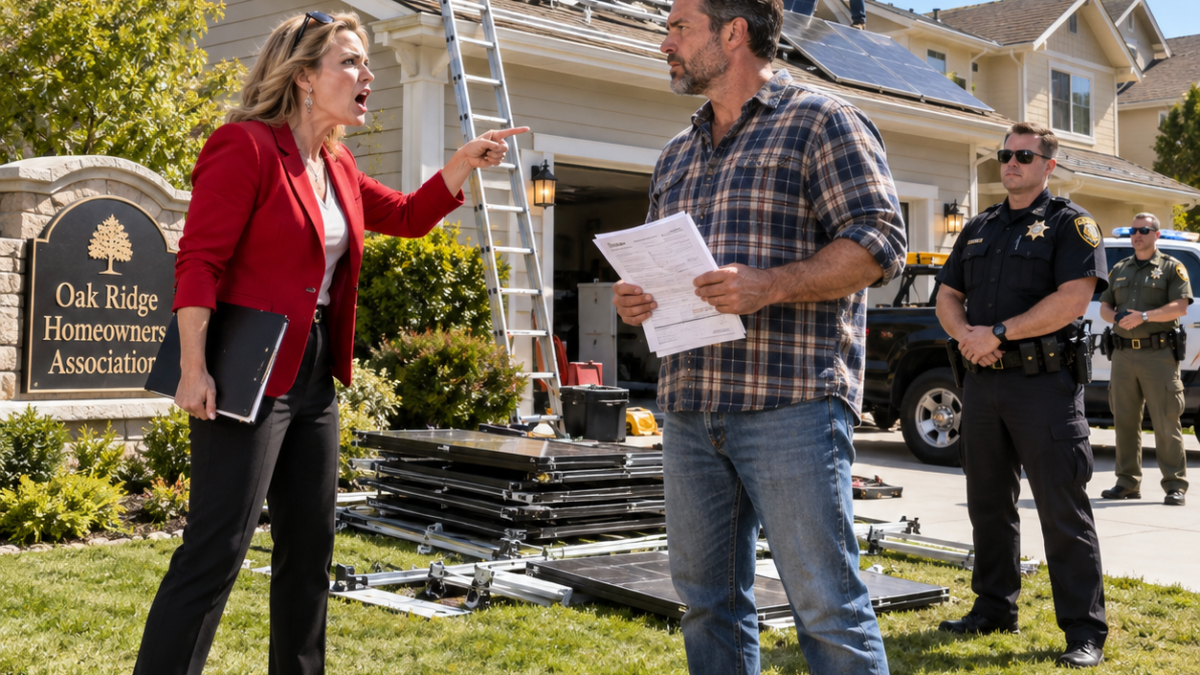
PART 2
I walked inside without saying goodbye.
Karen was still talking when I ended the call.
For about thirty seconds, I stood in the foyer with my keys in my hand and listened to the house.
Nothing.
No compressor running in the garage.
No television.
No hum from the new inverter mounted on the wall outside.
The silence felt wrong.
The solar installation had only been active for a day, but I had spent months planning it. I had compared equipment, calculated payback periods, studied roof angles, checked wind loads, and run enough spreadsheets to make most normal people question my sanity.
That was simply how my brain worked.
For twenty-two years, details had been my profession.
Now details were going to be Karen’s problem.
I put my keys down, went directly to my home office, and opened the security-camera system.
There were four exterior cameras.
Front door.
Driveway.
Rear patio.
Side gate.
I scrolled backward.
At 9:47 that morning, a white truck with the words A1 Roofing & Maintenance pulled into my driveway.
At 9:51, another vehicle arrived.
A gray SUV.
I froze the frame.
Karen climbed out.
White pants.
Blue blouse.
Oversized sunglasses.
Clipboard under her arm.
I leaned closer to the screen.
There was something almost surreal about seeing her stroll across my lawn as if she were conducting an inspection of property she owned.
She pointed toward my roof.
A man in a work shirt nodded.
Karen handed him something.
Then she walked around the side of my house.
I switched camera angles.
At 10:03, she appeared at my side gate.
She tested the latch.
When it didn’t open, she waved to one of the workers.
The man came over with a toolbox.
They didn’t break the gate, but he manipulated the latch from the outside until it opened.
Karen stepped through.
My jaw tightened.
That changed things.
This wasn’t some contractor mistakenly believing the homeowner had given permission.
She had been physically present.
She had watched them enter.
For almost four hours, the cameras recorded workers climbing ladders, disconnecting wiring, removing panels, stacking them in the truck, and carrying hardware across my yard.
At 12:16, one worker dropped a panel against the edge of the truck bed.
I saw the glass flex.
At 12:41, another man pulled a mounting rail loose with enough force to tear something beneath it.
That probably explained the damaged shingles.
At 1:37, Karen returned.
She walked around the driveway, looked up at the nearly bare roof, and actually smiled.
Then she took a photograph with her phone.
At 1:58, the truck left.
Karen’s SUV followed.
I watched the entire sequence twice.
The first time as the homeowner.
The second time as an engineer assembling evidence.
Then I created three backups.
One on an external drive.
One in encrypted cloud storage.
One on a thumb drive I put in the small fireproof safe beneath my desk.
After that I opened a new folder on my computer.
I named it OAK HAVEN SOLAR.
Then I changed my mind.
I renamed it PROJECT KAREN.
It was petty.
I admit that.
But it made me smile for the first time all afternoon.
I printed the HOA denial.
I printed my original application.
I printed the email in which I had quoted the Solar Access Act and explained that the board’s aesthetic objection could not lawfully prohibit the system.
Then I printed Karen’s responses.
There weren’t many.
That was another thing about people who enjoyed authority.
They loved giving orders.
They hated explaining themselves.
By six that evening, my dining room table looked like the beginning of a litigation file.
At six-thirty, someone knocked on my door.
It was my neighbor, Tom Miller.
Tom lived across the street with his wife, Rachel, and their two children. I knew him mostly from driveway conversations about lawn equipment and football.
He looked past me toward the roof.
“Man,” he said. “I thought I was seeing things.”
“You saw them?”
“I was working from home. Saw the truck. Saw Karen.”
That got my attention.
“What exactly did you see?”
Tom stepped inside.
“I figured maybe you’d hired somebody to adjust the system. Then I saw Karen walking around with that clipboard she carries everywhere.”
“She was here almost four hours.”
“I know.”
He hesitated.
“Frank, are you okay?”
I thought about the question.
“My property isn’t.”
He gave a humorless laugh.
“Yeah. That’s kind of what I meant.”
I brought him into the dining room.
His eyes widened at the papers.
“You work fast.”
“I had good training.”
He picked up the denial letter.
“They really denied solar panels?”
“Because of aesthetic harmony.”
He stared at me.
“Your panels were on the back of the house.”
“I noticed.”
Tom shook his head.
“That woman is insane.”
“No. Don’t give her that excuse.”
He looked up.
“What?”
“People call behavior crazy when they don’t want to examine it. Karen knows exactly what she’s doing. She believes nobody will challenge her.”
Tom’s expression changed.
He looked toward my front window, then lowered his voice.
“She fined us again.”
“For what?”
“The basketball hoop.”
I waited.
Tom rubbed the back of his neck.
“Apparently recreational equipment can’t remain in public view overnight.”
I looked across the street.
At the edge of his driveway stood a small adjustable basketball hoop.
Plastic base.
Black pole.
Faded backboard.
Probably a hundred dollars new.
His kids used it almost every evening.
“How much?”
“Twenty-five dollars a day after the warning period.”
“For a basketball hoop?”
“That’s nothing. Rachel got a notice because the kids drew hopscotch squares in sidewalk chalk.”
I thought he was joking.
His face told me he wasn’t.
“What rule?”
“Defacement of a common visual corridor.”
I stared at him.
“That’s not a real phrase.”
“It is when Karen types it on HOA letterhead.”
Something clicked into place.
My solar panels weren’t an isolated dispute.
Karen had simply made the mistake of picking a target with the time, training, and temperament to push back.
“Tom,” I said, “keep every notice you’ve ever received.”
He nodded slowly.
“Why?”
“Because this stopped being about solar panels about three hours ago.”
The next morning at 8:05, I called the county sheriff’s office.
I deliberately did not describe it as an HOA disagreement.
I said someone had entered my property without permission and removed approximately ten thousand dollars in permanently installed equipment.
That got attention.
A deputy arrived shortly after ten.
His name was Daniel Ruiz.
He looked young enough that my first instinct was to call him son, so naturally I did not.
He walked the property with me.
I showed him the roof.
The tire marks.
The gate.
Then I showed him the video.
At first, his expression was neutral.
Professional.
HOA complaints probably ranked somewhere between barking-dog disputes and fence-line arguments in terms of how eagerly deputies wanted to receive them.
Then the footage showed Karen testing the side gate.
Ruiz leaned closer.
“Who’s that?”
“HOA president.”
“She lives here?”
“No.”
“She have any ownership interest in your property?”
“No.”
“Did you give her permission to enter?”
“No.”
He watched the contractor open the latch.
Then he watched the workers remove the panels.
“So they didn’t issue a fine?”
“No.”
“They actually came onto the property and removed them?”
“Yes.”
He exhaled through his nose.
“That’s different.”
“That’s what I told Karen.”
He took photographs.
I gave him copies of the invoice, correspondence, and video stills.
When he finished, he closed his notebook.
“Mr. Peterson, I’m not going to make promises about charges. The detective and prosecutor determine where this goes, and there may be contractual issues mixed in.”
“Understood.”
“But this isn’t just somebody arguing over HOA dues.”
“No, Deputy. It isn’t.”
He gave me a report number.
I wrote it on the first page of PROJECT KAREN.
Step one was complete.
Step two was legal counsel.
I knew enough about law to know the dangerous amount: just enough to make expensive mistakes.
So I didn’t want to represent myself.
I also didn’t want the loudest attorney in town.
I had spent much of my professional life around people who confused aggression with competence.
I wanted somebody who understood statutes, contracts, evidence, insurance, and leverage.
A former colleague put me in touch with Mark Chen.
Mark had served as a Marine JAG officer before going into private practice. His office occupied the second floor of an old brick building downtown, above a dentist and beside an accounting firm.
There was no marble reception area.
No giant television.
No leather couch designed to make clients feel rich.
Just organized shelves and a coffee machine that sounded like artillery.
I liked him immediately.
He did not interrupt while I spoke.
I gave him the chronology.
Application.
Denial.
Statutory notice.
Installation.
Removal.
Phone call.
Security footage.
Sheriff’s report.
When I finished, Mark stared at me for several seconds.
Then he reached for the video still showing Karen in my driveway.
“Please tell me she knew about the state statute before this happened.”
I slid him the email.
He read it.
Then read it again.
A slow smile appeared.
“What?”
He tapped the page.
“Frank, do you know what most civil cases are missing?”
“Good evidence?”
“More specific.”
“Written evidence?”
“Written evidence proving somebody knew exactly what they weren’t supposed to do before they did it anyway.”
He lifted the page.
“You handed them the law.”
“Yes.”
“They received it?”
“The HOA portal logs delivery.”
“They never responded?”
“No.”
“And then the president personally supervised removal?”
“Correct.”
Mark leaned back.
“You may have brought me the legal equivalent of a gift basket.”
I almost laughed.
Almost.
“My roof still has holes in it.”
“That part isn’t funny.”
He became serious again.
“The first objective is restoration. Your system, your roof, your costs. But there’s another question.”
“What?”
“Whether the board members are protected by the association’s insurance and corporate structure.”
I already knew where he was going.
“Malicious conduct exclusion?”
Mark raised an eyebrow.
“Engineers.”
“I read.”
“Good. Then you understand why your email matters. If this were a simple mistake—a board misreading its authority—directors and officers insurance might absorb most of the fight. But if they knowingly violated state law and intentionally interfered with your property, coverage gets complicated.”
“Personal liability.”
“Potentially.”
That word mattered.
Potentially.
Mark wasn’t promising me a fantasy.
He was identifying leverage.
“How do we maximize it?” I asked.
His smile returned.
“You really were a lieutenant colonel.”
“Retired.”
“No such thing.”
For the next hour, we discussed strategy.
I expected him to suggest filing immediately.
He didn’t.
“Your individual case is strong,” he said. “But I want context.”
“What kind?”
“Patterns.”
I thought of Tom’s basketball hoop.
Mark noticed my expression.
“What?”
“I may have something.”
He closed his notebook.
“Then start listening.”
That was how a lawsuit over solar panels became something larger.
I didn’t knock on doors announcing a rebellion.
I didn’t print flyers.
I simply started talking to people.
The first was Mrs. Gable.
Her house was three doors down from mine, a pale yellow ranch with the most beautiful rose garden in Oak Haven.
She was seventy-six and had lived there longer than Karen.
Her husband, George, had died six years earlier.
I knew that because she still said his name in the present tense sometimes.
“George likes yellow roses.”
“George always hated that mailbox.”
“George says a good tomato needs morning sun.”
Grief had changed the grammar of her life.
One afternoon I saw her kneeling beside a bare patch of dirt near the walkway.
She wasn’t gardening.
She was staring at it.
I stopped.
“Everything okay, Mrs. Gable?”
She turned.
Her eyes were red.
For one awful second, I thought she had fallen.
Then I noticed a small pile of cut stems beside her.
“What happened?”
She looked toward the street before answering.
“The association.”
My stomach tightened.
“What did they do?”
“They said the Peace rose wasn’t approved anymore.”
I crouched beside her.
There was a circular hole in the flower bed where a mature rosebush had clearly been removed.
“How old was it?”
“Twenty years.”
Her voice broke slightly.
“George gave it to me for our fortieth anniversary.”
I said nothing.
There are moments when speaking too quickly is a form of disrespect.
Mrs. Gable touched the dirt.
“They said it wasn’t native. New landscaping standards.”
“When were those adopted?”
“I don’t know.”
“Did the board vote?”
“I suppose.”
“Did homeowners receive notice?”
She looked embarrassed.
“I don’t know, Frank. I don’t understand all those papers.”
“Do you still have the violation letter?”
She nodded.
“Would you show me?”
Five minutes later, I sat at her kitchen table with a stack of HOA notices.
Peace rose.
Garden gnome.
Wind chimes.
Decorative edging.
A bird feeder that supposedly attracted nuisance wildlife.
Each offense came with deadlines.
Each deadline came with fines.
The language was always the same.
Failure to cure.
Noncompliant condition.
Community standards.
Architectural harmony.
Different pretexts.
Same pressure.
Mrs. Gable poured coffee with a hand that trembled slightly.
“I don’t like trouble.”
“I know.”
“George handled these things.”
“I know.”
She folded her hands.
“Karen knows I don’t like confrontation.”
That sentence changed the temperature in the room.
Because there it was.
Not arbitrary enforcement.
Target selection.
Karen wasn’t simply strict.
She knew who would resist and who wouldn’t.
“What would George say about that rose?” I asked.
Mrs. Gable looked toward the window.
Her mouth twitched.
“He’d say nobody with plastic flamingos in her backyard gets to lecture us about landscaping.”
I laughed.
So did she.
The sadness didn’t leave her face, but something else arrived beside it.
Defiance.
“Mrs. Gable, I’m preparing a legal challenge against the board.”
Her expression tightened.
“I don’t want my name in court.”
“I won’t use anything without your permission.”
“What happened to your roof?”
So she had heard.
I told her.
Not dramatically.
Just facts.
When I finished, she stared at me.
“They went onto your property?”
“Yes.”
“While you were gone?”
“Yes.”
“And took them?”
“Yes.”
For the first time, anger replaced fear in her eyes.
“George would have called that stealing.”
“So would the sheriff’s office.”
That landed.
She stood, disappeared into a bedroom, and returned with an old accordion folder.
“This is everything they’ve sent me.”
I took it carefully.
“May I copy it?”
“Yes.”
Then she pointed a finger at me.
“But you bring it back.”
“Yes, ma’am.”
“And don’t let that woman know I’m helping you until we have to.”
“Yes, ma’am.”
I left with enough paper to double the size of PROJECT KAREN.
The Millers added more.
Tom had not exaggerated.
They had been fined for the basketball hoop.
Sidewalk chalk.
Children’s bicycles on the porch.
An inflatable kiddie pool visible for one afternoon.
A treehouse whose roofline extended above the privacy fence.
Rachel kept every notice in a kitchen drawer because, as she put it, “I wanted proof I wasn’t imagining this.”
Their nine-year-old son, Ethan, wandered in while we were talking.
“Dad, can I put the hoop back?”
Tom glanced at me.
Then at his son.
“Not yet, buddy.”
Ethan’s shoulders dropped.
That small reaction angered me more than any of Karen’s emails.
Rules were supposed to help neighbors live together.
Not teach children that their own driveway was a place where they could get their parents punished.
The next person surprised me.
Harold Henderson lived on the corner.
Retired accountant.
Perfect lawn.
Perfect hedges.
Perfect mailbox.
Perfect beige house.
I had always assumed he was Karen’s ideal resident.
Then I found him repainting his mailbox post on a Saturday morning.
“What happened to the old color?” I asked.
He didn’t smile.
“Obsolete.”
“Mailbox colors become obsolete?”
“In Oak Haven, apparently.”
He held up the paint can.
“Taupe.”
“Wasn’t it gray last year?”
“Greige.”
“My mistake.”
He gave me a dry look.
“Two hundred dollars to repaint the exterior trim last year. Karen announced at the last meeting that the color looked gloomy.”
“You repainted because Karen thought gray was gloomy?”
“She said the board had adopted a revised palette.”
“Did they?”
“That’s an excellent question.”
Something in his tone made me stop joking.
“You don’t support her.”
Harold set down his brush.
“I support peace.”
“Those aren’t always the same thing.”
“No.”
He looked at his immaculate house.
“You know how you survive people like Karen?”
“How?”
“Make yourself boring.”
I waited.
“You comply. Immediately. Every time. You don’t give them a reason.”
“That sounds exhausting.”
“It is.”
He lowered his voice.
“And expensive.”
I told him about the solar panels.
Unlike Tom, Harold didn’t react emotionally.
He asked questions.
Dates.
Costs.
Notice.
Evidence.
Insurance.
Then I mentioned personal liability.
His eyes narrowed.
“Personally?”
“Potentially.”
“You’ve had counsel confirm that?”
“Yes.”
He put the paintbrush down completely.
Then he said something I did not expect.
“You should look at the landscaping contract.”
“What about it?”
“Karen’s brother-in-law owns the company.”
I stared at him.
“Green Pastures?”
He nodded.
“You’re sure?”
“I spent thirty-seven years auditing corporate accounts, Frank. I don’t make statements like that because somebody whispered them at a barbecue.”
“What’s wrong with the contract?”
“Price.”
“How bad?”
“Approximately forty percent above what we were paying two years ago, with no meaningful increase in scope.”
“Could be inflation.”
“Not forty percent.”
“Anything else?”
“Clubhouse maintenance.”
“How much?”
“Fifteen thousand dollars last fiscal year.”
I thought about the clubhouse.
The carpet was older than some of the residents.
“What maintenance?”
Harold gave me a thin smile.
“Another excellent question.”
“Have you asked?”
“Three times.”
“And?”
“I’ve received three versions of ‘the board has reviewed all expenditures and found them appropriate.’”
I studied him.
“Would you help us?”
“Us?”
I told him about Mrs. Gable.
The Millers.
Mark.
The legal case.
Harold looked back at the half-painted mailbox.
For a long time, he said nothing.
Then he dipped the brush into the taupe paint.
“You know what this feels like?”
“No.”
“Being nibbled to death by ducks.”
That surprised a laugh out of me.
He painted one slow stripe.
“I’ve spent years telling myself each individual thing wasn’t worth fighting.”
He painted another.
“Two hundred dollars here.”
Another.
“Fifty dollars there.”
Another.
“Another stupid notice.”
Then he stopped.
“You add enough small numbers together, eventually you get a large one.”
“That sounds like an accountant.”
“It is.”
He looked at me.
“When’s the next HOA meeting?”
“Two weeks.”
He nodded.
“Bring your lawyer.”
That evening, my dining room became headquarters.
I resisted calling it that.
Tom did not.
Harold brought spreadsheets.
Mrs. Gable brought lemon bars.
Rachel Miller brought a folder thick enough to stop a bullet.
Mark brought law.
We sat around my table beneath a light fixture I had been meaning to replace for six months, and for the first time since moving into Oak Haven, I felt like I actually knew my neighbors.
That bothered me.
Not because I disliked them.
Because it had taken a bully to make us talk.
Mark listened to each story.
When Mrs. Gable described the rose, his expression changed.
Not legally.
Personally.
“My grandmother grows roses,” he said quietly.
Mrs. Gable pushed the lemon bars toward him.
“Then take two.”
He did.
Afterward, he spread the documents across the table.
“Here’s the distinction we need to maintain,” he said. “Frank’s solar case has a specific statutory hook. The other enforcement actions may or may not be unlawful individually. Some may simply be stupid.”
“Can stupidity be prosecuted?” Tom asked.
“Sadly, our prisons would run out of space.”
Even Harold smiled.
Mark continued.
“But the other cases matter because they show governance. Selective enforcement. Process. Whether rules were properly adopted. Whether owners received notice. Whether the board used association power responsibly.”
Harold slid over his spreadsheet.
“And this?”
Mark read it.
His eyebrows climbed.
“This is interesting.”
“I thought so.”
“Can you prove the relationship between Green Pastures and Karen?”
“Public business registration.”
“Good.”
“Can we say she’s stealing?” Tom asked.
“No.”
Mark’s answer was immediate.
“We say exactly what we can prove. Nothing more.”
I nodded.
That was the approach I wanted.
Mark tapped the table.
“This is how people lose good cases. They have ten provable facts and ruin them by adding an eleventh claim they can’t support. We don’t need exaggeration.”
Mrs. Gable looked at him approvingly.
“You’re a sensible young man.”
Mark smiled.
“My wife would like that in writing.”
We developed two tracks.
Legal.
Community.
The legal track began with a demand letter.
Mark drafted it personally.
It was six pages long.
No insults.
No grandstanding.
Just facts.
My solar application.
The denial.
The statutory notice.
The installation.
Karen’s documented presence during the removal.
The property damage.
The police report.
The applicable solar protections.
Then the part that mattered most.
The letter was addressed not only to the Oak Haven Estates Homeowners Association.
It named Karen Whitmore, Robert Jones, and Brenda Davis individually.
Official capacity.
Personal capacity.
When I saw their names written that way, I understood why Mark had insisted on precision.
“That’s going to scare them,” Tom said.
“It should educate them,” Mark replied.
The demand was simple.
Replace the solar system with an equivalent or better system.
Repair the roof.
Reimburse related losses.
Pay legal fees.
Provide additional damages reflecting the intentional nature of the act.
And issue written assurance that the association would not interfere with a lawful replacement installation.
They had fourteen days.
Harold read the letter twice.
“Do you think they’ll settle?”
Mark looked at Karen’s denial email.
“No.”
“Why not?”
“Because reasonable people don’t supervise the unauthorized dismantling of ten thousand dollars’ worth of somebody else’s equipment after being shown a statute.”
He turned to me.
“She’s going to interpret compromise as defeat.”
“What happens when she rejects it?”
“We file.”
The community track was less formal.
Mrs. Gable and the Millers circulated a petition calling for an independent audit and a special confidence vote.
At first, neighbors were reluctant.
Then they heard why.
The solar panels brought people to the conversation.
The rose kept them there.
Everybody understood ten thousand dollars.
But people felt Mrs. Gable’s rose.
It had been planted by her late husband.
It had bloomed for two decades.
Then somebody with a title and a rulebook told a widow it offended community aesthetics.
Signatures came quickly after that.
Thirty.
Forty-two.
Fifty-one.
Sixty-three.
Almost half the neighborhood.
And then something unexpected happened.
People started bringing us their own folders.
Violation notices.
Photographs.
Emails.
Fines.
One man had been ordered to replace a flag because it exceeded the approved dimension by half an inch.
A woman had received three notices over a vegetable garden that was visible through the slats of her fence.
Another homeowner had spent nearly six hundred dollars replacing porch lights because Karen decided the fixtures were “architecturally inconsistent.”
Nobody’s grievance was as dramatic as my missing solar array.
That was the point.
Power like Karen’s survives not through one enormous act but through hundreds of small surrenders.
Each one too inconvenient to fight.
Each one cheaper to obey.
Each one training the next person to stay quiet.
Four days before the HOA meeting, Karen called me.
I let it go to voicemail.
Her message was twenty-three seconds.
“Frank, this escalation is unnecessary. If you continue spreading defamatory allegations about board members, the association will have no choice but to take appropriate action. I strongly suggest you stop organizing residents and allow the board to perform its duties.”
I played it for Mark.
He smiled.
“Save that.”
“Already saved in three places.”
“Of course you did.”
“Was anything she said legally significant?”
“Mostly it’s useful because she sounds exactly like the person we’re describing.”
Two days before the meeting, a new violation notice appeared on my front door.
LANDSCAPE DAMAGE.
The tire ruts caused by the contractor Karen had sent to remove my panels had apparently left my lawn below community standards.
Fine: fifty dollars.
I stood on the porch reading it twice.
Then I started laughing.
Tom saw me from across the street.
“What?”
I held it up.
He came over.
He read it.
Then he laughed harder than I had.
“She destroys your lawn and fines you because your lawn is destroyed?”
“Apparently.”
“You can’t make this up.”
I scanned it and sent it to Mark.
His reply arrived three minutes later.
Exhibit. Don’t pay it yet.
The night of the HOA meeting, I arrived ten minutes early.
The clubhouse parking lot was already full.
Cars lined both sides of the street.
People were walking from blocks away.
The normal attendance was six or seven homeowners.
That night, more than eighty showed up.
Karen entered through a side door.
For half a second, she stopped.
She hadn’t expected the crowd.
Then the mask returned.
Chin up.
Shoulders back.
Clipboard against her chest.
Bob Jones followed her carrying a binder.
Brenda Davis came behind him.
Bob had spent his career selling insurance.
Brenda was the board secretary and Karen’s most reliable vote.
The three of them sat behind a folding table at the front.
Karen placed the gavel beside her right hand.
At seven sharp, she struck the table.
“Good evening.”
Conversations stopped.
“Due to the unusually large attendance, I’d like to remind everyone that this is a business meeting, not a public rally.”
A few people shifted.
Karen continued.
“The board will conduct the agenda in the normal fashion. Homeowner comments will be limited to three minutes.”
Harold raised his hand.
Karen ignored him.
She began reading the previous month’s minutes.
Harold stood.
“Point of order.”
Karen stopped.
Her smile vanished.
“Mr. Henderson, please sit down.”
“I have a question concerning approval of the minutes.”
“You may submit questions in writing.”
“I did.”
Murmurs.
Karen’s eyes narrowed.
“Then you’ll receive a response.”
“I submitted them two weeks ago.”
She glanced at Bob.
“Mr. Henderson—”
“The financial summary attached to the minutes reflects a forty-percent increase in the Green Pastures landscaping contract.”
The room changed.
Not loudly.
But attention sharpened.
Karen reached for the gavel.
“Financial questions are not part of—”
“Approval of financial minutes?”
Harold’s voice remained perfectly calm.
“I’m trying to understand what I’m being asked to approve.”
Bob leaned toward Karen and whispered.
Harold continued.
“The scope of work appears substantially unchanged. What accounts for the increase?”
Bob cleared his throat.
“Fuel costs.”
Harold nodded.
“Forty percent?”
“Labor too.”
“Do you have competitive bids?”
Silence.
“Mr. Henderson,” Karen said, “this interrogation is inappropriate.”
“Then let me ask one simpler question.”
“No.”
“Is Gerald Smith, registered agent of Green Pastures LLC, your brother-in-law?”
Someone behind me whispered, “Oh, my God.”
Karen’s face went crimson.
She hit the gavel.
“That is a personal attack.”
Harold sat down.
He had made his point.
Karen hurried through the remaining agenda.
Then she looked at the speaker sheet.
My name was first.
Of course it was.
“Mr. Peterson.”
I stood.
My binder felt light in my hand.
Three months earlier, I had walked into that clubhouse believing the board was a boring administrative nuisance.
Now almost every chair was occupied.
Mrs. Gable sat in the second row.
Tom and Rachel beside her.
Harold near the aisle.
Mark stood against the rear wall.
I walked to the front.
Karen glanced at the clock.
“Three minutes.”
“I won’t need much more.”
That was not entirely true.
“My name is Frank Peterson. I live at 124 Willow Creek Drive.”
I turned slightly so I wasn’t speaking only to the board.
“Two weeks ago, contractors acting at the direction of this board entered my property without permission and removed a solar-energy system worth approximately ten thousand dollars.”
The room went still.
Karen opened her mouth.
I continued.
“The system was installed after the board attempted to prohibit it solely for aesthetic reasons. Before installation, I notified the board in writing that its denial conflicted with the state’s Solar Access Act.”
I held up the email.
“They received this notice.”
I placed it on the table.
“They did not answer it.”
Another document.
“One day after installation, HOA contractors came to my home.”
Another.
“Security cameras recorded the truck.”
Another.
“They recorded Ms. Whitmore on my property.”
Karen’s face tightened.
“They recorded workers opening my side gate.”
Another.
“They recorded the removal.”
Karen slammed the gavel.
“Your time—”
“Let him finish.”
The voice came from behind me.
I didn’t turn.
Karen did.
Several others joined.
“Let him speak.”
“Yes.”
“Finish.”
Karen looked around the room.
For the first time, the gavel didn’t seem like a symbol of authority.
It looked like a piece of wood.
I continued.
“The damage has been reported to the sheriff’s office. A case has been opened.”
Brenda’s head snapped toward Karen.
Bob stared at the table.
“The association and each member of this board have also received a formal legal demand explaining potential civil liability.”
I let that settle.
“Individual liability.”
That did it.
Bob looked up.
So did Brenda.
Karen stayed rigid.
I faced them directly.
“This board was warned before it acted.”
I touched the email.
“You were given the statute.”
Then the security still.
“You acted anyway.”
Then the roof photographs.
“And you damaged my property.”
Karen leaned into her microphone.
“This is a grotesque mischaracterization. The association was enforcing covenants that Mr. Peterson voluntarily agreed to—”
“The covenants do not override state law.”
“That is your interpretation.”
“No.”
Mark’s voice came from the rear.
Everybody turned.
He stepped forward just enough to be seen.
“My name is Mark Chen. I represent Mr. Peterson.”
Karen looked as though somebody had opened a window in winter.
Mark didn’t approach the table.
He didn’t need to.
“The board has our written legal position. I suggest you review it carefully with competent counsel.”
Karen stared at him.
Then at me.
I turned toward the residents.
“This isn’t only about my roof.”
Mrs. Gable’s hands tightened around her purse.
I continued.
“It’s about whether rules serve homeowners or whether homeowners exist to serve whoever happens to control the rules.”
Karen struck the gavel.
I raised my voice slightly.
“It’s about Mrs. Gable being ordered to tear out a rosebush her husband planted for their fortieth anniversary.”
Mrs. Gable stood.
Every eye in the room moved to her.
Her voice trembled.
But it carried.
“Twenty years.”
Karen froze.
Mrs. Gable looked at her.
“That rose was there twenty years before you decided it offended you.”
Nobody spoke.
Then Tom stood.
“They’ve fined my family more than five hundred dollars this year.”
He pointed toward the table.
“My kids can’t leave a basketball hoop in our own driveway.”
A woman stood near the wall.
“They fined me over my vegetable garden.”
Another man rose.
“They made me replace my flag.”
Then another.
“My porch lights.”
Another.
“My fence stain.”
Another.
“My trailer.”
Another.
“My daughter’s graduation sign.”
The meeting stopped being a meeting.
It became testimony.
Not courtroom testimony.
Something older.
Neighbors finally comparing the things they had endured alone.
Karen kept striking the gavel.
“Order!”
Nobody stopped.
“Order!”
Tom walked forward.
He placed the petition on the table.
More than sixty signatures.
“We are formally demanding an independent financial audit and a special vote regarding this board.”
Karen stared at the pages.
“You cannot simply—”
“Read the bylaws,” Harold said.
She looked at him.
He had spent enough years obeying her that his calmness seemed to scare her more than anger would have.
“The owners can petition for a special meeting,” he continued. “The signature threshold has been met.”
Karen looked at Bob.
Bob looked at Brenda.
Brenda looked as if she might cry.
Karen stood.
“This meeting is adjourned.”
She hit the gavel once.
Nobody moved.
She gathered her purse.
“This meeting is adjourned.”
Then she left.
Bob and Brenda followed.
For several seconds, everyone stared at the closed door.
Then conversations erupted.
I stayed near the front.
People approached me one after another.
Not to congratulate me.
To tell me things.
Stories they had never thought mattered.
Receipts.
Letters.
Fear.
Anger.
One woman touched my arm.
“My husband keeps saying we should move.”
“Do you want to?”
“No.”
“Then don’t decide tonight.”
An older man shook my hand.
“I should’ve spoken up years ago.”
“So should a lot of us.”
Mrs. Gable came over last.
She looked exhausted.
“You okay?” I asked.
She nodded.
“George would have enjoyed that.”
“Which part?”
“When she couldn’t make anyone sit down.”
I smiled.
“He sounds like my kind of man.”
“He was difficult.”
“So I’ve gathered.”
Her smile softened.
“Thank you for saying his name.”
That stayed with me.
Four days remained on our demand.
Karen did not answer.
Three days.
Nothing.
Two.
Silence.
On the fourteenth day, Mark called.
“It’s here.”
“Settlement?”
He laughed.
“No.”
“How bad?”
“For them? Excellent.”
I drove to his office.
He slid a letter across the desk.
It came from the HOA’s outside law firm.
The tone was exactly what Mark had predicted.
Our claims were frivolous.
The board had acted in good faith.
I was a disgruntled homeowner.
The solar installation was an unauthorized architectural modification.
The removal was a lawful enforcement action.
The board denied all wrongdoing.
Then came the best part.
They threatened to seek reimbursement from me for the cost of removing my own solar panels.
I read that paragraph twice.
“They want me to pay the contractor?”
“They do.”
“The contractor they sent onto my property?”
“Correct.”
“To remove a system state law says they couldn’t prohibit?”
“That’s the theory.”
I set the letter down.
“They’re going to regret this.”
Mark folded his hands.
“They already do. They just don’t know how much yet.”
The following morning, he filed suit.
Oak Haven Estates Homeowners Association.
Karen Whitmore.
Robert Jones.
Brenda Davis.
Defendants.
The claims were methodical.
Violation of the solar statute.
Trespass.
Property damage.
Conversion.
Breach of the association’s duties.
Declaratory relief.
Injunctive relief.
Attorney’s fees.
Enhanced damages where permitted.
And, based on the evidence of notice and intentional conduct, claims aimed at preventing the individual board members from hiding entirely behind the association.
I read the complaint before filing.
No insults.
No adjectives we didn’t need.
That made it stronger.
Every accusation had a date.
Every date had a document.
Every document had a source.
Mark looked at me over his desk.
“Last chance to change strategy.”
“No.”
“You understand litigation can take time.”
“Yes.”
“You understand settlement may not look emotionally satisfying.”
“I don’t need Karen crying in court.”
“What do you need?”
“My roof repaired.”
He waited.
“My system replaced.”
He waited again.
“The fines against these people reviewed.”
Again.
“A board that understands it serves the neighborhood.”
“And Karen?”
I considered that.
“I need her unable to do this again.”
Mark nodded.
“Good answer.”
Service of the lawsuit happened three days later.
The annual Oak Haven community picnic was that Saturday.
I had mixed feelings about serving them there.
Part of me preferred privacy.
Part of me remembered Karen standing on my lawn while workers stripped equipment from my roof.
Mark left the decision to the process server.
The server decided the picnic offered the cleanest opportunity to locate all three defendants.
At one in the afternoon, families filled the community park.
Smoke rose from two grills.
Children ran between picnic tables.
Karen sat beneath the largest canopy.
Huge sun hat.
White slacks.
A floral shirt that looked like it had won an argument with a tropical greenhouse.
She was talking loudly to two residents.
Bob stood near the drinks.
Brenda arranged paper plates.
For the first time since the disastrous meeting, Karen seemed determined to perform normality.
Then a man in a polo shirt walked toward her.
“Karen Whitmore?”
She looked up.
“Yes?”
He handed her a thick envelope.
“You’ve been served.”
Nothing dramatic happened at first.
No thunder.
No music.
No cheering.
Just paper changing hands.
Then he approached Bob.
“Robert Jones?”
Bob’s face changed before he touched the envelope.
Then Brenda.
By that point, half the people beneath the canopy were watching.
Karen tore hers open.
She scanned the first page.
I saw the moment she reached the caption naming her individually.
Her mouth opened slightly.
A woman beside her asked, “What is it?”
Karen didn’t answer.
Bob opened his packet more slowly.
Brenda read three lines and sat down.
The process server walked away.
His work was finished.
Karen’s eyes searched the park.
Eventually they found me.
I was standing with Mark near the far edge of the lawn.
I did not smile.
That mattered to me.
This wasn’t entertainment.
It was consequence.
Karen crossed the grass toward us.
People moved out of her way.
She stopped about six feet from me.
“You did this.”
I looked at the complaint in her hand.
“Yes.”
“You humiliated us in front of the entire neighborhood.”
“I didn’t choose where you opened the envelope.”
“You planned this.”
“No, Karen.”
My voice was quiet enough that only the people closest could hear.
“I planned to install solar panels on my own roof.”
Her face flushed.
“You think you’re going to take my house?”
“No.”
“That’s what this says.”
“It says we’re seeking damages.”
“You threatened my personal assets.”
“I warned you before the panels were removed.”
“You’re enjoying this.”
That was the first thing she said that actually angered me.
“No.”
She blinked.
“I was enjoying retirement.”
I pointed toward the houses beyond the park.
“I was enjoying my garden. My workshop. My electricity bill. I wasn’t looking for a war with you.”
“You made this a war.”
“You came onto my property.”
Her jaw tightened.
“You could’ve followed the rules.”
“I did.”
“No.”
“I followed the law.”
Her voice rose.
“You always have to be right, don’t you?”
For a moment I almost felt sorry for her.
Because that question revealed everything.
To Karen, this had never been about whether she had authority.
It was about obedience.
Winning.
Who yielded first.
“I don’t have to be right,” I said. “But before I let somebody tear ten thousand dollars off my house, they’d better be.”
She stared at me.
Then turned and walked away.
The picnic never recovered.
Within forty-eight hours, the association’s insurance carrier received the complaint.
That changed the board’s world faster than anything I had done.
People think insurance is a magic shield.
It isn’t.
Insurance companies read exclusions.
They read timelines.
They read words like intentional, knowing, malicious, unauthorized, and statutory violation very carefully.
The carrier sent what Mark called a reservation-of-rights letter.
The HOA itself would receive a defense while coverage questions were evaluated.
But the carrier reserved the right to deny some claims.
Especially claims involving intentional or wrongful conduct beyond covered board activity.
Bob called Mark’s office the next morning.
Not his lawyer.
Mark.
Mark refused to discuss substance with him without counsel.
But Bob’s message told us enough.
He wanted out.
Two days later, he resigned from the board.
His letter went to every homeowner.
He said he had relied on information provided by others.
He said he never intended to violate anyone’s rights.
He said he had not understood the extent of the action taken at my property.
Karen responded with a neighborhood email accusing “certain individuals” of creating division.
It backfired.
Residents began replying all.
Normally there are few things more dangerous than reply-all.
This time, it was glorious.
One homeowner asked why Bob didn’t know the HOA had sent contractors onto my property.
Another asked who authorized payment.
Harold asked for the invoice.
Tom asked for the board minutes approving the removal.
Karen stopped replying.
Brenda resigned two days after Bob.
Her letter was shorter.
She apologized.
Not to me directly.
To the community.
She admitted she had trusted Karen’s representations and voted without independently reviewing the solar statute.
That admission was not ideal for her legal position.
Mark called it “unexpectedly candid.”
Karen called it betrayal.
We knew because Karen sent Brenda an email saying exactly that.
Brenda forwarded it to her lawyer.
Her lawyer produced it during settlement discussions.
The board no longer had a functioning quorum.
The management company sent notice that it intended to end its contract unless governance was stabilized.
Karen had spent years building power through procedure.
Now procedure was trapping her.
No quorum.
No reliable treasurer.
No secretary.
A homeowner petition demanding a special election.
An insurance carrier asking uncomfortable questions.
A lawsuit.
A police investigation.
And dozens of neighbors who had stopped being afraid.
Then came the financial records.
Once the petition gained enough support and attorneys became involved, the association could no longer dismiss Harold with vague summaries.
Documents began arriving.
Invoices.
Contracts.
Checks.
Board approvals.
Harold sat at my dining room table for three nights reviewing them.
On the fourth evening, he called me.
“Come over.”
He didn’t sound excited.
That worried me.
I walked to his house.
He had papers covering the table in precise rows.
“Bad?”
“Sloppy.”
“Criminal?”
He looked annoyed.
“I didn’t say that.”
“Fair.”
He pointed to the landscaping invoices.
“Green Pastures is definitely charging more than prior vendors.”
“Can you prove the increase wasn’t justified?”
“Not without bids and market comparisons.”
He moved to another stack.
“Clubhouse maintenance is mostly legitimate.”
“That surprises me.”
“Roof work. HVAC. Plumbing. Poor documentation, but real vendors.”
“So no secret vault full of HOA money.”
“Sorry to disappoint Tom.”
“What about the brother-in-law?”
“Conflict of interest concerns, absolutely. But conflict doesn’t automatically mean theft.”
I nodded.
“And the legal fees?”
“That’s where it gets interesting.”
He slid me three invoices.
The board had spent thousands consulting counsel over covenant enforcement.
Paint colors.
Landscaping.
Fines.
Architectural denials.
Including my solar application.
“They paid a lawyer to review it?”
“Look at the date.”
The invoice predated the removal.
Description:
Review homeowner correspondence regarding solar installation; advise association regarding state statutory limitations.
I read it again.
Slowly.
“Harold.”
“I know.”
“They consulted counsel about statutory limitations before they tore out the panels.”
“I know.”
I called Mark.
He arrived twenty minutes later.
The moment he read the invoice, his entire posture changed.
“Do not interpret this beyond what it says,” he cautioned.
“I know.”
“It doesn’t tell us what the lawyer advised.”
“I know.”
“But it establishes they were discussing state statutory limitations before the removal.”
“Yes.”
“We need the underlying communication.”
“Privilege,” Harold said.
Mark nodded.
“Probably. Unless privilege gets waived or an exception applies. But even this is useful.”
I thought of Karen on the phone.
Our attorney reviewed the covenants.
She hadn’t said the lawyer approved the removal.
She had chosen her words carefully.
Perhaps more carefully than I had realized.
Discovery eventually answered part of the question.
The HOA’s counsel had not given the board written approval to dismantle my system.
In fact, the available communications were much more cautious.
Counsel had warned that the association’s architectural authority was subject to state solar protections.
He recommended that the board focus only on reasonable placement or safety restrictions and avoid an outright prohibition based solely on appearance.
Mark read the produced email twice.
Then he looked at me.
“Remember when I said your original notice was good?”
“Yes.”
“This is better.”
Karen’s personal attorney tried to contain the damage.
Her position shifted.
She had misunderstood counsel.
She believed the installation remained unauthorized.
She had relied on the HOA’s enforcement powers.
She had not intended to violate state law.
Mark responded with the timeline.
My email citing the law.
The HOA lawyer’s warning.
Karen’s presence at the removal.
Her phone call admitting the association acted intentionally.
The later letter defending the removal.
The demand letter rejection.
At some point, an argument stops having places to hide.
That was happening to Karen.
The sheriff’s investigation moved more slowly.
A1 Roofing & Maintenance gave a statement.
Their manager claimed the HOA represented that it had authority to order removal.
They produced the work order.
Authorized by Karen Whitmore, President, Oak Haven Estates HOA.
The contractor’s insurer became involved.
Nobody wanted to be the last party holding the invoice.
Meanwhile, the community scheduled its special election.
Karen contested it.
Of course she did.
She claimed the petition contained improper signatures.
Harold checked every one.
She claimed notice was defective.
Mark reviewed it.
It wasn’t.
She claimed owners with outstanding fines shouldn’t vote.
That was the moment the neighborhood finally turned almost completely against her.
Because half the people supporting the petition had outstanding fines Karen’s board had imposed.
The new election moved forward.
Harold agreed to run for president.
Tom agreed to serve as treasurer.
Linda Alvarez, a retired high-school principal who had spent thirty years managing teenagers and therefore considered HOA politics amateur hour, ran for secretary.
I refused every nomination.
Tom cornered me at the mailbox.
“You’d win.”
“I don’t want it.”
“You started this.”
“I started a lawsuit.”
“Same thing around here.”
“No.”
“Why not run?”
“Because I don’t want authority over your basketball hoop.”
He stared at me.
Then laughed.
“That’s the best campaign slogan I’ve heard.”
The election turnout broke every association record.
Harold won by a landslide.
So did Tom.
So did Linda.
Karen received eleven votes.
I never asked who the eleven were.
People were entitled to make bad decisions privately.
The new board’s first meeting lasted two hours.
No gavel.
No raised voices.
No speeches.
Harold began by reading a simple statement.
“This association exists to maintain shared property and administer necessary community standards. It does not exist to manage the private preferences of individual directors.”
Mrs. Gable whispered beside me.
“George would’ve liked him.”
The board froze pending fines that appeared to rely on questionable rules adopted without proper process.
It commissioned an independent financial audit.
It required conflict-of-interest disclosure for vendors.
It adopted a rule that enforcement decisions affecting a homeowner’s property had to identify the actual covenant authority and appeal procedure.
And then Harold looked at me.
“Next item. Solar application for 124 Willow Creek Drive.”
Tom raised his hand.
“I move approval.”
Linda seconded.
Harold looked at the residents.
“All in favor?”
The vote was unanimous.
It was symbolic.
Legally, Mark maintained that I had never needed their permission to exercise a protected solar right in the way Karen had demanded.
But symbols matter.
The new board was saying something the old one never understood.
Rules and rights were supposed to coexist.
Not crush one another.
Karen did not attend.
By then, settlement talks had begun.
Her attorney requested a conference.
Mark and I drove downtown on a rainy Tuesday morning.
Karen was already in the conference room when we arrived.
I almost didn’t recognize her.
Not physically.
She looked the same.
But the performance was gone.
No bright power suit.
No clipboard.
No oversized sunglasses.
Plain gray jacket.
Hair pulled back.
Hands folded.
She didn’t look at me.
Her attorney, a man named Charles Mercer, did most of the speaking.
“We’re here to see whether all parties can reach a practical resolution.”
Mark nodded.
“We tried practical before filing.”
Mercer ignored that.
“The association is prepared to fund replacement of Mr. Peterson’s original system.”
Mark closed his notebook.
“That offer expired.”
“I’m aware of your position.”
“Then why repeat it?”
Mercer exhaled.
Karen’s jaw tightened.
“We are prepared,” he continued, “to include roof repairs and reasonable legal fees.”
Mark looked at me.
I said nothing.
He looked back at Mercer.
“Your client was offered almost exactly that before litigation.”
Karen finally spoke.
“I was told the board had authority.”
Mark turned toward her.
“By whom?”
“My counsel.”
“That’s not what the produced correspondence says.”
Her face hardened.
“You’re twisting it.”
“No. I’m reading it.”
Mercer touched her arm.
“Karen.”
She pulled away.
Then she looked at me.
“You wanted to destroy me.”
The room went quiet.
I felt something strange then.
Not triumph.
Weariness.
“Karen, I wanted electricity.”
She frowned.
“I wanted panels on my roof. That’s all.”
“You organized everybody against me.”
“You gave them reasons.”
“You went through financial records.”
“The homeowners own the association.”
“You humiliated me.”
“You sent a crew to my house.”
Her eyes flashed.
“Because you defied the board.”
There it was.
Even then.
Not because I was unsafe.
Not because I damaged the neighborhood.
Not because the panels harmed anyone.
Because I defied the board.
Mark didn’t say a word.
He didn’t need to.
Karen had just summarized the case better than any complaint could.
Mercer leaned toward her.
“We should take a break.”
“No.”
She stared at me.
“You think all those people are your friends now?”
“I think they’re my neighbors.”
“They’ll turn on you too.”
“Maybe.”
That seemed to surprise her.
“That’s the difference,” I continued. “I don’t need them to obey me.”
She looked away.
The settlement conference lasted three more hours.
The final terms were not the fantasy some neighbors wanted.
Karen did not lose her house.
Nobody marched her away in handcuffs.
There was no million-dollar jury verdict.
Real justice is often less theatrical.
But it can be much more useful.
The damaged solar system would be replaced with a newer, higher-output array.
My roof would be professionally repaired.
My legal expenses would be reimbursed.
I would receive additional compensation reflecting the loss and the intentional interference with my property.
The HOA’s insurer and other responsible parties would contribute according to negotiated allocations.
And, critically, Karen, Bob, and Brenda would each contribute personally to the settlement.
Not enough to ruin them.
Enough to make the phrase personal liability real.
Karen also agreed to resign from any remaining association position and not seek another Oak Haven board seat for a defined period.
The association agreed to formally rescind the violation against my solar installation.
And Karen signed a statement acknowledging that the removal had not been a lawful exercise of HOA authority.
She hated that part.
I could see it.
Mercer read the language.
Karen shook her head.
“No.”
He spoke quietly to her.
She crossed her arms.
“No.”
Mark closed his folder.
“Then we’ll see you in court.”
For several seconds, nobody moved.
Mercer whispered again.
Karen looked at me.
I didn’t speak.
Finally, she picked up the pen.
The first line of her signature came out so hard the pen nearly tore the paper.
She signed.
That should have felt like victory.
Instead, I mostly felt tired.
Outside the building, rain tapped against the sidewalk.
Mark opened an umbrella.
“Well?”
“Well what?”
“You’ve been planning this fight for months.”
“Feels longer.”
“You won.”
I looked through the rain at people crossing the street.
“I know.”
“You don’t look happy.”
“I am.”
“That’s a terrible happy face.”
I laughed.
Then I realized what was bothering me.
“I keep thinking about the phone call.”
“The first one?”
“Yeah.”
“What about it?”
“If she’d apologized that afternoon, none of this would’ve happened.”
Mark nodded.
“Probably.”
“She could’ve said the board made a mistake. Returned the panels. Repaired the roof.”
“Probably.”
“Instead she kept escalating.”
“Pride is expensive.”
I looked at him.
“You put that on your invoices?”
“Premium clients only.”
A week later, Karen’s statement appeared in the Oak Haven newsletter.
It was not warm.
It was not heartfelt.
It did not call me a wonderful neighbor.
It did not need to.
It said the former board’s decision to remove my solar installation exceeded its authority and that homeowners were entitled to protections provided by state law.
That was enough.
The independent audit finished the following month.
It did not uncover the giant theft scandal some residents had imagined.
There were no secret offshore accounts.
No bags of cash.
What it found was almost more instructive.
Poor procurement.
Weak documentation.
Conflict-of-interest failures.
Excessive reliance on sole-source vendors.
Rules announced without clear evidence of proper adoption.
Money spent defending enforcement decisions that sensible governance could have prevented.
The new board terminated the landscaping contract and obtained competitive bids.
The winning bid cost substantially less.
Harold displayed the savings at the next meeting.
Tom leaned toward me.
“Think of all the basketball hoops we can buy.”
“Don’t give him budget ideas.”
Mrs. Gable’s rose issue was reviewed too.
The supposed indigenous-planting requirement had never been properly adopted as a binding restriction.
Harold went to her house personally.
I happened to be there.
He carried a folder.
She eyed it suspiciously.
“If that’s another notice, Harold Henderson, I’ll hit you with my watering can.”
He smiled.
“No notice.”
He handed her the paper.
“Your roses are fine.”
She read it.
Then read it again.
“The old one too?”
“Yes.”
Her mouth tightened.
For a second, I thought she might cry.
Instead she walked around the side of the house.
We followed.
Behind the shed, in a large black nursery pot, was a small rose plant.
I stared.
“Is that—”
“A cutting.”
She touched one leaf.
“I took it before I removed George’s bush.”
A month later, we helped her plant it in the original spot.
Tom dug the hole.
I amended the soil.
Harold read planting instructions as if we were constructing a bridge.
Mrs. Gable supervised all three of us and criticized our technique.
It was one of the best mornings I’d had since retirement.
The Millers put the basketball hoop back.
On the first evening it returned, Ethan knocked on my door.
“Mr. Frank?”
“Yes?”
“Dad says you’re why we can use it again.”
“Your dad exaggerates.”
He held out a basketball.
“You wanna play?”
I looked at the hoop.
Then at my knees.
“I’m fifty-nine.”
“So?”
I should have known better than to accept a challenge from a nine-year-old.
He beat me.
Badly.
Tom filmed part of it.
I threatened legal action.
Nobody believed me.
Harold stopped repainting his mailbox every time someone developed a new favorite shade of beige.
The new board chose a broad neutral standard and grandfathered existing colors.
Linda Alvarez simplified the architectural-review process from seven pages to two.
The board also created an appeal procedure.
A real one.
With dates.
Written reasons.
Records.
And no president could unilaterally authorize entry onto a homeowner’s property.
That last rule passed without debate.
Then came the morning I had been waiting for.
A solar truck pulled into my driveway.
Different company.
New equipment.
Better panels.
Higher efficiency.
Improved inverter.
The crew chief walked over carrying plans.
“Mr. Peterson?”
“Frank.”
He shook my hand.
“We’ve got twenty-two panels. Layout matches the approved engineering package. Rear slope first, then the southeast section.”
“Roof repairs?”
“Already inspected. Flashing looks good. We’ll verify every penetration.”
I nodded.
Music to an engineer’s ears.
They worked through the morning.
This time, when ladders leaned against my house, they were there because I had invited them.
When boots crossed my roof, the people wearing them had my permission.
When panels rose from the truck, they went up instead of down.
Around noon, Mrs. Gable walked over.
She carried a small terracotta pot.
Inside was another Peace rose cutting.
“This one is for you.”
I took it.
“For what?”
“For your garden.”
“I don’t know anything about roses.”
“I do.”
“That seems like you’re giving yourself additional work.”
She smiled.
“George always said victory should leave something growing behind.”
I looked at her.
“You never told me George said that.”
“He didn’t.”
I laughed.
“You just made it up.”
“I think he would’ve said it.”
“That’s not the same thing.”
“At my age, Frank, I get editorial privileges.”
Fair enough.
Across the street, Ethan’s basketball hit the pavement.
Bounce.
Bounce.
Bounce.
Tom was washing his truck.
Harold walked past carrying mail.
He stopped and looked at the new array taking shape on my roof.
“Ugly,” he said.
I stared at him.
He held the expression for two seconds.
Then smiled.
“Terrible stain on our harmonious roofline.”
“Keep walking, Harold.”
He did.
Laughing.
By four o’clock, the last panel was secured.
The electrician completed the final connections and ran the system checks.
A green light appeared on the inverter.
Then another.
The monitoring app populated.
Generation climbed.
Two kilowatts.
Four.
Six.
I stood in the driveway watching numbers rise as the afternoon sun cleared a thin bank of clouds.
The crew chief came over.
“She’s producing.”
I nodded.
“I can see that.”
“Want me to walk you through the app?”
“I’ve already read the manual.”
He smiled.
“Of course you have.”
After the truck left, I stayed outside.
The house looked almost exactly the way it had before this started.
Dark roof.
Black panels.
Clean lines.
Flowers near the driveway.
But Oak Haven didn’t feel the same.
It was noisier.
That was the first thing I noticed.
Children outside.
A basketball.
Someone using a leaf blower too early.
Wind chimes at Mrs. Gable’s house.
A dog barking.
Normal neighborhood sounds.
For years, people had mistaken silence for harmony.
Karen liked silence.
Silence meant nobody objected.
Nobody questioned.
Nobody compared notes.
Nobody discovered that the warning letter on their own refrigerator looked almost identical to the warning letter in someone else’s kitchen.
Once we started talking, her authority shrank remarkably fast.
That was the part I kept thinking about.
Not the settlement check.
Not the lawsuit.
Not even the new panels.
The conversations.
People who had lived fifty yards apart for years had never discussed what was happening to them.
Each person assumed his fine was his own problem.
Her warning was her own problem.
Their fear was their own problem.
Karen benefited from that isolation.
The moment everyone put their papers on the same table, the pattern became obvious.
That evening, I took the Peace rose Mrs. Gable had given me into the backyard.
I chose a spot near the workshop.
Good morning sun.
Some protection from afternoon heat.
I dug a hole.
Not because I knew what I was doing.
Because Mrs. Gable had written instructions on an index card and underlined DO NOT PLANT TOO DEEP twice.
Halfway through, I heard a voice behind me.
“You’re doing that wrong.”
Mrs. Gable stood at the gate.
I leaned on the shovel.
“You’ve been here thirty seconds.”
“Long enough.”
“I followed your card.”
“You misunderstood it.”
“There are six instructions.”
“And somehow you’ve misunderstood three.”
I handed her the shovel.
“No.”
She shook her head.
“You need to learn.”
“I’m an engineer.”
“That explains why you’re making it complicated.”
She walked over and pointed.
“Wider.”
I widened the hole.
“Not deeper.”
“I know.”
“You were going deeper.”
“I was not.”
“Frank.”
“Fine.”
She supervised until the rose was planted.
Then we stood looking at it.
Tiny plant.
Fresh soil.
Not impressive yet.
“How long before it blooms?” I asked.
“Maybe next season.”
“That long?”
“Some good things take time.”
I looked toward the roof.
The panels reflected a thin strip of sunset.
“You know what’s funny?”
“What?”
“I thought this whole thing was going to be about revenge.”
Mrs. Gable considered that.
“Wasn’t it?”
“At first.”
“And now?”
I watched Ethan chase a loose basketball across the street.
Harold was talking with a neighbor at the corner.
Tom’s wife had chalk drawings all over the front sidewalk with the kids.
Huge suns.
Stars.
A crooked house.
Nobody had scrubbed them away.
“Now I think revenge would’ve been too small.”
Mrs. Gable nodded.
“George would’ve liked that.”
“I thought George was difficult.”
“He contained multitudes.”
The next annual HOA picnic took place almost exactly one year after Karen had been served.
I went reluctantly.
Tom insisted.
Harold grilled hamburgers.
Linda ran a children’s raffle.
Mrs. Gable brought roses for the tables.
Nobody sat beneath a special president’s canopy.
There was no throne.
No performance.
Just folding chairs scattered under trees.
At one point, I noticed Karen standing on the sidewalk outside the park.
I hadn’t seen her in months.
She still lived in Oak Haven.
That had caused some awkwardness at first.
People expected some final confrontation.
There wasn’t one.
She largely kept to herself.
That afternoon, she stood watching the picnic for several seconds.
Then she saw me.
Our eyes met.
I didn’t wave.
Neither did she.
She walked away.
Tom appeared beside me with two paper plates.
“That weird?”
“A little.”
“You feel bad for her?”
I thought about it.
“A little.”
He nearly dropped the plates.
“Frank.”
“People can deserve consequences and still be sad.”
“That’s annoyingly mature.”
“I have moments.”
He handed me a burger.
“For the record, I don’t feel bad.”
“You’re allowed.”
We sat at a picnic table.
Ethan came running past with three other kids.
The old basketball hoop had finally broken and the Millers had replaced it with a better one.
Nobody requested architectural approval.
Harold pretended not to notice.
Near the garden beds, Mrs. Gable was lecturing Linda about fertilizer.
The neighborhood wasn’t perfect.
There were still arguments.
One homeowner wanted to paint his garage door bright orange.
Harold strongly objected.
The homeowner called him a hypocrite.
They compromised on dark red.
Someone complained about barking dogs.
Someone else parked a camper too long.
Tom once forgot to post the quarterly financial report and received seventeen emails by breakfast.
He showed up at my house holding his phone.
“This transparency thing was a terrible idea.”
I poured him coffee.
“Democracy is exhausting.”
“Karen made dictatorship look efficient.”
“Most dictators do.”
He posted the report.
That was the difference.
Nobody expected the new board to make everyone happy.
We expected them to explain themselves.
We expected rules to mean something.
We expected appeals.
Records.
Votes.
Limits.
And when they made mistakes, we expected them to admit it before somebody had to hire Mark Chen.
My solar system became almost boring.
Which was exactly what I wanted.
Every month, the app showed production.
Every month, my utility bill dropped.
Every sunny day turned the same roof Karen had called trashy into something practical.
Quiet.
Efficient.
Mine.
Two years later, the Peace rose in my backyard finally bloomed heavily.
Mrs. Gable came over to inspect it.
She stood with both hands on her hips.
“Well.”
“What?”
“You haven’t killed it.”
“High praise.”
“I had doubts.”
“So did I.”
She bent toward one of the blossoms.
Pale yellow petals edged with pink.
Beautiful.
“I wish George could see it,” she said.
The sentence was soft.
I didn’t answer immediately.
Then I looked toward her house, where the cutting from the original anniversary rose had grown into a healthy bush beside the walkway.
“I think he’d be more interested in yours.”
She smiled.
“Yes.”
We stood there in silence.
Good silence this time.
Not fearful silence.
Not obedient silence.
Just two neighbors in a garden.
Eventually she pointed toward my roof.
“How much have those ugly things saved you?”
I told her.
Her eyebrows lifted.
“That much?”
“Approximately.”
“Maybe I need some.”
I stared at her.
“You’re serious?”
“Why not?”
“You know what the HOA will say.”
She gave me a look.
I laughed.
Three months later, panels went onto Mrs. Gable’s roof.
Smaller system.
Front slope partly visible from the street.
The architectural committee approved it in five days.
Harold called me afterward.
“You realize what you’ve done?”
“What?”
“Now everyone wants solar.”
“Terrible.”
“Property values may survive.”
“Let’s hope.”
A year after that, more than a dozen Oak Haven homes had panels.
They weren’t identical.
Some were visible.
Some weren’t.
Nothing collapsed.
Home prices didn’t plummet.
Children continued playing.
Roses continued growing.
The sky remained attached to the earth.
One afternoon, I came home and stopped in my driveway almost exactly where I had stood during that first phone call with Karen.
For a moment, the memory came back perfectly.
Empty brackets.
Cracked shingles.
Mud.
Her voice telling me I should thank her.
I remembered the fury.
I remembered wanting her to understand exactly how badly she had misjudged me.
In the end, she did.
But that wasn’t the part that satisfied me most.
Her personal check toward the settlement didn’t satisfy me most.
Her resignation didn’t.
Her public acknowledgment didn’t.
Even watching a new solar system rise onto my roof didn’t.
The best part was across the street.
Ethan was teaching his younger sister to shoot a basketball.
A chalk hopscotch grid stretched down the sidewalk.
Nobody was scrubbing it away.
Three houses down, Mrs. Gable’s roses spilled over the edge of her walkway in every color Karen once called gaudy.
At the corner, Harold’s mailbox was still the old gray.
Or greige.
Or whatever he wanted to call it.
Nobody cared.
That was victory.
Karen believed power meant making people comply.
She believed a title gave her ownership over other people’s choices.
She believed nobody would risk the inconvenience, cost, or embarrassment of standing up to her.
For a long time, she was right.
Then she climbed onto the wrong roof.
Well—not personally.
But close enough.
She chose a ten-thousand-dollar solar system because she thought removing it would remind one homeowner who was in charge.
Instead, the empty brackets exposed everything.
The arbitrary rules.
The frightened neighbors.
The conflicts.
The weak oversight.
The difference between an association and a kingdom.
And one law she should have read before sending a truck onto my property.
I never framed the settlement agreement.
I never displayed the lawsuit.
I never kept Karen’s apology on my wall.
But I did keep one thing.
The first photograph I took that afternoon.
My roof with the panels missing.
Silver brackets against dark shingles.
Mud across the lawn.
For a while, I kept it in PROJECT KAREN.
Then, one day, I moved it.
It now sits in the back of the binder containing the documents for my current solar system.
Not as a trophy.
As a reminder.
Rules matter.
Documents matter.
Law matters.
But none of them protect people automatically.
Someone has to read them.
Someone has to ask questions.
Someone has to refuse to be frightened by official letterhead.
And sometimes one person has to say, calmly and clearly:
No.
You do not own my home.
You do not own my choices.
And you do not get to break the law just because nobody stopped you yesterday.
Late that afternoon, the sun dropped lower behind the trees.
My monitoring app showed the day’s final production curve beginning to fall.
The house was quiet.
The rose beside my workshop moved slightly in the breeze.
I looked up at the panels.
Black rectangles.
Clean lines.
Nothing dramatic.
Nothing trashy.
Just sunlight turning into electricity on a roof I had worked twenty years to own.
Karen had torn them down because she wanted to prove they didn’t belong there.
The law put them back.
But my neighbors made sure nobody like her would ever have that kind of power in Oak Haven again.
And that was worth far more than the electricity.
That was getting my home back.
All of us did.
[FULL STORY END]








