PART 2: HOA Told Me to Stop Burning Brush—Until the Forestry Service Revealed It Was Wildfire Prevention
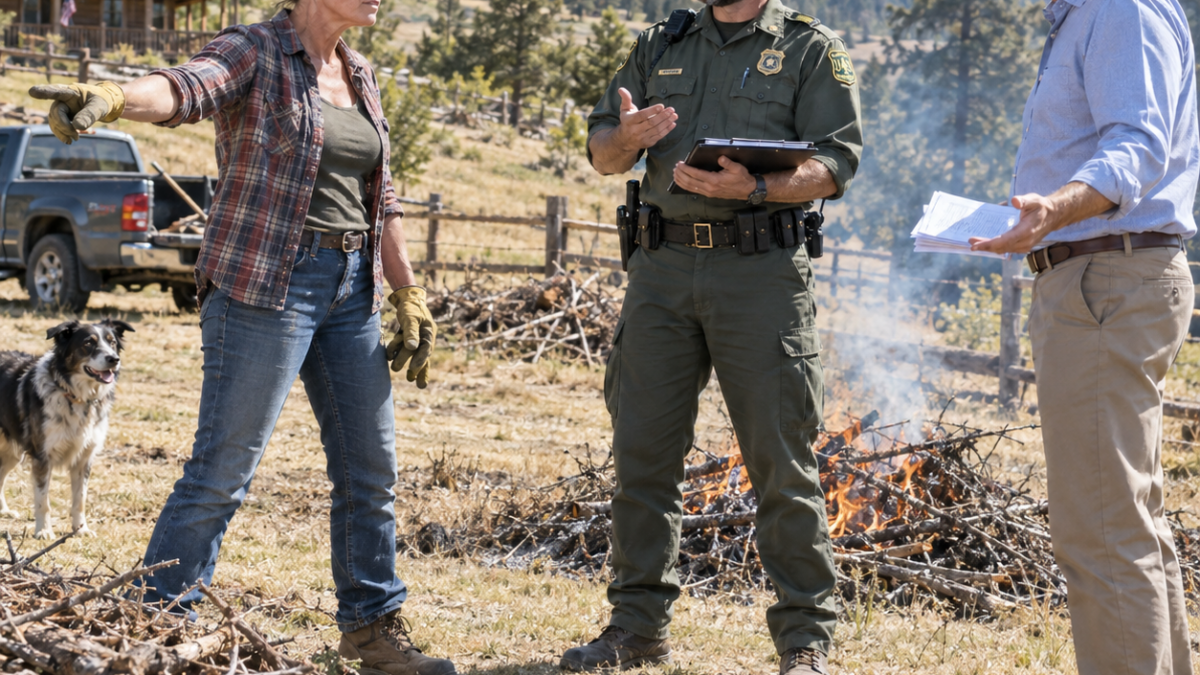
The HOA president came charging toward my controlled burn in a pink tracksuit, screaming that she would have me arrested for arson if I didn’t extinguish every flame before the sheriff arrived.
I told her the burn was permitted, professionally prepared, and required as wildfire mitigation, but she planted herself beside my firebreak and announced that her neighborhood covenants outranked whatever authorization I had.
Then she called 911—and the people who arrived would force her to answer a question she had never bothered asking before she threatened me.
My name is Jack Thompson.
For fifteen years, I served as an Army combat engineer.
That career taught me something I never forgot after leaving the service.
You respect dangerous things before they force you to.
Explosives.
Floodwater.
Unstable ground.
Fire.
My wife, Sarah, and I bought fifteen wooded acres in Colorado because we wanted quiet after years of military life.
Our property wasn’t part of Oak Ridge Meadows, the immaculate subdivision bordering our eastern boundary.
We owned an older parcel that backed directly against national forest land.
Ponderosa pine covered most of it.
From our porch, I could see nothing but trunks, mountains, and sky.
For two years, it felt perfect.
But beautiful land can still be dangerous.
Drought had left the forest floor buried beneath pine needles, fallen branches, scrub oak, and dead timber.
Fuel.
That was the word wildfire professionals used.
To somebody unfamiliar with forests, it looked natural.
To somebody who understood fire behavior, it looked like an invitation.
Then the federal notice arrived.
My property had been identified as carrying an excessive fuel load that threatened not only the adjoining forest but nearby homes.
That included Oak Ridge Meadows.
I had ninety days to mitigate it.
After consultations, permits, planning, and weather monitoring, controlled burning became part of the approved strategy.
I did not simply light a match.
I cleared firebreaks down to mineral soil.
I staged a 250-gallon water tank.
I had pumps, tools, radios, and contingency plans.
I contacted county dispatch.
I notified the volunteer fire department.
Sarah stood by with the water trailer.
Wind was low.
Humidity was right.
There were no red-flag conditions.
When I finally touched the drip torch to the first strip of pine litter, the flames moved exactly as planned.
Low.
Slow.
Controlled.
They crept through dead needles and small branches while leaving the mature pines standing untouched.
Then I heard a woman shouting.
“You put that fire out right now!”
I turned.
She was standing beyond the firebreak beside a golf cart.
Karen Albright.
President of the Oak Ridge Meadows HOA.
I had heard about her before.
Apparently, so had half the county.
She pointed at me.
“This community prohibits open fires.”
“This isn’t your community.”
Her mouth opened.
“My property isn’t part of your HOA.”
“You border us.”
“That doesn’t make me a member.”
She pulled a folder from her golf cart.
“Covenant 7.4 prohibits bonfires, open burning, and burning refuse.”
“This is wildfire mitigation.”
“Fire is fire.”
“No, ma’am. It isn’t.”
Her face reddened.
“I’m assessing you one thousand dollars immediately.”
“You can’t.”
“Another thousand for every hour this continues.”
I almost laughed.
Instead, I pointed toward the flames.
“Please step back. You’re too close to an active burn zone.”
She stepped forward.
Onto my firebreak.
“Don’t order me around.”
Now my patience disappeared.
“Karen, move back.”
She raised her phone.
“I’m calling the sheriff.”
“Go ahead.”
“And the fire department.”
“They already know I’m burning.”
That stopped her for half a second.
Then she dialed anyway.
“There’s a man setting the woods on fire next to our neighborhood,” she announced dramatically.
I returned to monitoring the burn.
Ten minutes later, sirens approached.
Karen smiled.
“They’re going to shut you down.”
A sheriff’s cruiser arrived first.
Behind it came a volunteer fire engine.
Chief Evans stepped down from the cab.
He looked at me.
Then the fire line.
Then my cleared break.
“Jack.”
“Chief.”
Karen rushed toward him.
“Thank God. Arrest him before this spreads into our homes.”
Evans ignored her and walked to the burn.
He studied it for maybe fifteen seconds.
Then he smiled.
“Beautiful backing fire.”
Karen froze.
The deputy took the permit folder from my hand.
Evans turned toward her.
“Ma’am, this burn is legal.”
Her face changed.
“He is violating our HOA rules.”
“He isn’t in your HOA.”
“That’s under review.”
“No, ma’am.”
Evans pointed toward the forest behind my land.
“He’s conducting wildfire mitigation that protects your subdivision.”
Karen stared at him.
And for the first time since she arrived, the woman who had threatened to have me arrested had absolutely nothing to say.
But the look she gave me before driving away told me one thing clearly.
The fire fight was finished.
The real war was about to begin.
PART 2
Chief Evans watched Karen’s golf cart disappear around the bend.
Then he looked at me.
“You know her?”
“Not personally.”
He gave me a tired smile.
“You do now.”
The sheriff’s deputy returned my permit folder.
“Everything checks out.”
“Thank you.”
He glanced toward the blackened strip where the fire had already passed.
“Looks pretty calm.”
“That’s the idea.”
Karen had described it over the emergency line as if I were standing in the forest throwing gasoline onto pine trees.
Reality looked very different.
The flames were mostly ankle-high.
They moved through needles and dry grass in a deliberate line.
Behind them remained dark soil and scattered white ash.
The mature ponderosas stood exactly where they had been.
Chief Evans pointed at the firebreak.
“You cut all this yourself?”
“Mini excavator and Pulaski.”
“Width?”
“Three feet minimum. More near the slope.”
He nodded.
“Good.”
Then his expression hardened slightly.
“Karen stepped inside the burn zone?”
“Onto the break.”
“I saw.”
He looked toward Oak Ridge Meadows.
“She needs to understand that distracting somebody during prescribed fire operations is not a game.”
The deputy added, “I told her the same thing.”
“What did she say?”
Evans laughed.
“That she’s the HOA president.”
Of course she did.
The deputy shook his head.
“I told her that isn’t an emergency-services rank.”
Even Sarah laughed at that.
She had been standing beside the water trailer during the entire confrontation.
Now that Karen was gone, I saw how pale Sarah looked.
“You okay?”
“Me?”
She pointed at the departing vehicles.
“She called 911 on you.”
“I noticed.”
“She said arson.”
“I noticed that too.”
“What happens if she keeps doing this?”
I looked toward Oak Ridge Meadows.
“At the moment?”
“Yes.”
“We finish the burn.”
That was what military life had taught me.
Handle the immediate mission before starting the next one.
For the next three hours, Sarah and I worked.
I laid controlled lines.
She watched the perimeter and monitored water.
We raked heavier material inward.
We extinguished a few stubborn smoking logs near the break.
By late afternoon, the entire approved section was blackened but secure.
No flare-ups.
No escaped fire.
No damage to healthy trees.
Exactly what should have happened.
Agent Daniel Miller from the Forestry Service arrived just before sunset.
He was tall, weathered, and had the permanent squint of a man who spent more time outside than behind a desk.
He walked the perimeter.
Checked the moisture.
Looked at my firebreak.
“Nice job.”
“Thanks.”
“I heard you had entertainment.”
“Karen.”
He smiled.
“Karen.”
“You know her too?”
“I know the subdivision.”
That answer told me enough.
Agent Miller walked toward the boundary.
Beyond it, the manicured green lawns of Oak Ridge Meadows looked almost ridiculous against the dry forest landscape.
He pointed toward the subdivision.
“You see the problem?”
“What?”
“Most of those people think irrigated grass means wildfire can’t reach them.”
I nodded.
“But ember transport doesn’t care about lawn color.”
“Exactly.”
He pointed toward several houses.
“Wooden decks.”
“Cedar fencing.”
“Mulch.”
“Decorative junipers.”
He shook his head.
“Your fuel reduction helps, but they’ve got work to do on their side too.”
I looked back at him.
“They know that?”
“They’ve received general notices.”
“From you?”
“From multiple agencies over the years.”
“And?”
He shrugged.
“People like beautiful forests until you tell them healthy forests sometimes require cutting trees and burning dead material.”
Sarah joined us.
“Karen told us this was environmental destruction.”
Miller laughed.
“Then Karen needs a wildfire ecology lesson.”
I would remember that sentence.
Because within twenty-four hours, Karen would give us the perfect reason to provide one.
The next morning, I opened the front door and found a white envelope taped directly beneath the handle.
OAK RIDGE MEADOWS HOMEOWNERS ASSOCIATION.
NOTICE OF VIOLATION.
I stared at it.
Sarah came up behind me.
“Oh no.”
I opened it.
Illegal open burn: $1,000.
Nuisance smoke: $500.
Unauthorized alteration of landscape appearance: $250.
Failure to obtain Architectural Review Committee approval: $500.
TOTAL DUE: $2,250.
Sarah read over my shoulder.
Then she laughed.
It wasn’t amusement.
It was disbelief.
“Architectural approval?”
“For wildfire mitigation.”
“You’re not even in their HOA.”
“I’m aware.”
“Does she know that?”
“She does now.”
At the bottom was Karen’s signature.
The flourish was enormous.
Sarah took the notice from me.
“She’s serious.”
“Yes.”
“What are you going to do?”
“Call her once.”
“Why?”
“To make sure she understands exactly what she is doing before I start documenting everything through attorneys.”
The phone rang once.
“Oak Ridge Meadows Homeowners Association. President Albright speaking.”
“Karen. Jack Thompson.”
“Oh.”
The single syllable contained enough contempt for a paragraph.
“You received your violation notice?”
“I did.”
“Good.”
“I’m calling to give you an opportunity to withdraw it.”
She laughed.
“You don’t give me opportunities.”
“You have no authority over my property.”
“That is disputed.”
“By whom?”
“The board.”
“My deed is not disputed.”
“Our counsel is reviewing the matter.”
“Name?”
Silence.
“Your lawyer.”
“That information is confidential.”
It wasn’t.
But I didn’t argue.
I continued.
“My burn was permitted.”
“Not by the HOA.”
“My property is outside the HOA.”
“Your actions affected HOA residents.”
“Smoke crossing a property line doesn’t create HOA jurisdiction.”
“Your smoke created a nuisance.”
“The county fire chief inspected the operation while it was active.”
“I don’t care what he thinks.”
That sentence changed everything.
I lowered my voice.
“You should.”
Karen continued.
“The Forestry Service also does not dictate Oak Ridge Meadows policy.”
“No.”
I agreed.
“But wildfire law and public-safety regulations dictate what your policy is allowed to interfere with.”
She sighed dramatically.
“Mr. Thompson, this is exactly the type of aggression we do not tolerate.”
I almost smiled.
“I called you to resolve this quietly.”
“The way to resolve it quietly is to pay.”
“So that’s your final position?”
“Yes.”
“Good.”
She hesitated.
“Good?”
“Thank you.”
“For what?”
“For making it clear.”
Then I hung up.
Sarah was watching from across the kitchen.
“What does ‘thank you for making it clear’ mean?”
“It means I don’t have to wonder whether this was confusion.”
I took a manila folder from my desk.
On the tab I wrote:
OAK RIDGE HOA.
Sarah looked at it.
“That seems healthier than ‘Operation Karen.’”
“I considered that.”
“I know.”
She had been married to me too long.
I placed the violation notice inside.
Then I scanned it.
Photographed it.
Backed it up.
I saved the recording log of my call.
Not the call itself—we lived in a state where recording rules mattered and I wasn’t taking chances—but the time, date, and a written summary.
Then I pulled out my deed.
Survey.
Forestry order.
Burn permit.
Chief Evans’s contact information.
County dispatch confirmation.
Everything went into the file.
Sarah leaned against the desk.
“You look almost happy.”
“I’m organized.”
“That’s your happy.”
Fair.
The next morning I walked into Oak Ridge Meadows.
Not onto private property.
Public sidewalk.
The neighborhood looked like a brochure.
Perfect lawns.
Matching mailboxes.
Stone entry monument.
Small ornamental trees placed at identical distances from driveways.
The strange thing was how little activity there was.
It was a beautiful Saturday.
No children biking.
No neighbors talking over fences.
No basketball bouncing.
Just sprinkler systems.
Then I met Eleanor Gable.
She was kneeling in a flower bed trimming roses.
Maybe seventy.
Silver hair.
Work gloves.
A faded sun hat.
“Morning.”
She startled.
“Oh.”
“Sorry. Didn’t mean to scare you.”
“No, no.”
She stood slowly.
“Can I help you?”
“I’m Jack Thompson.”
Her expression changed.
“The fire man.”
I smiled.
“The controlled-burn man.”
“Yes.”
She glanced across the street.
I followed her eyes.
Karen’s house.
Large.
Stone façade.
Flagpole.
Golf cart in the driveway.
Eleanor lowered her voice.
“I thought what you did was sensible.”
“Thank you.”
“My husband worried about those woods every summer.”
“Wildfire?”
“He was a volunteer firefighter when he was younger.”
She smiled sadly.
“He died four years ago.”
“I’m sorry.”
“He used to look at all that deadfall and say somebody was going to regret leaving it there.”
She went quiet.
Then added:
“Karen fined me because of this.”
She touched a small stone birdbath.
“For the birdbath?”
“Two hundred dollars.”
“Why?”
“Unapproved ornamental water feature.”
I stared at it.
It was maybe three feet tall.
A robin sat carved along the edge.
“My granddaughter gave it to me.”
“Did you pay?”
“Yes.”
“Why?”
Eleanor looked toward Karen’s house again.
“Because she threatened another fine every week.”
That was the first time I understood what Oak Ridge Meadows actually was.
From outside, Karen looked ridiculous.
Inside the subdivision, she had power.
Not legal power over me.
But practical power over them.
Fines.
Liens.
Hearings.
Letters.
Embarrassment.
People with mortgages and children don’t always have time to fight over birdbaths.
I asked Eleanor a careful question.
“Do you still have the letter?”
She hesitated.
Then nodded.
“Every one.”
“How many?”
Her laugh had no humor.
“A folder.”
That afternoon she showed me.
Birdbath.
Mailbox color.
Decorative edging.
Trash can visibility.
Rose trellis.
One citation claimed her roses exceeded “appropriate density.”
I read it twice.
“What does that even mean?”
“I asked.”
“What did she say?”
“That aesthetic decisions are discretionary.”
I put the paper down.
“Would you be comfortable letting an attorney look at these?”
Eleanor’s eyes widened.
“You have an attorney?”
“Soon.”
That evening I called Marcus Reed.
Marcus had been my platoon sergeant during the last five years of my military career.
After retirement he went to law school.
Apparently being terrifying in camouflage had not been enough.
Now he was terrifying in a suit.
He answered:
“Thompson.”
“Top.”
Long silence.
Then:
“Jack?”
“Yeah.”
“Well, I’ll be damned.”
We spent five minutes catching up.
Then he asked why I really called.
I told him.
Forestry Service order.
Permit.
Burn.
Karen.
Sheriff.
Chief.
Fine.
Jurisdiction claim.
When I finished, Marcus was silent.
“That woman fined you twenty-two hundred dollars?”
“Twenty-two fifty.”
“For complying with a wildfire order?”
“Correct.”
“On land outside her HOA?”
“Correct.”
“And the fire chief personally told her the burn was legal?”
“Standing three feet from her.”
Another silence.
Then Marcus laughed.
Deep.
Slow.
“Oh, Jack.”
“What?”
“You always did find interesting ways to spend retirement.”
“I want this stopped.”
“Good.”
“I’m not looking to bankrupt anybody.”
“Also good.”
“But I want her away from my property.”
“Very good.”
He became serious.
“Send me everything.”
I did.
He arrived two days later.
Marcus was six-foot-four and still built like he expected someone to ask him to carry an engine block.
His suit probably cost more than my chainsaw.
Sarah hugged him.
Then he spread the HOA documents across our dining table.
“You got their covenants?”
“I’m not a member.”
“Public record.”
Within ten minutes he had them downloaded.
One hundred twenty-eight pages.
We printed them.
Sarah stared at the stack.
“This is insane.”
Marcus flipped pages.
“Some people write novels.”
He held up the covenants.
“Some people write rules about mailbox beige.”
We read.
Definitions.
Board authority.
Architectural restrictions.
Fire provisions.
Common areas.
Enforcement.
Then I found Article Five.
Duty to Maintain.
The association had an affirmative duty to protect common areas and promote safety and welfare.
Marcus marked it.
Then Article Eight.
Owners could not maintain conditions creating unreasonable safety hazards or violating applicable fire-safety laws.
Marcus stopped reading.
He looked at me.
Then back at the page.
Then smiled.
“What?”
“She handed us the argument.”
“What argument?”
He tapped the covenant.
“She’s using HOA safety language to attack wildfire mitigation.”
“So?”
“So the association’s own documents require it to support reasonable safety measures.”
He leaned back.
“She cannot credibly claim that preserving hazardous fuel is necessary to enforce a covenant whose stated purpose includes community safety.”
Sarah said:
“Especially when the Forestry Service says the fuel is dangerous.”
Marcus pointed at her.
“Exactly.”
He turned to me.
“We’re not going to spend our energy arguing whether the fire looked pretty.”
“Good.”
“We make this about risk.”
He started typing.
Formal Notice of Wrongful Enforcement and Interference with Wildfire Mitigation.
Not just to Karen.
Every board member.
Each individually named.
Marcus attached:
My deed showing I was not in Oak Ridge Meadows.
The federal mitigation order.
The burn permit.
The county dispatch documentation.
A short written confirmation from Chief Evans.
The HOA violation notice.
Relevant sections of their own covenants.
The letter demanded immediate rescission of all fines.
Written acknowledgment that the HOA had no jurisdiction over my parcel.
No interference with future legally permitted mitigation.
And one more thing.
Marcus looked at me.
“We need expert confirmation that stopping your mitigation increases their risk.”
“Agent Miller.”
“Call him.”
Daniel Miller agreed to visit again.
This time, Marcus joined us.
Miller walked the boundary with him.
Pointed toward untreated sections.
Explained ember behavior.
Fuel ladders.
Deadfall.
Crown-fire risk.
Defensible space.
Then he looked toward the homes.
“If fire comes hard from the west, this parcel is part of their buffer.”
Marcus asked:
“So reducing fuel here can reduce risk to the subdivision?”
“Absolutely.”
“And allowing accumulation?”
“Increases available fuel.”
“Would interference with mandated mitigation concern your office?”
“Yes.”
That was enough.
Miller refused to get involved in the HOA fight.
I respected that.
He provided a factual letter.
Nothing more.
Marcus attached it.
The notices were delivered.
For five days, nothing happened.
Karen stopped calling.
No new fines.
No golf cart.
Nothing.
Then Eleanor called.
“You scared them.”
“How do you know?”
“Frank came to my house.”
“Frank?”
“Treasurer.”
“What did he want?”
“To ask whether Karen really fined me for my birdbath.”
“What did you say?”
“I handed him the folder.”
That was the second crack.
The third came from a man named Luis Bennett.
His son had a portable basketball hoop.
Karen had fined them because it disrupted “streetscape consistency.”
Luis had paid three hundred dollars rather than fight.
Another resident had been cited for putting trash cans out at 5:00 p.m. instead of 6:00.
Another over a porch flag.
Another because a work truck remained in his driveway overnight.
Some complaints may have been technically supported by covenants.
Others seemed invented.
We didn’t lump everything together.
Marcus insisted on that.
“Bad cases weaken good cases.”
So we documented carefully.
No exaggeration.
No rumors.
Meanwhile, Karen started telling neighbors I had deliberately endangered Oak Ridge Meadows.
One woman knocked on my door.
“Is it true the Forestry Service ordered you not to burn and you did anyway?”
I stared at her.
“No.”
“That’s what I heard.”
I showed her the order.
She read it.
Then the permit.
Then Agent Miller’s letter.
Her expression changed.
“She said you were under investigation.”
“I’m not.”
“Why would she say that?”
I could have answered.
I didn’t.
“Ask her.”
That became our strategy.
Facts.
Then silence.
Karen hated silence more than confrontation.
Because silence left people alone with documents.
Two weeks later came the HOA meeting.
Marcus suggested I speak.
I almost refused.
“This isn’t my association.”
“No.”
“Why should I attend?”
“Because their president used their name to interfere with your property.”
“What if they don’t let me?”
“Eleanor requested you as a guest.”
“Of course she did.”
The clubhouse was packed.
Not because of me.
Because word had spread that individual board members had received a lawyer’s warning involving potential liability.
Fear works differently when it reaches the people holding the clipboard.
The board sat at the front.
Karen in the center.
Frank the treasurer looked ill.
Two other members avoided eye contact.
Eleanor sat near the aisle with her folder.
Luis sat behind her.
Sarah sat beside me.
Marcus stood against the wall.
The meeting started normally.
Pool maintenance.
Landscaping.
Budget.
Then Karen announced:
“Mr. Thompson has requested time regarding his ongoing dispute with the association.”
I stood.
“It’s not a dispute with the association.”
Her eyes narrowed.
“Excuse me?”
“It’s a dispute created by you.”
People murmured.
Karen struck the gavel.
“You have three minutes.”
Marcus stood.
“Actually, given that the board is presently on formal notice regarding potential safety liability, I recommend you allow sufficient time for factual presentation.”
Karen stared at him.
“And you are?”
“Marcus Reed. Counsel for Mr. Thompson.”
Frank went pale.
Apparently he had already read Marcus’s name multiple times.
Karen looked furious.
“This is not a courtroom.”
Marcus smiled.
“Excellent.”
Then sat.
I walked to the front.
I brought no speech.
Only documents.
“My name is Jack Thompson.”
I looked around.
“Most of you know me as the man who burned the woods.”
A few nervous laughs.
“That description is technically true.”
More laughter.
“Here’s the part you weren’t told.”
I held up the federal directive.
“My property was identified as carrying a hazardous fuel load.”
I placed a large map on an easel.
“My parcel.”
The national forest.
Oak Ridge Meadows.
I pointed toward the western boundary.
“If fire moves from national forest land toward your subdivision, it reaches my property before many of your homes.”
Nobody spoke.
I held up the permit.
“The burn Karen attempted to stop was authorized mitigation.”
Karen interrupted.
“Our issue was uncontrolled smoke.”
I looked at her.
“Chief Evans inspected the active burn.”
I held up his report.
“He found it controlled.”
Karen hit the gavel.
“This is not—”
Frank interrupted.
“Karen.”
Everyone froze.
Frank had probably never interrupted her.
“Let him finish.”
Karen’s face changed.
I continued.
Then I displayed the HOA fine.
$2,250.
People laughed.
Not because it was funny.
Because it looked absurd beside the federal documentation.
I read each violation.
Illegal fire.
Nuisance smoke.
Landscape alteration.
Failure to obtain architectural approval.
Luis raised his hand.
“Architectural approval for dead pine needles?”
Laughter.
Karen slammed the gavel.
“Enough.”
I looked toward the residents.
“My property is not in your HOA.”
Then at the board.
“Your president knows that.”
Karen shouted:
“Your status is disputed!”
Marcus spoke from the wall.
“By whom?”
Silence.
“Provide the recorded covenant encumbering his parcel.”
Karen stared at him.
Marcus continued calmly.
“We requested it in writing.”
No answer.
Then I showed Agent Miller’s letter.
The room changed.
This was not my opinion.
Not Marcus’s argument.
Not Karen’s framing.
Professional wildfire guidance.
The document explained that fuel reduction on my parcel contributed to broader wildfire-risk reduction.
I finished with the HOA’s own language requiring the association to promote community safety.
Then I stepped back.
“I don’t want money.”
I looked at the board.
“I don’t want membership.”
Several people laughed.
“I don’t want your president removed because of me.”
That surprised Karen.
“I want your HOA to stay off my land and stop interfering with lawful wildfire prevention.”
I returned to my seat.
Marcus whispered:
“Good.”
Then Eleanor stood.
Karen immediately said:
“This matter is closed.”
“No.”
Eleanor’s voice was soft.
But it carried.
“My matter isn’t.”
She walked to the podium holding her folder.
“My husband gave me this birdbath.”
She showed a photograph.
“He died four years ago.”
Karen rolled her eyes slightly.
I saw it.
So did half the room.
Eleanor continued.
“I paid two hundred dollars because Karen said it violated aesthetic standards.”
She held up the fine.
“She told me if I refused, the penalties would continue.”
Karen interrupted.
“The rules apply equally.”
“Do they?”
Eleanor turned.
For the first time, the timid woman I met beside the roses looked directly at Karen.
“Your front fountain is three times larger than my birdbath.”
Someone gasped.
Then laughter.
Karen reddened.
“That feature was approved.”
“By whom?”
“The Architectural Committee.”
“Which you chaired.”
More murmurs.
Eleanor opened another letter.
“My mailbox.”
Another.
“My trellis.”
Another.
“My walkway gravel.”
“Twenty years in this neighborhood.”
Her voice shook.
“I used to love it here.”
The room became very quiet.
“Now I’m afraid to change flowers without wondering whether you’ll send me a bill.”
That hit harder than my entire presentation.
Luis stood next.
Basketball hoop.
Then Paul Erickson.
Trash cans.
Then another resident.
Then another.
Karen tried to stop them.
Nobody listened.
Finally she stood.
“This is an organized attack.”
The room quieted.
“This outsider comes in here, sets fires beside our homes, brings lawyers and military friends—”
I had invited several former unit friends as personal support.
They sat quietly in the back.
No uniforms.
No threats.
Just people.
Karen pointed toward them.
“—and now everyone thinks I’m the enemy?”
One of my friends, David Harper, stood.
David had served as a Marine before joining our engineering unit.
He spoke calmly.
“Ma’am.”
Karen glared.
“Jack followed a federal wildfire plan.”
“That does not make him infallible.”
“No.”
David nodded.
“It makes the plan something worth understanding before accusing him of trying to burn your homes.”
Karen opened her mouth.
David continued.
“Fire prevention isn’t pretty.”
He looked around.
“You clear brush.”
“You cut trees.”
“You burn fuel under controlled conditions.”
“You do ugly work when you can control it so you don’t face catastrophic work when you can’t.”
The room was silent.
David sat.
Then Eleanor pulled papers from her tote bag.
“I have a petition.”
Karen’s head snapped around.
“For what?”
“Your recall.”
The clubhouse erupted.
Karen struck the gavel.
Again.
Again.
Again.
It meant nothing.
People formed a line.
The image remains vivid even now.
Eleanor standing there.
Silver hair.
Flowered blouse.
Hands that trembled slightly from age.
Holding the recall petition while people who had been scared for years waited to sign.
Karen stared.
“This is illegal.”
Marcus said:
“The procedure appears to comply with Article Twelve.”
She looked at him with pure hatred.
“You planned this.”
“No.”
He shook his head.
“Your members did.”
Karen stormed out.
Two board allies followed.
The remaining members called an executive session.
Marcus and I were invited.
Frank closed the office door.
Then looked at me.
“What do you want?”
“Nothing from you personally.”
“What does your lawyer want?”
Marcus answered.
“First, all fines against my client rescinded.”
Frank nodded.
“Second, written acknowledgement that his property is outside HOA jurisdiction.”
“Fine.”
“Third, no interference with any permitted fuel-mitigation operation.”
“Yes.”
“Fourth, reimbursement of legal expenses caused by the association’s enforcement action.”
Frank looked at Karen’s empty chair.
“How much?”
“Currently five thousand.”
He winced.
“Fifth.”
Frank looked miserable.
“There’s more?”
“A community-wide correction.”
“Meaning?”
“You used association authority to tell residents Mr. Thompson endangered them.”
Marcus leaned forward.
“You correct that record.”
The other board members nodded.
Frank rubbed his forehead.
“What about the lawsuit?”
“No lawsuit has been filed.”
“Yet.”
“Correct.”
“What prevents it?”
Marcus looked at me.
I answered.
“Stop.”
“Stop what?”
“All of it.”
No money beyond actual costs.
No punishment.
No public humiliation.
No more fake jurisdiction.
Frank nodded slowly.
“We can do that.”
Karen could not.
When the board called her and explained the agreement, she refused.
We could hear her shouting through the speaker.
“You’re surrendering!”
Frank closed his eyes.
“We’re resolving liability.”
“You’re cowards.”
“Karen.”
“He came here to destroy us!”
“He came here because you fined property we don’t control.”
Silence.
Then:
“I am the president.”
Frank looked around the table.
“For now.”
He ended the call.
The next morning, the HOA’s insurance counsel became involved.
That accelerated everything.
Insurance companies dislike surprises.
They especially dislike clients intentionally continuing behavior after being warned of liability.
The attorney reviewed the documents.
My property status.
Federal order.
Permit.
Chief’s report.
Fine.
Marcus’s notice.
He called Marcus first.
Then me.
“Mr. Thompson, I want to clarify that the carrier is not admitting liability.”
“Understood.”
“But I’ve advised the association to resolve this immediately.”
“Good.”
“Would rescission of all fines, written correction, acknowledgement of jurisdictional limits and reimbursement of documented fees satisfy you?”
“Yes.”
The attorney paused.
“That’s all?”
“That’s all.”
“You aren’t seeking damages?”
“Was my property damaged?”
“No.”
“Then no.”
He seemed genuinely surprised.
“I appreciate that.”
“I want my life back.”
That was the truth.
The fight was already affecting Sarah.
She had started looking out the window whenever a golf cart passed near the boundary.
She worried every envelope might contain another accusation.
I didn’t need a victory.
I needed the conflict to end.
Three days later, the documents arrived.
Formal rescission.
Zero balance.
Violations expunged.
Written acknowledgment that our fifteen-acre parcel had never been subject to Oak Ridge Meadows covenants.
Statement supporting lawful wildfire mitigation in accordance with public-safety orders.
Legal fee reimbursement.
Sarah read the community bulletin aloud.
“‘The Board of Directors recognizes Mr. Thompson’s proactive efforts to reduce wildfire risk and regrets any misunderstanding regarding the permitted fuel-mitigation operation.’”
She looked at me.
“Misunderstanding?”
“Lawyer language.”
“She called you an arsonist.”
“I know.”
“Can I write the apology?”
“No.”
“It would be better.”
“I know.”
The board demanded Karen resign.
She refused.
Naturally.
Instead, she went online.
The official Oak Ridge Meadows Facebook group had long been her personal megaphone.
She wrote a massive post accusing me of manipulating federal agencies.
Calling my burn reckless.
Calling Marcus an ambulance chaser.
Calling my veteran friends “intimidation squads.”
Then residents responded.
Eleanor posted a photo of her birdbath.
Caption:
THE DANGEROUS WATER FEATURE.
Luis posted his son’s basketball hoop.
Caption:
THREAT TO PROPERTY VALUES.
Paul posted his trash cans.
Caption:
OUT AT 5:14 P.M. PLEASE PRAY FOR OAK RIDGE.
The responses became brutal.
Not threatening.
Mocking.
Karen deleted comments.
People reposted them.
She shut comments off.
Screenshots spread anyway.
Every attempt to control the narrative made her look weaker.
I stayed out of it.
Sarah didn’t.
I caught her laughing at her phone.
“What?”
She turned the screen.
Somebody had photographed a six-inch garden gnome holding a tiny cardboard sign:
RECALL ELECTION OBSERVER.
I laughed harder than I should have.
Then I stopped.
“Don’t get involved.”
“I didn’t post it.”
“Good.”
“I shared it with Eleanor.”
“Sarah.”
“She already saw it.”
The recall meeting was scheduled for the following Thursday.
For seven days Oak Ridge Meadows became almost festive.
People talked openly in driveways.
Children played basketball.
Trash cans appeared slightly earlier than usual.
Eleanor moved her birdbath six inches closer to the sidewalk.
When I asked why, she smiled.
“Better sunlight.”
“Of course.”
The recall meeting drew nearly the entire community.
One hundred sixty-one ballots were eventually cast.
Marcus sat beside me.
Sarah held my hand.
Eleanor greeted people at the door.
Karen arrived last.
Black pantsuit.
Tight expression.
No golf cart.
Frank served as acting chair.
He opened the meeting.
“We are here pursuant to the valid recall petition.”
Karen requested five minutes to speak.
Frank allowed it.
What followed was not an apology.
It was not reflection.
It was Karen Albright’s final attempt to make reality submit to her.
“I built this community.”
That was her opening.
Several people shook their heads.
“I protected your investments.”
She pointed toward residents.
“I kept Oak Ridge Meadows from becoming like every other declining neighborhood where people do whatever they please.”
Her voice rose.
“I enforced standards because none of you had the courage to.”
Eleanor looked down.
Karen saw me.
“And then he came.”
Every head turned.
“An outsider.”
She pointed.
“He sets fires on the boundary of our homes.”
I remained seated.
“He brings lawyers.”
Still seated.
“He brings military men to meetings.”
David crossed his arms.
“He turns neighbors against one another.”
Now people began muttering.
Karen continued.
“You think he saved you?”
Her voice cracked.
“He destroyed what I spent years building.”
That sentence revealed everything.
She did not understand that Oak Ridge Meadows belonged to its homeowners.
Not her.
Her identity had fused with the HOA so completely that disagreement became betrayal.
I almost felt sorry for her.
Almost.
She finished.
Frank looked toward me.
“Mr. Thompson, would you like equal time?”
Everyone waited.
I stood.
Karen watched.
I walked toward the front.
Then stopped.
“No.”
Frank blinked.
“No?”
“I don’t have anything else to say.”
I looked around.
“The Forestry Service order exists.”
“The permit exists.”
“The fines were withdrawn.”
“The board issued its correction.”
“This isn’t my vote.”
I looked at the homeowners.
“It’s yours.”
Then I sat down.
That was all.
Seven sentences.
No attack.
No revenge speech.
Karen looked more wounded by that than anything Marcus had written.
Because I had removed myself from her drama.
The ballots were distributed.
Collected.
Counted.
Frank read the result.
“One hundred fifty-eight in favor of recall.”
He paused.
“Three opposed.”
Silence lasted perhaps one second.
Then applause erupted.
Karen remained seated.
For the first time since I met her, she looked old.
Not physically.
Deflated.
The title was gone.
The authority.
The gavel.
The private certainty that everyone would eventually obey.
Eleanor stood.
She did not cheer.
She walked toward Karen.
For one strange second I worried.
Then Eleanor stopped beside her.
“I hope wherever you go after this, you find something you enjoy that doesn’t require controlling other people.”
Karen stared at her.
Eleanor smiled sadly.
Then walked away.
That was more merciful than anything I could have said.
The special election happened three weeks later.
Eleanor Gable became president.
She tried desperately not to.
Residents ignored her.
Her first board meeting was almost comical.
She held the gavel.
Stared at it.
Then put it in a drawer.
“I don’t like this thing.”
The room laughed.
Her first policy initiative became known as the Good Neighbor Amendment.
Rules that served legitimate safety, maintenance, or property purposes stayed.
Ridiculous discretionary rules went.
Garden-gnome height.
Exact mailbox shades.
Micromanaged trash-can timing.
Subjective restrictions that gave one person too much interpretive power.
Appeal procedures were improved.
Fines required clear citation.
Repeat penalties required review by more than one officer.
No president could unilaterally create enforcement policy.
The HOA remained an HOA.
Roads needed maintenance.
Common landscaping needed care.
The pool needed insurance.
Budgets mattered.
But the association became what it was supposed to be.
Administrative.
Boring.
Limited.
Not a personality cult.
Then came wildfire season.
The real test.
Agent Miller contacted me in early spring.
“We need phase two.”
“I figured.”
“Fuel loading on the north section is still high.”
“When?”
“Depending on weather, early May.”
I told Eleanor.
Not because I needed HOA permission.
Because neighbors deserved notice.
She stared at me.
“You’re burning again?”
“Yes.”
She swallowed.
Then smiled.
“Tell me what we need to do.”
That sentence alone showed how much had changed.
We organized a community wildfire-safety meeting.
Chief Evans attended.
Agent Miller came.
The clubhouse was packed.
No shouting.
No threats.
People took notes.
Miller explained ember showers.
How houses can ignite even when flames never physically reach them.
He showed photographs of homes lost because dry pine needles accumulated beneath decks.
He explained defensible space.
Ladder fuels.
Tree spacing.
Fire-resistant landscaping.
One homeowner raised a hand.
“So Jack’s burn really does protect us?”
Miller answered carefully.
“It reduces one component of wildfire risk.”
He pointed toward the map.
“But your safety also depends on what you do around your own structures.”
People looked uncomfortable.
Good.
Safety information should sometimes make you uncomfortable.
After the meeting, residents requested property assessments.
Some removed junipers.
Others cleaned gutters.
One family replaced wood mulch near the house with gravel.
Eleanor removed dead branches behind the clubhouse.
Even more surprising, the HOA created a modest wildfire-mitigation fund.
Not for my land.
For theirs.
When burn day arrived, I expected spectators.
Instead, people came wearing work gloves.
Luis.
Paul.
Eleanor’s grandson.
Several parents.
Even Frank, the former treasurer.
They brought rakes.
Shovels.
Coolers.
Chief Evans laughed when he saw them.
“What is this?”
Eleanor answered:
“Architectural review committee.”
Everyone laughed.
We did not let untrained residents near active ignition.
That mattered.
Prescribed fire is not a neighborhood barbecue.
Agent Miller and Chief Evans helped establish safe observation and mop-up roles.
I handled ignition with authorized support.
Sarah monitored water again.
The fire moved slowly through the north section.
Low flames.
Dead needles consumed.
Heavy material blackened.
Mature trees remained.
This time no one called 911.
No one screamed arson.
No one threatened fines.
Children watched from a safe distance beside their parents.
Agent Miller explained what they were seeing.
“This blackened ground looks destructive.”
He pointed toward the trees.
“But much of the dangerous surface fuel is now gone.”
A boy asked:
“Will it stay black?”
“No.”
“For how long?”
“Wait until spring rain.”
He smiled.
“You’ll see.”
After ignition ended, neighbors helped with supervised mop-up.
Water on smoking material.
Raking.
Checking edges.
Turning logs.
Three hours later, people looked filthy.
Soot on faces.
Mud on boots.
Sweaty.
Happy.
Luis leaned on a shovel.
“So this is community wellness?”
I laughed.
“Apparently.”
Eleanor sat on a cooler.
“I prefer this to board meetings.”
“Everything is better than board meetings.”
That evening Sarah and I sat on the porch.
The burn area stretched black between pine trunks.
Smoke rose in thin threads.
The mature canopy remained green.
Neighbors packed up tools.
They waved before leaving.
Sarah handed me a beer.
“Remember the first burn?”
“Hard to forget.”
“She was standing right there.”
Sarah pointed toward the boundary.
“Pink tracksuit.”
“Golf cart.”
“Arson.”
“Two thousand two hundred fifty dollars.”
Sarah laughed.
“What did you think was going to happen?”
“At which point?”
“When Karen left.”
“I thought she would send paperwork.”
“You were right.”
“I’m frequently right.”
Sarah leaned over.
“Don’t ruin the moment.”
We sat quietly.
Eventually she said:
“You came here because you wanted nobody around.”
“I remember.”
“Now half the subdivision has been in our yard.”
“That seems like a design flaw.”
She laughed.
“But you like them.”
“Some.”
“Jack.”
“Fine.”
I looked toward Oak Ridge Meadows.
Kids were still outside.
Someone bounced a basketball.
I could hear it from our porch.
Regular rhythm.
Thump.
Thump.
Thump.
“That sound would have been a violation a year ago.”
“Probably.”
Sarah rested her head on my shoulder.
“You wanted isolation.”
“What did I get?”
“A neighborhood.”
I hated when she was poetic because she was usually right.
The following spring, the burn scar changed.
First tiny shoots.
Then grasses.
Wildflowers in patches.
Young oak growth.
The landscape looked healthier than before.
One afternoon Eleanor walked over.
No golf cart.
Just boots and a sun hat.
She stood beside the old burn line.
“It’s beautiful.”
“Karen called it environmental destruction.”
Eleanor smiled.
“Karen called my birdbath a water feature.”
“Fair.”
She touched the new grass.
“Agent Miller said this is normal?”
“Yes.”
“I wish Walter had seen this.”
Her husband.
“The firefighter?”
She nodded.
“He would have liked you.”
“I’ll take that as a compliment.”
“It is.”
We walked toward the house.
Then she stopped.
“I need your opinion.”
“That sounds dangerous.”
“The HOA wants to replace the entrance landscaping.”
“So?”
“Half the current plants are high-flammability ornamentals.”
“That is true.”
“We’re considering fire-resistant species.”
“Good.”
“Can you look over the plan?”
“I’m not a landscape architect.”
“No.”
She smiled.
“But you’re the person who made us stop pretending wildfire was somebody else’s problem.”
That stayed with me.
The HOA changed its entrance.
Removed dense resinous shrubs.
Improved spacing.
Created better access for emergency vehicles.
Installed an evacuation-information board inside the clubhouse.
Oak Ridge Meadows even held annual wildfire-preparation weekends.
The first year, turnout was huge.
The second, smaller.
The third, smaller still.
That didn’t worry me.
Preparedness had become normal.
Normal is quiet.
Normal does not go viral.
That is usually good.
Karen sold her house eventually.
I learned through Eleanor.
“What happened?”
“House sold.”
“I know.”
“I mean with Karen.”
Eleanor shrugged.
“Moved closer to her daughter, I heard.”
“You going to miss her?”
Eleanor looked offended.
“I am trying to become a better person, Jack. Don’t test me.”
I laughed.
When the moving truck came, I did not watch.
Sarah did, briefly.
Then she joined me behind the house.
“She’s gone.”
“Okay.”
“That’s it?”
“What else?”
“I thought you’d have a speech.”
“I used them all.”
She studied me.
“You really are done.”
“Yes.”
And I was.
That surprised me.
For months, Karen had occupied an unreasonable amount of mental space.
Every envelope.
Every golf cart.
Every phone call.
Every rumor.
I thought victory would mean watching her lose.
Instead, victory felt like realizing I no longer cared where she went.
Our land remained.
The mitigation was complete.
Oak Ridge Meadows had changed.
Eleanor had her birdbath.
Luis’s son had his basketball hoop.
Fire safety had become part of the community budget.
Karen’s name slowly disappeared from conversation.
That was enough.
Two years later came the summer that proved why all of it mattered.
June was brutally dry.
July worse.
By August, the grasses crisped brown.
Red-flag warnings became routine.
Then lightning struck national forest land twelve miles west.
The first smoke column appeared around three in the afternoon.
By four, every phone in the county screamed with alerts.
WILDFIRE.
Sarah stood on the porch staring toward the horizon.
Black smoke rose behind the ridge.
“How far?”
“Twelve miles at ignition.”
“That’s close.”
“Yes.”
Wind pushed east.
Toward us.
Toward Oak Ridge Meadows.
For the first time since the controlled burns, people saw the threat the way I had seen it years earlier.
Not theoretical.
Not ugly brush.
Not dramatic government warnings.
Fire.
The county issued pre-evacuation status.
Oak Ridge Meadows activated the plan developed after our safety meetings.
Residents packed vehicles.
Elderly homeowners received assistance.
Medications.
Pets.
Documents.
Routes.
No panic.
Eleanor called.
“Jack?”
“I’m here.”
“We’re at Level One.”
“So are we.”
“Anything we should do?”
“Follow the county.”
“We are.”
“Good.”
She paused.
“Thank you.”
“For what?”
“We wouldn’t have a plan if…”
She didn’t finish.
She didn’t have to.
By sunset, ash fell on our porch.
The wildfire never reached our property.
Fire crews caught its eastern progression several miles away after two long days.
No houses in Oak Ridge Meadows burned.
No flames reached our fifteen acres.
So technically, nobody could prove our fuel mitigation saved anything during that fire.
And I never claimed it did.
That mattered to me.
Fire behavior is complicated.
Wind.
Terrain.
Fuel.
Suppression.
Chance.
I would not turn safety work into mythology.
But something had unquestionably changed.
The community had prepared.
They understood evacuation.
They had reduced fuels around homes.
Emergency access was improved.
Residents had plans.
And nobody argued when professionals issued instructions.
Sometimes prevention succeeds long before flames arrive.
After the fire was contained, Oak Ridge Meadows held a community dinner.
Not a celebration.
More like collective relief.
Firefighters attended.
Agent Miller.
Chief Evans.
Families.
Sarah and me.
Eleanor stood at the front.
No gavel.
She hated gavels.
“I want to say one thing.”
People quieted.
“Several years ago, many of us saw wildfire prevention as something ugly.”
She looked toward me.
“Smoke.”
“Cut branches.”
“Black ground.”
“We were wrong.”
Then she corrected herself.
“Some of us were uninformed.”
That was kinder.
“We thought safety was supposed to look pretty.”
Chief Evans smiled.
Eleanor continued.
“Jack taught us that sometimes protecting something means changing how it looks before disaster changes it for you.”
I wanted to disappear under the table.
Sarah squeezed my knee.
Eleanor looked at Agent Miller.
“Our forestry professionals taught us what to do.”
Then at Chief Evans.
“Our firefighters taught us how to prepare.”
Then she looked around the room.
“But we had to choose whether to listen.”
That was the real lesson.
Not Karen.
Not me.
Listening.
Expertise matters only when arrogance makes room for it.
After dinner, Luis approached me.
His son was seventeen now.
Tall.
Still played basketball.
“Remember that hoop?”
“How could I forget?”
“Kid wants to be a firefighter.”
I smiled.
“Really?”
“He went to the wildfire-safety day when he was twelve.”
Luis looked toward Chief Evans.
“Been obsessed ever since.”
“That’s good.”
“Karen fined us three hundred dollars because that hoop was visible.”
“I remember.”
Luis laughed.
“Best three hundred dollars I ever got refunded.”
We both laughed.
Time moved.
My military friends visited less often.
Marcus threatened to retire and never did.
Eleanor served two terms as HOA president, then refused a third.
“They’ve had enough of me.”
“Nobody has had enough of you.”
“I have.”
Fair.
A younger father named Daniel became president.
His first question before accepting was:
“What exactly can I not do?”
Eleanor told me that proudly.
“See?”
She smiled.
“Progress.”
The controlled-burn sections matured.
Grass returned.
Wildflowers.
Healthier spacing.
Some pine seedlings emerged.
We continued mechanical fuel reduction every year.
Not everything required fire.
That was another misconception people had.
Prescribed burning was one tool.
Thinning.
Removal.
Pruning.
Grazing in some landscapes.
Defensible space.
All had roles.
The neighborhood learned nuance.
That might have been Karen’s greatest accidental gift.
By being so spectacularly wrong, she forced everyone to learn enough to avoid repeating her mistake.
Years later, our grandson visited.
He was seven.
Sarah took him walking through the treated forest.
He noticed an old black scar on one ponderosa.
“Grandma, did this tree burn?”
“A little.”
“Was there a wildfire?”
“No.”
“Then why?”
She looked at me.
I knew what was coming.
“Ask Grandpa.”
I crouched beside him.
“We burned some dead stuff around it on purpose.”
His eyes widened.
“You set the forest on fire?”
“Very carefully.”
“Why?”
“To stop worse fire later.”
He frowned.
That sounded impossible.
I picked up two sticks.
One dry.
One green.
We talked about fuel.
Heat.
Oxygen.
How dead material accumulates.
How controlled fire can remove some fuels under safer conditions.
He listened.
Then asked:
“Did Grandma let you?”
Sarah shouted from behind us:
“Barely.”
I laughed.
Then he pointed toward Oak Ridge Meadows.
“Mom says a mean lady tried to stop you.”
Kids always get the dramatic summary.
“Yes.”
“Why?”
“She thought fire was always bad.”
“Is it?”
“That’s the wrong question.”
He looked confused.
“Fire is dangerous.”
I held up the dry branch.
“So we respect it.”
“Sometimes that means putting it out.”
“Sometimes that means preventing it.”
“And sometimes trained people use controlled fire safely because leaving all this fuel can be worse.”
He considered that.
“So she didn’t know?”
“No.”
“Why didn’t she listen?”
That question was harder.
“Sometimes grown-ups decide being in charge means they don’t have to.”
He nodded solemnly.
Then immediately ran after a grasshopper.
Lesson over.
I remained beside the scarred ponderosa.
That tree had become one of my favorites.
Its bark carried black marks from the first burn.
But above that scar, its canopy remained thick and green.
A reminder.
Scars are not always evidence of destruction.
Sometimes they are evidence that something survived necessary heat.
The same could be said of Oak Ridge Meadows.
Karen’s presidency had damaged people.
Eleanor.
Luis.
Frank.
Others.
The recall did not magically erase that.
Trust recovered slowly.
The HOA’s reputation recovered slowly.
People continued questioning board decisions.
Good.
They should.
Some meetings became frustrating because residents demanded documentation.
Good.
They should.
Transparency is less convenient than obedience.
It is also safer.
One summer afternoon, I attended an HOA meeting because Daniel wanted input on a wildfire grant.
I sat in the back.
A disagreement developed over tree removal near the clubhouse.
One resident complained:
“We elected you to make decisions. Why are we still debating this?”
Daniel answered:
“Because being elected does not make me right.”
The room went quiet.
I smiled.
That sentence would never have survived Karen’s presidency.
Afterward Daniel came over.
“What?”
“What?”
“You’re smiling.”
“Nothing.”
“That’s disturbing.”
“You’re doing fine.”
“High praise.”
“It is.”
I drove home.
Sarah was in the garden.
“How was the meeting?”
“Argument about trees.”
“Did anyone get fined?”
“No.”
“Call the sheriff?”
“No.”
“Threaten arson charges?”
“No.”
“Sounds boring.”
“Perfect.”
We ate dinner on the porch.
Sunset turned the mountains orange.
The subdivision lights came on one by one.
No sirens.
No smoke.
No golf cart.
Just evening.
I thought about the first day again.
Karen standing at my firebreak.
“You’ll be in handcuffs before your last log turns to ash.”
She had believed authority came from confidence.
From titles.
From speaking first and loudest.
From making someone else afraid of consequences.
But legitimate authority is different.
It comes with boundaries.
Evidence.
Responsibility.
Accountability.
Chief Evans had authority over emergency fire response.
The Forestry Service had expertise and jurisdiction over the mitigation order.
The sheriff understood criminal law.
The HOA had authority over certain contractual matters inside Oak Ridge Meadows.
I had authority over my land within the limits of law.
Problems began when Karen decided her authority had no edge.
Every healthy system has edges.
Property lines.
Jurisdiction.
Due process.
Professional expertise.
The moment one person begins treating boundaries as insults, trouble follows.
That was the deepest lesson of the whole fight.
Not “HOAs are bad.”
Too simple.
Oak Ridge Meadows still had an HOA years later.
And under Eleanor and Daniel, it did useful work.
Pool repairs.
Insurance.
Common landscaping.
Snow contracts.
Emergency planning.
It worked because nobody mistook administration for ownership of other people’s lives.
The final change came nearly a decade after the original confrontation.
The Forestry Service updated its regional wildfire-risk maps.
Oak Ridge Meadows received improved ratings in several mitigation categories.
Daniel mailed me a copy.
At the bottom he wrote:
LOOK WHAT YOUR “ARSON” STARTED.
I laughed.
Sarah framed it.
“Absolutely not.”
“Too late.”
She hung it beside the door to my office.
Years earlier, that office wall had held violation notices.
Maps.
Legal letters.
Exhibits.
Now it held the new wildfire plan.
Photographs of our grandson.
A picture of Eleanor beside her birdbath.
And that framed note.
The Operation Karen folder—yes, I eventually changed the label back—sat in a cabinet.
I rarely opened it.
One rainy afternoon, I did.
The original $2,250 violation notice lay on top.
Paper slightly yellowed.
Karen’s enormous signature at the bottom.
I remembered how angry it had made me.
I remembered the feeling of being invaded.
Told that someone else’s rules could cross a property line simply because she said so.
Then I looked outside.
Rain fell softly on the forest.
Green grass covered the old burn scar.
The ponderosas stood healthy.
Oak Ridge Meadows looked peaceful beyond the trees.
That piece of paper had no power anymore.
It never truly had much.
Only the power I might have given it through fear.
I put it back.
Closed the folder.
Returned it to the cabinet.
Sarah called from the kitchen.
“Jack?”
“Yeah?”
“Come here.”
I found her standing at the window.
A group of Oak Ridge children were walking along the subdivision boundary with Chief Evans.
Wildfire education program.
Each carried a clipboard.
One little boy pointed at our property.
Evans stopped the group.
He began explaining something.
I couldn’t hear through the glass.
Sarah smiled.
“Think he’s telling them about you?”
“I hope not.”
“Why?”
“I don’t want to become neighborhood folklore.”
She laughed.
“Too late.”
I watched the children.
One raised his hand.
Then another.
Chief Evans crouched and drew something in the dirt.
Probably fire triangle.
Maybe defensible space.
It didn’t matter.
They were learning.
That was the ending Karen never could have imagined.
She thought stopping my controlled burn would protect the community.
Instead, her attempt to stop it forced Oak Ridge Meadows to learn what wildfire protection actually meant.
She thought calling the sheriff would expose me.
It exposed her misunderstanding.
She thought fines would force compliance.
They forced homeowners to compare stories.
She thought the rulebook made her untouchable.
Her own covenants helped prove that public safety mattered more than her ego.
She thought losing the presidency was the worst thing that could happen.
It wasn’t.
The worst thing—for someone who wanted every decision to revolve around her—was that the neighborhood learned how to function perfectly well without her.
That is why, when people ask whether I got revenge, I have to think about the question.
Did Karen lose her office?
Yes.
Did her fines disappear?
Yes.
Did the board pay my legal expenses?
Yes.
Did people finally stand up to her?
Absolutely.
For a while, those things felt like revenge.
But years later, none of them feels like the real ending.
The real ending was neighbors arriving at my property carrying rakes instead of violation notices.
It was Eleanor becoming confident enough to lead the same association that once frightened her.
It was Luis’s son deciding he wanted to become a firefighter.
It was children learning that blackened soil can sometimes mean prevention rather than destruction.
It was a community that once panicked at the sight of controlled flame learning enough about wildfire to prepare calmly when a real fire threatened.
And it was Sarah and me sitting on our porch beneath an evening sky, knowing our home was safer not because we had defeated a woman, but because people had finally decided to respect reality more than authority.
Fire never cared who the HOA president was.
Wind never cared about covenant 7.4.
Embers never stopped at decorative stone entrance signs.
Nature was never impressed by a title.
That was Karen’s mistake from the beginning.
She believed rules created reality.
The forest taught us otherwise.
Good rules respond to reality.
Good leaders listen to people who understand it.
And good neighbors protect one another even when the work is inconvenient, ugly, smoky, or difficult.
Sometimes safety looks like green lawns and clean gutters.
Sometimes it looks like evacuation plans.
Sometimes it looks like cutting dead branches.
And sometimes it looks like a controlled line of orange flame moving carefully across a forest floor while trained people stand nearby with water and tools.
Karen saw fire and assumed destruction.
The Forestry Service saw accumulated fuel and understood the greater danger.
In the end, Oak Ridge Meadows learned the difference.
So did I.
I had moved to those fifteen acres because I wanted isolation.
What I eventually found was something better.
Boundaries respected.
Neighbors who helped.
Professionals trusted.
A community strong enough to argue without surrendering to one person.
And every spring, when green shoots rise through the soil that Karen once called ruined, I remember the threat she shouted at me on that first afternoon.
“Put that fire out.”
I’m glad I didn’t.
Because that controlled burn removed more than dead brush.
It exposed fear.
It burned through intimidation.
It cleared away a kind of authority that had grown dangerous because nobody had challenged it.
And when the smoke finally lifted, the forest was safer.
So were the homes beside it.
And, in a way none of us expected, so was the community.








