HOA Threatened to Foreclose Over My “Trashy” Porch—They Had No Idea I Investigated Corruption for a Living
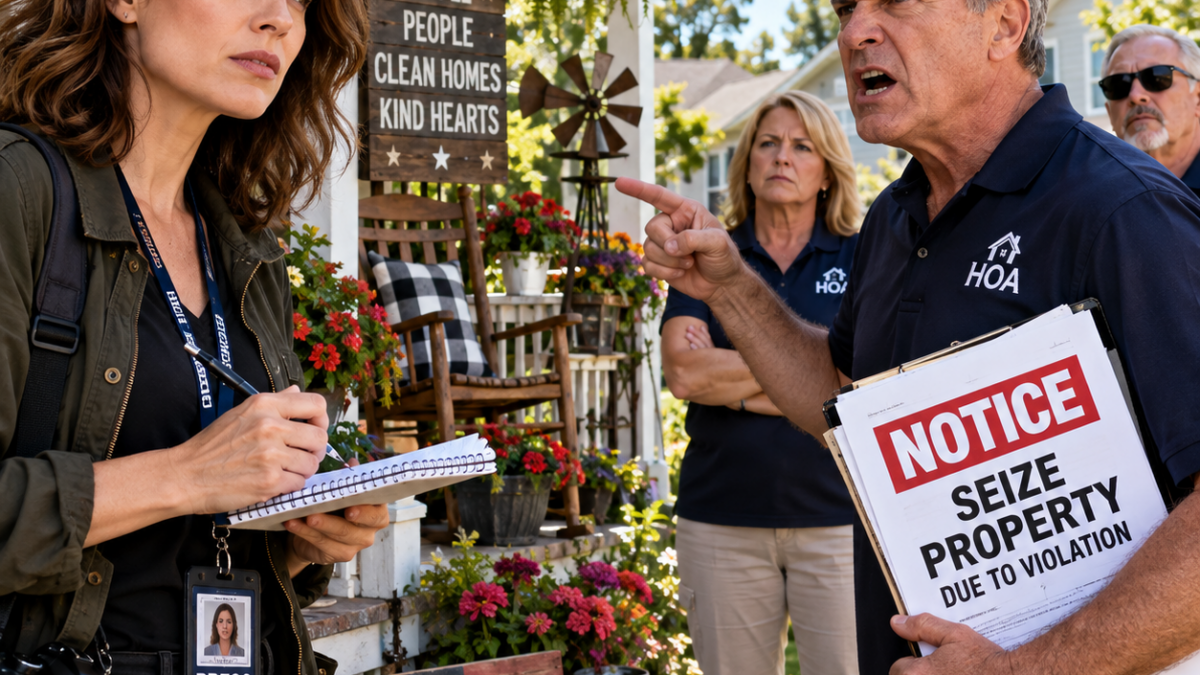
PART 2
Sarah stood behind me while I wrote Karen’s name in the center of the page.
“You have that look.”
“What look?”
“The one that ruins weekends.”
I glanced at her.
She folded her arms.
“You had the same look when the county commissioner told you his brother’s paving company had won six contracts by coincidence.”
“He went to prison.”
“That does not make my point less accurate.”
I smiled despite myself.
Sarah walked around the desk and placed both hands on my shoulders.
“Jack.”
I stopped smiling.
She rarely used that tone unless she wanted the husband instead of the reporter.
“This isn’t the newspaper.”
“I know.”
“This is our house.”
“I know.”
“And Karen lives three streets away.”
“I know.”
“She can make this personal.”
“She already did.”
“That isn’t what I mean.”
I turned my chair.
Sarah had endured enough of my investigations to understand how ugly apparently respectable people could become when somebody started opening drawers they preferred closed.
For the last eleven years, I had worked on the investigative desk of the Capital Ledger, the largest newspaper in the region.
Fraud.
Public contracting.
Nursing-home abuse.
Corrupt nonprofits.
Municipal kickbacks.
I had been threatened with lawsuits more times than I could remember.
Once, a developer had hired a private investigator to follow me for three months.
Another source had left a dead fish in a cooler outside our newsroom because he apparently believed organized crime required clichés.
But those stories had taken place somewhere else.
Sarah could close our front door and leave them outside.
Karen Peterson was already standing on the other side of that door.
“I won’t publish anything through the Ledger unless my editor agrees and the evidence supports it,” I said.
Sarah studied me.
“So you’re investigating her.”
“I’m investigating the association.”
“That was not a different sentence.”
“Technically—”
“Jack.”
“Yes.”
She sighed.
“Then do it right.”
“I intend to.”
“And no hiding things from me because you’re trying to protect me.”
I nodded.
“Agreed.”
She kissed the top of my head.
“And those soldiers stay up.”
I looked toward the porch.
“Absolutely.”
That night I did something intentionally boring.
I read.
Every page of Pleasant Valley’s governing documents.
Covenants.
Bylaws.
Architectural guidelines.
Enforcement procedures.
Collection policies.
Election procedures.
Budgets we had received with annual notices.
I read them the way I read city audits when somebody claimed there was nothing interesting inside them.
Slowly.
With a pencil.
Karen had cited Article Four, Section Seven, Subsection B.
The rule existed.
But its language was vague:
Exterior seasonal decorations should reflect customary community standards and must not create excessive visual clutter, illumination, noise, or disruption.
Twelve two-inch plastic figures created no noise.
No unusual lighting.
No obstruction.
No safety issue.
The board would have to rely almost entirely on “customary community standards.”
Subjective language.
Discretion.
Exactly the kind of language that can become dangerous when enforcement depends on whether the board likes you.
I pulled up the HOA website.
Karen’s house appeared in photographs from the previous Christmas party.
Her front yard contained two six-foot illuminated reindeer, an inflatable snowman, three glowing candy canes, and something resembling a polar bear wearing sunglasses.
Barry’s house had a projection system covering the entire garage in moving snowflakes.
Linda displayed a twelve-foot inflatable Santa.
None of them had received violations.
At least none that I knew about.
Selective enforcement was my first hypothesis.
Money was my second.
The next morning, I drafted a records request.
Not as a reporter.
As a homeowner.
That distinction mattered.
I cited the state statute governing homeowners associations and requested:
Five years of complete board meeting minutes.
Five years of financial statements.
General ledgers.
Bank reconciliations.
Vendor contracts.
Collection records with homeowner identifying information appropriately redacted.
Legal invoices.
Landscaping invoices.
Election results.
Conflict-of-interest disclosures.
Reserve-fund statements.
Copies of all written enforcement policies.
I sent it certified mail.
Then I created a folder.
REQUEST 001.
Sarah leaned through the doorway.
“You numbered it?”
“Yes.”
“There hasn’t been a second request.”
“There will be.”
“You are exhausting.”
“So I’ve been told.”
For the next ten days, nothing happened.
At least officially.
Unofficially, Pleasant Valley became interesting.
When you live in a neighborhood for years, you think you know it.
You know whose dog escapes.
Who decorates first.
Who drives too fast.
Who has teenagers.
Who borrows tools and forgets to return them.
But once I started watching enforcement patterns, another map appeared beneath the familiar one.
Violation notices were not random.
They clustered.
Older residents living alone.
Young families.
Recent buyers.
People who rarely attended HOA meetings.
People unlikely to challenge authority.
Karen’s allies seemed nearly immune.
I started walking after breakfast with a small notebook in my jacket pocket.
I never photographed through windows.
Never trespassed.
Never followed anyone.
I observed what any pedestrian could see from public sidewalks.
Barry’s driveway had a large oil stain despite a rule requiring driveways to remain clean.
No notice appeared.
Linda’s fence was visibly peeling.
Nothing.
A member of Karen’s landscaping committee had garbage bins visible from the street for four days.
Nothing.
Meanwhile, Mr. Henderson, seventy-four years old and recently widowed, had an orange violation notice taped to his door.
I found him bringing in groceries.
“Need a hand?”
He hesitated.
Then gave me two bags.
“Appreciate it.”
Inside his garage, I noticed the notice folded on his workbench.
“You get one too?”
His face changed.
“You shouldn’t ask.”
“Why?”
He lowered his voice.
“Karen doesn’t like neighbors comparing notices.”
That sentence deserved to be written down.
“What did you do?”
He almost smiled.
“My garden hose.”
I waited.
“Apparently I coil it incorrectly.”
“You’re serious.”
He showed me.
The letter said his exterior hose created “visual disorder inconsistent with community presentation standards.”
Fine: $300.
I stared.
“Did you appeal?”
“Once.”
“What happened?”
“They added fifty dollars for administrative review.”
That was new.
“Can I see the appeal paperwork?”
His hands tightened around the paper.
“No.”
“That’s fine.”
“I don’t want trouble.”
“I understand.”
“You don’t.”
He looked toward the street through his open garage.
“My wife died nineteen months ago. I don’t have the energy to fight with these people.”
I handed back the notice.
“You don’t have to.”
That afternoon, a young couple named Evan and Melissa Miller stopped me near the mailbox cluster.
They had a six-month-old daughter.
Melissa whispered before saying anything substantive.
“Karen fined us for our welcome mat.”
I thought she was joking.
She wasn’t.
The mat said HELLO SUNSHINE in yellow letters.
Apparently the approved architectural palette did not include that shade.
“Did you pay?”
Evan nodded.
“One hundred seventy-five dollars.”
“Why?”
He gave me the answer I would hear repeatedly.
“We didn’t want trouble.”
Trouble had become a business model.
On the eleventh business day after my records request, I received nothing.
The statute required a response within ten business days.
I sent Request 002.
Shorter.
Sharper.
I documented the missed deadline and gave five additional days before I would file a regulatory complaint.
Three days later, a courier delivered a thick envelope.
Not from the HOA.
From Falk, Wexler & Croft.
Jonathan Croft himself had signed the letter.
I remembered his name.
Two years earlier, while reporting on aggressive municipal debt collection, I had encountered complaints against his firm involving excessive fees placed on homeowners facing association liens.
Nothing had resulted in criminal findings in that matter.
But I remembered the style.
Twenty-dollar problem.
Two-thousand-dollar legal bill.
The letter accused me of submitting an “unreasonably burdensome and harassing demand.”
It claimed much of what I wanted was privileged.
Attached was a fourteen-page “budget summary.”
Nine pages were heavily redacted.
They also included a $250 copying and administrative charge.
Sarah stared at the blacked-out pages.
“They’re charging us for this?”
“Apparently.”
“For black rectangles?”
“Premium black rectangles.”
She didn’t laugh.
There was one more document.
My fine had increased.
$4,000.
Original penalty.
Late charges.
Administrative charges.
Legal review.
Collection preparation.
Croft’s letter warned that failure to pay within thirty days could lead to a lien and foreclosure proceedings.
Sarah sat down.
“Four thousand dollars.”
“Yes.”
“For twelve plastic soldiers.”
“No.”
She looked at me.
“What?”
“This isn’t about the soldiers anymore.”
I placed Croft’s letter beside the redacted budget.
A two-hundred-home suburban HOA had spent over fifty thousand dollars on legal services the previous year.
Landscaping appeared to cost almost seventy thousand dollars.
Administrative expenses exceeded thirty thousand.
The reserve-fund line was strangely vague.
Round numbers.
No supporting schedules.
No vendor names.
No clear reconciliation.
A budget designed to communicate almost nothing.
I pulled a dry-erase board from the closet.
Sarah groaned.
“There goes the weekend.”
At the center I wrote:
PLEASANT VALLEY HOA.
Three lines extended outward.
KAREN PETERSON — PRESIDENT
FALK, WEXLER & CROFT — LEGAL
VENDORS — ?
Then another.
FINES → REVENUE → ?
Sarah pointed.
“You don’t know that fines are significant revenue.”
“Correct.”
“So that’s speculation.”
“Correct.”
“Good.”
She gave me a stern look.
“Because you are not putting reporter words in homeowner facts.”
I smiled.
“Have you considered changing careers?”
“I’ve edited you for free for twenty-eight years.”
That Tuesday, I attended the HOA meeting.
I arrived early.
Fifteen residents.
Two hundred homes in the community.
Fifteen residents.
That explained some things.
Karen sat behind a folding table with Barry and Linda.
A large man wearing a shirt embroidered EVENT STAFF stood near the back wall.
That was also new.
The meeting lasted twenty-seven minutes before public comments.
Barry read the treasurer’s report.
Not distributed.
Read aloud.
“Operating account remains in good standing.”
That was effectively the entire report.
I raised my hand.
Karen ignored me until open forum.
Finally:
“Mr. Davis.”
I walked to the microphone.
“Jack Davis, 124 Patriots Way. I submitted a statutory records request on December fifth seeking association financial and governance records—”
Karen struck the gavel.
“This is a legal matter.”
“It’s a transparency matter.”
“Our counsel has responded.”
“Your counsel refused documents homeowners are legally entitled to inspect.”
“Take it up with counsel.”
“This board has fiduciary duties independent of your lawyer.”
Her face tightened.
“You have two minutes.”
“I’ve used twenty-eight seconds.”
The room shifted.
Someone almost laughed.
Karen did not.
I continued.
“The association reported more than fifty thousand dollars in legal expenses last year. I would like the board to explain what services required that expenditure.”
Karen struck the gavel again.
“Confidential.”
“Fifty thousand dollars of homeowner money is confidential?”
“Legal matters are privileged.”
“Individual advice may be privileged. Total spending and properly redacted invoices are not automatically exempt from inspection.”
The event staff member began walking toward me.
Karen said, “Your time is up.”
I looked at my watch.
“One minute, three seconds.”
“Security.”
The man stopped beside me.
“Sir.”
I didn’t resist.
That would only make me the story.
Instead I turned toward the residents.
“So we’re clear: the board will not produce financial records, will not explain more than fifty thousand dollars in legal spending, and is using paid security to end a homeowner’s question before his allotted time expires?”
Karen stood.
“This meeting is adjourned.”
She pounded the gavel.
The sound echoed through the clubhouse.
Nobody applauded.
Nobody protested.
People simply looked down.
That bothered me more than Karen.
Outside, Mrs. Evelyn Gable caught me near my car.
She was eighty-one.
Tiny.
Silver-haired.
Usually accompanied by a small white dog named Biscuit.
“Mr. Davis.”
“Yes, ma’am.”
“You’re the newspaper man.”
I had never introduced myself that way in the neighborhood.
“Yes.”
“My husband knew something was wrong.”
I stopped.
“George?”
She nodded.
George Gable had died two years earlier.
I knew only that he had once served on the HOA board.
“He tried asking about the landscaping bills.”
Her voice trembled.
“They came after him.”
“Who?”
“Karen. Barry. The lawyers.”
“What do you mean?”
“Everything became a violation.”
Shutters.
Driveway.
Birdbath.
Mailbox.
A cracked walkway.
Trash-can timing.
“They sent letters every week.”
Mrs. Gable’s eyes filled.
“George stopped sleeping.”
I’m careful with causation.
Journalists have to be.
Grief has a way of connecting events because the heart needs a sequence that explains loss.
So when she told me the HOA killed her husband, I did not write that down as fact.
I wrote down something narrower.
George Gable believed HOA financial records were improper.
After raising concerns, his household received repeated enforcement actions.
He later resigned from the board.
He died after suffering heart problems.
Then Mrs. Gable said something that changed the investigation.
“George kept copies.”
“Of what?”
“Everything.”
“Where?”
“My attic.”
She looked directly at me.
“He thought Karen had two sets of books.”
My reporter’s instinct sharpened immediately.
But I forced myself to slow down.
“Mrs. Gable, before you give me anything, I need you to understand something.”
She waited.
“I live here. I’m personally involved. If these records become part of a published investigation, my newspaper will need independent review. I can’t promise what we’ll publish.”
“I don’t care about your newspaper.”
She surprised me.
“What do you care about?”
“George being right.”
That evening Sarah and I went to her house.
Mrs. Gable climbed halfway up the attic stairs before I made her come down.
I retrieved the box.
It weighed perhaps thirty pounds.
On the top, written in thick black marker:
PVE — FINANCIAL / BOARD.
George Gable had been meticulous.
Old bids.
Invoices.
Meeting notes.
Email printouts.
Vendor proposals.
Budget comparisons.
Copies of check registers he had obtained while serving on the board.
One folder concerned landscaping.
Green Pastures LLC.
Before Green Pastures, Pleasant Valley had paid roughly twenty-two thousand dollars annually for common-area landscaping.
After Karen became president, Green Pastures received a contract exceeding sixty-eight thousand.
Three times as much.
I pulled the company’s business registration.
Owner:
Martin Sloan.
Address:
A house jointly owned with Patricia Peterson Sloan.
Karen’s sister.
Sarah whispered, “There it is.”
“Not yet.”
“What?”
“Relationship doesn’t prove wrongdoing.”
“You’re impossible.”
“It proves conflict-of-interest questions.”
“Fine.”
George’s handwritten note beside the contract:
KAREN REFUSED COMPETING BIDS.
BARRY SAYS CONTRACT “URGENT.”
NO DISCLOSURE OF FAMILY RELATIONSHIP.
Another note:
RESERVE FUND SHORT APPROX. $40K?
REQUESTED STATEMENTS. K.P. REFUSED.
Then:
CROFT LETTER THREATENED ME PERSONALLY.
My stomach tightened.
George had been walking the same path I was.
Alone.
And Karen had crushed him before he found enough allies.
Mrs. Gable sat across from me at her kitchen table.
“Was he right?”
“About some of it, definitely.”
“About the money?”
“I need more.”
She nodded.
“Take the box.”
“Are you sure?”
“I’ve been afraid of it for two years.”
She touched the cardboard.
“I’m tired of being afraid of paper.”
That sentence became the emotional center of everything that followed.
I scanned every document.
Stored encrypted copies.
Created an evidence index.
Then, because I was both resident and journalist, I did something that frustrated me but protected the work.
I called my editor.
Rachel Monroe had run the Ledger’s investigative desk for eleven years.
She answered:
“If this is about taking Christmas week off, no.”
“I have a conflict question.”
She became serious immediately.
I explained.
HOA.
Fine.
Foreclosure threat.
Records stonewalling.
Vendor conflict.
George Gable.
Rachel stayed silent.
Then:
“You cannot report this alone.”
“I know.”
“You are a principal subject.”
“I know.”
“If we touch it, you become a source.”
“I know.”
“I assign another reporter.”
“I know.”
“You sound unhappy.”
“I’ve done eighty percent of the digging.”
“You can give us eighty percent of the digging.”
I sighed.
Rachel laughed.
“You hate journalism ethics when they’re applied to you.”
“I love journalism ethics.”
“From a distance.”
She became serious again.
“Send me a memo. Sources separated from assumptions. Everything documented. No newsroom publication until legal review.”
“Agreed.”
“And Jack?”
“Yeah?”
“Do not tell the HOA you’re a reporter unless there’s a reporting reason.”
“Why?”
“Because if they’re doing what you think, I want to see how they behave when they believe they’re bullying an ordinary homeowner.”
That sentence was uncomfortable.
Not because it was wrong.
Because I had already thought the same thing.
The assignment went to Jessica Riley.
Jessica had joined the Ledger after twelve years in television investigative reporting.
She was one of the best people I knew.
Relentless.
Skeptical.
Absolutely uninterested in my ego.
She came to my house two nights later.
Sarah opened the door.
Jessica carried three notebooks and a laptop.
“Mrs. Davis.”
“You’re the woman who’s going to stop my husband from becoming unbearable?”
“No one has that skill.”
Sarah smiled.
“I like you already.”
For three hours, I briefed Jessica.
She interrupted constantly.
“How do you know?”
“Source?”
“Document?”
“Is that firsthand?”
“Can we independently verify?”
“Are you assuming motive?”
“Why does that number matter?”
Exactly what a good investigative reporter should do.
When I finished, she leaned back.
“You don’t have a corruption story.”
I stared at her.
Sarah looked amused.
I said, “Explain.”
“You have a suspicious vendor relationship. Selective enforcement. Potential statutory violations. Aggressive debt collection. A dead former board member who suspected missing money.”
“And?”
“That’s not corruption yet.”
“You sound like me.”
“I learned from an irritating editor.”
“I never edited you.”
“You corrected my FOIA request in front of the entire newsroom.”
“It was bad.”
“It was one comma.”
“It was an important comma.”
Jessica pointed toward George’s files.
“What you need is money movement.”
“Agreed.”
“And current records.”
“Agreed.”
“So stop trying to prove your theory.”
I frowned.
“What should I prove?”
“Whatever is true.”
That is one of those sentences journalists repeat because it sounds obvious.
It is not.
Once you develop a theory, every new fact tries to become evidence for it.
Good reporting means letting facts kill your favorite theory.
So we widened.
Jessica researched Green Pastures.
I continued observing as a homeowner.
Our data editor reviewed public business filings.
A newsroom lawyer examined Croft’s collection letters.
Jessica found civil complaints involving Falk, Wexler & Croft.
Several accused the firm of excessive collection practices.
One older lawsuit alleged a referral arrangement between Croft and an association-management consultant.
The case had settled.
No admission of wrongdoing.
Still, it was relevant context.
Then our data editor found Karen’s company.
Peterson Community Management Solutions LLC.
Formed eight months after she became HOA president.
No public website.
No staff.
No obvious clients.
Registered to Karen’s home.
Jessica looked at me across the newsroom conference table.
“What does a volunteer HOA president need a community-management consulting company for?”
“Good question.”
“Not an answer.”
“I know.”
We needed records.
Karen wasn’t going to give them voluntarily.
So I stopped thinking like a reporter for a moment and started thinking like a homeowner organizing other homeowners.
Not anonymously through my newspaper.
Privately.
Legally.
I drafted a one-page flyer.
No accusations.
Just questions.
Are you satisfied with HOA transparency?
Have you received fines based on subjective standards?
Have you requested records and been refused?
Do you know how much Pleasant Valley spends on legal services?
Do you know how vendors are selected?
At the bottom, I created a secure email address.
I placed one copy in each newspaper delivery tube late at night.
Not mailboxes.
I knew better.
By morning, thirty-one messages.
By noon, fifty-eight.
By evening, seventy-three.
Sarah stared at the laptop.
“Seventy-three?”
“Seventy-three households.”
“That is more than a third of the neighborhood.”
“Exactly.”
Some messages contained only:
YES.
Others included documents.
Fine notices.
Letters.
Photographs.
Collection threats.
One homeowner had been charged $500 because his basketball hoop remained visible for forty-eight hours after his grandchildren visited.
Another received a $275 penalty for a blue ceramic planter.
A woman named Sarah Jensen, who lived on Willow Creek Lane, emailed:
I’m a paralegal. Their collection notices contain fees not authorized by the governing documents. I can help organize this.
Then:
Arthur Bell.
Retired forensic accountant.
His email read:
Your estimates are conservative. If you want someone who hates unexplained round numbers, call me.
We met in Arthur’s basement.
Seven households initially.
Me.
Arthur.
Sarah Jensen.
The Millers.
Mr. Henderson.
Mrs. Gable.
Two other couples.
I laid out what we knew.
Not what we suspected.
Arthur immediately separated the documents into categories.
“Verified.”
“Probable.”
“Unknown.”
“Need source.”
My kind of man.
He examined the redacted budget.
“This thing is garbage.”
“Technical term?” Jessica asked from the back of the room.
Arthur looked at her.
“I charged four hundred dollars an hour before retirement. For you, I’ll explain free.”
She smiled.
He pointed to legal spending.
“Fifty-two thousand.”
Landscaping.
“Sixty-eight thousand.”
Administration.
“Thirty-one.”
Reserve transfer.
“Unclear.”
He tapped the page.
“Nearly half the association’s available operating money appears to be flowing into categories residents cannot meaningfully inspect.”
Sarah Jensen opened Croft’s letter.
“These collection fees aren’t listed in the published schedule.”
Arthur looked at her.
“So unauthorized?”
“Potentially. I want a lawyer to say that.”
Jessica looked toward me.
“This is finally becoming a story.”
“Finally?”
“You were emotionally ready to put Karen on page one over Christmas soldiers.”
“She threatened my house.”
“Exactly why you’re conflicted.”
I hated when she was right.
Our committee grew carefully.
We asked homeowners for documents.
No rumors.
No secret recordings unless lawfully made.
No trespassing.
No harassment.
No social-media attacks.
We would not become Karen.
That rule mattered.
After two weeks, we had forty-seven households willing to sign a formal records demand.
Sarah Jensen drafted it with outside counsel reviewing.
The demand named Karen, Barry, and Linda individually as board fiduciaries.
It requested invoices.
Contracts.
Bids.
Bank statements.
Vendor correspondence.
Meeting minutes.
Legal billing summaries.
Conflict disclosures.
We served the board members separately.
Karen received hers Saturday morning.
Barry was served outside the golf club.
Linda received hers in a grocery-store parking lot.
I had mixed feelings about the public service.
Sarah Davis did not.
“They threatened our house in front of neighbors.”
“That’s not a legal argument.”
“I didn’t say it was.”
The board answered through Croft.
Every request denied.
And then they made a mistake so extraordinary that Jessica called me from the newsroom laughing.
“What?”
“Check your email.”
I opened the notice.
SPECIAL ASSESSMENT — LEGAL DEFENSE.
Five hundred dollars per household.
The board claimed homeowner “harassment and disruptive demands” had forced it to incur additional legal costs.
“They are charging the neighborhood to defend themselves against the neighborhood,” Jessica said.
“Yes.”
“That’s the headline.”
“Not yet.”
“You’re learning.”
The Ledger’s investigation was ready for formal comment.
Because I was personally involved, Jessica handled the approach.
She called Karen.
No response.
Emailed.
No response.
Sent detailed written questions.
No response.
Then Jessica learned Karen met Barry and Linda every Thursday morning at a café near the interstate.
Journalism ethics required we give subjects a fair opportunity to respond.
It did not require them to like where the questions were asked.
Thursday morning, Jessica waited outside with a camera operator from the Ledger’s digital team.
I stayed away.
That was Jessica’s call.
“You being there makes it look personal.”
“It is personal.”
“Exactly.”
At 10:14, Karen exited carrying a pastry box.
Jessica approached.
“Mrs. Peterson, Jessica Riley with the Capital Ledger. We’ve been trying to reach you regarding Pleasant Valley Estates.”
Karen froze.
For the first time, she learned a newsroom was investigating.
“What is this?”
“We have questions about association finances.”
“No comment.”
Jessica walked beside her.
“Did the board disclose that Green Pastures LLC is owned by your brother-in-law?”
Karen stopped.
“That’s false.”
“State business records identify Martin Sloan as the owner, and property records show Mr. Sloan shares a residence with your sister.”
Karen’s face reddened.
“Green Pastures is a legitimate contractor.”
“Why is Pleasant Valley paying roughly three times prior landscaping costs?”
“That’s a lie.”
“We have prior bids and current budget records.”
Barry stepped between them.
“This is harassment.”
Jessica turned slightly.
“Mr. Smith, as treasurer, can you explain why homeowners have been denied general ledgers and bank reconciliations?”
Barry’s mouth opened.
Nothing came out.
Jessica looked back at Karen.
“Why did the HOA impose a five-hundred-dollar special assessment to pay legal costs arising from homeowners’ requests to inspect association records?”
Karen pointed toward the camera.
“Turn that off.”
“We’re standing on a public sidewalk.”
“I’ll have you arrested.”
“For asking questions on a public sidewalk?”
“I’ll sue the Ledger.”
“You’re entitled to seek legal advice.”
Karen looked around.
Then she made the statement that transformed a financial investigation into something much uglier.
“This entire thing was started by one delinquent homeowner who thinks being some washed-up newspaper man puts him above our rules.”
Jessica did not react.
“So you’re aware Mr. Davis works as an investigative reporter?”
Karen smiled.
“Everyone knows now.”
That was news to me.
Later, we learned Croft had looked up my employment after our coalition served the records demand.
Karen continued.
“He is using his newspaper to retaliate because he refuses to remove trash from his porch.”
Jessica asked, “Are you referring to the twelve memorial figures honoring deceased members of his Army unit?”
Karen realized too late what she had said.
“They violate our standards.”
“Do your six-foot illuminated reindeer comply with the same standards?”
Karen’s expression hardened.
“This interview is over.”
She walked away.
Barry followed.
Linda stayed behind for half a second.
She looked directly at Jessica.
And whispered:
“Check the reserve account.”
Then she hurried after Karen.
Jessica called me immediately.
“She cracked.”
“Karen?”
“Linda.”
“What did she say?”
“Check the reserve account.”
That afternoon, the Ledger published the first story.
Not an opinion piece.
Not a revenge story.
An investigation.
PLEASANT VALLEY HOMEOWNERS QUESTION SECRETIVE SPENDING, SELECTIVE FINES AND VENDOR TIES.
My name appeared as a homeowner and investigative reporter recused from the newsroom’s editorial decisions.
The story disclosed my personal involvement.
Transparency mattered.
The article included Karen’s comments.
Green Pastures’ ownership.
Historical pricing.
Records refusals.
The special assessment.
George Gable’s concerns, carefully attributed.
Mrs. Gable agreed to speak on record.
Her photograph showed her sitting beside George’s framed picture.
Her quote became the line people remembered:
“I spent two years being afraid of the box where my husband kept the truth.”
The story exploded.
Not because HOAs were inherently fascinating.
Because people recognized the pattern.
Small authority.
Little oversight.
Official-looking threats.
People too exhausted or frightened to challenge them.
The article spread across local social media.
Radio stations discussed it.
Television called.
Then state regulators called.
The State Attorney General’s Economic Crimes Division contacted Jessica first.
Then me.
Investigator David Chen met with our legal team and the homeowners.
From that point forward, the newsroom investigation and government investigation separated completely.
We protected confidential sources according to law.
We did not become investigators for the state.
But homeowners could voluntarily provide their own records.
I provided mine.
Arthur provided his financial analysis.
Mrs. Gable provided George’s files.
The Millers provided collection letters.
Sarah Jensen provided her legal research.
Chen listened for three hours.
At the end, he stared at the indexed folders.
“You people did a remarkable amount of work.”
Arthur said, “Retirement is boring.”
Chen almost smiled.
Then he became serious.
“From here forward, don’t try to obtain anything you aren’t legally entitled to possess.”
“We haven’t.”
“Good.”
“Don’t confront anyone.”
“We won’t.”
“Don’t warn subjects about subpoenas.”
“We won’t.”
“And Mr. Davis.”
“Yes?”
“You are a reporter.”
“Yes.”
“I’m not asking what your newspaper has beyond what residents voluntarily provide.”
“Understood.”
“I’d like to keep it that way.”
“So would I.”
That separation protected everyone.
The Attorney General’s office issued subpoenas independently.
HOA.
Board members.
Green Pastures.
Falk, Wexler & Croft.
Banks.
Accounting platforms.
Internet-service providers.
Karen’s consulting company.
The first production from the HOA was incomplete.
The banks were not.
Money tells the truth even when people don’t.
Arthur was right.
Green Pastures invoiced small amounts for actual work.
The HOA paid much larger amounts.
Some of the difference moved into accounts controlled by Martin Sloan.
From there, regular payments moved into Peterson Community Management Solutions.
Karen’s company.
No legitimate consulting work could initially be documented for many of those payments.
The reserve fund had also been raided.
Tens of thousands.
Then more.
Legal invoices showed enormous charges for collection work against homeowners.
Croft’s firm billed the association to threaten residents.
Those same threats produced fines and collection payments.
The system fed itself.
Fear created revenue.
Revenue paid lawyers.
Lawyers created more fear.
And underneath it all, money flowed toward people connected to the board.
The investigators were still building the case when Karen made her final mistake.
She learned which homeowners had cooperated.
We never discovered exactly how.
Maybe someone talked.
Maybe she guessed from public reporting.
Maybe she saw names on the coalition letters.
Whatever the source, she held an emergency board meeting at her house.
Karen.
Barry.
Linda.
They voted to impose punitive fines on twenty-one households.
Mine totaled more than fifty thousand dollars.
The alleged offenses included:
Unauthorized exterior objects.
Failure to maintain aesthetic harmony.
Improper political activity affecting association reputation.
Harassment of board officers.
Abuse of association records procedures.
And my favorite:
Use of media influence to destabilize community governance.
That was not a bylaw.
It was a confession.
Then Karen filed liens.
Or tried to.
The county recorder had already been alerted by the Attorney General’s office to flag unusual Pleasant Valley filings.
Investigator Chen called me at 4:03 that afternoon.
“She filed against you.”
“How much?”
“Fifty-one thousand eight hundred.”
“Creative.”
“She’s also filed against Mrs. Gable.”
My humor disappeared.
“How much?”
“Fourteen thousand.”
“For what?”
“Various violations.”
“She is eighty-one.”
“I know.”
“And a witness.”
“I know.”
His voice turned colder.
“The act of filing these documents after an active investigation began creates additional problems for her.”
“Witness intimidation?”
“We’re evaluating everything.”
He paused.
“Stay home tomorrow morning.”
“Why?”
“Jack.”
“Right.”
“Stay home.”
At 8:11 the next morning, Sarah brought me coffee.
I was sitting on the porch.
The twelve green soldiers were still lined along the railing.
We had never removed them.
The HOA had eventually stopped sending notices once the investigation became public, but I kept them there until the holiday season ended.
At 8:15, two dark sedans turned onto Karen’s street.
A marked state police cruiser followed.
Sarah stood beside me.
“Is that them?”
“Yes.”
Investigator Chen stepped from the first sedan.
Two troopers approached Karen’s front door.
The street was quiet.
December frost still silvered the lawns.
The same peaceful suburban scene where Karen had threatened to take my home.
Chen knocked.
A long pause.
Karen opened the door wearing a pink robe.
Even from two houses away, I could see her expression change.
Confusion.
Recognition.
Fear.
Chen held up a document.
Karen began gesturing.
Then pointing.
Then arguing.
Her voice carried.
“This is retaliation!”
One trooper said something.
Karen stopped.
Chen spoke again.
She looked past them.
Across the street.
Her eyes found me.
Sarah touched my arm.
“Don’t.”
“I wasn’t going to.”
I did not smile.
Did not wave.
Did not raise my coffee cup.
I simply looked at her.
A trooper turned Karen around.
Her hands moved behind her back.
Handcuffs closed.
The woman who had threatened to seize my home over twelve plastic soldiers stood on her immaculate front lawn in slippers while officers placed her under arrest.
The scene should have felt triumphant.
It didn’t.
It felt heavy.
Because behind every satisfying arrest is a list of people who had to suffer long enough for enough evidence to exist.
George Gable.
Mrs. Gable.
Mr. Henderson.
The Millers.
Dozens of homeowners who paid because fighting seemed impossible.
Sarah squeezed my hand.
“It’s over.”
“Not yet.”
Barry was arrested thirty minutes later while loading golf clubs into his Mercedes.
Linda surrendered voluntarily.
Within hours, her attorney contacted prosecutors.
She wanted to cooperate.
Martin Sloan was taken into custody at Green Pastures’ equipment yard.
And at 9:20 that morning, investigators executed a search warrant at Falk, Wexler & Croft.
Jonathan Croft watched officers carry computers and file boxes from the firm he had used to intimidate homeowners for years.
The Ledger newsroom became chaos.
Every television station wanted comment.
National outlets called.
Our first story had become a criminal corruption investigation.
Rachel found me near the elevators.
“You are not writing today’s main story.”
“I know.”
“You are too close.”
“I know.”
“You can write first-person later, after legal review.”
“I know.”
She narrowed her eyes.
“You’re taking this extremely well.”
“I’ve grown.”
“No, you’re already writing the ending in your head.”
I smiled.
She pointed at me.
“I knew it.”
Jessica wrote the breaking story.
PLEASANT VALLEY HOA PRESIDENT, TWO BOARD MEMBERS ARRESTED IN FRAUD PROBE.
The Attorney General held a press conference that afternoon.
The preliminary allegations involved embezzlement, fraud, conspiracy, fraudulent property filings, and financial misconduct tied to a seven-year scheme.
Investigators estimated losses exceeding half a million dollars.
The final number would change as records were audited.
The court placed Pleasant Valley Estates HOA into temporary receivership.
That mattered more immediately to residents than the arrests.
Karen no longer controlled fines.
Barry no longer controlled money.
Croft’s firm no longer controlled collections.
The punitive liens were blocked.
The five-hundred-dollar special assessment was suspended.
All active enforcement actions were frozen pending review.
For the first time in years, people could open their mail without wondering what the HOA had decided they had done wrong.
That evening, neighbors came outside.
No one organized it.
It simply happened.
Mrs. Gable sat on her porch with Biscuit.
Mr. Henderson carried two folding chairs into his driveway.
The Millers brought their baby out wrapped in a yellow blanket.
Arthur stood on the sidewalk explaining receivership to anyone foolish enough to ask him.
Sarah leaned against me.
“You gave them their neighborhood back.”
“No.”
She looked up.
“Don’t start.”
“It wasn’t me.”
“Jack.”
“George started looking years ago. Mrs. Gable kept his files. Arthur traced numbers. Sarah Jensen organized the legal side. Jessica reported it. Homeowners came forward. Chen built the case.”
Sarah smiled.
“So you’re saying teamwork.”
“Exactly.”
“You spent twenty-two years in the Army and eleven in journalism before discovering teamwork.”
“Apparently.”
Across the street, Mrs. Gable lifted George’s framed photograph from a small table beside her chair.
She looked at it.
Then toward me.
She didn’t say anything.
She didn’t have to.
The court-appointed receiver was named Denise Albright.
She had spent twenty-five years restructuring troubled nonprofit organizations.
She had no patience for theatrics.
Her first community meeting took place at the high school because nearly every Pleasant Valley household wanted to attend.
For years, fifteen people had shown up.
That night, more than three hundred residents filled the auditorium.
Albright stood at a podium.
“No one is being fined tonight.”
Laughter and applause erupted.
She waited.
“This is not entertainment.”
Silence returned.
“The association is in serious financial distress.”
A preliminary audit showed the reserve fund nearly depleted.
Landscaping overpayments.
Legal expenses.
Questionable administrative payments.
Unreconciled accounts.
Improper penalties.
“Your association did not fail because homeowners asked too many questions,” she said.
“It failed because too few people believed they had the right to ask them.”
That sentence deserved publication.
I wrote it down anyway, though Jessica was covering the meeting.
Then Albright announced a comprehensive review of seven years of violations.
Every fine unsupported by clear governing documents would be voided.
Selective enforcement would be examined.
Improper payments would be credited or refunded where legally possible.
Mrs. Gable covered her mouth.
Mr. Henderson started crying.
He had paid almost six thousand dollars over seven years.
Garden hose.
Mailbox.
Driveway.
Fence stain.
Trash cans.
Holiday wreath.
Bird feeder.
Six thousand dollars to make a seventy-four-year-old man afraid of his own front yard.
The criminal case took nearly a year.
Reality is slower than revenge stories.
Documents had to be authenticated.
Accounts traced.
Witnesses interviewed.
Defense motions filed.
Experts retained.
Cooperating defendants negotiated.
Linda was first.
She admitted she had known financial reports were incomplete.
She denied knowing the full scale of Karen’s kickback arrangement.
Evidence supported part of her claim.
She had been weak.
Passive.
Afraid of Karen.
But she had also signed documents.
Approved enforcement.
Stayed silent.
She pleaded to lesser charges, paid substantial penalties, received probation, and was permanently prohibited from serving in association leadership.
Barry cooperated later.
His excuse was worse.
He claimed he never really understood the finances even though he was treasurer.
Arthur’s reaction:
“That is not a defense. That is a job description for negligence.”
Barry received probation, fines, restitution obligations, and the same lifetime governance restrictions.
Martin Sloan liquidated Green Pastures.
Assets went toward restitution.
The company disappeared.
Jonathan Croft fought longer.
Then investigators obtained communications showing his firm had repeatedly advised Karen on collection strategies designed to maximize homeowner legal fees.
Evidence also supported financial arrangements prosecutors characterized as improper.
Eventually he cooperated.
His law license was revoked.
His firm restructured under partners not implicated in the case.
Croft served a short custodial sentence and paid financial penalties.
Karen held out longest.
She blamed Barry.
Linda.
Croft.
The homeowners.
The Ledger.
Me.
At one hearing, her attorney argued that I had “weaponized journalism.”
Jessica nearly threw a pen.
Rachel whispered, “Don’t.”
Jessica whispered back, “I wasn’t going to.”
“You were absolutely going to.”
The prosecution did not need my anger.
It had bank records.
Contracts.
Payments.
Emails.
Vendor relationships.
Improper liens.
Witness testimony.
George Gable’s historical documents.
Current financial records.
Karen’s own public statements.
Eventually, Karen accepted a plea deal.
The sentencing hearing filled the courtroom.
Mrs. Gable sat in front.
She held George’s photograph.
I sat behind her with Sarah.
Karen entered in a plain jail uniform.
For the first time since I had known her, she wore no jewelry.
No board-president pin.
No binder.
No authority.
The judge spent almost twenty minutes explaining the damage.
Not merely money.
Trust.
“You transformed a community association,” he told her, “from a mechanism of shared governance into an instrument of private enrichment and intimidation.”
Karen stared forward.
The judge continued.
“You used fines against those least equipped to fight them. You used association funds to finance legal threats against the homeowners whose money supported the association. When residents requested transparency, you treated scrutiny as insubordination.”
Mrs. Gable’s shoulders shook.
Sarah Jensen reached forward and touched her back.
Then the judge discussed the retaliatory liens.
“You attempted to place financial claims against witnesses and critics while under active investigation.”
Karen finally looked down.
Three years.
Restitution.
Financial penalties.
Restrictions after release.
It was less dramatic than television.
No one cheered.
The bailiff didn’t slam anything.
The judge simply imposed consequences.
Karen turned before being led away.
Her eyes moved across the courtroom.
For one brief moment, they stopped on me.
I wondered what she saw.
The delinquent homeowner?
The reporter?
The veteran?
The man with plastic soldiers?
Her enemy?
I hoped eventually she would understand the simplest answer.
Neighbor.
I had always been a neighbor.
She had chosen to make that dangerous.
After sentencing, Mrs. Gable remained seated.
The courtroom emptied around us.
I approached.
“Ready?”
She stared at George’s photograph.
“He would’ve enjoyed this.”
“Karen going to prison?”
“No.”
She smiled through tears.
“Being right.”
I laughed softly.
“That sounds like George.”
“You never knew him.”
“I know his files.”
“That counts.”
She looked toward the empty defense table.
“Do you think this makes up for what happened?”
“No.”
She seemed relieved by the answer.
Neither of us needed a false ending.
Justice cannot retroactively remove fear.
It cannot give back sleepless nights.
It cannot restore George.
It cannot make a young couple forget the week they thought an HOA could put a lien on their home over a welcome mat.
What it can do is stop the harm.
Name it.
Correct the record.
Return what can be returned.
And make repetition harder.
The receiver recovered substantial money through restitution, insurance, settlements, and asset seizures.
Homeowners received credits.
Some received refund checks.
Mr. Henderson’s reimbursement exceeded five thousand dollars.
He came to my house holding the envelope.
“They paid me back.”
“Good.”
He stared at it.
“What do I do now?”
“With the money?”
“With the hose.”
I laughed.
“Coil it however you want.”
The next morning his garden hose lay across the driveway in what can only be described as aggressive chaos.
Sarah photographed it.
I sent the picture to Arthur.
He replied:
ANARCHY.
Mrs. Gable received refunds too.
She used part of the money to create a small scholarship at the local high school in George’s name.
Civics and public service.
The plaque contained a line George had written in one of his notes:
IF THEY WON’T SHOW YOU THE NUMBERS, THE NUMBERS ARE PROBABLY THE STORY.
Jessica stole it for the headline of our long-form follow-up.
With permission.
The new Pleasant Valley board election took place six months after receivership began.
Residents nominated me for president.
Absolutely not.
At the meeting, I walked to the microphone.
“I appreciate the confidence.”
Several people shouted:
“Do it!”
“No.”
Laughter.
“I spent this entire year proving that too much power concentrated in one person is a bad idea. Electing an investigative reporter with control issues would be an unusual response.”
Arthur yelled:
“Finally, self-awareness!”
More laughter.
I pointed toward Sarah Jensen.
She looked horrified.
“I nominate Sarah Jensen for president.”
She mouthed:
I hate you.
“And Arthur Bell for treasurer.”
Arthur stopped laughing.
“That is not funny.”
“It wasn’t meant to be.”
Both were elected.
Sarah Jensen had legal discipline.
Arthur had financial paranoia.
Perfect combination.
The new board changed everything slowly.
Budgets posted online.
Vendor bids disclosed.
Conflicts of interest mandatory.
Board meetings livestreamed.
Minutes published promptly.
Fine schedules explicit.
Appeal procedures independent.
No legal expenses above a threshold without documented board approval.
No foreclosure action without multiple levels of review and outside legal confirmation.
And one rule Arthur insisted upon:
Every financial report had to be understandable to a homeowner who did not work in accounting.
“If ordinary people can’t understand where their money went,” he said, “the report failed.”
The landscaping contract went to a reputable local company for less than half what Green Pastures had charged.
The entrance looked better within two months.
The world did not end.
One evening the new landscaper’s crew repaired the neglected flower bed near the pond.
Mr. Henderson stood nearby.
“Karen said Green Pastures was expensive because they provided premium service.”
Arthur looked at the weeds they were removing.
“Those must have been premium weeds.”
Pleasant Valley began feeling like a neighborhood rather than a jurisdiction.
People spoke at meetings.
Disagreed.
Asked annoying questions.
Some proposals failed.
Some passed.
One meeting lasted seventy-three minutes debating whether basketball hoops should be permitted permanently in driveways.
I left after thirty.
Sarah asked why.
“I fought for democracy. I did not promise to enjoy it.”
The twelve soldiers stayed in their storage box most of the year.
When December returned, I hesitated before putting them out.
Sarah noticed.
“What?”
“I don’t know.”
“You’ve displayed them for years.”
“It feels different now.”
“How?”
“Too much happened.”
She picked up one small green soldier.
“Jack, Karen doesn’t get to own their meaning.”
That settled it.
We placed them along the railing.
Twelve.
Same white light.
No fanfare.
The new HOA sent no notice.
Three nights later, my doorbell rang.
Mrs. Gable stood there.
Behind her were Mr. Henderson, the Millers, Arthur, Sarah Jensen, and perhaps twenty neighbors.
I looked at Sarah.
“Did you organize this?”
“No.”
Mrs. Gable stepped forward holding something.
A thirteenth small figure.
Not green.
Bronze-colored.
“What is that?”
“For George.”
I couldn’t speak for a second.
Mrs. Gable looked toward the twelve soldiers.
“I know he wasn’t one of your men.”
“No.”
“But he fought too.”
My throat tightened.
I took the figure.
“He did.”
We placed George beside them.
Not among the twelve.
Slightly apart.
A civilian in a different uniform.
Arthur muttered, “This technically violates symmetry.”
Mr. Henderson said, “Fine him.”
Everyone laughed.
Sarah leaned against me.
For the first time, those little figures represented something larger than loss.
They represented people whose absence still asked something of the living.
Remember.
Pay attention.
Do not waste what others defended.
My own first-person piece finally ran several months later.
Not during prosecution.
Not while facts remained contested.
After convictions.
After legal review.
I titled it:
THE HOUSE THEY THREATENED TO TAKE.
I wrote about twelve soldiers.
About George’s box.
About seventy-three emails.
About neighbors who believed fear was private until they discovered everyone was afraid of the same people.
The piece ended with Mrs. Gable’s sentence:
“I was tired of being afraid of paper.”
It became one of the most-read things I had ever written.
Not because I was brilliant.
Because people everywhere knew what it felt like to receive an official-looking envelope and wonder whether resisting would cost more than surrendering.
Messages arrived from homeowners around the country.
Some had legitimate disputes.
Some clearly hated perfectly reasonable rules.
Investigative reporters learn quickly that not every person claiming persecution is right.
But the broader lesson held.
Ask for the rule.
Ask for the record.
Ask where the money goes.
Document conversations.
Use lawful appeal processes.
Find allies.
Do not confuse confidence with authority.
And never assume a stamped envelope means the person who sent it is correct.
A year after Karen’s sentencing, Pleasant Valley held a summer block party.
Sarah Jensen insisted on approving the permit even though everyone mocked her.
Arthur set up a table displaying the current budget.
Nobody visited it.
He was offended.
Children rode bikes in the street.
The Millers’ daughter toddled across the grass.
Mr. Henderson’s garden hose remained disgracefully uncoiled.
Mrs. Gable sat beneath a canopy watching everyone.
I brought her lemonade.
“George would like this.”
“He would complain.”
“About what?”
“Food costs.”
“Arthur already did.”
She laughed.
Across the common area, Jessica was talking to Rachel.
Neither was working.
Supposedly.
Jessica saw me looking.
“Don’t worry. Nobody is reporting anything.”
“I don’t believe you.”
“Occupational paranoia.”
Sarah Davis joined us.
She looked around.
“Remember when we thought we’d have to sell?”
I did.
The night after Croft’s foreclosure threat, we had sat at our kitchen table after midnight.
Sarah had quietly asked whether we should pay the four thousand dollars simply to make the problem disappear.
I almost said yes.
That part never made the newspaper.
Not because I was embarrassed.
Because courage is often edited badly in retrospect.
People like to tell stories where the protagonist always knew what to do.
I didn’t.
I was scared.
A lien can become expensive.
Legal disputes can spiral.
Even when you’re right, winning can bankrupt you.
The difference was not that I felt no fear.
The difference was that I had spent enough years investigating intimidation to recognize what fear was trying to make me do.
Stop asking.
Pay.
Obey.
Go away.
I chose one more question instead.
Then another.
Then another.
Sarah touched my arm.
“You disappeared again.”
“Thinking.”
“Dangerous.”
“Remember when you suggested paying them?”
She groaned.
“Why would you bring that up at a party?”
“Because I almost agreed.”
“You did not.”
“I almost did.”
She studied me.
“Would that have been terrible?”
“No.”
That surprised her.
“Sometimes protecting your peace is worth money.”
“But?”
“But if we’d paid, Karen would have moved to someone else.”
Sarah looked toward Mrs. Gable.
“Yes.”
“That doesn’t mean everyone has to fight every battle.”
“No.”
“It means this one eventually became ours.”
She squeezed my hand.
Our house remained the same.
Brick.
Two-story.
Small front porch.
Paid off.
I repainted the railing the following spring.
Not because the HOA told me to.
Because it needed paint.
The distinction mattered.
One afternoon, a moving truck stopped at Barry’s former house.
A young family moved in.
The father introduced himself.
“Daniel.”
“Jack.”
“I heard you’re the reporter.”
I sighed.
“Depends who’s asking.”
He laughed.
“We’re new. Anything we should know?”
I considered giving him the long version.
Instead:
“Read the bylaws.”
“Seriously?”
“Yes.”
“Anything else?”
“Go to meetings occasionally.”
“That sounds miserable.”
“It is.”
He smiled.
“Anything fun?”
“Mr. Henderson will lend you tools.”
Across the street, Henderson shouted:
“No, I won’t!”
Daniel laughed.
I pointed.
“He will.”
Pleasant Valley healed.
Not perfectly.
Communities never do anything perfectly.
There were arguments about dogs.
Parking.
Trees.
A fence.
Someone wanted chickens.
Someone else believed chickens represented the collapse of civilization.
Arthur threatened to resign as treasurer three times.
Sarah Jensen actually resigned as president after two years, saying she wanted to enjoy neighbors without receiving emails about mulch.
A normal community is noisy.
That became one of my favorite things about it.
Karen had confused order with obedience.
The new Pleasant Valley learned that fairness could survive disagreement.
Years later, Mrs. Gable died peacefully at eighty-six.
Her niece asked me to help sort George’s old papers.
At the bottom of a filing cabinet, we found his original notebook.
The final entry he wrote about the HOA was dated three weeks before he resigned.
Karen says nobody else cares.
Maybe she’s right.
I sat there for a long time.
Because Karen had been wrong.
People cared.
They were simply isolated.
Fear had convinced each one that everybody else had accepted what was happening.
That was Karen’s real power.
Not the bylaws.
Not Croft.
Not the fines.
Isolation.
Once seventy-three homeowners discovered they were asking the same questions, her authority began collapsing.
Mrs. Gable’s niece gave me George’s notebook.
I eventually donated it, with her permission, to the local historical archive as part of a collection about the Pleasant Valley case.
The archivist asked what title to use.
I said:
GEORGE GABLE PAPERS — COMMUNITY ACCOUNTABILITY.
Not rebellion.
Not HOA war.
Accountability.
That was what the entire story had been about.
My retirement from the Ledger came several years later.
At my farewell dinner, Jessica handed me a gift.
A framed copy of the first HOA fine.
TRASHY NONTRADITIONAL DECORATION.
Below it she had mounted one green plastic soldier.
I stared at her.
“You stole one of my soldiers?”
“Borrowed.”
“For how long?”
“Several months.”
“That display represents twelve real men.”
“Relax. Sarah helped.”
I turned toward my wife.
She smiled.
“Journalistic collaboration.”
Under the notice, Jessica had engraved:
FOLLOW THE MONEY.
I laughed harder than I expected.
Then I cried a little.
I blamed retirement.
Nobody believed me.
Today, I still live at 124 Patriots Way.
Sarah still complains that I read documents nobody asked me to read.
Arthur still sends me the HOA budget every quarter with notes in the margins even though he stopped serving as treasurer years ago.
Mr. Henderson’s hose is still a disaster.
The Millers’ old yellow welcome mat eventually wore out.
Their replacement is bright red.
Nobody fined them.
Every December, I place twelve green soldiers on my porch.
And one bronze figure nearby for George.
Sometimes a new resident asks why.
I tell them.
Not every detail.
Just enough.
Those twelve are men I served with.
The other is a neighbor who asked where the money went before the rest of us were brave enough to listen.
One December evening, Sarah and I sat outside beneath blankets.
The white porch light shone over the little figures.
A car slowed.
Not suspiciously.
The driver waved.
I waved back.
Sarah rested her head against my shoulder.
“Do you ever miss reporting?”
“Sometimes.”
“Investigating?”
“Yes.”
“You investigate our electric bill.”
“It increased eleven percent.”
She groaned.
“I walked into that.”
Down the street, children were playing beneath Christmas lights.
Someone’s inflatable dinosaur wore a Santa hat.
Technically, it probably violated Karen’s old interpretation of “traditional holiday adornment.”
I hoped it stayed up until February.
Sarah looked at the soldiers.
“Funny.”
“What?”
“She threatened to take this house because she thought those looked trashy.”
“Yeah.”
“She had no idea who she was dealing with.”
I thought about that.
People often told the story that way.
Karen picked the wrong homeowner.
She threatened an investigative reporter.
She should have researched me.
I never liked that lesson.
Because it suggests what she did would have been acceptable if I had been weaker.
If I had been an accountant.
A teacher.
A mechanic.
A widow.
A young couple with a baby.
The truth was simpler.
Karen picked the wrong thing to do.
It did not become wrong because I knew how to investigate it.
It was already wrong.
I just happened to know how to follow the paper.
And once the rest of Pleasant Valley stopped being afraid to follow it with me, there was nowhere left for the truth to hide.
I looked at our porch.
Our house.
Our neighborhood.
Nothing extraordinary.
That was what made it precious.
Years earlier, Karen Peterson had stood on the sidewalk and told me she could take all of it over twelve small figures.
She believed an official title gave her ownership over other people’s fear.
She learned otherwise.
The house remained ours.
The fraudulent fines were gone.
The money was traced.
The residents were repaid.
The corrupt board disappeared.
George’s questions were finally answered.
And the twelve soldiers Karen once called trash continued their silent watch every December.
Nobody threatened them again.








