HOA Sent 80 Concrete Trucks Down My Private Quarry Road—So I Locked the Gate and Her $420,000 Gamble Collapsed
part 2
A few days after Delaney left my office, my operations manager, Owen Ledbetter, called me from the midpoint of Quarry Ridge Road.
“Seth, you need to come see this.”
Owen had been with the quarry almost as long as I had.
He knew every curve, culvert, crack, dip, and patch on that road.
When he sounded concerned, I listened.
I drove out in a pickup.
He was standing beside the shoulder with his hands on his hips.
Fresh orange paint covered the gravel.
Survey marks.
Stakes.
Numbers.
Arrows.
I got out.
“What is this?”
“Not ours.”
We followed the markings.
Someone had measured potential truck turnarounds.
Temporary signage locations.
Staging zones.
Passing points.
It looked like a logistics planner had already mapped my road for construction traffic.
I stared at the paint.
“Who was out here?”
“Survey crew yesterday.”
“You talk to them?”
“Told me they were hired by Silvercrest.”
That made my jaw tighten.
“Did they ask permission?”
“No.”
I called the HOA.
Delaney answered.
“Yes?”
“You sent a survey crew onto Quarry Ridge Road.”
A pause.
Then she said, “We’re preparing logistics.”
“You’re trespassing.”
“Oh, Seth.”
“No.”
My voice stayed calm.
“You were told you don’t have access.”
“We’re simply measuring.”
“On private property.”
“You’re making this much more dramatic than it needs to be.”
I looked at the orange marks.
“You want to know what isn’t dramatic?”
“What?”
“A written notice.”
I hung up.
Back at the office, I drafted one.
Quarry Ridge Road was private.
The old easement had terminated.
No Silvercrest contractor, delivery vehicle, surveyor, vendor, subcontractor, or representative had authorization to use the road.
Any project vehicle arriving at the gate would be refused entry.
I sent it by certified mail.
I emailed copies.
I saved the delivery receipts.
Owen watched me file everything.
“You think she’ll actually try it?”
“Yes.”
“How many trucks?”
I looked at him.
“She said eighty.”
He laughed.
Then saw I wasn’t laughing.
“Seriously?”
“She thinks the number is the argument.”
Owen shook his head.
“That woman has never worked around concrete.”
Neither had Delaney.
That would become important.
Three days later, my phone rang.
A man introduced himself as Curtis Langston.
General contractor for the Silvercrest Plaza project.
He sounded professional.
“Mr. Callahan, I’m confirming the haul schedule for the foundation pour.”
“What haul schedule?”
There was a short pause.
“Concrete traffic on Quarry Ridge.”
“There is no concrete traffic on Quarry Ridge.”
Another pause.
“I was told access had been resolved.”
“By who?”
“Silvercrest.”
“Delaney?”
“Yes.”
I leaned back in my chair.
“No truck connected to your project has permission to use my road.”
The silence on his end lasted several seconds.
Finally he said, “That’s not what we were given.”
“I believe you.”
I emailed Curtis the deed.
The expired easement.
The termination clause.
The certified notice.
Everything.
He called back.
“Thanks.”
“You’re welcome.”
“I’m going to get this clarified.”
“Good.”
That evening, Delaney called.
Her voice was different now.
No warmth.
No performance.
“You contacted my contractor.”
“He contacted me.”
“You’re interfering with HOA contracts.”
“No.”
I kept my voice level.
“I’m protecting my land.”
“You have no idea what you’re putting at risk.”
“I know exactly what’s at risk. My road.”
“This is bigger than your road.”
“That doesn’t make it yours.”
She inhaled sharply.
Then her voice became calm again.
Too calm.
“Our main slab pour is scheduled next week.”
I said nothing.
“Eighty mixers.”
I remained silent.
“Two concrete pumps.”
Still nothing.
“Specialized finishing crews. Structural inspection. Full labor mobilization.”
“Sounds expensive.”
“It is.”
“Then I hope your access plan works.”
She ignored that.
“If that pour gets delayed, the losses will be enormous.”
“Then don’t send the trucks here.”
“When eighty loaded trucks are sitting at your gate, Seth, you’ll understand what refusing access really costs.”
I finally spoke.
“You just described your problem.”
She went quiet.
“Not mine.”
I ended the call.
That night, I ordered two more cameras.
Not because I wanted drama.
Because I knew Delaney.
If eighty trucks showed up and the morning collapsed, she would tell the story differently.
So we mounted one camera covering the gate.
Another covered the approach.
A third covered the highway shoulder where traffic might queue.
Owen watched us install them.
“You think we need audio?”
“Yes.”
“Think she’ll say something useful?”
“She usually does.”
Within days, Silvercrest residents received a letter.
Several homeowners forwarded it to me.
Delaney described a “neighboring industrial landowner” who was attempting to interfere with a community project.
No mention that the road was private.
No mention of the expired easement.
No mention of my certified notice.
No mention that I had offered Curtis documents proving access wasn’t resolved.
She was building a story.
A greedy quarry owner.
An entire community.
One gate.
The usual formula.
What she didn’t know was that her own treasurer, Pamela Shore, had started feeling uneasy.
I wouldn’t learn that until later.
Pamela was meticulous.
She handled numbers the way I handled maintenance records.
At one budget review, she asked Delaney how much Silvercrest was paying to use Quarry Ridge Road.
Delaney answered immediately.
“Nothing.”
Pamela looked up.
“Nothing?”
“We own access rights.”
“Permanent?”
“Yes.”
Pamela trusted her.
Most people did.
Confidence is persuasive when nobody bothers to open the file.
The foundation pour stayed on the calendar.
Then the morning came.
At 5:42 a.m., my phone buzzed on the nightstand.
Motion alert.
I opened the camera feed.
Headlights.
At first, I couldn’t tell how many.
Then the camera exposure adjusted.
A line of mixer trucks stretched along the highway shoulder.
One behind another.
Their drums turning.
Lights blinking.
It looked like a mechanical snake nearly a mile long.
I sat up.
My wife was awake beside me.
“What is it?”
“They came.”
“All eighty?”
“Looks like it.”
She stared at the screen.
“What are you going to do?”
“What I said.”
I put on work clothes and boots.
By the time I reached the gate, Owen was already there.
Thermos in one hand.
The steel gate locked.
The lead mixer had the logo **Ralston Ready Mix** on the door.
The driver climbed down.
He wasn’t angry.
Mostly confused.
“Morning.”
“Morning.”
He handed me a delivery ticket.
Destination:
**SILVERCREST PLAZA**
Route:
**QUARRY RIDGE INDUSTRIAL ACCESS**
He pointed through the gate.
“I was told this was approved.”
“It isn’t.”
His face changed.
“Seriously?”
“Seriously.”
“Landowner?”
“Me.”
He looked at the locked gate.
Then back at the line of trucks.
“Okay.”
That was all.
He hadn’t done anything wrong.
Neither had the seventy-nine drivers behind him.
I handed the ticket back.
“Please keep every truck outside the gate.”
“You got it.”
A white SUV arrived several minutes later.
Delaney got out.
Same leather folder.
Same confidence.
She walked directly toward me.
No greeting.
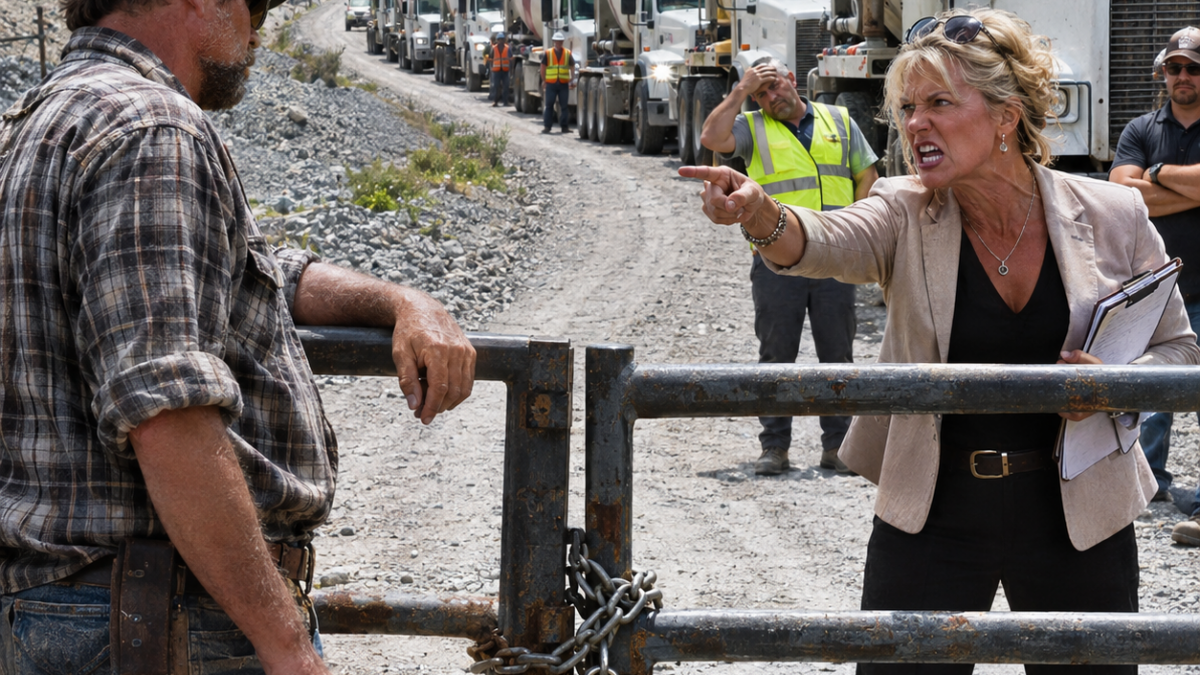
“Open the gate.”
“No.”
She held up the folder.
“We have a legal easement.”
“Open it.”
“What?”
“The folder.”
Her jaw tightened.
“Show me the clause that gives you access today.”
“I don’t need to perform a legal seminar on the side of a road.”
“You’re asking me to open private property.”
“You’re obstructing lawful access.”
I looked at the lead driver.
She did too.
Then she pointed at the gate.
“Drive through.”
The driver stared at her.
Then at the heavy steel bars.
Then at me.
“No, ma’am.”
Her head snapped toward him.
“What?”
“I’m not ramming a private gate.”
“You have legal access.”
“That’s between you two.”
“My company contracted your employer.”
“And my employer didn’t tell me to destroy anybody’s gate.”
The first crack.
Small.
But visible.
Delaney pulled out her phone.
Called Curtis.
He was already at the construction site.
Pumps staged.
Crews ready.
Forms prepared.
Rebar inspected.
Everything waiting.
Except concrete.
Behind us, eighty mixer drums continued turning.
Ticking clocks made of steel.
At the ready-mix plant, truck number eighty-one never left the loading bay.
Jenna Ralston, the dispatcher, had received a call from one of her drivers.
Access dispute.
Locked gate.
Possible trespass.
She looked up my number from property records and called me.
“Mr. Callahan?”
“Yes.”
“This is Jenna Ralston with Ralston Ready Mix.”
“Morning.”
“I need a direct answer.”
“Okay.”
“Did you authorize my fleet to use Quarry Ridge Road?”
“No.”
“Ever?”
“No.”
“Is there any temporary permission?”
“No.”
“Any verbal agreement?”
“No.”
“Understood.”
Then she ended the call.
Within seconds, radios came alive up and down the convoy.
Drivers were ordered to hold.
Nobody was to move one inch onto private property.
Delaney had imagined eighty drivers yelling at me.
Instead, the concrete company itself sided with caution.
The pressure she tried to create turned around.
At the jobsite, two pumps were billing.
Roughly fifty laborers stood waiting.
Finishing crews.
Vibrators.
Lifts.
Inspectors.
Formwork.
Everything cost money by the minute.
Martin Greeley, the structural engineer, was losing his mind.
I met him later.
That morning, he was pacing around the empty slab forms while calling Curtis over and over.
Martin understood concrete.
A large structural slab couldn’t be poured casually.
You didn’t dump a few trucks, wait three hours, add some more, and pretend it was one monolithic foundation.
The pour had to flow.
Steady waves.
Planned sequence.
Correct slump.
Correct timing.
If concrete started curing before the next section arrived, cold joints could form.
Weak interfaces.
Potential structural problems.
Martin wasn’t going to sign off on that.
Meanwhile, Delaney stood at my gate like she could intimidate steel.
She checked her watch.
Then looked at me.
“Do you know how much this is costing?”
“Yes.”
“Open the gate.”
“No.”
“Seth.”
“No.”
“Be reasonable.”
I stared at her.
“You scheduled eighty trucks on a road you don’t own.”
She lowered her voice.
“You’re going to regret this.”
I walked to my truck.
Opened the toolbox.
Pulled out a second heavy padlock.
Owen watched.
I ran it through the chain beside the first.
**Click.**
The sound was small.
But it carried.
Several drivers looked over.
I turned to Delaney.
“You bet eighty trucks of concrete that I’d be scared of your bill.”
Her eyes narrowed.
“You bet wrong.”
Then she called the sheriff.
I expected that.
A deputy arrived about half an hour later.
No lights.
No rush.
He got out looking like a man who had already decided he hated whatever paperwork waited behind this situation.
Delaney walked toward him first.
“This man is illegally blocking an easement.”
The deputy looked at me.
“Your road?”
“Yes.”
I opened the folder I had prepared.
Deed.
Plat.
Old easement.
Termination clause.
Certified notice.
Delivery confirmation.
Email to Curtis.
Everything.
I laid it across the hood of my pickup.
The deputy read carefully.
Delaney checked her watch.
“There are eighty concrete trucks out there.”
The deputy didn’t look up.
“I see them.”
“Every minute costs money.”
He turned another page.
“That doesn’t affect ownership.”
She stared at him.
“This is an emergency.”
“A construction schedule is not a law enforcement emergency.”
“We have access.”
“The document I’m reading appears to contain a termination clause.”
“It’s still an easement.”
“Ma’am, I’m not going to interpret a civil property agreement beyond what’s obvious enough for me to avoid forcing entry.”
She pointed at the gate.
“So you’re letting him block us?”
“I’m telling you there is no court order here authorizing anyone to cut locks or enter by force.”
Her face reddened.
Then she pulled out her phone.
“Fine.”
She called Rebecca Morrow.
Silvercrest’s private attorney.
She put the call on speaker.
By then Curtis had driven around to the gate.
Pamela arrived too.
Delaney wanted an audience.
She was certain Rebecca would validate her.
The phone rang.
Rebecca answered.
“Delaney?”
“Rebecca, I’m at Quarry Ridge. Seth is refusing access based on some claim that the easement expired. Please explain the HOA’s rights.”
A long pause.
Then Rebecca’s voice came through the speaker.
Tired.
Sharp.
“Delaney, I told you last week that easement is no longer valid.”
Nobody moved.
The mixer drums continued turning behind us.
That was the only sound.
Pamela looked at Delaney.
Curtis slowly lowered his coffee.
Delaney’s face went blank.
Rebecca continued.
“I advised you in writing to negotiate a temporary license with Mr. Callahan or use the approved public route.”
Delaney spoke quickly.
“That was one interpretation.”
“No.”
Rebecca’s voice hardened.
“That was legal advice.”
Curtis looked at Delaney.
“You told us counsel cleared this route.”
Delaney lifted her chin.
“I said we believed access remained enforceable.”
“You said it was cleared.”
“I gave you my interpretation.”
Curtis’s voice became flat.
“Your interpretation just put my company one step away from trespassing.”
More than an hour had passed.
Jenna called.
The first concrete batches were approaching the allowable time window under the project specifications.
Once concrete exceeded the approved limits, it could no longer be used for the engineered slab.
Delaney grabbed Curtis’s phone.
“Keep the trucks here.”
Jenna heard her.
“No.”
Delaney blinked.
“What?”
“We’re not letting concrete harden inside eighty mixers.”
“Give us more time.”
“You don’t have access.”
“We’re resolving it.”
“You’ve been resolving it for over an hour.”
“I am the project owner.”
“And I’m responsible for my trucks.”
Jenna began diverting what loads she could.
Some went to other jobs.
Others would need recycling or disposal.
One by one, mixers started turning around.
Slow three-point maneuvers.
Heavy tires grinding over the shoulder.
Then they drove away.
I didn’t smile.
I didn’t celebrate.
I stood beside the gate.
Delaney watched truck after truck disappear.
The weapon she had brought to scare me was leaving.
By nine o’clock, the pour was dead.
Curtis called an emergency meeting in the site trailer.
I wasn’t there.
Pamela later told me everything.
Nobody sat at first.
Curtis opened a spreadsheet.
Material.
Standby.
Pumps.
Labor.
Equipment.
Remobilization.
Disposal.
Rescheduling.
Inspection.
Engineering.
Specialty crews.
Delay costs.
Eight hundred cubic yards of concrete had been ordered.
Some was saved.
A lot wasn’t.
Martin explained that the foundation could not be partially poured and resumed whenever convenient.
If they created uncontrolled cold joints through the slab, he would not approve it.
Rebar would need cleaning.
Forms rechecked.
Inspection rescheduled.
The entire sequence rebuilt.
Two pumps had been billing since before dawn.
Laborers were still owed a full day.
Rental equipment didn’t care that Delaney had lost an access dispute.
Meters kept running.
Special finishing crews had minimum charges.
Subcontractors sent delay notices.
By late morning, the preliminary damage passed $300,000.
Then Curtis found a clause.
**OWNER CREATED ACCESS FAILURE**
Pamela told me later that she felt sick reading it.
If the owner gave false information about site access and that failure prevented work, mobilization and remobilization costs belonged to the owner.
At the bottom of the agreement—
Delaney’s signature.
When the first full estimate was assembled, the number was roughly:
**$420,000.**
Pamela sat down.
“Insurance covers this?”
Curtis looked at Delaney.
“Not necessarily.”
“Why?”
“Not if the loss came from a deliberate decision after legal warning.”
That was the first time Delaney looked frightened.
Only for a moment.
Then she went back to what she knew.
Attack.
She announced that I had caused the loss.
Silvercrest would sue me for all $420,000.
When the threat reached me that afternoon, Owen was standing in my office.
He said, “Want me to call the lawyer?”
I shook my head.
“I already did.”
“What’d you tell them?”
“Go ahead.”
Owen stared at me.
“That’s it?”
“That’s it.”
He laughed.
Then stopped.
“You really aren’t worried?”
“I have three camera angles.”
“True.”
“I have certified delivery.”
“True.”
“I have Curtis confirming I warned him.”
“True.”
“Jenna called me before ordering trucks forward.”
“True.”
“And their own attorney just told everybody Delaney ignored legal advice.”
Owen smiled.
“So.”
“So if they want to explain all of that in court, I’m happy to listen.”
I hadn’t trapped Delaney.
That part mattered.
I never invited the trucks.
Never pretended access existed.
Never waited until the last minute to object.
I said no from the beginning.
She built the trap.
She stepped into it.
Then demanded I pay for the walls.
Pamela couldn’t stop thinking about the $420,000.
So she started reading.
Every project file.
Every budget line.
Every approval.
Every logistics document.
Late one night, she found something.
The original plaza budget included an alternate hauling route.
County Route 18.
Longer.
Legal.
Approved.
There was even an engineering plan.
Pamela called Iris Donahue, the traffic engineer.
Iris confirmed everything.
The public route had been designed months earlier.
It required traffic-control fees.
Protective mats over a vulnerable section.
Two flaggers at peak hours.
Permits.
Total cost:
About $96,000.
Pamela hung up.
Then asked the question that changed the entire story.
Why would Delaney risk a $6.8 million project to avoid spending $96,000?
She followed the money.
The logistics allocation had been moved.
Not lost.
Moved.
Imported stone.
Bigger fountain.
Glass terrace canopy.
Upgraded outdoor stage.
Decorative additions.
Delaney had stripped money out of transportation and poured it into visible features.
Why?
Because she had already announced the grand opening date.
Publicly.
Repeatedly.
The plaza was supposed to become her legacy.
The legal route added time.
Quarry Ridge saved time.
The legal route cost $96,000.
My road, in Delaney’s mind, cost nothing.
All she had to do was make me surrender.
Then Pamela found the email.
Delaney to Curtis.
Two days before the pour.
Curtis had asked whether Quarry Ridge access was truly settled.
Delaney replied:
**Callahan won’t stop 80 loaded trucks once they’re at his gate.**
Pamela read it three times.
That wasn’t confusion.
That wasn’t bad legal interpretation.
That was strategy.
Delaney had designed the morning.
She wanted eighty trucks.
Not despite the risk.
Because of it.
The spectacle was the leverage.
Eighty drivers.
Hundreds of thousands of dollars.
A ticking concrete clock.
She expected me to look down the line of trucks and panic.
Open the gate.
Then later she could argue that my conduct proved access was accepted.
She didn’t believe she needed legal rights.
She believed she needed enough pressure.
Pamela printed the email.
That decision ended her friendship with Delaney.
Delaney, meanwhile, shifted tactics again.
If documents wouldn’t help her, residents might.
She called an emergency HOA meeting.
The issue, she said, was “community survival.”
Silvercrest was facing a $420,000 loss caused by a hostile neighboring landowner.
She wanted the board to authorize litigation against me.
Because the dispute affected the budget directly, I received a formal invitation.
I went.
The clubhouse was packed.
Wall to wall.
Some residents looked angry before I even sat down.
Weeks of Delaney’s letters had worked.
She stood beside a projector.
First slide:
A dramatic dawn photograph of eighty trucks lined along the highway.
She let everyone stare at it.
Then said,
“One man held an entire community hostage with a gate.”
Murmurs.
Several people turned toward me.
I stayed quiet.
Delaney continued.
She talked about delays.
Workers.
Families.
Community investment.
The plaza.
Contract losses.
Then she asked for legal funding.
When the floor opened, I stood.
No speech.
No anger.
I carried three stacks of paper down the aisle.
I handed them to residents.
First:
The old easement.
Expiration clause highlighted.
Second:
My written refusal.
Delivered weeks before the pour.
Third:
Rebecca Morrow’s legal warning to Delaney.
The room grew quieter as pages moved through hands.
Then Pamela stood.
Delaney looked at her.
“What are you doing?”
Pamela connected a laptop.
The projector changed.
One email.
One sentence.
Huge on the screen.
**CALLAHAN WON’T STOP 80 LOADED TRUCKS ONCE THEY’RE AT HIS GATE.**
Silence.
Not ordinary silence.
The kind where everyone suddenly realizes the story they believed has broken in half.
Delaney turned toward Pamela.
“That is confidential internal correspondence.”
Pamela answered calmly.
“I’m the treasurer.”
“You had no authority to distribute it.”
“I’m reviewing financial decisions that created a $420,000 loss.”
“Take it down.”
“No.”
Curtis stood from the back.
He confirmed Delaney told his company access had been cleared.
Jenna appeared by video.
She confirmed Ralston Ready Mix never had landowner permission.
Iris Donahue confirmed the public route already existed.
Approved.
Funded.
Legal.
One defense after another disappeared.
Then Delaney smiled.
That surprised me.
She clicked to a new slide.
Photographs of Silvercrest residents driving on Quarry Ridge Road years earlier.
SUVs.
Sedans.
Vehicles with Silvercrest stickers.
She looked around the room.
“The association also has a prescriptive easement.”
A few board members leaned forward.
Delaney regained confidence.
“Residents have openly used Quarry Ridge Road for years. Longstanding continuous use creates permanent rights.”
She looked at me.
“You cannot erase history with a padlock.”
I leaned back.
I had been waiting for that.
I stood.
“Those photos are real.”
Delaney blinked.
Maybe she expected denial.
I continued.
“Those residents did use Quarry Ridge Road.”
She smiled.
“Thank you.”
“Because I let them.”
The smile faded.
Years earlier, the bridge on County Route 18 had closed for major repair.
Silvercrest’s main access to town became difficult.
My father was still alive then.
The HOA asked for help.
We opened Quarry Ridge Road.
Free.
No toll.
No fee.
Residents could use it temporarily.
But we protected ourselves.
At the entrance we installed a large sign:
**TEMPORARY REVOCABLE PERMISSION**
We also signed a written agreement.
Courtesy access.
Limited duration.
Revocable.
No permanent right created.
No adverse use.
No claim of ownership.
Rebecca spoke from the front row.
“That kind of permissive use generally defeats the hostile-use element of a prescriptive easement claim.”
Delaney’s face tightened.
Then Rebecca added,
“There should already be a copy in the HOA’s legal files.”
Every eye turned to Delaney.
She knew.
Of course she knew.
She had simply hoped I couldn’t prove it.
I reached into my jacket.
Pulled out the original.
My father’s signature.
Former HOA president’s signature.
Blue ink.
Date.
Terms.
Everything.
I laid it on the table.
For the first time that evening, Delaney said nothing.
Rebecca addressed the board.
If Silvercrest sued me using an expired easement and a prescriptive theory contradicted by its own records, the association could face substantial legal costs.
Potentially my fees too, depending on what happened.
Public court filings.
More delay.
More expense.
Board members started moving away from Delaney.
Literally.
Chairs shifted.
Pamela made a motion.
Suspend the president’s authority to sign new contracts until a full internal audit was complete.
Seconded immediately.
Vote.
Passed.
Only Delaney objected.
For the first time since taking office, she no longer controlled the HOA’s money.
I gathered my papers.
Started toward the door.
Her voice followed me.
“Are you satisfied now?”
I stopped.
Turned.
She looked furious.
Humiliated.
Cornered.
I said,
“I never wanted you to lose $420,000.”
She laughed bitterly.
“Right.”
“I only wanted you to stay off my road.”
Then I left.
Over the next week, Silvercrest tried to reduce the damage.
Curtis waived some surcharges.
He didn’t want the entire project destroyed.
Ralston Ready Mix credited material that had been diverted successfully.
Some costs came down.
Others didn’t.
Labor.
Mobilization.
Equipment.
Lost inspection.
Rescheduling.
Concrete disposal.
Revised logistics.
Delay claims.
When everything settled, the financial impact still hovered around $420,000.
The board looked for a way to make me responsible.
There wasn’t one.
No contract.
No valid easement.
No permission.
No oral agreement.
Nothing.
Every trail led back to Delaney.
Then the internal audit widened.
She had approved multiple design changes without full documentation.
Moved funds.
Expanded decorative scope.
Committed the HOA to upgrades.
Pushed the opening date.
The plaza had become personal.
Her monument.
Residents became angry.
Not only because they were paying.
Because they had been used.
Some had signed petitions against me.
Some had sent angry messages.
Some had believed I was a greedy quarry owner trying to extort the neighborhood.
Now they learned Silvercrest had already budgeted a legal route.
Delaney simply wanted that money for prettier stone and a bigger fountain.
Longtime residents remembered the bridge closure.
They remembered my father opening Quarry Ridge for free.
They remembered the temporary permission sign.
A few came to my office.
One man stood awkwardly near the door.
“You probably don’t remember me.”
“I do.”
He looked surprised.
“Blue Tacoma.”
He smiled.
“That was me.”
“You used Quarry Ridge during the bridge closure.”
“Every day.”
I nodded.
“My wife worked at the hospital then. Your road cut forty minutes off her commute.”
“I remember.”
He looked down.
“I signed Delaney’s petition.”
I didn’t say anything.
“I called you selfish.”
“I remember that too.”
“I’m sorry.”
I looked at him.
“You believed what you were told.”
“I should’ve checked.”
“Yes.”
He winced.
Then I added,
“But you came here.”
He looked up.
“That matters.”
He nodded.
We shook hands.
There were no handcuffs.
No police dragging Delaney out.
No courtroom climax.
Her punishment came from the system she had controlled.
Silvercrest held a special session.
Removal vote.
It passed decisively.
Delaney Crossfield was no longer HOA president.
Pamela Shore became interim president.
Her first task was brutal.
Make the plaza affordable again.
The grand fountain?
Canceled.
Imported stone?
Replaced with domestic material.
Upgraded stage?
Removed.
Decorative features?
Postponed.
The irony was perfect.
Every luxury Delaney had funded by stripping money from legal logistics now had to be cut to pay for the consequences of her shortcut.
She tried to save $96,000.
Instead Silvercrest lost about $420,000.
And still had to pay for the public route.
A few days after her removal, Delaney came to Quarry Ridge.
Alone.
No trucks.
No lawyers.
No contractors.
No board members.
I saw her SUV from the scale house.
I walked down.
She stood outside the gate.
Same steel bars.
Same chain.
Different woman.
She looked at the road beyond it.
Then said,
“If you had opened this gate that morning, nobody would have lost anything.”
I shook my head.
“No.”
She looked at me.
“If you had accepted no the first time, nobody would have lost anything.”
“You could’ve helped the community.”
“I could have.”
Her eyes narrowed.
“So you admit it.”
“If you’d asked honestly.”
She went quiet.
I continued.
“If you’d come to me with a real proposal, a safety plan, limited hours, maintenance fees, insurance, and a realistic truck cap, maybe I would’ve considered something.”
Her expression changed.
Just slightly.
Because that possibility hurt more than a flat refusal.
“You said no.”
“I said no to what you demanded.”
“You would’ve negotiated?”
“Maybe.”
She looked back through the gate.
“You never told me that.”
“You never asked.”
Silence.
“You came into my office and told me you didn’t need my permission.”
She said nothing.
“You treated my road like something you were entitled to take.”
Still nothing.
“You didn’t want an agreement.”
I looked at her.
“You wanted surrender.”
Her face hardened again.
“You think this makes you noble?”
“No.”
“What, then?”
“A property owner.”
She stared at me.
Then returned to her SUV.
Before getting in, she turned.
“This project will still open.”
“I hope it does.”
That surprised her.
“You do?”
“I never wanted the plaza to fail.”
“Could’ve fooled me.”
“I wanted your trucks off my road.”
She drove away.
Several weeks later, concrete mixers returned to Silvercrest.
This time, they took County Route 18.
Twenty-two extra miles.
Flaggers in bright vests.
Protective mats.
Permits.
Insurance.
Traffic-control plan.
Everything legal.
Not one truck touched Quarry Ridge.
And the world did not end.
Martin Greeley got his pour.
Eighty mixers came in steady sequence.
Concrete pumps ran.
Finishing crews worked.
The slab was poured as one continuous mass.
No cold joints.
No emergency.
Inspector signed off before sunset.
Curtis sent me a message.
**You were right to send the access documents when you did. They probably kept us out of a trespass case.**
Jenna Ralston called too.
She told me her company had changed internal policy.
Private haul routes now had to be checked against property records before delivery tickets were printed.
“You changed the way we dispatch.”
“I didn’t mean to.”
“Still did.”
“That’s probably good.”
“It is.”
Life at the quarry returned to normal.
That mattered more than I expected.
No television cameras.
No neighborhood meetings.
No lawyers calling every day.
Just rock.
Loaders.
Dust.
Haul trucks.
Owen complaining about equipment.
Me complaining about Owen complaining.
A month later, I stood on the upper bench of the quarry.
From there, you could see part of County Route 18.
The new concrete convoy crawled in the distance.
Owen climbed up beside me carrying two coffees.
He handed me one.
We watched the trucks.
After a while, he said,
“You ever think we should’ve let them use our road?”
“For money?”
“Steep money.”
“How steep?”
“Enough to make Delaney cry.”
I laughed.
Then thought about it.
“Before all this?”
“Yeah.”
“Maybe.”
He looked at me.
“Seriously?”
“If they’d come honestly.”
“With limits?”
“Strict ones.”
“Maintenance fee?”
“Yes.”
“Insurance?”
“Yes.”
“Truck windows?”
“Yes.”
“Quarry gets priority?”
“Always.”
He nodded.
“So it never really was about the road.”
“It was about permission.”
Owen sipped his coffee.
“Same thing?”
“No.”
I looked down at Quarry Ridge.
“A road is asphalt.”
“Permission is ownership.”
He nodded slowly.
“Fair.”
That afternoon, I installed a new sign beside the gate.
Not sarcastic.
No mention of Silvercrest.
No mention of Delaney.
Just:
**PRIVATE ROAD
WRITTEN AUTHORIZATION REQUIRED**
A month later, an envelope arrived from Pamela.
Inside were HOA meeting minutes.
Silvercrest had adopted a new policy.
Any claim involving easement access or third-party land use had to be confirmed in writing by legal counsel before contracts were signed.
Obvious.
Painfully obvious.
The kind of rule nobody should need.
Silvercrest paid $420,000 to learn it.
I filed the minutes.
Same cabinet as my deeds.
Same place I had always kept agreements.
The next morning, I opened Quarry Ridge Gate.
A line of our own haul trucks rolled through.
Crushed stone.
Base material.
Normal business.
Owen stood by the guard booth.
“Eighty trucks.”
I smiled.
“What?”
“She really thought eighty trucks would make you panic.”
I turned the gate control.
“That’s the trouble with people who hear yes too often.”
Owen looked at me.
“What?”
“They start thinking no just means they haven’t pushed hard enough.”
The final quarry truck passed.
The gate closed.
**Clang.**
Solid.
Final.
For a long time after everything ended, that sound stayed with me.
Not because I enjoyed what happened to Delaney.
I didn’t.
Four hundred twenty thousand dollars is a lot of money.
It affected families.
Budgets.
Plans.
The plaza became smaller.
Homeowners paid for mistakes they didn’t personally make.
There was nothing funny about that.
But the losses weren’t caused by a locked gate.
That distinction mattered.
Delaney spent months telling people I cost Silvercrest $420,000.
That version was easier.
One stubborn man.
One gate.
One disaster.
The truth was more uncomfortable.
She had a legal route.
She had money budgeted for it.
She had an attorney telling her the easement was dead.
She had my written refusal.
She had Curtis asking whether access was really resolved.
She had every opportunity to stop.
Then she wrote:
**Callahan won’t stop 80 loaded trucks once they’re at his gate.**
That was the decision.
Not my lock.
Not the gate.
Not the trucks.
The decision was believing pressure could replace permission.
My father taught me something when I was young.
He was repairing a loader one night.
I was maybe fourteen.
A supplier had delivered the wrong hydraulic hose.
I suggested we make it work.
He looked at me.
“You know what happens when you force the wrong fit?”
“It leaks?”
“Eventually.”
He held up the hose.
“Usually after you’ve convinced yourself it’s fine.”
I thought about that years later.
Delaney forced the wrong fit.
Expired easement.
Private road.
Bad assumption.
Huge deadline.
She convinced herself it was fine because nobody around her wanted to challenge her.
By the time reality leaked through, eighty mixer drums were turning outside my gate.
Pamela visited the quarry several months later.
The plaza was nearing completion.
Smaller.
Simpler.
More practical.
She stood in my office looking through the window.
“I wanted to thank you.”
“For what?”
“Not suing us.”
I smiled.
“I had nothing to sue you for after the board backed off.”
“You could’ve pushed harder.”
“Probably.”
“Why didn’t you?”
I thought about it.
“Because I wanted my road.”
“That simple?”
“Yes.”
She laughed softly.
“I spent years on an HOA board. Nothing is that simple.”
“Then maybe that’s the problem.”
She smiled.
Then looked toward the filing cabinet.
“You still have every document?”
“Of course.”
“Even the temporary permission agreement from the bridge closure?”
“Especially that.”
She nodded.
“Your father was smart.”
“He was paranoid.”
“Same thing, sometimes.”
I laughed.
Pamela became serious.
“I should have checked the easement.”
“You were the treasurer.”
“Exactly.”
“You trusted the president.”
“That’s not an excuse.”
“No.”
She looked down.
“I asked about the road fee. She said we already had rights.”
“And you believed her.”
“Yes.”
“Then what changed?”
“The $420,000.”
I raised an eyebrow.
“Expensive curiosity.”
“Very.”
She looked at me.
“But once I started reading, I couldn’t stop.”
“That’s how records work.”
“What do you mean?”
“People lie in sentences.”
I tapped the cabinet.
“Paper lies less.”
She smiled.
“That sounds like something your father taught you.”
“No.”
I smiled back.
“That one I learned from Delaney.”
The plaza finally opened months late.
I didn’t attend.
Not because I was angry.
Because I had a quarry to run.
I saw pictures later.
The lake looked good.
The restaurant opened.
The conference center worked.
The stage was smaller.
The fountain was modest.
Nobody died because the imported stone had been replaced.
Nobody complained that the glass canopy was simpler.
The community got its plaza.
It just wasn’t Delaney’s monument anymore.
That felt fitting.
One Sunday, my wife and I drove past Silvercrest.
She looked toward the plaza.
“You ever wonder what would’ve happened if you opened the gate?”
“Yes.”
“What do you think?”
I considered it.
“Eighty trucks go through.”
“Then?”
“Then they use it again.”
“Why?”
“Because I opened it.”
She nodded.
“Then the next delivery.”
“Yes.”
“And the next.”
“Yes.”
“Then Delaney says you accepted the easement.”
“Probably.”
“Then eventually it becomes normal.”
“Yes.”
She looked at me.
“So the $420,000 wasn’t the biggest thing at risk.”
“No.”
“What was?”
I looked toward Quarry Ridge.
“The next twenty years.”
That was the part people didn’t understand.
A private road is expensive.
Maintenance alone mattered.
Heavy mixers destroy pavement.
Shoulders break.
Culverts take stress.
Dust increases.
Crossing points become dangerous.
Insurance changes.
But beyond money was precedent.
Once unauthorized use becomes routine, stopping it gets harder.
People start saying:
“But we used it last month.”
“But we always go this way.”
“But the old president said it was okay.”
“But contractors have been using it.”
Then permission gets blurry.
Ownership gets treated like inconvenience.
Boundaries don’t usually disappear in one dramatic moment.
They erode.
One exception.
One shortcut.
One “just this once.”
That was why I locked the gate.
Not revenge.
Not pride.
Protection.
The next winter, heavy rain washed part of Quarry Ridge’s shoulder.
Owen and I spent two days rebuilding drainage.
As we worked, he looked toward Silvercrest.
“They ever offer to pay for maintenance?”
“No.”
“Figures.”
He moved a shovel of gravel.
“You know, if Delaney had gotten eighty mixers through here, this shoulder would’ve been gone.”
“Probably.”
“You should send her a thank-you card.”
“For what?”
“Saving us road repairs by getting herself fired.”
I laughed.
“No.”
“Coward.”
“Professional.”
He shook his head.
We kept working.
That was the kind of revenge I liked.
Normal work.
No speeches.
No drama.
Just a road still functioning because I protected it.
A year after the standoff, Pamela mailed me another letter.
Silvercrest’s final project audit.
I didn’t need to read it.
I did anyway.
The $420,000 loss remained on the books.
Not hidden.
Not renamed.
A documented project failure.
The legal-route expense was separately recorded.
The redesigns were listed.
The removal of Delaney’s authority.
The new review procedures.
Everything.
I reached the final page.
There was a note from Pamela.
**Some lessons should be kept where people can see them.**
I filed it.
A few days later, a new Silvercrest board member called.
I almost didn’t answer.
“Seth Callahan?”
“Yes.”
“My name is Eric Bell. I’m on the HOA board.”
“What can I do for you?”
“We’re planning landscaping work near the eastern boundary next spring.”
“Okay.”
“One contractor asked whether he could bring two dump trucks through Quarry Ridge for a single day.”
I waited.
Eric continued.
“I told him no until I asked you.”
I smiled.
“That’s a good start.”
“So I’m asking.”
We talked.
Two trucks.
One day.
Off-peak hours.
Proof of insurance.
Written agreement.
Maintenance fee.
No conflict with quarry traffic.
I approved it.
Owen nearly fell out of his chair when I told him.
“You let the HOA use the road?”
“Two trucks.”
“Traitor.”
“They asked.”
“That’s all it took?”
“No.”
“Paperwork?”
“Yes.”
“Insurance?”
“Yes.”
“Fee?”
“Yes.”
“Schedule?”
“Yes.”
Owen shook his head.
“Imagine that.”
“What?”
“Permission works.”
The two dump trucks arrived on schedule.
Gate opened.
They drove through.
Finished.
Left.
No lawsuit.
No convoy.
No sheriff.
No $420,000 disaster.
The road didn’t care whether the trucks belonged to Silvercrest.
I didn’t either.
The problem was never who needed access.
The problem was who believed they were entitled to take it.
That realization softened something in me.
For months after the standoff, I had associated Silvercrest with Delaney.
That wasn’t fair.
Silvercrest was families.
Retirees.
Kids.
Working people.
Homeowners who trusted the wrong person.
Some had treated me badly.
Some apologized.
Some didn’t.
But one arrogant president wasn’t the whole community.
Pamela proved that.
So did Eric.
So did the homeowners who eventually asked questions.
The difference between a healthy community and a dangerous one wasn’t whether mistakes happened.
Mistakes always happen.
It was whether people could admit them.
Delaney couldn’t.
That was why one bad decision became ten.
She could have stopped when I said the easement expired.
She didn’t.
She could have stopped when I sent certified notice.
She didn’t.
She could have stopped when Curtis asked.
She didn’t.
She could have listened to Rebecca.
She didn’t.
She could have used the $96,000 route.
She didn’t.
She could have rescheduled the pour.
She didn’t.
Instead, every warning became another reason to push harder.
That’s what pride does.
It makes retreat feel worse than disaster.
By sunrise on that morning, Delaney wasn’t trying to solve a construction problem anymore.
She was trying to beat me.
And once winning becomes more important than solving, people become expensive.
Very expensive.
Years later, the steel gate is still there.
Different paint.
New motor.
Same position.
The sign beside it still reads:
**PRIVATE ROAD
WRITTEN AUTHORIZATION REQUIRED**
Most days, nobody notices.
Quarry trucks roll through.
Delivery drivers check in.
Visitors stop.
Gate opens.
Gate closes.
Simple.
Every once in a while, someone from Silvercrest drives past on the public road and looks toward Quarry Ridge.
I wonder whether they remember.
Maybe.
The plaza is part of normal life now.
Weddings.
Meetings.
Dinner.
Holiday events.
People probably don’t think about the morning eighty cement trucks sat outside my gate.
That’s fine.
I do.
Not every day.
But sometimes.
Usually when I hear a concrete mixer in the distance.
That low rotating sound.
It takes me back to dawn.
Headlights.
Owen with his thermos.
The driver holding that ticket.
Delaney in front of the gate.
“Open it.”
“No.”
“Eighty trucks are waiting.”
“I know.”
“Do you understand what this will cost?”
“I do.”
She believed cost was a weapon.
That was her mistake.
Money can create pressure.
Deadlines can create pressure.
Crowds.
Contracts.
Angry residents.
All pressure.
But pressure doesn’t transfer ownership.
A million dollars of concrete sitting outside my gate would still have been outside my gate.
Ten million would have been outside my gate.
Because the road wasn’t public.
The easement was dead.
And no amount of urgency could resurrect it.
My father died before all of this happened.
Sometimes I wish he had seen the standoff.
Not because he would’ve enjoyed the conflict.
He hated drama.
But he would have understood.
He was the one who negotiated the original easement.
He wrote the expiration clause.
He kept the temporary-permission agreement.
He taught me to save records.
I once asked him why he kept old documents nobody cared about.
He said,
“Because the day people care is usually the day they pretend they don’t exist.”
I smiled thinking about it.
Delaney pretended the expiration clause didn’t exist.
Then the permission agreement.
Then legal advice.
Then the alternate route.
Then her own email.
But documents have patience.
They wait.
Years if necessary.
Then somebody opens the drawer.
The final time I ever saw Delaney was almost two years after the standoff.
I was at a hardware store.
She was in another aisle.
For a second, we both stopped.
No HOA title.
No leather folder.
No crowd.
Just two people beside shelves of bolts and drill bits.
She looked older.
Maybe I did too.
She said,
“Seth.”
“Delaney.”
Silence.
Then she surprised me.
“I drove Quarry Ridge last month.”
My expression changed.
She quickly added,
“Public section near the highway. Not through your gate.”
I almost smiled.
“What for?”
“Nothing.”
She looked at the floor.
“I wanted to see it.”
“Why?”
“I don’t know.”
Another pause.
Then she said,
“I still think you could’ve opened the gate.”
I looked at her.
“Then you still haven’t learned it.”
Her eyes hardened.
But only briefly.
Then something in her face softened.
“What was I supposed to do?”
“Use the route your engineer designed.”
“It would have delayed the opening.”
“Yes.”
“We had already promised the date.”
“Change the date.”
“People would’ve been angry.”
“Yes.”
“The board would’ve blamed me.”
“Maybe.”
She looked at me.
“You make everything sound simple.”
“It wasn’t simple.”
“Then why say it like that?”
“Because difficult choices don’t stop being choices.”
She didn’t answer.
I picked up a box of bolts.
Before walking away, I said,
“You had legal advice.”
She looked at me.
“You had a legal route.”
Silence.
“You had money budgeted for it.”
She looked away.
“You chose the gate.”
Then I left.
That conversation stayed with me.
Not because I expected an apology.
I didn’t get one.
But because it reminded me how people rewrite their own mistakes.
In Delaney’s memory, the gate was the problem.
Not the decision to send eighty trucks there.
The gate.
The refusal.
My stubbornness.
Anything except the moment she decided no didn’t count.
That’s why boundaries matter.
They make responsibility visible.
A gate says:
Here is where your authority ends.
Some people respect that.
Some resent it.
Some try to break through.
But the line remains.
The following spring, my son started working more hours at the quarry.
He was twenty-two.
Smart.
Restless.
He had heard the truck story a hundred times.
One afternoon, we stood by the gate while waiting for a supplier.
He looked at the sign.
“You know everyone tells this story like you planned it.”
“Planned what?”
“The concrete going bad.”
“I didn’t.”
“I know.”
“They think you wanted to cost her four hundred grand?”
“Yes.”
I shook my head.
“I wanted her not to send trucks.”
He laughed.
“That’s less exciting.”
“Truth usually is.”
He leaned against the guard booth.
“What would you do differently?”
I thought about it.
“Maybe call Curtis earlier.”
“You did.”
“Call the ready-mix company before the pour.”
“That might’ve prevented the convoy.”
“Maybe.”
“Would that have been better?”
“Yes.”
He looked surprised.
“Seriously?”
“Of course.”
“But then Delaney might not have gotten exposed.”
I looked at him.
“That wasn’t my goal.”
He thought about that.
“I guess I always thought you let her hang herself.”
“No.”
I pointed down Quarry Ridge.
“I maintained my side.”
“What’s that mean?”
“I gave notice.”
“Okay.”
“I kept records.”
“Okay.”
“I locked my property.”
“Okay.”
“I didn’t trespass on theirs.”
“Right.”
“I didn’t lie to contractors.”
“Right.”
“I didn’t send eighty trucks anywhere.”
He smiled.
“Right.”
“Her consequences were attached to her choices.”
He nodded slowly.
“That’s different from revenge.”
“Yes.”
He looked toward Silvercrest.
“Still satisfying, though.”
I laughed.
“A little.”
That was as close as I came to admitting it.
Because yes, there was satisfaction.
Not in wasted concrete.
Not in homeowners losing money.
Not in a project delayed.
The satisfying part was simpler.
The gate stayed closed.
The road remained ours.
The lie didn’t become permanent just because it arrived with eighty trucks behind it.
That mattered.
A lot.
Several years later, Granite Hollow repaved a major section of Quarry Ridge.
The bill was painful.
Owen looked at the invoice.
“Maybe we should’ve charged Delaney $420,000 for road access.”
“Too late.”
“Could’ve retired.”
“You’d still come here.”
“Probably.”
We stood watching the paver.
Fresh asphalt.
New shoulders.
Smooth grade.
I thought about every heavy truck that would travel that road over the next decade.
Our trucks.
Approved suppliers.
Occasional permitted visitors.
Every axle added wear.
Every load had a cost.
That was why ownership meant responsibility too.
People like Delaney see a private road and think:
Empty capacity.
Shortcut.
Convenience.
They don’t see drainage budgets.
Surface life.
Culverts.
Snow removal.
Liability.
Scheduling.
They see the gate.
They don’t see what the gate protects.
That lesson extends far beyond roads.
A boundary always looks unnecessary to the person standing outside it.
Until something goes wrong.
Then suddenly they want to know who owns what.
Who agreed.
Who pays.
Who carries liability.
Who signed.
Delaney learned all of that in one morning.
So did Silvercrest.
The plaza eventually became profitable.
Pamela told me years later.
Restaurant leases.
Events.
Conference rentals.
The project recovered.
That made me happy.
Really.
I never wanted the community to suffer permanently.
Pamela laughed when I told her.
“You’re nicer than they deserve.”
“Maybe.”
“You know some people still blame you.”
“I’m sure.”
“Does it bother you?”
“No.”
“Why?”
“Because they don’t maintain Quarry Ridge.”
She laughed.
Fair enough.
Then she told me something interesting.
The board had kept Delaney’s email in its governance training materials.
New board members saw it.
**Callahan won’t stop 80 loaded trucks once they’re at his gate.**
Underneath it, the training note explained why assumptions about access must be legally verified before contracts, scheduling, or mobilization.
I sat back.
“You use her email in training?”
“Yes.”
“How does she feel about that?”
“No idea.”
I smiled.
“That might be the most expensive training slide in America.”
Pamela laughed.
“Probably not.”
“Still.”
She became serious.
“It works.”
“What?”
“People remember it.”
That was Delaney’s true legacy.
Not the fountain.
Not the glass canopy.
Not the stage.
A sentence on a compliance slide.
There was something sad about that.
She wanted the plaza to prove she had vision.
Instead, the lesson people remembered was what happens when you confuse confidence with authority.
The last truck came through Quarry Ridge one evening just before sunset.
One of ours.
Loaded with crushed base.
The driver waved.
I waved back.
The gate closed behind him.
That same solid clang.
Years earlier, that sound had marked the beginning of Delaney’s $420,000 disaster.
Now it was ordinary again.
Exactly what I wanted.
I stood there for a moment.
The road stretched up toward the quarry.
Three miles of pavement and gravel.
Twenty years of repairs.
My father’s work.
Mine.
Owen’s.
Employees who had patched potholes in summer heat and cleared snow before dawn.
A private road is not glamorous.
Nobody cuts ribbons for it.
Nobody builds monuments beside it.
But it carried everything our business needed.
And because I refused to let one person turn it into a shortcut she could claim by force, it was still ours.
People sometimes tell the story like I got revenge on an HOA.
I don’t see it that way.
Revenge would have been sending eighty trucks to her house.
Revenge would have been hoping the concrete failed.
Revenge would have meant trying to hurt her.
I did none of that.
I said no.
She refused to hear it.
That was the entire story.
The $420,000 came after.
The removal vote came after.
The redesign came after.
The humiliation came after.
Every consequence stood downstream from one choice.
She decided that my no didn’t matter.
That morning taught Silvercrest something my father taught me decades earlier:
You can negotiate with an owner.
You can ask an owner.
You can pay an owner.
You can walk away from an owner.
But you do not get to become the owner because your deadline is expensive.
And you certainly don’t become the owner because eighty trucks are waiting.
The next morning, I opened the quarry gate before sunrise.
Our haul trucks rolled out.
Dust rose.
Engines echoed between the hills.
Owen stood beside me.
He looked toward the highway.
“No concrete convoy today.”
“Good.”
“You miss the excitement?”
“No.”
“Not even a little?”
I looked at him.
“No.”
He laughed.
I pressed the control.
The steel gate swung shut.
For the first time in a long time, there was nothing dramatic about it.
No Delaney.
No sheriff.
No contractors.
No cameras needed.
Just private property doing what private property is supposed to do.
Keeping control in the hands of the people responsible for it.
I turned toward the scale house.
Behind me, the sign caught the morning light.
**PRIVATE ROAD
WRITTEN AUTHORIZATION REQUIRED**
Seven words.
Simple enough.
Silvercrest had once needed a $420,000 lesson to understand them.
I hoped nobody ever needed another.
And if they did?
The gate still locked.








