PART 2: HOA Sent 21 Private Jets Onto My Land at 2 A.M.—Then the FAA Asked Who Cleared a Single One
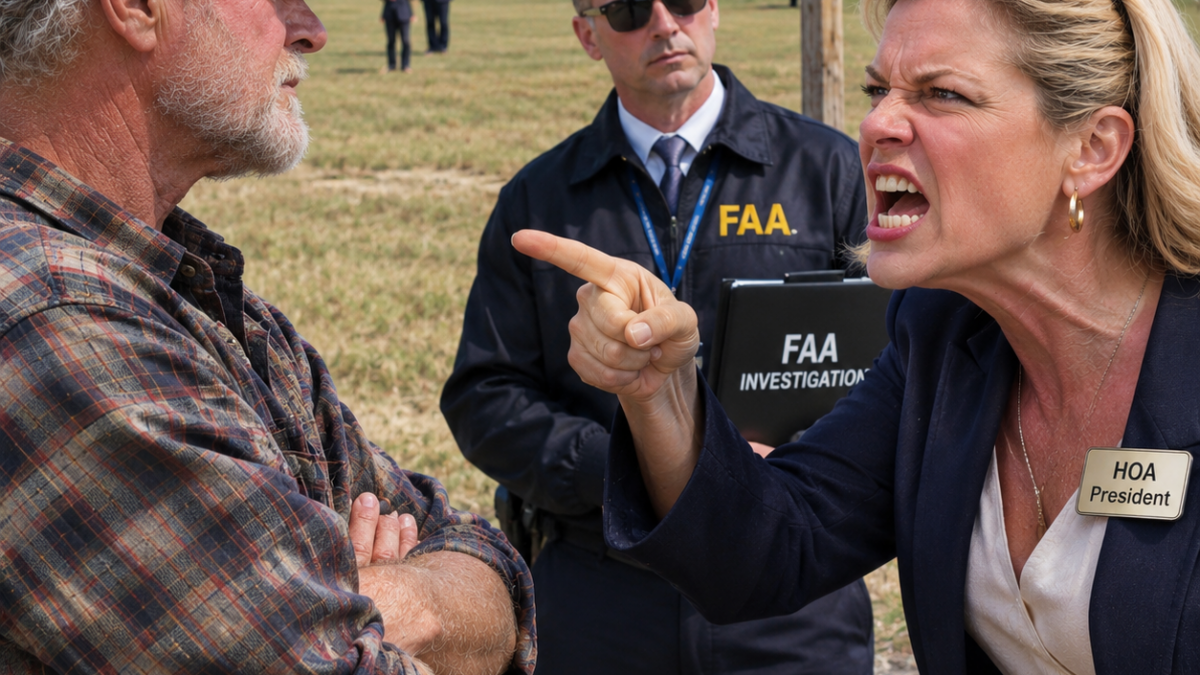
PART 2
I stared at the signature long enough for Vivienne to notice.
“What?” she asked.
I looked up.
“Where did you get this?”
“Association counsel prepared the packet.”
“That wasn’t my question.”
Her expression tightened.
I turned the paper toward her and tapped the signature.
“This isn’t mine.”
Vivienne gave a little exhale through her nose, the kind people use when they want you to feel embarrassed for slowing them down.
“Kalen, please.”
“Don’t ‘Kalen, please’ me. I didn’t sign this.”
“You may not remember every document you signed.”
“I remember my own name.”
She folded her arms.
The sun was beginning to rise behind her, turning the parked jets into black silhouettes.
I studied the signature again.
Whoever had copied it was good.
The broad shape was right. The slant was close. Even the loop in the M looked familiar.
But I had signed my name the same way since college. Before the final stroke, I always paused slightly and pressed harder. It left a tiny hook where the ink thickened.
This signature had no hook.
Every line was smooth.
Too smooth.
“Who drafted the easement?” I asked.
“Outside counsel.”
“Name.”
“I don’t have that information in front of me.”
“You brought me the document.”
“And I’m telling you what the association has been advised.”
“Who paid the attorney?”
Her eyes moved away from mine.
It lasted maybe half a second.
But I saw it.
“Our legal matters are not your concern.”
“They became my concern when twenty-one aircraft landed on my property.”
“Community property.”
I laughed once.
“No. Don’t do that.”
“Kalen—”
“You drove through my gate after sending twenty-one jets onto my runway with a document carrying a forged signature, and you’re still standing here calling it community property.”
Her voice lowered.
“You need to think carefully about the position you’re taking.”
“What position is that?”
“The association has resources. Counsel. Insurance. Relationships with the county.”
“And?”
“A prolonged fight could become very expensive.”
There it was.
Not law.
Pressure.
I closed the folder.
“You have ten seconds to get off my property.”
She stared at me.
“Is that a threat?”
“No. It’s the first permission-related sentence anyone has bothered to use on this land all night.”
She snatched the folder back.
I caught it before she could take it.
“This stays.”
Her mouth fell open.
“You cannot keep association documents.”
“You handed them to me.”
“I provided them for review.”
“Great. I’m reviewing them.”
“Kalen.”
“Nine seconds.”
She stepped backward.
“You are making this much harder than it needs to be.”
“Eight.”
She turned and walked toward her car.
At the gate, she stopped.
“You think ownership is simple because your name is on a deed.”
I didn’t answer.
She looked across the field toward the jets.
“Things change.”
Then she left.
I stood there with the forged document in my hand while twenty-one aircraft sat on asphalt I had built.
For the first time since the engines woke me, anger gave way to something colder.
Someone had copied my signature well enough to fool people who wanted to be fooled.
The question was where they had gotten it.
I locked the folder inside my house, grabbed a notebook, and began walking the runway.
The aircraft were parked nose-to-tail along the apron and grass verge. I wrote down every tail number I could see.
N923BR.
N771KH.
N602VX.
Twenty-one registrations.
I photographed each one.
I photographed the pilots.
The ground equipment.
The fuel trucks.
The temporary cones.
The tire marks.
The black-and-silver emblem near the doorway of the last jet.
I took pictures of everything because my old engineering supervisor had once drilled a sentence into me that I had never forgotten.
If you cannot reconstruct the failure, you cannot prove where it started.
At the time, he had been talking about navigation systems.
That morning, I applied it to my life.
Around eight, I found the young ground worker again.
He was standing beside a catering van.
“Hey.”
He turned.
“You’re the owner?”
“That’s what my deed says.”
He looked embarrassed.
“I really didn’t know.”
“I believe you.”
That seemed to surprise him.
I held up my notebook.
“Who contracted your crew?”
“I shouldn’t—”
“I’m not asking for anything classified. I’m asking who sent you onto private property.”
He looked toward a supervisor near one of the jets.
Then lowered his voice.
“We were subcontracted.”
“By who?”
“Northline Ground Services.”
“Who hired Northline?”
“I don’t know.”
“Who sent the schedule?”
“Dispatch.”
“Whose dispatch?”
He hesitated.
“Blackridge.”
The name landed like a wrench on concrete.
“Blackridge Aviation Holdings?”
His eyebrows lifted.
“You know them?”
I looked toward the emblem on the jet.
That was where I had seen it.
Not on an airline.
On an investor packet years earlier.
Blackridge Aviation Holdings.
They had offered to buy my land before I finished the runway.
I had said no.
Three times.
The last offer had arrived six years ago, followed by a polite phone call from a man who made refusal sound like bad financial judgment.
I had forgotten the man’s name.
I had not forgotten the tone.
“Did Blackridge tell you this was an HOA strip?”
The worker swallowed.
“We were told it was an approved community-use field.”
“Approved by whom?”
“No idea.”
He glanced at the jets.
“Honestly, sir, we just got coordinates and procedure.”
Procedure.
That word stayed with me.
Nothing about twenty-one aircraft arriving between 2:13 and 2:41 a.m. was spontaneous.
I spent the rest of the morning pulling footage from the security cameras along my fence.
The recordings made the situation look worse.
Plane one touched down at 2:13:18.
Plane two at 2:14:47.
Plane three at 2:16:09.
The intervals varied, but the flow was coordinated with the precision of an event that had been scheduled weeks earlier.
Vehicles had arrived before the first landing.
Temporary lighting had been placed at two access points.
A fuel truck had entered through the east service road.
Nobody wandered around looking lost.
Nobody asked where to park.
Nobody called me.
They knew the field.
They knew the taxiway.
They knew the apron dimensions.
They knew exactly how much space they had.
I sat at my kitchen table watching the footage again and again.
That was when I noticed something else.
The first ground vehicle entered at 1:31 a.m.
Forty-two minutes before the first jet.
Meaning whoever planned this had been given access information before the operation started.
I opened Vivienne’s folder again.
The easement claimed the association had possessed shared aviation rights for eighteen months.
Eighteen months.
I almost laughed.
In eighteen months, not one HOA resident had landed on my runway.
Nobody had asked.
Nobody had mentioned an easement.
Nobody had voted on aviation access in any meeting I knew about.
And yet the document claimed routine shared use.
I flipped farther.
Near the back was an email printout.
It looked like it had been included accidentally between legal attachments.
Three lines.
No greeting.
No context.
But one sentence made me stop breathing for a second.
**Once the airstrip is established as community infrastructure, Mercer’s unilateral control becomes administratively unsustainable.**
I read it twice.
Then a third time.
Not “if.”
Once.
I checked the sender.
The address had been partially cut off in the printout, but the domain ended in **blackridgeaviation.com**.
I leaned back.
They weren’t using the runway because it was community infrastructure.
They wanted to use it enough to claim that it was.
I just didn’t know what that claim would buy them.
By noon, Vivienne had called me six times.
I didn’t answer.
On the seventh call, she left a voicemail.
“Kalen, refusing to communicate will not help you. The association has scheduled an emergency meeting for Thursday evening. I strongly suggest you attend so residents can understand why you are obstructing an arrangement that benefits the entire community.”
I replayed the phrase.
Benefits the entire community.
Nobody says that when they are confident the paperwork speaks for itself.
They say it when they need an audience.
I printed the email.
Then I called the best aviation attorney I knew.
Not because we were friends.
We had never met.
But three different pilots had once told me the same thing about Marlo Vance.
If a problem involved aircraft, land, federal rules, and someone lying, she was the person you wanted reading the documents.
Her assistant told me the earliest appointment was next week.
I said, “Tell her twenty-one private jets landed on my private runway last night under an HOA authorization carrying a signature I didn’t write.”
The line went silent.
“One moment.”
Marlo came on thirty seconds later.
“Mr. Mercer?”
“Yes.”
“Do you still have the document?”
“Yes.”
“Original or copy?”
“Copy they handed me.”
“Do not write on it. Do not staple it. Do not let anyone take it from you.”
“I wasn’t planning to.”
“Good. Now tell me one thing. Have you ever signed any document granting the HOA access to that runway?”
“No.”
“Not a temporary use agreement?”
“No.”
“Emergency-services agreement?”
“No.”
“Construction easement?”
“No.”
“Anything?”
“Nothing.”
She paused.
“Then stop talking to the association until I see the paper.”
“What about the jets?”
“Are they still there?”
“Most of them.”
“Document everything.”
“Already doing it.”
Another pause.
“You have aviation experience.”
“How do you know?”
“You said ‘private runway’ instead of ‘little airport in my backyard.’ People with no aviation background usually describe things differently.”
Despite everything, I almost smiled.
“I used to be a systems engineer.”
“For whom?”
The smile disappeared.
“That’s a longer conversation.”
“Fine. Bring that conversation with the documents.”
We met the next morning.
Marlo was fifty-two, compact, sharp-eyed, and uninterested in wasting words.
Her office had no aviation decorations. No model airplanes. No framed photographs of glamorous jets.
Just books, files, two screens, and a whiteboard covered in dates.
She read Vivienne’s packet in silence.
When she reached the signature page, she stopped.
“You’re sure?”
“That isn’t mine.”
“I’m not asking whether it feels wrong. I’m asking whether you will testify under oath that you did not sign it.”
“Yes.”
She looked at me for a long moment.
“Good.”
She compared the date beside the signature to something on my résumé.
“This says you signed the easement on October 17 four years ago.”
“I didn’t.”
“Where were you working then?”
“I wasn’t.”
“You’d already left Aerovance Systems?”
My stomach tightened at the company name.
“Yes.”
“How long before this date?”
“About six months.”
“Do you still have records from your employment?”
“Some.”
“Contracts? Technical sign-offs?”
“Probably.”
“Documents with your genuine signature?”
“Yes.”
She leaned back.
“Then somebody may have used an authentic signature as a template.”
I rubbed my jaw.
“That’s what I thought.”
“How many people had access?”
“At Aerovance? Hundreds, potentially.”
“Did you leave on good terms?”
I looked toward the window.
“No.”
That was the first answer I had given her that carried more weight than the word itself.
She waited.
I hated that she was good at silence.
“Toward the end,” I said, “we were working on navigation and safety systems for private airfields. Small strips. Remote operations. Automated approach guidance. Weather integration.”
“Your design?”
“Partly.”
“Did you own any of it?”
“Some intellectual property stayed with me. Some belonged to the company.”
“Dispute?”
“Yes.”
“Litigation?”
“Almost.”
“What stopped it?”
“A settlement separating the technology. I kept rights to several pieces I had developed before joining them.”
“And then?”
“I left.”
“Why?”
I looked down at the forged signature.
“Because I stopped trusting the people signing my paychecks.”
Marlo tapped the page.
“I think somebody brought your old life to your front door.”
That sentence stayed in the room.
Then she said something that made the situation feel much larger.
“Forging a signature well enough to fool an HOA board is easy.”
“Comforting.”
“I’m not trying to comfort you. I’m telling you the dangerous part.”
She pushed the paper toward me.
“This was formatted to look like something that could survive regulatory review.”
I frowned.
“You think this was built for the FAA.”
“I think whoever drafted it expected someone federal to read it eventually.”
Three hours later, I attended the HOA emergency meeting.
Marlo told me not to argue the entire case.
“Ask questions,” she said.
“That’s it?”
“People who are lying hate narrow questions.”
The clubhouse was packed.
Vivienne stood at the front beneath a projector screen.
I sat in the second-to-last row.
She had already been speaking for ten minutes when I arrived.
“…critical access that could benefit emergency response, regional transportation, medical evacuation, and future community needs.”
Medical evacuation.
That was new.
A man near the front raised his hand.
“Was there an emergency the night those planes landed?”
Vivienne’s smile barely changed.
“The flights represented a coordinated operational exercise.”
Operational exercise.
Also new.
I stood.
Heads turned.
Vivienne’s eyes narrowed.
“Kalen. Thank you for joining us.”
“Who authorized the twenty-one flights?”
“The association.”
“I heard that part. Who had the legal authority to authorize them?”
“The association has an easement.”
“The easement I never signed?”
Murmurs spread.
Vivienne raised a hand.
“That allegation has not been substantiated.”
“It’s my signature.”
“Which appears on a valid document.”
“So answer the question.”
“I just did.”
“No. You told everyone who made the decision. I’m asking what gave you aviation authority over private land.”
Her mouth opened.
Closed.
Someone in the back said, “He thinks he owns the sky.”
A few people laughed.
I turned.
“No. I think I own the ground my runway is sitting on.”
That stopped the laughter.
Vivienne stepped closer to the microphone.
“Mr. Mercer has consistently resisted improvements that could raise property values throughout this area.”
There it was.
Not emergency medicine.
Property values.
I looked around the room.
“How many of you knew about the aviation easement before this week?”
Nobody raised a hand.
Vivienne’s jaw tightened.
“How many voted on it?”
Still nothing.
A gray-haired man near the aisle spoke.
“I’ve attended every board meeting for twelve years. I never heard the phrase ‘community aviation easement’ until Monday.”
Vivienne picked up a folder.
“Certain legal matters are handled administratively.”
I asked, “Who paid the outside attorneys who drafted it?”
Her fingers stopped moving.
“The association’s financial matters—”
“HOA dues?”
“I’d have to verify.”
“Then verify.”
The room shifted.
For the first time, people weren’t looking at me as the difficult landowner.
They were looking at her.
I left before she could rebuild the narrative.
By morning, she had already found another way.
A local news page ran a headline:
**LANDOWNER BLOCKS COMMUNITY EMERGENCY AVIATION ACCESS**
I read it sitting at my kitchen counter.
The story quoted Vivienne three times.
Me zero.
According to the article, I was refusing to cooperate with a program designed to enhance regional emergency preparedness.
I called Marlo.
“Tell me I can sue.”
“You can sue many people for many things.”
“That sounded deliberately unhelpful.”
“It was. First, we prove facts.”
“I checked the flight declarations.”
“And?”
“Not one of them lists emergency operations.”
Silence.
“What do they list?”
“Corporate transport. Private charter. Executive movement.”
“Send them.”
“All twenty-one?”
“All twenty-one.”
That afternoon, I drove to see the gray-haired HOA resident who had spoken at the meeting.
His name was Arthur Bell.
He had lived nearby for thirty-one years.
“Emergency aviation?” he said when I asked. “Never heard of it.”
“Were residents told anything before the landings?”
“Vivienne said infrastructure investors were looking at the area.”
“What kind?”
“Transportation. Roads. Utilities. Nothing about jets.”
“Blackridge?”
Arthur’s eyes sharpened.
“That name I’ve heard.”
“When?”
“Board dinner maybe six months ago. Vivienne introduced two men from some development group.”
“What did they want?”
“She said they were exploring investment.”
“Did she say where?”
“No.”
He studied me.
“You think this is about your runway?”
“I think the runway is part of it.”
He nodded toward the fields beyond his porch.
“Then you should look at who’s been buying land.”
That advice changed the entire direction of the case.
Marlo pulled county property records.
Blackridge had acquired nine parcels in two years.
Not one touched mine directly.
At first, the purchases looked random.
An abandoned dairy farm.
Forty acres of scrub.
Two wooded lots.
An old machine shop.
A foreclosed farmhouse.
Then Marlo put them on a map.
I stared.
The parcels formed a loose ring around my property.
And my runway sat almost dead center.
“They boxed me in.”
“Not physically,” she said.
“Economically.”
“Maybe.”
“What else could it be?”
“I don’t say ‘couldn’t’ until we prove ‘is.’”
I pointed to the map.
“Blackridge tried to buy my land six years ago.”
Her eyes moved to me.
“You didn’t mention that.”
“I forgot.”
“You forgot someone tried to buy the exact property currently surrounded by their acquisitions?”
“At the time, they were one of a dozen buyers.”
“Find the offer.”
I went home and dug through an old filing cabinet until midnight.
There it was.
Blackridge Aviation Holdings.
Initial purchase offer.
Then a revised proposal.
Attached development concept:
**REGIONAL PRIVATE AVIATION LOGISTICS FACILITY.**
My runway hadn’t existed in its finished form then, but the proposed site map showed a private air corridor and transfer hub centered almost exactly where I later built it.
I called Marlo.
She answered sounding half asleep.
“I found it.”
“What?”
“The old Blackridge offer.”
Pause.
“And?”
“They wanted an aviation logistics hub.”
She was awake now.
“Send it.”
I scanned every page.
At 1:08 a.m., she called back.
“Kalen.”
“I’m here.”
“Page seventeen.”
I opened it.
A section titled DEVELOPMENT CONDITIONS.
Item four:
**Acquisition or establishment of recognized community-access aviation infrastructure within target service radius.**
I read it aloud.
Marlo said, “Now look at the email you found in Vivienne’s packet.”
Once the airstrip is established as community infrastructure, Mercer’s unilateral control becomes administratively unsustainable.
I felt something settle into place.
“They don’t need to own the runway first.”
“No.”
“They need it classified.”
“That appears to be the strategy.”
I stood and walked to the window.
The runway lights were off.
Everything outside looked quiet.
“They landed twenty-one aircraft to create use.”
“Potentially.”
“To manufacture a history.”
“Potentially.”
I laughed without humor.
“Stop saying potentially.”
“I’ll stop when an agency with subpoena power starts saying definitely.”
The agency arrived the next morning.
At 10:04, I heard rotor noise.
Not a jet.
A helicopter.
It circled once and descended into the open field beside the runway.
A white federal marking flashed along the fuselage.
Marlo, who had driven out early, stepped onto my porch.
“Well,” she said.
“You wanted an agency.”
“I was hoping for paperwork first.”
Two people exited.
The first introduced himself as Dorian Keats, an FAA aviation safety inspector working with a regional compliance team.
He was probably in his late forties, quiet, clean-shaven, carrying a hard-sided case and a folder.
He did not arrive like someone ready to rescue me.
That mattered.
He arrived like someone ready to inspect everybody.
“Mr. Mercer?”
“Yes.”
“I need to verify the operational status of this strip.”
“Private.”
“We’ll determine that from records.”
I appreciated the answer even though I didn’t enjoy it.
A second vehicle arrived twenty minutes later.
Vivienne stepped out.
The confident smile she wore at HOA meetings was gone.
Dorian asked us both to stand beside his vehicle.
He opened a folder.
“Who maintains this runway?”
“I do.”
“Inspection logs?”
“I have them.”
“Insurance?”
“Private-use coverage.”
“Operational intake procedures for transient aircraft?”
“I don’t have any.”
He looked up.
“Why?”
“Because I don’t accept transient aircraft unless I personally approve them.”
He wrote something.
Then turned to Vivienne.
“Association procedures?”
She cleared her throat.
“The HOA coordinated special access.”
“Show me your intake process.”
“Our what?”
“Pilot notification, aircraft acceptance, runway-condition verification, liability protocol, arrival sequencing.”
Vivienne looked toward me as though I might somehow answer for her.
“We relied on outside specialists.”
“Names?”
“I’d need to review the contracts.”
Dorian opened another document.
“Your signature appears on the pilot notifications.”
Her face changed.
“Those were administrative.”
“You signed them?”
“I signed what counsel provided.”
“Did you verify runway conditions before authorizing twenty-one aircraft?”
“I was told the runway was suitable.”
“By whom?”
“Our consultants.”
“Names.”
She hesitated.
“Blackridge.”
Dorian wrote it down.
Then he asked me, “Did you approve any of the twenty-one landings?”
“No.”
“Any?”
“Not one.”
He turned back to Vivienne.
“Then who did?”
She opened her mouth.
Nothing came out.
That silence did more damage than any argument I could have made.
One of Dorian’s colleagues approached with a document obtained through a records request.
Dorian read the first page.
His eyes moved to the bottom.
Then back to Vivienne.
“Ms. Harrow, this authorization carries your signature.”
Her face lost color.
“I signed association paperwork. I didn’t personally clear aircraft.”
“You authorized access.”
“I was told I had authority.”
“By whom?”
“Counsel.”
“Name.”
She looked down.
“I don’t remember.”
Dorian closed the folder.
“We’re going to need the full association record connected to this airstrip.”
“How far back?”
“Two years.”
Vivienne’s voice was suddenly smaller.
“Am I being accused of something?”
“I’m gathering facts.”
“Could I face charges?”
“That depends on what the facts show and which agencies have jurisdiction over any violations.”
She glanced toward me.
I expected satisfaction.
Instead, I felt something uncomfortable.
Pity.
Not forgiveness.
Not even close.
But for the first time, Vivienne looked less like the architect of the entire operation and more like someone who had finally realized the machine behind her was much bigger than the chair she occupied.
Dorian ordered a temporary halt to activity while records were reviewed.
The remaining aircraft could not simply continue using the strip as though nothing had happened.
Pilots began making calls.
Ground crews stopped moving equipment.
Men who had ignored me two days earlier were suddenly asking whether they could retrieve cases, reposition vehicles, or access the apron.
I gave permission one request at a time.
It was petty.
I knew that.
It also felt necessary.
For forty-eight hours, everyone had acted as if permission were an outdated concept.
I wanted them to hear the word again.
That evening, Marlo and I traced the tail numbers.
On paper, the twenty-one jets belonged to nine separate corporations.
But those companies shared management services, leasing intermediaries, insurance brokers, and operational contractors.
At the center of the web was one name.
Blackridge Aviation Holdings.
I sat back.
“So the variety was theater.”
“Looks that way.”
“They wanted twenty-one aircraft to look like twenty-one independent users.”
“That would strengthen the appearance of broad use.”
“Community use.”
“Possibly.”
I gave her a look.
She almost smiled.
“Fine. Community use.”
We pulled Blackridge’s old development proposal.
Without recognized shared aviation infrastructure, its regional logistics project faced major zoning and access barriers.
With such infrastructure?
Different story.
Higher surrounding land values.
Stronger permit arguments.
Commercial partnerships.
A ready-made regional hub.
And Blackridge had spent two years buying surrounding land before any of us knew the game had started.
“They’re not after my runway,” I said.
Marlo looked up.
“No?”
“They’re after the right to say it was never fully mine to control.”
She nodded slowly.
“That’s closer.”
I pointed at the property map.
“And the second this becomes recognized infrastructure, everything they bought around me becomes more valuable.”
“Potentially much more valuable.”
“How much?”
“Depends on zoning.”
“Millions?”
“Yes.”
“Tens of millions?”
“Possible.”
I sat there staring at little colored parcels on a county map.
For years, I had thought being left alone meant nobody cared about my land.
I had been wrong.
Someone had cared enough to build a ring around it quietly.
At 12:37 that night, someone knocked on my front door.
I looked through the side window.
Vivienne.
Alone.
No blazer this time.
Dark sweater.
Hair pulled back.
She looked exhausted.
I opened the door but left the security chain on.
“What?”
“I need to talk.”
“Call Marlo.”
“Not as HOA president.”
“That doesn’t improve the invitation.”
“Kalen.”
Her voice cracked slightly.
“Please.”
I let her in.
Marlo lived twenty minutes away. I texted her before Vivienne reached the kitchen.
**Vivienne is here.**
Marlo replied almost immediately.
**Record lawfully. Don’t threaten. Don’t promise anything. I’m coming.**
Vivienne sat at the table.
I stayed standing.
“What do you want?”
She rubbed her hands together.
“I did sign the authorizations.”
“I know.”
“I didn’t understand what they were building.”
“You understood enough to threaten me.”
She flinched.
“I was told you were obstructing a project that would benefit everyone.”
“You also told me my land wasn’t entirely mine.”
“That’s what counsel told us.”
“Counsel paid by who?”
She stared at the table.
“Blackridge.”
I felt anger rise again.
“You knew.”
“Not at first.”
“When did you know?”
“I knew they were covering legal costs. I didn’t know why that mattered.”
“You didn’t ask why a private aviation company was paying HOA attorneys to create rights over my runway?”
“When you say it like that—”
“How else should I say it?”
She looked up sharply.
“I made a mistake.”
“A mistake is sending a landscaping crew to the wrong lot.”
“I know.”
“Twenty-one jets is planning.”
“I know.”
“Forging my signature is planning.”
“I didn’t forge it.”
“Did you know it was fake?”
“No.”
“Did you ever ask me whether I had signed it?”
Her silence answered.
I pulled out a chair and sat across from her.
“Why are you here?”
“Because Blackridge is telling everyone this was my project.”
“Wasn’t it?”
“No.”
“You signed the authorizations.”
“Yes.”
“You defended them publicly.”
“Yes.”
“You threatened me with legal costs.”
She shut her eyes.
“Yes.”
“Then explain the difference.”
She unlocked her phone.
Opened an email.
Slid it across the table.
The sender was Elias Rook.
Director of Blackridge Aviation Holdings.
The message was brief.
**Once federal acknowledgment of established operational history is secured, surrounding property complications become manageable. Maintain association position until classification review is complete.**
I read it twice.
“Operational history.”
Vivienne nodded.
“They kept using that phrase.”
“What did you think it meant?”
“That the runway had to demonstrate community value.”
“By landing twenty-one jets in one night?”
“They told me the volume was necessary for an evaluation window.”
I stared at her.
“You believed that?”
She looked ashamed.
“I wanted to.”
There was more honesty in that answer than anything she had said since the night this started.
“Why?”
“Because they promised the association money for roads, drainage, security upgrades. They said surrounding property values could rise twenty or thirty percent.”
“So you saw dollar signs.”
“So did everyone.”
“No. Everyone wasn’t signing aircraft authorizations.”
She looked away.
Marlo arrived ten minutes later.
She read Elias’s email.
Then looked at Vivienne.
“You have more.”
It wasn’t a question.
Vivienne nodded.
“Original agreements. Emails. Draft documents.”
“Where?”
“My home office.”
“Give them to federal investigators.”
Fear moved across her face.
“Elias told me if I do, Blackridge will establish that I exceeded my authority and acted independently.”
Marlo’s voice stayed calm.
“Did you?”
“Not independently.”
“Then preserve the evidence.”
“You don’t understand.”
“I understand perfectly. They intend to make you the expendable person in the middle.”
Vivienne’s lips pressed together.
Outside, headlights appeared beyond my tree line.
Not at the gate.
Farther down the county road.
A dark sedan.
It stopped.
Engine running.
A figure stepped out.
Raised something toward the house.
A camera.
I moved away from the window.
“What?” Marlo asked.
“Someone’s watching.”
Vivienne turned pale.
“Black sedan?”
“You know it?”
She whispered, “I’ve seen it outside my house.”
That was the moment I stopped thinking of Vivienne as the top of the problem.
She had been dangerous.
Arrogant.
Reckless.
Willing to use power she didn’t possess.
But she had also been useful to someone.
And now that usefulness was ending.
The next morning, Marlo changed our strategy.
“No public accusations.”
“I thought we had enough.”
“We have enough to make them nervous. I want enough to make denial impossible.”
“So we wait?”
“We collect.”
I hated it.
Which probably meant it was smart.
We gathered everything.
Security footage.
Tail numbers.
Flight declarations.
Runway logs.
Property records.
The forged easement.
Association communications Vivienne provided through counsel.
Blackridge acquisition maps.
Old purchase offers.
Corporate registrations.
Contracting invoices.
The accidental email.
The signed authorizations.
Then I remembered something.
A camera.
Years earlier, before I upgraded the fence system, I had installed a small trail-style security camera near the far end of the runway after someone stole fuel.
I had forgotten about it.
The housing was still mounted to an old utility post.
I walked through weeds, opened the enclosure, and found the storage card.
The battery had been replaced as part of a solar trickle system.
I almost laughed.
“Please.”
I carried it inside.
The card opened.
Video files.
Months of them.
I scrubbed to the night of the landings.
At 1:28 a.m., a black SUV drove onto the service road.
Blackridge logo on the door.
A man stepped out carrying a folder.
He handed papers to the ground supervisor.
At 2:11, another SUV arrived.
Before the first jet touched down, Blackridge personnel were already positioned along the runway.
I kept watching.
Second jet.
Blackridge employee.
Folder.
Third jet.
Same pattern.
The sequence repeated.
Twenty-one times.
Vivienne never appeared.
Not once.
I called Marlo.
“I found the choreography.”
“What does that mean?”
“Come here.”
She watched three clips.
Then five.
Then all twenty-one.
At the end, she sat silently.
“What?”
“This is the difference between an allegation and a timeline.”
We provided the footage to Dorian.
When he returned two days later, his questions had changed.
He barely asked me anything.
Vivienne arrived with her attorney.
Dorian set a tablet on the hood of his vehicle and played the footage.
“Ms. Harrow, who are these individuals?”
She looked closely.
“Blackridge personnel.”
“Why were they present before each flight?”
“I don’t know.”
“Did the HOA direct them?”
“No.”
“Did you?”
“No.”
“Did you know they were conducting field operations?”
“No.”
He played another clip.
A Blackridge employee handing a folder to a crew supervisor.
“Do you know what was in those packets?”
“No.”
Dorian looked toward her attorney.
“Then somebody other than the HOA appears to have exercised operational control over a runway the HOA claimed authority to manage.”
Vivienne’s attorney said, “We would characterize that differently.”
Dorian nodded.
“You’re welcome to.”
I almost smiled.
That afternoon, another black vehicle arrived.
Not the one from the tree line.
A newer sedan.
The man who stepped out was tall, silver at the temples, dressed in a charcoal suit that probably cost more than my first truck.
He approached the porch.
“Kalen Mercer?”
“I’m guessing you already know.”
He smiled.
“Elias Rook.”
I looked past him.
“No entourage?”
“I prefer direct conversation.”
“You should’ve tried that before sending twenty-one jets.”
He didn’t react.
“I didn’t personally send aircraft anywhere.”
“Then we should invite Dorian Keats over. I’m sure he’d enjoy hearing that.”
The smile thinned.
“I came to make an offer.”
“I’ve heard one before.”
“This is substantially better.”
He handed me a folder.
I didn’t open it.
“How much?”
“Three point eight million dollars.”
For a second, the number disconnected from the conversation.
My land, house, runway, outbuildings—none of it would have sold for that on the ordinary market.
“You’re offering almost twice what this property is worth.”
“Value depends on use.”
“Exactly.”
He watched me.
“Take the offer, Kalen.”
“No.”
“You haven’t reviewed the terms.”
“I don’t need to.”
“That’s emotional.”
“So is trespassing with twenty-one jets.”
“This doesn’t have to become personal.”
I laughed.
“You forged my signature.”
His expression barely moved.
“That is a serious accusation.”
“Then sue me.”
“I’m trying to prevent everyone from losing more than necessary.”
“Everyone?”
“You. The association. Investors. Businesses.”
“You mean you.”
His eyes cooled.
“You’re holding an asset whose full economic value you don’t understand.”
“I understand it better every day.”
“I doubt that.”
“Then stop trying to buy it.”
That touched something.
Not much.
But enough.
He stepped closer.
“People sometimes confuse ownership with control.”
“I’m learning that.”
“And people who stand against projects of this scale often lose more than the land they were trying to protect.”
Marlo’s voice came from behind me.
“Would you like to repeat that?”
Elias turned.
She stood in the doorway holding her phone.
He smiled again.
“Attorney Vance.”
“Mr. Rook.”
“I was making an observation.”
“Good. Observations are useful when accurately preserved.”
He looked at me.
“Consider the offer.”
“No.”
“Forty-eight hours.”
“No.”
He walked back to the sedan.
When the car disappeared, I turned to Marlo.
“You recorded that?”
“From ‘three point eight million’ onward.”
“Nice timing.”
“I’ve had practice.”
She held up a folder.
“Also, we found something.”
“Good something?”
“For us.”
We went inside.
The document was a contract between Blackridge Aviation Holdings and an aviation consulting company called Meridian Field Strategies.
Dated three months before the twenty-one landings.
Most of it was ordinary consulting language.
Then Marlo showed me a compensation clause.
A large success payment would become due when the target airstrip received recognition as a community-access aviation facility.
Three months before the supposed HOA decision.
Three months before the emergency-access story.
Three months before Vivienne claimed community aviation rights had simply become necessary.
They had already budgeted the reward.
I sat back.
“So the whole thing was designed first.”
“Yes.”
“And the HOA process came afterward.”
“Looks that way.”
“Can Dorian use this?”
“He can certainly ask questions about it.”
The question became much more important when Vivienne saw the contract.
She read the date.
Then covered her mouth.
“What?” I asked.
“That’s before they approached us.”
“How long before?”
“Seven weeks.”
Marlo leaned forward.
“You’re certain?”
“Yes.”
Vivienne looked sick.
“They told me the project was being created in response to community interest.”
“And this contract suggests the community component was already part of the commercial plan,” Marlo said.
Vivienne stared at the page.
I watched something happen to her.
Fear changed into anger.
Not at me.
At the people who had used her.
“I’ll testify.”
Marlo didn’t react.
“Think carefully before you say that.”
“I have.”
“No, you haven’t. Formal cooperation means your own conduct will be examined too.”
“I know.”
“You may lose your HOA position.”
“I know.”
“You could face civil exposure.”
“I know.”
“Possibly more, depending on what investigators find.”
Vivienne looked at me.
“I already lost the version of myself I was trying to protect.”
I didn’t know what to say to that.
Her phone rang.
She looked at the screen.
Elias.
Marlo said, “You don’t have to answer.”
Vivienne did.
She put it on speaker.
“Hello.”
Elias’s voice was colder than I had ever heard it.
“I understand you’ve been meeting with Mercer.”
“Yes.”
“That was unwise.”
“So was lying to me.”
Silence.
Then:
“You signed the authorizations, Vivienne.”
“Because your people told me they were lawful.”
“You were the association president. You exercised your own judgment.”
“I have your emails.”
“You should think carefully about how far HOA indemnification extends once intentional conduct is alleged.”
Vivienne’s hand tightened around the phone.
I saw the fear.
Then she looked at the contract in front of her.
“You planned this before you ever came to us.”
“I don’t know what you think you’ve found.”
“I’m cooperating with investigators.”
A long pause.
“Do you really think the HOA will protect you when this becomes public?”
“No.”
“Then who exactly do you think will?”
Vivienne’s voice became strangely calm.
“The truth.”
She ended the call.
No speech.
No triumph.
Just a woman staring at a dark phone screen after finally choosing which side of the wreckage she wanted to stand on.
The FAA review took place the following week.
It was not a dramatic courtroom.
No jury.
No judge slamming a gavel.
Just a federal conference room, recorded testimony, attorneys, documents, and the kind of silence that makes every lie sound louder.
Dorian laid out the timeline.
My deed.
My maintenance records.
My private-use insurance.
No history of community operations.
The forged easement.
The twenty-one coordinated arrivals.
The HOA authorizations.
The absence of proper intake records.
Blackridge’s operational presence before every landing.
The consulting contract written months earlier.
The surrounding land acquisitions.
The payment condition tied to community-access recognition.
Then he said the sentence I had been waiting to hear.
“The available records establish that the airstrip remained private property under the control of Mr. Mercer and that the homeowners association possessed no independently verified authority to authorize operations on that property.”
I didn’t move.
I wanted the words to sink in.
Dorian continued.
“The supposed operational history appears to have been documented after the planning for the flights was already underway.”
Marlo slid one document toward me.
“Breathe.”
I hadn’t realized I was holding my breath.
Vivienne testified next.
She admitted signing the authorizations.
Admitted Blackridge paid outside counsel.
Admitted she never independently verified my signature.
Admitted she pressured me after being warned I disputed the easement.
Her own attorney tried to soften the wording.
She didn’t hide behind it.
“I wanted the project to be real,” she said. “And I treated the things I was being told as facts because the outcome benefited the community and made me look effective. That was reckless.”
Dorian asked, “Did Blackridge direct the flight operation?”
“Based on what I know now, yes.”
“Did you understand that when you signed?”
“Not fully.”
“When did you begin to suspect it?”
Vivienne looked toward me.
“Before the jets landed.”
The room changed.
Her lawyer shifted in his chair.
Dorian’s expression sharpened.
“What made you suspicious?”
“They avoided putting certain instructions in HOA emails. They kept routing operational questions through outside contractors.”
“And you authorized the flights anyway?”
“Yes.”
That answer cost her.
I saw it.
But it also made the rest believable.
People who tell the truth only where it protects them are hard to trust.
Vivienne told the truth where it hurt.
Then Dorian asked why my property had been targeted.
The obvious answer was the runway.
But as investigators dug through Blackridge’s old records, another layer surfaced.
One I had spent years trying not to think about.
A technical file from my former career.
My navigation system.
Before I built the runway, I had spent nearly a decade developing low-cost approach and safety architecture for private airfields.
The goal was simple: give small remote strips some of the operational efficiency of much larger facilities without requiring the same physical infrastructure.
Integrated weather sensing.
Approach guidance.
Runway-status monitoring.
Automated traffic sequencing.
Nothing magical.
Just engineering.
I had developed early pieces before joining Aerovance.
That ownership history was why I left.
The company wanted rights I did not believe belonged to them.
I refused.
The dispute became ugly.
Eventually, we settled.
I walked away with several core intellectual-property rights.
For years, I barely touched them.
Then, when I built my own runway, I redesigned much of the system for myself.
Dorian slid an internal Blackridge memo across the table.
My name appeared in the first paragraph.
I stared at it.
**Mercer platform provides existing technical pathway for rapid regional hub conversion.**
I looked at Marlo.
“They knew.”
“Apparently.”
Dorian said, “Mr. Mercer, this stopped being a simple property dispute some time ago.”
I read farther.
Blackridge didn’t just want land.
They wanted a functioning test environment built around technology I had refused to sell years earlier.
My runway sat in the exact place they wanted.
Surrounded by land they had quietly acquired.
Already equipped with infrastructure that would make their proposed logistics hub faster and cheaper to develop.
And if they could establish shared-use history first, they could weaken my practical control while negotiating from a position of supposed inevitability.
I felt sick.
For years, I had believed I escaped that world by leaving the company.
Apparently, part of it had followed me.
The federal inquiry expanded.
Other agencies became involved where their jurisdiction applied.
Subpoenas went out.
Association members who had defended Vivienne publicly began insisting they had never understood the scope of the arrangement.
Some were probably telling the truth.
Some were probably protecting themselves.
I stopped caring.
Marlo focused on documents.
Blackridge’s contracts were especially useful because the digital records retained version history.
Names.
Edits.
Dates.
Approvals.
Elias had initially denied directing the HOA strategy.
The metadata did not share his memory problem.
His account appeared on drafts.
His comments appeared beside easement language.
His approval appeared on compensation arrangements.
And in one early version of a planning memo, before the wording had been cleaned up, investigators found a sentence stating that established multi-user activity would provide leverage against “single-owner obstruction.”
Me.
I read that phrase alone in my kitchen.
Single-owner obstruction.
Six years of work reduced to three words.
I didn’t sleep much that night.
Not because I was scared anymore.
Because I was angry enough to make bad decisions.
I wanted to call Elias.
I wanted to tell him I had seen everything.
I wanted him to hear exactly what I thought.
Instead, I called Marlo.
“It’s midnight,” she said.
“I know.”
“You want to call him.”
“Yes.”
“Don’t.”
“I hate that you know me this well.”
“You pay me to know when you’re about to do something expensive.”
“What do I do with the anger?”
“Save it.”
“For what?”
“For the moment he has to sit quietly while somebody reads his own documents back to him.”
She was right.
Again.
The next time I saw Elias was three weeks later at the edge of my runway.
He had requested the meeting through counsel.
I agreed only because Marlo would be present.
He arrived without the polished confidence I remembered.
Still expensive suit.
Still controlled voice.
But something had changed.
He looked like a man who had started checking doors behind him.
“You won a battle,” he said.
I looked down the empty runway.
“No.”
“No?”
“I reclaimed something that was already mine.”
“You think the distinction matters?”
“It matters to me.”
He gave a tired smile.
“Your need to make this moral is fascinating.”
“My need?”
“You could have taken millions.”
“You could have asked permission.”
“Permission is often just a price.”
“That sentence explains why you lost.”
His face hardened.
“You still don’t understand the scale.”
“I understand enough.”
“Blackridge can survive this.”
“Maybe.”
“Projects change. Companies restructure. People move on.”
“Then why are you here?”
That stopped him.
Marlo stood a few feet away, silent.
Elias looked toward the hangar.
“Because none of this needed to happen.”
I laughed softly.
“You mean I could have sold.”
“Yes.”
“You offered to buy the land after your people had already built a strategy around taking control of it.”
“You are simplifying.”
“No. I’m finally simplifying.”
I stepped closer.
“You wanted the runway.”
He said nothing.
“You wanted the technology.”
Still nothing.
“You bought land around me.”
His jaw moved.
“You used the HOA.”
He glanced toward Marlo.
“You manufactured twenty-one landings so the paperwork could pretend history existed where it didn’t.”
“That characterization is disputed.”
“Of course it is.”
I looked down the strip.
“You asked me once whether I understood what this place was worth.”
“I remember.”
“I do now.”
He waited.
“It’s worth exactly as much as the right to say no.”
For the first time, Elias looked tired rather than dangerous.
“You really believe this ends with your runway?”
“As far as my runway is concerned?”
“Yes.”
“It ends with you never using it again without my permission.”
He studied me.
Then asked quietly, “Did you ever wonder how much easier your life would’ve been if you accepted Blackridge’s first offer?”
“Sure.”
“And?”
“Easy was never the reason I built this place.”
He nodded once.
Almost respectfully.
Then he left.
I thought that would be the final personal confrontation.
It wasn’t.
Dorian called four days later.
“We found another name.”
I was repairing a runway light.
“What name?”
“Someone associated with the technical files Blackridge received.”
“Elias?”
“No.”
“Vivienne?”
“No.”
“Who?”
Dorian paused.
“Orson Vale.”
I stopped moving.
The screwdriver slipped from my hand.
For a few seconds, I heard nothing but wind moving through dry grass.
“Say that again.”
“Orson Vale.”
I sat on the edge of the light housing.
Orson had been my business partner before Aerovance.
Before the lawsuits.
Before the runway.
Before I learned that friendship and ownership agreements should never rely on the same handshake.
We had been twenty-eight when we started working together.
Two engineers.
One rented office.
Bad coffee.
No money.
Too much confidence.
Orson was brilliant.
Not in the dramatic way people use the word.
He could look at a navigation problem for ten minutes and find the one assumption everybody else had accepted without testing.
We built early versions of the private-airfield system together.
Then we separated.
Not violently.
Worse.
Quietly.
He wanted investors.
I wanted control of the design.
He wanted faster commercialization.
I wanted more testing.
By the time Aerovance entered the picture, we barely spoke.
Eventually, Orson sold his interests and disappeared from my life.
Or so I thought.
“What does Blackridge have from him?” I asked.
“Technical documentation. Old architecture. Design notes.”
“How old?”
“Several years.”
I closed my eyes.
That was almost funny.
“What?”
“Dorian, the system they think they bought doesn’t exist anymore.”
“What do you mean?”
“I redesigned almost everything before I finished this runway.”
Silence.
“How much is obsolete?”
“Enough.”
“Could Blackridge build what they planned from Orson’s material?”
“Not the way they think.”
I pictured the internal memo.
Existing technical pathway for rapid regional hub conversion.
They had built their financial strategy around information that was already outdated.
Orson had sold them a map to a house I had rebuilt.
For a moment, satisfaction rose.
Then something else took its place.
Grief.
Not because I missed Orson.
Because once, a long time ago, I had trusted him.
I had eaten Thanksgiving dinner with him when neither of us could afford flights home.
He had stood beside me at my father’s funeral.
And somewhere after all of that, he had decided my old work was something he could quietly sell to people circling my land.
I asked Dorian, “Did he know what Blackridge planned?”
“We’re still establishing that.”
“Did he give them my signature?”
“I can’t answer that yet.”
That question stayed with me for weeks.
Investigators never gave me every detail, and I learned to live without every answer.
What became clear was enough.
Orson had provided historical technical material to Blackridge for compensation.
Blackridge had used pieces of that history in evaluating my property.
Some genuine documents from my engineering career contained my real signature.
Whether Orson personally created the forged easement was not something I could prove.
So I never claimed he had.
I didn’t need to.
His betrayal was already complete without adding anything I couldn’t establish.
Blackridge’s regional project froze.
Without legitimate operational history, the company lost the foundation it needed for its proposed aviation hub.
Pending transactions tied to the project stalled.
Investors started asking questions.
Contractors stepped away.
The surrounding parcels Blackridge had bought as strategic assets became ordinary rural property again.
The twenty-one flights they had hoped would prove community use became evidence of coordinated misuse instead.
That was the part Marlo enjoyed most.
We were standing beside my kitchen counter when she said it.
“They created your best exhibit.”
“What?”
“The jets.”
I looked at her.
“They sent twenty-one planes here to manufacture proof against you.”
“Right.”
“And now the synchronized flights, common contractors, shared intermediary, and identical operational pattern help prove coordination.”
I smiled.
“So the thing they thought would bury me—”
“Became part of the record that buried their story.”
That was revenge I could live with.
Not smashing windows.
Not threatening anyone.
Not destroying property.
Just preserving exactly what they did long enough for their own actions to become impossible to explain away.
Vivienne resigned as HOA president shortly after her federal testimony.
The association appointed an interim board.
An outside audit reviewed legal spending and agreements connected to Blackridge.
Residents were furious.
Some blamed her entirely.
Others blamed the board.
A few blamed me, which was almost impressive.
Arthur Bell called one afternoon.
“You’ve become very unpopular with three people on my street.”
“Only three?”
“Give it time.”
I laughed.
Then he became serious.
“Most of us had no idea what she was signing.”
“I know.”
“Vivienne did some good things here before this.”
“I believe that.”
“You do?”
“She wasn’t wrong about everything just because she was wrong about me.”
Arthur was quiet.
“That’s generous.”
“No. It’s accurate.”
I meant it.
Vivienne had acted arrogantly.
She had threatened me.
She had used power she did not possess.
She had ignored questions because the promised outcome appealed to her.
But she also eventually walked into a federal review and admitted what she had done when hiding might have been easier.
I didn’t forgive the first part because of the second.
I simply refused to turn her into a cartoon villain.
Real people are more dangerous than villains because they can convince themselves the outcome justifies what they are doing.
Two weeks before she moved away, a handwritten letter arrived.
No return address.
I recognized her name inside.
Kalen,
I spent years believing authority meant getting people to listen when I spoke. I did not understand that responsibility meant listening before I acted.
I cannot undo what I signed or what I said to you.
I knew there were questions I should have asked, and I chose not to ask them because the answers might have threatened something I wanted to believe in.
I am sorry.
Vivienne.
I read it once.
Folded it.
Put it in a kitchen drawer.
I never answered.
Some apologies deserve acknowledgment.
Others deserve silence.
Mine was silence.
The FAA’s final determination confirmed what my deed had said all along.
The runway was private.
The HOA had no valid authority to authorize aircraft operations.
None of the twenty-one flights had been approved by a party with legitimate control over my property.
The federal aviation portion of the matter eventually closed as far as my runway status was concerned, while broader investigations into Blackridge’s conduct continued through the appropriate channels.
Marlo called the day we received the final letter.
“Frame it.”
“The determination?”
“Yes.”
“You told me never to treat one piece of paper like magic.”
“That was before I spent this many billable hours obtaining it.”
I laughed.
“I’ll think about it.”
“Frame the invoice too.”
“I’m definitely burning that.”
“You still owe part of it.”
“Then I’ll wait.”
Life returned slowly.
That surprised me.
I thought victory would feel like a door opening.
Instead, it felt like noise fading.
One jet left.
Then another.
Ground equipment disappeared.
Federal vehicles stopped coming.
News stories moved on.
Neighbors stopped driving slowly past my gate.
The black sedan never returned.
For the first time in weeks, I could stand on my porch at night without seeing headlights parked beyond the trees.
I repaired the runway edges where the heavier aircraft had damaged the shoulder.
I replaced two lights.
Resealed a section of asphalt.
I spent an entire Saturday fixing a drainage grate, and by noon I realized I had gone four straight hours without thinking about Vivienne, Elias, Blackridge, or Orson.
That felt more valuable than any headline.
A month later, I received a legitimate radio call while checking lights near the south end.
“Kalen, this is November Four-Two-Seven-Lima, eight miles northeast. Requesting permission for landing.”
I knew the voice.
Tom Reyes, an old pilot friend.
I smiled.
“Four-Two-Seven-Lima, Mercer strip. Permission granted. Winds light out of the west.”
“Copy. Nice to hear that phrase.”
“What phrase?”
“Permission granted.”
I looked down the runway.
“Yeah.”
His small single-engine plane appeared in the distance.
No convoy.
No black SUVs.
No forged papers.
No people explaining that I had lost rights I never surrendered.
Just a pilot asking.
And an owner answering.
Tom touched down gently.
He taxied toward the hangar and shut down.
When he climbed out, he looked around.
“Quiet.”
“That’s the idea.”
“I heard Blackridge offered you almost four million.”
“People hear too much.”
“You turn it down?”
“Yes.”
He whistled.
“Either you’re principled or stupid.”
“I’ve been called both.”
He looked across the fields.
“You regret it?”
I expected the answer to come immediately.
It didn’t.
Three point eight million dollars was still three point eight million dollars.
I could have bought another property.
Retired early.
Traveled.
Never repaired another drainage grate.
“No,” I finally said.
“Never?”
“I regret that saying no cost so much.”
He nodded.
“That’s different.”
“Yeah.”
We walked toward the house.
I thought about the first Blackridge offer years earlier.
What if I had accepted?
There would have been no twenty-one jets.
No forged easement.
No federal investigation.
No sleepless nights.
Maybe no betrayal by Orson that I ever knew about.
But the absence of a fight does not prove surrender would have been right.
Sometimes all it proves is that nobody had to reveal what they were willing to do.
A few months later, Dorian stopped by.
Not officially.
At least not in the way he had arrived the first time.
No helicopter.
No compliance team.
Just an ordinary government sedan and a paper cup of coffee.
We walked the runway.
He stopped near the spot where the twenty-first jet had parked.
“Hard to picture them all here now.”
“I can still picture every one.”
“You counted twice, right?”
I looked at him.
“How’d you know that?”
“You mentioned it in your first statement.”
“Twenty-one is a strange enough number to make a man check.”
He smiled.
Then his expression became serious.
“The final airstrip record is clean.”
“I know.”
“No community-use classification.”
“Good.”
“Private status confirmed.”
“Better.”
He looked toward the house.
“You going to keep flying?”
“That was the point.”
“Good.”
We kept walking.
After a moment I asked, “Did you ever figure out exactly who forged my signature?”
He glanced at me.
“You know I can’t discuss unresolved investigative details.”
“I figured.”
“Does it still matter?”
“Yes.”
He nodded.
“I understand.”
We walked another fifty yards.
Then he said, “Sometimes a case gives you enough truth to protect yourself without giving you every truth you want.”
I hated that sentence because I knew he was right.
Orson’s role remained the hardest part to settle inside myself.
I never called him.
He never called me.
Marlo once asked whether I wanted to send a letter.
“What would I say?”
“The truth.”
“He knows.”
“Maybe.”
“If he doesn’t know by now, my letter won’t fix him.”
I kept one old photograph from our early engineering days.
Two young men standing beside a workbench covered in wires.
Me holding a soldering iron.
Orson holding a coffee mug.
Both smiling like we had invented the future.
For a while, I considered throwing it away.
I didn’t.
Not because I wanted him back in my life.
Because betrayal does not erase the time before betrayal.
That photograph belonged to someone I had once been.
I wasn’t going to let Orson take that too.
The following spring, I repainted the runway markings.
I could have hired a crew.
I didn’t.
There was something satisfying about doing it myself.
White paint.
Straight edges.
Slow work.
At midday, I stopped in the center of the strip and looked toward the house.
Almost exactly where I had stood the night twenty-one jets arrived.
I could still remember the sound.
Engines tearing across the darkness.
Landing lights filling my bedroom.
Strangers walking my land as though somebody else had already decided I no longer mattered.
The memory no longer made me furious.
It made me precise.
Ownership, I had learned, is not always attacked with fences being cut or doors being kicked in.
Sometimes somebody arrives carrying a folder.
Sometimes they show you your own name.
Sometimes they tell you the decision has already been made.
Sometimes they rely on the fact that most people are too frightened, tired, embarrassed, or broke to ask who actually gave them authority.
I had been all four.
Frightened.
Tired.
Embarrassed.
And, after the lawyers started billing, considerably more broke than I preferred.
I had also been stubborn enough to keep looking.
That was all.
No secret power.
No brilliant revenge scheme.
I documented what landed.
I saved what they handed me.
I asked narrow questions.
I let people talk.
And eventually the story they invented became too heavy for their paperwork to carry.
Late that afternoon, my radio crackled.
A pilot I didn’t recognize requested landing permission.
I asked his identification.
He gave it.
I checked the aircraft information.
Everything looked ordinary.
“Reason for landing?”
“Fuel stop and weather check, if you’re accepting.”
I looked up.
A small aircraft circled far beyond the north field.
Nothing expensive.
Nothing threatening.
Just somebody asking to use a runway.
For a moment, I thought about saying no.
Then I smiled.
“Permission granted.”
The plane turned onto final.
I stepped off the centerline and watched it descend.
Its wheels touched the asphalt gently.
No violence.
No assumptions.
No men in suits waiting at the edge.
The pilot taxied toward me and shut down.
When he climbed out, he raised a hand.
“Appreciate it.”
“No problem.”
He glanced around.
“Nice strip.”
“Thanks.”
“You build it?”
“Most of it.”
He nodded toward the pavement.
“Must’ve taken years.”
“It did.”
He had no idea how much that sentence contained.
After he left, the sun dropped behind the fields.
I walked the length of the runway alone.
At the far end, I stopped where the old security camera still hung from the utility post.
I had thought about removing it after everything ended.
Instead, I replaced the battery.
Not because I expected another attack.
Because I had learned the value of a quiet witness.
My phone buzzed.
One message.
Dorian.
**Final federal aviation file closed. Private-use status remains confirmed.**
I read it once.
No celebration.
No champagne.
No speech.
I locked the screen and slipped the phone back into my pocket.
Then I stood there listening.
No turbines.
No helicopters.
No idling sedans.
Just wind moving through the grass beyond the asphalt.
Twenty-one private jets had once been sent onto my land to create a history that had never existed.
In the end, every timestamp, every landing, every authorization, every hurried signature, and every aircraft they sent became part of the record proving exactly the opposite.
The runway had never belonged to them.
And now, when an airplane wanted to land, there was only one question that mattered.
Had they asked me first?
[END OF STORY]








