HOA President Shut Off My Propane With My 72-Year-Old Mother Inside—Then the Prosecutor Read Her Paper Trail
PART 2
The words landed harder than I expected.
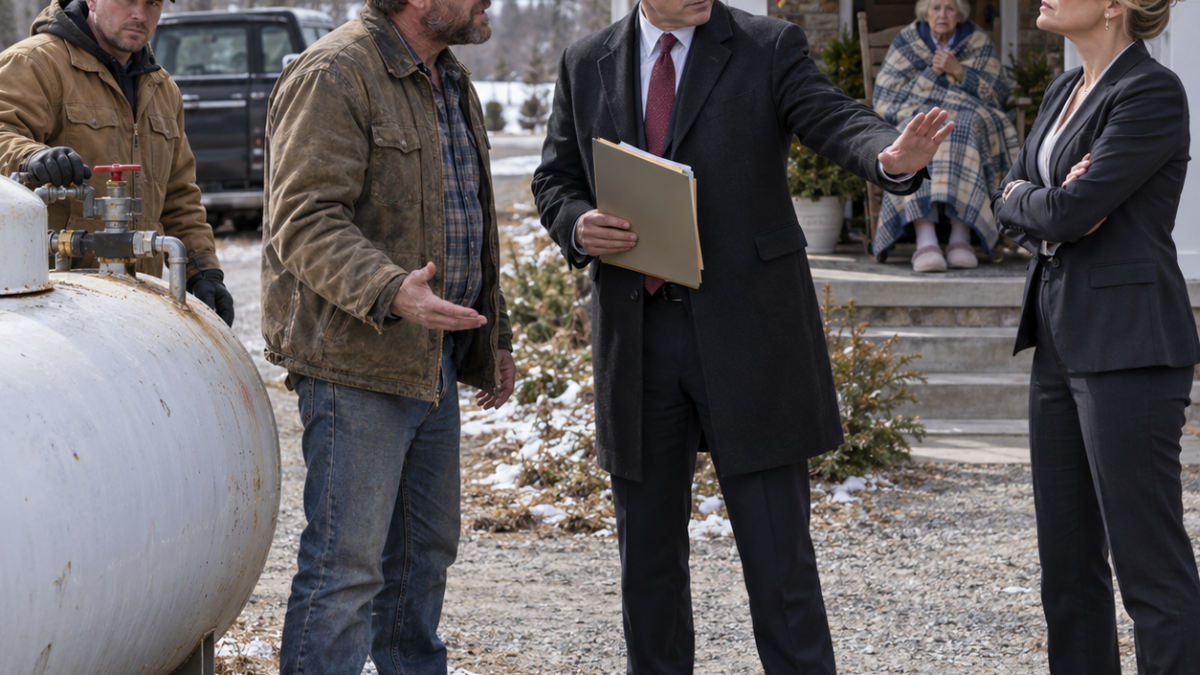
For several seconds, all I could hear was the propane detector chirping in Bill’s hand and the idle of my truck behind us.
“Why?” I asked.
Bill crouched near the tank.
“Residual vapor.”
“From the line?”
“Looks that way.”
“How bad?”
“I’m not telling you it’s about to explode. I’m telling you somebody opened a system they had no business touching, and until I know exactly what they damaged, we treat it seriously.”
He moved the detector slowly along the regulator and exposed fitting.
The chirping increased.
Bill muttered something under his breath.
“What?”
“She scored the brass.”
I stepped closer.
He held up one gloved hand.
“Stay there.”
He pointed to the connection.
“She put a wrench directly on this fitting and cranked on it. See those marks?”
I saw bright gouges in the brass.
“That line can’t just be reconnected?”
“No.”
He stood.
“The pigtail gets replaced. Regulator gets inspected. The entire downstream system has been open to atmosphere, so before I restore service I have to pressure-test everything from here to every appliance.”
“How long?”
“Couple hours if nothing else is wrong.”
My eyes went to the truck.
Mom was watching through the windshield.
Bill followed my gaze.
“That your mother?”
“Yes.”
“She okay?”
“COPD.”
His face changed.
“She needs the house warm?”
“Seventy-two if possible.”
He shook his head.
“Then whoever did this is an idiot.”
“Karen Bishop.”
“The HOA woman?”
“You know her?”
“Everybody who services Willow Creek knows her.”
That surprised me.
“What does that mean?”
Bill opened his toolbox.
“It means last fall she tried to tell one of our drivers where he was allowed to park the propane truck while delivering to another customer.”
Despite everything, I almost laughed.
Bill didn’t.
“Mark, this isn’t funny.”
“I know.”
“Tampering with LP gas equipment without training can get people killed.”
That sentence went through me like ice.
Not inconvenienced.
Not fined.
Killed.
I walked back to the truck.
Mom lowered the window.
“How long?”
“A while.”
“Is there a leak?”
“Bill found some vapor.”
She looked toward the tank.
Then toward me.
“Did she cause it?”
“Yes.”
Mom closed her eyes for a second.
“What are you going to do?”
“Right now? Get you somewhere warm.”
“I’m warm.”
“In the truck.”
“Then quit looking at me like I’m dying.”
That was Eleanor Davies.
Seventy-two.
Five foot three.
Barely one hundred twenty pounds anymore.
But she could still flatten me with a sentence.
“I’m not.”
“You are.”
“I’m worried.”
“I know.”
Her voice softened.
“Your father used to get the same look.”
That hurt.
Dad had been gone eighteen months.
Cancer.
Quick at the end.
Mom’s health had worsened after he died, and moving her into my place had seemed like the most obvious decision in the world.
She had spent forty-eight years taking care of him.
It was my turn.
The thought that Karen’s obsession with an old propane tank could have put Mom in an ambulance—or worse—was difficult to hold without letting anger take over.
I stepped away from the truck and called the sheriff’s office.
The dispatcher sounded tired.
I explained calmly.
Trespass.
Utility tampering.
Residential propane.
Elderly medically vulnerable occupant.
The dispatcher interrupted.
“So this is an HOA dispute?”
“No.”
I kept my voice level.
“The person happens to be HOA president. The act is intentional interference with a residential fuel system.”
“Was anyone injured?”
“Not yet.”
“Was property damaged?”
“A propane technician is determining that now.”
There was a pause.
“We can have a deputy respond.”
“Thank you.”
“When one is available.”
I hung up.
Bill had opened another panel and was taking notes.
“What did they say?”
“They’ll send somebody.”
He snorted.
“They hear HOA and think two people yelling about mailboxes.”
“That’s exactly what happened.”
“Get my report.”
“What?”
“When the deputy gets here, make sure he gets the service report number. I’m writing everything.”
I nodded.
Bill had become an unexpected ally in less than half an hour.
He worked methodically.
New pigtail hose.
Regulator inspection.
Leak test at the tank.
Pressure test through the house.
He eventually let me accompany him inside after the exterior vapor had dispersed.
The furnace was off.
The water heater cold.
The kitchen range dead.
The house already felt cooler than it had when I left that morning.
Mom would have been sitting there wondering why.
That thought bothered me more than the wrench marks.
Bill checked every connection.
At the furnace, he looked up.
“How long was your mom alone?”
“Maybe forty minutes before I came home.”
“Could’ve been worse.”
I hated that phrase.
Could’ve been worse.
It becomes meaningless when you start imagining the ways.
The deputy arrived just before sunset.
Young guy.
Early twenties.
Nameplate said PARKER.
He approached with one hand resting near his belt.
“Mr. Davies?”
“That’s me.”
“What seems to be the problem?”
I pointed toward Bill.
“He can explain the safety part. I can explain the rest.”
Deputy Parker looked from me to the propane truck to Mom sitting in my pickup.
“HOA issue?”
I felt the familiar irritation.
“Yes, but—”
He sighed.
“Okay.”
I caught myself.
Anger would give him an excuse to reduce everything to two difficult neighbors.
So I slowed down.
I showed him the video.
Karen.
Pipe wrench.
Her own words.
Board-authorized remediation.
Unauthorized tank.
Service fee.
Parker watched it twice.
Then gave the phone back.
“She actually says she disconnected it.”
“Yes.”
He walked over to Bill.
“Sir, you’re the gas technician?”
“Twenty-five years.”
“Was there an active leak?”
“Residual vapor and a damaged fitting.”
“Immediate danger?”
Bill looked at him.
“Deputy, if somebody tampers with a propane line and creates a release near a residence, you don’t ask whether it was immediately dangerous after everybody got lucky. You ask why an untrained person touched it.”
Parker’s posture changed a little.
Bill continued.
“Propane vapor is heavier than air. It can settle low. You get the right fuel-air mixture and an ignition source, that’s your fire or explosion pathway. This was reckless.”
Parker looked toward Mom.
“And she was inside?”
“Yes,” I said.
“Age?”
“Seventy-two.”
“Medical issues?”
“COPD.”
He took out his notebook.
That was progress.
He still wasn’t convinced it was a serious criminal case, but he was writing.
“I’ll take a report.”
“What happens after that?”
“I’ll talk to Ms. Bishop.”
“And?”
“And we document it.”
“Is tampering with residential gas equipment a crime?”
“Potentially.”
“That’s not what I asked.”
Parker’s expression tightened.
“Mr. Davies, I’m not the district attorney. I’m telling you what I can do tonight.”
He was right.
I didn’t like his answer, but he was right.
I backed off.
“Fair enough.”
He spoke with Mom.
Then Bill.
Then drove across the subdivision toward Karen’s house.
Bill restored the system shortly afterward.
Final emergency invoice:
$842.50.
Before he left, he handed me his card.
“I’ll have the formal report tomorrow.”
“I need every detail.”
“You’ll get it.”
“Potential consequences too.”
“I’ll write what I can defend professionally.”
“That’s all I want.”
Bill shook my hand.
Then he glanced toward Karen’s street.
“If she ever comes near this tank again, call us and law enforcement before you touch anything.”
“I will.”
When Mom and I finally went inside, the furnace kicked on.
Normal sound.
Ordinary sound.
I stood in the hallway listening to it.
Mom touched my arm.
“You look like you’re going to punch a wall.”
“I don’t punch walls.”
“You did when you were sixteen.”
“I learned.”
“Apparently.”
She walked slowly toward her room.
Then turned.
“Mark.”
“Yeah?”
“Don’t do anything stupid because you’re angry for me.”
I smiled without humor.
“You sound like Dave.”
“Your lawyer friend?”
“Former JAG.”
“He always had more sense than you.”
“Thanks.”
“I’m serious.”
“I know.”
She looked at me for a long second.
“Make her answer for it.”
Then she went to bed.
That was different from revenge.
Mom knew the distinction.
I spent the next morning at the dining-room table.
The certified envelope from Karen arrived at eleven.
Inside were three documents.
The first:
$1,000 fine.
Unauthorized propane installation.
Aesthetic Guideline 14C.
There was no 14C.
The architectural section ended at Guideline 12.
Second:
$500 failure-to-cure fine.
It referenced a warning supposedly sent thirty days earlier.
I had never received one.
Third:
$300 remediation service fee.
I stared at that one.
She was billing me for shutting off the gas.
For damaging the fitting.
For leaving Mom without heat.
The brazenness was almost difficult to process.
I checked the date on the warning notice.
January 15.
Then I opened my file cabinet.
Every HOA letter.
Every certified envelope.
Every email.
Nothing.
No January warning.
No propane violation.
No Guideline 14C.
My phone rang.
Bill.
“Got your report.”
“Email?”
“Already sent.”
I opened it while he talked.
Four pages.
Photographs.
Damage description.
Safety implications.
Applicable service rules.
Requirement for pressure testing after system opening.
Potential for vapor accumulation and ignition.
Professional conclusion:
Unauthorized tampering by an unqualified person created a hazardous condition.
Then the medical letter arrived from Mom’s pulmonologist.
Dr. Samuel Harris.
He had treated her for six years.
His letter was even simpler.
COPD.
Temperature sensitivity.
Cold exposure risk.
Bronchospasm.
Respiratory distress.
Pneumonia.
Potential hospitalization.
I placed Karen’s documents beside Bill’s report and Dr. Harris’s letter.
The contrast was almost surreal.
One side:
invented rule.
Backdated warning.
Fake remediation fee.
Other side:
gas-system damage.
Medical risk.
Police report.
I called Colonel David Miller.
No relation to the elderly Millers who lived down the street, though that coincidence would later confuse everyone.
Dave and I had served together in Iraq.
I handled engineering.
He handled legal problems.
He answered with his usual booming voice.
“Davies. Which federal agency are you suing now?”
“None yet.”
“That ‘yet’ worries me.”
“I have an HOA problem.”
He groaned.
“I preferred insurgents.”
I told him everything.
At first he made jokes.
Then I mentioned Mom.
The jokes stopped.
“She disconnected the gas herself?”
“Video.”
“Pipe wrench?”
“Video.”
“She issued fines afterward?”
“Three documents.”
“Send me scans.”
I did.
He called back two hours later.
His voice was different.
“Mark.”
“Yeah.”
“This isn’t normal HOA stupidity.”
“I know.”
“No, I mean legally.”
He had found the same things I had.
Nonexistent rule.
Questionable jurisdiction.
Backdated notice.
Fraudulent service charge.
Possible elder endangerment.
Possible false business records.
Potential extortion depending on how threats of liens had been used.
“Your patrol deputy probably categorized this as a neighborhood dispute.”
“Pretty much.”
“That’s because patrol handles what’s in front of them. We need someone who sees patterns.”
“How?”
“We build the pattern.”
Dave advised me to pay the disputed fines under protest to prevent Karen from using nonpayment as an excuse to escalate liens or collection action while we challenged them.
I hated that.
“Pay her?”
“Pay the association.”
“She wins.”
“No. She creates damages.”
I understood his logic even while resenting it.
“Cashier’s check?”
“Exactly. Memo: PAID UNDER PROTEST. Keep copies.”
Then letters.
Every board member.
Insurance carrier.
Prosecutor.
The prosecutor letter surprised me.
“You think they’ll care?”
“Not if you write, ‘My HOA lady is mean.’”
“I wasn’t planning to.”
“You’re going to give them a package.”
“What goes in?”
“Everything.”
The propane report.
Medical evidence.
Video.
Police report.
Bylaws.
Nonexistent 14C.
Backdated notice.
The previous ramp dispute.
Every other example of Karen fabricating authority.
Dave paused.
“And other residents.”
“I’m not turning the neighborhood into witnesses for my private feud.”
“This stopped being private when she started inventing rules and threatening liens.”
I thought about the months before the propane incident.
The ramp.
That had been the beginning.
Mom’s knees and breathing had made the garage step difficult.
I built an accessibility ramp.
Good lumber.
Correct slope.
Handrails.
Concrete footings.
Nothing improvised.
Karen taped a stop-work notice to my door before the first footing cured.
Ten-page application.
Soil analysis.
Two-hundred-dollar fee.
For a ramp my mother needed to enter the house safely.
I responded with her doctor’s letter and the reasonable-accommodation requirements.
Built it anyway.
Karen fined me five hundred dollars.
I paid because Mom hated conflict.
Karen apparently interpreted payment as submission.
After that came the measuring.
Lawn.
Trash cans.
Garage door.
Utility boxes.
Anything she could photograph.
She didn’t target everyone equally.
She targeted people who reacted.
That was the pattern Dave wanted me to prove.
So Saturday morning, I walked.
First stop was the other Miller household.
Harold and June Miller.
Both in their eighties.
Their front yard looked like something from a gardening magazine.
Roses.
Tulips.
Stone edging.
Three small ceramic gnomes beside a birdbath.
Harold was kneeling in the flower bed when I approached.
“Morning.”
He looked up.
“Mark.”
We talked weather first.
Then I asked about the gnomes.
His expression darkened.
“That woman.”
June came outside.
Karen had fined them two hundred dollars.
Then threatened weekly increases.
Then mentioned a lien.
Over three ceramic figures their grandchildren had given them.
June’s eyes became wet as she talked.
“We almost threw them away.”
Harold looked down.
“I told her we would.”
I stared at him.
This was a man who had lived in the same house thirty-five years.
Retired machinist.
Korean War veteran.
And Karen Bishop had made him afraid to keep garden decorations.
“Would you give me copies?”
Harold looked up.
“Why?”
“Because I’m building a record.”
June’s face changed.
“Against her?”
“Against what she’s doing.”
Harold nodded slowly.
“You finally fighting back?”
“I’m trying to do it correctly.”
“Good.”
He stood with difficulty.
“Then take everything.”
Next:
Carlos and Ana Rodriguez.
Their offense had been a portable basketball hoop.
Karen called it an attractive nuisance for nonresidents.
Then garage-door violations.
Then a warning because a children’s bicycle remained beside the porch overnight.
Carlos had paid a lawyer six hundred dollars to make the basketball-hoop issue disappear.
“Six hundred bucks,” he said. “Over something I bought my kids for Christmas.”
“Would you write a statement?”
He hesitated.
“I have two kids.”
“So?”
“She retaliates.”
That was the first time someone said it plainly.
“She goes after people.”
“I know.”
“If I help you, she’ll know.”
“Maybe.”
He rubbed his forehead.
Ana came up behind him.
“Give Mark the papers.”
Carlos turned.
“You sure?”
“I’m tired of telling the kids they can’t play because some woman might take a picture.”
That was statement number two.
By Sunday evening I had seven.
By Monday, fifteen violation notices.
Unwritten standards.
Rules that didn’t exist.
Different fines for similar conduct.
Threats of liens disproportionate to the offense.
And one recurring signature.
Karen Bishop.
The prosecutor package grew to thirty pages.
Executive summary.
Timeline.
Exhibits.
Witness list.
Technical report.
Medical letter.
Police report.
Certified-mail receipts.
I drove it to the county courthouse myself.
The receptionist initially looked skeptical.
“I’d like to submit a complaint to someone handling economic crimes.”
“Regarding?”
“Fraud, extortion, and reckless endangerment connected to an HOA enforcement scheme.”
That got her attention.
She disappeared through a door.
Ten minutes later, a man in his late thirties came out.
“Mr. Davies?”
“Yes.”
“I’m Assistant District Attorney Daniel Chen.”
He looked at the folder.
“You brought homework.”
“I was an engineer.”
“That explains the tabs.”
He took me into a conference room.
I expected ten minutes.
We were there almost two hours.
Chen read carefully.
He stopped at Bill’s report.
Read it twice.
“She used a wrench directly on this?”
“Yes.”
“You have video?”
I showed him.
He watched without speaking.
Then again.
Karen’s voice:
“I am doing my job as HOA president.”
Chen paused the video.
“Did she mention a gas leak?”
“No.”
“Ever?”
“Not until after the deputy spoke with her.”
His eyes sharpened.
“What did she say afterward?”
“The treasurer later told me she claimed she found a leak.”
“Interesting.”
He turned to the January notice.
“When did you first receive this?”
“After the shutoff.”
“Certified?”
“The packet containing it was certified. The warning itself claims it was previously delivered.”
“Do you have postal records?”
“No prior mailing.”
“Email?”
“No.”
“Board minutes?”
“Not that I’ve seen.”
Chen made a note.
Then he reached the neighborhood statements.
He initially skimmed.
Then slowed.
Gnomes.
Basketball hoop.
Garage door.
Playset.
Work van.
Wreath.
Each individually looked petty.
Together they formed a method.
Notice.
Fine.
Escalation.
Threat.
Payment.
Chen closed the folder.
“Mr. Davies, I’m going to recommend a formal investigation.”
I didn’t immediately respond.
I had spent days imagining that moment.
Yet hearing it brought fear with the relief.
Mom would be interviewed.
Neighbors would be pulled in.
The HOA would fracture.
My name would become part of a criminal case.
Chen seemed to read my expression.
“You can still walk out.”
“What?”
“You brought us information. If we open a case, it won’t belong to you anymore.”
“I understand.”
“Do you?”
He leaned forward.
“We’ll follow evidence. That means if parts of your theory aren’t supported, we drop them. If board members turn out to be innocent, they’re witnesses, not villains. If we find broader crimes, they become our responsibility. You don’t control charging decisions.”
That was exactly what I needed to hear.
This was not revenge.
It was process.
“Open it.”
Chen nodded.
“One more thing.”
“What?”
“Do not confront Ms. Bishop about this investigation.”
“I can manage that.”
“I’m serious.”
“So am I.”
A week later Detective Laura Miller arrived at my house.
She photographed the tank.
Measured the distance to the house.
Interviewed Bill separately.
Then Mom.
I offered to sit beside her.
Detective Miller asked Mom first.
“Mrs. Davies, are you comfortable speaking with me alone?”
Mom looked at me.
“He’ll hover if you let him.”
The detective smiled.
“I’ll send him to the kitchen.”
I went.
Ten minutes later I heard Mom cough.
Every instinct told me to walk back in.
I didn’t.
Afterward Detective Miller found me.
“She’s tougher than you are.”
“I know.”
“She said she was frightened.”
Mom rarely admitted fear.
That hurt.
“What else?”
“That she thought the heat failure was accidental until she saw you outside talking to Karen.”
I looked toward the living room.
Mom was staring through the window at the propane tank.
For months afterward, I would wonder whether moving her into my house had protected her or put her in the middle of my fight.
That guilt was irrational.
But guilt rarely asks permission to be irrational.
The investigation spread.
Harold and June.
Carlos and Ana.
Other residents.
The board.
Karen’s emails.
HOA financial records.
Computer metadata.
Insurance correspondence.
Then George Harrison, the HOA treasurer, called me.
His voice shook.
“Mark, what have you done?”
“I filed a complaint.”
“There’s a detective requesting records.”
“Then provide them.”
“Karen says this is harassment.”
“George, Karen disconnected my gas.”
“She said there was a leak.”
I closed my eyes.
There it was.
The lie had spread.
“Did she tell you she was holding a pipe wrench?”
Silence.
“Did she tell you she told me on video that the tank was an unauthorized alteration?”
Silence.
“Did she tell you there was no leak until after she opened the system?”
“Mark—”
“I have the technician’s report.”
George exhaled.
“She said she saved your house.”
I almost laughed.
Instead:
“Talk to your own attorney.”
“We have HOA counsel.”
“Your own attorney, George.”
That scared him.
Good.
Not because I enjoyed frightening him.
Because fear was the first thing strong enough to make Karen’s board members start asking questions.
The insurer reacted too.
Their letter to the board was not subtle.
Potential intentional acts.
Possible coverage exclusions.
Duty to preserve evidence.
Independent counsel recommended for certain officers.
Suddenly Karen was not merely creating conflict.
She was creating personal liability.
Then she called an emergency meeting.
The notice accused me of running a malicious defamatory campaign against community leadership.
Mom read it at breakfast.
“She’s going to put you on trial.”
“Basically.”
“I’m coming.”
“No.”
“Yes.”
“Mom—”
“I was in the house.”
“That’s why you’re not coming.”
She put down her coffee.
“Mark, I spent twenty years worrying about whether you’d come home from places I couldn’t pronounce.”
“That’s not relevant.”
“It’s very relevant. I did not raise you so you could decide I’m too fragile to attend a neighborhood meeting.”
“You have COPD.”
“I also have a coat.”
“Mom.”
“I’m going.”
I looked at her.
She looked back.
I lost.
The clubhouse was packed.
Dave came too.
Not representing me officially.
Just standing in the back.
Mom sat with June Miller.
Oxygen bottle beside her chair.
Karen stood at the lectern in a red blazer.
For ten minutes, she talked about harmony.
Standards.
Property values.
Volunteers being bullied by hostile residents.
She never said propane.
Never said wrench.
Never said Eleanor.
When she finally paused, I raised my hand.
“Are you taking questions?”
“This is not a debate.”
George stood from the board table.
His hands were visibly shaking.
“Our bylaws permit member comments.”
Karen turned.
“George.”
“Mark has the floor.”
Something shifted in the room.
Small.
But permanent.
I walked forward with one folder.
No projector.
No theatrics.
One photograph.
Propane tank.
Disconnected line.
Karen holding the wrench.
“This is why I contacted authorities.”
The room went silent.
I explained the temperature.
Mom’s COPD.
Bill’s report.
The damaged fitting.
Then I held up the bylaws.
“There is no Guideline 14C.”
People looked toward Karen.
“The architectural standards end at twelve.”
Someone shouted:
“Then why does my notice say 13B?”
That was unexpected.
A woman three rows over stood holding paper.
Karen went pale.
Another resident spoke.
“Mine says 15A.”
The pattern was bigger than even I knew.
I looked at Dave.
He didn’t move.
But his eyes sharpened.
I continued.
“The warning Karen says she sent me in January does not appear in any certified-mail record, email record, or board minutes I have received.”
Karen interrupted.
“You’re lying.”
“Then produce it.”
“It’s in the records.”
“Produce it.”
She gripped the lectern.
“Sit down.”
George spoke again.
“Karen.”
“What?”
“Do we have that notice?”
She looked at him.
“That is confidential enforcement material.”
“I’m the treasurer.”
“You don’t manage compliance files.”
His chair scraped backward.
“That’s not what I asked.”
The mutiny had begun.
Then Harold stood.
His wife stayed seated.
His voice trembled.
“I’ve lived here thirty-five years.”
Karen rolled her eyes.
“Harold, this is not about your gnomes.”
“It became about them when you threatened my home.”
A murmur swept through the room.
Carlos stood next.
“You timed my garage door.”
Karen snapped:
“You violated the rule.”
“What rule?”
She had no answer ready.
Ana held up the basketball notice.
“My children stopped playing outside because of you.”
Then Rebecca Peterson.
Then the man with the work van.
Then the woman with the wreath.
One by one.
The room Karen had called to shame me became a witness list.
Mom squeezed June’s hand.
I held up Bill’s report last.
“This document explains what happened when Karen touched my propane system.”
I did not dramatize it.
I read the conclusion.
Unauthorized tampering.
Hazardous condition.
Risk of release.
Possible ignition.
Then I said the sentence Karen had not expected to hear.
“The county prosecutor has opened a criminal investigation.”
Silence.
Not murmuring.
Not whispers.
Silence.
Karen’s face lost color.
“You’re bluffing.”
“No.”
“This is intimidation.”
“No.”
“You think you can use some prosecutor to threaten me?”
“I didn’t ask him to threaten you.”
My voice stayed even.
“I gave him the records.”
People started shouting questions.
George demanded the meeting be recessed.
Karen refused.
Another board member left the table entirely.
Mom motioned me over.
I walked to her.
She took my hand.
“You did good.”
“It’s not over.”
“No.”
She looked toward Karen.
“But she knows it now.”
The board suspended Karen the next morning.
Not permanently yet.
Pending investigation.
All fines issued under questionable authority were frozen.
My payments were refunded.
The $842.50 propane bill was reimbursed.
But those checks were not victory.
The real shift came when residents started knocking on one another’s doors.
They compared notices.
Some referenced nonexistent provisions.
Some fines had been deposited into unusual accounts.
Some “remediation fees” had no corresponding contractor invoice.
The prosecutor’s investigation widened.
Two mornings later, I was in my workshop when blue lights appeared outside.
Not at my house.
Across the street.
Karen’s.
Detective Miller walked to the door with another officer.
Neighbors emerged quietly.
Nobody cheered.
Nobody smiled.
Karen opened the door.
Even from my garage I could see the exact moment she understood.
The warrant.
Her hands gesturing.
The denial.
Then the handcuffs.
She looked across the street at me.
I did not wave.
I did not smile.
Mom came up behind me.
“Is that her?”
“Yes.”
She watched Karen being guided toward the vehicle.
“I thought I’d feel better.”
“So did I.”
Mom looked at me.
“Maybe justice isn’t supposed to feel good.”
That stayed with me.
The prosecutor’s office charged Karen with offenses tied to the propane incident and the fraudulent enforcement documents.
The financial investigation continued separately.
Local news picked it up.
I hated that part.
People who knew nothing about us reduced the story to jokes about HOAs.
Some treated Karen like a cartoon villain.
Others decided I must be some anti-HOA crusader who had been waiting for an excuse.
Neither was true.
I had paid dues.
Attended meetings.
Followed reasonable rules.
I believed shared communities needed shared standards.
What I opposed was invented authority backed by threats.
Karen hired private defense counsel.
Her strategy became clear during pretrial motions.
Good faith.
Mistake.
Safety intervention.
Hostile homeowner.
Overzealous volunteer.
Her lawyer argued that she believed the tank leaked.
That claim made me angrier than almost anything else she had done.
Because if she had truly smelled a leak, the correct action would have been evacuation and a call to emergency services or the propane company.
Not a wrench.
Not a fine.
Not a service fee.
Dave called the night before trial.
“You sleeping?”
“No.”
“Normal.”
“I don’t want Mom testifying.”
“She may not have to.”
“She already gave statements.”
“Chen decides.”
“I should’ve moved her somewhere else when this started.”
Dave went quiet.
“Mark.”
“What?”
“You didn’t endanger your mother.”
“I let the conflict keep escalating.”
“You sent letters. You built a ramp. You kept records. You did not trespass with a wrench.”
“I knew Karen was targeting me.”
“You did not know she’d touch a fuel system.”
I stared at the dark propane tank through the kitchen window.
“She could’ve died.”
“But she didn’t.”
“That’s luck.”
“Yes.”
Dave’s voice softened.
“And sometimes luck is what gives people time to fix what nearly went wrong.”
The trial began the next morning.
Mom insisted on straightening my tie.
“You look like your father.”
“That bad?”
She slapped my arm.
“Be serious.”
“I am.”
“You’re scared.”
“Yes.”
“Good.”
“That’s helpful.”
“It means you understand it matters.”
The courthouse smelled like old paper and floor polish.
Karen sat beside her attorney.
No puffer jacket.
No clipboard.
No HOA seal behind her.
Just a defendant.
Assistant District Attorney Chen’s opening statement was restrained.
He did not call her a tyrant.
Did not mention suburban dictators.
He described actions.
Entry onto property.
Utility tampering.
Subsequent fabrication.
Financial demands.
Cover story.
Intent.
That was stronger than insults.
When I testified, Chen walked me through the afternoon.
The video.
The smell.
Mom.
Bill.
The fines.
The January notice.
Then Karen’s lawyer stood.
Mr. Sloan.
Expensive suit.
Smooth voice.
“Mr. Davies, you disliked Ms. Bishop before February seventeenth.”
“I disagreed with her.”
“You had already been fined.”
“Yes.”
“For violating HOA requirements.”
“For building an accessibility ramp for my mother.”
“But you paid the fine.”
“Yes.”
“So you accepted the HOA’s authority.”
“No.”
His smile tightened.
“You paid.”
“To prevent escalation while disputing it.”
“You’re an engineer, not a lawyer.”
“Correct.”
“You considered Ms. Bishop a bully.”
“Yes.”
Sloan paused.
Maybe he hadn’t expected that answer.
“You admit bias.”
“I admit an opinion.”
“And then you spent weeks collecting complaints against her.”
“After she disconnected my gas.”
“You wanted revenge.”
I looked toward the jury.
“I wanted a record.”
“Convenient distinction.”
“It’s an important one.”
He moved closer.
“Mr. Davies, isn’t it true that no one was injured?”
“No.”
“No explosion occurred?”
“No.”
“Your mother did not require hospitalization?”
“No.”
“So the catastrophic scenario you’ve described never happened.”
“Correct.”
He smiled as though he had won something.
I continued.
“Because we got lucky.”
He frowned.
“I didn’t ask you to editorialize.”
“You asked whether it happened.”
“Just answer yes or no.”
Chen stood.
“Your Honor, counsel invited explanation.”
Judge Albright looked at Sloan.
“He did.”
Sloan changed direction.
“You are not a propane expert.”
“No.”
He smiled.
“Nothing further.”
Chen called Bill next.
That smile did not survive Bill.
Twenty-five years in propane service.
No dramatic vocabulary.
No legal theory.
Just technical reality.
“What happens if an untrained person disconnects a residential line?”
“You can create a leak.”
“Can propane ignite?”
“Yes.”
“Does the absence of an ignition prove the act was safe?”
“No.”
“Why not?”
“Because a hazard doesn’t stop being a hazard just because nobody got hurt.”
Sloan tried.
“Mr. Jensen, there was no explosion.”
“No.”
“No fire.”
“No.”
“So your worst-case scenario is speculation.”
Bill looked at him.
“Sir, seat belts are for a worst-case scenario. You still wear one.”
A juror smiled.
Sloan did not.
Dr. Harris testified about Mom’s COPD.
Cold exposure.
Respiratory stress.
He did not exaggerate.
That made him stronger.
Then George Harrison took the stand.
The former treasurer looked miserable.
Chen handed him the bylaws.
“Find Guideline 14C.”
George searched.
“It isn’t there.”
“Was it ever adopted?”
“Not that I know.”
“Did the board authorize Karen Bishop to disconnect Mark Davies’s propane?”
“No.”
“Did Ms. Bishop tell you why she did it?”
George swallowed.
“She said she discovered a leak.”
“Did she say she was enforcing an architectural violation?”
“No.”
Chen played my video.
Karen’s recorded voice filled the courtroom.
“This tank was installed without architectural review board approval.”
George closed his eyes.
Chen turned off the screen.
“Was that consistent with what she told you?”
“No.”
Then came the file metadata.
The January warning.
Creation date:
February 17.
Hours after the incident.
The courtroom became so quiet I could hear the air-conditioning vent.
Chen asked the forensic examiner one question.
“Could this document have been created on January fifteenth on this computer?”
“No.”
“Why not?”
“Because the original file did not exist until February seventeenth.”
Karen stared at the table.
For the first time, I felt something close to pity.
Not enough to want charges dropped.
But enough to see how small her choices had made her.
The defense made its biggest mistake when Karen testified.
Sloan probably hoped she could humanize herself.
For the first ten minutes, it almost worked.
She talked about moving to Willow Creek after retirement.
Wanting to contribute.
Watching property values decline in her previous neighborhood.
Believing standards protected everyone’s investment.
Residents ignoring rules.
Board members refusing responsibility.
Feeling that she had been left to “do everything.”
For the first time, I understood part of her.
Control had probably begun as fear.
Fear of decline.
Fear of disorder.
Fear that if nobody enforced standards, everything she had invested in would lose value.
The problem was what she did with that fear.
Sloan asked:
“Did you intend to hurt Mrs. Davies?”
“Absolutely not.”
“Did you believe the propane system was unsafe?”
“Yes.”
That was the lie she had chosen.
Chen stood for cross-examination.
He approached with my video transcript.
“Ms. Bishop, you smelled gas before touching the system?”
“Yes.”
“You were concerned about a leak?”
“Yes.”
“What did you do?”
“I shut the tank off.”
“Did you call 911?”
“No.”
“Fire department?”
“No.”
“Propane supplier?”
“No.”
“Did you evacuate the house?”
“I didn’t know anyone was inside.”
“Did you knock?”
She hesitated.
“No.”
“You testified you were addressing an emergency safety hazard.”
“Yes.”
Chen held up the video transcript.
“Then why did you tell Mr. Davies, quote, ‘This tank was installed without architectural review board approval’?”
“I was explaining the underlying violation.”
“You never mentioned a leak.”
“I was upset.”
“You charged him three hundred dollars for ‘board-authorized remediation.’”
“Yes.”
“If this was emergency life-safety intervention, why did you call it remediation of an architectural violation?”
She looked toward Sloan.
He could not help her.
Chen continued.
“You later told the HOA treasurer that you found a leak.”
“I did.”
“Before or after you applied a pipe wrench?”
Karen’s mouth tightened.
“I don’t remember.”
“The propane technician found tool damage to the fitting.”
“I’m not responsible for that.”
“You are on video holding the wrench.”
“I was trying to help.”
Chen walked to the evidence table.
Then picked up the backdated notice.
“Why does this document say January fifteenth?”
“That is when the violation process began.”
“The file was created February seventeenth.”
“That must be a computer issue.”
“Your computer created a document a month late?”
“I don’t understand metadata.”
“You understand dates.”
Sloan objected.
Overruled.
Chen stepped closer.
“Ms. Bishop, did you create this notice after Mr. Davies confronted you?”
“No.”
“Who created it?”
“I don’t remember.”
“Was anyone else authorized to access your compliance files?”
“Yes.”
“Who?”
Long pause.
Karen named the board secretary.
Chen already had that witness’s statement.
The secretary had not created it.
Karen knew that.
Everyone in the courtroom could feel it.
Chen let the silence stay.
Then:
“No further questions.”
The jury deliberated less than an hour.
I sat beside Mom in the hallway.
She held my hand.
“You’re squeezing too hard,” I said.
“You survived the Army.”
“My fingers didn’t.”
She loosened her grip.
The bailiff opened the door.
We went back in.
The foreperson stood.
Guilty.
Reckless endangerment.
Guilty.
Fraud.
Guilty.
Extortion-related counts tied to the fraudulent fine scheme.
Karen’s shoulders collapsed.
No celebration rose inside me.
Only release.
Like I had been holding my breath since that February afternoon and finally remembered how to exhale.
Sentencing came two weeks later.
The prosecutor asked for incarceration.
Sloan asked for probation.
Judge Albright asked Karen if she wished to speak.
Karen stood.
“I’m sorry this situation became so misunderstood.”
The judge’s expression changed.
Not much.
Enough.
Karen continued.
“I was trying to protect the neighborhood. I never intended—”
Judge Albright interrupted.
“Ms. Bishop, that is not an apology.”
Karen stopped.
The judge reviewed the record.
The danger.
The fabrication.
The false explanation to the board.
The trial testimony.
The pattern.
Then she imposed a custodial sentence, with additional concurrent terms on the fraud-related convictions, restitution, and probation conditions to follow.
Karen cried.
I looked at Mom.
Mom looked down.
Later, outside the courthouse, reporters gathered.
I declined to speak.
One shouted:
“Mr. Davies, do you feel vindicated?”
I kept walking.
Mom answered under her breath.
“No. He feels tired.”
She was right.
Willow Creek had its own reckoning afterward.
The independent financial review found that Karen had controlled more than anyone realized.
Some of the questionable fines had been moved into a separate “beautification” account.
Records were incomplete.
Several planned improvements never happened.
Restitution proceedings eventually required Karen to repay tens of thousands of dollars.
The association recovered additional amounts through civil action and insurance where coverage applied.
George called another community meeting.
No red blazer at the lectern.
No gavel theatrics.
Just folding chairs and tired homeowners.
“We need new leadership,” he said.
June Miller stood.
“I nominate Mark Davies.”
I laughed.
Nobody else did.
“No.”
Carlos raised his hand.
“I second.”
“Absolutely not.”
Mom, sitting beside me, whispered:
“Coward.”
I looked at her.
She smiled.
The vote was unanimous.
I became the HOA president.
The irony was painful.
Dave called that night.
“I heard.”
“Who told you?”
“Your mother.”
“Traitor.”
“She says congratulations.”
“I’m dissolving the HOA.”
“You are not.”
“No.”
I wasn’t.
Willow Creek did need an association.
Shared drainage.
Entrance landscaping.
Snow-contract management during bad winters.
Common retention pond.
Insurance.
The answer to bad governance was not necessarily no governance.
It was limited, boring, transparent governance.
My first motion dissolved Karen’s Architectural Review Board and Covenants Compliance Committee.
Their legitimate duties went back to the full board.
Second motion:
review every bylaw.
If a rule could not be tied clearly to safety, shared property, genuine nuisance prevention, or an enforceable community interest, it went.
The “aesthetic harmony” language disappeared.
No invented guidelines.
No one-person enforcement decisions.
No fines without written notice citing an actual recorded provision.
No liens without board review and counsel.
Accommodation requests involving disability received expedited handling.
Board spending went online.
Monthly statements.
Vendor names.
Invoices available.
Meeting minutes posted.
The first three meetings lasted forever.
People had years of anger stored up.
George wanted orderly agendas.
Maria Rodriguez wanted everything discussed immediately.
Harold wanted garden gnomes specifically protected in the bylaws.
“That is unnecessary,” I told him.
“Karen said that too.”
I stared.
The whole room laughed.
“Fine. Decorative lawn objects permitted unless they create a safety hazard.”
Harold nodded.
“That’s democracy.”
Mom attended almost every meeting.
Usually in the back.
Usually knitting.
If discussions became too heated, she would cough loudly.
Nobody knew whether the cough was real.
I suspected at least half were strategic.
Spring came.
The propane tank remained exactly where it had always been.
I built a lattice screen around it anyway.
Not because Karen had been right.
She wasn’t.
Because Mom wanted climbing roses.
We kept the required clearances.
Bill Jensen came by to inspect the placement.
“Looks good.”
“Safe?”
“Safe.”
“HOA compliant?”
He grinned.
“Aren’t you the HOA?”
“Unfortunately.”
“Then fine yourself.”
“Get off my property.”
He laughed.
Mom sat on the patio beneath a blanket.
The new ramp gleamed with fresh stain.
She watched me plant the roses.
“Too close together.”
“They’re exactly where the nursery instructions say.”
“The nursery doesn’t know roses.”
“You do?”
“I’m old. That’s basically a horticulture degree.”
I moved one.
She nodded.
“Better.”
My phone buzzed.
Dave.
A news link.
FORMER WILLOW CREEK HOA PRESIDENT ORDERED TO PAY RESTITUTION TO RESIDENTS.
I showed Mom.
She read it.
“Good.”
That was all.
No speech about karma.
No celebration.
Just good.
Then she looked at the propane tank.
“You know what bothered me most?”
“What?”
“That she thought she could come onto your property and decide what was best for me without ever seeing me.”
I sat beside her.
“She didn’t know you were home.”
“That makes it worse.”
“How?”
“She never checked.”
I had never thought of it that way.
Karen’s entire reign had been built on not checking.
She didn’t check whether 14C existed.
Didn’t check whether the tank was grandfathered.
Didn’t check whether Mom was inside.
Didn’t check whether the ramp was medically necessary.
Didn’t check whether the neighbors’ lives fit neatly inside the rules she invented.
She decided first.
Then made paperwork support the decision.
That was the real pattern.
Months passed.
Mom’s health stabilized.
Not improved exactly.
COPD doesn’t negotiate.
But she breathed easier through spring and summer.
She loved the roses.
By July, the first vines had reached the lattice screen around the propane tank.
Pink blooms against white wood.
The tank itself became less visible.
One evening I came home to find Mom on the patio with June Miller.
Three ceramic gnomes sat around them.
I stopped.
“What is this?”
June smiled.
“Housewarming gift.”
“For a house I’ve owned ten years?”
“For your administration.”
Mom pointed toward the smallest gnome.
“That one’s you.”
It wore a tiny military-style cap.
“No.”
“Yes.”
“I am removing it.”
Mom raised one eyebrow.
“As HOA president?”
I stared at her.
June laughed so hard she had to wipe her eyes.
I left the gnome.
Willow Creek changed in ways that had nothing to do with regulations.
Carlos put the basketball hoop back.
Children played in the cul-de-sac.
Harold’s gnomes multiplied suspiciously.
The Peterson playset stayed visible over the fence.
A nurse who worked nights was allowed to keep her work van in her driveway without receiving threatening letters.
A widower installed a handrail without filing ten pages of architectural paperwork.
Our property values did not collapse.
The neighborhood did not become chaos.
The world did not end because somebody’s garage door stayed open ninety minutes.
What returned was proportion.
That was what Karen had destroyed.
Not rules.
Proportion.
Every inconvenience became a violation.
Every disagreement became disobedience.
Every resident became somebody to manage.
It took us almost a year to make the HOA ordinary again.
At my final meeting as president, I announced I would not seek another term.
People protested.
I held up both hands.
“I did not retire from the Army so I could spend my evenings debating mulch.”
Maria Rodriguez shouted:
“It’s pine bark, Mark. This matters.”
Everyone laughed.
George took over after me.
He was a good president because he hated power.
That may be the best qualification.
Mom’s roses covered most of the lattice by the second spring.
One April afternoon, Bill stopped during a delivery.
He walked around the tank.
“Nice screen.”
“Mom’s idea.”
“Of course.”
He filled the tank.
I watched the gauge rise.
Normal job.
Normal day.
Then he closed the valve cover and looked at me.
“You ever think about that first afternoon?”
“More than I want.”
“Me too.”
“Why?”
He shrugged.
“I’ve seen houses after gas incidents.”
I went quiet.
Bill noticed.
“Sorry.”
“No. It’s okay.”
He leaned against the truck.
“You know the part I still don’t understand?”
“What?”
“She had to walk past your front windows to get to the tank.”
I looked toward the house.
He was right.
From the driveway to the tank, Karen would have passed the living-room window.
Mom had been in Dad’s recliner.
Visible.
Had Karen seen her?
Maybe.
Maybe not.
I never asked.
By then, I didn’t want an answer I could not prove.
That was another lesson the whole ordeal had taught me.
There is danger in building certainty out of suspicion.
Karen had done that constantly.
I refused to become her mirror image.
“I don’t know what she saw,” I told Bill.
He nodded.
“Fair enough.”
After he drove away, Mom called from the porch.
“Mark.”
“Yeah?”
“Tea.”
I went inside.
The house was warm.
Seventy-two degrees.
Exactly where she liked it.
Dad’s old chair sat by the window.
Mom had stopped using supplemental oxygen every day, though the concentrator remained nearby.
She handed me a mug.
“Remember when you were eight and tried to fix the furnace?”
“I was ten.”
“You almost burned your eyebrows off.”
“That was the water heater.”
“Even worse.”
“You let me become an engineer anyway.”
“I believed in second chances.”
We sat quietly.
Then she touched my wrist.
“You know I never blamed you.”
“For what?”
“The propane.”
“I know.”
“No, you don’t.”
She waited until I looked at her.
“You think because she targeted you, what happened to me belongs on your conscience.”
I started to answer.
She stopped me.
“I know my son.”
I looked down.
Mom continued.
“Your father used to do the same thing. He thought being responsible meant being responsible for everything.”
“I should have known she might escalate.”
“You should have known a neighborhood volunteer would take a wrench to a gas line?”
“When you say it that way.”
“There is no other honest way to say it.”
I smiled faintly.
She squeezed my hand.
“You protected me.”
“After.”
“Mark.”
I looked at her.
“You came home.”
Those three words broke something open in me.
Not because of Karen.
Because of Iraq.
Because of Dad.
Because of every phone call Mom had waited for while I was overseas.
Every deployment.
Every missed holiday.
Every time she had sat beside Dad wondering whether I would come back.
Now she was the vulnerable one.
And I had been treating one frightening afternoon as proof I had failed her.
She would not allow that.
“You came home,” she repeated.
I nodded.
“Yes, ma’am.”
“Good.”
Then she handed me her empty mug.
“More tea.”
“Emotional manipulation.”
“Effective, though.”
I stood.
Very effective.
Years later, the propane tank is still behind the house.
Same location.
Different regulator now.
Same roses around the lattice.
Mom is older.
So am I.
Her breathing has good months and bad months.
Willow Creek has changed presidents three times since I stepped down.
No one has attempted a coup.
No one has created seventeen committees.
No one has measured George Rodriguez’s grass with a ruler.
The bylaws fit in a binder half the size of Karen’s.
The financial statements are still emailed monthly.
Most residents don’t read them.
That’s fine.
The point is that they can.
Karen eventually completed her sentence and probation requirements.
I heard she moved after release.
I never contacted her.
She never contacted me.
For a long time, people asked whether I wanted an apology.
I didn’t know.
Eventually I realized I had already received the thing I needed more than an apology.
A record.
Court findings.
Corrected HOA documents.
Restitution.
A community that knew what happened.
An apology asks someone to understand the harm.
Consequences require them to answer for it even when they refuse to understand.
One winter afternoon, years after the case, the temperature dropped below freezing.
I came home from the hardware store and saw Mom standing at the living-room window.
She waved.
I waved back.
Then my eyes moved toward the propane tank.
For half a second, the old image returned.
Karen.
Wrench.
Disconnected line.
That little copper fitting shining in the cold.
My chest tightened.
Then the furnace exhaust sent a white cloud into the winter air.
Heat.
Working.
Normal.
I went inside.
Mom sat in Dad’s recliner.
A blanket over her knees.
Book open.
Exactly as she had been that afternoon.
She looked up.
“You get the screws?”
“Yes.”
“The right ones?”
“I’m an engineer.”
“That wasn’t my question.”
I laughed.
Then I checked the thermostat.
Seventy-two.
Mom watched me.
“You still do that every time.”
“Do what?”
“Check the thermostat when you come home.”
I hadn’t realized.
“I guess I do.”
She closed her book.
“Come sit.”
I sat beside her.
Outside, snow had started to fall.
Thin at first.
Then heavier.
The roses around the propane screen were bare for winter, their branches dark against the lattice.
Mom reached over and took my hand.
“You know what I like about this house?”
“What?”
“It’s warm.”
I laughed quietly.
“That’s it?”
“That’s plenty.”
The furnace came on.
Soft rush of air through the vents.
No alarms.
No arguments.
No violation notices.
No pipe wrench.
Just heat moving through a house where an old woman could breathe comfortably and her son could finally understand that peace was not the absence of rules.
It was knowing nobody could weaponize them against you again.
I looked through the window at the propane tank disappearing beneath snow.
For years, Karen had treated it like an offense against her idea of perfection.
To me, it had become something much simpler.
A tank.
A utility.
A piece of equipment doing exactly what it was supposed to do.
And somehow that ordinariness felt like the most complete ending I could have asked for.
[END OF STORY]








