HOA President Poisoned My Late Wife’s Hedgerow—Then a Soil Test Put Investigators at Her Door
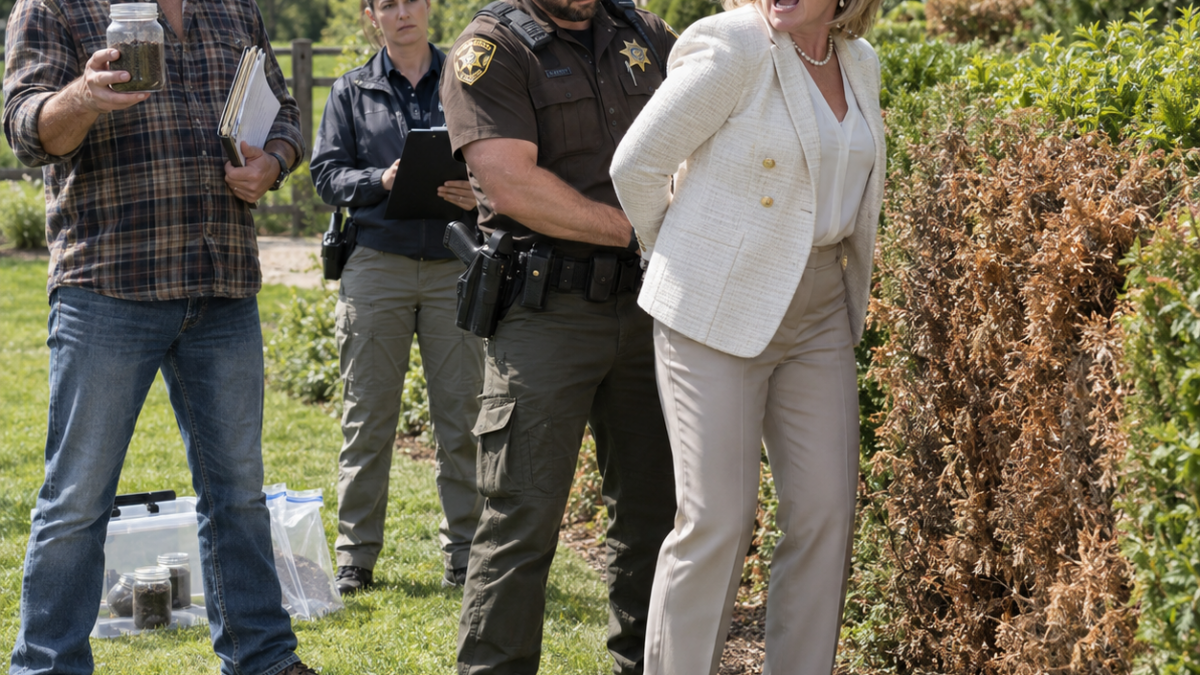
The HOA president stood beside the dead remains of the hedgerow my late wife and I had planted together and told me she had done the neighborhood a favor.
By sunrise, fifty arborvitae that had survived storms, droughts, and ten years of careful tending were turning brown from a chemical strong enough to leave an oily film in the soil.
Karen thought the worst thing waiting for her was another argument over landscaping rules, but the smell coming off that dirt told me this had already become something much bigger.
“What did you do?”
My voice came out so calm that even I barely recognized it.
Karen Williams stood at the edge of my yard wearing rubber gloves and holding an industrial pressure sprayer.
The nozzle was still wet.
Behind her, my hedge was dying in real time.
Eight feet tall.
Almost one hundred feet long.
A solid wall of emerald green yesterday.
Brown spreading through it now like fire through paper.
Karen glanced at the hedge.
“Your little green wall was a fire hazard.”
I stared at her.
“What?”
“Section Seven, Subsection C. Potential fire-spread vectors.”
“You sprayed it?”
“I corrected a violation.”
The smell hit me again.
Sharp.
Chemical.
Nothing like ordinary weed killer.
Twenty years in Army engineering had taught me to pay attention when the environment suddenly smelled wrong.
I stepped toward the hedge.
“Karen, what exactly did you put on my property?”
Her mouth curled.
“The HOA has broad authority to maintain the common buffer.”
“This isn’t common property.”
“The buffer extends five feet beyond the boundary.”
“No, it doesn’t.”
“It does under our interpretation.”
I pointed to the metal survey pin three feet behind the hedge.
“You crossed my property line.”
She shrugged.
“You’ve been warned about this hedge for months.”
That was a lie.
I had received one vague letter three months earlier mentioning “landscape maintenance.”
I had trimmed the hedge the next morning.
It already complied with the eight-foot maximum in the covenants.
Karen knew that.
She just hated it.
Maybe because it gave me privacy.
Maybe because she couldn’t control it.
Maybe because every time she drove her golf cart past my house, she saw something she had ordered me to change and I had politely refused.
But she didn’t know what that hedge meant.
My wife, Sarah, planted the first sapling with me the week we bought this house.
“Living fence,” she called it.
“Something that grows with us.”
We planted fifty.
When the branches were thin enough to see through, Sarah worried they would never fill in.
Ten years later, they were thick enough to block the road completely.
Three years after that, Sarah was gone.
Cancer took her in less than six months.
Afterward, the garden became the only place where the house didn’t feel unbearably empty.
I trimmed the hedge.
Mulched it.
Checked each trunk after storms.
It was one of the last living things on that property her hands had helped put into the earth.
Karen looked at those trees and saw a landscaping violation.
I looked at them and remembered my wife laughing with dirt on her cheek.
“You have thirty days to remove the dead foliage,” Karen said.
I turned slowly.
“The dead foliage?”
“Yes.”
“You poisoned it.”
Her face hardened.
“Be careful what you accuse people of.”
“You’re standing here holding the sprayer.”
“I performed authorized vegetation treatment.”
“And now you’re ordering me to pay to remove what you killed?”
“If you fail to comply, the HOA will hire a contractor and assess the cost against your property.”
Something cold settled inside me.
Not rage anymore.
Focus.
I took out my phone.
Photographed the hedge.
Photographed the sprayer.
Photographed Karen.
Her smug expression disappeared.
“What are you doing?”
“Documenting the condition.”
“You do not have permission to photograph me.”
“You’re standing on my property.”
She stepped backward.
For the first time, she looked uncertain.
I crouched near the hedge but didn’t touch the oily residue.
The smell was wrong.
Too strong.
Too industrial.
I stood.
“You should probably stop walking through that.”
Karen laughed.
“Scare tactics won’t help you.”
“I’m not trying to scare you.”
I looked at the dead trees.
Then at the wet soil beneath them.
“I’m telling you I’m treating this as a contamination site.”
She rolled her eyes and walked away.
I watched until she reached the sidewalk.
Then I called an old Army buddy who now worked in environmental compliance.
When I described the rapid vegetation death, the chemical odor, and the oily residue around the roots, he stopped me halfway through.
“Mark, don’t touch anything else.”
My stomach tightened.
“Why?”
“Because if somebody used what I think they used, this stopped being an HOA landscaping dispute the second that sprayer came onto your property.”
I looked back at Sarah’s dying hedge.
Then I went to my garage for gloves, clean sample tools, evidence bags, and a notebook.
Karen wanted a fight over landscaping.
Instead, she had just handed me a crime scene.
PART 2
Dex did not exaggerate.
That was one of the reasons I trusted him.
During our years in uniform, he had been the guy who could walk onto a damaged site, take one look at discolored soil or leaking drums, and tell you whether everyone needed to back away.
Now he worked as an environmental consultant.
When he said treat it like contamination, I did exactly that.
“First thing,” he told me, “keep children and pets away.”
“I live alone.”
“Neighbors?”
“Mrs. Gable has a dog.”
“Then mark the area.”
I put temporary caution tape along the hedge line.
Not dramatic.
No skull signs.
Just enough to tell people not to walk through it.
“Second,” Dex continued, “you need samples.”
“How many?”
“Enough to establish pattern.”
He walked me through it carefully.
Samples from beneath dead trees.
Samples between trees.
Samples farther into the lawn.
Control samples from healthy soil well away from the hedge.
And a sample near the public-side strip to determine whether the contamination extended beyond my property.
“Use clean tools.”
“I know.”
“I know you know. I’m saying it anyway.”
“Understood.”
“Label everything.”
“Date, time, location.”
“And photograph each point before and after.”
“Got it.”
“Mark?”
“Yeah?”
“Don’t decide what the chemical is before the lab tells you.”
That was important.
The smell reminded me of industrial herbicide.
That did not make it proof.
So I documented facts.
Nothing more.
Twenty sampling locations.
Each bag labeled.
Each point marked on a hand-drawn site map.
Photographs.
Video.
Gloves changed between sampling groups.
Tools cleaned.
Control samples taken from the opposite side of the yard.
I had spent half my adult life learning that evidence only has value if you can explain where it came from.
By the time I finished, my neighbor Martha Gable was standing on her porch.
Martha was eighty-one.
Tiny woman.
White hair.
Usually wore cardigans even when Virginia summers made that seem medically impossible.
She had lived next door for fourteen years.
Sarah loved her.
Karen terrified her.
“Mark?”
I looked up.
“Morning, Martha.”
She looked toward Karen’s house.
Then toward my hedge.
“It’s terrible.”
“I know.”
Her hands twisted together.
“I heard something last night.”
That got my attention.
“What?”
“A motor.”
“Car?”
“Golf cart, I think.”
Karen used one constantly.
“When?”
“Late.”
“How late?”
Martha lowered her voice.
“After two.”
“Did you see who was driving?”
She hesitated.
“Karen’s cart.”
“Did you see Karen?”
“I saw someone.”
“Could you identify them?”
Her face tightened.
“I don’t know.”
That was an honest answer.
Good.
“What else?”
“A hissing noise.”
She glanced at the dead hedge.
“Like spraying.”
I did not push.
People destroy useful testimony when they pressure scared witnesses into certainty they do not actually have.
“Do me a favor.”
“What?”
“Write down exactly what you remember.”
“Why?”
“So you don’t forget later.”
“Do I have to give it to police?”
“Not unless you choose.”
Relief crossed her face.
“Okay.”
“And don’t add anything you didn’t actually see.”
She nodded.
“I won’t.”
I shipped the samples that afternoon to a certified laboratory Dex recommended.
Priority analysis.
Broad herbicide and soil contaminant panel.
It cost more than two thousand dollars.
I paid without blinking.
Sarah used to tease me about overpaying for certainty.
“Engineers hate mystery,” she once told me.
She was right.
That same afternoon, Karen sent a certified violation letter.
I opened it at the dining-room table.
The language almost impressed me.
**FAILURE TO MAINTAIN LANDSCAPE MATERIALS.**
**DEAD OR HAZARDOUS VEGETATION.**
**THIRTY DAYS TO REMEDY.**
Estimated removal cost if the HOA hired someone:
Five thousand dollars.
Administrative charge additional.
Potential assessment against my property.
I read it twice.
Then laughed.
Not because it was funny.
Because of the sequence.
A woman walks onto my land.
Vegetation dies.
Then she cites me for the dead vegetation.
Whether she had legally caused it remained to be proven.
But from a documentation standpoint, the timing was extraordinary.
I scanned the letter.
Saved the original.
Started a binder.
Photos.
Sample map.
Shipping receipt.
HOA notice.
Prior landscaping letter.
Survey.
Covenants.
Sarah had once called me “the only man in America who could turn gardening into an operation order.”
She should have seen that binder.
The HOA rules were almost two hundred pages.
Dense.
Repetitive.
Contradictory.
I read them through the night.
Karen had cited a fire-risk provision.
It did exist.
But another provision required a majority board action before the HOA could impose certain remediation costs.
I found no evidence of a vote.
Then I found something better.
Hazardous-material response.
Buried deep in an appendix.
If a spill, leak, or deliberate introduction of regulated material affected a homeowner’s property, the association had obligations to notify, coordinate mitigation, and notify applicable insurance carriers.
I read it three times.
Then again.
Karen thought she had created a landscaping enforcement case.
If the lab confirmed significant chemical contamination connected to HOA action, she might have triggered the association’s own environmental-response duties.
That changed my strategy completely.
I did not accuse her.
Not yet.
Instead, I wrote the board.
All five directors.
Separately.
Certified mail.
No emotional language.
**This letter provides formal notice of a suspected chemical contamination event affecting my property.**
I described the dead vegetation.
The residue.
The sampling.
The laboratory.
Then I cited the hazardous-material provision.
I requested the HOA’s applicable insurer information.
Policy contact.
Claim process.
Environmental rider if any.
I ended simply:
**Upon receipt of the laboratory analysis, I will provide the relevant findings so that appropriate remediation procedures may begin.**
Then I mailed five copies.
Karen Williams, president.
George Maxwell, vice president.
Susan Clark, treasurer.
David Chen, secretary.
Linda Potts, member at large.
Now everyone knew.
No one could later say:
Karen handled it.
I didn’t know.
Not my area.
That mattered.
The certified receipts came back.
Silence followed.
I waited.
Karen lasted five days.
Then every homeowner received an email.
**URGENT SPECIAL MEETING REGARDING BASELESS LEGAL THREATS**
I sat at my computer reading it.
The email never named me.
Didn’t need to.
It described a “disgruntled resident” threatening catastrophic environmental claims in retaliation for ordinary enforcement.
It warned of massive legal expenses.
Higher insurance premiums.
Possible special assessments.
Then Karen proposed a five-hundred-dollar-per-household legal defense fund.
She was trying to make two hundred families afraid of me.
Smart politically.
Terrible strategically.
Because frightened people ask questions.
My phone started ringing.
First:
David Chen.
Board secretary.
“Mark?”
“Yes.”
“It’s David.”
“I know.”
“Can we talk?”
“You’re talking.”
He sounded nervous.
“I read your letter.”
“Good.”
“Karen told us to ignore it.”
“Did the board vote on that?”
“No.”
“Did the board vote to issue the removal assessment against me?”
Silence.
“David?”
“No.”
“Did the board authorize the hedge treatment?”
Another silence.
“I don’t know.”
That answer was important.
Not no.
Not yes.
I don’t know.
“What did Karen tell you?”
“That your hedge violated fire regulations.”
“And?”
“That she had handled it.”
“Meaning?”
“I thought she sent a contractor.”
“Did anyone approve a contractor?”
“I didn’t.”
“Did you review a bid?”
“No.”
“Did you vote?”
“No.”
I heard him exhale.
“This is bad, isn’t it?”
“That depends on the lab.”
“What do you want from us?”
“The board should notify its insurer.”
“She says doing that will validate your claim.”
“Insurance exists because claims happen.”
“Exactly what Susan said.”
“Who?”
“Treasurer.”
“Has Karen spoken to counsel?”
“She says yes.”
“Written legal opinion?”
“None I’ve seen.”
I leaned back.
“David, I am not trying to bankrupt Oak Haven.”
“I know.”
“I am trying to get contaminated soil handled properly.”
“I know.”
“And I am trying to understand who authorized what happened.”
Long pause.
“I can get you the minutes.”
“I’m entitled to inspect association records.”
“She’ll delay.”
“Probably.”
“I can send them.”
“I’m not asking you to break rules.”
“I know.”
“Then follow whatever access procedures apply.”
He sighed.
“She doesn’t.”
“That’s not a defense.”
The next call came from Bill Sterling.
Retired corporate lawyer.
Gruff voice.
Had lived in Oak Haven almost twenty years.
“Davison.”
“Bill.”
“What in God’s name is happening?”
I explained from the beginning.
He interrupted less than David.
That worried me.
At the end he said:
“You have not filed suit?”
“No.”
“Demanded money?”
“No.”
“Threatened the board?”
“No.”
“Only requested insurance information?”
“Yes.”
“And lab results pending?”
“Yes.”
He grunted.
“Then her email is reckless.”
“That was my assessment.”
“Send me your letter.”
I did.
Ten minutes later he called again.
“You built this carefully.”
“I’m trying.”
“Do not get emotional at the meeting.”
“I know.”
“I mean it.”
“Bill.”
“People with good cases ruin them because they desperately want everyone to know they’re angry.”
“I’m angry.”
“I know.”
“Very.”
“Wonderful. Feel it privately.”
Then he said something I remembered for years.
“Facts don’t need volume.”
The night before the special meeting, David delivered board records I had formally requested.
Minutes.
Email printouts.
Enforcement records.
Karen’s correspondence.
Susan Clark had asked:
**Shouldn’t we report the suspected contamination to insurance?**
Karen replied:
**No. That would give legitimacy to his stunt.**
Susan:
**The covenants require notice.**
Karen:
**I am president. I will determine when the clause applies.**
There it was.
Not proof she poisoned anything.
But proof she was intentionally blocking procedure.
Then another email.
David asking whether the board had authorized herbicide treatment near my boundary.
Karen:
**Routine maintenance actions do not require full board review.**
What maintenance action?
The record contained no vendor authorization.
No work order.
No chemical application notice.
Nothing.
At nine that evening, an email from the laboratory arrived.
I opened the PDF.
Twenty-plus pages.
I skipped to findings.
The hedge-line samples contained extremely high concentrations of a persistent systemic herbicide.
The unaffected control samples contained none.
The laboratory also identified markers consistent with a restricted commercial formulation not ordinarily sold to residential consumers.
I called Dex.
He read the report remotely.
“Mark.”
“Yeah?”
“This is serious.”
“How serious?”
“The concentration is extreme.”
“What does it mean for soil?”
“Depends on depth and product, but likely excavation and replacement.”
“Groundwater?”
“Needs assessment.”
“Can it be traced?”
“Possibly through formulation or batch records.”
I looked at Sarah’s photograph on the shelf.
“Can the lab say somebody intentionally poured it there?”
“No.”
“Can they say contamination is localized?”
“Yes.”
“Can they say my controls are clean?”
“Yes.”
“Can they say the hedge died because of this?”
“Strongly consistent.”
That was enough for the meeting.
I printed the report.
Placed it in the binder.
Then slept four hours.
The clubhouse was packed.
Standing room.
Karen sat at the front wearing navy blue.
Not pink.
Probably trying to look serious.
Bill stood near the back.
David avoided Karen’s eyes.
Susan looked exhausted.
Karen opened with a speech.
Fifteen minutes.
Maybe twenty.
Community stability.
Legal threats.
Hostile residents.
Rising insurance.
She described me as someone trying to “extort the neighborhood.”
I wrote nothing.
Said nothing.
Bill caught my eye.
Wait.
Then Karen announced the proposed emergency assessment.
Five hundred dollars per household.
People erupted.
“What for?”
“How much does this lawsuit cost?”
“What lawsuit?”
“Who is suing us?”
Exactly.
Bill stepped forward.
“Point of information.”
Karen stared.
“This is a board presentation.”
“The bylaws permit member questions on financial matters requiring membership assessment.”
A few people nodded.
Bill continued.
“What specific written claim has been filed against the association?”
Karen froze.
“There are legal complications.”
“That wasn’t my question.”
“The matter is under legal review.”
“What demand for damages did the resident submit?”
None.
“What lawsuit number?”
None.
“What attorney communication?”
None.
The room changed.
I stood.
“My name is Mark Davison.”
Everyone turned.
“I’m the resident Karen has been describing.”
I held up my certified letter.
“I have not filed a lawsuit.”
Murmurs.
“I have not demanded millions of dollars.”
Louder murmurs.
“I notified the board that a chemical contamination event occurred on my property.”
I looked at Karen.
“And I requested the insurance information required under the HOA’s own hazardous-material provision.”
I handed copies to residents in the front row.
They passed them back.
Karen tried interrupting.
“This is a distortion—”
Susan Clark spoke.
“No.”
Karen turned.
Susan’s hands shook.
But her voice didn’t.
“He’s telling the truth.”
The room went dead.
Susan continued.
“I told Karen we should notify our carrier.”
Karen snapped:
“This is board business.”
“I am on the board.”
That sentence landed.
David leaned forward.
“We never voted on the hedge enforcement.”
Karen stared at him.
“We delegated enforcement authority.”
“Not chemical application.”
“David—”
“Did we authorize chemical treatment?”
He asked it clearly.
Karen did not answer.
I opened the lab report.
“Today I received the results.”
Karen’s eyes changed.
For the first time that night:
Fear.
I held up the summary.
“Samples from the hedge line contain extremely elevated concentrations of a persistent commercial herbicide.”
I kept the language accurate.
“The control samples from unaffected soil do not.”
A homeowner asked:
“How elevated?”
I read the laboratory’s comparative figure.
People gasped.
Another asked:
“Is it dangerous?”
“I am not an environmental toxicologist. The laboratory recommends professional remediation assessment.”
That restraint mattered.
Then:
“The formulation appears consistent with restricted commercial-use product.”
I placed the report on the table.
“So this is not a dead hedge problem.”
I looked around.
“It is a contamination problem.”
Then I looked at Karen.
“And the board president has been trying to stop the association from notifying its insurer.”
Karen stood.
“That is a lie!”
Susan pushed her chair back.
“No, Karen.”
Karen spun.
Susan held up printed emails.
“You wrote it.”
David had copies too.
Bill stepped forward.
“We also need to know who authorized whatever occurred on Mr. Davison’s property.”
Karen pointed at me.
“He did this himself!”
There it was.
The accusation.
“You poisoned your own plants because you’ve been trying to frame me from the beginning!”
A few people gasped.
I felt anger rise.
Bill looked at me.
Facts don’t need volume.
I breathed.
Then said:
“My wife planted that hedge with me.”
That was all.
The room became still.
Even people who barely knew me knew Sarah had died.
Martha Gable stood near the wall.
She looked terrified.
Then raised one hand.
“I saw Karen’s golf cart.”
Karen turned.
Martha almost sat.
I watched her.
She stayed standing.
“Last week,” Martha continued, “around two in the morning.”
Karen shouted:
“She’s confused!”
Martha flinched.
Bill stepped between their lines of sight.
“Let her speak.”
Martha’s voice shook.
“I heard spraying.”
“Did you see who sprayed?”
Bill asked gently.
“I saw someone by the hedge.”
“Can you identify them with certainty?”
Martha swallowed.
“No.”
Good.
Honest.
“But Karen’s golf cart was there.”
Karen screamed:
“This is insane!”
Then the room exploded.
Not physically.
Voices.
Questions.
Demands.
Karen tried the gavel.
Nobody listened.
A no-confidence motion formed.
Bill reminded everyone formal removal required proper process.
He insisted.
Even now.
Especially now.
A near-unanimous symbolic vote passed against Karen’s leadership.
She declared the meeting adjourned.
Stormed toward the exit.
Two officers had arrived because multiple residents called during the chaos.
Karen immediately pointed at me.
“He is threatening me!”
One officer looked at me.
“Sir?”
Bill introduced himself.
Explained.
I handed over the lab report.
“Officer, I filed a property-damage complaint earlier today after receiving this result.”
The officer read.
Then asked Karen:
“Ma’am, do you know what product was applied?”
“I didn’t apply anything.”
“Did the HOA hire anyone?”
“No.”
Susan said:
“We don’t know.”
Karen glared.
The officer’s expression changed.
He asked Karen to step outside and give a statement.
She resisted.
Then went.
No handcuffs.
Not that night.
That mattered.
Real investigations take time.
Applause broke out after she left.
I didn’t join.
We were nowhere near finished.
The HOA insurer was notified the next morning.
Finally.
They sent an adjuster.
Then an environmental contractor.
More samples.
Deeper cores.
Groundwater screening.
The contamination was confirmed.
The remediation estimate was more than fifty thousand dollars.
Excavation.
Disposal.
Replacement topsoil.
Monitoring.
Replacement vegetation.
The insurer accepted the claim subject to investigation of responsibility.
Karen resigned from the board two days later.
Her resignation was one sentence.
No apology.
No explanation.
Bill Sterling became interim president.
His first message to residents began:
**There will be no special assessment.**
That alone made him popular.
Then:
**The association is cooperating fully with its insurer and environmental professionals.**
Good.
No spin.
No enemy.
No drama.
The contaminated soil was removed.
Watching that hurt more than I expected.
Excavators dug where Sarah and I once knelt planting saplings.
The hedge came out in sections.
Dead trunks.
Roots.
Contaminated earth.
Men in protective equipment loaded everything into covered containers.
By evening, the property line looked like a trench.
Empty.
Raw.
I stood beside it after the crews left.
Sarah’s hedge was gone.
Not dying.
Gone.
That was when I finally cried.
Not when Karen sprayed it.
Not at the meeting.
Not when the lab report arrived.
Then.
Because anger had kept grief moving.
Without something to fight, loss caught up.
Martha found me sitting on the back steps.
She didn’t say anything.
Just brought tea.
We sat.
After a while she said:
“Sarah would be furious.”
I laughed through tears.
“She hated Karen.”
Martha smiled.
“She thought Karen’s Christmas wreath was tacky.”
“That sounds like Sarah.”
“She also would’ve made you plant something new.”
I looked at the trench.
“Eventually.”
“No.”
Martha’s voice became surprisingly firm.
“Now.”
I stared.
She shrugged.
“I’m old. I can be bossy.”
Three days later, ten mature arborvitae arrived.
Not fifty small saplings.
Ten enormous trees spaced to form a dense new line.
Insurance covered them.
The nursery crews lowered each into fresh soil.
I watched the first root ball settle.
For a moment, I felt guilty.
As if replacement meant betrayal.
Then I remembered Sarah on the day we planted the originals.
Dirt on her knees.
“You know these aren’t supposed to be a monument, right?”
“What?”
“They’re plants.”
She laughed.
“They’re allowed to change.”
I had forgotten that.
The new hedge was not hers.
Not exactly.
That was okay.
It could be mine.
Something living after something lost.
Meanwhile, local police still had a problem.
The lab proved contamination.
Martha placed Karen’s golf cart nearby.
Karen had motive.
Opportunity.
But no one had seen chemical leave her sprayer and enter my soil clearly enough for a criminal case.
Karen insisted I contaminated my own property for revenge.
Ridiculous.
Still legally possible as a theory.
Dex called.
“Want to finish this?”
“Yes.”
“Then stop treating it as vandalism.”
“What do you mean?”
“The chemical.”
“Restricted product.”
“Exactly.”
He explained that licensed commercial formulations often move through documented distribution channels.
Manufacturer.
Distributor.
Licensed applicator.
Inventory.
Invoices.
Purchase records.
If investigators could identify the exact formulation, they might trace the supply chain.
“Local police may not have the resources.”
“Who does?”
“State pesticide enforcement. Possibly federal environmental investigators depending on the product and application.”
He gave me contacts.
I compiled another file.
Not accusations.
Evidence.
Lab report.
Photographs.
Site map.
Witness statement.
HOA correspondence.
Karen’s claim of authority.
Insurer confirmation.
Timeline.
I submitted it to the appropriate environmental enforcement contacts.
Then I waited.
Two weeks.
Nothing.
During that time, Oak Haven changed.
Karen was gone from leadership.
Bill insisted every board meeting be posted publicly.
Financial statements went online.
Susan regained control of accounting.
David built a simple community website.
Ridiculous rules began dying.
Approved seasonal flower species?
Gone.
Mailbox flag shade?
Gone.
Wind chime enforcement?
Gone.
Martha hung hers back up.
The first time I heard it, I walked next door.
She froze.
“What?”
“I’m reporting you.”
Her mouth opened.
Then I smiled.
She smacked my arm.
“That isn’t funny.”
“Yes, it is.”
Then the investigator called.
“Mr. Davison?”
“Yes.”
“This is Frank Miller. Environmental enforcement.”
He thanked me for the documentation.
Then said:
“The formulation marker in your laboratory report gave us a place to start.”
I sat.
He continued.
The manufacturer had shipped that particular formulation through one licensed distributor in the region.
The distributor sold a matching quantity to Prestige Lawn Care.
I knew the name immediately.
Oak Haven’s landscape contractor.
“Karen’s vendor.”
“Association vendor?”
“Yes.”
“Owner?”
“Robert Hale.”
“We’ve spoken to him.”
I waited.
“Mr. Hale says Ms. Williams requested a small quantity for what she described as brush control around HOA utility infrastructure.”
My jaw tightened.
“Did the board authorize that?”
“We’re still investigating.”
“Did he apply it?”
“No.”
“Then what?”
“He says he transferred product to her in a secondary container.”
There it was.
“Do you believe him?”
“That’s not a conversation I can have yet.”
Fair.
Then:
“We would like your permission to re-access the site and collect additional evidence.”
“Anytime.”
Investigators came.
Measured.
Photographed.
Asked about drains.
Asked about runoff.
Asked where Karen stood that morning.
Asked whether I had seen the original chemical container.
No.
Only her sprayer.
Then they went to Prestige.
Several days later, investigators obtained legal authority to search Karen’s property.
The morning they arrived, I was outside watching replacement trees go in.
Two dark vehicles.
Local cruiser.
Agent Miller.
Another investigator.
They knocked.
Karen answered wearing turquoise.
Even from across the street, I could see her posture change.
She argued.
Held up the document.
Argued more.
Agents entered.
Neighborhood curtains moved.
Martha stepped onto her porch.
Bill appeared beside me with coffee.
“Don’t enjoy this too much.”
“I’m not.”
“Good.”
Ten minutes later, Agent Miller came out carrying a sealed evidence bag.
Inside:
A partially used commercial herbicide container.
Matching product family.
Inventory label intact.
Karen came out behind him shouting.
“You planted that!”
No one responded.
“You did this!”
She pointed at me.
I stood still.
Miller turned toward her.
“Ms. Williams, we need you to come with us.”
She stopped shouting.
“What?”
Investigators had also obtained statements from Prestige Lawn Care.
Transfer records.
Messages.
The product link.
The physical container.
Application equipment.
The case finally had more than inference.
Karen looked at me.
Hatred first.
Then fear.
Then disbelief.
“You ruined my life.”
Those were the first words she directed at me.
I shook my head.
“No.”
Her face twisted.
“You did.”
“No, Karen.”
I looked at Sarah’s replacement trees.
“You crossed the street.”
She started crying.
Officers escorted her away.
No neighbors cheered.
That part of the original retelling grew over time.
People love to imagine crowds applauding arrests.
Reality was quieter.
Everyone watched.
A few looked relieved.
Some looked shocked.
Martha whispered:
“Good.”
That was enough.
Karen faced environmental and property-damage charges connected to the chemical application.
The ongoing HOA financial audit also uncovered unrelated irregularities.
Personal expenses charged to association accounts.
Vendor relationships not properly disclosed.
Selective fine waivers.
Poor documentation.
Some resulted in civil repayment demands.
Some became part of the criminal investigation.
Not every suspicious expense became a felony.
Bill insisted the community stop inventing rumors.
“No witch hunt.”
People complained.
He didn’t care.
“We remove bad leadership by becoming better than it.”
That became the new standard.
Prestige Lawn Care lost its HOA contract and faced licensing consequences for transferring restricted material improperly.
Its owner claimed Karen misrepresented intended use.
Investigators and regulators handled that.
I stayed out.
My property was clean.
My hedge was returning.
That mattered more.
The new board refunded my original laboratory expense.
They issued a written apology.
Not a vague one.
**The Oak Haven Estates Homeowners Association acknowledges that prior leadership failed to follow required procedures, failed to protect a homeowner’s property, and failed to respond appropriately after notification of suspected contamination.**
I framed it.
Not because I needed vindication.
Because documents matter.
Martha laughed when she saw it.
“You frame apologies?”
“I frame useful records.”
“You’re impossible.”
Sarah used to say that too.
Karen eventually accepted a plea resolution.
By then, months had passed.
I almost skipped sentencing.
Bill convinced me.
“Closure.”
“I don’t believe in closure.”
“Then call it paperwork.”
That worked.
Karen looked smaller in court.
Not physically.
Spiritually.
No HOA title.
No gavel.
No pink tracksuit.
Plain dark suit.
Her attorney emphasized age.
No prior criminal history.
Community service.
Stress.
Poor judgment.
Then Karen read a statement.
She said being HOA president had become overwhelming.
She said she felt attacked.
She said she believed my hedge threatened community safety.
She said she acted impulsively.
The judge listened.
Then asked:
“At two in the morning?”
Silence.
Karen stared down.
The judge continued.
“Impulsive conduct rarely includes obtaining restricted commercial herbicide through a vendor, transporting it, entering a neighbor’s property after dark, applying it across one hundred feet of vegetation, and later attempting to charge the victim for removal.”
Karen began crying.
The judge did not raise her voice.
That made it worse.
“You were entrusted with limited private-association authority.”
Pause.
“You treated that authority as personal permission.”
Another pause.
“You then used it to justify deliberate damage.”
The sentence included incarceration.
Restitution.
Financial penalties.
Probationary conditions after release.
Restrictions involving fiduciary roles.
Not the decades some neighbors wanted.
Enough to be real.
As bailiffs approached, Karen looked toward me.
For the first time since the arrest, our eyes met.
I expected satisfaction.
Instead, I felt tired.
This woman had spent years needing everyone around her to know she was powerful.
Now that hunger had reduced her life to lawyers, court dates, debt, and a number on a sentencing order.
I did not enjoy that.
I did not forgive the poisoning either.
Both feelings can exist.
I walked outside.
Bright afternoon.
Bill joined me.
“Well?”
“Well what?”
“How do you feel?”
“I need lunch.”
He laughed.
“That’s healthy.”
We ate sandwiches at a diner.
No strategy.
No law.
No Karen.
It was the first meal in months where I realized I had gone thirty minutes without thinking about her.
That felt more like victory than the sentence.
The new hedge grew.
Slowly.
Not because arborvitae care about justice.
Plants follow biology.
Water.
Sun.
Soil.
Time.
I mulched.
Fertilized carefully.
Checked drainage.
Installed new irrigation.
Martha supervised from her porch like a tiny dictator.
“More water on number four.”
“It’s fine.”
“It looks dry.”
“It isn’t.”
“Sarah would listen to me.”
“Sarah liked you more.”
“Correct.”
One spring, the hedge produced bright new growth.
Soft green tips.
I stood touching one of them.
For three years after Sarah died, I had tried to preserve everything exactly as she left it.
Her coffee mug.
Garden tools.
Books.
Coat in the hall closet.
The hedge.
I thought preservation was loyalty.
But living things don’t preserve.
They change.
They grow.
They die.
They return differently.
The new trees taught me something the old ones couldn’t.
Continuing was not betrayal.
That summer, Oak Haven held a block party.
First real one since Karen’s presidency.
Children drew on driveways.
Nobody fined them.
Mailboxes had different flowers nearby.
Nobody measured.
Martha’s wind chime rang constantly.
Dave Chen complained jokingly that it violated his right to silence.
Martha threatened to hang two.
Bill grilled burgers badly.
Susan confiscated the spatula.
Someone put up a table labeled:
**COMMUNITY FEEDBACK**
Bill groaned.
“No complaints today.”
Maria, another neighbor, laughed.
“Transparency, Mr. President.”
“I regret everything.”
I stood near the hedge holding lemonade.
People kept coming over.
Thanking me.
That became uncomfortable.
One man said:
“You saved the neighborhood.”
“No.”
“You exposed her.”
“She exposed herself.”
“But you fought.”
“I documented.”
He stared.
“That sounds less heroic.”
“Good.”
Because I wasn’t a hero.
I was angry.
Organized.
Stubborn.
And lucky enough to have useful experience.
Martha had courage.
David shared records through proper channels.
Susan challenged Karen inside the board.
Bill knew procedure.
Dex recognized contamination.
Investigators did their jobs.
The insurer paid.
Environmental crews cleaned the soil.
Justice was collective.
The story became distorted online anyway.
“Army veteran defeats HOA chemical terrorist.”
Nonsense.
“EPA raid takes down suburban dictator.”
More nonsense.
People like clean heroes and villains.
Reality is paperwork.
Test results.
Witnesses saying only what they actually saw.
Insurance clauses.
Board minutes.
Boring things.
Boring things saved me.
Years passed.
Bill served two terms.
Then refused a third.
David became president.
He hated the idea.
Best qualification possible.
At his first meeting, he said:
“If you ever hear me say ‘because I’m president,’ please throw something soft at me.”
Martha brought a pillow the next month.
Just in case.
Oak Haven governance became almost invisible.
That meant it worked.
People attended budget meetings when needed.
Rules stayed focused on actual shared concerns.
Drainage.
Roads.
Common areas.
Safety.
No approved tulip colors.
No garbage-can surveillance patrols.
No golf cart carrying a little black violation notebook.
The hedge reached eight feet again.
Exactly the old height.
I considered letting it grow taller.
Then laughed.
Sarah would have said:
“Don’t become Karen just because Karen is gone.”
So I kept it at eight.
One morning, a young couple moved into Karen’s former house.
They had a golden retriever.
The dog escaped while movers carried boxes.
Ran straight across the street.
Into my yard.
Through the open gate.
I caught its collar before it reached the garden.
A woman ran after it.
“Oh my God, I’m sorry.”
“Friendly?”
“Too friendly.”
The dog licked my hand.
“Clearly.”
She introduced herself.
Emily.
Her husband, Nate.
First home.
Baby on the way.
They knew nothing about Karen.
At least at first.
A week later Emily approached while I trimmed the hedge.
“Can I ask something weird?”
“Usually those are the best questions.”
“Neighbors keep acting strange when I mention who owned our house.”
I stopped trimming.
“Ah.”
“What happened?”
I considered.
There are stories you can weaponize indefinitely.
Or let age.
“She had some disagreements with the neighborhood.”
Emily waited.
“That sounds extremely diplomatic.”
“She was HOA president.”
“Oh.”
“And?”
“She made some bad decisions.”
“How bad?”
I looked at the hedge.
Emily followed my eyes.
“This?”
“Yes.”
“She killed it?”
“The previous one.”
Emily’s face changed.
“Oh.”
“But she’s gone.”
I started the trimmer again.
“And you’re not her.”
That mattered.
I did not want that house cursed by association.
Nate eventually joined the HOA landscaping committee.
The irony was magnificent.
He was reasonable.
Asked permission before doing work near private property.
Bill nearly cried from happiness.
Martha died at eighty-nine.
Peacefully.
Her niece sold the house.
At the memorial, I sat near the back.
Someone had brought her wind chime.
Afterward, her niece handed it to me.
“She wanted you to have this.”
I stared.
“No.”
“Yes.”
“She knew I hated that thing.”
Her niece smiled.
“Exactly.”
I hung it near the new hedge.
Every breeze produced the same ridiculous metallic tinkling Karen once fined her for.
Sometimes at night, I heard it and imagined Martha laughing.
Loss does strange things.
Sarah.
Martha.
Old friends.
Neighbors.
Life keeps removing people.
The landscape keeps holding traces.
A hedge.
A chime.
A photograph.
That became enough.
At the tenth anniversary of the contamination, David asked me to speak at the annual meeting.
“No.”
“Five minutes.”
“No.”
“Three.”
“No.”
“Mark.”
“Why?”
“Because we’re adopting the environmental-response policy.”
I sighed.
Oak Haven had decided to formalize procedures for pesticide use on common property.
Licensed applicators only.
Notice requirements.
Product logs.
No board member personally handling restricted products.
Runoff protections.
Resident notification.
Common-sense things that should have existed before.
I agreed.
At the meeting, David introduced me.
I walked to the microphone.
“I was promised three minutes.”
People laughed.
“I have one point.”
I looked around.
“When Karen poisoned my hedge, everyone focused on the person.”
Pause.
“Eventually, we fixed the person problem.”
“Removed her.”
“Changed leadership.”
“Court handled the rest.”
I held up the new policy.
“But good systems cannot depend on good people forever.”
The room quieted.
“Someday, people in this room will move.”
“Boards change.”
“Memories fade.”
“If the only thing preventing abuse is that current leaders are decent, then you have not solved the problem.”
I placed the policy down.
“This solves part of it.”
Three minutes.
Exactly.
David complained.
“You had extra time.”
“I follow standards.”
He rolled his eyes.
The hedge kept growing.
One morning, I noticed a bird nesting deep inside it.
Sarah loved birds.
She could identify half of them by sound.
I could identify:
Big bird.
Small bird.
Annoying bird.
The nest contained four eggs.
I stopped trimming that section until they fledged.
Every morning I checked from a distance.
Then one day:
Empty nest.
I stood there smiling.
The hedge Sarah planted had been destroyed.
The replacement hedge now sheltered something new.
That felt like an answer to a question I had never known how to ask.
Years later, I sold the house.
That surprised everyone.
Especially me.
But age changes priorities.
Stairs became annoying.
The yard became work.
The new place was smaller.
Closer to my daughter’s family.
Before closing, the buyers walked the property with me.
Young couple.
Two kids.
They loved the hedge.
“How old?”
“Those trees? About twelve years.”
“Beautiful.”
I touched one branch.
“They have history.”
The wife smiled.
“Good history?”
“Eventually.”
At closing, I gave them a folder.
Survey.
Irrigation map.
Tree-care notes.
Environmental remediation clearance.
Insurance documents.
The husband flipped through it.
“This is incredibly organized.”
“Army.”
“Of course.”
Then I handed them one final page.
Not legal.
Sarah’s original garden sketch.
Faded pencil.
At the top:
**LIVING FENCE**
The wife read it.
“Who’s Sarah?”
“My wife.”
“She designed this?”
“The first one.”
I explained only enough.
She looked toward the yard through the window.
“We’ll take care of it.”
I believed her.
On my last evening in Oak Haven, I walked the hedge.
Every tree.
The soil beneath them had long since tested clean.
Branches thick.
Green.
Healthy.
Martha’s wind chime hung near the gate.
I was taking that.
Nonnegotiable.
I stopped at the point where Sarah and I had planted the first sapling decades earlier.
The original plant was gone.
The soil had been removed.
The replacement tree stood there now.
For years, I thought that meant the memory was broken.
It wasn’t.
Memory isn’t located in roots.
It travels.
I carried Sarah with me.
The hedge had simply helped me realize that.
I put one hand against the trunk.
“Time to go.”
No dramatic wind.
No voice.
No sign.
Just evening light.
That was fine.
I walked across the street before leaving.
Karen’s old house was still occupied by Emily and Nate.
Their daughter was riding a bicycle in the driveway.
Golden retriever older now.
Nate waved.
“Big day?”
“Tomorrow.”
“You sure?”
“No.”
He laughed.
“Want a beer?”
“Yes.”
We sat on his porch.
Karen’s porch once.
Same house.
Different people.
That mattered.
Power feels permanent when someone is abusing it.
It almost never is.
People move.
Titles end.
Rules change.
Houses change owners.
Even poisoned soil can be removed.
At sunset, Nate said:
“You know, when we bought this house, people told us the story.”
“I’m sorry.”
“No.”
He smiled.
“They also told us what happened after.”
“That part’s better.”
“Yeah.”
We looked across at the hedge.
“My daughter calls that the soldier wall.”
I frowned.
“Why?”
“She heard you were Army.”
“I was engineering.”
“She’s six.”
“Fair.”
He took a sip.
“She thinks you planted it to protect everyone.”
I laughed.
“Tell her Sarah planted the idea.”
“I will.”
The next morning, I drove away from Oak Haven.
No victory parade.
No final look at Karen.
No need.
That chapter had ended years earlier.
What remained was quieter.
A neighborhood that learned to question authority.
A board that learned power needed procedure.
A contaminated property restored.
A frightened widow next door who found enough courage to speak.
A new family living comfortably where a tyrant once ruled.
And fifty years’ worth of lessons inside one strip of green trees.
People often ask whether I regret not confronting Karen more aggressively the morning I caught her with the sprayer.
No.
Anger would have given me a moment.
Documentation gave me the truth.
The photographs mattered.
The soil samples mattered.
The controls mattered.
The certified letters mattered.
Martha’s careful statement mattered.
Susan’s email mattered.
David’s minutes mattered.
The vendor records mattered.
The investigators mattered.
Every piece added weight.
That is how people like Karen usually survive.
They rely on everyone else treating each incident as too small.
A dead plant.
A petty fine.
A rude email.
A frightened neighbor.
One thing at a time.
Disconnected.
Unimportant.
Until someone lays everything on one table.
Then the pattern becomes visible.
I never forgot that.
Years after moving, I visited Oak Haven again.
David invited me to a block party.
I almost declined.
Then my granddaughter wanted to see “Grandpa’s famous hedge.”
So we went.
The trees were enormous.
Still trimmed at eight feet.
The new owners had honored that.
My granddaughter ran her hand along the green branches.
“This is the hedge?”
“This is the second hedge.”
“What happened to the first?”
“Somebody hurt it.”
“Why?”
I looked at her.
Children deserve truth proportionate to their age.
“Because she was angry.”
“That’s dumb.”
“Yes.”
“What happened to her?”
“She got in serious trouble.”
“Because of trees?”
“Because of what she did.”
My granddaughter thought.
Then:
“Did Grandma Sarah plant these?”
“No.”
“She planted the first ones.”
“Then why are these special?”
That stopped me.
I looked at the hedge.
New plants.
New soil.
New family.
Old memory.
“Because sometimes replacing something doesn’t mean forgetting what was there before.”
She considered.
Then accepted it.
Children are better at grief than adults in strange ways.
They don’t demand objects remain unchanged.
They only need stories to stay true.
The block party was louder than I remembered.
Music.
Children.
Different-colored flowers everywhere.
Martha’s old house had a giant wind chime now.
Obnoxious.
Perfect.
David found me.
“You see the community garden?”
“No.”
“Come on.”
We walked past the clubhouse.
Behind it stood raised beds.
Vegetables.
Flowers.
Pollinator plants.
A small sign:
**SARAH & MARTHA COMMUNITY GARDEN**
I stopped.
David suddenly became interested in his shoes.
“What is this?”
“Board approved it.”
“You named it after them?”
“Martha’s niece suggested it.”
“And Sarah?”
“People remembered your story.”
I touched the sign.
For once, I had no sarcastic answer.
David said:
“We thought living things made sense.”
He was right.
The garden became the happiest thing Karen accidentally caused.
Not because of her.
In spite of her.
Sarah’s name no longer lived only in my private memory.
Martha’s courage no longer belonged only to one frightened night.
Children picked tomatoes there.
Older residents grew herbs.
Teenagers earned service hours maintaining beds.
No one cared what color the flowers were.
I sat on a bench while my granddaughter chased butterflies.
The hedge was visible beyond the houses.
I thought about the morning Karen stood holding that sprayer.
She believed she had reduced something I loved to dead branches.
For a while, I believed that too.
But destruction is rarely the final act unless everyone agrees to stop afterward.
We didn’t.
We tested the soil.
We documented.
We removed contamination.
We rebuilt governance.
We replanted.
We kept living.
That was the revenge Karen never understood.
Not prison.
Not public humiliation.
Not losing the presidency.
Growth.
She wanted control.
What survived her was life she could no longer control.
The hedge.
The garden.
The neighbors.
The rules.
The memories.
All of it grew beyond her.
That afternoon, I stood beside Sarah’s garden sign.
My granddaughter brought me a small flower.
“Can I pick this?”
“Did you ask?”
She looked toward David.
“Mr. David said yes.”
“Then yes.”
She handed it to me.
“For Grandma Sarah.”
I put it beside the sign.
Wind moved through the leaves.
Somewhere behind the clubhouse, a wind chime rang.
I laughed.
Martha still getting the last word.
And in that moment, I finally understood something that had taken me years to learn.
Karen poisoned my hedgerow because she believed destroying what I loved would make me easier to control.
Instead, the soil test exposed her.
The investigation removed her.
The community changed.
The poisoned earth was replaced.
And the living wall Sarah once dreamed of returned greener than before.
That was justice.
But the garden?
The children?
The neighbors laughing without fear?
That was something better.
That was healing.
And when I left Oak Haven that evening, I no longer thought of the hedge as the place where Karen’s downfall began.
I thought of it as the place where Sarah’s idea kept growing after both of us were gone.
A living fence.
Exactly like she promised.
Years after I left Oak Haven, I thought I had finally learned how to remember Sarah without needing to touch the things she had touched.
I was wrong.
Memory has its own timing.
Sometimes it waits until you think you are finished with something.
Then it knocks again.
The call came on a Sunday afternoon.
My granddaughter Emma was sitting at my kitchen table painting a birdhouse when my phone rang.
I almost ignored it.
Then I saw David Chen’s name.
David had eventually become one of the best HOA presidents Oak Haven ever had, which was ironic considering he once spent half of Karen’s administration afraid to disagree with her.
I answered.
“David.”
“Mark.”
“You sound too cheerful. What happened?”
He laughed.
“Nothing bad.”
“Suspicious.”
“We’re doing the twenty-year neighborhood anniversary next month.”
“Oak Haven is older than twenty years.”
“Twenty years since the board reforms.”
I stopped.
I knew exactly what he meant.
Twenty years since Karen’s downfall.
Twenty years since the soil tests.
Twenty years since the contaminated ground had been excavated.
Twenty years since new arborvitae had gone into clean soil.
“That’s not an anniversary I celebrate.”
“I know.”
“So why are you calling?”
“Because nobody else sees it that way anymore.”
I leaned against the counter.
“What do they see?”
“A community anniversary.”
He paused.
“We want to dedicate the environmental garden officially.”
“You already named it after Sarah and Martha.”
“This is different.”
“How?”
“We’re adding a small education area for the school kids. Soil health. Pollinators. Safe pesticide use. Watershed runoff. Things like that.”
I almost laughed.
“So Karen accidentally created an environmental classroom.”
“That’s one way of putting it.”
“Cruel.”
“Accurate.”
Then David became quiet.
“We’d like you there.”
“I’m old.”
“You were old twenty years ago.”
“Very funny.”
“Emma can come.”
My granddaughter looked up when she heard her name.
“Come where?”
I covered the phone.
“A place where old people talk too much.”
“I like that.”
Of course she did.
David heard her.
“So?”
I looked toward the small flower sitting in a glass on my windowsill.
Emma had picked it during our last Oak Haven visit.
It had dried almost completely.
“For Sarah?”
David asked.
He knew me too well.
“Yes.”
“Then come.”
I did.
The neighborhood looked different when we drove in.
Same roads.
Same big oak trees.
Same clubhouse.
But generations had changed.
Children I remembered as toddlers were adults carrying toddlers.
Some homes had extensions.
Some landscaping had changed.
Karen’s former house had been repainted a soft gray.
No connection to her remained.
Good.
The hedge caught my eye before anything else.
It was enormous.
Still maintained at eight feet.
Dense.
Healthy.
The new owners had added flowering groundcover beneath it.
Emma pointed.
“That’s Grandma Sarah’s hedge?”
“The replacement.”
“You always say that.”
“Because it is.”
She looked at me.
“You know you could just call it the hedge.”
“I’m aware.”
She smiled.
At eleven, children think old men are ridiculous.
At seventy-eight, I agreed.
David met us beside the clubhouse.
His hair had gone almost completely silver.
“You got older.”
“So did you.”
“Mine looks distinguished.”
“Yours looks expired.”
Emma groaned.
“You two are twelve.”
Probably.
The garden had expanded.
What started as several raised beds now included native wildflowers, vegetables, herbs, a butterfly patch, a small rain garden, and a shallow demonstration channel showing how runoff moved through soil.
There were signs explaining compost.
Erosion.
Pollinators.
Groundwater.
Pesticide safety.
One sign caught my attention.
WHAT HAPPENS IN THE SOIL DOESN’T STAY IN THE SOIL.
I stared at it.
David stood beside me.
“Too much?”
“No.”
“Good.”
“Who wrote it?”
“Elena Garcia.”
Of course.
Elena, one of the former schoolchildren from the bridge years, had become an environmental engineer.
Oak Haven apparently had a habit of turning conflict into careers.
Emma ran ahead.
A group of kids were examining worms in a compost bin.
One little boy announced:
“This one is huge!”
Another responded:
“It’s disgusting!”
Martha would have loved the argument.
At the entrance to the garden stood a new bronze plaque.
David waited while I read it.
THE SARAH DAVISON & MARTHA GABLE LIVING GARDEN
Dedicated to remembrance, restoration, and the courage to leave the ground better than we found it.
I swallowed.
David pretended not to notice.
“Who wrote that?”
“Committee.”
“Meaning you?”
“Meaning Maria.”
“Better.”
He smiled.
Then I noticed a second line below.
Established from the reforms that followed the Oak Haven Environmental Incident.
No Karen.
Again.
I appreciated that.
Not because her role should be erased.
Because her name did not deserve to become the center of every good thing that followed.
People gathered for the ceremony.
No politicians.
No reporters.
No dramatic speeches.
Just residents.
Former residents.
Children.
Teachers.
The current HOA board.
Environmental staff from the county.
David spoke first.
“Twenty years ago, Oak Haven learned an uncomfortable lesson.”
He looked around.
“A community can have rules and still lack accountability.”
“That problem was not fixed because one person was removed.”
He looked toward me.
“It was fixed because residents changed the system.”
Good.
That mattered.
Then he talked about the garden.
School classes visited every spring.
High school students tested soil pH.
Elementary children planted native flowers.
The HOA stopped using broad-spectrum herbicides in common areas unless necessary.
Licensed professionals handled treatments.
Applications were documented.
Residents received notice.
Runoff zones were protected.
Nobody expected perfection.
Just responsibility.
Then David said:
“There are two people whose names belong here.”
He pointed toward the plaque.
“Sarah Davison, whose love of growing things began with a row of tiny arborvitae.”
“And Martha Gable, who proved that courage doesn’t always look loud.”
That one got me.
Martha had been terrified.
Still spoke.
That was courage.
Emma squeezed my hand.
“You okay?”
“Fine.”
“You’re crying.”
“Allergies.”
“To speeches?”
“Very common.”
She rolled her eyes.
After the ceremony, people came over.
Some I knew.
Many I didn’t.
A woman in her thirties introduced herself as Karen’s former next-door neighbor’s daughter.
A man told me he bought his house years after everything happened but had read the archived board records.
A teenager asked if I really took twenty soil samples myself.
“Yes.”
“Why so many?”
“Pattern.”
“Wouldn’t one prove it?”
“No.”
He frowned.
I explained.
“One tells you something was present.”
“Multiple samples tell you where.”
“Controls tell you where it wasn’t.”
“Location matters.”
“Concentration matters.”
“Repeatability matters.”
The teenager nodded seriously.
“You should teach science.”
“No.”
Emma interrupted.
“He teaches everyone whether they ask or not.”
Traitor.
Later, the county environmental educator gave Emma a small soil-testing kit.
By the time we returned to my house, she had decided my backyard needed “baseline sampling.”
Apparently genetics can express as inconvenience.
The visit should have been enough.
It wasn’t.
Two weeks later, an envelope arrived.
No return name.
Inside was a letter.
Handwritten.
The first line stopped me.
Mr. Davison, my name is Laura Williams. Karen Williams was my mother.
I sat down.
Emma was not there.
The house was quiet.
I kept reading.
Laura wrote that Karen had died several months earlier.
Cancer.
She had lived quietly after release and supervision.
Moved away from Oak Haven.
Never held another board position.
Never joined another association committee.
Never spoke publicly about the case.
Laura said her mother remained defensive for years.
Blamed the neighborhood.
Blamed me.
Blamed the lawyers.
Blamed investigators.
Then something changed.
Age.
Isolation.
Consequences.
Maybe simply running out of people willing to accept the old explanations.
Laura wrote:
Near the end of her life, she began telling the story differently.
I stopped there.
Read it again.
Then continued.
Karen had admitted she hated the hedge because she saw it as defiance.
Not because it was dangerous.
Not because it violated rules.
Because I had refused to let her control something she had decided should be under her control.
That simple admission felt more truthful than every legal argument we had ever heard.
Laura wrote that Karen had carried embarrassment about being exposed publicly, but the thing that eventually haunted her was not prison.
It was Sarah.
She learned later from neighbors that Sarah had planted the original hedge.
Karen had known my wife was dead.
But apparently she had not understood the significance until much later.
According to Laura, Karen once said:
I thought I was killing plants. I understand now that I was trying to hurt a memory because I was angry at a man who told me no.
I put the letter down.
Walked outside.
Stood for several minutes without doing anything.
Then returned.
The final paragraph was shorter.
My mother left no excuse for what she did. She asked me to write only if I believed it would not disturb your peace. I don’t know whether this helps or hurts. She wanted you to know that she was sorry, especially for turning your grief into a target.
Below that:
She also asked me to tell you that she saw a photograph online of the new hedge years later and was relieved that it had survived her.
I read that sentence several times.
Survived her.
Not the hedge.
Life.
The community.
Me.
Maybe even memory.
I folded the letter.
Placed it on the table.
Then did something I had not expected.
I cried for Karen.
Not much.
Not forgiveness exactly.
Not grief in the way I had grieved Sarah or Martha.
Something closer to pity.
A life spent confusing authority with worth.
Then years discovering that power had never been love.
Karen had wanted people to obey her.
By the end, I suspect she understood obedience disappears as soon as power does.
Respect stays.
Love stays.
Kindness sometimes stays decades after the person is gone.
The next day I wrote Laura back.
I kept it simple.
Thank you for writing. Your mother’s actions caused real harm, and the consequences were appropriate. But I do not carry hatred for her. I hope you do not carry her mistakes as if they belong to you. They do not.
Then I added:
Sarah would have wanted the last word to be about something growing, not something destroyed. The new hedge is healthy. The community garden is thriving. Children use it to learn about the soil your mother once damaged. Life moved forward.
I mailed it.
Laura replied only once.
A small card.
Thank you for allowing the story to end there.
I kept that too.
Not in the Karen file.
That file had been boxed decades earlier.
I kept Laura’s card near Sarah’s garden sketch.
Different category.
Several months later, Emma came over after school.
She was now obsessed with environmental science.
She dumped her backpack on my table.
“Grandpa.”
“Yes?”
“I have a project.”
“No.”
“You don’t know what it is.”
“You always have a project.”
“We have to interview someone about a local environmental problem.”
“There are professionals.”
“I picked you.”
“Bad judgment.”
She placed a recorder on the table.
“Question one.”
I sighed.
“Fine.”
“What happened to the hedge?”
I looked at her.
“You know.”
“I need the interview version.”
“Your teacher wants twenty minutes?”
“Ten.”
“Excellent.”
She asked questions.
How did I know the soil was contaminated?
Why were control samples important?
Why didn’t I just replace the hedge?
How did chemicals move in soil?
What did the HOA change afterward?
Then she asked:
“Did getting Karen arrested make you feel better?”
I stared at the recorder.
That was not a science question.
“Who wrote these?”
“I did.”
Of course.
I thought.
“No.”
She frowned.
“Really?”
“It made me feel safer.”
“Different.”
“Yes.”
“Why didn’t it make you happy?”
“Because somebody ruining their own life isn’t happy.”
“But she hurt you.”
“Yes.”
“So justice wasn’t satisfying?”
“It was necessary.”
She waited.
“That’s not the same as satisfying.”
I pointed at her recorder.
“Write that down.”
“It’s recording.”
“Right.”
She laughed.
Then:
“What did make you feel better?”
I answered immediately.
“Seeing the new trees grow.”
Emma became quiet.
“Why?”
“Because punishment stops harm.”
I looked toward the window.
“Growth proves harm didn’t get the final word.”
She wrote that manually even though the recorder was running.
A week later, her teacher emailed me.
Emma received an A.
More importantly, the school asked permission to use a short excerpt from the interview in its environmental curriculum.
I agreed.
The line they chose was:
Punishment stops harm. Growth proves harm didn’t get the final word.
Sarah would have laughed at me becoming quotable.
The years kept moving.
The arborvitae at Oak Haven reached maturity.
A winter storm damaged two.
Nobody panicked.
The owners replaced them.
The community garden expanded again.
Martha’s old wind chime finally broke in a windstorm.
I repaired it badly.
Emma repaired my repair.
She had inherited her grandmother’s impatience with poor workmanship despite never meeting her.
When Emma turned sixteen, she asked me something I didn’t expect.
“Can we plant a hedge at your house?”
“My current house?”
“Yes.”
“Why?”
“You don’t have one.”
“I have a fence.”
“Wood.”
“Efficient.”
“Boring.”
“Excellent.”
She brought ten young arborvitae.
Small.
Barely three feet tall.
I stared at them.
“No.”
“You already bought them?”
“Mom did.”
“Conspiracy.”
“Yes.”
We planted them along the rear property line.
Just ten.
Not fifty.
Emma dug.
I supervised too much.
“You’re planting too deep.”
“I’m not.”
“Root flare.”
“I know what a root flare is.”
“Do you?”
She threw dirt at my shoe.
Sarah.
Exactly.
When the last tree stood upright, Emma wiped her forehead.
“Living fence.”
I stopped.
She had never heard Sarah say that.
Not directly.
Maybe I had told the phrase so many times it had become family language.
“Yes.”
“Something that grows with us.”
My throat tightened.
“Where did you hear that?”
“Mom.”
Of course.
Stories travel.
Sarah told me.
I told my daughter.
She told Emma.
Now Emma stood beside a row of young trees repeating words spoken decades earlier by a woman she never met.
That was survival.
Not preserving old branches forever.
Passing meaning forward.
The new hedge took years to fill.
I watched it grow with Emma.
She graduated high school.
Left for college.
Environmental engineering.
Another one.
Apparently my life had become a recruitment campaign.
Before leaving, she made me promise to water the hedge.
“I’ve maintained hedges longer than you’ve been alive.”
“That does not mean you won’t forget.”
“I will not.”
She pointed.
“Tree six dries fastest.”
“I know.”
“Tree four leans.”
“I know.”
“Mulch—”
“Go to college.”
She hugged me.
Hard.
Then left.
I watered every tree exactly as instructed.
Not because she was right.
Because she was far away.
Years later, Emma returned with a degree.
She stood beside the now-tall hedge.
“You didn’t kill them.”
“Shocking.”
“I had concerns.”
“You are no longer welcome.”
She laughed.
Then ran her hand along the branches.
“Grandma Sarah would like these.”
“Yes.”
“You think so?”
“I know so.”
We stood there quietly.
I thought about Oak Haven.
Karen.
The dead hedge.
The hazmat trench.
Martha.
The lab.
The courtroom.
The garden.
Laura’s letter.
So much life had come from one ugly event.
Not because ugly events are gifts.
They aren’t.
I would still undo what Karen did if I could.
I would still choose the original hedge.
Sarah’s hands on those saplings.
The exact trees we planted.
No poisoning.
No case.
No arrest.
No story.
But we don’t get to choose history after it happens.
Only what we build from it.
That distinction saved me.
For years, I wanted justice to restore the past.
Impossible.
No court could restore Sarah’s hedge exactly.
No insurer could replace memory.
No prison sentence could reverse that morning.
Justice did something different.
It protected the future.
It stopped Karen.
Cleaned the soil.
Changed rules.
Gave frightened neighbors courage.
Created systems that made future abuse harder.
That was enough.
Healing handled the rest.
Slowly.
Imperfectly.
Trees.
Letters.
Children.
Time.
One autumn afternoon, David called again.
He was moving away from Oak Haven.
Closer to his son.
“End of an era,” he said.
“You’ve been saying that for twenty years.”
“This one is real.”
“Who’s president?”
“Young woman named Rebecca.”
“Competent?”
“Very.”
“Good.”
“She has no idea who Karen was.”
“Better.”
David laughed.
“We archived everything.”
“Why?”
“History.”
“As long as nobody worships it.”
“They don’t.”
He became quiet.
“You know the garden is still there.”
“I know.”
“We’re adding another sign.”
“Oh no.”
“This one has a quote.”
I immediately understood.
“No.”
“Too late.”
“What quote?”
He read it.
PUNISHMENT STOPS HARM. GROWTH PROVES HARM DIDN’T GET THE FINAL WORD.
I closed my eyes.
“You people are impossible.”
“You’re famous.”
“Take it down.”
“No.”
“David.”
“Goodbye, Mark.”
He hung up.
I complained for three days.
Then asked Emma to send me a photograph.
The sign stood near the garden entrance.
Below the quote:
—MARK DAVISON, OAK HAVEN RESIDENT
I hated it.
I printed the photo.
Put it in a frame.
Hypocrisy runs in everyone.
My final visit to Oak Haven came when I was much older.
Emma drove.
I no longer trusted myself on long highways.
She pretended not to notice how much that bothered me.
The neighborhood had changed again.
More mature trees.
Different cars.
Different families.
The hedge remained.
The garden remained.
The plaque remained.
The soil lesson board remained.
A school group was there.
Third graders.
Bright safety vests.
Teacher explaining groundwater.
One child raised her hand.
“So somebody poisoned the dirt?”
The teacher answered:
“A long time ago, someone used a chemical improperly.”
Good answer.
“Did the plants die?”
“Yes.”
“Then why are there plants now?”
The teacher smiled.
“Because people cleaned the soil and replanted.”
The child looked satisfied.
That was the entire story reduced to its healthiest form.
Something was damaged.
People fixed it.
No villain required for children.
No spectacle.
Just consequence and restoration.
Emma pushed my wheelchair closer to the Sarah and Martha plaque.
I hated the wheelchair.
Necessary.
Still hated it.
“You okay?”
“Yes.”
“Want to go closer?”
“Yes.”
She helped me stand for a moment.
I touched Sarah’s name.
Then Martha’s.
“Two bossy women.”
Emma smiled.
“Sounds familiar.”
“Watch it.”
I looked at the garden.
Tomatoes.
Black-eyed Susans.
Milkweed.
Children.
Bees.
A wind chime somewhere.
Not Martha’s.
Another one.
Good.
The world replaces objects while keeping patterns.
I sat again.
Emma crouched beside me.
“Grandpa?”
“What?”
“You ever think about Karen?”
“Less every year.”
“Even after the letter from her daughter?”
“Sometimes.”
“Do you forgive her?”
That question had followed me for decades.
This time the answer came easily.
“Yes.”
Emma looked surprised.
“When?”
“I don’t know.”
“Did she deserve it?”
“Wrong question.”
“What’s the right question?”
“Did I still need the anger?”
She waited.
“No.”
“Then forgiveness became useful.”
Emma thought about that.
“That sounds selfish.”
“It is.”
I smiled.
“People think forgiveness is a gift you hand someone else.”
“Sometimes it’s just putting down something heavy.”
Martha had said almost the same thing once.
Anger is heavy.
I understood her better now.
The schoolchildren began leaving.
One little girl walked past us carrying a seedling in a paper cup.
She stopped.
“Are you Mr. Davison?”
I glanced at Emma.
She shrugged.
“Apparently.”
The girl pointed toward the quote sign.
“Is that you?”
“Unfortunately.”
She looked serious.
“We’re planting these at school.”
“What is it?”
“Milkweed.”
“For butterflies?”
She nodded.
“Teacher said this garden exists because people learned something bad can become something good.”
I looked at the seedling.
Then at the garden.
Then at Sarah’s name.
“Your teacher is close.”
The girl frowned.
“Close?”
“Bad things don’t become good.”
She listened carefully.
“People can build good things after bad things.”
She nodded.
That distinction mattered to me.
Karen’s act was never good.
Losing Sarah was never good.
Martha being afraid was never good.
But we were not obligated to let those things produce only pain.
The girl held up the cup.
“Want to see?”
Tiny green leaves.
Fragile.
Alive.
“Looks strong.”
“It’s small.”
“So were the first trees.”
She smiled and ran toward her class.
Emma watched her leave.
“You always turn everything into a lesson.”
“Occupational defect.”
“You were never a teacher.”
“Exactly.”
We stayed until late afternoon.
Before leaving, Emma pushed me beside the mature hedge.
I reached out.
Touched one branch.
The leaves were warm from sunlight.
Not Sarah’s original trees.
Not even the young replacements I had watched being planted.
Some sections had been replaced again over time.
That no longer bothered me.
A living fence was never meant to remain unchanged.
That was the lesson I had resisted longest.
Living things survive through renewal.
Not preservation.
We drove away.
I did not look back until the neighborhood disappeared around the curve.
Then I asked Emma:
“Your hedge?”
She smiled.
“At my house?”
“Yes.”
“We’re planting next spring.”
“You bought a house?”
“Last week.”
“You didn’t tell me.”
“Surprise.”
“Unacceptable.”
She laughed.
“Guess what I’m putting along the backyard.”
I already knew.
“How many?”
“Fifteen.”
“Too close together?”
“No.”
“Spacing?”
“Thirty-six inches.”
“Depends on cultivar.”
“Grandpa.”
“Drainage?”
“Tested.”
“Sunlight?”
“Full.”
“Soil?”
“Already sent samples.”
I stared at her.
She grinned.
There it was.
The inheritance.
Not the hedge.
The habit.
Test first.
Know the ground.
Then plant.
Sarah would have loved that.
Karen, in the strangest way, had helped teach the next generation something too.
Not through wisdom.
Through warning.
That evening, back home, I took Laura’s letter from the drawer.
Read it one last time.
Then placed it with Sarah’s original garden sketch.
Two women.
Two very different legacies.
Sarah planted something because she wanted a home to grow around love.
Karen destroyed something because she wanted power.
Both actions echoed.
But only one kept producing life.
That answered everything.
I closed the drawer.
Outside my window, Emma and I had planted ten arborvitae years before.
They now formed a green wall.
Wind moved softly through them.
No chemical smell.
No brown branches.
No golf cart.
No clipboard.
Only leaves.
I opened the back door.
Walked outside.
Touched the nearest tree.
And for a moment, I could almost hear Sarah.
Something that grows with us.
She had been right from the beginning.
A hedge is not just a hedge when people pour memory into it.
But memory does not die when branches do.
It takes root somewhere else.
In another yard.
Another child.
Another story.
Another row of small trees waiting to become a living wall.
Karen poisoned one hedgerow.
She could not poison what it meant.
And in the end, that was the only part she never had the power to touch.








