HOA President Flooded My Pasture With Storm Runoff—Then My Engineer Billed Her for Every Ruined Acre
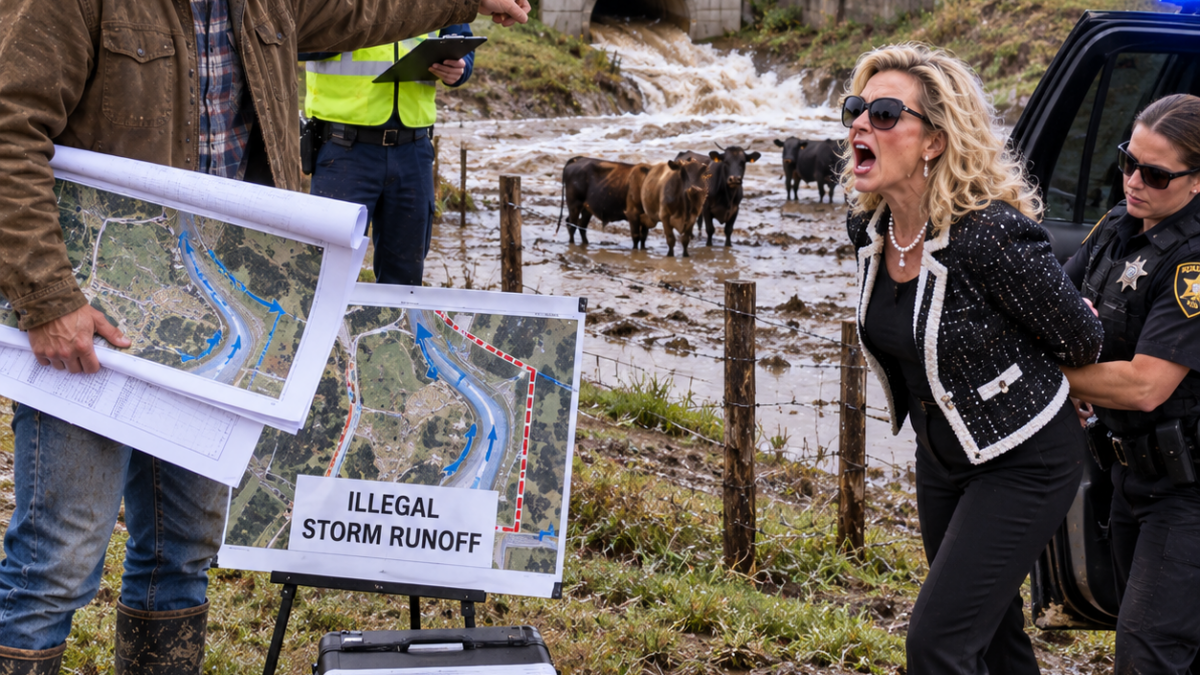
The HOA president stood on her dry, manicured lawn and told me the five acres of brown water drowning my pasture were “my drainage problem,” even though a brand-new culvert behind her subdivision was still pouring storm runoff straight onto my land.
My daughter’s mare was limping from standing in contaminated mud, sections of my fence were flattened, and the creek where we used to catch minnows had an oily sheen drifting across the surface.
Karen thought she had redirected a little rainwater away from her expensive neighborhood, but the engineer I called that afternoon would eventually put a price tag on every gallon she had sent across my property.
“That mud pit is your problem, Sergeant.”
Karen Miller folded her arms over her pink tracksuit.
“And if you keep tracking mud onto Pleasant Meadows sidewalks, I’ll have you cited for damaging community property.”
For a second, I honestly thought I had misheard her.
I looked at my boots.
Then across the road at my pasture.
Five acres of what had been green grass three days earlier were now buried beneath muddy water.
Fence posts leaned at impossible angles.
Plastic debris hung from the wire.
My daughter Emily’s quarter horse, Daisy, was standing on the small strip of higher ground near the barn, her left front hoof wrapped after an emergency veterinary visit.
Then I looked back at Karen.
“You understand that water is coming from your subdivision?”
“Our stormwater system is on HOA property.”
“That wasn’t my question.”
She smiled.
“Perhaps you should have considered drainage before buying farmland next to a premier residential community.”
I felt the old Army discipline settle over me.
Twenty years working with the Corps of Engineers had taught me that anger makes people loud.
Training makes them observant.
So instead of arguing, I asked:
“When was the drainage system changed?”
Her smile tightened.
“I don’t know what you’re referring to.”
“The thirty-six-inch culvert behind your berm.”
Silence.
“The one currently emptying your subdivision onto my pasture.”
She shrugged.
“We completed necessary drainage improvements.”
“With county approval?”
“Our board has authority over common areas.”
“That’s not county approval.”
Karen stepped closer.
“Mr. Davis, Pleasant Meadows is not responsible for the natural drainage conditions of neighboring agricultural land.”
Natural.
That word nearly made me laugh.
I had owned these ten acres before Pleasant Meadows existed.
I knew how rain moved across them.
I knew where water pooled after hurricanes.
I knew which section of the creek rose first after a three-inch storm.
And I knew there had never been a three-foot-wide pipe aimed downhill toward my pasture.
Three mornings earlier, after a night of hard spring rain, I had walked outside and found half my land underwater.
Daisy was trapped in the lower pasture.
Emily had been crying when we reached her.
“Dad, she won’t walk.”
Daisy lifted one front leg every few seconds, trembling.
The vet later diagnosed a severe hoof infection from prolonged exposure to contaminated standing water.
Treatment started immediately.
Recovery uncertain.
That alone was enough to make my hands shake.
But the engineer in me kept noticing details.
The volume.
The velocity.
The debris.
The smell.
The oily rainbow floating along the edge of the water.
I followed the flow uphill.
Behind ornamental grasses along Pleasant Meadows’ berm, I found the culvert.
New earth around it.
Fresh machine tracks.
No erosion protection.
No discharge basin.
Just a pipe pointed at my land like somebody had installed a cannon and loaded it with stormwater.
I had gone to Karen first because I still believed neighbors should speak before lawyers did.
That belief lasted approximately seven minutes.
“Our residents were experiencing standing water,” she told me.
“So you redirected it onto me?”
“We improved our drainage.”
“You transferred your problem.”
She gave me that smile again.
“Buyer beware.”
I didn’t answer.
I took out my phone.
Photographed her lawn.
Photographed my muddy boots.
Photographed the water visible beyond the berm.
Karen’s expression changed.
“What are you doing?”
“Documenting conditions.”
“Don’t photograph my property.”
“I’m standing on a public sidewalk.”
“You are becoming hostile.”
“No.”
I put the phone away.
“I’m becoming precise.”
Then I walked back toward my land.
Behind me, Karen called:
“You’ll hear from the HOA about those muddy footprints!”
I didn’t turn around.
By noon I had photographed every damaged fence post, collected water and soil samples, marked flood depths, launched my survey drone, and downloaded the original Pleasant Meadows drainage plans from county records.
By two o’clock, I found the first thing Karen never expected me to find.
The subdivision’s approved plan did not contain that culvert.
It showed retention ponds and a municipal stormwater connection.
No discharge onto my land.
None.
I stared at the county map.
Then at the brown lake outside my window.
Karen thought she had pushed rainwater downhill.
What she had actually done was send me the beginning of a case.
And the next call I made was to an engineer who knew exactly how expensive water could become once somebody deliberately sent it where it didn’t belong.
PART 2
Mike answered on the third ring.
“Jack Davis.”
His voice still sounded like gravel in a coffee can.
“Tell me you finally bought a boat.”
“Not intentionally.”
There was a pause.
“That bad?”
“Half my pasture is underwater.”
“Storm?”
“Subdivision runoff.”
Another pause.
Longer this time.
“Engineered?”
“Yes.”
“How sure?”
“Thirty-six-inch culvert. New installation. Pleasant Meadows drainage converges behind the berm.”
Mike stopped joking.
“Permitted?”
“Not on the county plan.”
“Send me everything.”
Mike Reynolds had spent twenty-four years with the Army Corps before leaving to start a civil engineering firm specializing in hydrology, stormwater design, erosion control, and the expensive mistakes people make when they assume water can be bullied.
I sent drone footage.
Photos.
County plat.
Survey.
Video of the culvert discharging.
A map of flood depths.
Pictures of Daisy’s injured hoof.
Then I waited.
Seven minutes later my phone rang.
“That is not natural drainage.”
“I know.”
“That flow is concentrated.”
“I know.”
“Who installed it?”
“HOA.”
“Who designed it?”
“Unknown.”
“Who inspected it?”
“Probably nobody.”
Mike swore softly.
“When can you get here?”
“Tomorrow morning.”
“Bring boots.”
“You think I own dress shoes?”
Fair.
That afternoon I continued documentation.
Flooding had dropped six inches.
Enough to reveal damage previously hidden.
Fence posts uprooted.
Topsoil washed into low pockets.
Pasture grass matted beneath sediment.
The creek bank had collapsed in two places.
I found dead minnows trapped in a shallow muddy pool.
That bothered me.
Daisy bothered me more.
Emily sat beside her in the barn while I changed the bedding.
She was fourteen.
Old enough to understand when adults were trying not to frighten her.
“Is she going to be okay?”
“The vet thinks so.”
“That’s not what I asked.”
I looked at my daughter.
Sarah had given her that directness.
My wife could ask one question and make evasion feel dishonest.
“The infection is serious.”
Emily swallowed.
“But we caught it early.”
“So she’ll be okay?”
“I think she will.”
Emily rubbed Daisy’s neck.
“Why did they do this?”
“They wanted water off their property.”
“Then why put it on ours?”
Good question.
“Because they thought they could.”
She looked at me.
“Can they?”
“No.”
That was not bravado.
Property law and drainage law vary by jurisdiction, but nobody gets automatic permission to engineer concentrated runoff onto a neighbor’s land simply because downhill is convenient.
Especially not when permits and approved plans say otherwise.
Still, being right and proving damages are different things.
That was Mike’s job.
Mine was evidence.
I collected samples at four locations.
Directly from culvert discharge.
Flooded pasture.
Creek downstream.
Creek upstream.
Control sample from unaffected high ground.
Date.
Time.
GPS.
Photos.
Cooler.
Chain of custody.
I sent them to a state-certified lab.
Then I drove to the county planning office.
The clerk pulled the original Pleasant Meadows file.
Boxes.
Maps.
Review comments.
Drainage calculations from the developer.
The original plan was exactly what I remembered.
Retention basin.
Overflow structure.
Storm sewer connection toward the public road.
No drainage easement across my property.
Then I found a letter.
Ten years old.
County engineering department to the original developer.
The developer had once proposed emergency overflow toward the agricultural watershed adjoining the subdivision.
The county rejected it.
In writing.
The reason:
Potential erosion.
Agricultural contamination.
Impacts to the creek.
Insufficient easement rights.
The developer had been instructed to contain and route runoff through the approved municipal system.
I copied everything.
Then I sat in my truck staring at the letter.
Karen had not merely improvised something the county had overlooked.
She had recreated an option the county had already considered and explicitly rejected.
That was different.
The question became:
Did she know?
The next morning Mike arrived at seven.
White pickup.
Survey gear.
Two cases of equipment.
He stepped out, looked across the pasture, and whistled.
“Congratulations.”
“For what?”
“You own a lake.”
“Temporary.”
“Expensive.”
He walked toward the culvert.
I followed.
Mike crouched beside the outlet.
Freshly exposed soil around the pipe showed obvious machine excavation.
No apron.
No riprap.
No energy dissipator.
No erosion-control matting.
Nothing to slow the velocity.
“Whoever installed this,” he said, “either didn’t know what they were doing or didn’t care.”
“Can you prove where the water comes from?”
He looked at me.
“Jack.”
“What?”
“This is why you called me.”
For the next nine hours, Mike turned my pasture into a field laboratory.
Survey points.
Slope profiles.
Flow measurements.
Outlet diameter.
Invert elevation.
Berm grades.
Creek cross sections.
Soil cores.
He launched his own drone and mapped the subdivision drainage network.
Then he climbed onto the berm.
From there we could see several storm inlets inside Pleasant Meadows.
Mike followed them.
Drainage structures converged toward the basin.
The basin had been modified.
Its previous outlet toward the municipal system appeared partially abandoned.
A freshly cut channel now directed overflow toward the new culvert.
He looked at me.
“This wasn’t someone sticking a pipe through a dirt pile.”
“What?”
“They changed the system.”
“How much?”
“Enough that somebody should have produced plans.”
“Can you tell when?”
“Recent excavation.”
I told him about the neighbor who remembered a backhoe two months earlier.
Mike nodded.
“Good.”
By sunset he had six pages of field notes.
I had one question.
“How bad?”
He looked across the floodplain.
“If the rain event was what the weather station says it was, the subdivision should never have produced this condition on your property under its approved drainage plan.”
“How much water?”
“Need calculations.”
“Guess.”
“I don’t guess professionally.”
“Unofficially?”
He smiled.
“A lot.”
The laboratory report arrived three days later.
Bacteria elevated downstream.
Nitrates.
Hydrocarbon traces consistent with roadway and driveway runoff.
Nothing exotic.
Exactly the sort of contamination you would expect when stormwater washes across streets, lawns, parking areas, and chemically treated landscaping before being concentrated through one outlet.
The important comparison was upstream versus downstream.
Upstream was substantially cleaner.
The culvert discharge matched the downstream contamination profile.
Mike incorporated everything.
His report took another week.
Fifty-three pages.
Maps.
Tables.
Storm event data.
Hydrologic modeling.
Original approved design.
Current altered configuration.
Flow paths.
Soil damage.
Erosion.
Remediation.
He called me before sending the final PDF.
“You sitting?”
“Should I be?”
“Yes.”
I sat.
“Direct pasture restoration, fence replacement, contaminated topsoil removal where warranted, creek stabilization, veterinary expenses, crop and grazing loss, testing, engineering, monitoring.”
“How much?”
“One hundred twenty-seven thousand four hundred fifty dollars.”
I was silent.
“You sure?”
“That is conservative.”
“Karen is going to say I’m extorting them.”
“Karen can say you caused the moon.”
“You’ll defend the report?”
“With my license.”
That was enough.
I delivered the claim to Pleasant Meadows by certified mail.
Engineering report.
Lab reports.
Vet bills.
Photos.
County drainage documents.
Demand to stop discharge immediately.
Request for restoration.
No threats.
No insults.
No military language.
Just facts.
Karen answered with silence.
For thirteen days.
Then a purple paper appeared on my mailbox.
Pleasant Meadows violation notice.
I read the heading twice.
**UNSIGHTLY PROPERTY CONDITION.**
My flooded pasture.
Apparently, according to the HOA, I had failed to maintain adjacent property in a manner consistent with Pleasant Meadows aesthetics.
There was one obvious problem.
I did not live in Pleasant Meadows.
My land was not subject to its covenants.
Not one acre.
I checked with the county clerk before buying.
My deed had no Pleasant Meadows declaration.
No HOA membership.
No architectural control.
Karen knew that.
She fined me anyway.
One hundred dollars per day.
I photographed the notice where it had been taped to my mailbox.
Then removed it.
Two days later:
Fence violation.
The fence their runoff knocked down.
Next:
Agricultural equipment.
My tractor.
Then:
Mud contamination of HOA pedestrian surfaces.
That one almost made me admire her commitment.
Mike called.
“She is creating exhibits for you.”
“I know.”
“Don’t stop her.”
“I wasn’t planning to.”
Then Karen finally scheduled my board appearance.
Three directors attended.
Karen.
Gary Peters.
Sharon Price.
Pleasant Meadows apparently had five authorized seats but only three active directors at the time.
The clubhouse smelled like stale coffee.
Karen sat center.
I set Mike’s report on the table.
Thud.
Gary flinched.
“This report was prepared by a licensed civil engineer specializing in stormwater hydrology.”
I pushed copies across.
“It concludes the flooding and damage to my property were caused by the unauthorized alteration of Pleasant Meadows’ drainage system.”
Gary opened it.
Sharon did not.
Karen barely glanced.
“We have our own experts.”
“Names?”
“That is confidential.”
“Engineering firm?”
“Not relevant.”
“Stamped report?”
“We are not required to share internal consultations.”
I looked at Gary.
He had reached the county denial letter.
His face changed.
Karen noticed.
“Gary.”
He closed the binder.
I continued.
“The county previously prohibited drainage onto my watershed.”
Karen waved one hand.
“That letter involved the original developer.”
“The drainage restriction applies to the approved system.”
“Our maintenance improvement did not require county involvement.”
“It changed your drainage outlet.”
“It repaired a longstanding deficiency.”
“Where is the permit?”
“No permit was required.”
“Where is the engineering plan?”
Karen leaned back.
“Mr. Davis, this board is not going to be interrogated by you.”
“I asked three questions.”
“And I’ve answered.”
“No. You haven’t.”
She looked at Sharon.
“All those in favor of dismissing Mr. Davis’s complaint?”
Sharon’s hand went up instantly.
Karen’s.
Gary waited.
His eyes dropped toward Mike’s report.
Karen stared.
Gary slowly raised his hand.
“Motion carries.”
Karen smiled.
“This matter is closed.”
Then she picked up one of the purple notices.
“Now, regarding your accumulating fines—”
I stood.
“This property isn’t in your HOA.”
Karen’s smile held.
“Adjacent-property nuisance provisions.”
“Do not apply to me.”
“Our attorney disagrees.”
“Name?”
Karen’s eyes sharpened.
“Meeting adjourned.”
I gathered my papers.
At the door I stopped.
“This is your formal notice.”
She looked up.
“You now have an engineering report documenting that your drainage system is damaging my land.”
I kept my voice flat.
“From this moment forward, every additional discharge occurs after actual notice.”
Karen laughed.
“Is that supposed to frighten me?”
“No.”
“What is it supposed to do?”
“Clarify the record.”
Then I left.
The next storm arrived four days later.
Not severe.
One inch of rain.
Enough.
I stood under an umbrella filming the culvert.
Water erupted through it.
Not catastrophic.
But concentrated.
Mud moved.
Fresh erosion carved another shallow channel.
I emailed the video to Karen.
Gary.
Sharon.
Subject:
**CONTINUED DISCHARGE AFTER FORMAL NOTICE**
No commentary.
Just date and time.
Dave called that evening.
Dave Morgan had been JAG before becoming a civil attorney.
We served together overseas.
After reviewing the file, he said:
“You have a strong civil case.”
“How long?”
“Could be a year. Could be three.”
“Cost?”
“Enough to hurt.”
“The HOA has deeper pockets.”
“They have homeowners’ dues.”
“Exactly.”
Dave paused.
“So change terrain.”
I smiled.
“You miss the Army.”
“Daily.”
“What terrain?”
“Regulators.”
He laid it out.
County planning.
State environmental enforcement.
HOA insurer.
Possibly watershed authorities depending on jurisdiction.
“Karen can ignore you.”
“She can make a lawsuit expensive.”
“She cannot order the county to ignore a master drainage violation.”
“She cannot order the state to ignore an unauthorized discharge.”
“And she definitely cannot order an insurance company to enjoy gross negligence.”
We spent four days preparing complaints.
No exaggeration.
That mattered.
Every accusation tied to an attachment.
County first.
Original approved plan.
County denial letter.
Current photos.
Survey.
Mike’s stamped report.
Then state environmental authorities.
Water results.
Erosion.
Sediment movement.
Creek impacts.
Then Pleasant Meadows’ insurer.
Formal notice of claim.
Damage estimate.
Knowledge timeline.
Board report.
Continued discharge after notice.
Dave smiled when we mailed the insurance package.
“Now somebody with money at risk knows.”
Two weeks later, a state environmental enforcement officer called me.
Her name was Rachel Albright.
“I’ve reviewed your complaint.”
“Okay.”
“I’d like to inspect both sides of the discharge.”
“You have access to mine.”
“I may need access through the subdivision.”
“That should be interesting.”
She did not laugh.
Good sign.
Site visit happened Thursday.
State SUV.
Safety vest.
Survey equipment.
Sampling kit.
Albright walked the entire damaged area.
Asked careful questions.
Did not accept Mike’s report blindly.
She checked measurements herself.
Took independent samples.
Photographed the pipe.
Reviewed flow path.
Then Karen appeared.
Teal tracksuit.
Gary behind her.
Sharon beside him.
Karen walked down the berm.
“This is private association property.”
Albright kept writing.
Karen stopped six feet away.
“I’m Karen Miller, president of Pleasant Meadows.”
Albright looked up.
“Good morning.”
“Were you given permission to enter?”
“I am conducting an authorized environmental inspection relating to a reported discharge.”
Karen folded her arms.
“This matter is under litigation.”
“No lawsuit has been filed,” I said.
Karen turned.
“You stay out of this.”
Albright looked between us.
“Ms. Miller.”
“Yes?”
“Did Pleasant Meadows install this culvert?”
Karen hesitated.
“It was part of a maintenance project.”
“Did the association authorize the work?”
“Yes.”
“Did you supervise it?”
“I oversaw the project.”
Gary visibly shifted behind her.
Albright wrote.
“Who prepared the engineering drawings?”
“We did not require engineering drawings.”
“Who determined permit requirements?”
“The board.”
Albright stopped writing.
“The board made that determination?”
“We were advised this was a repair.”
“By whom?”
“Our contractor.”
“Name?”
Karen’s jaw tightened.
“Benson Earthworks.”
Albright wrote it down.
“County permit number?”
“There was no permit.”
“State erosion-control approval?”
“Not necessary.”
“Stormwater modification approval?”
“No.”
Albright finally looked directly at Karen.
“So for the record, Pleasant Meadows authorized installation of this discharge structure without outside permitting or licensed engineering review?”
Karen understood too late.
Her face changed.
“We acted within our rights.”
Albright nodded.
“I’ll note your statement.”
Karen tried recovering.
“This man has drainage problems on his farmland.”
Albright pointed toward the pipe.
“I can see the pipe.”
“That doesn’t mean—”
“I’m not reaching conclusions today.”
Karen stopped.
Albright packed her equipment.
“Mr. Davis, thank you.”
Then to Karen:
“The department will correspond with the HOA formally.”
Karen watched the state vehicle leave.
Then looked at me.
“You think this makes you clever?”
“No.”
“You are going to regret attacking this community.”
“I asked you to stop sending water onto my land.”
“You’re trying to bankrupt families.”
“You spent their money building the pipe.”
Her face flushed.
“You’re done here.”
I looked around.
“I’m standing on my property.”
Then I walked away.
The insurer’s reservation-of-rights letter arrived the next week.
I did not receive it directly.
Arthur Henderson showed it to me.
Arthur lived three houses from the berm.
Retired accountant.
Seventy-one.
Quiet.
Precise.
He invited me inside.
“I think you should see this.”
The letter warned Pleasant Meadows that coverage might be limited or denied if the loss resulted from knowing violations, intentional conduct, or unpermitted construction.
The insurer reserved all rights.
Arthur looked sick.
“If they deny this, who pays?”
“The HOA.”
“That means us.”
“Potentially.”
“And if the board acted outside authority?”
“Dave says there may be claims against individual directors.”
Arthur leaned back.
“Karen never told us any of this.”
“What did she tell you?”
“That the drainage project was routine maintenance.”
“Cost?”
“Twenty thousand.”
“Assessment?”
“Yes.”
“Engineering?”
“None presented.”
“Bids?”
“Karen said the contractor had already been vetted.”
“Who?”
“Benson Earthworks.”
I wrote it down.
Arthur watched.
“You always take notes?”
“Yes.”
“Army?”
“Marriage.”
He laughed.
Then became serious.
“My patio cracked last month.”
“Near the berm?”
“Yes.”
“Ground soft?”
“Yes.”
Mike had predicted it.
Concentrating water changes saturation patterns on both sides.
I told Arthur.
His face hardened.
“So her fix may be damaging our property too.”
“Yes.”
That was when the fight changed.
Before Arthur, Pleasant Meadows residents saw me as outside trouble.
Karen’s newsletter helped.
**HOSTILE NEIGHBOR ATTACKS OUR COMMUNITY**
She called me greedy.
Claimed I wanted $127,000 for pre-existing farm problems.
Warned residents of lawsuits.
Arthur quietly began asking different questions.
Where did the $20,000 assessment go?
Who hired Benson?
Where were the plans?
Why had the county rejected drainage toward my property years earlier?
Why had Karen never disclosed that?
Why was the insurer reserving rights?
Why were patios near the berm cracking?
Questions are dangerous to people who survive on certainty.
More residents contacted Arthur.
One had wet soil behind his fence weeks after rain.
Another had a retaining wall beginning to lean.
A realtor named Jenna Parker worried about disclosures.
“If the county declares the drainage system noncompliant, anyone selling may have to disclose an active violation.”
That got attention.
Nothing mobilizes suburban homeowners faster than threats to saleability.
Karen’s “hostile neighbor” story began failing.
Then the county posted the violation notice at Pleasant Meadows’ entrance.
Large.
Official.
Impossible to ignore.
**UNAUTHORIZED MODIFICATION OF APPROVED STORMWATER SYSTEM**
**STOP WORK / CORRECTIVE PLAN REQUIRED**
Every resident drove past it.
Morning.
Evening.
The purple newsletters suddenly looked less convincing.
Arthur called.
“She’s losing them.”
“Don’t rush.”
“She scheduled another board meeting.”
“Good.”
“She says the county is overreaching.”
“Of course.”
“She says you pressured them.”
“I sent evidence.”
“I know.”
Arthur chuckled.
“People are starting to understand the difference.”
The state report followed.
Unauthorized discharge.
Erosion.
Potential pollutant transport.
Corrective measures required.
Possible civil penalties pending final review.
Karen responded by hiring counsel.
Finally.
Her attorney sent me a letter ordering all communication through him.
Dave read it.
“Excellent.”
“Why?”
“Adults are in the room now.”
The lawyer requested Mike’s supporting data.
We provided it.
He requested lab chain-of-custody records.
Provided.
He requested deed and survey.
Provided.
He requested horse veterinary records.
Provided with appropriate redactions.
Then silence.
Apparently Karen’s lawyer had discovered facts.
Arthur forced an emergency membership meeting using petition signatures.
More than half the subdivision signed.
I was invited.
Dave came.
Mike too.
The clubhouse held maybe sixty comfortably.
More than ninety arrived.
People stood along walls.
Karen sat at the front.
Gary looked like he hadn’t slept.
Sharon looked angry enough to chew steel.
Arthur held a microphone.
Karen struck the gavel.
“This emergency meeting—”
Arthur stood.
“We requested the meeting.”
“I am still president.”
“For now.”
The room reacted.
Karen’s cheeks reddened.
Arthur continued.
“We are asking questions tonight.”
“I have prepared a presentation—”
“No.”
That single word from quiet Arthur silenced her.
“We have had presentations.”
“We want answers.”
Applause.
Arthur held up the original twenty-thousand-dollar assessment notice.
“Question one.”
“Who authorized Benson Earthworks?”
Karen leaned toward microphone.
“The board.”
Gary looked up.
Arthur saw him.
“Gary?”
He swallowed.
“I voted for drainage improvements.”
“Did you vote for this culvert?”
Gary looked at Karen.
“No.”
The room stirred.
Sharon snapped:
“We authorized the president to execute the project.”
Arthur:
“Written resolution?”
Sharon had none.
Arthur continued.
“Were you shown the county’s prior denial of drainage toward Mr. Davis’s watershed?”
Gary:
“No.”
Sharon:
“That document was irrelevant.”
Arthur looked at Karen.
“Were you aware of it?”
Karen hesitated.
“Yes.”
The room exploded.
Arthur raised his hand.
“Please.”
People quieted.
“You knew the county previously rejected this exact drainage direction.”
“It was ten years old.”
“Did you disclose it?”
“The conditions changed.”
“Did an engineer document those changed conditions?”
Karen glared.
“Not required.”
Arthur held up the county violation.
“Apparently required.”
A homeowner shouted:
“How much is this going to cost us?”
Another:
“Is insurance paying?”
Arthur looked at Karen.
“That is question two.”
He held up the reservation-of-rights letter.
“Why did residents not receive notice that the insurer may deny coverage?”
Karen slammed one hand on the table.
“Because insurance correspondence is confidential.”
“Not when it creates a material financial risk to the association.”
Arthur had spent his career reading balance sheets.
Karen had finally met somebody who weaponized spreadsheets.
Then it was my turn.
I kept it short.
Drone image first.
Subdivision drainage basin.
Culvert.
Brown flow path.
My pasture.
No adjectives necessary.
Then approved plat.
Original retention system.
Municipal discharge.
Then county denial.
Then Mike’s hydrologic map.
Flood extent.
Then lab results.
Then photos of Daisy’s hoof.
Emily had asked me not to use dramatic pictures.
I used one.
Daisy standing on clean bedding with the treatment wrap.
“This horse belongs to my daughter.”
The room quieted.
“She was injured after being stranded in the contaminated lower pasture.”
I switched slides.
Fence damage.
Erosion.
Creek sediment.
Then Mike’s cost table.
**PASTURE SOIL RESTORATION**
**FENCE RECONSTRUCTION**
**CREEK BANK STABILIZATION**
**ENVIRONMENTAL TESTING**
**ENGINEERING**
**VETERINARY COSTS**
**MONITORING**
Total:
$127,450.
Someone whistled.
I looked at the residents.
“I didn’t choose that number.”
“My engineer calculated what restoration requires.”
Mike stood.
“I did.”
A homeowner asked:
“Could it be cheaper?”
Mike answered.
“If contamination depths are shallower than worst-case assumptions, yes.”
Another:
“Could it be more?”
“Yes.”
No salesmanship.
That gave him credibility.
I continued.
“I went to Karen before I called an agency.”
Karen stared.
“I asked for the discharge to stop.”
“I asked for a meeting.”
“I provided evidence.”
“The board dismissed it.”
“I did not create this financial problem.”
“I documented it.”
Then I stopped.
The room stayed quiet.
Arthur said:
“That’s the issue.”
He faced the homeowners.
“Who do you trust to resolve it?”
The recall vote was not legally as simple as shouting hands up.
Dave insisted on process.
Written ballots.
Eligibility.
Quorum.
Bylaw requirements.
Karen objected constantly.
Good.
Every objection documented.
The result:
Over ninety percent against her.
Gary removed.
Sharon removed.
Karen removed.
Arthur elected interim president pending regular election.
Karen remained seated after results were announced.
For the first time since I met her, she looked small.
Not physically.
In authority.
No one waited for her next instruction.
People gathered around Arthur.
Asked about remediation.
Legal counsel.
Insurance.
Assessment exposure.
She stood.
Picked up her purse.
Walked toward side door.
A homeowner called:
“Karen!”
She stopped.
“Where did the twenty thousand dollars go?”
She kept walking.
Another:
“Who approved the contractor?”
Another:
“Why did you lie about the county?”
She left without answering.
I felt no urge to follow.
Arthur’s first official call the next morning was to me.
“Can we meet?”
“Yes.”
“No purple paper.”
“Good start.”
We sat at my dining table.
Arthur.
New board counsel.
Mike.
Dave.
Susan Bell, new treasurer.
For the first time, nobody argued about cause.
Only remedy.
Mike presented stages.
First:
Stop discharge.
Remove illegal culvert.
Restore approved drainage on HOA property.
Second:
Stabilize berm.
Third:
Remove contaminated sediment and damaged topsoil from my pasture where testing supported it.
Fourth:
Restore grade.
Fifth:
Fence.
Sixth:
Creek stabilization.
Seventh:
Monitoring.
Arthur listened.
Then said:
“We’re responsible.”
The HOA lawyer nodded.
“We’re negotiating insurance and potential claims against prior directors and contractor, but yes.”
I looked at Arthur.
“That’s all I wanted from the beginning.”
“I know.”
He lowered his eyes.
“We should have listened sooner.”
“You weren’t on the board.”
“I lived there.”
That answer stayed with me.
A community sometimes allows bad leadership through silence.
Arthur understood his share of that.
So did many others.
The assessment still hurt.
Insurance covered portions after negotiation.
Benson’s insurer became involved.
The HOA reserves covered another portion.
Residents approved a temporary assessment for the remainder while recovery claims proceeded.
Nobody liked it.
But Arthur presented every number.
Invoices online.
Bids.
Contracts.
Minutes.
No secrets.
The illegal pipe came out first.
I stood with Emily near the fence.
An excavator lifted the thirty-six-inch culvert from the berm.
Mud poured from one end.
Emily crossed her arms.
“That caused all this?”
“Part of it.”
“It looks stupid.”
I laughed.
“That’s a very expensive engineering review.”
The crew cut the pipe into sections.
Hauling truck carried it away.
Water returned to approved routes.
The next heavy storm came two weeks later.
Emily and I stood under the porch watching.
Rain hammered the roof.
I kept checking the lower pasture.
Old habit.
Water followed natural swales.
Creek rose.
No brown wall.
No lake.
Emily smiled.
“It’s working.”
“Nature is.”
The damaged soil took longer.
Dump trucks.
Excavators.
Testing.
Clean fill.
Topsoil.
Seed.
Erosion blankets.
For weeks my land looked worse before it looked better.
That is restoration.
You tear out damaged material.
Expose scars.
Then rebuild.
Daisy recovered slowly.
Emily cleaned her hooves daily.
Medication.
Dry bedding.
Vet visits.
At first Daisy limped.
Then less.
Then one morning she walked normally.
Emily ran into the house.
“Dad!”
I thought something was wrong.
“She’s putting full weight on it!”
I followed her outside.
Daisy crossed the paddock.
No limp.
Emily cried.
So did I.
Not where she could see.
Much.
Three months later Emily rode her again.
Only walking at first.
A slow circle around the upper field.
Sarah stood beside me.
My wife had kept me grounded through the entire fight.
She slipped her arm through mine.
“That’s your victory.”
Not Karen losing her house.
Not county orders.
Not state fines.
Not the $127,450 report.
Emily.
Daisy.
Green grass returning.
She was right.
The state eventually finalized enforcement.
Pleasant Meadows received a significant civil penalty for unauthorized discharge and environmental violations.
The report specifically criticized the decision-making behind the project.
Karen’s role was documented.
The county required final engineering certification.
Benson Earthworks faced its own consequences involving unpermitted work.
Then came the lawsuits.
Pleasant Meadows sought recovery against the contractor.
The HOA also pursued former directors for losses tied to conduct outside authorized procedures.
Gary cooperated.
He admitted Karen pushed the project.
He admitted he voted without reviewing documentation.
He provided emails.
Sharon fought longer.
Karen longest.
Her defense was that the board collectively approved improvements and that she relied on contractor advice.
Emails complicated that.
Arthur obtained messages.
Karen to Benson:
**I want all basin overflow routed behind Davis’s pasture.**
Contractor:
**Need to confirm easement.**
Karen:
**HOA owns berm. Do it.**
Contractor:
**Discharge is outside HOA parcel.**
Karen:
**He has ten acres. Water will dissipate.**
That message traveled through the neighborhood like electricity.
He has ten acres.
As if land was empty because it wasn’t covered in houses.
As if my pasture existed for their convenience.
As if Daisy standing in mud was acceptable because Pleasant Meadows lawns stayed dry.
The lawsuit settled.
Terms mostly confidential.
But residents learned enough.
Karen sold her house.
Her settlement contribution and contractor recovery returned money to the HOA.
Special-assessment refunds followed later.
Not full.
Meaningful.
Arthur mailed each homeowner a detailed accounting.
Karen disappeared from Pleasant Meadows.
No dramatic goodbye.
No confrontation at the moving truck.
One morning her house had curtains.
That afternoon it didn’t.
Then a for-sale sign.
Then new owners.
I preferred that.
People like Karen sometimes occupy too much mental acreage.
At some point, eviction from your thoughts matters more than eviction from the neighborhood.
The pasture grew.
First thin.
Then green.
Native grass took root.
Fence rebuilt.
Creek banks stabilized with native shrubs.
Pleasant Meadows funded a conservation planting along their side too.
Mike designed a proper stormwater rehabilitation project.
Actual engineer.
Permits.
Calculations.
Retention improvements.
Emergency overflow.
Maintenance schedule.
No pipes aimed at neighbors.
He presented the final plan at the clubhouse.
A resident raised her hand.
“Can you explain why this costs more than Karen’s solution?”
Mike smiled.
“Because this one is legal.”
Laughter filled the room.
Then he added:
“And because water management isn’t about making water disappear. It’s about controlling where it goes, how fast it gets there, and what happens downstream.”
That sentence became almost philosophical in Pleasant Meadows.
Downstream.
People started using it metaphorically.
Arthur once told the board:
“Before we approve anything, ask who is downstream.”
Good governance in six words.
Who pays later?
Who gets affected?
Who isn’t in the room?
Who absorbs the consequence?
Karen never asked.
Arthur always did.
Pleasant Meadows changed.
Financial controls.
Multiple bids.
Engineering review for infrastructure.
Conflict disclosures.
Resident access to minutes.
Reserve studies.
No more unilateral president spending.
Gary apologized to me.
He came one Saturday.
Stood at the fence.
“I should’ve stopped her.”
“You should have asked questions.”
“I was afraid of confrontation.”
“Most people are.”
“That’s not an excuse.”
“No.”
He looked at the pasture.
“Looks good.”
“It’s getting there.”
“I’m sorry about your daughter’s horse.”
“Thank you.”
He held out his hand.
I shook it.
Forgiveness is easier when someone doesn’t demand it.
Sharon never apologized.
That was her choice.
I stopped caring.
Arthur remained president for three years.
Then resigned voluntarily.
At his final meeting, residents gave him a plaque.
He hated it.
Good.
Sarah and I attended Pleasant Meadows’ first creek cleanup event afterward.
Thirty residents crossed onto a permitted public access area downstream.
Trash bags.
Gloves.
Kids.
Arthur picked up plastic bottles.
Jenna Parker organized recycling.
Mike taught children about watersheds.
Emily brought Daisy near the fence where everyone could see her.
One child asked:
“Is that the horse that got sick?”
Emily nodded.
“She’s okay now.”
“What happened?”
Emily pointed uphill.
“People sent too much dirty water where it didn’t belong.”
The child thought.
“Why?”
Emily shrugged.
“They didn’t think about us.”
That was more accurate than anything I could have said.
The worst decisions often come from people who do not see those downstream as real.
One year after restoration, I had Mike run final tests.
Creek water improved.
Pasture soil acceptable.
No ongoing contamination attributable to the event.
He handed me the final report.
“Congratulations.”
“What?”
“You are officially boring again.”
“Best report you’ve written.”
I paid his invoice.
He tried discounting it.
I refused.
“Your report saved my land.”
“Your evidence made my report possible.”
“Still paying.”
“Stubborn.”
“Professional.”
That evening, I filed the final report.
My original binder had grown to four.
Photos.
Lab work.
County documents.
State correspondence.
Insurance.
HOA letters.
Legal settlement records.
I put them in a cabinet.
Then closed the drawer.
Sarah watched.
“That’s it?”
“For now.”
“No celebration?”
I looked outside.
Emily was riding Daisy.
Sun low.
Pasture green.
“What would we celebrate?”
She smiled.
“Exactly.”
Years passed.
Emily graduated.
Daisy grew older.
Pleasant Meadows added a walking trail near the creek designed with proper setbacks.
They invited me to the opening.
I resisted.
Arthur called.
“Come.”
“Why?”
“You’re part of the reason it exists.”
“I almost sued you into financial ruin.”
“Details.”
At the trail entrance was a small educational board.
No names.
No Karen.
Good.
It explained stormwater.
Retention.
Runoff.
Watershed responsibility.
At the bottom:
**EVERY PROPERTY IS DOWNSTREAM FROM SOMEONE AND UPSTREAM FROM SOMEONE ELSE.**
I liked that.
Children walked the trail.
Nobody knew the original fight.
Better.
A neighborhood should remember lessons without needing villains forever.
Daisy lived to twenty-three.
The day we put her down was harder than the flood.
Emily was in college but drove home.
She held Daisy’s head.
The vet was gentle.
Afterward, Emily sat in the pasture.
Same land Karen once flooded.
She cried.
“I hate that this is where she got sick.”
I sat beside her.
“This is also where she recovered.”
“I know.”
“Where you rode her.”
“I know.”
“Where she lived.”
Emily looked across the grass.
“Which memory wins?”
“Whichever one you feed.”
She leaned against me.
We buried Daisy near the old oak stand.
Not in the floodplain.
Engineer’s choice.
Emily rolled her eyes when I said that.
Years later, she brought her own daughter to the grave.
My granddaughter asked why there was a horseshoe nailed to the oak.
Emily told her about Daisy.
Not Karen.
Not runoff.
Just a horse she loved.
That was right.
The pasture became more than recovery.
I leased part of it to a young couple raising sheep.
Later I planted native wildflowers along the creek buffer.
Pleasant Meadows partnered with a conservation group.
Arthur donated.
Jenna handled grant paperwork.
Mike reviewed erosion plans for free.
He complained the entire time.
The creek became cleaner than before the incident.
Not because disasters are good.
They aren’t.
But once damage forces people to look closely, they sometimes finally fix problems that existed quietly for years.
The original Pleasant Meadows retention system had been poorly maintained long before Karen.
Sediment reduced capacity.
Outlets clogged.
Instead of paying to repair properly, Karen chose the cheap shortcut.
That mattered.
Karen was responsible for her choices.
But the conditions that allowed her choice included deferred maintenance, inattentive boards, residents who wanted low dues, and years of nobody asking difficult questions.
Pleasant Meadows learned that too.
Every budget meeting after that included stormwater reserves.
Boring.
Essential.
Arthur once joked:
“People would rather vote on flowers than culverts.”
“Flowers don’t destroy farms.”
“Exactly.”
The new board funded what nobody sees.
Drainage.
Insurance.
Reserves.
Inspections.
The invisible systems that keep visible life functioning.
That is adulthood in infrastructure form.
Ten years after the flood, a tropical system brought nearly eight inches of rain in forty-eight hours.
Worse than the storm that started everything.
I barely slept.
At three in the morning I walked outside with a flashlight.
Rain sideways.
Creek roaring.
Pasture saturated.
But no catastrophic flow.
Pleasant Meadows retention pond rose.
Overflow system worked.
Water released gradually toward approved municipal infrastructure.
My lower field had shallow natural sheet flow.
Nothing more.
At daylight Arthur—long retired from the board—called.
“How’s the farm?”
“Wet.”
“Flooded?”
“No.”
He laughed.
“Mike’s system works.”
“Engineering usually does when people pay attention.”
I stood on the porch listening to rain.
For the first time, a major storm did not make me think of Karen.
It made me think of competence.
That was healing.
Mike died several years later.
Heart attack.
Sudden.
At his memorial, his daughter asked if I wanted to speak.
I did.
I told the room about the day he stood beside the illegal culvert.
He looked at it for ten seconds and said:
“Amateurs.”
Everyone laughed.
Then I held up a copy of his report.
“This report was fifty-three pages.”
“Most people thought it was about money.”
“It wasn’t.”
“It was about accountability.”
I looked at his family.
“Mike took water seriously because water does not care who signed the check, who owns the HOA, or who has the loudest voice.”
“He followed the facts downhill.”
“That saved my property.”
Afterward, his daughter gave me his old field notebook from my case.
Inside, on the first page, Mike had written:
**DAVIS PROPERTY — RUNOFF DIVERSION**
Below:
**LIKELY EASY CASE IF PEOPLE STOP LYING.**
I laughed so hard I cried.
I framed that page.
Eventually Sarah and I downsized.
The ten acres became too much.
Emily wanted the property.
That surprised me.
“You live two hours away.”
“Not forever.”
“What would you do with it?”
“Keep some horses.”
“Again?”
She smiled.
“Apparently childhood trauma didn’t work.”
I stared at her.
“You actually want the farm?”
“Yes.”
“Even after everything?”
“Because of everything.”
That answer hit me.
She moved back two years later.
Her husband worked remotely.
Their daughter started riding.
The pasture stayed in the family.
Pleasant Meadows was still next door.
Different board.
Different residents.
Different culture.
One Saturday my granddaughter rode a small mare along the fence.
A boy from Pleasant Meadows watched from the walking trail.
“Can I pet her?”
My granddaughter looked at Emily.
Emily nodded.
The boy reached through carefully.
The horse sniffed his hand.
No hostility.
No property war.
No downstream enemy.
Just neighbors.
I stood under the oak watching.
Sarah came beside me.
“You thinking about Karen?”
“No.”
“Really?”
I smiled.
“No.”
“What are you thinking?”
“That this is what should’ve happened from the beginning.”
Two properties.
Different uses.
Shared watershed.
Mutual respect.
Simple.
Hard.
Years later, Pleasant Meadows invited Emily to serve on its environmental advisory committee even though she wasn’t an HOA member.
She laughed when she told me.
“What did you say?”
“Yes.”
“Why?”
“Because we’re downstream.”
I couldn’t argue.
The committee reviewed stormwater inspections.
Creek health.
Native planting.
They included adjacent landowners in planning.
That single procedural choice probably prevented more conflict than any fancy rule.
Who is downstream?
Ask them before you act.
My granddaughter learned the story eventually.
Not from me.
School project.
Local environmental planning history.
She came home with printed articles.
“Grandpa.”
I knew that tone.
“What?”
“You sued an HOA?”
“I threatened to.”
“You got the state involved?”
“Yes.”
“You flew a drone?”
“Yes.”
“You had a fifty-three-page engineering report?”
“Yes.”
She looked impressed.
“That’s awesome.”
“No.”
“It is.”
“It was expensive.”
She read.
“They had to pay $127,450?”
“Approximately.”
“And the president lost her house?”
“Settlement contributed to that.”
“You destroyed her.”
I shook my head.
“No.”
“But—”
“She made decisions.”
“Agencies enforced rules.”
“Residents removed her.”
“Lawyers negotiated money.”
“Engineers repaired damage.”
“No single person destroyed her.”
My granddaughter considered.
“Would you do it again?”
“Yes.”
“Exactly the same?”
I thought.
“No.”
“What differently?”
“I would have gone to regulators sooner.”
She laughed.
Not what she expected.
Then she asked:
“Did you hate her?”
“For a while.”
“Do you now?”
“No.”
“Why?”
I looked toward Pleasant Meadows.
“Because hate is an ongoing payment.”
She frowned.
“What?”
“You keep paying long after the bill is settled.”
She wrote that down.
Teenagers collect quotes when they think old people accidentally say something useful.
A few months later she showed me her school essay.
Title:
**WHO IS DOWNSTREAM?**
It was about stormwater justice.
Not Karen.
Systems.
Externalities.
How one community’s convenience can become another property owner’s loss.
She used my farm as a case study.
Then she expanded it.
Industrial pollution.
Urban runoff.
Flood control.
Development.
Infrastructure.
The small suburban fight had taught her a larger idea.
Actions move.
Water moves.
Costs move.
Responsibility should move with them.
She won a state essay competition.
Mike would have been unbearable about it.
I attended the ceremony.
She thanked me.
I told her to thank hydrology.
She rolled her eyes.
The pasture remained green.
That became my final measure.
Not settlement amounts.
Not penalties.
Not headlines.
Green grass.
Clear creek.
Healthy animals.
A family still using the land.
Pleasant Meadows paying for proper drainage maintenance.
No one secretly sending their problem downhill.
Karen’s greatest mistake was not the illegal culvert.
That was engineering stupidity.
Her greatest mistake was believing distance erased responsibility.
Water left her neighborhood.
So she thought the problem had disappeared.
It hadn’t.
It had simply arrived at my house.
That principle applies to more than water.
Debt.
Pollution.
Bad policies.
Neglected maintenance.
Cruel decisions.
Somebody is always downstream.
Years after all the lawsuits ended, Arthur and I sat beside the creek.
He was eighty-six.
Walked with a cane.
Still complained about improper bookkeeping.
He watched water move around the rocks.
“You know the funny thing?”
“What?”
“I used to think HOA president mattered.”
“It does.”
“No.”
He shook his head.
“It matters less than good minutes.”
I laughed.
“Spoken like an accountant.”
“Karen had power because nobody wanted to read anything.”
“That’s partly true.”
“And because we didn’t want conflict.”
“That too.”
Arthur looked toward Pleasant Meadows.
“Silence is expensive.”
I nodded.
That might have been the best summary of the whole thing.
Residents stayed quiet.
Gary stayed quiet.
People let Karen call shortcuts improvements.
Then everyone paid.
Literally.
The lesson cost more than a hundred thousand dollars.
At least they learned it.
Arthur died the following winter.
Pleasant Meadows planted an oak near the trail in his memory.
The plaque said:
**ARTHUR HENDERSON
ASK THE SECOND QUESTION**
Perfect.
I visited once.
Stood beside the young oak.
First question:
What does this project do for us?
Second question:
What does it do to everyone else?
Arthur understood.
That became Pleasant Meadows’ unofficial culture.
My granddaughter eventually studied civil engineering.
Of course.
At university, she called after her first hydrology exam.
“I hate you.”
“Why?”
“Because runoff coefficients.”
I laughed.
“Mike is responsible.”
“He’s dead.”
“Convenient.”
She graduated.
Joined a regional water-resources firm.
On her first major project she reviewed a new housing development.
The developer proposed emergency overflow near agricultural land.
She called me that evening.
“You’ll never guess.”
“I can.”
“They want to route excess runoff downhill.”
“Whose land?”
“Farm.”
“Easement?”
“No.”
“Model?”
“Incomplete.”
“What did you say?”
She smiled through the phone.
“Who’s downstream?”
I sat quietly.
There it was.
Not revenge.
Legacy.
Karen once pointed a culvert at my pasture because she thought ten acres of someone else’s land was cheaper than fixing her own retention system.
Decades later, a young engineer who grew up hearing that story stopped another version before it began.
That meant more than any settlement.
More than every fine.
The best justice does not only repair yesterday.
It prevents tomorrow.
One autumn evening, long after I stopped doing farm work myself, I walked the lower pasture with Emily.
Daisy’s grave beneath the oak was covered with fallen leaves.
Creek clear.
Grass thick.
Pleasant Meadows roofs visible beyond the berm.
No pipe.
No brown water.
Emily hooked her arm through mine.
“You ever miss the fight?”
I stared at her.
“What kind of question is that?”
“You were alive during it.”
“I was furious.”
“Same thing for you sometimes.”
She knew me too well.
“No.”
I looked across the field.
“I don’t miss fighting.”
“What do you miss?”
“Being young enough to think every problem could be fixed with enough paperwork.”
She laughed.
“Can’t it?”
“No.”
“Most?”
“Maybe.”
We reached the creek.
Water moved quietly.
Not justice.
Not revenge.
Water has no morality.
Gravity simply pulls.
That was why systems mattered.
Someone has to decide where water is allowed to go.
Someone has to remember property lines.
Easements.
Capacity.
Consequences.
Someone has to protect people downstream.
Karen failed that responsibility.
Then spent months refusing to admit it.
My engineer made her pay for every ruined acre.
But money was only the accounting.
The real payment was losing authority.
Losing trust.
Losing the ability to push consequences onto someone else and walk away.
And the real victory was never watching her leave Pleasant Meadows.
It was standing years later in a pasture she once turned into a swamp and hearing my granddaughter explain runoff to a child beside a clean creek.
That was the ending Karen never imagined.
The land recovered.
The horse recovered.
The neighborhood recovered.
Even the people who had once defended Karen learned to become better neighbors.
The pipe disappeared.
The scars faded.
The lesson stayed.
Whenever storms roll over the hills now, rain still falls on Pleasant Meadows.
It still falls on my pasture.
It still finds the low ground.
But now it moves through systems designed by engineers, reviewed by regulators, maintained by people who understand that sending a problem away does not make it vanish.
And when I hear the creek running after a storm, I no longer hear the roar of that illegal culvert.
I hear something quieter.
Something Sarah once said while we were choosing the farm.
“This land doesn’t have to be perfect, Jack.”
“It just has to be ours.”
Karen tried to turn it into the place her community sent what it didn’t want.
Mud.
Runoff.
Risk.
Responsibility.
We refused.
We restored every acre.
We rebuilt every fence.
We cleaned the creek.
We healed the horse.
And eventually, we stopped talking about Karen at all.
Because the strongest revenge was not watching her lose.
It was watching everything she tried to damage keep growing after she was gone.
The pasture stayed green.
The creek ran clear.
Emily’s laughter became her daughter’s laughter.
And whenever the rain came down hard enough to test all of us, the water finally went where it was supposed to go.
Justice, like water, eventually found its own level.
For almost two years after Pleasant Meadows finally rebuilt its drainage system, the storms stopped frightening me.
That may sound like a small thing.
It wasn’t.
For months after Karen’s culvert was removed, every dark cloud had tightened something in my chest.
I would walk outside before the first drop fell.
Check the creek.
Check the pasture.
Check the slope behind the berm.
Check the fence line.
Then check it all again.
Sarah used to stand at the kitchen window and watch me pace.
“You know Mike signed off on the new system.”
“I know.”
“The county approved it.”
“I know.”
“The state closed the enforcement file.”
“I know.”
“The pipe is gone.”
“I know.”
She would smile.
“Then why are you wearing boots before it’s raining?”
“Preparedness.”
“Paranoia.”
“Experience.”
Eventually, even I learned to stop looking uphill every time thunder rolled.
The new Pleasant Meadows retention basin worked.
The restored outlet carried runoff toward the municipal system.
The creek flowed where it had flowed for decades.
My pasture stayed green.
The scars disappeared.
And life became beautifully ordinary.
Emily finished high school.
Daisy grew older.
Pleasant Meadows had boring HOA meetings.
Arthur resigned after his term and started spending more time fishing.
Mike sent me Christmas cards featuring pictures of drainage failures from other counties because apparently hydrologists have their own strange sense of humor.
Karen became a name nobody used much anymore.
Exactly the way I wanted it.
Then, one October morning, I found water where water should not have been.
Not much.
A shallow puddle beside the northern fence.
Maybe three inches deep.
I noticed it while carrying feed.
It had not rained in four days.
I stopped.
Looked uphill.
Pleasant Meadows sat quiet behind the berm.
No visible discharge.
No broken pipe.
Nothing.
I crouched.
The soil around the puddle was soft.
Too soft.
I touched the grass.
Wet.
Then smelled my fingers.
Nothing unusual.
No sewage.
No petroleum.
No fertilizer odor.
Still, something felt wrong.
Engineers develop instincts the same way old farmers do.
Patterns matter.
This one didn’t fit.
I took a photograph.
Marked the location.
Then forced myself to walk away.
One unexplained puddle is not a crisis.
By afternoon it was gone.
I said nothing to Sarah.
The next morning, it was back.
Larger.
That got my attention.
I drove a survey stake beside it and marked the water line.
Then walked the entire fence.
Twenty yards farther east, another wet spot.
Not standing water.
Saturated soil.
I stared toward Pleasant Meadows.
The closest home belonged to a young couple named the Parkers.
Good people.
No connection to Karen.
No reason to suspect anything.
I climbed the berm from my side.
The vegetation on Pleasant Meadows’ side looked normal.
No pond overflow.
No erosion.
No obvious leak.
Then I heard it.
A faint hiss.
I froze.
Listened.
Nothing.
Then again.
Hiss.
Not air.
Water.
I followed the sound.
Near a cluster of ornamental grasses, the soil trembled slightly.
I pushed one plant aside.
A thin stream of clear water was bubbling from the ground.
Not runoff.
Pressurized flow.
“Interesting.”
That word usually means expensive.
I walked home.
Called Mike.
He answered:
“You missed me.”
“I found water.”
“Congratulations. Earth has plenty.”
“Coming out of the berm.”
Silence.
“After four dry days?”
“Yes.”
“Clear?”
“Yes.”
“Constant?”
“Seems to be.”
“Municipal line?”
“Could be.”
“Stormwater line?”
“Not pressurized.”
“Irrigation?”
“Maybe.”
Mike sighed.
“You already started a notebook, didn’t you?”
“Yes.”
“Of course you did.”
He drove out the following afternoon.
We dug carefully by hand near the seep.
Six inches down:
Wet gravel.
Another foot:
A buried plastic line.
Not large.
Maybe two inches.
Blue stripe.
Mike looked at it.
“Water service.”
“To what?”
“Good question.”
We did not expose more.
That required utility location and permission on the HOA side.
Mike called the county.
The next day, a locator marked underground utilities.
The buried line ran parallel to the berm.
Then turned toward the Pleasant Meadows common area.
Arthur happened to be visiting when we discovered it.
He stood beside me.
“Please tell me Karen did not install another pipe.”
“No.”
Mike pointed.
“This is pressurized water.”
Arthur frowned.
“Why would there be a water line behind the houses?”
I looked at Pleasant Meadows.
“Maybe irrigation.”
Arthur shook his head.
“Common irrigation comes from the front entrance.”
“Then what?”
Nobody knew.
The new HOA president did the right thing.
Immediately.
Her name was Rebecca Sloan.
Forty-two.
Civil servant.
Organized.
No tracksuits.
No gavel addiction.
She arrived with utility records.
“We don’t have this line on our plans.”
Mike took the folder.
“Original developer plans?”
“Yes.”
“Any abandoned infrastructure?”
“Not that I can find.”
Rebecca looked worried.
“Could Karen have installed it?”
Arthur laughed without humor.
“At this point, I wouldn’t rule out a missile silo.”
Rebecca didn’t smile.
“This line is on HOA common property.”
Mike nodded.
“And it’s leaking toward Jack’s pasture.”
Rebecca looked at me.
“We’ll fix it.”
That simple sentence still felt miraculous.
No argument.
No blame.
No purple notice.
No “buyer beware.”
Just:
We’ll fix it.
A contractor came.
Excavated.
Found a split coupling.
The line fed three old irrigation hydrants near the tennis courts that nobody used anymore.
Mystery solved.
Repair cost:
Four hundred eighty dollars.
No scandal.
No conspiracy.
No war.
I laughed when Rebecca emailed me the invoice.
Sarah looked over my shoulder.
“You’re disappointed.”
“I am not.”
“You wanted a secret pipe.”
“No.”
“You wanted Mike to build another fifty-page report.”
“Never.”
“You wanted to sue someone.”
“Absolutely not.”
She smiled.
“You’re healing.”
Maybe.
That should have been the end.
Instead, the leak led us to something buried six feet beyond it.
The contractor’s excavator operator saw the metal first.
He stopped immediately.
Called Mike over.
I walked up.
“What?”
He pointed into the trench.
A rusted steel corner.
Not pipe.
Flat plate.
Mike crouched.
“Old utility box?”
The operator shook his head.
“Too big.”
They widened the excavation slightly.
More steel appeared.
Then wood.
Old treated timber.
Rebecca stood above the trench.
“I’ve never seen this on any plan.”
Mike brushed mud from the metal.
There were bolts.
A frame.
Something substantial.
He looked at me.
“Jack.”
“What?”
“This was built.”
“Obviously.”
“No.”
He pointed to the orientation.
“This isn’t random debris.”
The contractor exposed another section.
A concrete wall appeared beneath the berm.
Then another.
Arthur, who had shown up because Arthur apparently had no concept of staying home, stared into the hole.
“What in God’s name is that?”
Mike didn’t answer.
He climbed down with a flashlight.
I followed.
The concrete wall extended deeper than the excavation.
At one point, dirt had collapsed inward.
Behind it:
Dark space.
A void.
Mike shone his light.
Nothing reflected.
“Stop.”
He climbed back out.
“No more digging.”
Rebecca nodded immediately.
“Why?”
“Possible buried structure.”
“Old drainage vault?”
“Maybe.”
Arthur looked at me.
“You knew about this?”
“No.”
Mike studied the berm.
“How old is Pleasant Meadows?”
“About twenty years.”
“And this berm?”
“Original.”
He looked toward the old county road.
Then back toward my pasture.
“Jack, when did you buy your land?”
“Before the subdivision.”
“Did the previous owner ever mention anything here?”
I thought.
“No.”
Then something surfaced.
A memory.
Barely.
The previous owner had been an elderly farmer named Walter Briggs.
When I walked the property before closing, he once pointed toward the ridge and said:
“Don’t dig too deep up there.”
I had assumed he meant rock.
“What?”
Mike asked.
“Nothing.”
“Jack.”
“Old owner said something strange.”
“What?”
“Don’t dig too deep up there.”
Arthur laughed nervously.
“That is not what you say when there’s nothing buried.”
Rebecca folded her arms.
“Could be an old septic tank.”
“Too large,” Mike said.
“Storm vault?”
“Wrong orientation.”
“Cold War bunker?”
Arthur offered.
Rebecca looked at him.
“Please stop helping.”
The county building department came the next morning.
Then public works.
Then fire rescue.
Because once someone says unidentified buried structure, everyone suddenly becomes interested.
They brought cameras.
Air monitor.
Confined-space equipment.
The opening was widened safely.
A camera went inside.
We watched on a small monitor.
Concrete corridor.
Maybe four feet wide.
Water staining.
Rusted conduit.
Then:
A steel door.
Arthur whispered:
“Oh, come on.”
Rebecca looked at me.
“I am going to resign.”
Mike smiled.
“Too late.”
The camera moved closer.
The steel door had a faded stencil.
Most of it unreadable.
One word remained:
CONTROL
Nobody spoke.
The fire captain looked at the county engineer.
“You know what this is?”
“No.”
They checked historical utility records.
Nothing.
County maps.
Nothing.
Old development plans.
Nothing.
Then someone found a parcel map from the 1960s.
The land Pleasant Meadows occupied had once belonged to a textile company.
Not residential.
Industrial.
A dye-processing facility had operated half a mile away.
Arthur stared.
“You mean there was a factory here?”
“Nearby,” the county engineer said.
“What kind of control room gets buried?”
Nobody answered.
The county halted excavation.
Environmental authorities were notified.
Mike looked at me.
“Remember how I told you your original drainage case was easy if people stopped lying?”
“Yes.”
“This one might not be easy.”
For the next week, my pasture again filled with official vehicles.
But this time, the water was not the problem.
The ground was.
State environmental investigators pulled historical records.
Aerial photographs.
Industrial permits.
Old newspaper archives.
The textile company had closed in 1978.
There had been a fire.
Then bankruptcy.
Land sold.
Records incomplete.
Development came decades later.
One archived article mentioned something called:
Process Water Recovery Facility.
Mike read it twice.
“Process water.”
“What?”
“Industrial wastewater.”
My stomach tightened.
Rebecca went pale.
“You think that structure held chemicals?”
“Maybe.”
“Under the neighborhood?”
“Maybe.”
Arthur looked toward the houses.
“How does nobody know?”
The environmental investigator answered.
“People forget.”
That sentence bothered me more than anything.
People forget.
Developers change.
Companies disappear.
Records get lost.
Then someone builds houses.
Families arrive.
Children play.
Grass grows.
And history sits underground waiting for an excavator bucket.
The state ordered soil sampling around the buried structure.
Groundwater monitoring too.
I volunteered access from my side.
The first results were mostly normal.
Then one monitoring well near the berm showed elevated chlorinated solvents.
Not catastrophic.
Not proof of an active plume.
But enough to trigger more investigation.
Rebecca called an emergency community meeting.
This one felt nothing like Karen’s meetings.
No blame.
No theatrics.
County officials attended.
State environmental staff attended.
A toxicologist explained the data.
Residents asked terrified questions.
“Is our drinking water safe?”
Municipal water.
Yes.
“Are children exposed?”
No known pathway identified yet.
“Are homes contaminated?”
No evidence so far.
“Is this because of the old drainage project?”
No.
Different issue.
“Did Karen know?”
That question changed the room.
Rebecca looked at me.
I looked at Arthur.
Arthur stared at the floor.
Then one former board member raised his hand.
Gary.
Older now.
He rarely attended meetings after Karen.
“What?”
Rebecca asked.
Gary swallowed.
“There was something.”
The room quieted.
“What do you mean?”
Gary rubbed his forehead.
“When Karen did the drainage project…”
He stopped.
Arthur leaned forward.
“Gary.”
“We found concrete.”
My pulse changed.
“When?”
“During excavation.”
Mike looked at him.
“Where?”
“Behind the berm.”
The room exploded with voices.
Rebecca raised both hands.
“What happened?”
Gary looked ashamed.
“Contractor said it was probably old foundation debris.”
“Did anyone report it?”
“No.”
“Why not?”
Gary looked toward me.
Then away.
“Karen said reporting it would delay the drainage project.”
I felt cold.
Mike’s voice became very quiet.
“Did the contractor open it?”
Gary nodded.
“What did he see?”
“I don’t know.”
“You were there?”
“No.”
“What did Karen say?”
Gary hesitated.
Then:
“She said it was an old utility vault and nothing to worry about.”
Rebecca stared.
“You’re telling me the board knew there was a buried concrete structure before Pleasant Meadows installed the illegal culvert?”
Gary’s face had gone gray.
“Yes.”
“And Karen ordered work to continue?”
“Yes.”
Arthur stood.
“You never told us?”
Gary looked at him.
“I was scared.”
Arthur’s voice broke.
“People built homes here.”
“I know.”
“Children.”
“I know.”
Mike asked:
“Did they move soil?”
Gary nodded again.
My stomach dropped.
“How much?”
“I don’t know.”
“Where?”
Gary looked at me.
That was when I understood before he said it.
“No.”
His eyes filled.
“The contractor needed fill material.”
No one moved.
I whispered:
“Where did they put it?”
Gary’s voice was barely audible.
“Behind the berm.”
Mike turned toward my pasture.
The same area the illegal culvert had flooded.
The same area where tons of contaminated sediment had later been removed and replaced.
The room became dead silent.
I thought of the oily sheen.
The strange chemical readings we had originally attributed to street runoff.
The soil we hauled away.
The groundwater.
Daisy.
Emily.
Mike looked at me.
“Jack.”
I already knew.
“We need the original lab data.”
He nodded.
“Every compound.”
Rebecca whispered:
“You think the flood spread something that was already buried?”
Mike did not answer.
Not yet.
He didn’t guess professionally.
Neither did I.
But that night, I went home and pulled out the old binders.
Four of them.
Dusty.
Closed for years.
I opened the laboratory report from the first flood.
Turned past bacteria.
Nitrates.
Petroleum residues.
Then into the full analytical appendix I had barely read because those results had not seemed relevant at the time.
Page thirty-seven.
Volatile organic compounds.
Most listed as nondetect.
One did not.
A chlorinated solvent.
Low concentration.
Below an emergency threshold.
High enough to be noted.
At the time, we assumed background contamination or subdivision runoff.
I stared at the number.
Then called Mike.
He answered immediately.
“You found something.”
“How do you know?”
“You only call this late when you find something.”
I read the compound name.
Silence.
Then:
“Jack.”
“Yeah.”
“That matches the new monitoring well.”
My mouth went dry.
“So?”
“So tomorrow we compare signatures.”
“Mike.”
“Yes?”
“Could Karen’s drainage project have disturbed old industrial contamination?”
He paused.
“Possibly.”
“Could the culvert have carried it onto my property?”
“Possibly.”
“Could the soil remediation have removed most of it before anyone understood where it came from?”
Another pause.
“Yes.”
I looked through the dark window toward the pasture.
Green.
Quiet.
Restored.
Emily’s old saddle hung in the barn.
Daisy was gone.
Arthur’s oak stood downstream.
Pleasant Meadows lights glowed beyond the berm.
For years, I believed we understood what Karen had done.
An illegal culvert.
A reckless board.
A flooded pasture.
A six-figure cleanup.
We thought that was the whole story.
It wasn’t.
Mike spoke again.
“Jack, don’t call anyone tonight.”
“Why?”
“Because if the chemical signatures match…”
He stopped.
“What?”
“If they match, Karen didn’t just redirect stormwater.”
I tightened my grip on the phone.
“What did she do?”
Mike’s answer came slowly.
“She may have opened an old industrial contamination site, moved material from it, buried the problem again, and then used your land as the discharge path.”
I looked toward Pleasant Meadows.
“Would she have known?”
“I don’t know.”
“Gary said she saw the structure.”
“That proves awareness of the structure.”
“Not contamination.”
“Correct.”
“But somebody made the decision not to report it.”
“Yes.”
The old anger returned.
Not hot.
Cold.
Familiar.
“What happens tomorrow?”
“We pull every historical file.”
“Every contractor invoice.”
“Every email.”
“Every original sample result.”
“And?”
Mike’s voice hardened.
“We find out exactly what was under that berm before anyone else gets to rewrite history.”
I closed the binder.
For the first time in years, the fight no longer felt finished.
Across the pasture, the Pleasant Meadows streetlights came on one by one.
Everything looked peaceful.
Normal.
Safe.
Then my phone buzzed.
Unknown number.
One text message.
No greeting.
No name.
Just six words:
ASK GARY WHERE THE BARRELS WENT.
I stared at the screen.
Then at the dark ridge beyond my fence.
And suddenly, the water was no longer the thing I was afraid of.








