HOA PRESIDENT CUT MY POWER LINE—BY THE NEXT DAY, POLICE WERE BUILDING A FELONY CASE AGAINST HER
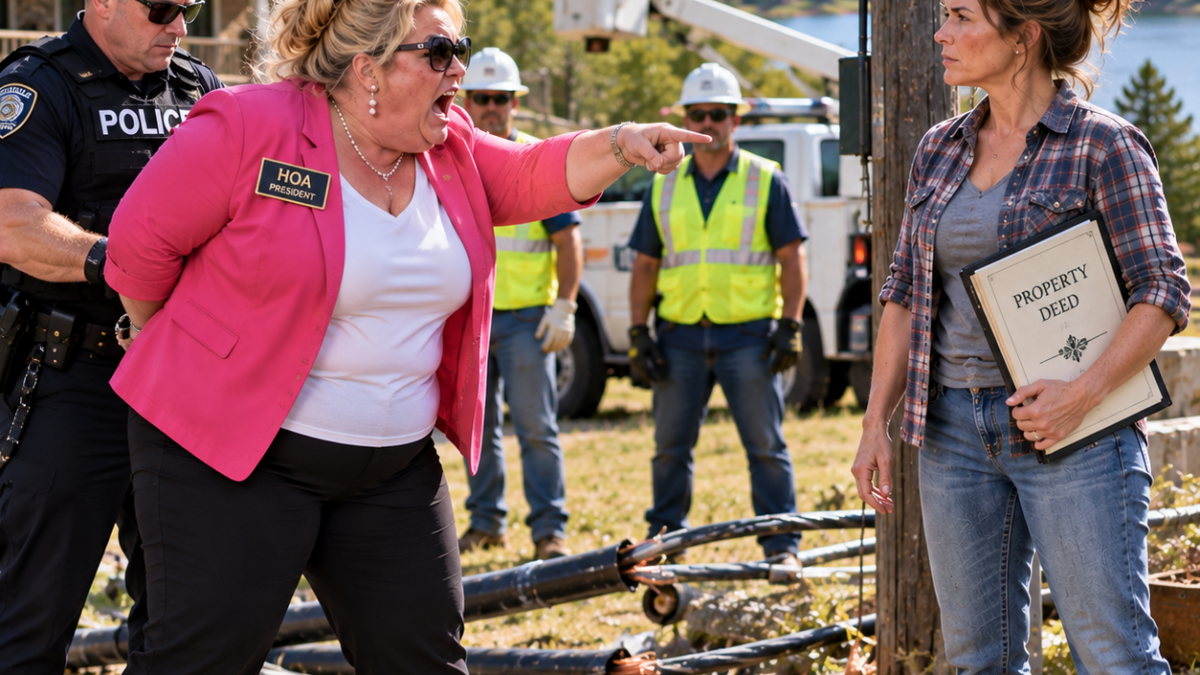
The HOA president was standing in my yard holding the severed ends of the power line that kept my entire business alive. She looked proud of herself, as if cutting electricity to a retired Marine’s workshop was just another neighborhood violation she had successfully corrected. But the moment I saw the yellow bolt cutters beside her boots, I knew this wasn’t going to end with a fine, an angry meeting, or another certified letter.
I had just pulled into my driveway when I noticed the silence.
My workshop was never silent at three in the afternoon.
Usually I could hear the low hum of the ventilation system before I even opened my truck door. Sometimes the hydraulic pump on my metal brake. Sometimes music coming through the old speakers mounted above my workbench.
That afternoon there was nothing.
Then I saw Karen Peterson.
She was standing beside a shallow trench near the edge of my property, wearing gardening gloves and a floral blouse, with two HOA board members hovering several feet behind her.
At her feet lay a pair of industrial bolt cutters.
In her hands were two thick black cable ends.
My stomach dropped.
“Karen.”
She turned toward me.
“Oh, good. You’re home.”
I stepped out of the truck.
“What did you do?”
She actually smiled.
“This cable was installed in violation of community standards. We notified you repeatedly.”
I stared at the exposed cable.
It was the dedicated underground electrical service feeding my detached workshop.
Not an extension cord.
Not landscape lighting.
The workshop had a legally permitted, grandfathered electrical service installed years before I bought the property.
Before purchasing the house, I had spent days checking county records because that workshop was the entire reason I wanted the place.
My name is Frank Miller.
I had spent twenty years in the Marine Corps as a combat engineer.
When I retired, I started a custom metal fabrication business.
Gates.
Restoration parts.
Architectural steelwork.
One-off components for classic cars.
That workshop wasn’t a hobby shed.
It was my livelihood.
And Karen had just cut its power.
I walked toward her.
“Put the cable down.”
Her smile weakened.
“I’m acting in my official capacity as HOA president.”
“Karen. Put it down and step away.”
She dropped the cable.
I pulled out my phone.
She folded her arms.
“You should have hired an approved contractor and buried the line properly.”
“It is buried.”
“That trench proves otherwise.”
“You dug the trench.”
She hesitated.
I looked at the board members behind her.
Neither would meet my eyes.
“The line is inside a recorded utility easement,” I said. “I sent you the county documents three weeks ago.”
“The HOA map shows this strip as community property.”
“The HOA map is wrong.”
Her face hardened.
“Mr. Miller, I will not be intimidated.”
“I’m not intimidating you.”
I raised my phone and began recording.
“I’m documenting you.”
That changed something.
Karen glanced at the cable.
Then at the bolt cutters.
For the first time, uncertainty moved across her face.
I called the utility company first.
I gave them my address, explained that someone had intentionally cut a buried service line, and told them the area needed to be treated as unsafe until a technician confirmed otherwise.
The dispatcher’s voice became serious immediately.
Then I called 911.
Karen stared at me.
“You’re calling the police?”
“Yes.”
“For an HOA matter?”
“No.”
I looked directly at her.
“For destruction of private utility infrastructure.”
Her face went pale.
“You can’t be serious.”
“You cut the line.”
“I had authority.”
“No, Karen.”
I pointed toward my house.
“Inside that office is a licensed survey showing exactly where this property ends. I have the original electrical permit. I have the recorded easement. I have the certified letter I sent warning you not to interfere with the service.”
A siren sounded somewhere beyond the entrance to Oak Creek Estates.
Karen looked toward the street.
Her confidence disappeared.
Neighbors began stepping onto porches.
Doors opened.
Phones appeared.
Then a police cruiser turned onto my street.
Behind it came a utility truck.
The officer parked and walked toward us.
Karen immediately rushed forward.
“Officer, thank goodness. I’m Karen Peterson, president of the homeowners association. This homeowner has been operating an unauthorized industrial business and—”
The utility technician passed her without listening.
He saw the trench.
Saw the cable.
Stopped dead.
Then he looked at me.
“Who cut this?”
I pointed toward the bolt cutters.
Karen stopped talking.
The technician stared at her.
His expression changed completely.
The police officer noticed.
And in that instant, standing beside my dark workshop while half the neighborhood watched from their lawns, I realized Karen still thought the worst consequence she faced was losing an argument with me.
She had no idea the question the officer was about to ask would change everything.
PART 2
The utility technician looked down at the severed service line, then back at Karen.
“Ma’am,” he said slowly, “did you personally cut this?”
Karen looked toward the police officer.
Then toward me.
Her mouth tightened.
“I authorized the removal of an unauthorized utility installation.”
The officer repeated the question.
“That wasn’t what he asked. Did you cut it?”
Karen lifted her chin.
“Yes.”
The technician closed his eyes briefly.
Not dramatically.
More like a man trying to find patience.
“Okay,” he said. “Nobody touches anything.”
He walked back to his truck and returned with testing equipment.
The police officer motioned for everyone to move farther away from the trench.
Karen protested immediately.
“I am the HOA president. This is common property.”
“Ma’am,” the officer said, “please stand over there.”
She looked offended.
That was the strange thing about Karen.
Even with a police cruiser parked behind her and a utility technician treating the ground she had been standing on like a potential hazard, she still seemed more insulted by being given an instruction than frightened by what she had done.
The technician tested the exposed line.
After several tense seconds, his shoulders loosened.
“The upstream protection opened.”
The officer looked at him.
“Meaning?”
“The line isn’t energized now.”
“Now?”
The technician nodded toward the cable.
“When she cut it, that was another story.”
Karen crossed her arms.
“Well, obviously it was safe.”
The technician turned toward her so quickly that even I took a step back.
“No, ma’am.”
His voice wasn’t loud.
That made it stronger.
“You were lucky.”
Her expression changed.
He pointed toward the severed conductors.
“That is not landscaping cable. It is not telephone. It is not something an HOA volunteer removes with hand tools because they don’t like how a property looks.”
“I was told—”
“Who told you to cut it?”
Silence.
Carol Thatcher, the board treasurer standing behind her, suddenly found something fascinating across the street.
The other board member, Patricia Doyle, took two slow steps backward.
Karen looked at them.
Neither helped her.
The officer noticed.
“Let’s separate everyone,” he said.
He asked Karen to stand beside the cruiser.
Then he approached me.
“Your name?”
“Frank Miller.”
“Property owner?”
“Yes.”
“Did you give anyone permission to cut the line?”
“No.”
“Did you previously notify the HOA that you claimed this utility line was legally permitted?”
“I didn’t claim it. I documented it.”
I pointed toward my house.
“I have the electrical permit, the recorded easement, and a licensed survey. I sent copies to the board by certified mail.”
“When?”
“Three weeks ago.”
He wrote something down.
“You have proof they received it?”
“Return receipt.”
His eyebrows rose slightly.
“Get everything.”
I went inside.
Sarah was standing just beyond the front window.
Our daughter had both hands against the glass.
Our younger son stood beside her.
Sarah opened the door before I reached it.
“What happened?”
“Keep the kids inside.”
“Frank.”
“I’m okay.”
She looked over my shoulder toward Karen.
“What did she do?”
“She cut the workshop service.”
Sarah stared at me.
“She what?”
“I need my property file.”
Her face hardened in a way I rarely saw.
“Top drawer?”
“Blue folder.”
She turned immediately.
I had met Sarah when I was still on active duty.
She had lived through deployments, rushed phone calls, last-minute moves, and years of plans changing with almost no notice.
Chaos did not paralyze her.
It organized her.
She returned with the folder.
“Anything else?”
“The certified mailing receipt.”
“Already inside.”
Of course it was.
I kissed her forehead.
“Stay with the kids.”
She caught my arm.
“Frank.”
I stopped.
“Don’t let her make you lose your temper.”
I looked toward the window.
Karen was gesturing angrily while talking to the officer.
“That’s not what I’m worried about.”
I walked back outside.
The utility technician had been joined by another crew member.
I handed the officer the survey first.
He studied it.
The easement was clearly marked along my property boundary.
Then I showed him the county electrical permit and the older service documentation from the previous owner.
Finally, I handed him a copy of my certified letter to the HOA.
The officer read one paragraph twice.
It stated plainly that the electrical service was legally permitted, that the easement was recorded, and that no HOA representative had permission to enter the property or interfere with the utility infrastructure.
The officer looked toward Karen.
“You sent this?”
“Yes.”
“And they received it?”
I handed him the receipt.
He exhaled through his nose.
“All right.”
Karen had apparently decided she’d had enough of waiting.
She marched toward us.
“This is ridiculous. That document does not supersede the HOA’s authority over common areas.”
The officer held up the survey.
“According to this, you weren’t in a common area.”
“Our community plat says otherwise.”
“Do you have a licensed survey?”
“We have our map.”
“That’s not what I asked.”
Karen’s lips tightened.
The officer turned toward me.
“Mr. Miller, did you actually see her cutting it?”
“No. I arrived immediately afterward. She was holding the two ends and had the cutters beside her.”
Karen jumped in.
“I already told you I cut it.”
The officer looked at her.
“Yes, ma’am. You did.”
For the first time, she seemed to understand that her confession was not helping.
The officer asked to see my recording.
I played it.
Her voice came clearly through the phone.
I have enforced our community standards.
The officer watched the entire clip.
Then another patrol car arrived.
A second officer stepped out.
The first walked him several yards away.
They spoke quietly.
Karen tried to hear.
So did I.
I caught only pieces.
Intentional.
Documented warning.
Property damage.
Utility.
Then the first officer returned.
“Ms. Peterson.”
“Yes?”
“I need you to turn around and place your hands behind your back.”
Her mouth opened.
Nothing came out.
Then she laughed.
It was a strange little sound.
“You’re joking.”
“No, ma’am.”
“You cannot arrest the president of an HOA for enforcing bylaws.”
“We’re not arresting an HOA president.”
He stepped closer.
“We’re detaining an individual suspected of intentionally damaging private property.”
Karen looked toward Carol.
“Call our lawyer.”
Carol didn’t move.
“Carol!”
The officer told Karen again to turn around.
She finally did.
When the cuffs closed around her wrists, Oak Creek Estates became absolutely silent.
Nobody cheered.
Nobody spoke.
But almost every neighbor was outside.
The same people Karen had fined for basketball hoops.
Mailbox paint.
Garden ornaments.
Work trucks.
Trash cans.
They watched as the woman who had spent years threatening liens and penalties was guided toward the back seat of a police cruiser.
She looked at me before the officer closed the door.
There was no apology in her expression.
Only rage.
That bothered me.
Not because I was afraid of her.
Because rage meant she still thought this was something I had done to her.
The cruiser drove away.
And for about thirty seconds, I allowed myself to feel satisfied.
Then the senior utility technician walked over.
“We need to talk about your service.”
That erased the satisfaction immediately.
He explained that the cut had damaged more than the exposed section.
The conduit itself appeared crushed.
The service run was old enough that a simple repair wasn’t the best or safest solution.
They would need to inspect the entire span.
“Worst case?” I asked.
He looked toward my workshop.
“Replacement from the source connection to your service equipment.”
“How long?”
“Depends on materials, inspection, and what we find.”
“My business operates out of there.”
“I figured.”
“How long?”
He hesitated.
“Possibly a week.”
A week might not sound catastrophic if your electricity goes out at home.
A week in my workshop was different.
I had three active commissions.
One restoration shop waiting for suspension brackets I was machining for a 1967 muscle car.
A landscape architect expecting a set of custom steel entry panels.
And a contractor waiting for decorative rail components.
Every deadline mattered.
I was still building my civilian reputation.
My military pension paid the mortgage.
The fabrication business was supposed to become the future.
Sarah’s future.
Our children’s college funds.
The life I’d spent two decades telling myself I’d build once the uniform came off.
Karen hadn’t merely cut a cable.
She had cut into that plan.
“How much?” I asked.
The technician gave me a rough range.
It was enough to make my stomach tighten.
Then he added, “Document everything. Labor. Materials. Lost business. All of it.”
A detective arrived before sunset.
Russo.
Compact man, gray beginning at his temples, eyes that missed very little.
He took photographs.
Measured the trench.
Bagged the bolt cutters as evidence.
Downloaded my phone recording.
Then he walked through the story with me twice.
“What was the conflict before this?”
“The workshop.”
“Noise?”
“She claimed noise.”
“Was there a violation?”
“No.”
“Zoning?”
“Permitted.”
“Commercial use?”
“Allowed under the property’s existing approval.”
“Electrical line?”
“Grandfathered and recorded.”
“You gave her those documents?”
“Yes.”
Russo tapped his pen against his notebook.
“Why would she still cut it?”
“I don’t know.”
That answer bothered me more than I expected.
Because Karen was controlling.
Petty.
Arrogant.
But stupid?
Not usually.
She had received the survey.
The easement was obvious.
She knew I kept records.
She knew I was prepared to challenge her.
Cutting that line personally made almost no sense.
Unless there was something I didn’t know.
Russo must have seen the thought on my face.
“What?”
“Nothing yet.”
“Yet?”
“I need to think.”
He handed me his card.
“If you remember anything, call.”
The next morning Sarah rented a commercial generator large enough to keep part of the workshop running.
It was expensive.
Loud.
I hated it.
But it meant I could at least operate selected equipment in sequence.
The arrangement was awkward.
The productivity loss was brutal.
Still, I could work.
I had just finished positioning the generator when I noticed a white envelope tucked beneath my truck’s windshield wiper.
Oak Creek Estates Homeowners Association.
I opened it.
UNAPPROVED INDUSTRIAL EQUIPMENT.
Temporary generator.
One-hundred-dollar daily penalty.
I read it twice.
Then I laughed.
Sarah came outside.
“What?”
I handed her the notice.
She read it.
“She cuts the power.”
“Yes.”
“You rent a generator because she cut the power.”
“Yes.”
“And now she’s fining you for the generator.”
“That seems to be the logic.”
Sarah looked toward Karen’s house three streets over.
“Is she out of jail?”
“Made bail this morning.”
Sarah handed the letter back.
“Find a lawyer.”
“I already started looking.”
“No.”
She pointed at the notice.
“Find a mean lawyer.”
By lunchtime I had purchased three large binders.
The first one was labeled:
HOA — INCOMING.
The generator notice went behind Tab One.
My response went into another binder:
HOA — OUTGOING.
I cited the section Karen had referenced.
I noted that the covenants did not prohibit temporary emergency generators.
I documented why the generator was necessary.
I attached the police incident number.
I attached the utility repair report.
Then I formally disputed the fine and requested the hearing guaranteed under the association rules.
Certified mail.
Return receipt.
The following morning, another notice arrived.
Construction materials visible.
The “construction materials” were steel stock stored behind my workshop.
You couldn’t see them from the street.
The next day:
Oil stain on driveway.
The mark was smaller than my palm.
Then:
Improper garden-hose storage.
Then:
Unapproved front-door color.
The door had been that color before Karen joined the board.
Then:
Children’s recreation item left outdoors.
My son’s red bucket had been on the lawn.
Forty-three minutes.
By the seventh notice, I understood.
Karen wasn’t trying to win any specific violation.
She was trying to exhaust me.
Most people would eventually stop responding.
Pay the fine.
Remove the item.
Make the problem disappear.
That was probably how she had controlled the neighborhood for years.
Unfortunately for Karen, she had chosen the wrong kind of person for a paperwork war.
I responded to every notice.
Photographs.
Dates.
Bylaw citations.
Formal disputes.
Hearing requests.
Certified mail receipts.
I made duplicates.
Scanned everything.
Created digital folders.
Sarah watched me one evening while I arranged tabs at our dining table.
“You’re enjoying this.”
“No.”
She raised an eyebrow.
“Maybe a little.”
“You’re color-coding the retaliation.”
“Documentation deserves standards.”
She smiled for the first time since the power line had been cut.
“That poor woman has no idea who she picked a fight with.”
I looked at the stack of violations.
“I think she knows.”
What I couldn’t understand was why she wouldn’t stop.
The criminal case was active.
A detective had interviewed her.
The utility company had documented the damage.
Any reasonable attorney would have told her to make no contact with me.
Yet the notices kept coming.
Either Karen believed the HOA itself could protect her.
Or there was more at stake than pride.
My neighbors began approaching me.
Tom Reynolds from next door came first.
He waited until after dark.
I was checking fuel on the generator when he walked across the lawn.
“Hey, Frank.”
“Tom.”
He looked around.
“You got a minute?”
“Sure.”
His voice dropped.
“I saw them arrest her.”
“I figured most people did.”
“My wife recorded it.”
“Of course she did.”
He smiled nervously.
Then his face became serious.
“I just wanted to tell you we’re on your side.”
“Our?”
“Half this street.”
He told me about the swing set.
His daughter’s grandparents had bought it for her fifth birthday.
Karen objected because the slide was bright blue rather than an approved earth tone.
Tom assumed she was kidding.
She wasn’t.
The fines reached five hundred dollars.
Eventually he replaced the slide.
“My daughter asked why we were taking down her favorite color.”
He shook his head.
“I felt ridiculous.”
“Why didn’t you fight?”
“Three kids. Job. Mortgage.”
He shrugged.
“Five hundred dollars was cheaper than a lawyer.”
Two days later, Dave Harper stopped by.
Retired Air Force.
Quiet guy.
Always waved.
He told me Karen had forced him to remove a flagpole that had stood in his yard for ten years.
“She threatened daily fines,” he said.
“How much?”
“Enough.”
“You appealed?”
“Board denied it.”
“Who was on the appeal panel?”
He looked at me.
“Karen, Carol, Patricia.”
Of course.
Then Mrs. Gable came over.
She brought cookies.
She was seventy-eight, tiny, silver-haired, and seemed perpetually afraid of inconveniencing people.
“I hope I’m not interrupting.”
“You brought cookies. You can interrupt whenever you want.”
She smiled.
Then she told me about her roses.
Her husband had planted them before he died.
Karen claimed fallen petals occasionally reached the common sidewalk.
She began issuing weekly notices.
“Why didn’t you tell anyone?”
Mrs. Gable looked embarrassed.
“I thought maybe I really was causing trouble.”
That sentence hit me harder than anything Tom or Dave had said.
Karen hadn’t merely fined people.
She had taught decent people to question whether they deserved to live peacefully in their own homes.
That evening, I asked Tom, Dave, and Mrs. Gable to come to the workshop.
The generator hummed outside.
Inside, several of my machines sat dark because I couldn’t safely run everything at once.
I spread the HOA binders across my steel fabrication table.
“This is every notice they’ve sent since Karen cut the line.”
Dave whistled.
“You built a case file.”
“I built several.”
Tom flipped through certified receipts.
“What are you planning?”
“At first? Defending myself.”
“And now?”
I looked at Mrs. Gable.
“Now I want to know what else they’re doing.”
I had read the bylaws cover to cover.
Members had inspection rights.
Financial statements.
Contracts.
Meeting records.
Certain association documents had to be available under both the governing rules and applicable property law.
“How much do we know about HOA spending?” I asked.
Tom laughed.
“Nothing.”
“Exactly.”
Mrs. Gable hesitated.
“They hold a lot of private meetings.”
“Executive sessions?”
“Yes.”
“For what?”
“They never say.”
Dave leaned against the workbench.
“So we request the records.”
“Not casually.”
I pulled out a draft.
“We do it formally.”
The letter requested five years of financial statements, bank summaries, vendor contracts, major invoices, board meeting minutes, and records supporting recent special assessments.
Tom read the final paragraph.
“You already wrote this?”
“I couldn’t sleep.”
Mrs. Gable smiled.
“You remind me of my husband.”
“Was he difficult?”
“Extremely.”
“I’ll take it as a compliment.”
All four of us signed.
The request went certified.
Then we began talking to neighbors.
Not campaigning.
Listening.
Stories came quickly.
A young family fined because holiday lights remained up one day too long.
A nurse fined for parking on the street after returning from a double shift.
A widower ordered to remove a bench his wife had purchased before she died.
Another resident charged administrative fees for asking to review a violation.
The pattern became impossible to ignore.
Karen rarely targeted people likely to challenge her.
She targeted busy families.
Older residents.
New homeowners.
People who wanted peace badly enough to pay for it.
Meanwhile, Karen’s friends seemed strangely immune from enforcement.
Carol’s fence needed paint.
Nothing.
Patricia’s landscaping violated several written requirements.
Nothing.
Karen’s own trash bins sometimes remained visible until afternoon.
Apparently the visual integrity of Oak Creek Estates survived.
Ten business days passed.
No response to our records request.
On the eleventh, we received a letter from the HOA attorney saying the request was “overly burdensome.”
That was when I met Evelyn Reed.
She practiced property and association law downtown.
Her office was twenty floors above a street I couldn’t afford to park on for more than two hours.
Sarah came with me.
We brought three binders.
Evelyn didn’t ask for a dramatic summary.
She started reading.
For nearly forty minutes, she turned pages in silence.
Violation notice.
My response.
Another violation.
Response.
Photographs.
Certified receipts.
Utility easement.
Police report.
Records request.
HOA refusal.
Finally, she closed the last binder.
“Mr. Miller.”
“Frank.”
“Frank.”
She looked at Sarah.
“Does he organize everything like this?”
Sarah nodded.
“You should see our tax files.”
Evelyn looked back at me.
“You have made my job considerably easier.”
“Good.”
“What do you want?”
I had expected her to ask what happened.
Not what I wanted.
“I want the harassment stopped.”
“Easy.”
“I want my workshop restored.”
“Likely.”
“I want my lost income recovered.”
“Documented?”
“Every invoice.”
Her mouth twitched.
“Of course.”
“And I want to know why she cut that line after she already had proof it was legal.”
Evelyn became still.
“That interests me too.”
She filed a civil action against Karen and the HOA.
The claim sought repair costs, lost business income, legal fees, and damages arising from the alleged retaliatory conduct.
She also moved to compel production of association records.
The stream of violation notices stopped almost overnight.
Silence.
Beautiful silence.
Then came the records hearing.
The HOA’s lawyer argued that our request was excessive.
Evelyn placed our original certified letter in front of the judge.
The judge read it.
Then looked at the HOA attorney.
“Your governing documents provide inspection rights.”
“Yes, Your Honor, but—”
“Did your clients respond substantively?”
“They considered the scope unreasonable.”
“That was not my question.”
“No.”
The judge ordered production.
Seven days.
A week later, twelve banker boxes appeared at Evelyn’s office.
An avalanche of paper.
If Karen hoped volume would hide whatever we were looking for, she had underestimated the number of angry retired people in Oak Creek Estates.
One of them was Arthur Bell.
Retired CPA.
Karen had once fined him because his satellite dish was not the preferred model.
When he heard we had five years of financial records, the man looked twenty years younger.
My workshop became an accounting room.
Folding tables.
Laptops.
Scanners.
Coffee.
Boxes.
Sarah labeled everything.
Arthur reviewed bank records.
Tom cross-referenced invoices.
Dave organized meeting minutes.
Mrs. Gable brought enough food to sustain a small infantry company.
At first, the irregularities looked like incompetence.
Then Arthur found the landscaping contract.
“Frank.”
His voice was different.
I walked over.
“Look.”
Prestige Greenscapes LLC had received the same contract four years in a row.
No competitive bids in the file.
Annual spending far above what Arthur expected for a development our size.
He searched the state corporate database.
Registered agent:
Gary Peterson.
I stared at the surname.
“Karen’s husband?”
“Brother-in-law.”
Tom leaned over.
“You’re kidding.”
Arthur shook his head.
“Keep digging.”
The invoices were worse.
Routine tasks billed at extraordinary rates.
Repeated line items.
Fees with vague descriptions.
That didn’t automatically prove criminal conduct.
Evelyn made that point firmly.
“Do not call it theft unless the evidence supports theft.”
So we didn’t.
We called it what the documents proved.
Undisclosed family connections.
No-bid contracts.
Unusually high charges.
Possible conflicts of interest.
Then we found payments to a consulting company owned by Carol’s adult son.
Ten thousand dollars.
Purpose:
Community satisfaction survey.
We searched the minutes.
No presentation.
No report.
No survey results.
Nobody we spoke with remembered receiving one.
Then came the executive-session notes.
They were inside a folder marked DRAFT.
Dave opened it around midnight.
“Frank.”
Everyone stopped.
He handed me a page.
MILLER — WORKSHOP NOISE. NEED VIOLATION PRESSURE. CHECK POWER / PROPERTY CORRIDOR.
I read it twice.
Another entry mentioned Mrs. Gable.
ROSES — CONTINUE FINES UNTIL REMOVED.
She was sitting ten feet from me.
I didn’t want her to see it.
Too late.
She read over my shoulder.
Her face changed.
Those roses had been planted by her husband.
Karen knew that.
Everyone knew that.
Mrs. Gable sat down slowly.
“I thought I was imagining it.”
I pulled up a chair beside her.
“Imagining what?”
“That she didn’t like me.”
I didn’t know what to say.
She wiped one eye.
“She always made me feel foolish when I appealed.”
Dave looked furious.
Tom swore under his breath.
Mrs. Gable straightened.
“No.”
Everyone looked at her.
“No more feeling sorry for me.”
She pointed toward the documents.
“Find the rest.”
So we did.
Three nights later, Arthur discovered a file associated with a special assessment collected two years earlier.
Five hundred dollars from every household.
Official purpose:
Drainage and common-area infrastructure improvements.
Some money had clearly gone toward legitimate work.
But mixed into the supporting materials were surveys that didn’t belong.
Boundary surveys.
Traffic projections.
Rezoning documents.
Conceptual access plans.
I spread them across my fabrication table.
One involved the wooded two-acre common parcel at the rear of Oak Creek Estates.
Everybody called it the Creek Lot.
Children explored there.
Residents walked dogs along the path.
The community had always been told it would remain green space.
The documents showed Karen had been pursuing rezoning.
Residential development.
Then we found a letter from a developer.
Proposed purchase price:
$1.2 million.
Contingent upon rezoning and legal access.
The room went quiet.
Tom finally whispered, “She was selling our park?”
“Trying to.”
Arthur pulled another page.
“Look at the access plan.”
I did.
The proposed road ran from the main street toward the Creek Lot.
Through the narrow corridor beside my property.
I froze.
“Give me the survey.”
Sarah handed me my laminated property map.
I placed it beside the developer’s plan.
The alignment was almost exact.
Right through my utility easement.
Right where the power service ran.
Nobody spoke.
I remembered Karen standing in my yard.
This unsightly cable was violating common area aesthetics.
I remembered her obsession with the workshop.
Her repeated claims about the utility corridor.
Her refusal to accept the recorded survey.
I felt something cold move through me.
Tom saw it.
“What?”
“It wasn’t about aesthetics.”
Dave stepped closer.
I pointed at the maps.
“My utility easement blocks the proposed access configuration.”
Arthur studied the pages.
“If this is accurate.”
“It is.”
“The developer couldn’t just pave through your recorded utility corridor without resolving your rights.”
“No.”
Sarah crossed her arms.
“So she wanted the line gone.”
Evelyn arrived the following morning.
We showed her everything.
She did what good attorneys do.
She refused to become excited before verifying.
“This is evidence of motive,” she said. “It does not automatically prove the line was cut for the development deal.”
“But the board notes say check power corridor.”
“Yes.”
“The access plan crosses the easement.”
“Yes.”
“She had the developer offer before cutting it.”
“Yes.”
“She was pursuing rezoning without telling the membership.”
“That appears to be what these documents show.”
“So what does that make it?”
Evelyn looked at me.
“A very serious set of facts that should be given to Detective Russo and the prosecutor.”
Russo came to her office.
I watched his expression while he read.
He asked almost no questions.
Then he requested copies.
Before leaving, he said, “Do not confront her about this.”
“I wasn’t planning to.”
“Good.”
“What happens now?”
“We investigate.”
I hated that answer.
Not because it was wrong.
Because after weeks of harassment, I wanted movement.
Sarah reminded me that criminal investigations didn’t operate on my schedule.
So we focused on what we could control.
The HOA.
Under the bylaws, twenty-five percent of homeowners could demand a special membership meeting.
Oak Creek Estates had 120 homes.
We needed thirty signatures.
We collected fifty-eight.
People signed because they were angry.
But more importantly, they signed because now they weren’t alone.
The special-meeting notice listed three agenda items:
Association finances.
Recent board conduct.
Vote of confidence.
Karen responded with an association-wide letter accusing a “small group of disgruntled homeowners” of destabilizing the community.
It was one of the worst strategic mistakes she made.
People who hadn’t cared suddenly wanted to know what she didn’t want them seeing.
We rented the elementary school cafeteria.
The night before the meeting, I stood alone in my workshop.
The permanent electrical repairs were still underway.
Most of the machinery was quiet.
Dust coated the lathe.
The generator vibrated outside.
I ran one hand across the workbench.
My first week after leaving the Marines, I had felt lost.
Nobody warns you about silence after a long military career.
For two decades, my life had been mission schedules, inspections, equipment, people depending on me.
Then suddenly I was home.
No formation.
No radio.
No next assignment.
Metalworking gave me something familiar.
Problems that could be measured.
Steel that behaved according to known principles.
Precision.
Heat.
Patience.
I had built the business piece by piece.
Bought equipment carefully.
Took small commissions.
Earned repeat clients.
Every successful job made civilian life feel less temporary.
Karen hadn’t understood that when she cut the line.
She saw a cable.
I saw the artery feeding the future I had built for my family.
Sarah entered quietly.
“You’ve been standing here ten minutes.”
“Thinking.”
“Dangerous.”
I smiled.
She handed me coffee.
“You nervous?”
“No.”
“Liar.”
“A little.”
She stood beside me.
“Tomorrow isn’t about humiliating her.”
“I know.”
“Do you?”
I looked at the silent machines.
“I want everyone to see what she did.”
“They will.”
“I want her to feel what she made everyone else feel.”
Sarah said nothing.
That silence did more than an argument would have.
Finally I sighed.
“That part isn’t useful.”
“No.”
“But it’s there.”
“I know.”
She rested her head against my shoulder.
“Just don’t become her to defeat her.”
The cafeteria was overflowing the next evening.
Nearly a hundred residents attended.
Karen sat at a table in front with Carol, Patricia, and the association lawyer.
She had brought a gavel.
Of course she had.
I stood behind a simple podium.
Tom controlled the projector.
Arthur had prepared financial charts.
Dave sat beside Mrs. Gable.
Evelyn stood at the rear of the room.
Not representing the association.
Watching.
I began with the power line.
Not accusations.
Documents.
County survey.
Recorded easement.
Electrical permit.
Photograph of the trench.
Photograph of the severed cable.
Then the police incident record.
Karen interrupted.
“These matters are part of pending litigation.”
I looked toward Evelyn.
She gave the smallest nod.
I continued.
“The point tonight isn’t to decide the criminal case. The point is to understand what actions were taken in the name of this association.”
That distinction mattered.
Then Arthur explained the finances.
Prestige Greenscapes.
The family connection.
No documented competing bids in the records produced.
Charges significantly above comparison estimates.
The consulting payment to Carol’s son’s company.
No located survey product.
Residents began murmuring.
Carol leaned toward the HOA attorney.
He whispered back.
Then we displayed the internal notes.
MILLER — NEED VIOLATION PRESSURE.
The room quieted.
GABLE — CONTINUE FINES UNTIL ROSES REMOVED.
Someone gasped.
Mrs. Gable stood before I could stop her.
Her hands shook as she walked toward the microphone.
“My husband planted those roses.”
Karen looked down.
Mrs. Gable continued.
“He planted them thirty-four years ago.”
Her voice cracked.
“The summer after my mother died, he dug every hole himself because he said I needed something beautiful outside the kitchen window.”
Nobody moved.
“When he got sick, he still went outside every morning to check them.”
She looked directly at Karen.
“You knew that.”
Karen shifted.
“You told me once that you knew because your mother liked roses too.”
Karen opened her mouth.
Mrs. Gable raised a hand.
“No.”
Her voice became firmer.
“For years, every time one of your letters came, I wondered what I had done wrong.”
She looked around the room.
“I was afraid of a homeowners association.”
That sentence landed like a stone.
“I am seventy-eight years old. I buried my husband. I raised three children. I cared for my mother until she died.”
She turned back to Karen.
“And you made me afraid of rose petals.”
Nobody applauded at first.
Then Dave stood.
Then Tom.
Then nearly everyone in the cafeteria.
The applause wasn’t celebratory.
It was something deeper.
Respect.
Mrs. Gable returned to her seat crying.
I had to wait before continuing.
Then came the Creek Lot.
The rezoning applications appeared on screen.
Karen stood.
“That information is confidential.”
Residents shouted questions.
“What rezoning?”
“You were selling the park?”
“When did we vote on this?”
The attorney tried to speak.
Nobody listened.
I raised my voice.
“Please.”
The room settled.
“We found a developer’s written proposal.”
Next slide.
$1.2 million.
The room erupted again.
Karen grabbed her gavel.
“This is misinformation!”
I clicked to the next image.
The conceptual road plan.
Then my property survey beside it.
The path of the proposed road intersected the corridor containing my electrical service.
I didn’t call it proof of motive.
I repeated Evelyn’s words.
“We cannot tell you tonight what another person intended. That is for investigators and courts to determine.”
Then I pointed at the screen.
“But these documents establish a sequence.”
The developer proposed purchasing the Creek Lot.
The proposed access crossed my easement.
Internal notes discussed pressure against my workshop and power corridor.
Karen received documentation establishing my utility rights.
Weeks later, my power line was intentionally cut.
“Those are the records,” I said. “You decide whether your board adequately protected this association.”
Karen stood.
“You are destroying this community.”
I looked around.
Young parents.
Retirees.
Teachers.
Veterans.
Nurses.
People who had lived beside one another for years without really knowing what each other had endured.
“No,” I said.
“We’re finally talking to each other.”
The vote came next.
Karen’s attorney challenged the procedure.
Evelyn calmly cited the notice requirements and bylaws.
The challenge ended quickly.
Paper ballots were distributed.
A neutral resident counted them.
Karen Peterson.
Remove: eighty-nine.
Retain: four.
Carol Thatcher.
Remove: eighty-nine.
Retain: four.
Patricia Doyle.
Remove: eighty-eight.
Retain: five.
The board was removed.
Not by me.
By the residents.
That mattered.
Tom nominated me to the interim board.
I immediately shook my head.
“No.”
People shouted objections.
I returned to the microphone.
“I’ll serve temporarily if necessary, but I don’t want to replace one permanent power center with another.”
Dave called out, “That’s exactly why you should do it.”
People laughed.
Eventually, I agreed to serve until the next regular election.
Dave joined.
Arthur joined.
Mrs. Gable refused.
“I’ve had enough excitement.”
Then she paused.
“I’ll help with minutes.”
The meeting ended near ten.
Residents clustered in the halls.
People hugged.
Shared stories.
Exchanged phone numbers.
For the first time since moving to Oak Creek Estates, it felt less like 120 separate properties and more like one neighborhood.
Karen tried to leave quietly.
Detective Russo was waiting outside.
So was another investigator.
He approached her.
I stayed back.
No theater.
No cheering.
No victory speech.
Russo informed her that additional evidence had been reviewed and that the prosecution was proceeding with felony criminal-damage allegations along with another charge associated with the danger created by her actions.
Her face lost color.
Then a process server approached.
Civil papers.
She looked toward me.
This time, I saw something other than rage.
Fear.
The kind she had spent years creating in other people.
For one moment, I remembered Sarah’s warning.
Don’t become her.
So I didn’t smile.
I didn’t say anything.
I simply walked past.
The interim board’s first meeting was held in my workshop.
Coffee.
Donuts.
Folding chairs.
No gavel.
Our first action was a temporary moratorium on minor aesthetic enforcement.
Health and safety rules remained.
Everything else paused while we reviewed the system.
Our second action was to commission an independent financial review.
Our third was to terminate the landscaping contract at the earliest lawful opportunity and solicit competitive bids.
A local family-owned company won.
Better service.
Far lower cost.
The savings were significant enough that the association eventually reduced annual dues.
Then we rewrote procedures.
Not to eliminate standards.
Most people actually wanted reasonable standards.
Nobody wanted abandoned cars on lawns or unsafe structures.
What residents hated was arbitrary power.
So we required clear notice.
Real appeal procedures.
Conflict disclosures.
Competitive bidding above defined thresholds.
Open financial summaries.
Term limits.
Recorded votes.
Executive sessions limited to legitimate confidential matters.
No more disappearing behind the phrase “the board decided.”
The Creek Lot was removed from any development consideration.
At the next annual meeting, residents voted to permanently preserve it as community green space.
Mrs. Gable suggested the name Liberty Park.
The name passed unanimously.
My electrical service was restored ten days after Karen cut it.
The morning the utility crew finished, the senior technician came into my workshop.
“Ready?”
“Absolutely.”
He closed the disconnect.
A second later, the lights above my benches flickered on.
Ventilation fans spun up.
Displays illuminated.
The compressor started.
That familiar industrial hum filled the room.
I hadn’t realized how much I’d missed it.
Sarah stood in the doorway.
Our children were behind her.
My daughter covered her ears when the compressor kicked on.
Then she smiled.
“Dad’s shop is back!”
I had to look away for a second.
People assume soldiers cry over war.
Sometimes they do.
Sometimes what gets you is your seven-year-old celebrating fluorescent lights.
My first project after restoring full power wasn’t for a client.
I took stainless steel scrap.
Cut twelve roses.
Shaped every petal by hand.
Polished the edges.
Then I carried them to Mrs. Gable.
She opened the door.
“What is all this?”
“For your garden.”
When she realized what they were, she pressed one hand to her mouth.
“Oh, Frank.”
“Steel doesn’t drop petals.”
She laughed through tears.
“You’re terrible.”
“I’ve heard.”
We placed them among her real roses.
The criminal case moved slowly.
Much slower than neighborhood gossip.
Karen eventually accepted a plea rather than take the property-damage charge to trial.
The court ordered probation, community service, fines, and restitution for the utility damage.
My documented repair cost was $18,742.
The civil case resolved separately.
The repair expenses weren’t the only issue.
I had documented every delayed order.
Every lost workday.
Every rental expense.
Every client adjustment.
Every retaliatory notice.
Evelyn had told me from the beginning that evidence mattered more than anger.
She was right.
Eventually, Karen became personally responsible for a substantial financial settlement that included business losses and legal costs.
It hurt.
But it didn’t destroy her family.
I was glad about that.
I had spent enough time angry to imagine total ruin.
By the end, I no longer wanted it.
Her husband hadn’t cut my power line.
Her family hadn’t fined Mrs. Gable.
Justice didn’t require innocent people to become collateral damage.
Karen resigned completely from association affairs.
Carol and Patricia did the same.
The development proposal disappeared.
Her family’s landscaping company never received another Oak Creek contract.
A few months later, Karen and her husband decided to sell their house.
I watched the moving truck one Saturday morning.
She stood beside the driveway directing movers.
For years, that house had seemed like the palace at the center of her little kingdom.
Now it was boxes.
Furniture.
Packing tape.
Ordinary things.
She noticed me across the street.
For several seconds, neither of us moved.
Then she walked toward me.
Sarah saw her coming and stepped outside.
I shook my head slightly.
I’m fine.
Karen stopped several feet away.
She looked exhausted.
Not defeated.
Just tired.
“I suppose you’re happy.”
“No.”
She laughed bitterly.
“Of course you are.”
“I’m happy the neighborhood is better.”
“Same thing.”
“No.”
She stared at me.
“You turned everyone against me.”
“I didn’t write the board notes.”
Her jaw tightened.
“I didn’t award contracts to relatives.”
Silence.
“I didn’t pursue the Creek Lot deal.”
She looked away.
“And I didn’t cut that line.”
Her eyes returned to mine.
“You don’t understand what it was like running that association.”
“Then you should have stopped running it.”
That hit harder than I expected.
She looked toward her house.
“Everybody wanted something. Nobody wanted responsibility. Everyone complained, but nobody volunteered.”
“I believe that.”
She seemed surprised.
“Then you understand.”
“I understand how someone becomes frustrated.”
I paused.
“I don’t understand deciding that frustration gives you ownership over everyone else.”
She said nothing.
“The first time you sent me a violation,” I continued, “I fixed it.”
“I remember.”
“Trash cans.”
“Yes.”
“The second time, I responded.”
“The flag.”
“Yes.”
“You thought every time I complied, it meant you were right.”
She looked at me.
“It meant I wanted peace.”
For a moment, Karen’s expression softened.
Then it disappeared.
“The line really did interfere with the access plan.”
There it was.
Not quite a confession.
Not legally useful anymore.
Just exhaustion.
“You knew.”
She looked down.
“I thought the easement could be moved.”
“By cutting the cable?”
“I thought once the service was gone, the developer could pay to redesign everything.”
I stared at her.
“You could have asked me.”
“You would have said no.”
“Yes.”
She gave a hollow laugh.
“Exactly.”
“That was my right.”
“I know that now.”
“No, Karen.”
I shook my head.
“You knew it then.”
She looked at me.
That was the entire story in one sentence.
She had known.
The survey told her.
The permit told her.
My certified letter told her.
But those documents contradicted what she wanted.
So she treated them as obstacles instead of boundaries.
A car horn sounded near her house.
Her husband was waiting.
Karen turned.
Then stopped.
“For what it’s worth, I’m sorry your business got hurt.”
It wasn’t enough to erase anything.
But it was the first apology she’d ever given me.
“For what it’s worth,” I said, “I hope your next place is quieter.”
She almost smiled.
Then walked away.
The new owners arrived a month later.
Young couple.
Three children.
Within two weeks, a bright blue plastic slide appeared in their backyard.
Tom sent me a photo.
YOU GOING TO FINE THEM?
I replied:
ONLY IF THEY REPLACE IT WITH BEIGE.
He sent back six laughing emojis.
I never became permanent HOA president.
At the regular election, residents tried to nominate me.
I declined.
Dave became president instead.
Arthur stayed treasurer.
Mrs. Gable finally agreed to become secretary.
She turned out to be terrifying about meeting minutes.
“If you said it, it’s going in the record.”
Nobody argued with her.
I focused on my family and business.
The story of what happened spread locally.
Not because I wanted publicity.
Neighbors talked.
Then clients talked.
Someone knew someone.
Soon customers were joking that if I could survive an HOA war, I could probably fabricate a gate straight.
Business increased.
I hired an apprentice.
Then another.
A year after the power line was cut, the shop was busier than it had ever been.
One summer evening, Sarah brought me a beer while I was finishing a decorative panel.
I shut off the welder.
Outside, I could hear children laughing.
Liberty Park had opened that afternoon.
The HOA had used savings from renegotiated contracts to build a small walking path and picnic area.
Nothing extravagant.
No giant monument.
Just trees, benches, and room for children to play.
We walked over after dinner.
Mrs. Gable was sitting beneath an oak tree.
Dave was grilling burgers.
Tom’s kids were running through the grass.
A flag stood near the entrance.
Dave’s idea.
He had finally put his home flagpole back up too.
Sarah looked around.
“You know what’s weird?”
“What?”
“If Karen hadn’t cut your power line, none of this might have happened.”
“I’ve thought about that.”
“So maybe it was good.”
I looked at her.
“She could have killed herself.”
“I didn’t say the cutting part was good.”
“Important distinction.”
She bumped my shoulder.
“You know what I mean.”
I did.
The power line had exposed everything already broken.
The selective enforcement.
The secret meetings.
The financial conflicts.
The fear.
The development plan.
But I didn’t believe bad actions became good because something better eventually grew from them.
Karen made a reckless decision.
People got hurt.
There were consequences.
The good part was what everyone chose afterward.
The neighbors chose to speak.
Mrs. Gable chose not to be afraid.
Tom chose to stop keeping his head down.
Dave chose to return to public service.
Arthur chose to spend three sleepless nights reading bank statements because he cared about people he’d barely known.
Sarah chose to stand beside me when my civilian dream looked like it might collapse.
That’s where the victory came from.
Not Karen’s arrest.
Not the settlement.
Not watching her move away.
Community.
That evening, Mrs. Gable walked over.
She had one of the stainless-steel roses in her hand.
“What happened?” I asked.
“Nothing.”
“Then why are you carrying it?”
“I wanted to show everyone.”
She held it up proudly.
“My roses are famous now.”
“They were always famous.”
“Not like this.”
Tom wandered over.
“Frank made those?”
“Every one.”
He looked at me.
“You make anything besides roses and lawsuits?”
“Occasionally gates.”
Mrs. Gable laughed.
Then her expression became serious.
“I never thanked you properly.”
“You brought enough cookies to cover it.”
“No.”
She touched my arm.
“My husband always told me not to let loud people convince me they were strong.”
I waited.
“I forgot that after he died.”
She looked toward the park.
“You reminded me.”
My throat tightened.
“I think you reminded yourself.”
She squeezed my arm.
Then walked away.
I watched her join a group of neighbors near the picnic tables.
That moment meant more to me than the court judgment.
Much more.
Later, after sunset, I went back to the workshop.
I switched on the lights.
The entire room came alive.
The same power service Karen had thought she could erase ran beneath the ground exactly where the county survey said it did.
New conduit.
New cable.
Properly inspected.
Documented more thoroughly than probably any residential workshop service in the state.
I walked toward the electrical panel.
Inside the door, I’d taped a tiny photocopy of the original utility easement.
Sarah had laughed when she saw it.
“You’re decorating the electrical panel with legal documents now?”
“Art is subjective.”
Above my workbench, I kept something else.
One of Karen’s first violation notices.
Not the later harassment.
The original demand that I remove the electrical service.
I had framed it.
Dave thought it was hilarious.
Sarah thought it was unhealthy.
She was probably right.
But it reminded me of something important.
The notice looked official.
Logo.
Formal language.
Deadline.
Signature.
Threats.
Yet underneath all that authority was a false assumption.
Karen believed a rule gave her power it didn’t actually grant.
And because most people were intimidated by the appearance of authority, she had gotten away with that kind of thing for years.
The lesson wasn’t “fight every rule.”
Most rules exist for reasons.
The lesson was simpler.
Know what you agreed to.
Know where your property line is.
Keep your paperwork.
Ask questions.
And never confuse somebody’s confidence with somebody’s legal authority.
A year and two days after Karen cut the line, I was closing the workshop when my daughter came inside.
She was eight now.
She looked up at the framed notice.
“Is that from the mean HOA lady?”
I almost laughed.
“That’s not a very nice way to describe people.”
“Mom calls her worse things.”
I made a mental note to discuss that with Sarah.
“Yes. It’s from the former HOA president.”
“Why did she cut your wire?”
There are questions children ask that adults make too complicated.
I could have explained the development deal.
The easement.
The power struggle.
The money.
Instead I said, “She wanted something that belonged to someone else, and she thought being in charge meant she didn’t have to ask.”
My daughter considered that.
“That’s stealing.”
I smiled.
“Pretty close.”
“Did she go to jail?”
“No.”
“She got arrested.”
“Yes.”
“Is that different?”
“Very.”
She nodded thoughtfully.
Then pointed toward my welding table.
“Can I make a rose?”
“You can help.”
We spent the next hour making one.
I operated the dangerous equipment.
She helped trace the pattern and choose the shape.
When it was finished, she decided it belonged in Liberty Park.
The next board meeting approved a small community display near the entrance.
No plaque naming me.
I didn’t want one.
Just a cluster of steel roses near the walking path.
Mrs. Gable cried again.
That woman cried over every piece of metal I gave her.
A few months later, the final civil paperwork closed.
Evelyn called me.
“It’s done.”
“No appeals?”
“Done.”
I sat in the workshop office.
For more than a year, some part of this battle had always remained unfinished.
Police interviews.
Court dates.
Insurance letters.
Depositions.
Financial review.
HOA elections.
Settlement documents.
Now suddenly there was nothing left.
“How do you feel?” Evelyn asked.
People kept asking me that.
Victory.
Justice.
Relief.
I looked through the office window.
My apprentice was setting up the plasma table.
Another employee was packaging finished railings.
The shop was alive.
“Grateful.”
“That wasn’t the answer I expected.”
“I’ve had time.”
“Dangerous habit.”
“I’ve heard.”
After the call, I walked outside.
The strip of grass where Karen had dug the trench looked completely ordinary.
New sod had grown over the repair.
Unless you knew the story, you’d never guess what had happened there.
Tom was washing his truck.
He raised a hand.
“Everything done?”
“Everything.”
He turned off the hose.
“Beer?”
“Later.”
“You sure?”
“I need to finish something.”
Inside the shop, I found the yellow copy of the power-company restoration invoice.
$18,742.
Paid.
Restitution completed.
I placed it into the final binder.
Then I closed the cover.
Sarah had teased me about the number of binders.
Incoming notices.
Outgoing correspondence.
Legal records.
Financial investigation.
Utility documentation.
Now they filled almost an entire shelf.
I considered throwing them away.
Then decided against it.
Not because I expected another fight.
Because history mattered.
The residents of Oak Creek Estates had spent years experiencing Karen’s rule individually.
Each person thought his fine was just his problem.
Her rose dispute.
His flagpole dispute.
Their swing-set dispute.
My workshop dispute.
Separate problems kept people separate.
The moment we put the records on one table, we saw the pattern.
That was what Karen had failed to understand.
A bully’s strongest weapon isn’t authority.
It’s isolation.
As long as every person thinks, Maybe it’s just me, nothing changes.
The night those binders came together, “me” became “us.”
And Karen’s power started disappearing before any court ever touched her case.
That fall, the HOA held its annual picnic at Liberty Park.
Someone proposed giving me an award.
I refused.
Dave ignored me and ordered a plaque anyway.
It didn’t say HERO.
Thank God.
It read:
FRANK MILLER
FOR SERVICE TO OAK CREEK ESTATES
I complained for fifteen minutes.
Mrs. Gable told me to shut up.
So I did.
As darkness settled, strings of lights came on around the picnic tables.
Children ran through the grass.
The young family in Karen’s old house had brought their bright blue slide to a community play area for the afternoon.
Tom pointed at it.
“Still looks non-compliant.”
“Terrible.”
“Ruining property values.”
“Obviously.”
We laughed.
Sarah came beside me.
“You happy?”
I looked toward the neighborhood.
Dave talking with new homeowners.
Arthur explaining HOA finances to someone unfortunate enough to have asked.
Mrs. Gable distributing cookies like ammunition.
Our children playing beneath the trees.
Then I looked beyond them toward my house.
The workshop lights glowed through the windows.
Steady.
Reliable.
Exactly as they should.
“Yeah.”
Sarah slipped her hand into mine.
“Worth it?”
That question was harder.
I thought about the fear when I learned the shop could be down for weeks.
The lost orders.
The legal meetings.
The anger.
Karen in handcuffs.
Mrs. Gable crying over handwritten notes proving she had been deliberately targeted.
No.
The conflict itself wasn’t worth it.
But what we built afterward was.
“I wouldn’t choose to do it again.”
Sarah smiled.
“That’s not what I asked.”
“I know.”
I looked around once more.
“Yes.”
That night, after everyone left, I walked home alone.
When I reached the place beside the driveway where the line had been cut, I stopped.
There was no scar anymore.
Only grass.
Beneath my feet, several feet underground, the replacement service ran toward the workshop.
You couldn’t see it.
You couldn’t hear it.
But it carried enough power to run every machine I had.
Funny how some of the strongest things work like that.
Property rights.
Trust.
Community.
Evidence.
Quiet people.
Invisible until someone tries to cut through them.
Karen had believed power came from the title printed beneath her name.
President.
She believed a gavel made her stronger than a deed.
A violation notice stronger than a survey.
An HOA map stronger than a recorded easement.
And when the documents contradicted her, she reached for bolt cutters.
Twenty-four hours later, she wasn’t arguing about aesthetics anymore.
She was answering questions from investigators.
Months later, she had lost the position she’d abused, faced criminal consequences, paid restitution, and left the neighborhood she once controlled.
But that wasn’t the ending I remember most.
I remember the day the workshop lights came back on.
I remember my daughter shouting, “Dad’s shop is back!”
I remember Mrs. Gable holding a steel rose between both hands.
I remember Dave raising his flag again.
I remember residents voting to protect the two acres Karen had tried to put on the development path.
And I remember a neighborhood finally realizing that nobody had to fight alone.
Karen cut one power line.
She thought she was removing an obstacle.
Instead, she connected 120 homes that had spent years living separately under the same fear.
That’s the part she never saw coming.
And every evening when I shut down the machines, lock the workshop, and watch the lights of Oak Creek Estates come on one house at a time, I still think about that afternoon.
The trench.
The bolt cutters.
Her smile.
The silence after my workshop went dark.
She thought darkness meant she’d won.
She was wrong.
Sometimes all darkness does is make people finally notice where the power was coming from.








