HOA President Blocked My Combine With Her SUV for Six Hours—Then the Storm Turned Her Power Trip Into a $155K Reckoning
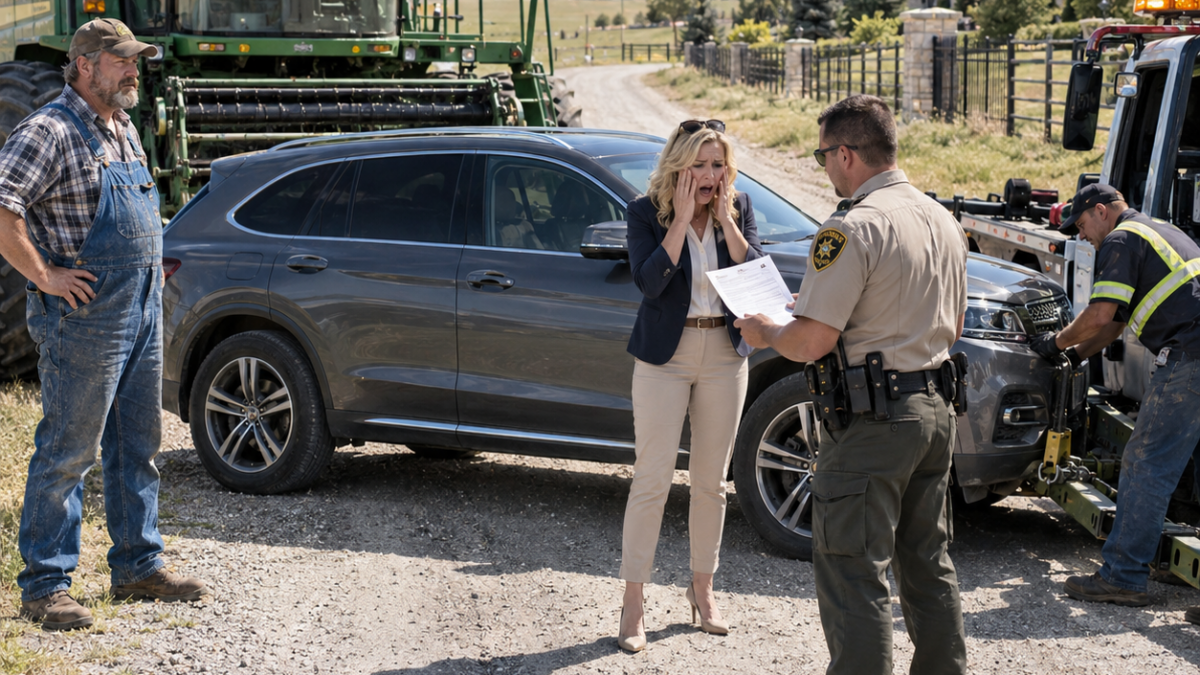
The HOA president parked her luxury SUV sideways across the only farm lane to my twenty-acre alfalfa field and told me my combine would move when she decided it could move. Six hours later, a wall of rain was flattening the most valuable cutting I had grown that year while she sat in climate-controlled comfort insisting she was “protecting community standards.” What bothered me most wasn’t the ruined crop or even the storm rolling over the western ridge—it was how certain she seemed that a title on an HOA letterhead gave her the right to stop a man from reaching his own land.
“You will move that ridiculous machine when I say you can move it.”
Karen Miller stood beside the driver’s door of her red SUV with one hand on the roof and the other holding her phone.
My John Deere combine idled behind her, filling the narrow gravel lane with the low vibration of a diesel engine ready to work.
Beyond her SUV, my field waited.
Twenty acres of second-cut alfalfa.
Months of irrigation, fertilizer, fuel, repairs, weather checks, and prayers condensed into green rows ready for harvest.
Above it, clouds were turning the color of bruises.
I looked at my watch.
The National Weather Service had warned that severe thunderstorms could arrive by late afternoon.
If I got the crop off now, I had a chance.
If it stayed through a downpour, premium hay could become low-grade feed in hours.
“Karen,” I said, “you’re blocking an agricultural access easement.”
She smiled.
“This is HOA common property.”
“No. The lane predates Whispering Pines by decades.”
“You farmers always have some excuse.”
“My farm was here first.”
“So?”
“So farming requires farm equipment.”
Her lips tightened.
Six months earlier, Karen had begun sending me letters because I sometimes staged equipment along that lane while moving between fields. My property was grandfathered outside the HOA covenants, but a surveying oddity from the subdivision’s construction had allowed the association to pretend it controlled the final hundred yards of the old farm access.
For years nobody cared.
Then Karen became president.
My planter became an “eyesore.”
My tractor became “commercial activity.”
Now my combine was apparently a threat to suburban civilization.
I pointed toward the sky.
“You have sixty seconds to move the SUV.”
Her smile widened.
“I’ve already called the sheriff.”
“Good.”
“I told them an aggressive man is threatening me while operating unauthorized commercial machinery on community property.”
There it was.
The performance.
I spent twelve years in the Army and learned early that the fastest way to lose a bad situation was to let someone else choose your emotional state.
So I stepped backward, pulled out my phone, and started recording.
“My name is Mark Evans. It is 12:41 p.m. Karen Miller, president of the Estates at Whispering Pines HOA, has positioned her vehicle across the sole agricultural access lane serving my north field.”
Karen scoffed.
“You’re ridiculous.”
I continued.
“My combine cannot pass. Severe thunderstorms are forecast. The crop awaiting harvest is twenty acres of second-cut alfalfa.”
“You’re not putting that monster through here.”
“You understand I’m documenting your refusal to move?”
“I understand that I am enforcing HOA rules.”
“The farm isn’t in your HOA.”
“The lane is.”
“We’ll let the county sort that out.”
For the next twenty minutes, the clouds darkened.
Then two sheriff’s vehicles arrived.
An older sergeant walked the lane, studied the map on my phone, looked at the combine, then at Karen’s SUV.
“Ma’am,” he said, “I need you to move your vehicle.”
Karen’s face hardened.
“I will not.”
“Then I’ll have it towed.”
For one second I thought it was over.
Then Karen pressed a hand to her chest.
“I don’t feel well.”
An ambulance was called.
She refused transport but insisted she was too distressed to drive.
And while deputies followed protocol, my combine remained trapped.
One hour became two.
Two became four.
At the five-hour mark, the first cold gust hit my face.
My farmhand Dave looked west.
“Mark.”
“I know.”
The tow truck finally arrived as heavy drops struck Karen’s windshield.
When the winch pulled her SUV onto the flatbed, she lowered her window.
“Should’ve listened to the warnings,” she called.
Then the sky opened.
I stood in the rain watching twenty acres of alfalfa bend under water, and something inside me went very still.
Karen thought she had delayed a combine.
What she had actually done was create a six-hour record of exactly who had caused the loss.
PART 2
The rain erased the horizon in less than ten minutes.
Dave and I stood beneath the open side of the machinery shed watching water hammer the field we had spent all morning preparing to harvest.
There was nothing to do.
That was the hardest part.
Farmers are problem solvers by necessity.
A hydraulic line bursts, you replace it.
A belt tears, you find another.
A storm breaks a fence, you repair it before cattle discover the opening.
You are always doing something.
That afternoon, action was useless.
The crop was still standing when the storm began, but not for long.
The wind came first.
Rows of alfalfa leaned east.
Then the rain intensified and pushed the stalks almost flat against the soil.
Water began collecting in the lower end of the field.
Dave took off his cap and wiped his forehead even though the temperature had dropped fifteen degrees.
“Maybe it passes fast.”
I knew he was trying to give me something.
“Maybe.”
It didn’t.
The storm stayed over us nearly two hours.
By the time the worst rain moved east, the field looked like somebody had rolled a heavy blanket across it.
Dave kicked mud from his boot.
“What now?”
I looked at the field.
“Now we document.”
He nodded immediately.
That was why I trusted Dave.
No speech about revenge.
No suggestion we drive to Karen’s house.
No useless anger.
Just the next step.
We walked the field in rain jackets while I recorded video.
Time.
Location.
Weather.
Condition before harvest.
Condition after the blockade.
I photographed lodged stalks.
Standing water.
Mud.
The gravel lane.
The tire marks from Karen’s SUV.
The location where the sheriff vehicles had parked.
The tow marks.
Then we returned to the barn.
Dave sat at my workbench while water dripped from the brim of his cap.
“Write down everything you remember.”
“Right now?”
“Right now.”
“Why?”
“Because tomorrow you’ll remember what you think happened. Tonight you still remember what happened.”
He stared at me.
“That is depressingly accurate.”
“Start with the time she arrived.”
Dave took a yellow legal pad.
He had been a logistics NCO in the Marines before becoming one of the best farmhands I ever hired.
His handwriting looked like printed labels.
12:32 p.m. — Karen’s SUV positioned crosswise in lane.
12:41 — Mark starts recording.
Approx. 1:02 — deputies arrive.
1:19 — Karen refuses instruction to move.
1:26 — claims medical distress.
And on.
While he wrote, I opened a spreadsheet.
Diesel first.
The combine had idled for hours.
Fuel cost was irritating but small compared with everything else.
Labor.
Mine.
Dave’s.
Equipment scheduling.
Then crop value.
That number made me stop typing.
Twenty acres.
Second cutting.
Premium alfalfa.
We had a dairy buyer waiting.
I knew the expected yield almost down to the bale.
I knew current market price.
I knew how much fertilizer went into the field, how many gallons of diesel, irrigation electricity, labor hours, seed, maintenance.
But calculating what I thought the crop was worth was not enough.
If this became a lawsuit—and by then I knew it probably would—I needed someone who had no emotional investment in me, Karen, the HOA, or the argument.
I needed an adjuster.
The next morning the sun came out.
That almost made it worse.
Heat settled over the soaked field.
Healthy alfalfa has a clean, green smell when cut correctly.
Wet alfalfa beginning to spoil smells heavier.
Sweet first.
Then sour.
By noon I could smell the change.
A crop adjuster named Daniel Peterson arrived at two.
He worked independently for several agricultural insurers and had spent most of his life around hay.
We walked the field.
He bent the plants.
Checked moisture.
Examined lodging.
Looked at drainage.
Asked when I had intended to cut.
“Yesterday at noon.”
“How long to harvest twenty acres with your equipment?”
“Under normal conditions, well within the weather window.”
“Any equipment problem?”
“No.”
“Labor available?”
“Dave and me.”
“Buyer arranged?”
“Yes.”
“Contract?”
I handed him a copy.
Peterson read it.
Then looked back toward the flattened field.
“What time did the rain start?”
I showed him the sheriff’s incident timeline and weather record.
He nodded.
“So if access had remained open, you had a plausible harvest window.”
“That’s my position.”
“It’s more than plausible.”
He crouched again.
“This is going to mold.”
“All of it?”
“I won’t say all until I finish sampling.”
Two hours later he did.
“Premium market is gone.”
I said nothing.
“You might salvage some for low-grade cattle feed if conditions improve.”
“How much loss?”
“Give me forty-eight hours.”
The report arrived two days later.
$42,800.
That was his calculated loss after salvage value.
I stared at the figure in my office.
Forty-two thousand eight hundred dollars.
I had seen larger numbers.
Mortgages.
Equipment invoices.
Land purchases.
But there was something different about a number attached to work already completed.
Months of work were in that figure.
And unlike a machine, the crop could not be repaired.
My daughter Emily called that evening from her college apartment.
She was nineteen, starting her second year.
“Dad, Mom said you lost the hay.”
My ex-wife and I had been divorced for years, but news still traveled.
“Most of it.”
“How bad?”
“Manageable.”
That was a lie.
“Dad.”
“What?”
“You always say manageable when something is terrible.”
“I do not.”
“You said Afghanistan was manageable.”
“I was talking about logistics.”
“You had a broken arm.”
“Unrelated.”
She went quiet.
Then she asked, “Does this affect tuition?”
That was the question I had been avoiding in my own head.
“No.”
“Are you sure?”
“Yes.”
“You don’t have to lie.”
“I’m not.”
I had money set aside.
But a $42,800 loss mattered.
A lot.
Emily worked part-time, carried scholarships, and hated feeling like anybody sacrificed for her.
I didn’t want Karen’s stunt reaching all the way into my daughter’s dorm room.
“You worry about classes.”
“Dad.”
“I mean it.”
She sighed.
“Fine.”
Then, quieter:
“Are you going to sue that woman?”
“I’m going to ask them to pay what they caused.”
“That sounds like yes.”
“It might become yes.”
“Good.”
“Emily.”
“What?”
“Don’t say things online.”
“I wasn’t going to.”
“No posts. No comments. No messages to anybody in that neighborhood.”
“You think I’m twelve?”
“I remember you at twelve.”
“That’s rude.”
“It’s evidence.”
She laughed.
That helped.
My first formal letter went to the board.
Not Karen personally.
The entire HOA board.
I described the incident.
Included the sheriff’s report number.
The crop appraisal.
Photographs.
Weather data.
A copy of the deed and easement language.
I requested reimbursement for documented losses and written confirmation that the association would not interfere with agricultural access again.
Ten business days.
Certified mail.
Return receipt.
Karen signed for it.
I knew because the green card came back.
Then silence.
Day five.
Day eight.
Day ten.
Nothing.
On day eleven, I found a thick HOA envelope in my mailbox.
For one foolish second, I thought it contained a settlement response.
Instead, I received three violations.
$500 for improper parking of commercial equipment on common property.
The combine.
The combine Karen had trapped.
$1,000 for conducting unauthorized commercial operations visible from HOA land.
Farming.
On my farm.
And $250 for failure to maintain landscaping to neighborhood standards.
The “landscaping” was my storm-flattened alfalfa.
I read the third one twice.
Then a third time.
The note said:
Field area presents an overgrown and neglected appearance visible from association common space.
I sat in my truck laughing.
There are moments when rage becomes so complete it circles around into disbelief.
Dave walked over.
“What?”
I handed him the pages.
He read the first.
Second.
Then third.
His expression became blank.
“That’s impressive.”
“What?”
“I’ve seen stupid before.”
He tapped the pages.
“This is professional-grade stupid.”
“She signed for the demand yesterday before these were issued.”
“No.”
“Check the dates.”
He did.
“Mark.”
“I know.”
“She fined you for the crop she stopped you from harvesting.”
“I know.”
Dave handed the papers back.
“You need a lawyer.”
“Yes.”
But before that, I wanted to understand exactly what Karen thought she controlled.
I retrieved everything I had from closing.
Deed.
Survey.
Title policy.
County zoning.
Agricultural-use documentation.
Then I downloaded every public HOA document I could find.
Declaration.
Bylaws.
Rules.
Architectural standards.
Maps.
Budgets.
Minutes.
The farm itself had never been annexed into Whispering Pines.
That was clear.
The disputed piece was the access lane.
When the subdivision was developed, the common-area map shaded the land around it as association property.
Karen treated that map as ownership of the lane itself.
My title paperwork described something older.
An agricultural access easement across that strip.
The previous owner had used it.
The owner before him had used it.
County aerial imagery showed farm vehicles traveling it years before Whispering Pines existed.
I called the title company.
They assigned a claims specialist.
Then I visited the county recorder.
No dramatic discovery.
No secret century-old map through Karen’s living room this time.
Just a straightforward chain of records confirming the easement.
That was enough.
The next unexpected step came from Carlos Rodriguez.
I barely knew Carlos.
His house sat two streets into the subdivision.
Three kids.
Pickup truck.
Always fixing something in the garage.
He stopped me near the mailbox one afternoon.
“Mark?”
“Yeah?”
“I heard about Karen and your combine.”
I looked toward the neighborhood.
“From Karen?”
“Everybody heard Karen’s version.”
“What is her version?”
“That you tried to drive industrial machinery through HOA property and threatened her when she stopped you.”
I nodded.
“Sounds right.”
Carlos frowned.
“You’re joking?”
“About that being her version.”
He stepped closer.
“What actually happened?”
I gave him the short version.
Then showed him the sheriff incident report on my phone.
He read it.
“Deputy told her to move?”
“Yes.”
“She refused?”
“Yes.”
“And then she fined you?”
I showed him the notices.
Carlos stared.
Then laughed bitterly.
“Of course she did.”
“You sound familiar with the process.”
He pointed toward his driveway.
A regulation basketball hoop stood beside the garage.
“She fined us five hundred dollars.”
“For that?”
“Too permanent.”
I looked at the hoop.
“What does that mean?”
“I asked.”
“And?”
“She said it altered the streetscape.”
He wiped grease from his fingers onto a shop rag.
“My wife wanted to fight it. Then Karen threatened daily fines.”
“So you paid?”
“Yeah.”
He looked embarrassed.
“Five hundred was cheaper than a lawyer.”
“No reason to be embarrassed.”
“There is.”
“No.”
I knew that feeling.
People like Karen survived on turning compliance into shame.
Carlos continued.
“You want to know who else she’s done it to?”
That question opened a door.
Mr. Hemlock lived six houses away.
Retired Navy.
Seventy-four.
His flagpole was twenty years old.
Karen’s architectural committee adopted a maximum pole height after he installed it.
Then applied the rule to him retroactively.
Two inches.
That was how far above the new limit his pole stood.
$100 per month.
He refused to shorten it.
“I didn’t crawl around aircraft carriers for twenty-five years so some woman with a clipboard could measure my flagpole with a tape.”
I liked him immediately.
Then came the Mitchell family.
Their daughter’s plastic play structure was purple.
Not an approved recreational color.
The Parkers wanted a wheelchair ramp for Mr. Parker’s elderly father.
Karen rejected the first design because the handrail was visible from the street.
That one made me genuinely angry.
The board eventually approved a different ramp after medical documentation, but only after weeks of delay.
I started seeing a pattern.
Not every HOA complaint was illegitimate.
Some residents had violated actual rules.
One man wanted to store a boat on his front lawn permanently.
Another built a six-foot fence without checking utility lines.
Reasonable governance existed for reasons.
Karen’s pattern was different.
Discretion always flowed toward more control.
Ambiguous rule?
Interpret it strictly.
Old feature?
Apply new standard.
Appeal?
She chaired the appeal.
Question her?
Expect another inspection.
Dave helped me organize what people voluntarily shared.
We made a spreadsheet.
Name.
Notice.
Rule cited.
Fine.
Appeal result.
Committee members.
Date.
No gossip column.
No “Karen is evil” category.
Documents.
The total fines over roughly three years exceeded $70,000.
That number came from HOA budget reports and resident records.
Then Dave noticed something.
“Look at beautification.”
I leaned over his laptop.
The line item had grown every year.
Entrance landscaping.
Gazebo improvements.
Seasonal flowers.
Pond upgrades.
I frowned.
“Where are these?”
“Mostly the east entrance.”
“Karen lives near the east entrance.”
“Yes.”
“Does that prove misuse?”
“No.”
“Good.”
Dave looked at me.
“You sound disappointed.”
“I sound careful.”
We requested more detailed financial records through homeowners who were association members.
Some projects had been properly approved.
Some records were vague.
The landscaping contractor serving the entrance also maintained flower beds near Karen’s block, but nothing we had yet proved she personally took money or illegally redirected funds.
That distinction mattered.
I told the group the same thing.
“We do not accuse her of stealing.”
Mr. Hemlock grumbled.
“She’s stealing my money every month.”
“Through fines you dispute. Different issue.”
Carlos nodded.
“What can we say?”
“That the fine income increased while discretionary beautification spending increased and that residents deserve an audit.”
“Less satisfying.”
“More defensible.”
Mrs. Rodriguez smiled.
“You really were Army.”
“Twelve years.”
“It shows.”
Sarah—the young mother with the wheelchair-ramp issue, not anyone in my family—asked, “What do we actually want?”
Good question.
I wrote four things on Dave’s whiteboard.
My crop loss paid.
Agricultural access protected.
Retaliatory fines canceled.
Fair review of questionable neighborhood fines.
Then I added a fifth.
Independent audit and governance changes.
Dave stared.
“You forgot Karen.”
“What about her?”
“Gone.”
“That is the homeowners’ decision.”
Mr. Hemlock said, “I already decided.”
“We still follow the bylaws.”
He sighed.
“Everybody suddenly loves procedure.”
“Procedure is what keeps the next Karen from becoming Karen.”
That ended the argument.
Finding a lawyer took longer.
I wanted someone who understood property rights and association law.
A veteran business network led me to Arthur Vance.
Retired Air Force JAG.
Twenty-five years in uniform.
Private practice afterward.
Late sixties.
White mustache.
Office so organized that even his pens looked intimidated.
He shook my hand.
“Colonel McGregor says you have a homeowners association problem.”
“I don’t live in their homeowners association.”
Arthur smiled.
“Those are often the most interesting ones.”
I spent an hour on my case.
Blockade.
Weather.
Sheriff.
Towing.
Crop damage.
Certified demand.
Retaliatory fines.
Easement.
Then I opened the community binder.
Arthur stopped me.
“Before we go farther.”
“Yes?”
“Are these people asking you to represent them?”
“No.”
“Good.”
“Why?”
“Because I represent you if you hire me. Not a movement.”
“Understood.”
He reviewed the fines.
Budgets.
Minutes.
His expression changed only twice.
Once at Karen fining me for the combine after blocking it.
Again at the landscaping violation for the ruined field.
Finally he leaned back.
“Your crop case is stronger than most consequential-damage cases I see.”
“Why?”
“Timeline.”
He began counting.
“Crop ready.”
“Documented.”
“Buyer?”
“Documented.”
“Weather forecast?”
“Documented.”
“Equipment operational?”
“Yes.”
“Access blocked intentionally?”
“Video.”
“Sheriff witness?”
“Yes.”
“Duration?”
“Six hours.”
“Independent crop appraisal?”
“Forty-two eight.”
Arthur nodded.
“You mitigated?”
“Salvaged what little we could.”
“Excellent.”
I frowned.
“Excellent?”
“Legally.”
“Financially it was terrible.”
“I mean excellent evidence.”
He moved to the easement.
“This is likely our declaratory claim.”
He explained.
The HOA might own land underlying part of the lane.
That did not necessarily mean it could interfere with a recorded easement.
Ownership of the burdened property and the right to use an easement can coexist.
Karen had collapsed those concepts into one sentence:
HOA property, therefore HOA control.
Property law was more complicated.
“Can we stop them from blocking me again?”
“We seek injunctive relief.”
“What about the fines?”
“First question is whether they have jurisdiction over you at all.”
“They don’t.”
“I like confidence. Courts prefer documents.”
I smiled.
Then he reviewed the retaliation timeline.
Karen signs for demand.
Next day, violations.
He tapped the dates.
“This is ugly.”
“Good ugly?”
“For you.”
He paused.
“I’m not calling it illegal retaliation yet. But a jury may find the timing persuasive.”
“What are we suing for?”
Arthur rejected some of the more dramatic legal labels I had seen online.
“No fantasy causes of action.”
He outlined a case based on intentional interference with my easement and business expectancy, nuisance-related theories depending on state law, declaratory and injunctive relief concerning the access, challenges to unauthorized assessments or fines, actual damages, fees where recoverable, and potential punitive damages if we could prove malice.
“And Karen personally?”
“If an officer commits her own intentional tort, being president does not automatically immunize her.”
“So no ‘piercing the corporate veil’ speech?”
Arthur looked almost offended.
“Please never say that to me unless we’re actually litigating alter ego.”
I laughed.
“I think I hired the right lawyer.”
He slid a retainer agreement across the desk.
Five thousand dollars.
I signed.
The complaint was filed three weeks later.
Karen was named.
So was the HOA.
The filing did not call her tyrannical.
Did not mention medieval queens.
Did not describe her SUV as a weapon.
It did something much worse.
It listed dates.
12:32 p.m.
Blockade begins.
Law enforcement responds.
Repeated request to move.
Medical claim.
Ambulance evaluation declined.
Tow initiated after extended obstruction.
Storm begins.
Crop lost.
Demand received.
Fines issued.
Facts are less dramatic than insults.
They are also harder to argue with.
Karen’s attorney was Barry Thompson.
Polite enough in person.
Aggressive on paper.
He filed a motion asking the court to dismiss major parts of the case.
HOA authority.
Business judgment.
No duty to guarantee my crop against weather.
Karen acting within her official capacity.
Arthur filed our response.
The hearing came six weeks later.
Judge Eleanor Carmichael sat behind the bench reading while attorneys spoke.
She was probably in her early sixties.
Reading glasses low on her nose.
The kind of judge who did not need to raise her voice because everybody already knew where authority actually sat.
Barry argued first.
“Mr. Evans’s loss was caused by a severe weather event.”
Arthur stood.
“The weather was the mechanism that damaged the crop. Our allegation is that defendants intentionally prevented plaintiff from completing a time-sensitive harvest before that known event.”
Barry objected to the word known.
Arthur handed up weather advisories.
Then the video transcript.
Then the incident report.
Judge Carmichael looked at Barry.
“There was a severe storm watch?”
“Yes, Your Honor, but weather forecasts—”
“And your client blocked the sole access?”
“Our position is that she was temporarily enforcing community safety rules.”
Judge Carmichael looked over her glasses.
“With her personal vehicle?”
Barry paused.
“Correct.”
“And the plaintiff’s farm is outside the association?”
“The access strip is common property.”
Arthur stood.
“Subject to a recorded agricultural easement, Your Honor.”
The judge turned to Barry.
“Is that disputed?”
“We dispute scope and enforceability.”
“Fine.”
She made a note.
Then came the retaliation issue.
Arthur showed the dates.
Judge Carmichael did not rule that Karen acted maliciously.
Not then.
She did something worse for Karen.
She allowed the claims to proceed into discovery.
Barry’s motion failed in the areas that mattered.
Outside the courtroom, Karen walked past me.
No hello.
No comment.
But the expression on her face told me something had changed.
For the first time, somebody else had decided whether her authority had limits.
She hated it.
My deposition came first.
Arthur prepared me the way I used to prepare soldiers for briefings.
“Short answers.”
“I know.”
“Answer what is asked.”
“I know.”
“No speeches.”
“I know.”
“Do not argue with Barry.”
“I know.”
“Then why do I think you’re going to argue with Barry?”
“Because you bill by the hour and enjoy anxiety.”
Arthur almost smiled.
The deposition lasted three hours.
Barry tried to portray me as hostile.
“Mr. Evans, had you previously received HOA warnings?”
“Yes.”
“And ignored them?”
“I disagreed with their applicability.”
“You threw some away.”
“Yes.”
“So you did not take the association seriously.”
“I did not believe the association had authority over agricultural operations on my property.”
“Did you tell Ms. Miller you would call law enforcement?”
“Yes.”
“Would you characterize that as a threat?”
“No.”
“What would you characterize it as?”
“Notification.”
Barry frowned.
“You’re splitting hairs.”
Arthur said, “Counsel.”
Barry moved on.
“Were you angry?”
“Yes.”
“Extremely angry?”
“I was watching a harvest window close.”
“Did you raise your voice?”
“Possibly.”
“Did you threaten physical harm?”
“No.”
“Did you approach her vehicle aggressively?”
“No.”
Video backed that up.
He tried another direction.
“Isn’t it possible the storm would have destroyed the crop even if you had entered the field at noon?”
“Anything is possible.”
“So you cannot guarantee you would have finished.”
“I can testify to my equipment capacity, field conditions, crew availability, and historical harvest times.”
“That isn’t a guarantee.”
“No.”
“Thank you.”
Arthur later told me that answer helped.
Why?
Because I didn’t pretend uncertainty didn’t exist.
The law rarely requires certainty.
It requires proof strong enough to persuade.
Then came Karen’s deposition.
I attended because Arthur believed my presence might make her more careful.
He was wrong.
Karen walked in carrying a large leather handbag and wearing a navy suit.
She treated the court reporter as staff.
Told Barry she had another appointment at three.
Corrected Arthur twice before he finished questions.
Then the blockade.
“Ms. Miller, did you park your SUV across the access lane on August fourteenth?”
“I parked on association property.”
“Did your vehicle prevent Mr. Evans’s combine from passing?”
“The machine was too large to safely enter.”
“That wasn’t my question.”
Her mouth tightened.
“Yes.”
“Did you intend to prevent it from passing?”
“I intended to enforce our standards.”
“So yes?”
“I suppose.”
Arthur showed her photographs.
“Your SUV is perpendicular to the lane.”
“Yes.”
“Why?”
“To prevent an unauthorized commercial vehicle from entering community property.”
“Were you aware Mr. Evans claimed an agricultural easement?”
“He claims many things.”
“Were you aware?”
“Yes.”
“Did you review his deed?”
“No.”
“Survey?”
“No.”
“Title documents?”
“No.”
“County records?”
“No.”
Arthur paused.
“Did you obtain a legal opinion before physically blocking his access?”
Barry objected.
Karen answered anyway.
“I’m HOA president. I don’t need a lawyer every time someone ignores the rules.”
Arthur looked at Barry.
Barry looked at the table.
That was the first gift.
Then the demand letter.
Arthur placed the certified receipt in front of her.
“Your signature?”
“Yes.”
“You received Mr. Evans’s claim on August twenty-sixth?”
“Apparently.”
“These violations are dated August twenty-seventh?”
“Yes.”
“Why?”
“He was in violation.”
“Had the combine violation existed on August fourteenth?”
“Yes.”
“Why issue it thirteen days later?”
“I process paperwork when I have time.”
“And the farming violation?”
“His commercial activities are disruptive.”
“His farm predates the subdivision, correct?”
“I don’t know.”
Arthur handed her county records.
“Now you know.”
Barry shifted again.
Arthur continued.
“The landscaping violation refers to Mr. Evans’s field as overgrown.”
“Yes.”
“At that time, you knew the crop had been damaged in the storm?”
“He claims that.”
“You were physically present when the storm began.”
“Yes.”
“You watched the field?”
“I didn’t study his field.”
“You knew he was trying to harvest before the rain?”
“He said that.”
“And the next day you approved a notice fining him because the field looked neglected?”
Karen leaned forward.
“Mr. Evans seems to think being a veteran and farmer means he does not have to respect the people who live around him.”
Arthur waited.
No question.
He just let the answer exist.
The court reporter typed.
Karen continued.
“We have standards for a reason. People paid a lot of money to live in Whispering Pines. They should not have to stare at industrial machinery and unkempt farmland.”
Arthur finally asked, “Is Mr. Evans’s farmland part of Whispering Pines?”
“It borders us.”
“Yes or no?”
“No.”
“Thank you.”
Then Mr. Hemlock’s flagpole.
Carlos’s basketball hoop.
The play structure.
Karen defended every one.
“Rules are rules.”
Arthur asked whether Mr. Hemlock’s pole predated the regulation.
“That’s irrelevant.”
“Why?”
“Current standards apply to current residents.”
“Did you obtain counsel on retroactive enforcement?”
“No.”
The wheelchair ramp.
That one changed the room.
Arthur did not accuse her of violating disability law outright because the actual facts were more nuanced.
He asked why the first application was delayed.
“Aesthetic review.”
“Did the family submit medical documentation?”
“Eventually.”
“Did you personally suggest the ramp should be placed at the rear even though that route was longer?”
“I suggested a less visually disruptive option.”
“And did the resident explain that the rear route was impractical for the wheelchair user?”
Barry objected.
Karen said, “Everybody thinks their case deserves an exception.”
Arthur leaned back.
“Thank you.”
Afterward, in the hallway, he closed his notebook.
“You heard it.”
“What?”
“She believes discretion only goes one direction.”
“Toward her.”
“Exactly.”
“Did she hurt herself?”
“Yes.”
“How much?”
Arthur smiled.
“Enough.”
Karen did not slow down.
That surprised even me.
Most people become careful once lawyers are involved.
Karen became more Karen.
The HOA sent a notice threatening a lien for my unpaid fines.
By then late charges had pushed the amount above five thousand dollars.
Arthur filed for emergency relief.
Judge Carmichael scheduled the matter quickly.
Arthur placed Karen’s deposition beside the lien notice.
“The association seeks to encumber property that is not within its covenants, using fines issued immediately after the plaintiff demanded compensation, for activities including the agricultural operation at issue in this litigation.”
Barry tried to argue administrative consistency.
Judge Carmichael stopped him.
“Is Mr. Evans’s farm property subject to the declaration?”
Barry hesitated.
“Not the farm parcel itself.”
“Then what is the basis for placing a lien on that parcel?”
Silence.
“Mr. Thompson?”
“The association believes the access-related violations attach through—”
“Show me.”
He could not.
Judge Carmichael issued an injunction preventing collection activity on the disputed fines pending final resolution.
Then she looked directly at Karen.
“Ms. Miller, I am not making findings today about your motives.”
Karen nodded stiffly.
“But while this case is active, you would be well advised to avoid actions that could reasonably be interpreted as interfering with the litigation.”
“Yes, Your Honor.”
That lasted eleven days.
The next HOA newsletter arrived.
PROTECTING OUR COMMUNITY’S CHARACTER.
It did not name me.
It did not need to.
It described “a neighboring commercial agricultural operator” using “oversized industrial equipment.”
It complained that association funds were being consumed by “baseless litigation.”
It warned that legal expenses could threaten community amenities.
The implication was simple.
My lawsuit endangered everyone’s pool, landscaping, clubhouse, and property values.
Carlos called me before I finished reading.
“You seeing this?”
“Yes.”
“She’s blaming you for legal fees she created.”
“Yes.”
Mr. Hemlock called next.
“She’s calling your farm industrial.”
“Technically farming is an industry.”
“Do not defend that woman to me.”
“I’m not.”
Dave came to the barn carrying a copy.
He slapped it on the bench.
“She wants the neighborhood against you.”
“I know.”
“What do we do?”
For months we had quietly documented.
Now people were ready to talk.
Arthur surprised me.
“Don’t use the HOA meeting.”
“Why?”
“She controls it.”
“Residents can speak.”
“She controls agenda, time, microphone, minutes.”
“What do you suggest?”
“Neutral ground.”
Carlos found us a room at VFW Post 732.
We called it a Community Property Rights and HOA Governance Forum.
Not “Down With Karen.”
Dave wanted that.
I rejected it.
Arthur offered to moderate.
Residents would speak.
Documents would be available.
No screaming.
No threats.
No personal insults.
Then Arthur made one phone call.
Jessica Chen.
Investigative reporter at a local television station.
I stared at him.
“Media?”
“You don’t have to agree.”
“I thought you hated public litigation.”
“I hate clients posting reckless things online.”
“Difference?”
“Journalists ask questions and edit.”
“That is optimistic.”
“It is also useful when there is public-interest documentation.”
I thought about it.
“Will this hurt the case?”
“Not if you say only what we can prove.”
“Which is?”
“Karen blocked you. Sheriff responded. Crop loss documented. Fines issued. Lawsuit pending. Court entered injunction. Homeowners can tell their own stories.”
“No predicting verdict.”
“Correct.”
I agreed.
Karen heard about the meeting.
She emailed residents.
UNAUTHORIZED GATHERING.
She said it had no standing under association governance.
That probably doubled attendance.
The VFW hall held one hundred twenty people.
More than one hundred came.
I stood behind the curtain before it started and listened to chairs scrape.
Sarah Parker—the woman whose father needed the ramp—touched my arm.
“You nervous?”
“Very.”
“You don’t look nervous.”
“Army.”
“Useful.”
“Sometimes.”
Arthur opened.
“We are not here to destroy an association.”
That sentence surprised people.
“We are here to discuss what an association is legally allowed to do, what accountable governance requires, and what residents can do when they believe procedures are not being followed.”
He introduced me.
I carried the binder.
No speech written by a lawyer.
Just facts.
“My name is Mark Evans. I operate the farm bordering Whispering Pines.”
Some people nodded.
“On August fourteenth, HOA president Karen Miller parked her SUV across the agricultural access lane used to reach my north field.”
Jessica’s camera recorded.
“I had twenty acres of alfalfa ready for harvest. Severe storms were forecast. I asked her to move.”
I showed one still image.
Red SUV.
Combine behind it.
“She refused.”
Then sheriff incident report.
“Law enforcement responded.”
Weather timeline.
“The lane remained blocked approximately six hours.”
Crop report.
“The storm reached us before access reopened. Independent appraisal placed crop loss at $42,800 after salvage.”
I paused.
“When I asked the board to reimburse documented damages, I received these the following day.”
Three violation notices went onto the projector.
People murmured.
“The first fined me for the combine she blocked.”
Laughter.
“The second fined me for commercial agricultural activity on a farm that is not in the HOA.”
Louder reactions.
“The third fined me because the storm-damaged crop looked neglected.”
Silence.
“That is why I filed suit.”
Then I closed my binder.
“But this meeting is not my lawsuit.”
I looked around.
“It is your neighborhood.”
Mr. Hemlock spoke next.
He wore his Navy cap.
Did not shout.
“My flagpole is twenty years old.”
He held up Karen’s notices.
“The rule she used is five.”
A voice called, “Five years?”
“No.”
He smiled.
“Five years old.”
People laughed.
“The pole is twenty.”
Then Carlos.
He brought his son.
The basketball hoop fine.
Mrs. Rodriguez described why they paid.
“We were afraid every appeal would create another inspection.”
That line hit harder than the amount.
The Parker family discussed the wheelchair-ramp delay.
The young mother with the purple play set held up a picture of her daughter.
“She asked me why the neighborhood hated her slide.”
Nobody laughed.
Then Dave projected the spreadsheet.
Fine totals.
Budget totals.
Not accusations.
Data.
“We are not claiming these numbers prove theft.”
I appreciated him saying it before I had to.
“We are asking why fine revenue increased this much, how enforcement decisions were made, and whether spending received appropriate board review.”
The remaining HOA directors were in the front row.
Vice President Robert Hayes.
Treasurer Linda Cho.
Secretary Michael Burns.
Two at-large members.
Karen was absent.
That absence became a presence.
Jessica Chen approached the board during audience questions.
“Were you aware of all these enforcement actions?”
Robert Hayes looked miserable.
“I knew about some.”
“All?”
“No.”
“Did the full board vote on each fine?”
“No. The architectural committee handled many.”
“Who chaired that committee?”
He did not answer immediately.
Everyone knew.
“Ms. Miller.”
Then a man named Glenn Price stood from the side of the room.
“I’m on that committee.”
Karen was not there to stop him.
“We were given packets.”
“What packets?” Arthur asked.
“Violation summaries.”
“Who prepared them?”
Glenn swallowed.
“Karen.”
“Did you independently review each rule?”
“Not always.”
He looked at the residents.
“I’m sorry.”
The room remained quiet.
“I thought these were straightforward.”
He pointed toward the projected fines.
“I never saw them together like this.”
That was the real turning point.
Not the crop.
Not my lawsuit.
Not even the judge.
The moment ordinary residents saw that Karen’s “board decisions” were often Karen’s summaries passing through people who trusted her.
The forum ended with Arthur explaining governance options.
Records requests.
Petitions.
Board elections.
Recall procedures if bylaws allowed.
Independent audit.
He did not tell anyone to revolt.
He told them to read.
Jessica’s report aired two nights later.
The opening image was my combine behind Karen’s SUV.
Then rain over the flattened field.
Then residents at the VFW hall.
Then court documents.
Karen declined an interview.
The reporter included the HOA attorney’s written statement saying the association disputed liability and believed its actions were lawful.
Fair.
But the visual facts were ugly.
The next morning, Arthur called.
“Insurance carrier.”
“What about them?”
“They want to talk.”
The HOA carried directors-and-officers coverage and general liability coverage.
The insurer had been defending under a reservation of rights.
Karen’s deposition, the injunction, and the media attention changed their risk calculation.
Not because television determines law.
Because television reminded them what a jury might look like.
Arthur put it plainly.
“A jury will see the SUV.”
“I know.”
“They will hear six hours.”
“I know.”
“They will see weather radar.”
“I know.”
“They will see the $42,800 report.”
“Yes.”
“Then the fines.”
“Yes.”
“And Karen saying under oath that she believed her office allowed her to enforce aesthetics against neighboring agricultural land.”
“When you say it that way—”
“That is how opposing counsel says it to their client.”
The first settlement offer covered my crop loss.
Nothing else.
In return, I would dismiss claims against the HOA and Karen.
“No.”
Arthur waited.
“You don’t need to perform for me.”
“I’m not.”
“What do you want?”
“Access confirmed.”
“Reasonable.”
“Legal fees.”
“Reasonable.”
“My fines canceled.”
“Obviously.”
“The neighbors?”
“That is where it gets complicated.”
“They have their own claims.”
“Some do. Some may not. Your lawsuit cannot become a magic eraser for every HOA dispute.”
I knew that.
“What can we do?”
“Settlement can include governance review and voluntary refund program for identified fines if the association agrees.”
“And Karen?”
Arthur watched me.
“Do you want money from Karen or resignation?”
“Both.”
He smiled slightly.
“Honest.”
“I want her accountable.”
“That word means different things.”
“She blocked the lane herself.”
“Yes.”
“She issued the fines.”
“Yes.”
“She kept escalating.”
“Yes.”
“Then I don’t want a settlement where the insurance company writes a check and she keeps the gavel.”
Arthur leaned back.
“That is not entirely within your control.”
“I know.”
“But you can make it a term.”
“Yes.”
“And they can refuse.”
“Yes.”
“Then we keep litigating.”
“Yes.”
He nodded.
“Good. Now you understand.”
The insurer hired new defense counsel.
A woman named Rebecca Sloan.
Much sharper than Barry.
Our case changed immediately.
No more bluffing letters.
No melodrama.
Rebecca deposed witnesses.
Reviewed title records.
Hired an agricultural economist to examine my crop loss.
Sent an engineer to inspect the lane.
Requested combine capacity records.
Arthur liked her.
“That worries me.”
“Why?”
“Competent opposing counsel narrows nonsense.”
“Isn’t that good?”
“For settlement.”
He smiled.
“For my entertainment, less so.”
The defense economist challenged Peterson’s $42,800 figure.
Said some hay might have been salvageable.
Said weather could have reduced quality anyway.
We expected that.
Peterson explained his methodology.
Buyer price.
Moisture.
Yield.
Salvage.
Historical timing.
Then Paul Martin, my dairy buyer, testified that he had planned to purchase the crop at premium grade and that after the storm he sourced elsewhere.
Dave testified to equipment readiness.
Weather records showed the storm’s arrival.
Sheriff body-camera footage captured Karen refusing to move.
That footage became critical.
Sergeant Miller—the deputy, no relation to Karen—was calm.
“Ma’am, move the vehicle.”
“I am president of this association.”
“I understand.”
“This is HOA property.”
“Then pursue that civil issue later. Right now you are obstructing access.”
“I do not feel safe with that machine here.”
“Then step away from the lane.”
“No.”
Later:
“If you don’t move it, we will tow it.”
Then her sudden medical complaint.
No one accused her of faking.
That would have been impossible to prove and unnecessary.
The ambulance report showed she declined evaluation beyond basic vitals and declined transport.
She remained in the SUV.
Hours passed.
Then tow.
The timeline spoke for itself.
Rebecca Sloan requested mediation.
Arthur agreed.
Not because we were weak.
Because litigation had already cost everyone too much.
Before mediation, the HOA finally conducted an independent audit.
That report mattered.
It did not find Karen had stolen money.
That was important.
No secret bank account.
No embezzlement.
No envelope of cash from landscapers.
What it found was bad governance.
Karen had exercised disproportionate influence over discretionary beautification decisions.
The board had poorly documented approvals.
Fine revenue flowed into the general budget and indirectly supported expanded landscaping projects.
Several projects disproportionately benefited areas near Karen’s side of the development, but they remained common areas.
That was conflict and optics.
Not proven theft.
I was glad the truth was narrower than the suspicion.
If we were going to win, I wanted to win on what actually happened.
The audit also found twenty-three fines with questionable procedural defects.
Missing notice.
Inconsistent appeal records.
Rules adopted after the condition being penalized.
Insufficient committee minutes.
That was enough.
Then came one last disaster of Karen’s own making.
She sent a letter to the board accusing Robert Hayes of betraying her.
He forwarded it to counsel.
In the letter, she wrote:
If the board had supported me from the start and made Evans understand that access through our community is a privilege, none of this would have happened.
Arthur circled one word.
Privilege.
“It’s an easement.”
“I know.”
“She still doesn’t understand.”
“No.”
“She thinks access is permission.”
“Yes.”
“That sentence is going into mediation.”
It did.
Mediation began at nine in the morning.
I was in one conference room with Arthur.
HOA directors in another.
Karen in a third with separate counsel because the insurer had concerns about coverage for intentional conduct.
Rebecca Sloan moved between rooms with the mediator.
First offer.
$65,000.
Arthur slid it toward me.
“No.”
“Agreed.”
Second.
$92,000.
Included crop and some fees.
No governance provisions.
“No.”
Third.
$120,000 total package.
Some refunds.
Access declaration.
Karen remained president.
I looked at Arthur.
“No.”
He nodded.
“Agreed.”
At four o’clock, the mediator came in.
“He wants to know what matters most besides money.”
I answered immediately.
“Access.”
“Already agreed.”
“Recorded declaration.”
“Agreed.”
“No HOA jurisdiction over farm equipment using the easement.”
“Agreed.”
“Fines canceled.”
“Yours, yes.”
“Neighbor review.”
“They’re willing to refund identified defective fines.”
“All?”
“List being negotiated.”
“And Karen?”
The mediator sighed.
“They cannot technically promise an elected director’s resignation without her agreement.”
“Then she agrees.”
“She is not currently agreeing.”
I looked at Arthur.
He said nothing.
The mediator continued.
“The board is prepared to call a special meeting.”
“No.”
Arthur finally spoke.
“Mark.”
I looked at him.
“You cannot buy a private person’s resignation unless she consents. What you can do is settle your case and let the members remove her under their governing documents.”
“That lets her say she won.”
“Does that matter?”
At that moment, yes.
Then I remembered Emily asking about tuition.
Dave standing in the rain.
Mr. Hemlock paying $100 a month over two inches.
Carlos’s wife afraid of another inspection.
The wheelchair ramp.
This stopped being about what Karen said.
“Fine.”
Arthur nodded.
“But no confidentiality on the governance terms.”
The mediator wrote.
“And monetary demand?”
Arthur turned to me.
We had calculated actual crop loss.
Fuel.
Labor.
Survey and title work.
Legal fees.
Other expenses.
Refunds to neighbors.
Audit.
The total settlement value, depending on which obligations were counted, was approaching $155,000.
Not all cash to me.
That distinction mattered.
I wanted my losses covered.
I wanted Arthur paid.
I wanted refunds.
The insurer and HOA could structure the rest.
By seven, the deal took shape.
My documented crop loss paid.
Fuel and labor paid.
Substantial legal fees paid.
My $1,750 fines voided.
No lien.
Recorded declaration protecting agricultural access.
Permanent injunction-like settlement covenant preventing interference with normal farm traffic.
Refunds or credits for agreed improper fines, including Hemlock, Rodriguez, the play-set family, and others.
Governance reforms.
Independent review process.
Karen to issue a written public acknowledgment that blocking my access exceeded her authority.
And Karen agreed—after pressure from her own board—to resign from the presidency and board.
That final term came from her side at 8:16 p.m.
I stared at Arthur.
“She agreed?”
“Apparently.”
“Why?”
“The board informed her they would otherwise proceed with recall and remove her counsel funding where permitted.”
I sat back.
The total settlement value exceeded $155,000.
Again, not a $155,000 check in my pocket.
My personal recovery represented documented losses and fees.
The rest included refunds and obligations funded through the settlement.
That was better.
It meant the number had meaning beyond revenge.
Karen’s SUV had already been towed the day of the blockade.
The settlement did not seize it.
No judge awarded me her car.
That story would grow later.
Reality was enough.
The clubhouse meeting occurred two weeks later.
Every chair was filled.
I sat in the front with Arthur.
Carlos on my right.
Mr. Hemlock on my left.
Dave behind us.
Someone whispered that Karen might not show.
Arthur checked his watch.
“She signed.”
“That doesn’t mean she’ll come.”
“Then we enforce.”
At 7:11, the door opened.
Karen entered.
No red SUV.
Someone later told me she had been dropped off.
I did not care.
She wore a dark blue dress.
No clipboard.
No giant handbag.
Just one piece of paper.
She walked to the board table.
Did not sit in the president’s chair.
Robert Hayes opened the meeting.
“Before regular business, Mrs. Miller has a statement.”
Karen gripped the paper.
I expected hatred in her face.
There was some.
But mostly she looked exhausted.
She began.
“I am issuing this statement pursuant to the settlement entered in Evans v. Estates at Whispering Pines Homeowners Association and related parties.”
Lawyer language.
She swallowed.
“On August fourteenth, I used my personal vehicle to prevent Mr. Mark Evans from using the agricultural access lane adjacent to the association’s property.”
The room was completely still.
“My actions exceeded the authority of my position.”
Her voice tightened.
“I regret the financial loss that followed.”
She looked at me once.
Only once.
“The association has agreed that Mr. Evans’s farm is not subject to HOA agricultural-use restrictions and that his lawful use of the access easement will not be obstructed.”
Mr. Hemlock sat straighter.
Karen continued.
“The board has also reviewed enforcement actions issued during my tenure and determined that certain fines were inconsistently or improperly applied.”
Her hand shook.
“Those identified fines will be rescinded and refunded.”
Carlos’s wife began crying quietly.
Not because of $500.
Because somebody had finally said they had not been crazy.
Karen reached the final paragraph.
“In the interest of allowing the community to move forward, effective immediately, I resign as president and as a director of the Estates at Whispering Pines Homeowners Association.”
She stopped.
No applause yet.
She folded the paper.
Robert said, “Thank you.”
Karen looked at him.
Something passed between them.
Three years of board meetings.
Control.
Loyalty.
Fear.
Whatever it was, it ended there.
She walked toward the door.
Mr. Hemlock stood.
For one terrifying second, I thought he was going to say something.
He didn’t.
He began clapping.
Carlos joined.
Then others.
Not cheering.
Not jeering.
Applause that sounded more like people letting go of pressure.
Karen stopped at the door.
Did not turn.
Then left.
I sat still.
Dave leaned forward.
“You okay?”
“Yeah.”
“You don’t look happy.”
“I am.”
“Could fool me.”
Arthur answered for me.
“Relief is quieter.”
That was exactly it.
The new board election happened six weeks later.
Carlos won a seat.
So did Linda Cho, who had served as treasurer but had openly supported the audit.
Mr. Hemlock ran.
Won.
I told him governance was going to ruin retirement.
He said, “I’ve been retired eighteen years. I need something to complain about.”
Their first changes were boring.
Those were the best ones.
Written enforcement procedures.
Clear grandfathering provisions.
Independent appeals.
Recusal when a board member had a personal stake.
Accessible accommodation review.
Agricultural-easement recognition.
Financial approvals recorded in minutes.
No daily fines without defined notice and cure periods.
No unilateral newsletter attacks on residents involved in active disputes.
The wheelchair-ramp guidelines were rewritten first.
The play-set color rule disappeared.
The basketball-hoop process became simple.
Mr. Hemlock’s flagpole stayed exactly where it had stood for twenty years.
“Not lowering it?”
“Two inches?”
He stared at me.
“I’ll be dead before that pole loses two inches.”
“Metal doesn’t shrink.”
“Then we’re both safe.”
My refund check arrived with the settlement distribution.
The crop money did not feel like winnings.
It felt like somebody had returned something that could never actually be returned.
You can reimburse revenue.
You cannot reattach a season to the calendar.
That cutting was gone.
The work was gone.
The smell of rot after the storm stayed in my memory.
But bills got paid.
Emily’s tuition stayed untouched.
That mattered more than I admitted.
She came home on fall break.
We stood beside the access lane.
“You got the money?”
“Settlement funded.”
“All of it?”
“Enough.”
“What does that mean?”
“It means your tuition is fine.”
She rolled her eyes.
“I didn’t ask about tuition.”
“You were thinking it.”
“Maybe.”
She looked toward Whispering Pines.
“Is that woman gone?”
“From the board.”
“Still lives there?”
“Yes.”
“Awkward.”
“A little.”
Emily noticed the access sign.
A new metal marker had been installed:
AGRICULTURAL ACCESS EASEMENT — KEEP CLEAR.
She laughed.
“That is aggressively specific.”
“I like specific.”
“I know.”
Then she looked at me.
“Was it worth it?”
“What?”
“Everything.”
I thought.
The legal fees had been covered, but the time was gone.
Stress.
Meetings.
Depositions.
Neighbors afraid.
A crop destroyed.
“Ask me in a year.”
“That means no.”
“It means complicated.”
She hooked her arm through mine the way she did when she was little.
“Complicated is your favorite word.”
“No. ‘Documented’ is my favorite word.”
She laughed.
The following spring gave me the answer.
First cutting.
Clear weather.
Equipment ready.
I drove the baler down the access lane before sunrise.
No SUV.
No clipboard.
No argument.
Just gravel beneath the tires.
At six thirty, I entered the field.
The alfalfa was perfect.
Green.
Dry.
Heavy.
Dave followed in the tractor.
He pulled alongside.
“You waiting for permission?”
I gave him a look.
“Too soon?”
“Drive.”
We harvested all day.
By sunset the field was covered in tight round bales.
Emily came out from town with sandwiches.
Carlos brought his kids to see the machinery.
Mr. Hemlock arrived in his old pickup even though nobody invited him.
“I’m supervising.”
“Go home.”
“No.”
He sat on the tailgate and watched.
The kids climbed onto a parked tractor after I removed the key.
One of Carlos’s boys asked why the lane had a KEEP CLEAR sign.
Carlos glanced at me.
“Long story.”
The boy shrugged.
“Okay.”
Then ran toward the hay bales.
That was the right response.
Children should not inherit every feud.
A month later, a FOR SALE sign appeared in Karen’s yard.
The neighborhood group chat exploded.
I muted it.
Dave called.
“You see?”
“Yes.”
“She’s leaving.”
“Looks that way.”
“You want to know why?”
“No.”
“I know anyway.”
“Of course you do.”
“According to Linda, Karen says the neighborhood has become hostile.”
I looked at my field.
“Don’t repeat that.”
“Why?”
“Because it’s her reason to tell.”
“You’re no fun.”
“I’m farming.”
Karen’s SUV appeared in her driveway less frequently after that.
The same red one.
It had suffered no permanent harm from the tow beyond fees and whatever indignity Karen attached to it.
The viral version of the story later claimed my lawsuit “cost her the SUV.”
It didn’t.
Reality was different.
Her SUV had been the instrument of the blockade.
It had been publicly towed after six hours.
That image followed her longer than the car itself.
What the lawsuit actually cost her was authority.
Standing.
Time.
Money through whatever personal contribution her coverage and settlement required.
And eventually, perhaps, the desire to remain in Whispering Pines.
The house sold in early summer.
On moving day, I saw Karen near the lane.
She walked over.
I almost wished she hadn’t.
There are confrontations you imagine.
Then there are conversations that happen after everyone is too tired for confrontation.
“Mr. Evans.”
“Karen.”
She looked toward the sign.
“Happy?”
That word again.
People who lose often assume the winner must be celebrating.
“No.”
She almost smiled.
“You keep saying that.”
“You keep asking.”
She looked toward the farm.
“Your field looks better.”
“First cutting was good.”
“I suppose you think I ruined my own life.”
I considered the trap in that sentence.
“I think you made decisions.”
“That’s diplomatic.”
“I’ve spent enough on lawyers.”
She looked down.
“I really thought the lane was ours.”
“I believe that.”
Her head snapped up.
“You do?”
“Yes.”
“Then why did you sue me personally?”
“Because once the sheriff told you to move, you knew there was a dispute.”
She crossed her arms.
“You threatened me.”
“I told you I would call the sheriff.”
“You were intimidating.”
“I’m six foot two and standing beside a combine. I can’t change that.”
“You could have been nicer.”
I almost laughed.
“Karen.”
“What?”
“You parked across the road.”
She looked away.
“I thought if I backed down, every resident would challenge me.”
There it was.
I had suspected it.
Not about my farm.
Not really.
Authority.
“You thought moving the SUV would make you look weak.”
“Yes.”
“How did the tow truck look?”
She actually laughed.
One short laugh.
Surprised out of her.
Then she covered it with a sigh.
“Terrible.”
We stood in silence.
She said, “I didn’t think the crop would be lost.”
“I told you the storm was coming.”
“I thought you were exaggerating.”
“Why?”
“Because you wanted through.”
“That doesn’t make the weather radar fake.”
“I know that now.”
She looked older than she had the day of the blockade.
Not physically aged in a year.
Just stripped of the posture she used like armor.
“I hated that farm equipment.”
“I know.”
“I bought here because it looked polished.”
“The farm was here when you bought.”
“I know.”
“You could see it?”
“Yes.”
“Then I’m confused.”
She shook her head.
“You’re not.”
Maybe I wasn’t.
People buy next to airports and complain about planes.
Next to farms and complain about tractors.
Next to stadiums and complain about traffic.
Sometimes they believe purchase confers a right to rewrite what existed first.
Karen had simply been willing to enforce that belief.
“You moving far?”
“Two counties over.”
“HOA?”
“No.”
That did make me smile.
“Good choice.”
She narrowed her eyes.
“Don’t enjoy it too much.”
“I’m not.”
She started toward her house.
Then stopped.
“I’m sorry about the crop.”
Not the lawsuit.
Not the embarrassment.
The crop.
That was the apology I wanted.
“Thank you.”
She nodded.
Then left.
The next family who bought her house had two children and a Labrador.
They introduced themselves as Nathan and Priya Shah.
Nathan worked in healthcare administration.
Priya was a civil engineer.
When she saw my equipment using the lane, she came over.
“Can I ask something?”
“Sure.”
“Our title packet references an agricultural access easement near the common boundary.”
“That’s correct.”
“Any drainage conflicts?”
“No.”
“Width?”
I told her.
She nodded.
“Good.”
I laughed.
“What?”
“You’re the first person from that house who asked what the easement actually says.”
She looked confused.
Then Nathan whispered something.
She laughed too.
“The famous previous owner?”
“So you heard.”
“Our real estate attorney told us the lane had litigation history.”
“Everything is settled.”
“That’s all I care about.”
Perfect neighbor.
Months passed.
The HOA became almost boring.
That was success.
The newsletters discussed pool hours.
Road resurfacing.
Tree trimming.
Annual budget.
No enemies.
No warnings about unnamed farmers threatening civilization.
At one meeting, Carlos asked me to attend because they were voting on easement language.
I sat in back.
Mr. Hemlock chaired that portion.
He put on reading glasses.
“The proposed amendment acknowledges grandfathered access rights and prohibits the association from intentionally obstructing any recorded easement.”
He looked at me.
“Anything?”
“No.”
“You want it stronger?”
“No.”
“Longer?”
“No.”
“You feeling okay?”
“Pass the rule, Hemlock.”
Motion carried unanimously.
Afterward, Carlos handed me an envelope.
“What’s this?”
“Refund summary.”
All the agreed fines had been processed.
Basketball hoop.
Flagpole.
Play set.
Several landscaping notices.
Not everything Karen had ever issued.
Only cases the board independently determined were defective or inconsistent.
That was right.
Accountability is not deleting every rule because the person who enforced it became unpopular.
It is reviewing fairly.
Mrs. Rodriguez received her $500 back.
She used part of it to buy a new basketball.
Her oldest son brought it to the farm.
“Mr. Evans, sign it.”
“Why?”
“Dad says you got our hoop back.”
“I did not.”
“You kind of did.”
“No.”
“Please?”
I signed.
Children are immune to legal nuance.
The independent audit also led to revised budgeting.
Entrance landscaping was cut back.
Not eliminated.
The gazebo stayed.
It turned out families actually used it.
That mattered.
Karen’s projects were not automatically bad because Karen liked them.
The problem had been process.
That became a theme in the neighborhood.
Separate outcome from process.
A pretty flower bed can still be approved badly.
A legitimate rule can still be enforced unfairly.
A leader can sometimes be right for the wrong reasons.
And a farmer can win a lawsuit without being right about everything.
That last one came from Arthur.
I told him it was unnecessary.
He billed me for the conversation anyway.
Arthur retired from full-time practice two years later.
At his retirement dinner, I attended with Emily.
She was finishing college.
Debt-free.
That fact made me happier than any settlement.
Arthur introduced me to another lawyer.
“This is the combine case.”
I groaned.
“I have a name.”
The lawyer laughed.
“You’re famous.”
“No.”
Arthur said, “He taught an HOA how expensive six hours can be.”
“Karen taught them.”
“Fair.”
Emily looked at me.
“You like this.”
“I do not.”
“You absolutely do.”
I smiled.
Maybe a little.
Dave stayed with the farm.
He eventually bought a small acreage of his own.
The first time he had a property-line dispute, he called me.
“My neighbor says my fence is three feet over.”
“What does the survey say?”
“I haven’t surveyed.”
“Then why are you calling me?”
“For emotional support.”
“Get a survey.”
“You’re cold.”
“Documented.”
He hung up.
Called two weeks later.
Neighbor was right.
Dave moved the fence.
“That easy?” I asked.
“He had a survey.”
“Remarkable technology.”
“Shut up.”
Mr. Hemlock died at eighty-one.
That loss hit harder than I expected.
His funeral included Navy honors.
The flag from his casket went to his daughter.
His old flagpole remained at the house until she sold it.
Before moving, she asked the HOA if it had to come down.
Carlos responded in writing:
The association has no objection to the pole remaining in place.
She sent me a screenshot.
I stared at it for a long time.
Two inches.
That stupid two-inch fight had become one of the symbols of Karen’s years in power.
Now the pole simply existed.
No fine.
No argument.
I attended one last board meeting in Hemlock’s memory.
They passed a grandfathering provision named informally after him.
Not legally.
Just in conversation.
The Hemlock Rule.
If a structure lawfully existed before a later aesthetic standard, the board had to identify actual health, safety, legal, or material property impact before forcing alteration.
Common sense written because common sense had once failed.
The farm changed too.
I reduced alfalfa acreage as input costs rose.
Added orchard grass.
Started custom baling for neighboring farms.
Emily graduated with a degree in physical therapy.
At her graduation, she handed me a small box.
Inside was a keychain.
A tiny metal combine.
I laughed.
“Seriously?”
“Turn it over.”
Engraved on the back:
KEEP CLEAR.
I looked at her.
“You spent money on this?”
“Twelve dollars.”
“Wasteful.”
“You paid tuition.”
“That was my job.”
“And this is my job.”
“What job?”
“Mocking you.”
Fair.
Years later, the six-hour blockade became a story people told with details that changed every time.
Karen blocked me for twelve hours.
Then twenty-four.
The storm was a tornado.
Then a hurricane.
My crop loss became eighty thousand dollars.
Then two hundred thousand.
A judge seized Karen’s SUV and gave it to me.
My favorite version had me driving her Lexus through the alfalfa field as part of the settlement.
None of that happened.
The real story did not need help.
One woman decided an HOA title gave her authority over a farm she did not govern.
She parked her vehicle in the wrong place at the worst possible time.
She ignored a lawful request.
Ignored a deputy.
Then, after the loss occurred, she used association paperwork to punish the person asking for compensation.
That created evidence.
Evidence created a case.
The case exposed a pattern.
The pattern gave frightened neighbors enough confidence to speak.
Their voices forced a board to examine how it had been governing.
And in the end, the community changed.
That was more interesting than an imaginary judge handing me car keys.
One August afternoon, almost exactly five years after the blockade, another storm approached.
I was cutting hay.
Different equipment.
Different crop.
Same field.
Weather alert hit my phone.
Severe thunderstorms possible by five.
I checked the sky.
Dark west.
My body remembered before my mind did.
Red SUV.
Sheriff lights.
Hours.
Rain.
I looked toward the access lane.
Empty.
KEEP CLEAR sign still standing.
I called Dave.
“How long to finish?”
“Three hours.”
“Storm maybe four.”
“We can do it.”
We did.
At 4:12 the final bale rolled out.
At 4:35 equipment was under cover.
At 4:51 rain started.
I stood inside the barn listening to it hit the metal roof.
Dave handed me a bottle of water.
“Déjà vu?”
“A little.”
“Want me to park my truck in the lane?”
“Try it.”
He laughed.
Rain intensified.
The harvested field darkened.
Bales were covered.
Crop secure.
No anger.
No paperwork.
No witness statements.
Just weather.
That was when I realized the real value of winning had never been the $155,000 settlement.
Money repaired the financial damage.
The injunction repaired the legal damage.
Governance reform repaired part of the neighborhood.
But this—
Standing in a barn while rain fell on a field I had harvested because nobody had the power to arbitrarily stop me—
this repaired something else.
Trust.
Not trust in people always doing the right thing.
I had lost that illusion long before Karen.
Trust that when people do the wrong thing, systems can still be made to respond.
If you document.
If you stay disciplined.
If you choose evidence over anger.
If enough people stop whispering separately and start comparing what happened.
I walked to the open barn door.
Water ran down the lane.
The gravel held.
Beyond it, Whispering Pines lights came on one by one beneath the storm clouds.
Nathan Shah’s kids had left a basketball near their driveway.
Someone ran outside to grab it before the rain carried it toward the street.
The hoop stood where Carlos’s family’s hoop had once been treated like a threat to civilization.
Different house.
Same kind of ordinary life.
Dave came beside me.
“You ever hear from Karen?”
“No.”
“Curious?”
“Sometimes.”
“Want me to look her up?”
“No.”
“You sure?”
“Yes.”
He nodded.
“That sounds healthy.”
“Don’t get used to it.”
The rain came harder.
I pulled the barn door halfway closed.
Then I looked at the little KEEP CLEAR keychain hanging from my truck ignition.
Emily had been right.
The phrase had become funny again.
That mattered too.
Karen had tried to turn the access lane into a symbol of her authority.
For a while, I turned it into a symbol of my resistance.
Eventually it became what it had always been.
A road.
A place for equipment to pass.
A strip of gravel between work and home.
Nothing dramatic.
And that was the ending I wanted.
Not her humiliation.
Not the tow truck.
Not the resignation.
Not even the settlement.
Just a clear road.
A harvested field.
A daughter whose education had never been sacrificed to somebody else’s ego.
Neighbors who no longer lowered their voices before criticizing their own board.
And the knowledge that six hours of obstruction had finally taught everyone in Whispering Pines one lesson no bylaw could improve:
Authority has boundaries.
The rain eased after dark.
I stepped outside.
The air smelled like wet gravel and cut hay.
Behind me, the machinery was parked safely.
Ahead of me, the access lane was empty.
Exactly the way it should have been from the beginning.
[END OF STORY]
:::








