HOA Plugged Their Christmas Lights Into My Outlet—Then My Meter Exposed 11 Months of Stolen Power
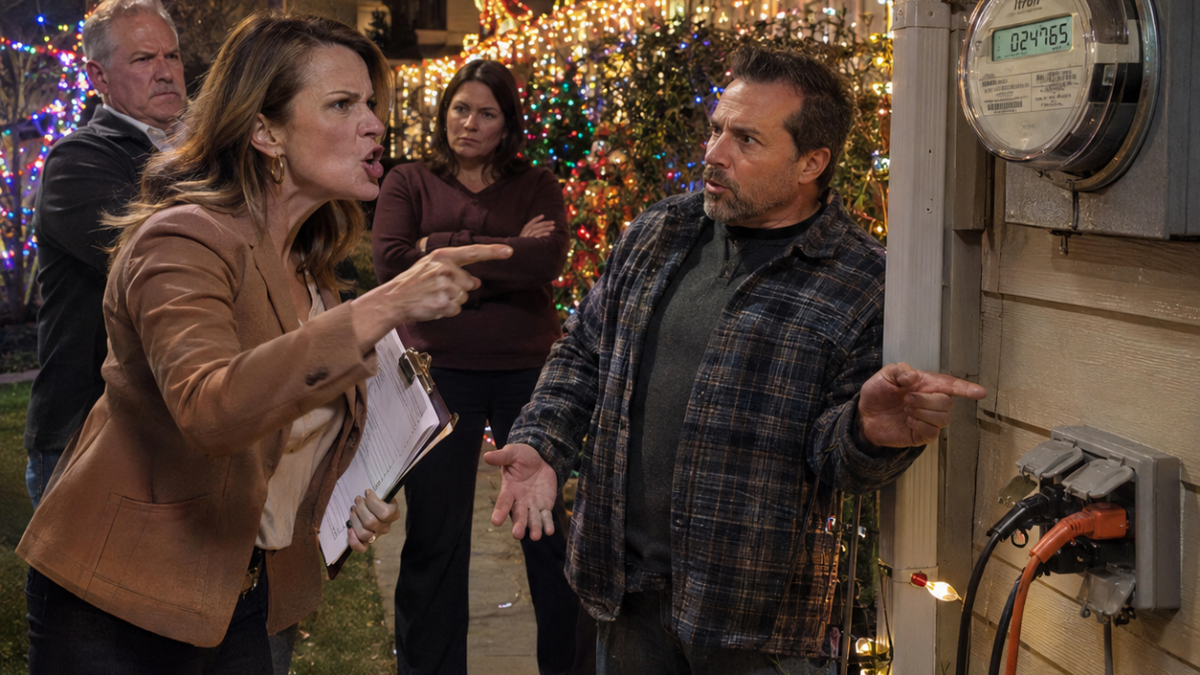
PART 2
I stayed in the shop until after midnight.
Every electric bill from the previous two years ended up spread across my workbench.
I had never been the kind of person who ignored numbers.
You couldn’t run a machine shop that way.
Material costs mattered.
Tool life mattered.
Labor hours mattered.
Electricity mattered.
Before January, my shop usually consumed around nine hundred kilowatt-hours in an ordinary month.
Sometimes more.
Sometimes less.
If I had a large production run, consumption climbed.
If work was slow, it fell.
The pattern always made sense.
Then January happened.
My usage jumped.
Not by ten percent.
Not twenty.
Thousands of kilowatt-hours.
At the time, I blamed the compressor.
It was old.
The bearings were noisy.
The motor had been running hotter than usual.
I told myself efficiency was getting worse.
Then spring came.
Bills stayed high.
Summer came.
Higher.
I still made excuses.
Maybe the cooling system.
Maybe longer production cycles.
Maybe one of the CNC units drawing more standby power than I realized.
I felt stupid looking at those statements now.
The evidence had been sitting in envelopes on my desk for almost a year.
One period bothered me more than everything else.
Late summer.
My largest lathe had developed spindle problems, so I closed the shop for six weeks while a technician rebuilt it.
No production.
No overnight runs.
No air compressor hammering away.
Almost everything had been shut down except a refrigerator, security lights, and a few small circuits.
I remembered thinking the reduced activity would finally give me a cheap electric month.
It hadn’t.
The bills were almost as high as months when the shop operated normally.
I put both hands on the workbench.
“That’s impossible.”
Electricity had to go somewhere.
Something had been running.
Not occasionally.
Regularly.
I looked toward the western wall.
Beyond it sat Briarwood Estates.
Then I remembered January.
A crew had been digging beside the fence.
There had been a small HOA sign announcing a “landscape lighting upgrade.”
Trucks.
Trenching equipment.
Two electricians.
I had walked past the work several times.
Nobody asked to enter my parcel.
At least, not while I was there.
The project finished early in January.
My power usage increased almost immediately afterward.
I didn’t sleep much that night.
By seven the next morning, Marla had already started telling everyone her version of the Christmas story.
One of the Briarwood homeowners forwarded me the email.
The subject line read:
**AN IMPORTANT MESSAGE ABOUT OUR HOLIDAY TRADITION**
There was a photograph of the dark Christmas tree.
Marla wrote that a neighboring business owner had deliberately cut power to Briarwood’s holiday display because he refused to contribute a “minor amount of electricity to a community celebration.”
She described my behavior as hostile.
Unneighborly.
Damaging to the spirit of the season.
She never mentioned that the outlet belonged to me.
She never mentioned that nobody had asked permission.
She never mentioned her threatened $750 fine.
By lunch, I had received three angry messages.
One resident told me children were disappointed because of me.
Another told me to “grow a heart.”
Someone left a handwritten note in my mailbox.
**IT’S CHRISTMAS. STOP BEING SELFISH.**
I read it twice.
Then put it in a folder.
That was something my father taught me when I was young.
When people started lying loudly, don’t shout louder.
Save paper.
I opened my laptop and sent Briarwood’s board four questions.
Who authorized the use of my electrical outlet?
On what date did that use begin?
Which contractor made the connection?
What arrangement existed for reimbursing me?
I also requested a copy of any document they believed gave them permission.
Marla replied that afternoon.
She answered none of those questions.
Instead, she instructed me to leave the outlet available until the holiday festival ended.
Not asked.
Instructed.
I called Tessa Rollins.
Tessa had been my electrician for years.
She was thirty-nine, practical, impatient with drama, and so obsessed with electrical safety that I once watched her spend twenty minutes arguing with a contractor over one improperly labeled breaker.
She arrived before closing.
I handed her the bills.
She read them quietly.
Then looked at me.
“You didn’t add equipment?”
“No.”
“Second shift?”
“No.”
“Electric heat?”
“No.”
“New compressor?”
“No.”
“Server rack?”
“No.”
“Cryptocurrency mining operation you forgot to mention?”
I looked at her.
“Seriously?”
“Had to ask.”
She spread the bills out.
“This is a lot of power.”
“I know.”
“Meter failure is possible.”
“But?”
“But you’ve got smart interval data. If the meter is recording a consistent pattern, we should look at the pattern first.”
“Can the data tell us where the power went?”
“No.”
“Can it tell us who used it?”
“No.”
“Then what can it tell us?”
“When.”
She tapped one statement.
“And how much.”
Tessa walked outside.
She inspected the outlet the holiday lights had used.
The protective cover had been damaged when the temporary box was installed.
She photographed it.
Then her attention shifted toward a larger gray cabinet closer to the western fence.
“That’s your machine service distribution.”
“I know.”
“Two-forty volt.”
“Yes.”
“Your big equipment feeds through there.”
“Yes.”
She crouched beside it.
Then looked toward the HOA property.
“Grant.”
“What?”
“That Christmas outlet is tiny compared to what can move through this cabinet.”
I understood what she meant.
“If someone tapped this—”
“They could draw serious power.”
“Enough to explain the bills?”
“Potentially.”
I felt a knot tighten in my stomach.
Tessa stood.
“But we do this correctly.”
“What does that mean?”
“It means you do not start opening cabinets, pulling wires, digging trenches, or accusing anyone.”
“I wasn’t planning to.”
“You have the face of someone planning to.”
“I’m planning to know where my electricity went.”
“Good. Let me inspect.”
Three days later, Marla held what she called an emergency cooperation meeting.
I was invited.
I almost didn’t go.
My attorney—at that point just someone I had called for general advice—told me I should.
“Don’t argue,” he said.
“Listen.”
So I went.
The clubhouse was packed.
About forty homeowners sat facing a projector.
Marla stood at the front.
The first slide showed the dark Christmas tree.
Of course it did.
She opened with a speech about tradition.
Children.
Community.
Shared responsibility.
Then she described me as a neighboring business owner who had withdrawn support at the last minute.
Withdrawn support.
As though I had ever offered any.
She displayed costs she claimed my “interference” had created.
Temporary generators.
Contractor changes.
Event delays.
Then she listed what she wanted.
A public apology.
Continued access to my outlet.
Payment for costs caused by my disruption.
When she finished, she looked at me.
“Grant, would you like to explain yourself?”
I stood.
“Yes.”
The room got quiet.
I held up one sheet of paper.
“Can you show everyone the document where I gave Briarwood permission to use my electricity?”
Marla blinked.
“That’s not the issue.”
“It’s exactly the issue.”
“The association is entitled to use necessary infrastructure for the safety and welfare of the community.”
A man near the back frowned.
I opened my folder.
Then unfolded a certified survey.
I placed it beside the projector.
“This is the property boundary.”
Several people leaned forward.
I pointed.
“This is my fence.”
Another point.
“My outdoor outlet.”
Another.
“My electrical distribution cabinet.”
Then the black boundary line.
“All on my property.”
I looked at Marla.
“Being close to your subdivision does not make my power community property.”
The room shifted.
Not physically.
Emotionally.
That was the first moment I felt it.
People had come expecting a selfish outsider.
Now they had a property survey.
Someone asked,
“Marla, did the board actually have an agreement?”
She answered too quickly.
“It was handled administratively.”
“By who?”
“Management.”
Another voice.
“Did we vote on this?”
Marla ignored the question.
Then Evelyn Pritchard raised her hand.
Evelyn was Briarwood’s treasurer.
Fifty-eight.
Quiet.
Meticulous.
The kind of woman who probably balanced her personal checkbook to the penny.
“Marla?”
“Yes, Evelyn?”
“What budget line covers the electricity?”
Marla smiled.
“The arrangement was part of a community agreement.”
“I don’t remember approving one.”
“It didn’t require a special vote.”
“Then where are the records?”
Marla picked up her remote.
“We can review administrative documentation separately. Now, regarding festival parking—”
She changed the slide.
That was when I knew she was hiding something.
Not what.
But something.
After the meeting, most people avoided me.
One person waited.
Walter Briggs.
Retired highway engineer.
Gray hair.
Heavy winter coat.
He stopped beside the coat rack.
“Mr. Huxley.”
“Grant.”
“Walter.”
We shook hands.
He looked around before lowering his voice.
“I saw them digging last January.”
“The landscape lighting project?”
“That’s what they called it.”
“What did you see?”
“Trench was deeper than I expected.”
“How deep?”
“Deep enough I wondered why decorative lights needed it.”
“You ask anyone?”
“Marla.”
“What did she say?”
He smiled without humor.
“Told me to mind my own lot.”
He handed me his phone number.
“I still remember the dates.”
The next morning, Tessa arrived with test equipment.
She isolated my circuits one at a time.
Lathe circuits.
Milling machines.
Compressor.
Lighting.
Office.
HVAC.
Security.
Refrigeration.
Every legitimate load was measured.
The Christmas outlet remained disconnected.
But the unexplained power draw barely changed.
Tessa stared at her meter.
“Again.”
We repeated the test.
Same result.
She walked toward the gray service cabinet.
“I don’t like this.”
“What?”
“The power is going somewhere that isn’t on your normal branch schedule.”
“Meaning?”
“Meaning we have a circuit we haven’t accounted for.”
I looked toward Briarwood.
She followed my eyes.
“Don’t jump yet.”
“Tessa.”
“I know.”
“No, I don’t think you do.”
I pointed toward the clubhouse.
“Marla isn’t fighting me over Christmas lights.”
Tessa was silent.
“She’s fighting because she needs access to something.”
“Maybe.”
“And if that something is connected to my system—”
“We prove it.”
That night, I sent another letter.
Stop all unauthorized electrical connections.
Preserve all contracts.
Preserve all invoices.
Preserve emails.
Preserve payment records.
Preserve contractor instructions relating to the western boundary.
Marla replied within an hour.
One sentence.
**You have no idea who you’re dealing with.**
I printed it.
Put it in the folder.
Then the utility company emailed the interval data I had requested.
Fifteen-minute readings.
Nearly an entire year.
I opened the file.
I plotted it.
And the hair on my arms rose.
Every night, after my shop shut down, consumption climbed.
Not randomly.
Regularly.
A steady plateau.
Hour after hour.
Night after night.
Weekends.
Holidays.
Even during my six-week shutdown.
Something was using my electricity while my business slept.
Two days later, I sat across from Owen Strickland, a meter data analyst at the utility company.
Owen was forty-six and spoke the way engineers often do when they don’t want emotion contaminating a conclusion.
He didn’t say “theft.”
He didn’t say “HOA.”
He didn’t say “Marla.”
He said,
“This is unusual.”
He displayed the graph.
“Here is your historical baseline.”
Then January.
The line jumped.
“Here is when it changes.”
“How much?”
“Significantly.”
“Can you tell what used it?”
“No.”
“Can you tell where?”
“No.”
“Can you tell whether it’s my equipment?”
“Not from meter data alone.”
He zoomed into several weeks.
“However.”
I leaned closer.
“Your nightly load becomes extremely consistent.”
He highlighted evening hours.
“Then watch the seasonal behavior.”
Summer.
Spikes.
Winter.
Different spikes.
Cold nights.
Higher draw.
Hot afternoons.
Higher draw.
Early mornings.
Pumps or timed equipment seemed to cycle.
Owen said,
“This looks like multiple loads operating on schedules.”
I slid Briarwood’s January newsletter toward him.
The headline celebrated the completion of an “energy-efficient landscape and security upgrade.”
He read it.
Then looked back at the graph.
I asked,
“Could Christmas lights explain this?”
“No.”
“Definitely?”
“Holiday LEDs on a normal 120-volt outlet would not explain eleven months of this scale.”
“So if Briarwood is involved—”
“Then the Christmas connection is not the main load.”
I thought of Tessa tapping the gray cabinet.
Two-forty volt.
Heavy service.
I didn’t say anything.
Over the next week, Owen and Tessa compared everything.
Production schedules.
Machine logs.
Shutdown dates.
Measured loads.
Known equipment.
After every legitimate source was subtracted, a huge unexplained remainder remained.
Tens of thousands of kilowatt-hours.
Owen still refused to call the number final.
“We need the physical path.”
I respected that.
By then, I had hired an attorney formally.
Daniel Mercer.
Real estate and utility disputes.
Calm voice.
Expensive suit.
The first thing he told me was,
“You’re no longer dealing with neighborhood drama.”
“I figured that out.”
“Good.”
He sent preservation demands to Briarwood.
Then helped me file a formal utility safety report.
We included photographs.
Bills.
Survey.
Interval data.
Marla’s emails.
The threatened fine.
Everything.
Three mornings later, Tessa was walking the ground beside my distribution cabinet with a cable locator.
She stopped.
“What?”
She crouched.
Brushed gravel aside.
A faint seam ran through the soil.
Almost invisible.
A straight line.
From my cabinet.
Toward Briarwood.
Tessa followed it.
A few feet away, half buried, was a pull-box cover.
Newer than everything around it.
Sharp edges.
Fresh paint.
She pulled out the original drawings.
Looked at the ground.
Looked back at the plans.
“There’s no line here.”
“Maybe drawings were updated?”
“No permit on record.”
She walked several steps toward the fence.
The locator continued responding.
Tessa looked at me.
I had never seen that expression on her face before.
Not anger.
Not surprise.
Something colder.
“The lights weren’t the theft.”
My chest tightened.
She pointed toward the buried path.
“They were just the first thing you could see.”
She refused to open the service cabinet alone.
That mattered.
We coordinated with the utility.
A qualified field technician came.
Lockout procedures.
Safety checks.
Documentation.
Photographs.
I stood away from the energized equipment while they opened the gray cabinet.
Inside were the breakers I recognized.
Then one I didn’t.
A 240-volt branch.
Neatly installed.
Professional workmanship.
Labelled as though it were a standby feed for my shop.
Tessa compared it with the drawings.
“No.”
The technician checked.
“No permit.”
He traced it.
Then said the words I had been dreading.
“This is downstream of your meter.”
I stared at him.
“Meaning?”
He looked at me.
“Every kilowatt-hour passing through this branch was billed to your account.”
Eleven months.
My bills.
My money.
My name.
The hidden circuit crossed toward Briarwood.
Getting access to their side became the next battle.
Marla initially refused inspection.
She claimed association infrastructure was private.
Daniel responded that power from my system appeared to be entering that infrastructure.
Board members had now seen enough documents to become nervous.
Evelyn pushed for access.
So did two other directors.
The board voted.
Inspection allowed.
Technicians traced the buried cable under the fence.
Into Briarwood’s utility building.
Then into a service panel.
From there, circuits fed community amenities.
Security lighting along walking paths.
Part of the clubhouse climate-control load.
Seasonal irrigation equipment.
The pattern fit Owen’s graph almost perfectly.
Night plateau?
Security lights.
Summer peaks?
Cooling and irrigation.
Cold weather increases?
Clubhouse heating.
Christmas lights?
Almost irrelevant by comparison.
The holiday tree had only been connected to the separate outdoor outlet.
It wasn’t the cause of the eleven-month billing disaster.
It was Marla getting careless.
She had stolen so much electricity invisibly that she eventually decided she could steal a little more in plain sight.
Inside one junction box, Tessa found a maintenance sticker.
Graham Voss Electrical.
I knew the name.
Then I remembered the man.
January.
Fence trench.
I had walked over and asked what they were installing.
“Security equipment,” he told me.
Easy smile.
Nothing suspicious.
I believed him.
The utility technician performed a controlled isolation of the unauthorized branch.
Then we watched my meter.
The hidden baseline fell.
Just disappeared.
Like someone shutting a valve.
For almost a year, I had been watching somebody else’s electricity run through my bill.
Now the moment the line was disconnected, my meter returned to something that looked like my shop again.
I stood beside the trench.
Tessa came over.
“You okay?”
I laughed once.
“No.”
I looked toward Briarwood.
“They called me selfish.”
“I know.”
“I paid to cool their clubhouse.”
“Looks that way.”
“Light their walkways.”
“Yes.”
“Run their irrigation.”
“Part of it.”
“And they told people I ruined Christmas because I wouldn’t donate an outlet.”
Tessa said nothing.
I looked at the ground.
The anger was almost too clean.
Not wild.
Focused.
The utility prepared a technical report.
Then contacted Graham Voss.
His first response was simple.
He had been given authorization.
Written authorization.
From Briarwood.
According to him, Marla had provided paperwork showing I approved the connection.
I told Tessa,
“I never signed anything.”
She believed me.
Daniel believed me.
Then the next morning, a courier arrived.
Envelope from Briarwood’s attorney.
Inside was a document.
**COMMUNITY UTILITY ACCESS AGREEMENT**
My name.
My property address.
January date.
Language stating I had voluntarily granted Briarwood access to part of my electrical capacity.
One clause said the association owed me no reimbursement for electricity consumed.
At the bottom—
My signature.
Daniel called.
“Did you sign this?”
“No.”
“Are you certain?”
“Completely.”
“Look carefully.”
“I am.”
I held it under the desk lamp.
At first glance, it looked right.
At second glance, too right.
Every person signs slightly differently each time.
Angle changes.
Pressure changes.
Speed.
Pen.
Mood.
But this signature looked familiar in a specific way.
I went to my records cabinet.
Pulled an old township building permit.
There it was.
Same hook on the G.
Same break in the y.
Same microscopic ink skip near the final stroke.
I put them side by side.
My stomach turned.
“They copied it.”
Daniel said,
“Don’t say that publicly yet.”
“Look at them.”
“I see it.”
“They’re identical.”
“That’s why we hire an examiner.”
Helen Garrity had spent years working as a state crime-lab document analyst.
Now she worked privately.
She compared the building permit and the supposed utility agreement.
Ten days later, she sat across from Daniel and me.
“The signature on the HOA agreement was not created with ink.”
I leaned forward.
“What was it?”
“A digital image.”
She showed magnified edges.
Tiny stair-step artifacts.
The signature had been scanned and inserted.
Then she looked at the file metadata.
“The document says January.”
“Yes.”
“The digital file was created in late November.”
I stared.
“This November?”
“Correct.”
“Eleven months later?”
“Yes.”
Daniel folded his hands.
“And the software license?”
Helen answered.
“Registered to Briarwood’s management office.”
I actually laughed.
Not because it was funny.
Because the lie was so enormous that my mind needed somewhere to put the disbelief.
Then Marla made it worse.
Daniel asked Briarwood’s attorney for details about when and where the agreement had supposedly been signed.
Before their lawyer could answer, Marla emailed directly.
She wrote that she had personally watched me approve and sign the agreement during a clubhouse meeting in early January.
Daniel called me.
“Where were you January ninth?”
I checked my calendar.
Then smiled.
“Chicago.”
“Prove it.”
I could.
Airline ticket.
Hotel invoice.
Industrial equipment expo registration.
Restaurant receipt.
Credit-card transactions.
Parking at the airport.
I had not been in Briarwood.
I hadn’t even been in the state.
Daniel requested the original signed paper.
There wasn’t one.
While all of this was happening, Evelyn Pritchard started reviewing Briarwood’s financial records.
The more she looked, the worse it became.
The HOA’s own electric bills had dropped sharply after the January project.
At the annual meeting, Marla had celebrated the savings.
She stood in front of homeowners and talked about leadership.
Efficiency.
Responsible budgeting.
She received applause.
Evelyn told me later that she had applauded too.
Nobody asked the obvious question.
If Briarwood’s energy consumption had not changed, why had the bill dropped?
The answer was now sitting in my utility data.
But Evelyn found another number.
$16,800.
A payment described as a long-term backup generator rental.
She searched the facilities records.
No generator.
No delivery.
No fuel.
No maintenance.
No rental agreement connected to actual equipment.
Nothing.
The money went to a private company.
Evelyn searched the corporate filing.
One of the company’s listed managers shared a business address with Marla’s consulting operation.
That changed everything.
Until then, someone might still have argued Marla had broken rules to save the HOA money.
Wrong.
Illegal.
Reckless.
But perhaps motivated by keeping dues low.
The generator payment suggested something darker.
The “energy savings” might not simply have been a shortcut.
It might have been cover.
At the next board meeting, I attended with Daniel.
Marla sat at the front.
I placed two documents on the table.
The old building permit.
The utility agreement.
“Explain this.”
She looked at them.
“What?”
“The signatures.”
“They’re yours.”
“They’re identical.”
“You signed them.”
“No human being makes two signatures identical down to the smallest flaw.”
Marla leaned back.
“This is becoming absurd.”
Daniel said nothing.
I asked,
“Where is the original?”
“What original?”
“The paper I supposedly signed.”
“It’s in association records.”
Daniel finally spoke.
“Your counsel has been unable to produce it.”
Marla’s expression sharpened.
“You’re manufacturing a lawsuit because you don’t want to honor an agreement.”
I looked around the room.
“Every document goes to my attorney.”
Then I looked at Marla.
“And to whichever authorities have jurisdiction.”
I gathered my papers.
No shouting.
No threat.
I left.
Halfway to my truck, my phone rang.
Evelyn.
Her voice shook.
“Grant?”
“Yeah.”
“I need to talk to you.”
“What happened?”
“I found records.”
“What records?”
“She knew.”
I stopped walking.
“Who?”
“Marla.”
“Knew what?”
“Where the electricity came from.”
My grip tightened on the phone.
“And there’s more.”
“What?”
“Bank records.”
She inhaled.
“This is much bigger than the cable.”
Evelyn didn’t sleep much that week.
I learned that later.
She had trusted Marla for years.
Not casually.
Professionally.
She had signed budgets.
Presented reports.
Defended the board to homeowners.
Now she was terrified she had unknowingly helped legitimize fraud.
But she did something important.
She didn’t hide.
She collected records she was legally entitled to access.
Then handed them to the HOA’s attorney and an independent auditor.
The financial timeline became clear.
Briarwood’s amenity costs had surged the previous year.
Homeowners complained.
Marla was running for another term.
She promised to reduce operating costs without raising dues.
Then came Graham Voss and the “energy efficiency upgrade.”
A buried line quietly shifted much of Briarwood’s electrical load onto my meter.
The HOA’s bills fell.
Marla presented the savings as her accomplishment.
Residents applauded.
Then there was the fake generator rental.
$16,800 paid out.
No generator.
A recipient company linked back to Marla.
The auditor began treating it separately from the power theft.
Different transaction.
Different issue.
Potentially worse motive.
Then Graham Voss changed his position.
He had a license to lose.
He had invoices.
Emails.
Job notes.
Once the utility report made clear what the connection had actually done, he began cooperating.
He admitted installing the buried line.
He said Marla gave him the approval document.
He never independently verified my signature.
That didn’t make him innocent.
But then he produced an email that destroyed Marla’s ability to blame him.
After the installation, she instructed him to leave the cable off drawings circulated to residents.
Not correct the drawings.
Not update them.
Leave it off.
Hide it.
Evelyn called a special homeowner meeting.
The clubhouse was packed.
People stood along the walls.
Some who had previously emailed me angry messages wouldn’t look in my direction.
Marla attempted to keep the financial records private.
“Confidential association business.”
The other directors overruled her.
An independent audit was authorized.
A complete inspection of HOA electrical infrastructure was approved.
Then Marla crossed the room.
She stopped directly in front of me.
Her voice was low.
“You think exposing one electrical line destroys this board?”
The conversations nearby stopped.
I looked at her.
“No.”
She smiled.
Like she thought I had backed down.
I continued.
“The line only shows where the power went.”
Her smile faded.
“Your records show why you hid it.”
The entire room seemed to go quiet.
For weeks, everyone had asked me why I unplugged Christmas.
Now the question had reversed.
Why had Briarwood needed my electricity in the first place?
The township electrical inspector issued findings the next afternoon.
The buried branch violated code requirements.
Several related installations needed correction.
They could not legally be energized again until brought into compliance.
That evening, Marla emailed every homeowner.
The Christmas tree lighting would proceed.
Exactly as planned.
No one, she wrote, would stop Briarwood from celebrating.
Saturday evening arrived cold and clear.
The square looked beautiful.
I’ll admit that.
Vendor booths.
Hot cider.
Cocoa.
Handmade ornaments.
Families in winter coats.
Children running between decorations.
The forty-foot spruce stood in the center, wrapped in thousands of bulbs.
Marla had arranged a small stage beside it.
She planned to give a speech about community.
But the power situation had changed.
Earlier that day, qualified technicians had safely isolated the unauthorized buried branch.
My outdoor outlet had been repaired.
A new weatherproof cover protected it.
Locked.
Nothing from Briarwood crossed my property line.
Essential HOA safety systems were placed on lawful sources.
The decorative system had a problem.
About an hour before the ceremony, I watched Marla confront Graham near the utility building.
I couldn’t hear every word.
But I heard enough.
“Run a temporary line.”
Graham shook his head.
“From anywhere.”
“No.”
“Fix it after the holiday.”
“No.”
Marla stared at him.
“You work for us.”
“I’m not making another unpermitted connection.”
“Graham.”
“No.”
It may have been the first time he ever said that to her.
She didn’t know what to do with it.
Then she sent two volunteers toward my fence.
They walked along it.
Looking for outlets.
Cabinets.
Anything.
They found my locked weatherproof cover.
Beside it was a fresh township notice.
They read it.
Then walked back.
I stood in my shop doorway.
I didn’t say a word.
That silence felt better than shouting.
At seven o’clock, Marla climbed onto the stage.
Scattered applause.
She thanked volunteers.
Sponsors.
Families.
Then raised one hand toward the technician.
“Let there be light.”
The switch moved.
Nothing.
The forty-foot spruce remained black.
Marla laughed nervously.
“Try again.”
The technician did.
Nothing.
A murmur spread.
Children looked up.
Adults started whispering.
Then one board member walked onto the stage.
He gently took the microphone.
Marla resisted for a second.
Then released it.
He explained that the tree-lighting ceremony had to be postponed.
The electrical system previously used for association amenities had not been properly authorized and was being corrected under township direction.
Then he said the sentence Marla had spent weeks trying to stop anyone from hearing.
Evidence indicated that electricity serving Briarwood amenities had been billed to the neighboring property owner for most of the year.
Hundreds of heads turned toward my fence.
Toward me.
Marla grabbed the microphone back.
“This is false!”
The crowd murmured louder.
She pointed toward my shop.
“Grant Huxley has sabotaged this holiday from the beginning!”
I stayed where I was.
A resident near my gate said,
“Grant, what happened?”
I answered quietly.
“The utility report and court filings will be available. Read them.”
That was all.
Then a homeowner in a gray parka raised his voice from near the cider booth.
“If his story is fake, why were we paying for a generator?”
Silence.
He continued.
“Where is the generator, Marla?”
Her mouth opened.
Nothing convincing came out.
That was the end of the ceremony.
No dramatic countdown.
No glowing tree.
Vendors began packing early.
The event company informed the HOA that cancellation provisions would apply.
Marla had spent weeks telling everyone I ruined Christmas over one outlet.
Instead, her own hidden wiring left the tree dark in front of the entire neighborhood.
Monday morning, Daniel filed a petition asking the court to protect my property and prohibit Briarwood from connecting to my electrical system without lawful consent.
By then, the utility’s reconstruction was finished.
Eleven months.
Unauthorized consumption.
47,520 kilowatt-hours.
I read the number twice.
Forty-seven thousand five hundred twenty.
The Christmas tree barely mattered anymore.
This was nearly a year of someone else’s electricity appearing on my bill.
The hearing took place on a frozen January morning.
I wore the only suit I owned that still fit comfortably.
Daniel had organized the evidence into a sequence so clean that even I understood why lawyers obsess over order.
First:
Property ownership.
Certified survey.
Outlet and cabinet inside my parcel.
Second:
Photographs.
Holiday cable zip-tied through my fence.
Third:
Meter records.
Eleven months of abnormal consumption.
Fourth:
Physical inspection.
Buried cable from my post-meter distribution system into Briarwood.
Fifth:
Lack of valid authorization.
Sixth:
The suspicious agreement.
Marla sat across the courtroom with Briarwood’s attorney.
She still insisted I had consented.
Their lawyer referenced the community utility access agreement.
Daniel stood.
He submitted Helen Garrity’s forensic report.
Digitally pasted signature.
File created in November.
Printed date January.
Software tied to the HOA office.
Then my Chicago records.
Airline.
Hotel.
Expo.
Credit card.
Evidence that I could not have attended the meeting where Marla claimed to watch me sign.
The judge did not make a sweeping criminal finding about who forged what.
That wasn’t the immediate question.
But the court refused to treat the agreement as reliable proof of consent.
Then Owen Strickland testified.
He walked through the meter data.
Calm.
No exaggeration.
Historical baseline.
January jump.
Night plateau.
Summer spikes.
Winter heating pattern.
Six-week shop closure with continued consumption.
Then the final point.
The moment technicians isolated the hidden branch.
The abnormal baseline vanished.
Briarwood’s attorney asked,
“Could this have been faulty shop equipment?”
Owen answered,
“We tested for that.”
“Meter error?”
“Ruled out.”
“Seasonal use by Mr. Huxley?”
“Inconsistent with production records and shutdown periods.”
“Then your conclusion?”
“The buried branch matched the unexplained load pattern.”
The final attributed consumption:
47,520 kilowatt-hours.
Using the agreed average effective rate:
$9,028.80.
But electricity was only one part of what this had cost me.
Electrical repairs.
Restoring the cabinet.
Replacing damaged components.
Tracing the hidden line.
Professional inspection.
Document analysis.
Legal work.
Expert expenses.
During a recess, Briarwood’s attorney met privately with the remaining board.
By then, Marla’s financial authority had already been stripped.
She no longer controlled the room.
He told them continuing to deny everything would expose the association to more litigation and more expense.
The directors negotiated.
Within a week, a settlement was entered and made enforceable.
Briarwood would pay me:
$42,288.80.
That covered the stolen electricity, repairs, and negotiated reimbursement for investigation expenses.
People later assumed I celebrated.
I didn’t.
I felt relieved.
And tired.
That check didn’t erase eleven months of looking at inflated bills and blaming my own equipment.
It didn’t erase being called selfish.
It didn’t erase the note telling me to grow a heart.
But it meant the cost wasn’t mine anymore.
And Briarwood’s problems were far from finished.
Without access to my electrical system, the HOA needed its own lawful service.
New electrical supply.
New meter.
Permits.
Engineering.
Installation.
Estimated cost:
$63,400.
Then came the failed event.
Cancellation charges.
Refunds.
Revised contracts.
$24,700.
Outside the courthouse, Marla waited by the elevators.
I saw her before she saw me.
For the first time since this began, she looked tired.
Not polished.
Not presidential.
Just tired.
Then she noticed me.
Anger returned instantly.
She stepped in front of me.
“You destroyed Christmas over an outlet.”
I looked at her.
That sentence almost made me sad.
Almost.
“No.”
Her eyes narrowed.
“You stole electricity for eleven months.”
I stepped around her.
“Christmas just made the theft visible.”
I walked toward the elevator.
Behind Marla stood several members of her own board.
Not one defended her.
Two days later, Evelyn called.
The independent auditor had completed the first review of the generator payment.
The $16,800 transfer was real.
The company receiving it had ties to Marla.
No generator service had been provided.
No equipment.
No delivery.
No rental.
Nothing.
The electricity case with Briarwood had reached settlement.
Marla’s other problems were only beginning.
Eight weeks after the failed Christmas lighting, Briarwood held another special meeting.
This time, I wasn’t the subject.
Marla was.
Eighty-six homeowners were eligible to vote.
Sixty-two cast ballots under the association’s procedures to remove her.
The woman who once threatened to fine me $750 a day no longer had authority to approve a single HOA penalty.
No signing authority.
No control over contractors.
No control over association accounts.
The board presented the financial consequences.
$9,028.80 in stolen electricity reimbursement.
$14,760 restoring my electrical system.
$18,500 toward investigation and expert expenses.
$63,400 for Briarwood’s new legal electrical service.
$24,700 in event-related penalties, refunds, and contract costs.
Direct cost:
$130,388.80.
And that did not include the separate $16,800 generator issue.
I sat near the back.
Evelyn stood at the front.
She looked exhausted.
But steady.
She explained that the generator matter had been referred for appropriate review and that the association would attempt to recover funds from whoever was responsible.
Marla sat with her arms crossed.
For years, she had been the person holding the microphone.
Now she listened while other people read numbers she could no longer hide.
There was no dramatic arrest.
No handcuffs.
No screaming police scene.
And I was glad.
Real consequences rarely look like movies.
Sometimes consequence is losing the office you used to intimidate people.
Sometimes it is losing access to accounts.
Sometimes it is watching every document you once controlled become available to auditors.
Sometimes it is sitting silently while your neighbors vote.
Briarwood changed after that.
The new board required two authorized signatures for significant payments.
Major electrical work required documented permits.
Property-owner authorization had to be independently confirmed.
Contracts had to exist before money moved.
Evelyn remained treasurer.
She helped publish financial reports so homeowners could see where their dues went.
A few weeks later, Walter came by my shop.
He brought coffee.
“You were right.”
I smiled.
“About?”
“The trench.”
“You were the one who noticed the trench.”
“I noticed it.”
He handed me a cup.
“You proved it.”
We stood outside.
Briarwood contractors were installing their new lawful electrical service.
New trench.
Proper permits.
Utility markings.
Inspections.
Everything the hidden job had avoided.
Walter watched.
“Funny.”
“What?”
“They could’ve done that the first time.”
“Yeah.”
“Probably cheaper.”
“Definitely.”
He laughed.
Then became serious.
“I’m sorry.”
“For what?”
“I was at the meeting when Marla called you selfish.”
“So?”
“I didn’t say anything.”
I looked at him.
“You gave me the dates.”
“Later.”
“You helped.”
He nodded.
But I understood what he meant.
A lot of Briarwood residents did.
Over the next few months, several came to my gate.
Some apologized.
Some simply shook my hand.
One woman had been among the people who sent me an angry email.
She looked embarrassed.
“I believed her.”
“I know.”
“She said you had promised power.”
“I know.”
“She said you changed your mind because you hated the HOA.”
“I know.”
She looked toward my shop.
“I’m sorry.”
“Thank you.”
She hesitated.
“Why didn’t you just tell everybody immediately?”
“I tried.”
“No. I mean after you found the line.”
I thought about it.
“Because I wanted evidence more than I wanted an argument.”
She nodded slowly.
“That’s probably why she lost.”
Maybe.
Tessa returned after the restoration work was complete.
She inspected every repaired part.
Cabinet.
Outlet.
Grounding.
Branch circuits.
Trench patch.
Everything.
Then signed off.
I opened my meter app.
For the first time in almost a year, the graph looked boring.
I loved it.
Small overnight baseline.
Normal morning startup.
Machine spikes during production.
Drop after closing.
No mysterious plateau.
No clubhouse.
No security lights.
No irrigation pumps.
Just my shop.
My machines.
My electricity.
That month’s bill arrived.
I opened it at my desk.
Then laughed.
Tessa happened to be there.
“What?”
I showed her.
“That low?”
“That normal.”
“You know most people complain about electric bills.”
“I’m framing this one.”
She rolled her eyes.
But I almost did.
Spring passed.
Then summer.
Briarwood installed its lawful service.
Their amenities ran normally.
People still used the walking paths.
The clubhouse still had air conditioning.
Irrigation still watered landscaping.
Nothing collapsed because the HOA finally paid for its own electricity.
That was what bothered me most when I thought about the whole thing.
None of it had been necessary.
Marla had acted like stealing my power saved Briarwood from disaster.
It didn’t.
They simply had to install the service they should have paid for in the first place.
She had turned an ordinary infrastructure expense into a six-figure catastrophe because she decided rules were for other people.
By the next December, Briarwood Square looked different.
Not dramatically.
But enough.
The new board had repaired its reputation slowly.
The forty-foot spruce went up again.
Decorators wrapped it in lights.
This time, every cable remained on Briarwood property.
Their new meter stood inside the utility area.
Properly permitted.
Properly labeled.
Paid for by them.
On Christmas Eve, light snow started falling.
I closed the shop early.
Before going inside, I walked toward the western fence.
My old outdoor outlet sat beneath its repaired weatherproof cover.
I had added a small padlock.
Beside it hung a plain sign.
**PRIVATE PROPERTY
NO UNAUTHORIZED ELECTRICAL CONNECTIONS**
Maybe a little petty.
Tessa said it was.
I called it informative.
Across the fence, Briarwood’s tree glowed.
Thousands of lights.
Red.
Gold.
White.
Green.
Perfectly bright.
Children ran around it.
Music played.
Someone handed out hot chocolate.
I watched for a while.
And I realized something.
I had never hated the Christmas tree.
I never hated Briarwood.
I never wanted children standing under a dark spruce.
I wanted one thing.
Ask.
That was all Marla had needed to do.
She could have called.
“Grant, can we use your outlet for the tree?”
Maybe I would have said yes for one night if we had put a meter on it.
Maybe I would have said no because of liability.
Maybe we could have found another solution.
But that choice belonged to me.
That was the point she could never understand.
Permission isn’t a technicality.
It is the difference between borrowing and stealing.
She saw an outlet near her fence and decided proximity gave her rights.
Then she saw my larger electrical service and decided secrecy gave her opportunity.
Then she used paperwork to create permission after the fact.
Then public pressure to make me look unreasonable.
Then threats.
Then lies.
Every step depended on the belief that I would eventually become too tired, embarrassed, or intimidated to fight.
For almost eleven months, I didn’t even know I needed to fight.
That was the part that stayed with me.
I paid every bill.
I blamed my compressor.
I blamed old motors.
I blamed myself for not understanding my own equipment.
There were nights I sat in that shop looking at the electric statement and wondering whether the business was becoming too expensive to keep.
I considered replacing machines that weren’t causing the problem.
I postponed buying a new inspection system because I wanted extra cash available for utilities.
I worked overtime to cover expenses created by electricity I never used.
Meanwhile, Marla stood at annual meetings taking credit for reducing Briarwood’s operating costs.
That was the betrayal that money couldn’t fully repay.
She made my business look inefficient so she could make herself look competent.
One evening, Evelyn visited.
She stood near my workbench holding a folder.
“I brought something.”
“What?”
“Final financial summary.”
I smiled.
“I think I’ve seen enough Briarwood paperwork for one lifetime.”
She laughed softly.
“I understand.”
Then she became serious.
“I wanted to apologize.”
“You already did.”
“Not personally.”
She sat.
“I was treasurer.”
“You didn’t know.”
“I should have.”
“Why?”
“Because the numbers changed.”
I understood immediately.
She continued.
“Our electric bills fell dramatically.”
“And you believed Marla.”
“Yes.”
“Everybody did.”
“That doesn’t make it better.”
“No.”
She looked down at the folder.
“I keep thinking about the annual meeting. She presented the savings. I clapped.”
I leaned back against the bench.
“Evelyn.”
She looked up.
“What did you do when you found out?”
“I investigated.”
“What did you do when the records got ugly?”
“I turned them over.”
“What did you do when Marla tried to stop you?”
“I kept going.”
“Then that’s the part that matters.”
Her eyes watered slightly.
She looked away.
“I thought you hated all of us.”
“I didn’t.”
“Even after those emails?”
“I hated some emails.”
She smiled.
“I hated one mailbox note.”
“The grow a heart one?”
“You know about that?”
“Everyone knows.”
I groaned.
“Great.”
She laughed.
Then handed me the folder.
On the cover was Briarwood’s new financial-control policy.
Two signatures.
Independent approval.
Contract verification.
Vendor disclosure.
Conflict-of-interest rules.
“I thought you might want to see what changed.”
I flipped through it.
“You did all this?”
“The board did.”
I looked toward the fence.
“Then maybe something good came out of it.”
She nodded.
“Expensive lesson.”
“Very.”
“Over a hundred thirty thousand dollars.”
I smiled.
“That number will probably keep people careful.”
She smiled too.
“Hopefully.”
After she left, I thought about Marla.
I hadn’t seen her in months.
People occasionally told me things.
She sold her consulting interest.
She had lawyers.
There were ongoing questions about the generator money and the fake agreement.
I didn’t follow every detail.
Not because I stopped caring.
Because at some point, justice became somebody else’s job.
My part had always been simpler.
Protect my property.
Find the truth.
Stop the power loss.
Get reimbursed.
Once that happened, I wanted my life back.
Machine work.
Clients.
Invoices.
Coffee.
Quiet.
That became my favorite part of the ending.
Nothing dramatic.
Normal life.
The shop lights came on when I switched them on.
They went off when I switched them off.
The meter moved because of my equipment.
My bill reflected my work.
Nobody else.
A year earlier, I had taken electricity for granted.
Afterward, normal numbers felt almost beautiful.
On Christmas Eve, I stood outside again.
The snow had thickened.
Briarwood’s tree glowed beyond the fence.
This time the lights were powered legally.
I could even see the small utility enclosure where their new service sat.
Their meter.
Their bill.
Their responsibility.
I walked back into my shop.
Turned on the overhead lights.
The machines stood quiet.
I looked at the meter display.
Normal.
Steady.
Honest.
For a moment, I remembered that first orange cable.
Zip-tied through my fence.
Marla in her red coat.
“It’s one outlet, Mr. Huxley.”
“Don’t ruin Christmas over a few dollars.”
She had been right about one thing.
It was never really about one outlet.
The outlet was simply where arrogance became visible.
The real story was underground.
A hidden branch.
A copied signature.
Eleven months of stolen electricity.
A fake generator expense.
A president who believed that if she controlled the paperwork, she controlled the truth.
But meters don’t care about titles.
Wires don’t care about speeches.
Electricity leaves a trail.
Every fifteen minutes, my meter had been recording what Marla thought nobody would ever see.
Night after night.
Week after week.
Month after month.
A quiet digital witness sitting on the wall.
The association’s lights turned on.
My meter recorded it.
The clubhouse cooling started.
My meter recorded it.
The irrigation cycled.
My meter recorded it.
My shop closed for six weeks.
The hidden load continued.
My meter recorded that too.
Marla could call me selfish.
She could email eighty-six homeowners.
She could threaten $750 daily penalties she had no authority to impose.
She could produce paperwork with my signature pasted onto it.
But she couldn’t rewrite eleven months of fifteen-minute electrical data.
She couldn’t make the buried cable disappear.
And once technicians disconnected it, she couldn’t explain why my unexplained consumption disappeared with it.
That was what finally beat her.
Not revenge.
Evidence.
People like Marla expect anger.
They know how to use anger.
If I had cut cables with bolt cutters, she would have called me destructive.
If I had stormed into the clubhouse screaming, she would have called me unstable.
If I had dug up the buried line myself, she might have accused me of damaging HOA property.
If I had posted wild accusations online before knowing the facts, she could have turned uncertainty against me.
So I did something she didn’t expect.
I kept records.
I saved the email.
I photographed the outlet.
I pulled the meter data.
I hired professionals.
I waited while qualified people opened equipment.
I let technicians trace the line.
I let the document examiner inspect the signature.
I let the auditor follow the money.
Every time Marla pushed harder, another record appeared.
Her biggest mistake wasn’t stealing electricity.
It was believing records were weaker than authority.
They weren’t.
By the end, she had nothing left except anger.
No valid agreement.
No original signature.
No lawful connection.
No explanation for the generator.
No board control.
No financial authority.
No Christmas speech that could make any of it disappear.
The following January, exactly one year after the hidden line had first been installed, I received an ordinary electric bill.
Nothing special.
No note.
No apology from the utility because the meter had never been wrong.
The number was completely normal.
I put it on the workbench.
For a few seconds, I just looked at it.
Then I opened the drawer where I kept the first huge bill from the previous year.
I placed them side by side.
Two pieces of paper.
One told me what my business actually cost.
The other told me what somebody else had quietly taken.
I thought about throwing the old one away.
Instead, I kept it.
Not because I enjoy remembering what happened.
Because I never again wanted to ignore a number that didn’t make sense.
Tessa came in later that afternoon.
She saw the statements.
“You actually kept that?”
“Yep.”
“You’re weird.”
“Probably.”
She pointed toward the fence.
“Outlet locked?”
“Yes.”
“Cabinet secured?”
“Yes.”
“New labels?”
“Yes.”
“Meter normal?”
“Yes.”
She smiled.
“Then I’m officially out of reasons to visit.”
“You can visit without inspecting my electricity.”
“That sounds dangerous.”
I laughed.
She started toward the door.
Then stopped.
“Grant.”
“Yeah?”
“You did the right thing.”
I looked at her.
“With what?”
“Not reconnecting the Christmas lights after Marla threatened you.”
“Wasn’t exactly difficult.”
“It could’ve been.”
I didn’t answer.
She continued.
“A lot of people would’ve plugged them back in just to avoid looking like the bad guy.”
That was true.
And maybe that was how Marla had operated for so long.
Not because everyone agreed with her.
Because people hated conflict.
Because saying no in front of neighbors felt uncomfortable.
Because a $10 problem was easier to tolerate than an argument.
Then a $10 problem became a cable.
A cable became a hidden branch.
A hidden branch became eleven months.
And eleven months became $130,388.80 in direct consequences before anyone even finished dealing with the separate fraud questions.
I nodded.
“Sometimes the expensive word is yes.”
Tessa smiled.
“That belongs on your fence.”
“I already have a sign.”
“Add another.”
I didn’t.
One was enough.
PRIVATE PROPERTY.
NO UNAUTHORIZED ELECTRICAL CONNECTIONS.
Simple rules are usually enough when people respect them.
The problem was never the rule.
It was Marla deciding she was above it.
I shut down the shop that evening.
One machine at a time.
Lathe.
Mill.
Compressor.
Lights.
The familiar hum faded.
I looked at the meter.
Usage dropped.
Exactly like it should.
Outside, Briarwood’s pathway lights came on.
My meter didn’t move.
I smiled.
That tiny moment felt better than the settlement check.
Their lights.
Their power.
My lights.
My power.
A fence between us.
Not hostility.
Just boundaries.
Sometimes boundaries are the most peaceful thing two neighbors can have.
And that was the final irony.
Marla accused me of destroying community.
But the new Briarwood board became healthier only after people stopped treating one person’s property as everybody else’s resource.
They became more transparent.
More careful.
More accountable.
Residents started attending meetings again.
Evelyn published financial summaries.
Major decisions required more than one signature.
Contractors asked questions.
People checked permits.
The association finally behaved more like the community Marla had always claimed to protect.
And all of it started because she couldn’t resist stealing electricity from one outlet for a Christmas tree.
At least, that was what we could see.
The rest had been buried.
Eleven months later, the buried truth came up with it.
The night before Christmas, I stood at my gate for one final minute.
Snow collected on the top rail.
Across the square, the forty-foot tree glowed brightly.
People gathered beneath it.
No angry speeches.
No dark tree.
No extension cord crossing my fence.
I could hear children laughing.
Someone started playing Christmas music.
I slipped my hands into my coat pockets.
For the first time, I actually enjoyed looking at the display.
Because every single bulb represented something different now.
Not stolen power.
Responsibility.
The HOA wanted Christmas lights.
So the HOA paid for electricity.
That was all I had ever asked.
I turned toward the shop.
Behind me, Briarwood’s tree continued glowing.
Ahead of me, my meter showed only the electricity I was using.
I thought about Marla’s accusation one last time.
“You destroyed Christmas over an outlet.”
No.
I had protected one outlet.
The meter exposed everything else.
And if she had never pushed that orange extension cord through my fence, if she had never zip-tied it in place, if she had never stood there in her red coat and dared me to pull the plug, maybe that buried line would have continued draining my account for another year.
Maybe two.
Maybe longer.
Her arrogance exposed her own secret.
That was the revenge she gave herself.
I didn’t need to sabotage a festival.
I didn’t need to steal anything back.
I didn’t need to humiliate her.
I only needed to stop paying for what was never mine.
The meter did the rest.
Eleven months.
47,520 kilowatt-hours.
$9,028.80 in electricity.
$42,288.80 in the settlement paid to me.
More than $130,000 in direct consequences to Briarwood after the repairs, legal power installation, refunds, and event costs were counted.
And one HOA president who lost the position she had used to threaten everybody around her.
All because she looked at my private outlet and decided the word “private” didn’t apply to her.
I reached the shop door.
Then looked back once.
The tree was still glowing.
This time, I smiled.
“Looks better that way,” I said quietly.
Then I stepped inside and closed the door.
My lights.
My meter.
My bill.
Finally.








