HOA Ordered My Water Tower Demolished—Then the Fire Chief Revealed It Was Protecting Every Home They Owned
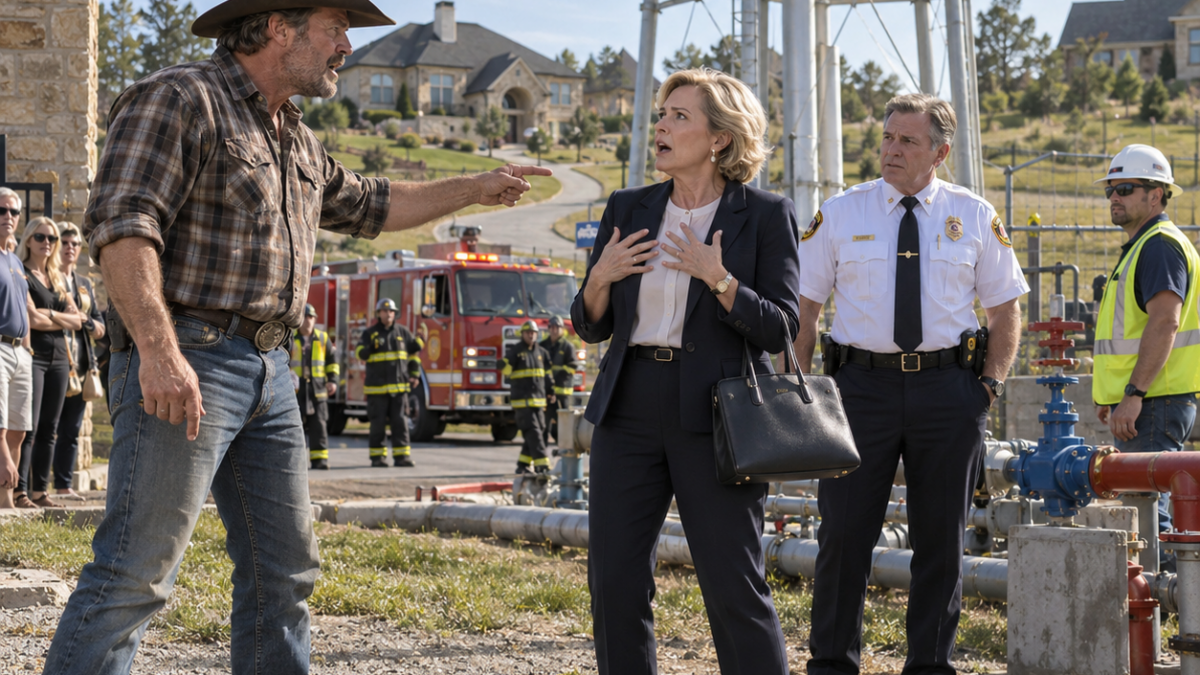
The HOA president stood on my lawn, pointed at the water tower my grandfather had built with his own hands, and told me I had four days to tear it down—or she would do it for me.
I should have been furious, but the only thing I felt was a cold knot forming in my stomach as I realized she had no idea what she was threatening.
And when she refused to let me finish one sentence about that tower, I knew the next few days were going to change our neighborhood forever.
“That rust bucket comes down by Friday,” Karen Albright said, tapping the violation notice against my chest. “Five o’clock. Not one minute later.”
I looked at the paper.
Then at her.
Then over her shoulder at the steel tower rising above the old oak trees behind my house.
It had been there for more than fifty years.
Long before Karen.
Long before the HOA.
Long before the subdivision of expensive beige houses surrounding my twenty acres had even existed.
My grandfather, Sergeant Major Thomas Garrison, had built that tower after coming home from Korea.
To Karen, it was ugly.
To me, it was part of my family.
“You’re standing on private property,” I said.
Her smile tightened.
Two HOA board members stood behind her, clutching folders and refusing to meet my eyes.
Karen raised her clipboard.
“Section Seven, Subsection B,” she said. “No detached structure exceeding eighteen feet without board approval.”
“This property isn’t under your covenants.”
“That’s what you keep claiming.”
“I’ve never claimed it before today.”
For half a second, she seemed confused.
Then she covered it with the expression I was beginning to recognize—the look of someone who believed confidence could substitute for facts.
“This community has standards, Mr. Garrison.”
“My property predates your community.”
“That doesn’t mean you get to destroy everyone else’s property values.”
I almost laughed.
Instead, I unfolded the notice again.
She had described the tower as an “unapproved, deteriorating, aesthetically incompatible structure presenting a potential community hazard.”
Potential community hazard.
Those words stayed with me.
Because if she actually accomplished what she was threatening, “community hazard” would take on a very different meaning.
“Karen,” I said quietly, “before you do anything else, you need to listen to me.”
She folded her arms.
“That tower provides the hydrostatic pressure for—”
Her hand shot up.
“I don’t care what it provides.”
The sentence landed harder than she realized.
Behind her, one board member shifted uncomfortably.
I studied Karen’s face.
“You should.”
“I care about our property values.”
“You should care about this more.”
“Friday,” she repeated. “After that, the HOA will arrange removal and send you the bill.”
She turned and marched toward the road.
I called after her.
“Karen.”
She stopped but didn’t turn.
“You’re making a serious mistake.”
She glanced over her shoulder.
“No, Mr. Garrison. The mistake was allowing that eyesore to remain this long.”
Then she left.
I stood beneath the tower for several minutes after her SUV disappeared around the curve.
The afternoon sun reflected from the weathered steel.
I could remember being eight years old and watching my grandfather climb its ladder.
He had looked enormous to me then.
Strong.
Fearless.
Permanent.
“Things worth building,” he once told me, “should still matter after the man who built them is gone.”
I hadn’t understood him then.
I did now.
My wife, Sarah, met me inside the workshop.
She had watched everything from the kitchen window.
“What are you going to do?”
I walked to the old filing cabinet my grandfather had used for decades.
The bottom drawer stuck halfway, exactly as it always had.
I pulled harder.
It opened with a metallic groan.
Inside was a thick yellowed folder.
OAK CREEK EASEMENT.
I laid it on the workbench.
Original signatures.
County seals.
Survey maps.
Engineering diagrams.
A recorded agreement signed decades earlier between my grandfather, the developer, and county officials.
Sarah leaned over my shoulder.
Her expression changed as she read.
“They really don’t know?”
“No.”
“What happens if they remove the tower?”
I looked toward the window.
Beyond our pasture were hundreds of roofs belonging to the very people Karen claimed she was protecting.
“I tried to tell her.”
Sarah slowly sat down.
“And she interrupted you.”
“Yes.”
She was silent for a moment.
Then we heard an engine outside.
Not a car.
Something heavier.
Diesel.
I stepped out of the workshop and saw a flatbed truck slowing near our gate.
Behind it came another vehicle.
ACE DEMOLITION.
A man in a hard hat climbed out holding a work order.
I checked my watch.
It was Tuesday morning.
Karen hadn’t even waited until Friday.
And as the demolition crew started walking toward my gate, I realized she had just turned an HOA argument into something much bigger.
PART 2
I reached the gate before the demolition foreman did.
He was maybe fifty, broad-shouldered, sunburned across the back of his neck, with the tired expression of a man who had spent most of his adult life discovering that other people’s paperwork was usually wrong.
His name patch said MITCH.
“Morning,” he said cautiously.
“Morning.”
He looked past me toward the tower.
“I’ve got a work order from the Estates at Oak Creek HOA.”
“I figured.”
His eyebrows lifted.
“Emergency removal.”
I nodded toward the paper.
“Mind if I see it?”
He hesitated, then turned the clipboard around.
Karen had authorized the demolition herself.
She had checked a box describing the tower as an immediate structural danger.
There was no engineering report attached.
No inspection.
No county order.
No ownership verification.
Nothing.
Just Karen’s signature.
“When were you hired?” I asked.
“Last night.”
“She told me I had until Friday.”
Mitch sighed.
“Sounds like I got dropped into something.”
“You did.”
He looked toward the tower again.
“My crew can wait while you call whoever you need.”
“I don’t need to call anybody.”
I went to the truck parked beside my workshop and retrieved the clear folder I had prepared that morning.
Inside were copies of the deed, plat map, and the page excluding my property from HOA authority.
Mitch read them slowly.
His face changed.
“Lot One.”
“That’s right.”
He checked his work order.
Then the plat.
Then the address marker beside my gate.
“Well, damn.”
I almost smiled.
“Exactly.”
He scratched his jaw.
“This says they don’t own it.”
“They don’t.”
“And you’re not in the association.”
“No.”
“Then why the hell did she hire us?”
“That’s a question you should probably ask her.”
Mitch took out his phone.
He called his supervisor first.
Within three minutes, Karen was on speaker.
Her voice came through so loudly that two men unloading equipment behind the truck stopped and looked over.
“What is the delay?”
Mitch glanced at me.
“Ma’am, we have a property issue.”
“There is no property issue.”
“The homeowner has documents showing the tower isn’t on HOA land.”
“He is lying.”
I leaned slightly toward the phone.
“I’m standing right here, Karen.”
Silence.
Then:
“Of course you are.”
Mitch looked as though he wanted to disappear.
I continued.
“Your contractor has reviewed the deed.”
“That changes nothing.”
“It changes everything.”
“You are in violation.”
“I’m not a member of your association.”
“Your property is surrounded by association property.”
“That doesn’t annex it.”
She raised her voice.
“Mitch, I am ordering you to proceed.”
He looked at the gate.
Then at me.
“No, ma’am.”
“What?”
“My company doesn’t knowingly trespass.”
“I am giving you legal authorization.”
“You don’t own the property.”
“I am the president of the homeowners association.”
Mitch rubbed his forehead.
I almost felt sorry for him.
Almost.
Then Karen said the words that changed my approach completely.
“If he interferes, call the police.”
I leaned toward the phone again.
“Please do.”
She went quiet.
“Call them, Karen. I’ll provide the responding officer with your demolition work order, my deed, the recorded easement agreement, and the county infrastructure documents attached to it.”
Another silence.
Longer this time.
I continued.
“And then I’ll ask to file a formal complaint for attempted destruction of private property.”
Mitch’s supervisor suddenly spoke.
“Mitch.”
“Yeah?”
“Pack it up.”
Karen exploded.
“You cannot do that!”
“We’re doing it.”
“I hired you!”
“And I’m canceling the job.”
“You’ll hear from our attorney!”
“Good.”
The call ended.
Mitch handed me the folder.
“Sorry.”
“You checked before crossing the gate. That’s all I could ask.”
He shook his head.
“I don’t know what that woman told us, but she made it sound like you were some squatter refusing a county demolition order.”
That caught my attention.
“She said that?”
“Pretty much.”
I filed that sentence away.
After years in the Army, you learn there are moments when anger helps and moments when it only makes you careless.
This was the second kind.
So I watched.
Recorded.
Documented.
And waited.
The demolition crew pulled away ten minutes later.
From my porch, Sarah watched the truck disappear.
“She really sent them.”
“Yep.”
“Three days early.”
“Yep.”
Sarah folded her arms.
“What now?”
“Now she gets frustrated.”
“That worries me.”
“It should.”
I wasn’t being dramatic.
People who respect rules stop when they discover the rules are against them.
People who love power usually don’t.
Karen proved me right the next morning.
Twelve envelopes appeared in the HOA mailbox near the entrance to the development.
Every one addressed to me.
Five-hundred-dollar fine for refusing a board directive.
One-hundred-dollar daily fine for maintaining the water tower.
Fifty dollars because my old Ford pickup was visible from the street.
Seventy-five because weeds along the fence supposedly violated landscaping requirements.
There was even a fine because the wooden bench beside my driveway was “inconsistent with approved exterior furnishings.”
I laughed at that one.
My grandfather had built the bench.
He had also built the water tower.
Apparently Karen was trying to erase him one piece at a time.
Sarah didn’t laugh.
“This isn’t funny anymore.”
“I know.”
“What if she puts liens on the property?”
“That’s why I’m keeping everything.”
I arranged the notices across the workbench.
Each envelope.
Each postmark.
Each signature.
Each invented violation.
Then I photographed them.
Scanned them.
Made digital copies.
Backed them up.
Sarah stood in the doorway.
“You’re doing that Army thing.”
“What Army thing?”
“The thing where you get calmer the angrier you are.”
I looked at her.
“I’m not angry.”
She gave me a look.
“Jack.”
I exhaled.
“All right. I’m furious.”
“Good. I was starting to worry.”
I sat on the stool beside the bench.
“She came onto our land. Threatened the tower. Hired contractors to tear down something she doesn’t own. Now she’s trying to invent debt against property she has no jurisdiction over.”
Sarah put her hand over mine.
“My grandfather built half of what keeps this place running.”
“I know.”
“And she talks about him like he left garbage behind.”
“I know.”
That was the part that hurt more than I wanted to admit.
The tower wasn’t pretty in the way new subdivisions defined pretty.
It was riveted steel, concrete footings, faded paint, and old welds.
But I still remembered my grandfather touching one of its support legs whenever we walked past it.
Not dramatically.
Just a palm against the steel.
Like greeting an old friend.
He had bought this land after returning from Korea with almost nothing.
No trust fund.
No developer.
No HOA dues collected from two hundred and fifty families.
Just acreage, determination, and the stubborn belief that a man should leave something useful behind.
When the county’s water pressure had been unreliable, he built the tower.
When the volunteer fire station needed help maintaining usable pressure in the area, he let them connect.
Years later, developers surrounded our farm with houses.
Their engineers discovered a problem.
The elevation made fire suppression expensive.
To give hundreds of homes adequate hydrant pressure, they would have needed a separate pumping station and storage system costing millions.
My grandfather had already built the solution.
So they came to him.
They negotiated.
The agreement was permanent.
The future subdivision could connect its fire-main loop to our pressure system.
In return, our land would remain outside the HOA forever.
No dues.
No covenants.
No assessments.
No architectural review.
It wasn’t a handshake.
It was recorded with the county.
Karen wasn’t merely wrong.
She had somehow become president of a community without bothering to understand the infrastructure that allowed that community to exist.
I looked at the fines again.
“I need to go see Henderson.”
Sarah nodded immediately.
Chief Robert Henderson had known my grandfather.
If anyone understood the tower, he did.
Northwood County Fire Station Two sat three miles away in a low brick building beside the highway.
When I walked in, a young firefighter looked up from the desk.
“Can I help you?”
“I’m looking for Chief Henderson.”
“Appointment?”
“No. Tell him Jack Garrison is here.”
The young man disappeared through a doorway.
Seconds later I heard a chair scrape.
Then a familiar voice.
“Jack Garrison?”
Chief Henderson emerged.
He was in his late sixties now, built like an old oak stump, gray hair cut short, shoulders still square beneath his uniform shirt.
He grabbed my hand.
“Last time I saw you, you were trying to climb your grandfather’s water tower.”
“I was twelve.”
“You were stupid.”
“I was twelve.”
“Same thing.”
I laughed.
For the first time in three days, something inside me loosened.
Then Henderson studied my face.
“What’s wrong?”
“I have an unusual question.”
“Those are usually the expensive ones.”
“What would happen to Oak Creek if my water tower disappeared?”
His smile vanished.
“Why?”
“The HOA president is trying to demolish it.”
Henderson stared at me.
I waited.
He blinked once.
“She’s trying to what?”
I explained everything.
The ultimatum.
The demolition crew.
The fines.
Karen refusing to listen.
He said nothing until I finished.
Then he pushed his chair backward and stood.
“Come here.”
He led me to a county infrastructure map covering most of one wall.
His finger landed on Oak Creek.
“You see these?”
Blue dots marked the streets.
“Hydrants.”
“Thirty-seven of them.”
He traced a thick line backward through the neighborhood until it reached my property.
“That is the twelve-inch supply main.”
“I know.”
“Your grandfather’s tower provides the static head for the loop. We verify it every year.”
He opened a cabinet and pulled out a binder.
“Last flow test.”
He turned pages.
“Here.”
He tapped the numbers.
“Hydrant outside the clubhouse. One hundred twenty pounds per square inch static pressure.”
“And without the tower?”
He looked at me.
“Depending on demand and municipal conditions? Forty. Maybe less in some locations.”
I stared at him.
“That bad?”
“Jack, why do you think the developers signed that agreement?”
I knew the answer.
But hearing him say it made the situation feel heavier.
“Because the alternative was expensive.”
“Very expensive.”
He paced back to the map.
“Listen to me carefully. Your tower isn’t some auxiliary convenience. It is integrated into their fire-flow design.”
He tapped the subdivision.
“Two hundred and fifty homes.”
Another tap.
“Clubhouse.”
Another.
“Pool facilities.”
Another.
“Common buildings.”
He faced me.
“If somebody disables the primary pressure source without installing a replacement, our response changes instantly.”
“How?”
“Lower hydrant pressure means engine crews may have to relay pump. They may need longer supply lines. Depending on conditions, we may need tankers.”
“Minutes.”
“Exactly.”
He leaned toward me.
“And in a structure fire, minutes aren’t minutes.”
I nodded.
“They’re rooms.”
He looked at me with surprise.
“Your grandfather used to say that.”
“So did you.”
He sat again.
“And then there’s insurance.”
I frowned.
“If the fire-protection classification changes…”
“Premiums could change.”
He closed the binder.
“So your HOA president wants to make every homeowner pay to remove the system keeping their hydrants functional because she doesn’t like how it looks?”
“That’s about the size of it.”
For the first time, Chief Henderson looked genuinely angry.
Not irritated.
Angry.
“Does she know?”
“I tried to tell her.”
“And?”
“She said she didn’t care what the tower provided.”
His jaw tightened.
“All right.”
He reached for a legal pad.
“What are you doing?”
“Helping you make sure she understands.”
Within an hour, he had prepared a formal letter.
Then an affidavit.
Then copies of hydrant-flow test reports going back years.
Every one identified the Garrison tower or associated pressure system as a source.
Before I left, Henderson stopped me.
“When’s the next board meeting?”
“Two weeks.”
“I’ll be there.”
“You don’t have to.”
“Yes, I do.”
He stared through the office window toward the apparatus bay.
“Your grandfather helped this department when we barely had money to replace hoses. He never asked for recognition. Never asked for money. He just wanted the water available when somebody needed it.”
His expression hardened.
“I’m not going to let somebody erase that because she thinks weathered steel looks ugly from her SUV.”
I drove home with a thick folder on the passenger seat.
But I didn’t go directly to my house.
Instead, I stopped at Mrs. Gable’s.
Helen Gable was eighty-one and had lived in Oak Creek since its earliest phase.
Her front yard was full of roses.
Actual roses.
Not HOA-approved decorative grass.
She opened the door and immediately said, “If you’re here about Karen, come inside before she sees us talking.”
That told me plenty.
We sat at her kitchen table.
She remembered my grandfather.
“Oh, Tommy Garrison was one of the finest men I ever knew.”
She smiled.
“When our house was being built, my husband used to walk across that field and talk with him for hours.”
“Do you remember the tower agreement?”
“Of course.”
She frowned.
“Why?”
I told her.
Her hand went to her chest.
“She wants to tear down Tommy’s tower?”
“Yes.”
“That woman has lost her mind.”
“She says it violates the bylaws.”
Mrs. Gable snorted.
“Your land isn’t even in the association.”
“Correct.”
“She knows that.”
“I’m beginning to think she knows very little.”
Mrs. Gable leaned closer.
“You should talk to the Millers.”
“Who?”
“The young couple two houses from Karen.”
She lowered her voice.
“She’s made their lives miserable.”
By sunset, I had spoken with four homeowners.
By the next evening, nine.
The pattern was obvious.
Karen had fined a family because their child left a tricycle outside overnight.
She had threatened another homeowner over curtains visible through a front window.
She had ordered a widower to replace a mailbox because its shade of bronze differed from the approved finish.
A couple had been fined because their basketball hoop stood one inch outside the placement standard.
Mrs. Gable herself had received a citation for a garden gnome.
I stared at that notice for ten seconds.
“Naturalistic aesthetic?” I asked.
“That’s what it says.”
“It’s a ceramic gnome.”
“I know what it is, Jack.”
I photographed everything.
Some residents were frightened to sign statements.
I didn’t push them.
Karen had spent years teaching these people that resistance had a price.
Fear becomes a habit.
I understood that.
But habits can break.
I just needed the right moment.
For that, I called David Chen.
David and I had served together in the 101st Airborne.
Back then, he had been the officer who could look at a chaotic situation and somehow find the one weak point nobody else noticed.
After the Army, he used the GI Bill to attend law school.
By the time I called him, he had become one of the best property and contract lawyers in the state.
He listened while I explained.
Then he said, “Bring everything.”
His office was downtown on the eighth floor of a glass building.
I arrived carrying two document boxes.
David looked at them.
“This is either very good or very bad.”
“For whom?”
He smiled.
“Now I’m interested.”
For the next hour, I laid out the entire case.
My deed.
The HOA exemption.
The recorded easement.
Fire-department records.
Photos of the demolition truck.
Karen’s work order.
Twelve fines.
Statements from homeowners.
Emails.
Maps.
David barely spoke.
He read.
Turned pages.
Made notes.
Finally, he leaned back.
“How much does she know about the easement?”
“I told her there was one.”
“Did she read it?”
“I doubt it.”
“Did the demolition contractor?”
“Yes.”
“And he withdrew?”
“Yes.”
David stared toward the window.
Then a slow smile appeared.
I knew that smile.
“What?”
“Jack.”
“What?”
“This woman may have just created one of the cleanest records of bad faith I’ve seen in years.”
He began organizing documents into separate piles.
“First, your property is expressly exempt from HOA control.”
Pile one.
“Second, she was informed.”
Pile two.
“Third, after being informed, she hired a demolition company.”
Pile three.
“Fourth, when the contractor independently verified ownership and refused, she instructed them to proceed anyway.”
Pile four.
“Fifth, after that failed, she began issuing fines against property over which the association has no authority.”
Pile five.
“Sixth, the structure she tried to destroy is tied to a recorded public-safety infrastructure agreement.”
He placed Henderson’s affidavit in the center.
“And that is where this stops being amusing.”
“I never found it amusing.”
“I do.”
I raised an eyebrow.
He grinned.
“Professionally.”
Then his expression became serious.
“Jack, she is exposing the HOA to enormous liability.”
“Can we stop her?”
“Immediately.”
He turned toward his computer.
“I can have a cease-and-desist letter delivered by tomorrow. We can seek injunctive relief if necessary.”
He began typing.
Then stopped.
His fingers rested on the keyboard.
“What?”
“Question.”
“Go ahead.”
“Do you want her stopped?”
“That’s why I’m here.”
“No.”
He looked at me.
“I mean: do you want only the immediate conduct stopped?”
I understood.
“What else?”
David turned in his chair.
“Because right now, she thinks you’re isolated. She thinks she controls the narrative.”
He gestured at the homeowners’ statements.
“But she has apparently been terrorizing half the neighborhood.”
“That seems accurate.”
“And the next meeting?”
“Two weeks.”
“What is she planning?”
“I don’t know.”
He picked up one of Karen’s fines.
“I do.”
I waited.
“She’s going to make you the agenda.”
I thought about Karen.
Her need to control the room.
Her performative confidence.
Her clipboard.
Her gavel.
David was right.
“So what do we do?”
“We prepare the cease-and-desist.”
“But don’t send it.”
“Not yet.”
“What about the lawsuit?”
“We prepare that too.”
I stared at him.
“You want to file?”
“I want options.”
He leaned forward.
“Here’s the difference between revenge and accountability, Jack. Revenge is hurting someone because you’re angry. Accountability is allowing someone’s documented choices to produce consequences.”
He tapped Karen’s demolition order.
“She has been choosing.”
A week later, we learned exactly what she planned.
An Oak Creek homeowner called me.
“You didn’t hear this from me.”
“Understood.”
“Karen wants a special assessment.”
“For what?”
“To remove your tower.”
I closed my eyes.
“How much?”
“Two hundred dollars per house.”
I almost couldn’t believe it.
Two hundred and fifty homes.
Fifty thousand dollars.
Karen wanted the neighborhood to finance the destruction of the system protecting their own houses from fire.
“Is it on the agenda?”
“Yes.”
“Thank you.”
“Jack?”
“Yeah?”
“Can you actually beat her?”
The question wasn’t really about me.
It was the question people ask when they’ve been bullied so long they’ve forgotten power can move in both directions.
“We’ll see,” I said.
The night of the meeting, Sarah stood in our bedroom doorway while I buttoned a clean shirt.
“Nervous?”
“A little.”
“You?”
“Very.”
I smiled.
“You don’t have to come.”
She gave me a look that ended that idea immediately.
“My home. My family. My water tower too.”
I kissed her forehead.
“Fair enough.”
Before we left, I walked outside.
The tower stood dark against the early evening sky.
I put my palm against one steel support.
Cold metal.
For a second, I could almost hear my grandfather.
Don’t fight noise with noise, Jackie.
Bring facts.
Then make people look at them.
The clubhouse parking lot was full.
That surprised me.
Usually HOA meetings attracted barely enough homeowners for quorum.
Karen had advertised this one aggressively.
The “Garrison problem,” apparently, had become a community emergency.
Sarah and I sat in the back.
Mrs. Gable was near the middle.
The Millers sat three rows ahead of us.
Several neighbors I’d interviewed avoided looking at me.
I understood.
Karen sat at the front table between two board members.
Gerald Pierce, the association treasurer, looked as though he already regretted being there.
Beside him sat Linda Mercer, the board secretary.
Karen struck the gavel.
“Meeting called to order.”
The room quieted.
She moved through routine business quickly.
Landscaping.
Pool maintenance.
Streetlights.
Then she paused theatrically.
“Now we come to the most urgent matter before this association.”
There it was.
She clicked a remote.
A photograph of my water tower filled the projector screen.
She had taken it on a gray day from the least flattering angle possible.
“This,” she announced, “is the structure I have spent several weeks attempting to address.”
Several weeks.
It had been thirteen days.
Karen continued.
“As many of you know, this deteriorating industrial structure stands directly adjacent to our community.”
She never said my property was inside the HOA.
Interesting.
“It represents an aesthetic problem, a property-value concern, and potentially a serious safety hazard.”
I felt Sarah’s fingers close around mine.
Karen showed a close-up of rust.
Then another photograph.
Then the bogus fines.
“Unfortunately, the owner has refused reasonable cooperation.”
I stood.
“Point of order.”
Karen’s eyes snapped toward me.
“You are not recognized.”
“The motion concerns my property.”
“Sit down.”
“The information you are presenting is false.”
She hit the gavel.
“Mr. Garrison, you are not a member of this association and therefore have no standing to disrupt this meeting.”
Exactly.
I smiled.
“Thank you for confirming that.”
A few people laughed.
Karen’s face tightened.
“I said sit down.”
I did.
She resumed.
“Due to the owner’s continued refusal to address this danger, the board has obtained a professional demolition estimate.”
A murmur moved through the room.
“Because removal benefits all residents, I am proposing a one-time special assessment of two hundred dollars per household.”
The murmur became louder.
Someone behind me said, “You’ve got to be kidding.”
A man near the aisle raised his hand.
“Why are we paying to demolish something that isn’t ours?”
Karen stiffened.
“Because the owner refuses to accept responsibility.”
Another voice.
“Is it actually unsafe?”
“We have every reason to believe—”
“Do you have an engineering report?”
Karen paused.
“I have consulted professionals.”
That meant no.
She raised the gavel.
“All in favor—”
The clubhouse doors opened.
Chief Henderson walked in.
Behind him were two battalion chiefs.
Nobody spoke.
Henderson was wearing his formal uniform.
Not because he needed to.
Because he understood rooms.
He understood symbols.
And he knew exactly what Karen had built this meeting around: authority.
So he brought real authority with him.
Karen lowered the gavel slowly.
“Chief Henderson.”
“Mrs. Albright.”
Her smile returned, but it looked painful.
“What an unexpected pleasure.”
“I doubt you’ll find it pleasurable.”
Several people turned toward him.
Henderson walked to the center aisle.
“I apologize for interrupting.”
“No,” Karen said quickly. “Actually, we’re in the middle of official association business.”
“That’s why I’m here.”
Her smile disappeared.
He held up a binder.
“I understand this board is considering spending homeowners’ money to dismantle the Garrison water tower.”
Karen straightened.
“A private structure posing a potential—”
“Are you aware that the structure you’re discussing provides hydrostatic pressure to the fire-suppression loop serving this development?”
Silence.
Absolute silence.
Karen blinked.
“What?”
Henderson didn’t move.
“Your hydrants.”
Someone whispered, “What did he say?”
Henderson turned so he could address the room.
“This development contains thirty-seven fire hydrants. The system was engineered around an agreement connecting its fire-main infrastructure to the Garrison property’s pressure system.”
A man in the front row stood.
“You’re saying that tower feeds our hydrants?”
“More precisely, it supplies essential pressure to the loop.”
He opened the binder.
“Last year’s test at the hydrant directly outside this clubhouse measured approximately one hundred twenty PSI static pressure with the Garrison system operating.”
He looked toward Karen.
“Disable that tower without an engineered replacement, and pressure may fall to a fraction of that.”
The man stared at Karen.
“You knew about this?”
She shook her head.
“He’s exaggerating.”
Henderson’s expression changed.
Barely.
But enough.
“Mrs. Albright, I have been a firefighter for forty-two years.”
The room seemed to shrink.
“I do not exaggerate water pressure.”
A laugh broke somewhere near the back.
Then another.
Karen flushed.
She pointed toward me.
“He is manipulating you. Mr. Garrison has been trying to undermine this board.”
Henderson opened another document.
“This is the municipal services agreement recorded with Northwood County.”
I watched Gerald, the treasurer.
His face went pale.
Henderson continued.
“It was executed between the original developer and Sergeant Major Thomas Garrison.”
Mrs. Gable stood.
“I remember it.”
Everyone looked at her.
She was tiny in that room.
White hair.
Floral blouse.
Hands trembling slightly.
But her voice carried.
“Tommy Garrison helped this neighborhood before most of us even knew we were going to live here.”
Karen frowned.
“Mrs. Gable, please sit down.”
“No.”
The room changed.
It was one word.
But for people who had spent years obeying Karen, it sounded enormous.
Mrs. Gable pointed at the projected image.
“That tower was here when my husband and I moved in.”
Karen lifted the gavel.
“We are not conducting a history lesson.”
Chief Henderson looked at her.
“History is exactly why your hydrants work.”
The room erupted.
Questions came from everywhere.
“Why weren’t we told?”
“What happens to our insurance?”
“Can our hydrants actually fail?”
“Did she already hire people to demolish it?”
That last question came from Mr. Miller.
Karen stared at him.
I stood.
This time she didn’t tell me to sit.
I walked toward the projector.
David and I had arranged access to the presentation laptop before the meeting through one of the homeowners.
I pressed a key.
Karen’s photograph disappeared.
The recorded easement appeared.
Official seal.
Signatures.
Date.
Terms.
“This,” I said, “is the agreement Karen was told about before she hired anyone.”
Next slide.
A photograph of the demolition truck at my gate.
Gasps.
Next.
The work order.
Next.
Her signature.
Someone said, “Oh my God.”
Karen stepped toward me.
“You had no right to put that on my presentation.”
“My property was your presentation.”
Next slide.
Five-hundred-dollar fine.
Next.
One-hundred-dollar daily fine.
Next.
Commercial vehicle violation.
Next.
Lawn violation.
Next.
The bench violation.
People began laughing now.
Not because it was funny.
Because sometimes absurdity is what finally destroys fear.
Mrs. Gable raised her hand.
“She fined my garden gnome.”
Someone shouted, “What?”
Mrs. Gable pulled the notice from her purse.
“I brought it.”
Laughter became applause.
Karen banged the gavel repeatedly.
“Order! Order!”
Nobody listened.
Mr. Miller stood.
“You fined us because my son left his tricycle in the driveway overnight.”
Another homeowner stood.
“You threatened a lien over my curtains.”
Another.
“You fined my mother’s wheelchair ramp before the county made you withdraw it.”
Another.
“You photographed my backyard from the common path.”
Another.
“You sent me three notices because my mailbox was the wrong bronze.”
The stories came faster than Karen could answer.
The dam had broken.
Years of humiliation.
Fear.
Petty control.
All pouring out at once.
Karen’s face twisted.
“You people begged for standards!”
“No,” someone yelled. “We agreed to rules, not a dictator.”
The applause was immediate.
Gerald pushed away from the table.
“I didn’t know about the water agreement.”
Karen turned on him.
“Don’t you dare.”
He raised both hands.
“You told us the attorney had reviewed the demolition.”
“I said I was handling it.”
“You said it was legal.”
Linda Mercer stared at Karen.
“You told me the county ordered the tower removed.”
My head snapped toward her.
Karen’s face froze.
David had suspected there might be more.
Now we had it.
I looked at Linda.
“The county?”
She nodded slowly.
“That’s what Karen told us.”
Henderson crossed his arms.
“No county fire official ordered removal.”
Gerald looked sick.
“We voted based on what you told us.”
Karen stared at her own board.
“You’re both spineless.”
Then the clubhouse door opened again.
David Chen stepped inside.
Dark suit.
Calm expression.
Legal envelope in one hand.
He walked directly toward the front table.
The room gradually quieted.
Karen watched him approach.
“Who are you?”
David placed the envelope in front of her.
“David Chen. Counsel for Jack and Sarah Garrison.”
Nobody moved.
He looked at Karen.
“Mrs. Albright, you’ve been served.”
Her face changed.
For all her shouting, all her demands, all the power she claimed to possess, that simple sentence reached her in a way nothing else had.
She stared down at the envelope.
“What is this?”
“A civil complaint naming the Estates at Oak Creek Homeowners Association and you personally.”
She looked up.
“Personally?”
“Yes.”
“For what?”
David spoke evenly.
“Among other claims, attempted interference with recorded property rights, harassment, slander of title arising from unauthorized assessments and threatened liens, attempted destruction of private property, and interference with a critical infrastructure agreement.”
Karen’s mouth opened.
Nothing came out.
David continued.
“The complaint includes documentation demonstrating that you were informed the property fell outside HOA jurisdiction before you authorized demolition.”
Gerald looked at Karen.
“You knew?”
She snapped.
“He’s twisting everything!”
David didn’t react.
“We also have the contractor’s statement confirming that after he reviewed the property documentation, you instructed him to proceed anyway.”
Now Linda stood.
“You told us he refused because Jack threatened him.”
Mitch’s statement destroyed that lie instantly.
Karen’s eyes darted around the room.
For the first time, she seemed to understand what had happened.
She had spent two weeks thinking she was tightening a net around me.
But every fine had become evidence.
Every threat had become evidence.
Every exaggeration had become evidence.
The demolition order.
The misrepresentation to her board.
The special assessment.
The meeting.
All of it.
David had said accountability was letting someone’s choices produce consequences.
Karen had made many choices.
Now they had arrived together.
A homeowner near the back raised his voice.
“I move for an immediate vote of no confidence in Karen Albright.”
“Second,” another said.
Then another.
“Second.”
“Second.”
“Second.”
Karen reached for the gavel.
Gerald grabbed it first.
She stared at him.
“What are you doing?”
“I’m acting as treasurer and board member.”
“You don’t have authority.”
“The bylaws say any director may chair when the president is the subject of a removal motion.”
For the first time, Karen had met someone who knew the bylaws too.
Gerald swallowed.
“All homeowners eligible to vote on immediate removal of Karen Albright as association president…”
Hands went up.
One after another.
Then rows at a time.
I watched Karen count.
She stopped halfway.
It didn’t matter.
The vote was overwhelming.
Nearly unanimous.
Gerald lowered his hand.
“The motion carries.”
Karen looked as though someone had removed the floor beneath her.
“No.”
Nobody answered.
She looked toward Linda.
“You can’t do this.”
Linda looked away.
Karen faced the homeowners.
“I protected this neighborhood.”
Someone laughed bitterly.
“You almost destroyed our fire system.”
“I didn’t know!”
Henderson spoke from the back.
“You were told.”
She turned toward me.
Hatred filled her face.
“You.”
I said nothing.
“You planned this.”
“No.”
“You humiliated me.”
I finally answered.
“You did that yourself.”
Her lips trembled.
For a moment, I saw something beneath the anger.
Not remorse.
Fear.
She had built her identity around being the person everyone obeyed.
And now, in less than ten minutes, everyone had stopped.
She grabbed her purse.
“You’re all fools.”
No one responded.
“I tried to make this place worth living in!”
Mrs. Gable looked at her.
“It was worth living in before you made everyone afraid of one another.”
That landed harder than anything I could have said.
Karen shoved past the chairs and left.
Outside, a local reporter was standing near the parking lot.
I hadn’t invited him.
Neither had David.
Later, I learned one of the firefighters had mentioned the meeting to a friend at the paper after hearing what was happening.
By the next morning, Oak Creek had become local news.
The headline was merciless without being sensational:
HOA DEMOLITION PLAN TARGETED WATER SYSTEM SUPPORTING COMMUNITY FIRE HYDRANTS
The article laid out the documented facts.
Recorded easement.
Fire department records.
Demolition order.
Special assessment.
No-confidence vote.
The photograph showed the tower behind my house.
For the first time in decades, people were looking at it.
Really looking.
Not as rusted steel.
As infrastructure.
Karen disappeared from public view.
But the legal battle wasn’t over.
In fact, that was where the consequences became real.
The morning after the meeting, Gerald called.
“Jack.”
“Gerald.”
“I resigned.”
I wasn’t surprised.
“Linda too.”
“All right.”
“I’m sorry.”
There was a long silence.
“I should have checked.”
“Yes.”
“I believed her.”
“I know.”
“That doesn’t excuse it.”
“No.”
He exhaled.
“I just wanted you to hear me say that.”
“I appreciate it.”
The emergency board election happened ten days later.
For the first time anyone could remember, more than eighty percent of the neighborhood participated.
Bill Hawkins was elected president.
Bill was a civil engineer in his fifties who had lived in Oak Creek for eleven years and somehow avoided every HOA committee Karen had tried to recruit him into.
Two days after the election, his truck stopped at my house.
He walked to the porch alone.
No clipboard.
No violation notice.
No entourage.
“Jack?”
“Bill.”
He removed his cap.
“I owe you an apology.”
“You didn’t do anything.”
“I live here.”
“That doesn’t make you responsible.”
“No, but we let it happen.”
I gestured toward a chair.
He sat.
Sarah brought coffee.
For an hour we talked.
Not about revenge.
About repair.
The new board had already voted to cancel every unauthorized fine Karen had issued against me.
Then they ordered a review of every open violation she had created over the previous two years.
Bill shook his head.
“You wouldn’t believe some of these.”
“I probably would.”
“There’s one for a bird feeder.”
“I believe it.”
“Another because somebody’s garage door was open for forty-three minutes.”
“Definitely believe it.”
He rubbed his face.
“How did we get here?”
“Slowly.”
That was the truth.
Nobody wakes up one morning inside an abusive system.
It builds by inches.
A ridiculous rule accepted because fighting seems harder.
A neighbor staying silent because the fine is small.
A board member looking away.
A president discovering that nobody challenges her.
Then another inch.
Then another.
Until people forget there was ever another way.
Bill looked toward the tower.
“The lawsuit.”
“Yes.”
“We’d like to settle.”
“Talk to David.”
“I will.”
He hesitated.
“I’m not asking you to walk away.”
That surprised me.
“You’re not?”
“No.”
He looked me in the eye.
“What happened was wrong. The association has to own its part.”
I respected him for that.
“I don’t want to punish innocent homeowners.”
“I know.”
“But there has to be a consequence.”
“I agree.”
David handled negotiations.
The HOA’s insurance carrier entered quickly.
Its attorneys were not pleased.
Karen had created the exact situation insurers hate: documented warnings ignored before escalating conduct.
They examined the timeline.
She had been told my property was exempt.
She proceeded.
The demolition contractor independently verified the documents.
She instructed him to proceed anyway.
He refused.
She retaliated with fines.
Then she attempted to charge homeowners fifty thousand dollars to complete the same demolition.
The insurer’s attorney called David.
“We can resolve the HOA portion.”
“And Mrs. Albright?”
“Her conduct may fall outside coverage.”
That mattered.
Corporate protection and directors’ insurance can shield board members who make honest mistakes while acting within their duties.
But intentional misconduct is different.
David didn’t promise Karen would lose everything.
He didn’t want that.
Neither did I.
What I wanted was something simpler.
I wanted the next person who considered using power the way Karen had used it to remember what happened.
During mediation, Karen appeared with her own attorney.
It was the first time I had seen her since the clubhouse.
She looked smaller.
Not physically.
Something in her posture had changed.
The absolute certainty was gone.
We sat across a polished conference table.
Her lawyer spoke most of the time.
David spoke for us.
The mediator went between rooms.
Hours passed.
Near the end of the day, Karen asked to speak directly to me.
Her attorney looked nervous.
David looked at me.
“Your choice.”
I nodded.
Karen folded her hands on the table.
“You ruined my reputation.”
I waited.
“You turned everyone against me.”
“No.”
“You keep saying that.”
“Because it’s true.”
She leaned forward.
“You could have told me.”
“I did.”
“You could have shown me the agreement.”
“I offered to explain it on my lawn.”
“You ambushed me at the meeting.”
“You tried to raise fifty thousand dollars to destroy my property.”
She looked away.
For several seconds neither of us spoke.
Finally she said, “The tower looked terrible.”
I almost laughed.
Not because it was funny.
Because after everything, that was still where her mind went.
“It needed maintenance,” I said.
“So you admit it.”
“I never denied that.”
She stared at me.
“What?”
“The tower could have used paint.”
Her mouth opened slightly.
“If you had come to my door and said, ‘Jack, this thing is getting rusty. Is it structurally sound? Can we work together to improve how it looks?’ we probably would have had a ten-minute conversation.”
I leaned toward her.
“But you didn’t ask.”
She said nothing.
“You gave orders.”
Silence.
“You threatened.”
Silence.
“You sent demolition equipment.”
Her face tightened.
“You fined property you knew you didn’t control.”
She looked down.
“And when people questioned you, you lied.”
Her eyes came back to mine.
“What do you want?”
That was the first useful question she had asked me.
“I want the tower protected.”
She waited.
“I want the recorded agreement acknowledged by the HOA permanently.”
Nothing.
“I want every bogus fine against us removed.”
She nodded slightly.
“I want the community reimbursed for costs created by this.”
Another nod.
“And I want you to personally contribute to the settlement.”
Her face hardened.
“There it is.”
“What?”
“Revenge.”
“No.”
I shook my head.
“If this were revenge, I’d ask for everything David says we might win at trial.”
She looked at David.
He did not smile.
I continued.
“I’m asking for enough that you never forget other people’s property rights are real.”
Karen sat back.
For the first time, she seemed tired.
Not defeated.
Not furious.
Just tired.
“I thought I was protecting the neighborhood.”
“Maybe you did once.”
Her eyes narrowed.
“What does that mean?”
“It means I don’t think people become what you became overnight.”
She flinched.
I hadn’t intended cruelty.
So I softened my voice.
“Maybe the first fine you issued really mattered. Maybe somebody actually broke an important rule.”
She looked away.
“Then people listened. And maybe that felt good.”
No answer.
“So you pushed harder.”
Her jaw worked.
“And eventually being obeyed mattered more than whether you were right.”
Her voice was barely audible.
“You don’t know me.”
“No.”
I stood.
“But I know what you did.”
The settlement was finalized three weeks later.
All fines and claims against my property were permanently withdrawn.
The HOA formally recorded an acknowledgment that Lot One remained outside its jurisdiction under the original agreement.
The association’s insurer paid our legal expenses and damages.
Karen personally paid a significant portion under the settlement.
It wasn’t enough to destroy her financially.
I had never wanted that.
But it was enough that ignoring warnings and hiring a demolition crew would never again feel like a minor decision.
The most important terms had nothing to do with money.
The HOA was required to commission an independent engineering inspection of the water tower.
Not because Karen had been right about it being dangerous.
Because after half a century, professional inspection was responsible.
I welcomed it.
The engineers tested the steel.
Concrete footings.
Welds.
Connections.
Tank.
Piping.
The final report found the tower structurally sound.
It needed surface restoration, corrosion treatment, and routine maintenance.
So the HOA paid for it.
The irony was not lost on anyone.
Karen had begun by demanding the HOA pay to destroy my grandfather’s tower.
Her actions ended with the HOA paying to preserve it.
The restoration crew arrived on a cold Monday morning.
This time, when heavy trucks stopped outside my gate, I opened it myself.
The same gate I had refused to let the demolition crew cross.
Sarah stood beside me.
“You okay?”
“Yeah.”
“You look emotional.”
“Dust.”
“They haven’t started sandblasting.”
“Pre-dust.”
She laughed.
For weeks, workers stripped decades of faded paint and surface rust.
The tower changed color every few days.
Brown.
Bare gray steel.
Primer.
Then came the question everyone had been waiting for.
Bill called.
“The settlement says you choose the final color.”
“I know.”
“We’ve had suggestions.”
“I bet you have.”
“Mrs. Gable wants blue.”
“No.”
“The Millers’ kid wants red.”
“Definitely no.”
“Somebody anonymously suggested hot pink.”
I laughed.
“I know who.”
Sarah was sitting across from me trying not to smile.
Bill chuckled.
“What are you thinking?”
I looked through the window at the old oaks.
“Forest green.”
There was a pause.
“Seriously?”
“Seriously.”
“After everything, you’re not going to make some giant statement?”
“The tower is the statement.”
Bill was quiet.
Then he said, “Forest green it is.”
When the painters finished, I stood in the field at sunset.
The tower looked almost new.
Deep green steel rose between golden leaves.
It no longer seemed abandoned.
It looked solid.
Intentional.
Necessary.
Sarah slipped her hand into mine.
“Your grandfather would like it.”
“He’d complain about how much paint cost.”
She laughed.
“That too.”
The settlement required one more thing.
A plaque.
Polished brass.
Mounted at the base.
David and I worked on the wording.
When it arrived, I read it three times before installation.
GARRISON WATER TOWER
Erected in 1972 by Sergeant Major Thomas Garrison.
Dedicated to his foresight, service, and belief that strong communities are built when neighbors look after one another. This tower has supported essential water pressure and fire protection for the surrounding community since 1988.
I ran my thumb across my grandfather’s name.
My throat tightened.
Sarah stood beside me.
“You all right?”
“Yeah.”
“You sure?”
“No.”
She put her arm around me.
For two weeks after my grandfather died, I had handled everything like a soldier.
Funeral arrangements.
Estate paperwork.
Property transfer.
Insurance.
Maintenance.
Everyone told me how strong I was.
Nobody tells you that sometimes being strong is just grief with a schedule.
I hadn’t cried at his funeral.
I cried in front of that brass plaque.
Quietly.
Sarah didn’t say anything.
She didn’t need to.
Chief Henderson arrived a few minutes later.
He read the plaque.
Then looked at me.
“That’s right.”
“What?”
“Tom would approve.”
“You think?”
“He’d pretend he hated the attention.”
“That sounds right.”
“Then he’d spend the next thirty years showing the plaque to everybody who visited.”
I laughed through the tears.
“Also sounds right.”
The neighborhood changed after Karen.
Not instantly.
Communities aren’t machines.
You can’t replace one defective part and assume everything is fixed.
People had to relearn how to disagree without being punished.
The new board started publishing meeting minutes.
Budgets became available.
Fine procedures required independent review.
Residents received actual appeal rights.
Dozens of Karen-era citations were rescinded.
Mrs. Gable put her garden gnome back outside.
Then she bought two more.
When I noticed them, she smiled sweetly.
“I’m expanding.”
The Millers put their basketball hoop exactly where they wanted it, within county rules.
Their son left his tricycle in the driveway occasionally.
Civilization survived.
Neighbors began staying after meetings instead of fleeing immediately.
They talked.
Argued.
Compromised.
Sometimes they were annoying.
That was fine.
Real community is messy.
Karen had confused uniformity with harmony.
They are not the same thing.
A choir works because different voices create something together.
Not because everyone is forced to sing the same note.
That fall, Sarah had an idea.
“Barbecue.”
“For what?”
“The tower.”
“The tower doesn’t eat.”
“For everyone else.”
I looked at her.
“You want to invite the HOA?”
“The new HOA.”
“On our non-HOA property?”
She smiled.
“Exactly.”
So we did.
Bill came.
The Millers came.
Mrs. Gable came carrying potato salad and all three garden gnomes.
Chief Henderson arrived in jeans and a flannel shirt.
Firefighters from Station Two stopped by.
Families brought folding chairs.
Children ran across the grass beneath the same tower Karen had described as a menace.
Someone set up cornhole boards.
The smell of burgers drifted across the property.
I stood behind the grill when Bill walked over with two beers.
He handed me one.
“To dangerous industrial eyesores.”
I raised it.
“To property values.”
We touched bottles.
He looked up.
“You know something?”
“What?”
“It actually looks good.”
“It always looked good.”
“No, Jack.”
He laughed.
“It absolutely did not.”
I stared at him.
Then laughed too.
“Fine. It looks better.”
“That’s all I wanted.”
We stood quietly.
Then Bill became serious.
“I’ve been thinking about your grandfather.”
“You never met him.”
“No. But I keep thinking about that agreement.”
“What about it?”
“He could have said no.”
I nodded.
“He could have made the developer build its own system.”
“Yes.”
“He could have demanded a fortune.”
“Probably.”
“But he made a deal that protected his land and helped the people who would live here.”
“That was him.”
Bill watched children playing beneath the trees.
“We nearly paid fifty thousand dollars to erase a gift we didn’t even understand.”
I looked at him.
“That’s why understanding comes before governing.”
He nodded.
“I wrote that down after the meeting.”
“Seriously?”
“It’s in the new board handbook.”
I laughed.
“Poor future board members.”
Later, I noticed a moving truck near the far end of Oak Creek Drive.
Karen’s house.
A FOR SALE sign stood on the lawn.
I had heard she intended to move, but seeing the truck made it real.
Sarah followed my gaze.
“That’s her.”
Karen emerged carrying a cardboard box.
For a moment, the party sounds around me faded.
I remembered her standing on my lawn.
Friday, five o’clock.
I remembered the demolition truck.
The fines.
The gavel.
The lies.
The rage in the clubhouse.
Now she crossed her driveway alone.
She placed the box in her car.
Then looked toward my property.
Our eyes met.
Even across the distance, I could recognize the old expression.
Anger.
But it didn’t last.
Something replaced it.
Exhaustion, maybe.
Loss.
She looked at the restored tower.
Then at the people gathered beneath it.
The same people she once claimed needed protection from me were laughing on my lawn.
Mrs. Gable’s gnomes sat near a cooler.
Children chased each other between picnic tables.
Chief Henderson was telling some exaggerated story beside the grill.
Bill was helping Sarah carry drinks.
Nobody was afraid.
Karen looked away.
She got into her car.
And drove off.
I expected to feel triumphant.
I didn’t.
There was satisfaction.
Justice, certainly.
Relief.
But not joy at her pain.
That surprised me.
For weeks I had imagined the moment when she would finally lose.
But standing there, I understood something my grandfather probably would have understood immediately.
Defeating a person is a small victory.
Fixing what that person damaged is the bigger one.
Karen lost her presidency.
Paid damages.
Lost the authority she had abused.
Eventually left the neighborhood she once controlled.
Those were consequences.
But the real victory was behind me.
Laughter.
Neighbors.
A functioning hydrant system.
A restored tower.
A board that understood its limits.
A community that had remembered how to speak.
As sunset approached, people began packing up.
Mrs. Gable walked toward me carrying her empty casserole dish.
“Jack?”
“Yes, ma’am?”
“Your grandfather would have loved this.”
I swallowed.
“Chief Henderson said the same thing.”
“Well, Robert Henderson is rarely wrong.”
From across the lawn, Henderson shouted, “I heard that!”
Mrs. Gable smiled.
“I intended you to.”
She hugged me.
Then whispered, “Thank you for standing up to her.”
I shook my head.
“You all stood up.”
“Eventually.”
“That’s what matters.”
After everyone left, Sarah and I cleaned until darkness settled over the field.
She went inside.
I stayed behind.
The tower rose above me against a clear sky.
Fresh green paint.
Brass plaque catching light from the porch.
I walked to the base.
Placed my palm against the steel.
Just as my grandfather had.
The surface felt cool.
Solid.
Permanent.
The pump in the well house started.
A low mechanical hum traveled through the piping.
Water moving.
Pressure building.
Somewhere beyond my property line, thirty-seven hydrants stood ready.
Most residents would never think about them.
I hoped they never needed to.
That was the strange thing about infrastructure.
The best systems are often invisible until someone destroys them.
My grandfather understood that.
He hadn’t built the tower because he wanted people fifty years later to admire it.
He built it because somebody might need water.
A farmer.
A firefighter.
A family whose kitchen caught fire at two in the morning.
A neighborhood that didn’t exist yet.
That was his kind of generosity.
Practical.
Quiet.
Steel and concrete instead of speeches.
I looked at his name on the plaque.
For years I had thought inheriting the property meant inheriting land.
Twenty acres.
A house.
A workshop.
A tower.
But standing there, I finally understood that inheritance can also be responsibility.
He had left me something worth defending.
Not because it was mine.
Because it mattered to people who might never know his name.
Karen had looked at the tower and seen rust.
My grandfather had looked at an empty hill and seen what people might someday need.
That difference was the entire story.
The HOA had ordered me to remove his tower.
Instead, they ended up restoring it.
They had tried to fine me into silence.
Instead, the neighborhood found its voice.
They had tried to charge two hundred and fifty families to destroy something they didn’t understand.
Instead, those families learned exactly what had been protecting them.
And Karen?
She had wanted the tower gone because she believed authority meant the power to decide what belonged.
In the end, she discovered authority has boundaries.
Deeds matter.
Contracts matter.
Public safety matters.
And when somebody hands you evidence that you might be wrong, refusing to read it doesn’t make you more powerful.
It only makes the consequences more expensive.
I stayed beneath the tower until Sarah opened the back door.
“Jack?”
“Coming.”
I took one last look upward.
The structure disappeared into the darkness above the trees.
No spotlight.
No grand monument.
Just a water tower doing what it had done for decades.
Standing.
Holding.
Protecting.
Exactly where my grandfather had put it.
I touched the brass plaque once more and walked toward home.
Behind me, the pump continued its steady hum.
Across Oak Creek, water waited behind hydrant valves for an emergency that I prayed would never come.
And for the first time since Karen Albright had stepped onto my property with that violation notice, everything felt quiet again.
Not the quiet of fear.
Not the silence of people afraid to challenge somebody with a clipboard.
The good kind of quiet.
The kind you earn after the truth has finally been heard.
The tower stayed.
My grandfather’s legacy stayed.
Our home stayed ours.
And Oak Creek learned that a strong community isn’t built by forcing every house, lawn, mailbox, and family to look exactly the same.
It is built by neighbors understanding what they owe one another—and by knowing exactly where their authority ends.
That night, the water pressure remained strong.
So did the people.
And that was the part Karen had never understood.








