HOA Ordered My Private Bridge Demolished—Then Their Own Kids Missed the School Bus
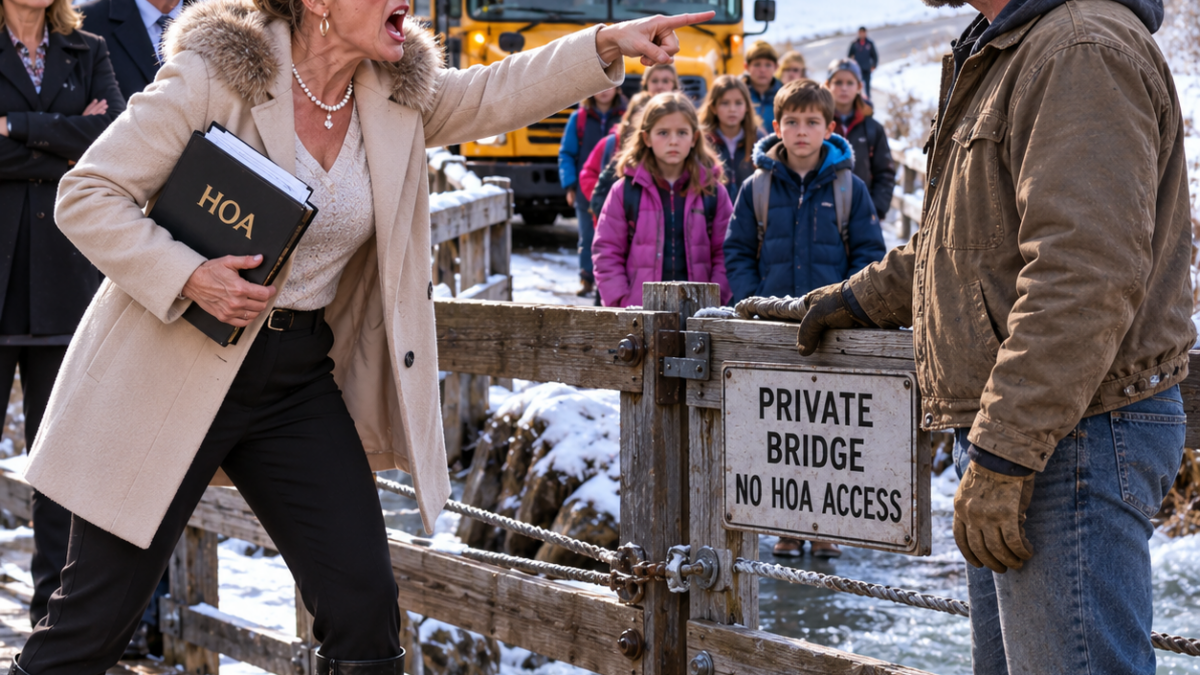
The HOA voted six to one to demolish the private bridge my late wife and I had built across our ravine, then handed me thirty days to pay for destroying it myself.
They called it an illegal safety hazard even though it had passed county inspections for twenty years and existed before their subdivision was built.
I almost spent that night fighting their demolition order—until the next morning, when I discovered exactly who had been quietly depending on that “dangerous” bridge every single school day.
“The motion carries.”
Karen Butler lowered her little wooden gavel with a smile.
“The unauthorized bridge will be removed within thirty days at Mr. McGregor’s expense.”
Nobody in the beige Creekwood clubhouse looked at me.
Not Todd, the vice president.
Not the other board members who had just raised their hands.
Not the handful of neighbors scattered among the folding chairs.
I stared at Karen.
“Unauthorized?”
“Yes, Major McGregor.”
Her use of my old Army rank was deliberate.
“Unauthorized and potentially hazardous.”
“That bridge has a county permit.”
“The HOA has standards beyond county requirements.”
“It was built before Creekwood Estates existed.”
“The board has reviewed that argument.”
“And?”
“We rejected it.”
I almost laughed.
Instead, I reached into the leather portfolio on my lap.
Twenty years earlier, my wife Sarah and I had stood beside that same ravine while a county inspector signed the final approval.
I still had the permit.
I still had the engineering drawings.
I still had photographs of Sarah in muddy jeans tightening one of the final bolts.
Cancer had taken her years later.
The bridge remained.
It connected the five acres around my house to the one-acre parcel on the other side of the ravine where my workshop and barn stood.
Without it, getting from my kitchen to my own workshop required a three-mile drive around public roads.
But distance wasn’t why the bridge mattered.
Sarah had helped build it.
Every steel beam.
Every timber deck section.
Every railing.
Some mornings after she died, I carried coffee to the middle of the span and stood where we once watched deer moving through the creek bottom.
Karen called that bridge an eyesore.
“Twenty-five thousand dollars,” she continued.
“What?”
“That’s the preliminary demolition estimate.”
“You expect me to pay twenty-five thousand dollars to destroy my own bridge?”
“The association should not be forced to subsidize your noncompliance.”
I opened my portfolio.
“Here.”
Karen barely looked at the county permit.
“County approval is irrelevant.”
I felt something inside me become very still.
“Say that again.”
She leaned back.
“This is Creekwood Estates. We have our own governing documents.”
I pulled out the covenant agreement from when my land had been incorporated.
“Article Twelve, Section Two. Pre-existing structures on my parcel are exempt from architectural review.”
Karen’s smile tightened.
“That clause was never intended to protect a structure of this scale.”
“That isn’t what it says.”
“The board’s interpretation is final.”
Todd nodded beside her.
“Safety comes first.”
I looked at him.
“When was the bridge inspected?”
Silence.
“When?”
Karen answered.
“The architectural committee reviewed photographs.”
“You didn’t inspect it.”
“We don’t need to.”
“You called a twenty-year-old permitted bridge dangerous without sending an engineer onto it?”
Karen stacked her papers.
“You have thirty days.”
“And after that?”
“Daily fines.”
She smiled.
“And eventually a lien.”
I closed my portfolio.
There was nothing left to say.
That night, I drove home the long way around.
Three miles to reach a workshop I could normally walk to in less than five minutes.
Then I stood at the bridge entrance beneath the old oak trees.
The timbers were dry.
The steel was clean.
The concrete footings showed no movement.
My last structural inspection was less than a year old.
Excellent condition.
No fatigue.
No rot.
No reason for Karen’s crusade.
That bothered me.
Why this bridge?
Why now?
The answer came the following morning.
Just before eight, I saw a group of children with backpacks leave Creekwood’s cul-de-sac and disappear onto the wooded footpath beside my property.
I followed at a distance.
Ten kids emerged from the trees.
Two of them were Karen’s grandchildren.
And one by one, every child stepped onto the same bridge Karen had just declared too dangerous to exist.
They crossed my private property, reached the old county road on the far side, and disappeared toward the school bus stop.
Then I heard the bus brakes hiss.
I checked the map.
Without my bridge, those children faced nearly two miles along a narrow forty-five-mile-per-hour road with no sidewalk.
I stood there staring at the empty span.
Then I smiled for the first time since the vote.
Karen had given me thirty days to remove her “dangerous” bridge.
She had no idea I was about to make her live with that decision by Friday morning.
PART 2
I didn’t confront the children.
That mattered.
They weren’t responsible for any of this.
They had found a shortcut across a bridge that had been standing longer than most of them had been alive.
For all I knew, their parents had told them it was okay.
Apparently, many had.
I waited behind the tree line until the school bus disappeared down the county road.
Then I walked onto the bridge.
The morning sun came through the oaks in narrow golden strips.
My boots sounded against the timber planks.
Halfway across, I stopped.
Sarah and I used to stand right there.
Twenty years earlier, the ravine had been nothing but inconvenience.
Our house was on one side.
The workshop parcel on the other.
Three miles by road.
Less than one hundred feet across the ravine.
I had been an Army Corps engineer.
Sarah had looked down into the creek and said:
“You build bridges for everybody else.”
I smiled at the memory.
“Build me one.”
So I did.
Not alone.
Never alone.
Sarah helped clear brush.
Carried tools.
Held measuring tapes.
Complained when I rechecked calculations she insisted were already correct.
When we set the final timber deck section, she opened a bottle of cheap champagne and sprayed half of it over the railing.
I told her that was a waste.
She kissed me and said:
“You worry too much.”
Years later, in the hospital, when her cancer had moved somewhere the doctors could no longer reach, she asked me whether the bridge still creaked near the eastern abutment.
I told her I had fixed it.
She smiled.
“Knew you would.”
After she died, I never considered selling the land.
People suggested it.
Six acres in the middle of an expensive Virginia development?
Developers would have paid well.
But money cannot replace geography once geography becomes memory.
The bridge connected more than two parcels.
Karen had no understanding of that.
But emotion was not going to win this.
Evidence was.
I went home and retrieved the certified demolition letter.
I read every word again.
The board officially described my bridge as:
**UNAUTHORIZED.**
**UNSAFE.**
**A POTENTIAL LIABILITY TO CREEKWOOD ESTATES.**
Interesting.
If the bridge was truly unsafe, I had a responsibility to prevent people from using it.
Especially children.
I called Dave Reynolds.
He answered on the second ring.
“McGregor?”
“Still alive.”
“Disappointing.”
Dave had been an Army JAG officer during one of my overseas assignments.
He had retired years earlier but still took occasional property and municipal cases when they interested him.
I explained the HOA vote.
He laughed once.
Then I told him about the children.
He stopped laughing.
“How many?”
“Ten this morning.”
“Karen’s grandkids?”
“Two.”
“You sure?”
“Absolutely.”
“Every day?”
“Don’t know yet.”
“Document before you act.”
Exactly what I expected.
I installed a trail camera that afternoon.
Not hidden near children in any invasive sense.
It simply covered the bridge entrance on my own property.
Time stamp.
Wide angle.
No audio.
Thursday morning:
Eleven children.
Thursday afternoon:
Eleven returning.
Friday morning:
Ten.
Karen’s grandson.
Karen’s granddaughter.
The Garcias’ older daughter.
Several others.
Dave reviewed the clips.
“Beautiful.”
“That’s an odd response to children trespassing.”
“They’re not the problem.”
“I know.”
“The board has formally classified this structure as dangerous.”
“Yes.”
“Then you’re going to respect the board’s expertise.”
I knew that tone.
“Dave.”
“Mac.”
“What are you proposing?”
“Malicious compliance.”
I leaned back.
“I like it already.”
He dictated the first draft.
I revised it.
He revised mine.
Eventually we had one page.
Polite.
Professional.
Devastating.
**Dear Creekwood Estates Board of Directors:**
**I acknowledge receipt of your certified notice formally determining that the private bridge located on my property constitutes an unauthorized and potentially unsafe structure creating liability for the community.**
**As the property owner, I take the board’s safety determination seriously. Effective Friday at 6:00 a.m., access to the bridge will therefore be suspended to all persons, including pedestrians, until the safety and legal issues identified by the board are resolved.**
**The bridge will be secured at both entrances to prevent accidental entry and reduce the liability expressly identified in your notice.**
**Thank you for bringing this alleged danger to my attention.**
Dave laughed for almost thirty seconds when he read the final paragraph.
“You’re terrible.”
“I learned from counsel.”
“Send it certified.”
I did.
Email copies to every board member.
Certified letter to management.
Copy for my file.
Then I went into town.
Two steel gates.
Heavy hinges.
Chains.
Padlocks.
Reflective safety signs.
I did not put insulting language on them.
I did not write Karen’s name.
I simply posted:
**BRIDGE CLOSED**
**NO PEDESTRIAN ACCESS**
**SAFETY / LIABILITY CLOSURE PENDING HOA ACTION**
Dave suggested I remove “HOA.”
“Why?”
“Because we want you looking responsible, not theatrical.”
He was right.
I changed it.
Friday morning, I woke at five.
Coffee.
Headlamp.
Tools.
The gates went up at both ends.
Secure enough that a child could not simply squeeze around them.
No sharp edges.
No climbable gaps.
I tested the locks.
At 6:03 a.m., the bridge was closed.
Then I walked back home.
Made more coffee.
Waited.
At 7:44, voices carried through the trees.
“What?”
“It’s locked!”
“Why?”
A few minutes later, I walked toward the ravine.
The children stood in front of the western gate.
Confused.
Not frightened.
Just irritated.
One older boy read the sign aloud.
“Bridge closed.”
A girl groaned.
“We’re going to miss the bus.”
Karen’s granddaughter pulled out her phone.
“Grandma is going to freak.”
Probably.
I approached from my side.
“Morning.”
Several kids knew me.
“Mr. Mac, why is it locked?”
“Your HOA says the bridge may be unsafe.”
“It’s not unsafe.”
“I agree.”
“Then open it.”
“I can’t let children cross something your HOA formally declared dangerous until the adults sort it out.”
That was the truth.
A boy pointed through the gate.
“The bus is coming.”
I heard it.
Air brakes.
Diesel.
Then silence.
Then the bus drove away.
The first SUV arrived six minutes later.
A mother in pajama pants jumped out.
“What happened?”
Her daughter pointed.
“The bridge is closed.”
The woman looked at me.
“Why?”
I handed her a copy of the board notice.
She read.
Her face changed.
“They ordered you to demolish it?”
“Yes.”
“They said it’s unsafe?”
“Yes.”
“My daughter crosses this every day.”
“I learned that this week.”
She looked toward the road.
“We have no other safe walking route.”
“I know.”
“What are we supposed to do?”
“That’s something you need to ask the board.”
Her mouth tightened.
She called Karen.
The second parent arrived.
Then the third.
Within twenty minutes, what was usually a peaceful wooded trail looked like a suburban evacuation zone.
Minivans.
SUVs.
Coffee mugs.
Backpacks.
Parents trying to get children to school.
Questions.
Anger.
Carlos Garcia arrived with Maria.
They already knew the situation.
Maria looked at the gate and tried not to smile.
Carlos failed completely.
“You closed it.”
“The board declared it unsafe.”
“Responsible citizen.”
“Exactly.”
A woman turned toward him.
“What is going on?”
Carlos explained.
Not dramatically.
“He received a demolition order.”
“Why?”
“HOA says bridge is dangerous.”
“But the kids have used it for years.”
“Yes.”
“Karen knew?”
Maria answered.
“She told me last month it was a practical solution for the bus stop.”
Silence.
The woman stared.
“Her grandchildren use it.”
“Yes.”
That was when the frustration changed direction.
My phone began ringing.
Unknown number.
Then another.
Then Karen.
I let it go to voicemail.
Dave’s instruction.
“Do not become the villain in her story.”
So I didn’t.
By nine, every child had been driven to school.
I went inside.
Made eggs.
Then listened to the voicemail.
Karen’s voice was tight.
“Major McGregor, your decision to lock the bridge has created a serious safety problem for the children of this community.”
I paused playback.
Actually laughed.
Then continued.
“Your retaliatory conduct is reckless and unneighborly. Call me immediately so we can discuss restoring access while the board determines the appropriate removal schedule.”
Restoring access.
To the unsafe bridge.
I saved the message.
Forwarded it to Dave.
His reply arrived instantly.
**Christmas came early.**
Karen posted online next.
She claimed I was “holding children hostage to a personal property dispute.”
That phrase nearly destroyed her before we even reached the real confrontation.
Parents answered immediately.
**You called the bridge unsafe. Why should he keep it open?**
**Why were children using it if it was dangerous?**
**Why didn’t parents receive notice?**
**What is the school-route plan after demolition?**
**Did the board even ask the school district?**
Then one parent posted:
**Karen, your own grandchildren have been crossing it every day.**
No response.
By lunch, the post had more comments than anything Creekwood had published in years.
People had tolerated abstract overreach.
Property rights.
Architectural standards.
Meeting procedures.
Those issues felt distant.
Missed school buses did not.
Neither did children walking along a two-lane forty-five-mile-per-hour road.
Karen had finally created a problem everyone could see.
I expected her to retreat.
She did the opposite.
That was Karen’s pattern.
When reality challenged her authority, she challenged reality harder.
She announced an emergency town hall.
Subject:
**UNSAFE BLOCKADE AND STUDENT ACCESS CRISIS**
Dave called.
“She’s blaming you.”
“Obviously.”
“She’s also giving us a room.”
“I know.”
“Don’t waste it.”
We still needed more than hypocrisy.
Public embarrassment can remove influence.
It does not establish fraud.
Dave wanted records.
We requested board minutes.
Vendor bids.
Contracts.
Emails concerning the bridge.
Communications about demolition.
Financial disclosures.
Karen initially resisted.
The HOA was not automatically subject to every public-record statute the way a government agency would be, so Dave framed the requests under applicable association record-inspection rights and the governing documents.
That distinction mattered.
He was irritatingly precise about it.
“Never exaggerate your legal authority while accusing someone else of exaggerating theirs.”
Fair.
The HOA eventually produced records.
Boxes.
Electronic files.
Emails.
Minutes.
Invoices.
Dave brought in a paralegal.
I brought coffee.
For two days we searched.
Most of it was ordinary.
Boring.
Landscaping.
Pool.
Insurance.
Road maintenance.
Then the first strange item.
K&B Contracting LLC.
Twenty-five-thousand-dollar demolition proposal.
No competing bids.
I searched the business registry.
Kevin Butler.
Same surname.
I called Dave.
“You seeing this?”
“Already did.”
“Relative?”
“Researching.”
Thirty minutes later:
Brother-in-law.
Interesting.
Not automatically criminal.
Related-party transactions can be legitimate.
The issue was disclosure.
There was none in the minutes.
Then we found the email.
Karen to Kevin.
Four months before the board voted.
**Need a preliminary quote for bridge removal. Make it high enough to cover contingencies and look official for budgeting.**
Kevin:
**Will $25,000 do the trick, sis?**
Dave stopped reading.
“Mac.”
“Yeah.”
“We just changed categories.”
“What category?”
“Potential self-dealing.”
He continued searching.
Another message.
Karen:
**Board will approve once liability language is in place. Owner will ultimately be responsible.**
This was months before any inspection.
Before any formal safety finding.
Before the vote.
The outcome had been planned first.
Safety came later.
That changed everything.
We obtained legitimate demolition estimates for comparison.
Nine thousand.
Eight thousand four hundred.
Seven thousand eight hundred.
Not twenty-five.
Then came another Creekwood resident.
Mr. Henderson.
Eighty years old.
Cane.
Wheelchair ramp for his wife before she died.
Karen had forced him to replace the pressure-treated ramp because the stain color violated architectural standards.
His contractor?
A company connected to one of Karen’s relatives.
The facts required investigation.
We did not call it criminal yet.
Dave repeated that every hour.
“Documents first.”
Town hall night arrived.
Standing room only.
Parents.
Retirees.
Board supporters.
People who had never attended an HOA meeting in fifteen years.
Karen sat at the head table.
Todd beside her.
Three other directors looked nervous.
She hit the gavel.
“This meeting concerns Mr. McGregor’s reckless obstruction of a necessary pedestrian route.”
I almost admired it.
She had gone from:
**Bridge must be demolished because dangerous**
to:
**Bridge must be available because necessary**
without ever acknowledging contradiction.
Karen spoke for twelve minutes.
Liability.
Safety.
Property values.
Community harmony.
Then:
“Mr. McGregor chose to weaponize access to our children.”
Carlos stood.
“Question.”
Karen sighed.
“Go ahead.”
“If the bridge is dangerous, why were your grandchildren using it?”
Murmurs.
Karen adjusted papers.
“I became aware of structural concerns recently.”
“When?”
“Following architectural review.”
“What structural review?”
“The committee reviewed—”
“An engineer?”
Silence.
“Did an engineer inspect it?”
“No.”
“Then what changed?”
Karen’s voice sharpened.
“The board has authority to identify liability.”
Someone shouted:
“That isn’t an inspection.”
Another parent:
“My son used it yesterday!”
Then:
“You knew!”
Then:
“Why didn’t you tell us?”
Karen banged the gavel.
“Order!”
I stood.
No shouting.
Laptop.
Projector.
“May I respond?”
The room quieted.
Karen hesitated.
“You have five minutes.”
“Good.”
First slide:
County permit.
Twenty years old.
Stamped.
Approved.
Second:
Original engineering drawings.
Third:
Latest structural inspection.
Licensed engineer.
Excellent condition.
No evidence of structural distress.
Fourth:
Four previous inspections over twenty years.
All satisfactory.
I looked at the residents.
“The bridge has never failed inspection.”
Then:
Covenant exemption.
My pre-existing structures expressly protected.
“The board’s position is that this exemption somehow excludes the bridge.”
I looked at Karen.
“I disagree.”
Then came the trail-camera stills.
Dates.
Times.
Children crossing.
Karen’s grandchildren clearly among them.
I did not show close-up faces unnecessarily.
Just enough to establish the repeated use pattern.
“The bridge the board described as a dangerous liability has functioned as an unofficial school route for years.”
Parents nodded.
“I did not create that route.”
I paused.
“I discovered it after the demolition vote.”
Then the voicemail transcript.
Karen demanding restored access because closure created danger.
A man in the back laughed.
The tension broke.
Karen’s face reddened.
“Mr. McGregor is manipulating private communications.”
Dave stood.
“I’ll handle this part.”
Karen stared.
“Who are you?”
“David Reynolds.”
“Resident?”
“No.”
“Then you have no standing—”
“Counsel assisting Mr. McGregor.”
That changed her posture.
Dave connected his laptop.
First screen:
K&B Contracting proposal.
Twenty-five thousand dollars.
“Board-approved demolition contractor.”
Then three independent quotes.
Highest:
Nine thousand.
People murmured.
Then K&B registration.
Kevin Butler.
Dave asked:
“Ms. Butler, is Kevin Butler your brother-in-law?”
Karen’s face changed.
“That is irrelevant.”
The room erupted.
Dave waited.
“Is he?”
“Yes.”
No gavel could stop what followed.
People shouted.
“Did you disclose that?”
“Why only one bid?”
“Twenty-five thousand?”
“You were going to make Mac pay your family?”
Karen shouted back:
“This is defamatory!”
Dave raised one hand.
“Then perhaps the email will clarify.”
The projector changed.
Her email appeared.
**NEED A PRELIMINARY QUOTE FOR BRIDGE REMOVAL… MAKE IT HIGH…**
Then Kevin’s response.
**WILL $25,000 DO THE TRICK, SIS?**
Silence.
I will remember that silence forever.
Karen looked at the screen.
Then toward Todd.
Todd looked away.
One board member whispered:
“Oh my God.”
Dave continued.
“The email predates the board’s purported safety determination by approximately four months.”
He changed slides.
Another email.
**BOARD WILL APPROVE ONCE LIABILITY LANGUAGE IS IN PLACE.**
The CPA board member stood.
“Karen.”
Karen looked at her.
“Did you plan this before we voted?”
“No.”
“The email says you did.”
“It’s being taken out of context.”
“What context?”
Karen had none.
Mr. Henderson stood near the back.
He leaned on his cane.
“That contractor thing…”
Everyone turned.
“She did it to me.”
His voice shook.
“My wife needed a wheelchair ramp.”
Karen stared.
“She made me replace it.”
“Mr. Henderson—”
“With a contractor she recommended.”
He looked at Dave.
“I have the invoices.”
That was the moment the board stopped being a board.
Two directors resigned at the table.
Not theatrically.
They pushed their binders forward.
One said:
“I want no part of this.”
Todd remained frozen.
Carlos called for a formal recall process.
Residents shouted support.
Dave intervened.
“Do it properly.”
That mattered.
Anger does not replace procedure just because the target deserves scrutiny.
The meeting ended with a petition.
More than enough signatures within forty-eight hours.
Then the news station called.
Maria had sent video of the locked-bridge morning.
Children staring at gates.
Parents scrambling.
Reporter wanted an interview.
I agreed on one condition.
“No kids’ faces without parental permission.”
They accepted.
We filmed at my workshop.
Bridge behind me.
I showed:
Permit.
Inspections.
HOA exemption.
Demolition order.
I did not call Karen corrupt.
I said:
“Records raise serious questions about an undisclosed family relationship and an inflated demolition proposal.”
Dave approved that sentence.
The report aired at six.
**PRIVATE BRIDGE DISPUTE LEAVES SCHOOLCHILDREN WITHOUT SAFE SHORTCUT**
Then the deeper story.
Related contractor.
Emails.
Recall petition.
The district school transportation office contacted Creekwood.
They had not formally authorized children to cross my private bridge.
That created another layer.
Parents had developed the route because the existing bus stop was much safer to reach across my land than by walking the long road.
The district warned parents not to use unauthorized private property until a formal arrangement existed.
That made things harder immediately.
But it also forced everyone to solve the problem properly.
For the first time.
Karen had relied on unofficial convenience while attacking the very structure making it possible.
The school district asked for a meeting.
Me.
Parents.
HOA.
Transportation officials.
County traffic engineer.
We met at the bus stop.
A county engineer walked Creekwood Drive.
No sidewalk.
Curves.
Limited shoulder.
He looked at me.
“You’ve been letting them cross?”
“Unknowingly for years.”
“And now?”
“Closed because HOA declared bridge unsafe.”
He read the inspection.
“It isn’t unsafe.”
“I know.”
Then:
“Would you ever consider a formal pedestrian easement?”
That question mattered.
Not yet.
First:
Recall.
The vote happened one week later.
Ninety-eight to two.
Karen removed.
The rumor that both votes were hers and her daughter’s was probably true.
I never checked.
The next morning, a for-sale sign appeared in her lawn.
I felt less satisfaction than expected.
Maybe because the bridge remained locked.
Winning against Karen did not put the children on the bus.
Carlos Garcia became interim president.
His first meeting had three agenda items.
Rescind demolition order.
Recognize pre-existing legal status.
Discuss bridge access.
The first passed unanimously.
The second passed unanimously.
Then Carlos looked at me.
“Mac.”
I stood.
“I appreciate it.”
A parent spoke before I continued.
“Will you reopen it?”
I looked around.
Dozens of people.
Some had ignored me during Karen’s campaign.
Some had supported her.
Some only became angry when their mornings were disrupted.
It would have been easy to punish them.
But children were not leverage.
Never should have been.
“I’ll reopen it.”
Relief moved through the room.
“But not under the old arrangement.”
Silence.
“No more unofficial trespassing.”
A parent frowned.
“What does that mean?”
“It means if this bridge is going to function as a community school route, we document it.”
Dave nodded from the back.
I continued.
“Formal pedestrian-use agreement.”
“Insurance.”
“Maintenance responsibilities.”
“School coordination.”
“Safety rules.”
“No bicycles during icy conditions.”
“No vehicles.”
“Hours of access.”
“Emergency closure authority.”
Carlos smiled.
“That sounds expensive.”
“Less expensive than demolition.”
Laughter.
Then I added my conditions.
“First, the HOA gives me a formal written acknowledgment that the bridge is legal, pre-existing, privately owned, and exempt from future architectural demolition orders absent genuine safety findings supported by qualified inspection.”
Carlos:
“Done.”
“Second, because the community relies on it, the community shares safety costs.”
I had estimates.
Solar lighting.
Non-slip surface.
Reflective rail markers.
Annual structural review.
Seven thousand dollars initially.
Then shared inspection costs.
A mother raised her hand.
“I’ll pay part.”
Another:
“Me too.”
I shook my head.
“No individual collections.”
I looked at Carlos.
“This became community infrastructure in practice. The association needs to own its part.”
He nodded.
“Agreed.”
The HOA funded upgrades.
The school district worked with parents to recognize a supervised pedestrian path to the existing bus stop, subject to private-property permissions and local requirements.
The county traffic engineer helped evaluate approach points.
Insurance counsel drafted terms.
It took weeks.
Boring weeks.
Important weeks.
Then came reopening morning.
I woke before dawn.
Not because I needed to.
Habit.
The new solar lights glowed softly along the rails.
The non-slip surface made the deck darker.
Freshly inspected.
Signed off.
I removed the chains.
Swung both gates open.
Did not remove them.
If conditions became dangerous, I wanted closure capability.
At 7:42, children appeared.
They stopped.
Nobody crossed immediately.
Karen’s grandchildren were still living with their mother in Karen’s house while the sale moved forward.
Her grandson stood at the front of the group.
Maybe eleven.
He looked at me.
“Mr. McGregor?”
“Morning.”
“Can we cross?”
“Yes.”
His face changed instantly.
“Really?”
“Follow the rules.”
“We will.”
“No running.”
Behind him, somebody groaned.
“No climbing rails.”
Another groan.
“And if the red closure light is on, you use the alternate plan.”
“Okay.”
The boy hesitated.
Then:
“Sorry about my grandma.”
That surprised me.
“You don’t need to apologize for adults.”
“She said you hated us.”
I looked toward the other children.
“No.”
“Then why’d you lock it?”
“Because adults needed to solve something.”
He thought about that.
Then nodded.
“Thanks for opening it.”
“You’re going to miss the bus.”
His eyes widened.
“Go.”
They crossed.
Not running.
Mostly.
Their backpacks bounced.
Voices echoed through the ravine.
The bus brakes hissed beyond the trees.
I stood by the gate long after they disappeared.
Sarah would have loved it.
That realization hit harder than expected.
I walked to the center of the bridge.
One of the new solar lights remained faintly illuminated in the morning shade.
I touched the railing where Sarah once leaned.
“You would’ve said yes immediately, wouldn’t you?”
Wind through leaves.
No answer.
I smiled.
“Probably would’ve yelled at me for taking so long.”
Creekwood changed after Karen.
Not overnight.
That part people simplify.
Removing one bad leader does not instantly create healthy governance.
Carlos made mistakes.
Everyone does.
But he admitted them.
Board records went online.
Vendor relationships disclosed.
Multiple bids required above a threshold.
No related-party contracts without explicit review.
Architectural decisions needed written standards.
Emergency enforcement had appeal procedures.
The bizarre rules Karen accumulated began disappearing.
Flamingo welcome mats survived.
Children used sidewalk chalk.
Mr. Henderson got reimbursed for part of his unnecessary ramp replacement after the financial review determined the enforcement had been mishandled.
The board hired an accessibility consultant to make sure something that stupid never happened again.
My favorite moment came six months later.
Mr. Henderson crossed my bridge in a motorized wheelchair.
We had added a smooth transition plate during the resurfacing.
He stopped halfway.
“Never thought I’d see this view.”
The ravine below had turned green.
Creek moving between rocks.
He looked at me.
“Sarah helped build it?”
“Yes.”
“You miss her?”
“Every day.”
He nodded.
“My Helen hated that replacement ramp.”
I smiled.
“Why?”
“Wrong color.”
We both laughed.
Then cried a little.
Old men can do both.
The investigation into K&B Contracting continued.
Not every ugly email becomes a felony.
That was something Dave repeated whenever neighbors demanded immediate arrests.
Evidence must match statutes.
Intent matters.
Actual payments matter.
The original twenty-five-thousand-dollar bridge demolition never occurred.
No money transferred on that contract.
But investigators reviewed the bidding process, related-party dealings, and earlier vendor relationships.
Karen and Kevin eventually faced charges related to other documented transactions and attempted fraudulent procurement.
A plea arrangement resolved the matter.
Karen paid significant penalties and restitution tied to improper transactions.
She received probation and restrictions associated with the resolution.
Kevin’s company lost access to Creekwood business.
The details mattered less to me by then.
The bridge was open.
That was the point.
Karen’s house sold.
The moving truck came on a gray Tuesday.
I saw it from the workshop.
She walked outside once.
Looked toward the ravine.
Then toward me.
We were too far apart to speak.
She got into her car.
Drove away.
No victory speech.
No cheering neighbors.
No dramatic final confrontation.
Good.
Some endings are stronger when nobody performs them.
A year after the original demolition vote, Carlos asked me to attend the HOA annual meeting.
“I attend plenty.”
“This is different.”
“Why?”
“Come.”
I regretted it immediately when I saw the covered object beside the podium.
“No.”
Carlos smiled.
“Yes.”
“Absolutely not.”
Too late.
Near the end of the meeting, he called me forward.
Parents.
Kids.
Residents.
Even the county school transportation coordinator.
Carlos removed the cloth.
Bronze plaque.
My stomach tightened.
**THE McGREGOR BRIDGE**
**BUILT BY MAC AND SARAH McGREGOR**
**A PATH OF SERVICE, RESILIENCE, AND COMMUNITY**
No “defended 2023.”
No Karen.
I liked that.
He pointed.
“We changed the original wording.”
“Why?”
“Because you said this wasn’t about the fight.”
I looked at him.
“I said that?”
“Repeatedly.”
“Smart man.”
He smiled.
“We added Sarah.”
That got me.
For a second, I couldn’t speak.
The room blurred slightly.
I touched her name.
Sarah McGregor.
Twenty years earlier, she had held a wrench under that bridge while I complained she was tightening the wrong direction.
She threw a glove at me.
Now her name would stay there after both of us were gone.
“Thank you.”
That was all I managed.
The plaque went on the eastern timber post.
Kids touched it as they crossed.
Some knew who Sarah was.
Most didn’t.
That was okay.
Memory does not require every stranger to know the whole story.
Sometimes a name on something built with love is enough.
The bridge became part of daily life.
Morning:
Kids.
Afternoon:
Kids again.
Weekends:
Families walking toward the county road.
Occasional deer below.
Me heading to the workshop.
Nothing dramatic.
That was the best outcome.
One winter morning, ice covered the deck.
The temperature had dropped below twenty.
I turned on the red closure light.
Locked the gates.
Ten minutes later, parents received the route alert through the community system.
No outrage.
No accusations.
Kids were driven to an alternate stop.
At noon, the sun warmed the surface.
I checked traction.
Reopened.
That was safety.
Not Karen declaring danger because she wanted demolition money.
Actual conditions.
Actual inspection.
Actual response.
One parent called.
“Thanks for closing it.”
I almost laughed.
Years earlier, I had been accused of endangering children by closing the same bridge.
Context matters.
The school district eventually revised transportation routes when a new development changed road access.
They added a proper stop closer to Creekwood.
Fewer children needed my bridge after that.
For the first time in years, some mornings were quiet.
I thought I would enjoy it.
I didn’t.
Then several families kept using it anyway because it was a pleasant walking route.
That surprised me.
Carlos called.
“You okay with that?”
“Yes.”
“Want the agreement changed?”
“No.”
“What happened to the grumpy widower who wanted to be left alone?”
“He was invaded.”
“By children?”
“Worst kind.”
He laughed.
The Garcias’ toddler grew into a school-age boy.
His older sister was nearly in high school.
One morning he crossed carrying a backpack almost his own size.
Maria stood near the gate.
“You realize this is your fault.”
“What?”
“My children think walking through private woodland on a bridge is normal.”
“It should be.”
“Most suburbs do not have ravines.”
“Poor planning.”
She smiled.
Then looked at the plaque.
“I’m glad Sarah’s name is there.”
“Me too.”
“You ever think about what would’ve happened if you’d just fought the demolition order normally?”
“All the time.”
“Court?”
“Probably.”
“Would you have won?”
“I think so.”
“But?”
I looked at children crossing.
“We might never have learned everyone needed it.”
That was true.
Karen created the crisis.
But the crisis revealed hidden facts.
I didn’t know the bridge had become school infrastructure.
Parents didn’t fully understand it was private.
The HOA didn’t appreciate the liability of unofficial access.
The school district didn’t know families had created the route.
Everyone operated on assumptions.
Bad governance thrives on assumptions.
Good governance replaces them with agreements.
The whole incident changed how I saw property too.
I remained protective.
Strongly.
My land was still mine.
The bridge was still private.
But ownership and generosity were not opposites.
I could maintain boundaries and still choose access.
In fact, clear boundaries made generosity easier.
Nobody could claim entitlement.
Nobody could quietly transform my land into public property.
We had a written license.
Insurance.
Responsibilities.
Termination rights.
Rules.
Because everyone knew the bridge belonged to me, every child crossing did so through permission instead of assumption.
That mattered.
Dave called it:
“Legalized neighborliness.”
I called it paperwork.
Same thing.
Several years passed.
Dave truly retired.
Or claimed to.
Carlos eventually left the board.
Maria ran for president.
Won easily.
Her first meeting lasted forty-one minutes.
Creekwood record.
She called me afterward.
“I beat Karen.”
“Wrong metric.”
“Fine. I beat Carlos.”
“Still wrong.”
“You’re impossible.”
“Yes.”
Under Maria, HOA governance became almost painfully boring.
Budgets.
Drainage.
Pool maintenance.
Tree trimming.
The occasional fence dispute handled with actual notice and conversation.
That boredom was evidence of success.
Healthy systems are rarely entertaining.
The bridge aged.
So did I.
At twenty-five years, I commissioned a full structural evaluation.
Engineer younger than the bridge arrived carrying modern sensors.
He examined steel.
Timber.
Footings.
Fasteners.
Load paths.
At the end, he looked at the original drawings.
“You designed this?”
“Yes.”
“Army Corps?”
“Retired.”
He nodded.
“Figures.”
“Good or bad?”
“Overbuilt.”
“Good.”
“You could probably drive something ridiculous across it.”
“I used to drive my F-250.”
He stared.
“Don’t.”
“Noted.”
The report recommended replacing several deck boards and treating portions of timber.
Nothing major.
HOA paid the agreed pedestrian-use share.
I covered private-use portions.
No argument.
No politics.
Just maintenance.
That afternoon, I sat on the bridge with the inspection report beside me.
Sarah’s photo in my phone.
She had been thirty-eight when we finished it.
I was older now than her father had been then.
Life is unfair with arithmetic.
I enlarged the picture.
Sarah in dirty jeans.
Hair tied back.
Wrench in hand.
Grinning.
Sometimes grief softens.
It never disappears.
It simply stops demanding attention every minute.
The bridge helped with that.
It gave memory somewhere physical to live.
Not a shrine.
Something useful.
People crossed it.
Children laughed on it.
Rain hit it.
Snow covered it.
Boards wore down and were replaced.
That was better than preserving it untouched.
Sarah never built things to be admired.
She built them to be used.
One spring morning, Karen’s grandson returned.
Not as a child.
As a young man.
College age.
He parked near the old county road and walked across.
I was repairing a railing.
“Mr. McGregor?”
I recognized him after a second.
“Daniel?”
He smiled.
“You remember.”
“You missed a school bus because of me.”
“Because of Grandma.”
“Fair.”
He stood beside the railing.
“I wanted to see it.”
“The bridge?”
“Yes.”
“Why?”
He looked down into the ravine.
“I’m studying civil engineering.”
That stopped me.
“No.”
“Yes.”
“Because of this?”
“Partly.”
I laughed.
“You cannot blame me for that.”
He smiled.
Then became serious.
“My mom told me more of the story when I got older.”
I waited.
“I know what Grandma did.”
“That’s between adults.”
“She regrets it.”
I looked at him.
“She told you?”
“Yes.”
He hesitated.
“She said the worst part wasn’t losing the HOA.”
“What was it?”
“Realizing she’d been willing to destroy something before understanding what it did.”
That was heavier than I expected.
Daniel touched the rail.
“She talks about this bridge.”
“What does she say?”
“That she was wrong.”
I nodded.
People can change.
Sometimes after consequences.
Sometimes because of them.
Daniel helped me replace two railing bolts that afternoon.
Engineering student.
Still bad with a wrench.
Sarah would have teased him mercilessly.
Before leaving, he stood at the western gate.
“Do you hate her?”
“No.”
“Did you?”
“Yes.”
He appreciated the honesty.
“What changed?”
“Time.”
“Just time?”
“No.”
I thought.
“The bridge stayed.”
He nodded.
That was enough.
Another decade.
Creekwood’s children became adults.
Some moved away.
Some returned with families.
The bridge saw another generation.
Eventually my knees stopped liking the slope from the house.
I used a small utility cart to reach the bridge.
Maria, now retired herself, saw me one morning.
“You’re getting old.”
“So are you.”
“Rude.”
“Accurate.”
We stood near the Sarah plaque.
The bronze had darkened with age.
She rubbed it with her sleeve.
“We should polish this.”
“No.”
“Why?”
“I like it.”
“Patina?”
“Exactly.”
She looked down the bridge.
“You ever regret sharing it?”
“No.”
“Never?”
“Sometimes at 7:45 in the morning.”
She laughed.
The county later built a sidewalk along Creekwood Drive.
Long overdue.
Children no longer needed the bridge for safety.
Technically, the reason for the pedestrian agreement disappeared.
At a board meeting, Maria asked whether I wanted to terminate access.
I thought about it.
Legally easy.
Practically unnecessary.
The path had become part of Creekwood life.
Not entitlement.
Tradition.
“No.”
“You want it to stay open?”
“Yes.”
“Why?”
I looked at the new families in the room.
“Because Sarah built a bridge.”
Nobody understood why that answer made Maria smile.
I did.
On the thirtieth anniversary of construction, Creekwood organized a small celebration without telling me.
I hate surprises.
They know that.
Did it anyway.
Children decorated the approaches with paper flowers.
No balloons tied to rails because I had rules.
Carlos came back.
Dave attended with a cane.
Mr. Henderson had died years earlier, but his daughter came.
The Garcias.
Former schoolchildren.
Daniel, now a professional engineer.
He brought his own daughter.
Five years old.
She crossed holding his hand.
Time does strange things.
Daniel introduced her.
“Emma.”
She stared at me.
“You built the bridge?”
“With my wife.”
“Where is she?”
Children ask direct questions because they have not learned adults’ fear of sadness.
“She died a long time ago.”
“Oh.”
Emma looked at the plaque.
“Is that her name?”
“Yes.”
She touched the letters.
Then ran after other children.
Simple.
Not tragic.
A name.
A bridge.
Life continuing.
Daniel stood beside me.
“She knows the story.”
“Which version?”
“The one where Grandma was wrong.”
I smiled.
“Good.”
He laughed.
Then he handed me an envelope.
Inside was a copy of a new inspection report.
He had performed it pro bono.
Professional seal.
Excellent structural condition with routine maintenance recommendations.
I looked at him.
“You inspected my bridge?”
“Annual tradition now.”
“Free?”
“Community service.”
“Your grandmother would hate that.”
He laughed so hard he nearly dropped his coffee.
By sunset, everyone left.
I remained.
Center span.
Same place Sarah and I once stood.
Solar lights came on.
Warm pools across the deck.
The creek moved below.
I had Sarah’s framed photograph in my hands.
Not because I needed to tell her the story.
She had been part of it from the beginning.
I just wanted company.
“You did good,” I said.
Wind moved through oak leaves.
I smiled.
“Fine. We did good.”
The bridge had begun as a solution to a practical problem.
Two pieces of land.
One ravine.
Then it became memory.
Then conflict.
Then a school route.
Then evidence.
Then community infrastructure.
Then tradition.
I thought back to Karen’s first vote.
Six to one.
Unauthorized structure.
Thirty days.
Twenty-five thousand dollars to destroy it.
She believed the gavel was the most powerful thing in the room.
It wasn’t.
The most powerful thing was an old permitted bridge quietly doing work nobody had bothered to notice.
Carrying me to my workshop.
Holding memories of Sarah.
Giving children a safe route.
Connecting neighbors.
Exposing bad governance.
Eventually teaching all of us that ownership and community do not have to be enemies.
Karen tried to destroy it because she saw independence as defiance.
Then parents demanded it because they saw convenience.
Eventually we preserved it because we finally understood its value.
That is the difference.
Convenience asks:
“What can this do for me?”
Community asks:
“How do we protect what helps all of us without stealing it from the person who built it?”
That question changed Creekwood.
It changed me too.
The gates remained at both ends.
Mostly open.
Always functional.
Someone once suggested removing them because they reminded people of the conflict.
I refused.
Not from bitterness.
From memory.
Boundaries matter.
Permission matters.
Safety matters.
And sometimes a closed gate teaches a lesson an open bridge never could.
The plaque with Sarah’s name remains on the eastern post.
Children still touch it.
The HOA still pays part of the annual pedestrian inspection.
I still own every beam.
Every board.
Every foot of land beneath it.
And I still drink coffee in the middle sometimes.
Early.
Before everyone wakes.
If the air is quiet enough, I can hear the old sounds beneath the new ones.
Sarah laughing.
A wrench falling.
Her telling me I was overengineering the railing.
Me telling her there is no such thing as overengineering.
Then the present arrives.
Footsteps.
Backpacks.
Morning voices.
“Good morning, Mr. McGregor!”
“Morning.”
“Bus coming!”
“Then stop talking to an old man and move.”
They laugh.
Run despite the no-running rule.
I pretend not to notice unless it’s wet.
The bus brakes hiss on the county road.
Children disappear.
The bridge becomes quiet again.
And every time that happens, I think about the woman who once ordered it destroyed.
Not with anger anymore.
Almost gratitude.
Not gratitude for what she tried to do.
Gratitude that her mistake forced everyone to finally see what had been standing in front of them.
A bridge can look like steel and timber.
A home can look like property.
A neighborhood can look like rows of houses.
But usefulness lives deeper than appearances.
Sarah understood that.
She never cared whether the bridge was pretty.
She cared that it connected things.
Thirty years later, that is still what it does.
The HOA voted to remove my private bridge.
Then their children needed it for school.
But that was only the beginning.
In the end, those kids saved something they never knew was in danger of disappearing.
Not merely a shortcut.
Not merely a structure.
They saved the last great thing Sarah and I built together.
And because the community finally chose to protect it instead of control it, her bridge will keep carrying people long after I’m gone.
That is more than victory.
That is legacy.
A few years after the bridge became part of Creekwood’s daily rhythm, I learned that the hardest part of winning a fight is deciding what to do after nobody is fighting anymore.
For months, my life had been organized around opposition.
Letters.
Inspections.
Meetings.
Lawyers.
Karen.
The locked gates.
The school bus.
The records.
The emails.
The recall vote.
Then suddenly it all stopped.
No demolition order.
No certified threats.
No board members telling me what my own property meant.
The children crossed in the morning.
They crossed again in the afternoon.
The solar lights came on at dusk.
The creek ran below.
Normal life returned.
And normal life felt strangely unfamiliar.
One Saturday morning, I was in the workshop when Carlos Garcia appeared at the door holding two cups of coffee.
“That looks suspicious,” I said.
“What?”
“You never bring coffee unless you want something.”
He handed me one.
“Community relations.”
“Worse.”
Carlos laughed.
Then he leaned against my workbench.
“The board had an idea.”
“No.”
“You don’t even know what it is.”
“That has never stopped me before.”
He looked through the open workshop door toward the bridge.
“We want to create a maintenance fund.”
“For what?”
“The bridge.”
“No.”
“Mac.”
“It’s mine.”
“I know.”
“I maintain it.”
“We know.”
“Then why are we having this conversation?”
“Because three dozen families use it.”
I put the coffee down.
“That doesn’t make it public property.”
“Nobody said it did.”
Carlos had become good at this.
He no longer pushed.
He explained.
“We want a dedicated line in the HOA budget for the community-use portion of maintenance. Annual inspection, non-slip coating when needed, lighting batteries, that kind of thing.”
“And if the HOA pays, five years from now someone says they own it.”
“We’ll write the agreement so they can’t.”
“Dave review it?”
“Already did.”
Traitor.
Carlos handed me a folder.
The proposed agreement was better than I expected.
Ownership remained entirely mine.
No permanent easement.
No right of vehicular use.
No public dedication.
The HOA contribution applied only to expenses directly associated with the pedestrian access I voluntarily allowed.
Either party could request modification.
I retained closure authority for repair, weather, emergency, and safety conditions.
“What do you think?”
I looked at him.
“I think you all finally learned how to write paperwork.”
“That’s almost a compliment.”
“Don’t get used to it.”
We signed the agreement the following month.
That was when the bridge truly changed from an accidental shortcut into something intentional.
A responsibility shared without ownership being taken.
Sarah would have liked that.
She was always better than I was at understanding the difference between sharing and surrender.
I had spent my Army years learning boundaries.
Property lines.
Authority.
Responsibility.
Control.
Sarah understood that some of the strongest things in life only matter because you give part of them away.
Time.
Food.
Trust.
A bridge.
The kids gradually stopped treating me like the angry old man who might lock their route without warning.
That reputation had probably been unfair, but I admit I enjoyed it.
One morning, I found a handwritten sign taped carefully beside the bridge plaque.
THANK YOU MR. MAC
Underneath were twelve names.
Then somebody had drawn what I assumed was the bridge.
It looked more like a ladder falling over.
I left the sign up until rain destroyed it.
The next one was laminated.
Kids adapt.
So do communities.
A strange tradition began.
Every last day of school, the kids crossing the bridge would leave something small near Sarah’s plaque.
At first it was one flower.
Then a note.
Then a painted stone.
Nobody organized it.
Nobody asked them to.
I found out later that Maria’s daughter Elena had started it.
She had been one of the children stranded the morning I first locked the gates.
Years later, when she was preparing to graduate high school, she stopped beside me one afternoon.
“I owe you an apology.”
“For what?”
She looked confused that I didn’t know.
“When we were younger, we were mad at you.”
“For locking the bridge?”
“Yeah.”
“Understandable.”
“We thought you were just being mean.”
“I was being a little mean.”
She smiled.
“My mom said you were proving a point.”
“She probably used nicer language.”
“No.”
That sounded like Maria.
Elena leaned on the railing.
“You know I’m going to Virginia Tech?”
“I heard.”
“Engineering.”
I looked at her.
“Civil?”
“Environmental.”
“Better.”
She laughed.
Then turned toward Sarah’s plaque.
“I wrote my college essay about this bridge.”
That got me.
“You did?”
“Not about Karen.”
“Good.”
“About how infrastructure can change a community even when nobody notices it.”
I said nothing.
She continued.
“I wrote that everybody thought this was just a shortcut until we lost it.”
I looked down toward the creek.
“You get accepted because of that essay?”
“I like to think so.”
“Then I want ten percent.”
She laughed.
Before leaving, she put a folded note beneath the plaque.
I waited until she was gone before opening it.
Mrs. McGregor,
I never knew you, but thank you for helping build the bridge that got me to school.
I sat down on the railing support and read it twice.
Then a third time.
Grief changes over time.
Early grief is selfish.
Not intentionally.
But everything reminds you of what you lost.
Your pain.
Your silence.
Your empty chair.
Years later, grief becomes something wider.
You begin noticing what the person left behind in other people.
Sarah had never met Elena.
Yet something Sarah built with her hands had helped a little girl reach school safely for years.
That was a form of survival I had never considered.
I placed the note inside a waterproof sleeve and mounted it discreetly behind the plaque.
After that, other notes appeared.
Some from children.
Some from parents.
One simply said:
BEST SHORTCUT EVER.
That one might have been my favorite.
Creekwood also changed in ways that had nothing to do with the bridge.
Once people learned that board authority could be questioned without the neighborhood collapsing, participation improved.
The annual elections were no longer ignored.
Candidate statements became serious.
Budgets were actually read.
People asked questions.
Sometimes too many.
Carlos once called me after a four-hour meeting.
“You did this.”
“I did what?”
“You taught them to read documents.”
“You’re welcome.”
“I hate you.”
“Good governance is exhausting.”
“So is democracy.”
“Then drink more coffee.”
He did.
The board created a conflict-of-interest policy.
Related-party vendors had to be disclosed.
Contracts above a set amount required competing bids unless an emergency existed.
Meeting minutes had to reflect actual votes, not whatever summary the president preferred.
Residents gained clearer appeal procedures.
None of that made exciting news.
That was the point.
The best aftermath of abuse is not permanent outrage.
It is a system designed to make the same abuse harder the next time.
Karen’s name gradually disappeared from meetings.
For a while, every bad proposal drew the same comparison.
“We’re not doing another Karen thing.”
Then even that stopped.
New residents moved into the neighborhood who had never met her.
They only knew there had once been “some big bridge fight.”
That pleased me more than I expected.
A community should not be defined forever by the person who damaged it.
Eventually, people started asking about Sarah instead.
That felt right.
One fall morning, Carlos arrived with a photographer from the county historical society.
I nearly shut the door.
“Absolutely not.”
The photographer looked amused.
Carlos raised both hands.
“Hear me out.”
“No.”
“The county is documenting locally significant community structures.”
“It’s a bridge.”
“Built privately by a retired Army Corps engineer before the development, later incorporated into a formal neighborhood pedestrian route.”
“Still a bridge.”
“Connected to a major HOA governance reform.”
“Unfortunately.”
“And it has thirty years of continuous use.”
I looked at the photographer.
“You drove out here for this?”
She smiled.
“I’ve driven farther for barns.”
I respected that.
They photographed the bridge.
Original drawings.
Sarah’s old construction pictures.
The bronze plaque.
The gates.
The solar lights.
The worn section of railing where hundreds of hands had rested.
A few months later, they sent me a small archival booklet.
The title was:
McGregor Bridge: Private Structure, Shared Passage
I put it next to Sarah’s photographs.
That winter was hard.
Not because of the weather.
Because my health finally reminded me that I was not twenty years younger than the bridge.
I slipped on ice near the workshop.
Nothing dramatic.
One moment upright.
Next moment on my back wondering why the sky was moving.
Broken wrist.
Bruised hip.
Pride destroyed beyond repair.
Maria found me.
She called Carlos.
Carlos called an ambulance despite my objections.
“I can walk.”
“You’re lying on the ground.”
“Temporary.”
“You’re seventy-two.”
“Also temporary.”
The paramedic laughed.
I did not.
For six weeks, I couldn’t perform normal bridge maintenance.
That bothered me more than the wrist.
One morning, I looked out from the house and saw people on the bridge.
Carlos.
Maria.
Dave.
Three teenagers.
Daniel, Karen’s grandson, now home from college.
They were replacing a worn traction strip.
I walked down wearing my brace.
“What are you doing?”
Carlos looked up.
“Trespassing.”
“Apparently.”
“You going to lock the gate?”
“I might.”
Daniel held up a drill.
“We’ve got the maintenance checklist.”
“My checklist?”
“Community copy.”
I stared at him.
“You people copied my checklist?”
Maria laughed.
“You gave it to the HOA.”
“That doesn’t mean you’re allowed to use it correctly.”
Dave looked at my wrist.
“Go home, Mac.”
“This is my bridge.”
“And we’re maintaining our pedestrian-use portion.”
“That agreement is going to haunt me.”
“Legalized neighborliness,” Dave reminded me.
I stood there watching them work.
At first, I felt displaced.
Then something shifted.
For thirty years, I had believed the bridge survived because I protected it.
Maybe that had once been true.
Not anymore.
Now it survived because enough people cared whether it remained standing.
That realization was uncomfortable.
Also beautiful.
I went home.
Made coffee.
Watched from the porch.
Sarah would have been proud of me for staying out of the way.
Probably shocked.
When my wrist healed, I found the work had been done properly.
Annoyingly properly.
Bolts torqued.
Surface patched.
Lights checked.
Inspection log updated.
At the bottom of the page, Daniel had written:
TRY TRUSTING PEOPLE OCCASIONALLY.
I crossed it out.
Then wrote:
NO.
I left the sheet in the binder so he would see it.
He did.
That became another tradition.
Years continued moving.
Children I once watched carrying backpacks started returning with wedding rings.
Some brought their own kids.
Elena came back after finishing college.
She worked on watershed projects.
One afternoon she stood beneath the bridge in waders measuring stream flow.
I called down.
“You have a permit?”
She shouted back:
“County project!”
“Convenient!”
She laughed.
Later she came up holding a tablet.
“We’re assessing erosion resilience.”
“Problem?”
“Not with your footings.”
“Of course not.”
She rolled her eyes.
“You designed those things like the Soviet Union was going to invade through the creek.”
“Redundancy.”
“We know, Mr. Mac.”
She pointed downstream.
“Actually, the bridge helps us because it gives a fixed reference point for historical channel measurements.”
I shook my head.
Sarah’s bridge was now helping environmental surveys.
She really would have enjoyed that.
Then came the conversation I had avoided for years.
Estate planning.
Dave called me.
“You have a will?”
“Yes.”
“Updated?”
“Yes.”
“Bridge?”
“What about it?”
“What happens to the bridge after you die?”
I hated the question.
Which is why it was necessary.
The house and main acreage would likely go to my nephew, since Sarah and I never had children.
He lived two states away.
Good man.
But no emotional connection to Creekwood.
“What if he sells?”
Dave asked.
“Then he sells.”
“And the pedestrian agreement?”
“Terminates according to the terms.”
“And the community loses the bridge.”
“Potentially.”
“You okay with that?”
No.
I didn’t answer.
Dave waited.
“Mac.”
“What?”
“You spent thirty years protecting Sarah’s bridge.”
“Yes.”
“What do you want after you’re gone?”
I looked through the window toward the ravine.
“I want it used.”
“Then write that.”
The solution took months.
Not because it was complicated legally.
Because it was complicated emotionally.
I refused to donate ownership to the HOA.
Too much history there.
Instead, Dave helped establish a narrow conservation and pedestrian-access covenant tied to the bridge parcel, triggered upon future transfer under conditions we carefully defined.
Ownership could remain private.
But the crossing could continue, subject to maintenance, safety, and clear limitations.
The community would assume certain costs.
County coordination remained possible.
My nephew understood.
“You sure?”
“Yes.”
“You really want kids walking through the property forever?”
“Not forever.”
“How long?”
“As long as the bridge stays safe.”
He nodded.
“You know Aunt Sarah would love that.”
“I know.”
That night I walked out to the bridge carrying the legal documents.
I stood beside her plaque.
“Apparently, you win.”
The creek answered.
I smiled.
The paperwork went into my estate file.
For the first time, I knew the bridge might outlive not only Karen.
Not only me.
But perhaps everyone who remembered why it was nearly destroyed.
That was strangely comforting.
Years later, Creekwood marked the fortieth anniversary of the bridge.
I was eighty.
Walking slower.
Thinking no slower, despite what Carlos claimed.
The event was modest.
I had threatened everyone in advance.
“No speeches longer than three minutes.”
Carlos spoke for eleven.
Maria spoke for seven.
Elena spoke for four.
Daniel spoke for five.
No discipline anywhere.
Then a group of children came forward.
Current Creekwood kids.
Most had no idea who Karen was.
One little boy carried a model bridge made from popsicle sticks.
It sagged badly in the middle.
I examined it.
“Structural deficiencies.”
He looked horrified.
Everyone laughed.
I pointed to one support.
“Add another brace.”
He nodded seriously.
Someone handed me a framed aerial photograph.
The bridge crossing the ravine.
Trees on both sides.
Creekwood beyond.
My workshop.
My house.
On the back, dozens of names.
People who used it.
Former students.
Parents.
Neighbors.
Volunteers.
One message stood out:
Thank you for closing it long enough to teach us why it mattered.
I read that line several times.
Maybe that was the truth of the whole story.
If Karen had never attacked the bridge, it might have remained unnoticed.
Useful.
Private.
Taken for granted.
Her effort to destroy it forced everyone to see it.
Forced me to see it differently too.
I had thought of the bridge as Sarah’s memory and my property.
Both true.
Incomplete.
It had become part of other people’s lives without my permission and without my awareness.
At first, that angered me.
Eventually, it humbled me.
The things we build sometimes leave our control long before they leave our ownership.
A bench becomes the place someone proposes marriage.
A tree becomes where children gather after school.
A barn becomes the landmark people use to tell drivers where to turn.
A bridge becomes a path to a bus stop.
You cannot always decide what meaning people attach to the things you make.
You can only decide whether to fight that meaning or help shape it responsibly.
I chose the second.
Eventually.
Sarah probably would have chosen it faster.
After the anniversary crowd left, Daniel remained.
His daughter Emma was fourteen then.
She sat on the railing despite the rule.
I gave her a look.
She climbed down.
Good kid.
Daniel stood beside me.
“You know Grandma died last spring.”
I hadn’t known.
“I’m sorry.”
“She was sick for a while.”
I nodded.
He looked toward the bridge.
“She asked me something near the end.”
“What?”
“Whether it was still there.”
I swallowed.
“What did you tell her?”
“That Emma uses it.”
Daniel smiled slightly.
“She laughed.”
For a moment, I remembered Karen at the first board meeting.
Smug.
Certain.
Calling Sarah’s bridge illegal.
Then Karen’s grandson standing beside me decades later.
Life refuses to keep people simple.
Daniel continued.
“She wanted you to know something.”
I waited.
“She said she was ashamed of what she tried to do.”
He looked directly at me.
“And grateful you didn’t let her succeed.”
I took that in quietly.
“Thank you for telling me.”
“She also said you were the most stubborn man she ever met.”
I laughed.
“That sounds more like her.”
Daniel laughed too.
We stood there as the solar lights came on.
Karen was gone.
Sarah was gone.
Dave would be gone a few years later.
Carlos moved closer to his grandchildren.
Maria developed arthritis and stopped walking the full length of the bridge.
Time kept collecting people.
The structure remained.
Not untouched.
Boards replaced.
Bolts changed.
Lights upgraded.
Steel recoated.
A bridge survives because people maintain it.
So does a community.
One spring, after a severe storm, a large oak fell across the western approach.
No structural damage.
But access blocked.
By the time I arrived in my utility cart, six neighbors were already there with chainsaws.
I stopped.
Nobody asked me what to do.
That irritated me.
Then I realized every person there knew exactly what to do.
That pleased me more.
They cleared the tree.
Inspected the railing.
Logged the event.
Reopened the path.
I signed the maintenance sheet afterward.
Under comments, I wrote:
Work acceptable. Supervision inadequate.
Someone added:
OWNER GRUMPY.
I never learned who.
Probably Maria.
At eighty-three, I stopped crossing alone in winter.
Doctor’s orders.
I disliked my doctor.
Sarah would have sided with him.
So I obeyed.
Mostly.
On clear mornings, I still walked to the middle.
Slower.
Cane.
Coffee in a travel mug.
The plaque had weathered.
Sarah’s name remained readable.
Sometimes children passed.
“Morning, Mr. Mac!”
“Walk.”
“We are walking!”
“You’re running.”
“That’s fast walking!”
Every generation invents the same excuses.
I pretended outrage.
They pretended obedience.
Good arrangement.
One morning, Emma stopped.
She was heading to high school.
“Can I ask you something?”
“Depends.”
“Why didn’t you just sell the bridge to the HOA?”
“Because it wasn’t theirs.”
“But everybody uses it.”
“Yes.”
“So why keep owning it?”
I thought carefully.
“Because sharing something means more when you could keep it to yourself.”
She frowned.
“That sounds philosophical.”
“I hate philosophy.”
She smiled.
“So it’s about control?”
“Partly.”
“Memory?”
“Yes.”
“Aunt Sarah?”
“Very much.”
Then I added:
“And because ownership gave me the ability to protect it when someone else wanted it gone.”
Emma looked at the railing.
“But now the agreement protects it too.”
“Yes.”
“So you don’t need to control it anymore.”
I stared at her.
“You’ve been talking to Dave.”
“Daniel.”
“Same problem.”
She laughed.
Then ran toward the bus.
Fast walking.
That question stayed with me.
At eighty-five, I made one final change.
I transferred the bridge parcel into a small trust.
Private.
Protected.
Purpose defined.
Maintenance funded through a modest endowment from my estate and matching contributions from Creekwood under the agreement.
No board could sell it.
No future owner could demolish it casually.
No family could claim it outright.
The bridge would remain a privately endowed community crossing as long as inspections deemed it viable.
If someday engineers determined it could no longer be safely maintained, the trust would require either replacement or formal retirement after community consultation.
Not immortality.
Stewardship.
That was enough.
I signed the documents at my dining-room table.
The same table where decades earlier I had spread out Karen’s demolition order.
Funny.
Same wood.
Different paperwork.
Then I walked to the bridge with Sarah’s old construction photograph.
I carried a small screwdriver.
Behind the bronze plaque was a sealed compartment Dave had suggested years ago.
Inside, I placed copies of the trust document’s first page.
Sarah’s photo.
Elena’s college note.
The children’s laminated thank-you sign.
And one copy of Karen’s original demolition order.
Not out of bitterness.
History.
People should know how close useful things sometimes come to disappearing.
I closed the compartment.
Tightened the screws.
Then stood back.
A group of children approached.
New faces.
New families.
One little girl paused at the plaque.
“Who’s Sarah?”
I looked at her.
“My wife.”
“Did she build the bridge?”
“Yes.”
“All of it?”
“I helped.”
She nodded.
Children understand hierarchy.
“Was she an engineer?”
“No.”
“What was she?”
I smiled.
“Braver than one.”
The girl accepted that.
Then crossed.
The others followed.
Their footsteps faded toward the bus stop.
I sat on the bench we had installed near the eastern entrance.
Sunlight came through the trees.
The creek below reflected gold.
Forty-plus years earlier, Sarah and I had stood on raw soil looking across the ravine.
No bridge.
Just distance.
She had pointed to the other side and said:
“We should connect it.”
That sentence became steel.
Timber.
Concrete.
Then memory.
Then conflict.
Then service.
Then legacy.
Karen thought the bridge was only a structure.
For a while, I thought it was only mine.
We were both wrong.
The bridge belonged legally to a trust now.
Emotionally?
To everyone who crossed it respectfully.
To the kids who needed school.
To the parents who learned not to take access for granted.
To the neighbors who maintained it when my hands could no longer do the work.
To Daniel, whose grandmother once tried to destroy it.
To Emma, who asked better questions than most adults.
To Elena, who wrote that infrastructure matters most when nobody notices it.
To Sarah.
Always Sarah.
That evening, the solar lights flickered on one after another.
I sat alone in the center of the span.
No anger left.
No desire for vindication.
No need to replay the board vote.
I had won long ago.
Not when Karen was recalled.
Not when investigators opened her files.
Not when the demolition order was rescinded.
Not even when the gates reopened.
The real victory took decades to understand.
Something Sarah and I built for ourselves became useful to people we had never imagined.
Then when someone tried to destroy it, those people eventually learned how to protect it too.
That is what legacy is.
Not leaving behind something nobody touches.
Leaving behind something strong enough to be used.
Strong enough to change.
Strong enough to belong to the future without forgetting who built it.
The next morning, I heard the children before I saw them.
Laughter.
Backpacks.
Arguments about homework.
Someone complaining about a math test.
Normal life.
They crossed.
The bus brakes hissed beyond the trees.
Then silence returned.
I looked down at Sarah’s name.
“You were right,” I said.
About what?
Everything, probably.
Especially one thing.
A bridge is never only about getting from one side to the other.
Sometimes the real purpose is what happens because people are finally connected.
Karen voted to remove my private bridge.
Her own grandchildren helped prove why that was a mistake.
Parents fought to save it.
The community learned to respect it.
Children grew up crossing it.
Some came back with children of their own.
And long after the woman who tried to destroy it was gone, long after the people who fought over it stopped fighting, the bridge kept doing the simplest thing it had ever been designed to do.
Carrying people safely forward.
That was enough for me.
More than enough.








