PART 2: HOA Ordered Me to Tear Out My Private Mailbox—Then the Postmaster General’s Office Sent Them a Cease-and-Desist
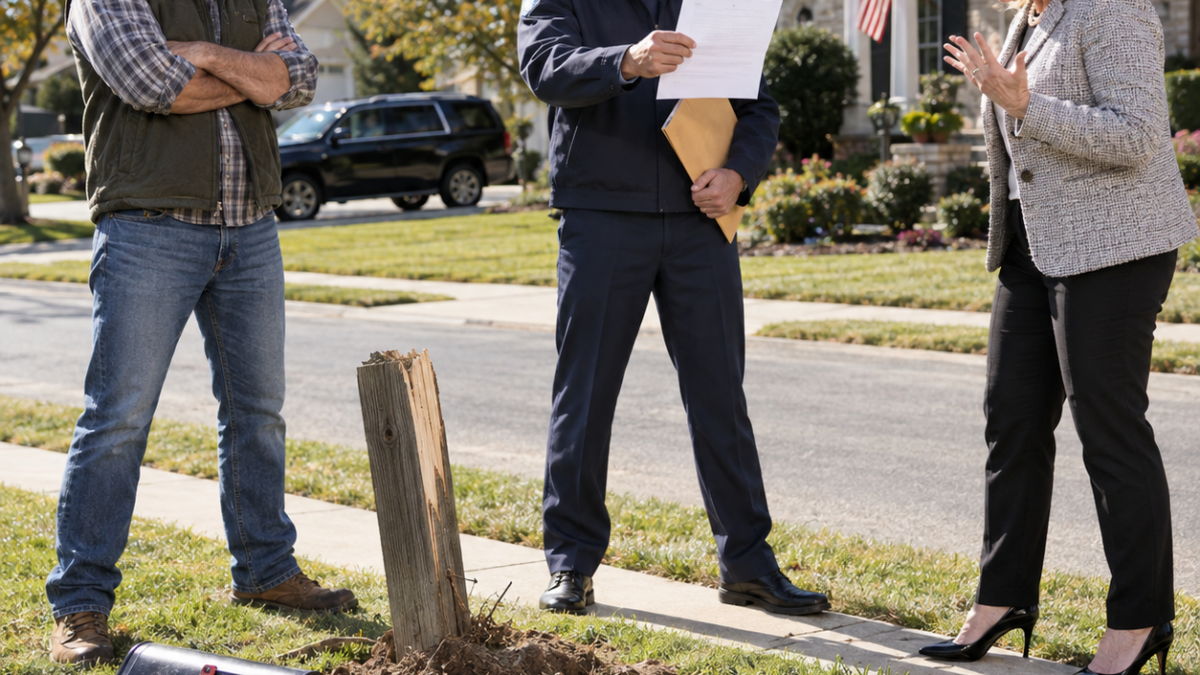
PART 2
Sarah was waiting when I reached the porch.
She had one hand wrapped around her coffee mug and that look on her face every married man eventually learns to recognize—the one that says she has already watched enough to know there is trouble, and she is waiting to find out exactly how much.
“What did she want?”
I held up the violation notice.
“Apparently, we’re living under an oppressive mailbox dictatorship.”
Sarah took the paper from me.
At first she looked amused.
Then she read the line about the daily fines.
Then she reached the part about the lien.
Her expression changed.
“They can’t do that.”
“No.”
“But they think they can.”
“Yes.”
She looked past me toward the road.
Karen was disappearing through the entrance to Whispering Pines.
“Jack.”
I knew the tone.
“What?”
“Don’t turn this into a war.”
“I didn’t.”
Sarah held up the notice.
“She did.”
I kissed her forehead.
“That’s exactly what I was going to say.”
She sighed.
“Which is why I’m worried.”
That night, I cleared the dining room table.
Most people would have called a lawyer immediately.
I eventually did.
But before I ever bring someone else into a problem, I want to understand it myself.
I went upstairs and pulled out the old document box that had belonged to my father.
Inside were decades of surveys, tax records, deeds, easements, receipts, handwritten notes and county correspondence.
My grandfather had bought the land after returning from World War II.
Forty acres.
Not forty acres inside Whispering Pines.
Not forty acres subject to some modern development agreement.
Just forty acres of woods, field and creek that belonged to our family.
My father had later transferred a narrow strip along the eastern edge to the county for one dollar so the road could be widened, paved and maintained publicly.
I found that deed.
Then I found the survey.
Parcel 47B.
My property line ran along the road.
The mailbox stood exactly where I remembered putting it—six inches inside the boundary.
Sarah sat across from me while I spread the papers out.
“You kept all this?”
“My father kept it.”
“Your father kept receipts for nails.”
“He was a wise man.”
“He was a hoarder with excellent filing habits.”
“That too.”
She smiled.
Then I showed her the development plat.
Whispering Pines wrapped around us on three sides.
But my parcel was clearly excluded.
A perfect legal island.
Ten years earlier, when the developer began buying the farmland surrounding our property, his representatives had approached me repeatedly.
At first they wanted to buy.
I refused.
Then they wanted an easement.
I refused that too.
Finally they suggested incorporating my property into the planned HOA.
That conversation lasted about ninety seconds.
I had nothing against neighborhoods.
I had nothing against homeowners associations in principle.
If people voluntarily bought homes under agreed restrictions, that was their business.
But I hadn’t bought into Whispering Pines.
Whispering Pines had been built around me.
That distinction mattered.
Apparently Karen had decided it didn’t.
I went to bed that night thinking about the notice.
Not because I feared the fine.
Not because I feared the lien.
I was thinking about the sentence at the bottom.
THE ASSOCIATION RESERVES THE RIGHT TO REMEDY THE VIOLATION AT THE OWNER’S EXPENSE.
That meant something more serious.
They weren’t only threatening me with paperwork.
They were reserving the right to send someone onto my property and remove the mailbox themselves.
The next morning, I took photographs.
Front.
Back.
Both sides.
The foundation.
Its distance from the road.
The property marker.
The county road sign.
Then I photographed the violation notice.
I scanned it.
I saved copies to my computer and an external drive.
Sarah leaned against my workshop door.
“You’re enjoying this.”
“No.”
She raised one eyebrow.
“Maybe five percent.”
“Jack.”
“Three.”
The seventy-two-hour deadline passed.
Nothing happened.
On the fourth morning, I walked down the driveway to collect the mail.
Another notice was taped directly to the steel door.
Laminated.
I almost admired the commitment.
DAY ONE FINE: $100.
Below it was another reminder that the association could “remedy” the violation.
I removed the notice carefully.
That afternoon, I learned the HOA board meeting was scheduled for the following Tuesday.
So I decided to attend.
Sarah watched me iron a collared shirt.
“You haven’t worn that since Emily’s wedding.”
“I want to make an impression.”
“You could wear your work clothes.”
“That’s the impression Karen expects.”
I tucked copies of the deed, survey, subdivision plat and HOA incorporation documents into a folder.
“She wants the room to see an angry farmer who doesn’t understand the rules,” I said. “I’m going to give them an engineer with a filing system.”
Sarah smiled.
“That sounds substantially more dangerous.”
The Whispering Pines clubhouse looked as if someone had tried to build a Tuscan villa from a catalog.
Artificial stone.
Decorative columns.
Too many fountains.
Inside were about thirty homeowners sitting in folding chairs.
The board occupied a long table at the front.
Karen sat in the center.
Royal-blue pantsuit this time.
To her right was her husband, Gary, the treasurer.
Gary looked like a man whose soul had been slowly compressed by decades of saying, “Yes, dear.”
Two other women completed the board.
Karen saw me enter.
For half a second, surprise crossed her face.
Then she smiled.
The meeting dragged through discussions about pool hours, landscaping and approved seasonal decorations.
I waited.
Eventually Karen reached the last agenda item.
“Compliance matter concerning 1412 County Road.”
Heads turned.
“That would be me,” I said.
Karen gestured toward the front.
“Mr. Davidson, since you have chosen to attend, the board will allow you an opportunity to explain your refusal to comply.”
I stood and carried my folder forward.
I didn’t address Karen.
I addressed the homeowners.
“My name is Jack Davidson. My family has owned the forty-acre parcel beside this neighborhood for more than seventy years.”
Karen tapped her gavel.
“Please remain relevant.”
“This is relevant.”
I opened the subdivision plat.
“I am not a member of Whispering Pines Homeowners Association.”
A murmur rolled through the room.
Karen stiffened.
“My property is Parcel 47B. Here is the recorded development plat.”
I held it up.
“The red boundary marks HOA property. My parcel is specifically outside that boundary.”
“The property is geographically integrated into the neighborhood,” Karen said.
“That’s not a legal category.”
A few people laughed.
Karen glared at them.
I continued.
“This is your own incorporation document. Membership applies to owners of lots within the defined property.”
I tapped the plat.
“I don’t own one.”
Karen leaned toward her microphone.
“You benefit from the community.”
“No, ma’am.”
“You use the road.”
“The county owns the road.”
“You see our landscaping.”
“I’ll try to look away.”
That got another laugh.
Even Gary almost smiled.
Karen’s face darkened.
I wasn’t there to embarrass her, but she was making it difficult to avoid.
“Now,” I said, “the second problem concerns the mailbox.”
I placed photographs on the table.
“It is on my parcel beside a public county road. It is an active receptacle for United States mail.”
I pulled out the violation notice.
“Your written notice states the HOA may enter my property and remove it.”
I paused.
“That would be an extremely poor decision.”
One board member shifted nervously.
Karen folded her arms.
“Are you threatening this board?”
“No. I’m warning you that postal property and mail delivery are subject to federal law. If you damage, obstruct or destroy a mailbox being used for United States mail, you are no longer having a neighborhood dispute.”
The room became very quiet.
Gary looked at Karen.
Karen looked at me.
“You’re trying to intimidate us with legal jargon.”
“No.”
I picked up her notice.
“You wrote the threat. I’m just explaining what it means.”
One of the women beside Karen leaned over.
They whispered.
Karen shook her head.
Then she spoke loudly.
“The board’s ruling stands.”
That was the moment I understood this wasn’t going to end with common sense.
I gathered my papers.
“For the record, I will not remove my mailbox. I will not pay your fines. I do not consent to anyone entering my property. And if anyone damages that mailbox, I will report it.”
Karen banged the gavel.
“The fines will continue.”
“Then please keep sending them.”
She blinked.
I smiled slightly.
“They’re useful documentation.”
The meeting ended.
As I walked toward the door, a man with grease permanently embedded beneath his fingernails caught my arm.
“You’re the mailbox guy?”
“Apparently.”
He introduced himself as Bill.
He lived three streets over and restored classic cars.
“They’ve been after me for six months,” he said.
“For what?”
“A Ford sign.”
I thought he was joking.
He wasn’t.
It was a small vintage sign inside his garage.
Karen considered it unapproved signage visible from the street.
Bill had received three notices.
The latest threatened a five-hundred-dollar penalty.
“My father had that sign in his garage,” he said. “Had it thirty years before he died.”
That sentence stayed with me.
Because I understood it.
My mailbox wasn’t beautiful to Karen.
Bill’s sign wasn’t tasteful to Karen.
But not everything valuable is valuable because it matches somebody’s color palette.
Sometimes an object holds a memory.
Sometimes that’s enough.
A few days later, while walking through Whispering Pines, I met Maria.
She was pushing a stroller.
Her older daughter had drawn a rainbow in sidewalk chalk on their driveway.
The HOA called it graffiti.
“They power-washed it,” she told me.
“Then billed us two hundred dollars.”
“For chalk?”
“My daughter cried because she thought she’d done something bad.”
That one bothered me more than the mailbox.
As word spread that I was fighting Karen, people started talking.
A retired teacher had been fined for a bird feeder.
Another homeowner left his trash container outside three hours too long.
A couple had received notices because their welcome mat was “excessively colorful.”
Someone’s basketball hoop was allegedly the wrong shade.
Someone else’s satellite dish was two inches outside an arbitrary limit.
Individually, every story sounded ridiculous.
Together, they formed a pattern.
Karen had learned something important about power.
Most people won’t fight over a small injustice because fighting costs more emotionally than paying.
A hundred dollars here.
Two hundred there.
A threatening letter.
A meeting.
An embarrassing public lecture.
Eventually people surrender just to regain peace.
Karen mistook surrender for respect.
Then I met Arthur.
Arthur had been the HOA treasurer before Gary.
He was retired from a regional accounting firm and had the careful habits of a man who could smell an unexplained decimal point from fifty feet.
I found him pruning roses.
“I hear you upset the queen,” he said without looking up.
“So I’ve been told.”
“She doesn’t like variables.”
“People are variables.”
“Exactly.”
He clipped another stem.
Then he looked at me.
“You think this is about your mailbox?”
“No.”
“Good.”
Arthur invited me inside.
His kitchen table was cleaner than some operating rooms.
He poured coffee.
“The HOA budget has nearly doubled in three years,” he said. “Services haven’t.”
“Where did the money go?”
“That’s what I wanted to know when I was treasurer.”
“What happened?”
“I started asking.”
“And?”
“I stopped being treasurer.”
He pulled out old financial statements.
Landscaping contracts had increased.
Legal expenses had exploded.
Maintenance costs didn’t align with what residents were seeing.
“Lawn and Order handles landscaping,” Arthur said.
“Karen’s cousin owns it.”
I stared at him.
“Competitive bids?”
“None that I ever saw.”
“What about the lawyers?”
“Karen picked them.”
“Expensive?”
Arthur gave me a humorless smile.
“Very.”
“Good?”
“Depends whether you’re billing by the hour.”
I sat back.
“You think she’s stealing?”
“I think she’s doing things she desperately doesn’t want examined.”
That was careful accountant language.
It told me everything.
My problem had changed.
I still wanted the HOA away from my mailbox.
But now I had neighbors whose money might be funding the very machinery used to intimidate them.
The next morning I drove to the county courthouse.
I spent hours in the register of deeds office.
I pulled my grandfather’s deed.
My father’s road conveyance.
The Whispering Pines master deed.
The subdivision plat.
The HOA incorporation filing.
Every document confirmed what I already believed.
My property was outside the HOA.
Not arguably.
Not accidentally.
Explicitly.
Parcel 47B appeared in the exclusions.
I ordered certified copies.
Then I called an old friend.
Mark Callahan and I had served together in the Army Corps of Engineers.
Back then, Mark could calculate bridge-load requirements while people were shouting at him from three directions.
After leaving the service, he became an attorney specializing in property law.
He answered on the second ring.
“Jack Davidson. Either somebody died or you finally decided to sell me ten acres.”
“Worse.”
Silence.
Then I said, “HOA.”
Mark groaned.
“My condolences.”
I explained everything.
When I finished, he was quiet.
“Jack.”
“Yes?”
“Please tell me the HOA threatened in writing to remove your mailbox.”
“They did.”
“Please tell me they’re fining you even though your deed excludes your parcel.”
“They are.”
“Please tell me their president reaffirmed the threat during a public meeting.”
“In front of about thirty witnesses.”
Mark started laughing.
“What?”
“I haven’t received a case this well wrapped since Christmas.”
He explained our first move.
A formal cease-and-desist letter from his law firm.
No insults.
No threats.
Just documents and law.
The HOA would be ordered to withdraw the fines, stop claiming authority over my parcel and cease interfering with my property.
Certified mail.
Return receipt.
Separate copies to every board member.
“They need individual notice,” Mark said. “Nobody later gets to claim they didn’t know.”
“What if they ignore it?”
“Then they become much more expensive versions of stupid.”
Meanwhile, I visited our local postmaster.
He knew my route and knew the mailbox.
He listened sympathetically.
“You’re right to be concerned,” he said.
“Can you stop them?”
“At the local level, I can document the complaint. But for enforcement, you’re looking at Postal Inspection.”
“The federal investigators?”
He nodded.
“United States Postal Inspection Service.”
“How do I get their attention?”
The postmaster looked at the folder under my arm.
“Judging by that, probably the same way you got mine.”
So I built a file.
Not an angry complaint.
A case file.
Chronology.
Photographs.
Certified deeds.
Survey map.
HOA notices.
Meeting witness list.
Correspondence.
A description of the mailbox and its position.
I wrote the cover letter like an engineering incident report.
Facts.
Dates.
Names.
No adjectives I couldn’t support.
Then I submitted the complaint to the Postal Inspection Service.
I also mailed a complete package to federal postal officials and copied the Postmaster General’s office.
When I dropped that thick envelope into a collection box in town, I felt oddly calm.
I had done everything I could do.
Now I waited.
Mark’s letter arrived at Karen’s house three days later.
Bill called me.
“You need to see this.”
“See what?”
“She’s fighting with the mailman.”
I walked upstairs and looked through binoculars from the guest room.
Across the development, a USPS vehicle sat in front of Karen’s house.
Dave, our regular carrier, stood patiently beside the driveway holding a certified-mail form.
Karen was on her porch wearing a robe.
Even from that distance I could see the hand gestures.
She didn’t want to sign.
Dave didn’t care.
He had delivered mail through sleet, heat, barking dogs and holiday traffic.
Karen Peterson in bedroom slippers was not going to break him.
Five minutes later, she stormed down the steps, signed and snatched the envelope.
Dave tipped his cap and returned to the truck.
I lowered the binoculars.
Sarah stood behind me.
“Are you spying on our neighbors now?”
“Observing.”
“With binoculars.”
“Bird-watching equipment.”
“Is Karen a bird?”
“An unusual species.”
Sarah tried not to laugh.
A week later, the HOA responded.
Not Karen personally.
Their law firm.
The letter dismissed Mark’s position and claimed I was bound by the HOA because of “geographic and aesthetic integration.”
I read that sentence three times.
Then I looked at Sarah.
“I think they invented a legal concept.”
“They can do that?”
“They can write anything on expensive paper.”
The letter accused me of harassing board members.
Threatened defamation claims.
Restated the demand that I replace the mailbox.
Then it included an updated invoice.
More than two thousand dollars.
Fines.
Late fees.
Administrative charges.
And legal fees for the lawyer who had written me the letter.
I sent it to Mark.
He called almost immediately.
He was laughing again.
“Why do you keep laughing when people threaten me?”
“Because they’re helping us.”
“How?”
“They’ve just billed you for the cost of asserting authority they don’t have. In writing.”
“So?”
“So now we draft the lawsuit.”
My amusement disappeared.
“You think we’re there?”
“We’ve been there. I was giving them a chance to walk backward.”
Mark planned to seek a declaratory judgment confirming the HOA had no authority over my parcel, an injunction against further harassment and compensation for my legal costs.
He also wanted to name Karen and the other board members where legally appropriate.
That possibility mattered.
Board members liked to speak about “the association” as though it were some independent creature.
Personal exposure had a way of reminding people that organizations are made of individuals who make choices.
While Mark worked, Karen launched a campaign of her own.
I became “the angry outsider.”
The troublemaker.
The man trying to destroy community values.
Some neighbors avoided me.
Others suddenly became more interested.
Bill called one evening.
“She told three people you’re trying to sue the neighborhood into bankruptcy.”
“I haven’t even filed.”
“Facts aren’t really her preferred medium.”
Maria heard another version.
According to that story, I wanted all HOA rules abolished so I could turn my property into an industrial junkyard.
I looked across my fields, my restored farmhouse, Sarah’s garden and the oak trees my grandfather had planted.
“Should we buy a rusty school bus?” I asked Sarah.
“For what?”
“To complete the image.”
She shook her head.
“Do not encourage yourself.”
At the same time, our small group grew.
Bill.
Maria.
Arthur.
Then others.
We started meeting quietly.
Not because we were plotting anything illegal.
Because people were genuinely afraid of retaliation.
Arthur showed us a section of the HOA bylaws giving homeowners the right to inspect association financial records.
“There,” he said, tapping the page. “That’s the door.”
“So open it.”
He smiled.
“I intend to.”
Arthur submitted a formal written request for three years of bank statements, contracts, invoices, receipts and general-ledger records.
Karen delayed as much as she could.
Eventually she gave him a two-hour inspection window at the clubhouse, with a board representative present.
“Two hours isn’t much,” Maria said.
Arthur shrugged.
“I was an auditor for thirty-eight years. Give me twenty minutes with a general ledger and I’ll know where the bodies are buried.”
The phrase was figurative.
But he said it with such calm confidence nobody laughed.
We made a plan.
Arthur would photograph documents rather than attempt to analyze everything onsite.
Contracts first.
Bank records second.
Vendor payments.
Legal bills.
Anything connected to board members or relatives.
On the morning of the inspection, he checked in with me by text.
Thirty minutes:
THEY ARE WATCHING ME LIKE I’M STEALING THE SILVERWARE.
An hour:
FOUND LANDSCAPING CONTRACT. NO COMPETITIVE BID. 15% ANNUAL INCREASE. COMPANY REGISTERED BY KAREN’S COUSIN WEEKS BEFORE CONTRACT.
Ninety minutes:
LEGAL FEES ARE INSANE.
Then, just before his two hours ended, a photograph appeared on my phone.
A check.
Payee:
KAREN’S CREATIONS.
Amount:
$5,000.
Memo:
FALL CLUBHOUSE DECOR.
Arthur’s next text arrived.
KAREN’S CREATIONS CLOSED TWO YEARS AGO.
I stared at the screen.
Then another message.
THERE IS NO $5,000 FALL DECOR AT THE CLUBHOUSE.
I called him after he left.
“Could there be a legitimate explanation?”
“There could always be an explanation.”
“Do you believe there is?”
“No.”
He spent the next several days cross-referencing payments with state business records.
What he uncovered went far beyond one check.
Consulting payments to a company associated with Gary’s brother.
Suspicious repair expenses.
Inflated printing charges.
Vendor relationships with people personally connected to board leadership.
Not every transaction was necessarily criminal.
But the pattern was ugly.
Arthur prepared a formal report.
We agreed not to make reckless accusations.
We would document.
We would present.
We would let independent auditors and authorities decide what laws had been broken.
Karen, meanwhile, seemed to sense control slipping away.
She proposed new restrictions on gatherings in common spaces.
Landscaping crews started lingering suspiciously near my property.
One morning, a Lawn and Order truck parked along the road.
Two men sat inside staring toward my house.
I carried my coffee down the driveway.
“Morning.”
Neither answered.
I pulled out my phone.
“What are you doing?” one finally asked.
“Taking pictures.”
“Why?”
“Documentation.”
The word made him uncomfortable.
People who depend on intimidation dislike documentation.
I photographed the truck.
The plate.
Its position relative to my property line.
Then I smiled.
“Have a great day.”
They left twenty minutes later.
That became our rule.
Documentation.
If Karen called, homeowners followed with an email.
Per our conversation today…
If a notice arrived, it was photographed.
If a contractor appeared, dates and times were recorded.
Fear thrives in ambiguity.
Records destroy ambiguity.
The entire culture of Whispering Pines started changing.
People who had once whispered were talking.
People who had felt isolated discovered their neighbors had received almost identical threats.
Then came the Thursday afternoon that changed everything.
I was repairing a cabinet hinge in my workshop when Sarah called from the kitchen.
“Jack?”
Something in her voice made me put the screwdriver down.
“What?”
“Government car.”
I walked outside.
A dark blue sedan had stopped beside my mailbox.
Government plates.
A man stepped out.
Late forties.
Dark suit.
Short hair.
He spent nearly a minute inspecting the mailbox.
He walked around the stone base.
Photographed it.
Examined the road.
Looked at the property markers.
Then he came up the driveway.
I met him halfway.
“Jack Davidson?”
“Yes.”
He opened a leather credential wallet.
“Special Agent David Chen. United States Postal Inspection Service.”
There are moments when a long plan stops being theoretical.
That was one of them.
I shook his hand.
“Agent Chen.”
“You submitted a complaint concerning interference with a rural mail receptacle.”
“I did.”
He nodded toward the house.
“Do you have some time?”
“As much as you need.”
We sat at the kitchen table.
Sarah brought coffee, though Agent Chen barely touched his.
He opened a folder.
My folder.
Apparently the packet had traveled.
“Your submission was unusually complete,” he said.
“Military habit.”
“It helped.”
For almost an hour, he verified dates and statements.
He reviewed the HOA notices.
The plat.
The legal description of my parcel.
The road deed.
He paid particular attention to the phrase allowing the HOA to “remedy” the violation.
“This means they were asserting authority to physically remove it?”
“That was my interpretation.”
“Did anyone from the association clarify otherwise?”
“No.”
“Did the president reaffirm the board’s position after you warned her?”
“In a public meeting.”
“Witnesses?”
“Several dozen.”
Agent Chen wrote something.
Then he picked up the letter from the HOA’s attorney.
“They charged you legal fees for this?”
“Yes.”
He looked at me.
Then at the invoice.
Then back at me.
For the first time, his professional expression cracked.
“That’s creative.”
“So I’ve been told.”
He returned to his notes.
I didn’t ask him to arrest anyone.
I didn’t ask him to scare Karen.
I didn’t need theatrics.
I wanted one thing.
For someone with actual authority to explain where her authority ended.
Finally Agent Chen closed the folder.
“Mr. Davidson, I’m going to speak with Ms. Peterson.”
“What happens after that?”
“That depends largely on Ms. Peterson.”
I almost felt sorry for her.
Almost.
He continued.
“Based on the documents you’ve provided, federal postal officials will be formally directing the HOA and its board to stop interfering with this receptacle and with your mail service.”
I sat quietly.
He watched me.
“You don’t seem surprised.”
“I mailed enough paperwork to Washington to kill a small tree.”
That got the faintest smile.
“The directive will be clear. Any further attempt to damage, remove or obstruct the receptacle after formal notice could create much more serious problems for the individuals involved.”
“When?”
“Soon.”
He stood.
I walked him to the porch.
Before leaving, Agent Chen looked back toward the mailbox.
“Mr. Davidson?”
“Yes?”
“You did the right thing by documenting rather than escalating.”
“Learned that the expensive way a long time ago.”
He nodded.
Then he drove directly toward Whispering Pines.
I watched until the sedan disappeared around the entrance.
Sarah stepped beside me.
“Well?”
“The federal government would like a word with Karen.”
She crossed her arms.
“Should I feel sorry for her?”
“I’ll leave that to you.”
“I don’t.”
Neither did I.
Two days later, official notices began arriving for the board.
The communication associated with the postal investigation was exactly what Karen had spent weeks insisting could never happen.
A formal cease-and-desist direction backed by federal postal authority.
Stop interfering.
Stop threatening removal.
Rescind the mailbox-related actions.
Do not obstruct mail service.
For the first time, Karen was facing a rule she couldn’t rewrite.
Bill called Saturday morning.
“She’s at the pool.”
“What?”
“Get ready.”
“For what?”
“I don’t know, but she has a federal letter in one hand and the look of a woman about to fight Washington.”
I did not go.
I didn’t need to.
By then half the neighborhood had my number.
Messages started arriving.
KAREN IS SCREAMING.
SHE’S SAYING THE GOVERNMENT IS HARASSING HER.
SHE JUST MENTIONED YOUR MAILBOX.
GARY IS TRYING TO GET HER TO LEAVE.
Then Bill called.
Behind him I could hear voices.
“What’s happening?”
“You’ve broken her.”
“I haven’t done anything.”
“She’s reading portions of the federal notice out loud.”
I closed my eyes.
“Oh, Karen.”
“She thinks everyone is going to rally behind her.”
“Are they?”
“No one is saying anything.”
That silence mattered.
For years, homeowners had watched Karen publicly shame people.
Now she was standing beside the community pool trying to convince those same people that she was the victim.
Apparently she pointed toward my property and declared that one stubborn man cared more about an ugly mailbox than an entire community.
No one applauded.
Gary tried to guide her away.
According to several witnesses, she snapped at him.
The other board members left.
One drove away before the speech ended.
Karen’s power had always depended on the appearance of unanimous authority.
That appearance vanished in one afternoon.
I called our group together that evening.
Bill arrived grinning.
Maria looked energized.
Arthur carried three binders.
“Before anyone celebrates,” I said, “this isn’t finished.”
Bill dropped into a chair.
“You heard what happened.”
“I did.”
“So she’s finished.”
“No. She’s wounded.”
Maria nodded.
“And wounded people do stupid things.”
“Exactly.”
I looked at Arthur.
“Show them.”
He opened the first binder.
His financial report was devastating.
Vendor relationships.
Payments.
Contracts.
Chronology.
Supporting documents.
Bank entries.
The questionable five-thousand-dollar payment wasn’t an isolated mistake.
It sat inside a pattern.
Arthur had also calculated the HOA’s legal spending.
Residents were paying extraordinary amounts for lawyers to pursue petty enforcement disputes against the residents themselves.
Bill stared at the number.
“They spent that much threatening us?”
“Yes,” Arthur said.
Maria looked furious.
“My dues paid for the letter about my daughter’s chalk?”
“In part.”
That made the room go quiet.
Nothing unites people like discovering they financed their own mistreatment.
Arthur pulled out the bylaws.
“There’s a recall procedure.”
“How many signatures?” I asked.
“Twenty-five percent to compel a special meeting.”
Bill laughed.
“We can get that before lunch.”
“We do it properly,” I said. “No exaggeration. No rumors. No accusations we can’t document.”
Maria leaned forward.
“What do we say?”
“The truth.”
The next morning our volunteers went door to door.
Every team carried three things.
The recall petition.
The bylaw section authorizing it.
A concise summary of documented financial concerns.
No screaming.
No insults.
No revenge speeches.
Just evidence.
Maria and another mother worked one section.
Bill spoke to homeowners around garages and driveways.
Arthur answered financial questions.
I moved between teams.
At the first house, the owner barely let me finish.
“Where do I sign?”
At another, a man was skeptical.
“I don’t like Karen,” he said, “but removing the whole board seems extreme.”
“Read the documents.”
He did.
He spent ten minutes on Arthur’s summary.
Then he signed.
By afternoon, the signature count crossed twenty-five percent.
We kept going.
Thirty.
Forty.
Fifty.
By evening, more than sixty percent of homeowners had signed.
I sat at the kitchen table counting signatures while Sarah made dinner.
She looked at the pages.
“Remember when I told you not to start a war?”
“I remember.”
“You started a government.”
“I did not.”
“Jack, there are people in our driveway asking for assignments.”
I looked through the window.
She wasn’t exaggerating.
“I may have accidentally organized a neighborhood.”
Sarah kissed my cheek.
“That is the most you thing you have ever done.”
Monday morning, we delivered the petition to the HOA management company.
Not Karen.
The management company.
Procedure mattered.
The administrator counted signatures, checked homeowner names and reviewed the bylaws.
Then she looked up.
“You’ve substantially exceeded the requirement.”
“We wanted margin.”
“I see that.”
A special meeting was scheduled for ten days later.
The purpose appeared in large, unavoidable language:
REMOVAL OF CURRENT BOARD OF DIRECTORS.
That notice changed the entire neighborhood.
Karen stopped appearing publicly.
Gary looked exhausted.
Two board members resigned before the meeting.
The HOA’s lawyers sent a last-minute letter claiming unspecified procedural problems.
Mark responded.
He didn’t need three pages.
His answer was effectively:
See you at the meeting.
He also prepared our civil case for filing.
I asked him to hold service until after the recall.
“Still hoping she’ll walk away?” he asked.
“No.”
“Then why wait?”
“Because this part belongs to the homeowners.”
Mark was silent for a second.
“Fair enough.”
The night of the special meeting, cars lined both sides of the road.
The clubhouse overflowed.
People stood along walls and in the hallway.
I had attended military briefings with less tension.
Karen sat at the front table.
Gary beside her.
No royal-blue suit this time.
No pink tracksuit.
She wore gray.
For the first time since I’d met her, she looked tired.
The management-company representative called the meeting to order.
As one of the petition organizers, I was given the floor.
I walked to the podium.
Hundreds of eyes followed me.
I had imagined that moment during the worst parts of the previous weeks.
I had imagined telling Karen exactly what I thought of her.
I had imagined anger.
Victory.
Humiliation.
But when I stood there, none of those things seemed useful.
So I kept it simple.
“My name is Jack Davidson.”
The microphone carried my voice across the room.
“My family does not belong to this HOA. That fact is what started this dispute. But it is not why we are here tonight.”
Karen stared at me.
“We are here because too many people in this neighborhood became afraid of the organization that was supposed to serve them.”
No one moved.
“Rules can protect a community. Rules can also be abused. Authority can solve problems. Authority can also create them.”
I looked toward Maria.
Bill.
The retired teacher.
The young couple with the colorful welcome mat.
“This stopped being about my mailbox a long time ago.”
Then I stepped away.
Arthur took my place.
If my speech opened the door, Arthur drove a truck through it.
He projected the financial records onto a screen.
First:
Lawn and Order.
No-bid contract.
Automatic increases.
Business ownership connected to Karen’s cousin.
Murmurs.
Then legal spending.
Tens of thousands of dollars.
Gasps.
Then the payment to Karen’s Creations.
Five thousand dollars.
Arthur displayed public records showing the business was no longer operating.
Someone in the room shouted, “Where did the money go?”
The management representative called for order.
Arthur didn’t raise his voice.
“That is precisely why an independent forensic audit is required.”
Then he displayed other questionable transactions.
Consulting fees.
Unverified repairs.
Irregular vendor payments.
He was careful.
He never said “theft” when he couldn’t prove theft.
He said “unexplained.”
“Conflict of interest.”
“Unsupported.”
“Requires investigation.”
That precision made the evidence more powerful.
At the end, he turned toward the audience.
“This is not the board’s money.”
His voice shook slightly.
“This is your money.”
No one whispered now.
“You paid it expecting roads, landscaping, snow removal, pool maintenance and responsible management. You did not pay it so that the board could use lawyers to threaten you over chalk drawings, bird feeders and garage signs.”
Someone began clapping.
Then another.
The room erupted.
Karen stood.
“Enough!”
The applause faded.
She walked toward the microphone.
For weeks, I’d been waiting for her final attack.
Instead, the woman who reached the podium looked smaller than the one who had stood beside my mailbox.
“I volunteered for this neighborhood,” she said.
Her voice cracked.
“I gave years of my life.”
Nobody responded.
“Do you know how difficult it is to maintain standards when everyone thinks their own exception should be allowed?”
She looked around.
“The contracts went to people we trusted.”
A homeowner called out, “Your family?”
“People we trusted!”
Another voice shouted, “With our money!”
The room became noisy again.
The representative called for order.
Karen gripped the podium.
“You people begged for higher property values. You wanted standards. You wanted enforcement.”
Maria stood.
“We wanted a neighborhood. Not permission to live in our own houses.”
That line quieted the room.
Karen stared at her.
Then Gary stood.
He had been silent all evening.
“Gary,” Karen said sharply.
He didn’t look at her.
He looked at the floor.
“The checks were real.”
The room froze.
Karen’s face drained of color.
Gary continued.
“I signed them.”
“Sit down.”
“I told her some of it wasn’t right.”
“Gary.”
“She said I was treasurer and I had to sign.”
Karen moved toward him.
“Stop talking.”
For once, he didn’t.
“The contracts. The checks. She handled everything.”
His voice trembled.
“I should have stopped it.”
Karen stared at him as though he had physically struck her.
“You coward.”
Maybe he was.
Maybe confessing only when the room turned against them wasn’t courage.
But it was testimony.
And it destroyed whatever defense Karen still had.
The management representative moved the meeting to the recall vote.
Paper ballots.
Independent count.
The wait lasted about ten minutes.
It felt longer.
Karen sat motionless.
Gary kept his head down.
I stood in the back beside Sarah.
She slipped her hand into mine.
“Whatever happens,” she whispered, “you were right about one thing.”
“What?”
“This was never only about a mailbox.”
The representative returned.
She approached the microphone.
“The vote regarding removal of the remaining board leadership is as follows.”
Nobody breathed.
“One hundred eighty-seven in favor of removal.”
A pause.
“Four opposed.”
For one heartbeat, the room was silent.
Then it exploded.
Applause.
Cheers.
People hugged.
Bill slapped my shoulder hard enough to hurt.
Maria was crying.
Arthur removed his glasses and wiped his eyes.
I looked toward Karen.
She picked up her purse.
No speech.
No final insult.
She walked through the cheering crowd without looking left or right.
Gary followed several steps behind.
The doors closed after them.
The strangest thing happened next.
The room grew calm.
Not immediately.
But within minutes.
The anger had somewhere to go.
The fear had broken.
An interim board was elected.
Arthur agreed to serve.
So did Maria and Bill, along with two other homeowners.
Their first actions were simple.
All disputed enforcement penalties issued under the previous board would be reviewed.
Mailbox-related fines against me were formally rescinded, even though I had never owed them legally.
The HOA issued a written apology.
An independent forensic audit was authorized.
Arthur’s evidence would be provided to the proper authorities for investigation.
And the old culture of automatic threats would stop.
When the meeting finally ended, people stayed.
They talked.
Not about Karen.
About barbecues.
Pool repairs.
Road maintenance.
Children’s events.
Actual community business.
That was when I knew the real victory had occurred.
A week later, Mark served the civil papers.
By then, there wasn’t much left to argue about.
The documentation was overwhelming.
The HOA no longer stood behind Karen.
My parcel records were clear.
The postal matter had been formally addressed.
Eventually the civil dispute was settled.
My legal costs were covered.
There was some additional compensation.
I accepted because Mark told me never to confuse principle with refusing money you are legitimately owed.
But the check mattered less than another piece of paper.
A formal acknowledgment that my property was not subject to the HOA.
I framed that one.
Sarah laughed when she saw it.
“You actually framed a land-use acknowledgment.”
“I’ve framed uglier things.”
“You’re impossible.”
“I’m legally documented.”
The independent audit took months.
Arthur’s suspicions were largely confirmed.
Some transactions had innocent explanations.
Others didn’t.
There had been conflicts of interest.
Improper reimbursements.
Unsupported payments.
Misuse of HOA funds.
Investigators became involved.
I stayed out of that part.
Once official authorities took control, I gave them what information I had and went back to my life.
Eventually Karen and Gary faced criminal charges connected to the financial misconduct.
The case did not end with some dramatic television-style trial.
Real life rarely does.
Attorneys negotiated.
Charges were reduced.
There were guilty pleas.
Restitution.
Probation.
Legal bills.
Their house went on the market.
One morning, while collecting my mail, I noticed the FOR SALE sign in their yard.
I expected to feel satisfaction.
Maybe I did, a little.
But mostly I felt tired.
Sarah joined me.
“You okay?”
“Yeah.”
“You don’t look happy.”
“I wanted her stopped. I didn’t want her life destroyed.”
Sarah slipped her arm through mine.
“She made choices.”
“I know.”
“That doesn’t mean you have to enjoy the consequences.”
That was Sarah.
She could turn an entire moral argument into two sentences.
The new HOA changed quickly.
Not perfectly.
No organization made of human beings is perfect.
People still argued about budgets.
Landscaping.
Pool hours.
Parking.
But arguments no longer automatically became threats.
Meetings were open.
Financial statements were posted.
Contracts above a certain amount required multiple bids.
Conflict-of-interest disclosures became mandatory.
Rules were rewritten to be objective where possible.
The neighborhood didn’t collapse.
Property values didn’t disappear because somebody had a colorful welcome mat.
Children drew chalk rainbows again.
The retired teacher rehung her bird feeder.
Bill put his father’s Ford sign back in the garage.
The first time I saw it, I stopped.
He was polishing the hood of an old Mustang.
“Looks good,” I said.
“The car?”
“The sign.”
He smiled.
“My dad would’ve enjoyed this whole thing.”
“Think so?”
“He hated bullies.”
I looked at the faded sign.
“Sounds like I would’ve liked him.”
“You would’ve.”
Maria’s daughter drew something on their driveway one Saturday.
A huge rainbow.
Under it were stick figures holding hands.
I stood at the edge of the driveway admiring it.
Maria came outside.
“She asked if the neighborhood police were going to wash it away again.”
My chest tightened.
“What did you tell her?”
“I told her there aren’t neighborhood police.”
“Good answer.”
“She wanted to know who you were.”
“What did you say?”
Maria smiled.
“I told her you’re the man with the mailbox.”
Apparently that had become my permanent title.
Months later, Sarah came into my workshop carrying an envelope.
“Mail for the mailbox man.”
“Very funny.”
“It’s from the board.”
I opened it cautiously.
Inside was a reimbursement check covering the certified copies I’d purchased at the courthouse.
There was also a handwritten note from Arthur.
Jack—
The board voted to make this our first official reimbursement.
It doesn’t begin to repay what you did.
We reduced legal spending by nearly ninety percent this quarter and redirected money toward maintenance and community events.
Neighborhood barbecue next month.
Sarah says you’re coming.
—Arthur
I reread the final sentence.
“Sarah says?”
She was already walking away.
“Traitor.”
“You need friends.”
“I have friends.”
“You have Mark.”
“Exactly.”
“You need friends who aren’t lawyers.”
At the barbecue, I expected awkward gratitude.
Instead, I got potato salad.
Which was better.
Children ran across the grass.
Bill manned one grill.
Arthur argued with somebody about the proper way to cook corn.
Maria’s daughter covered half the sidewalk in chalk.
Nobody cited her.
The rebuilt community was louder than Karen’s version.
Messier.
More colorful.
Human.
And somehow the houses survived.
Near sunset, Arthur joined me at a picnic table.
“You ever consider serving on the board?”
“No.”
“You’d be good.”
“That’s why I’m saying no.”
He laughed.
“You led the entire recall.”
“I fixed a structural failure.”
“You organized sixty percent of the neighborhood.”
“Temporary field team.”
“You coordinated legal counsel, federal reporting, financial review and governance reform.”
“Coincidence.”
Arthur shook his head.
“You know, Karen’s biggest mistake wasn’t attacking the mailbox.”
“No?”
“She attacked an engineer.”
I smiled.
“She definitely underestimated paperwork.”
There was one final thing I needed to do.
The old mailbox was still standing exactly where it always had.
No HOA crew had touched it.
No federal agent had removed it.
No court had ordered it changed.
I had won the right to leave it there forever.
So naturally, I decided to replace it.
Sarah found me examining it one Saturday morning.
“What are you doing?”
“Thinking.”
“That usually costs money.”
“The box is old.”
She stared at me.
“You fought an HOA, hired a lawyer and contacted federal investigators to protect that mailbox.”
“I fought to protect the right to decide what happens to it.”
She considered that.
Then smiled.
“That’s annoyingly reasonable.”
The truth was that the steel door didn’t close as smoothly anymore.
Rust was creeping around the hinges.
The stone foundation had survived decades of winters, but mortar had begun to crack.
I could repair it.
Instead, I decided its work was finished.
I dismantled the old base carefully.
Stone by stone.
Each rock had come from our creek.
I saved them for the garden wall Sarah had been asking me to build for years.
The steel box came free last.
I carried it into my workshop.
It was scarred.
Dented.
Heavy.
Still solid.
I cleaned it and placed it on a shelf.
Not because it was beautiful.
Because it reminded me of something.
Rights are strange things.
You rarely appreciate them when nobody challenges them.
The freedom to keep an ugly mailbox doesn’t sound important.
Until someone who has no authority decides you aren’t allowed to.
Then the mailbox isn’t merely a mailbox.
It becomes a boundary.
I drove to town and bought a new one.
Plain black metal.
Standard size.
Nothing fancy.
I built a smaller stone pedestal beside the road.
Measured twice.
Level in both directions.
Exactly inside my property.
When I finished, Sarah stood beside me.
“Well?”
She tilted her head.
“It’s incredibly boring.”
“Thank you.”
“You’re welcome.”
Monday morning, I carried coffee onto the porch.
Dave’s USPS truck came down the county road.
He slowed.
Stopped.
Dave got out.
He examined the new mailbox.
Then he looked up toward me.
I raised my cup.
He gave me a thumbs-up.
I returned it.
He opened the door.
Placed our letters inside.
Closed it.
Click.
Such a small sound.
But after everything that had happened, it felt final.
Not triumphant.
Final.
The truck moved on.
Birds were calling from the woods.
Sarah came through the screen door behind me.
“You happy?”
I thought about Karen.
The fines.
The federal agent.
The packed clubhouse.
The vote.
Arthur’s spreadsheets.
Maria’s daughter and her chalk rainbow.
Bill’s old Ford sign.
My grandfather’s deed.
My father’s county-road agreement.
The ugly steel mailbox sitting on a workshop shelf.
Then I looked at the new one standing quietly beside the road.
“Yeah,” I said.
“What was the best part?”
I could have said the cease-and-desist.
I could have said watching Karen lose the board.
I could have said the 187 votes.
I could have said the settlement.
But revenge had never been the thing that stayed with me.
“The quiet.”
Sarah smiled.
We sat together on the porch.
Across the road, Whispering Pines looked almost exactly as it had before any of this began.
Same houses.
Same streets.
Same clubhouse.
But the people were different.
Or maybe they had simply remembered that a community was supposed to belong to the people living in it.
Karen had believed authority came from a clipboard, a title and the willingness to frighten people.
She learned otherwise.
Authority has boundaries.
Documents matter.
Laws matter.
People willing to stand beside each other matter even more.
I never joined Whispering Pines.
I never paid their dues.
I never served on their board.
My forty acres remained exactly what they had always been—my family’s land outside their jurisdiction.
But I stopped thinking of the homes beyond my fence as some foreign development surrounding us.
Bill lived there.
Maria lived there.
Arthur lived there.
Friends lived there.
That made them neighbors.
And maybe that was the strangest result of the entire fight.
Karen had tried to use a mailbox to draw a line between her perfect community and the stubborn man who refused to obey.
Instead, she gave us a reason to cross that line and meet each other.
The old mailbox had survived pickup trucks, blizzards, vandals and twenty years of weather.
Its final challenge was a woman with a clipboard.
It survived that too.
Not because steel was stronger than Karen.
Because the law was.
Because evidence was.
Because frightened people eventually stopped being frightened when they realized they weren’t standing alone.
A few weeks after the barbecue, I was repairing the garden wall with the stones from the old mailbox when Maria’s daughter came walking up the driveway with her mother.
She carried something behind her back.
“Mr. Jack?”
“That’s me.”
“I made you something.”
She handed me a drawing.
Crayon on construction paper.
There was a little farmhouse.
Trees.
A giant black mailbox.
Several stick figures.
And a rainbow so enormous it covered half the page.
I looked at Maria.
She shrugged.
“She’s in a rainbow phase.”
“I approve.”
The little girl pointed at one of the stick figures.
“That’s you.”
The figure had enormous arms and what looked like a cowboy hat.
“I don’t wear a hat.”
“You do in my picture.”
“Fair enough.”
Then she pointed at the mailbox.
“That’s the famous mailbox.”
“Looks stronger than mine.”
“It can’t be broken.”
I swallowed.
Children say things without realizing adults sometimes need to hear them.
I crouched so we were at eye level.
“Can I keep it?”
She nodded seriously.
I took the picture into my workshop.
Today it hangs above the shelf where the old steel mailbox sits.
Not the federal letter.
Not the HOA violation notices.
Not the settlement paperwork.
Not even the framed acknowledgment of my property rights.
A child’s rainbow.
Because that’s what the whole ridiculous war eventually became about.
Not winning.
Not humiliating Karen.
Not proving that I knew more law than an HOA president.
It was about making sure ordinary people could live ordinary lives without wondering whether some self-appointed authority would punish them for being slightly different.
A Ford sign.
A bird feeder.
Sidewalk chalk.
A welcome mat.
A mailbox.
Tiny things.
Until somebody tries to take them away.
Then they become something larger.
A question.
Who gets to decide?
For my forty acres, the answer had always been clear.
Karen simply forced me to prove it.
And in proving it, we uncovered everything else.
The threats.
The financial misconduct.
The intimidation.
The fear.
She wanted one ugly mailbox gone.
Instead, she lost the power she had spent years collecting.
The board she controlled disappeared.
The contracts were exposed.
The money was audited.
The neighbors she had divided found one another.
And the federal system she had dismissed as “some mailman” finally arrived at her front door carrying paperwork she could not ignore.
There is a kind of justice that arrives loudly.
Sirens.
Gavels.
Handcuffs.
Crowds.
Ours arrived mostly through envelopes.
Certified letters.
Petitions.
Bank records.
Official notices.
Ballots.
A federal cease-and-desist.
Maybe that was appropriate.
After all, the entire thing started with the mail.
And in the end, justice was delivered the same way.
Right to the door.
The weeks after the recall felt strangely quiet.
For nearly two months, every morning had begun with the same question in the back of my mind.
What had Karen done now?
Another violation notice?
Another lawyer’s letter?
Another landscaping truck parked too close to my property?
Another rumor passed through Whispering Pines?
Then suddenly there was nothing.
No threats.
No envelopes stamped FINAL NOTICE.
No clipboard-carrying board members standing beside my road.
The silence should have felt empty.
Instead, it felt like freedom.
The first real sign that things had changed came on a Saturday morning.
I was repairing a hinge on the barn when I heard children laughing somewhere beyond the fence.
It took me a second to recognize why the sound caught my attention.
During Karen’s years as president, Whispering Pines had become unnaturally quiet.
Children still lived there, of course.
But parents were always worried about what might trigger another complaint.
Bikes left too long on lawns.
Sidewalk chalk.
Basketball hoops.
Plastic toys visible from the street.
Even laughter near the clubhouse after certain hours had produced warnings.
Now three kids were racing scooters down the sidewalk while another girl knelt in the driveway drawing something enormous in blue, yellow, red and green chalk.
A rainbow.
Nobody came out carrying a violation notice.
Nobody photographed it.
Nobody washed it away.
I stood by the barn door longer than I meant to.
Sarah came up behind me.
“What are you looking at?”
I pointed.
She smiled when she saw the chalk.
“Civilization survived.”
“Barely.”
She nudged me with her shoulder.
“You know what I mean.”
I did.
Whispering Pines had not collapsed because people were allowed to behave like human beings.
Grass still got cut.
The pool still opened.
Trash still disappeared on collection day.
Property values did not suddenly crater because Bill put his father’s old Ford sign back inside his garage.
All the disasters Karen had predicted turned out to exist mostly in Karen’s imagination.
A few weeks later, the independent forensic audit came back.
Arthur called me before the new board released the findings.
“You sitting down?” he asked.
“No.”
“You should.”
I sat at the kitchen table.
Sarah noticed my expression and quietly took the chair across from me.
Arthur sounded tired rather than excited.
That told me the report was worse than he had hoped.
The auditor had confirmed a pattern of conflicts of interest, unsupported payments and improper reimbursements.
The landscaping contract awarded to Karen’s cousin had cost the association tens of thousands more than comparable bids.
Several “emergency” repair invoices could not be supported by work orders.
Payments had been made to businesses connected to relatives of board members.
And the five-thousand-dollar check to Karen’s old craft company had not been an isolated incident.
There were others.
Smaller amounts.
Different descriptions.
Decorations.
Consulting.
Meeting supplies.
Administrative reimbursement.
Taken one at a time, they might have looked like sloppy bookkeeping.
Taken together, they looked like something else.
“How much?” I asked.
Arthur paused.
“The auditor won’t call all of it theft. That’s for investigators to decide.”
“I understand.”
“But the amount requiring explanation is substantial.”
He gave me the number.
Sarah’s eyes widened when I repeated it.
“That came from homeowners?”
“Every dollar.”
The new board voted unanimously to send the audit to law enforcement.
After that, the matter moved beyond neighborhood politics.
Detectives interviewed Arthur.
Then Gary.
Then Karen.
Subpoenas went out.
Bank records were requested.
The story that had begun with a mailbox became a financial investigation.
Karen tried one final time to blame me.
According to Bill, she told a neighbor that none of it would have happened if I had simply replaced the mailbox when asked.
When I heard that, I didn’t get angry.
I laughed.
It was almost impressive.
In Karen’s version of events, her financial records had somehow been perfectly safe until an ugly steel box forced investigators to look at them.
But that was how she had always viewed responsibility.
Consequences belonged to whoever exposed the problem.
Never to the person who created it.
Several months later, formal charges were filed.
Gary reached an agreement first.
That surprised nobody.
His attorney negotiated a plea requiring cooperation, restitution and probation.
Karen held out longer.
Maybe she still believed some judge would look at years of documents and conclude the real problem was everyone else.
Eventually reality won.
Her attorney negotiated reduced charges in exchange for a guilty plea and repayment.
There was no dramatic trial.
No courtroom confession.
No television cameras.
Real consequences are often quieter than people imagine.
There were legal fees.
Restitution.
Probation.
A permanent record.
And eventually, a FOR SALE sign appeared in Karen’s front yard.
I saw it one morning while driving through Whispering Pines.
For years, her house had been one of the largest in the development.
Perfect lawn.
Perfect shrubs.
Perfect seasonal wreath.
Every detail arranged to communicate status and control.
Now a white real-estate sign stood near the sidewalk.
I slowed without meaning to.
Karen was on the front porch.
For one second, our eyes met.
I expected anger.
Instead, she looked exhausted.
Older.
Not defeated in some theatrical way.
Just tired.
I considered driving on.
Then she walked toward the road.
I stopped.
She stood several feet from my truck.
Neither of us spoke at first.
Finally she said, “Are you happy?”
There was no bite in the question.
That made it harder to answer.
“About what?”
She gestured toward the house.
“This.”
I looked at the FOR SALE sign.
“No.”
She gave a bitter laugh.
“You expect me to believe that?”
“I wanted you to leave my property alone.”
“And you destroyed everything.”
“No, Karen.”
My voice stayed calm.
“I reported what you were doing to me. Arthur found the financial records. The homeowners voted. The auditors audited. Investigators investigated.”
Her jaw tightened.
“You started it.”
“You threatened to tear down my mailbox.”
“It was ugly.”
I almost smiled.
Even after everything, there it was.
The mailbox.
“I know.”
For a moment I thought she might laugh too.
She didn’t.
She looked toward the ground.
“You embarrassed me.”
“I warned you privately first.”
She said nothing.
“I warned you at the board meeting.”
Still nothing.
“I gave you several chances to stop.”
Her eyes lifted.
“You could have let it go.”
“So could you.”
That landed between us.
Karen looked back at the house.
“When people become president of something,” I said, “they sometimes forget the title doesn’t make them more important than the people they’re supposed to serve.”
“You think you’re better than me?”
“No.”
“Everyone thinks you’re some hero.”
“I built a mailbox.”
That actually pulled the faintest unwilling smile from her.
Then it disappeared.
“What happens now?” she asked.
“I don’t know.”
It was the truth.
She nodded once.
I put the truck into gear.
“Karen.”
She looked at me.
“I hope whatever comes next is quieter.”
For the first time since I’d known her, she had no answer.
I drove away.
When I told Sarah about the conversation, she was silent for a while.
“You felt sorry for her.”
“A little.”
“That doesn’t erase what she did.”
“I know.”
“It also doesn’t mean you have to enjoy seeing someone fall apart.”
I looked across the kitchen toward the window.
“That’s what surprised me.”
“What?”
“I thought winning would feel louder.”
Sarah smiled.
“The good kind usually doesn’t.”
The new HOA kept changing.
Arthur became interim president mostly because everyone trusted the man who had uncovered the accounting problems.
He hated the title.
That was probably why he was good at it.
Maria took responsibility for community events.
Bill somehow ended up on the architectural committee, which amused everyone.
At his first meeting, somebody asked whether a homeowner could repaint a front door dark green instead of one of the three previously approved beige tones.
Bill reportedly stared at the application for ten seconds.
Then he said, “Is it fluorescent?”
“No.”
“Does it have offensive words painted across it?”
“No.”
“Then why are we discussing it?”
The application passed.
Within six months, the bylaws had been revised.
Rules that relied on vague phrases such as “inappropriate appearance” or “inconsistent neighborhood character” were removed or rewritten.
Large contracts required competitive bids.
Board members had to disclose relationships with vendors.
Financial reports were posted for every homeowner to see.
Legal action against residents required full-board approval.
And there was now a formal dispute process before fines could begin.
Nobody abolished standards.
They simply stopped treating standards as weapons.
The neighborhood barbecue that Arthur mentioned in his note took place in early summer.
Sarah insisted we attend.
“You helped organize half these people.”
“I organized them against something.”
“Now go meet them when they’re not angry.”
She had a point.
When we arrived, Bill was working two grills like a man commanding an aircraft carrier.
Maria’s daughter was drawing with chalk near the clubhouse.
Arthur was arguing with three men about whether hamburgers should be flipped once or multiple times.
I stood there holding a bowl of Sarah’s potato salad and realized something strange.
For ten years, Whispering Pines had felt like the development that surrounded my land.
That afternoon, it felt like a neighborhood.
People waved when they saw me.
One man tried to thank me for “saving the community.”
I stopped him.
“I protected my mailbox.”
He laughed.
“You did a little more than that.”
“Arthur did the accounting.”
“Maria organized people.”
“Bill annoyed everybody into signing.”
“I did not,” Bill shouted from the grill.
“You absolutely did.”
Everyone laughed.
That laughter mattered more to me than the recall vote had.
There was no fear underneath it.
No one looked around to see whether a board member disapproved.
Later, Arthur sat beside me at a picnic table.
“Still refusing to join the board?”
“Absolutely.”
“We could use you.”
“No.”
“You enjoy arguing with bureaucracies.”
“I enjoy winning arguments with bureaucracies.”
“Exactly.”
“That’s different.”
Arthur shook his head.
“You know what Karen’s biggest mistake was?”
“Assuming federal law was optional?”
“Second biggest.”
“What was the first?”
“Picking a fight with a man who keeps certified copies of seventy-year-old land records.”
I raised my paper cup.
“To paperwork.”
He tapped his against mine.
“To paperwork.”
By autumn, the last civil issues were settled.
Mark called with the final documents.
The HOA formally acknowledged that Parcel 47B had never been subject to its covenants.
All purported fines were void.
My legal expenses were covered.
There was a modest additional settlement.
I wasn’t interested in squeezing anyone for money.
The homeowners had already paid enough for Karen’s decisions.
Mark understood.
“You sure?” he asked.
“Completely.”
“You’re a terrible client.”
“You knew that when you answered the phone.”
“I did.”
The document I cared about most was only a few pages long.
A formal recorded acknowledgment confirming exactly what my grandfather’s deed had said all along.
My land was outside Whispering Pines.
I framed it and hung it in my workshop.
Sarah discovered it the next day.
“You framed legal paperwork.”
“It’s historically important.”
“To six people.”
“Seven if you count Karen.”
She laughed.
Then one Saturday morning, months after the entire fight had ended, I walked down to the mailbox.
The old steel box was still there.
Scarred.
Dented.
Rust showing around one hinge.
The stone pedestal had a crack near the base.
I ran my hand across the steel door.
I had built it twenty years earlier because I wanted something that would last.
It had.
It had survived storms.
Snowplows.
A drunk driver.
Teenagers.
And Karen Peterson.
But for the first time, I noticed how tired it looked.
I went back to the house.
Sarah was reading on the porch.
“I think I’m replacing the mailbox.”
She slowly lowered the book.
“Excuse me?”
“The mailbox.”
“The mailbox you nearly went to federal war over?”
“Yes.”
“The mailbox that caused an HOA president to lose her board?”
“Indirectly.”
“The mailbox that brought a federal agent to our kitchen?”
“The same.”
“And now you’re replacing it?”
“Yes.”
She stared at me.
Then she started laughing so hard she had to put the book down.
“What?”
“Nothing.”
“What?”
“You are the most stubborn man I’ve ever met.”
“How does replacing it make me stubborn?”
“Because you didn’t fight to keep the mailbox.”
“No.”
“You fought to keep the choice.”
Exactly.
That was the entire point.
Karen had never understood it.
The fight had not been about whether her preferred mailbox looked nicer.
Maybe it did.
It was about who had the authority to decide.
I drove into town and bought a plain black rural mailbox.
Nothing custom.
Nothing reinforced.
Nothing likely to survive a collision with a pickup truck.
Over the weekend, I dismantled the old stone pedestal.
Carefully.
One rock at a time.
Sarah wanted the riverstones for a garden wall.
When the last stone came loose, I unbolted the heavy steel box.
I carried it into the workshop and set it on a shelf beneath the framed property acknowledgment.
Then I built a smaller stone base.
Straight.
Level.
Simple.
The new mailbox sat exactly where the old one had stood.
Six inches inside my property line.
When I finished, Sarah came down the driveway.
She examined it.
“Well?”
She tilted her head.
“Boring.”
“Perfect.”
“Very boring.”
“Even better.”
Monday morning, I was drinking coffee on the porch when Dave’s mail truck came down the road.
He slowed.
Stopped.
Dave got out.
He walked around the new mailbox once.
Then he looked toward the porch.
I raised my cup.
He grinned and gave me a thumbs-up.
I returned it.
He opened the mailbox.
Placed the day’s letters inside.
Closed the door.
Click.
After months of lawyers, threats, federal investigations, board meetings, audits and criminal charges, the sound of that small metal door closing felt more satisfying than any gavel ever could.
The system was working again.
A few weeks later, Maria and her daughter walked up our driveway.
The little girl held a folded piece of construction paper behind her back.
“Mr. Jack?”
“Yes, ma’am?”
“I made you something.”
She handed it to me.
It was a crayon drawing.
Our farmhouse.
Trees.
A road.
A huge black mailbox almost as tall as the house.
Several stick people.
And above everything, a rainbow.
I smiled.
“That’s a very large mailbox.”
“It’s the famous one.”
Maria laughed.
“She thinks your mailbox saved the neighborhood.”
I crouched beside the girl.
“The mailbox didn’t save anything.”
She frowned.
“You did?”
“No.”
I pointed toward the stick people.
“Those people did.”
She considered that very seriously.
Then she pointed to the rainbow.
“I made that because nobody can wash it away now.”
Something tightened in my throat.
Children remember fear differently than adults.
Adults remember letters.
Money.
Meetings.
Children remember somebody washing away their rainbow.
“That’s a good rainbow,” I said.
“Can I keep it?”
She nodded.
I hung the drawing in my workshop.
Not beside the legal papers.
Above them.
Today, that’s still where it sits.
The child’s drawing on top.
The official property acknowledgment underneath.
The old steel mailbox on the shelf below both.
People sometimes ask me what the greatest moment was.
Was it when Agent Chen arrived?
When the federal cease-and-desist reached Karen?
When the homeowners voted 187 to 4?
When the audit exposed the money?
When Karen finally lost control of the board?
Those moments mattered.
But they weren’t the ones I remembered most.
I remembered Bill’s Ford sign hanging in his garage again.
I remembered children riding scooters through the neighborhood.
I remembered chalk on Maria’s driveway.
I remembered Arthur complaining about barbecue budgets instead of legal invoices.
I remembered Sarah sitting beside me on our porch when there was finally nothing left to fight.
Karen thought victory meant control.
For a while, I probably thought victory meant defeating her.
We were both wrong.
Victory was ordinary life returning.
Nobody afraid of their mailbox.
Nobody frightened by a clipboard.
Nobody wondering whether a child’s chalk drawing would cost two hundred dollars.
Nobody paying lawyers to threaten the people whose dues hired those lawyers.
The greatest victory wasn’t watching Karen leave.
It was realizing that, after she was gone, nobody needed another Karen to replace her.
The community had learned something.
So had I.
You don’t have to destroy someone to stop them from abusing power.
Sometimes you simply document everything.
Know where your boundary is.
Stand on your side of it.
And refuse to move when someone with no authority orders you to.
My grandfather had bought those forty acres after a war.
My father had protected them with deeds, surveys and careful records.
I had inherited more than land from them.
I had inherited the understanding that ownership was not merely possessing something.
It was being willing to protect it responsibly.
That old mailbox became part of that lesson.
Karen wanted it gone because she thought it was ugly.
Eventually, I removed it myself.
Not because she ordered me to.
Because I decided its job was finished.
There is a difference.
A huge one.
Sometimes I still walk into the workshop and see that battered steel box sitting beneath the rainbow drawing.
And I remember the first afternoon Karen stood beside the road in her pink tracksuit, waving a violation notice and telling me she had seventy-two hours to control something that had never belonged to her.
She thought she was looking at an outdated mailbox.
She wasn’t.
She was looking at a boundary.
She crossed it.
Then kept crossing.
Until the law, the homeowners, the auditors and eventually the courts showed her exactly where it had been all along.
These days, Dave delivers our mail into a plain black box beside the county road.
No reinforced steel.
No fortress of stone.
Nothing dramatic.
Just letters.
Bills.
Birthday cards.
Catalogs.
Ordinary mail arriving at an ordinary home.
And every time that little metal door closes, I hear the same quiet click.
Not revenge.
Not triumph.
Something better.
Peace.
Because justice doesn’t always arrive with sirens.
Sometimes it arrives in a government envelope.
Sometimes it appears in an audit.
Sometimes it is counted on 191 paper ballots.
And sometimes, after all the shouting finally ends, justice is simply the right to stand on your own porch, look at your own land, watch the mail carrier drive away, and know that nobody gets to take what is yours simply because they printed their demand on official-looking paper.
Karen tried to remove my mailbox.
Instead, she exposed everything she had built her power on.
And when it was finally over, the mailbox was the least important thing we saved.
We saved a neighborhood from fear.
We saved people from believing they had to face bullies alone.
And somewhere along the way, people who had lived only a few streets apart finally became neighbors.
That was the ending I never expected.
And it was better than revenge.
It was home.








