HOA Ordered Me to Tear Down My Stone Columns—Then My Survey Proved I Owned Their Pool, Clubhouse, and Parking Lot
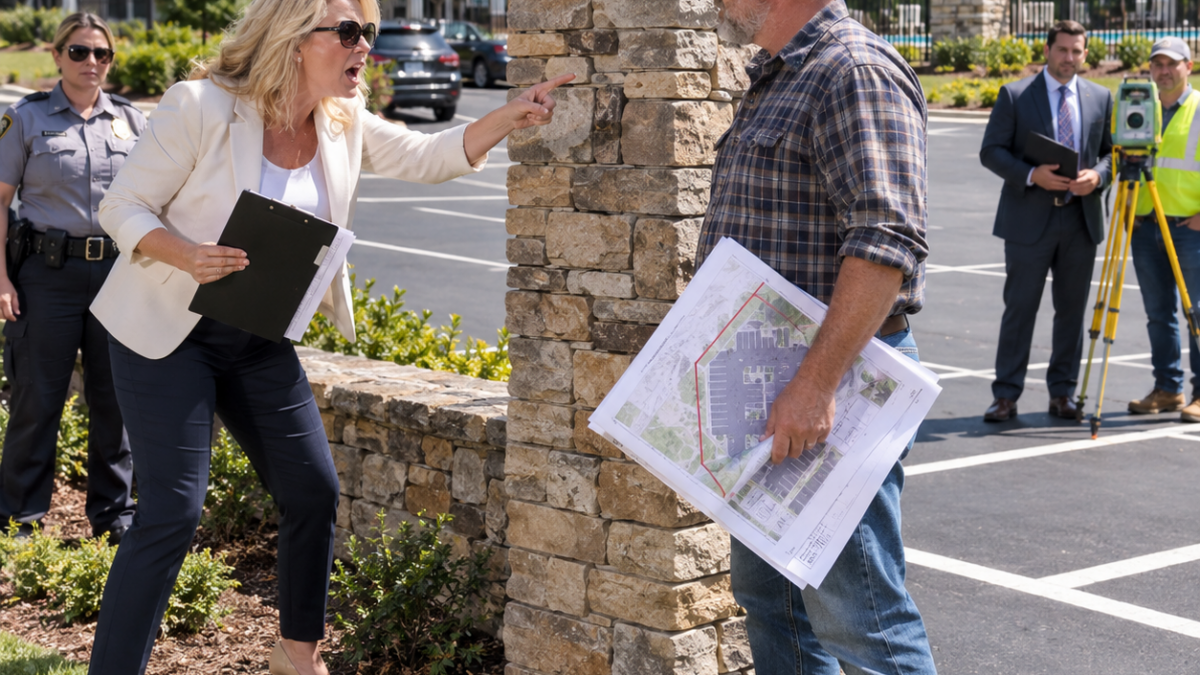
Karen gave me seventy-two hours to demolish the two stone columns I had built at the entrance to my own driveway, then smiled as she threatened to send a contractor onto my land and charge me five thousand dollars for the privilege. She thought the columns were proof that I had finally crossed the HOA badly enough for her to break me, but to me they marked something much older than her bylaws, her golf cart, or the subdivision she ruled like a private kingdom. What neither of us knew yet was that those two piles of stone were about to lead me to a dusty map that would turn her entire community upside down.
My name is Jack Riley, and after twenty-five years in the Marine Corps, all I wanted from retirement was a place where nobody could order me to pack another bag.
My wife Sarah and I had spent most of our marriage moving every few years. New bases, new houses, new neighbors, new roads to memorize, new bedrooms that never quite felt permanent. So when my great-uncle Silas left me ten acres outside Charleston, South Carolina, I thought life had finally given us roots.
The property was everything I wanted. An old farmhouse that needed work, acres of woods, rolling pasture, a creek at the back, and enough distance from the world that mornings began with birds instead of engines. The only complication was that our land had become an island surrounded on three sides by Oak Ridge Meadows, a new development filled with beige houses, manicured lawns, decorative streetlights, and a homeowners association run by a woman named Karen Prescott.
From the day we arrived, Karen treated my property like a stain on her master plan.
My Ford F-250 was an “unauthorized commercial vehicle.”
My chainsaw became a “community noise concern.”
A county-approved burn pile was suddenly an “atmospheric nuisance.”
Every few weeks, another notice appeared.
Every few weeks, I answered politely, citing the county regulations and reminding the board that several of their rules did not apply the way Karen claimed.
That only made her dislike me more.
Then I built the columns.
They were four feet high, three feet square, constructed from river stone I had collected from the property. I spent months on them. I mixed every batch of mortar myself, checked every course with a level, and chose each stone carefully. I wanted them to mark the entrance to the place where Sarah and I planned to grow old.
More than that, they meant permanence.
For a man who had moved for most of his adult life, that mattered.
I submitted the plans to the architectural committee six months before construction.
They were approved.
Signed.
Stamped.
Filed.
Then, two days after I placed the final capstone, Karen came rolling down the road in her customized HOA golf cart.
She stopped in front of my driveway, climbed out with a clipboard under one arm, and stared at the columns as though I had erected a missile silo.
“They come down,” she said.
I wiped mortar dust from my hands.
“No, they don’t.”
Her face reddened.
“The board reconsidered your application. Approval was issued in error.”
“You don’t retroactively unapprove completed work because you changed your mind.”
“We can, and we did.”
She handed me a notice.
“You have seventy-two hours. If the columns remain after that deadline, the HOA will hire a contractor to remove them. You will pay the demolition cost and a five-thousand-dollar penalty.”
I looked at the paper.
Then at her.
“These columns are on my property.”
“You are subject to community covenants.”
“They’re ten feet inside my surveyed boundary.”
“Your property is whatever the recorded documents say it is.”
That sentence stayed with me.
Because underneath Karen’s arrogance, there was one thing I respected.
Recorded documents.
I spent most of my military career around engineers, logistics officers, survey teams, and construction crews. I trusted measurements. I trusted coordinates. I trusted old records when people had bothered to preserve them.
So I looked at my columns.
Then at the road beyond them.
Then toward the clubhouse and swimming pool visible through the trees.
And somewhere in the back of my mind, I heard my late Uncle Silas telling me something I had dismissed years earlier.
“This was all ours once.”
That afternoon, instead of renting a jackhammer, I drove to the county records office.
Four hours later, I was staring at a plat map drawn in 1932.
There was my great-grandfather’s property.
There was the land later sold to the company that eventually became Oak Ridge Meadows.
And there, outlined in faded ink, was a one-acre rectangle marked with a single handwritten word.
RESERVED.
I laid the modern subdivision map beside it.
My hands went still.
Because that forgotten rectangle did not contain woods.
It contained the Oak Ridge Meadows clubhouse.
Its swimming pool.
And most of Karen’s eighty-space visitor parking lot.
I leaned closer to the map, barely breathing.
Karen had ordered me to tear down the columns marking my property.
Instead, she had just sent me looking for the documents proving I owned part of hers.
PART 2
I stayed in the county records office for almost another hour after finding the map because I did not trust myself to believe what I was seeing.
The woman working the records desk was named Mrs. Holloway, and she had the patient, slightly amused expression of someone who had spent thirty years watching families discover that land could carry secrets longer than people could.
“You all right over there?” she asked.
I looked from the 1932 plat to the modern Oak Ridge Meadows survey.
“I think I need another deed.”
She adjusted the magnifying glass hanging from a chain around her neck.
“That sentence usually means somebody’s afternoon just got complicated.”
“You could say that.”
I pointed to the one-acre rectangle.
“I need the chain of title for this parcel.”
She leaned over.
“Reserved tract?”
“Yes.”
“Give me a minute.”
She disappeared into the back room.
I remained seated, staring at faded lines drawn nearly a century before Karen had ever driven her golf cart through Oak Ridge Meadows.
The more I studied the map, the more obvious the problem became.
The original family property had once stretched across hundreds of acres. During the Depression, my great-grandfather had sold the majority of it to a timber company, but for some reason he carved out one rectangular acre near the old county road.
Reserved.
I remembered Uncle Silas talking about it.
He had been sitting on his porch, smoking a pipe and pointing toward what was then mostly woods.
“Your great-granddaddy never sold everything,” he had said.
I was probably seventeen.
I barely listened.
“What’d he keep?”
“The good parts.”
“What does that mean?”
Silas laughed.
“Means old men know things young men don’t.”
At seventeen, that sounded like nonsense.
At sixty, it sounded like evidence.
Mrs. Holloway returned carrying a thin folder.
“Here.”
Inside was the deed history.
The one-acre tract had remained in my great-grandfather’s name.
When he died, it passed to his son.
Then eventually to Silas.
And Silas’s will contained language I already knew well because Maria—the attorney I would soon call—had reviewed it during probate.
All real property, wherever situated, owned by me at the time of my death.
No exclusions.
No exceptions.
Everything went to me.
I looked up.
“Mrs. Holloway, who owns this parcel according to the current tax record?”
She typed something into her computer.
Her eyebrows rose.
“That’s interesting.”
“What?”
“The tax mapping system appears to have folded it into your larger tract for assessment purposes.”
“So the county has been taxing me for it?”
“Looks that way.”
“How long?”
She clicked again.
“Long enough that I’d suggest speaking with an attorney before you leave here telling people you own a swimming pool.”
I stared at her.
She smiled.
“I know Oak Ridge Meadows.”
I looked back at the map.
“So you see it too?”
“I see a title question.”
“Meaning?”
“Meaning old maps are wonderful, Mr. Riley, but you’ll want a licensed surveyor, title abstract, and lawyer before anybody starts changing locks at the clubhouse.”
I smiled for the first time all day.
“I wasn’t planning on changing locks.”
“Good.”
I folded my hands.
“I was thinking about charging rent.”
She laughed so loudly someone in the next room shushed us.
I left with certified copies of the 1932 plat, the deed chain, the tax parcel history, Silas’s recorded will, and enough adrenaline to keep me awake for a week.
When I got home, Sarah was in the kitchen.
She looked at the stack of papers under my arm.
“What happened?”
“I need the dining table.”
“That sounds serious.”
“It might be.”
I spread everything out.
Modern plat on the left.
1932 plat on the right.
Deeds down the center.
Then I circled the reserved acre in red pencil.
Sarah leaned over.
“What am I looking at?”
“The property line.”
“Ours?”
“Apparently.”
She followed the old boundary.
Then the modern one.
Then looked out the kitchen window toward the distant clubhouse.
Her eyes widened.
“No.”
“I think yes.”
“Jack.”
“I know.”
“You’re telling me their clubhouse is on our land?”
“Part of it.”
“The pool?”
“Yes.”
“The parking lot?”
“Most of it.”
She stared at me for several seconds.
Then she sat down.
“This is impossible.”
“That was my first thought.”
“How does a developer build an entire community center on land it doesn’t own?”
“Bad title work. Bad survey work. Bad assumptions.”
“Wouldn’t the county catch that?”
“County plat approval isn’t necessarily a warranty of title. They review zoning, access, drainage, infrastructure. If a developer presents a recorded deed and flawed survey that nobody challenges, mistakes can survive.”
Sarah rubbed her forehead.
“This is insane.”
“Yes.”
She looked at the two stone columns visible through the front window.
“So Karen…”
“Sent me to the records office.”
Sarah began laughing.
Not a polite laugh.
The kind that starts because your brain has run out of normal responses.
“She ordered you to tear down the columns, and instead you discovered she built her headquarters on your land?”
“I haven’t discovered anything legally final yet.”
She pointed at me.
“Don’t ruin this.”
“I’m being accurate.”
“You’re being annoying.”
“Also accurate.”
Her laughter faded.
Then concern returned.
“Jack, this could become enormous.”
“I know.”
“Please don’t do anything reckless.”
“I won’t.”
“Promise.”
“I promise.”
“And call a lawyer.”
“I already know which one.”
Maria Sanchez had been a captain in the Judge Advocate General’s Corps when we served together overseas.
She was one of those people who could speak softly while making everyone in a room understand they were losing an argument.
Years earlier, one of my Marines had been accused of misconduct after a chaotic convoy incident. The initial investigation was lazy, contradictory, and politically convenient.
Maria dismantled it.
Not with speeches.
With timelines.
Radio logs.
Vehicle records.
Witness contradictions.
At the end of the hearing, the case practically collapsed under its own weight.
After leaving the service, she opened a real-estate and contract law practice in Charleston.
Her receptionist initially told me she was booked for three weeks.
“Tell her it’s Jack Riley.”
A pause.
“May I tell her what it’s regarding?”
I thought about it.
“Tell her I’ve got a Karen situation involving a swimming pool I may accidentally own.”
Maria called back eleven minutes later.
“Sergeant Major.”
“Captain.”
“You actually own a swimming pool?”
“Possibly.”
“Are you drunk?”
“No.”
“Disappointing. Bring everything tomorrow.”
I arrived at her office carrying two document boxes.
She shook my hand.
“You always were dramatic.”
“I learned from officers.”
“Sit down before I charge you double.”
I explained the columns first.
The HOA approval.
Karen’s retroactive denial.
The five-thousand-dollar fine.
The threatened demolition.
The lien.
Maria’s expression went from amused to irritated.
Then I showed her the 1932 map.
She stopped talking.
I showed her the chain of title.
She leaned forward.
I showed her the modern overlay.
She stood.
“Where did you get this?”
“County archives.”
“Certified?”
“Yes.”
“Tax history?”
“Here.”
“Silas’s will?”
“Here.”
“Modern subdivision plat?”
“Here.”
She spread everything across her desk.
For fifteen minutes, she said almost nothing.
Finally, she looked up.
“Jack.”
“Yes?”
“If this survives professional survey and title review, Oak Ridge Meadows has a serious problem.”
“How serious?”
“The legal phrase is ‘very.’”
I smiled.
She did not.
“The funny part is Karen.”
“No, the dangerous part is Karen.”
That sobered me.
Maria pointed at the clubhouse parcel.
“If the HOA believes it owns this land, it may have borrowed against it.”
“They did. They renovated the clubhouse three years ago.”
“How much?”
“I heard around two million.”
She leaned back.
“If a lender has a security interest tied to property with defective title, that bank will become interested very quickly.”
“What about title insurance?”
“Also interested.”
“The developer?”
“Who built Oak Ridge?”
“Low Country Lifestyles LLC.”
She typed.
A moment later she frowned.
“Entity dissolved.”
“Gone?”
“Administratively dissolved years ago.”
“So who’s left holding the problem?”
“Potentially everybody.”
She started counting.
“The HOA. The title insurer. The bank. Possibly professionals involved in the original closing or survey, depending on statutes and records. Maybe successor entities.”
I looked at her.
“And me.”
“Yes.”
“What should I do?”
“Nothing.”
“That’s your advice?”
“For forty-eight hours.”
She lifted the HOA demolition notice.
“Karen thinks she has you cornered.”
“She does.”
“No.”
Maria smiled.
“She thinks she does.”
She pointed at me.
“You do not mention this parcel to anyone.”
“Not even Karen?”
“Especially not Karen.”
“What about the columns?”
“They stay.”
“The deadline is Friday.”
“Excellent.”
“Excellent?”
“If she escalates after written notice that the columns are on your property and previously approved, she creates more evidence.”
“What if she sends someone to tear them down?”
“You call the sheriff.”
“What if they show up before the sheriff?”
“You stand on your land and tell them they do not have permission to enter.”
“No confrontation?”
“No touching anybody. No threats. No Marine Corps reunion tour.”
I smiled.
“Understood.”
“Document everything.”
“I already do.”
Maria leaned back.
“Jack, this is no longer two stone columns.”
“I know.”
“No, I mean legally.”
Her expression hardened.
“If they are manufacturing violations, threatening your title, filing liens, and directing contractors onto property without authority, damages can become significant.”
I nodded.
“Then we let Karen keep talking.”
Maria smiled.
“Exactly.”
Karen did.
The seventy-two-hour deadline expired Friday at five.
Saturday morning, my columns were still standing.
Sunday afternoon, I found another notice taped to my mailbox.
TEN THOUSAND DOLLARS.
The fine had doubled.
The letter accused me of “willful defiance.”
Then came the towing attempt.
Monday morning at 6:42, my phone rang.
“Mr. Riley?”
“Yes.”
“This is Earl’s Towing. We have an HOA removal order for your Ford F-250.”
I looked out the kitchen window.
The truck was parked legally along the public street because I had been moving gravel the night before.
“Who authorized it?”
“Karen Prescott. HOA president.”
“Do not tow that vehicle.”
“Sir, I have a signed authorization.”
“You have authorization from someone who does not own my truck and does not control the public road.”
The man sighed.
“I just do the work order.”
“I understand. I’m giving you fair warning that I’m calling the sheriff.”
Silence.
“Why?”
“Because taking my legally parked vehicle without lawful authority could become a criminal matter.”
He muttered something.
“I’ll tell my driver.”
Five minutes later, a tow truck arrived anyway.
So did Deputy Miller.
I had called the non-emergency line, explained the situation, and told dispatch nobody was currently violent or threatening.
Miller pulled behind the tow truck just as the driver lowered the wheel lift.
I walked outside with registration papers in one hand and my phone recording in the other.
The driver looked toward the deputy.
“Aw, hell.”
Miller stepped out.
“Morning.”
“Morning, Deputy.”
He looked at the truck.
“What’s going on?”
The driver held up his paperwork.
“HOA says unauthorized commercial vehicle.”
Miller looked at my Ford.
Then at me.
“Commercial?”
“Personal. Registered to me. No business markings.”
I handed him the registration.
He read it.
“Street public?”
“Yes.”
“Any posted restriction?”
“No.”
Miller turned to the tow operator.
“You have a repossession order?”
“No.”
“Court order?”
“No.”
“Vehicle abandoned?”
“No.”
“Then don’t touch it.”
The man raised both hands.
“Fine with me.”
He started retracting the lift.
Then Karen arrived.
Of course she did.
Her golf cart came flying around the corner.
She parked halfway into the road.
“What is happening?”
Deputy Miller looked at her.
“Are you Karen Prescott?”
“Yes. I’m president of Oak Ridge Meadows.”
“You ordered this tow?”
“Yes. The vehicle violates covenant nineteen-B.”
“It’s on a public street.”
“It serves HOA homes.”
“That doesn’t make the street private.”
Karen’s face tightened.
“This community has standards.”
Miller handed the towing order back.
“Standards don’t override state traffic law.”
She pointed at me.
“He is intentionally provoking us.”
I said nothing.
Maria had been explicit.
Let her talk.
Karen looked at the tow driver.
“Remove it.”
The driver shook his head.
“Not with the deputy standing here telling me it’s legal.”
“I hired your company.”
“You hired a tow, lady. You didn’t buy the company.”
Several neighbors were watching from driveways.
Karen realized it.
Her face reddened.
“You’ll hear from our attorney.”
Miller sighed.
“I strongly recommend you do that before ordering another tow.”
The tow truck left.
Karen spun her golf cart around.
Before she could leave, Miller pointed toward it.
“Ma’am.”
She stopped.
“Your cart is obstructing the lane.”
“You cannot be serious.”
“I am.”
He wrote her a ticket.
By breakfast, the entire neighborhood knew.
By lunch, my doorbell started ringing.
That was how the Hendersons arrived.
Tim and Chloe Henderson lived three houses from the clubhouse.
Chloe was visibly pregnant.
Tim held a folder.
“We saw what happened.”
I let them in.
Sarah brought coffee.
Tim opened the folder.
“Our door.”
“Your door?”
Chloe showed me a photograph of a muted blue front door.
“It used to look like this.”
“What happened?”
“Karen said blue wasn’t approved.”
“What color is it now?”
Tim showed another photograph.
Beige.
Not warm beige.
Not elegant beige.
The kind of beige that looks like somebody surrendered.
“Five hundred dollars a month until we changed it.”
Sarah shook her head.
“That’s insane.”
Chloe’s eyes filled.
“We couldn’t afford the fight. We have a baby coming.”
Then came Mr. Abernathy.
Seventy-two.
Retired history professor.
Rose garden.
One small stone gargoyle tucked beside the flowers.
Karen had classified it as “potentially frightening statuary.”
I read that phrase twice.
“You’re serious?”
“Deadly.”
“How much?”
“Three hundred dollars so far.”
“Why keep it?”
Abernathy looked at me as if the answer were obvious.
“I bought it with my wife in Paris thirty years ago.”
His wife had died.
The gargoyle stayed.
By evening, nine families had come through our dining room.
A basketball hoop.
A school fundraiser sign.
Grass allegedly one-quarter inch too tall.
A mailbox post.
Children’s chalk drawings.
A decorative flag.
A birdbath.
One family had been fined for leaving a stroller visible inside an open garage.
When the last neighbor left, Sarah stood among the papers.
“This is bigger than you.”
“I know.”
“They’re afraid of her.”
“I know.”
“What do we do?”
I pulled out a legal pad.
“We stop fighting separately.”
The Oak Ridge Meadows Resistance started as a joke.
Mr. Abernathy called it that.
Then the name stuck.
Every Thursday, neighbors brought documents.
We built timelines.
Compared enforcement.
Noted which homes received warnings and which received fines.
Documented exemptions.
Photographed inconsistencies.
Maria reviewed everything.
Most of it was petty.
Some of it was troubling.
But she warned us constantly.
“Do not turn every obnoxious decision into a crime.”
Mr. Abernathy grumbled.
“Spoilsport.”
“Professor, I’m trying to keep you all out of defamation suits.”
“Fine.”
Karen’s next move arrived by certified mail.
FORCED REMEDIATION NOTICE.
The HOA had hired Bedrock Busters Demolition to remove my columns.
Scheduled arrival: Wednesday, 8:00 a.m.
Estimated charge to me: $7,000.
Maria read the letter.
Then sent me one word.
Perfect.
At 7:45 Wednesday morning, I was standing between the columns.
Deputy Miller waited behind the house.
He was there because I had filed a formal trespass complaint and showed him the demolition notice.
At 7:53, the convoy arrived.
Pickup truck.
Dump truck.
Flatbed carrying a Bobcat fitted with a hydraulic hammer.
Then Karen’s golf cart.
She rolled up wearing a khaki pantsuit and the expression of someone arriving to witness an execution.
The demolition foreman stepped out.
Big man.
Handlebar mustache.
He looked at the columns.
“Those?”
“Yes,” Karen said.
He shrugged.
“Hour. Maybe less.”
I walked forward.
“Morning.”
Karen held up her clipboard.
“Mr. Riley, this is your final opportunity to voluntarily comply.”
“Your contractor does not have permission to enter my property.”
“You signed HOA covenants.”
“I’m not debating you.”
The foreman looked uncomfortable.
“Lady said it was HOA property.”
“It isn’t.”
Karen turned.
“Proceed.”
The Bobcat started.
Metal tracks rolled forward.
The hydraulic hammer pointed toward the first column.
I raised one hand.
“That machine crosses my property line, I’m filing a criminal complaint.”
The operator stopped.
Foreman looked at Karen.
She shouted, “He is bluffing.”
That was when Deputy Miller walked around the house.
The foreman stared.
The Bobcat engine dropped to idle.
Miller approached.
“Who authorized this?”
Karen lifted her chin.
“I did.”
“To demolish his structures?”
“They are HOA violations.”
“Are they on his land?”
“They are subject to HOA control.”
“That wasn’t my question.”
Karen hesitated.
Miller looked at me.
“Are these columns inside your surveyed property?”
“Yes.”
“Did you authorize removal?”
“No.”
He turned back to Karen.
“Then nobody touches them without a court order or lawful authority establishing otherwise.”
Karen exploded.
“You do not understand HOA law.”
Miller gave her a tired look.
“I understand destruction of property.”
The demolition foreman took two steps backward.
“Nobody told us there was a dispute.”
“There isn’t,” Karen said.
“There sure looks like one.”
He waved at his crew.
“Load it.”
Karen spun around.
“You signed a contract!”
“And I’m not catching a felony charge over two rock pillars.”
The convoy left in under five minutes.
Karen remained.
Alone.
Deputy Miller wrote her another traffic citation for parking the golf cart sideways across the lane.
Neighbors watched openly now.
No curtains.
No pretending.
Karen looked at me.
“You humiliated me.”
I shook my head.
“You brought demolition equipment to my house.”
“You forced this.”
“No.”
I stepped closer, keeping my voice low.
“You chose this.”
Her face twisted.
“You think you’ve won?”
“No.”
I looked toward the clubhouse.
“I think we’re just getting to the interesting part.”
Maria filed for the boundary survey the next day.
We hired DeWitt Land & Survey, one of the most respected firms in the county.
They did not arrive with one guy and a tripod.
Four-person crew.
High-precision GPS.
Old monument research.
Ground-penetrating equipment.
Digital overlays.
Historic deed plotting.
For two days, they worked between my tract and the community center.
Karen followed them.
Harassed them.
Asked what they were doing.
The lead surveyor, Robert DeWitt, had the emotional range of granite.
“We are surveying property for Mr. Riley.”
“You do not have permission to survey HOA land.”
“We are not relying on HOA permission.”
“This is private property.”
“Yes.”
“Then leave.”
“No.”
She called the sheriff.
Deputy Miller returned.
At this point, he looked as though Oak Ridge Meadows had become his second job.
DeWitt showed him the work order and preliminary title information.
Miller looked at Karen.
“They can complete the survey.”
Her face went white.
Then the stakes appeared.
Bright pink ribbon.
One near the edge of the clubhouse lawn.
One behind the parking lot.
Another beside the pool equipment fence.
Residents began asking questions.
“What are those stakes?”
Karen told everyone they meant nothing.
They meant quite a lot.
Three days later, Maria called.
“Come in.”
Sarah came with me.
DeWitt’s final survey lay across Maria’s conference table.
The reserved one-acre tract had survived.
Precisely.
Unambiguously.
The modern physical improvements sat inside it.
Not all eighty parking spaces.
Sixty-two.
The clubhouse.
Most of the pool deck.
The pool itself.
A section of landscaped common ground.
Maria tapped the survey.
“This is now much more than an old map.”
Sarah stared.
“So we own it?”
Maria chose her words carefully.
“You have an extremely strong record title claim. The next step is quiet title.”
“What does that do?”
“Asks the court to determine ownership and eliminate competing claims.”
“And the HOA?”
“Defendant.”
“The bank?”
“Likely defendant.”
“Title insurer?”
“Yes.”
“Developer?”
“If there is any successor or entity to serve.”
Maria smiled faintly.
“Jack, you wanted roots.”
“I didn’t mean under the swimming pool.”
She laughed.
Then became serious.
“There’s another question.”
“What?”
“What do you want?”
I looked at Sarah.
“The land.”
“You want the clubhouse?”
“No.”
“Pool?”
“No.”
“Parking revenue?”
“They don’t charge.”
“Back rent?”
I paused.
Maria leaned forward.
“This is important. Ownership rights are leverage, but litigation should serve an objective.”
“I want the HOA off my back.”
“Only you?”
I thought about Chloe’s blue door.
Abernathy’s gargoyle.
Kids fined for basketball hoops.
All the people sitting around my dining table because one woman had made them afraid to decorate their own homes.
“No.”
Maria nodded.
“Good.”
The quiet-title complaint was filed the following Monday.
Oak Ridge Meadows HOA.
The original developer.
The title insurer.
The lender.
Other necessary parties.
Maria requested declaration of title.
Removal of the improper lien against my property.
Compensation for taxes attributable to the reserved tract.
Damages arising from the harassment campaign.
Other relief the court considered appropriate.
Karen was served at the pool.
I did not arrange that.
But I admit the irony was satisfying.
According to Tim Henderson, who happened to be there with his wife, Karen opened the complaint and sat down so suddenly someone thought she was fainting.
Within hours, the board called an emergency executive session.
We learned what happened later.
The HOA attorney, Barry Colton, finally performed the title review Karen should have ordered months earlier.
His conclusion was not comforting.
The Riley claim was strong.
Very strong.
The survey matched the historic deeds.
The recorded chain was intact.
The original developer’s title package appeared to have overlooked the reserved acre.
The bank demanded information.
The title insurer hired outside counsel.
The remaining board members panicked.
Barry recommended settlement.
Karen refused.
Of course she did.
She wanted a legal-defense assessment.
Two thousand dollars per home.
Hundreds of thousands in fresh money to fight me.
That was when the board finally fractured.
Frank Whitaker, the HOA treasurer and a quiet accountant who had spent years nodding through meetings, reportedly put both hands on the table and said:
“No.”
Karen stared at him.
“What?”
“We are not charging every family two thousand dollars because you couldn’t leave two stone columns alone.”
“This man is trying to steal our community center.”
“No.”
Frank pointed toward her.
“You escalated this.”
“I enforced the covenants.”
“You retroactively revoked an approval.”
“It was issued in error.”
“You tried to tow his truck.”
“It violated policy.”
“You sent demolition equipment onto his property.”
“He refused compliance.”
Frank stood.
“And now we may not own the land beneath this building.”
Karen screamed at him.
He resigned.
Another director resigned fifteen minutes later.
The emergency homeowners meeting was scheduled for the following Tuesday.
Karen intended to ask the residents to approve the $2,000 special assessment.
Maria attended with Sarah and me.
The clubhouse was packed.
People stood against the walls.
Some sat on windowsills.
The resistance group filled the first two rows.
Karen entered wearing red.
Bright red.
A power suit.
She looked directly at me.
Then away.
She opened without the usual minutes.
“Friends and neighbors, our community is under attack.”
Maria whispered beside me.
“Subtle.”
I almost smiled.
Karen continued.
“One individual who has spent months refusing to respect our community standards has now filed litigation seeking to take our clubhouse, our swimming pool, and our parking facilities.”
People looked toward me.
I stayed seated.
Karen pointed.
“He wants what you paid for.”
Someone behind us muttered:
“Didn’t we pay for lawyers trying to tear down his pillars?”
A few laughs.
Karen ignored them.
“He is using an ancient technicality to seize community property.”
Maria wrote something on her pad.
I leaned over.
“What?”
“Ancient technicality = deed.”
I bit my lip.
Karen raised her voice.
“We must fight.”
Then came the number.
“Two thousand dollars per household.”
The room erupted.
A young father stood.
“Two thousand?”
An elderly woman shouted:
“I’m on Social Security.”
Another:
“Why are we paying for your lawsuit?”
Karen pounded the gavel.
“This is not my lawsuit. This is our defense.”
Tim Henderson stood.
“No.”
Karen stared at him.
Tim’s voice shook slightly.
“This started with Jack’s columns.”
“Sit down.”
“You fined Chloe and me every month over our front door.”
“Mr. Henderson—”
“We repainted because we were afraid of you.”
The room quieted.
Chloe stood beside him.
“We hated that beige door.”
Somebody laughed.
Chloe did not.
“I cried the night we painted it because it felt like we didn’t own our own house anymore.”
Karen’s face tightened.
“This meeting is about litigation.”
Mr. Abernathy rose.
“Everything is about litigation once you hire enough lawyers.”
That got laughter.
He held up a photograph.
“My gargoyle.”
More laughter.
Karen slapped the table.
“This is ridiculous.”
Abernathy’s voice hardened.
“No.”
He looked at the room.
“What was ridiculous was being afraid to put a stone souvenir in my own rose garden because a woman with a clipboard might fine me.”
Someone clapped.
Then another.
Karen pointed at me.
“This is what he’s done! He turned you against the board!”
I finally stood.
“No.”
The room quieted.
“I didn’t turn anybody against you.”
“You organized them.”
“They came to my house after you tried to tow my truck.”
“You are an outsider.”
“I’ve never claimed otherwise.”
“You don’t even pay HOA dues.”
“Correct.”
“Yet you want our pool.”
“No.”
That confused her.
People looked toward Maria.
Karen laughed harshly.
“Your lawsuit says otherwise.”
Maria stood.
“My client’s lawsuit asks the court to determine title.”
Karen grabbed the gavel.
“You have no right to speak.”
Maria smiled.
“I represent the person whose land this meeting may currently be taking place on.”
A wave of laughter rolled through the room.
Karen’s face went crimson.
Maria continued.
“Mr. Riley does not want to close your clubhouse.”
Murmurs.
“He does not want to fence your pool.”
More murmurs.
“He does not want to charge your children admission.”
Someone shouted:
“Good!”
Maria smiled.
“He wants a lawful resolution.”
Karen snapped:
“Then dismiss the case.”
“No.”
Maria’s tone sharpened.
“Because your association placed a lien against his home, threatened him with demolition, attempted to tow his vehicle, and sent contractors onto his property.”
The remaining board members looked down.
Maria held up the survey.
“This is not an internet map.”
She held up the title abstract.
“This is not speculation.”
She held up the 1932 plat.
“This is not something Mr. Riley created.”
Then she turned toward the homeowners.
“The original developer built this facility on a one-acre parcel that it did not properly acquire. That parcel remained in the Riley family chain of title.”
Silence.
Karen shouted:
“Technical mistake!”
Maria turned.
“A deed is not a technical mistake.”
Karen’s hands shook.
“You’re extorting us.”
“No.”
Maria looked toward Frank Whitaker, the accountant who had resigned from the old board but was sitting near the aisle.
“Mr. Whitaker, would you come forward?”
He hesitated.
Then stood.
Maria handed him one page.
“The settlement proposal.”
Karen shot upright.
“What settlement?”
Maria looked at her.
“The one my client authorized this afternoon.”
Every person in the room leaned forward.
Maria spoke slowly.
“Mr. Riley will convey his entire interest in the one-acre tract containing the community center, pool, and parking area to a successor community association.”
A gasp.
Karen stared.
“For how much?”
Maria smiled.
“One dollar.”
The room went silent.
Then somebody said:
“What?”
“One dollar,” Maria repeated.
People started whispering.
Karen looked as if someone had struck her.
Maria held up one finger.
“Condition one: the current Oak Ridge Meadows HOA will be dissolved in accordance with applicable law and governing documents, and replaced with a new community association with transparent procedures and homeowner-approved bylaws.”
Second finger.
“Condition two: the current board resigns.”
The remaining directors stared at Karen.
Third finger.
“Condition three: Karen Prescott may not hold an elected, appointed, committee, enforcement, architectural-review, or volunteer position granting authority over residents within the successor association.”
The room exploded.
Applause.
Shouts.
People stood.
Karen pounded the gavel.
“Order!”
Nobody listened.
Maria waited.
The applause grew.
Tim hugged Chloe.
Mr. Abernathy raised both hands.
Sarah squeezed mine so hard my fingers hurt.
Karen screamed into the microphone.
“You cannot do this!”
I stood.
“I can keep the land.”
That quieted her.
Her eyes locked onto mine.
I continued.
“I can litigate title until the court decides.”
The room slowly settled.
“I can seek compensation for the years the tract was used without my family knowing the title problem existed.”
Karen said nothing.
“I can force the bank and title insurer to fight over who pays what.”
I looked around at the homeowners.
“But none of you created that survey error.”
People watched me.
“You bought houses in good faith. You paid dues in good faith. Your children swim in that pool. You hold birthdays here. Weddings. Retirements. Christmas parties.”
I looked at Karen.
“This was never about taking your clubhouse.”
Then I looked toward the doors.
“It was about two stone columns.”
Someone laughed.
I smiled.
“Two columns I had permission to build.”
The laughter faded.
“Karen wanted them gone because she needed to prove that saying no to her had consequences.”
I turned toward the residents.
“I’m offering you the land for one dollar because I don’t want your property.”
I paused.
“I want mine respected.”
The room stood.
Not everybody.
But almost everybody.
The applause felt different this time.
Not revenge.
Relief.
Karen remained seated.
Her red suit suddenly seemed too bright.
Too loud.
Too desperate.
Frank Whitaker stood.
“I move that we formally authorize counsel to negotiate acceptance of Mr. Riley’s settlement proposal and begin the process required to replace the current board structure.”
“Second!”
At least twelve people shouted it.
Karen grabbed the microphone.
“You don’t have authority to dissolve—”
The HOA attorney, Barry Colton, who had been sitting quietly against the wall, finally stood.
“Karen.”
She turned.
His face was exhausted.
“Stop.”
The room froze.
Her own lawyer continued.
“The members have the right to vote according to the governing documents.”
“You work for the board.”
“I work for the association.”
That sentence ended her.
A paper ballot was demanded.
The results were overwhelming.
The special assessment failed.
The settlement framework passed.
A recall petition against Karen began before the meeting ended.
By the following afternoon, more than enough signatures had been collected.
She resigned before the formal recall vote.
Not gracefully.
Her resignation letter accused me of manipulating the neighborhood, weaponizing historical records, and engaging in “legal terrorism.”
Maria read that phrase twice.
Then looked at me.
“Congratulations.”
“For what?”
“You’re officially a historical-record terrorist.”
Sarah laughed.
Within a week, the remainder of the old board resigned.
The successor association was formed under legal supervision.
Frank Whitaker became interim president.
Tim Henderson joined the board.
A retired accountant became treasurer.
Mr. Abernathy volunteered for the landscaping committee.
Maria warned everyone.
“You understand putting him on landscaping means there will be gargoyles.”
Abernathy nodded proudly.
“Plural.”
The property transfer happened in Maria’s office.
One dollar.
Frank handed me a crisp bill.
Maria recorded the deed.
The new association received clear title to the one-acre parcel.
The bank accepted the cure.
The title insurer paid a negotiated amount related to costs and defects.
Our litigation over title ended.
But Karen’s harassment remained a separate issue.
Maria had documented everything.
Retroactive denial.
Fines.
Lien.
Tow attempt.
Demolition convoy.
Trespass.
Abuse of association authority.
The new board did not want residents funding Karen’s behavior.
Neither did I.
We eventually reached a settlement requiring removal of every improper fine and lien, reimbursement of our legal costs attributable to HOA misconduct, and changes to enforcement rules.
I refused to demand money that would financially punish innocent families.
Maria initially argued with me.
“You are entitled to pursue damages.”
“I know.”
“You spent months under threat.”
“I know.”
“Sarah lost sleep.”
“I know.”
“So why are you protecting the association?”
“I’m protecting the people.”
She studied me.
Then nodded.
“Fine.”
“Fine?”
“I hate morally responsible clients.”
The new rules were simple.
No retroactive architectural revocations after completed approved work absent fraud or immediate safety concerns.
No towing from public roads based on HOA preference.
No contractor entry onto private property without owner consent, court order, or other lawful authority.
Fines required written evidence.
Appeals went to a panel not controlled by the person who issued the violation.
Large penalties required a board vote.
Enforcement records had to be public to members.
Selective enforcement could be challenged.
And vague clauses Karen had used as personal weapons were rewritten.
The blue front door returned first.
Tim and Chloe held a painting party.
Half the street showed up.
Chloe cried when the final beige patch disappeared.
“This is ridiculous,” she said, laughing through tears.
Sarah hugged her.
“No, it isn’t.”
Mr. Abernathy installed his gargoyle the next weekend.
Then another.
He named them Jack and Maria.
Maria threatened to sue him for defamation.
He told her he was a retired professor and had nothing left to lose.
Kids returned basketball hoops to driveways.
Some lawns got slightly too long.
Nobody died.
Someone put a bright purple planter beside a mailbox.
Property values did not collapse.
A yellow front door appeared.
Then a green one.
Oak Ridge Meadows began looking less like a brochure and more like a place where actual humans lived.
Karen disappeared for several weeks.
Her golf cart remained inside her garage.
No walkie-talkie.
No clipboard.
No enforcement patrols.
Her curtains stayed shut.
I did not celebrate that.
At least not the way I thought I would.
For months I had imagined her defeat.
I imagined some enormous confrontation.
A courtroom.
A judge.
Maybe a speech where I explained everything she had done.
But once her authority vanished, she became smaller than the conflict.
I realized I had never really hated Karen.
I hated what she had done to Sarah.
I hated the anxiety.
I hated seeing neighbors afraid.
I hated watching grown adults explain why they needed permission to enjoy their own homes.
Karen had simply become the face of that.
Three weeks after the new association took over, a FOR SALE sign appeared on her lawn.
A full-size professional sign.
Mr. Abernathy saw it first.
He knocked on my door.
“Jack.”
“What?”
“You need to see this.”
I stepped outside.
He pointed down the road.
The sign stood in front of Karen’s house.
He smiled.
“Any chance it violates community aesthetic standards?”
I stared at him.
“No.”
“Shame.”
“Professor.”
“I’m only asking.”
The house went under contract quickly.
Karen’s final day arrived on a Saturday.
I was applying sealant to my columns.
The same columns.
Still standing.
A moving truck was parked outside her house.
People carried boxes.
Karen emerged holding a cardboard container filled with framed photographs.
She saw me.
Stopped.
I did not wave.
Neither did she.
For almost a minute, we simply looked at each other across the distance.
Then she set the box in her car.
And walked toward me.
Sarah was in the garden.
She noticed.
I saw her straighten.
Karen stopped on the street side of my columns.
Her face looked tired.
Not furious.
Tired.
“They’re still here,” she said.
I looked at the columns.
“Yes.”
“You could have saved everyone a lot of trouble if you had just taken them down.”
I almost laughed.
“You still believe that?”
Her jaw tightened.
“This entire mess started because you refused to cooperate.”
“No.”
“You refused a lawful HOA order.”
“It wasn’t lawful.”
“You challenged everything I did.”
“Because some of it was wrong.”
She looked toward the clubhouse.
“You took my association.”
“I gave the association land.”
“You destroyed the board.”
“The homeowners replaced the board.”
“You humiliated me.”
I wiped sealant from my gloves.
“Karen, you brought a demolition crew to my driveway.”
“You forced me.”
“No.”
My voice remained calm.
“That is the part you still don’t understand.”
Her eyes narrowed.
“You had choices at every step.”
I pointed toward the first column.
“You could have honored the approval.”
Second column.
“You could have reviewed the survey.”
The road.
“You could have stopped after the towing attempt.”
The clubhouse.
“You could have settled when your own attorney told you the title claim was strong.”
I looked back at her.
“But every time someone told you no, you heard rebellion.”
Her face trembled.
“I was trying to preserve standards.”
“For whom?”
“The community.”
“The community voted against you.”
“They were manipulated.”
“No.”
“You turned them against me.”
“No.”
I lowered my voice.
“You made them afraid one at a time.”
She said nothing.
“All I did was let them meet each other.”
That hit her.
I saw it.
For months, Karen’s power had depended on isolation.
Tim thought he was the only person ashamed of repainting his door.
Abernathy thought he was the only one being ridiculous over a garden ornament.
Parents thought they were the only ones fined for toys.
Each family believed its problem was private.
Once they compared notes, the fear weakened.
Karen looked past me toward the house.
“You know what this neighborhood will look like in five years?”
“What?”
“A mess.”
“Maybe.”
That surprised her.
I continued.
“Maybe somebody paints something ugly.”
She frowned.
“Maybe somebody’s grass gets too long.”
I shrugged.
“Maybe Abernathy buys twenty gargoyles.”
“He probably will.”
“We agree on something.”
She almost smiled.
Almost.
Then it disappeared.
“And maybe people argue.”
I looked toward Oak Ridge Meadows.
“But that’s what living near other humans looks like.”
Karen shook her head.
“You don’t understand what it takes to keep order.”
I looked at my columns.
“Spent twenty-five years in the Marine Corps.”
“That’s different.”
“Yes.”
I looked back at her.
“It is.”
She waited.
“In the Marines, authority comes with accountability.”
Her eyes hardened.
“You think I wasn’t accountable?”
“I think you confused obedience with respect.”
She looked away.
A moving-truck driver called her name.
Karen stepped back.
Then she glanced at the columns.
“I always hated those things.”
I smiled.
“I know.”
“They’re too big.”
“Probably.”
“They don’t match anything.”
“That’s the point.”
Her eyes moved over the river stone.
“Did you really collect every one yourself?”
“Most.”
“Why?”
I thought about it.
Because after twenty-five years of moving, I wanted to build something I could not pack.
Because Uncle Silas had skipped stones across that creek as a boy.
Because Sarah deserved a house that would still be ours when the next set of orders never came.
Because permanence can become sacred to people who have spent their lives leaving.
“They meant we were staying.”
Karen looked at me.
For the first time, I think she understood at least part of it.
She nodded once.
Then turned away.
No apology.
No final insult.
She got into her car.
Drove past the clubhouse.
Past the pool.
Past the parking lot she once believed she ruled.
And disappeared around the curve.
I never saw her again.
A young couple bought her house.
Michael and Jen.
Two kids.
Golden retriever.
The first weekend after moving in, they painted their front door yellow.
Not pale yellow.
Not “heritage cream.”
Bright, unapologetic yellow.
I happened to be driving past.
Michael saw me staring.
“Too much?”
I thought about Karen.
Then the blue door.
Then the 1932 plat.
“No.”
I smiled.
“Looks like home.”
The clubhouse changed too.
Not physically at first.
The same brick.
Same pool.
Same parking lot.
But it felt different.
The brass plaque on the president’s office disappeared.
The door remained open during meetings.
Financial statements were posted.
Board votes were recorded.
Homeowners could speak without being cut off after sixty seconds.
The parking lot became the site of Friday food-truck nights.
The pool hosted a summer barbecue.
Sarah and I attended.
That was strange.
For months, the pool had existed in my mind as Parcel B-17, reserved tract, one acre more or less.
Now children were jumping into it.
Music played.
Abernathy sat under an umbrella wearing a Panama hat.
Tim and Chloe’s baby slept in a stroller.
Frank handed me a paper plate.
“Hamburger?”
“Thanks.”
He pointed toward the water.
“Want to know how much your pool costs to maintain?”
“My pool?”
He smiled.
“Old habits.”
“Not mine anymore.”
“Still one dollar too expensive.”
We laughed.
Then Chloe walked over.
She had her baby in one arm.
“Jack.”
“Yes?”
“I never thanked you.”
“You did.”
“Not properly.”
“For what?”
“For the door.”
I smiled.
“The door?”
She looked toward the houses.
“When Karen started fining us, I thought we had made a huge mistake buying here.”
Her eyes watered.
“We spent everything to get that house.”
Tim put a hand on her shoulder.
“I was pregnant. Every certified letter felt like someone telling us we didn’t belong in our own home.”
I understood.
More than she knew.
Chloe continued.
“Then we saw you tell that tow truck no.”
She laughed softly.
“That was the first time I realized Karen could be wrong.”
I looked toward the pool.
“She was wrong about plenty.”
“No.”
Chloe shook her head.
“I mean wrong and stoppable.”
That word stayed with me.
Stoppable.
Bullies are not powerful only because they have authority.
They are powerful because people begin treating their decisions as inevitable.
Karen had become inevitable.
Until she wasn’t.
Mr. Abernathy joined us carrying a plastic cup.
“You people are being sentimental.”
“Professor, nobody invited you.”
“This is technically communal land.”
“It’s actually communal now.”
“Because of me.”
“Because of you?”
“My affidavits were devastating.”
Tim laughed.
“You complained about a gargoyle.”
“Exactly.”
Abernathy pointed toward the clubhouse entrance.
Beside it sat two small stone gargoyles.
Jack and Maria.
Maria had come to the reopening and nearly dropped her coffee when she saw them.
“I hate you,” she told Abernathy.
“Counselor, I consider that a professional achievement.”
The new bylaws were not perfect.
No rules ever are.
But they were understandable.
Reasonable.
Enforceable.
And, most importantly, limited.
The association could address actual property issues.
Dangerous conditions.
Serious neglect.
Nuisances.
Common expenses.
But it could no longer become a lifestyle police force because one president disliked the color blue.
My improper lien was formally released.
The original architectural approval for the columns was reaffirmed.
Frank mailed me a new letter.
APPROVED — FINAL.
I framed that too.
Beside the one-dollar bill.
Sarah called the wall in my office “the museum of suburban warfare.”
Maria preferred “evidence locker.”
Months passed.
I finished restoring the farmhouse.
Sarah planted tomatoes, rosemary, roses, and enough basil to supply half Charleston.
I repaired the old barn.
Built a workshop.
Cleared trails through the woods.
The sound of my chainsaw stopped meaning conflict.
It became what it should have been from the beginning.
A man working on his land.
One autumn afternoon, I walked down the driveway carrying a bucket of sealant.
The columns needed maintenance.
River stone lasts.
Mortar needs care.
I brushed dirt from the base.
That was when I noticed something.
A small metal plaque.
Someone had attached it to the back side of the left column.
I crouched.
THE OAK RIDGE REVOLUTION BEGAN HERE.
I stared.
Then yelled:
“ABERNATHY!”
From somewhere across the road came laughter.
Sarah walked down the driveway.
“What happened?”
I pointed.
She read the plaque.
Then laughed.
“You’re leaving it.”
“No.”
“Yes.”
“It’s ridiculous.”
“So are you.”
“I did not start a revolution.”
“Tell them.”
She pointed toward the neighborhood.
Two children rode bicycles past.
One waved.
“Hi, Mr. Jack!”
I waved back.
Sarah touched the column.
“You know what I remember?”
“What?”
“The first night after Karen threatened demolition.”
I did too.
Sarah standing in our bedroom.
Unable to sleep.
Asking whether maybe we should take the columns down temporarily.
I remembered being angry.
Not at her.
At myself.
Because I had promised retirement would be peaceful.
Instead, our first permanent home had become another place where I had to plan for conflict.
“I was scared,” she said.
“I know.”
“No.”
She looked at me.
“I mean really scared.”
“I know.”
“I thought if she could put a lien on the house…”
Her voice trailed off.
I set down the brush.
Sarah continued.
“I knew logically that she was probably wrong.”
She looked toward our farmhouse.
“But fear doesn’t care much about logic at two in the morning.”
I took her hand.
“I’m sorry.”
“For what?”
“For making you go through it.”
“You didn’t.”
“I refused to take the columns down.”
“Good.”
“You asked me to.”
“I asked because I was scared.”
She squeezed my fingers.
“I’m glad you said no.”
That surprised me.
“You are?”
“Yes.”
She rested her head against my shoulder.
“If we had taken them down, Karen would have learned that frightening us worked.”
We stood between the columns.
The evening sun fell through the trees.
Sarah smiled.
“Also, we never would’ve found the pool.”
I laughed.
“There is that.”
Years of military life had taught me to think of terrain in tactical terms.
High ground.
Access routes.
Obstacles.
Cover.
Lines of communication.
But I eventually learned that home has terrain too.
A kitchen where someone waits for you.
A porch where your wife drinks coffee.
A barn carrying your family’s fingerprints.
A driveway framed by stone you set with your own hands.
Those things look ordinary to everyone else.
To you, they become coordinates.
They tell you where you belong.
That was why Karen’s demolition order hurt more than five thousand dollars.
She was not threatening rock.
She was threatening the first thing I had built specifically to say:
I am staying.
And ironically, the records created by generations of people who had stayed before me were what defeated her.
The old deed.
The reserved acre.
Uncle Silas’s will.
Faded ink.
Property lines nobody had bothered to ask about because everyone assumed the subdivision map was complete.
That assumption cost Oak Ridge Meadows months of legal panic.
But it also forced something good.
The title problem was fixed.
The community got indisputable ownership.
The lender got clear collateral.
The residents got a better association.
And I got something I never expected.
Neighbors.
Real ones.
Tim helped me reroof the shed.
Michael from Karen’s old house borrowed my tractor.
Chloe brought Sarah baby clothes her sister no longer needed for visiting grandchildren.
Abernathy appeared regularly without invitation and considered this normal.
Even Deputy Miller stopped by once while off duty.
He parked near the columns.
“Still standing.”
“So far.”
“Any more tow trucks?”
“No.”
“Demolition convoys?”
“Quiet year.”
He looked toward the clubhouse.
“You really gave them that for a dollar?”
“Yes.”
He shook his head.
“I’d have charged Karen rent.”
“Maria suggested it.”
“Smart lawyer.”
“Dangerous lawyer.”
He laughed.
Before leaving, he touched one column.
“Nice work.”
Those two words meant more than I expected.
Nice work.
Not violation.
Not structure.
Not noncompliant object.
Just something built well.
The way I had intended.
The one-dollar bill remained framed in my office.
Frank once asked if I wanted it back.
“No.”
“That was technically payment.”
“Exactly.”
“For land worth…”
“Don’t calculate it.”
“I’m an accountant.”
“Fight the urge.”
He smiled.
“That parcel is worth a lot more than a dollar.”
“I know.”
“Why really give it away?”
I thought about the question.
“Because owning it wasn’t the victory.”
“What was?”
“Choosing what happened to it.”
Frank nodded slowly.
That was the difference.
Karen thought power meant forcing choices onto other people.
I learned that power can also mean refusing to exploit an advantage just because you have one.
I could have fought for rent.
Could have threatened the pool.
Could have demanded access fees.
Could have forced a financial settlement large enough to hurt every homeowner.
Legally, Maria could have pursued several of those options.
But innocent residents would have paid.
People like Tim and Chloe.
Abernathy.
Families already paying mortgages.
Retirees on fixed incomes.
I did not spend twenty-five years in uniform to retire into the kind of man who punishes civilians because their board president angered him.
So I took a dollar.
What I wanted cost nothing.
Boundaries.
Respect.
Peace.
The pool reopened every summer.
No key for me.
No reserved chair.
No special privilege.
Exactly as I wanted.
Sometimes Sarah and I attended neighborhood events there.
Every time I pulled into the parking lot, she would say:
“You know, you used to own this spot.”
“I owned the dirt.”
“Same thing.”
“No.”
“You’re such an engineer.”
“Retired Marine.”
“Same personality problem.”
One evening after a barbecue, we stayed late.
Children had gone home.
The pool water was still.
String lights reflected across the surface.
Frank and Tim were stacking chairs.
Abernathy was stealing leftover cookies.
Sarah and I walked toward the parking lot.
She stopped at one of the survey markers that had been preserved near the landscaping.
“You remember when these pink stakes first appeared?”
“Yes.”
“You looked terrifyingly happy.”
“I was professionally satisfied.”
“You were grinning like a supervillain.”
“Unverified.”
She laughed.
Then became quiet.
“Was it worth it?”
The same question she had asked months earlier.
This time I knew the answer immediately.
“Yes.”
“All of it?”
“No.”
She looked at me.
“I wish you never lost sleep.”
I looked toward the clubhouse.
“I wish Chloe never cried over a blue door.”
The pool.
“I wish Abernathy never had to defend a memory of his wife.”
The road.
“I wish Karen had just driven past my columns and minded her own business.”
Sarah smiled faintly.
“But?”
“But once she didn’t, I’m glad we finished it.”
We walked home.
The columns were visible ahead.
Porch light spilling across them.
Solid.
Ordinary.
Permanent.
The plaque Abernathy attached remained on the back.
I never removed it.
Not because I believed a revolution started there.
It didn’t.
What started there was much smaller.
A woman told a man that because she held a title, she could erase something he had already been given permission to build.
The man said no.
Then he checked the records.
That was all.
But sometimes the most dangerous word a bully can hear is not a threat.
It is no.
No, you cannot rewrite an approval because you are angry.
No, you cannot tow property because somebody disagrees with you.
No, you cannot send machines onto private land and call destruction “remediation.”
No, your authority does not become unlimited simply because everyone around you stopped challenging it.
And no, a community does not belong to the person with the loudest voice.
Years later, people in Oak Ridge Meadows still told the story incorrectly.
New residents would point toward my driveway.
“That’s the guy who stole the HOA’s parking lot.”
Older neighbors corrected them.
“No.”
Then they pointed to the columns.
“The HOA tried to tear those down.”
Another neighbor would add:
“And found out he owned the pool.”
Someone else:
“For about five minutes.”
Abernathy:
“Until he foolishly sold it for one dollar.”
Then the story became laughter.
That was how I preferred it.
Not a war story.
A neighborhood story.
Because eventually that was what Oak Ridge Meadows became.
A neighborhood.
Not Karen’s kingdom.
Not my battlefield.
Just a place where people lived.
Tim and Chloe raised their daughter there.
Her first bicycle was blue.
To match the door, Tim claimed.
Abernathy’s roses expanded into what he called “an unauthorized botanical empire.”
The new association approved it unanimously.
Michael and Jen kept the yellow door.
Their golden retriever regularly escaped and visited our pasture.
Sarah named him Mayor.
I never joined the HOA board.
People asked.
Several times.
My answer never changed.
“No.”
“You’d be good at it.”
“That is exactly how trouble starts.”
Frank laughed when I told him.
“What if we need your advice?”
“Ask.”
“Architectural committee?”
“No.”
“Land-use advisory group?”
“No.”
“Historic property liaison?”
“Absolutely not.”
He shook his head.
“Fine.”
I wanted no title.
That was part of the point.
My authority ended at my property line.
Their authority ended at theirs.
Simple.
One spring morning, Sarah found me rebuilding a section of stone wall near the entrance.
She watched for several minutes.
“You know you could hire somebody.”
“I know.”
“You’re sixty-three.”
“I know.”
“Your back is going to hate you.”
“It already does.”
She handed me water.
“Then why?”
I looked toward the two columns.
“Same reason.”
“What reason?”
“I like knowing where the stones go.”
She understood.
Later that afternoon, Tim’s daughter came over.
She was maybe six.
She pointed at the columns.
“Did you make those?”
“Yes.”
“Why?”
“To mark the driveway.”
She considered that.
“My dad said a mean lady wanted to break them.”
I looked toward Tim.
He was pretending not to listen.
“That was a long time ago.”
“Did she?”
“No.”
The little girl touched the stone.
“Because they’re too strong?”
I smiled.
“Something like that.”
She ran off.
I watched her go.
Too strong.
Not exactly.
The columns could have been broken.
A hydraulic hammer would have reduced them to rubble in minutes.
Strength was not why they survived.
They survived because destruction required authority Karen did not have.
That distinction mattered.
People often confuse force with legitimacy.
Karen had force.
Money.
Board votes.
Contractors.
A lawyer on retainer.
Letters with official logos.
What she lacked was the legal right to do what she wanted.
Once somebody forced that question into the open, the rest collapsed.
The same was true of the reserved acre.
The clubhouse had looked permanent.
Concrete.
Brick.
Mortgage.
Pool.
Parking lot.
Twenty years of unquestioned use.
But none of that changed the old deed.
Appearances do not create ownership.
Confidence does not create jurisdiction.
A clipboard does not create law.
One evening, I opened Uncle Silas’s old cedar chest.
I had kept several things from his house.
Pocketknife.
Pipe.
Photographs.
A cracked compass.
At the bottom was an envelope I had never opened.
Inside was a photograph of the property from the 1950s.
Open fields.
A dirt road.
No subdivision.
No pool.
On the back, Silas had written:
KEEP THE BEST PIECE.
I sat there for a long time.
Maybe he meant the ten acres.
Maybe the reserved acre.
Maybe something else entirely.
Sarah found me.
“What is that?”
I handed her the photograph.
She read the back.
Then looked at me.
“Well.”
“What?”
“Apparently he knew.”
“Knew what?”
“That you’d need instructions.”
I laughed.
We framed the photograph.
It hangs beside the one-dollar bill.
That is my favorite wall in the house.
Not military awards.
Not photographs from deployments.
A one-dollar bill.
A note from a dead uncle.
A copy of the original column approval.
Three reminders.
Know what is yours.
Know what matters.
And never confuse price with value.
Years after Karen left, someone asked me whether I felt sorry for her.
I thought carefully.
“Yes.”
They were surprised.
“After all that?”
“Yes.”
“Why?”
“Because she built her whole identity around being obeyed.”
When that disappeared, she had nothing underneath it.
I don’t know what happened to Karen after she moved.
I heard different stories.
Different town.
Different neighborhood.
Maybe another HOA.
I hope not.
Not because I wanted her punished forever.
Because I hope somewhere she discovered what authority is actually for.
Good leadership is quiet most of the time.
It solves problems nobody applauds.
Repairs drainage.
Balances budgets.
Maintains insurance.
Makes sure pools are safe.
Keeps roads usable.
Explains decisions.
Takes criticism.
Allows disagreement.
Karen wanted the visible parts.
The gavel.
The badge.
The clipboard.
The power to say no.
She never understood that leadership is mostly responsibility.
Eventually, Oak Ridge Meadows did.
The new association was boring.
That was the highest compliment I could give it.
Meetings ended on time.
Budgets balanced.
Nobody screamed.
Nobody drove enforcement patrols in golf carts.
The biggest annual dispute became whether the holiday lights could stay up until January tenth or January fifteenth.
Abernathy argued for February.
He lost.
Democracy survived.
One fall, the community decided to renovate the parking lot.
Frank called me.
“Jack.”
“No.”
“I haven’t asked anything.”
“You’re about to.”
“We need temporary access across six feet of your driveway.”
“For what?”
“Construction staging.”
“How long?”
“Three days.”
“Insurance?”
“Yes.”
“Contractor?”
“Bonded.”
“Written agreement?”
“Already drafted.”
I smiled.
“Send it.”
There was a pause.
“That easy?”
“You asked.”
Another pause.
“That’s it?”
“That’s how property rights work.”
Frank laughed.
“You’re never going to let us forget, are you?”
“Never.”
The work finished in two days.
They restored the grass.
No dispute.
No fines.
No war.
Because respect makes most conflicts boring.
That is something Karen never learned.
The final time anyone seriously mentioned the columns at an HOA meeting, I happened to be there because Sarah wanted to discuss landscaping near the entrance.
A new homeowner named Daniel raised his hand.
“Can someone explain those stone pillars at the Riley property? Are they historic?”
Mr. Abernathy, now nearly eighty, slowly stood.
“Yes.”
I looked at him.
“They are not historic.”
He ignored me.
“They represent the uprising against the Prescott regime.”
Groans.
Frank buried his face in his hands.
Daniel looked fascinated.
Abernathy continued.
“Those columns led to the discovery that Jack owned this building.”
I interrupted.
“Temporarily.”
“Property rights do not care about modesty.”
Maria would have enjoyed that.
After the meeting, Daniel approached me.
“Is any of that true?”
“Unfortunately.”
“You really owned the clubhouse?”
“The land underneath it.”
“And gave it away?”
“For a dollar.”
“Why?”
I looked around.
Children ran through the lobby.
Parents talked near the doors.
A board member was helping an elderly resident with a maintenance form.
Nobody looked nervous.
“Because I didn’t need a clubhouse.”
“What did you need?”
I smiled.
“Two stone columns.”
That was the whole story.
Everything else came because Karen could not accept that answer.
That night, Sarah and I sat on our porch.
The same porch we had imagined sitting on when we first inherited the property.
No deployment schedule.
No moving boxes.
No orders.
Crickets.
Trees.
The glow of the house behind us.
The columns visible near the road.
Sarah rested her head against my shoulder.
“Still worth it?”
I smiled.
“You ask that a lot.”
“I like checking.”
I looked toward Oak Ridge Meadows.
A blue door.
A yellow door.
A basketball hoop.
Farther away, lights from the clubhouse.
Then my eyes settled on the columns.
The river stones caught the porch light.
Each one was imperfect.
Different shape.
Different shade.
Yet fitted together carefully enough to hold.
I thought about how much that resembled the neighborhood after Karen left.
Not uniform.
Not identical.
Strong because differences had been fitted together instead of ground down.
“Yeah,” I said.
“It was worth it.”
Sarah squeezed my hand.
“Good.”
We sat quietly.
No certified letters.
No golf cart.
No demolition trucks.
No survey crew.
No lawyers calling.
Just our home.
That was the ending I had wanted from the beginning.
Not Karen destroyed.
Not a parking lot acquired.
Not a legal victory.
Peace.
The columns never moved.
The pool stayed with the families who used it.
The parking lot stayed full during summer barbecues.
The clubhouse belonged to the community under a clean deed.
And my property line became exactly what a property line should be.
A boundary.
Not a battlefield.
Karen once told me my property was whatever the HOA said it was.
She was wrong.
Property is determined by deeds, surveys, law, and rights older than any HOA president’s opinion.
But home?
Home is something else.
Home is the place where your wife stops worrying about another move.
Where neighbors knock because they want coffee instead of because they are afraid.
Where children laugh without someone measuring the sound.
Where a blue door can stay blue.
Where a gargoyle can sit among roses.
Where two stone columns can simply be two stone columns.
And where the man who spent most of his life leaving finally gets to look at something he built and know it will still be there tomorrow.
Sometimes I run my hand across the rough river stone when I walk past.
I remember Uncle Silas.
I remember Mrs. Holloway laughing in the records office.
I remember Maria staring at the 1932 map.
I remember Deputy Miller appearing behind the house as the Bobcat rolled forward.
I remember Karen’s face when Maria offered the clubhouse back for one dollar.
And I remember Sarah asking if any of it had been worth the stress.
The answer becomes simpler every year.
Yes.
Not because Karen lost.
Because we stayed.
Not because I discovered I owned their parking lot.
Because I chose not to use ownership to become the kind of person I had been fighting.
Not because the HOA disappeared.
Because it came back smaller, cleaner, and accountable.
And not because those columns defeated Karen.
They didn’t.
The truth did.
The survey did.
The records did.
The neighbors did.
All the columns ever did was stand there.
Solid.
Quiet.
Exactly where they belonged.
Just like us.








