HOA Ordered Me to Tear Down My Grandfather’s Stone Wall—Then an Engineer Proved It Was Holding Back a Landslide From Their Cul-de-Sac
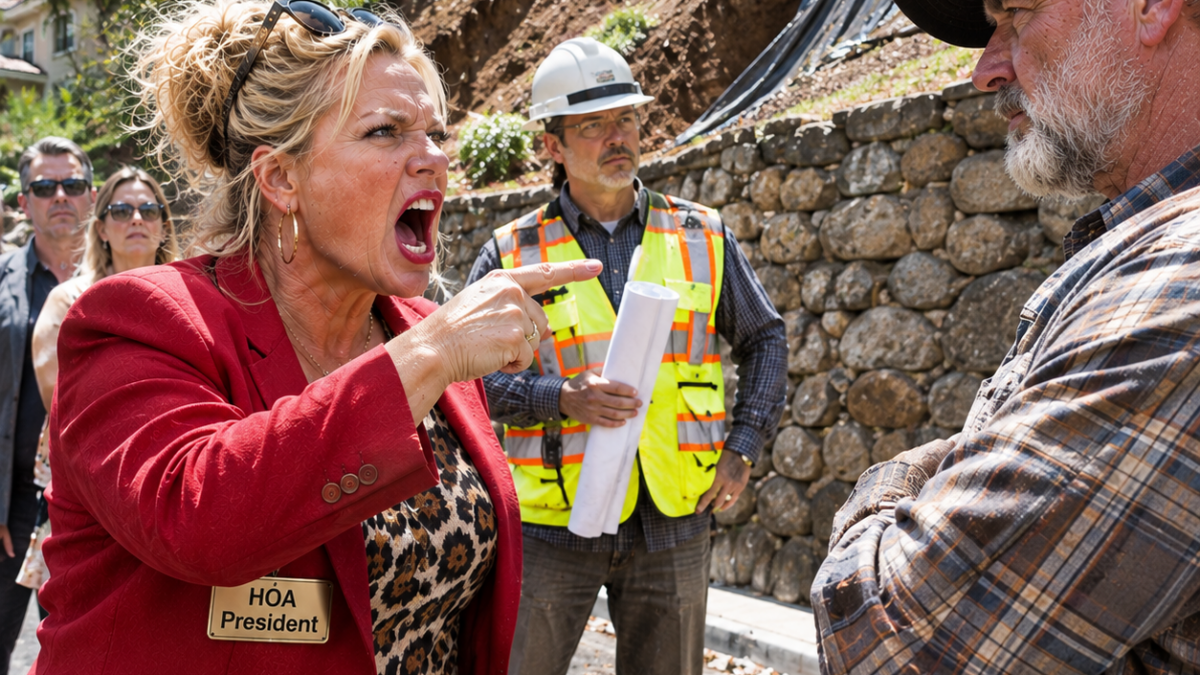
The afternoon Karen stood beyond my split-rail fence, pointed at the two-hundred-foot stone wall my grandfather and his brothers had built by hand sixty years earlier, and informed me that I had thirty days to demolish the “unsightly pile of rocks” or Harmony Ridge Estates would hire a contractor to do it for me and charge my property two hundred dollars a day until I surrendered, I didn’t argue with her because I had spent twenty years in the Army learning that when somebody confidently orders the destruction of something they don’t understand, the smartest first move is usually to let them finish talking.
She thought the wall was nothing more than moss-covered granite ruining the view from her immaculate beige cul-de-sac, but I knew every twelve-foot section of that old dry-stack structure had been built into the hillside for a reason, and as I looked past Karen toward the perfectly manicured homes sitting below us, I felt the kind of cold unease that comes when a person with just enough authority to be dangerous starts making decisions about forces she cannot see.
What Karen didn’t know as she adjusted the clipboard against her chest and told me the board’s decision was “final” was that by threatening those stones she had just forced me to open records nobody in Harmony Ridge had looked at for decades, and somewhere inside those forgotten surveys, old planning minutes, legal agreements, and layers of Appalachian soil was an answer that would change what every family at the bottom of that hill thought they knew about the ground beneath their homes.
My name is Jack Reed.
I inherited forty acres after my grandfather died.
The land sat above Harmony Ridge Estates like a stubborn wedge of old Appalachia that development had somehow failed to erase.
Pine.
Pasture.
Shale.
Clay.
An old split-rail fence.
And the wall.
Nearly two hundred feet long.
About twelve feet high through its largest sections.
No mortar.
Massive stones fitted together by men who understood gravity before software started explaining it for them.
My grandfather and his brothers built it sixty years earlier.
As a kid, I thought it was simply part of the hill.
Granddad never treated it like a monument.
He’d inspect it after hard rain.
Pull vines from the drainage gaps.
Replace small stones if frost shifted them.
Once, when I was maybe twelve, I asked why he cared so much about a wall nobody could even see from the house.
He put his hand against one of the lower stones.
“Because the hill wants to go downhill, Jackie.”
I laughed.
He didn’t.
“Everything does, given enough water and time.”
That sentence stayed with me.
Twenty years in the Army turned it from grandfather wisdom into engineering truth.
When I came home for good, those forty acres became the quietest place I knew.
Then the lower parcel changed.
Granddad had sold that portion to developers about a decade before, but the sale came with a written condition: the retaining wall on our remaining land was to be treated as permanent because it was essential to the slope.
The developer signed.
Then came roads.
Utilities.
Cookie-cutter houses.
Harmony Ridge Estates.
At the bottom of the hill, they built Harmony Court—a pristine cul-de-sac of expensive homes with trimmed lawns and driveways clean enough to eat off.
For years, nobody bothered me.
Then Karen became HOA president.
Her first complaints were cosmetic.
Wildflowers.
Fence appearance.
“Mismatched rural character.”
I ignored most of it because my property wasn’t part of Harmony Ridge.
Then she noticed the wall.
Two days after our confrontation at the fence, her official letter arrived.
Cream cardstock.
Embossed pine-tree logo.
SECTION 12, SUBSECTION B — AESTHETIC HARMONY AND LANDSCAPE INTEGRITY.
Thirty days to remove the wall.
Photographs showed moss circled in red.
Wildflowers growing between stones marked as “visible deterioration.”
Daily fines after the deadline.
I sat at my grandfather’s old oak desk beneath the yellow light of his banker’s lamp and read the letter twice.
Then I opened a blank file on my computer.
At the top, I typed:
OPERATION KEYSTONE
I wasn’t planning revenge.
Not yet.
I was planning documentation.
Because Karen thought the argument was about whether an old wall was ugly.
I already knew it wasn’t.
The only question was how much proof I would need before she understood exactly what she had ordered destroyed.
PART 2
My first response was deliberately boring.
No anger.
No insults.
No threat about lawsuits.
I wrote Karen and the board a short, professional letter explaining three things.
First, the wall predated Harmony Ridge Estates by decades.
Second, it stood entirely on my private property.
Third, the original sale agreement between my grandfather and the developer explicitly protected it as a permanent structural feature necessary to the stability of the hillside.
I attached the agreement.
Then I added one paragraph I hoped would end the fight.
This structure is not decorative. It functions as a critical retaining system. Any modification or removal could result in severe geotechnical instability affecting the properties below. I strongly recommend that the board consult a licensed geotechnical engineer before taking further action.
I sent it certified mail.
Karen signed for it.
Seven days later, an email arrived.
No engineer.
No questions.
No request for clarification.
Karen wrote that the old developer agreement was “irrelevant” to current Harmony Ridge covenants.
She claimed every property within the “visual range” of Harmony Ridge could be subject to community aesthetic standards.
Then she dismissed my warning as:
your personal opinion concerning the alleged purpose of the wall.
I read that phrase twice.
Personal opinion.
After two decades working around earthworks, infrastructure, drainage, and slope conditions, I knew enough to understand the risk.
But that didn’t matter.
Karen didn’t know me.
And even if she had, I didn’t want the case depending on my résumé.
If she wanted an independent professional opinion, I would give her one.
Actually, I would give her one whether she wanted it or not.
Arthur Vance
Apex Geotechnical Services was forty minutes away.
The man who answered the phone introduced himself as Arthur Vance.
Thirty years in geotechnical engineering.
I explained the wall.
His tone changed immediately.
“Twelve feet?”
“Average in the main section.”
“Dry stack?”
“Yes.”
“How long?”
“Almost two hundred feet.”
“And homes are below it?”
“Cul-de-sac.”
“How close?”
“Close enough that I’m calling you.”
He went quiet.
Then:
“And the HOA wants it removed?”
“Yes.”
“For aesthetics?”
“Yes.”
Another silence.
“I’ll be there tomorrow.”
Arthur arrived in an old truck coated with enough dust to suggest he actually visited job sites.
Tall.
Lean.
Weathered face.
No wasted motion.
He walked the wall from end to end.
Measured.
Photographed.
Tapped stones.
Examined the batter angle.
Looked at drainage gaps.
Took soil samples above it.
Used a hand auger.
Checked the toe.
Studied how the lowest courses disappeared into the slope.
For four hours, I mostly stayed out of his way.
Eventually we stood near the center of the wall looking down toward Harmony Court.
Arthur wiped his hands on a rag.
“Your grandfather built this?”
“With his brothers.”
“He know engineering?”
“Not formally.”
Arthur gave a small laugh.
“He knew something.”
He pointed toward the lower courses.
“Look at the mass at the base.”
Then the backward tilt.
Then the way stones had been keyed toward the hill.
“This is a gravity retaining system.”
“I know.”
“No, Jack.”
He looked at me.
“This is a damn good gravity retaining system.”
For the first time since Karen’s letter, I felt some of the pressure in my chest loosen.
Then Arthur turned serious.
“You need a report.”
“That’s why you’re here.”
“No.”
He looked downhill.
“You need a report because somebody is eventually going to ask why houses were allowed this close to a slope like this.”
That was the first hint the problem might be bigger than Karen.
The Survey
While Arthur prepared his analysis, I hired a licensed surveyor.
If Karen intended to argue jurisdiction, I wanted the boundary fixed beyond dispute.
Two days later, bright orange ribbons appeared along the line.
The result was better than expected.
The entire retaining wall stood roughly five feet inside my property.
Not inches.
Feet.
Every stone.
Every footing.
Every cap.
I photographed each marker.
Wide shots.
Close-ups.
Wall.
Stake.
Harmony Ridge houses visible below.
The green Operation Keystone binder gained another section.
Arthur’s Report
Twenty pages.
Soil charts.
Slope geometry.
Drainage conditions.
Hydrological observations.
Stability calculations.
But the important paragraph was written in language nobody needed an engineering degree to understand.
The wall was the primary element preventing catastrophic slope failure.
The hillside consisted largely of colluvial soil over weathered shale.
Under heavy saturation, that combination could become extremely unstable.
Removing the wall without a comprehensive replacement stabilization system would, in Arthur’s professional opinion, create a near-certain risk of significant landslide activity.
Potential consequences:
Property destruction.
Road obstruction.
Foundation damage.
Possible injury or death.
Estimated cost of replacing its stabilizing function with a modern engineered system:
High six figures.
I leaned back in my chair.
Granddad’s “pile of rocks” had probably saved the developer hundreds of thousands, maybe more.
And Karen wanted to bulldoze it because moss offended her.
I made ten copies.
The Hearing
The HOA hearing happened on a Thursday evening.
Small community center.
Folding chairs.
Stale coffee.
Karen at the center table.
Her two familiar nodding board members sat nearby.
The treasurer was a woman whose expression suggested the entire world smelled unpleasant.
About a dozen residents watched.
When my name was called, I walked forward with the green binder.
Karen smiled.
“Mr. Reed, you may present your appeal.”
“I’m not appealing.”
That bothered her.
I continued.
“I’m providing evidence.”
I handed packets to every board member.
“First document is the original land-sale agreement.”
Karen didn’t look.
“Second is the certified survey establishing the wall approximately five feet inside my private property.”
One man actually studied that.
“Third is a twenty-page report by Arthur Vance of Apex Geotechnical Services.”
I paused.
“Licensed geotechnical engineer. Thirty years’ experience.”
That finally got a few residents’ attention.
I explained Arthur’s conclusion.
The wall wasn’t decorative.
It wasn’t abandoned.
It wasn’t crumbling.
It was actively retaining a saturated and inherently unstable slope.
Karen pushed her packet aside.
Literally.
Didn’t read the first page.
“Mr. Reed, we appreciate your homework project.”
A few people shifted uncomfortably.
“But the architectural review committee is responsible for maintaining property values.”
“Arthur Vance is responsible for evaluating whether the hill stays on the hill.”
Nervous laughter behind me.
Karen’s face hardened.
“This fear-mongering is exactly the sort of behavior we will not tolerate.”
“It’s an engineering report.”
“Your expert.”
“You’re welcome to hire another.”
“We don’t need to.”
That sentence told me more than the entire hearing.
They didn’t want the truth tested.
They wanted it dismissed.
Karen called for a vote.
Motion to uphold violation.
Seconded.
All four hands.
“The motion carries.”
She looked directly at me.
“Your fines currently total thirty-four hundred dollars.”
I nodded.
Then turned toward the residents.
“For the record, this board has now received a licensed engineer’s written warning that removing this wall could create catastrophic landslide risk to the homes below.”
Karen snapped:
“Mr. Reed—”
I kept going.
“And the board has voted to ignore it.”
I looked toward whoever was recording minutes.
“Please include that.”
Then I left.
I hadn’t lost anything.
I had put them on notice.
George Henderson
The nearest house below belonged to George Henderson.
Late seventies.
Classic Ford Mustang in the garage.
Lawn cut so evenly it looked painted.
I found him polishing the car.
“Mr. Henderson?”
He looked up.
“Depends who’s asking.”
“Jack Reed. Property above the cul-de-sac.”
His face changed.
“The wall guy.”
“That’s me.”
He smiled faintly.
“Come in out of the sun.”
I explained the situation.
Not dramatically.
Then showed him Arthur’s conclusion.
George stopped polishing.
“You’re telling me that wall is holding the hill?”
“Arthur is.”
He read silently.
Then:
“Karen said it’s decorative.”
“No.”
“She said you’re refusing to maintain it.”
“Also no.”
He looked uphill.
Then toward his house.
“My bedroom’s at the back.”
I understood what he was thinking.
I didn’t exaggerate.
“The wall is stable now.”
“Now?”
“Yes.”
“And if they remove it?”
“Arthur thinks that’s dangerous.”
George exhaled.
Then he surprised me.
“Let me tell you something about Karen.”
Eggshell White
George and his wife had repainted their home the previous spring.
They submitted the exact color.
Approved.
Crew painted the house.
Four thousand dollars.
Two days after completion, Karen arrived.
The finished paint appeared half a shade brighter in afternoon sunlight than the two-inch sample.
Violation.
Repaint.
Another four thousand.
They appealed.
Lost.
George laughed bitterly.
“That’s the woman deciding what’s safe for my house.”
He signed an affidavit.
Detailed.
Not about the wall.
About how Karen operated.
Power first.
Facts second.
The Miller Family
George gave me another name.
The Millers.
They no longer lived in Harmony Ridge.
I found them in the next town.
Their teenage son had survived cancer.
During recovery, his friends helped install a heavy-duty basketball hoop so he could gradually rebuild strength.
Harmony Ridge allowed portable basketball hoops.
Theirs was permanent.
Karen launched a year-long enforcement campaign.
Fines.
Legal expenses.
Threats.
Eventually the family couldn’t keep carrying it.
They sold.
When I met them, the father still had every notice.
“I don’t care if it helps you,” he said. “I want somebody to know what she did.”
They gave me a notarized statement.
Another divider in Operation Keystone.
Town Hall
Then I found the documents that changed everything.
Planning office.
Old records.
Microfilm.
Boxes nobody had probably opened in years.
Harmony Ridge preliminary development file.
Inside:
A geotechnical report commissioned by the original developer, Northstar Homes.
I started reading.
Then stopped.
Then started again.
Same soil conditions Arthur found.
Colluvium.
Weathered shale.
Saturation risk.
Potential slope failure.
Recommended setback:
Two hundred feet from the base of the hill unless substantial engineered stabilization was provided.
I pulled the final approved plan.
Some homes sat alarmingly near that setback.
How?
Planning-board minutes answered.
Northstar’s representative had assured the town that a private agreement existed with the owner of the upper parcel—my grandfather.
The existing stone retaining structure was described as adequate stabilization for the proposed development.
The town approved a variance partly on that assurance.
Then came another promise.
Northstar would include a maintenance and safety provision in Harmony Ridge’s governing documents ensuring the wall was monitored.
I searched the covenants.
Nothing.
No maintenance clause.
No inspection requirement.
No historical reference.
The developer had relied on Granddad’s wall to get its houses approved.
Then apparently failed to preserve that institutional memory.
Residents bought homes beneath a hill without knowing the structure above them had helped make their development possible.
And Karen was about to remove it.
I sat alone in the records office.
My hands went cold.
This wasn’t an HOA dispute anymore.
It was a safety failure twenty years in the making.
Frank Miller
I needed a lawyer.
A buddy recommended Frank Miller.
Retired Marine JAG.
Now property and contract disputes.
No relation to the Miller family.
His office was almost aggressively plain.
Diplomas.
Marine Corps War Memorial photograph.
Nothing else.
Frank was in his sixties.
Shaved head.
Perfect posture.
He listened to the entire story.
Then I opened Operation Keystone.
Sale agreement.
Survey.
Arthur’s report.
Northstar report.
Planning minutes.
George affidavit.
Miller affidavit.
Frank read.
Slowly.
When he finished, he sat back.
Then smiled.
Not warmly.
“Jack.”
“Yeah?”
“This is beautiful.”
“I wouldn’t use that word.”
“I would.”
He tapped Karen’s hearing record.
“They were formally given a geotechnical warning?”
“Yes.”
“They rejected it?”
“Yes.”
“No independent review?”
“No.”
He tapped Northstar’s old report.
“And the development itself depended on the existing wall?”
“That’s how I read it.”
“So do I.”
Then:
“This is no longer aesthetics.”
“What is it?”
“Gross negligence if they keep going.”
He leaned forward.
“And potentially a whole lot worse if somebody gets hurt.”
Cease and Desist
Process server delivered it personally.
Stop all enforcement.
Void fines.
Retract demolition demand.
Do not touch wall.
Frank cited my property rights, original agreement, technical reports, and the board’s fiduciary obligations to its residents.
Then:
Ten business days.
Fail to comply and we’d seek injunctive relief and damages.
Against the HOA.
And, where legally supported, against individual board members.
I read that line.
“You enjoy that part.”
Frank smiled.
“People become more attentive when their own wallet enters the conversation.”
State Complaint
We also filed with the relevant state real-estate oversight body described in the source.
Full package.
No more closed-loop HOA hearing.
Outside record now existed.
Karen could no longer pretend the conflict lived only inside her boardroom.
The Lien
The HOA attorney replied.
Dismissive.
Two paragraphs.
They rejected our position.
Then came the attachment.
NOTICE OF DELINQUENT ASSESSMENT LIEN.
More than five thousand dollars.
Interest.
Attorney fees.
Against my forty acres.
I stared at the document.
Karen had done exactly what Frank warned her not to do.
I called him.
He laughed.
Short.
Sharp.
“She filed it?”
“Yes.”
“Recorded?”
“Yes.”
Pause.
“Good.”
“Frank.”
“Jack, she just converted harassment into a legally cognizable injury against your title.”
I sat down.
“You’re happy about this?”
“I’m happy she stopped hiding behind threats.”
Then:
“Now we get discovery.”
The Lawsuit
Slander of title.
Breach of fiduciary duty allegations.
Gross negligence.
Injunctive relief.
Damages.
HOA.
Individual board members where supported.
The filing changed the atmosphere immediately.
We asked for five years of records.
Board minutes.
Emails.
Financials.
Communications about me.
Communications about the wall.
Insurance communications.
Frank said:
“Somewhere in there is the moment somebody told Karen to stop.”
“And if nobody did?”
“Then we have a different problem.”
Northstar’s Ghost
I kept investigating.
Northstar had gone bankrupt years earlier.
Its former CEO later appeared at another development company.
Corporate filings showed an investor connection involving a private-equity firm where Karen’s husband held a senior position.
It wasn’t proof that Karen’s campaign had another motive.
Frank was careful.
“Interesting.”
“That’s it?”
“Interesting is the word until evidence says otherwise.”
I hated lawyer discipline.
Probably why I needed him.
Discovery
Documents came slowly.
Redactions.
Missing attachments.
Incomplete threads.
Still enough.
Karen dominated emails.
After Frank’s cease-and-desist, she wrote:
Reed is bluffing.
Another line mocked me as a stubborn redneck.
Another email dismissed George Henderson’s complaints as the whining of an old man unable to accept progress.
I read that twice.
George had repainted his house twice because of her.
He was nearly eighty.
And that was how she described him privately.
Not resident.
Not neighbor.
Obstacle.
The Treasurer’s Deposition
Frank subpoenaed the sour-faced treasurer.
Under oath.
He walked her carefully through the timeline.
“Did you receive Arthur Vance’s report?”
“Yes.”
“Did you read it?”
“I skimmed it.”
“Did you understand the conclusion?”
She hesitated.
“That removing the wall could cause a landslide?”
“Yes.”
“What did the board do?”
“We discussed it.”
Frank looked at the minutes.
“There is no record of that.”
“Karen said it was exaggerated.”
“Is Karen a geotechnical engineer?”
“No.”
“Did you hire one?”
“No.”
“Did you contact Apex?”
“No.”
“Did you seek an independent assessment?”
“No.”
Then:
“Did you notify your insurer of a potential catastrophic slope claim?”
“Karen handles insurance.”
Frank went silent for several seconds.
I watched the treasurer become smaller in the chair.
Finally:
“So you received a professional warning that member homes could be endangered, and the board took no technical action to verify or mitigate it?”
She looked down.
“Yes.”
That was the moment I knew the legal case had changed.
But nature wasn’t finished.
The Rain
It started on Monday.
By Wednesday, the ground was saturated.
By Friday, everything was mud.
The storm parked over our region and refused to leave.
Sheets of rain.
All day.
All night.
Creeks rose.
Lawns flooded.
Drainage ditches overflowed.
Arthur called me.
“Watch the slope.”
“I am.”
“Look for new seepage.”
“Already seeing some.”
“Tree movement?”
“Not yet.”
“Call me immediately if you do.”
I started walking the wall several times per day.
Rain gear.
Phone.
Notebook.
Photographs.
Time stamps.
The wall looked unchanged at first.
Then small springs appeared in places I’d never seen water.
Brown runoff.
Fine sediment.
The hill was filling.
Water adds weight.
Reduces effective strength.
Finds weak layers.
Then I saw the oak.
Fifty yards uphill.
Large tree.
I’d known it my whole life.
Its trunk leaned differently.
Barely.
But enough.
At the root zone, soil had bulged in a shallow crescent.
Soil creep.
My stomach dropped.
The hill was moving.
Granddad’s Wall Under Load
I stood in the rain with my hand on one stone.
Water slipped between courses.
Exactly what a dry-stack wall should allow.
Relieve pressure.
Drain.
But the forces behind it were enormous.
Small gravel trickled from one section.
Not structural failure.
Pressure.
The stones held.
Granddad’s wall was doing what he’d built it to do.
Sixty years later.
Against a storm.
Against a development nobody had imagined.
Against a board trying to destroy it.
I felt something like anger and pride at the same time.
The Final Warning
I wrote the board again.
More urgent.
Not rhetorical.
The hillside was showing active saturation and creep.
Arthur agreed risk was critical.
Residents on Harmony Court needed warning.
Nobody should approach the wall.
Nobody should disturb it.
I attached twelve time-stamped photographs.
Karen.
Entire board.
HOA lawyer.
Frank.
Everybody received it.
Three hours later, Karen answered.
Not privately.
Community-wide email.
Subject:
AN IMPORTANT MESSAGE REGARDING COMMUNITY CONDUCT
She told residents a disgruntled neighboring landowner was using bad weather to spread panic.
She called my warnings baseless.
She wrote:
There is no cause for alarm.
I read that sentence several times.
Rain hammered my roof.
There is no cause for alarm.
A professional engineer had warned them.
Their own development records warned them.
The hill was visibly moving.
And she told people to stay comfortable in their homes.
I sent the email to Frank.
His reply:
Checkmate. See you tomorrow.
Annual Meeting
Next night.
Packed.
Rain continued.
The community center felt damp despite air conditioning.
Residents stood along walls.
Frank sat front row.
Briefcase on his lap.
I set up a projector in the back.
Karen had allowed it after I described it as a property-line visual aid.
She looked almost pleased with the crowd.
The usual reports dragged on.
Then:
“Finally, we must address the ongoing compliance issue at 1120 Old Mill Road.”
People turned toward me.
Karen described me as noncompliant.
Alarmist.
Hostile.
She said the board had voted to hire a contractor to remove the wall.
Then:
“We seek community authorization for the expenditure.”
I almost couldn’t believe it.
They wanted homeowners to fund the demolition of the thing protecting their homes.
Karen smiled.
“Before the vote, I suppose Mr. Reed may say a few words.”
Public humiliation.
That was what she expected.
I stood.
“Thank you.”
Then clicked the remote.
Slide One
County survey.
Wall five feet inside my property.
“This is the legal boundary.”
Murmurs.
Slide Two
1990s Northstar geotechnical report.
Highlighted sentence.
Serious slope-failure risk.
Two-hundred-foot setback recommendation.
“This report existed before your homes.”
People leaned forward.
Slide Three
Planning-board minutes.
Northstar representative assuring the town that my grandfather’s wall provided sufficient stabilization to justify the development configuration.
“This wall wasn’t an obstacle to Harmony Ridge.”
I looked around.
“It helped make Harmony Ridge possible.”
The room changed.
Slide Four
Arthur Vance report.
Current conditions.
Modern analysis.
High six-figure replacement stabilization estimate.
Warning against removal.
“This was given to your board.”
Several heads turned toward Karen.
Slide Five
Photographs from the last forty-eight hours.
Seepage.
Mud.
Leaning oak.
Bulging ground.
“This is happening now.”
A woman in the second row covered her mouth.
Slide Six
Karen’s email.
Full screen.
THERE IS NO CAUSE FOR ALARM.
I let it sit there.
Nobody spoke.
Then I turned.
“This email was sent after the board received multiple warnings of acute geotechnical risk.”
Karen’s face was changing.
I continued.
“This is not an argument about landscaping.”
My voice rose slightly.
“This is about whether you were told people could be in danger and chose to reassure them without getting a single qualified engineer to verify your claim.”
The room erupted.
Karen Loses Control
“That’s a distortion!”
Questions flew.
“Did you read the report?”
“You told us we were safe!”
“Why didn’t you call an engineer?”
Karen slammed the gavel.
Nobody cared.
Then a man in the front row got a phone call.
He listened.
His face went pale.
“My wife.”
The room quieted.
He stood.
“Our back fence just disappeared.”
“What?”
“Mud.”
His voice cracked.
“There’s mud all over the patio.”
That was the moment technical risk became real.
Phones came out.
People called home.
Someone shouted about water behind a retaining fence.
Another resident stood.
The meeting dissolved into panic.
Karen sat frozen.
The Doors Open
Two figures entered through the back.
Rain silhouetted them.
One police officer.
One man in a bright yellow slicker.
CITY BUILDING INSPECTOR.
He walked straight to the front.
“I’m Mike Henderson, city chief building inspector.”
No relation to George.
He looked at Karen.
“We’ve received documentation of potential geotechnical instability and concerns regarding actions by this board.”
Karen said nothing.
“We’ve also reviewed the email distributed yesterday advising residents there was no cause for alarm.”
He paused.
“Did you authorize that communication?”
Karen nodded.
Barely.
Mike’s expression hardened.
“Effective immediately, the city is issuing a stop-work order concerning any activity involving the retaining wall on Mr. Reed’s property.”
Then:
“No contractor is to disturb it.”
He looked toward the board.
“No board member is to disturb it.”
Then:
“Any violation of the stop-work order will result in enforcement action.”
He turned to the residents.
“Households on Harmony Court should prepare for possible evacuation if rainfall continues.”
The officer beside him nodded.
They were going door-to-door.
For months, Karen had spoken as though the HOA represented ultimate authority.
Now actual public-safety authority stood in her meeting and told everyone her plan was dangerous.
She didn’t argue.
That was how I knew she understood.
Leaving the Meeting
I packed the laptop.
Projector.
Green binder.
George stopped me.
“You knew?”
“I knew the risk.”
“You saved us.”
“No.”
I looked toward the rain.
“The wall did.”
Then I walked outside.
The City Investigation
Everything moved quickly after that.
Engineers inspected Harmony Court.
The minor mud flow near the accountant’s house hadn’t become a catastrophic slide.
The wall remained intact.
Arthur returned repeatedly.
The storm eventually moved on.
The hillside began draining.
People slept easier.
But Karen’s presidency didn’t recover.
Insurance
The HOA carrier received:
Arthur’s report.
My warnings.
Karen’s responses.
Meeting records.
Discovery emails.
Her community-wide reassurance.
They issued a reservation of rights.
They would provide an initial defense under applicable policy terms.
But personal judgments involving proven gross negligence or willful conduct might not be covered.
Board members suddenly understood that “HOA liability” could become “my liability.”
That changed loyalty fast.
Resignations
Treasurer resigned.
Then the two men who’d nodded beside Karen from the beginning.
Joint apology.
They admitted they had relied too heavily on Karen’s judgment.
They expressed regret.
I appreciated the apology.
But reliance isn’t the same as innocence.
They had voted.
They had received the report.
Board service means responsibility even when someone else speaks louder.
Karen Holds On
For a while.
She fought.
Called the city overreactive.
Called Frank predatory.
Called me vindictive.
But her audience was disappearing.
Without an audience, Karen’s certainty looked less like leadership and more like desperation.
Recall Petition
George Henderson led it.
That mattered to me.
The man who had once repainted his house because Karen ordered him to now knocked on doors asking residents to remove her.
Signatures came fast.
Special meeting.
Same room.
Same table.
No projector needed this time.
Everyone knew.
Vote.
Nearly unanimous.
Karen removed as president.
Removed from board.
She sat motionless for several seconds.
Then stood.
Collected her papers.
Walked out.
No speech.
No final threat.
Her power ended quietly.
For Sale
Two weeks later.
Sign.
Her front lawn.
I saw it while driving past.
Didn’t stop.
Didn’t smile.
Didn’t photograph it.
Some endings don’t need trophies.
Settlement
The new board approached Frank.
No interest in continuing.
Their lawyer knew the evidence.
They knew the wall mattered.
They knew the lien was indefensible.
Terms:
Lien removed.
Title cleared.
Every fine erased.
My legal fees paid.
Survey cost reimbursed.
Arthur Vance’s fees reimbursed.
Written apology to me.
Written acknowledgment mailed to residents explaining the wall’s importance.
Then the part that mattered most:
Harmony Ridge would hire Apex Geotechnical Services at HOA expense to inspect the wall annually.
In perpetuity under the settlement framework described in the source.
And:
A dedicated capital reserve account for long-term wall maintenance.
Initial deposit:
$50,000.
I read that clause twice.
Karen wanted the wall demolished.
She had accidentally turned it into protected infrastructure.
Arthur’s Reaction
I called him.
“They’re paying you to inspect it every year.”
“Smart.”
“They’re creating a maintenance reserve.”
“Smarter.”
“Fifty thousand to start.”
He laughed.
“What?”
“My first suggestion was that they send your grandfather a thank-you card.”
“He’s dead.”
“Then make the check out to the wall.”
George Becomes President
I didn’t expect that.
Neither did he.
He became the face of the new board.
His platform was simple.
Safety.
Transparency.
Common sense.
No speeches about aesthetic harmony.
No theatrical gavel.
He started with document review.
Rules.
Reserves.
Maintenance.
Actual infrastructure.
Some cosmetic rules were rolled back.
Some stayed.
The point wasn’t eliminating standards.
It was remembering standards were supposed to serve people.
Not humiliate them.
The House Paint Rule
George invited me to the first open board meeting after the recall.
Someone asked whether subtle paint variance in changing sunlight should trigger repainting.
George stared.
“No.”
Applause.
He shook his head.
“Please don’t applaud common sense.”
More applause.
The Miller Family
They heard about Karen’s removal.
The father called me.
“I wish we’d had this board.”
I didn’t know what to say.
Their family had already paid the price.
We couldn’t give them back the years.
But their statement had helped.
I told him that.
He went quiet.
“Then at least it mattered.”
“Yes.”
It mattered.
Northstar’s Broken Promise
Harmony Ridge hired counsel to review the original developer history.
Northstar was long gone.
Bankruptcy.
Corporate changes.
Time.
Recovery from the old developer wasn’t simple.
But the community finally understood what had happened.
Their homes had been approved partly because my grandfather’s wall existed.
The promised maintenance provision never made it into their governing documents.
Institutional memory disappeared.
Karen inherited rules without history.
Then tried to destroy the thing the history would have told her to protect.
That Was the Real Failure
Not just Karen.
She was the spark.
But the system had no memory.
One generation knew why the wall mattered.
Then paperwork changed hands.
Developers left.
Boards changed.
Residents moved.
Eventually people saw rocks without understanding function.
That’s dangerous.
Not only for retaining walls.
For institutions.
Granddad Knew Without Calculations
Arthur visited one evening after the legal case ended.
We stood beside the wall.
He pointed to one section.
“You know what I like most?”
“What?”
“The drainage.”
Small gaps.
Water paths.
Nothing trapped.
“Whoever built this understood that you don’t beat water by pretending it isn’t there.”
I laughed.
“Sounds familiar.”
Arthur smiled.
“Karen?”
“Exactly.”
The Wall Was Never Beautiful to Her
Maybe because she only saw surface.
Moss.
Wildflowers.
Irregular stones.
Granddad saw weight.
Angle.
Drainage.
Bedrock.
Function.
That difference became the whole story.
The First Annual Inspection
Arthur’s team arrived.
No emergency.
No lawsuits.
Just planned inspection.
They photographed.
Measured.
Checked movement markers.
Reviewed drainage.
Issued report.
Wall stable.
Harmony Ridge board received it.
George forwarded me a copy.
Subject:
GOOD NEWS FROM THE UGLY ROCK PILE
I laughed.
The Reserve Fund
Residents complained at first.
“Why are our dues paying for a wall on Jack’s property?”
Fair question.
George explained.
Because the wall protects their slope.
Because the development benefited from it.
Because long-term maintenance costs less than catastrophic failure.
Because ignoring infrastructure is how communities end up paying enormous emergency bills.
People understood.
Most of them.
There is always someone who wants dues lower and services higher.
Human nature.
I Didn’t Own Their Safety
That was important.
The wall stood on my property.
But I wasn’t going to become personally responsible for funding a structure serving an entire development without a framework.
Settlement created shared responsibility.
Inspection.
Reserve.
Communication.
No ambiguity.
That was healthier than the old arrangement.
The Storm Marker
Arthur installed reference points.
Simple monitoring.
Nothing dramatic.
Now the wall’s movement could be measured over time.
Data.
My favorite kind of peace.
Operation Keystone
The green binder became enormous.
By the end:
Legal correspondence.
Survey.
Engineering reports.
Town records.
Discovery.
Depositions.
Emails.
Settlement.
Inspection framework.
I put it on the shelf.
Didn’t burn it.
Didn’t frame it.
Just stored it.
History should be available without becoming your whole identity.
Karen’s Empty House
Eventually sold.
New owners.
Young family.
They didn’t know much at first.
One day the husband walked uphill while I was repairing fence.
“You Jack Reed?”
“Yes.”
“We bought the old Karen place.”
I looked toward his house.
“Hope you got a good deal.”
He laughed.
“So the wall story is real?”
“Yes.”
He looked uphill.
Then down toward his own basement.
“So that thing is really holding…”
“The slope.”
He nodded slowly.
“Thank you.”
That felt strange.
Not unpleasant.
Just strange.
I hadn’t built it.
Granddad deserved the thanks.
The Wall Becomes Respected
Residents stopped calling it ugly.
Some still thought it was.
That’s fine.
Beauty was never the issue.
Harmony Ridge’s new community materials eventually described it as part of the hillside stabilization system.
Not monument.
Not attraction.
Infrastructure.
Exactly right.
Wildflowers Return
Karen had circled them in red.
Now nobody cared.
They grew between stones.
Purple.
Yellow.
White.
Arthur said roots from small vegetation weren’t hurting the structure, though we continued controlling woody growth.
Practical maintenance.
Not aesthetic panic.
The Cul-de-Sac
Harmony Court stayed where it was.
Driveways.
Cars.
Children.
Halloween decorations.
Packages.
Life.
Most residents eventually stopped thinking about the slope.
That’s success.
Safety systems are best when people don’t have to fear them every day.
I Did Think About It
Especially during rain.
For a while, every storm pulled me to the window.
I’d check drainage.
Walk the wall.
Look at the oak.
Old habit.
Then annual inspections helped me stop carrying everything alone.
Shared responsibility does that.
The Leaning Oak
It survived.
The soil around it stabilized after the storm drained.
Arthur monitored it.
No dramatic collapse.
I was glad.
I’d known that tree longer than Harmony Ridge existed.
George’s Mustang
Still immaculate.
He invited me over one afternoon.
“Want to drive it?”
“No.”
“Why?”
“Because if I scratch it, you’ll become Karen.”
He laughed.
“Fair.”
The Second Year
Inspection.
Stable.
Drainage functioning.
Minor maintenance.
A few stones reset under Arthur’s guidance.
Nothing dramatic.
I helped.
George watched.
“So that’s how it works.”
“What?”
“You don’t just knock stones out.”
“No.”
He looked embarrassed.
“I believed her at first.”
“I know.”
“Sorry.”
“You changed your mind when you saw evidence.”
“Should’ve asked earlier.”
“Yes.”
He nodded.
No offense.
Truth.
The Apology Letter
Harmony Ridge’s formal apology arrived on heavy paper.
Funny.
Similar weight to Karen’s violation notice.
Completely different effect.
It acknowledged:
The wall was structurally significant.
The board had acted improperly.
My warnings were justified.
The association regretted the fines, lien, and distress.
I placed it in Operation Keystone.
Granddad would’ve laughed at the whole idea of an HOA apologizing to rocks.
The Lien Release
That mattered more.
Clean title.
No cloud.
No fake debt.
I ran my finger over the recording stamp.
For months, Karen had tried to turn my land into collateral for her authority.
Now the county record told the truth again.
The Money
Legal fees reimbursed.
Survey reimbursed.
Engineering costs reimbursed.
That was satisfying.
Not because I profited.
Because telling the truth had been expensive.
The person forced to defend a right shouldn’t always be the only one paying for the fight.
The $50,000 Reserve
Residents joked about it.
“The rock account.”
George hated that nickname.
I loved it.
Better than “emergency landslide assessment.”
No Monument to Me
Someone suggested a plaque.
I refused.
“Why?”
“The wall doesn’t need my name.”
Granddad’s either, honestly.
He didn’t build it for recognition.
He built it because the hill needed support.
That was enough.
What I Learned About Karen
People wanted explanations.
Was she stupid?
Corrupt?
Power hungry?
I don’t know.
The source evidence showed arrogance, contempt, and willful disregard.
That was enough.
You don’t need a psychological diagnosis to understand behavior.
She was warned.
Repeatedly.
She chose not to listen.
That is the part that mattered.
What I Learned About the Board
Fear works downward and sideways.
They deferred.
Nodded.
Skimmed.
Let Karen think for them.
Then when personal liability became real, they suddenly discovered independent judgment.
Systems need people willing to say:
Wait.
Let’s verify.
Nobody did until it was almost too late.
What I Learned About Experts
Arthur never shouted.
Never insulted Karen.
Never called her reckless in casual conversation.
He measured.
Sampled.
Calculated.
Wrote.
That made him more dangerous to her position than any angry neighbor could have been.
Facts don’t need theatrical voices.
Frank’s Style
Different.
Frank enjoyed theatrical pressure.
But always grounded in documents.
He once told me:
“Good litigation is mostly forcing the other side to confront the paper they hoped nobody would read.”
Accurate.
The Developer Records
That was the paper nobody had read.
Twenty years sitting in town archives.
If I hadn’t looked, the community might never have known.
How many disasters begin with forgotten documents?
Probably more than people think.
The Wall and the Development
There was irony there.
Harmony Ridge residents originally saw my land as an outsider’s problem.
But my grandfather’s wall had helped enable their houses.
The old rural property and the new subdivision were structurally connected long before they were socially connected.
Karen wanted separation.
Reality demanded cooperation.
The First Community Workday
George organized one.
Drainage cleaning in common areas.
Stormwater grates.
Not my wall—that stayed under professional guidance.
People actually participated.
Kids picked up trash.
Neighbors talked.
I brought coffee.
No one discussed paint colors.
Best HOA event I’d attended.
The Meaning of Harmony
The entrance sign said:
HARMONY RIDGE ESTATES
For years, Karen treated harmony as sameness.
Same colors.
Same lawns.
Same obedience.
Afterward, the neighborhood learned a different version.
Harmony isn’t identical voices.
It’s different people cooperating without trying to control everything about one another.
The sign finally became less ironic.
The Wall During Another Storm
Two years later.
Heavy rain.
Not as bad.
Still substantial.
I checked.
Arthur’s monitoring data showed no significant movement.
Harmony Court residents got an informational email.
Not panic.
Not denial.
Facts.
Current conditions.
Inspection status.
Emergency contacts.
That’s what leadership looks like.
George Sent It
Subject:
STORM UPDATE — HILLSIDE STABLE, MONITORING CONTINUES
I read it.
Then thought of Karen’s:
THERE IS NO CAUSE FOR ALARM.
Same purpose.
Reassurance.
But one was based on evidence.
That difference is everything.
Granddad’s Old Habit
After heavy rain, he’d walk the wall.
Now I understood why.
Not fear.
Respect.
Every structure deserves respect for the forces it manages.
A retaining wall manages earth.
A dam manages water.
A board manages authority.
Ignore the forces behind any of them and failure becomes a matter of time.
Karen Managed Authority Badly
She tried to contain disagreement instead of draining it.
Pressure built.
Residents stayed quiet.
The lawsuit.
The email.
The meeting.
Then pressure released all at once.
Maybe that’s why I still think of her presidency when I look at the drainage gaps between Granddad’s stones.
You can’t stop pressure by pretending it doesn’t exist.
You give it somewhere safe to go.
The Hill Didn’t Care About the HOA
That’s one of the funniest truths in the story.
The hill didn’t recognize Section 12, Subsection B.
Clay didn’t care about aesthetic harmony.
Weathered shale didn’t care who held the gavel.
Rain didn’t read covenants.
Physics remained stubbornly independent.
Karen’s entire authority ended where geology began.
People Ask About Revenge
“Were you glad when Karen got recalled?”
Yes.
I’d be lying otherwise.
“Were you glad she had to sell?”
No.
That was more complicated.
I wanted her stopped.
I wanted accountability.
I didn’t need personal ruin.
But consequences don’t always arrive in the exact amount we would choose.
Her decisions had legal and financial effects.
That was hers to carry.
My Revenge Was the Settlement
If you insist on calling it revenge.
She called the wall unsightly.
Now the HOA pays to inspect it.
She wanted it demolished.
Now it has a dedicated reserve fund.
She fined me for keeping it.
The HOA reimbursed the cost of proving it needed to remain.
She said my engineering warning was fear-mongering.
Her residents received a formal apology acknowledging its importance.
She tried to use the wall to prove her authority over me.
Instead, the wall became the evidence that ended her authority.
That’s enough.
I Never Painted Her House
Never fined her.
Never touched her property.
Never threatened her family.
Never sabotaged Harmony Ridge.
I fought paper with paper.
Engineering with engineering.
Law with law.
That matters.
Because revenge that turns you into the person you’re fighting isn’t victory.
The Grandfather Question
Sometimes I imagine what Granddad would say.
Probably:
“Told you the hill wants to go downhill.”
Then he’d ask whether I’d cleaned the drainage openings.
He wouldn’t care about Karen.
Or Frank.
Or the lawsuit.
Practical men often have the best priorities.
The Stone I Remember
There’s one granite block near the center.
Huge.
Rough gray face.
Granddad once told me it took four men and a tractor to place.
During the worst storm, I rested my hand against it.
It didn’t move.
Now whenever I pass, I touch it.
Not superstition.
Connection.
The Wall Isn’t Invincible
Important.
Nothing is.
Arthur reminds everyone annually.
Time.
Water.
Freeze-thaw cycles.
Vegetation.
Drainage change.
Maintenance matters.
The lesson isn’t that old construction is magical.
The lesson is that destroying infrastructure without understanding it is reckless.
The wall survived because people now respect its limits.
The HOA Finally Understands Maintenance
Before:
Money for seasonal flowers.
Branding initiative.
Aesthetic projects.
Deferred road work.
No reserve study.
After:
Reserve planning.
Infrastructure inspections.
Drainage.
Roads.
Slope.
Less glamorous.
More useful.
That’s Another Victory
Beauty shouldn’t be funded by borrowing from safety.
Karen did not understand that.
The new board learned.
The Community’s Relationship With Me
At first:
Outsider.
Troublemaker.
Man with ugly wall.
Then:
Neighbor.
Someone would wave from Harmony Court.
George brought over vegetables.
A family invited me to a barbecue.
The wall physically separated our properties.
The fight somehow made the people closer.
Strange.
One Resident Apologizes
A woman stopped me near the road.
“I voted to authorize demolition at first.”
I remembered her.
“Why?”
“Karen said you were refusing to maintain it.”
“I know.”
“She said it was crumbling.”
“I know.”
“I believed her.”
I didn’t say anything.
Then:
“I should’ve asked.”
“Yes.”
She looked surprised.
Maybe she expected comfort.
But accountability and forgiveness can exist together.
“I forgive you.”
That was also true.
The Word ‘Crumbling’
The wall had moss.
Small plants.
Weathered edges.
To Karen, age looked like failure.
But weathering isn’t always structural failure.
That’s something modern culture forgets.
New doesn’t automatically mean strong.
Old doesn’t automatically mean weak.
Granddad’s wall had endured six decades because it was built for the forces acting on it.
The Cul-de-Sac at Sunset
From above, Harmony Court looks peaceful.
Curved road.
Roofs.
Backyards.
Nothing dramatic.
Hard to imagine ten thousand cubic yards of saturated earth sitting upslope.
That’s why invisible risks are so dangerous.
People judge what they can see.
Paint.
Moss.
Flowers.
They miss pressure.
Water tables.
Weak soil layers.
Institutional negligence.
Karen Loved Visible Problems
She could circle moss in red.
She couldn’t see shear strength.
So she dismissed it.
Leadership requires respecting things you don’t personally understand.
That’s what experts are for.
Frank Retires
Eventually.
Mostly.
He still answered my calls.
One day:
“How’s the wall?”
“Still holding.”
“How’s the HOA?”
“Still boring.”
“Then I did my job.”
“We did ours.”
He accepted that.
Arthur Gets Older Too
But Apex keeps inspecting.
Different engineers join.
Records accumulate.
Wall history becomes formal.
Measurements.
Photos.
Reports.
Future boards won’t have to rediscover everything from scratch.
That may be the best part.
Institutional memory restored.
Operation Keystone Gets Copied
One copy of key records went to the HOA.
One to my property file.
One with Apex.
One digital archive.
No single forgotten cabinet can erase history again.
Granddad’s original handwritten notes are scanned too.
The Sale Agreement
The old notarized condition that started everything now matters again.
For years, nobody read it.
Now every board member receives it during orientation.
George insisted.
Good.
The New Homeowner Packet
Includes a hillside-safety summary.
Not frightening.
Clear.
Explains wall.
Drainage.
Inspection.
Contact procedures.
People buying houses deserve to know what protects them.
Secrecy isn’t safety.
The Cul-de-Sac Residents Become Stakeholders
They used to see the wall as my issue.
Now they understand it’s shared infrastructure located on private land.
That nuance matters.
My property rights remain.
Their legitimate safety interest exists.
The settlement created cooperation instead of control.
That’s How It Should Have Started
Karen could have knocked.
Asked.
“What is that wall?”
I would’ve explained.
She could have hired Arthur.
Learned.
Maybe Harmony Ridge would have created an inspection program without any lawsuit.
Everyone saves money.
No recall.
No fear.
No lien.
No mud panic.
One conversation.
But control doesn’t ask questions.
It issues orders.
Thirty Days
I think about her first deadline sometimes.
Thirty days to remove it.
Imagine if I’d obeyed.
Imagine a contractor arriving.
Excavator.
Stones pulled.
Wall weakened.
Then storm.
Maybe nothing immediate.
Maybe weeks.
Maybe months.
Or maybe the saturated hill comes down.
We don’t know.
That’s the part that chills me.
Some disasters are avoided without anyone ever knowing exactly how close they came.
The Accountant’s Fence
The small mud flow during the meeting became an important warning.
His back fence disappeared.
Patio coated.
No one injured.
It wasn’t the catastrophic slide Arthur modeled.
But it showed the slope was active.
Enough to force attention.
I sometimes think nature gave us the gentlest possible demonstration.
A warning instead of a tragedy.
Mike Henderson
The city inspector sent follow-up reports.
Professional.
Blunt.
He later told Frank:
“What bothered me wasn’t that the board didn’t understand geology.”
“What?”
“They refused to ask someone who did.”
Exactly.
The Police Officer
No arrests that night.
No need.
The stop-work order was respected.
That’s another thing people exaggerate when they tell the story.
The dramatic part wasn’t handcuffs.
It was that nobody dared touch the wall after that.
Authority finally aligned with reality.
The Lawsuit Ends
Settlement signed.
Claims resolved according to terms.
No giant courtroom finale.
No jury applause.
Real cases often end on paper.
I was fine with that.
I’d had enough rooms full of people.
The Check
HOA reimbursement arrived.
I deposited it.
No celebration.
Then paid remaining legal balances.
Seeing zero afterward felt better than any dramatic judgment.
The Reserve Account Statement
George showed me the first one.
$50,000 designated.
Wall maintenance.
I laughed.
“What?”
“Karen would’ve had a heart attack.”
“Don’t say that.”
“Sorry.”
Then he grinned.
“Still true.”
The Annual Inspection Invoice
Paid by Harmony Ridge.
Every year.
An old stone wall Karen called an eyesore became a line item in the HOA budget under:
HILLSIDE STABILIZATION / RETAINING STRUCTURE MONITORING
Bureaucratic poetry.
The Community Starts Calling It Granddad’s Wall
Not official.
I don’t mind.
A Child Asks Me
One of the cul-de-sac kids came up the hill with his father during an authorized inspection.
“Did your grandpa really build this?”
“Yes.”
“Why?”
“To keep the hill where it belongs.”
He looked at the stones.
“Could I build one?”
His father laughed.
Arthur said:
“Start smaller.”
The Next Generation
That’s what matters.
Not Karen’s name.
Not mine.
Understanding.
Respect.
People knowing why something exists before deciding it should disappear.
The Wall Has No Opinion
It doesn’t know it won.
It doesn’t know Karen lost.
It does what it has always done.
Resists gravity through mass, geometry, friction, drainage, and good placement.
There’s humility in that.
Useful things don’t need applause.
Maybe That’s Why I Love It
After the Army, after bureaucracy, after arguments—
a wall that simply does its job feels honest.
The Farm Remains Quiet
Forty acres.
Pasture.
Trees.
Fence.
The development stays below.
I stay above.
No war.
No fear.
Occasional meetings.
Shared inspection.
That’s enough connection.
The Last Time I Saw Karen
Before her house sold.
She drove past once while I was checking fence.
Slowed.
Our eyes met.
No wave.
No insult.
No conversation.
She drove on.
I didn’t feel victory.
I felt finished.
Better.
Her House Gets New Owners
Good people, from what I heard.
They became part of Harmony Ridge without inheriting her status.
Nobody treated them badly.
Important.
Accountability shouldn’t become generational punishment.
George Steps Down Eventually
New president.
Another after that.
The annual inspection continues.
Reserve remains.
That’s how I know reform worked.
A system that only functions under one good leader isn’t fixed.
A fixed system survives leadership changes.
The Wall Survives Leaders
Granddad.
Developers.
Karen.
George.
Me eventually too.
Stone outlasts titles.
The Lesson of Titles
HOA president sounds important until saturated soil starts moving.
Then you want an engineer.
That’s not an insult.
It’s specialization.
The smartest leaders know when expertise belongs to someone else.
The Most Dangerous Sentence Karen Said
Not:
“Remove the wall.”
Not even:
“We’ll demolish it.”
The most dangerous sentence was:
There is no cause for alarm.
Because she didn’t know.
She hadn’t checked.
Reassurance without evidence can be more dangerous than fear.
At least fear makes people look.
The Most Important Sentence I Said
Maybe:
“Let the minutes reflect that.”
Documentation turns denial into history.
The Binder’s Final Page
I added one handwritten note.
Not legal.
Not technical.
Granddad’s sentence.
The hill wants to go downhill. Everything does, given enough water and time.
Then I closed Operation Keystone.
The Final Walk
A few months after settlement, I walked the wall near sunset.
No rain.
Cool air.
The stones glowed warm.
Moss in shadows.
Wildflowers in cracks.
Harmony Court lights slowly coming on below.
I stopped at the big granite block.
Placed my palm against it.
Cold.
Solid.
Granddad had touched the same stone.
Maybe fifty thousand times.
I thought about what he’d built.
Not only a wall.
Responsibility.
He understood that the land above could harm the land below if unmanaged.
He built accordingly.
Then decades later, a whole community grew beneath his work.
People he never knew.
Children born long after him.
Families sleeping below a structure built before their houses existed.
That is legacy in its strangest form.
You don’t always know who your work will protect.
The Ending
Karen thought she was ordering the removal of an ugly wall.
That’s where the entire story began.
An aesthetic violation.
Moss.
Wildflowers.
Irregular stones.
A structure that didn’t match Harmony Ridge’s polished image.
She believed the problem was visible.
What she couldn’t see was the thing that mattered.
Weight.
Water.
Soil.
History.
Responsibility.
The wall wasn’t standing there because my grandfather liked rocks.
It was holding back a hillside.
The developers knew.
They commissioned their own geotechnical study.
Their engineers warned them.
They asked the town for a variance.
And when the town questioned safety, the developer pointed uphill toward my grandfather’s wall and said:
That structure is enough.
That promise helped build Harmony Ridge.
Then the developer left.
Documents disappeared into boxes.
A safety clause never made it into the HOA covenants.
Years passed.
New residents arrived.
New board members.
Eventually Karen became president.
She inherited authority without history.
And because she didn’t know the history, she assumed the wall served no purpose she valued.
That alone could have been forgiven.
Ignorance can be corrected.
I tried.
I sent the original agreement.
She dismissed it.
I warned her the structure was retaining the hill.
She called it my opinion.
I hired Arthur Vance.
Licensed engineer.
Thirty years’ experience.
Twenty-page report.
She pushed it aside without reading.
I gave the board a second chance.
They voted anyway.
Then I found the developer’s own geotechnical report.
Same warning.
Same hill.
Same risk.
The evidence kept growing.
Karen’s certainty did too.
That was no longer ignorance.
That was choice.
Then she filed the lien.
Then she fought the lawsuit.
Then the storm arrived.
And even with the hillside saturated, water seeping from new places, and soil beginning to creep, Karen still had one final chance to act responsibly.
Warn the residents.
Call an engineer.
Evacuate vulnerable homes if necessary.
Admit uncertainty.
She did none of those things.
Instead she sent an email.
There is no cause for alarm.
That sentence ended her presidency more completely than any lawsuit could have.
Because the next evening, every homeowner saw exactly what she had known when she wrote it.
They saw Arthur’s report.
The old developer report.
The photographs.
The leaning oak.
The wet soil.
The historical promise.
Then a man stood up in the meeting and said mud had just destroyed his back fence.
Reality arrived in the room before Karen could explain it away.
Then the city inspector walked in.
No HOA gavel could silence him.
No aesthetic clause overruled him.
No smile changed the geology.
The stop-work order came down.
The residents understood.
The wall Karen wanted to bulldoze was not threatening Harmony Ridge.
Her attempt to destroy it was.
That was the moment her power ended.
The recall came later.
So did the resignations.
The lien release.
The settlement.
The reimbursement.
The public apology.
The annual inspections.
The $50,000 maintenance reserve.
Those were consequences.
The actual defeat happened when the people Karen governed stopped mistaking confidence for competence.
That is why I don’t think of this story as revenge.
Revenge would have been finding something Karen loved and trying to destroy it because she’d threatened something I loved.
I didn’t need that.
The truth gave me something better.
She called Granddad’s wall an eyesore.
Today Harmony Ridge pays professionals to protect it.
She wanted it torn down.
Today the HOA maintains a reserve fund so future boards can keep it standing.
She accused me of fear-mongering.
Today every resident receives documented slope-safety information.
She tried to encumber my land with a lien.
The lien was removed, and the association paid the cost of proving why it never should have existed.
She tried to use aesthetic authority to erase history.
Instead, her fight forced everyone to rediscover that history.
And the wall?
It never moved.
That’s my favorite part.
While Karen threatened.
While lawyers wrote.
While residents argued.
While rain hammered the hillside.
While mud started slipping below.
Those stones simply remained where my grandfather had placed them.
Mass against earth.
Drainage against pressure.
Patience against gravity.
Sixty years earlier, he understood something none of us appreciated enough.
A good structure doesn’t need to look impressive.
It needs to know what force it is resisting.
Karen never understood the force she was resisting.
Not just the hill.
Facts.
Records.
Engineering.
Law.
Memory.
Neighbors who finally stopped being afraid.
She believed a binder of HOA rules could overcome all of that.
It couldn’t.
Years later, Harmony Court still sits below my land.
Children ride bicycles around the cul-de-sac.
Cars come home after dark.
People grill on patios.
George’s old Mustang still appears occasionally in his driveway, polished enough to reflect the sky.
Most residents don’t spend their evenings worrying about the hill anymore.
They don’t need to.
The wall is inspected.
The slope is monitored.
The reserve exists.
The information is shared.
That is what safety is supposed to feel like.
Boring.
Reliable.
Quiet.
On my side of the fence, very little has changed.
Pasture.
Pines.
Wildflowers.
The old wall.
Sometimes after heavy rain, I still walk its length.
Old habit.
I check drainage.
Look for movement.
Touch a few stones.
And every time I reach that massive granite block near the center, I remember Granddad.
The hill wants to go downhill, Jackie.
He was right.
About the hill.
About water.
And maybe about people too.
Everything moves when enough pressure builds.
Karen spent years putting pressure on people because she assumed they would always move in the direction she wanted.
Then one day she pushed against something that wouldn’t.
An old wall.
An old agreement.
An engineer’s report.
A retired soldier who knew how to document.
A community that finally had enough.
She ordered me to tear down the only thing holding back the hillside.
Instead, the fight tore down the illusion that her authority was stronger than reality.
Her presidency disappeared.
The wall stayed.
And if my grandfather could see Harmony Ridge today, I don’t think he’d care about the apology letter, the lawsuit, or the reserve account.
He’d walk straight to the wall.
Check the drainage.
Put his hand on the same stone I do.
Look down at the houses.
Then probably say the one thing that mattered from the beginning.
“Still holding.”
And sixty years after he built it, after a developer used it, an HOA tried to destroy it, a storm tested it, lawyers defended it, and an entire neighborhood finally learned why it existed—
it is.








