HOA Ordered Me to Tear Down My Grain Silo—Then a Tornado Sent the Whole Neighborhood Running to It
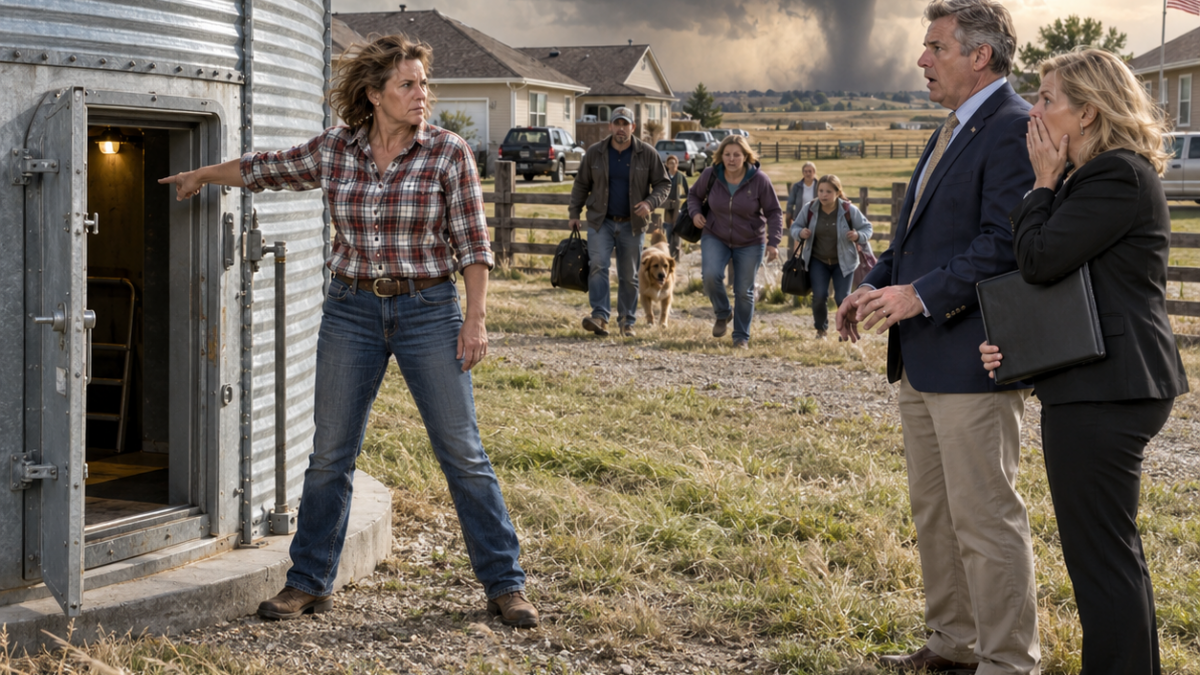
The HOA president stood at the edge of my farm, pointed at the steel grain silo behind my house, and gave me fourteen days to tear down the structure I had spent nearly a year building.
She called it an ugly violation, threatened me with daily fines, and smiled as though destroying something important to my family was just another item on her clipboard.
What she didn’t understand was that when the sky finally turned green over Harmony Creek, the very thing she wanted gone would become the one place nobody could afford to lose.
“That metal monstrosity has to come down, Mr. Thorne.”
Karen Thompson said it like she was ordering somebody to remove a broken refrigerator from the curb.
I stood beside my fence staring at her.
Behind me, rising above the pasture, was a twenty-foot-wide corrugated steel structure that looked enough like an old-fashioned grain silo to fool anyone who never stepped inside it.
Karen hadn’t.
She didn’t care what was inside.
She cared how it looked.
“The Meadows at Harmony Creek has architectural standards,” she continued. “Your structure violates the covenant regarding industrial buildings, exterior materials, and visual harmony.”
I glanced past her toward the subdivision bordering my ten acres.
Rows of expensive homes.
Matching roofs.
Matching mailboxes.
Lawns cut so precisely they looked printed onto the earth.
Then I looked back at my farmhouse.
Chicken coop.
Barn.
Mud on my Ford F-250.
And the steel structure Karen hated.
“We’re not part of your subdivision,” I said.
Karen extended a white envelope.
“You are now.”
I didn’t take it immediately.
“What does that mean?”
“The board approved an expansion of HOA jurisdiction several months ago.”
“Nobody asked us.”
“You were notified.”
“No, we weren’t.”
Her smile tightened.
“The vote passed.”
I finally took the envelope.
Inside was an official violation notice.
REMOVE UNAPPROVED STRUCTURE.
Fourteen days.
After that, fines.
Five hundred dollars initially, followed by daily penalties.
I looked up.
“Karen, that isn’t a grain silo.”
Her eyes traveled toward the structure again.
“It certainly looks like one.”
“It’s a tornado shelter.”
She actually laughed.
Not loudly.
Just one dismissive breath.
“Call it whatever makes you comfortable.”
I felt my jaw tighten.
Twenty-two years in the Army had taught me how to keep my voice calm when somebody desperately wanted a reaction.
“I designed it after the Prairie Ridge tornado.”
Her expression didn’t change.
“I’ve got county permits. Engineering inspections. Emergency ventilation. Reinforced concrete. Backup power.”
“That’s wonderful.”
“It can shelter fifty people.”
Karen glanced toward the silo again.
“That doesn’t change the covenants.”
Something about the casual way she said it stopped me cold.
The year before, an EF4 tornado had cut through Prairie Ridge fifteen miles away.
I had joined a volunteer search crew afterward.
I still remembered a father standing in what used to be his living room, calling his daughter’s name while firefighters pulled insulation and splintered lumber from the wreckage.
I remembered a basement wall collapsed inward.
A crushed pickup sitting upside down inside a church.
Children’s photographs scattered through a soybean field half a mile from where their house had stood.
I came home from that cleanup and told my wife, Sarah, one thing.
“We’re never depending on luck.”
So I built the shelter.
The steel shell was anchored into reinforced concrete fifteen feet below grade.
A heavy blast-rated door protected the entrance.
Inside were bunks, water, medical supplies, emergency radios, food, backup lighting, and filtered ventilation.
County emergency management had inspected it.
They called it one of the strongest privately built shelters they’d ever seen.
Karen called it ugly.
“You’re asking me to tear down something designed to save lives because you don’t like the way it looks?”
“I am asking you to follow community standards.”
“This is my farm.”
“Your property now falls under our jurisdiction.”
I looked at the envelope.
Then at her clipboard.
Then at the perfect roofs behind her.
“You have proof?”
“Of what?”
“That you legally annexed my land.”
For the first time, her expression flickered.
Only for a second.
Then the smile returned.
“You’ll receive whatever documentation you’re entitled to.”
She turned toward the golf cart parked beside the road.
“Fourteen days, Mr. Thorne.”
I watched her drive away.
That evening, Sarah found me at the dining room table surrounded by permits, engineering drawings, HOA documents, and a county map.
She set a cup of coffee beside me.
“You’ve been reading for three hours.”
“I know.”
“Did you find anything?”
I didn’t answer immediately.
Because buried in six months of meeting minutes was a single line that shouldn’t have bothered me as much as it did.
Authorization granted to explore jurisdictional expansion.
Explore.
Not approve.
Not complete.
Not certify.
I pulled another document closer.
Then another.
Sarah leaned over my shoulder.
“What are you looking for?”
“Something they should have.”
“What?”
I looked at her.
“Proof that they ever had the legal right to fine us in the first place.”
And by two that morning, I was almost certain they didn’t.
PART 2
I didn’t sleep much that night.
At twenty minutes past two, Sarah finally came back downstairs wearing her robe and found me sitting in the same chair.
The dining room table had disappeared beneath paper.
HOA bylaws.
County permits.
Plat maps.
Meeting minutes.
A printed copy of the state statute governing neighborhood associations and property annexation.
“You’re still doing this?”
“I found the section.”
She pulled out the chair beside me.
“What section?”
I slid the statute toward her.
“For an existing association to annex independently owned land like ours, there has to be notice to the affected owner. Not just some newsletter. Formal notice.”
Sarah read silently.
I tapped the paragraph.
“Certified notice before the vote. Opportunity to object. Recorded amendment if it passes.”
“Did we get any of that?”
“No.”
“Maybe the previous owner did.”
“We bought this place six years ago.”
“And they say the annexation happened this year.”
“Exactly.”
She looked toward the dark kitchen window.
Outside, the silhouette of the shelter stood against the moonlight.
“Then how did they do it?”
“That’s what I intend to find out.”
Sarah knew that tone.
During my Army years, she used to say there were two versions of me.
The husband who misplaced his coffee cup three times in one morning.
And the engineer who could spend twelve straight hours tracing the cause of a structural failure until every bolt and load path made sense.
Karen Thompson had awakened the second one.
By eight the next morning, I was at the county recorder’s office.
A clerk named Denise helped me pull everything associated with our parcel.
My deed showed agricultural residential zoning.
No HOA covenant.
No declaration.
No recorded amendment adding our land to The Meadows at Harmony Creek.
Then we searched for annexation filings.
Nothing.
“Could it be waiting to be recorded?” I asked.
Denise shook her head.
“If they claim your land is already bound, there should be something.”
“What about a vote?”
“That would be with the HOA, but if the declaration changed to include your property, I’d expect a recorded amendment.”
“There isn’t one?”
“Not that I can find.”
I left with certified copies of every document.
Instead of driving home, I went to the county planning office.
The shelter permit was there.
Building approval.
Electrical.
Ventilation.
Inspection report.
All current.
All legal.
Then I asked about The Meadows at Harmony Creek.
A planner named Luis Ramirez pulled up the subdivision map.
The original development stopped exactly at my eastern property line.
My farm was not inside it.
Neither were three other rural parcels farther north.
“So this hasn’t changed?” I asked.
“Not according to the recorded plat.”
“They claim they annexed us.”
Luis frowned.
“Into the HOA?”
“Yes.”
“That’s private covenant territory. But if you’re asking whether the subdivision boundary changed, no.”
I asked him to print it.
Then I went home.
Sarah was feeding chickens when I pulled into the driveway.
She took one look at my face.
“You found something.”
“They don’t have us.”
“What do you mean?”
I spread everything across the kitchen table.
“No recorded annexation.”
“You’re sure?”
“The county has nothing.”
She sat down.
For a few seconds, relief spread across her face.
Then it disappeared.
“John, if that’s true, why did Karen come here acting like it was already settled?”
“That is the question.”
The first fine arrived the next morning.
Five hundred dollars.
Plus a two-hundred-fifty-dollar enforcement fee.
I almost admired the timing.
Karen hadn’t even waited to see whether I’d challenge her.
The letter described my failure to begin removal of the structure as “willful noncompliance.”
I called the HOA office.
Karen answered.
“Meadows at Harmony Creek.”
“Karen, this is John Thorne.”
Silence for half a beat.
“Yes, Mr. Thorne.”
“I received your fine.”
“As expected.”
“I checked the county records.”
Another silence.
“My property was never annexed.”
“The board’s legal counsel disagrees.”
“Then send me the recorded amendment.”
“Our attorney will communicate through the appropriate channels.”
“Send me the certified notice you claim I received.”
“You were notified.”
“Send me proof.”
Her voice sharpened.
“I don’t appreciate your tone.”
“My tone isn’t the issue.”
“You have an outstanding violation.”
“No. You have an outstanding jurisdiction problem.”
She hung up.
I stood in my kitchen listening to the dead line.
Sarah raised one eyebrow.
“That went well.”
“Better than she thinks.”
I sent Karen a certified letter that afternoon.
It was four pages.
I disputed the fine.
I challenged the annexation.
I demanded documentation.
And because I wanted no one to accuse me of simply refusing to pay while the issue was unresolved, I opened a separate escrow account and deposited the amount of each claimed penalty into it.
Sarah thought that was excessive.
“It proves we’re not hiding from the money,” I explained. “We’re challenging whether they have the right to collect it.”
“How much are these fines going to become?”
“I don’t know.”
That worried her.
It worried me too.
Five hundred dollars was irritating.
Five hundred a day would become catastrophic.
But dismantling the shelter was not an option.
Even if it had been nothing more than a steel monument to my stubbornness, I wouldn’t have torn it down for an association that couldn’t prove jurisdiction.
But it wasn’t a monument.
It was infrastructure.
The Prairie Ridge cleanup had changed me.
I had watched ordinary basements fail under tornadic pressure.
Seen concrete block walls cave in.
Seen people rescued from spaces that were supposed to protect them.
My shelter wasn’t improvised.
The visible silo was only part of it.
Fifteen feet below the surface, reinforced concrete surrounded the main chamber.
The aboveground shell anchored into the foundation with embedded steel.
A hardened entry corridor led to a three-inch steel door.
Ventilation could run from generator power or manual backup.
There were medical supplies.
Water storage.
Sanitation.
Weather radio.
Emergency lighting.
Enough food for fifty people for nearly a week.
I had spent my retirement money on it.
Sarah had never complained.
She had stood inside the unfinished chamber while I welded support framing and said, “If it helps you sleep when tornado season comes, build it right.”
So I did.
Now Karen wanted it removed because galvanized steel didn’t fit her color palette.
Three days after my certified letter was delivered, I received my second notice.
The silo fine was now accruing daily.
But Karen added another violation.
My pasture fence was allegedly six and a half inches too tall.
I measured it.
One section stood half an inch above six feet where the ground dipped.
Fifty dollars per day.
The following morning, another notice was taped to my mailbox.
The black paint had faded.
Apparently, the HOA approved three shades:
Jet Black.
Onyx.
Midnight Black.
Mine was merely “weathered black.”
Twenty-five dollars per day.
Sarah stared at the notice.
“Is this real?”
“I think she’s running out of actual offenses.”
Then came the truck.
My Ford F-250, which I used for feed, fencing material, lumber, and hauling livestock equipment, was declared a prohibited commercial-grade vehicle.
One hundred dollars per day.
I lived on ten acres.
Karen wanted me to hide a farm truck.
By the end of the month, the HOA claimed I owed more than ten thousand dollars.
All of it sat mirrored in escrow.
Sarah hated watching the account grow.
“That’s our money locked up.”
“I know.”
“What if this takes years?”
“I don’t think it will.”
“How can you know?”
“I don’t.”
That was the problem.
I could pretend confidence for Karen.
I could sound confident in letters.
But with Sarah, I tried not to lie.
She stood at the sink one evening looking toward the pasture.
“I don’t want to lose this place.”
“We won’t.”
“You just said you can’t know.”
I walked over.
“You’re right.”
She folded her arms.
“My parents thought we were crazy buying this much land.”
“I remember.”
“Your Army friends thought retirement meant Florida.”
“I remember that too.”
She looked at me.
“I finally stopped worrying every time the phone rang at two in the morning.”
That one hurt.
Twenty-two years of deployments had left fingerprints on our marriage.
Not enough to break it.
Enough to remind us what breaking could look like.
“I know,” I said.
“I don’t want to spend retirement fighting people.”
“Neither do I.”
“But you’re going to.”
I took her hands.
“Only until they stop coming after us.”
She studied me for a long time.
Then she nodded.
“Then make sure we win.”
My first real ally appeared unexpectedly.
His name was Art Donovan.
He lived inside The Meadows, two houses beyond the subdivision entrance.
Sixty-eight.
Retired corporate attorney.
He knocked on my door carrying a copy of the community-wide email Karen had sent.
“Are you John Thorne?”
“Yes.”
“I’m Art.”
He handed me the email.
“You’ve seen this?”
I had.
Karen never named me.
She didn’t need to.
She warned residents about “an unauthorized industrial structure located near the western boundary.”
According to her, the structure presented potential “safety and insurance concerns.”
I invited Art inside.
He looked at my paperwork.
Then at me.
“She hates you.”
“We’ve met.”
He laughed.
“Karen fined me three hundred dollars last year because my front garden contains native prairie plants.”
“What was wrong with them?”
“She said they looked like weeds.”
“Do they?”
“Yes.”
I laughed.
He leaned back.
“That’s not why I’m here.”
“What is?”
“I practiced law for thirty-seven years.”
“That explains the paperwork curiosity.”
“Your certified letter got mentioned at the board meeting.”
“How do you know?”
“A board member is my poker partner.”
That caught my attention.
“Karen said you were making frivolous legal threats.”
“I’m asking her for proof.”
“Exactly.”
Art tapped my copy of the statute.
“You’re asking the right question.”
“Do I have a case?”
“I’m retired, so don’t treat this as formal legal advice.”
“Fine.”
“But if what you’re showing me is complete, they have a problem.”
“How big?”
“That depends on whether this annexation was sloppy or dishonest.”
I poured him coffee.
“How do we find out?”
He smiled.
“Records.”
We submitted a formal homeowner-records request.
Because Karen insisted I was an HOA member, she had created an amusing contradiction.
If I was a member, I had inspection rights.
If I wasn’t, she couldn’t fine me.
Art found that delicious.
We demanded meeting minutes.
Financial statements.
Vendor contracts.
Board correspondence related to the annexation.
Proof of notice.
Vote records.
Ballots.
Legal invoices.
Everything.
Karen responded by email.
The request was “overly burdensome.”
Art replied.
“Not a statutory exception.”
She delayed.
We documented it.
She produced partial records.
We requested the rest.
While that fight unfolded, I began talking to neighbors.
The first was Jessica Miller.
No relation to anyone involved.
She and her husband, Ben, had moved into the Meadows with their two children eighteen months earlier.
Their eight-year-old son, Leo, was terrified of storms.
Jessica approached me while I was repairing the gate.
“Mr. Thorne?”
“John.”
She smiled nervously.
“Karen sent another email.”
“I know.”
“She says people shouldn’t use your shelter.”
“I saw that.”
“Is it actually safe?”
Instead of explaining, I opened the gate.
“Want to see it?”
She hesitated.
Then nodded.
Ben came over that afternoon with her and Leo.
I opened the steel entrance door.
Leo stopped.
“Whoa.”
Inside, the lights came on automatically.
Rows of folding bunks lined one wall.
Emergency storage occupied another.
The radio station sat beside a weather monitor.
Leo ran his hand over the concrete.
“Is this underground?”
“Most of it.”
“Like a bunker?”
“Pretty much.”
His eyes widened.
Jessica walked slowly around the room.
“This could really hold fifty people?”
“Forty comfortably. Fifty if nobody complains.”
Ben examined the ventilation unit.
“You built all this?”
“I designed most of it. Contractors handled excavation and concrete. I did the welding and systems integration.”
Jessica turned toward me.
“Prairie Ridge?”
I nodded.
She knew.
Everybody in our county knew.
Her voice softened.
“We lived in an apartment then. Leo still wakes up when the sirens get tested.”
The boy pretended not to hear.
I crouched beside him.
“You know what happens if the sirens ever go off for real?”
He shook his head.
“You come here.”
His mother looked at me.
“Even with everything happening with the HOA?”
“Especially then.”
Leo smiled.
“Can I sleep on the top bunk?”
“If we’re here long enough.”
Jessica covered her mouth.
Her eyes had filled.
That was the moment the fight changed.
Until then, the shelter belonged to me.
After that, it belonged emotionally to people who understood why it existed.
Word spread.
Neighbors asked for tours.
A retired nurse volunteered to inventory my medical supplies.
A ham-radio operator offered to inspect the communications equipment.
An electrician checked the generator transfer system.
The more people saw the structure, the harder it became for Karen to describe it as a dangerous eyesore.
So she became more aggressive.
At the next monthly HOA meeting, more than fifty residents showed up.
I sat beside Art.
Jessica and Ben sat behind us.
Karen opened the meeting by reminding everyone that “mob pressure” would not influence board decisions.
Someone near the back laughed.
She ignored it.
After routine business, a homeowner named Steve stood.
“I want to know why you’re trying to remove the tornado shelter.”
Karen stiffened.
“We are not discussing individual compliance cases.”
“Your email discussed it with the whole neighborhood.”
“That email addressed general liability.”
Jessica stood.
“Then answer the liability question.”
Karen’s eyes narrowed.
Jessica kept going.
“I’ve been inside John’s shelter. So has my husband. It’s better built than anything in this subdivision.”
“Mrs. Miller—”
“My son is terrified of tornadoes.”
Her voice shook.
“That shelter is the first thing that’s made him feel safer living here.”
People murmured.
Karen raised the gavel.
“This board is responsible for maintaining standards.”
“Standards?” another man called out. “You fined me because my playset was forest green instead of heritage green.”
Laughter erupted.
Karen slammed the gavel.
“Order.”
A woman stood.
“You made me remove roses because they had thorns.”
“Those were adjacent to a walkway.”
“They were four feet away.”
Someone else stood.
“You sent me a warning over a flag in a flowerpot.”
“It was unauthorized signage.”
“It said God Bless America.”
“I don’t care what it said.”
The room changed.
Karen heard herself too late.
The silence after that sentence was worse than shouting.
Art rose.
His voice was calm.
“Madam President.”
Karen looked exhausted already.
“Yes, Mr. Donovan?”
“I’d like to return to Mr. Thorne’s annexation.”
“Again, that is a legal matter.”
“Good.”
Art lifted a folder.
“Then let’s discuss procedure.”
He cited the notice requirement.
Certified mail.
Advance warning.
Opportunity to object.
Recorded amendment.
Then he asked a simple question.
“Where are the certified receipts for Mr. Thorne’s property?”
Karen looked toward Gerald, the treasurer.
Gerald looked toward Karen.
“We are still assembling records.”
“Where are the ballots?”
“Counsel has them.”
“Where is the recorded amendment?”
“Counsel is handling that.”
Art paused.
“Does it exist?”
Karen’s face reddened.
“This meeting is not a courtroom.”
“No.”
Art smiled.
“In a courtroom, avoiding the question would be harder.”
Applause broke out.
Karen hit the gavel repeatedly.
I stood.
“I don’t want to fight with this board.”
That quieted the room.
“I don’t want my neighbors choosing sides.”
I looked around.
“I built that shelter because I saw what happened in Prairie Ridge.”
Some faces lowered.
People remembered.
“If a tornado warning comes tomorrow, I don’t care whether you like me.”
I pointed toward the western edge of the neighborhood.
“My door opens.”
I looked at Karen.
“For you too.”
Something flashed across her face.
Annoyance.
Embarrassment.
Maybe disbelief.
I continued.
“So here’s my proposal. Let the county emergency management office inspect it again. If they say it’s unsafe, I’ll listen. If they certify it, then let’s create an emergency plan around it.”
Jessica started clapping.
Then half the room joined.
Karen slammed the gavel one final time.
“This meeting is adjourned.”
She stormed out.
Gerald followed.
The other board members disappeared quickly.
But nobody else left.
Residents stayed.
Art found a legal pad.
Jessica began taking names.
Within forty minutes, thirty-seven people had joined a volunteer community-safety committee.
Karen had entered the meeting with formal authority.
I walked out with something more dangerous to her.
Trust.
The next morning, I called County Emergency Management Director Robert Miller.
Retired Marine colonel.
Fifteen years in emergency planning.
He had inspected my shelter during construction.
When I explained the situation, he was silent for a few seconds.
“They want you to remove that shelter?”
“Yes.”
“Why?”
“Appearance.”
He muttered something I won’t repeat.
Then said, “I’ll inspect it.”
“Officially?”
“Officially.”
“Could you evaluate it as a community refuge point?”
“That requires more paperwork.”
“I like paperwork.”
He laughed.
“So I’ve heard.”
The inspection was scheduled for Tuesday.
I didn’t invite the press.
Art did.
At least he claimed he “mentioned it to someone who might mention it to someone.”
At 9:50 Tuesday morning, a county emergency-management SUV arrived.
At 9:54, a Channel 8 news van pulled in behind it.
At 9:57, Karen Thompson appeared in her golf cart with Gerald beside her.
I almost felt sorry for Gerald.
He looked seasick.
Karen jumped out.
“You cannot conduct this inspection.”
Director Miller had just stepped from the county vehicle.
He looked at her.
“Excuse me?”
“This property is under HOA enforcement.”
“I’m aware there’s a dispute.”
“The board has not authorized county access.”
I stared at her.
“This is my property.”
She ignored me.
Director Miller didn’t.
“Did Mr. Thorne invite us?”
“Yes,” I said.
He turned back to Karen.
“Then we’re authorized.”
“You don’t understand.”
“I understand private property.”
Behind him, the news camera was already rolling.
Karen noticed.
Her expression changed.
“I’m concerned about liability.”
“So are we.”
“Then you agree—”
“No.”
He adjusted his jacket.
“Which is why I’m here to inspect the shelter.”
Karen looked toward the camera.
Then me.
Then Gerald.
Gerald whispered something.
She snapped, “Be quiet.”
Director Miller waited.
Finally Karen stepped aside.
“Fine.”
We spent almost an hour underground.
Director Miller checked structural documentation.
Emergency ventilation.
Backup power.
Door seals.
Communications.
Water.
Sanitation.
Occupancy.
Fire protection.
The reporter followed with a camera.
When we finished, Director Miller stood outside with the shelter behind him.
The reporter asked, “What’s your assessment?”
He didn’t hesitate.
“This is one of the most substantial privately constructed tornado shelters I’ve inspected in this county.”
He explained that the structure exceeded the level of protection available in most residential homes.
Then he said the sentence Karen never wanted broadcast.
“If severe weather threatened this neighborhood, I would rather see families inside Mr. Thorne’s shelter than trying to ride out a major tornado in an aboveground residence.”
The reporter turned toward me.
“Why did you build it this large?”
I looked at the camera.
“Because emergencies don’t stop at property lines.”
That evening, the segment led the local news.
Sarah and I watched from our couch.
The report showed the shelter.
My permits.
The county director praising it.
Jessica describing what it meant to Leo.
Then came footage of Karen trying to block the inspection.
Sarah winced.
“That was not her best moment.”
“No.”
“Do you feel bad?”
“A little.”
“You’re a terrible liar.”
“Fine.”
I smiled.
“No.”
My phone began ringing before the segment ended.
Neighbors.
Former Army buddies.
County commissioners.
People I hadn’t heard from in years.
But while public opinion shifted, Art cared about another deadline.
Our records request.
The HOA finally produced several boxes.
I expected bureaucracy.
What we found was worse.
Art invited an old friend named David Bell.
Retired forensic accountant.
We moved everything into my workshop.
Three long tables.
Boxes.
Invoices.
Bank statements.
Meeting minutes.
Vendor files.
Emails.
For two days, we sorted.
David barely spoke.
He marked pages with colored tabs.
Yellow.
Blue.
Red.
By Sunday afternoon, one stack of red tabs had become thick.
“What are those?” I asked.
“Problems.”
“How bad?”
He removed his glasses.
“Potentially very.”
The community beautification fund paid thousands to Thompson Landscaping and Design.
Owner: Frank Thompson.
Karen’s brother-in-law.
There was nothing automatically illegal about hiring a relative’s company.
Not if disclosed.
Bid competitively.
Approved properly.
But these contracts weren’t.
We found no competing bids.
No conflict disclosures.
No detailed scopes of work.
Some invoices looked inflated.
A gazebo project billed fifteen thousand dollars for materials that David estimated at less than half.
Seasonal plantings appeared repeatedly in invoices but not consistently in community photographs.
Then came the five-thousand-dollar “emergency tree removal.”
I remembered the date.
Clear weather.
No storms.
No emergency reports.
Art asked around.
A town employee confirmed no documented tree emergency in the common areas.
Then Jessica found something online.
A social-media photo from Karen’s sister.
A large oak had been removed from her private backyard that same week.
The caption thanked Frank Thompson.
David placed the HOA invoice beside the photo.
Nobody spoke.
“Could be coincidence,” I said.
“It could,” Art answered.
“So we prove it before claiming otherwise.”
That was why I trusted him.
We kept going.
Near midnight, I found the emails about annexation.
The chain began with the HOA attorney reminding Karen that affected owners should receive legally sufficient notice.
Certified delivery was specifically recommended.
Karen responded:
Could regular bulk mail be sufficient? Certified is expensive.
The attorney pushed back.
The next email from Karen made my hands go cold.
She wanted the cheaper mailing.
She complained that rural owners rarely participated.
She suggested low turnout would make expansion easier.
Art read the chain twice.
“She’s in trouble.”
“Because she didn’t send certified letters?”
“Because the issue may not be merely defective notice anymore.”
He tapped the email.
“She was warned.”
David nodded.
“And if they represented afterward that the process was valid…”
I stared at the papers.
All those fines.
All those threats.
Karen had not simply misunderstood the process.
At minimum, the records suggested she knew formal requirements existed and pushed to bypass them.
We packaged everything.
Not with dramatic language.
Facts.
Dates.
Invoices.
Emails.
Bank records.
The county map.
The fines.
My escrow statements.
Art prepared complaints for the appropriate state office and district attorney.
But before we submitted the full package, something happened that made every legal argument suddenly feel very small.
Two weeks later, on a warm late-spring afternoon, my weather radio screamed.
Sarah and I were in the kitchen.
The alarm tone stopped us both.
“Tornado warning.”
I turned toward the window.
The sky had changed.
If you’ve lived in Tornado Alley long enough, you know the color.
Green-gray.
Heavy.
Wrong.
The trees stopped moving.
Then the emergency sirens began.
Sarah moved immediately.
We had practiced this.
She grabbed the emergency binder.
I checked the radar.
A strong rotating cell was southwest of Harmony Creek.
The projected path ran almost directly toward us.
“Open the shelter,” she said.
“Already going.”
I ran outside.
The air felt charged.
The first gust hit as I reached the steel door.
I opened it fully.
Emergency lights came on.
I switched the ventilation system to storm mode.
Generator ready.
Radio ready.
Then I called Jessica.
She answered before the first ring finished.
“We’re coming!”
“Now.”
“They’re already in the car.”
“Don’t wait.”
I called Art.
“On my way.”
Then another number called me.
A neighbor I barely knew.
“John, can we use your shelter?”
“Yes.”
Another.
“Yes.”
Another.
“Yes.”
Within minutes, cars were turning into my driveway.
Parents jumped out with children.
People carried dogs.
A woman brought a cat carrier.
An elderly man arrived holding nothing but his medication bag.
Ben came running with Leo under one arm.
The boy wasn’t crying.
He looked scared.
But he knew where he was going.
“Top bunk?” I shouted.
He nodded.
“Top bunk.”
Jessica hugged Sarah.
Thunder rolled.
The wind began bending the pasture grass flat.
Twenty people.
Twenty-five.
Thirty.
Thirty-eight.
I stood at the top of the stairs counting.
The radio issued an emergency alert.
Confirmed tornado.
Debris signature.
Moving northeast.
“John.”
Sarah stood below me.
“Get inside.”
“One more minute.”
“You don’t have one.”
Then headlights appeared.
A sedan slid sideways at the end of my driveway.
It corrected.
Came racing toward the house.
Karen.
She stopped near the fence.
Jumped out.
For the first time since I had known her, she looked completely different.
No clipboard.
No perfect hair.
No controlled voice.
Her hair whipped across her face.
She ran toward her own house next door.
Then the wind exploded.
A heavy branch tore from a maple tree and cartwheeled across her yard.
Karen screamed.
She tried reaching her front door.
A larger oak limb crashed onto the porch.
The entryway disappeared beneath branches.
Karen stumbled backward.
She turned.
Saw me.
Saw the open shelter.
For one second, neither of us moved.
Behind me was the structure she had fined me thousands of dollars for refusing to destroy.
She had called it industrial.
Dangerous.
A liability.
An eyesore.
Now the sirens wailed.
The sky behind her twisted almost black.
Karen ran toward me.
“John!”
I stayed beside the door.
She reached the concrete apron, breathing hard.
“Please.”
That word nearly vanished in the wind.
“Please let me in.”
There are moments when revenge presents itself in a form so perfect that it doesn’t even feel real.
I could have told her the shelter was noncompliant.
I could have asked whether she had board approval.
I could have reminded her that she wanted it demolished.
For half a heartbeat, every cruel answer passed through my mind.
Then I remembered Prairie Ridge.
The father searching rubble.
The families I’d helped pull from broken homes.
I stepped aside.
“Get downstairs.”
Karen stared at me.
“Go!”
She ran past.
I followed.
Then sealed the steel door.
The locking pins drove home.
Seconds later, the tornado reached us.
The shelter began vibrating.
Not shaking wildly.
Vibrating.
A deep, heavy resonance traveled through the walls.
Children screamed.
Adults prayed.
Something massive struck the steel above us.
The impact sounded like artillery.
Leo clung to his mother.
Ben wrapped both arms around them.
Sarah stood beside the emergency panel monitoring power.
The lights flickered.
Generator held.
Ventilation held.
I watched the gauges.
Karen sat against the wall.
Her knees pulled to her chest.
She looked at the people around her.
People she had fined.
People she had lectured.
People she had dismissed.
Nobody said anything to her.
Another impact.
Then another.
The roar became unlike anything I can describe accurately.
People compare tornadoes to freight trains.
They’re right.
But inside that shelter, it sounded like a freight train dragging an entire building behind it.
A terrible mechanical scream.
Pressure.
Violence.
Chaos.
And beneath it, the solid hum of steel and reinforced concrete doing exactly what I had designed it to do.
Ninety seconds.
Maybe less.
Maybe more.
Time disappeared.
Then the sound began fading.
Rain remained.
Debris clattered.
The walls stopped vibrating.
Nobody moved.
I checked the weather radio.
Another circulation was possible.
We waited.
Twenty minutes.
Then thirty.
Finally I unlocked the door.
I climbed the stairs first.
The world outside looked wrong.
Trees lay across roads.
Roofing material hung from power lines.
Sections of fencing had vanished.
The pasture was littered with branches, insulation, and pieces of siding.
My farmhouse still stood.
Several windows were broken.
Part of the roof was damaged.
The chicken coop had lost panels.
But it stood.
Then I looked toward The Meadows.
Three houses had major roof damage.
One garage had partially collapsed.
A porch was gone.
The clubhouse roof had been peeled open.
Karen’s home had taken a heavy blow from the oak.
A limb had punched through the front section.
I looked back at the shelter.
Scratched.
Dented slightly in two places.
Standing.
Unbroken.
Sarah came out.
Then Jessica.
Ben.
Leo.
Art.
One by one, nearly forty people emerged.
Alive.
Every one of them.
Nobody had so much as a serious cut.
Karen came out last.
She stood at the top of the steps and looked around.
Then back at the shelter.
Her lips trembled.
I thought she might say something.
She didn’t.
She walked toward her damaged house.
I let her.
Within an hour, my shelter became the unofficial neighborhood command post.
Power was out.
Cell service was unreliable.
But my generator worked.
So did the radio.
We coordinated with emergency services.
Stored medication.
Charged phones.
Kept children safe.
Distributed water.
The very neighbors Karen had spent months warning against entering my “unauthorized facility” now used it as the most reliable building on the block.
By evening, County Emergency Management arrived.
Director Miller stepped from his vehicle, surveyed the damage, then looked at my shelter.
“Still standing?”
“Still standing.”
“How many?”
“Thirty-nine, counting us.”
“All safe?”
“Yes.”
He shook my hand.
“That’s why we build correctly.”
A reporter arrived later.
I didn’t call this one.
Nobody had to.
Word had already spread.
Veteran’s HOA-disputed shelter saves neighborhood during tornado.
The headline practically wrote itself.
Jessica gave the interview I will never forget.
She stood beside Leo.
The boy held her hand.
“The HOA wanted this structure removed,” the reporter said.
Jessica looked directly at the camera.
“If John had listened to them, I don’t know where my family would have gone today.”
Leo tugged her sleeve.
She looked down.
“He says tell them about the top bunk.”
The reporter smiled.
“What about it?”
Leo looked at the camera.
“Mr. John saved it for me.”
I had to walk away.
Not because I was embarrassed.
Because Sarah saw my face.
And once she started crying, I knew I would too.
Karen refused interview requests.
The next week was cleanup.
Insurance adjusters.
Chainsaws.
Tarps.
Utility crews.
Meals cooked on outdoor grills.
People who previously argued about landscaping rules carried plywood into each other’s homes.
Nobody discussed mailbox colors.
Nobody measured fence height.
The storm had stripped away everything trivial.
Then Art called me.
“Ready?”
“For what?”
“The board.”
I looked toward the damaged subdivision.
“Now?”
“Especially now.”
The special HOA meeting was held in the high-school gymnasium because the clubhouse wasn’t usable.
Almost every household attended.
Karen sat in the front row.
Not at a raised table.
Not behind a gavel.
Just in a folding chair.
Her house was temporarily uninhabitable.
She was staying with relatives.
The rest of the board looked equally diminished.
Art stood at a lectern.
He had asked me whether I wanted to speak first.
I declined.
“This isn’t about me anymore.”
He agreed.
Art began with the annexation.
County records.
Missing amendment.
Defective notification.
The attorney emails.
He projected them on a screen.
Karen’s own words appeared twenty feet tall.
Her push to avoid certified notification.
Her concern about opposition from rural landowners.
Her desire to move the process forward with minimal resistance.
People read in silence.
Then Art moved to finances.
Thompson Landscaping and Design.
Family connection.
No-bid contracts.
Questionable invoices.
The gazebo.
Landscaping expenses.
The emergency tree-removal charge.
David’s spreadsheets showed payment patterns.
Art never called Karen a thief.
He didn’t need to.
He said:
“These records raise serious questions requiring independent investigation.”
Then he introduced the final issue.
My fines.
A photograph of the shelter appeared.
Then another taken after the tornado.
Scratches across the steel.
The structure still intact.
Art looked toward the residents.
“A week ago, thirty-nine people took refuge inside the building this board attempted to compel Mr. Thorne to demolish.”
Silence.
“One of those people was Mrs. Thompson.”
Everyone looked at Karen.
I didn’t.
Art continued.
“This is not presented to humiliate anyone.”
His voice sharpened.
“It is presented because governance without humility becomes dangerous.”
Karen stood.
“May I speak?”
Nobody stopped her.
She walked to the microphone.
For a moment, she couldn’t find the words.
Then she looked toward me.
“John.”
I raised my eyes.
“I was wrong about the shelter.”
The gymnasium stayed completely silent.
“I believed I was protecting property values.”
Someone muttered something.
Art raised one hand.
Let her finish.
Karen swallowed.
“The storm changed my perspective.”
I almost laughed.
Not because it was funny.
Because the phrase was so small compared with what happened.
She continued.
“When my house was damaged…”
Her voice cracked.
“And I couldn’t get inside…”
She paused.
“The only place I had to go was the place I had ordered removed.”
She looked down.
“John let me in.”
People shifted in their seats.
“He could have refused.”
“No,” I said.
My voice carried through the gym.
Karen looked up.
I stood.
“No, I couldn’t.”
She stared at me.
“I was angry with you.”
I walked into the aisle.
“I was furious.”
Nobody spoke.
“But nobody deserves to die because they were wrong about an HOA rule.”
Karen’s eyes filled.
“That wasn’t forgiveness.”
I let the words settle.
“That was emergency shelter.”
Her face tightened.
I continued.
“What happens now isn’t revenge either.”
I looked toward the screen showing the financial records.
“It’s accountability.”
I sat down.
Art called for motions.
The first proposed immediate suspension of enforcement against my property and withdrawal of every fine.
Unanimous.
The second authorized independent counsel to determine whether the attempted annexation of my land and neighboring rural parcels had been legally effective.
Unanimous.
The third authorized a full forensic audit of the HOA.
Only Gerald hesitated.
Then raised his hand.
Unanimous.
The fourth motion removed Karen as president pending investigation.
She didn’t vote.
Everyone else did.
The remaining board members were removed shortly afterward.
Art was asked to serve as interim president.
He tried refusing.
People laughed.
He finally accepted on one condition.
“Six months.”
That became nine.
His first official action involving me was simple.
He sent a letter.
Dear Mr. Thorne,
The Meadows at Harmony Creek formally withdraws all enforcement actions, fines, penalties, and demands regarding your property.
Pending final legal review, the Association makes no claim that your property is subject to its restrictive covenants.
The Association further recognizes your storm shelter as an important emergency resource to the surrounding community and expresses its gratitude for your voluntary decision to make it available during the recent tornado.
At the bottom were signatures from the interim board.
I read it twice.
Then handed it to Sarah.
She sat at the kitchen table.
Same place where months earlier we had first opened Karen’s removal order.
Sarah smiled.
“So how much money comes out of escrow?”
“All of it.”
Her smile widened.
“All of it?”
“Every dollar.”
“Good.”
“What should we do with it?”
She thought.
Then looked toward the shelter.
“Upgrade the medical supplies.”
I laughed.
“You’re supposed to say vacation.”
“We can do both.”
“Deal.”
The legal review finished two months later.
Our property had not been lawfully annexed.
Neither had the other three rural tracts.
The attempted expansion was declared ineffective.
No HOA authority.
No covenants.
No fines.
No question.
Art called me with the result.
“Congratulations.”
“For what?”
“You are officially free to own an ugly silo.”
“Beautiful silo.”
“Debatable.”
The financial audit took longer.
Investigators eventually became involved.
I won’t pretend I knew every detail.
Some rumors in the neighborhood became ridiculous.
People claimed Karen had bought vacations with HOA money.
Others said she owned secret property in another state.
I never saw evidence of either.
What the records did support was bad enough.
Conflict-of-interest contracts.
Improper reimbursements.
Money spent without required approvals.
Expenses linked to relatives.
The attempted annexation procedures.
The file eventually reached the district attorney.
Karen was charged months later with financial misconduct connected to certain association funds and fraudulent records.
She entered a plea agreement rather than go to trial.
She received probation.
Restitution.
Fines.
And restrictions that effectively ended any chance of her controlling another HOA’s finances.
Some residents wanted more.
Prison.
Public humiliation.
A harsher ending.
I didn’t.
The woman had lost her position.
Her reputation.
Money.
Much of her damaged home.
And the illusion that her authority was unlimited.
That was enough for me.
The strangest moment came almost a year after she first walked onto my farm with that envelope.
Karen came to my property alone.
No clipboard.
No golf cart.
She stopped outside the fence.
I was repairing a section damaged in the storm.
“John?”
I put down my drill.
“Yes?”
“Can we talk?”
I opened the gate but didn’t invite her farther.
She seemed to understand.
Her hair was shorter.
She looked tired.
They had repaired the house but put it on the market.
A SOLD sign stood in the yard.
“We’re leaving next week.”
“I heard.”
She nodded.
“I wanted to say something before we go.”
I waited.
She looked at the shelter.
“I hated that thing.”
“I noticed.”
A faint smile appeared.
Then vanished.
“I thought people like you moved out here and ruined what we built.”
I leaned against the fence.
“People like me?”
“Farms. Trucks. Sheds. Equipment.”
“You moved next to agricultural land.”
“I know.”
“Now.”
She accepted that.
“My husband used to tell me I was taking the board too seriously.”
I didn’t answer.
“He said nobody cared as much about the rules as I did.”
“He may have been right.”
She looked toward the repaired neighborhood.
“I thought if I controlled all the small things, nothing big could go wrong.”
That was the first thing she ever said that helped me understand her.
Not excuse her.
Understand her.
“So every mailbox had to match.”
She nodded.
“Every lawn.”
“Yes.”
“Every fence.”
“Yes.”
“And my shelter.”
Her eyes shifted toward it.
“That didn’t match anything.”
“No.”
“And then the thing you couldn’t control showed up.”
She looked at the sky.
“The tornado.”
For a while, neither of us spoke.
Finally she said, “I remember standing outside my house.”
Her voice lowered.
“I remember seeing that tree fall.”
She rubbed her hands together.
“I thought I was going to die.”
I believed her.
“I looked toward your property.”
She swallowed.
“And I knew exactly where I needed to go.”
The irony didn’t need explanation.
“I expected you to hesitate.”
“I did.”
Her eyes widened slightly.
“Really?”
“For about half a second.”
“What were you thinking?”
I smiled.
“Nothing I’m proud of.”
She gave a weak laugh.
“I probably deserved it.”
“No.”
She looked confused.
“You deserved consequences.”
I pointed toward the house behind her.
“Not a tornado.”
Her eyes filled.
“I don’t know why you let me in.”
“Because the shelter wasn’t built for people I agreed with.”
That did it.
She turned away.
Wiped her face.
Then looked back.
“I’m sorry.”
I had imagined hearing those words for months.
In every imagined version, they felt satisfying.
In reality, they felt sad.
“I believe you.”
“Can you forgive me?”
I thought carefully.
“I can stop carrying it.”
She nodded.
Maybe that wasn’t the answer she expected.
It was the only honest one I had.
She started walking away.
“Karen.”
She turned.
“Wherever you go next…”
I looked at the sky.
“Find out where the storm shelter is before you worry about the mailbox colors.”
For the first time, she laughed without superiority.
“I will.”
Then she left.
A week later, the moving truck drove away.
Life around Harmony Creek changed.
Art’s interim board replaced dozens of petty restrictions.
Grass didn’t become lawless wilderness.
Property values didn’t collapse.
People simply had room to breathe.
The financial records went online for members to inspect.
Vendor contracts above a certain amount required competing bids.
Conflict-of-interest disclosures became mandatory.
Enforcement required written evidence and an appeal process.
The association couldn’t pursue liens without independent legal review.
The community safety committee became permanent.
Jessica chaired it.
Director Miller helped us write an emergency plan.
We created neighborhood alert groups.
Assigned volunteers to check on elderly residents.
Marked homes with basement shelters.
Established medical-response teams.
And yes, my so-called grain silo became part of the plan.
Not because the HOA owned it.
They didn’t.
The agreement was voluntary.
It stayed mine.
That mattered.
But I signed a memorandum with the county making it available as an emergency shelter when severe-weather warnings were issued.
The association helped buy additional folding cots.
Water.
First-aid supplies.
A second radio.
We added a weather camera and upgraded backup batteries.
Art insisted on installing a plaque outside.
I told him absolutely not.
He installed it anyway.
It said:
HARMONY CREEK COMMUNITY STORM REFUGE
Private Property — Made Available by the Thorne Family During Declared Severe Weather Emergencies.
Below that was a smaller line.
SAFETY BEFORE APPEARANCES.
I accused Art of enjoying himself too much.
He denied it badly.
Leo loved the shelter most.
Storm season returned the following spring.
The first time thunder rolled over the county, Jessica called me.
“Leo wants to know if the bunker is ready.”
“Tell him top bunk is reserved.”
She laughed.
“He’s not scared anymore.”
That meant more than any court ruling could have.
Sarah and I eventually took the vacation she wanted.
Four days at a lake cabin.
No HOA.
No cellular signal.
No emergency sirens.
I spent the first morning doing absolutely nothing.
Sarah sat beside me on the dock.
“You hate doing nothing.”
“I’m learning.”
“How long until you start repairing something?”
“Twenty minutes.”
She laughed.
Then leaned her head against my shoulder.
“You know what I hated most?”
“Karen?”
“No.”
“The money?”
“No.”
“What?”
“Watching you become a soldier again.”
I looked at her.
“You weren’t sleeping.”
“I slept.”
“You patrolled the property at two in the morning.”
“I was checking things.”
“You organized the paperwork into tactical folders.”
“That is just efficient filing.”
“You called the workshop the war room.”
“Art did that.”
“You liked it.”
I couldn’t deny that.
Sarah looked across the water.
“I married a man who came home.”
That sentence hurt more than any HOA fine.
“I know.”
“I don’t want every problem turning you back into someone who thinks he has to fight until nothing is left standing.”
I took her hand.
“You’re right.”
“Say it again.”
“Don’t abuse your authority.”
She hit my arm.
I laughed.
“You’re right.”
“Better.”
The truth was, Karen wasn’t the only person who learned something.
For years, I had believed strength meant preparing for every possible attack.
Build stronger walls.
Stronger doors.
Better plans.
More redundancy.
The shelter represented that instinct perfectly.
Steel.
Concrete.
Control.
But the tornado taught me something strange.
The strongest thing I built wasn’t underground.
It was the trust that brought thirty-nine people to my driveway.
Concrete saved us after they arrived.
Community got them there.
A shelter nobody knows about saves fewer people.
A bunker whose owner hates his neighbors protects one family.
Mine had been built differently.
I built it for Sarah.
But I made it large because somewhere in the back of my mind, I knew emergencies turn strangers into responsibilities.
Years later, people still tell the story wrong.
They say Karen Thompson tried to make me remove my grain silo, then a tornado forced her to beg me for shelter inside it.
That’s the dramatic version.
It’s true enough.
But it isn’t the part I remember most.
I remember opening the door before anyone arrived.
I remember Sarah stacking blankets.
I remember Leo running down the steps.
I remember an elderly neighbor clutching his medication bag.
I remember the terrified look on Karen’s face when she realized her house couldn’t protect her.
And I remember the steel door closing.
Inside that room, titles disappeared.
HOA president.
Retired attorney.
Veteran.
Farmer.
Mother.
Treasurer.
Homeowner.
Nobody cared.
We were forty frightened people underneath the same storm.
Months after Karen left, I stood outside during one of the county’s monthly siren tests.
The mechanical wail rolled across Harmony Creek.
Nobody panicked.
People knew where to go.
I looked toward the repaired homes of The Meadows.
There were different flower beds now.
A few mailboxes didn’t match.
Someone had painted their front door bright red.
Art had native prairie grass growing nearly waist high.
Apparently, nobody’s property value had collapsed.
Sarah came outside carrying two glasses of iced tea.
“You listening to the siren?”
“Testing day.”
“You check it every month.”
“I like knowing it works.”
She handed me the glass.
The shelter stood behind us.
Its galvanized steel had weathered slightly.
There were still shallow dents from the tornado.
I could have replaced those panels.
I chose not to.
One dent came from a piece of roofing.
Another from what we believed had been a section of wooden fence.
They were scars.
Proof.
Sarah touched one.
“You know, Karen was right about one thing.”
I stared at her.
“That sentence should be illegal.”
She smiled.
“It does look like an ugly grain silo.”
“Take that back.”
“No.”
“It’s an advanced hardened community refuge.”
“It is an ugly grain silo.”
“With filtered ventilation.”
“Still ugly.”
“Reinforced foundation.”
“Very ugly.”
“Backup power.”
“Horrible.”
“Fifty-person capacity.”
She kissed me.
“Ugliest lifesaving building in Harmony Creek.”
I looked at it.
“Fine.”
That evening, neighbors gathered at our place for a barbecue.
Art arrived carrying potato salad.
Jessica brought dessert.
Leo headed straight toward the shelter to show a new kid the “secret bunker.”
The county director stopped by briefly.
Someone played music from a truck.
Children chased each other through the pasture.
Nobody asked permission.
As the sun dropped behind the fields, I stood beside the grill and watched them.
Our farm had once felt separate from the subdivision.
That had been one of the reasons I bought it.
Distance.
Peace.
Privacy.
Karen tried to erase the boundary through control.
Ironically, defeating her erased another kind of boundary.
Not legal.
Human.
We remained outside the HOA.
That never changed.
But we stopped being outsiders to the people living there.
George from Cedar Lane helped mend my barn roof.
Jessica watered Sarah’s garden when we traveled.
Art used my workshop whenever he needed tools and returned everything to the wrong drawer.
Leo visited so often that Sarah kept his favorite soda in the refrigerator.
That was the revenge Karen never expected.
She tried to turn people against me.
Instead, she introduced us.
A few years later, another strong tornado crossed the northern part of the county.
It missed Harmony Creek.
But the sirens sounded.
Forty-seven people came to the shelter.
Nobody waited for permission.
Nobody asked whether the steel matched the neighborhood aesthetic.
They came.
We closed the door.
We listened to the warning.
Then, twenty-five minutes later, the all-clear sounded.
People climbed back into the evening light.
Leo was older by then.
Taller.
Braver.
As he walked past me, he slapped the steel wall.
“Best ugly silo in America.”
I pointed toward Art.
“He taught you that.”
“Mrs. Thorne did.”
I looked at Sarah.
She shrugged.
“Truth matters.”
That night after everyone left, I locked the outer door.
The sky had cleared.
Stars appeared over the pasture.
I stood there alone for a while.
A structure can mean different things depending on who is looking at it.
Karen saw metal.
I saw engineering.
Sarah saw my need to protect.
Leo saw safety.
The county saw emergency infrastructure.
The neighborhood eventually saw something bigger.
A promise.
When the weather turns bad, there’s room for you here.
That was all I ever wanted it to be.
The HOA once demanded that I destroy it because it didn’t fit their vision of a perfect community.
But perfection had never saved anybody.
People saved people.
Preparation saved people.
Good engineering saved people.
And sometimes the thing everyone complains is ugly becomes beautiful the moment they need it.
I ran my hand across one of the tornado dents.
Then turned toward the farmhouse.
Sarah had left the porch light on.
Beyond our fence, lights glowed across The Meadows at Harmony Creek.
Different houses.
Different families.
One neighborhood when it mattered.
I shut off the shelter’s exterior light and walked home.
The silo remained behind me.
Steel against the dark sky.
Still ugly.
Still mine.
Still standing.
And ready for the next storm.
[END OF FIRST COMMENT / FULL STORY]








