HOA Ordered Me to Tear Down My Clothesline—They Didn’t Know I Wrote the State Law Protecting It
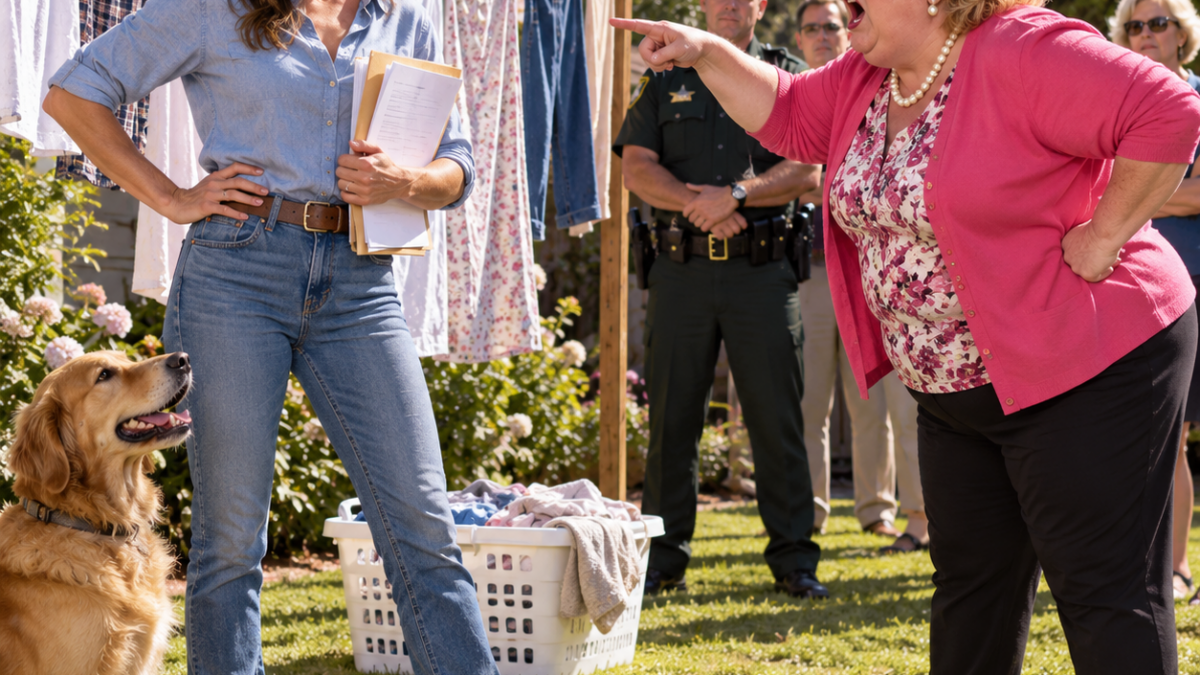
PART 2
I didn’t answer Karen’s letter immediately.
That surprised Sarah.
She found me at the dining-room table Monday morning with the violation notice beside my coffee and the HOA covenants open in front of me.
“You’ve been staring at that for fifteen minutes.”
“Reading.”
“You memorized it yesterday.”
“Reviewing.”
“You wrote notes in the margins.”
“Good lawyers review.”
She sat across from me.
“Good retired lawyers go fishing.”
“I don’t fish.”
“You could learn.”
I looked at the clothesline through the window.
White sheets moved in the morning sun.
“That would be surrender.”
“To fish?”
“To have hobbies.”
She smiled.
Then her expression became serious.
“You’re enjoying this.”
“No.”
“Jack.”
“A little.”
“I knew it.”
I closed the covenant booklet.
The truth was more complicated.
I wasn’t enjoying Karen.
I was enjoying clarity.
Military retirement had been strange for me.
For twenty-five years, every day had structure.
Cases.
Commands.
Regulations.
Deadlines.
People depending on decisions that had real consequences.
Then suddenly there was nothing.
No uniform.
No courtroom.
No one calling after midnight because a commander had made a legal mistake three time zones away.
Harmony Creek was supposed to help me learn how to live without conflict.
Karen had managed to bring conflict directly into my backyard.
Part of me hated that.
Another part knew exactly what to do with it.
I turned back to Section C, paragraph twelve.
**All properties shall be maintained in a manner preserving aesthetic harmony and an overall pleasing appearance, as determined by the Architectural Review Committee.**
That was it.
No clothesline prohibition.
No drying-rack language.
No outdoor laundry restriction.
Nothing.
Just “aesthetic harmony.”
Vague language.
The favorite tool of petty government.
I opened my laptop and wrote:
**Dear Members of the Harmony Creek Board of Directors:**
Not Karen.
The entire board.
I acknowledged receipt of the violation.
Then asked one question:
**Please identify the specific objective covenant or duly adopted rule that prohibits installation or use of a residential clothesline.**
I quoted their paragraph.
Then noted that the cited provision contained no clothesline prohibition.
No threat.
No lecture.
No reference to the state law.
Not yet.
I printed five copies.
Sarah looked over my shoulder.
“You’re not telling her?”
“About the law?”
“Yes.”
“No.”
“Why?”
“Because I want to know whether this is ignorance or intent.”
Sarah leaned against the desk.
“That sounds like lawyer language for you’re setting a trap.”
“I’m asking a question.”
“You already know the answer.”
“I know the legal answer.”
“And she doesn’t.”
“Maybe she does.”
Sarah shook her head.
“You retired four months ago.”
“Yes.”
“You lasted four months.”
“Apparently.”
She kissed my forehead.
“Try not to get us sued.”
“That’s usually my line.”
I sent the letter certified.
Return receipt.
The green card came back three days later.
Karen’s signature.
Then silence.
I left the clothesline exactly where it was.
Used it every day.
Sheets.
Towels.
My old Army PT shirts.
Sarah hung one of her bright red gardening aprons directly where anyone walking the rear sidewalk could see it.
“Subtle.”
She smiled.
“I learned from you.”
Karen’s reply arrived exactly one week after my letter.
Two pages.
Official letterhead.
The first paragraph informed me that the original fine had doubled.
One thousand dollars.
The second paragraph answered my question without answering it.
**The Architectural Review Committee possesses full authority to interpret and enforce the community standard of aesthetic harmony. The committee has unanimously determined that exterior clothes-drying installations are inconsistent with the visual character of Harmony Creek. This determination is final.**
Final.
I read that word twice.
Sarah stood behind me.
“Can they say that?”
“They just did.”
“That’s not what I asked.”
“No.”
I turned the page.
Handwritten at the bottom:
**P.S. Your raised vegetable beds also appear nonconforming. Formal review pending.**
That changed the mood.
I felt it physically.
A cold tightening across my chest.
Sarah read the note.
She became quiet.
Not angry.
Worse.
Hurt.
“They’re coming after the garden?”
“They’re threatening to.”
“Why?”
“Because she thinks pressure works.”
Sarah looked through the window.
Her tomato plants were barely twelve inches tall.
For years she had carried packets of seeds between duty stations and never planted half of them because we never knew how long we’d stay.
At Fort Bragg, she’d grown basil in pots.
In Germany, rosemary on a kitchen sill.
At Fort Hood, she tried tomatoes in containers until a move interrupted the season.
This was the first garden she’d ever planned knowing we’d still be there next year.
I folded Karen’s letter.
Very carefully.
“She isn’t touching the garden.”
Sarah looked at me.
“That sounded like Colonel Callahan.”
“Lieutenant Colonel.”
“You’ve been retired too long.”
“Apparently not long enough.”
I created another divider in the binder.
**RETALIATION.**
Then I started reading.
Not my own law.
Harmony Creek.
Every covenant.
Every amendment.
Every architectural policy.
Meeting minutes.
Election procedures.
Corporate filings.
Budgets.
Vendor contracts available to members.
If Karen wanted to use the HOA as a weapon, I wanted to know every component of that weapon.
The deeper I went, the stranger things became.
Harmony Creek’s board had five directors.
Karen Miller, president.
Her husband, Norman, treasurer.
Gerald Pike, vice president.
Linda Shaw, secretary.
Robert “Bob” Felton, member-at-large.
Meeting minutes over the previous five years were thin.
Suspiciously thin.
“Motion made.”
“Motion seconded.”
“Passed unanimously.”
Again.
Again.
Again.
No discussion.
No dissent.
No detail.
Karen had been president eight years.
Every election uncontested.
At least officially.
But buried in archived newsletters, I found references to residents who had announced candidacies.
They never appeared on final ballots.
I began contacting people.
One man had been rejected because his nomination packet arrived five minutes after the management office’s posted morning window.
Another because he’d filled one field in blue ink.
A third because her signature hadn’t been witnessed, despite no such requirement appearing in the bylaws.
Interesting.
Then came the money.
Harmony Creek spent nearly forty thousand dollars annually on landscaping.
I pulled comparable numbers.
High.
Not impossible.
High.
Vendor:
Prestige Lawn & Garden.
Registered owner:
Daniel Mercer.
Karen’s brother-in-law.
I sat back.
That didn’t automatically mean wrongdoing.
A relative could legitimately provide services.
But where were the bids?
None in the records I could access.
Where was conflict disclosure?
Nothing.
Then I saw the fountain.
Ten thousand dollars.
Entrance improvement.
Bronze plaque.
**Harmony Creek — A Community of Distinction**
Smaller line below:
**Project Overseen by Karen Miller, President**
I stared at it.
Sarah came into the office.
“What?”
“Karen built herself a monument.”
She leaned over.
“Oh my God.”
“HOA money.”
“How much?”
“Ten thousand.”
“For that ugly fountain?”
“Subjective aesthetic opinion.”
She smacked my shoulder.
“Don’t start.”
The next few evenings, I walked the neighborhood with Duke.
Not because I needed more evidence about clotheslines.
I needed context.
Karen’s power did not make sense unless people had allowed it.
Why had they?
I found the answer quickly.
Fear.
Small fear.
The kind respectable adults are embarrassed to admit.
A young Marine captain named Miguel Rodriguez lived two streets over.
His sons had a portable basketball hoop.
Clean.
New.
Kept beside the driveway.
Karen called it a “temporary recreational structure inconsistent with neighborhood character.”
The fines had reached two thousand dollars.
Miguel stood at the end of his driveway with his arms crossed.
“I’ve been shot at in Helmand.”
“Different problem.”
He gave a humorless laugh.
“You’d think.”
His wife stepped outside.
“We’re taking it down.”
Miguel looked at her.
“Baby—”
“We can’t keep paying.”
Their oldest son heard.
“Dad, are they taking the hoop?”
Nobody answered.
That bothered me.
A few streets away, Mrs. Evelyn Gable had seven garden gnomes.
They were objectively terrible.
I mean that affectionately.
One fishing.
One holding a lantern.
One sleeping beneath a mushroom.
One pushing a tiny wheelbarrow.
Karen had fined her one hundred dollars a week per gnome.
Seven hundred weekly.
Mrs. Gable showed me the notices.
“My husband bought them.”
“George?”
She looked surprised.
“How did you know?”
“Neighbor mentioned him.”
Her expression softened.
“Forty-six years.”
She touched the fishing gnome.
“This was our first anniversary.”
It was chipped.
Paint faded.
Worth maybe fifteen dollars.
Priceless.
“Karen said they’re tacky.”
“I disagree.”
“You’re lying.”
“Professionally.”
She laughed.
First time I’d heard her.
Then her eyes watered.
“I’ve thought about putting them away.”
“Why haven’t you?”
“George would haunt me.”
I smiled.
“Then we can’t have that.”
Each story made the pattern clearer.
Karen wasn’t protecting property values.
She was standardizing people.
Basketball hoop.
Gnomes.
Wind chimes.
Work vans.
Garden benches.
A child’s lemonade sign.
One family had received a warning because their Christmas lights were “excessively multicolored.”
Another because a birdhouse faced the street.
Most people complied.
Not because Karen was legally right.
Because fighting costs time.
Energy.
Money.
Peace.
A fifty-dollar fine is often cheaper than proving a fifty-dollar fine is wrong.
Karen understood that.
Then she made her strategic mistake.
She picked someone who had more time than fear.
I invited Miguel and two other homeowners to my house.
No uprising speech.
No revenge plan.
Documents.
I laid out Karen’s letter.
Financial records.
Vendor relationship.
Election anomalies.
Fine histories.
Miguel stared.
“You found all this in public records?”
“Mostly.”
“How?”
“I read.”
He laughed.
“No, seriously.”
“So am I.”
Another homeowner, Maria Flores, worked as an accountant.
She looked through the vendor payments.
“These landscaping charges are high.”
“That’s what I thought.”
“Not necessarily fraudulent.”
“Agreed.”
“Needs bids.”
“Yes.”
She looked at the fountain expenditure.
“Ten thousand?”
“Apparently.”
“What did we defer that year?”
I showed her.
Sidewalk repairs.
Playground equipment.
Drainage maintenance.
Maria’s eyebrows rose.
“That changes things.”
We drafted a joint demand.
Ten pages.
Respectful.
Precise.
Dispute subjective fines.
Request full records.
Demand special homeowner meeting.
Request competitive-contract documentation.
Request election records.
Demand cease-and-desist on retaliatory enforcement.
Still no Right-to-Dry Law.
Miguel asked:
“You’re really not mentioning it?”
“No.”
“You wrote the law.”
“Helped write.”
“You’re splitting hairs.”
“Occupational disease.”
“Why hold it back?”
“Because right now Karen thinks this is a debate over her authority.”
“It isn’t?”
“No.”
“What’s it over?”
“Whether she can be trusted with authority.”
That silenced the room.
We mailed every board member separately.
Certified.
Within forty-eight hours, Gerald Pike called me.
“Mr. Callahan?”
“Jack.”
“This is Gerald.”
“I know.”
“We received your letter.”
“I assumed.”
“Karen says you’re threatening individual board members.”
“I described potential fiduciary liability.”
“That sounds like a threat.”
“It sounds like corporate governance.”
He lowered his voice.
“Look, I don’t know anything about her brother-in-law.”
“You voted for the contract.”
“Karen handles vendors.”
“You’re a director.”
“We’re volunteers.”
“Volunteers still have duties.”
Silence.
Then:
“Could we just drop your fine?”
“No.”
He sounded stunned.
“You don’t want the fine dropped?”
“I want everyone treated fairly.”
“That’s not realistic.”
“Interesting answer.”
“That’s not what I meant.”
“I hope not.”
“What exactly do you want?”
“The letter says.”
“Special meeting?”
“Yes.”
“Full financial records?”
“Yes.”
“Review of fines?”
“Yes.”
“Election procedures?”
“Yes.”
Gerald exhaled.
“Karen will never agree.”
“Then Karen isn’t running a board.”
“What?”
“She’s running a personal office.”
He hung up shortly afterward.
Two days later, Karen responded publicly.
Email to every resident.
**NOTICE REGARDING DISRUPTIVE CONDUCT BY CERTAIN HOMEOWNERS**
I made coffee before reading.
Always prepare for nonsense properly.
Karen accused me of intimidation.
Slander.
Harassment.
Attempting to destabilize the association.
She described herself and the board as “dedicated volunteers under attack.”
Then announced a special hearing.
Not the homeowner meeting we’d demanded.
A disciplinary hearing.
Miguel called.
“She’s putting us on trial.”
“Looks like.”
“Can she?”
“She can hold a meeting.”
“Binding decision?”
“That’s more ambitious.”
“What do we do?”
“Attend.”
“Seriously?”
“She wants an audience.”
“Why give her one?”
“Because she’s making the mistake for us.”
Wednesday night, Harmony Creek’s clubhouse was full.
Karen had advertised the hearing heavily.
Residents came for drama.
Good.
Sunlight doesn’t hurt a weak case.
Karen sat behind a long table.
Navy pantsuit.
Gavel.
Norman beside her.
Gerald looked physically ill.
Linda shuffled papers.
Bob stared at his phone.
Miguel whispered:
“Looks like court.”
“No.”
“What?”
“In court the judge is neutral.”
He almost laughed.
Karen called us by name.
“Respondents.”
I wrote that word down.
She started with Miguel.
“Captain Rodriguez, you have repeatedly refused to remove an unapproved recreational structure.”
“My children’s basketball hoop.”
“The committee has determined it negatively impacts aesthetic harmony.”
“It’s portable.”
“Irrelevant.”
“It isn’t visible from the main entrance.”
“The committee’s decision is final.”
Miguel looked toward me.
I shook my head slightly.
Stay calm.
He sat.
Next homeowner.
Satellite dish screening.
Another.
Garden border.
Then me.
Karen leaned toward the microphone.
“Mr. Callahan, you currently have multiple violations.”
“Please identify them.”
“Clothesline.”
“Okay.”
“Unapproved raised garden beds.”
Sarah, sitting behind me, muttered:
“You touch my tomatoes and I’ll show you violation.”
I nearly lost composure.
Karen continued.
“And conduct detrimental to community harmony.”
I looked up.
“Where is that defined?”
“Your defamatory letter.”
“You mean the records request?”
“The accusations.”
“Which one is false?”
Her face tightened.
“This hearing concerns your violations.”
“Then why list my letter as one?”
Murmurs.
Karen banged the gavel.
“Answer the question before you.”
“What question?”
“Will you remove your clothesline?”
“No.”
A ripple through the room.
She smiled.
Good.
She thought she’d finally cornered me.
“Will you pay the accumulated fines?”
“No.”
“Will you remove the raised beds if the committee orders you to?”
“No.”
Sarah touched my shoulder.
Karen leaned forward.
“So you openly admit your refusal to obey this association?”
“No.”
Her smile disappeared.
“I admit my refusal to obey unlawful or unsupported orders.”
“This board determines what is lawful under the covenants.”
“No.”
She blinked.
“No?”
“No board determines law simply because it votes.”
“This committee has authority—”
“To interpret valid covenants within legal limits.”
“We are within our limits.”
“Are you?”
Karen’s face reddened.
“You think you’re smarter than everyone here.”
“No.”
“You think being a lawyer lets you bully volunteers.”
“I haven’t raised my voice once.”
“Don’t lecture me!”
The room became very quiet.
There it was.
She heard it too.
Karen had finally become the loud person in the room.
I stood.
“May I present the records we requested?”
“No.”
“Why?”
“Not relevant.”
“Financial conflicts aren’t relevant?”
“This is a violation hearing.”
“Election procedure?”
“Not relevant.”
“Selective enforcement?”
“Not relevant.”
“Then this hearing isn’t for finding facts.”
“It is for enforcement.”
“Exactly.”
Someone in the crowd said:
“Let him talk.”
Another:
“Yeah, let’s hear it.”
Karen struck the gavel.
“This is not a town hall.”
Mrs. Gable stood.
“Maybe it should be.”
Karen stared.
“Evelyn, sit down.”
Mrs. Gable’s face changed.
I knew that look.
Seventy-eight years old.
Widowed.
Finished being ordered around.
“No.”
The room erupted.
Not loudly.
Applause.
Short.
Sharp.
Karen’s authority cracked.
I opened my folder.
“Prestige Lawn & Garden received more than one hundred thousand dollars from the association over the last three years.”
Karen went pale.
“This is out of order.”
“The company’s owner is your brother-in-law.”
Voices rose.
Karen hit the gavel.
“No evidence has been presented of wrongdoing!”
“Correct.”
That surprised her.
I continued.
“A family relationship does not itself establish wrongdoing.”
The room quieted.
“But homeowners are entitled to ask whether the conflict was disclosed and whether competitive bids were obtained.”
Maria stood.
“As an accountant, I formally request those records.”
Karen pointed.
“Sit down.”
Maria didn’t.
“Are there bids?”
Karen ignored her.
I held up the election records.
“Three candidates disqualified in four years.”
Karen snapped:
“For failing requirements.”
“Blue ink?”
Laughter.
“Deadlines are deadlines.”
“Five minutes?”
“Rules are rules.”
“Interesting.”
Her eyes narrowed.
“What does that mean?”
I looked at the clothesline fine.
“Nothing yet.”
Karen’s anger finally boiled over.
“The fines stand.”
I said nothing.
“You will remove that disgusting clothesline.”
Still nothing.
“Do you hear me?”
“Yes.”
“Then answer.”
“No.”
“Fine. Two thousand additional penalty for deliberate defiance.”
Gerald jerked toward her.
“Karen—”
She turned.
“What?”
“We haven’t voted.”
Silence.
The room heard it.
Karen stared at him.
Gerald swallowed.
“I said we haven’t voted.”
Karen’s face became stone.
“Then vote.”
Linda hesitated.
Bob looked down.
Norman said:
“Yes.”
Karen:
“Yes.”
Gerald:
“No.”
Linda whispered:
“No.”
Everyone looked at Bob.
He looked trapped.
“Abstain.”
Karen couldn’t process it.
The fine failed.
Two to two.
One abstention.
For eight years, Karen’s minutes had said:
**Unanimous.**
Not tonight.
Something changed permanently in Harmony Creek in that moment.
People saw disagreement.
They saw Karen lose.
And once you’ve watched a tyrant lose a vote, they never look ten feet tall again.
The meeting ended badly.
Karen declared my original fines valid anyway.
Gerald challenged her.
Residents shouted questions.
She adjourned.
Nobody left quietly.
The next morning, I found another envelope.
Three thousand dollars total.
Cease-and-desist from HOA counsel.
Remove clothesline within seventy-two hours.
Remove garden pending architectural ruling.
Legal action threatened.
Sarah read it.
“So now?”
I smiled.
“Now.”
I went into my office.
Opened the locked file cabinet.
Pulled out an old legislative binder.
Not HOA.
State government.
Inside were drafts.
Committee comments.
Amendments.
Final enacted text.
I found the section.
The language was almost exactly as I remembered.
Years earlier, while still in the JAG Corps, I’d been assigned to a state-level policy working group focused on renewable-energy access and homeowner property rights.
One recurring complaint kept surfacing.
HOAs banning solar panels.
HOAs banning rain barrels.
HOAs banning clotheslines.
The clothesline issue sounded trivial to some legislators.
Until we showed them the numbers.
Energy use.
Dryer costs.
Low-income households.
Older residents.
Families simply wanting to use sun and wind.
One senator had laughed.
“We’re writing legislation about laundry?”
I answered:
“No, Senator. We’re writing legislation about whether a private corporation can prevent a homeowner from using free sunlight on property they own.”
He stopped laughing.
Months later, the statute passed.
Among its provisions:
**No homeowners association covenant, condition, restriction, rule, or interpretation thereof may prohibit the installation or use of a clothesline or drying rack on the property of a homeowner, subject only to reasonable placement and safety restrictions consistent with this section.**
I hadn’t written every word.
Legislation never belongs to one person.
Lawmakers.
Staff counsel.
Stakeholders.
Committee attorneys.
Advocates.
But I had drafted the initial language.
Defended it.
Revised it.
Negotiated it.
Sat behind the senator when the final bill passed.
Sarah had brought me dinner that night because the session ran late.
A sandwich.
Coffee.
She’d said:
“All this for clotheslines?”
“Someday somebody will care.”
She had laughed.
Now I carried the old binder into the kitchen.
Sarah saw it.
“Oh.”
“Remember?”
She smiled slowly.
“Someday.”
“Apparently today.”
I drafted a letter.
Not to Karen.
To HOA counsel.
Professional courtesy.
Attorney to attorney.
I identified myself.
Retired Lieutenant Colonel Jack Callahan.
Former JAG Corps.
Former state legislative policy advisor.
Lead drafting counsel on the portion of the Solar Access and Energy Freedom Act commonly referred to as the Right-to-Dry Law.
Then I quoted the statute.
I attached legislative history.
Effective date.
Committee report.
Final codified language.
Attorney-general guidance discussing HOA preemption.
I wrote:
**Your client’s continued attempt to levy fines based on the presence or use of my residential clothesline directly conflicts with controlling state law. Please advise immediately whether your firm intends to continue pursuing an enforcement action expressly prohibited by statute.**
At the bottom:
**Please preserve all board communications concerning this matter.**
That’s lawyer language for:
Things are about to become evidence.
I sent it by email and certified mail.
Then I made another document.
For homeowners.
No jargon.
Three pages.
Timeline.
Violation.
Fines.
Hearing.
Financial questions.
Election concerns.
Then the reveal.
I explained my role in drafting the law.
Quoted the clothesline provision.
Attached the HOA notices.
Then wrote:
**The issue is no longer whether you personally like clotheslines. The issue is whether our board may knowingly spend association money attempting to enforce a rule state law prohibits.**
That was the paragraph that changed everything.
I included a petition for recall.
Harmony Creek had 286 voting homes.
We needed a specified percentage to compel a special recall meeting.
I printed two hundred packets.
Miguel came over.
“Ready?”
“Yes.”
Maria joined.
Mrs. Gable insisted.
“You don’t need to walk door to door.”
“I have orthopedic shoes.”
“That isn’t what I meant.”
“I survived George for forty-six years. I can survive sidewalks.”
Sarah handed her water.
The first door belonged to a couple I’d never met.
I introduced myself.
The husband frowned.
“Clothesline guy.”
“Unfortunately.”
His wife laughed.
They read the packet.
Then signed.
Second house.
Signed.
Third.
Questions.
Then signed.
Fourth refused.
Fine.
Fifth signed.
By evening, people were waiting for us.
Word traveled.
One homeowner opened his door holding Karen’s email.
“Did you really write this law?”
“Helped draft.”
“Is she breaking it?”
“That’s for counsel and a court to formally determine if necessary, but the language is clear.”
He signed.
Another woman asked:
“Are you going to sue us?”
Important question.
“No.”
“But the HOA is us.”
“Yes.”
“So if you sue the association, our dues pay.”
“That is one reason the board needs to resolve this quickly.”
She didn’t sign immediately.
Good.
People should think.
Eventually, she did.
By sunset, we had enough.
Then more.
Karen found out that night.
Her response was an all-caps email.
Not official account.
Personal.
**DO NOT BE MISLED BY THIS MAN.**
Sarah read the subject line.
“Strong opening.”
I poured wine.
Karen called me litigious.
Dishonest.
An outsider.
She said the law didn’t apply to “private communities of distinction.”
That phrase made me stop.
“What?”
Sarah asked.
“She thinks statute stops at decorative entrance signs.”
Karen claimed she’d consulted “state legal experts.”
No names.
No opinion attached.
Then threatened defamation claims against anyone signing the recall petition.
That was catastrophically foolish.
Gerald called again.
“She has lost her mind.”
“Don’t diagnose.”
“Figure of speech.”
“Better.”
“She says she’ll sue the board if we abandon her.”
“Talk to independent counsel.”
“You sound like a recording.”
“Because I am not your lawyer.”
“Jack, what do I do?”
“Your duty.”
“To whom?”
“That’s the question you should have asked eight years ago.”
He went silent.
Then:
“I’m sorry.”
“For what?”
“Letting it get here.”
That mattered more than I expected.
“Then fix your part.”
The HOA attorney responded the next morning.
Very short.
**Mr. Callahan, thank you for bringing the referenced statutory provision to our attention. Our office is reviewing the matter and has instructed the association to suspend collection efforts regarding the clothesline violation pending further review.**
Translation:
Oh no.
Karen apparently ignored her own lawyer.
She posted another violation sticker on my gate.
I photographed it.
Added to binder.
Then the attorney called me directly.
“Jack?”
We’d discovered we knew some of the same JAG attorneys.
“David Morris.”
“Morning.”
“I want to be candid.”
“Please.”
“Our firm did not approve that latest notice.”
“Okay.”
“We advised suspension.”
“Understood.”
“Karen says board authority permits independent enforcement.”
I almost laughed.
“Does your engagement letter agree?”
Silence.
“That is being addressed.”
“Good.”
He sighed.
“Did you really draft this section?”
“Yes.”
“Small world.”
“Smaller clothesline.”
He chuckled despite himself.
“Between lawyers?”
“Sure.”
“She is wrong.”
“I know.”
“I wish you’d told us earlier.”
“I asked for the specific rule.”
“I know.”
“Then she escalated.”
“I know.”
“So now we have a governance issue.”
“We do.”
The recall petition was formally submitted.
Under the bylaws, the association had thirty days to hold the meeting.
Karen tried everything.
Questioned signatures.
Claimed some were illegible.
Challenged proxy rules.
Argued two homeowners were delinquent and therefore ineligible.
Maria checked.
One “delinquency” was a disputed fifty-dollar landscaping fine.
The other had already been paid.
We documented both.
Neutral election counsel was eventually retained because the association insurer insisted.
Her name was Rachel Albright.
Experienced.
No patience.
First meeting with both sides, Karen attempted to talk over her.
Rachel held up one hand.
“Mrs. Miller.”
Karen kept talking.
“Mrs. Miller.”
Still talking.
Rachel stopped writing.
“When I am administering the recall procedure, I will speak without interruption.”
Karen went silent.
Miguel later whispered:
“I love her.”
“Professional admiration only, Captain.”
The recall date was set.
Fourteen days.
Meanwhile, our lawsuit moved.
Declaratory judgment.
Injunction.
Challenge to fines.
Request for attorney fees where permitted.
Claims relating to retaliatory enforcement were preserved.
I deliberately kept damages modest.
Sarah asked why.
“You could crush them.”
“The homeowners are the association.”
“So?”
“So I don’t want Miguel paying higher dues because Karen violated Miguel’s rights.”
She nodded.
“Then why sue?”
“For the ruling.”
A court order matters.
Board promises change.
Personalities change.
A judgment stays.
The judge granted temporary relief preventing clothesline enforcement while the case proceeded.
Karen’s attorney finally persuaded the board to rescind my clothesline fines.
Three thousand dollars vanished.
Karen called it a “temporary administrative accommodation.”
I called it Tuesday.
But the recall continued.
This wasn’t about my fine anymore.
The financial records became available under pressure from counsel and homeowners.
Maria reviewed them.
Prestige Lawn & Garden had indeed received significant no-bid work.
Not all improper.
Not all suspicious.
But conflict disclosures were missing.
Invoices lacked detail.
Some renewals had never received documented board votes.
The fountain spending had exceeded the originally budgeted amount.
The playground had been deferred despite safety complaints.
More troubling were fine practices.
Karen had sometimes issued penalties before formal board approval.
Appeals were routinely heard by the same committee that issued the violation.
No independent review.
Some fines continued accruing while appeals were pending.
A governance nightmare.
Not a criminal empire.
That distinction mattered.
People started calling it corruption.
I corrected them.
“Bad governance.”
Miguel rolled his eyes.
“She’s paying her brother-in-law.”
“Potential conflict.”
“You really can’t help yourself.”
“No.”
“Fine. Potentially corrupt bad governance.”
“Better.”
The night before the recall, Sarah and I sat outside.
The clothesline was full.
Sheets moved under porch light.
Tomatoes had climbed their supports.
Duke lay at my feet.
Sarah handed me tea.
“You nervous?”
“Yes.”
“Really?”
“Of course.”
“You’ve argued felony cases.”
“Different.”
“How?”
“A courtroom has rules everyone recognizes.”
“And HOA meeting doesn’t?”
I laughed.
“Fair.”
She looked at the sheets.
“If you lose?”
“I don’t.”
“What?”
“If recall fails?”
“I keep the clothesline.”
“Because of the court.”
“Yes.”
“So what are you nervous about?”
I thought.
“The neighbors.”
“What about them?”
“I asked them to stand up.”
“And?”
“If they don’t, Karen will punish them.”
Sarah looked at me.
“Jack.”
“Yeah?”
“They’re adults.”
“I know.”
“You spent your career defending people’s right to make choices.”
“Yes.”
“Then let them.”
That was exactly what I needed.
Recall night.
Clubhouse overflowing.
Standing room.
Foyer packed.
Some residents watched from outside doors.
Rachel Albright sat at the front with sealed ballot materials.
Karen’s board sat to her right.
Our group to the left.
No gavel for Karen.
Rachel controlled the meeting.
That alone seemed to wound her.
“Each side receives fifteen minutes,” Rachel said. “No interruptions. No personal insults. No audience responses until both presentations conclude.”
Karen chose first.
Of course.
She walked to the podium.
For a moment, I almost felt sorry for her.
Almost.
Eight years of identity wrapped around one position.
HOA President.
Committee Chair.
Neighborhood voice.
Her entire social status had fused with authority.
Now she had fifteen minutes to convince her neighbors not to take it away.
“My friends.”
Some people shifted.
“For eight years, I have sacrificed countless hours to preserve Harmony Creek.”
She described landscaping.
Pool improvements.
Holiday events.
Entrance beautification.
Property values.
Then the threat.
Without strict standards, she said, neighborhoods decline.
One exception becomes ten.
One clothesline becomes visible laundry everywhere.
One basketball hoop becomes neglected toys.
One gnome becomes “a carnival of lawn clutter.”
Mrs. Gable inhaled dramatically.
Rachel glanced at her.
She remained silent.
Karen continued.
“Mr. Callahan arrived here determined to challenge our culture.”
No.
But I couldn’t respond yet.
“He has used his legal background to intimidate volunteers and divide neighbors.”
Still no.
“He wants you to believe this is about freedom.”
She pointed toward me.
“It is about control.”
That word nearly made me laugh.
She meant mine.
Everyone else heard hers.
Then she defended the landscaping contract.
“Prestige has served us reliably.”
No mention of brother-in-law.
The fountain?
“Investment in community image.”
Election disqualifications?
“Following rules.”
Fines?
“Standards require enforcement.”
She ended with fear.
“If you recall this board tonight, you may celebrate tomorrow. But when your property values decline, your neighborhood becomes cluttered, and the harmony we built disappears, remember this moment.”
No applause.
Rachel thanked her.
Then my turn.
I carried one page.
No binder.
No slides.
No props.
I stood at the podium.
For several seconds, I looked around.
Miguel.
Maria.
Mrs. Gable.
Gerald.
Neighbors I’d met.
Neighbors I hadn’t.
Then:
“My name is Jack Callahan.”
Silence.
“Five months ago, Sarah and I moved here because we wanted peace.”
I glanced toward her.
“She wanted a garden.”
Small smiles.
“I wanted a clothesline.”
Laughter.
“Apparently, I aimed too high.”
More laughter.
Even Rachel smiled slightly.
I continued.
“Karen is correct about one thing.”
She looked surprised.
“This vote is about control.”
The room quieted.
“The question is who controls Harmony Creek.”
I paused.
“One president?”
“Or the homeowners?”
Nobody moved.
“I am not asking you to eliminate rules.”
“Rules matter.”
“I spent twenty-five years practicing military law. Believe me, I like rules more than most reasonable people.”
Laughter.
“But a rule deserves obedience because it is lawful, clear, fairly adopted, and fairly enforced.”
I held up the clothesline notice.
“This fine failed every test.”
I told them about the Right-to-Dry Law.
My role.
Why it existed.
Not to embarrass Karen.
To explain principle.
“Years ago, legislators asked why a state should care about laundry.”
I smiled.
“The answer was simple.”
“A homeowner shouldn’t need permission from a private board to use sunlight and wind when state policy protects that choice.”
I lowered the notice.
“Karen didn’t know the law.”
Pause.
“That alone would be fixable.”
“Everyone makes mistakes.”
I looked at the board.
“The problem was what happened when homeowners asked questions.”
“More fines.”
“Retaliation.”
“No meaningful appeal.”
“Records withheld.”
“Candidates disqualified on technicalities.”
“Contracts awarded without transparent competition.”
“Family relationships not disclosed in the records we’ve reviewed.”
“Safety repairs deferred while vanity projects were funded.”
I looked at Karen.
“This is not evidence that every decision she made was wrong.”
She looked surprised again.
“It is evidence that too much power accumulated in too few hands.”
Gerald lowered his head.
I continued.
“Mrs. Gable should not fear losing hundreds of dollars because seven pieces of ceramic remind her of her husband.”
Mrs. Gable covered her mouth.
“Miguel’s children should not lose their basketball hoop because one committee chair dislikes seeing it.”
Miguel’s wife began crying.
“Sarah should not wake up wondering whether tomatoes will become the next violation because I asked the board to identify the law behind a fine.”
I looked at the room.
“A community is not harmonious because everyone has been forced to look the same.”
“Harmony is not silence.”
“Harmony is people who are different choosing to live beside one another with respect.”
That’s when the applause started.
Rachel raised her hand.
It stopped.
I finished.
“If you believe the current board still has your confidence, vote to keep it.”
“If you don’t, vote to recall it.”
“Not for me.”
“Not because you like clotheslines.”
“Because leadership is borrowed authority.”
“And when leaders forget who lent it to them, homeowners have the right to take it back.”
I stepped away.
Rachel distributed ballots.
No speeches.
No chanting.
Paper.
Pens.
One homeowner per lot or valid proxy.
The way power should change hands.
Quietly.
Legally.
We waited.
Twenty minutes.
Then thirty.
Karen sat perfectly still.
Norman whispered to her.
She ignored him.
Gerald looked at me once.
Then away.
Mrs. Gable held Sarah’s hand.
Miguel paced until Rachel told him to sit.
Finally, Rachel returned.
She placed the tally sheet on the podium.
“Total valid votes represented: two hundred twenty-six.”
Silence.
“Votes in favor of recall: two hundred twelve.”
A sound moved through the room.
Not quite cheering yet.
“Votes against: fourteen.”
Then it came.
Applause.
People stood.
Miguel hugged his wife.
Mrs. Gable burst into tears.
Maria covered her face.
I stayed seated.
Rachel continued.
“The recall passes. The current board is removed effective immediately pursuant to the bylaws.”
Karen didn’t move.
Rachel waited.
“Mrs. Miller.”
Karen stared ahead.
“Your position is terminated.”
Norman stood first.
Gerald followed.
Linda gathered her papers.
Bob walked away without looking at anyone.
Karen remained.
Then slowly stood.
She picked up her purse.
Looked toward me.
There was no rage.
That surprised me.
Only disbelief.
Eight years.
Gone in one tally.
She walked out.
Nobody booed.
I was grateful.
Mrs. Gable whispered:
“Can I boo a little?”
“No.”
“Inside?”
“Absolutely.”
Interim directors were elected.
Miguel.
Maria.
Me.
Ninety days.
No more.
That had been my condition.
First meeting happened the following Tuesday.
Open room.
Every seat occupied.
I sat where Karen had sat.
Hated it immediately.
Miguel smiled.
“How’s the throne?”
“Uncomfortable.”
Maria opened financial reports.
We began with fines.
Not blanket cancellation.
Review.
One by one.
Objective violation?
Procedure followed?
Proper notice?
Opportunity to cure?
Fair appeal?
If no, rescind.
Mrs. Gable’s gnome fines:
Gone.
Miguel’s basketball fines:
Gone.
Retaliatory laundry fines:
Already gone.
Several legitimate parking fines remained.
One homeowner objected.
“So Karen issued those!”
Maria answered:
“Doesn’t matter who issued them if they were valid and fairly processed.”
Exactly.
Justice isn’t reversing every act of a bad leader.
It’s applying the same standard whether you like the outcome or not.
Paid improper fines were refunded where records allowed.
Liens tied solely to void penalties were released.
Contract review began.
Prestige Lawn & Garden was not automatically fired.
That surprised everyone.
We put the work out to bid.
Prestige could participate.
They did.
They lost.
Another company offered comparable service for twenty-four percent less.
Maria nearly hugged the bid packet.
“That funds sidewalk repairs.”
We repaired the sidewalks.
Then playground equipment.
The fountain stayed.
Some residents wanted it removed because Karen had championed it.
“No.”
I said that at the meeting.
A woman asked:
“Why?”
“Because hating Karen isn’t a maintenance plan.”
The fountain worked.
Kids liked throwing coins into it.
We removed the plaque naming her.
That was enough.
Election rules were rewritten.
Clear deadlines.
Online submission.
No ink-color nonsense.
Independent verification.
Appeal process.
Conflict disclosure.
Recusal.
Records-access procedure.
And architectural enforcement changed most of all.
No more vague “aesthetic harmony” standing alone.
Objective standards.
Height.
Setback.
Safety.
Condition.
Visibility only where legally permitted.
Reasonable accommodation.
Protected homeowner rights.
Including, explicitly:
**Clotheslines and drying racks shall be permitted consistent with applicable state law.**
Miguel read it.
“Think that’s strong enough?”
“Add bold?”
“You lawyers.”
The lawsuit settled.
The HOA agreed the clothesline restriction could not be enforced.
Legal fees addressed through insurance and negotiated settlement.
I received a modest payment connected to the harassment claim.
Sarah asked what I wanted to do with it.
“Fishing boat.”
She stared.
“You don’t fish.”
“Exactly.”
We donated it to playground repair.
Leo—not the child from another story, but one of the younger neighborhood kids—was the first down the new slide.
That felt better than a boat.
The right-to-dry dispute also created an unexpected trend.
Clotheslines appeared.
Not everywhere.
Maybe fifteen homes.
Then twenty.
Some residents installed retractable lines.
Some drying racks.
Mrs. Gable hung quilts.
Miguel hung children’s soccer uniforms.
One man dried hunting clothes and received complaints from his wife because apparently they smelled terrible.
Freedom has limits.
Mostly marriage.
The neighborhood did not collapse.
Property values did not plummet.
Cars did not appear on lawns.
Nobody raised goats.
Although Mrs. Gable suggested it specifically to annoy me.
“You’d look good with goats.”
“No.”
“Community goats.”
“No.”
“Eco-friendly.”
“No.”
“What about chickens?”
“Evelyn.”
She smiled.
Karen still lived in Harmony Creek during our interim term.
We saw little of her.
No golf cart patrols.
No clipboard.
No mass emails.
Some residents avoided her.
Others didn’t.
I discouraged ostracism.
Miguel thought I was too soft.
“She made my boys think their hoop was shameful.”
“I know.”
“She went after Sarah’s garden.”
“I know.”
“She tried to fine you into submission.”
“I know.”
“Then why should anyone be nice?”
“Basic civility isn’t absolution.”
He crossed his arms.
“You’ve been married too long.”
“Also true.”
One afternoon, while I was hanging sheets, I heard:
“Jack.”
Karen stood at the fence.
No floral dress.
No clipboard.
Jeans.
Sweater.
She looked smaller somehow.
“Karen.”
She glanced at the clothesline.
“Still there.”
“Seems stable.”
No smile.
“I suppose you’re proud.”
“Of the engineering?”
“You know what I mean.”
I clipped another sheet.
“I’m glad the dispute is over.”
“You destroyed my reputation.”
I stopped.
“Your neighbors voted.”
“Because you turned them against me.”
“They signed a petition.”
“After your letter.”
“With copies of your notices.”
“You made me look ridiculous.”
“I didn’t write your notices.”
Her jaw tightened.
“You knew about that law from day one.”
“Yes.”
“And you didn’t tell me.”
“No.”
“You set me up.”
There it was.
The accusation I’d expected eventually.
I put down the clothespin basket.
“I asked you for the specific rule.”
“You knew there wasn’t one.”
“I knew the covenants didn’t specifically prohibit clotheslines.”
“You knew state law protected yours.”
“Yes.”
“You let fines accumulate.”
“Yes.”
Her eyes flashed.
“So you wanted this.”
“I wanted to know what you would do when questioned.”
“That is unbelievably manipulative.”
“Maybe.”
She wasn’t expecting that answer.
“But I didn’t make you double the fine.”
Silence.
“I didn’t make you threaten Sarah’s garden.”
Silence.
“I didn’t make you hold a disciplinary hearing.”
Her eyes dropped.
“I didn’t make you ignore your own board vote.”
She looked away.
“I didn’t make you send an email threatening homeowners who signed a lawful recall petition.”
She crossed her arms.
“You’re a lawyer. Everything sounds bad when you list it that way.”
“Facts often do.”
She looked toward Sarah’s garden.
Tomato vines six feet tall now.
Cucumbers climbing trellises.
“I never would’ve made her tear that out.”
“You threatened it.”
“To get your attention.”
“You had my attention.”
Karen sighed.
“Do you know what it’s like managing this place?”
“No.”
“Everyone complains.”
“I believe that.”
“Trash cans. Dogs. Noise. Trees. Parking. Every little thing.”
“Yes.”
“And nobody wants to make decisions.”
“So you did.”
“Somebody had to.”
“That isn’t the problem.”
“What is?”
“You stopped knowing where the board ended and you began.”
Her face changed.
Not anger.
Recognition.
Maybe.
She looked across the neighborhood.
“When I became president, nobody wanted the job.”
“I believe you.”
“The finances were a mess.”
“Probably.”
“The entrance looked terrible.”
“Subjective.”
She almost smiled.
“I got people to pay dues.”
“Good.”
“Got the pool reopened.”
“Good.”
“Organized volunteers.”
“Good.”
“Then why does everybody act like I was some monster?”
I thought carefully.
“Because good things don’t cancel bad things.”
She swallowed.
“I cared about this neighborhood.”
“I believe that too.”
That seemed to hurt more.
“Then why?”
“Because caring about a place isn’t the same as owning the people in it.”
She stared at me.
I continued folding laundry.
After a moment:
“I hate clotheslines.”
I laughed.
“That’s allowed.”
“You really believe that?”
“Absolutely.”
“They look cheap.”
“Also allowed.”
“You think they’re beautiful?”
“No.”
That surprised her.
“What?”
“I like what they represent.”
She looked at the sheets.
“Laundry?”
“Choice.”
Karen shook her head.
“You really are a lawyer.”
“Retired.”
She started to walk away.
“Karen.”
She stopped.
“The next election’s in six weeks.”
“So?”
“Run.”
She turned sharply.
“Are you mocking me?”
“No.”
“You recalled me.”
“Homeowners did.”
“You think they’d vote for me?”
“No idea.”
“You’d vote for me?”
“Depends on your platform.”
For the first time, Karen laughed.
Not nicely.
But genuinely.
“You’re insane.”
“Possible.”
She didn’t run.
A month later, a For Sale sign appeared.
Sarah saw it first.
“Karen’s leaving.”
I walked outside.
There it was.
Perfect lawn.
Perfect house.
Sign.
“Feel victorious?”
Sarah asked.
“No.”
“Really?”
“I wanted the board changed.”
“You got that.”
“I wanted the fines stopped.”
“Got that.”
“The law followed.”
“Got that.”
“Then why would her leaving matter?”
Sarah looked at me.
“Growth.”
“Don’t sound surprised.”
She kissed my cheek.
Karen’s house sold quickly.
Moving day came on a Saturday.
I was doing exactly what started the entire conflict.
Laundry.
Sheets on the line.
Karen directed movers.
At one point, she looked over.
Our eyes met.
I gave her a nod.
Nothing more.
She stared at the clothesline.
Then shook her head.
I couldn’t tell whether she was angry or amused.
Maybe both.
Then she got into her car.
Drove away.
No cheering.
No crowd.
No humiliation.
Just gone.
Our ninety-day interim term ended.
Fair election.
New board.
Miguel won a seat.
Maria became treasurer.
Gerald, surprisingly, ran again.
He publicly apologized for failing to challenge Karen sooner.
Homeowners elected him.
That mattered to me.
Accountability should allow redemption.
I refused nomination.
Miguel cornered me.
“Vice president.”
“No.”
“Legal committee.”
“No.”
“Architectural review.”
“Absolutely not.”
“Why?”
“I’ve become allergic to aesthetic harmony.”
Mrs. Gable volunteered instead.
That terrified everyone.
Her first proposal was permanent protection for garden gnomes.
It failed.
Four to one.
She was the one.
She called us fascists.
Harmony Creek survived.
A year passed.
Then two.
The funny thing about major conflicts is how ordinary life looks afterward.
Miguel’s boys grew taller.
Their basketball hoop faded.
Nobody demanded an approved shade of black.
Mrs. Gable added two gnomes.
Nine total.
One wore a tiny lawyer’s wig.
She claimed it was me.
I threatened defamation.
Sarah’s garden expanded.
Tomatoes.
Beans.
Peppers.
Strawberries.
Her clothesline remained beside it.
Laundry flapping above vegetables.
Sometimes neighbors visited.
Sometimes nobody.
Exactly the life we’d wanted.
One summer afternoon, the state senator who’d sponsored the Right-to-Dry Law happened to call.
Retired now.
He’d heard the Harmony Creek story through a mutual acquaintance.
“Callahan.”
“Senator.”
“I heard you finally needed your laundry law.”
“Apparently.”
He laughed.
“I told you that thing would matter.”
“You called it the sock bill for six months.”
“Legislative branding.”
“You mocked me.”
“I voted for it.”
“Eventually.”
He became quiet.
Then:
“Was it worth the trouble?”
I looked outside.
Sarah was hanging towels.
Beyond her, two houses had retractable lines.
Children played basketball farther down.
Mrs. Gable’s ridiculous gnomes guarded her roses.
“Yes.”
“Because you won?”
“No.”
“Then why?”
“Because the law worked exactly where it was supposed to.”
That was true.
People imagine laws as grand things.
Courtrooms.
Constitutions.
History.
Sometimes law is a white bedsheet in a backyard.
A widow keeping an object tied to her husband.
Children playing basketball.
A vegetable garden.
Small freedoms don’t feel small when someone tries to take them.
Years later, a young couple moved into Karen’s old house.
Their names were Amy and Daniel Webb.
Nice people.
New baby.
The first week, Daniel knocked.
“Mr. Callahan?”
“Jack.”
“Daniel.”
We shook hands.
“I heard you’re the lawyer.”
“Retired.”
“Good.”
He looked nervous.
“Can I ask something?”
“Sure.”
“My wife wants a clothesline.”
I stared at him.
Then toward the house.
“Behind Karen’s old place?”
He looked confused.
“The previous owner?”
“Never mind.”
“HOA rules allow it, right?”
I laughed.
“Daniel.”
“Yeah?”
“You have no idea.”
I helped him install it.
Same design as mine.
T-posts.
Galvanized wire.
His wife brought lemonade.
Sarah brought cookies.
Their baby slept beneath a patio umbrella.
When we finished, Daniel stepped back.
“Looks good.”
I tilted my head.
“Debatable.”
He laughed.
“Then why do you have one?”
“Long story.”
That evening, Sarah and I sat on the patio.
Two clotheslines visible now.
Ours.
Karen’s old yard.
Sarah started laughing.
“What?”
“Oh, nothing.”
“No.”
She pointed.
“If Karen could see that.”
I smiled.
“Don’t.”
“I didn’t say anything.”
“You were thinking revenge.”
“A little.”
I looked at the two sets of sheets moving in the same breeze.
Maybe there was poetry in it.
Karen had fought harder than anyone to keep a clothesline out of Harmony Creek.
Years later, one stood in her old backyard.
Not because anyone wanted to insult her.
Because the new homeowner wanted dry sheets.
That’s all.
Life moves on.
Rules change.
People change.
Wind keeps blowing.
The binder eventually went into storage.
**HARMONY**
Thick.
Letters.
Fines.
Petitions.
Budgets.
Recall documents.
Court papers.
I opened it once when a younger attorney asked me to speak at a property-rights seminar.
He wanted the dramatic details.
“What was your favorite moment?”
I thought.
“Gerald saying we hadn’t voted.”
“What?”
“At the disciplinary hearing.”
“Not the recall?”
“No.”
“Not revealing you wrote the law?”
“No.”
“Why?”
“Because that was the first moment somebody inside the system stopped pretending one person’s opinion was unanimous.”
He wrote that down.
“What lesson should lawyers take?”
“Read everything.”
He waited.
“That’s it?”
“Pretty much.”
“Sounds boring.”
“Most winning is boring.”
Documents.
Dates.
Procedures.
Evidence.
Patience.
People want the cinematic moment.
The reveal.
Karen’s face when she learns who I am.
But none of that would have mattered if I hadn’t asked for the rule in writing.
Or saved the letter.
Or read the bylaws.
Or checked records.
Or spoken to neighbors.
Or filed the petition correctly.
Rights are powerful.
Procedure makes them usable.
One Saturday, Mrs. Gable died.
Eighty-four.
Peacefully.
Her niece called Sarah.
We attended the funeral.
Afterward, the niece asked what to do with the gnomes.
I surprised myself.
“Keep them outside.”
“All of them?”
“Yes.”
“HOA won’t care?”
I looked at Miguel.
He smiled.
“No.”
Her niece kept the house.
Kept the gnomes.
The little one in the lawyer wig stood closest to the walkway.
I still hate it.
I also smile every time I pass.
Miguel’s oldest son eventually left for college.
Before going, he stopped by.
“Mr. Callahan?”
“Yeah?”
“My dad says you saved our hoop.”
“Your dad saved it.”
“He says you taught everybody how.”
“Your father exaggerates.”
“He said you wrote some laundry law.”
“That part’s true.”
The kid laughed.
“That’s so weird.”
“Deep respect for your elders.”
“Yes, sir.”
Then he said:
“Thanks.”
“For what?”
He looked toward his house.
“For making this place less… scary.”
That stopped me.
“Scary?”
“When we were little, Mom would freak out if we left anything outside. She’d be like, ‘Karen will see.’”
He laughed awkwardly.
“I thought Karen was like police.”
I didn’t laugh.
A child had believed the HOA president was law enforcement.
That’s what unchecked authority does.
It grows in silence until people forget its actual size.
“You know better now?”
“Yeah.”
“Good.”
He went off to college.
Miguel eventually replaced the basketball hoop.
The new one was bigger.
I accused him of abusing freedom.
He invited me to play.
My knees declined.
Sarah’s tomatoes became famous.
Neighbors traded vegetables.
Someone started a community seed exchange.
No committee.
No application.
No aesthetic standard.
Just people.
Harmony Creek finally lived up to its name.
Not because everyone agreed.
They didn’t.
There were arguments.
Dog barking.
Parking.
Pool hours.
Tree removal.
One memorable six-week battle over whether food trucks could park at community events.
Democracy is annoying.
That’s part of its charm.
But people spoke.
Board members disagreed publicly.
Minutes reflected dissent.
Financial statements went online.
Contracts were bid.
Appeals actually changed outcomes sometimes.
Power became boring.
Exactly as it should be.
On our tenth anniversary living there, Sarah bought new sheets.
White.
Old-fashioned.
She washed them and handed me the basket.
“Your department.”
“My department?”
“You started the war.”
“I installed infrastructure.”
“Hang them.”
I carried the basket outside.
The afternoon was bright.
Warm breeze.
I clipped the first corner.
Then the second.
Sarah stood nearby.
“Remember Karen?”
“Unfortunately.”
“Do you think she remembers us?”
“Probably every time she sees laundry.”
Sarah laughed.
I finished the first sheet.
It filled with wind.
Snapped once.
Bright against the trees.
Exactly the image I’d wanted when we moved.
Simple.
Peaceful.
Domestic.
Nothing dramatic.
That’s what made it valuable.
I stood there longer than necessary.
Sarah noticed.
“What?”
“I spent twenty-five years thinking freedom was always the big stuff.”
She leaned against the post.
“Very lawyer sentence.”
“War.”
“Very soldier sentence.”
“Courts.”
“Better.”
“Constitution.”
“Jack.”
“I know.”
She smiled.
“What are you trying to say?”
I touched the line.
“Sometimes it’s this.”
“Laundry?”
“Being able to do something harmless on your own property without someone deciding their taste outranks your rights.”
Sarah nodded.
“That was almost romantic.”
“Almost?”
“You said ‘property.’”
“Occupational disease.”
She kissed me anyway.
Later that evening, Daniel from Karen’s old house walked over.
“Jack.”
“Yeah?”
“HOA question.”
I groaned.
“What happened?”
“Our baby swing is visible from the side street.”
“And?”
“Nothing. Amy wants to know if we need approval.”
I stared at him.
“No.”
“You sure?”
“Yes.”
“Should I check the rules?”
I smiled.
“Always.”
He laughed.
“Thought you’d say that.”
I walked inside afterward and looked at the old binder.
Didn’t open it.
Didn’t need to.
The final victory wasn’t inside those pages.
It was outside.
Daniel asking questions instead of being afraid.
Miguel’s hoop.
Sarah’s garden.
Mrs. Gable’s gnomes.
Clotheslines moving in the wind.
Board members who knew disagreement wasn’t treason.
Neighbors who understood HOA authority had limits.
That’s why when people hear the story and say:
“You destroyed Karen.”
I correct them.
No.
Karen destroyed her own authority.
I simply stopped pretending she had more than she did.
She ordered me to remove my clothesline.
I asked her to show me the rule.
She couldn’t.
She fined me anyway.
I asked for documentation.
She escalated.
She threatened my wife’s garden.
She punished neighbors.
She ignored dissent.
She spent association money defending an unlawful position.
And eventually, she did all of it publicly enough that the community could finally see what had been happening privately for years.
Yes, I had an advantage.
I knew the law.
More than that, I had helped write it.
But the statute wasn’t the reason Karen fell.
It was the reason the clothesline stayed.
Karen fell because once people realized her authority had limits, they started asking where all the other limits were.
That question changed Harmony Creek.
And if there was revenge in any of it, it wasn’t the lawsuit.
It wasn’t the recall vote.
It wasn’t watching Karen’s house go up for sale.
It wasn’t even seeing another clothesline installed in her old backyard.
The revenge was quieter.
Karen wanted a neighborhood so controlled that nobody’s personality disturbed her idea of perfection.
Instead, Harmony Creek became louder.
Children bouncing basketballs.
Wind chimes.
Garden tools.
Neighbors laughing.
Tomatoes growing in cedar boxes.
Quilts drying outdoors.
Gnomes standing crooked in flower beds.
People living.
Actual harmony.
Not forced sameness.
I retired because I was tired of fighting.
Karen made me fight one more time.
But in the end, the fight gave me what retirement alone hadn’t.
A community.
Not perfect.
Not uniform.
Not silent.
Just free enough for people to breathe.
And every Saturday, when Sarah hangs our sheets in the Carolina sun and they billow over the backyard Karen once ordered me to “correct,” I remember the first day she pointed at those two posts and told me they were an abomination.
She thought she was looking at something ugly.
I was looking at something protected.
She thought she held the final authority.
I knew better.
Because years before Karen ever picked up an HOA gavel, I had sat in a government office working late into the night on language meant to protect one simple right:
The right to let the sun and wind dry your own laundry.
Karen ordered me to tear down my clothesline.
Instead, her illegal order helped bring down an entire board.
And the clothesline?
It’s still standing.
The sheets are still drying.
Sarah’s tomatoes are still growing beside it.
And Harmony Creek is finally harmonious enough to let them.








