HOA Ordered Me to Pave My Old Wooden Entrance—Then They Learned It Was a National Historic Bridge
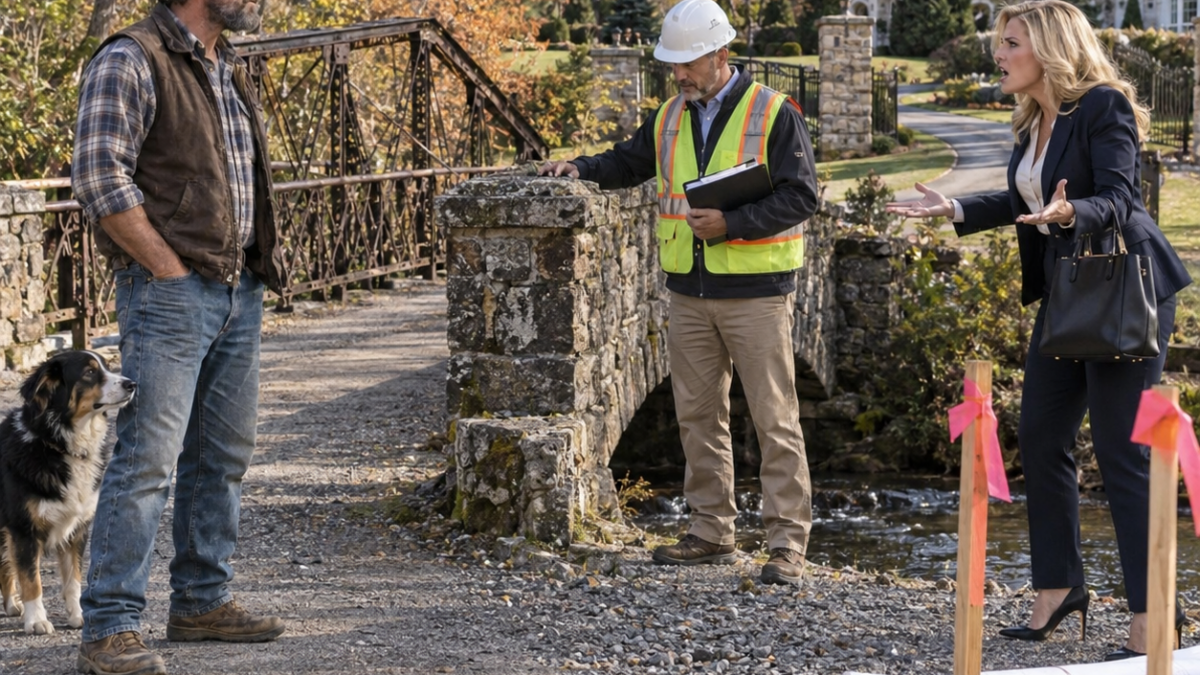
PART 2
The next morning I started building the paper trail.
That was the first lesson the Army Corps had drilled into me: if something matters, document it before memories get creative.
I scanned every page of Dad’s preservation file.
The original nomination materials.
Historic photographs.
Structural descriptions.
The 1982 designation letter.
County correspondence.
Inspection reports.
Old drawings attributed to Silas Miller.
Then I photographed the bridge exactly as it stood that morning.
North elevation.
South elevation.
Interior lattice.
Decking.
Roof structure.
Abutments.
Creek channel.
Entrance posts.
The National Register plaque.
I even photographed the smallest details Dad had taught me to notice—the wooden pegs, old tool marks, repairs made with period-compatible timber.
Sarah watched from the porch.
“You expecting a trial?”
“I’m expecting Karen.”
“That sounds worse.”
I smiled.
She didn’t.
Sarah had grown up in the valley too.
Her family remembered the bridge before Oakwood Bluffs existed.
To her, Karen’s demand wasn’t merely ridiculous.
It felt invasive.
“You know what bothers me?” she asked.
“What?”
“She didn’t ask.”
I lowered the camera.
Sarah continued.
“She could have walked over here and said, ‘Jack, tell me about the bridge.’ Five minutes. That’s all.”
“She already decided what it was.”
“An eyesore.”
“Exactly.”
Sarah looked toward the bridge.
“That’s how people destroy important things. They name them before they understand them.”
I remembered that sentence later.
A lot.
I drafted my response that afternoon.
No insults.
No threats.
No sarcasm.
Just facts.
I identified Harmony Creek Bridge by name.
Date of construction: 1883.
Design: Town lattice truss.
Builder: Silas Miller.
Historic designation: 1982.
I explained that the bridge predated Oakwood Bluffs, that it was privately owned, and that modifying its historic fabric without proper review could create significant legal and preservation issues.
I attached the designation documents.
I asked the board to rescind Violation 17B.
I requested written confirmation that the matter was closed.
Then I sent one copy certified.
I hand-delivered another to the clubhouse drop box.
I kept the third.
“You think she’ll back down?” Sarah asked.
“She has a graceful exit.”
“That wasn’t my question.”
“No.”
She nodded.
“Me neither.”
The response arrived seven days later.
I opened the envelope at the kitchen table.
Sarah was pouring coffee.
The letter was only two sentences long.
The board had reviewed my documentation.
It found the information irrelevant to enforcement of community bylaws.
The violation remained in effect.
Attached was the first five-hundred-dollar fine.
Sarah read the letter over my shoulder.
Then she slowly set the coffeepot down.
“Irrelevant?”
“That’s the word.”
“The federal designation is irrelevant?”
“Apparently.”
“What are you going to do?”
I stared at Karen’s signature.
She had done something incredibly useful.
She had removed ambiguity.
Until that moment, she could have claimed misunderstanding.
Maybe she thought the bridge was decorative.
Maybe she had never seen the records.
Maybe the notice was automated.
Not anymore.
She had been informed.
She had received the documents.
And she had consciously chosen to proceed.
“I’m going over her head.”
My first call went to the State Historic Preservation Office.
I eventually reached a preservation specialist named Arthur Collins.
He had the kind of precise, polite voice that suggested he enjoyed archives more than people.
I liked him immediately.
“Harmony Creek?” he repeated.
“Yes.”
“You own it?”
“My family does.”
“You’re Jack Miller?”
“That’s me.”
There was a pause.
“I know that bridge.”
That surprised me.
“You do?”
“I wrote a graduate paper on surviving covered bridges in the region.”
I leaned back.
“You’re kidding.”
“No. Your father’s nomination file is unusually good.”
“That sounds like Dad.”
“What’s the problem?”
I explained.
The HOA.
The pavement requirement.
The fine.
Karen’s response.
Arthur was silent.
Then:
“They want you to pave the deck?”
“Yes.”
“Original deck?”
“Mostly. Some historically compatible replacements.”
“And their basis is aesthetic uniformity?”
“That and alleged safety.”
Another silence.
“Mr. Miller, I’m trying to remain professional.”
“I appreciate that.”
“This is absurd.”
“I appreciate that more.”
He became serious.
“Send me everything.”
I emailed the full file.
Arthur called back later that afternoon.
“I’ve reviewed the correspondence.”
“And?”
“Your HOA is stepping into territory they don’t understand.”
He explained the distinction carefully.
Historic listing was not some magical force field against every private action.
But preservation law, permitting requirements, state review procedures, local regulations, grant history, transportation connections, and potential adverse effects could all become relevant depending on what the association tried to do.
More importantly, paving the bridge wasn’t a normal driveway-maintenance project.
Any competent engineer or preservation professional should have known that.
Arthur agreed to send the HOA an official notice explaining that proposed alterations should not proceed without appropriate review.
“Will that stop Karen?”
“I’ve never met Karen.”
“You’ve described her.”
Arthur sighed.
“Then probably not.”
The fines kept coming.
Five hundred.
Then another five hundred.
Then a notice announcing an increased penalty.
Karen’s letters became less formal and more personal.
Failure to comply.
Willful disregard.
Community safety.
Negative impact on neighboring property values.
Sarah put the third envelope on the counter.
“How high are we now?”
“Three thousand.”
“In imaginary money?”
“For now.”
“You’re too calm.”
“I’m not calm.”
“You look calm.”
“That’s different.”
The official SHPO letter arrived two days later.
Three pages.
Dense language.
Historic status.
Adverse alteration.
Review requirements.
Potential liability.
Preservation obligations.
I forwarded it to the HOA certified.
For twenty-four hours, I allowed myself to think the fight might end.
Then a county code-enforcement truck pulled into my drive.
The inspector introduced himself as Dave Lawson.
“I received a complaint regarding an unsafe structure.”
I looked toward the bridge.
“Harmony Creek?”
“That would be the one.”
“Anonymous?”
His expression answered the question.
I invited him inside first.
Coffee.
Documents.
Latest engineering inspection.
Maintenance log.
Photographs of repairs.
Load recommendations.
Dave read for fifteen minutes.
Then we walked the bridge.
He examined the deck.
Truss connections.
Abutments.
Roof.
He crawled underneath with a flashlight.
When he came back up, his pants were covered with creek-bank mud.
“You maintain this thing better than most county bridges.”
“That’s because my father haunted me about it.”
“Smart man.”
He closed his clipboard.
“I’m marking the complaint unfounded.”
“Thank you.”
He hesitated.
“You know who called?”
“I have a theory.”
“I can’t disclose complainant information.”
“I didn’t ask.”
He nodded.
“Good.”
A week later, two environmental officers arrived after somebody claimed I was contaminating Harmony Creek.
Water samples.
Soil inspection.
No violation.
Then the fire marshal.
Anonymous report.
Severe combustible hazard.
He stared at the covered bridge.
Then at me.
“You know wood burns, right?”
“I’ve heard rumors.”
He fought a smile.
We spent forty minutes inspecting the structure.
Nothing.
By the fourth agency visit, Sarah stopped finding it funny.
She stood at the kitchen window after another county vehicle left.
“This isn’t about the bridge anymore.”
“No.”
“She’s trying to wear us down.”
“I know.”
“How far will she go?”
That question stayed with me.
Because I didn’t know.
So I installed cameras.
Not pointed at neighbors.
Just the bridge.
Motion-activated.
Timestamped.
Cloud backup.
Then I called an attorney.
Ben Carter had served as a JAG officer before going into property and land-use law.
His office walls were lined with zoning maps, old deeds, and photographs of cases he had won.
He listened without interrupting.
When I finished, he read the SHPO letter.
Then the HOA response.
Then my inspection reports.
Then the anonymous-complaint timeline.
Finally, he leaned back.
“Jack.”
“Yes.”
“You realize they’re helping you.”
“That’s what I was afraid you’d say.”
He smiled.
“Every time they escalate after receiving actual notice, your record gets stronger.”
“Can we stop it?”
“Yes.”
“How?”
“First, we make harassment expensive.”
He drafted a cease-and-desist letter.
It identified Karen personally.
It demanded rescission of the violation.
Cancellation of all fines.
An end to interference.
Preservation of all board records, texts, emails, meeting notes, complaints, contractor discussions, and communications related to me or the bridge.
“If somebody deletes something now,” Ben said, “that decision may become its own problem.”
“Will Karen understand that?”
“Her attorney will.”
“If she shows it to him.”
“That’s why we send him a copy.”
Then Ben surprised me.
“There’s another front.”
“What?”
“The homeowners.”
“I don’t want to drag neighbors into my lawsuit.”
“I didn’t say lawsuit.”
He opened the HOA bylaws.
“As a member under whatever limited relationship your father established, you have inspection rights.”
“Financials?”
“Correct.”
“Why?”
Ben shrugged.
“Because power-abusing boards are sometimes clean financially.”
“And sometimes?”
“Sometimes they’re not.”
I thought about Karen’s golf cart.
The endless landscaping.
The fancy clubhouse entrance.
The new monument sign installed the year before while residents complained about potholes.
“What do we request?”
“Three years.”
“That much?”
“If she’s clean, we find nothing.”
“And if she isn’t?”
Ben smiled.
“Then your bridge becomes the least of her problems.”
I started talking to neighbors.
Not campaigning.
Talking.
George Parker was first.
Retired mechanic.
Quiet.
He had lived in Oakwood Bluffs eight years.
He caught me at the mailbox one evening.
“Jack.”
“George.”
He looked toward Karen’s street before speaking.
“I heard about the bridge.”
“Whole neighborhood probably has.”
“People think you’re right.”
“People are quiet.”
“That’s because she punishes anybody who isn’t.”
He told me about the garden hose.
Two-hundred-dollar fine because it wasn’t coiled neatly.
I stared at him.
“You paid?”
“Wife wanted peace.”
That sentence became the story of Oakwood Bluffs.
People paid for peace.
Repainted for peace.
Removed things for peace.
Moved decorations for peace.
Accepted humiliation for peace.
But peace built on fear isn’t peace.
It’s compliance.
The Ellisons came next.
Rose bushes.
Too exuberant.
Their words, not mine.
Then Maria and Luis Garcia.
Front door.
Three repaints.
Karen had physically brought paint cards to supervise the final color.
“She stood there for two hours,” Maria said.
“You’re joking.”
“I wish.”
Luis shook his head.
“We wanted to sell.”
“Because of a door?”
“Because of everything.”
I showed them the SHPO letter.
The cease-and-desist.
The record request Ben planned.
Maria leaned forward.
“You’re actually challenging her.”
“Yes.”
“What do you need?”
“Truth.”
She smiled.
“You’ve come to the right house.”
Within a week, twelve homeowners were sitting in my workshop.
Mismatched chairs.
Coffee.
Sawdust.
Old tools.
Sarah set out sandwiches.
I told them about the bridge.
Then I stopped talking.
For the next two hours, they talked.
Holiday decorations.
Bird feeders.
Mailbox colors.
Children’s toys.
Lawns measured with a ruler.
Trash cans visible five minutes too early.
Contractors denied access because truck logos were “visually disruptive.”
George finally said what everyone was thinking.
“She acts like she owns us.”
Mr. Ellison, the retired accountant, had brought the bylaws.
He flipped through them.
“She also refuses meaningful financial disclosure.”
That got Ben’s attention when I called him later.
We submitted a formal records request.
Bank statements.
Credit-card transactions.
Vendor invoices.
Contracts.
Budgets.
Board approvals.
Karen responded the next morning.
Denied.
Privacy concerns.
Financial reports available only in summarized form.
Ben laughed when he read it.
“What?”
“She has three options.”
“Which are?”
“Produce the records voluntarily.”
“Unlikely.”
“Produce them after a court compels her.”
“More likely.”
“Or resign before we get there.”
“Least likely.”
He sent another letter.
Five business days.
Produce the records.
The neighborhood coalition grew.
We needed ten percent of homeowners to force a special meeting.
We reached that threshold the first night.
By the third day, more than a third of the subdivision had signed.
That changed everything.
Karen’s authority had always depended on private resentment.
Once people discovered their resentment was shared, fear began evaporating.
Then the newspaper called.
Maria had tipped them.
The reporter was Jessica Monroe.
Young.
Sharp.
Prepared.
She met me at the bridge.
“What do you want people to understand?”
I thought about it.
“That this isn’t about asphalt.”
“What is it about?”
“Some things exist before your rules.”
She smiled.
“That’s good.”
“It wasn’t meant to be.”
She photographed the bridge.
The historic plaque.
The violation notice.
Then she interviewed Sarah.
I watched from a distance.
“What does this bridge mean to your family?” Jessica asked.
Sarah looked toward me.
Then toward the trusses.
“It’s the last place his father waited for him.”
I stopped breathing.
I had never told Jessica that.
Sarah continued.
“Jack was deployed. His father was sick. Every afternoon he’d sit near the bridge because he said he wanted to see his son’s truck come across it one more time.”
Jessica lowered her notebook.
“Did he?”
“No.”
Sarah’s voice broke.
“He died two months before Jack came home.”
I looked away.
That story made the article.
Sunday morning.
Front page of the local section.
HOA Orders Veteran to Pave Historic Bridge.
By noon, my phone wouldn’t stop ringing.
Historical groups.
Veterans.
Old residents from the county.
People who remembered school field trips to Harmony Creek.
Then regional television called.
I declined most interviews.
The facts were enough.
Karen did not agree.
She emailed the whole neighborhood.
The article, she claimed, was misleading.
She described me as an angry homeowner manipulating historic status to avoid ordinary safety rules.
That email cost her more support.
Because everyone could see the bridge.
Nobody believed asphalt would make a timber-covered bridge safer.
The board finally agreed to financial inspection.
Two hours.
One reviewer.
No photographs except where legally required.
No removal of originals.
Karen clearly believed restrictions would save her.
She had never met Mr. Ellison with a portable scanner.
He emerged from the clubhouse exactly two hours later.
George and I waited in my truck.
Mr. Ellison opened the passenger door.
Got in.
Closed it.
Said nothing.
“What?” George asked.
Ellison stared through the windshield.
“It’s worse.”
“How worse?”
He put a flash drive in my hand.
“Criminal worse.”
We met Ben that evening.
Ellison walked us through the records.
Restaurant charges.
Salon charges.
Retail purchases.
Online orders.
All assigned vague labels.
Community relations.
Administrative supplies.
Board development.
Then vendors.
A landscaping company charging double or triple normal rates.
Owner: Karen’s brother-in-law.
Consulting payments.
Monthly.
Recipient company traced to Karen’s maiden name.
There were discrepancies in reserve transfers.
Unexplained reimbursements.
Duplicate invoices.
Cash withdrawals.
Ellison totaled what he could verify.
Forty-seven thousand dollars over roughly two years.
“That’s preliminary,” he said.
“It could be more.”
Ben stared at the spreadsheet.
“Jack.”
“I know.”
“No. Your bridge is no longer the central legal exposure.”
“What do we do?”
“We preserve everything.”
“Police?”
“Eventually.”
Ellison looked surprised.
“Eventually?”
Ben nodded.
“We need originals protected. We need the board formally put on notice. We need to avoid tipping anyone off before records can be secured.”
I understood.
Controlled escalation.
But the homeowners had forced a special meeting.
Karen would have to face everyone.
Ben recommended we let that meeting happen.
Not to humiliate her.
To establish public transparency.
The notice went out.
Harmony Creek Bridge.
Recent community expenditures.
Possible special assessment.
Karen believed the meeting was about me.
That was obvious from the opening.
The clubhouse was packed.
People stood along the walls.
Karen sat front and center.
Mark—the young treasurer—looked terrified.
Brenda, the board secretary, stared at the crowd as if wishing she were invisible.
Karen struck the gavel.
“We are here because one homeowner has chosen to place his personal preferences above the lawful standards of this community.”
Murmuring.
She continued.
“Mr. Miller has generated unnecessary legal expenses.”
My legal expenses.
Not hers.
I almost admired the framing.
“The board may therefore require a special assessment.”
That triggered anger.
“How much?”
“For what?”
“What lawyers?”
Karen raised her voice.
“This is what happens when residents refuse to follow the same rules everyone else follows.”
I stood.
She saw me.
“No.”
“What?”
“You will have an opportunity during homeowner comments.”
“I’m asking now.”
She glared.
“Sit down.”
I stayed standing.
“My question isn’t about the bridge.”
That shifted the room.
Karen hesitated.
“What is it?”
I walked forward.
Placed Ellison’s summary on the table.
“How much money has this association paid companies connected to you or your relatives?”
Her face changed.
Not dramatically.
Just enough.
“What are you talking about?”
“Forty-seven thousand dollars.”
Silence.
Mark turned toward Karen.
Brenda did too.
Karen laughed.
“That is absurd.”
Mr. Ellison stood.
“No.”
Everyone knew him.
Quiet accountant.
Never dramatic.
Never loud.
That made him dangerous.
He walked toward the front carrying a binder.
“I reviewed the records.”
Karen’s face went pale.
“You were permitted only to inspect them.”
“I inspected them.”
“You had no authority to conduct an audit.”
“I conducted arithmetic.”
A few people laughed.
Karen didn’t.
Ellison held up the first record.
“Three hundred twelve dollars and forty-six cents. Steakhouse. Categorized community relations.”
He looked at Karen.
“Who attended?”
She said nothing.
“Next. Eight hundred ninety dollars. Salon and spa charge. Categorized administrative supplies.”
People began murmuring.
“Next. Two thousand dollars to Lawn and Garden Excellence for three azalea replacements.”
Someone shouted:
“Three bushes?”
Ellison continued.
“The company is registered to your brother-in-law.”
Karen slammed her hand down.
“Those numbers are being taken out of context.”
“Then explain the context.”
She couldn’t.
Next came monthly consulting fees.
Company registered under Karen’s maiden name.
Mark picked up the sheet.
His hands shook.
“I didn’t approve this.”
Karen turned on him.
“You signed budgets.”
“Not this.”
“You’re treasurer.”
“I never saw this.”
The room erupted.
Maria Garcia stood.
“You fined us because our front door was the wrong beige while you were using our dues at spas?”
Karen shouted over her.
“That is defamatory!”
Ellison raised another page.
“The bank statement is defamatory?”
George stood.
“You charged me two hundred dollars over a garden hose.”
The Ellisons.
“Our roses.”
A young mother.
“My son’s slide.”
People began pulling out their old notices.
All those little humiliations returned at once.
Karen banged the gavel.
Nobody listened.
Her power depended on the illusion that her paperwork was law.
Now everyone had paperwork of their own.
Maria stepped into the aisle.
“I move for an immediate vote of no confidence in Karen Henderson.”
A roar.
Karen stood.
“You cannot do this!”
Ellison opened the bylaws.
“Yes, we can.”
“Not without notice.”
“This is a duly called special meeting.”
“The agenda—”
“Recent community expenditures.”
He held up the financial file.
“Your expenditures.”
Somebody seconded the motion.
Then another.
Hands rose across the room.
Not close.
Overwhelming.
Karen looked at Mark.
He wouldn’t meet her eyes.
Brenda shook her head.
For years, Karen had been the most important person in every HOA meeting.
Now she was the only person with no control over what happened next.
The motion passed.
She was removed.
Maria moved to refer the financial records for independent audit and law-enforcement review.
Passed.
Karen stared around the clubhouse.
Then at me.
“You did this.”
I shook my head.
“No.”
“You turned them against me.”
“I showed them the door.”
Her face twisted.
“You think that bridge makes you special?”
“No.”
“You think because you served—”
“Stop.”
My voice cut through the room.
I stepped closer.
“This was never about me being special.”
I pointed toward the homeowners.
“It was about you believing they were powerless.”
For once, Karen had nothing to say.
She stormed out.
The meeting continued for another hour.
Interim officers.
Record security.
Bank access suspended.
Independent auditor approved.
Attorney instructed to cooperate.
I drove home exhausted.
Sarah was waiting.
“How bad?”
“She’s out.”
Sarah closed her eyes.
“Thank God.”
I sat on the porch.
“You know what scares me?”
“What?”
“It was almost too easy.”
She frowned.
“What does that mean?”
“People like Karen don’t handle losing quietly.”
At six fourteen the next morning, George called.
I answered half asleep.
“Jack.”
Something in his voice brought me fully awake.
“What?”
“Get to the bridge.”
“Why?”
“She’s got a bulldozer.”
I was moving before the call ended.
Boots.
Jeans.
Phone.
I ran.
The engine was audible before I reached the creek.
Deep diesel growl.
When I came around the tree line, I stopped.
A D9 bulldozer sat twenty yards from Harmony Creek Bridge.
Blade lowered.
Operator in the cab.
Karen beside it wearing a yellow hard hat.
She was waving papers.
“Move forward!” she shouted.
The operator leaned out.
“Ma’am, I need to see permits.”
“I told you, emergency order.”
“This thing has a historic plaque.”
“The structure has been condemned.”
“No, it hasn’t.”
My voice carried across the clearing.
Karen spun.
Her expression was almost unrecognizable.
No controlled smile.
No HOA-president mask.
Just rage.
“You.”
I held up my phone.
Already recording.
“What are you doing?”
“Removing an unsafe structure.”
“You were removed from office last night.”
“The vote was illegal.”
“The bridge isn’t condemned.”
“It will be.”
The operator killed the engine.
“Hold on.”
Karen pounded the side of the machine.
“Start it.”
“No.”
“I hired you.”
“You told me the association authorized demolition.”
“It did.”
“No, it didn’t.”
George arrived behind me.
Then Maria.
Then Luis.
Within minutes, half a dozen neighbors stood near the road.
Sarah came last.
I hated seeing her there.
“Stay back,” I told her.
Police sirens sounded in the distance.
Karen heard them.
She pointed at me.
“You called them?”
“Yes.”
“This is a civil matter.”
“You brought heavy equipment onto private property to destroy a historic bridge.”
“I have authority.”
Maria shouted:
“You don’t even have a title anymore.”
Karen turned on her.
“You shut your mouth.”
That was when the first sheriff’s vehicle arrived.
Then another.
Deputies stepped out.
The lead deputy raised his voice.
“Everybody stay where you are.”
Karen immediately walked toward him.
“Thank God. Arrest that man.”
The deputy looked past her.
“Which man?”
“Jack Miller. He has interfered with lawful HOA operations.”
The deputy looked at me.
“Mr. Miller?”
“Yes.”
“Property owner?”
“Yes.”
“Bridge owner?”
“Yes.”
Karen shouted:
“The HOA has jurisdiction!”
The operator climbed down.
“Officer, I’d like to say something.”
The deputy raised a hand.
“One at a time.”
For the next fifteen minutes, documents replaced shouting.
Historic designation.
Deed.
SHPO letter.
Meeting minutes.
Vote removing Karen.
The contractor’s work order.
The operator explained what Karen had told him.
Emergency demolition.
Unsafe structure.
HOA authorization.
None of it existed.
The deputy’s expression became colder with each page.
He approached Karen.
“Ma’am, who authorized you to hire this equipment?”
“The board.”
“What board officer?”
“I am president.”
“You were removed.”
“The vote was invalid.”
“Do you have a court order saying that?”
“No.”
“Do you have a demolition permit?”
She hesitated.
“The structure is dangerous.”
“Do you have an inspection report?”
“No.”
“Condemnation notice?”
“No.”
“Ownership interest in this bridge?”
“The HOA—”
“That wasn’t my question.”
Karen looked toward the bridge.
Then at me.
Then back at the deputy.
Her confidence finally cracked.
“This man has caused everything.”
The deputy’s voice remained calm.
“Turn around.”
Karen froze.
“What?”
“Turn around.”
“You can’t be serious.”
“Hands behind your back.”
Her mouth opened.
Closed.
“No.”
The deputy repeated himself.
Karen stepped backward.
Two deputies moved closer.
“This is insane! I was protecting the community!”
The handcuffs clicked.
Sarah grabbed my arm.
For months, I had imagined what justice would feel like.
I expected satisfaction.
Vindication.
Maybe relief.
Instead, watching Karen break down beside the bridge, I felt tired.
Deeply tired.
The hard hat slipped from her head.
Rolled once.
Stopped in the dirt.
Karen looked at me as deputies escorted her toward the cruiser.
“You ruined my life.”
I answered quietly.
“No, Karen.”
She stopped.
“You kept choosing what happened next.”
The deputies led her away.
When the vehicles disappeared, the clearing became still.
Nobody celebrated at first.
The bulldozer stood silent.
Morning light filtered through the trees.
Harmony Creek moved beneath the bridge.
Then George began clapping.
Slow.
Once.
Twice.
Maria joined.
Then everyone.
I shook my head.
“Don’t.”
George stopped.
“This isn’t for you.”
He pointed at the bridge.
“It’s for the old girl.”
I looked behind me.
The bridge stood exactly as it had before Karen arrived.
Weathered.
Imperfect.
Still there.
I put my hand against one of the entrance posts.
Cold timber.
Solid.
Sarah came beside me.
“Your dad would have lost his mind.”
“At Karen?”
“At the bulldozer.”
“He’d probably have blocked it with his tractor.”
“He absolutely would.”
That made me laugh.
The first laugh of the morning.
The criminal case and financial investigation unfolded over the following months.
I stayed out of most of it.
An independent forensic accountant expanded the suspected misuse substantially beyond what Ellison had found in two hours.
The new board turned everything over to investigators.
Karen faced charges tied to association funds as well as the attempted demolition incident.
Her attorney eventually negotiated a plea.
By then, I cared less about punishment than I thought I would.
The bridge was safe.
The financial records were open.
The residents were no longer afraid.
That mattered more.
Oakwood Bluffs held an emergency election.
Mr. Ellison became president.
Maria Garcia became vice president.
The young treasurer, Mark, resigned but cooperated fully with the audit.
Brenda stepped away from the board.
The first official meeting under new leadership was packed.
Ellison opened a folder.
“First item.”
He looked toward me.
“Resolution 2023-01. Harmony Creek Bridge.”
The room became quiet.
He read aloud.
The original violation was rescinded.
All fines cancelled.
The HOA formally recognized that the bridge predated the subdivision and carried historic significance.
Any future action affecting it would require proper preservation and legal review.
The association apologized to Sarah, me, and my family.
The board voted.
Unanimous.
Ellison looked up.
“Jack, anything you want to say?”
I stood.
A hundred speeches came to mind.
None felt right.
“Thank you.”
That was enough.
The second agenda item mattered almost as much.
Transparency.
Every monthly financial statement would be distributed to homeowners.
Vendor contracts over a threshold required competing bids.
Family or business conflicts had to be disclosed.
Members could inspect records.
Appeals would be heard by more than one person.
No unilateral fines without citation to an actual rule.
No anonymous board spending.
No personal debit-card use.
Karen had spent years making the HOA more powerful.
Her downfall made it more limited.
That was the proper direction.
The special assessment still came.
There was no avoiding it.
Money was missing.
Legal and forensic costs existed.
The community had to stabilize itself.
But Ellison stood in front of everyone with a real budget.
Line by line.
No secrets.
Five-year plan.
Road repair.
Pool pump.
Reserve rebuilding.
Nobody cheered at paying more money.
But nobody accused him of hiding it either.
Trust didn’t make the assessment painless.
It made it understandable.
After the meeting, Maria hugged Sarah.
Then she looked at me.
“You know what’s funny?”
“What?”
“If Karen had left your bridge alone, none of this would have happened.”
I thought about that.
“She believed the bridge was the weak point.”
“It was the thread.”
Maria smiled.
“She pulled it.”
“And everything unraveled.”
The newspaper kept calling Harmony Creek “the bridge that beat the HOA.”
I hated the phrase.
Bridges don’t beat people.
People either learn where their authority ends or they don’t.
Still, tourists began appearing.
Not many.
A few history enthusiasts.
Retired engineers.
Covered-bridge photographers.
Once, an elderly man stopped his car and cried because his father had taken him fishing there in 1952.
I walked him across.
He touched the lattice.
“Same marks.”
“What?”
“The chisel marks.”
I smiled.
“My dad used to say that.”
He laughed.
“Your dad was right.”
That encounter stayed with me.
Karen had called the bridge non-conforming.
That was precisely why people loved it.
It had survived because it didn’t conform to anything newer.
It belonged to its own time.
That autumn, the historical society asked permission to host a small preservation day near the creek.
Nothing elaborate.
Craft demonstrations.
Old photographs.
A talk by Arthur Collins.
Kids learned how timber trusses worked.
The fire department brought cider.
Sarah set up Dad’s photographs on a folding table.
One showed him as a boy.
One showed Grandpa repairing shingles.
One showed me in uniform standing at the bridge entrance after my first deployment.
Then Sarah found the photograph I had forgotten existed.
Dad in a lawn chair.
Near the bridge.
Taken during my final deployment.
The chair angled toward the road.
Waiting.
I held the picture.
“Who took this?”
“George.”
I looked at him across the field.
George approached slowly.
“Your dad sat there a lot.”
“How often?”
“Near the end?”
He swallowed.
“Every afternoon the weather was decent.”
I stared at the photo.
“He knew I wasn’t coming home yet.”
George nodded.
“He knew the dates.”
“Then why?”
“He said schedules change.”
I looked away.
George put a hand on my shoulder.
“He wanted to be first to see your truck.”
I walked onto the bridge alone.
Halfway across, I stopped.
The boards creaked beneath my boots.
For years, that sound had been ordinary.
Now it was Dad.
Waiting.
I rested both hands on the lattice.
“Sorry I was late.”
The creek answered.
Nothing else.
I stayed there until Sarah found me.
She didn’t ask whether I had been crying.
That was one of the reasons I loved her.
The legal case against Karen ended the following year.
The association recovered part of the missing funds through civil action.
Other assets were gone.
Money rarely returns as neatly as people imagine.
Karen accepted a criminal plea that included incarceration, probation afterward, restitution obligations, and restrictions on future fiduciary roles.
Her house was sold.
A young family bought it.
Their first week, they put three bright pink flamingos in the yard.
Maria sent me a photograph.
No caption.
I laughed for five minutes.
The HOA did nothing.
Of course.
That became one of the best things about the new Oakwood Bluffs.
Nothing happened.
A door turned blue.
Nothing happened.
Rose bushes grew past some imaginary aesthetic boundary.
Nothing happened.
A child left a bicycle in a driveway overnight.
Nothing happened.
George’s hose lay uncoiled one Saturday.
The republic survived.
People started talking again.
Not whispering.
Talking.
Potlucks.
Neighborhood watch.
Creek cleanup.
A walking trail.
Residents who had spent years avoiding each other discovered they actually liked one another.
The HOA became almost boring.
That may be the highest compliment an HOA can receive.
Then came the plaque.
Ellison arrived one October afternoon while I was checking a support beam.
He carried a wrapped object.
“What’s that?”
“A board decision.”
“That phrase still makes me nervous.”
“It’s a good one.”
He unwrapped bronze.
The plaque was small.
Tasteful.
It identified Harmony Creek Bridge.
Built 1883.
Silas Miller.
National Register status.
Then one final line:
PRESERVED BY A COMMUNITY THAT CHOSE HISTORY OVER HARASSMENT AND UNITY OVER UNIFORMITY.
I read it twice.
“This wasn’t my idea,” Ellison said quickly.
“Maria?”
“Obviously.”
I smiled.
“It’s a little dramatic.”
“We’ve earned dramatic.”
“Where were you planning to put it?”
“Beside the historic plaque. If you approve.”
That mattered.
If you approve.
Not:
We voted.
Not:
Community standards.
Not:
We have authority.
He asked.
I nodded.
“Let’s put it up.”
We mounted it together.
No ceremony.
No photographers.
Just two neighbors with a drill and a level.
When we finished, Ellison stepped back.
“You know, I used to think this thing was inconvenient.”
“The bridge?”
“Narrow. Slow. Old.”
“Still is.”
“Yeah.”
He looked through the opening toward the creek.
“Now I like that it makes people slow down.”
I smiled.
“Dad used to say the same.”
That evening Sarah and I walked down.
Leaves covered the approach.
The air smelled like wood smoke.
She read the plaque.
“Unity over uniformity.”
“Maria.”
“Definitely Maria.”
We stood inside the bridge.
Sunset filtered through the lattice.
Sarah leaned against me.
“You know what I remember most?”
“What?”
“The first day Karen came.”
“That seems like ten years ago.”
“You were furious.”
“I was calm.”
“You were military calm.”
“There’s a difference?”
“Huge difference.”
I laughed.
She continued.
“You folded that notice like you were deciding where to bury somebody.”
“I was being organized.”
“Of course.”
She took my hand.
“Was it worth it?”
I thought about the question.
The inspectors.
The fines.
The lawyers.
The fear.
The morning with the bulldozer.
Watching Karen in handcuffs.
Dad’s photograph.
Neighbors who had spent years afraid.
“Yes.”
“Even all of it?”
“Yes.”
“Why?”
I looked at the bridge.
“Because if I had paved it, I’d have heard Dad every time I drove across.”
Sarah squeezed my hand.
“What would he say?”
I smiled.
“He’d ask what kind of idiot puts asphalt on an eighty-eight-foot timber bridge.”
“That sounds like him.”
Then I became serious.
“But it wasn’t only Dad.”
“No.”
“It stopped being my fight.”
“When?”
“Probably when George told me about the hose.”
Sarah laughed.
“Of all things.”
“People weren’t afraid because the violations were serious.”
“They were afraid because they were endless.”
“Exactly.”
Karen had discovered that most people would surrender small things to avoid large conflict.
A hose.
A door color.
A rose bush.
A toy.
A mailbox.
Nothing seemed worth a war.
So people gave ground.
One inch at a time.
Until eventually Karen believed there was no boundary she couldn’t cross.
Then she reached the bridge.
The bridge didn’t move.
Maybe that was why the whole thing mattered.
A bridge is supposed to help people cross.
Harmony Creek Bridge did.
Just not in the way Silas could have imagined.
It carried my family over water for more than a century.
Then, one strange year, it carried an entire neighborhood from fear to courage.
From silence to conversation.
From control to community.
Dad would have liked that.
Years later, I still inspect the bridge every season.
Spring first.
Check moisture.
Deck boards.
Roof.
Connections.
Storm debris.
Then again before winter.
Arthur sometimes visits.
He retired from the preservation office but still loves covered bridges.
Ellison brings coffee.
George offers mechanical advice nobody asked for.
Maria still wants to add another plaque.
I keep saying no.
Children who were toddlers during the HOA fight are teenagers now.
Some know the story.
Most don’t.
That’s fine.
History doesn’t always need to shout.
Sometimes it just needs to remain.
A few summers ago, a young boy stopped while I was working near the entrance.
His family had moved into Oakwood Bluffs months earlier.
“Mr. Miller?”
“Yeah?”
“Is this really your driveway?”
“Technically.”
He looked inside.
“It’s weird.”
I laughed.
“What’s weird about it?”
“It’s a bridge.”
“True.”
“My mom said somebody tried to make you pave it.”
“Also true.”
“Why?”
I considered giving him the long version.
Instead:
“They didn’t know what it was.”
He nodded as if this made perfect sense.
Then he touched one of the old timbers.
“How old?”
“More than one hundred forty years.”
His eyes widened.
“Older than my grandma?”
“Much.”
“Older than Karen?”
I nearly dropped my wrench.
“Who told you about Karen?”
“My dad.”
I shook my head.
Legends are hard to control.
The boy pointed at the chisel marks.
“What are those?”
I stopped.
For a moment I was eight years old again.
Dad beside me.
Creek beneath us.
Silas’s tool marks above.
“Signatures,” I said.
He frowned.
“There aren’t names.”
“Not all signatures use names.”
I showed him how the marks followed the timber.
“Someone cut this by hand.”
“All of it?”
“Most of it.”
“That took forever.”
“Probably felt that way.”
“Why didn’t they just buy a bridge?”
I laughed.
“Different time.”
He studied the timber.
Then ran his fingers across the marks.
Exactly as I had.
Exactly as Dad had shown me.
Something inside me settled.
That was preservation.
Not a plaque.
Not a federal listing.
Not a court threat.
A child touching a mark made by somebody one hundred forty years earlier and asking who did it.
Karen never understood that.
To her, age meant obsolete.
Difference meant violation.
History meant something standing in the way of uniformity.
But living history isn’t frozen.
Cars still cross the bridge.
Mud still gets tracked onto the deck.
Boards wear out.
Shingles need replacing.
Wasps build nests.
Storms throw branches against the siding.
Preservation means caring for something while allowing it to keep doing the job it was built to do.
Silas built a bridge.
Not a monument.
Dad understood that.
That was why he kept it strong instead of precious.
That was why I still drive across it.
Slowly.
Windows down when the weather is good.
Listening to the timbers answer the weight of the truck.
Groan.
Creak.
Settle.
Home.
The HOA once called that sound evidence of a hazard.
I hear something else.
Continuity.
A thing doesn’t survive one hundred forty years because nobody challenges it.
It survives because every generation faces some version of the same question.
Is this still worth the trouble?
Flood.
Storm.
Rot.
Development.
Money.
Convenience.
Karen.
Every generation answered yes.
Mine did too.
If there was revenge in what happened, it wasn’t Karen’s arrest.
It wasn’t seeing her removed from office.
It wasn’t the newspaper headlines.
It wasn’t the audit.
It wasn’t even watching her authority disappear in the same clubhouse where she had spent years humiliating people.
The real revenge was quieter.
The bridge remained.
The neighborhood changed.
She wanted everything beige.
Now the Garcias have a blue door.
She wanted perfect landscaping.
The Ellisons’ roses spill wherever they please.
She fined George over a hose.
His grandchildren wash bicycles in his driveway every summer and leave the hose exactly where it falls.
She wanted my entrance covered in asphalt.
Every morning, sunlight still passes through the old lattice and paints moving diamonds across the wooden deck.
That is enough.
More than enough.
One evening, Sarah and I were sitting near the creek when she asked something I had never considered.
“What do you think Silas would say?”
“About Karen?”
“About all of it.”
I looked at the bridge.
A structure he built with local oak, hand tools, pegs, muscle, and patience.
He couldn’t have imagined homeowners associations.
Federal historic registers.
Television reporters.
Modern courts.
Bulldozers powerful enough to destroy his work in minutes.
“He’d probably ask why we made such a fuss.”
Sarah smiled.
“Really?”
“No.”
I thought again.
“He’d understand.”
“Why?”
“Because he built it to last.”
That was the answer.
People who build something to last are making a request of strangers they will never meet.
Take care of this after I’m gone.
Dad heard that request.
Then I did.
One day, someone else will.
I won’t own Harmony Creek forever.
That used to bother me.
Now it doesn’t.
Ownership is temporary.
Stewardship is the point.
That was the lesson Karen accidentally gave me.
She believed authority meant ownership.
She believed being president meant she had the right to reshape anything within reach.
She discovered too late that responsibility and control are not the same thing.
Neither are rules and wisdom.
Neither are uniformity and community.
Neither are old and worthless.
The final resolution from the HOA still sits in Dad’s leather folio.
Behind the 1982 designation.
Behind Silas’s drawings.
Behind the old photographs.
I added one thing.
Karen’s original violation notice.
VIOLATION 17B.
NON-CONFORMING DRIVEWAY SURFACE.
Five hundred dollars.
Ninety days to pave.
Sometimes I take it out and laugh.
Not because what happened was funny.
Because the paper looks so small now.
One sheet.
One bad assumption.
One woman absolutely certain she knew what something should become before understanding what it already was.
That notice nearly cost us months of peace.
But it also exposed corruption.
United neighbors.
Protected the bridge.
And reminded an entire community that rules should serve people, not replace judgment.
Dad’s handwriting remains on the inside cover of the folio.
Three words.
KEEP IT STANDING.
For years, I assumed he meant the bridge.
Now I think he meant more.
Keep the history standing.
Keep your principles standing.
Keep your neighbors standing.
Keep yourself standing when somebody tries to convince you that surrender is easier than truth.
He was right.
The bridge is still standing.
So are we.
And every time I drive home, I slow down before the entrance.
The tires touch the old boards.
The lattice darkens around me.
Harmony Creek moves below.
The timbers groan under the truck’s weight.
Then I emerge on the other side.
Home.
Exactly the way Silas intended.
Exactly the way Dad protected it.
And exactly the way Karen once insisted it could never remain.
The HOA president gave me ninety days to cover my family’s old wooden entrance with asphalt or face fines big enough to threaten my home.
She called it an unsafe eyesore, never once asking why generations of people in our county had fought to keep it exactly the way it was.
By the time she discovered what those weathered timbers actually were, the violation notice in her hand had already started a war she could no longer control.
“I don’t care who built it, Mr. Miller.”
Karen Henderson stood at the edge of my lawn with one hand on her hip and a clipboard pressed against her chest.
“The bylaws require all primary entrances to be paved with board-approved asphalt. You have ninety days.”
I looked down at the notice.
VIOLATION 17B.
NON-CONFORMING DRIVEWAY SURFACE.
Five hundred dollars if I failed to comply.
Higher fines every week after that.
Eventually, a lien.
Then I looked past her.
Harmony Creek flowed quietly beneath the covered bridge leading onto my forty acres.
Dark cedar siding.
Hand-hewn oak trusses.
Weathered wooden planks polished by more than a century of wagon wheels, Model Ts, farm trucks, my father’s old Ford, and now my own pickup.
Karen pointed toward it.
“That thing is dangerous.”
“That thing?”
“The wooden entrance.”
I almost laughed.
Instead, I folded the notice once.
Carefully.
“Karen, that bridge was built in 1883.”
She shrugged.
“That doesn’t make it compliant.”
“My great-great-grandfather built it.”
“Again, irrelevant.”
“It’s listed on the National Register of Historic Places.”
For the first time, she hesitated.
Only for a second.
Then came the laugh.
A short, dismissive bark.
“Oh, Jack. A plaque doesn’t make you exempt from HOA rules.”
I stared at her.
I had spent most of my adult life with the Army Corps of Engineers. I understood structures. I understood permits. I understood what happened when somebody modified a historic timber bridge without knowing what they were touching.
Harmony Creek Bridge wasn’t decorative.
It was the only vehicle access to my property.
And it wasn’t some backyard project thrown together by a hobby carpenter.
My great-great-grandfather, Silas Miller, had built the bridge using white oak harvested from this land.
My father used to take me underneath it when I was a boy.
He would point toward the massive latticework.
“See those marks?”
I would run my fingers over the old chisel cuts.
“Silas made those.”
Dad said every mark was a signature.
Every wooden peg mattered.
Every beam had survived because somebody before us understood that old things don’t survive by accident.
They survive because somebody chooses to protect them.
Dad had spent years getting the bridge historically recognized.
When he died, protecting it became my responsibility.
Karen saw none of that.
She saw wood.
She saw something that didn’t match the entrance roads in Oakwood Bluffs.
And Karen hated anything that didn’t match.
The subdivision had been built around our older farm property years earlier.
My father had agreed to a limited association arrangement mostly because part of the access road connected through common infrastructure.
He believed neighbors could work things out with handshakes and common sense.
Karen believed every signature gave her another piece of authority.
“You’re not paving this bridge,” I said.
Her expression hardened.
“That isn’t your decision.”
“It’s my property.”
“It affects community appearance.”
“It predates your community by more than a hundred years.”
“The rules apply equally.”
“No,” I said. “They don’t.”
Karen stepped closer.
“Then I suggest you hire an attorney.”
“I might.”
“We have one.”
“Good.”
She blinked.
Bullies usually expect resistance to sound louder.
Mine didn’t.
I had spent too many years dealing with dangerous problems to confuse volume with strength.
Karen lifted her clipboard.
“Ninety days, Jack. After that, fines begin automatically.”
She turned toward her golf cart.
I called after her.
“One question.”
She stopped.
“If your board orders me to alter a nationally listed historic structure and something goes wrong, who exactly plans to accept responsibility?”
That made her turn.
Her smile was gone.
But only briefly.
“The HOA is fully protected.”
Then she drove away.
That evening I went into my study and opened the leather folio my father had left behind.
Inside were deeds dating back generations.
Original bridge drawings.
Engineering inspections.
Historic photographs.
And at the very back, preserved inside archival sleeves, the document Dad had once called the bridge’s second birth certificate.
The federal historic designation.
I laid it on the desk.
Sarah stood behind me.
“She really wants you to pave it?”
“Yes.”
“What are you going to do?”
I looked at my father’s handwriting in the margins of the old file.
Then at Karen’s violation notice beside it.
“I’m going to give her one chance to understand what she’s touching.”
I didn’t know it then, but Karen was about to make the worst possible choice.
She was going to put her refusal in writing.
[END OF FACEBOOK CAPTION]
[FIRST COMMENT / FULL STORY CONTINUATION]
The next morning I started building the paper trail.
That was the first lesson the Army Corps had drilled into me: if something matters, document it before memories get creative.
I scanned every page of Dad’s preservation file.
The original nomination materials.
Historic photographs.
Structural descriptions.
The 1982 designation letter.
County correspondence.
Inspection reports.
Old drawings attributed to Silas Miller.
Then I photographed the bridge exactly as it stood that morning.
North elevation.
South elevation.
Interior lattice.
Decking.
Roof structure.
Abutments.
Creek channel.
Entrance posts.
The National Register plaque.
I even photographed the smallest details Dad had taught me to notice—the wooden pegs, old tool marks, repairs made with period-compatible timber.
Sarah watched from the porch.
“You expecting a trial?”
“I’m expecting Karen.”
“That sounds worse.”
I smiled.
She didn’t.
Sarah had grown up in the valley too.
Her family remembered the bridge before Oakwood Bluffs existed.
To her, Karen’s demand wasn’t merely ridiculous.
It felt invasive.
“You know what bothers me?” she asked.
“What?”
“She didn’t ask.”
I lowered the camera.
Sarah continued.
“She could have walked over here and said, ‘Jack, tell me about the bridge.’ Five minutes. That’s all.”
“She already decided what it was.”
“An eyesore.”
“Exactly.”
Sarah looked toward the bridge.
“That’s how people destroy important things. They name them before they understand them.”
I remembered that sentence later.
A lot.
I drafted my response that afternoon.
No insults.
No threats.
No sarcasm.
Just facts.
I identified Harmony Creek Bridge by name.
Date of construction: 1883.
Design: Town lattice truss.
Builder: Silas Miller.
Historic designation: 1982.
I explained that the bridge predated Oakwood Bluffs, that it was privately owned, and that modifying its historic fabric without proper review could create significant legal and preservation issues.
I attached the designation documents.
I asked the board to rescind Violation 17B.
I requested written confirmation that the matter was closed.
Then I sent one copy certified.
I hand-delivered another to the clubhouse drop box.
I kept the third.
“You think she’ll back down?” Sarah asked.
“She has a graceful exit.”
“That wasn’t my question.”
“No.”
She nodded.
“Me neither.”
The response arrived seven days later.
I opened the envelope at the kitchen table.
Sarah was pouring coffee.
The letter was only two sentences long.
The board had reviewed my documentation.
It found the information irrelevant to enforcement of community bylaws.
The violation remained in effect.
Attached was the first five-hundred-dollar fine.
Sarah read the letter over my shoulder.
Then she slowly set the coffeepot down.
“Irrelevant?”
“That’s the word.”
“The federal designation is irrelevant?”
“Apparently.”
“What are you going to do?”
I stared at Karen’s signature.
She had done something incredibly useful.
She had removed ambiguity.
Until that moment, she could have claimed misunderstanding.
Maybe she thought the bridge was decorative.
Maybe she had never seen the records.
Maybe the notice was automated.
Not anymore.
She had been informed.
She had received the documents.
And she had consciously chosen to proceed.
“I’m going over her head.”
My first call went to the State Historic Preservation Office.
I eventually reached a preservation specialist named Arthur Collins.
He had the kind of precise, polite voice that suggested he enjoyed archives more than people.
I liked him immediately.
“Harmony Creek?” he repeated.
“Yes.”
“You own it?”
“My family does.”
“You’re Jack Miller?”
“That’s me.”
There was a pause.
“I know that bridge.”
That surprised me.
“You do?”
“I wrote a graduate paper on surviving covered bridges in the region.”
I leaned back.
“You’re kidding.”
“No. Your father’s nomination file is unusually good.”
“That sounds like Dad.”
“What’s the problem?”
I explained.
The HOA.
The pavement requirement.
The fine.
Karen’s response.
Arthur was silent.
Then:
“They want you to pave the deck?”
“Yes.”
“Original deck?”
“Mostly. Some historically compatible replacements.”
“And their basis is aesthetic uniformity?”
“That and alleged safety.”
Another silence.
“Mr. Miller, I’m trying to remain professional.”
“I appreciate that.”
“This is absurd.”
“I appreciate that more.”
He became serious.
“Send me everything.”
I emailed the full file.
Arthur called back later that afternoon.
“I’ve reviewed the correspondence.”
“And?”
“Your HOA is stepping into territory they don’t understand.”
He explained the distinction carefully.
Historic listing was not some magical force field against every private action.
But preservation law, permitting requirements, state review procedures, local regulations, grant history, transportation connections, and potential adverse effects could all become relevant depending on what the association tried to do.
More importantly, paving the bridge wasn’t a normal driveway-maintenance project.
Any competent engineer or preservation professional should have known that.
Arthur agreed to send the HOA an official notice explaining that proposed alterations should not proceed without appropriate review.
“Will that stop Karen?”
“I’ve never met Karen.”
“You’ve described her.”
Arthur sighed.
“Then probably not.”
The fines kept coming.
Five hundred.
Then another five hundred.
Then a notice announcing an increased penalty.
Karen’s letters became less formal and more personal.
Failure to comply.
Willful disregard.
Community safety.
Negative impact on neighboring property values.
Sarah put the third envelope on the counter.
“How high are we now?”
“Three thousand.”
“In imaginary money?”
“For now.”
“You’re too calm.”
“I’m not calm.”
“You look calm.”
“That’s different.”
The official SHPO letter arrived two days later.
Three pages.
Dense language.
Historic status.
Adverse alteration.
Review requirements.
Potential liability.
Preservation obligations.
I forwarded it to the HOA certified.
For twenty-four hours, I allowed myself to think the fight might end.
Then a county code-enforcement truck pulled into my drive.
The inspector introduced himself as Dave Lawson.
“I received a complaint regarding an unsafe structure.”
I looked toward the bridge.
“Harmony Creek?”
“That would be the one.”
“Anonymous?”
His expression answered the question.
I invited him inside first.
Coffee.
Documents.
Latest engineering inspection.
Maintenance log.
Photographs of repairs.
Load recommendations.
Dave read for fifteen minutes.
Then we walked the bridge.
He examined the deck.
Truss connections.
Abutments.
Roof.
He crawled underneath with a flashlight.
When he came back up, his pants were covered with creek-bank mud.
“You maintain this thing better than most county bridges.”
“That’s because my father haunted me about it.”
“Smart man.”
He closed his clipboard.
“I’m marking the complaint unfounded.”
“Thank you.”
He hesitated.
“You know who called?”
“I have a theory.”
“I can’t disclose complainant information.”
“I didn’t ask.”
He nodded.
“Good.”
A week later, two environmental officers arrived after somebody claimed I was contaminating Harmony Creek.
Water samples.
Soil inspection.
No violation.
Then the fire marshal.
Anonymous report.
Severe combustible hazard.
He stared at the covered bridge.
Then at me.
“You know wood burns, right?”
“I’ve heard rumors.”
He fought a smile.
We spent forty minutes inspecting the structure.
Nothing.
By the fourth agency visit, Sarah stopped finding it funny.
She stood at the kitchen window after another county vehicle left.
“This isn’t about the bridge anymore.”
“No.”
“She’s trying to wear us down.”
“I know.”
“How far will she go?”
That question stayed with me.
Because I didn’t know.
So I installed cameras.
Not pointed at neighbors.
Just the bridge.
Motion-activated.
Timestamped.
Cloud backup.
Then I called an attorney.
Ben Carter had served as a JAG officer before going into property and land-use law.
His office walls were lined with zoning maps, old deeds, and photographs of cases he had won.
He listened without interrupting.
When I finished, he read the SHPO letter.
Then the HOA response.
Then my inspection reports.
Then the anonymous-complaint timeline.
Finally, he leaned back.
“Jack.”
“Yes.”
“You realize they’re helping you.”
“That’s what I was afraid you’d say.”
He smiled.
“Every time they escalate after receiving actual notice, your record gets stronger.”
“Can we stop it?”
“Yes.”
“How?”
“First, we make harassment expensive.”
He drafted a cease-and-desist letter.
It identified Karen personally.
It demanded rescission of the violation.
Cancellation of all fines.
An end to interference.
Preservation of all board records, texts, emails, meeting notes, complaints, contractor discussions, and communications related to me or the bridge.
“If somebody deletes something now,” Ben said, “that decision may become its own problem.”
“Will Karen understand that?”
“Her attorney will.”
“If she shows it to him.”
“That’s why we send him a copy.”
Then Ben surprised me.
“There’s another front.”
“What?”
“The homeowners.”
“I don’t want to drag neighbors into my lawsuit.”
“I didn’t say lawsuit.”
He opened the HOA bylaws.
“As a member under whatever limited relationship your father established, you have inspection rights.”
“Financials?”
“Correct.”
“Why?”
Ben shrugged.
“Because power-abusing boards are sometimes clean financially.”
“And sometimes?”
“Sometimes they’re not.”
I thought about Karen’s golf cart.
The endless landscaping.
The fancy clubhouse entrance.
The new monument sign installed the year before while residents complained about potholes.
“What do we request?”
“Three years.”
“That much?”
“If she’s clean, we find nothing.”
“And if she isn’t?”
Ben smiled.
“Then your bridge becomes the least of her problems.”
I started talking to neighbors.
Not campaigning.
Talking.
George Parker was first.
Retired mechanic.
Quiet.
He had lived in Oakwood Bluffs eight years.
He caught me at the mailbox one evening.
“Jack.”
“George.”
He looked toward Karen’s street before speaking.
“I heard about the bridge.”
“Whole neighborhood probably has.”
“People think you’re right.”
“People are quiet.”
“That’s because she punishes anybody who isn’t.”
He told me about the garden hose.
Two-hundred-dollar fine because it wasn’t coiled neatly.
I stared at him.
“You paid?”
“Wife wanted peace.”
That sentence became the story of Oakwood Bluffs.
People paid for peace.
Repainted for peace.
Removed things for peace.
Moved decorations for peace.
Accepted humiliation for peace.
But peace built on fear isn’t peace.
It’s compliance.
The Ellisons came next.
Rose bushes.
Too exuberant.
Their words, not mine.
Then Maria and Luis Garcia.
Front door.
Three repaints.
Karen had physically brought paint cards to supervise the final color.
“She stood there for two hours,” Maria said.
“You’re joking.”
“I wish.”
Luis shook his head.
“We wanted to sell.”
“Because of a door?”
“Because of everything.”
I showed them the SHPO letter.
The cease-and-desist.
The record request Ben planned.
Maria leaned forward.
“You’re actually challenging her.”
“Yes.”
“What do you need?”
“Truth.”
She smiled.
“You’ve come to the right house.”
Within a week, twelve homeowners were sitting in my workshop.
Mismatched chairs.
Coffee.
Sawdust.
Old tools.
Sarah set out sandwiches.
I told them about the bridge.
Then I stopped talking.
For the next two hours, they talked.
Holiday decorations.
Bird feeders.
Mailbox colors.
Children’s toys.
Lawns measured with a ruler.
Trash cans visible five minutes too early.
Contractors denied access because truck logos were “visually disruptive.”
George finally said what everyone was thinking.
“She acts like she owns us.”
Mr. Ellison, the retired accountant, had brought the bylaws.
He flipped through them.
“She also refuses meaningful financial disclosure.”
That got Ben’s attention when I called him later.
We submitted a formal records request.
Bank statements.
Credit-card transactions.
Vendor invoices.
Contracts.
Budgets.
Board approvals.
Karen responded the next morning.
Denied.
Privacy concerns.
Financial reports available only in summarized form.
Ben laughed when he read it.
“What?”
“She has three options.”
“Which are?”
“Produce the records voluntarily.”
“Unlikely.”
“Produce them after a court compels her.”
“More likely.”
“Or resign before we get there.”
“Least likely.”
He sent another letter.
Five business days.
Produce the records.
The neighborhood coalition grew.
We needed ten percent of homeowners to force a special meeting.
We reached that threshold the first night.
By the third day, more than a third of the subdivision had signed.
That changed everything.
Karen’s authority had always depended on private resentment.
Once people discovered their resentment was shared, fear began evaporating.
Then the newspaper called.
Maria had tipped them.
The reporter was Jessica Monroe.
Young.
Sharp.
Prepared.
She met me at the bridge.
“What do you want people to understand?”
I thought about it.
“That this isn’t about asphalt.”
“What is it about?”
“Some things exist before your rules.”
She smiled.
“That’s good.”
“It wasn’t meant to be.”
She photographed the bridge.
The historic plaque.
The violation notice.
Then she interviewed Sarah.
I watched from a distance.
“What does this bridge mean to your family?” Jessica asked.
Sarah looked toward me.
Then toward the trusses.
“It’s the last place his father waited for him.”
I stopped breathing.
I had never told Jessica that.
Sarah continued.
“Jack was deployed. His father was sick. Every afternoon he’d sit near the bridge because he said he wanted to see his son’s truck come across it one more time.”
Jessica lowered her notebook.
“Did he?”
“No.”
Sarah’s voice broke.
“He died two months before Jack came home.”
I looked away.
That story made the article.
Sunday morning.
Front page of the local section.
HOA Orders Veteran to Pave Historic Bridge.
By noon, my phone wouldn’t stop ringing.
Historical groups.
Veterans.
Old residents from the county.
People who remembered school field trips to Harmony Creek.
Then regional television called.
I declined most interviews.
The facts were enough.
Karen did not agree.
She emailed the whole neighborhood.
The article, she claimed, was misleading.
She described me as an angry homeowner manipulating historic status to avoid ordinary safety rules.
That email cost her more support.
Because everyone could see the bridge.
Nobody believed asphalt would make a timber-covered bridge safer.
The board finally agreed to financial inspection.
Two hours.
One reviewer.
No photographs except where legally required.
No removal of originals.
Karen clearly believed restrictions would save her.
She had never met Mr. Ellison with a portable scanner.
He emerged from the clubhouse exactly two hours later.
George and I waited in my truck.
Mr. Ellison opened the passenger door.
Got in.
Closed it.
Said nothing.
“What?” George asked.
Ellison stared through the windshield.
“It’s worse.”
“How worse?”
He put a flash drive in my hand.
“Criminal worse.”
We met Ben that evening.
Ellison walked us through the records.
Restaurant charges.
Salon charges.
Retail purchases.
Online orders.
All assigned vague labels.
Community relations.
Administrative supplies.
Board development.
Then vendors.
A landscaping company charging double or triple normal rates.
Owner: Karen’s brother-in-law.
Consulting payments.
Monthly.
Recipient company traced to Karen’s maiden name.
There were discrepancies in reserve transfers.
Unexplained reimbursements.
Duplicate invoices.
Cash withdrawals.
Ellison totaled what he could verify.
Forty-seven thousand dollars over roughly two years.
“That’s preliminary,” he said.
“It could be more.”
Ben stared at the spreadsheet.
“Jack.”
“I know.”
“No. Your bridge is no longer the central legal exposure.”
“What do we do?”
“We preserve everything.”
“Police?”
“Eventually.”
Ellison looked surprised.
“Eventually?”
Ben nodded.
“We need originals protected. We need the board formally put on notice. We need to avoid tipping anyone off before records can be secured.”
I understood.
Controlled escalation.
But the homeowners had forced a special meeting.
Karen would have to face everyone.
Ben recommended we let that meeting happen.
Not to humiliate her.
To establish public transparency.
The notice went out.
Harmony Creek Bridge.
Recent community expenditures.
Possible special assessment.
Karen believed the meeting was about me.
That was obvious from the opening.
The clubhouse was packed.
People stood along the walls.
Karen sat front and center.
Mark—the young treasurer—looked terrified.
Brenda, the board secretary, stared at the crowd as if wishing she were invisible.
Karen struck the gavel.
“We are here because one homeowner has chosen to place his personal preferences above the lawful standards of this community.”
Murmuring.
She continued.
“Mr. Miller has generated unnecessary legal expenses.”
My legal expenses.
Not hers.
I almost admired the framing.
“The board may therefore require a special assessment.”
That triggered anger.
“How much?”
“For what?”
“What lawyers?”
Karen raised her voice.
“This is what happens when residents refuse to follow the same rules everyone else follows.”
I stood.
She saw me.
“No.”
“What?”
“You will have an opportunity during homeowner comments.”
“I’m asking now.”
She glared.
“Sit down.”
I stayed standing.
“My question isn’t about the bridge.”
That shifted the room.
Karen hesitated.
“What is it?”
I walked forward.
Placed Ellison’s summary on the table.
“How much money has this association paid companies connected to you or your relatives?”
Her face changed.
Not dramatically.
Just enough.
“What are you talking about?”
“Forty-seven thousand dollars.”
Silence.
Mark turned toward Karen.
Brenda did too.
Karen laughed.
“That is absurd.”
Mr. Ellison stood.
“No.”
Everyone knew him.
Quiet accountant.
Never dramatic.
Never loud.
That made him dangerous.
He walked toward the front carrying a binder.
“I reviewed the records.”
Karen’s face went pale.
“You were permitted only to inspect them.”
“I inspected them.”
“You had no authority to conduct an audit.”
“I conducted arithmetic.”
A few people laughed.
Karen didn’t.
Ellison held up the first record.
“Three hundred twelve dollars and forty-six cents. Steakhouse. Categorized community relations.”
He looked at Karen.
“Who attended?”
She said nothing.
“Next. Eight hundred ninety dollars. Salon and spa charge. Categorized administrative supplies.”
People began murmuring.
“Next. Two thousand dollars to Lawn and Garden Excellence for three azalea replacements.”
Someone shouted:
“Three bushes?”
Ellison continued.
“The company is registered to your brother-in-law.”
Karen slammed her hand down.
“Those numbers are being taken out of context.”
“Then explain the context.”
She couldn’t.
Next came monthly consulting fees.
Company registered under Karen’s maiden name.
Mark picked up the sheet.
His hands shook.
“I didn’t approve this.”
Karen turned on him.
“You signed budgets.”
“Not this.”
“You’re treasurer.”
“I never saw this.”
The room erupted.
Maria Garcia stood.
“You fined us because our front door was the wrong beige while you were using our dues at spas?”
Karen shouted over her.
“That is defamatory!”
Ellison raised another page.
“The bank statement is defamatory?”
George stood.
“You charged me two hundred dollars over a garden hose.”
The Ellisons.
“Our roses.”
A young mother.
“My son’s slide.”
People began pulling out their old notices.
All those little humiliations returned at once.
Karen banged the gavel.
Nobody listened.
Her power depended on the illusion that her paperwork was law.
Now everyone had paperwork of their own.
Maria stepped into the aisle.
“I move for an immediate vote of no confidence in Karen Henderson.”
A roar.
Karen stood.
“You cannot do this!”
Ellison opened the bylaws.
“Yes, we can.”
“Not without notice.”
“This is a duly called special meeting.”
“The agenda—”
“Recent community expenditures.”
He held up the financial file.
“Your expenditures.”
Somebody seconded the motion.
Then another.
Hands rose across the room.
Not close.
Overwhelming.
Karen looked at Mark.
He wouldn’t meet her eyes.
Brenda shook her head.
For years, Karen had been the most important person in every HOA meeting.
Now she was the only person with no control over what happened next.
The motion passed.
She was removed.
Maria moved to refer the financial records for independent audit and law-enforcement review.
Passed.
Karen stared around the clubhouse.
Then at me.
“You did this.”
I shook my head.
“No.”
“You turned them against me.”
“I showed them the door.”
Her face twisted.
“You think that bridge makes you special?”
“No.”
“You think because you served—”
“Stop.”
My voice cut through the room.
I stepped closer.
“This was never about me being special.”
I pointed toward the homeowners.
“It was about you believing they were powerless.”
For once, Karen had nothing to say.
She stormed out.
The meeting continued for another hour.
Interim officers.
Record security.
Bank access suspended.
Independent auditor approved.
Attorney instructed to cooperate.
I drove home exhausted.
Sarah was waiting.
“How bad?”
“She’s out.”
Sarah closed her eyes.
“Thank God.”
I sat on the porch.
“You know what scares me?”
“What?”
“It was almost too easy.”
She frowned.
“What does that mean?”
“People like Karen don’t handle losing quietly.”
At six fourteen the next morning, George called.
I answered half asleep.
“Jack.”
Something in his voice brought me fully awake.
“What?”
“Get to the bridge.”
“Why?”
“She’s got a bulldozer.”
I was moving before the call ended.
Boots.
Jeans.
Phone.
I ran.
The engine was audible before I reached the creek.
Deep diesel growl.
When I came around the tree line, I stopped.
A D9 bulldozer sat twenty yards from Harmony Creek Bridge.
Blade lowered.
Operator in the cab.
Karen beside it wearing a yellow hard hat.
She was waving papers.
“Move forward!” she shouted.
The operator leaned out.
“Ma’am, I need to see permits.”
“I told you, emergency order.”
“This thing has a historic plaque.”
“The structure has been condemned.”
“No, it hasn’t.”
My voice carried across the clearing.
Karen spun.
Her expression was almost unrecognizable.
No controlled smile.
No HOA-president mask.
Just rage.
“You.”
I held up my phone.
Already recording.
“What are you doing?”
“Removing an unsafe structure.”
“You were removed from office last night.”
“The vote was illegal.”
“The bridge isn’t condemned.”
“It will be.”
The operator killed the engine.
“Hold on.”
Karen pounded the side of the machine.
“Start it.”
“No.”
“I hired you.”
“You told me the association authorized demolition.”
“It did.”
“No, it didn’t.”
George arrived behind me.
Then Maria.
Then Luis.
Within minutes, half a dozen neighbors stood near the road.
Sarah came last.
I hated seeing her there.
“Stay back,” I told her.
Police sirens sounded in the distance.
Karen heard them.
She pointed at me.
“You called them?”
“Yes.”
“This is a civil matter.”
“You brought heavy equipment onto private property to destroy a historic bridge.”
“I have authority.”
Maria shouted:
“You don’t even have a title anymore.”
Karen turned on her.
“You shut your mouth.”
That was when the first sheriff’s vehicle arrived.
Then another.
Deputies stepped out.
The lead deputy raised his voice.
“Everybody stay where you are.”
Karen immediately walked toward him.
“Thank God. Arrest that man.”
The deputy looked past her.
“Which man?”
“Jack Miller. He has interfered with lawful HOA operations.”
The deputy looked at me.
“Mr. Miller?”
“Yes.”
“Property owner?”
“Yes.”
“Bridge owner?”
“Yes.”
Karen shouted:
“The HOA has jurisdiction!”
The operator climbed down.
“Officer, I’d like to say something.”
The deputy raised a hand.
“One at a time.”
For the next fifteen minutes, documents replaced shouting.
Historic designation.
Deed.
SHPO letter.
Meeting minutes.
Vote removing Karen.
The contractor’s work order.
The operator explained what Karen had told him.
Emergency demolition.
Unsafe structure.
HOA authorization.
None of it existed.
The deputy’s expression became colder with each page.
He approached Karen.
“Ma’am, who authorized you to hire this equipment?”
“The board.”
“What board officer?”
“I am president.”
“You were removed.”
“The vote was invalid.”
“Do you have a court order saying that?”
“No.”
“Do you have a demolition permit?”
She hesitated.
“The structure is dangerous.”
“Do you have an inspection report?”
“No.”
“Condemnation notice?”
“No.”
“Ownership interest in this bridge?”
“The HOA—”
“That wasn’t my question.”
Karen looked toward the bridge.
Then at me.
Then back at the deputy.
Her confidence finally cracked.
“This man has caused everything.”
The deputy’s voice remained calm.
“Turn around.”
Karen froze.
“What?”
“Turn around.”
“You can’t be serious.”
“Hands behind your back.”
Her mouth opened.
Closed.
“No.”
The deputy repeated himself.
Karen stepped backward.
Two deputies moved closer.
“This is insane! I was protecting the community!”
The handcuffs clicked.
Sarah grabbed my arm.
For months, I had imagined what justice would feel like.
I expected satisfaction.
Vindication.
Maybe relief.
Instead, watching Karen break down beside the bridge, I felt tired.
Deeply tired.
The hard hat slipped from her head.
Rolled once.
Stopped in the dirt.
Karen looked at me as deputies escorted her toward the cruiser.
“You ruined my life.”
I answered quietly.
“No, Karen.”
She stopped.
“You kept choosing what happened next.”
The deputies led her away.
When the vehicles disappeared, the clearing became still.
Nobody celebrated at first.
The bulldozer stood silent.
Morning light filtered through the trees.
Harmony Creek moved beneath the bridge.
Then George began clapping.
Slow.
Once.
Twice.
Maria joined.
Then everyone.
I shook my head.
“Don’t.”
George stopped.
“This isn’t for you.”
He pointed at the bridge.
“It’s for the old girl.”
I looked behind me.
The bridge stood exactly as it had before Karen arrived.
Weathered.
Imperfect.
Still there.
I put my hand against one of the entrance posts.
Cold timber.
Solid.
Sarah came beside me.
“Your dad would have lost his mind.”
“At Karen?”
“At the bulldozer.”
“He’d probably have blocked it with his tractor.”
“He absolutely would.”
That made me laugh.
The first laugh of the morning.
The criminal case and financial investigation unfolded over the following months.
I stayed out of most of it.
An independent forensic accountant expanded the suspected misuse substantially beyond what Ellison had found in two hours.
The new board turned everything over to investigators.
Karen faced charges tied to association funds as well as the attempted demolition incident.
Her attorney eventually negotiated a plea.
By then, I cared less about punishment than I thought I would.
The bridge was safe.
The financial records were open.
The residents were no longer afraid.
That mattered more.
Oakwood Bluffs held an emergency election.
Mr. Ellison became president.
Maria Garcia became vice president.
The young treasurer, Mark, resigned but cooperated fully with the audit.
Brenda stepped away from the board.
The first official meeting under new leadership was packed.
Ellison opened a folder.
“First item.”
He looked toward me.
“Resolution 2023-01. Harmony Creek Bridge.”
The room became quiet.
He read aloud.
The original violation was rescinded.
All fines cancelled.
The HOA formally recognized that the bridge predated the subdivision and carried historic significance.
Any future action affecting it would require proper preservation and legal review.
The association apologized to Sarah, me, and my family.
The board voted.
Unanimous.
Ellison looked up.
“Jack, anything you want to say?”
I stood.
A hundred speeches came to mind.
None felt right.
“Thank you.”
That was enough.
The second agenda item mattered almost as much.
Transparency.
Every monthly financial statement would be distributed to homeowners.
Vendor contracts over a threshold required competing bids.
Family or business conflicts had to be disclosed.
Members could inspect records.
Appeals would be heard by more than one person.
No unilateral fines without citation to an actual rule.
No anonymous board spending.
No personal debit-card use.
Karen had spent years making the HOA more powerful.
Her downfall made it more limited.
That was the proper direction.
The special assessment still came.
There was no avoiding it.
Money was missing.
Legal and forensic costs existed.
The community had to stabilize itself.
But Ellison stood in front of everyone with a real budget.
Line by line.
No secrets.
Five-year plan.
Road repair.
Pool pump.
Reserve rebuilding.
Nobody cheered at paying more money.
But nobody accused him of hiding it either.
Trust didn’t make the assessment painless.
It made it understandable.
After the meeting, Maria hugged Sarah.
Then she looked at me.
“You know what’s funny?”
“What?”
“If Karen had left your bridge alone, none of this would have happened.”
I thought about that.
“She believed the bridge was the weak point.”
“It was the thread.”
Maria smiled.
“She pulled it.”
“And everything unraveled.”
The newspaper kept calling Harmony Creek “the bridge that beat the HOA.”
I hated the phrase.
Bridges don’t beat people.
People either learn where their authority ends or they don’t.
Still, tourists began appearing.
Not many.
A few history enthusiasts.
Retired engineers.
Covered-bridge photographers.
Once, an elderly man stopped his car and cried because his father had taken him fishing there in 1952.
I walked him across.
He touched the lattice.
“Same marks.”
“What?”
“The chisel marks.”
I smiled.
“My dad used to say that.”
He laughed.
“Your dad was right.”
That encounter stayed with me.
Karen had called the bridge non-conforming.
That was precisely why people loved it.
It had survived because it didn’t conform to anything newer.
It belonged to its own time.
That autumn, the historical society asked permission to host a small preservation day near the creek.
Nothing elaborate.
Craft demonstrations.
Old photographs.
A talk by Arthur Collins.
Kids learned how timber trusses worked.
The fire department brought cider.
Sarah set up Dad’s photographs on a folding table.
One showed him as a boy.
One showed Grandpa repairing shingles.
One showed me in uniform standing at the bridge entrance after my first deployment.
Then Sarah found the photograph I had forgotten existed.
Dad in a lawn chair.
Near the bridge.
Taken during my final deployment.
The chair angled toward the road.
Waiting.
I held the picture.
“Who took this?”
“George.”
I looked at him across the field.
George approached slowly.
“Your dad sat there a lot.”
“How often?”
“Near the end?”
He swallowed.
“Every afternoon the weather was decent.”
I stared at the photo.
“He knew I wasn’t coming home yet.”
George nodded.
“He knew the dates.”
“Then why?”
“He said schedules change.”
I looked away.
George put a hand on my shoulder.
“He wanted to be first to see your truck.”
I walked onto the bridge alone.
Halfway across, I stopped.
The boards creaked beneath my boots.
For years, that sound had been ordinary.
Now it was Dad.
Waiting.
I rested both hands on the lattice.
“Sorry I was late.”
The creek answered.
Nothing else.
I stayed there until Sarah found me.
She didn’t ask whether I had been crying.
That was one of the reasons I loved her.
The legal case against Karen ended the following year.
The association recovered part of the missing funds through civil action.
Other assets were gone.
Money rarely returns as neatly as people imagine.
Karen accepted a criminal plea that included incarceration, probation afterward, restitution obligations, and restrictions on future fiduciary roles.
Her house was sold.
A young family bought it.
Their first week, they put three bright pink flamingos in the yard.
Maria sent me a photograph.
No caption.
I laughed for five minutes.
The HOA did nothing.
Of course.
That became one of the best things about the new Oakwood Bluffs.
Nothing happened.
A door turned blue.
Nothing happened.
Rose bushes grew past some imaginary aesthetic boundary.
Nothing happened.
A child left a bicycle in a driveway overnight.
Nothing happened.
George’s hose lay uncoiled one Saturday.
The republic survived.
People started talking again.
Not whispering.
Talking.
Potlucks.
Neighborhood watch.
Creek cleanup.
A walking trail.
Residents who had spent years avoiding each other discovered they actually liked one another.
The HOA became almost boring.
That may be the highest compliment an HOA can receive.
Then came the plaque.
Ellison arrived one October afternoon while I was checking a support beam.
He carried a wrapped object.
“What’s that?”
“A board decision.”
“That phrase still makes me nervous.”
“It’s a good one.”
He unwrapped bronze.
The plaque was small.
Tasteful.
It identified Harmony Creek Bridge.
Built 1883.
Silas Miller.
National Register status.
Then one final line:
PRESERVED BY A COMMUNITY THAT CHOSE HISTORY OVER HARASSMENT AND UNITY OVER UNIFORMITY.
I read it twice.
“This wasn’t my idea,” Ellison said quickly.
“Maria?”
“Obviously.”
I smiled.
“It’s a little dramatic.”
“We’ve earned dramatic.”
“Where were you planning to put it?”
“Beside the historic plaque. If you approve.”
That mattered.
If you approve.
Not:
We voted.
Not:
Community standards.
Not:
We have authority.
He asked.
I nodded.
“Let’s put it up.”
We mounted it together.
No ceremony.
No photographers.
Just two neighbors with a drill and a level.
When we finished, Ellison stepped back.
“You know, I used to think this thing was inconvenient.”
“The bridge?”
“Narrow. Slow. Old.”
“Still is.”
“Yeah.”
He looked through the opening toward the creek.
“Now I like that it makes people slow down.”
I smiled.
“Dad used to say the same.”
That evening Sarah and I walked down.
Leaves covered the approach.
The air smelled like wood smoke.
She read the plaque.
“Unity over uniformity.”
“Maria.”
“Definitely Maria.”
We stood inside the bridge.
Sunset filtered through the lattice.
Sarah leaned against me.
“You know what I remember most?”
“What?”
“The first day Karen came.”
“That seems like ten years ago.”
“You were furious.”
“I was calm.”
“You were military calm.”
“There’s a difference?”
“Huge difference.”
I laughed.
She continued.
“You folded that notice like you were deciding where to bury somebody.”
“I was being organized.”
“Of course.”
She took my hand.
“Was it worth it?”
I thought about the question.
The inspectors.
The fines.
The lawyers.
The fear.
The morning with the bulldozer.
Watching Karen in handcuffs.
Dad’s photograph.
Neighbors who had spent years afraid.
“Yes.”
“Even all of it?”
“Yes.”
“Why?”
I looked at the bridge.
“Because if I had paved it, I’d have heard Dad every time I drove across.”
Sarah squeezed my hand.
“What would he say?”
I smiled.
“He’d ask what kind of idiot puts asphalt on an eighty-eight-foot timber bridge.”
“That sounds like him.”
Then I became serious.
“But it wasn’t only Dad.”
“No.”
“It stopped being my fight.”
“When?”
“Probably when George told me about the hose.”
Sarah laughed.
“Of all things.”
“People weren’t afraid because the violations were serious.”
“They were afraid because they were endless.”
“Exactly.”
Karen had discovered that most people would surrender small things to avoid large conflict.
A hose.
A door color.
A rose bush.
A toy.
A mailbox.
Nothing seemed worth a war.
So people gave ground.
One inch at a time.
Until eventually Karen believed there was no boundary she couldn’t cross.
Then she reached the bridge.
The bridge didn’t move.
Maybe that was why the whole thing mattered.
A bridge is supposed to help people cross.
Harmony Creek Bridge did.
Just not in the way Silas could have imagined.
It carried my family over water for more than a century.
Then, one strange year, it carried an entire neighborhood from fear to courage.
From silence to conversation.
From control to community.
Dad would have liked that.
Years later, I still inspect the bridge every season.
Spring first.
Check moisture.
Deck boards.
Roof.
Connections.
Storm debris.
Then again before winter.
Arthur sometimes visits.
He retired from the preservation office but still loves covered bridges.
Ellison brings coffee.
George offers mechanical advice nobody asked for.
Maria still wants to add another plaque.
I keep saying no.
Children who were toddlers during the HOA fight are teenagers now.
Some know the story.
Most don’t.
That’s fine.
History doesn’t always need to shout.
Sometimes it just needs to remain.
A few summers ago, a young boy stopped while I was working near the entrance.
His family had moved into Oakwood Bluffs months earlier.
“Mr. Miller?”
“Yeah?”
“Is this really your driveway?”
“Technically.”
He looked inside.
“It’s weird.”
I laughed.
“What’s weird about it?”
“It’s a bridge.”
“True.”
“My mom said somebody tried to make you pave it.”
“Also true.”
“Why?”
I considered giving him the long version.
Instead:
“They didn’t know what it was.”
He nodded as if this made perfect sense.
Then he touched one of the old timbers.
“How old?”
“More than one hundred forty years.”
His eyes widened.
“Older than my grandma?”
“Much.”
“Older than Karen?”
I nearly dropped my wrench.
“Who told you about Karen?”
“My dad.”
I shook my head.
Legends are hard to control.
The boy pointed at the chisel marks.
“What are those?”
I stopped.
For a moment I was eight years old again.
Dad beside me.
Creek beneath us.
Silas’s tool marks above.
“Signatures,” I said.
He frowned.
“There aren’t names.”
“Not all signatures use names.”
I showed him how the marks followed the timber.
“Someone cut this by hand.”
“All of it?”
“Most of it.”
“That took forever.”
“Probably felt that way.”
“Why didn’t they just buy a bridge?”
I laughed.
“Different time.”
He studied the timber.
Then ran his fingers across the marks.
Exactly as I had.
Exactly as Dad had shown me.
Something inside me settled.
That was preservation.
Not a plaque.
Not a federal listing.
Not a court threat.
A child touching a mark made by somebody one hundred forty years earlier and asking who did it.
Karen never understood that.
To her, age meant obsolete.
Difference meant violation.
History meant something standing in the way of uniformity.
But living history isn’t frozen.
Cars still cross the bridge.
Mud still gets tracked onto the deck.
Boards wear out.
Shingles need replacing.
Wasps build nests.
Storms throw branches against the siding.
Preservation means caring for something while allowing it to keep doing the job it was built to do.
Silas built a bridge.
Not a monument.
Dad understood that.
That was why he kept it strong instead of precious.
That was why I still drive across it.
Slowly.
Windows down when the weather is good.
Listening to the timbers answer the weight of the truck.
Groan.
Creak.
Settle.
Home.
The HOA once called that sound evidence of a hazard.
I hear something else.
Continuity.
A thing doesn’t survive one hundred forty years because nobody challenges it.
It survives because every generation faces some version of the same question.
Is this still worth the trouble?
Flood.
Storm.
Rot.
Development.
Money.
Convenience.
Karen.
Every generation answered yes.
Mine did too.
If there was revenge in what happened, it wasn’t Karen’s arrest.
It wasn’t seeing her removed from office.
It wasn’t the newspaper headlines.
It wasn’t the audit.
It wasn’t even watching her authority disappear in the same clubhouse where she had spent years humiliating people.
The real revenge was quieter.
The bridge remained.
The neighborhood changed.
She wanted everything beige.
Now the Garcias have a blue door.
She wanted perfect landscaping.
The Ellisons’ roses spill wherever they please.
She fined George over a hose.
His grandchildren wash bicycles in his driveway every summer and leave the hose exactly where it falls.
She wanted my entrance covered in asphalt.
Every morning, sunlight still passes through the old lattice and paints moving diamonds across the wooden deck.
That is enough.
More than enough.
One evening, Sarah and I were sitting near the creek when she asked something I had never considered.
“What do you think Silas would say?”
“About Karen?”
“About all of it.”
I looked at the bridge.
A structure he built with local oak, hand tools, pegs, muscle, and patience.
He couldn’t have imagined homeowners associations.
Federal historic registers.
Television reporters.
Modern courts.
Bulldozers powerful enough to destroy his work in minutes.
“He’d probably ask why we made such a fuss.”
Sarah smiled.
“Really?”
“No.”
I thought again.
“He’d understand.”
“Why?”
“Because he built it to last.”
That was the answer.
People who build something to last are making a request of strangers they will never meet.
Take care of this after I’m gone.
Dad heard that request.
Then I did.
One day, someone else will.
I won’t own Harmony Creek forever.
That used to bother me.
Now it doesn’t.
Ownership is temporary.
Stewardship is the point.
That was the lesson Karen accidentally gave me.
She believed authority meant ownership.
She believed being president meant she had the right to reshape anything within reach.
She discovered too late that responsibility and control are not the same thing.
Neither are rules and wisdom.
Neither are uniformity and community.
Neither are old and worthless.
The final resolution from the HOA still sits in Dad’s leather folio.
Behind the 1982 designation.
Behind Silas’s drawings.
Behind the old photographs.
I added one thing.
Karen’s original violation notice.
VIOLATION 17B.
NON-CONFORMING DRIVEWAY SURFACE.
Five hundred dollars.
Ninety days to pave.
Sometimes I take it out and laugh.
Not because what happened was funny.
Because the paper looks so small now.
One sheet.
One bad assumption.
One woman absolutely certain she knew what something should become before understanding what it already was.
That notice nearly cost us months of peace.
But it also exposed corruption.
United neighbors.
Protected the bridge.
And reminded an entire community that rules should serve people, not replace judgment.
Dad’s handwriting remains on the inside cover of the folio.
Three words.
KEEP IT STANDING.
For years, I assumed he meant the bridge.
Now I think he meant more.
Keep the history standing.
Keep your principles standing.
Keep your neighbors standing.
Keep yourself standing when somebody tries to convince you that surrender is easier than truth.
He was right.
The bridge is still standing.
So are we.
And every time I drive home, I slow down before the entrance.
The tires touch the old boards.
The lattice darkens around me.
Harmony Creek moves below.
The timbers groan under the truck’s weight.
Then I emerge on the other side.
Home.
Exactly the way Silas intended.
Exactly the way Dad protected it.
And exactly the way Karen once insisted it could never remain.








