PART 2: HOA Ordered Me to Jackhammer My Family’s 1849 Hitching Posts—They Had No Idea What Those Iron Rings Really Were
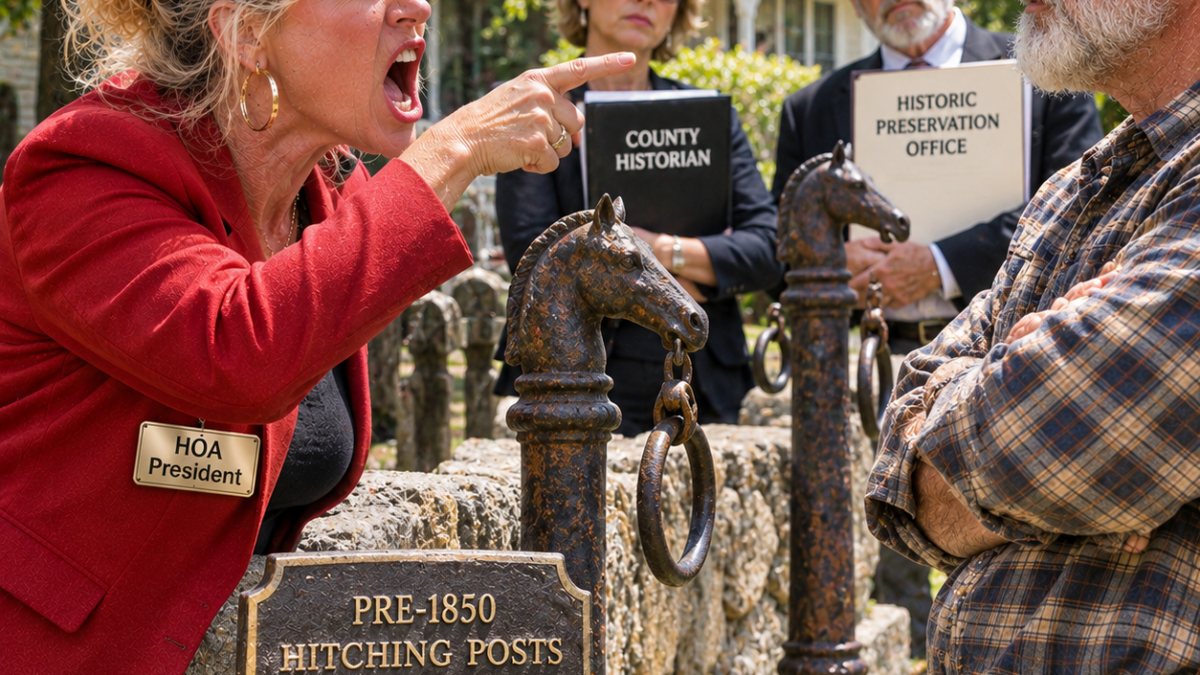
PART 2
## **The Lockbox**
My grandfather kept important documents in an old steel lockbox beneath his desk.
The lock barely worked.
The hinges squealed.
Inside were decades of paperwork.
Deeds.
Survey maps.
Tax receipts.
Letters from the developer.
Early Creekside Meadows documents.
I carried the box to the kitchen table.
The smell of old paper brought back memories so quickly it almost hurt.
Granddad sitting there.
Reading glasses low on his nose.
Coffee turning cold because he forgot to drink it.
He had always been obsessive about land documents.
When I was younger, I thought it was paranoia.
As I got older, I understood.
Land lasts longer than agreements between people.
Paper is what reminds the next generation what the previous one promised.
I found the 1990s developer agreement.
Then the deed amendment.
Granddad had highlighted one section in yellow.
**ARTICLE 9 — EXEMPTIONS**
Section 3.
The Callahan Homestead parcel, two acres in size, was expressly exempt from the architectural and landscaping covenants of Creekside Meadows, provided the property was reasonably maintained and did not constitute a public nuisance.
I read it twice.
Then a third time.
There was nothing ambiguous.
Not just the farmhouse.
Not merely the foundation.
The parcel.
All two acres.
I sat back.
Karen either hadn’t read it or had decided she could reinterpret it until it said what she wanted.
Neither possibility surprised me.
## **My First Letter**
I kept my response simple.
No threats.
No insults.
No reference to pink tracksuits.
I quoted Article 9, Section 3.
Attached a copy.
Circled the language.
Then explained that the hitching posts were original features of the Callahan Homestead and predated the association by roughly a century and a half.
I concluded:
**I respectfully decline your demand for removal and consider this matter closed.**
Certified mail.
Return receipt.
Karen signed for it.
For one week, silence.
I made the mistake of believing silence meant someone on the board had read the deed.
## **The Orange Notice**
The answer appeared taped to my front door.
Neon orange.
Large print.
Visible from the street.
Karen’s idea of subtlety.
The board had rejected my appeal.
Her explanation was almost impressive in its creativity.
According to Karen, Article 9 protected only the “core historic dwelling.”
Ancillary yard features remained subject to HOA landscaping rules.
The hitching posts were classified as:
**ANCILLARY YARD DEBRIS.**
I read that phrase three times.
Yard debris.
My great-great-grandfather had set those stones when Zachary Taylor was president.
Karen had turned them into trash with a capitalized sentence.
Then I reached the fine.
Original penalty:
$1,000.
Additional penalty for filing a “frivolous and time-consuming appeal”:
$1,000.
Total:
$2,000.
Sarah—my lawyer later, not my wife; at that point I hadn’t met her yet—would eventually tell me that fining someone for appealing an HOA determination was one of the more revealing things Karen had done.
At the time, I saw only the humiliation.
Because Karen had also copied the notice to the entire neighborhood.
My phone began buzzing.
Some neighbors supported me quietly.
Others didn’t.
**Just remove them, Jack.**
**We all make sacrifices.**
**Your rocks aren’t worth everyone’s property values.**
One message said:
**Get over yourself.**
I stared at that one for a long time.
Then walked outside.
The hitching posts stood exactly as they always had.
Silent.
Weathered.
Unimpressed.
I put my hand on one iron ring.
Cold.
Rough.
Pitted.
And I realized Karen had succeeded at one thing.
She’d made it personal.
## **Changing the Battlefield**
The Army taught me something useful.
Never fight the enemy on terrain they chose if you can move the fight somewhere better.
Karen wanted this dispute inside the HOA.
Her board.
Her interpretations.
Her newsletters.
Her supporters.
Her fines.
Fine.
I would leave that battlefield.
My first call wasn’t a lawyer.
It was the county historical society.
## **Dr. Alister Finch**
The administrative assistant listened politely.
I explained the posts.
1848 homestead.
Granite.
Iron rings.
Family history.
Then mentioned something Granddad had always said.
“The rings were forged at Black Creek.”
The assistant stopped typing.
“Black Creek Foundry?”
“Yes.”
“Are you sure?”
“Family story.”
“Hold, please.”
Several minutes later, another voice came on.
Older woman.
Crisp.
“Dr. Alister Finch.”
“Yes, ma’am.”
“Tell me exactly what the rings look like.”
I described them.
Not perfectly round.
Visible hammer marks.
Thick iron.
Primitive weld point.
Surface pitting.
She asked dimensions.
Attachment method.
Granite tooling.
Then:
“Can you send photographs?”
I did.
Ten minutes later, she called back.
Her voice had changed.
“Mr. Callahan.”
“Yes?”
“I would like to inspect those posts tomorrow.”
“Why?”
“Because if those rings are what I suspect they are, your HOA may be threatening something far more important than either of you realizes.”
That was the first time the fight stopped feeling like mine alone.
## **A Historian Arrives**
Dr. Finch came in a dusty Subaru.
Late sixties.
Gray hair cut short.
Thick glasses.
Leather satchel full of tools.
She walked straight past me toward the posts.
No small talk.
I liked her immediately.
She knelt beside the first granite block.
Ran gloved fingers over the stone.
“Hand worked.”
“Yes.”
“Original?”
“As far as anyone knows.”
She studied the iron ring.
Calipers.
Camera.
Magnifying lens.
Small scraping sample.
For twenty minutes, I barely existed.
Karen noticed.
Of course she did.
Her golf cart appeared at the end of the street.
She parked across from us.
Pretended to inspect petunias.
Watched.
Dr. Finch ignored her.
Finally, the historian stood.
A strange expression on her face.
Awe.
Excitement.
Maybe disbelief.
“Mr. Callahan.”
“Jack.”
“Jack.”
She touched the ring.
“This is almost certainly Black Creek iron.”
My stomach tightened.
“You’re sure?”
“I would stake my professional reputation on it.”
“What does that mean?”
She turned toward me.
“The Black Creek Foundry burned in the 1850s.”
“I know.”
“We have records of what they produced.”
“Farm hardware.”
“Hardware. Tools. Fixtures. Structural iron.”
She looked at the ring again.
“But no confirmed surviving examples.”
I stared.
“What?”
“We believed everything was lost.”
She smiled.
“These may be the only surviving examples of Black Creek Foundry work in the state.”
Suddenly the posts looked different.
Not because they had changed.
Because I finally understood what had survived.
## **Karen Crosses the Street**
Her golf cart rolled toward us.
She parked partly on my lawn.
Two muddy tire marks.
“Can I help you?”
Dr. Finch turned.
Karen asked:
“Who are you?”
“I am Dr. Alister Finch, director of the County Historical Society.”
Karen’s confidence slipped.
Barely.
Then returned.
“This is private HOA business.”
“No.”
Dr. Finch’s answer was immediate.
“This is historical preservation.”
Karen pointed at the posts.
“Those are noncompliant structures.”
Dr. Finch looked at me.
Then Karen.
“Those are likely the last known surviving examples of pre-1850 ironwork from Black Creek Foundry.”
Karen actually laughed.
“They’re rocks.”
“The granite is also historically significant.”
“They’re ugly.”
Dr. Finch removed a business card.
“Beauty is not the legal standard for preservation.”
She handed it to Karen.
“The Historical Society will issue a formal report today and begin preservation review immediately.”
Karen stared at the card.
“This HOA has rules.”
Dr. Finch smiled without warmth.
“So does the state.”
Karen left.
For the first time since she’d started this, she looked uncertain.
## **The Report**
Ten pages.
Historical context.
Photographs.
Material analysis.
Tool marks.
Comparison with archival Black Creek records.
Conclusion:
The hitching posts were significant pre-1850 artifacts.
The hand-forged rings were likely the only surviving examples of Black Creek Foundry ironwork.
Immediate preservation strongly recommended.
Dr. Finch sent copies everywhere.
HOA.
County commissioner.
State Historic Preservation Office.
Local newspaper.
“She really went wide,” I said.
Dr. Finch replied:
“History survives because people make it inconvenient to destroy.”
I liked her more every day.
## **Karen’s Newsletter**
Karen didn’t retreat.
She escalated.
Next HOA newsletter:
# **PRESERVING OUR COMMUNITY’S AESTHETIC HARMONY**
She didn’t name me.
Didn’t need to.
She warned residents about homeowners using “obscure historical claims” to avoid rules.
She warned of declining property values.
She suggested that allowing one “eccentric decoration” would lead to rusting automobiles, abandoned equipment, and general neighborhood decay.
The comments divided.
Some people believed her.
That bothered me more than I expected.
History had evidence.
Karen had fear.
Fear moves faster.
## **Mr. Henderson**
I started walking the neighborhood.
Not campaigning.
Talking.
First:
Mr. Henderson.
One of Creekside’s earliest residents.
I found him tending roses.
We discussed pruning first.
Then the newsletter.
He sighed.
“She’s wrong, Jack.”
“About what?”
“All of it.”
He remembered my grandfather.
Remembered the original development meetings.
“The developer loved your place.”
I laughed.
“Loved not being able to buy it?”
“No.”
Mr. Henderson disappeared inside.
Returned holding old papers.
A Creekside Meadows marketing brochure.
On the front:
My house.
Ancient oak.
And one hitching post.
Caption:
**A COMMUNITY ROOTED IN HISTORY.**
I stared.
Mr. Henderson smiled.
“Your grandfather was part of the sales pitch.”
Karen was calling the same history an eyesore that developers had used to sell her neighborhood.
## **The Other Stories**
Mr. Henderson told me about the Patels.
Young couple.
Toddler.
Plastic slide.
Karen fined them because the primary colors disrupted the landscape palette.
Then a widow who grew vegetables.
Karen forced her to remove the garden because it violated lawn uniformity.
Another family:
Mailbox.
Another:
Holiday lights.
Another:
Fence stain.
Each story sounded absurd.
Together they sounded familiar.
Control.
## **The Patels**
They were nervous when I visited.
Mrs. Patel said:
“We paid.”
“For the slide?”
“Yes.”
“Why?”
“Because fighting her costs more.”
That sentence bothered me.
I showed them Dr. Finch’s report.
Mr. Patel looked up.
“So you’re fighting?”
“Yes.”
“Even with the fines?”
“Yes.”
“What can we do?”
“Keep everything.”
Emails.
Letters.
Photos.
Receipts.
“Why?”
“Because people forget details.”
I tapped the report.
“Paper doesn’t.”
## **Sarah Jenkins**
Then I hired a lawyer.
Sarah Jenkins.
Former Marine JAG.
Property-rights specialist.
Her office was sparse.
Constitution print.
Books.
Nothing decorative.
She read everything.
Deed.
Exemption.
Karen notices.
Historical report.
Brochure.
She took her time.
Then leaned back.
“Mr. Callahan.”
“Jack.”
“Jack.”
A slow smile appeared.
“Your HOA president has made a remarkable number of mistakes.”
“How remarkable?”
“Enough that I’m going to enjoy this.”
That wasn’t comforting.
But it was promising.
## **Shield and Sword**
Sarah held up my deed.
“This is your shield.”
The two-acre parcel exemption was clear.
Karen’s argument that it applied only to the farmhouse had no support in the document.
Then Sarah held Dr. Finch’s report.
“And this is your sword.”
The historical significance changed the stakes.
Sarah explained that once the state accepted the site for pending historic designation and issued temporary protection, deliberate alteration could carry serious penalties under the preservation framework cited in the story.
I looked at her.
“How fast?”
“With Finch pushing?”
She smiled.
“Fast enough.”
## **The Trap**
Sarah’s strategy made me uncomfortable.
We would apply for protection.
Quietly.
We would continue rejecting HOA fines based on the deed.
We would not reveal every new development immediately.
“Why?”
“Because Karen already has Dr. Finch’s report.”
“She knows.”
“Exactly.”
“If she ignores that and escalates anyway, that’s her choice.”
Sarah leaned forward.
“We aren’t tricking her into ignorance, Jack.”
Important distinction.
“She has been explicitly warned these may be protected artifacts.”
“So if she proceeds—”
“She does so knowingly.”
That I could live with.
## **Karen Announces Demolition**
Two weeks later:
Formal notice.
The HOA intended to exercise “remedial authority.”
Contractor scheduled.
Tuesday morning.
The posts would be mechanically removed.
All costs plus accumulated fines and legal fees would become a lien.
Then I saw the date.
My monthly VA appointment.
One hour away.
I had mentioned it casually to a neighbor.
Someone told Karen.
She had chosen the morning she expected me gone.
That was the first moment I truly hated her.
Not because she wanted the posts removed.
Because she wanted me to come home and find history destroyed without even being allowed to witness it.
I called Sarah.
“She scheduled demolition during my VA appointment.”
Pause.
Then:
“Cancel it.”
“I can reschedule.”
“Good.”
“What are we doing?”
Sarah’s voice became almost cheerful.
“We’re going to welcome the contractors.”
## **Temporary Protection**
Three days before demolition, confirmation arrived.
The State Historic Preservation Office had accepted the application for review.
Temporary protective status applied pending designation.
Dr. Finch called.
“We have it.”
I looked toward the posts.
“They’re safe?”
“Legally.”
That qualification mattered.
Law doesn’t physically stop a jackhammer.
People have to obey it.
## **More Evidence**
Mr. Henderson found old steering committee minutes.
The developer had promised that the Callahan Homestead’s character would be respected.
Then the brochure.
The Patels gathered additional complaints.
Other residents joined.
Meanwhile Sarah’s paralegal investigated the demolition contractor.
Miller and Sons Contracting.
Owner:
Karen’s brother-in-law.
Two nephews worked there.
I stared at the business record.
“She hired family?”
“For a no-bid enforcement demolition.”
Sarah nodded.
“That’s another problem.”
“Does she know when to stop?”
“Apparently not.”
## **The Night Before**
I walked to the posts.
Touched the granite.
The iron ring had warmed slightly from the sun.
I imagined Cormac Callahan standing there in 1849.
No HOA.
No paved road.
No golf carts.
Just land.
Horses.
Work.
He could never have imagined his iron ring becoming the center of a twenty-first-century legal fight.
I whispered:
“Still here.”
Then went inside.
## **Tuesday Morning**
8:30.
Flatbed truck.
Miller and Sons.
Jackhammers.
Crowbars.
Two contractors climbed out.
They expected an empty house.
Instead, I stepped onto the porch.
I wore my old Army service uniform.
Was it theatrical?
Absolutely.
I didn’t care.
Sarah Jenkins stood beside me.
Dark suit.
Briefcase.
Dr. Finch stood on the other side.
Then Mark Cole from the State Historic Preservation Office.
Across the street:
Local Channel 8 news van.
Sarah had invited them.
I hadn’t known until they arrived.
“You called television?”
She looked at me.
“Public interest.”
“You lawyers are frightening.”
“Thank you.”
## **The Contractors Stop**
One man approached.
“Mr. Callahan?”
“Yes.”
“We’re here for the removal.”
Sarah stepped forward.
“I’m his attorney.”
The man stopped.
She showed him the order.
“These artifacts are under temporary state protection pending historic designation.”
He read.
His face changed.
Mark Cole added:
“Any alteration or removal today would violate the protective order and may expose responsible parties to criminal penalties.”
The contractor looked at his jackhammer.
Then at us.
Then took out his phone.
“Yeah, Karen?”
Pause.
“We have a problem.”
## **The Golf Cart**
Karen arrived quickly.
Pink tracksuit.
Golf cart too fast around the corner.
She parked.
Stormed toward us.
“What is this?”
Nobody answered immediately.
Her eyes landed on the news van.
Then Dr. Finch.
Then Mark Cole.
Then Sarah.
Finally me.
She pointed at the contractors.
“Get to work.”
They didn’t move.
Karen stared.
“I said remove them.”
The lead contractor swallowed.
“There’s a state order.”
“I don’t care.”
Sarah stepped forward.
“You should.”
## **Karen Meets the State**
“Mrs. Miller,” Sarah said, “your demolition order has no lawful effect against protected historical artifacts.”
Karen scoffed.
“Protected?”
Mark Cole identified himself.
Then explained the temporary designation.
Karen’s face flushed.
“This is ridiculous. They’re rocks.”
Dr. Finch stiffened.
“Again?”
“What?”
“After ten pages, you’re still calling them rocks?”
Karen pointed toward the posts.
“They violate our covenants.”
“They’re older than your subdivision by nearly a century and a half.”
“I am president of this HOA.”
Then came a voice from behind us.
“Mrs. Miller?”
Reporter Jennifer Croft crossed the street.
Microphone.
Camera behind her.
“Could you comment on why your homeowners association scheduled demolition of a site currently under state historical protection?”
Karen’s entire face changed.
## **The Camera**
Bullies operate differently when an audience changes.
Karen was comfortable in front of neighbors.
Uncomfortable in front of a television camera she didn’t control.
“This is private community business.”
Jennifer replied:
“The artifacts are under state review.”
“They’re on private property.”
“Exactly.”
Karen stopped.
Wrong answer.
Jennifer continued.
“Dr. Finch says the HOA was informed of their historic significance weeks ago.”
Karen looked at Finch.
“They’re still violations.”
Dr. Finch stepped toward the microphone.
“These rings are the only confirmed surviving examples we have found of pre-1850 Black Creek Foundry ironwork.”
Jennifer turned.
“The only examples?”
“Correct.”
Karen muttered:
“That hasn’t been proven.”
“It has been sufficiently established to trigger formal preservation review.”
## **The Family Contractor**
Then Jennifer asked the question Sarah had clearly fed her.
“Our records show Miller and Sons Contracting is owned by your brother-in-law.”
Karen froze.
“Is that standard practice?”
“That’s irrelevant.”
“Did the HOA seek competitive bids?”
“This is private financial information.”
“Did you disclose the family relationship to homeowners?”
Karen’s mouth opened.
Nothing came out.
Jennifer continued.
“Several residents also claim they’ve faced excessive fines over toys, gardens, and other minor issues.”
Karen snapped.
“This interview is over.”
But cameras do not stop recording merely because a subject dislikes the questions.
## **The Meltdown**
Karen pointed at me.
“This man thinks he’s above everyone!”
I said nothing.
“He thinks because his family lived here first he owns the whole neighborhood!”
Still nothing.
She turned toward the reporter.
“This is my community!”
That sentence did more damage than anything we could have scripted.
“My community!”
The residents watching from yards heard it.
The camera recorded it.
Karen continued:
“I keep this place beautiful. I protect these people from exactly this kind of junk!”
Dr. Finch looked physically offended.
“Cultural vandalism,” she said.
Karen shouted:
“Get off my streets!”
Jennifer raised an eyebrow.
“Public streets?”
Sarah almost smiled.
## **Mark Cole Ends It**
The state official stepped forward.
“Mrs. Miller.”
Karen turned.
“You and the contractors are directed to leave Mr. Callahan’s property immediately.”
“This is HOA business.”
“Not anymore.”
“The board authorized this.”
“The state has now prohibited alteration.”
He looked toward the contractors.
“Do not touch the posts.”
They nodded immediately.
Karen looked around.
Contractors no longer obeying.
Lawyer unmoved.
Historian furious.
State official authoritative.
Camera rolling.
Me standing beside the same posts she’d promised to destroy.
Something inside her broke.
Not physically.
Authority.
She turned.
Walked back to the golf cart.
Drove away.
## **Six O’Clock News**
The segment led the local broadcast.
**LOCAL VETERAN FIGHTS HOA TO SAVE HISTORIC 1849 HITCHING POSTS**
They showed Karen.
Not her best moments.
The “my community” clip aired.
So did the family-contractor question.
Then Dr. Finch explained Black Creek Foundry.
The Patels discussed their child’s slide.
An anonymous widow described losing her vegetable garden.
Mr. Henderson held the old development brochure.
On camera:
“This homestead was supposed to be part of Creekside’s identity.”
Then he showed the marketing photo.
My house.
My posts.
The irony was perfect.
## **Karen Resigns**
Next day.
Email.
Karen Miller resigned as president for “personal reasons.”
Nobody believed that wording.
The remaining board panicked.
Calls.
Emails.
Residents demanded records.
The private email chain became a neighborhood action group.
Emergency meeting scheduled.
Primary agenda:
Recall.
## **The Clubhouse Revolution**
Packed room.
Mr. Henderson stood at the podium.
He was no revolutionary.
That made him more effective.
He read original meeting minutes.
Developer promises.
Then residents told stories.
Slides.
Gardens.
Mailboxes.
Fines.
Selective enforcement.
Then came the money.
## **The Accountant**
One resident was a forensic accountant.
Quiet man named Stephen Brooks.
He had reviewed publicly available spending records and documents homeowners had obtained.
Miller and Sons appeared everywhere.
Maintenance.
Landscaping.
Compliance remediation.
Repairs.
More than eighty percent of relevant contracts during Karen’s two years of leadership had gone to that family-connected company.
No competitive bids.
Rates frequently above comparable estimates.
Stephen said carefully:
“This doesn’t prove criminal conduct by itself.”
Good.
“But it demands an independent investigation.”
The room exploded.
## **The Recall**
Unanimous.
Not nearly unanimous.
Unanimous.
Entire old board removed.
Mr. Henderson became interim president.
First motion:
Formal apology to Callahan family.
Passed.
Second:
Void all fines against my property.
Passed.
Third:
Hire independent counsel and auditors to review Karen-era contracts and enforcement.
Passed.
I stood at the back.
Did not speak.
Didn’t need to.
The community had become the plaintiff.
## **The Apologies**
Afterward, people approached me.
Some I’d never met.
One man admitted he’d sent me a message telling me to remove the “ugly rocks.”
He looked ashamed.
“I didn’t know.”
“You believed what you were told.”
“I should’ve asked.”
“Yes.”
He seemed surprised I agreed.
But forgiveness doesn’t require pretending mistakes weren’t mistakes.
Mrs. Patel hugged me.
“You showed us we could fight.”
“No.”
I looked toward the crowded room.
“You showed yourselves.”
## **Official Landmark Status**
Several weeks later:
Approved.
The Callahan Hitching Posts received state historical recognition.
Dr. Finch called me.
“They’re official.”
I walked outside.
Touched the iron.
“Granddad would’ve laughed.”
“Why?”
“He spent his whole life telling people not to lean equipment against them.”
Now the state wanted interpretive signage.
## **The Plaque**
Small.
Bronze.
Tasteful.
Placed nearby, not attached to the original stone.
It read:
**THE CALLAHAN HITCHING POSTS — CIRCA 1849**
**Featuring the last known surviving examples of hand-forged ironwork attributed to Black Creek Foundry.**
**Preserved as a testament to the agricultural and industrial heritage of the region.**
I read it several times.
The same objects Karen called yard debris had become a recognized piece of local history.
That felt like revenge.
The healthy kind.
## **Settlement**
Sarah negotiated with the new HOA.
All claims dropped.
All fines void.
Any lien threats formally withdrawn.
My legal expenses paid.
Then Sarah proposed something I hadn’t expected.
A donation to the Historical Society.
“In your name.”
“Why mine?”
“Because the HOA caused the problem.”
“I didn’t.”
“Goodwill doesn’t require guilt.”
The board agreed.
The Historical Society received a meaningful contribution toward preservation work.
Dr. Finch approved.
“That,” she said, “is how you convert stupidity into education.”
## **The Financial Investigation**
The audit deepened.
Miller and Sons records.
Invoices.
Payments.
Approvals.
Connections.
Investigators found evidence supporting improper financial conduct.
The story’s eventual outcome was a plea arrangement involving Karen and her brother-in-law.
Restitution.
Probation.
Financial penalties.
Permanent ban on serving in HOA leadership.
Some residents wanted prison.
I didn’t care.
By then, Karen’s greatest punishment had already happened.
Nobody feared her anymore.
## **The House Sale**
She and her husband sold.
Below what neighbors believed the property should have brought.
Moved away.
I never saw her after demolition day.
That was fine.
Some stories don’t need one final conversation.
## **Mr. Henderson**
One evening, after the plaque went in, he walked over.
We stood between the posts.
Sunset.
He said:
“My wife and I almost moved.”
“Because of Karen?”
“Because it stopped feeling like home.”
I understood.
“Every letter felt like being watched.”
He looked toward Creekside.
“Now kids are leaving toys out again.”
“Civilization may collapse.”
He laughed.
Then became serious.
“You saved more than these posts.”
“No.”
“I mean it.”
He looked at me.
“You forced everybody to remember the HOA belonged to us.”
That was more accurate.
## **The Widow’s Garden**
The widow Karen had forced to remove vegetables replanted.
Tomatoes.
Beans.
Peppers.
Her late husband had built the original raised beds.
Neighbors helped repair them.
The first summer she left a basket on my porch.
Tomatoes.
Note:
**History isn’t the only thing with roots. Thank you.**
I kept the note.
## **The Patel Slide**
Their toddler became a school-age kid.
The blue plastic slide eventually disappeared because he outgrew it.
Not because Karen ordered it gone.
That distinction mattered.
## **The New Rules**
Creekside rewrote the covenants.
Historic properties explicitly protected.
Conflict-of-interest disclosure mandatory.
Competitive bidding required above a threshold.
Appeals heard by people who didn’t issue the original violation.
No penalties for filing an appeal.
Imagine that.
Subjective aesthetic terms narrowed or removed.
Residents had more voice.
The HOA remained.
It simply stopped acting like government without limits.
## **The Marketing Brochure**
I framed the old brochure.
Not the plaque certificate.
The brochure.
Creekside’s own developer had used our homestead as proof the neighborhood possessed character.
Karen later tried to erase the very thing that helped sell the houses.
That contradiction deserved preservation too.
## **Dr. Finch Keeps Visiting**
She brought students.
History classes.
Preservation volunteers.
They photographed the granite.
Studied the iron.
One archaeology student asked:
“Do you ever worry people will touch them?”
I laughed.
“They’ve survived horses, wagons, snowplows, teenagers, and an HOA president.”
“They’ll be fine.”
## **What the Iron Revealed**
Further analysis strengthened the Black Creek attribution.
Wrought-iron characteristics.
Forge marks.
Weld style consistent with documented regional techniques.
I learned more about those rings in six months than my family had learned in one hundred and seventy years.
Granddad knew they were old.
He didn’t know they were rare.
Sometimes people inherit treasure and don’t recognize it because they see it every day.
## **Why Karen Hated Them**
I’ve thought about it.
They weren’t especially ugly.
Two granite posts.
Low.
Weathered.
They didn’t block traffic.
Didn’t create danger.
Didn’t affect anyone’s house.
What bothered Karen was that they were different.
Worse:
They were different in a way she could not take credit for.
They represented a Creekside that existed before her.
Before the board.
Before the covenants.
Before matching shutters.
That threatened the mythology of total control.
## **The Army Lesson**
In uniform, I learned standards matter.
Uniformity can save lives.
Procedures matter.
Discipline matters.
That’s exactly why Karen offended me.
She confused discipline with domination.
Real standards exist for reasons.
Safety.
Coordination.
Responsibility.
Karen’s standards often existed because she liked beige.
That isn’t discipline.
That’s preference wearing a badge.
## **The Uniform**
People asked why I wore my Army uniform on demolition morning.
Was it manipulation?
Maybe partly.
I wanted Karen to understand something.
The posts represented service older than mine.
Family endurance.
Generations.
I had worn that uniform in places where historical sites had been erased by war.
Standing beside Cormac’s ironwork in it felt right.
But I also wanted the camera to see contrast.
One side:
History.
Documentation.
Institutions.
One side:
A woman insisting she could jackhammer it because she chaired a committee.
Sometimes optics tell the truth efficiently.
## **Sarah Teases Me**
“You enjoyed the uniform.”
“No.”
“You absolutely did.”
“It was appropriate.”
“You polished medals.”
“Professional presentation.”
“You hadn’t worn them in years.”
“Sarah.”
She smiled.
“You veterans and lawyers are more alike than you think.”
Terrifying possibility.
## **The Reporter Returns**
Jennifer Croft came back one year later.
Follow-up story.
Plaque.
Restored neighborhood.
New board.
She asked:
“Do you consider yourself the winner?”
“No.”
She looked disappointed.
“Why?”
“Because the posts were already here.”
“So?”
“The victory was keeping something from being destroyed.”
I looked around.
“That’s different from winning something.”
She liked that answer.
## **Karen’s Name on the Internet**
For a while, searches brought up the meltdown.
Clips.
Articles.
Comments.
I stopped reading.
People said cruel things.
Some funny.
Some deserved.
Some unnecessary.
Public accountability can turn into entertainment very quickly.
I didn’t need strangers humiliating Karen forever.
She had lost power.
Paid restitution.
Left.
Enough.
## **The Bronze Plaque Becomes Popular**
Families took photos.
Local-history groups stopped.
Once, a wedding party used the homestead as background.
The photographer asked permission.
I said yes.
A bride rested her hand on one post.
I almost yelled:
“Don’t lean on that!”
Granddad would’ve.
I restrained myself.
Growth.
## **Cormac’s Name**
Historical researchers found more on Cormac Callahan.
Tax rolls.
Agricultural records.
A mention in an 1852 county ledger.
Black Creek purchase records weren’t complete, but enough suggested local farmers did business there.
The family story became plausible in a way oral history rarely gets to be.
I wished Granddad were alive.
He would’ve pretended not to care.
Then told everybody.
## **The Orchard**
I restored a small section.
Apple trees.
Not commercial.
Just enough to connect the landscape.
The Historical Society helped identify varieties common to the era.
Creekside residents volunteered.
The Patels came.
Mr. Henderson.
Kids.
Someone joked we needed HOA approval.
Everyone went silent for half a second.
Then burst out laughing.
Old trauma becomes humor eventually.
## **The Community Changes**
Less beige.
Not dramatically.
Nobody painted a house neon purple.
But doors changed colors.
Gardens became personal.
Children’s equipment returned.
People talked over fences.
The widow’s tomatoes became neighborhood-famous.
Uniformity had made Creekside look clean.
Freedom made it feel inhabited.
## **The New HOA President**
Mr. Henderson served one year.
Then stepped down.
He said:
“I don’t want to become comfortable in the chair.”
Good philosophy.
A younger resident took over.
She asked me to serve.
I declined.
“Why?”
“I just fought an HOA president.”
“Exactly why we’d want you.”
“Exactly why I don’t want the job.”
## **My Role**
I agreed to chair a small historical advisory group.
No enforcement authority.
No fines.
No golf cart.
Perfect.
## **The Family Contractor**
Miller and Sons lost HOA business after the audit.
The new board required bidding.
Other contractors came in cheaper.
Better documentation.
Karen’s brother-in-law complained the process was politically motivated.
Maybe he believed that.
But competitive bidding isn’t revenge.
It’s governance.
## **Restitution**
The financial case resulted in tens of thousands being repaid.
Not enough to make every questionable decision disappear.
Enough to restore reserves.
Residents received accounting reports.
For the first time, people understood where their dues went.
Transparency isn’t exciting until you’ve lived without it.
## **The Last Fine**
My original $2,000 penalty was formally removed.
The letter said:
**VOIDED**
I framed that?
No.
Sarah did.
It hangs in my office beside the development brochure.
She says it’s funny.
I pretend to disagree.
## **My Grandfather’s Lockbox**
I repaired the hinge.
Added new documents.
Historic designation.
Plaque record.
Survey.
Settlement.
Then wrote a note for whoever inherits the property after me.
**The hitching posts stay.**
Under it:
**If an HOA ever says otherwise, read Article 9 first.**
Then I added:
**Call the Historical Society before calling a lawyer. They are scarier.**
Dr. Finch approved.
## **Six Generations**
Sometimes family legacy sounds grander than it really is.
Most generations didn’t do anything heroic.
They farmed.
Raised children.
Paid taxes.
Fixed roofs.
Buried parents.
Kept going.
That’s what the posts represent to me.
Continuity.
Not fame.
Cormac couldn’t know I’d stand there one day in an Army uniform defending his ironwork from a suburban compliance committee.
I like to think he would’ve found the entire situation hilarious.
## **The Iron Ring**
I still touch it sometimes.
Not ceremonially.
Walking past.
Cold in winter.
Hot in summer.
Rough.
The hammer marks are faint but visible.
Someone made that by hand.
Someone stood at a forge nearly two centuries ago.
Raised a hammer.
Struck iron.
Again.
Again.
Again.
That physical act survived.
Karen called it clutter.
History has a sense of humor.
## **What Revenge Really Looked Like**
People wanted a harsher ending.
Some readers always do.
They wanted Karen jailed for years.
Her house seized.
Everything destroyed.
That wasn’t necessary.
The best revenge was visible every day.
Karen said the posts were worthless.
They received a landmark plaque.
Karen said they lowered property values.
They became a local attraction.
Karen used HOA money to remove them.
The HOA donated money to preserve local history instead.
Karen used her newsletter to isolate me.
Her own actions united residents.
Karen said the homestead didn’t fit Creekside’s identity.
The old brochure proved the homestead had literally been used to create that identity.
Karen gave family members favored work.
That triggered financial scrutiny.
Karen wanted demolition televised as her victory.
Instead, television recorded the collapse of her authority.
She wanted me humiliated.
She became the cautionary story.
That was enough.
## **The Difference Between Punishment and Repair**
Sarah Jenkins taught me something after settlement.
She said:
“Punishment looks backward.”
“What does repair do?”
“Forward.”
The posts survived.
Community rules changed.
Money returned.
Historical Society funded.
Residents safer from arbitrary enforcement.
That was repair.
Karen’s probation and board ban?
Punishment.
Necessary perhaps.
But not the most important outcome.
## **A Child Asks**
A boy visiting with his father read the plaque.
“Did horses really tie here?”
“Yes.”
“Like cowboys?”
“More farmers.”
He looked disappointed.
“Were there guns?”
“Probably.”
Better.
Then:
“Why are they important?”
I could’ve explained metallurgy.
Industrial heritage.
Black Creek.
Instead:
“Because they’re still here.”
He thought.
“That’s it?”
“Sometimes that’s enough.”
## **The Oak Tree**
The ancient oak remains too.
Older than the subdivision.
Possibly older than the posts.
Karen once complained about falling leaves.
Of course she did.
The new HOA leaves it alone.
Every autumn, the yard disappears under brown leaves.
I rake some.
Not all.
Granddad would approve.
## **Mr. Henderson’s Last Visit**
Years later, his health declined.
He came by less.
One afternoon, he walked slowly down the driveway.
Cane.
We sat near the posts.
He said:
“You know why these matter to me?”
“Because you’re secretly a horse?”
He laughed.
Then coughed.
“No.”
He looked toward Creekside.
“They remind me communities don’t begin when we arrive.”
That stayed with me.
He died the following winter.
His family asked whether we could hold a small memorial near the homestead.
Of course.
We placed roses near the plaque.
## **His Legacy Too**
Mr. Henderson had protected old meeting minutes.
Brochures.
Promises.
Without him, Karen’s narrative would’ve been harder to defeat.
The Historical Society later archived his Creekside documents.
He became part of the history too.
That’s how history actually works.
Not one heroic person.
Layers.
## **The Widow**
Her vegetable garden became huge.
She gave produce away.
A sign appeared:
**TAKE WHAT YOU NEED.**
Karen once considered the garden a violation.
Now Creekside included it in a neighborhood newsletter.
Not as “yard of the month.”
Just:
**THANK YOU, MRS. CARLSON.**
Better.
## **The Patel Family**
Their son grew older.
The plastic slide disappeared.
Then basketball hoop.
Then a used car.
Mr. Patel joked:
“Karen would’ve had a stroke.”
I said:
“Don’t summon her.”
## **Sarah Jenkins Retires**
Eventually.
Mostly.
Lawyers apparently never fully retire.
She still sent me Christmas cards.
One said:
**Hope the yard debris remains compliant.**
I sent back a photograph of the plaque.
## **Dr. Finch’s Students**
She built a small educational program around early regional industry.
Black Creek Foundry.
Local agricultural history.
The hitching posts became one stop.
Not famous.
Not national icons.
That’s fine.
They mattered locally.
History doesn’t need to be monumental to deserve survival.
## **The Iron Foundry Story**
Black Creek burned.
Most records lost.
Physical artifacts vanished.
A small rural forge disappeared from memory.
Except two rings.
That’s humbling.
Human beings build enormous things believing they’ll last forever.
Sometimes they don’t.
Then some tiny utilitarian object survives accidentally for one hundred and seventy years.
A hitching ring.
Nobody meant it to become important.
Time did that.
## **Karen’s Fundamental Error**
She believed age made the posts obsolete.
In reality, age made them rare.
That’s the paradox she never understood.
New things are replaceable.
Old things eventually stop being so.
## **The Property Exemption**
The legal exemption alone might have saved them.
Probably.
But law can be slow.
Karen’s willingness to ignore it made historical protection essential.
That combination—deed plus preservation—made the defense overwhelming.
It wasn’t one magic document.
It was layers.
That is usually how strong cases work.
## **The Day Nothing Happened**
One anniversary of demolition day, I forgot.
Completely.
Didn’t remember until Dr. Finch emailed:
**Happy Non-Demolition Day.**
I laughed.
Then realized something.
Forgetting was progress.
The fight no longer owned the date.
## **The New Residents**
People moved in who had never met Karen.
They knew the hitching posts only as the historic feature near the old Callahan house.
That’s ideal.
They didn’t need the trauma.
Only the result.
## **The HOA Newsletter Changes**
The old glossy propaganda style disappeared.
New newsletter:
Pool schedule.
Road repair.
Budget summary.
Lost dog.
Community garden.
Historical note.
Boring.
Wonderful.
## **The Plaque Gets Weathered**
Bronze darkens.
Rain stains stone.
We don’t polish it constantly.
Dr. Finch says patina is part of the story.
Karen would hate that.
I still find that funny.
## **My View of HOAs**
People expect me to hate all HOAs.
I don’t.
Shared communities need shared systems.
The problem is not the existence of authority.
It’s authority without boundaries.
Karen had bylaws.
She ignored the deed.
Karen had a board.
She controlled it.
Karen had procedures.
She bent them.
Karen had money.
She steered it toward relatives.
A healthy HOA is boring.
A dangerous HOA becomes personal.
## **The Uniform Goes Back Into Storage**
After demolition morning, I cleaned it.
Hung it away.
No need to wear it again.
The posts don’t need a soldier guarding them now.
They have law.
History.
Community.
Better defenses than one aging veteran standing on a porch.
## **My Family Returns**
Nieces.
Nephews.
Cousins.
People who hadn’t visited in years came because of the news story.
We held a Callahan reunion.
Children climbed around the orchard.
I stood near the posts telling stories.
One cousin said:
“Cormac would be proud.”
Maybe.
Another said:
“He’d probably ask why everyone was standing around instead of working.”
More likely.
## **The Homestead Trust**
I eventually put legal protections around the property for future inheritance.
Not freezing it in time.
Homes need to evolve.
But ensuring the posts, stone foundation, oak, and key historic features receive protection.
I didn’t want my grandchildren fighting the same battle from scratch.
## **The Last Thing Granddad Taught Me**
He never said it directly.
But his paperwork did.
Protect what matters before someone decides it doesn’t.
He had insisted on Article 9.
I used it decades later.
He saved the documents.
I found them.
Planning is a conversation with people you may never meet.
## **The Evening Light**
At sunset, the granite posts cast long shadows across the driveway.
The iron rings glow slightly orange.
Some evenings I sit on the porch and watch.
No grand revelation.
Just gratitude.
They are still there.
## **The Revenge Karen Never Expected**
She wanted the posts gone because they didn’t match.
Instead, Creekside changed enough that different became acceptable.
That might be the deepest defeat of all.
Karen wanted uniformity to win.
History won.
Personality won.
Neighbors won.
Color returned.
Vegetables returned.
Children’s toys returned.
Those old posts stayed.
Everything she tried to erase became harder to erase afterward.
## **The Final Lesson**
A community without history is easy to control.
You tell people:
This is how it has always been.
Nobody remembers otherwise.
The Callahan Homestead contradicted that.
It reminded Creekside there was a before.
Before Karen.
Before the HOA.
Before the developer.
Before asphalt.
Before beige siding.
Two granite posts stood at the edge of the driveway saying:
People were here.
They worked.
They built.
They stayed.
That is why Karen’s attack became bigger than she expected.
She wasn’t merely challenging me.
She was challenging memory.
Memory had reinforcements.
## **The Last Conversation About Karen**
Someone asked me years later:
“Would you forgive her?”
I thought.
“I don’t know.”
“Still angry?”
“No.”
“Then why not forgive?”
“Because forgiveness isn’t a switch.”
Fair enough.
“What if she apologized?”
“I’d listen.”
She never did.
That’s okay.
Closure doesn’t require participation from the person who hurt you.
## **What I Tell People Now**
When someone says:
“My HOA sent me a crazy letter.”
I don’t say:
Fight.
I say:
Read.
Documents first.
Emotion second.
Find your deed.
Find the actual covenant.
Keep every notice.
Ask professionals when expertise matters.
Talk to neighbors.
Don’t exaggerate.
And never assume the loudest person understands the law.
## **The Ending**
Karen Miller began this by pointing at two granite hitching posts and calling them ugly.
That was the insult I remembered first.
Later, I realized it wasn’t the worst thing she said.
The worst was:
**They are just yard debris.**
Because that sentence contained her entire worldview.
If something didn’t fit her idea of value, it had no value.
If something didn’t match her standards, it deserved removal.
If somebody disagreed, they deserved punishment.
History?
Debris.
Family memory?
Clutter.
Individuality?
Noncompliance.
A neighbor?
A problem resident.
She never saw how dangerous that way of thinking was until she pointed it at something old enough, documented enough, and loved enough to push back.
The hitching posts had survived nearly two centuries without needing anyone to call them important.
They survived thunderstorms.
Winters.
Farm equipment.
Horses.
Wagons.
Road construction.
Developers.
Six generations.
And then they survived Karen Miller.
In the end, she didn’t lose because I was stronger.
She lost because she made the mistake every petty tyrant eventually makes.
She confused temporary authority with permanent truth.
Her title lasted a few years.
The posts were already one hundred and seventy years old.
Her newsletter lasted one month.
The deed lasted generations.
Her demolition order lasted until the state official unfolded one sheet of paper.
Her “aesthetic standard” lasted until the community remembered it had a voice.
Her presidency ended.
The posts didn’t.
Today, the bronze plaque stands between them.
Children stop and read it.
Older residents bring visitors.
Local history students photograph the iron.
Sometimes people ask me whether I feel proud.
I do.
But not because I beat Karen.
I’m proud because I didn’t let anger trick me into doing something stupid.
I didn’t tear down her property.
Didn’t threaten her.
Didn’t vandalize the HOA office.
Didn’t answer humiliation with humiliation.
I found the deed.
Called the historian.
Hired the lawyer.
Talked to neighbors.
Let facts grow heavier than Karen’s authority.
And when demolition morning arrived, I didn’t need to stop the jackhammers with my body.
The law stopped them.
History stopped them.
The community eventually stopped her.
That is the part I want my family to remember.
Not that Jack Callahan fought an HOA president.
That when something irreplaceable was threatened, he took enough time to understand exactly what he was protecting.
Cormac Callahan installed those posts because visitors needed somewhere to tie their horses.
He couldn’t have known that almost two centuries later, one of his descendants would stand beside them while a television camera recorded a woman learning that they had become protected history.
He couldn’t have known the Black Creek Foundry would burn.
Couldn’t have known its work would disappear.
Couldn’t have known those rings might become the last surviving evidence of craftsmen whose names are mostly forgotten.
He simply needed hardware.
That’s history.
Ordinary people making ordinary things that become extraordinary because they survive.
Karen wanted to jackhammer that survival out of the ground because it didn’t match her neighborhood.
Instead, her attack ensured those posts will probably outlive all of us.
They now have a landmark record.
A state file.
Historical documentation.
Legal protection.
Community pride.
My great-great-grandfather could never have planned a better defense.
And maybe that is the most satisfying revenge of all.
Karen Miller wanted those hitching posts erased.
**She made them permanent.**








