HOA Ordered Me to Demolish My $500,000 Greenhouse—Then They Learned Every Garden Center in Town Depended on It
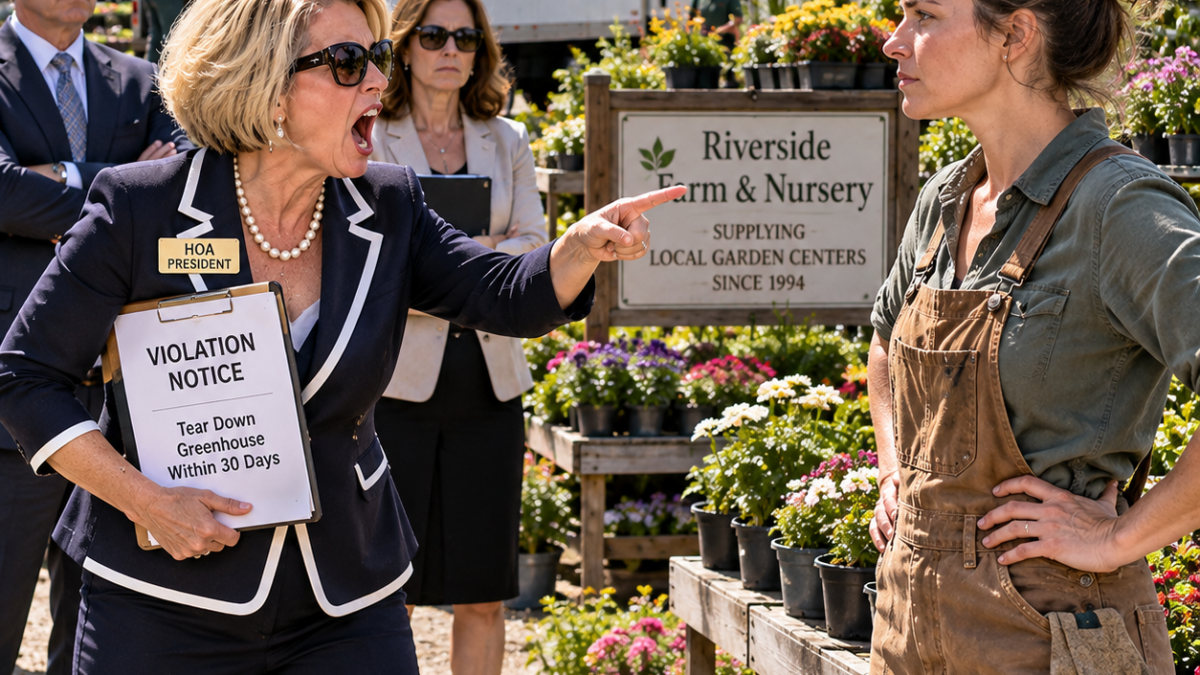
The HOA president stood in my driveway, pointed at the greenhouse I had spent half a million dollars building, and gave me thirty days to tear it down.
She called it an “unapproved temporary structure,” never realizing that inside those walls were thousands of plants already promised to nearly every major garden center in town.
And when Karen finally understood what would happen if she succeeded, the fight had already grown far beyond anything she could control.
“That pile of plastic and metal will be gone by the end of the month, Mr. Thorne.”
Karen Miller raised her clipboard toward the greenhouse like a judge delivering sentence.
“Or Serenity Meadows will remove it for you.”
I stood on my gravel driveway holding a mug of coffee and stared at her.
Behind me, three thousand square feet of galvanized steel and double-wall polycarbonate gleamed beneath the morning sun.
Computer-controlled ventilation.
Automated irrigation.
Heated flooring.
Drainage.
Backup power.
Storm-rated framing.
A structure engineered more carefully than half the houses surrounding it.
Karen called it a pile of plastic.
I took a slow drink.
“And under exactly what authority are you planning to demolish my greenhouse?”
Her expression changed.
People who enjoy giving orders rarely enjoy being asked to explain them.
“Article Nine, Section Four.”
She tapped her clipboard.
“No temporary or unauthorized outbuildings.”
“It isn’t temporary.”
“It’s not a house.”
“That doesn’t make it temporary.”
“It’s a commercial structure.”
“It’s an agricultural structure.”
“Which is prohibited.”
“No, it isn’t.”
Karen’s mouth tightened.
She had apparently expected anger.
Or panic.
Maybe begging.
Instead, I gave her engineering.
That tends to frustrate people who arrive with conclusions instead of facts.
She stepped closer.
“Mr. Thorne, Serenity Meadows is a residential community.”
“My parcel is zoned residential and limited agricultural.”
“We don’t allow commercial operations.”
“The county does.”
“The HOA has higher standards.”
I almost smiled.
Twenty-five years in the Army Corps of Engineers had taught me that whenever somebody uses the phrase higher standards without citing an actual standard, you should become very interested.
“What exactly have I violated?”
Karen looked offended by the question.
“The greenhouse itself.”
“That’s not an answer.”
“It was never approved by the architectural review committee.”
“I have a county permit.”
“I said HOA approval.”
“My permit application identifies the building as a permanent horticultural facility.”
Karen waved that away.
“You can call it whatever you want.”
“I didn’t name the classification. The county did.”
Her cheeks colored.
Beyond my property, I could see curtains moving.
Neighbors were watching.
Karen noticed too.
She lifted her voice.
“You have thirty days. After that, fines begin at two hundred dollars per day, and the association reserves the right to pursue removal at your expense.”
Something cold settled inside me.
Not fear.
Recognition.
I had spent most of my professional life around plans, regulations, procurement rules, safety codes, and people who occasionally thought confidence could substitute for competence.
Karen had just made the same mistake.
“All right,” I said.
She blinked.
“All right?”
“I’ve received your position.”
For the first time she looked uncertain.
“You’re agreeing to remove it?”
“No.”
“Then what are you saying?”
“That you can expect my formal response.”
Her lips pressed into a thin line.
“This isn’t a negotiation.”
“I agree.”
She turned sharply and marched toward the golf cart parked near my mailbox.
Before she reached it, I pulled out my phone.
Click.
Timestamped photograph.
Karen.
Golf cart.
My driveway.
First record.
She heard the camera and looked back.
“Did you just photograph me?”
“Yes.”
“For what?”
“My records.”
Her expression told me she didn’t like that answer.
Good.
She drove away.
I watched until the golf cart disappeared around the bend.
Then I turned toward the greenhouse.
Through the clear panels I could see row after row of orchids, heirloom tomato seedlings, propagation trays, and irrigation lines.
That building wasn’t a hobby.
It was Thorn & Bloom.
My retirement.
Sarah’s and my savings.
Years of planning.
And something Karen did not yet understand.
The Gilded Trowel depended on those orchids.
Frank’s Fine Flowers depended on them.
The County Gardener depended on them.
Several smaller nurseries were already placing advance orders.
Karen thought she was threatening one homeowner.
She was actually threatening a supply chain.
I walked inside the greenhouse and listened to the circulation fans humming above me.
Then I opened my laptop.
If Karen wanted to make this a fight about rules, permits, money, and authority, she had picked the wrong retired engineer.
Because I had spent twenty-five years building things that survived worse than bad weather.
And now I was going to find out whether her little kingdom could survive its own paperwork.
PART 2
The certified letter arrived three days later.
Thick envelope.
Embossed HOA logo.
Heavy paper.
The sort of presentation designed to make ordinary homeowners nervous before they even read the first sentence.
Sarah found it in the mailbox.
She carried it into my office and placed it on the oak table.
“Your friend wrote back.”
“She isn’t my friend.”
“She seems committed to the relationship.”
I looked at her.
Sarah had been married to me long enough to know when humor was the only thing keeping my irritation from becoming visible.
I opened the envelope.
SERENITY MEADOWS HOMEOWNERS ASSOCIATION.
NOTICE OF VIOLATION AND DEMAND FOR REMOVAL.
The letter cited Article Nine, Section Four.
No temporary structures, sheds, tents, or unapproved outbuildings without written architectural approval.
Then came the conclusion.
My greenhouse was being classified as a temporary outbuilding.
That almost impressed me.
Three thousand square feet.
Galvanized steel.
Poured concrete foundation.
Permanent electrical service.
Permanent water connection.
Engineered storm anchoring.
County inspections.
Five hundred thousand dollars invested between land preparation, building systems, climate equipment, irrigation, backup generator, and specialty infrastructure.
Temporary.
I handed the letter to Sarah.
She read it.
Then read it again.
“They think this is a shed?”
“Apparently.”
“They’ve been inside?”
“No.”
“They have the permit?”
“I included the permit with my construction notice last year.”
She lowered the pages.
“So they know.”
“They know something was built.”
“What’s the fine?”
“Two hundred a day.”
“Starting when?”
I pointed.
“Retroactive to the date of notice.”
Sarah sat across from me.
She looked toward the greenhouse through the office window.
Rows of reflected sunlight flashed across its panels.
“Marcus.”
“I know.”
“This business is everything we put away.”
“I know.”
“It’s not just retirement money.”
“I know.”
She leaned forward.
“I’m not asking whether you know the finances. I’m asking whether you understand what this would do to us if they somehow stopped operations.”
That was different.
For me, the problem had instantly become technical.
Classification.
Authority.
Procedure.
Zoning.
Permits.
For Sarah, it was personal.
She had lived through every year of the planning.
She had watched me retire after twenty-five years in the Corps.
She had watched me spend months waking at five in the morning because my body hadn’t learned civilian life yet.
She had seen me stare at television screens without really watching them.
The Army had given my life mission after mission.
Retirement had given me silence.
Thorn & Bloom filled that silence.
Not because I needed another job.
Because I needed to build something that grew instead of something designed to endure attack, flood, heat, wind, or military use.
Plants changed the rhythm of my days.
Water.
Temperature.
Humidity.
Roots.
Light.
Patience.
There was no ordering an orchid to bloom faster.
No rank.
No command.
You created conditions.
Then you waited.
Sarah had understood before I did that the greenhouse saved me from becoming a man who talked endlessly about what he used to do.
I reached across the table.
“I understand.”
Her eyes softened.
“I don’t want you treating this like some operation just because that helps you stay calm.”
“It is an operation.”
“Marcus.”
“I’m kidding.”
“You’re terrible at kidding.”
“That’s true.”
She sighed.
“What are we going to do?”
“We’re going to read.”
She stared at me.
“Read?”
“Everything.”
I spent two days buried in documents.
County zoning ordinances.
Permit records.
Subdivision declarations.
HOA formation documents.
Recorded plats.
Architectural provisions.
Agricultural definitions.
Commercial-use clauses.
The land itself sat at the edge of Serenity Meadows.
Five acres.
Original parcel.
Platted before most of the subdivision.
The developer had gone bankrupt during later construction phases, creating a mess of transferred obligations and incomplete governance documentation.
That mess had apparently given Karen an inflated opinion of the HOA’s reach.
The county zoning language was much cleaner.
My parcel permitted residential use and limited agriculture.
Then came the specific provision I needed.
Structures supporting horticulture, floriculture, viticulture, nursery propagation, and related agricultural activity were allowed subject to county permitting.
I read that section three times.
Then I pulled my permit file.
The greenhouse was identified clearly.
PERMANENT AGRICULTURAL/HORTICULTURAL FACILITY.
County inspection completed.
Electrical approved.
Drainage approved.
Foundation approved.
Structural engineering stamped.
Everything Karen had called unauthorized had been reviewed by people whose authority actually mattered.
I kept going.
The HOA defined an outbuilding as an accessory structure subordinate to primary residential use.
Examples:
Small storage building.
Detached shed.
Accessory garage.
Pool equipment enclosure.
My greenhouse wasn’t an accessory structure.
It was the primary structure of a legally registered agricultural business activity.
Then I reached the architectural review committee.
The covenants required three members.
Minimum.
Three.
I pulled the HOA’s most recent published roster.
Chair:
Karen Miller.
Position Two:
Vacant.
Position Three:
Vacant.
I stared at the screen.
Then laughed.
Sarah appeared in the doorway.
“What?”
“Karen’s architectural review committee.”
“What about it?”
“It’s Karen.”
“And?”
“Just Karen.”
Sarah walked over.
“That can’t be right.”
“It requires three members.”
“You’re serious?”
I turned the laptop.
She read it.
Then smiled.
“Oh.”
“Exactly.”
“Is this where you start enjoying yourself?”
“I’m not enjoying anything.”
“You’re smiling.”
“I’m appreciating procedural clarity.”
“That is the most Marcus sentence you have ever said.”
I built a binder.
Tab One:
County zoning.
Tab Two:
Building permit.
Tab Three:
Agricultural classification.
Tab Four:
HOA definitions.
Tab Five:
Architectural committee requirements.
Tab Six:
Committee roster.
Tab Seven:
Business registration.
Tab Eight:
Correspondence.
Then I drafted the response.
It was not emotional.
That mattered.
Anger makes a satisfying first draft and a terrible legal record.
I acknowledged receipt.
I cited their tracking number.
Then I wrote:
The Association’s classification of the Thorn & Bloom greenhouse as a temporary outbuilding is factually and legally incorrect.
I quoted the county definition.
Attached the building permit.
Quoted the HOA’s own definition.
Then the committee issue.
Article Four requires an Architectural Review Committee consisting of not fewer than three appointed members.
The Association’s published records currently identify only one member.
Accordingly, any purported denial or enforcement action issued exclusively by the sole remaining member raises substantial procedural concerns under the Association’s own governing documents.
I enjoyed the phrase substantial procedural concerns.
Ben would later tell me it was lawyer language for:
You screwed this up.
Ben was the one person I trusted to review the letter.
Former JAG.
Now civil attorney.
We had served together for several years.
I sent him the packet.
He called that evening.
“This is ridiculous.”
“Which part?”
“All of it.”
“That narrows nothing.”
“They called a permanent permitted agricultural building a temporary structure?”
“Yes.”
“And Karen is the entire architectural committee?”
“Yes.”
“Did you invent this woman because retirement is boring?”
“No.”
“Shame.”
He flipped pages.
I could hear it.
“What do you want from me?”
“Tell me whether my response is legally stupid.”
“Legally? No.”
“Strategically?”
“Also no.”
“Anything to change?”
He paused.
“One thing.”
“What?”
“Your last paragraph.”
I read it.
Any attempt to interfere physically with the structure, obstruct business operations, impose unsupported encumbrances, or cause measurable loss will result in pursuit of all available civil remedies.
Ben said, “Make it clearer.”
“How?”
“Tell them lost income matters.”
I rewrote:
Any action by the Association that interferes with lawful operations of Thorn & Bloom LLC may result in claims for actual business losses, contractual damages, and other available remedies.
Ben said, “Good.”
“That’s enough?”
“More than enough.”
“What do you think they’ll do?”
“A sane board?”
“Yes.”
“Call their lawyer, apologize, rescind everything.”
“And Karen?”
He laughed.
“You already know.”
I did.
The response went certified mail.
Email copy to the HOA general account.
Delivery confirmation saved.
Return receipt scanned.
Then I went back to work.
The orchids did not care about Karen Miller.
That helped.
Phalaenopsis trays needed inspection.
Humidity sensors needed calibration.
Several Cattleya hybrids were entering bud.
The Black Krim tomatoes were fruiting beautifully.
I had a delivery schedule.
Orders.
Customers.
Plants are ruthlessly indifferent to human drama.
If you neglect them because you’re angry, they die anyway.
Seven days later, another HOA letter arrived.
Shorter.
Less legal explanation.
More certainty.
The board had reviewed my response and found it “without merit.”
HOA authority, it claimed, superseded county zoning on community aesthetic matters.
The fines remained.
New balance:
$4,200.
I showed Sarah.
She closed her eyes.
“They didn’t address anything.”
“No.”
“Permit?”
“No.”
“Committee?”
“No.”
“County?”
“No.”
“What exactly did they address?”
“That I’m wrong.”
She dropped the letter onto the table.
“That’s not an argument.”
“I agree.”
For the next month, Karen built her paper mountain.
$5,600.
$7,000.
$8,400.
$10,200.
Violation notices began appearing taped to our front door.
That changed things.
Mail is communication.
Walking onto someone’s property at dawn to tape threats to their door is theater.
I installed another camera above the porch.
Two days later, it captured Karen arriving in her golf cart at 6:18 a.m.
Pink tracksuit.
Clipboard.
Envelope.
She walked to the door.
Pressed the notice against the wood.
Used two strips of tape.
Then instead of leaving, she walked around the side of my house.
The camera followed her.
She stopped near the fence separating the residence from the greenhouse area.
She leaned forward.
Peered through.
Then stood on her toes.
I watched the footage twice.
Sarah stood behind me.
“She came around the house?”
“Yes.”
“That isn’t HOA business.”
“No.”
“She’s spying.”
“She’ll call it inspection.”
“Does she have a right?”
“Not without notice and not under these circumstances.”
I saved the video.
Cloud.
External drive.
Binder notation.
Date.
Time.
Location.
I emailed a copy to Ben.
His response:
KEEP EVERYTHING.
Karen started parking her golf cart near the property line too.
Sometimes Gerald, the treasurer, sat beside her.
They pointed.
Talked.
Took notes.
I pretended not to notice.
Then Eleanor Brooks stopped me by the mailbox.
Retired elementary-school teacher.
Silver hair.
Gardening gloves permanently in one pocket.
“Marcus?”
“Morning, Eleanor.”
“Can I ask you something?”
“Sure.”
“Are you really growing rare orchids?”
I smiled.
“That depends whether you’re here from the orchid police.”
She laughed.
“No.”
Then lowered her voice.
“Karen says it’s a factory.”
“A factory?”
“She says trucks will be coming all night.”
“I make one delivery route a week.”
“She says the lights will destroy everyone’s sleep.”
“My lights are shielded.”
“I know.”
“How?”
“I can see your greenhouse from my upstairs guest room.”
“And?”
“I sleep just fine.”
She shook her head.
“She also says property values will collapse.”
“That greenhouse probably cost more than her house.”
Eleanor stared.
“Seriously?”
“Unfortunately.”
She laughed again.
Then grew serious.
“You should know something.”
“What?”
“People are tired of her.”
That was the first crack.
Not support.
Not rebellion.
Fatigue.
Which can be more powerful.
Eleanor told me about Bob Anderson.
Retired Air Force.
Basketball hoop.
Fined weekly because Karen decided it wasn’t an approved model.
It had existed five years before Karen became president.
Then the Hendersons.
Mature Japanese maple.
Twenty years old.
Ordered removed.
Wrong species.
Then a garden gnome.
A flagpole two inches too high.
A front door too blue.
I began asking people to keep their documents.
Not to exaggerate.
Not to embellish.
Just copies.
Dates.
Notices.
Appeals.
The pattern emerged naturally.
Karen’s power worked because each resident thought they were alone.
The moment people compared stories, the system looked very different.
Bob showed me his basketball-hoop file.
Twelve notices.
More than six hundred dollars.
“I took it down,” he said.
“Why?”
“I thought they could lien my house.”
He looked embarrassed.
“I’ve flown combat missions. I’m standing here telling you I was afraid of a suburban association.”
“That doesn’t make you weak.”
“It makes me feel stupid.”
“No.”
I pointed at the letter.
“It means they knew what threat to use.”
He looked toward the garage where the hoop was stored.
“My grandson asks about it every weekend.”
“Keep these.”
“The notices?”
“Yes.”
“Why?”
“Because if Karen does something serious enough, this stops being just my dispute.”
That day came sooner than I expected.
Before that, Thorn & Bloom had its first major business milestone.
Martha Caldwell owned the Gilded Trowel.
It was less a garden center than a botanical boutique.
Designer pottery.
Japanese tools.
Rare plants.
People drove from two counties away.
She had agreed to take a substantial quantity of my orchids.
I loaded samples into my van.
Cattleya hybrids.
Deep violet.
White with burgundy throats.
Yellow varieties with almost waxy petals.
A few heirloom tomatoes.
Black Krim.
Cherokee Purple.
Green Zebra.
Martha met me near the receiving area.
“Oh my God.”
“What?”
She lifted one orchid carefully.
“These are better than the photos.”
“That’s usually preferable.”
“Marcus, these are going to disappear.”
“That’s the plan.”
She walked me into her office.
We reviewed order volume.
Then I told her.
“I need you to understand there’s a possible disruption.”
Her expression sharpened.
“Disease?”
“No.”
“Equipment?”
“No.”
“What?”
“My HOA president wants the greenhouse demolished.”
Martha stared.
“She wants what?”
I explained.
No dramatics.
Temporary structure claim.
Fines.
Permits.
Legal response.
“Why?”
“She thinks it violates aesthetics.”
Martha leaned back.
“You’re my sole local source for these varieties.”
“I know.”
“Frank is buying from you.”
“Yes.”
“George too?”
“Yes.”
“And she wants the building gone.”
“Yes.”
Martha’s face changed.
Not emotional.
Businesslike.
Dangerously businesslike.
“Karen Miller.”
“You know her?”
“She comes in here every spring.”
I waited.
“She argues about petunia prices.”
I laughed.
Martha did not.
“Her husband David is trying to get into the Oak Hollow Business Association.”
“Why is that relevant?”
“I’m on the board.”
That caught my attention.
“So is Frank.”
“Frank’s Fine Flowers?”
“Yes.”
“And George.”
“The County Gardener.”
“Yes.”
Martha folded her hands.
“Karen may think your greenhouse is a neighborhood issue.”
“She does.”
“She’s wrong.”
A week later, the legal letter arrived.
Not from the HOA.
From their attorney.
NOTICE OF LIEN AND INTENT TO SEEK ENFORCEMENT.
$17,800.
Fines.
Fees.
Administrative charges.
Threat of court action.
Threat of forced removal.
Threat of foreclosure mechanisms.
That one hit differently.
Sarah was beside me when I read it.
She sat down.
“They’re threatening the house.”
“Yes.”
“Can they?”
“Not lawfully based on what we know.”
“That isn’t what I asked.”
I looked at her.
She was scared.
That mattered more than my confidence.
I called Ben.
He called back in nine minutes.
His first words were:
“Oh, this is beautiful.”
Sarah stared at the phone.
I said, “My wife would like you to use a different adjective.”
“Sorry, Sarah.”
She leaned toward the speaker.
“Are we going to lose our house?”
Ben’s voice changed immediately.
“No.”
“Are you sure?”
“Based on what Marcus sent me, I do not see a lawful basis for what they’re threatening.”
Sarah exhaled.
Then Ben continued.
“But they have escalated far enough that we stop treating this as nuisance correspondence.”
I picked up a legal pad.
“What did they miss?”
“Hearing procedure.”
I wrote.
“For fines of this type, their governing documents and applicable process require notice and opportunity for formal review. They never gave you one.”
“Correct.”
“Second, the violation itself is weak because your facility is permitted and appears outside the definition they’re relying on.”
“Correct.”
“Third, now they’re threatening an action that can directly damage your property and business.”
“Meaning?”
“Meaning we have measurable harm.”
Sarah crossed her arms.
“So what happens now?”
Ben said, “Now I write.”
His response was twenty-three pages with exhibits.
He attacked classification.
Authority.
Committee composition.
Procedure.
Notice.
Hearing rights.
Business interference.
Trespass evidence.
Karen’s personal conduct.
Then he demanded:
Immediate suspension of fines.
Withdrawal of lien-related action.
No entry onto our property.
No interference with Thorn & Bloom.
Preservation of all relevant records.
And notice that litigation would follow if they continued.
He included preliminary affidavits from Bob and the Hendersons.
Not because their cases were identical.
Because they showed pattern.
Karen had used the same mechanism repeatedly:
Questionable violation.
Threat.
Escalating fine.
Lien fear.
Compliance through intimidation.
When Karen saw the affidavits, the problem stopped looking like one angry homeowner.
It looked systemic.
Her lawyer apparently understood.
Ben called me the next afternoon.
“Their attorney wants to talk settlement.”
“That fast?”
“He didn’t know half of this.”
“What does that mean?”
“It means Karen may have been giving him a highly edited version.”
“Can we settle?”
“Yes.”
“What would you require?”
“The fines gone.”
“Obviously.”
“Lien withdrawn.”
“Yes.”
“Written acknowledgment your greenhouse is lawful.”
“Yes.”
“No harassment.”
“Yes.”
“Legal fees.”
“Yes.”
“Anything else?”
I thought.
“Karen resigns.”
Ben went quiet.
“Personal.”
“No.”
“It sounds personal.”
“She controls the committee.”
“She can be removed from that role without resigning.”
“She used HOA authority to threaten my home after being shown permits. She trespassed. She targeted other residents.”
“Marcus.”
“If she stays, this restarts in six months with someone else.”
Ben sighed.
“I’ll put it forward.”
“What do you think?”
“I think she’ll refuse.”
“So do I.”
That was fine.
Because another front was opening.
The Oak Hollow Business Association meeting took place the following Thursday.
Country club conference room.
Sixty or seventy local business owners.
Accountants.
Bankers.
Contractors.
Retailers.
Restaurateurs.
Garden businesses.
David Miller stood near the back.
Karen’s husband.
Financial planner.
He had been applying for membership.
I recognized him from neighborhood events.
He recognized me.
His smile faded slightly when I entered.
I carried a briefcase.
Inside were ten binders.
When my turn came, I stood at the podium.
“My name is Marcus Thorne.”
I explained Thorn & Bloom.
No Karen yet.
First, the business.
Three thousand square feet.
Specialty orchids.
Heirloom tomatoes.
Propagation.
Local supply contracts.
Then I put up one slide.
THORN & BLOOM LOCAL DISTRIBUTION.
Arrows.
Gilded Trowel.
Frank’s Fine Flowers.
County Gardener.
Three smaller businesses.
Projected seasonal revenue dependent on contracted supply.
People paid attention.
Business people understand supply chains.
Then:
“My primary production facility is currently under threat of forced removal.”
The room changed.
“Not because of zoning.”
Next slide.
County permit.
“Not because of safety.”
Engineering approvals.
“Not because of environmental violations.”
Inspection records.
“It is being targeted by my homeowners association as an alleged temporary unapproved structure.”
Murmurs.
“And the association president is Karen Miller.”
David’s face changed.
I continued.
“Daily fines have reached nearly eighteen thousand dollars.”
Next slide.
“Lien and foreclosure threats have been issued.”
Next.
“The facility being targeted is the same facility supplying several businesses represented in this room.”
Martha stood.
“That includes me.”
Frank stood too.
“And me.”
George raised a hand.
“Same.”
That mattered more than anything I said.
This was no longer Marcus complaining.
Three established businesses were confirming the economic reality.
Martha addressed the room.
“We have customers preordering his plants.”
Frank added:
“If Marcus loses production, I lose a major part of my specialty inventory.”
George nodded.
“Same.”
I distributed the binders.
One went to the association president.
One to Martha.
One to Frank.
One to George.
One to two other board members.
Then I walked toward David.
His face was pale.
I placed a binder in front of him.
“Mr. Miller.”
His jaw tightened.
“What is this?”
“The documentation.”
He opened it.
First photo.
Karen on my property.
Second.
Violation notice.
Third.
County permit.
Fourth.
Fine ledger.
Fifth.
Lien threat.
Then copies of business commitments.
He looked up.
“You’re doing this to embarrass my wife.”
“No.”
“You’re dragging a private neighborhood issue into my professional life.”
“This stopped being private when her actions threatened multiple businesses.”
“You could have handled this internally.”
“I tried.”
His eyes flashed.
“You’re enjoying this.”
I held his gaze.
“No.”
That answer seemed to anger him more.
I returned to the podium.
“I am not requesting that this association intervene in my HOA dispute.”
I meant that.
“I am informing local businesses that part of their supply chain is at risk because of an ongoing enforcement action unsupported by county permitting records.”
Facts.
Only facts.
Martha stood again.
“As a board member, I think that’s material information.”
The association president nodded.
“So do I.”
David closed his binder.
Then the president said:
“Given Mr. Miller’s pending membership application, I believe we should postpone consideration until we better understand the circumstances.”
Every eye turned toward David.
That was the moment Karen’s private crusade crossed into her husband’s professional world.
David stood.
No speech.
No accusation.
He simply left.
I felt no pleasure watching him go.
He hadn’t threatened my greenhouse.
Karen had.
But actions spread.
That was the lesson she had refused to understand.
The annual HOA meeting was six days later.
Packed.
Eleanor arrived early.
Bob sat with the Hendersons.
Other residents brought folders.
Karen sat at the head table.
Gerald beside her.
Three other board members looked deeply uncomfortable.
The HOA attorney sat in the corner.
Karen moved through the first thirty minutes pretending nothing had changed.
Pool schedule.
Landscaping.
Holiday decorations.
Security lighting.
Then:
“New business.”
I stood.
Her entire face tightened.
“Mr. Thorne.”
“Mrs. Miller.”
“If this concerns your illegal structure, the board has already—”
“I have a financial question.”
That stopped her.
I turned toward Gerald.
“Gerald, what has Serenity Meadows spent in legal fees related specifically to enforcement against my property during the last three months?”
He froze.
Karen said, “That is confidential.”
I looked at her.
“HOA expenditures are not personally yours to classify as confidential.”
“You are out of order.”
“Then Gerald can answer.”
Gerald looked miserable.
“I don’t have the number.”
“I do.”
I held up the discovery invoice.
“Twelve thousand four hundred fifty dollars.”
The room erupted.
A woman shouted:
“For what?”
I answered.
“Primarily legal work related to trying to force removal of a county-permitted greenhouse.”
Karen slammed the gavel.
“That characterization is false.”
I continued.
“Additionally, the HOA has threatened a lien approaching eighteen thousand dollars.”
More voices.
“What lien?”
“When?”
“Against him?”
Karen tried to regain control.
“The association is enforcing legitimate covenants.”
I looked at the other board members.
“Did you vote to authorize the lien action?”
Silence.
One looked at another.
Gerald looked at Karen.
Then said:
“Karen said counsel was handling it.”
The room went quiet.
I asked again.
“Was there a board vote?”
“No,” Gerald said.
Karen turned toward him.
“Gerald.”
He flinched.
“You told us it was administrative.”
Karen stared.
The other board members began whispering.
That was the first visible collapse.
Not mine.
Hers.
Bob stood.
“What about my basketball hoop?”
Karen banged the gavel.
“We are not relitigating individual violations.”
Bob held up his notices.
“You fined me six hundred dollars until I took it down.”
“You violated standards.”
“The hoop was there before you were president.”
“That’s irrelevant.”
“No, Karen.”
His voice sharpened.
“You made it irrelevant because you wanted it gone.”
Mrs. Henderson stood.
Her husband remained seated beside her.
“Our maple tree was twenty years old.”
Karen rubbed her forehead.
“Please.”
“You made us remove it.”
“It wasn’t approved.”
“It was planted before the approved-tree list existed.”
“We have heard this before.”
Mrs. Henderson’s voice trembled.
“We cried when that tree came down.”
The room changed.
Rules sound abstract until someone attaches grief to them.
That maple had been planted after their daughter was born.
She had moved out years ago.
The tree stayed.
Until Karen.
Then came the blue door.
The flagpole.
The garden gnome.
A stone birdbath.
A porch light.
A basketball hoop.
A mailbox.
Each ridiculous alone.
Together, devastating.
Karen’s entire philosophy became visible.
The covenants were not a set of common rules.
They were a catalog of weapons.
Then a woman stood near the back.
“Can I speak?”
Karen looked exhausted.
“State your name.”
“Linda Wallace. Garden Club.”
I knew her by sight.
She continued.
“I attended a presentation last month by Martha Caldwell, Frank Roberts, and George Lang.”
The nursery owners.
She turned toward the residents.
“The specialty plants many of us buy locally come from Mr. Thorne’s greenhouse.”
Murmurs.
“Some of the orchid varieties people line up for every spring are propagated right here.”
Someone asked:
“All of them?”
“A significant portion.”
Linda looked at Karen.
“So while you were telling us that greenhouse was hurting our community, the businesses we use were depending on it.”
Karen’s face went pale.
That was the moment the story flipped.
For months she had called Thorn & Bloom a threat.
Factory.
Eyesore.
Commercial nuisance.
Suddenly residents saw something else.
Local business.
Jobs.
Local supply.
An asset.
Karen had not merely overreached.
She had misread the entire community.
The HOA attorney stood.
That surprised everyone.
“Madam President.”
Karen turned.
He continued carefully.
“Given the procedural concerns raised tonight, current litigation risk, and information regarding the structure’s permitting status, my advice is that all enforcement related to Mr. Thorne’s property be suspended immediately.”
Karen stared.
“You told me we could enforce.”
“I advised that enforcement depended upon valid authority and proper procedure.”
“You said—”
“I am advising the board now.”
The distinction was brutal.
Karen looked at the other directors.
One by one, their eyes moved away.
She no longer had a board.
She had chairs occupied by people suddenly calculating their personal exposure.
The attorney continued.
“I further advise entering mediation.”
Karen whispered:
“No.”
Nobody heard except those near the table.
Then louder:
“No.”
She grabbed the gavel.
“This association will not be intimidated by a commercial operator who moved here knowing the rules.”
I stood very still.
Then said:
“I was here before your architectural committee existed.”
Karen pointed at me.
“You came here intending to exploit agricultural loopholes.”
“I applied for permits.”
“You manipulated zoning.”
“The county wrote the zoning.”
“You are destroying the residential character of Serenity Meadows.”
Eleanor stood.
“No, Karen.”
Everyone turned.
The retired teacher walked toward the front.
She was seventy-two.
Small.
Soft-spoken.
Until that night.
“You are.”
Karen stared at her.
Eleanor continued.
“I have lived here thirteen years.”
Her voice trembled, but she didn’t stop.
“I used to know everyone on my street.”
She looked around.
“We had cookouts.”
“We watched each other’s dogs.”
“We brought food when someone was sick.”
“Then every year there were more warnings.”
“More fines.”
“More letters.”
“People stopped talking because they were afraid somebody would report something.”
She looked directly at Karen.
“This place didn’t become better.”
“It became scared.”
Silence.
Then applause.
Not wild.
Not triumphant.
Something heavier.
Recognition.
Karen’s hand slowly lowered from the gavel.
The meeting adjourned badly.
Not officially.
It dissolved.
People stood.
Argued.
Asked questions.
The lawyer spoke quietly with board members.
Karen left through a side door.
David was not there.
Two days later, an emergency board meeting was held.
I didn’t attend.
Eleanor called at 8:47 p.m.
“She’s gone.”
I sat up.
“Who?”
“Don’t be difficult.”
“Karen?”
“She resigned.”
Sarah appeared in the doorway.
I put Eleanor on speaker.
“What happened?”
“The lawyer told them the association could be exposed.”
“Did Karen agree?”
“She apparently argued for forty minutes.”
“That sounds right.”
“Then Gerald told her he would resign if she didn’t.”
I pictured nervous Gerald finally finding a spine.
“What about the others?”
“Same.”
“So?”
“She resigned effective immediately.”
Sarah sat beside me.
Eleanor continued.
“They rescinded your fines.”
“All of them?”
“All.”
“Lien?”
“Attorney says withdrawal paperwork goes out tomorrow.”
I closed my eyes.
“Bob?”
“Fines rescinded.”
“Hendersons?”
“Yes.”
“Others?”
“Several pending cases suspended for review.”
Sarah squeezed my hand.
For months I had imagined victory as something loud.
Courtroom.
Order.
Judge.
Karen losing publicly.
Instead, it arrived through Eleanor’s tired voice on speakerphone.
She resigned.
The words were enough.
The lien threat was withdrawn.
Every fine against me disappeared.
Formal apology.
Legal language.
Cold.
Dry.
But unmistakable.
The board acknowledged procedural errors and agreed not to interfere with Thorn & Bloom’s permitted operations.
Ben called.
“Do you still want to sue?”
I looked through the window at the greenhouse.
“No.”
“You have a case.”
“I know.”
“You’ve suffered legal expense.”
“They’re reimbursing it.”
“Business disruption.”
“Minimal.”
“Trespass.”
“Documented.”
“So?”
“The objective was stopping them.”
“You sound like you’re still in uniform.”
“Maybe.”
Ben was quiet.
“Keep the draft complaint.”
“I will.”
“If they restart anything—”
“They won’t.”
“You sound confident.”
“They’re terrified of you.”
“That helps.”
The neighborhood changed almost immediately.
Not magically.
People who had avoided each other for years didn’t suddenly become best friends.
But fear disappeared first.
Bob reinstalled the basketball hoop.
His grandson helped.
They sent me a photo.
Caption:
STRUCTURAL THREAT RESTORED.
Mrs. Henderson did not replant the maple.
That hurt.
A twenty-year-old tree cannot be replaced with another twenty-year-old tree.
They planted two smaller ones.
One for themselves.
One for their daughter.
Maria from two streets over repainted her door blue.
Brighter than before.
The garden gnome returned.
Someone dressed it in a tiny HOA PRESIDENT sash for one afternoon.
That was probably unnecessary.
I laughed anyway.
Special elections came.
Bob ran for president.
Eleanor agreed to serve on a reconstituted architectural committee.
Five members this time.
Not one.
Actual meetings.
Written standards.
Appeals.
Conflict disclosures.
Residents asked me to run.
“No.”
Bob stood on my porch.
“Why not?”
“I grow plants.”
“You understand bylaws.”
“That is not a personality trait I want encouraged.”
“You’d be good.”
“I spent twenty-five years in government systems.”
“Army.”
“Exactly.”
“Different.”
“Not enough.”
He laughed.
“So advisory role?”
“Informal.”
“Fine.”
“Unpaid.”
“All HOA roles are unpaid.”
“Karen found emotional compensation.”
Bob nearly choked laughing.
The first major orchid shipment left Thorn & Bloom three weeks later.
Six in the morning.
Cool air.
Rows of padded racks loaded into my van.
Labels.
Counts.
Temperature monitors.
I had moved military equipment through deserts with less anxiety than I felt watching those flowers leave.
Sarah stood beside me.
“You’ve checked that manifest three times.”
“Four.”
“Of course.”
Martha met me at the Gilded Trowel.
Employees unloaded trays.
Customers were already waiting near the entrance.
Martha inspected the first Cattleya.
“Perfect.”
“Good.”
She looked at me.
“You realize Karen nearly cost me a fortune.”
“You mentioned.”
“She nearly cost herself more.”
“How?”
Martha nodded toward the office.
“David withdrew his membership application.”
I hadn’t heard.
“He did?”
“Quietly.”
“Probably wise.”
“They’re having problems.”
I looked at her.
“Martha.”
“What?”
“I don’t need details.”
She studied me.
“You’re serious.”
“Yes.”
“She came after your house.”
“I know.”
“And your business.”
“I know.”
“You don’t want to hear she’s miserable?”
I looked toward the orchids.
“No.”
That surprised me too.
For months I had imagined Karen’s downfall as emotional repayment.
Now that I had what I wanted, her unhappiness seemed irrelevant.
The greenhouse remained.
That was enough.
Thorn & Bloom grew.
Quickly.
Maybe too quickly.
Frank doubled his orchid order.
George wanted exclusive tomato cultivars.
A fourth garden center signed.
Then a fifth.
Garden clubs requested tours.
A local restaurant bought specialty tomatoes.
A wedding florist started ordering orchids.
I hired my first employee.
Then another.
Sarah took over bookkeeping after declaring my spreadsheet system “a crime against accounting.”
I objected.
She ignored me.
The greenhouse Karen wanted demolished became one of the most productive small specialty-growing operations in the county.
Then Bob came by one Saturday.
New HOA president.
Bottle of bourbon.
Two glasses.
He walked into the greenhouse and stopped.
“This is incredible.”
I looked around.
“Temporary shed.”
He laughed.
“So this is where the neighborhood almost went bankrupt?”
“Indirectly.”
He handed me the bottle.
“Peace offering.”
“For what?”
“Being president.”
“That’s your problem.”
“You created expectations.”
“I did no such thing.”
“You taught everyone to read the bylaws.”
“That was a tactical mistake.”
We sat on two overturned buckets near the tomato rows.
Bob poured.
“Can I tell you something off the record?”
“Depends.”
“We found credit-card charges.”
I stopped.
“What kind?”
“HOA card.”
“I assumed.”
“Restaurants.”
“Association business?”
“Doesn’t look like it.”
“Anything else?”
“Salon.”
I stared.
“Salon?”
“Several.”
“Karen?”
“Card issued to president.”
I put down the glass.
“Trips?”
“One hotel charge nobody can explain.”
“Have you talked to counsel?”
“Yes.”
“Then follow counsel.”
“You’re not curious?”
“Very.”
“You don’t sound curious.”
“I learned professional discipline.”
Bob shook his head.
“We’re deciding whether to pursue repayment.”
“You should.”
“Criminal referral?”
“That’s not a neighborhood decision. Give the records to the proper people.”
He nodded.
Then looked around the greenhouse.
“Can I tell you something else?”
“What?”
“When I first heard about this place, I thought Karen might be right.”
I smiled.
“About what?”
“Commercial greenhouse in a residential neighborhood.”
“Fair.”
“I pictured semi-trucks.”
“Fair.”
“Floodlights.”
“Fair.”
“Chemical smell.”
“Not fair.”
He laughed.
“Then I came in.”
He looked toward the orchids.
“She never did.”
“No.”
“Not once?”
“She peered through the fence.”
“That woman almost destroyed something she never bothered to understand.”
That sentence stayed with me.
Karen never came inside.
Never asked what I grew.
Never asked how the greenhouse operated.
Never asked whether noise existed.
Never checked traffic.
Never read the county classification.
Never toured.
Never listened.
She started with a verdict.
Then searched for rules that supported it.
That was the real danger.
Not HOA rules.
Certainty without curiosity.
Months passed.
The board revised the enforcement process.
No fine without written identification of the exact rule.
No escalation without opportunity to respond.
No lien-related action without full board vote and counsel review.
Architectural committee decisions required quorum.
Vendor and professional-service expenses posted quarterly.
Residents could appeal.
Common sense returned slowly.
The architectural committee even asked me to review technical language involving accessory structures.
I agreed.
Then made them define terms.
Bob complained.
“You’re making this too specific.”
“That is the point.”
“Normal people don’t talk like engineers.”
“Then normal people shouldn’t write structural rules.”
Eleanor laughed from the other end of the table.
“He’s right.”
Bob groaned.
The Hendersons invited Sarah and me to dinner.
We sat in their backyard near the two young maple trees.
Mrs. Henderson touched one trunk.
“It’ll take years.”
“I know.”
“Our old tree shaded this whole corner.”
“I’m sorry.”
She looked at me.
“For what?”
“I wish I’d known people were dealing with this sooner.”
“You couldn’t have known.”
“Still.”
She shook her head.
“No, Marcus.”
She looked toward the tree.
“We should have fought.”
Her husband said quietly:
“We thought paying the fine and cutting it down would end it.”
Mrs. Henderson nodded.
“It didn’t.”
“What do you mean?”
“After the tree, it was our mailbox.”
Then outdoor lights.
Then garbage container placement.
“We kept giving in.”
She looked at me.
“It made her worse.”
I understood.
Compliance is sometimes sensible.
Sometimes it feeds appetite.
“How do you feel now?”
She smiled at the smaller trees.
“Angry.”
Then:
“But less afraid.”
That mattered more.
About nine months after Karen resigned, I saw her.
Really saw her.
Not through a window.
Not on a camera.
Not across an HOA room.
At the Gilded Trowel.
I was delivering orchids.
She stood near the annuals.
Alone.
She saw me.
Stopped.
For one second, both of us considered pretending we hadn’t.
Then she walked toward me.
“Marcus.”
“Karen.”
She looked older.
Not dramatically.
Just tired.
I waited.
“I hear business is good.”
“It is.”
She glanced toward the orchids.
“They’re beautiful.”
“Thank you.”
Silence.
Then:
“I didn’t know.”
That irritated me more than an insult would have.
“You had every opportunity.”
Her face tightened.
“I mean I didn’t know the scale.”
“You didn’t ask.”
“I believed—”
“I know what you believed.”
She stopped.
People moved around us pushing carts.
Ordinary Saturday morning.
Finally she said:
“David’s business suffered because of that association meeting.”
“I’m sorry he was affected.”
She looked surprised.
“You are?”
“Yes.”
“You destroyed his application.”
“No.”
“You brought our private dispute there.”
“Your actions threatened their members’ businesses.”
“You knew what it would do.”
“Yes.”
She stared.
That was the closest we ever came to discussing revenge.
I didn’t deny the consequence.
I had known.
But I hadn’t lied.
I hadn’t invented.
I had placed facts in front of people affected by those facts.
Karen looked toward the orchids again.
“Do you hate me?”
“No.”
That seemed to hurt her.
Maybe hatred would have made her feel important.
“I don’t believe you.”
“That’s fine.”
She folded her arms.
“You ruined my reputation.”
“No.”
She looked at me sharply.
“You did.”
“I documented your decisions.”
“That’s the same thing.”
“No, Karen.”
I lowered my voice.
“If accurate documentation ruins your reputation, the problem is not the documentation.”
She looked away.
I almost left.
Then she said:
“I was trying to protect the neighborhood.”
“I believe you thought that.”
Her eyes returned to me.
“That isn’t forgiveness.”
“No.”
“Do you think I deserve any?”
“That’s not really my job.”
She laughed once.
Bitterly.
“You always talk like that.”
“Like what?”
“Like everything is a report.”
“Occupational damage.”
For the first time, the corner of her mouth moved.
Almost a smile.
Then it disappeared.
“I should have come inside.”
“What?”
“The greenhouse.”
I didn’t answer.
“I should have asked you to show me.”
“Yes.”
She nodded.
Then walked away.
No apology.
Not exactly.
But enough truth for one morning.
Sarah asked later whether the encounter satisfied me.
“No.”
“Disappointed?”
“No.”
“Then what?”
“Nothing.”
She looked skeptical.
“What did you expect?”
“I don’t know.”
“An apology?”
“Maybe.”
“Would it change anything?”
I thought about the Hendersons’ tree.
Bob’s hoop.
Months of fear.
Our legal bills.
The strain on Sarah.
The sleepless nights.
“No.”
“Then maybe nothing is the right feeling.”
Maybe.
A year later, Thorn & Bloom expanded.
Not the original greenhouse.
A second structure.
Smaller.
Specialized for propagation.
And this time, before construction, I submitted the plans to the reformed architectural committee voluntarily.
Not because they had authority over county agricultural permitting.
Because the new board and I had developed a cooperative process.
Bob arrived with Eleanor and three committee members.
I spread drawings across the table.
Drainage.
Height.
Exterior finish.
Screening.
Lighting.
Bob pointed.
“You know we’re probably going to approve it.”
“I know.”
“Then why do you have sixteen pages?”
“Because that is the correct number.”
Eleanor laughed.
One committee member asked:
“Can we require landscaping along this side?”
“You can request.”
“Would you do it?”
“If it’s reasonable.”
“What would you plant?”
I smiled.
“Something Karen would hate.”
Bob nearly fell out of his chair.
We planted native flowering shrubs.
Residents loved them.
The second greenhouse increased capacity.
More jobs.
More local supply.
Thorn & Bloom began offering internships to agriculture students.
Then something unexpected happened.
Eleanor suggested school tours.
I hated the idea.
Children around delicate orchids seemed strategically unsound.
Sarah loved it.
Therefore, we had school tours.
The first group arrived wearing matching elementary-school shirts.
Twenty-eight fourth-graders.
I stood in front of them.
“Rule one.”
A boy raised his hand.
“I haven’t asked anything.”
He lowered it.
“Rule one: walk.”
Another hand.
“Yes?”
“What happens if we run?”
“You become fertilizer.”
Teacher gasped.
Children laughed.
Sarah hit my arm.
I corrected.
“That was a joke.”
One girl became fascinated by pollination.
Another asked why tomatoes had different colors.
A boy wanted to know whether orchids were “expensive because they’re fancy.”
By the end of the tour, I was exhausted.
And happy.
One girl returned to me before leaving.
“My grandma buys your purple flowers.”
“Maybe.”
“She loves them.”
“Good.”
“Did you really almost have to tear this place down?”
Children hear everything.
“Yes.”
“Why?”
“A disagreement.”
“Who was right?”
I smiled.
“The permits.”
She looked confused.
Good.
That was safer than turning history into heroes and villains for a ten-year-old.
The Oak Hollow Garden Club began hosting an annual orchid weekend at Thorn & Bloom.
Hundreds of visitors.
Martha handled retail orders.
Frank taught potting demonstrations.
George talked about soil.
Sarah sold tomato seedlings faster than I could grow them.
The event generated enough business that restaurants nearby noticed increased weekend traffic.
The same greenhouse Karen had called a threat to property values became a regional attraction.
Serenity Meadows began using proximity to Thorn & Bloom in real-estate listings.
I nearly fell out of my chair the first time I saw one.
BEAUTIFUL SERENITY MEADOWS HOME NEAR LOCAL THORN & BLOOM HORTICULTURAL FARM.
I sent the screenshot to Bob.
He replied:
TEMPORARY STRUCTURE HAS ENTERED THE CHAT.
I saved that.
Three years after the fight, David Miller came to see me.
Karen’s husband.
He arrived alone.
No appointment.
He stood outside the greenhouse.
I walked out.
“David.”
“Marcus.”
“What can I do for you?”
He looked uncomfortable.
“I wanted to talk.”
“Okay.”
We sat outside.
He didn’t want to go inside.
That seemed significant.
He began:
“I blamed you.”
“For the business association?”
“For everything.”
I waited.
“My application.”
“The embarrassment.”
“My clients hearing.”
“Karen resigning.”
He rubbed his hands.
“She blamed you too.”
“I know.”
“Our marriage nearly ended.”
I said nothing.
He looked toward the greenhouse.
“Then the credit-card records came out.”
That had resulted in repayment.
No major criminal prosecution.
Counsel negotiated reimbursement and governance restrictions.
But it destroyed whatever remained of Karen’s credibility.
David continued.
“I realized I had spent months blaming the person who documented the problem instead of the person creating it.”
That was a hard sentence to say.
I respected him for saying it.
“I’m sorry your business suffered.”
He nodded.
“Thank you.”
“I didn’t target you.”
“I know that now.”
He laughed softly.
“Not then.”
“What changed?”
“My attorney asked me a question.”
“What?”
“If Marcus Thorne disappeared tomorrow, would the records still exist?”
I smiled.
“Good attorney.”
“Yes.”
“The answer was yes.”
“Exactly.”
David looked toward the greenhouse.
“She told me it was basically a shed.”
“It’s a very expensive shed.”
He smiled.
“She never told me about the permits.”
“That doesn’t surprise me.”
“She didn’t tell me she’d gone onto your property.”
“I have video.”
“I know.”
“Everybody knows.”
He nodded.
“I’m not here to defend her.”
“Good.”
“I’m here because I should have asked sooner.”
I understood.
We shook hands when he left.
Not friendship.
Closure.
Sometimes that is enough.
Karen eventually moved away from Serenity Meadows.
Not immediately.
About four years later.
No dramatic moving-day confrontation.
A listing sign appeared.
Then a SOLD sign.
Then a moving truck.
Bob called.
“You want to watch?”
“No.”
“You sure?”
“Yes.”
“Eleanor made lemonade.”
“Why?”
“She says it’s not a celebration.”
“It sounds like a celebration.”
“It is absolutely a celebration.”
I didn’t go.
Sarah did.
Traitor.
She came home later.
“How was the non-celebration?”
“Excellent lemonade.”
“Did Karen say anything?”
“No.”
“Did you?”
“No.”
“You just watched?”
“We helped the new owners carry a sofa.”
That made me laugh.
The new family moved in two weeks later.
Young couple.
Toddler.
Dog.
They knew almost nothing about Karen.
Perfect.
Serenity Meadows had finally reached the point where her name was history instead of daily conversation.
That is what healthy places do.
They move on.
Years passed.
Thorn & Bloom became larger than I planned.
A business is like a plant in that sense.
If the conditions are right, it stops asking permission.
We added another propagation house.
A shade house.
A small packing building.
Seven employees.
Then twelve during peak season.
Our orchids shipped farther.
The heirloom tomatoes went to restaurants.
Martha eventually retired and sold the Gilded Trowel to her daughter.
Frank’s son took over his business.
George refused to retire because, according to him, “retirement is for people without plants.”
I couldn’t argue.
Sarah became the real business brain behind Thorn & Bloom.
I was still the grower.
She handled accounts.
Customers.
Payroll.
Schedules.
Contracts.
Occasionally she reminded me that a business required invoices.
I reminded her plants required water.
We reached détente.
One autumn afternoon, Sarah found me standing near the original greenhouse.
“What are you doing?”
“Looking.”
“At?”
“The roof.”
“What’s wrong?”
“Nothing.”
She waited.
“Then why are you staring?”
I smiled.
“Remember the first notice?”
She laughed.
“Temporary structure.”
“It’s been fifteen years.”
“Very temporary.”
The polycarbonate panels had been replaced once.
The irrigation system upgraded.
Computers changed.
Fans changed.
But the steel frame remained.
Storm after storm.
Heat.
Hail.
Wind.
Karen had said it would be gone in thirty days.
Instead, it outlasted her presidency.
Her house.
Her control.
Most of the original board.
I touched one steel column.
Sarah leaned against me.
“You would have been miserable if they made you tear it down.”
“Yes.”
“Would you have rebuilt somewhere else?”
“I don’t know.”
“You would.”
“Maybe.”
“No.”
She looked at me.
“You absolutely would.”
“Why?”
“Because you don’t know how to stop building things.”
That was true.
Before Thorn & Bloom, I had built roads.
Bridges.
Facilities.
Drainage systems.
Bases.
Walls.
After retirement, I built something different.
A place where living things could be fragile without being unsafe.
Maybe that was why I fought so hard.
The greenhouse was not merely a building.
It represented permission I had finally given myself to live a gentler life.
Karen had threatened that without ever knowing what it meant.
One of my employees, Diego, eventually became operations manager.
He had started as an agriculture student.
Twenty-one years old.
Quiet.
Obsessed with orchids.
Ten years later, he knew the greenhouse better than I did.
One day he found the old HOA binder.
“Boss?”
“Yes?”
“What is this?”
I looked.
EXHIBIT B.
Fine notices.
He flipped through.
“Ten thousand dollars?”
“Keep going.”
“Seventeen eight?”
“Yep.”
“For this greenhouse?”
“Yep.”
He stared through the glass.
“They wanted it removed?”
“Yes.”
“Why?”
“Poor judgment.”
He kept reading.
Then found the photograph of Karen on the porch.
“Is this her?”
“Yes.”
“She looks angry.”
“She was.”
“What happened?”
“She lost.”
“That simple?”
“No.”
He smiled.
“I figured.”
That afternoon, I told him the whole story.
Not the heroic version.
The real one.
Sarah’s fear.
My stubbornness.
Ben’s restraint.
Martha’s business leverage.
Bob’s affidavit.
Mrs. Henderson’s tree.
Eleanor’s courage.
The HOA lawyer finally refusing to pretend.
Diego listened.
Then said:
“You always tell us problems get worse when people hide them.”
“That’s true.”
“So Karen’s problem was hiding?”
“Partly.”
“What was the other part?”
I thought.
“She could not imagine being wrong.”
He nodded slowly.
“That’s dangerous.”
“Yes.”
More dangerous than ignorance.
Ignorance can be fixed.
Certainty resists repair.
The neighborhood eventually created something called Community Garden Day.
Bob’s idea.
Eleanor’s execution.
Residents traded plants.
Seedlings.
Cuttings.
Herbs.
Tomatoes.
Flowers.
Thorn & Bloom donated starter plants.
I found it deeply ironic.
The HOA that once tried to tear down my greenhouse now promoted gardening.
The first year, someone made a sign:
SERENITY MEADOWS GROWS TOGETHER.
Too sentimental for me.
Sarah loved it.
Children painted pots.
Residents planted a shared herb bed.
Mrs. Henderson brought maple seedlings from one of the new trees.
She gave one to me.
“For the greenhouse.”
“You know this won’t fit inside eventually.”
“That’s the point.”
I planted it outside.
Near the road.
Years later, it became large enough to shade the entrance.
Every time I looked at it, I remembered the tree Karen made them cut down.
You cannot undo everything.
But sometimes you can grow something beside the wound.
When Bob finally stepped down as HOA president, he came to the greenhouse with the same kind of bourbon he had brought years before.
“Last day.”
“Congratulations.”
“I hated almost all of it.”
“Healthy reaction.”
“You know the best part?”
“What?”
“Not getting sued.”
I laughed.
“High standard.”
“Karen lowered expectations.”
We sat in the same spot.
Not the same buckets.
Sarah had eventually forced me to buy chairs.
Bob poured.
“We changed things.”
“Yes.”
“People forget why.”
“That’s good.”
He looked surprised.
“You think?”
“If people think transparent budgets and fair hearings are normal, that means you succeeded.”
“But they don’t remember the fight.”
“They don’t need to.”
He considered that.
“My grandson asked me last week who Karen was.”
“What did you say?”
“An HOA president.”
“That’s all?”
“What else should I say?”
I smiled.
“Exactly.”
History does not need every villain preserved at full size.
Sometimes the lesson deserves more memory than the person.
I retired from Thorn & Bloom a second time when I was seventy.
Sort of.
Sarah called it retirement.
Diego called it “Marcus stopping by every morning and pretending not to work.”
He became general manager.
Then part owner.
We sold him a stake gradually.
He deserved it.
Thorn & Bloom continued supplying the garden centers.
New ones too.
The original greenhouse remained.
We installed a small plaque near the entrance.
Sarah insisted.
I objected.
I lost.
It read:
THORN & BLOOM
ESTABLISHED BY MARCUS AND SARAH THORNE
BUILT TO GROW
I liked that last line.
Built to grow.
Not built to fight.
Not built to prove something.
Grow.
That was always the mission beneath the noise.
One spring, long after Karen had left, I attended Garden Day.
Children ran between tables.
Eleanor was gone by then.
She had passed quietly the previous winter.
The HOA planted a tree in her memory.
Japanese maple.
Mrs. Henderson chose it.
That nearly broke me.
The plaque beneath it read:
FOR ELEANOR BROOKS
WHO BELIEVED RULES SHOULD SERVE PEOPLE
I stood there longer than I intended.
Bob joined me.
“Good tree.”
“Yes.”
“She’d complain it wasn’t straight.”
“She would.”
“Then fix it herself.”
“Yes.”
We stood in silence.
A little girl approached carrying an orchid.
One of ours.
Purple Cattleya.
“Are you Mr. Thorn?”
“Thorne.”
“With an e.”
She frowned.
“That’s weird.”
“Agreed.”
“My mom says you built the greenhouse.”
“I did.”
“She says someone tried to make you tear it down.”
“A long time ago.”
“Why?”
I smiled.
“Because sometimes adults argue before they understand each other.”
She considered that.
“Did you win?”
There it was.
The simple version.
Children want winners.
Adults do too.
“Yes,” I said.
Then corrected myself.
“The greenhouse stayed.”
She nodded.
That answer satisfied her.
It satisfied me too.
The greenhouse stayed.
Everything else was commentary.
Karen lost office.
Fines vanished.
Lien vanished.
Board changed.
Her financial misconduct came out.
Her influence collapsed.
Those things were consequences.
But the victory was what survived.
The building.
The business.
The plants.
Sarah and me.
The employees.
The nurseries.
The school tours.
The garden days.
The maple.
That is the difference between revenge and restoration.
Revenge measures what the other person loses.
Restoration measures what you keep alive.
I had been angry enough in the beginning to want Karen embarrassed.
I admit that.
When she stood in my driveway and called twenty-five years of engineering experience a pile of plastic and metal, something primitive in me wanted to wipe that smile off her face.
When the fines crossed ten thousand, I wanted a judge to explain reality to her.
When she threatened our home, I wanted her afraid.
When the business association reacted, part of me felt satisfaction seeing David understand what Karen’s choices could cost.
I am not going to rewrite myself into a saint.
Anger was there.
But anger was useful only when it fueled discipline.
The moment it started driving the vehicle, it became dangerous.
Ben reminded me of that repeatedly.
“Document.”
“Don’t threaten.”
“Don’t retaliate.”
“Don’t touch their property.”
“Don’t post online.”
“Don’t exaggerate.”
“Let them create the evidence.”
That was probably the best legal advice I ever received.
Karen defeated herself because she needed constant victory.
Every unanswered fine made her send another.
Every calm response made her escalate.
Every limit made her push harder.
People like that misunderstand restraint.
They think calm means weak.
They think politeness means fear.
They think a person who refuses to shout has nothing to say.
Then eventually the binder opens.
Years after all of it, I found Karen’s first letter while clearing out my home office.
Sarah and I were downsizing.
Not selling the property.
Just reducing forty years of accumulated paper.
I held the notice.
REMOVE WITHIN THIRTY DAYS.
The date looked ancient.
Sarah walked in.
“Throw it away.”
“I’m considering.”
“No, you’re not.”
“I might.”
“You have never willingly thrown away a document in your life.”
“That is false.”
“Name one.”
I couldn’t.
She smiled.
“Frame it.”
“Why?”
“Put it in the greenhouse office.”
“That seems petty.”
“So?”
I looked at her.
“Sarah Thorne.”
“What?”
“You spent years criticizing my tactical mindset.”
“I’ve grown.”
I laughed.
We framed it.
Below the original removal order, Diego later added a second sheet.
CURRENT FACILITY OUTPUT:
Annual orchid production.
Tomato starts.
Employees.
Business partners.
School visits.
Community events.
At the bottom, he wrote:
STATUS: STILL TEMPORARY.
That was petty.
I loved it.
Visitors sometimes asked about the frame.
Diego told the story better than I did.
Probably because he hadn’t lived the stressful parts.
He made it funny.
Karen became the woman who tried to demolish the town’s plant supply.
That wasn’t entirely accurate.
She never understood that was what she was doing.
Which somehow made the story more instructive.
People often cause their greatest damage while convinced they’re fixing something.
That is why process matters.
Permits.
Hearings.
Multiple committee members.
Public records.
Conflict checks.
Appeals.
These are not bureaucratic annoyances.
They are friction.
And friction prevents one confident person from moving too fast.
Karen hated friction.
So she eliminated it.
Committee vacancies?
No problem.
She made decisions alone.
Questions?
Disloyalty.
Appeals?
Delay.
County permits?
Irrelevant.
Business impact?
Not her problem.
Neighbor objections?
Harassment.
Lawyer caution?
Weakness.
By the time people realized how much authority she had concentrated, almost every safeguard had become decorative.
Our conflict forced them to rebuild those safeguards.
That became the legacy.
Not my lawsuit threat.
Not the business association meeting.
The safeguards.
Decades after my Army retirement, I still believed good engineering and good institutions shared a principle.
Redundancy.
One support fails, another holds.
One person makes a mistake, another catches it.
One sensor gives a false reading, another confirms.
One committee member gets obsessed, four others slow the decision.
Karen was a single point of failure.
We removed the single point.
Serenity Meadows became stronger.
So did Thorn & Bloom.
On my seventy-fifth birthday, the neighborhood surprised me.
I hate surprises.
Sarah knew that.
She helped anyway.
They gathered at the greenhouse.
Employees.
Neighbors.
Nursery owners.
Former students.
Families.
Bob.
Mrs. Henderson.
David even attended.
Karen did not.
That was fine.
At the front stood a young woman I recognized vaguely.
Tomato tour.
Years earlier.
She introduced herself as Lily.
Agricultural science teacher now.
She had visited as a fourth-grader.
“I was one of the kids you threatened to turn into fertilizer.”
The entire room laughed.
I covered my face.
Sarah whispered:
“I told you that would follow you forever.”
Lily continued.
“That day was the first time I saw agriculture as something scientific.”
She looked around.
“Climate.”
“Biology.”
“Engineering.”
“Business.”
“I went home and told my parents I wanted a greenhouse.”
Her students laughed.
“Today my school runs one.”
That hit me harder than every legal victory combined.
She handed me an envelope.
Inside were letters from students.
Some with drawings.
Orchids.
Tomatoes.
Greenhouses.
One had a badly drawn man holding a clipboard beside a giant flower.
Underneath:
MR. THORNE BEAT THE HOA WITH PLANTS.
Not exactly.
But I kept it.
That evening, after everyone left, Sarah and I sat alone.
Same warm humidity.
Same circulation fans.
Or upgraded versions of them.
Orchids stretched down the rows.
She held my hand.
“You know what Karen would hate most?”
“What?”
“This place became loved.”
I thought about that.
Karen had treated beauty as uniformity.
Approved tree.
Approved color.
Approved structure.
Approved appearance.
But beauty is more complicated.
The greenhouse was industrial-looking from one angle.
Gleaming panels.
Steel.
Vents.
Utility lines.
Inside, there were flowers that looked almost impossible.
Maybe that was the entire lesson.
You cannot always judge value from the road.
Sometimes you have to walk inside.
Ask.
Listen.
Understand.
Karen never did.
The sun lowered outside.
Light moved through the polycarbonate and turned warm.
Sarah leaned against my shoulder.
“Would you do it again?”
“The greenhouse?”
“The fight.”
I thought.
“Yes.”
“All of it?”
“No.”
She laughed.
“What would you change?”
“I’d worry you less.”
Her smile faded slightly.
“That part was hard.”
“I know.”
“I thought we might lose the house.”
“I know.”
“You kept saying we were fine.”
“I believed we were.”
“That is not the same as certainty.”
“No.”
I squeezed her hand.
“I’m sorry.”
She nodded.
“I know.”
That was something I learned late.
Being calm for the people you love is useful.
Pretending there is no risk is not.
Sarah had carried fear while I carried strategy.
Both were real.
The happy ending belonged to her as much as me.
More, maybe.
Thorn & Bloom had been my second mission.
Sarah made it a life.
Years later, when she died, the greenhouse became almost unbearable for a while.
Cancer.
Fast.
Unfair.
Nothing dramatic could be done.
No permit to challenge.
No ordinance to quote.
No binder could fix it.
For months after, I avoided the office.
Diego ran operations.
Bob visited.
Mrs. Henderson brought food.
Martha’s daughter sent orchids.
I thought about selling.
Then one morning I walked into the greenhouse before sunrise.
The fans hummed.
Condensation covered the panels.
A row of white Phalaenopsis had opened overnight.
Sarah loved white orchids.
I stood there.
And for the first time since losing her, I understood that the place still belonged to both of us.
Not legally.
Emotionally.
She had worried through every fine.
Read every letter.
Managed every expansion.
Built every customer relationship.
Corrected every terrible spreadsheet.
Argued for school tours.
Forced me to buy chairs.
The greenhouse was not the thing Karen almost made me lose.
Sarah was part of what I had been protecting inside it.
That knowledge kept me from selling.
I turned more ownership over to Diego.
But I kept coming.
Not daily.
Enough.
The original greenhouse eventually reached thirty years old.
Temporary structure.
Thirty years.
One spring storm tore roofs from several homes in Serenity Meadows.
Winds screamed through the county.
The greenhouse took damage.
Three panels cracked.
One vent assembly failed.
The frame held.
By morning, neighbors had branches everywhere.
Power out.
Road partially blocked.
Thorn & Bloom had backup generation.
Refrigeration.
Water.
Open floor space.
We opened the packing building to residents.
Charged phones.
Stored medication.
Made coffee.
Kept insulin refrigerated.
A family with a newborn warmed bottles.
Bob, older now, stood beside me looking at the steel greenhouse.
“Karen said this endangered the neighborhood.”
I looked at the people inside the packing area.
“People can be wrong.”
“Spectacularly.”
“Sometimes.”
He smiled.
The HOA later added Thorn & Bloom to its emergency coordination plan—with our permission.
Full circle.
A building threatened as a nuisance became infrastructure.
A man treated as an outsider became a neighbor people trusted during storms.
I never joined the HOA.
Never wanted to.
Belonging does not require holding office.
Sometimes the best service comes from remaining exactly who you are.
Grower.
Engineer.
Neighbor.
Husband.
Friend.
I eventually moved into a smaller house on the same property.
Diego’s family took over more management.
Thorn & Bloom became employee-owned in part.
That pleased me.
The town grew.
The nursery industry changed.
Big-box chains expanded.
Online plant sellers appeared.
Yet local garden centers remained.
And our plants still went out every week.
One morning, I watched a delivery van leave.
Logo on the side:
THORN & BLOOM.
Underneath:
GROWN IN OAK HOLLOW.
I remembered Karen pointing at the greenhouse.
That pile of plastic and metal.
Funny how badly a person can misunderstand what they’re looking at.
She saw panels.
I saw infrastructure.
She saw business.
I saw purpose.
She saw a violation.
Garden centers saw inventory.
Students saw science.
Employees saw livelihoods.
Sarah saw my retirement becoming a life.
Neighbors eventually saw an asset.
Same building.
Different understanding.
That may have been Karen’s greatest mistake.
She believed naming something gave her power over it.
Temporary structure.
Violation.
Commercial nuisance.
Noncompliance.
But words do not change reality by themselves.
Calling a greenhouse a shed does not make it one.
Calling legal business activity illegal does not make it illegal.
Calling questions insubordination does not eliminate the questions.
Calling authority absolute does not make it absolute.
Eventually facts arrive.
Usually carrying paperwork.
On the fortieth anniversary of Thorn & Bloom, Diego held a ceremony.
I told him not to.
He ignored me.
That tradition had apparently survived Sarah.
The original greenhouse was renovated.
We replaced several panels.
Modernized controls.
Kept the frame.
A plaque was installed inside.
Not outside.
Inside.
You had to enter to see it.
I liked that.
It read:
THIS GREENHOUSE WAS NEARLY ORDERED REMOVED BEFORE SERENITY MEADOWS AND OAK HOLLOW RECOGNIZED ITS VALUE.
WHAT SURVIVED HERE WAS NOT SIMPLY A BUILDING.
IT WAS A BUSINESS, A COMMUNITY RESOURCE, AND A PLACE WHERE PEOPLE LEARNED THAT RULES WORK BEST WHEN TEMPERED BY FACTS, DUE PROCESS, AND COMMON SENSE.
Below that:
MARCUS & SARAH THORNE
FOUNDERS
I cried.
Didn’t bother blaming humidity.
I was too old.
After the ceremony, a teenager asked:
“Mr. Thorne?”
“Yes?”
“Is it true the HOA fined you almost twenty thousand dollars?”
“Something like that.”
“Did you pay?”
“No.”
He smiled.
“Was that scary?”
I looked around the greenhouse.
Workers.
Plants.
Families.
Photos of Sarah.
The original notice framed on the office wall.
“Yes.”
That surprised him.
“I thought you were Army.”
“I was.”
“Weren’t you used to worse?”
“Fear doesn’t work that way.”
He listened.
“Courage isn’t feeling nothing.”
I pointed toward the old notice.
“It’s doing the boring correct thing while you’re afraid.”
“Like paperwork?”
“Especially paperwork.”
He laughed.
Then asked:
“If you could go back, what would you say to Karen that first morning?”
I thought about it.
What would I say?
Not a threat.
Not a clever line.
Not:
You have no idea who I am.
Not:
You’re going to regret this.
Those lines sound good in stories.
Real life taught me something quieter.
I looked at him.
“I’d invite her inside.”
He frowned.
“Seriously?”
“Yes.”
“Why?”
“Because maybe if she had seen what she was trying to destroy, she would have stopped.”
“And if she didn’t?”
I smiled.
“Then I’d still keep the binder.”
He laughed.
So did I.
That evening, long after the visitors left, I walked slowly through the original greenhouse.
My knees hurt.
My back hurt.
Growing old is a badly designed system.
I stopped beside a row of orchids.
White.
Sarah’s favorite.
Outside, Serenity Meadows lights came on one by one.
Homes.
Families.
Life.
No kingdom.
No queen.
Just a neighborhood.
The greenhouse fans hummed above me.
Steady.
Familiar.
I placed my palm against one galvanized steel column.
Cold.
Solid.
Still there.
Karen had given me thirty days.
Decades had passed.
That was enough revenge for me.
Not her embarrassment.
Not her resignation.
Not her husband losing a networking opportunity.
Not the financial investigation.
Not the credit-card repayment.
Not the fines that vanished.
Time was the revenge.
The structure survived.
The business grew.
The neighborhood healed.
People who were afraid learned to speak.
A new board learned to listen.
Plants reached stores.
Students learned.
Families worked.
Sarah and I built a life.
That was the outcome Karen never imagined.
She thought destroying the greenhouse would protect Serenity Meadows.
Instead, trying to destroy it forced Serenity Meadows to decide what kind of community it wanted to be.
And to its credit, it chose better.
I switched off one row of lights.
Then another.
The greenhouse dimmed.
Moonlight showed through the roof panels.
I walked toward the door.
Before leaving, I looked back.
Rows of living things disappeared gradually into shadow.
Years earlier, Karen stood outside and saw a pile of plastic and metal.
She was wrong.
But not merely because it was a greenhouse.
She was wrong because no structure is only the material you can see from the road.
Inside this one were contracts.
Paychecks.
Marriages.
Retirement dreams.
Students.
Businesses.
Neighbors.
Second chances.
Memory.
A future.
That is why you should be careful before using authority to destroy something you have never bothered to understand.
Sometimes the ugliest mistake is not breaking a rule.
It is believing the rule matters more than the people it was supposed to serve.
I closed the greenhouse door.
The latch clicked.
The building stood behind me in the dark.
Still legal.
Still productive.
Still supplying garden centers.
Still growing.
And after everything Karen had done to make it disappear, that quiet hum behind me remained the most satisfying sound in the world.








