HOA Locked the Only Road to My Family Cabin—So I Put 113 “NO HOA BOATS” Signs Around the Lake They’d Been Selling for 11 Years
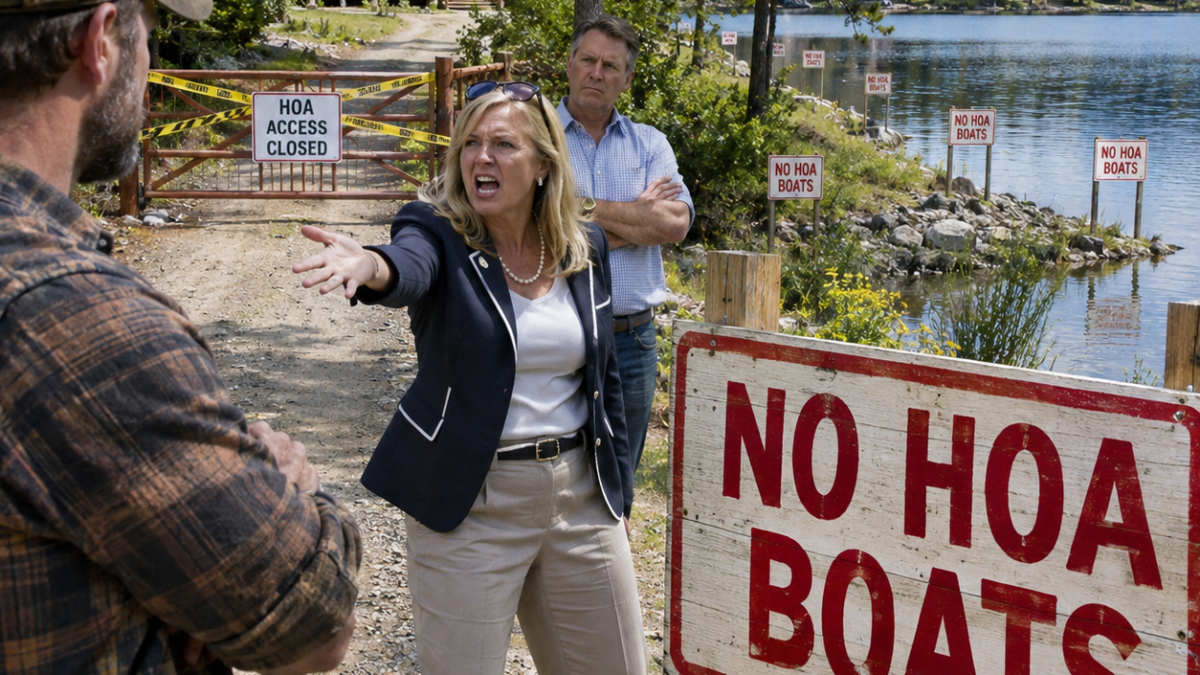
PART 2
I called my attorney that same morning.
Ezra Tilden had represented our family for twenty-eight years. He was sixty-eight, had grown up two lakes south of Loonsong, and belonged to the older school of northern Wisconsin lawyers who still carried yellow legal pads even when they had a laptop sitting open in front of them.
He drove out after lunch.
I met him at the new gate.
Cordy had taped an HOA notice to the steel post.
Ezra read it silently.
Then I handed him a certified copy of Sven’s 1937 easement.
He read the legal description.
Looked at the gate.
Read the recording information.
Then started laughing.
Pernilla folded her arms.
I checked my watch.
Ezra looked up.
“What?”
“Fourteen seconds.”
“You timed me?”
“I worked for the government thirty-one years. We measure unnecessary things.”
He pointed at the easement.
“Hamish, this was recorded in 1937.”
“Yes.”
“This subdivision wasn’t created until decades later.”
“I’m aware.”
“The easement is senior to everything they have.”
“That’s my understanding.”
“Then why are we standing here?”
“Because Cordy believes a steel gate is more persuasive than the Register of Deeds.”
Ezra looked through the bars.
“I can get you an order.”
“How fast?”
“Ten days. Eleven if the calendar is bad.”
“Don’t.”
That stopped him.
“Hamish.”
“Not yet.”
“She locked you out of your own cabin.”
“I know.”
“You have a recorded easement.”
“I know.”
“You want me not to enforce it?”
“I want you to enforce it after we post the lake.”
Ezra stared.
Then Pernilla said:
“Tell him about the signs.”
I did.
One hundred thirteen reflective signs.
Spaced every two hundred feet.
Around 4.3 miles of shoreline.
Private-water classification.
Trespass notice.
No Northwoods Sanctuary HOA boats.
My ownership information.
And the Wisconsin DOJ Real Estate Fraud Unit tip number.
Ezra’s expression changed.
“How far along is DOJ?”
“Far enough.”
“Hamish.”
“Yes?”
“You neglected to mention there was a state fraud investigation.”
“You didn’t ask.”
Pernilla laughed.
Ezra gave me the look lawyers reserve for clients they cannot fire because they have known them too long.
Then he looked toward the gate again.
“You’re right.”
“About what?”
“The gate isn’t the story anymore.”
## **HOW THIS STARTED**
When Northwoods Sanctuary first appeared north of our property, I didn’t hate it.
That matters.
People tell these stories later and imagine some old landowner glaring at construction equipment because civilization dared to come within eyesight.
That wasn’t me.
People have to live somewhere.
The developer owned the land.
They had the right to build houses if zoning permitted it.
What they didn’t have was the right to give away my lake.
At first, most residents understood that instinctively.
A man would walk down and ask:
“Mr. Brevard, mind if I take my kayak out?”
“Stay away from the western nesting area.”
“Yes, sir.”
A father would bring two kids.
“Can they fish?”
“Catch and release this time of year.”
“Thank you.”
That was it.
No contracts.
No fees.
No arguments.
It was a courtesy.
When Cordy became HOA president in 2018, she tried to convert that courtesy into a permanent legal right.
Her first letter was polished.
Almost friendly.
She proposed a recorded easement covering the entire lake surface.
I read it twice at the kitchen table.
Pernilla sat across from me.
“What does she want?”
“Everything.”
“Define everything.”
“Motorboat access, kayaking, swimming, ice fishing, docks.”
Pernilla raised one eyebrow.
“For all sixty homes?”
“Yes.”
“Forever?”
“Yes.”
“What are you going to tell her?”
“No.”
“You could add a few more words.”
“I probably will.”
I did.
The response was professional.
I explained Loonsong’s private-water status.
Explained that the lakebed and water column were part of my property.
Explained that informal recreational use had been permitted as a neighborly courtesy.
I even wrote that the arrangement could continue indefinitely as long as everybody remembered that distinction.
Cordy did not answer.
Three months later, the HOA newsletter published an editorial.
It didn’t name me.
It didn’t need to.
It described “a long-time adjacent landowner” whose unwillingness to recognize the community’s legitimate lake-access character had created uncertainty around property values.
Then came the advertisement.
Northwoods Discovery Realty.
Three homes for sale.
All advertised with Loonsong Lake access.
Pernilla read the page.
Then lowered it.
“Hamish.”
“Yes?”
“That is an advertisement for a lie.”
“I know.”
“What are you going to do?”
“Find out how many.”
## **THE FIRST BOX**
I drove into Eagle River.
Requested the historical listing records I could obtain.
Came home with a banker’s box.
Forty-seven properties had been listed and sold through Linnaeus’s brokerage from 2014 through 2018.
Forty-three descriptions referenced Loonsong access, exclusive lake access, shared waterfront amenities, or some variation of the same promise.
Not one disclosed the actual arrangement.
No easement.
No deed.
No recorded lake rights.
Just my permission.
Temporary.
Revocable.
Neighborly.
Linnaeus had taken a courtesy and turned it into a sales feature.
I put the box in my office closet.
Pernilla watched.
“That’s it?”
“For now.”
“You’re not calling Cordy?”
“No.”
“Linnaeus?”
“No.”
“Lawyer?”
“Not yet.”
She stared at me.
“You’re waiting.”
“Yes.”
“For what?”
“To see if it’s stupidity or a pattern.”
## **THE COMPLAINTS BEGIN**
The first formal complaint came in 2019.
Cordy claimed our septic system violated modern lakeside standards and threatened community water quality.
The county inspector, Olvart Tikkanen, had inspected that system when it went in and had returned every few years afterward.
He drove out.
Opened the system records.
Inspected the site.
Read Cordy’s complaint.
Then laughed.
Not a polite breath through the nose.
An actual laugh.
“No violation.”
Cordy moved on.
She complained about shoreline management.
Tree removal.
Runoff.
Then Linnaeus appeared in 2020.
He drove up in a branded Ford F-450 and parked at the end of my driveway.
Salt-and-pepper hair.
Polo shirt.
Chinos.
The uniform of a man who believes the right number solves every objection.
“Mr. Brevard?”
“Yes?”
“I’d like to make you an offer.”
“Not interested.”
“You haven’t heard it.”
“Still not interested.”
“One-point-three million dollars.”
“For what?”
“Two hundred twenty acres.”
“No.”
“You and Mrs. Brevard could remain here for life.”
“No.”
“Upon your passing, the property would transition into Northwoods Sanctuary’s community asset portfolio.”
That phrase stayed with me.
Community asset portfolio.
As if my grandfather’s cabin and forty-seven acres of water were line items waiting to be moved into the correct column.
I said:
“My great-grandfather bought this property in 1903 because he loved the lake.”
Linnaeus smiled.
“I’m offering nearly ten thousand times what he paid.”
“Then you should be relieved when I decline.”
His smile faded.
He left.
He came back months later with a larger offer.
Then again.
$1.6 million.
Then $2.1 million.
Same answer every time.
No.
## **THE PIER**
In 2022, Cordy stopped pretending my refusal mattered.
The HOA board voted to build a community pier on the northern shoreline of Loonsong.
My shoreline.
The budget was $158,000.
The meeting minutes called it a community amenity improvement.
Cordy mailed me a copy afterward with a letter requesting cooperation.
I wrote back:
No.
Then she sued me.
Small claims.
A thousand dollars in damages for interfering with the HOA’s planned amenity.
Judge Winona Lammer heard the matter.
Cordy’s attorney started talking about community expectations.
The judge interrupted.
“Who owns the shoreline?”
The attorney paused.
“The defendant, according to current county records.”
“And does your client possess an easement authorizing construction?”
“No recorded easement, Your Honor.”
“Then what exactly is your damages theory?”
The lawyer tried again.
The judge stopped him.
The case was dismissed.
Costs awarded to me.
I expected Cordy to appeal.
She didn’t.
Three weeks later, she hired a dock contractor.
## **THE SOUND OF THE PILE DRIVER**
I was in the boathouse with Sigrid when we heard it.
Metal.
Heavy.
Rhythmic.
Boom.
Pause.
Boom.
Sigrid looked toward the north shore.
“That sounds expensive.”
“It is.”
We drove around the perimeter road.
A pontoon barge floated near the northern bank.
Pile driver.
Pressure-treated lumber.
Flatbed trucks.
Galvanized brackets.
A full construction crew.
Their foreman was Wendell Sauko.
He had built docks around northern Wisconsin for more than forty years.
I walked toward him.
“Mr. Sauko?”
“Yes?”
“Who authorized you?”
“Northwoods Sanctuary.”
“Did they provide owner authorization?”
“They said the HOA owned the shoreline.”
I handed him my survey.
Then the lake classification information.
Then the parcel coordinates.
“Call the DNR office in Spooner.”
Wendell looked at the documents.
“You work for them?”
“Retired.”
“How long?”
“Thirty-one years.”
He immediately pulled out his phone.
Four minutes later, he lowered it.
Then turned toward his crew.
“Shut it down.”
Cordy had not simply misunderstood.
She had lost a court case about the same shoreline.
Then told a contractor she had authority anyway.
That changed how I saw her.
Before that, I thought she was arrogant.
Afterward, I understood she believed repetition could eventually become ownership.
Wendell apologized that evening.
“I should’ve asked to see paper.”
“Yes.”
“I believed her.”
“I know.”
“I won’t again.”
That sentence mattered.
## **SIGRID’S NUMBERS**
Sigrid had been working quietly.
That is her nature.
She doesn’t announce investigations.
She builds spreadsheets.
She had reconstructed Northwoods Sanctuary sales and resales.
Addresses.
Dates.
Listing language.
Brokerage.
Sale prices.
Comparable properties.
References to the lake.
One Saturday she put her laptop on my kitchen table.
“Dad.”
I sat.
“There have been sixty-three sales or resales connected to the development.”
“All through Linnaeus?”
“Most through his brokerage.”
She highlighted a column.
“Fifty-eight include some version of Loonsong access.”
I stared.
Then she opened another worksheet.
Comparable properties without lake access.
Price differences.
Adjustments.
“Average premium is about thirty-one percent.”
“And total?”
“Approximately $7.2 million.”
Pernilla stopped washing a cup.
I looked up.
“For something they don’t own.”
Sigrid nodded.
“Dad, this is bigger than Cordy.”
I knew.
“The fraud isn’t really the HOA.”
“No.”
“It’s Linnaeus.”
“Yes.”
## **THE PUBLIC PRESSURE CAMPAIGN**
In 2023, Cordy launched what she called **Modernizing Loonsong: A Path Forward for Community Lake Stewardship.**
The HOA newsletter ran multiple articles.
They described outdated landowner attitudes.
Shared resources.
Modern community expectations.
Again, I wasn’t named.
Again, nobody had trouble understanding who she meant.
Then came a newspaper letter accusing one stubborn landowner of jeopardizing property values.
Then a rally.
Twenty-three Northwoods Sanctuary residents in matching green windbreakers walked near the easement carrying signs.
Pernilla and I watched from the porch.
I felt anger.
Not at them.
Most looked uncomfortable.
Some were families who had used the lake politely for years.
Pernilla watched for almost forty minutes.
Then she went inside.
Added wood to the stove.
Returned.
“Hamish.”
“Yes?”
“They’ve been lied to.”
“I know.”
“They think you’re taking something from them.”
“Yes.”
“When really somebody sold them something you never gave.”
I looked toward the green jackets.
“Yes.”
That was when Sigrid contacted the Wisconsin Department of Justice.
## **THE INVESTIGATOR**
The Real Estate Fraud Unit assigned Sigrun Haugen.
She called Sigrid within days.
“I need everything.”
Sigrid asked:
“How much is everything?”
“Every listing. Every newsletter. Every photograph. Every construction attempt. Every letter. Every sale record you have.”
Sigrid delivered it.
Then Sigrun pulled Linnaeus’s broader history.
She called us on Monday morning.
“I found three more developments.”
I put the phone on speaker.
Pernilla and Sigrid sat nearby.
“Same problem?” I asked.
“Very similar.”
Star Lake.
Boulder Lake.
Big Saint Germain.
Private water associated with older landowners.
Nearby subdivision marketed as having exclusive access.
Pressure campaign.
Landowner eventually sells.
After purchase, developer can finally claim the access it had already been marketing.
Three times before Loonsong.
The combined value investigators associated with disputed access representations across the developments climbed to approximately $23.4 million.
Sigrun said:
“This is no longer a local real-estate dispute.”
Pernilla looked at me.
I looked at Sigrid.
Sigrun continued:
“We will need multiple agencies.”
That was the moment Cordy stopped being my main concern.
She was still dangerous.
But now I understood the mechanism behind her.
## **ANDERS POLLARD**
I asked Sigrun about the earlier landowners.
Could we speak with them?
Two were alive.
Sigrid and I drove to Wausau.
Anders Pollard was eighty-seven and living in assisted care.
He had owned a lake parcel for decades.
Widower.
Daughter overseas.
Health failing.
Eventually he sold after years of pressure.
We sat in a sunroom overlooking a pond that was not his.
I explained Loonsong.
Cordy.
Linnaeus.
The listings.
The DOJ investigation.
When I finished, Anders was quiet for a long time.
Then:
“Mr. Brevard, I have been waiting thirteen years for someone to ask me about that man.”
Not for someone to believe him.
Someone to ask.
He signed an affidavit.
His hands shook slightly.
Sigrid steadied the paper.
When we left, I sat in the truck without starting it.
Sigrid said:
“You okay?”
“No.”
“Me neither.”
## **GERDA**
The second surviving landowner was Gerda Korhonen.
Seventy-nine.
Small house outside Three Lakes.
She had been pressured for years before selling.
Gerda kept everything.
A green metal file box in her root cellar.
Letters.
Offers.
HOA complaints.
Legal threats.
Marketing copies.
Dates.
She put the box on her kitchen table.
“You want this?”
Sigrid opened it carefully.
“We’d like to copy it.”
Gerda shook her head.
“Take it.”
“It’s yours.”
“It was theirs.”
“What do you mean?”
“The pressure.”
She touched the lid.
“I’ve been carrying it long enough.”
Then she looked at Sigrid.
“You look like my daughter.”
Sigrid smiled gently.
Gerda’s daughter had died years earlier.
That afternoon she signed her affidavit.
Driving home, the green metal box sat in the truck bed.
I thought about all the ways people imagine fraud.
Fancy accounts.
Secret meetings.
Bribes.
But sometimes fraud looks like paper accumulating in an elderly woman’s cellar because nobody else knows what to do with it.
## **THE DEMONSTRATION**
By then DOJ had records.
Affidavits.
Listings.
Multiple lakes.
Financial analysis.
What they didn’t have was something every Northwoods Sanctuary resident could understand instantly.
The signs would do that.
One hundred thirteen of them.
Sigrid mapped the shoreline using professional GPS equipment.
Every two hundred feet.
We sent the coordinates to a manufacturer.
The signs arrived Wednesday.
White reflective vinyl.
Black sans-serif lettering.
Twelve by eighteen inches.
The main text was impossible to misunderstand.
**NO HOA BOATS**
**PRIVATE WATERS — LOONSONG LAKE**
**NORTHWOODS SANCTUARY HOA RESIDENT WATERCRAFT PROHIBITED**
Below that:
Private-water classification.
Enforcement information.
Owner contact.
DOJ tip line.
The signs sat boxed in our boathouse.
Waiting.
Then Cordy installed the gate.
## **THE MOMENT SHE MADE THE DECISION FOR ME**
Bravard Lane was the only normal vehicle route to the cabin.
Our easement predated the development.
Cordy knew we used it.
Still, contractors installed black powder-coated steel across it.
Locked.
No key.
No code.
That action changed the emotional equation.
Until then, part of me still hoped to preserve the courtesy access once the criminal investigation ended.
I knew most residents had done nothing wrong.
Then I stood at that gate and realized something.
Cordy was comfortable denying me access to my own land while demanding access to my lake.
She had reduced the issue to its clearest possible form.
Her community’s claimed access mattered.
My recorded access did not.
That was the moment I stopped trying to preserve ambiguity.
## **THE SIXTY LETTERS**
Ezra drafted certified notices for every household.
Each packet contained:
The DNR private-water classification.
My survey.
The recorded ownership record.
The applicable posting information.
Notice that HOA-affiliated watercraft were no longer authorized.
Then came the page that mattered most.
A summary of the ongoing fraud investigation.
Four developments.
Years of transactions.
Millions in disputed access premiums.
Northwoods Discovery Realty named directly.
The final sentence:
**If you purchased your Northwoods Sanctuary home based upon represented Loonsong Lake access, you may have been a victim of material disclosure fraud.**
We mailed sixty packets from Eagle River.
I watched them disappear into postal bins.
Pernilla said:
“That’s going to be an interesting Wednesday.”
She was right.
## **WENDELL’S RETURN**
The same Wendell Sauko who had stopped the illegal pier construction came back with cedar posts.
He pulled into our drive with a flatbed.
“What’s all this?”
“Sign posts.”
“How much?”
“Materials.”
“And labor?”
“No.”
“Wendell.”
He looked at me.
“I got fooled once.”
“You corrected it immediately.”
“I still got fooled.”
“You don’t owe me free labor.”
“I’m not asking.”
We eventually compromised.
I paid materials.
Bought lunch.
His crew handled the installation.
They worked around the shoreline.
Exact intervals.
Five feet into the ground.
Cedar.
By Wednesday afternoon, all 113 posts stood.
Thursday morning, Sigrid brought the signs out on a four-wheeler trailer.
Pernilla carried hardware.
I carried a drill.
We mounted them one by one.
It took all day.
By six fifteen that evening, we were finished.
The final sign stood near the south shore.
Pernilla wiped sawdust from her hands.
“Well?”
“Well what?”
“Do you feel victorious?”
I looked at the lake.
“No.”
“Angry?”
“Less.”
She read the sign.
“Clear?”
“Yes.”
“That’s probably better.”
## **THE FIRST ELEVEN CALLS**
The certified packets reached residents Wednesday and Thursday.
By noon Friday, eleven Northwoods Sanctuary homeowners had already called DOJ.
Sigrun called me at three.
“Hamish.”
“Yes?”
“The investigation has tripled in twenty-four hours.”
Sigrid was beside me.
I put the phone on speaker.
Sigrun continued.
“Residents have contracts. Emails. Brokerage brochures. Some have lender appraisal packages referencing lake access.”
Sigrid looked at me.
I said:
“What happens now?”
“Federal charges are likely by the end of the month.”
There was one place Linnaeus was scheduled to appear publicly before then.
The Vilas County Board.
He wanted rezoning for phase two.
I told Sigrun.
She was quiet.
Then:
“What date?”
I gave it.
“We’ll be there.”
## **CORDY SUES OVER THE SIGNS**
Friday afternoon, the HOA filed an emergency civil action seeking a temporary order against my signs.
Their complaint described the posting as harassment.
Ezra called.
“They used the phrase coordinated harassment.”
“I coordinated with my daughter.”
“So they’re technically right about one word.”
“Is the judge going to order them down?”
“No.”
“How certain?”
“Very.”
The court denied the request.
The signs remained.
The HOA ended up facing significant sanctions and costs.
Cordy’s response was not retreat.
It was another escalation.
## **SHE TRIES TO CHANGE THE LAKE**
Saturday morning she went to the DNR regional office.
Requested emergency reclassification.
Private waters to public navigable water.
If she could change the classification, she believed the signs might lose their force.
The regional director was Tovey Anderson.
Tovey had worked beside me for years.
She knew Loonsong.
Cordy presented her argument.
Community reliance.
Property values.
Shared usage.
Longstanding access norms.
Tovey listened.
Then said:
“The lake has no navigable inlet or outlet. The classification is not changing.”
Cordy argued.
Tovey repeated herself.
Then asked her to leave.
## **THE NEWSPAPER**
Cordy drove directly to the newspaper.
Sunday’s front page carried an interview.
She called Wisconsin’s private-water doctrine outdated.
Suggested one landowner should not be able to deprive a community of what she described as shared natural access.
A retired DNR fisheries supervisor named Ing Bjelland responded.
His letter explained the legal history and basic classification issues.
The paper printed it.
For the first time, Cordy’s public-relations advantage disappeared.
She had always been better at presentation than I was.
I wore old flannel.
She knew how to speak to cameras.
But a classification record is not impressed by presentation.
Neither is a survey.
## **THE LAST OFFER**
Monday afternoon Linnaeus returned.
He parked at the bottom of the driveway.
Sat inside forty-three minutes.
Sigrid timed him.
Eventually he stepped out.
“Brevard.”
“Linnaeus.”
“Two-point-five million.”
“No.”
“I haven’t finished.”
“No.”
“Cash.”
“No.”
“Pull the signs.”
“No.”
He stared at me.
“You’re destroying property values.”
“I didn’t write your listings.”
“You allowed residents to use the lake for years.”
“As guests.”
“They relied on that.”
“They relied on you.”
His face tightened.
Pernilla came down from the porch and stood beside me.
Linnaeus looked from her to me.
“Two-point-five million is generous.”
“The DOJ has been investigating you for months.”
His expression changed.
“The federal authorities are involved.”
Silence.
“You are not negotiating with me anymore.”
He looked toward the lake.
Then back at me.
“What am I doing?”
I said:
“Watching.”
He got into his truck.
That was the last offer.
## **CORDY AT SVEN’S DOCK**
At 9:15 that same evening, Cordy drove up.
She parked near the bottom of our drive.
Stayed inside the Navigator more than half an hour.
Then got out.
Walked toward the water.
She stood on the dock Sven built in 1937.
Sigrid saw her from the boathouse.
Pernilla saw her from the kitchen.
I walked down.
Stopped twenty feet away.
Cordy didn’t turn at first.
For a moment we both watched the water.
Finally I said:
“Mrs. Branwell.”
She turned.
“You need to leave.”
She said nothing.
“County board meeting tomorrow.”
Her face looked different.
Not defeated.
Not yet.
But uncertain.
I had never seen uncertainty on her before.
She walked away.
Pernilla waited on the porch.
Coffee in a thermos.
“Tomorrow.”
“Yes.”
We sat until the moon rose above the white pines.
The loons called from the western shore.
And for the first time in years, I spoke aloud to a man who had been dead since 1979.
“Thanks, Grandpa.”
## **A ROOM FULL OF PEOPLE WHO FINALLY KNEW**
The Vilas County Board meeting began at seven.
By 6:45, the room was standing-room only.
Northwoods Sanctuary homeowners.
Reporters.
DOJ investigators.
Federal staff.
Real-estate regulators.
DNR wardens.
Anders Pollard in his wheelchair.
His daughter beside him after flying from Australia.
Gerda Korhonen with the green file box on her lap.
Wendell Sauko.
Ing Bjelland.
Tovey Anderson.
People from different parts of the story sitting in one room for the first time.
Linnaeus sat at the petitioner’s table.
Cordy sat directly behind him.
He was there to sell phase two.
Forty-one more acres.
More houses.
More money.
More marketing.
## **LINNAEUS PRESENTS**
His presentation lasted nineteen minutes.
He spoke about property values.
Regional demand.
Luxury development.
Shared amenities.
Natural beauty.
He showed slides with Loonsong visible behind houses.
He did not say **lake access** once.
That told me his attorneys had already warned him.
At 7:24, public comment opened.
I stood.
Walked to the microphone.
Set down a manila folder.
“My name is Hamish Brevard.”
The room quieted.
“My family has owned Loonsong Lake since 1903.”
I held up Sven’s easement.
“This is our recorded 1937 ingress-and-egress easement.”
Then the gate documents.
“The HOA blocked it.”
Then the private-water classification.
“This lake is entirely within my parcel.”
Then one of the signs.
I held it up.
**NO HOA BOATS.**
I let everyone read it.
Then lowered it.
“For years, Northwoods Sanctuary properties have been sold with representations of Loonsong Lake access.”
I looked toward the residents.
“That access was never owned by the HOA.”
A woman in the fourth row covered her mouth.
I continued.
“The lake was never the developer’s to sell.”
Then came the sales.
Dozens.
Millions in estimated premium.
Then Star Lake.
Boulder Lake.
Big Saint Germain.
Older landowners.
Pressure.
Sales.
Same brokerage pattern.
“Across all four developments, investigators have identified approximately $23.4 million in disputed access-related value.”
Nobody moved.
I sat down.
## **THE INDICTMENT**
Sigrun Haugen stood.
Walked toward the front.
She carried a folded document.
“Mr. Chairman, members of the board, I am Sigrun Haugen with the Wisconsin Department of Justice Real Estate Fraud Unit.”
Linnaeus looked at her.
Cordy leaned forward.
Sigrun continued.
“I am unsealing an indictment.”
You can feel a room change.
Not hear it.
Feel it.
The air goes tight.
People stop shifting.
Stop coughing.
Stop whispering.
She read the names.
Linnaeus Branwell.
Cordelia Branwell.
Northwoods Discovery Realty.
Northwoods Sanctuary Properties.
Then counts.
Disclosure fraud.
Conspiracy.
Fiduciary violations.
Related offenses.
Linnaeus did not move.
Cordy stood.
“I need to respond—”
Investigators moved first.
At 7:46, she was placed in handcuffs.
So was her husband.
The county board chairman withdrew the phase-two rezoning request.
The expansion died before the evening ended.
## **“I DIDN’T KNOW”**
Asher Petrolia stood from the seventh row.
He had bought Lot 12.
His listing promised exclusive lake access.
He looked at me.
“Mr. Brevard.”
“Yes?”
“I didn’t know.”
His voice sounded smaller than I expected.
I believed him.
Most of the homeowners were not partners in the scheme.
They were customers.
Some had paid hundreds of thousands believing professional representations.
“I know.”
Then a woman stood.
“I’m sorry.”
Another man.
“So am I.”
More residents followed.
I raised my hand.
“You don’t owe me a performance.”
The room went quiet.
“Cooperate with investigators. Give them your contracts. Your emails. Your brochures.”
Asher nodded.
“That will help more than apologizing to me.”
## **THE QUESTION EVERY REPORTER ASKED**
Outside, cameras waited.
One reporter asked:
“The HOA has called Loonsong a community amenity for eleven years. What do you say now?”
I held up Sven’s easement.
“My grandfather recorded this in 1937.”
Then:
“The HOA never owned the lake.”
Another reporter:
“Are the signs retaliation?”
“No.”
“Then what are they?”
“Notice.”
“Will they come down when this is over?”
That was harder.
I looked toward Pernilla.
Then Sigrid.
Then the dark tree line where the lake sat beyond the government center.
“No.”
“Never?”
“Not for automatic HOA use.”
“Why?”
“Because a courtesy was sold as a property right.”
I paused.
“That ambiguity is over.”
## **WHAT HAPPENED TO THE GATE**
Ezra still handled the easement.
The court record was straightforward.
Sven’s easement came first.
The development came later.
The HOA could not block our access.
The gate could remain only under conditions that preserved permanent, unrestricted Brevard access and emergency access.
Codes.
Keys.
Clear protocols.
The HOA’s new leadership complied.
I never cut it.
I never rammed it.
I never photographed myself standing beside it with bolt cutters.
The gate became what it should have been from the beginning.
A minor access-control device subordinate to an older recorded right.
It stopped being interesting.
That was satisfying.
## **LINNAEUS**
The criminal proceedings moved through the following months.
Linnaeus ultimately pleaded guilty to serious federal offenses connected to the broader multi-development scheme.
Racketeering-related conduct.
Wire fraud.
Mail fraud.
Real-estate disclosure fraud.
Conspiracy.
He received a lengthy federal sentence.
Restitution ran into millions.
His brokerage dissolved.
His Wisconsin real-estate license disappeared permanently.
Northwoods Sanctuary Properties went into receivership.
The man who once stood in my driveway offering millions for my lake ended up losing the business he had used to sell it.
I did not attend every hearing.
I didn’t need to.
The record no longer depended on me.
## **CORDY**
Cordy pleaded guilty later.
Conspiracy.
Accessory conduct.
Breach of duty connected to her HOA authority.
Obstruction related to the DNR matter.
She went to state prison.
And she was permanently barred from serving on another Wisconsin HOA board.
I heard about the ban from Ezra.
He expected me to laugh.
I didn’t.
“You okay?” he asked.
“Yes.”
“You don’t sound pleased.”
“I’m pleased it can’t happen again.”
“That isn’t the same thing.”
“No.”
It wasn’t.
Punishment is satisfying for about a minute.
Protection lasts longer.
## **PHASE TWO DIES**
The planned second phase was canceled permanently.
That mattered enormously.
Forty-one undeveloped acres had been scheduled for more roads.
More houses.
More roofs.
More runoff.
More marketing.
Instead, the property went into conservation protection.
The forest stayed forest.
I walked part of that acreage with Pernilla later.
She looked around.
“Would’ve been houses.”
“Yes.”
“Driveways.”
“Yes.”
“Sprinklers.”
“Probably.”
She touched a young pine.
“Good.”
That was the whole conversation.
## **THE PEOPLE WHO BOUGHT THE LIE**
The sixty Northwoods Sanctuary households eventually received restitution payments.
Average amounts were substantial.
For some families, it was the first official acknowledgment that they had overpaid based on something that had never existed legally.
Asher became chair of the reconstituted HOA.
New bylaws prohibited future lake-access representations.
Board conflicts of interest faced stronger controls.
Association dues dropped.
Records became easier to inspect.
One afternoon Asher drove to the cabin.
No attorney.
No board packet.
Just coffee.
We sat on the porch.
“My kids miss the lake.”
“I know.”
“They thought it was theirs.”
“I know.”
“I thought it was ours.”
“I know.”
He stared toward the water.
“I’m not asking you to remove the signs.”
I looked at him.
“That’s good.”
He gave a small smile.
“I learned at least one thing.”
We sat quietly.
Then:
“Would you ever let kids come back?”
That question followed me for days.
## **NOT ACCESS—EDUCATION**
I asked Pernilla.
She understood immediately.
“Not HOA recreation.”
“No.”
“No motorboats.”
“No.”
“No promises in real-estate brochures.”
“Never again.”
She put down her coffee.
“Education.”
Sigrid said the same thing.
Annika agreed.
So I started talking to the DNR.
Not about reopening the lake as a neighborhood amenity.
About protecting it.
Research.
Fishery management.
Kettle-lake ecology.
School programs.
Explicit permission.
Limited dates.
No ambiguity.
## **LOONSONG WILD LAKE REFUGE**
In 2025, Loonsong received a conservation designation as a protected wild-lake refuge and research site.
Motorized recreational watercraft were prohibited.
Commercial recreation prohibited.
Unauthorized use prohibited.
The native fishery became the focus.
Three weekends a year, supervised school groups could come.
About a hundred students annually.
They measured water quality.
Identified native species.
Learned about groundwater.
Watched loon nesting behavior from proper distances.
The first school group arrived carrying notebooks and plastic sampling bottles.
One boy pointed at a shoreline sign.
“Why does that say no HOA boats?”
His teacher looked at me nervously.
I smiled.
“Long story.”
“Who won?”
I looked toward the water.
“The lake, hopefully.”
## **SVEN’S NAME RETURNS TO THE WATER**
Pernilla and I established the Sven Brevard Inland Lakes Conservation Initiative.
It funded scholarships for Wisconsin students planning careers in fisheries management.
It also helped support private-water conservation work where older landowners faced development pressure.
The first scholarship recipient was a young woman named Marit Solberg.
Her grandfather had once owned his own kettle lake.
He had eventually sold to a developer.
When Marit visited Loonsong, she stood beside one of the reflective signs.
“My grandpa needed these.”
I didn’t know how to answer.
“I’m sorry.”
She touched the cedar post.
“Me too.”
Then she smiled.
“But I’m going into fisheries.”
That was when I understood that not every old loss could be repaired.
Some could only become protection for someone else.
## **SIGRID’S WEDDING**
Sigrid continued living above the boathouse.
Her USGS equipment sat beside Sven’s old fly-tying bench.
Three monitors.
Modern sonar.
Old wooden vise.
Nearly a century of technology separated them.
She eventually married Axel Heggem, a Wisconsin conservation warden.
They chose the south-shore dock.
The dock Sven built in 1937.
Annika and her family came from Maine.
Pernilla cried before the ceremony.
I claimed I had something in my eye.
Sigrid didn’t believe me.
“Dad.”
“Yes?”
“You’re crying.”
“Wind.”
“There’s no wind.”
“Localized wind.”
She laughed.
Then hugged me.
That evening, for the first time since my grandfather died, four generations of the Brevard family were represented around that cabin.
I looked toward the lake.
One sign reflected the setting sun.
For the first time, it did not look like a warning.
It looked like inheritance.
## **ANDERS GOT HIS ANSWER**
Anders Pollard did not live forever.
None of us do.
But before he died, his daughter wrote me.
She said he kept the newspaper story about the case beside his chair.
He talked about it often.
Not because Linnaeus went to prison.
Because somebody finally wrote down that what happened to Anders had been real.
That mattered.
People ask older landowners:
Why didn’t you fight?
Why didn’t you hire a lawyer?
Why didn’t you refuse?
They rarely ask:
How many years were you pressured?
How sick were you?
How alone?
How much money did the other side have?
How many neighbors had been convinced you were the problem?
Anders had spent years thinking maybe he had simply failed.
The investigation told him otherwise.
I put his daughter’s letter in the file.
## **GERDA’S BOX BECOMES HISTORY**
After the case, I offered to return Gerda’s green metal box.
She refused.
“Keep it.”
“It belongs to you.”
“No.”
“The case is over.”
She looked at me.
“Then make it history.”
Sigrid scanned every page.
We preserved the originals.
Complaints.
Offers.
Threats.
Letters.
The slow progression from persuasion to pressure.
People imagine history is preserved in grand documents.
Sometimes it is preserved because an elderly woman refuses to throw away ugly envelopes.
## **THE NEW NORTHWOODS SANCTUARY**
Without Cordy and Linnaeus, the subdivision changed.
Quietly.
That was good.
HOA meetings became shorter.
The board handled roads.
Snow.
Insurance.
Common landscaping.
The boring things associations should handle.
No one held rallies about my lake.
No one proposed community piers.
No one tried to reclassify private water.
Future real-estate listings explicitly stated that homes had views toward Loonsong but no ownership or automatic recreational rights.
Property values did not collapse.
People still wanted homes near a beautiful protected lake.
They simply knew what they were buying.
Truth did not destroy the neighborhood.
The lie had nearly done that.
## **I CHECK EVERY SIGN**
Once a month I drive the perimeter logging road.
All 113.
Some are starting to weather.
A few have scratches.
One cedar post leaned after a winter freeze and needed resetting.
Wendell built them well.
Most remain straight.
Pernilla came with me one morning.
We stopped at sign seventy-four.
One corner had been damaged.
“Replace it?”
“It still reads.”
“You’re becoming sentimental about old signs.”
“Patina.”
She rolled her eyes.
I tightened the screws.
Then we kept going.
That is what protection looks like after the headlines disappear.
Maintenance.
## **WHY THE SIGNS STAY**
Some residents still wished I would remove them.
I understood.
They were not guilty of Linnaeus’s crimes.
But innocence does not create ownership.
The restitution compensated them for false representations.
The lake could not be part of that compensation because it had never been theirs.
If I removed every notice and returned to casual informal access, twenty years from now another board might make the same argument.
People move.
Documents get forgotten.
Children inherit assumptions.
Real-estate listings copy older listings.
Memory becomes myth.
The signs stop that.
There is nothing ambiguous about black lettering on reflective white aluminum.
## **ANNIKA ASKED ME ONCE**
“Would Grandpa Sven have put up 113 signs?”
“No.”
“How many?”
“Maybe twelve.”
“That wouldn’t meet the interval.”
“He wasn’t a DNR biologist.”
She laughed.
Then we sat at the dock.
She looked toward one sign.
“He’d probably hate them.”
“He hated signs.”
“But he recorded the easement.”
“He understood paperwork.”
She nodded.
“Then maybe he’d understand.”
I think he would.
## **THE LOONS BENEFIT TOO**
Something else changed after the boats disappeared.
The western shore became quieter.
Loons are sensitive during nesting.
Motor wake matters.
Repeated disturbance matters.
Sigrid documented nesting activity as part of her work.
Some seasons were better than others.
Nature does not care about our courtroom narratives.
But reduced recreational pressure helped.
One summer evening, Pernilla and I watched a chick riding on the back of an adult loon.
She whispered:
“Worth it?”
I knew what she meant.
The arguments.
The signs.
The fight.
“Yes.”
“All 113?”
“All 113.”
## **BRAVARD LANE TODAY**
The steel gate remains.
That surprises people.
Why not tear down the symbol of what Cordy did?
Because the gate itself was never evil.
The abuse was.
The new HOA configured it properly.
My family has permanent access.
Emergency services have override.
No one can deny us entry.
Sometimes I punch the code and remember the morning I found it locked.
The anger is gone.
What remains is almost appreciation for the clarity Cordy accidentally created.
Before that day, I was still trying to preserve everyone’s informal lake use.
The gate forced me to see that she wanted something completely different.
She wanted the power to deny my recorded access while claiming her community’s unrecorded access was permanent.
Once those two ideas stood beside each other, the absurdity became impossible to ignore.
## **WHY I NEVER CUT IT**
Sigrid asked once:
“You really never thought about cutting the gate?”
“Of course I thought about it.”
“How long?”
“Maybe thirty seconds.”
“Mom said five minutes.”
“Your mother exaggerates.”
Pernilla called from the kitchen:
“I do not.”
I smiled.
Then told Sigrid:
“If I cut it, the story becomes old man damages HOA gate.”
“And because you didn’t?”
“It stayed HOA blocks recorded easement.”
She nodded.
“Better evidence.”
“Always.”
Thirty-one years in government taught me that anger rarely writes your best exhibit.
## **THE LAST THING LINNAEUS EVER SOLD ME**
People sometimes ask whether Linnaeus’s offers tempted me.
Of course they did.
Not because I wanted to sell.
Because money is money.
Two-point-five million dollars changes a family.
But there was always a second question.
Then what?
Where does Pernilla sit in the evening?
Where does Sigrid run sonar?
Where do the loons nest?
What happens when the shoreline becomes a community amenity?
What happens to the next generation?
Every offer had a number.
None had an answer.
Eventually the offers stopped.
The land went back to being land instead of a negotiation.
That was a relief.
## **THE SIGN AT THE DOCK**
Sigrid made one additional sign.
Small.
Cedar.
Not statutory.
It hangs near Sven’s dock.
**COURTESY IS NOT OWNERSHIP.**
Pernilla hated it.
“It sounds smug.”
“It is accurate.”
“It sounds like something a lawyer puts on a coffee mug.”
“Sigrid made it.”
“That explains it.”
We left it.
School groups see it.
Sometimes teachers ask me to explain.
I tell the students:
“If I invite you into my house for dinner, you’re my guest.”
They nod.
“If I invite you every Friday for ten years, you’re still my guest.”
They nod again.
“You don’t own my kitchen.”
They laugh.
Then they understand.
## **A NEW OWNER IN CORDY’S OLD WORLD**
Years later, one family that bought inside Northwoods Sanctuary came to the cabin.
They had not lived there during Cordy’s presidency.
The husband said:
“We read everything before closing.”
“Good.”
“Our listing specifically said no Loonsong access.”
“Better.”
His wife looked toward the lake.
“It’s still beautiful.”
“It is.”
“Can we walk the observation trail?”
“Yes.”
That interaction meant more to me than any court order.
A healthy boundary had become ordinary.
No anger.
No argument.
No entitlement.
Just:
What is allowed?
Here.
What is not?
There.
Good neighbors can live very comfortably with the word no.
## **WHEN DOJ CLOSED THE FILE**
Sigrun called after the major restitution process finished.
“We’re closing the main file.”
“How does that feel?”
“Like I should sleep for a week.”
“Government policy allows sleep now?”
“Occasionally.”
Then she became quiet.
“Hamish, the signs mattered.”
“The sales records mattered.”
“Yes.”
“Sigrid’s spreadsheet mattered.”
“Yes.”
“Anders and Gerda mattered.”
“Yes.”
“So why the signs?”
“Because people could see them.”
I didn’t answer.
She continued.
“Before the posting, the homeowners thought you were withholding a right. Afterward, they asked where that right was written.”
That was it.
A sign is simple.
But sometimes simplicity destroys a complicated lie.
## **I STOPPED CHECKING ON CORDY**
Someone once told me Cordy had been released.
Asked whether I knew where she lived.
I didn’t.
They looked surprised.
“You never looked?”
“No.”
“Not curious?”
“No.”
That was how I knew the fight was finally over.
During the worst years, Cordy occupied my thoughts constantly.
Every envelope.
Every phone call.
Every truck on Bravard Lane.
After the boundaries were fixed, she became irrelevant.
The lake remained.
The cabin remained.
My family remained.
That is a better ending than continuing to hate someone who no longer has power over your life.
## **SUPPER CLUB NIGHT**
Last summer, Pernilla, Sigrid, Axel, and I drove into Eagle River.
We ate broasted chicken at an old supper club.
Had Wisconsin old-fashioneds.
A ceiling fan turned slowly overhead.
Hank Williams Jr. played on the jukebox.
Nothing dramatic happened.
That was the beauty of it.
On the drive home, the windows were down.
Warm night air.
Pine.
A little lake dampness.
When we reached the gate, Sigrid leaned forward.
“Dad.”
“Yes?”
“This is the gate.”
“I’m aware.”
“The famous gate.”
“Unfortunately.”
“You could’ve cut it.”
Pernilla immediately said:
“He wanted to.”
“I did not.”
“You stared at the hinge for five minutes.”
“Inspection.”
Sigrid laughed.
Then she said:
“If you had cut it, do you think everything else still happens?”
I thought.
“Eventually.”
“But?”
“Maybe not fast enough.”
The signs were already waiting.
Cordy made me use them.
## **THE WALL THAT ISN’T A WALL**
Reporters called it the Wall of Signs.
That sounds impressive.
It isn’t a wall.
You cannot stand anywhere and see all 113.
Most places you see one.
Maybe two.
But together they surround 4.3 miles.
A legal boundary repeated until misunderstanding becomes difficult.
That was the point.
Not hostility.
Clarity.
## **WHAT STILL MAKES ME ANGRY**
Not Cordy.
Not anymore.
What still bothers me is the way Anders and Gerda were treated.
Older.
Isolated.
Pressed for years.
People later wonder why they sold.
But pressure works through exhaustion.
One complaint does little.
Ten begin to matter.
A lawsuit costs money even if you win.
Neighbors stop inviting you.
Buyers circle.
Developers repeat that your property will become worthless if you refuse.
Eventually selling feels less like surrender and more like relief.
That was the model.
I survived it because I had advantages.
Pernilla.
Sigrid.
Annika.
Ezra.
Thirty-one years of fisheries knowledge.
Government contacts.
Enough money to wait.
Many people don’t have those things.
That realization shaped our conservation initiative more than anything else.
## **A QUESTION FROM A STUDENT**
A seventh grader once asked:
“Mr. Brevard, if you own the lake, can you do anything you want with it?”
Good question.
“No.”
“But it’s yours.”
“Yes.”
“So why not?”
“Ownership comes with rules.”
“Like what?”
“Environmental rules. Wildlife protection. Water-quality obligations. Local regulations.”
He thought.
“So owning it doesn’t mean you control everything?”
I smiled.
“Exactly.”
That was the lesson Cordy had never understood from the opposite direction.
Not owning something definitely doesn’t mean you control it.
## **SVEN’S FOUNDATION**
The cabin still sits on Sven’s fieldstone foundation.
Every few years, we repair mortar.
One autumn, I found the old chisel marks in a corner stone.
Sigrid crouched beside me.
“He made that?”
“Probably.”
“Same year as the easement?”
“Yes.”
She looked at the stone.
Then toward Bravard Lane.
“So he built two foundations.”
“What?”
“One for the cabin.”
She tapped the stone.
“One for our access.”
I stared at her.
“That’s annoyingly poetic.”
“Thank you.”
She was right.
One foundation was stone.
The other was paper.
Both had lasted.
## **OUR RECORDS NOW**
Everything important lives in a fire-resistant cabinet.
Deed.
Survey.
Easement.
DNR classification.
Posting map.
Sign specifications.
DOJ correspondence.
Conservation documents.
Digital copies exist in multiple places.
Annika has one.
Sigrid has more.
Pernilla says we are becoming archivists.
Then every January she asks whether I checked the backups.
Family hypocrisy is sometimes useful.
## **THE NEXT GENERATION**
Sigrid will likely handle most of the lake one day.
Annika loves Loonsong, but Maine is home.
We have worked carefully to make sure future generations understand the restrictions.
No commercial lake rights.
No automatic community access.
No vague permission language.
Educational use documented.
Conservation protections clear.
Everything written.
Everything recorded.
I used to think that felt unfriendly.
Now I think clarity is one of the kindest things you can leave your children.
## **THE QUESTION ABOUT REVENGE**
People call what I did revenge.
Cordy blocked my road.
I blocked her boats.
That’s the simple version.
And yes, when those signs first went up, there was satisfaction.
I am not going to pretend otherwise.
But revenge alone would have been easier.
I could have posted the lake and done nothing else.
Never allowed a school group.
Never built the refuge.
Never helped residents understand the fraud.
Never supported conservation.
Never funded students.
That is not what happened.
The signs began as defense.
They ended as protection.
That distinction matters.
## **THE MORNING AFTER A STORM**
Last fall a storm brought down two red pines.
Sigrid and I checked the shoreline.
Branches everywhere.
One tree fell near sign seventy-four.
Missed the post by maybe three feet.
We cleared the debris.
Sigrid tightened the screws.
Then said:
“These signs might outlive you.”
“Cheerful thought.”
“I mean it.”
“Cedar lasts.”
“I mean the rule.”
I looked at the lake.
“Good.”
She nodded.
“Yeah.”
Inheritance does not always look like a ceremony.
Sometimes it is your daughter tightening screws on a sign you installed because somebody once lied about her grandfather’s lake.
## **ASHER’S GRANDDAUGHTER**
Years after the indictment, Asher brought his granddaughter to visit.
Seven years old.
Binoculars around her neck.
She wanted to see loons.
We walked to an observation point.
No boat.
No complaint.
The girl saw one first.
“There!”
We all stopped.
Across the water, an adult loon surfaced.
Asher looked at me.
“Thank you.”
I knew what he meant.
Not thank you for excluding him.
Thank you for allowing something different.
Something honest.
The lake was not his.
But he could still care about it.
That is what Cordy never understood.
You do not have to own everything you value.
## **WHAT LOONSONG ACTUALLY IS**
For years, Linnaeus treated the lake as a price premium.
Cordy treated it as a community amenity.
Buyers saw it as part of a lifestyle.
I spent years defending it as property.
All those descriptions contain pieces of truth.
But sitting on Sven’s dock now, I think Loonsong is primarily a responsibility.
A glacier made it.
My great-grandfather happened to buy the land around it.
Our family became caretakers by paperwork.
That paperwork matters.
But the obligation matters too.
Send the lake forward cleaner than you received it.
Protect the fish.
Protect the loons.
Protect the shoreline.
Protect the legal boundary so the next generation doesn’t have to fight the same fight.
## **THE LAST EVENING**
Last night Pernilla and I sat on the dock.
Sigrid and Axel were up at the cabin.
The sky turned amber over the western trees.
A loon called.
Then another answered.
Sign thirty-one caught the last sunlight.
Pernilla leaned against me.
“You ever miss before all this?”
“Before Cordy?”
“Before everybody knew about the lake.”
“Yes.”
“Me too.”
She was quiet.
Then:
“But I like this better than losing it.”
“So do I.”
We sat without talking.
No motors.
No community pier.
No phase two.
Just water moving lightly against Sven’s old dock.
## **WHAT CORDY THOUGHT WOULD HAPPEN**
Cordy believed the gate would force me into a choice.
Accept the HOA’s authority.
Or explode.
Either outcome worked for her.
If I accepted, she gained control.
If I cut the gate, she gained a story.
Angry landowner attacks community security.
Instead, I did neither.
I let Ezra handle the road.
I let Sigrid handle the data.
I let DOJ handle the fraud.
And I handled the lake.
One hundred thirteen signs.
That was all.
## **THE QUESTIONS THE SIGNS CREATED**
The first question was simple:
**If the HOA owns lake access, why can Hamish legally post us out?**
Then:
**Where is our easement?**
Then:
**Where is the deed?**
Then:
**Why did our listing say exclusive access?**
Then:
**Who wrote the listing?**
Then:
**How many other listings say the same thing?**
Then:
**Did this happen elsewhere?**
That chain of questions destroyed more than anger ever could.
## **THE CASE WAS NEVER WON BY THE LOUDEST PERSON**
Cordy liked newsletters.
Interviews.
Rallies.
Public pressure.
Linnaeus liked offers.
Marketing.
Sales presentations.
I liked records.
That sounds dull because it is dull.
A 1937 easement is dull.
A DNR classification number is dull.
Sixty-three property listings are dull.
A spreadsheet is extremely dull.
Affidavits are dull.
But boring evidence does not care who gives the better interview.
It survives after everybody goes home.
## **GERDA ONCE CALLED ME**
About a year after everything settled, Gerda called.
“How’s the lake?”
“Still there.”
“Good.”
“How are you?”
“Still here.”
“Better.”
She laughed.
Then:
“Did you keep my box?”
“Yes.”
“Good.”
“That all you wanted?”
“Yes.”
Before hanging up she said:
“Don’t let them make you tired.”
I knew exactly what she meant.
## **THE FIRST SCHOLARSHIP LETTER**
When Marit Solberg received the first Sven Brevard scholarship, she wrote us a thank-you note.
Pernilla read it aloud at breakfast.
Marit wrote that she wanted to work with northern Wisconsin fisheries because she had watched her grandfather lose a lake property and realized nobody in her family understood the systems governing the water until it was too late.
The last line said:
**I want to become the person families can call before they feel forced to give up.**
Pernilla stopped reading.
I looked at her.
She wiped her eyes.
“That’s worth more than the signs.”
“Yes.”
## **WHY THE INITIATIVE HAS SVEN’S NAME**
People assumed we would name it after Erland because he bought the property.
But Sven recorded the easement.
He built the cabin.
He understood that land needs more than affection.
It needs documentation.
That lesson saved us.
So his name belongs on the initiative.
## **THE CABIN NEVER BECAME AN ASSET**
Linnaeus once described the lake as something that would join a community asset portfolio after Pernilla and I were gone.
I think about that phrase sometimes.
Asset portfolio.
The cabin has never been that.
It is the place where Sigrid came after her divorce.
The place Annika returns at Christmas.
The place Pernilla and I drink coffee.
The place Sven built.
The place Erland chose.
A balance sheet can describe value.
It cannot describe meaning.
Linnaeus confused the two.
## **THE FINAL TIME I EXPLAINED THE GATE**
A reporter returned years later for a conservation story.
She asked me to stand beside Cordy’s old gate.
I declined.
“Why?”
“It’s not important anymore.”
“But it started everything.”
“No.”
“What started everything?”
“The first false listing.”
She thought about that.
“The gate just made it dramatic?”
“The gate made me stop being patient.”
That answer ended up in her article.
It was accurate.
## **THE ROAD AND THE LAKE**
There is a nice symmetry people like.
Cordy blocked my road.
I blocked her boats.
But property rights are not poetry.
The road was my easement.
The lake was my property.
Those two things were independent.
She had no right to deny one.
The HOA had no right to demand the other.
The irony happened to be perfect.
The law didn’t care about the irony.
That is why it worked.
## **I NEVER ASKED RESIDENTS TO HATE HER**
When Cordy was arrested, many homeowners were furious.
Some wanted every board decision she made reversed automatically.
Some wanted lawsuits against everyone connected to her.
I told Asher something I still believe.
“Don’t build the new HOA around hating the old president.”
“What do we build it around?”
“Records.”
He laughed.
“Of course you’d say that.”
But they did.
Transparent books.
Conflicts disclosed.
Rules written.
Lake rights disclaimed.
A boring association.
The best kind.
## **PERNILLA’S VERSION**
My wife tells the story in about ninety seconds.
Someone asks:
“What happened with that HOA?”
She says:
“They locked our road.”
“What did Hamish do?”
“He posted the lake.”
“How many signs?”
“One hundred thirteen.”
“Then what?”
“The homeowners found out they’d been sold lake access nobody owned.”
“And the developer?”
“Prison.”
“And the lake?”
“Still ours.”
Then she drinks her coffee.
I have never learned that efficiency.
## **THE FINAL MORNING**
This morning, I drove Bravard Lane before sunrise.
No emergency.
No reporter.
No lawyer.
I just wanted coffee at the cabin before checking the shoreline.
The gate opened.
I drove through.
Mist sat between the pines.
When I reached Loonsong, the lake was flat enough to reflect every tree.
I parked.
Walked down to the dock.
A loon surfaced fifty yards out.
Then disappeared.
Near the trail stood one of the signs.
White reflective surface.
Black letters.
Weather around the edges.
Still readable.
**NO HOA BOATS.**
Years ago those words felt like anger.
Now they feel like memory.
I touched the cedar post.
Then looked toward the boathouse where Sigrid’s equipment was already humming.
Toward Sven’s cabin.
Toward the western nesting shoreline.
The Branwells once believed the central question was how much this place was worth.
They were wrong.
The central question was who had the right to decide what happened to it.
My great-grandfather answered that with $140 in 1903.
My grandfather answered it with an easement in 1937.
I answered it with 113 signs.
My daughters will answer it differently.
That is how land survives generations.
Not by refusing all change.
By knowing which things are allowed to change and which things must remain clear.
## **THE REAL ENDING**
Cordy Branwell wanted control of one road.
Linnaeus Branwell wanted control of one lake.
Their mistake was assuming both problems could be solved through pressure.
They had used that method before.
Older landowners.
Years of complaints.
Market pressure.
Offers.
Eventually somebody gives up.
Then property the developer had been promising buyers becomes property the developer actually owns.
That pattern had worked.
Until Loonsong.
Not because I was tougher than Anders.
Not because I was smarter than Gerda.
Because this time, enough pieces came together before exhaustion won.
My grandfather had recorded the road.
I understood the lake classification.
Pernilla recognized the lie.
Sigrid built the spreadsheet.
Wendell admitted what Cordy told him.
Anders and Gerda kept their evidence.
Sigrun followed the pattern.
Residents opened their closing files.
One hundred thirteen signs forced the question into daylight.
That is all.
No heroic confrontation.
No gate smashed with a tractor.
No midnight revenge.
Just records.
And boundaries.
Today, Northwoods Sanctuary still exists.
Sixty families still live there.
The houses are still beautiful.
The road still runs past their property.
The lake still sits below the pines.
Their homes did not become worthless because they lost a fictional right.
They became homes sold under honest descriptions.
Children from the county visit Loonsong to learn about fisheries and groundwater.
College students receive scholarships in Sven’s name.
The forest planned for phase two remains undeveloped.
And every spring, the loons return to the western shore.
The signs remain too.
Some people still think they are harsh.
Maybe they are.
But they are honest.
And after eleven years of someone else selling a lie about my family’s lake, honest was exactly what the shoreline needed.
I finished my coffee and started up the trail.
Behind me, one loon called.
Another answered from farther west.
The sound moved across all forty-seven acres without asking anyone’s permission.
I smiled.
That part of Loonsong has never belonged to anybody.
Then I walked back toward the cabin my grandfather built, along the land my great-grandfather bought, beside the water my daughter helped protect, knowing that the only road home was open again.
Cordy had locked one gate.
For a few weeks, she thought she had won.
What she actually did was give me the final reason to make 4.3 miles of shoreline tell the truth.
And those 113 signs are still telling it.








