HOA Karen Used My Cornfield as Her Private Highway for 14 Months—So I Dug a 5-Foot Trench Across Her Shortcut
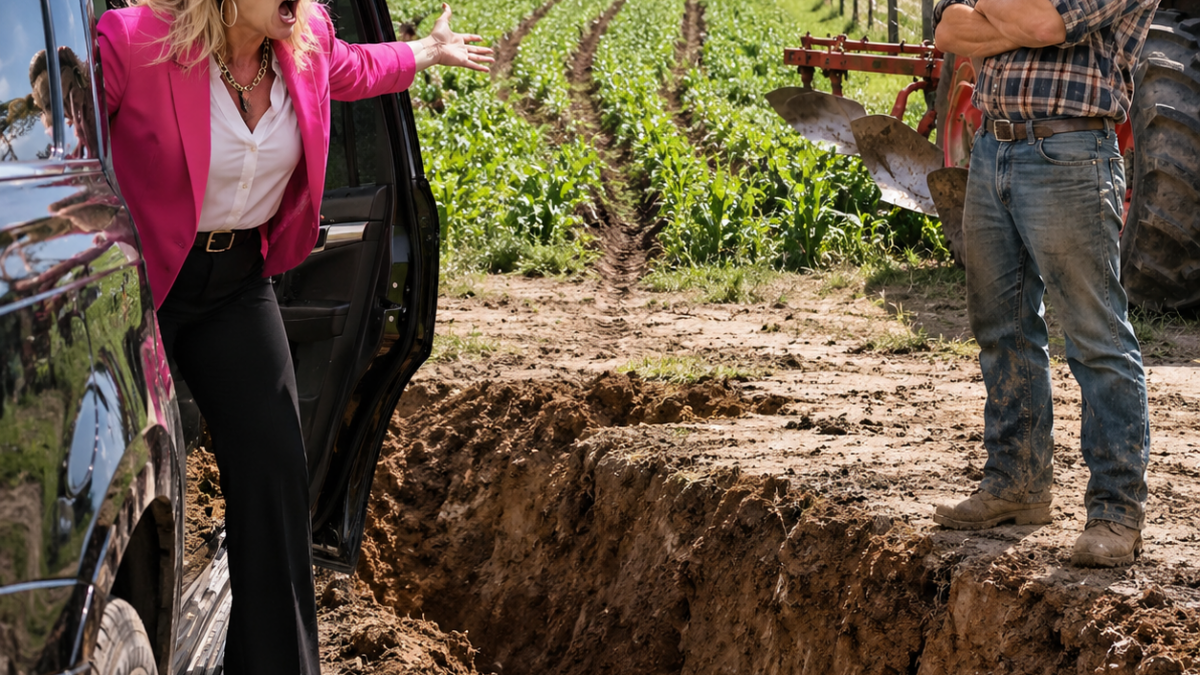
PART 2
I stood there after she drove away and watched broken corn stalks settle in her tire tracks.
The dust hung above the road.
Then the wind pushed it toward me.
A crushed ear of corn lay near my boot.
I picked it up.
Kernels were still soft.
Weeks from harvest.
That ear wasn’t worth much by itself.
Maybe a few cents.
But farming has a way of making small damage expensive when you repeat it enough times.
Four rows per vehicle.
Several vehicles a day.
Six days a week.
Mature corn.
Soybeans the next year.
Compaction.
Broken stalks.
Lost yield.
By harvest, the number was no longer small.
Neither was my anger.
But anger doesn’t fix boundaries.
So I started with boundaries.
Two weeks later, Tyler and I rebuilt the west gate.
Steel posts.
Concrete footings.
Heavy welded cable.
New padlock.
Twelve signs along the southern property line.
**PRIVATE PROPERTY**
**NO TRESPASSING**
**AGRICULTURAL ACCESS ONLY**
We worked until sunset.
Tyler was driving the last fence staple when he asked:
“You think this’ll actually stop them?”
“It’ll stop somebody who doesn’t know better.”
“What about Donna?”
I looked at the gate.
Then toward Timber Creek.
“We’ll see.”
It lasted nine days.
On the tenth morning, I found the entire gate lying flat.
Not unlocked.
Not cut.
Ripped out.
The concrete around one post had been pulled from the ground like a giant tooth.
Deep tire marks ran through the dirt.
Heavy-duty truck.
Three-quarter ton at least.
Every sign was gone.
All twelve.
Tyler walked up behind me.
“Dad.”
“I see it.”
“Who does that?”
Somebody who thinks consequences belong to other people.
That afternoon, certified mail arrived from Timber Creek Estates.
Cream-colored paper.
Gold embossed seal.
Formal language.
The letter claimed my gate and signs were “unauthorized obstructions to established community access.”
It demanded that I remove all barriers.
Fourteen-day deadline.
Threat of legal action.
I read it twice.
Then noticed the signatures.
Donna Prescott.
HOA President.
And underneath:
Doug Prescott.
Polk County Board of Supervisors, District 3.
Her husband.
I read his name again.
The same county board that had approved the Timber Creek development.
The same board responsible for subdivision access requirements.
A 180-home development with one entrance.
That suddenly stopped looking accidental.
I put the letter into a folder.
The next morning, I filed a report with the Polk County Sheriff’s Office.
Deputy Kevin Marsh came out.
Photographed the damage.
Measured tire tracks.
Looked at the pulled concrete.
“This took a serious truck.”
“I know.”
“Any cameras?”
“Not yet.”
He nodded toward Timber Creek.
“You have suspects?”
“Yes.”
“Proof?”
“No.”
Kevin sighed.
“Get me proof.”
So I did.
Six cellular trail cameras.
Infrared.
Motion activated.
Cloud upload.
I placed them where the corn and fence line hid them.
One on the gate.
Two covering the service road.
One watching each likely entry.
One high enough to catch license plates.
Then I waited.
Eleven nights.
At 2:17 a.m., my phone buzzed.
I opened the feed.
Black Dodge Ram 2500.
Truck backed toward my gate.
A man stepped out.
Hooked a tow chain around the steel post.
Climbed back into the cab.
The truck lurched.
Post came out of the ground.
Concrete and all.
My stomach tightened.
Then the headlights swept across the driver’s door.
White lettering.
**PRESCOTT CONTRACTING LLC**
Doug Prescott’s company.
I watched the video twice.
Then sent it to three backups.
Cloud.
External drive.
Trent Calloway, my attorney.
Then I went back to bed.
Tyler asked at breakfast why I was smiling.
“Nothing.”
“You never smile before coffee.”
“I got a good video.”
He knew what that meant.
“Donna?”
“Close enough.”
I drove straight to Deputy Marsh.
He watched the footage.
Again.
Then again.
He leaned back.
“That’s Prescott Contracting.”
“Yes.”
“Doug’s business.”
“Yes.”
“This is enough to move criminal mischief forward.”
“Good.”
He rubbed his jaw.
“But understand something.”
“What?”
“Doug sits on the county board.”
“That doesn’t make him invisible.”
“No.”
Kevin looked at me.
“It makes this political.”
“I don’t care about political.”
“You will when political cares about you.”
“I care about evidence.”
That earned a small smile.
“Keep collecting.”
Donna gave me plenty.
First, she accused me of poisoning Timber Creek through crop spraying.
County Health sent an inspector.
I gave him application records.
I hadn’t aerial sprayed in three years.
Ground application only.
Complaint closed.
Then Iowa DNR received a complaint about contaminated drainage.
An officer spent half a day walking tile outlets, grass waterways, and drainage structures.
Everything legal.
Everything compliant.
Complaint closed.
Then grain-bin setbacks.
County inspector measured 212 feet.
Minimum was fifty.
He shook his head.
“Who keeps filing this stuff?”
“I think you know.”
He looked toward Timber Creek.
“Yeah.”
Every dismissed complaint went into the folder.
Dates.
Agencies.
Findings.
Copies.
Trent told me:
“She’s building your tortious-interference case for you.”
“Doesn’t feel helpful.”
“It will later.”
Then the fight reached Tyler.
He came home from school one afternoon unusually quiet.
Normally he walked into the kitchen talking about football, equipment, or how some teacher had assigned too much work.
That day he sat through dinner pushing potatoes around his plate.
Afterward, I sat across from him.
“What happened?”
“Nothing.”
“Try again.”
He stared at the table.
“A kid in ag class said we’re poisoning Timber Creek.”
My jaw tightened.
“What kid?”
“Doesn’t matter.”
“It matters.”
“He lives there.”
I waited.
“He told everyone the county knows we’re contaminating the water but won’t do anything because farmers run everything.”
“Teacher hear him?”
Tyler nodded.
“Did he correct it?”
“No.”
That hurt worse.
Tyler looked at me.
“Why does she get to say whatever she wants?”
“She doesn’t.”
“She does, though.”
“For now.”
His eyes lifted.
“What does that mean?”
I leaned forward.
“It means consequences sometimes take longer than lies.”
“That’s not fair.”
“No.”
“Are you going to stop her?”
I remembered promising myself I wouldn’t turn this into revenge.
Then I looked at my son.
“Yeah.”
He didn’t look satisfied.
“Promise?”
That word carried weight.
I nodded.
“I promise.”
After Tyler went upstairs, I spread maps across the kitchen table.
Timber Creek.
One hundred eighty houses.
One entrance.
Something bothered me.
I pulled county subdivision regulations.
More than seventy-five residential units required two access points.
Not optional.
Not preferred.
Required.
I looked again at Timber Creek.
One.
Where was the second?
That question changed everything.
The next morning I filed a public-records request.
Original subdivision plan.
Revisions.
Board minutes.
Road studies.
Developer correspondence.
Financial disclosures.
Everything tied to Timber Creek Estates.
Three weeks later, a box arrived.
Three hundred eighty-seven pages.
I started at four in the afternoon.
Tyler went to bed at ten.
I kept reading.
At 11:20, I found the original plan.
June 2020.
Two access points.
Main entrance north to Highway 65.
Secondary connector road running south toward County Road 14.
The line on the plan was clearly marked.
**REQUIRED — POLK COUNTY SUBDIVISION ORDINANCE 12.04**
I sat straighter.
Then I pulled the revised plan.
November 2020.
Same development.
Same number of homes.
Same lots.
But the secondary road was gone.
In its place:
**SECONDARY ACCESS DEFERRED TO FUTURE DEVELOPMENT PHASE**
Approval signature:
Doug Prescott.
I searched meeting minutes.
No debate.
No public hearing.
No vote specifically authorizing removal.
Nothing.
Then came the transfer record.
$80,000.
From Phelps Development Group.
To Prescott Family Holdings LLC.
Nine days before Doug signed the revised plan.
I stared at the number.
Eighty thousand dollars.
Craig Phelps saved more than a million dollars by not building the connector road.
Doug received eighty thousand.
And Donna was now forcing the residents through my field because the road her husband had erased didn’t exist.
I checked conflict-of-interest disclosures.
Doug had never disclosed the payment.
Never disclosed the family holding company.
Never disclosed that his wife was HOA president in the development affected by the decision.
I called Trent at 1:37 a.m.
He answered after four rings.
“This better involve fire.”
“Eighty thousand dollars.”
“What?”
“Phelps to Prescott Family Holdings.”
Silence.
“When?”
“Nine days before Doug approved the revised plan.”
Now he was awake.
“You have the original access plan?”
“Yes.”
“Required second road?”
“Yes.”
“Revised plan?”
“Yes.”
“Signature?”
“Yes.”
He exhaled.
“Jack.”
“What?”
“You just found the reason they’re driving through your cornfield.”
“I know.”
“This is corruption territory.”
“I know.”
“Do not confront them.”
“I wasn’t planning to.”
“What are you planning?”
I looked at the map.
Then the service road.
Then the boundary.
“I’m going to make the road stop existing.”
Trent was quiet.
“I’m choosing not to ask what that means.”
“Good choice.”
The next morning, I hired Kurt Hessler.
Licensed surveyor.
West Des Moines.
His crew spent eight hours confirming every inch of my south boundary.
New pins.
GPS.
Total station.
Recorded plat comparison.
Result:
The service path was entirely on Ellison Farm.
No public easement.
No right-of-way.
No access agreement.
No prescriptive claim.
Timber Creek wasn’t even three years old.
I had the survey notarized and recorded.
Then I rented a CAT 420 backhoe.
Saturday morning.
Late October.
Cold enough that the stubble held frost.
Tyler met me outside before sunrise.
“You serious?”
“Yes.”
“How deep?”
“Five feet.”
He smiled.
“How wide?”
“Ten.”
“How long?”
“Forty.”
He looked toward Timber Creek.
“That’s going to stop a BMW.”
“That’s the general idea.”
We started at dawn.
I drove to the exact point where the private road crossed near the southern boundary.
Dropped stabilizers.
Lowered the bucket.
Black Iowa soil came up in heavy chunks.
Five feet.
Then six in one spot.
Ten feet wide.
Forty feet across.
Three feet beyond the road edges.
The spoil went north into a compacted berm.
Tyler ran the skid steer.
By noon, the trench looked like something from a military training range.
Straight cut.
Dark walls.
Groundwater already beginning to seep into the bottom.
Tyler stood beside it.
“Dad.”
“What?”
“This is a tank trap.”
I smiled.
“Vehicular denial obstacle.”
“That’s the same thing.”
“No. Army terminology makes everything sound expensive.”
He laughed.
By three, we finished.
Then I installed two signs.
Steel posts.
Concrete.
**PRIVATE PROPERTY — NO THROUGH ACCESS**
**NO TRESPASSING**
**ELLISON FARM — EST. 1962**
At the bottom:
Survey reference.
County recording number.
Tyler stepped back.
“She’s going to lose her mind.”
“Probably.”
“Are we allowed to enjoy that?”
“A little.”
Donna found it Monday morning.
I heard the horn from the machinery yard.
Long.
Constant.
Then again.
Then again.
I walked outside.
Six hundred yards away, three vehicles sat at the trench.
White BMW in front.
Donna beside it.
Hands on hips.
Door open.
Silver minivan behind.
Red pickup.
She looked tiny from that distance.
Her anger didn’t.
She called the sheriff at 8:47.
Deputy Marsh arrived at 9:15.
I met him at the gate.
“Mrs. Prescott says you destroyed a public road.”
“There is no public road.”
“Show me.”
I handed him the certified survey.
County record.
Deed.
Camera logs.
Damage report.
He read.
Then looked toward the trench.
“That’s five feet?”
“Yes.”
“Why?”
“Drainage.”
He looked at me.
“Drainage.”
“Also vehicular denial.”
Kevin almost smiled.
“Any Iowa law stopping a farmer from grading his own agricultural property?”
“Not here.”
“You checked?”
“I checked twice.”
He closed the folder.
“I’ll talk to her.”
From the yard, I couldn’t hear Kevin.
I could hear Donna.
“VINDICTIVE REDNECK!”
Tyler stepped beside me.
“She called you a redneck.”
“I heard.”
“That’s not even geographically accurate.”
I laughed.
Donna screamed something about lawyers.
Something about war.
Something about Friday.
It was Tuesday.
Tyler said:
“Why Friday?”
“Apparently lawyers need three days to mobilize.”
Donna turned around.
Drove back.
Twenty-five-minute route.
Minivan followed.
Pickup followed.
Then the field became quiet.
For the first time in fourteen months.
That evening, Tyler and I sat on the tailgate eating sandwiches.
No engines.
No dust.
No strangers.
Wind through stubble.
He said:
“This is what it’s supposed to sound like.”
I looked across the field.
“Yeah.”
Three days later, a process server knocked on my door.
**TIMBER CREEK ESTATES HOA v. ELLISON**
Donna wanted $250,000.
She claimed I had destroyed an established public access route.
She wanted a court order forcing me to fill the trench.
I called Trent.
He started laughing.
“What?”
“She’s suing you.”
“I noticed.”
“For digging on your own farm.”
“Yes.”
“I love her.”
“Please don’t.”
“I love this case.”
We counterclaimed.
Trespass.
Property destruction.
Crop loss.
Tortious interference.
Harassment.
Then attached the FOIA documents.
All of them.
Original subdivision plan.
Revised plan.
Doug’s signature.
Eighty-thousand-dollar transfer.
Conflict disclosure.
Trail cameras.
Gate destruction.
Dismissed complaints.
Crop-loss assessment.
Fourteen months of damage:
$67,000.
Once filed, those documents became part of the court record.
Donna wanted a public fight.
I gave her one.
The hearing was scheduled for December.
A week before court, a Timber Creek resident showed up.
Frank Dietrich.
Mid-fifties.
Work jacket.
Calloused hands.
He stayed outside the gate until I walked over.
“You Jack?”
“Yes.”
“I live in Timber Creek.”
I waited.
“Not all of us are with Donna.”
“Thirty vehicles a day suggest otherwise.”
He winced.
“Fair.”
“What do you want?”
“To tell you she lied.”
“About?”
“The road.”
I crossed my arms.
“She told us it was public.”
“It isn’t.”
“I know now.”
Frank looked embarrassed.
“Most of us never checked.”
“That’s the problem.”
“She said it so often…”
“That doesn’t make it true.”
“I know.”
He looked toward the trench.
“After you dug that, some people pulled the county plat.”
“And?”
“They’re angry.”
“At me?”
“At her.”
“How many?”
“Enough.”
“Enough for what?”
“An election.”
I thanked him.
Then called Megan Aldrich.
County politics reporter.
Des Moines Register.
I explained the story.
Off record.
For forty minutes she barely spoke.
When I finished:
“You have the bank transfer?”
“Yes.”
“Certified?”
“Yes.”
“Subdivision plans?”
“Yes.”
“Trail footage?”
“Yes.”
“Court hearing date?”
“Tuesday.”
“I’ll be there.”
December morning.
Polk County Courthouse.
Every seat filled.
Timber Creek residents left.
Farmers right.
Press near the front.
Donna sat in charcoal and cream.
Hair perfect.
Posture perfect.
Doug behind her.
He looked less comfortable.
Judge Rita Colvin called the case.
Donna’s attorney, Dan Harper, went first.
Twelve minutes.
“Established community access.”
“Dangerous obstruction.”
“Public safety.”
“Deliberate retaliation.”
“Property value damage.”
He spoke as though my grandfather had built the path specifically for Timber Creek decades before Timber Creek existed.
Then Trent stood.
No notes.
“Your Honor, Mr. Ellison dug a trench on his own agricultural property.”
Simple.
“The land is surveyed.”
He handed over the survey.
“Recorded.”
Deed.
“No easement.”
Plat.
“No right-of-way.”
Another page.
“No valid prescriptive-use claim.”
He paused.
“But this case isn’t really about Mr. Ellison’s trench.”
Donna’s attorney frowned.
Trent held up the original development plan.
“It’s about a road that should exist somewhere else.”
The courtroom became very still.
“This is Timber Creek Estates as submitted in June 2020.”
Two access roads.
“This southern connector was required by Polk County ordinance.”
Then revised plan.
“The road disappears.”
Judge Colvin leaned forward.
Trent continued.
“No public hearing.”
Page.
“No recorded discussion.”
Page.
“And approval bears the signature of Polk County Supervisor Doug Prescott.”
People turned.
Doug stared forward.
“Mr. Prescott is married to the plaintiff HOA president.”
Murmurs.
Then Trent lifted the transfer record.
“Nine days before this approval, Phelps Development Group transferred eighty thousand dollars to Prescott Family Holdings LLC.”
The courtroom erupted.
Judge Colvin struck the gavel.
“Order.”
Donna stood.
“That is a private financial matter!”
Judge Colvin looked at her.
“Mrs. Prescott, sit down.”
Donna froze.
Then slowly sat.
I had never seen anyone speak to her like that.
Trent opened his laptop.
Trail-camera footage.
Prescott Contracting truck.
2:17 a.m.
Tow chain.
Gate post ripped from ground.
Then video after video of vehicles using my service road.
Corn crushed.
Dust.
Signs gone.
Damage.
Then the dismissed government complaints.
County Health.
DNR.
Code enforcement.
Each one unfounded.
Finally:
$67,000 crop-loss report.
Trent faced the judge.
“The plaintiff is not being denied a public road.”
He turned slightly toward Donna.
“The plaintiff is being denied continued trespass over private farmland.”
He paused.
“And the reason one hundred eighty families need that trespass is because a required public access road was removed from the development plan under circumstances that deserve investigation.”
Then he said:
“Mr. Ellison didn’t obstruct a road.”
Silence.
“He closed a crime scene.”
For three seconds, nobody moved.
Then the gallery exploded.
Judge Colvin banged the gavel twice.
Donna looked furious.
Doug looked sick.
The judge spent forty-five minutes examining documents.
Then called Doug.
“Mr. Prescott, stand.”
He did.
“Is that your signature on the November 2020 revised subdivision plan?”
“Yes.”
“Did you disclose the eighty-thousand-dollar transfer?”
His voice dropped.
“No.”
“Why?”
Nothing.
“Mr. Prescott?”
“I don’t have an answer.”
The judge recessed.
The hallway became chaos.
Residents surrounded Frank.
Reporters moved toward Doug.
Donna’s attorney whispered rapidly to her.
Donna stared across the hall at me.
I held her gaze.
She walked over.
Trent stepped between us.
Donna ignored him.
“You think this makes you clever?”
I said nothing.
“You deliberately trapped an entire neighborhood.”
“No.”
“You knew people depended on that road.”
“You mean my road.”
“One hundred eighty families!”
“Ask your husband why they only have one legal exit.”
Her eyes flashed.
“This isn’t over.”
“No.”
I looked toward the courtroom.
“It isn’t.”
For the first time, Donna looked uncertain.
Judge Colvin returned.
Everyone sat.
She ruled from the bench.
HOA complaint:
Dismissed with prejudice.
The trench:
Lawful modification of private agricultural land.
No easement.
No public right-of-way.
No prescriptive claim.
Then my damages.
Crop loss:
$67,000.
Property repairs:
$18,000.
Legal fees:
$31,000.
Total:
$116,000.
Donna went still.
Judge Colvin wasn’t finished.
She referred Doug’s conduct to the Polk County attorney for investigation.
Potential ethics violations.
Conflict-of-interest failures.
Abuse of office.
Craig Phelps and the development arrangement were referred for additional investigation.
Then Judge Colvin looked at Donna.
“Mrs. Prescott.”
Donna raised her eyes.
“You spent fourteen months driving through another person’s livelihood because you did not want to take the longer route.”
No one breathed.
“You damaged private property.”
“You pursued repeated unsupported complaints.”
“You asserted rights that did not exist.”
“And today you asked this court to turn entitlement into an easement.”
The judge leaned forward.
“It will not.”
Donna’s face went pale.
Her lawyer requested a stay.
Denied.
She gathered her bag.
Stood.
Walked out.
Heels clicking.
Perfect posture.
Doug followed.
Five steps behind.
Trent whispered:
“That marriage looks healthy.”
I almost laughed.
Outside, Megan Aldrich waited.
“Mrs. Prescott, any comment?”
Donna walked past.
Sheriff Baxter stopped Doug near the door.
Handed him formal notice related to the investigation.
He took it without looking up.
Trent shook my hand outside.
“Best case I’ve had in years.”
“I hope it’s the last one I give you.”
“Boring clients don’t pay mortgages.”
The fallout came fast.
Doug resigned from the county board two days later.
Investigators opened the financial case.
Craig Phelps was forced to address the missing access road.
The development company ultimately funded the connector that should have existed from the beginning.
Cost:
About $1.4 million.
Plus penalties.
Eight months later, Timber Creek finally had its proper second route.
Nobody needed my field.
Nobody drove through it.
The HOA held a special election.
Donna lost.
141 to 6.
Carol Voss, a retired school principal, became president.
Her first letter to me wasn’t embossed.
Plain paper.
Handwritten.
**Mr. Ellison,**
**The new board apologizes for the HOA’s conduct toward you, your family, and your farm.**
Inside was a reimbursement check for the twelve stolen signs.
I cashed it.
Bought Tyler new work boots.
Megan’s story ran in the paper.
The headline included the words **Trench Warfare**.
For weeks, reporters called.
People emailed.
Lawyers wrote online about property rights.
Then winter arrived.
Snow covered everything.
Farm country has a way of shrinking scandals.
Once livestock need water heaters checked and tractors need winter service, yesterday’s outrage starts feeling far away.
Donna listed her house six weeks after the ruling.
Sold below asking.
The BMW disappeared.
I never asked where she went.
I didn’t care.
Frank came by one evening carrying a six-pack.
We stood near the machinery shed.
“She had us scared,” he said.
“Donna?”
He nodded.
“Sounds stupid now.”
“Fear usually does afterward.”
“She’d fine people.”
“Then challenge it.”
“Easy to say from outside.”
He was right.
I didn’t argue.
Frank continued.
“You get one violation, then another. She controls meetings. Controls the board. Her husband’s county supervisor. You start thinking maybe keeping quiet is cheaper.”
“That’s how it works.”
“Yeah.”
He looked toward Tyler.
“Sorry about the field.”
“Don’t apologize for everybody.”
“I drove through twice.”
I turned.
He looked embarrassed.
“Before I knew.”
“You knew it wasn’t yours.”
He nodded.
“That’s fair.”
There was a long silence.
Then he said:
“I’m sorry.”
I shook his hand.
“Don’t do it again.”
He laughed.
“Can’t.”
He pointed.
“Big hole.”
The trench stayed.
People expected me to fill it.
I didn’t.
Why would I?
In spring, I reshaped the sides.
Gentler slopes.
Stabilized the berm.
Seeded native prairie grass.
The standing water became part of the south field drainage system.
A county drainage inspector visited.
Walked the channel.
Checked tile flow.
“This actually improves drainage.”
“I know.”
He looked at me.
“Did you plan that?”
“I spent six years engineering roads and water.”
He blinked.
“You weren’t kidding.”
“No.”
Tyler planted wildflowers.
Black-eyed Susans.
Purple coneflowers.
His mother’s favorites.
My wife had died when Tyler was nine.
Cancer.
Fast.
Cruel.
Tyler rarely talked about her directly.
But he remembered every flower she planted around the farmhouse.
One evening we stood near the trench.
Purple flowers moved in the wind.
A monarch landed.
Then another.
Tyler counted.
Fourteen.
He smiled.
“Dad.”
“What?”
“I think Mom sent those.”
I looked away toward the corn.
There are moments when a father knows speaking will ruin something.
So I just nodded.
The trench that began as an obstacle slowly stopped looking like revenge.
Prairie grass covered the berm.
Water cleared.
Frogs showed up.
Butterflies.
Red-winged blackbirds.
It became part of the field.
Like scars do.
You remember why they’re there.
But eventually they belong to you.
I used some of the judgment money to create a scholarship.
Ellison Family Farm Heritage Award.
Two thousand dollars each year.
For a Polk County student studying agriculture, conservation, or rural engineering.
Tyler helped design the application.
“What should the essay question be?” I asked.
He thought.
Then:
“What would you fight to protect?”
I looked at him.
“That’s good.”
“I know.”
“You’re modest.”
“Got it from Grandpa.”
He was right.
We used it.
The first winner wanted to study agricultural engineering.
She wrote about her grandparents’ dairy farm.
The second year, a kid wrote about soil conservation.
Every time I read those essays, I thought about Grandpa’s words.
You don’t own the dirt.
You borrow it.
At first, I thought the fight with Donna was about ownership.
My land.
My road.
My corn.
My rights.
It was.
But it was also about stewardship.
Donna saw dirt.
I saw soil.
She saw a path.
I saw a field Grandpa worked.
She saw twenty-five minutes.
I saw forty rows of corn.
She saw an inconvenience.
Tyler saw his family being humiliated.
People fight hardest when two different meanings occupy the same place.
Years later, Timber Creek changed.
The new road became normal.
Residents used it.
Bike lane eventually added.
Carol kept HOA meetings boring.
That was a compliment.
No one measured grass with laser equipment anymore.
No one mailed threats to children.
Frank told me neighbors started having actual block parties.
No speeches.
No enforcement agenda.
Just food.
One Saturday, Carol called.
“Jack?”
“Yeah?”
“We’re having a community picnic.”
“Congratulations.”
“That was sarcasm.”
“It wasn’t.”
“Would you come?”
“No.”
“Why?”
“I don’t live there.”
“You’ve been discussed at every meeting for three years.”
“That makes me want to come less.”
She laughed.
“Tyler?”
“He decides for himself.”
Tyler went.
Came home with three hamburgers.
“Traitor.”
“They had pie.”
“Understandable.”
He told me people asked about the farm.
Not complaints.
Questions.
Could kids visit during harvest?
Could the HOA sponsor an agriculture day?
Would I explain drainage?
I said maybe.
The first group came the next spring.
Twenty children.
Parents.
I showed them the bins.
Planter.
Combine.
A kid asked why corn rows were straight.
Another asked whether tractors had air conditioning.
A little girl asked:
“Is that the famous trench?”
Every adult got uncomfortable.
I looked at Carol.
She shrugged.
I said:
“Yes.”
The girl walked closer to the wildflowers.
“Why’d you dig it?”
“To keep cars out of the field.”
“Why were cars in the field?”
“Because adults sometimes confuse convenient with allowed.”
She thought about that.
Then nodded.
Kids understand boundaries better than adults.
Years passed.
Tyler grew taller than me.
He stopped asking permission before starting equipment because he knew more than most people I could hire.
One harvest afternoon, I rode beside him.
He drove the combine.
I watched the monitor.
“You’re pushing too fast.”
“I’m not.”
“Loss monitor says—”
“Wind changed.”
I looked.
He was right.
That irritated me.
“You get lucky once.”
He smiled.
“Sure.”
At the end of the row, he stopped.
The trench was visible.
Flowers.
Prairie grass.
Clear drainage water.
“You ever regret it?”
“What?”
“Digging that.”
“No.”
“Not even a little?”
I thought.
“I regret it became necessary.”
“That’s different.”
“Yes.”
He looked toward Timber Creek.
“Do you hate Donna?”
“No.”
“You did.”
“For a while.”
“What changed?”
“Got tired.”
He laughed.
“That’s it?”
“Hate is work.”
He waited.
“I have enough work.”
That was true.
There was another reason.
Donna had taken more than crop yield.
For fourteen months, every engine near the south field made my shoulders tighten.
Every county vehicle made me wonder what complaint she filed.
Every time Tyler got quiet, I wondered what lie had reached school.
Even after court, it took months before I stopped expecting the next attack.
I realized that continuing to hate her meant continuing to let her live on my farm without permission.
I’d worked too hard to remove her physically.
I wasn’t letting her stay mentally.
One day Deputy Marsh stopped by.
Not official.
He bought sweet corn from us every summer.
We stood by the trench.
He looked down.
“Still impressive.”
“Drainage channel.”
“Of course.”
He smiled.
“Doug’s case finally closed.”
I didn’t ask.
Kevin continued.
“You don’t want to know?”
“Not really.”
“That’s new.”
“Life got busy.”
He nodded.
“That’s probably healthier.”
Then he looked toward the flowers.
“You know what I remember most?”
“What?”
“Donna calling this an act of war.”
I laughed.
“She was dramatic.”
“You were Army Corps.”
“Yeah.”
“She never understood how bad an idea it was to declare war on a guy whose resume included ‘vehicular obstacles.’”
“That part was funny.”
Kevin laughed.
Then grew serious.
“You did it right.”
“What?”
“Evidence first.”
I thought about the night I watched Prescott Contracting pull out the gate.
The temptation to drive over and confront Doug had been enormous.
If I had?
Maybe shouting.
Maybe a fight.
Maybe charges against me.
Instead I saved the footage.
Evidence first.
Dad used to say farming punishes impatience.
Plant too early.
Harvest too wet.
Work soil when it’s wrong.
You pay later.
Donna never learned patience.
She needed every argument won immediately.
Every person obedient immediately.
Every shortcut available immediately.
That urgency destroyed her.
One fall, Tyler left for Iowa State.
Agricultural engineering.
I helped move him into a dorm.
He pretended he wasn’t nervous.
I pretended I wasn’t emotional.
On the drive home, the truck felt too quiet.
I walked into the farmhouse.
One pair of boots by the door instead of two.
That hurt.
At dinner, I caught myself about to call upstairs.
Then remembered.
Later, Tyler texted.
**How’s the trench?**
I replied:
**Still deep.**
He sent:
**Good.**
Then:
**How are you?**
I stared at that longer.
**Still deep.**
His answer:
**Very funny, Dad.**
College changed him.
Not in bad ways.
He came home talking about watershed management, GPS-guided drainage, conservation tillage.
One Christmas, he stood over Grandpa’s old soil maps.
“This south forty could benefit from redesigned tile spacing.”
I crossed my arms.
“Your grandfather installed those.”
“I know.”
“Your grandfather was smart.”
“I know.”
“You saying he was wrong?”
“I’m saying drainage science improved since 1978.”
I stared.
He smiled.
“Want me to show you?”
I did.
He was right.
We improved it.
That was another lesson.
Protecting heritage doesn’t mean freezing it.
Grandpa used horses before tractors.
Dad modernized grain handling.
I brought Army engineering home.
Tyler brought new technology.
Land survives because each generation protects the purpose, not every exact method.
The trench stayed because it worked.
Not because I needed a monument to Donna.
Eventually, the wildflowers almost hid it.
One summer evening, I stopped the combine near the south quarter.
Corn stood straight.
No tire tracks.
No broken rows.
No dust clouds from commuters.
The engine idled.
Red-tailed hawk above.
Tyler’s voice came through the radio.
“Dad, north quarter’s finished.”
“You need help?”
“No.”
“You sure?”
“I’ve got it.”
I smiled.
Same words I’d once said to Dad.
“Take a break,” Tyler told me.
“I’m the boss.”
“Then order yourself to take a break.”
“Watch your tone.”
He laughed over the radio.
I shut the header down.
Sat there.
Grandpa bought the farm because he wanted somewhere a man could look out and see his own ground.
That part changed.
Timber Creek roofs were visible now.
Development had reached us.
You can’t stop time.
But every acre Grandpa bought was still ours.
Every row still grew.
The private road remained private.
The connector road now existed where it legally should have existed from the beginning.
No one needed to trespass.
And underneath the flowers, the old shortcut was still there.
You could see traces if you knew where to look.
Compacted gravel.
Different grass.
A faint line through the soil.
But no vehicle could use it.
One afternoon, a new Timber Creek resident stopped at my gate.
Young guy.
Two kids in the back seat.
“Mr. Ellison?”
“Yeah?”
“I just moved in.”
“Welcome.”
“My realtor told me there’s some history with this road.”
“That’s one word.”
He looked embarrassed.
“I wanted to ask if I could bring my boys over sometime. They’ve never seen a combine up close.”
I looked at the kids.
Both staring at the tractor.
“Saturday morning.”
His face brightened.
“Really?”
“Wear boots.”
Saturday came.
Then another family.
Then another.
The people who had once treated my farm like an obstacle began treating it like a neighbor.
Not everyone.
Never everyone.
But enough.
That mattered.
My scholarship grew too.
A local co-op added money.
Then a conservation group.
Eventually we awarded two students each year.
I kept Tyler’s essay question.
**What would you fight to protect?**
One girl wrote about her family’s century farm.
One boy wrote about a prairie his grandfather restored.
Another wrote about his younger brother.
That one surprised me.
He wanted to become a rural doctor because his brother had almost died waiting for emergency care.
Protection means different things to different people.
Maybe that was the core of my fight with Donna.
She thought protection meant preserving home values and convenience.
I thought protection meant land, livelihood, family.
Neither concept is inherently wrong.
What made Donna wrong was believing hers allowed her to destroy mine.
I never forgot that distinction.
Years after the case, I ran into her once.
Des Moines.
Hardware store.
Of all places.
I was buying hydraulic fittings.
She was near the front.
No BMW visible.
No HOA badge.
Same polished posture.
Older.
She recognized me.
We both stopped.
“Jack.”
“Donna.”
She looked at the fittings in my hand.
“Still farming?”
I almost laughed.
“Yeah.”
She nodded.
Silence.
Then:
“You ruined our lives.”
There it was.
Not hello.
Not apology.
I said:
“No.”
Her eyes narrowed.
“You humiliated Doug.”
“No.”
“You made everything public.”
“Court records are public.”
“You knew what would happen.”
“I knew what your husband did.”
Her face tightened.
“You could have handled it privately.”
“You drove through my crops for fourteen months.”
“That wasn’t the same thing.”
“It was the beginning of the same thing.”
She crossed her arms.
“You never cared about the residents.”
“I cared enough not to sue all of them.”
She looked away.
“People trusted me.”
“Yes.”
“And you destroyed that.”
“No.”
I shook my head.
“You did.”
She stared.
For a moment, some of the old Donna returned.
Cold.
Certain.
Then it faded.
“You enjoyed digging that trench.”
That accusation was at least true.
“A little.”
She almost smiled.
Almost.
Then:
“Still there?”
“Yes.”
“Of course it is.”
“Works well for drainage.”
That actually made her laugh once.
Short.
Bitter.
“You always were impossible.”
“I said no.”
“What?”
“That’s all I did at first.”
I looked at her.
“You weren’t used to hearing it.”
She had no answer.
I nodded once.
“Take care, Donna.”
Then walked away.
I didn’t feel triumphant.
I felt finished.
That was better.
When I got home, Tyler was back from college for summer.
He asked:
“You saw her?”
“Yeah.”
“What happened?”
“Nothing.”
“That’s disappointing.”
“It was perfect.”
He looked confused.
I handed him a hydraulic fitting.
“Help me fix the planter.”
Life continues.
That is what people forget about revenge stories.
The dramatic moment passes.
Courtroom empties.
Headlines disappear.
People move.
Equipment still breaks.
Cows still get out.
Weather still decides whether you’re happy.
Corn doesn’t care that you won a lawsuit.
Soybeans don’t care about corruption.
The farm keeps asking the same question every morning.
Are you getting up?
So I did.
And one morning, years after Donna, I stood at the trench with Tyler.
Wildflowers high.
Butterflies.
Drainage water moving.
He said:
“Grandpa would think this is funny.”
“My dad?”
“Great-Grandpa Earl.”
I smiled.
“Why?”
“He built a road.”
“Yeah.”
“You turned part of it into a ditch.”
“He’d complain.”
“Then brag.”
“Probably.”
Tyler crouched.
Picked up a handful of black soil.
Let it fall through his fingers.
Then he repeated something Grandpa used to say.
“Six thousand years.”
I looked at him.
“You remember that?”
“You’ve said it about a million times.”
He stood.
“You don’t own it. You borrow it.”
“Exactly.”
Tyler looked across the south forty.
“So who do we give it to?”
That question hit harder than he intended.
Someday this would be his.
The bins.
The old white house.
The machine shed where Dad died.
The trench.
Every mistake.
Every improvement.
Every story.
“You,” I said.
He shook his head.
“After me.”
I looked at the soil.
“That’s your problem.”
He laughed.
But it wasn’t a joke.
That is farming.
Borrow.
Protect.
Improve.
Pass on.
Donna’s shortcut taught me something Grandpa had understood without lawyers.
A boundary only matters if you are willing to defend it.
But defense doesn’t always look like anger.
Sometimes it looks like a survey.
A camera.
A folder.
A county record.
Sometimes it looks like patience.
And sometimes, after every reasonable warning has failed, it looks like a five-foot trench cut across the place where someone keeps pretending your property belongs to them.
People still ask whether I dug it for revenge.
I tell them no.
Then I tell them yes.
Both are true.
I needed drainage.
I needed a physical barrier.
I needed to protect crops.
And yes, I wanted Donna to drive up Monday morning, open that BMW door, walk to the edge, and realize that for once she could not talk her way through a property line.
I enjoyed that.
I’m not ashamed.
But revenge alone would have been filling the trench after she lost.
Instead, we turned it into something useful.
Drainage.
Prairie habitat.
Flowers for Tyler’s mother.
Monarchs in September.
A scar became infrastructure.
That feels more like farming.
Take what happened.
Work it.
Make it produce something.
Last fall, I was harvesting the same south quarter Donna used as a six-day-a-week shortcut.
Corn stood clean.
Straight rows.
No crushed stalks.
No tire ruts.
I reached the end.
Stopped.
The trench line was glowing with purple coneflowers in late sunlight.
Tyler’s voice came over the radio.
“Dad?”
“Yeah?”
“You stopping for pictures again?”
“No.”
“You always stop there.”
“I’m checking the crop.”
“Sure.”
“Respect your elders.”
“You’re not that old.”
“Keep talking and you’re unloading trucks all night.”
He laughed.
I sat there watching the field.
My grandfather first planted ground here more than sixty years ago.
My father worked it thirty-one years.
Mom is gone.
Dad is gone.
My wife is gone.
Someday I’ll be gone too.
The land will remain.
That is why Donna never understood the fight.
To her, the service road represented twenty-five minutes.
To me, the ground around it contained every person I had lost.
Every lesson they left.
Every year of work I hoped to hand to my son.
She saw convenience.
I saw inheritance.
And when those two things collided, convenience lost.
The hawk circled above the field.
Wind moved through the leaves.
I started the header again.
Before moving forward, I looked one last time at the old shortcut.
You can’t drive through it now.
You never will.
And that is exactly how it should be.
For fourteen straight months, the president of the HOA next to my farm treated a private gravel path my grandfather built in 1967 like it belonged to her neighborhood, cutting chains when I locked the gate, ripping down signs when I warned people off, and sending so many vehicles through my standing crops that I could follow her “shortcut” by the trail of broken corn.
I tried talking to her, calling the sheriff, reinforcing the gates, filing reports, documenting damage, and doing everything a reasonable landowner is supposed to do before a dispute becomes a war, but the day my sixteen-year-old son came home from school asking why people were calling our family polluters, I stopped wondering whether Donna Prescott would ever respect a boundary she couldn’t personally benefit from.
What Donna never bothered to learn was that before I came home to farm Iowa soil, I had spent six years in the Army Corps of Engineers building roads, removing roads, designing drainage systems, and creating obstacles meant to stop vehicles cold—and once I finally understood what was really hiding behind her obsession with my property, I knew exactly where to draw the line.
My name is Jack Ellison.
I farm 480 acres in Polk County, Iowa, about twenty minutes south of Ankeny.
Corn.
Soybeans.
Hay.
Black soil so rich my grandfather used to scoop a handful every spring and let it crumble through his fingers like he was holding gold dust.
“This took six thousand years to make,” he would tell me. “We don’t own it, Jack. We borrow it.”
His name was Earl Ellison.
He bought the first parcel in 1962 after spending fifteen years running combines on contract across three states.
He saved everything he could.
No vacations.
No new truck.
No fancy house.
Just land.
My father, Glenn, eventually took over and ran the operation for thirty-one years.
He modernized the grain system, expanded acreage, built the pole barn, and somehow convinced himself that starting work at four-thirty every morning counted as sleeping late.
Dad died eighteen months before the worst of this happened.
Heart attack.
Sixty-seven years old.
He was standing in the machinery shed with one hand on the hood of a John Deere 8370R he had just finished servicing.
The paramedic said he was gone before he hit the floor.
Mom had already passed in 2019.
So suddenly the farm belonged to me.
Me and my son Tyler.
Tyler was sixteen.
Already better with the grain cart than plenty of hired men I had known.
He had his grandfather’s patience and his mother’s smile.
His mother died when he was nine, and although he almost never talked about her directly, he remembered everything she loved.
Especially flowers.
Before returning to the farm, I spent six years active duty with the Army Corps of Engineers.
Route clearance.
Horizontal construction.
Drainage.
Bridges.
Demolition.
Two tours in Afghanistan.
One in Iraq.
I learned to build access roads through places where one bad grade could put a vehicle at the bottom of a ravine.
I learned what happens when water reaches a roadbed it was never designed to handle.
And I learned something else.
If you really want a vehicle to stop going somewhere, signs are usually the least interesting option.
I came home in 2014 with a Bronze Star, a bad knee, and a collection of skills I never imagined using against an HOA.
The road that started everything wasn’t even a public road.
Grandpa built it in 1967.
A quarter-mile gravel service path across the south end of our farm, connecting the machinery yard to County Road 14.
He used it during harvest to reach the elevator faster.
That was it.
No easement.
No county dedication.
No public right-of-way.
For more than fifty years, Ellisons used it.
Nobody else cared.
Then Timber Creek Estates appeared south of our property.
One hundred eighty houses.
Matching mailboxes.
Vinyl siding.
Clubhouse.
Pool.
Perfect lawns.
The developer called it Timber Creek even though there wasn’t a creek or meaningful stand of timber anywhere nearby.
Their main entrance ran north toward Highway 65.
If residents wanted to reach the stores, medical center, interstate, or anything south, they had to drive north first, loop around, then come back down.
About twenty-five minutes.
If they cut through my farm road?
Eight minutes total.
Somebody figured that out almost immediately.
The first time Tyler radioed me and said a car was driving through the south field, I thought he was joking.
He wasn’t.
By the time I got there, four rows of mature corn were flattened beside the service path.
The west gate chain had been cut.
I replaced it.
Three days later, the new chain was cut too.
Then several vehicles started using the route.
One going east.
Another west.
They widened the path every time they passed.
Corn stalks snapped beneath tires.
Dust rolled over the field.
At eight dollars a bushel, the losses added up fast.
I tried being reasonable.
Posted a polite notice at Timber Creek’s community board.
Private agricultural road.
No public access.
Please use Highway 65.
The paper disappeared the next morning.
So I waited near the south field.
Around four-thirty, a white BMW X5 came through.
Fast.
Forty miles an hour, maybe more.
It blew dust across the corn and crushed stalks on both sides.
I followed.
The BMW stopped near the west gate.
A woman stepped out.
Tall.
Chestnut hair.
Designer sunglasses.
White tennis dress.
Gold bracelet.
She looked like somebody from a luxury real-estate advertisement had wandered into the wrong county.
“Ma’am,” I called, “do you know where you are?”
She lowered the sunglasses.
“Yes. I’m taking the shortcut.”
“This isn’t a shortcut. It’s private farmland.”
She smiled.
“I’m Donna Prescott. President of Timber Creek Estates.”
“I’m Jack Ellison. Owner of the field you’re standing in.”
“Honey, if thirty families drive it every day, it’s a road.”
“No. It means thirty families are trespassing every day.”
The smile stayed on her face, but her eyes changed.
“The legitimate route adds a ridiculous amount of time.”
“That doesn’t make this public.”
“You could move your crops farther from the travel lane.”
I stared at her.
“My crops?”
“Yes.”
“This is a crop field.”
“Then perhaps you need to adapt to the community growing around you.”
That sentence told me everything I needed to know.
She climbed back into the BMW and drove away through six more rows of corn.
I stood there watching crushed stalks disappear beneath her tires.
Not confused.
Not mistaken.
Entitled.
That was Donna Prescott.
Two weeks later, Tyler and I reinforced the gates.
Steel posts.
Concrete.
Heavy welded cable.
Twelve private-property signs.
We welded the west gate shut.
Tyler was hammering the final post when he asked:
“You think this stops them?”
“It’ll stop the honest ones.”
“What about her?”
I looked toward Timber Creek.
Neither of us needed the answer.
Nine days later, the gate was lying on the ground.
Not cut.
Ripped completely out.
Concrete anchors and all.
Every sign was gone.
A heavy truck had pulled the whole assembly apart.
That afternoon, certified mail arrived.
Timber Creek Estates HOA.
Gold seal.
Cream paper.
Formal demand that I remove “unauthorized obstructions” from an “established community access route.”
The letter threatened legal action.
I laughed at first.
Then I saw the signatures.
Donna Prescott.
HOA President.
And beneath hers:
Doug Prescott.
Polk County Board of Supervisors.
Her husband.
That changed the smell of the whole thing.
The county board had approved Timber Creek.
It had reviewed access requirements.
And somehow a 180-home subdivision had ended up with only one legal exit.
The next morning, I called the sheriff.
Deputy Kevin Marsh photographed the damage.
Measured tire marks.
Looked at the gate.
“Whoever pulled this knew what they were doing.”
“I know.”
“Any cameras?”
“Not yet.”
“Get some.”
So I did.
Six cellular trail cameras.
Infrared.
Motion activated.
Hidden in corn and fence lines.
Eleven nights later, my phone buzzed at 2:17 a.m.
I opened the feed.
Black Dodge Ram 2500.
A man climbed out.
Wrapped a tow chain around one of my rebuilt posts.
Then pulled it straight out of the ground.
When his headlights swept across the truck door, the logo appeared clearly.
PRESCOTT CONTRACTING LLC.
Doug’s company.
I saved the footage.
Three backups.
Then went back to bed.
The next morning, Kevin watched it twice.
“That’s Doug’s company.”
“Yes.”
“That gives me criminal mischief.”
“Good.”
He rubbed his jaw.
“But this is going political.”
“I don’t do political.”
“You will.”
“I do evidence.”
He nodded.
“Then keep collecting.”
Donna made that easy.
She complained to county health that my spraying was poisoning Timber Creek.
Records proved I hadn’t aerial sprayed in three years.
Dismissed.
She complained to the Iowa DNR about contaminated runoff.
They inspected everything.
Dismissed.
She complained that my grain bins violated setbacks.
The code officer measured 212 feet.
Minimum was fifty.
Dismissed.
Every report went into a folder.
Then Tyler came home from school one afternoon and barely spoke through dinner.
Afterward, I sat across from him.
“What happened?”
“Nothing.”
“Try again.”
He stared at the table.
“A kid in ag class said our farm is poisoning Timber Creek.”
I felt my jaw tighten.
“Teacher hear it?”
“Yeah.”
“Correct him?”
“No.”
Tyler finally looked up.
“Why does she get to say whatever she wants?”
“She doesn’t.”
“She does right now.”
That hurt because he was right.
“For now,” I said.
He studied my face.
“You’re going to stop her?”
“Yes.”
“Promise?”
I hesitated.
Justice is a dangerous thing to promise a child.
But I nodded.
“Promise.”
That evening, I spread subdivision maps across the kitchen table.
Something had bothered me for months.
One hundred eighty homes.
One entrance.
County ordinance required two access roads for developments over seventy-five units.
So where was Timber Creek’s second road?
I filed a public-records request.
Three weeks later, I had 387 pages.
I read until two in the morning.
The original June 2020 plan showed two access points.
Main entrance north to Highway 65.
Secondary connector south to County Road 14.
Marked clearly:
REQUIRED.
Then I found the revised November plan.
Same houses.
Same subdivision.
Second road gone.
A note said it was deferred to a future development phase.
Doug Prescott’s signature sat at the bottom.
No public hearing.
No meaningful discussion.
No recorded vote explaining why.
Then I found the payment.
Eighty thousand dollars.
Phelps Development Group to Prescott Family Holdings LLC.
Nine days before Doug approved the revised plan.
I stared at the page.
Craig Phelps had saved more than a million dollars by not building the connector.
Doug received eighty thousand.
And Donna was forcing Timber Creek residents through my farm to compensate for the road her husband had erased.
I called my attorney, Trent Calloway.
“I’ve got it.”
“What?”
“The original road plan. Revised plan. Doug’s signature. Eighty-thousand-dollar transfer.”
Silence.
Then:
“Jack, do not confront anybody.”
“I won’t.”
“Good.”
“What do I do?”
“Force the access issue into public record.”
I looked at my service road.
“And Jack?”
“Yeah?”
“Whatever you’re planning with that farm path, make sure it is legal.”
I smiled.
“It will be.”
Two days later, I hired Kurt Hessler, a licensed surveyor.
His crew mapped the south boundary precisely.
Every inch of the service path was mine.
No easement.
No right-of-way.
No prescriptive claim.
Timber Creek had existed less than three years.
I recorded the certified survey.
Then rented a CAT 420 backhoe.
Saturday morning, Tyler met me outside before dawn.
“How deep?”
“Five feet.”
He smiled.
“How wide?”
“Ten.”
“And how far?”
“Forty feet.”
“Donna’s going to lose her mind.”
“That isn’t a permit requirement.”
We started digging.
Cold October air.
Frost on the stubble.
The bucket bit into black Iowa earth.
Five feet deep.
Ten wide.
Forty long.
The trench crossed every inch of the service road.
Three feet beyond both sides.
Groundwater started seeping into the bottom almost immediately.
Tyler shaped the spoil into a berm.
By afternoon, the old shortcut ended at a vertical wall of dirt.
Tyler stood beside it.
“This is basically a tank trap.”
“Vehicular denial obstacle.”
“Same thing.”
“Mine sounds more professional.”
We installed two steel signs.
PRIVATE PROPERTY.
NO THROUGH ACCESS.
Survey reference number.
County recording date.
Nothing ambiguous.
Donna discovered it Monday morning.
I heard the BMW horn from six hundred yards away.
Long.
Angry.
Then again.
Three vehicles sat at the trench.
Donna’s BMW first.
Silver minivan behind.
Red pickup.
Donna stood at the edge with both hands on her hips.
She called the sheriff.
Kevin arrived.
I met him with the survey and documentation.
He read.
Looked at the trench.
Then at me.
“Five feet?”
“Approximately.”
“Why?”
“Drainage modification.”
He raised an eyebrow.
“And?”
“Vehicular denial.”
He nearly smiled.
“You checked agricultural grading law?”
“Twice.”
He closed the folder.
“I’ll tell her.”
I couldn’t hear him from the machinery yard.
I could hear Donna.
“VINDICTIVE REDNECK!”
Tyler stepped beside me.
“She sounds upset.”
“Observant.”
“She said lawyers are coming Friday.”
“It’s Monday.”
“Maybe lawyers need preparation.”
Donna eventually turned around.
Twenty-five minutes north.
Exactly the route she had refused to use.
That evening, Tyler and I sat on the tailgate eating sandwiches.
No engines.
No dust.
No strangers.
He looked across the field.
“This is what it’s supposed to sound like.”
He was right.
Three days later, Timber Creek sued me.
They demanded I fill the trench.
Claimed damages of $250,000.
Called the service path an established public access route.
Trent laughed when I sent him the complaint.
“She’s suing you for modifying your own farm.”
“Yes.”
“I love this case.”
“We’re friends, Trent. Don’t say things like that.”
We counterclaimed.
Trespass.
Property destruction.
Crop damage.
Tortious interference.
Harassment.
And attached everything.
Survey.
Trail cameras.
Dismissed complaints.
Original subdivision plan.
Revised plan.
Eighty-thousand-dollar transfer.
Conflict-of-interest records.
Insurance crop-loss estimate.
Fourteen months of damaged crops:
$67,000.
A week before the hearing, a Timber Creek resident named Frank Dietrich came to my gate.
“Donna told us it was public.”
“You believed her?”
“She said it constantly.”
“That isn’t proof.”
“I know that now.”
“How many people know?”
“Enough.”
“Enough for what?”
“To remove her.”
The hearing filled the Polk County courthouse.
Timber Creek residents on one side.
Farmers on the other.
Reporters in front.
Donna wore charcoal and cream.
Doug sat behind her.
Her attorney argued first.
Public safety.
Established access.
Community dependence.
Deliberate obstruction.
Then Trent stood.
“Your Honor, Mr. Ellison dug a trench on his own agricultural land.”
Survey.
“No easement.”
Deed.
“No right-of-way.”
Plat.
“No prescriptive claim.”
Then Trent held up the original development plan.
“But this case is not really about the trench.”
He showed the required connector road.
Then the revised plan.
Road gone.
Doug’s signature.
Murmurs began.
Then Trent displayed the eighty-thousand-dollar transfer.
The courtroom erupted.
Donna stood.
“That is private!”
Judge Colvin looked at her.
“Mrs. Prescott, sit down.”
For the first time since I had met Donna, somebody gave her an instruction she couldn’t ignore.
Trent played the trail-camera footage.
Prescott Contracting.
Two in the morning.
My gate being pulled from the ground.
Then fourteen months of vehicles.
Crop damage.
Government complaints.
Dismissals.
Finally, Trent faced the judge.
“Mr. Ellison did not obstruct a public road.”
He paused.
“He closed a crime scene.”
Silence.
Then chaos.
Judge Colvin reviewed the documents for nearly an hour.
She asked Doug to stand.
“Is that your signature?”
“Yes.”
“Did you disclose the payment?”
“No.”
“Why?”
Doug stared at the floor.
“I don’t have an answer.”
When the judge returned from recess, she dismissed Timber Creek’s complaint with prejudice.
The trench was legal.
The road was private.
No easement existed.
Then she awarded me:
$67,000 in crop damage.
$18,000 for property repairs.
$31,000 legal fees.
Total:
$116,000.
Donna looked like somebody had finally unplugged the machine that kept her confidence running.
Judge Colvin referred Doug’s conduct for investigation.
Craig Phelps and the subdivision approval were referred for review.
Then the judge looked directly at Donna.
“You drove through another man’s livelihood because you found the lawful route inconvenient.”
Nobody moved.
“You destroyed his property.”
“You pursued unsupported complaints.”
“You asserted rights you did not possess.”
She paused.
“Entitlement is not an easement.”
Donna gathered her bag and walked out.
Perfect posture.
Perfect hair.
Nothing left to say.
Two days later, Doug resigned from the county board.
The investigation expanded.
Phelps Development was ultimately required to fund the connector road that should have existed from the beginning.
Cost:
Roughly $1.4 million plus penalties.
Eight months later, it opened.
Nobody drove through my crops again.
Timber Creek held an election.
Donna lost 141 to 6.
The new president sent me a handwritten apology and reimbursement for my twelve missing signs.
I used the money to buy Tyler work boots.
Donna sold her house.
The BMW disappeared.
And slowly, life became normal again.
I kept the trench.
People always assume I filled it.
I didn’t.
I reshaped the sides.
Seeded prairie grass.
Allowed the groundwater channel to become part of the field drainage.
Tyler planted black-eyed Susans and purple coneflowers along the berm.
His mother’s flowers.
One September afternoon, fourteen monarch butterflies landed there.
Tyler stood beside me.
“Dad.”
“Yeah?”
“I think Mom sent those.”
I didn’t answer.
I just stood beside him.
The thing I had dug out of anger had become something beautiful.
That mattered.
I used part of the judgment money to create the Ellison Family Farm Heritage Award.
Two thousand dollars each year for a student studying agriculture, conservation, or rural engineering.
Tyler chose the essay question.
“What would you fight to protect?”
Perfect.
Years passed.
Tyler went to Iowa State for agricultural engineering.
Timber Creek became quieter.
The new road became normal.
Residents started visiting the farm instead of driving through it.
Children came to see the combine.
Parents asked questions.
One little girl pointed toward the wildflowers.
“Is that the famous trench?”
“Yes.”
“Why did you dig it?”
“To stop cars.”
“Why were cars in your field?”
I thought for a second.
“Because adults sometimes confuse convenient with allowed.”
She nodded immediately.
Children understand boundaries.
Adults complicate them.
Years later, I ran into Donna once in Des Moines.
She recognized me.
“Still farming?”
“Yes.”
She looked tired.
Older.
Still polished.
“You ruined our lives.”
“No.”
“You exposed Doug.”
“Yes.”
“You could have handled it privately.”
“You could have used the public road.”
Her expression hardened.
“You enjoyed digging that trench.”
I thought about lying.
Didn’t.
“A little.”
For a second, she almost smiled.
Then she asked:
“Still there?”
“Still there.”
“Of course.”
“Works great for drainage.”
That actually made her laugh once.
Short.
Bitter.
I looked at her.
“You know what your mistake was?”
She crossed her arms.
“What?”
“I said no.”
“That’s your great insight?”
“You weren’t used to hearing it.”
She didn’t answer.
I walked away.
No victory feeling.
No anger.
Just finished.
That was better.
Today, the south quarter is quiet.
Corn grows where Donna’s tires once crushed it.
The connector road carries Timber Creek traffic where it was always supposed to go.
Prairie grass covers the trench berm.
Wildflowers bloom in summer.
Monarchs stop there in September.
Water flows clean through the bottom.
Sometimes Tyler comes home from college and stands beside it with me.
He once asked:
“Do you regret it?”
“Digging it?”
“Yeah.”
“No.”
“Nothing?”
“I regret that it became necessary.”
He nodded.
“That’s different.”
It is.
People call what I did revenge.
Maybe part of it was.
I wanted Donna to see that hole.
I wanted her to stand at the edge of my property and finally encounter a boundary she couldn’t charm, threaten, cut, tow away, or write a letter around.
I enjoyed that moment.
But the trench became something more useful than revenge.
Drainage.
Habitat.
Flowers.
Memory.
The farm taught me that scars don’t always need to disappear.
Sometimes you grade them.
Plant them.
Let water move through them.
Eventually they become part of the land.
Last harvest, I stopped the combine at the end of the same field Donna once used six days a week.
No tire tracks.
No broken corn.
No strangers.
Just straight rows disappearing toward the horizon.
The engine idled beneath me.
A red-tailed hawk circled above the berm.
Tyler’s voice came over the radio.
“Dad, north quarter’s finished.”
“You need me?”
“No. I’ve got it.”
I smiled.
He sounded like me.
Then I looked toward the trench.
My grandfather bought this ground in 1962 because he believed good land was worth protecting.
Dad spent thirty-one years protecting it.
Someday Tyler will borrow it from me.
That is how I think about ownership now.
Borrowed responsibility.
Donna never understood that.
She saw a quarter-mile path that could save her twenty minutes.
I saw my grandfather’s work.
My father’s life.
My son’s future.
She saw convenience.
I saw inheritance.
And eventually those two meanings collided.
Convenience lost.
The old shortcut is still there underneath the grass and flowers.
You can see traces of gravel if you know where to look.
But no BMW drives it.
No gates get torn down at two in the morning.
No corn gets flattened.
No one tells my son his family is poisoning the neighborhood.
The land is quiet again.
And when I stop at the edge of that south field and listen to the wind moving through the corn, I sometimes think about Grandpa holding a handful of black soil.
Six thousand years.
You don’t own it.
You borrow it.
He was right.
My job was never to own every inch forever.
My job was to make sure it was still here for the next Ellison.
And it is.








