HOA Karen Towed My Classic Boat From My Private Dock—Then Learned I Was the Harbor Master
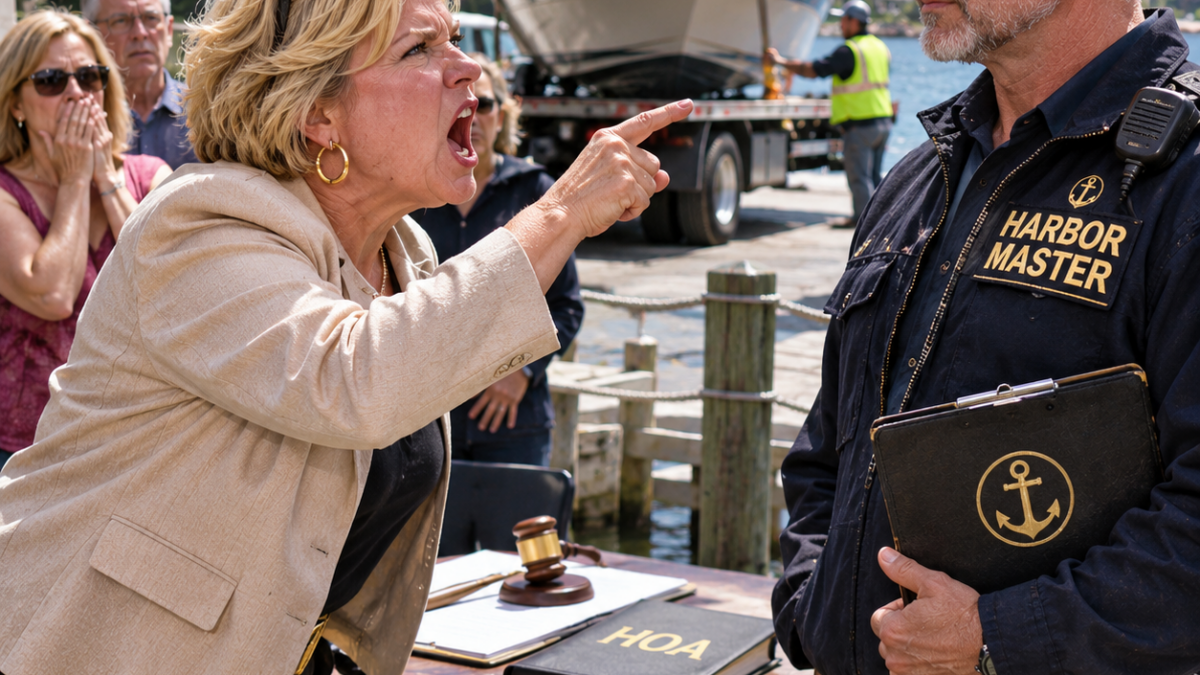
PART 2
The first person I called was the impound yard.
Not a lawyer.
Not the police.
Not another board member.
The boat.
That was priority one.
A vessel can be repaired.
A legal fight can wait.
A badly handled forty-five-foot wooden boat can be damaged in minutes.
There were only a few companies in the area capable of towing and hauling something that size.
The second company I called answered.
“Bayline Marine Recovery.”
“My name is Jack Callahan. I’m looking for a 1964 Chris-Craft Constellation removed this morning from Cypress Landing.”
Pause.
“Yeah. We got it.”
The casual tone made my jaw tighten.
“I’ll be there in an hour.”
“You’ll need payment before release.”
“How much?”
He gave me the number.
Nearly two thousand dollars.
Tow.
Emergency dispatch.
Haul-out.
Gate charge.
First-day storage.
I closed my eyes.
“Have an itemized invoice ready.”
“You paying?”
“Yes.”
“Cash or certified check.”
“Fine.”
I hung up.
Sarah was watching me.
“How bad?”
“Two grand before repairs.”
“Repairs?”
“If they damaged her.”
She came closer.
“Can Karen actually do this?”
“I don’t think so.”
“You don’t think so?”
“I haven’t checked everything yet.”
That answer bothered her.
It bothered me too.
My instinct said Karen had no jurisdiction over the channel.
But instinct is not evidence.
I called Bob Jenkins.
Bob had lived in Cypress Landing for three decades.
Retired civil engineer.
A man who owned more nautical charts than furniture.
He answered on the third ring.
“Callahan.”
“Bob. Karen had my boat towed.”
Silence.
Then:
“She what?”
“Removed it from the dock this morning.”
“You’re joking.”
“No.”
Another pause.
“She’s finally lost her damn mind.”
“I’m checking jurisdiction.”
“You don’t need to.”
“Humor me.”
Bob sighed.
“HOA authority stops at the mean high-water mark. Always has.”
“You’re sure?”
“I was here when they rewrote the covenants fifteen years ago.”
“What about docks?”
“State-permitted. Port authority controls the channel. HOA never touched them.”
“Any precedent?”
“Never. Not once.”
I looked out toward the water.
“That matches my memory.”
“Jack, she had no more authority to tow your boat than she has to move a navigation buoy.”
That was the first clean confirmation.
“Thanks.”
“What are you going to do?”
“Get the boat.”
“And then?”
“Read.”
Bob laughed.
“God help her.”
The drive to Bayline took forty minutes.
I spent the whole trip forcing myself not to imagine damage.
Wooden boats are different.
Fiberglass forgives certain mistakes.
Mahogany remembers them.
The impound yard looked exactly like a place that profited from people having bad days.
Rusting chain-link fence.
Sun-faded signs.
Trailer tires stacked near an oil-stained shed.
Abandoned vessels sitting on blocks.
And there, near the far corner, was *Sea Spirit*.
She looked wrong on land.
Every boat does.
But this was worse.
She had been hauled carelessly.
One side sat too close to a support stand.
The canvas cover had been pulled crooked.
I felt my anger return.
The yard owner stepped out.
Large man.
Stained shirt.
Permanent expression of boredom.
“You Callahan?”
“Yes.”
He slid paperwork through a window.
“Payment.”
I placed the certified check down.
“This payment is under protest.”
His expression barely changed.
“Whatever.”
“I’ll need an itemized receipt and a copy of your work order.”
He looked up.
“Why?”
“Because your company removed my vessel without my authorization.”
“HOA called us.”
“HOA doesn’t own the boat.”
“They said it was abandoned.”
“It wasn’t.”
“Not my problem.”
I leaned closer to the window.
“You conducted a commercial operation on a regulated navigable waterway based solely on an HOA president’s claim that she had authority.”
His face shifted.
Just slightly.
“I have paperwork.”
“Good. I want a copy.”
He hesitated.
Then disappeared inside.
He returned with the work order.
Karen’s signature was at the bottom.
Large.
Confident.
She had authorized immediate removal of a “derelict and hazardous vessel.”
Reason:
**Community aesthetic and safety emergency.**
There it was.
Her words turned into evidence.
I folded the copy.
“Now I inspect the boat.”
He shrugged.
“Go ahead.”
It took less than five minutes to find the first damage.
Port side.
A long gouge through fresh varnish.
I followed it with my fingertips.
Twelve feet, approximately.
Not superficial.
The scratch had cut into the wood.
Lower section near the rub rail showed impact scuffing.
The transom had a chip that hadn’t been there two days earlier.
I photographed everything.
Wide shots.
Close-ups.
Ruler for scale.
Time stamps.
The yard owner eventually wandered over.
“That was probably already there.”
I looked at him.
“No.”
“How do you know?”
“I have dated restoration photographs from forty-eight hours ago.”
He stopped talking.
“I’ll also have a marine surveyor inspect it.”
He shrugged, but the confidence was gone.
“I’m just telling you, we got called.”
“And I’m telling you that who called does not automatically make the tow lawful.”
“Take it up with the HOA.”
“I will.”
I hired a licensed marine surveyor the next morning.
His preliminary repair estimate exceeded ten thousand dollars.
Wood replacement.
Fairing.
Refinishing.
Color matching.
Multiple varnish coats.
Labor.
I had the boat moved to a reputable marina rather than returning her home.
I hated doing that.
But I wasn’t putting *Sea Spirit* back within easy reach of Karen until I understood exactly what had happened.
When I came home, I started the paper war.
First document:
Formal records request.
I requested:
Board minutes.
Vote records.
Architectural Review Committee findings.
Tow authorization.
Vendor contract.
Emergency procedures.
Insurance information.
And the exact bylaw permitting an HOA to seize a privately registered vessel from a dock located beyond the association’s jurisdictional boundary.
Certified mail.
Return receipt.
Sarah watched me seal the envelope.
“You look happier.”
“I found the boat.”
“Damaged.”
“Yes.”
“You’re not happier.”
“No.”
She sat across from me.
“Then what?”
“I understand the problem now.”
“Karen?”
“No.”
She waited.
“Jurisdiction.”
I spent the next weekend reading all three hundred pages of the Cypress Landing governing documents.
Karen probably thought sending me a link to the entire covenant package would discourage me.
She misunderstood what twenty-four years of military paperwork does to a person.
Three hundred pages was recreational reading compared with some Navy technical manuals.
I printed it.
Highlighted.
Cross-referenced.
Definitions.
Common areas.
Water access.
Architectural control.
Enforcement.
Fine procedures.
Board powers.
Then I found it.
Page twelve.
Boundary definitions.
Association jurisdiction extended to the mean high-water mark along the Cypress River.
Dock structures beyond that line were subject to applicable state permitting and waterway authority.
The channel itself was outside HOA jurisdiction.
I read the section twice.
Then showed Sarah.
“What does that mean?”
“It means Karen’s own bylaws say she had no authority where she ordered the tow.”
Sarah stared.
“She didn’t read her own rules?”
“She reads the parts that help her.”
“Can we sue?”
“Yes.”
“You sound very sure.”
“I am now.”
I drafted a demand letter.
No rage.
No sarcasm.
No threats beyond lawful remedies.
I cited the boundary clause.
State waterway law.
Port authority regulations.
Then laid out the timeline.
Karen’s warnings.
The tow.
The impound.
The work order.
The damage.
Demand:
Full towing reimbursement.
Impound costs.
Professional transport.
Repair costs.
All HOA fines rescinded.
Written apology.
Ten business days.
I sent a copy to the HOA office.
Another directly to Karen.
Her response arrived faster than expected.
Not in writing.
An emergency HOA meeting.
The community-wide email described a resident attempting to “undermine board authority” and threaten the association with frivolous litigation.
No mention of her unauthorized tow.
No mention of the jurisdiction boundary.
No mention of the damaged mahogany.
She framed herself as the defender.
Me as the aggressor.
Sarah read the email.
“She wants everyone angry at us.”
“Yes.”
“What do we do?”
“Go.”
“To the meeting?”
“Yes.”
“And argue with her?”
“No.”
“What then?”
“Listen.”
The clubhouse was packed.
Karen stood at the podium.
The woman loved a podium.
“My fellow homeowners,” she began, “we face an unprecedented challenge to the standards that protect our collective investment.”
I sat beside Sarah.
Bob Jenkins sat several chairs away.
Others watched carefully.
Karen held up my demand letter.
“One resident has decided that personal preference is more important than community values.”
Personal preference.
A legally registered boat.
Private property.
State-regulated water.
She continued.
“He wants all of you to pay for the consequences of his refusal to maintain his waterfront appropriately.”
Murmurs.
“He has threatened this association with expensive litigation.”
Sarah squeezed my hand.
Karen’s voice rose.
“We will not be bullied.”
Then she announced a new fine.
One thousand dollars.
“Failure to comply.”
Another five hundred.
“Administrative legal costs arising from threatening behavior.”
That got people’s attention.
Even Karen’s allies looked uncomfortable.
Bob leaned toward me.
“She can’t fine you for hiring a lawyer.”
“I know.”
“Good.”
Karen thought the additional fines made her look strong.
Instead, the room shifted.
A man behind me whispered:
“Can they fine anyone who complains?”
His wife answered:
“Apparently.”
That was the moment Karen’s fight stopped being about my boat.
Every homeowner suddenly imagined themselves on the receiving end of her anger.
The meeting ended badly for her.
No vote.
No resolution.
But fear had changed direction.
People were no longer afraid of opposing Karen.
They were becoming afraid of what Karen might do if nobody stopped her.
The next morning, I called Marcus Thorne.
Marcus and I had served together aboard the USS *Vicksburg*.
He’d been a JAG officer.
Now he practiced maritime and admiralty law.
I explained everything.
He listened without interrupting.
When I finished, silence.
Then:
“She called it what?”
“An aesthetic emergency.”
Marcus started laughing.
“I’m serious.”
“That makes it worse.”
“She authorized a commercial tow.”
“From the channel.”
“Yes.”
“With no port authorization.”
“Yes.”
“Her own HOA boundary stops at high water.”
“Yes.”
“And the boat was damaged.”
“Twelve-foot gouge.”
Marcus exhaled.
“Jack.”
“Yeah?”
“This isn’t a lawsuit.”
“What is it?”
“A gift.”
I laughed despite myself.
“You’ll take it?”
“Absolutely.”
“What do you think we have?”
“Potential conversion. Trespass-related claims. Property damage. Abuse of process depending on the fines. Possibly tortious interference. Regulatory violations for the towing operation.”
“Don’t get excited.”
“Too late.”
He became serious.
“But we don’t file yet.”
“Why?”
“One last settlement offer.”
“She’ll reject it.”
“Yes.”
“So why bother?”
“Because reasonable people give unreasonable people a clear exit before court.”
He paused.
“And because when she rejects it, the judge gets to see exactly who refused to solve the problem.”
Marcus’s settlement offer was generous.
Reimburse actual costs.
Pay repair invoice.
Void fines.
Clarify in the bylaws that HOA authority ends at the high-water mark.
No punitive damages claim if accepted.
No public battle.
No demand that Karen resign.
No humiliation.
Just restoration.
I asked Marcus:
“You really think she’ll reject this?”
“Jack, she needs to believe winning means you losing.”
He was right.
Karen rejected it almost immediately.
Worse, she sent the rejection to the entire neighborhood.
Then proposed a five-hundred-dollar special assessment per household to create a “legal defense fund.”
Sarah read that email aloud.
“She wants every family to pay five hundred dollars because she stole our boat?”
“Basically.”
“That should go well.”
For once, Sarah was right before Marcus.
The next meeting was standing-room only.
People were furious.
Five hundred dollars changes abstract principle into personal interest very quickly.
Karen stood at the podium again.
More strained.
Less confident.
“We must protect the association.”
A man shouted:
“From you?”
Karen banged the gavel.
“This meeting will remain civil.”
She described my lawsuit threat.
My “aggressive attorney.”
My “unreasonable demands.”
Then called for discussion of the assessment.
I stood.
Karen immediately pointed at me.
“You are out of order.”
“I haven’t spoken yet.”
“This matter concerns homeowners.”
“I am one.”
“Sit down.”
I didn’t.
“Before anyone votes on giving Karen another five hundred dollars, I think you deserve information she hasn’t shared.”
That quieted the room.
I held one folded document.
Not the bylaws.
Not the repair report.
My appointment letter.
“My name is Jack Callahan.”
People knew that.
“I served twenty-four years in the United States Navy and retired at the rank of commander.”
Karen rolled her eyes.
“That is irrelevant.”
I looked at her.
“No, Karen.”
Then I looked around the room.
“For the past six months, I’ve also served as the governor-appointed harbor master for the Cypress Port District.”
The room went silent.
Karen’s face changed.
The color disappeared.
Bob whispered:
“Well, I’ll be damned.”
I continued.
“My responsibilities include regulation and oversight of vessel activity within the navigable waters of this district.”
Karen interrupted.
“You never told us that.”
“You never asked.”
“That doesn’t give you special treatment.”
“Correct.”
I nodded.
“It gives me jurisdictional responsibility.”
Her mouth closed.
I unfolded the appointment.
“The same waterway from which you ordered a commercial company to seize my vessel falls under port authority regulation.”
People started looking at Karen.
“Your HOA’s own documents say its authority ends at the mean high-water mark.”
I held up a copy of the relevant page.
“You authorized a tow beyond that line.”
Karen shook her head.
“This is technical nonsense.”
“No.”
I stayed calm.
“You authorized commercial activity in a regulated channel without approval.”
A murmur spread through the room.
“More importantly, you did it against a private vessel belonging to the official responsible for administering that jurisdiction.”
Karen’s two board allies looked at each other.
Panic.
I turned toward the homeowners.
“The five-hundred-dollar assessment Karen wants you to approve is not protecting the community from me.”
I pointed toward her.
“It is asking you to finance the defense of her own decision.”
Someone in the back shouted:
“Absolutely not!”
Bob stood.
“I move to table the assessment indefinitely.”
“Second!”
Multiple voices.
Karen hit the gavel.
“We have not completed discussion.”
Bob looked at her.
“We’ve heard enough.”
The vote came.
Overwhelming yes to table.
Only Karen and her allies opposed.
The assessment died.
But I wasn’t finished.
I stood again.
“One additional matter.”
Karen’s expression had gone from anger to fear.
“My office is opening a formal investigation into the unauthorized removal of the vessel *Sea Spirit* from the Cypress River channel.”
Chaos.
Questions.
Whispers.
Karen shouted:
“This is retaliation!”
“No.”
I looked directly at her.
“I am the complainant, so I will not make the final enforcement determination.”
That mattered.
“I will recuse myself from any final ruling. Port Authority investigators and the port director will handle the case.”
The room quieted.
“But the investigation will proceed.”
Karen stared at me.
“You’re doing this because I fined you.”
“No.”
I paused.
“You did this when you ordered my boat removed from waters you don’t control.”
I walked out.
Sarah followed.
Outside, she grabbed my arm.
“You never told me you were going to reveal it tonight.”
“I didn’t know I would.”
“You enjoyed that.”
“A little.”
She smiled for the first time in weeks.
The port investigation began the next morning.
Two officers met me at home.
I treated myself like any other complainant.
Photos.
Tow receipt.
Work order.
Damage report.
HOA documents.
My written correspondence.
No editorializing.
Officer Daniel Miller studied Karen’s work order.
“She signed this personally?”
“Yes.”
“She ever claim somebody else authorized it?”
“No. She bragged about it.”
His partner looked at him.
“‘Aesthetic emergency.’”
Miller shook his head.
“That’s new.”
I gave them instructions.
“By the book.”
Miller nodded.
“Obviously.”
“I want interviews with the tow company, board members, anyone involved.”
“And you?”
“I’ll provide a statement. Port director signs off on final findings.”
“You’re recusing?”
“Yes.”
“Good.”
The tow company collapsed under questioning.
The owner produced everything.
Original work order.
Emails.
Text messages.
Even a phone recording from his dispatch system.
Karen had called repeatedly.
In one message she told him:
**Remove it before he gets back.**
In another:
**The board has complete authority. Don’t let him intimidate you.**
He admitted one employee had raised a jurisdiction question.
Karen dismissed it.
The company’s position became simple:
She lied to us.
That didn’t absolve them.
Commercial operators have obligations too.
But it shifted the story.
The two board members folded next.
Neither wanted to share Karen’s consequences.
One claimed he believed the vote concerned “routine nuisance enforcement.”
The other admitted no formal meeting had occurred.
No minutes.
No recorded vote.
Karen had circulated emails and later characterized their responses as unanimous authorization.
That was worse than I’d expected.
Then investigators interviewed Karen.
At first she tried to assert HOA authority.
According to Miller’s report, she brought the bylaws to the interview.
The irony was almost painful.
He showed her the boundary clause.
She argued aesthetics.
He asked about port authorization.
She changed the subject.
He asked about the board meeting.
She couldn’t provide minutes.
Asked about the emergency.
She said declining property values.
Asked whether the vessel was sinking.
No.
Blocking navigation?
No.
Leaking fuel?
No.
Unregistered?
No.
She had no emergency.
Just dislike.
When advised that counsel might be appropriate, Karen finally became quiet.
Meanwhile, Marcus filed the civil suit.
The HOA was named.
Karen was named personally.
That distinction mattered.
Marcus argued she had stepped outside legitimate board duties.
Willful misconduct.
Gross negligence.
Unauthorized property seizure.
If the court agreed, directors-and-officers insurance might not shield her.
The HOA insurer issued a reservation-of-rights notice.
Translation:
We’ll defend for now.
But if Karen knowingly acted illegally or outside covered duties, we may deny coverage.
Karen’s financial protection began disappearing.
Then the local news heard about it.
The headline almost wrote itself:
**HOA President Accused of Ordering Harbor Master’s Classic Boat Towed From Private Dock**
I hated the sensationalism.
Marcus loved it.
“Do not smile on camera.”
“I wasn’t planning to.”
“Good. You already look too pleased.”
A reporter named Ben Morris interviewed me.
I kept it factual.
“A private vessel was removed from a regulated waterway without proper authority.”
“Did Karen Peterson know you were harbor master?”
“I don’t believe so.”
“Why didn’t you tell her sooner?”
“My public appointment does not affect my rights as a homeowner.”
“Do you believe she targeted you personally?”
“I believe the documents speak for themselves.”
That was enough.
Then Ben went to Karen.
She made the mistake of talking.
“This is a private community matter,” she told the camera.
“The boat was an eyesore.”
Ben asked:
“Do HOA documents state that association jurisdiction stops at the high-water mark?”
Karen dismissed the question.
“That’s a technicality.”
That sentence became the entire story.
**That’s a technicality.**
A rule-obsessed HOA president publicly calling jurisdiction a technicality.
The clip ran all evening.
Bob called.
“You watching?”
“No.”
“You should.”
“No.”
“She said technicality.”
“I heard.”
“Jack, she’s doing our work for us.”
The neighborhood email chain exploded.
Residents began sharing stories.
Dave’s children’s playset.
Maria’s ornamental grasses measured with a tape measure.
Trash cans.
Holiday lights.
Parking.
Mailboxes.
Petty fines.
Warning letters.
Karen’s reign had always depended on isolation.
One target at a time.
Now everyone saw the pattern.
Bob drafted a recall petition.
The bylaws required twenty-five percent.
They got over seventy.
Karen’s remaining board allies resigned before the meeting.
She was alone.
The recall meeting took place one week later.
Neutral counsel was brought in to administer the vote.
Karen spoke first.
She sounded exhausted.
“I have devoted years to this community.”
No reaction.
“I have protected your property values.”
Someone muttered:
“By stealing boats?”
The attorney called for order.
Karen continued.
“I have been targeted by a personal vendetta.”
She looked directly at me.
“Mr. Callahan concealed his government position and used it as a weapon.”
I almost stood.
Marcus touched my arm.
“Don’t.”
Karen went on.
“He has destroyed my reputation.”
Marcus whispered:
“She did that herself.”
Karen tried fear next.
Without her leadership, standards would collapse.
Property values would fall.
The neighborhood would become chaotic.
People listened.
Then voted.
Paper ballots.
Anonymous.
Official.
The lawyer counted.
One hundred twenty-eight in favor of recall.
Three opposed.
Karen stared at the numbers.
No screaming.
No gavel.
No authority left to invoke.
Bob was nominated interim president.
Approved.
He stood at the microphone.
Looked toward me.
“Mr. Callahan.”
I stood.
“On behalf of Cypress Landing, I apologize.”
Karen’s face tightened.
Bob continued.
“What happened to your boat should never have happened.”
He looked around the room.
“The board exists to serve homeowners, not punish them.”
Applause.
Then he looked at Marcus.
“We would like to settle.”
Marcus smiled.
“Call me tomorrow.”
The settlement moved quickly.
My towing costs reimbursed.
Impound costs reimbursed.
Professional transport reimbursed.
Full repair costs paid.
Fines erased.
Written apology.
Most important:
A formal amendment clarifying that HOA authority ended at the high-water mark and did not extend to regulated docks, navigable water, or private vessels.
Not because it hadn’t already been true.
Because future boards shouldn’t be able to pretend otherwise.
The Port Authority case concluded separately.
The tow company cooperated.
It received a substantial penalty but retained its license.
Karen was personally fined.
Her insurance did not cover that penalty.
She also faced her own legal expenses where coverage was disputed.
I could have celebrated.
I didn’t.
The first time I saw *Sea Spirit* after repairs, none of that mattered.
She was back at the marina.
Fresh varnish.
Mahogany glowing.
Damage gone.
The repaired plank blended so perfectly that only I knew where the scar had been.
Sarah ran one hand along the hull.
“Can you tell?”
“Yes.”
“Really?”
“No.”
She smiled.
I paid for final detailing myself.
Not because the HOA wouldn’t.
Because I wanted the last work on her to be mine.
When *Sea Spirit* returned to our dock, half the neighborhood came outside.
Not planned.
People simply noticed.
Bob stood on his lawn.
Dave brought his kids.
Maria waved from across the street.
The transport captain eased the boat alongside.
I caught the stern line.
Then the bow.
Secured both.
For the first time in months, the dock looked right.
Sarah stood beside me.
“She came home.”
“So did we.”
That evening, I started the engines.
One coughed.
Then turned over.
The second joined.
Twin V8s settled into a deep rumble.
I put one hand on the wheel.
Sarah beside me.
We didn’t leave the dock.
Not yet.
I simply listened.
That sound mattered.
Restored machinery.
Restored order.
Restored peace.
A week later, Bob became permanent HOA president.
He hated the job.
Which is probably why he was good at it.
His first priority was transparency.
Meeting minutes published promptly.
Fine schedules standardized.
No president issuing punishment unilaterally.
Legal review required before unusual enforcement actions.
Homeowner appeals heard by more than the same people who issued the violation.
Most importantly, actual disputes were discussed before fines.
Revolutionary.
Karen’s house went on the market a few months later.
I heard she’d decided to move.
I didn’t ask why.
One Saturday afternoon, a moving truck arrived.
Sarah and I were working aboard *Sea Spirit*.
I was polishing hardware.
Sarah brought iced tea.
We saw Karen directing movers across the street.
The old gestures were still there.
Point.
Wave.
Correct.
Control.
But without the position behind them, they looked smaller.
Then she saw us.
Across the channel.
Our eyes met.
For months I’d imagined that moment.
I’d imagined some perfect final line.
Something devastating.
Something she would carry away with her.
But when it happened, I didn’t want one.
Karen looked at the boat.
Then at me.
Anger.
Humiliation.
Resentment.
Maybe exhaustion.
I gave her a small nod.
Nothing more.
Not forgiveness.
Not triumph.
Closure.
She looked away first.
Sarah leaned against me.
“You could’ve smiled.”
“Why?”
“To annoy her.”
“Tempting.”
“You’re getting soft.”
“Retirement.”
The movers loaded the last boxes.
Karen drove away.
I never saw her again.
That night, Sarah and I took *Sea Spirit* out for the first real cruise since the ordeal.
I eased away from the dock.
Past the waterfront homes.
Past the entrance markers.
Toward open channel.
The sunset turned the water copper.
Sarah sat beside me.
Hair moving in the wind.
“This is what we wanted.”
“What?”
“Retirement.”
I laughed.
“Could’ve done without the lawsuit.”
“Details.”
We cleared the no-wake zone.
I increased throttle.
The engines deepened.
The hull rose.
Water opened ahead.
For the first time in months, there was nothing between us and the horizon.
I thought about the first week we moved into Cypress Landing.
Karen complained about my mailbox.
I repainted it.
Black.
I did it because I wanted peace.
That decision had bothered me ever since.
Not because the mailbox mattered.
Because compliance taught Karen the wrong lesson.
She learned that a demand produced obedience.
Then came the flag.
I refused.
Then the boat.
She escalated.
Bullies often operate like that.
They don’t begin with the thing you care about most.
They begin with something small.
Something easier to surrender than fight over.
A mailbox.
A flowerpot.
A flag.
A swing set.
A hedge.
And every surrender becomes evidence that the next demand might work too.
That doesn’t mean every rule should be challenged.
Communities need standards.
Docks need safety requirements.
Waterways need regulation.
Boats need registration.
Noise matters.
Navigation matters.
Rules matter.
But authority has boundaries.
Karen’s problem wasn’t that she believed in rules.
Her problem was believing the rules only existed to empower her.
When the bylaws helped her, they were sacred.
When the same bylaws limited her authority at the high-water mark?
“Technicality.”
That one word explained everything.
Real rules constrain power as much as they constrain residents.
Good governance tells leaders what they can’t do.
Karen couldn’t tolerate that.
She thought being president meant final authority.
Then she met the harbor.
Water doesn’t care about HOA politics.
Neither does maritime jurisdiction.
Years after the case ended, people still told the story.
Usually incorrectly.
According to Dave’s version, Karen personally drove a towboat onto the river.
She didn’t.
Bob claimed I revealed my harbor master appointment by slamming a badge onto the table.
Also false.
I had a letter.
Very dramatic piece of paper.
A teenager in the neighborhood called me “Captain HOA.”
I hated that.
It continued.
But the exaggerated versions missed the important part.
I didn’t win because I outranked Karen.
I won because the facts did.
If I hadn’t been harbor master, her tow still would have been outside HOA jurisdiction.
If I’d been a plumber, teacher, accountant, or retired mechanic, the boundary would have remained where the documents placed it.
My position only made her mistake spectacular.
It didn’t create the mistake.
That mattered deeply to me.
I never wanted residents thinking justice required secret power.
It required documentation.
A deed.
Bylaws.
Port regulations.
Tow order.
Photos.
Receipts.
Survey.
Evidence.
That’s enough when institutions work.
And when they don’t, that’s what you carry into court.
One afternoon, Dave stopped while I was washing the boat.
His kids’ swing set was bright yellow again.
The gray paint Karen had pressured him to use was gone.
“Looks good,” I said.
“The slide?”
“Yeah.”
He smiled.
“My daughter picked the brightest yellow they sell.”
“Reasonable.”
“Karen would’ve had a stroke.”
“Let’s not make design decisions based on her blood pressure.”
Dave laughed.
Then became serious.
“You know, I feel stupid.”
“For what?”
“We all let her do it.”
“You weren’t alone.”
“That makes it worse.”
“No.”
He looked at me.
“I painted my kid’s slide gray.”
I put down the hose.
“Then paint it yellow.”
“I did.”
“Problem solved.”
“It doesn’t feel that simple.”
“Nothing is.”
He leaned against the railing.
“What if she’d never touched your boat?”
I thought.
“She’d still be president.”
“Probably.”
“You glad she did?”
That was harder.
“No.”
He looked surprised.
“Really?”
“She damaged something I cared about.”
“But she exposed herself.”
“Yes.”
“Same result.”
“No.”
I looked at *Sea Spirit*.
“Some wins cost more than they needed to.”
Dave nodded.
That became another lesson.
Consequences can be satisfying without pretending harm was necessary.
I would have preferred Karen to read the first demand letter, apologize, reimburse me, and stop.
No recall.
No news.
No lawsuit.
No public humiliation.
No damaged boat.
No stressed neighbors.
That would have been a better outcome.
She chose otherwise.
My job was to respond.
Not to make the conflict bigger than necessary.
The new board understood that.
A year later, Bob called me.
“Need your opinion.”
“Dangerous.”
“Dock issue.”
“HOA issue?”
“No. That’s why I’m calling.”
A resident wanted to install new lighting near their seawall.
Potential glare into the channel.
Bob didn’t issue a violation.
Didn’t claim authority.
He asked:
“Who regulates this?”
I smiled.
“Now you’re learning.”
We coordinated with the appropriate marine office.
Resident adjusted the angle.
Problem solved.
No fine.
No war.
That’s what good boundaries do.
They don’t prevent cooperation.
They define who needs to be involved.
Sarah liked the new Cypress Landing.
People talked more.
The clubhouse stopped feeling like a courtroom.
Homeowners still complained.
They always will.
Grass.
Parking.
Noise.
Pool hours.
But nobody feared opening their mailbox.
That was progress.
One evening, I found the old binder in my office.
Karen letters.
Tow records.
Photos.
Lawsuit.
Settlement.
I pulled out the photograph of the empty dock.
The first one I’d taken.
I remembered the feeling.
Not anger exactly.
Violation.
Someone had reached into our life and removed something because she believed she could.
Then I found the photo of the hull damage.
Twelve feet of torn varnish.
I looked toward the window.
*Sea Spirit* sat outside.
Whole.
Shining.
The repaired section invisible.
Sarah entered.
“What are you doing?”
“Cleaning files.”
“That means you’re reading old war stories.”
“Maybe.”
She picked up Karen’s first boat violation.
“Derelict property.”
She laughed.
“Sea Spirit looks better than half the houses here.”
“Careful. Bob will start an Architectural Boat Committee.”
“Don’t give him ideas.”
She picked up the harbor-master appointment.
“You know what I remember most about that night?”
“The reveal?”
“No.”
“What?”
“The sound everybody made.”
“What sound?”
“When you said harbor master.”
She imitated a collective gasp.
I laughed.
“It wasn’t that dramatic.”
“It absolutely was.”
“Memory inflation.”
“You enjoyed every second.”
“Professionally.”
She kissed my forehead.
“Liar.”
Maybe.
A little.
I am human.
Watching a bully realize the person she had dismissed understood the rules better than she did was satisfying.
But the satisfaction faded.
Peace lasted.
That’s how I judge the outcome now.
Not how good the takedown felt.
How much better life became after.
Five years later, *Sea Spirit* was still at the dock.
The restoration was never technically finished.
Anyone who owns an old wooden boat understands.
You don’t finish.
You maintain.
You repair one thing.
Another appears.
Varnish fades.
Chrome spots.
A pump starts making a suspicious sound.
Wood moves.
Engines develop personalities.
Sarah called it my “floating retirement job.”
She was right.
One spring morning, I was replacing a fuel line when a young boy stopped on the public path.
“Are you the harbor master?”
His mother looked embarrassed.
“Eli, don’t bother him.”
“It’s okay.”
The boy stared at the boat.
“Is that the one the bad HOA lady stole?”
His mother closed her eyes.
“Eli.”
I laughed.
“She had it towed.”
“Why?”
“She thought she had authority.”
“But you had more authority?”
Interesting question.
I put down the wrench.
“No.”
He frowned.
“But you’re harbor master.”
“Yes.”
“That means you’re in charge.”
“Of certain things.”
“The river.”
“Some parts of how people use it.”
“So more authority.”
I shook my head.
“Different authority.”
He still looked confused.
“Think of school.”
He nodded.
“Your teacher can tell you what to do in class.”
“Yeah.”
“Can your teacher walk into your house and tell your parents what color to paint the kitchen?”
He laughed.
“No.”
“Why not?”
“Not her house.”
“Exactly.”
The boy looked at the water.
“The HOA lady went into the kitchen.”
I smiled.
“Something like that.”
His mother thanked me and pulled him along.
That conversation stayed with me.
Different authority.
That’s what adults forget.
People assume institutions are stacked vertically.
Someone must be above everyone.
But society often works sideways.
City.
County.
State.
Federal.
HOA.
Port authority.
Private property.
Each with specific powers.
Boundaries.
Overlap.
Karen didn’t understand horizontal boundaries.
She thought everything near Cypress Landing belonged under her.
The water corrected that misconception.
Years later, Bob retired from the board.
Nobody wanted the presidency.
Which I considered a sign of institutional health.
Power should not attract people mainly because they enjoy having it.
Maria eventually took over.
The same Maria Karen had fined because her ornamental grass was two inches too tall.
Her first speech as president was eight sentences.
Bob almost cried.
“Shortest meeting in Cypress Landing history.”
Maria said:
“That’s because I’m not in love with my own voice.”
Everyone looked at Bob.
He was deeply offended.
I never joined the board.
People asked.
I refused.
“Why?”
Because I’d spent enough of my life commanding things.
I didn’t need another title.
Harbor master was already enough responsibility.
At home, I wanted to be Jack.
Husband.
Neighbor.
Boat owner.
The boat still flew the little American ensign Karen once objected to.
Nobody complained.
Actually, that wasn’t true.
Bob complained that it was faded.
He bought me a new one.
I installed it.
We became that kind of neighborhood.
People solving things with conversations and gifts instead of violation letters.
One autumn evening, I took *Sea Spirit* out alone.
Sarah had a headache and stayed home.
The water was almost flat.
Sun low.
Orange across the channel.
I passed the boundary markers.
Past the spot where the tow company must have first taken hold of the boat.
For a moment, I imagined that morning.
Karen on the dock.
Contractors asking questions.
Her insisting:
“Do it before he returns.”
The thought still angered me.
Then I looked at the repaired hull.
No visible scar.
That’s the thing about restoration.
Done well, it doesn’t pretend damage never happened.
It makes the structure sound again.
The neighborhood was like that.
So was I.
Karen’s actions had changed us.
But they didn’t get to define us permanently.
I pushed the throttles forward.
The bow lifted.
The engines settled into rhythm.
Behind me, Cypress Landing shrank.
Ahead, open water.
I thought about my Navy career.
Warships.
Orders.
Rules.
Chains of command.
The most dangerous leaders I’d known were rarely the loudest.
They were the ones who mistook their position for infallibility.
Good officers know authority comes with limits.
You can issue an order.
You are still responsible for whether that order is lawful.
You can have rank.
You are still accountable.
Karen wanted command without accountability.
That was never going to last.
She had believed the HOA presidency gave her control over everything she could see from the community boundary.
The mailbox.
Flag.
Boat.
Dock.
Channel.
People.
But power doesn’t expand just because someone wants it to.
And when she finally reached beyond her legal boundary, the whole system pushed back.
First me.
Then Marcus.
Then the port authority.
Then the insurer.
Then the residents.
Then her own board.
By the end, Karen wasn’t defeated by one powerful enemy.
She was defeated by every boundary she’d ignored.
Legal.
Financial.
Political.
Social.
Personal.
That’s why the ending satisfied me.
Not because she moved away.
Not because she paid a fine.
Not because she lost the presidency.
Because the boundaries were restored.
The river to the port authority.
The docks to their lawful owners and regulators.
The HOA to common areas and legitimate covenants.
My property to me.
Her authority to exactly where it belonged.
No farther.
Sarah always said I turned the whole thing into a lesson.
Maybe she was right.
One night we sat aboard *Sea Spirit* with dinner on the aft deck.
No voyage.
Just tied up at home.
Lights reflected on the water.
She asked:
“If you could do one thing differently, what would it be?”
“Paint the mailbox black.”
She laughed.
“No.”
“Then what?”
I thought.
“I would’ve challenged Karen earlier.”
“Over the flag?”
“Maybe.”
“Why?”
“Because compliance on the first little thing taught her the wrong lesson.”
Sarah shook her head.
“I don’t think the mailbox mattered.”
“It established a pattern.”
“Jack.”
“What?”
“She would’ve found something anyway.”
Probably true.
“So what would you change?”
I thought longer.
“I would’ve talked to the neighbors sooner.”
She nodded.
“That.”
“Not the legal strategy?”
“No.”
“Not revealing harbor master sooner?”
“No.”
“Why?”
“Because Bob knew the truth. Dave had his own story. Maria had hers. Everyone was alone.”
She looked toward the houses.
“Karen’s real power was making each person think their problem was only theirs.”
Again, Sarah was right.
I hate when that happens.
If we’d compared stories early, maybe Karen wouldn’t have become bold enough to tow a boat.
Institutions become abusive partly because people normalize isolated incidents.
Small fine.
Odd letter.
One rude interaction.
Then another.
Nobody connects them.
When people finally do, they realize the pattern was the story.
That was Cypress Landing.
Now the pattern had changed.
Meetings.
Transparency.
Reasonable enforcement.
Boundaries.
Conversations.
People still disagreed.
Of course.
Community isn’t harmony.
It’s conflict without domination.
That’s what Karen never understood.
The last time I heard her name was years later.
Bob had heard from a mutual acquaintance that she’d moved inland.
Far from any harbor.
He thought that was hilarious.
I didn’t.
Well.
Maybe slightly.
But wherever she went, I hoped she changed.
That surprises some people.
They assume a satisfying revenge story requires the villain to remain miserable forever.
I don’t.
Karen needed consequences.
She got them.
If she learned something afterward, good.
Permanent suffering isn’t justice.
Stopping harm is.
Restoring what was damaged is.
Making repeat abuse harder is.
That happened.
The boat was repaired.
Money repaid.
Rules clarified.
Board reformed.
Neighbors reconnected.
What else did I need?
One summer morning, a new family moved into Karen’s old house.
Young couple.
Two daughters.
The father came to the dock a week later.
Stopped at the legal boundary.
“Mr. Callahan?”
“Jack.”
“I’m Tyler.”
We shook hands.
“We bought the Peterson place.”
“Welcome.”
He looked embarrassed.
“The realtor told us the whole story.”
“I’m sorry.”
He laughed.
“I have one question.”
“Go ahead.”
“Are we allowed to own a kayak?”
I stared at him.
Then laughed harder than I had in months.
“Yes.”
“Do I need HOA permission?”
“No.”
“Harbor master permission?”
“Registration and safety requirements depend on use, but no, you don’t need my personal blessing.”
“Good.”
He paused.
“The realtor made it sound complicated.”
“It isn’t.”
“Respect property.”
“Follow waterway rules.”
“Don’t steal boats?”
“Strongly recommended.”
We became friends.
His daughters loved watching *Sea Spirit*.
One day I let them sit at the helm while tied up.
The younger one asked:
“Was this boat really stolen?”
“Temporarily.”
“Did you chase the bad guys?”
“No.”
“Did you fight?”
“Mostly paperwork.”
She looked disappointed.
Children deserve the exciting version.
So I added:
“And lawyers.”
Still disappointed.
“Did anybody get arrested?”
“No.”
She sighed.
“Boring.”
“That’s the goal.”
She didn’t understand.
Maybe someday.
Boring justice is usually good justice.
No violence.
No dramatic chase.
No revenge wrecking other people’s lives.
Documents.
Hearings.
Fines.
Reimbursement.
Votes.
Reforms.
Restoration.
I’d take boring every time.
When *Sea Spirit* finally reached the point where I considered the major restoration complete, Sarah insisted we throw a small dock party.
Nothing formal.
Neighbors.
Food.
Bob.
Dave.
Maria.
Marcus drove in.
Even Officer Miller came by off duty.
Someone gave me a wooden plaque.
I expected something sentimental.
It read:
**SEA SPIRIT
AUTHORIZED BY ABSOLUTELY NO HOA WHATSOEVER**
I stared at Bob.
“Your idea.”
He raised his beer.
“Obviously.”
Sarah laughed so hard she nearly spilled her drink.
I mounted the plaque inside the cabin where nobody could see it from shore.
Bob objected.
“The public deserves this.”
“The public has suffered enough.”
At sunset, Marcus stood beside me.
“You know what my favorite part was?”
“The lawsuit?”
“Karen’s TV interview.”
“Of course.”
“‘That’s a technicality.’”
He imitated her perfectly.
I shook my head.
“That sentence cost her.”
“No.”
He looked at me.
“Her decisions cost her.”
Important distinction.
Karen didn’t fall because she said one bad thing on television.
She fell because the bad thing summarized months of choices.
She believed boundaries were technicalities when they constrained her.
She believed bylaws were absolute when they constrained everyone else.
That inconsistency is what destroyed credibility.
Eventually the party ended.
Neighbors went home.
Marcus left.
Bob stole three beers for the walk back.
Sarah and I remained.
Night settled over the river.
The water became black glass.
She took my hand.
“Worth it?”
“What?”
“The boat.”
I looked around.
Mahogany.
Chrome.
Old gauges.
Polished wheel.
“Always.”
“No.”
She squeezed my hand.
“The fight.”
I thought carefully.
“No.”
She looked surprised.
“I wish there hadn’t been one.”
“That’s not what I asked.”
“I know.”
She waited.
“Was standing up worth it?”
“Yes.”
“That’s better.”
There are fights you win and still wish never happened.
That’s normal.
The scars don’t invalidate the victory.
The victory doesn’t make the scars necessary.
Karen’s biggest mistake was assuming resistance meant I enjoyed conflict.
I didn’t.
I wanted my boat.
My dock.
My wife.
My quiet.
That’s all.
She made those things conditional on obedience.
That’s why I fought.
Years later, when I think about the day the dock was empty, the anger is mostly gone.
What remains is clarity.
I can still see Karen holding that clipboard.
“You should have read the bylaws, Mr. Callahan.”
She was right about one thing.
Somebody should have read them.
I did.
All three hundred pages.
And buried inside was the sentence that ended her control of my waterfront.
Her authority stopped at the water.
Mine didn’t.
But even that isn’t the punch line anymore.
The real ending came much later.
A quiet Saturday.
No Karen.
No reporters.
No lawyers.
No port officers.
I was tightening a fitting below the helm.
Sarah was reading on the aft deck.
Kids were playing down the street.
Dave’s bright yellow swing set was visible from the river.
Maria’s ornamental grass had grown well past Karen’s old limit.
Bob’s tomato plants were probably violating half the former landscaping code.
Nobody cared.
A neighbor walked past.
Waved.
I waved back.
Then I turned the key.
The engines started.
Deep.
Steady.
Beautiful.
Sarah looked up.
“Going out?”
“Want to?”
She closed the book.
“Always.”
I untied the stern line.
Then the bow.
We eased away.
The dock slipped behind us.
No one tried to stop us.
No one claimed ownership.
No one measured anything.
We entered the channel.
Sun ahead.
Open water beyond.
The boat Karen called a rust bucket moved under her own power, fully restored.
And Cypress Landing disappeared slowly behind us.
That was the victory.
Not Karen’s fine.
Not her recall.
Not the lawsuit.
Not my title.
Freedom without harassment.
A wife beside me.
A boat beneath me.
A lawful boundary behind me.
And nothing ahead except water.
The HOA president had my forty-five-foot classic boat dragged off my private dock while I was away, then stood in my yard and told me I’d be paying the towing bill for the privilege.
She thought a paragraph in her neighborhood bylaws gave her more authority over the water than the man who actually owned the boat, the dock, and the waterfront rights beneath it.
What Karen didn’t know was that by the time she tried to make the entire neighborhood pay to defend her decision, I had one document in my pocket that was about to turn her victory speech into the beginning of her downfall.
“That rust bucket was an eyesore, Mr. Callahan. It’s gone.”
I heard Karen Peterson’s voice before I fully understood what I was seeing.
The end of my dock was empty.
No polished mahogany hull.
No heavy lines wrapped around the cleats.
No brass rail catching the afternoon sun.
No Sea Spirit.
For several seconds, I simply stared at the water.
Twenty-four years in the Navy had trained me to assess a situation before reacting. Anger was useful only when controlled. Panic solved nothing.
But standing there, looking at the empty space where my boat had been, I felt something cold twisting inside me.
I turned toward Karen.
She stood on my lawn with a clipboard pressed against her chest, wearing a floral blouse and the satisfied expression of a woman who believed she’d just won a major battle.
“What did you say?”
“The boat was removed this morning.”
“By whom?”
“A licensed vendor.”
“You had my boat towed from my private dock?”
“It was a violation of Section Fourteen, Subsection C.”
My jaw tightened.
The Sea Spirit was a 1964 Chris-Craft Constellation. Forty-five feet of old mahogany, chrome fittings, twin engines, and history.
I had found her in a neglected boatyard almost a year earlier.
The varnish was faded. Some of the wiring needed replacement. One engine needed major work.
But the hull was sound.
I’d spent months restoring her plank by plank.
She wasn’t abandoned.
She wasn’t derelict.
She was probably the best-maintained boat in the entire neighborhood.
Karen knew that.
She had watched me work on it nearly every weekend.
I took one step toward her.
“That vessel is registered, insured, and actively under restoration.”
Karen waved her hand.
“It looked abandoned.”
“You’ve seen me working on it.”
“That doesn’t change the appearance.”
“So you seized it.”
“The HOA removed a nuisance.”
I stared at her.
She had no idea what she had done.
Or worse, she knew exactly what she’d done and simply assumed nobody could stop her.
“You’re going to want to be very careful about what you say next.”
Her smile widened.
“The board voted unanimously. You’ll receive the towing and impound charges in the mail. I suggest you pay promptly because storage fees accumulate daily.”
I almost laughed.
Instead, I asked:
“Where are the meeting minutes?”
Her expression shifted.
“Official HOA records.”
“Vote tally?”
“Unanimous.”
“Vendor contract?”
“Submit a formal request.”
“Who authorized the tow?”
“I did, on behalf of the board.”
There it was.
Clear.
Direct.
No ambiguity.
I nodded.
“All right.”
Karen looked disappointed.
She had wanted anger.
She wanted me shouting.
She wanted proof that I was the unstable troublemaker she’d been describing to neighbors for months.
I gave her nothing.
Before she left, she held out a notice.
“Two hundred dollars for the original violation.”
I took it.
She climbed into her golf cart and drove away.
Sarah came down from the porch.
Her face was pale.
“Jack, where’s the boat?”
“Impound yard.”
“She actually did it?”
“Yes.”
“Can she?”
I looked toward the river.
“That’s what we’re going to find out.”
The first call I made was to the impound yard.
Not a lawyer.
Not the HOA.
The boat came first.
There were only a few companies in the region capable of towing a vessel that size.
Bayline Marine Recovery had it.
“Yeah,” the man on the phone said. “Came in this morning from Cypress Landing.”
“How much?”
He gave me a number just under two thousand dollars.
Tow fee.
Emergency dispatch.
Haul-out.
First day of storage.
I closed my eyes.
“I’ll be there in an hour.”
Before leaving, I called Bob Jenkins.
Bob had lived in Cypress Landing for thirty years.
Retired civil engineer.
Old enough to remember when half the waterfront homes were still empty lots.
“She did what?” he asked when I explained.
“Towed the boat.”
“From your dock?”
“Yes.”
Bob muttered something I won’t repeat.
“Jack, HOA authority ends at the mean high-water mark.”
“You’re sure?”
“Absolutely. Always has.”
“And the docks?”
“State-regulated. Port district handles the channel. The HOA has no jurisdiction over the water.”
That was the confirmation I needed.
The drive to Bayline Marine Recovery took forty minutes.
The yard was surrounded by rusting chain-link fence.
Old boats sat on trailers or blocks like carcasses.
And there, near the back, was Sea Spirit.
Seeing her sitting awkwardly on land made my stomach twist.
The owner met me at the office window.
“You Callahan?”
“Yes.”
He slid an invoice toward me.
I handed him the certified check.
“This payment is under protest.”
He shrugged.
“Whatever.”
“I want an itemized receipt and a copy of the work order authorizing removal.”
He frowned.
“Why?”
“Because your company removed my vessel without my authorization.”
“The HOA called us.”
“The HOA doesn’t own the boat.”
“They said it was abandoned.”
“It wasn’t.”
He disappeared into the office.
A minute later, he returned with a copy of the work order.
Karen’s signature was at the bottom.
Reason for removal:
DERELICT VESSEL — AESTHETIC AND SAFETY EMERGENCY
I almost admired the stupidity.
Almost.
Then I inspected the boat.
The first major damage was along the port side.
A long gouge.
Fresh.
Deep.
Nearly twelve feet through the varnish and into the mahogany.
There were additional scuffs along the rub rail and a chip near the transom.
I photographed everything.
The yard owner wandered over.
“Probably already there.”
I looked at him.
“I have dated photographs from two days ago.”
He stopped smiling.
“I’ll be obtaining a professional marine survey.”
“Take it up with the HOA.”
“Oh, I will.”
I arranged for a marine surveyor to inspect the boat the following morning.
His preliminary estimate put repairs above ten thousand dollars.
Suddenly, Karen’s little show of authority was becoming expensive.
I had Sea Spirit transported to a reputable marina rather than taking her home.
Then I started documenting.
Timestamped photographs of the empty dock.
The tow order.
The impound receipt.
Damage photographs.
Karen’s violation notice.
My notes from our conversation.
Then came the official records request.
I asked the HOA for:
The meeting minutes authorizing the tow.
Vote tally.
Vendor agreement.
Emergency policy.
Legal authority for removing property from a private dock.
Karen’s response arrived a few days later.
One page.
A link to the three-hundred-page HOA governing documents.
And one sentence:
All relevant information is contained within the governing documents acknowledged upon purchase of your home. The board considers this matter closed.
Sarah read it over my shoulder.
“She thinks you’ll give up.”
I smiled.
“Three hundred pages?”
“That’s your idea of fun.”
“Exactly.”
I printed the entire document.
For two days, my office disappeared beneath paper.
I read everything.
Definitions.
Boundaries.
Common areas.
Architectural restrictions.
Enforcement authority.
Dock access.
Waterfront rights.
Then I found it.
Page twelve.
The HOA’s jurisdiction stopped at the mean high-water mark.
Docks and navigable waterways beyond that point fell under applicable state and port authority regulations.
I sat back.
Karen hadn’t merely stretched a rule.
She had crossed outside her jurisdiction entirely.
I showed Sarah.
“So she couldn’t tow it?”
“No.”
“Her own bylaws say that?”
“Yes.”
Sarah’s expression hardened.
“Then make her pay.”
I drafted a formal demand.
Calm language.
No insults.
No threats beyond legal remedies.
I cited the HOA boundary.
State waterway law.
Port regulations.
Then I listed damages.
Tow.
Impound.
Professional transport.
Marine repairs.
I demanded that the HOA reimburse every dollar, rescind all fines, and issue a written apology.
Ten business days.
Karen responded by calling an emergency HOA meeting.
The email accused an unnamed resident of attempting to undermine board authority and threaten community standards.
That resident was me.
The clubhouse was packed.
Karen stood at the podium, waving my demand letter.
“My fellow homeowners, one individual believes his personal preferences are more important than our collective property values.”
I sat beside Sarah.
Bob sat nearby.
Karen continued.
“This resident is now threatening the association with litigation because the board dared to enforce our rules.”
Then she announced another fine.
One thousand dollars for continued noncompliance.
Five hundred more for “administrative legal costs.”
The room changed.
People who had looked bored suddenly looked worried.
A man behind me whispered:
“Can they fine you for hiring a lawyer?”
His wife shook her head.
Karen thought she was demonstrating power.
Instead, she was showing everyone what could happen if they crossed her.
The meeting ended with no resolution.
The next morning, I called Marcus Thorne.
Marcus and I had served together aboard the USS Vicksburg.
He had been a JAG officer.
Now he practiced maritime law.
I explained everything.
He was silent for several seconds.
Then:
“She called it an aesthetic emergency?”
“Yes.”
He laughed.
“Jack, this woman is a gift.”
“You’ll take the case?”
“Absolutely.”
Marcus reviewed everything.
His first recommendation surprised me.
“One final settlement offer.”
“She won’t accept it.”
“I know.”
“Then why?”
“Because we want a judge to see you gave her every possible chance to solve this reasonably.”
The offer was generous.
Reimburse the costs.
Pay for documented repairs.
Void the fines.
Amend the bylaws to clarify the waterfront boundary.
No punitive damages.
No demand that Karen resign.
She rejected it.
Then she made the mistake that finally turned the neighborhood against her.
She proposed a five-hundred-dollar special assessment for every household to fund the HOA’s legal defense.
The next meeting was standing room only.
People were furious.
Karen started with the usual speech.
Community integrity.
Property values.
Protecting standards.
Then she called for discussion of the special assessment.
I stood.
She pointed at me immediately.
“You’re out of order, Mr. Callahan.”
“I haven’t spoken.”
“This matter concerns homeowners.”
“I am a homeowner.”
I held one folded document.
“Before anyone votes to give the board another five hundred dollars, I think you deserve information Karen hasn’t shared.”
The room quieted.
“My name is Jack Callahan. I served twenty-four years in the United States Navy and retired as a commander.”
Karen rolled her eyes.
“That is irrelevant.”
I looked at her.
“No.”
I unfolded the letter.
“For the past six months, I’ve also served as the governor-appointed harbor master for the Cypress Port District.”
Silence.
Then a collective murmur.
Karen’s face went pale.
Bob whispered:
“You’ve got to be kidding me.”
I continued.
“As harbor master, my responsibilities include oversight of vessel activity and navigational safety within the district’s regulated waterways.”
Karen interrupted.
“You never told the board.”
“You never asked.”
“That position doesn’t put you above HOA rules.”
“Correct.”
I nodded.
“But HOA rules don’t put you above state jurisdiction either.”
I held up the bylaws.
“Your own governing documents say association authority ends at the mean high-water mark.”
Then I held up Karen’s signed work order.
“You ordered a commercial tow beyond that line without authorization from the port authority or the vessel owner.”
Karen’s two board allies exchanged looks.
The room was no longer looking at me.
Everyone was looking at her.
I turned toward the residents.
“The five-hundred-dollar assessment you’re being asked to approve isn’t protecting Cypress Landing.”
I pointed at Karen.
“It’s asking you to pay for the legal defense of a decision she personally made outside HOA authority.”
Someone shouted:
“Absolutely not!”
Bob stood.
“I move to table the assessment indefinitely.”
“Second!”
The vote passed overwhelmingly.
Only Karen and her closest allies voted against it.
Her financial weapon was gone.
Then I stood one last time.
“One additional matter.”
Karen stared at me.
“My office is opening a formal investigation into the unauthorized removal of the vessel Sea Spirit from the Cypress River channel.”
The room exploded with whispers.
Karen shouted:
“This is retaliation!”
“No.”
I kept my voice calm.
“Because I am the complainant, I will recuse myself from final enforcement decisions. The port director and investigative officers will handle the findings.”
I looked directly at her.
“This investigation is happening because you authorized activity in a jurisdiction you did not control.”
Sarah and I left.
Outside, she grabbed my arm.
“You enjoyed that.”
“Professionally.”
She laughed.
“Liar.”
The Port Authority investigation started the next morning.
Two officers interviewed me.
I handed them everything.
Tow order.
Receipts.
Photographs.
Marine survey.
HOA documents.
Emails.
They then visited Bayline Marine Recovery.
The owner became extremely cooperative once uniformed Port Authority officers arrived.
He turned over the original work order.
Dispatch records.
Text messages.
And recorded phone calls.
Karen had repeatedly insisted she had complete authority.
In one message she told them:
Remove it before he gets back.
One employee had reportedly questioned whether the HOA controlled the channel.
Karen dismissed the concern.
Then investigators interviewed the other board members.
Their loyalty collapsed.
Neither wanted personal liability.
One admitted there had never been a formal meeting authorizing the tow.
The supposed unanimous vote was mostly Karen circulating messages and later treating their silence as approval.
The other claimed he thought they were dealing with a routine enforcement action.
Karen was becoming isolated.
Marcus filed the civil suit.
The HOA was named.
Karen was also named personally.
The complaint alleged that she acted outside legitimate board authority and with willful misconduct.
That mattered because the HOA’s directors-and-officers insurance might not cover intentional or illegal acts.
The insurance carrier sent a reservation-of-rights letter.
Translation:
Karen might be paying her own legal bills.
Then local television picked up the story.
The headline was brutal:
HOA PRESIDENT ACCUSED OF ORDERING HARBOR MASTER’S CLASSIC BOAT TOWED FROM PRIVATE DOCK
I gave a short statement.
Facts only.
Karen made the mistake of giving an interview too.
“This is a private community matter,” she told the reporter. “That boat was an eyesore, and I was protecting property values.”
The reporter asked about the boundary clause.
Karen waved her hand.
“That’s a technicality.”
That sentence destroyed what remained of her credibility.
A woman who had spent years weaponizing technicalities was now dismissing jurisdiction as one.
The neighborhood erupted.
Stories started coming out.
Dave’s children had a yellow swing set Karen forced them to repaint gray.
Maria had been fined because her ornamental grass was two inches too tall.
Other residents had received threats over trash cans, holiday decorations, parking, mailboxes, and garden furniture.
Bob drafted a recall petition.
The bylaws required twenty-five percent of homeowners.
They got more than seventy percent.
Karen’s two remaining board allies resigned before the recall meeting.
She was alone.
The meeting was packed.
A neutral attorney administered the vote.
Karen spoke first.
“I have devoted years of service to this community.”
Nobody responded.
“I protected your property values.”
Someone whispered:
“By stealing boats?”
Karen tried anger.
Then fear.
Then victimhood.
She accused me of using my government position against her.
Marcus stopped me when I started to stand.
“Let her talk.”
She finished.
The ballots were counted.
One hundred twenty-eight voted to recall Karen.
Three voted against.
The room didn’t erupt in celebration.
Instead, there was relief.
Bob became interim president.
His first statement was directed at me.
“Mr. Callahan, on behalf of Cypress Landing, I apologize. What happened to you and your property was wrong.”
Then he turned toward Marcus.
“We want to settle.”
Within a week, the dispute was resolved.
Tow fees reimbursed.
Impound fees reimbursed.
Transport paid.
Full boat repairs covered.
Every HOA fine erased.
Formal apology mailed to residents.
And the bylaws were amended to state clearly that HOA jurisdiction ended at the high-water mark and did not extend to private vessels or regulated waterways.
The Port Authority investigation concluded separately.
Bayline Marine Recovery received a significant penalty but kept its license because it cooperated.
Karen received a personal fine related to her role in authorizing the unlawful operation.
Her insurance did not cover it.
But none of that mattered as much as seeing Sea Spirit repaired.
When I first saw her at the marina, the mahogany gleamed again.
The twelve-foot gouge was gone.
The repaired planks blended perfectly.
Sarah ran her fingertips along the hull.
“Can you tell where it was?”
“Barely.”
“Good.”
I smiled.
“She’s ready.”
When Sea Spirit returned to our dock, neighbors came outside to watch.
Bob.
Dave.
Maria.
Children.
I caught the bow line.
Then the stern.
Secured both.
The dock looked right again.
That evening, I started the engines.
One coughed.
Then caught.
The second followed.
A deep twin rumble filled the air.
Sarah sat beside me.
“It feels like she’s home.”
I looked toward the houses.
“It feels like everything is.”
Months later, Karen’s house went up for sale.
One Saturday, a moving truck arrived.
Sarah and I were sitting aboard Sea Spirit when Karen came outside carrying a box.
She saw us across the channel.
Our eyes met.
I’d imagined that moment many times.
I thought I might smile.
Say something.
Give her one final line she’d never forget.
Instead, I simply nodded.
Not triumph.
Closure.
She looked away first.
Then she got into her car and left Cypress Landing.
That evening, Sarah and I took the boat out.
We eased away from the dock.
Past the houses.
Past the channel markers.
Toward open water.
The sunset turned the river copper.
Sarah rested her head against my shoulder.
“This is what retirement was supposed to be.”
I laughed.
“Minus the lawsuit.”
“Minor detail.”
I pushed the throttle forward.
The bow lifted.
The engines deepened.
Cypress Landing slowly fell behind us.
Looking back now, the most satisfying part wasn’t that Karen lost her title.
It wasn’t the fine.
It wasn’t the lawsuit.
It wasn’t even the moment I revealed I was harbor master and watched her face go white.
The real victory was simpler.
The boundaries were restored.
The HOA went back to maintaining common areas instead of controlling people’s lives.
The waterfront was governed by the authorities actually responsible for it.
Residents stopped being afraid of violation letters.
Dave repainted his children’s swing set bright yellow.
Maria let her ornamental grasses grow.
Bob planted tomatoes wherever he wanted.
And my boat returned to the dock where it belonged.
Karen thought power meant being able to make people obey.
She was wrong.
Real authority comes with limits.
A good leader understands where those limits are.
A dangerous one treats every boundary as an insult.
That’s what destroyed her.
She believed the HOA’s rules were sacred when they gave her power.
But when the same rules said her authority ended at the high-water mark, she called it a technicality.
That contradiction was her entire problem.
Years later, people still tell exaggerated versions of the story.
Some claim I slammed a harbor-master badge onto the meeting table.
I didn’t.
It was an appointment letter.
Some claim Karen personally drove the towboat.
She didn’t.
Some say I had her arrested.
Also false.
The truth is less dramatic.
Paperwork.
Evidence.
Lawyers.
Investigators.
Votes.
Repairs.
That’s how most real victories happen.
Slowly.
Precisely.
And without the explosion people expect.
One summer afternoon, a boy stopped near my dock while I was polishing chrome.
“Are you the harbor master?”
“Yes.”
“Is that the boat the HOA lady stole?”
I laughed.
“She had it towed.”
“Because she was the boss?”
“No.”
“But she thought she was.”
“Yes.”
He frowned.
“So you were a bigger boss?”
I shook my head.
“Different authority.”
He looked confused.
I pointed toward his house.
“Your teacher can tell you what to do in school, right?”
“Yes.”
“Can your teacher walk into your house and tell your parents what color to paint the kitchen?”
He laughed.
“No.”
“Why?”
“Not her house.”
“Exactly.”
The boy pointed toward the river.
“So the HOA lady walked into the kitchen.”
“Something like that.”
He ran back to his mother.
I smiled.
Different authority.
That was the lesson.
Karen’s biggest mistake wasn’t disliking my boat.
She was entitled to think it was ugly.
Her mistake was believing dislike created jurisdiction.
It didn’t.
Wanting control doesn’t create authority.
A title doesn’t erase boundaries.
And a clipboard doesn’t turn private property into community property.
Years later, when I turn the key aboard Sea Spirit, the engines still settle into that same deep rumble.
Sarah still smiles when we leave the dock.
The river opens ahead of us.
No violation notices.
No threats.
No Karen.
Just water.
And every time the shoreline falls behind us, I remember the afternoon I came home to an empty dock.
At the time, it felt like somebody had stolen my peace.
In the end, Karen accidentally forced an entire neighborhood to reclaim theirs.
The boat came home.
The rules were corrected.
The board changed.
The fear disappeared.
And Cypress Landing finally became what it should have been all along.
A neighborhood.
Not a kingdom.








