HOA Karen Tore Down My Ranch Fence for Her Million-Dollar Showcase—So I Rebuilt It and Stopped All 36 Trucks at My Locked Gate
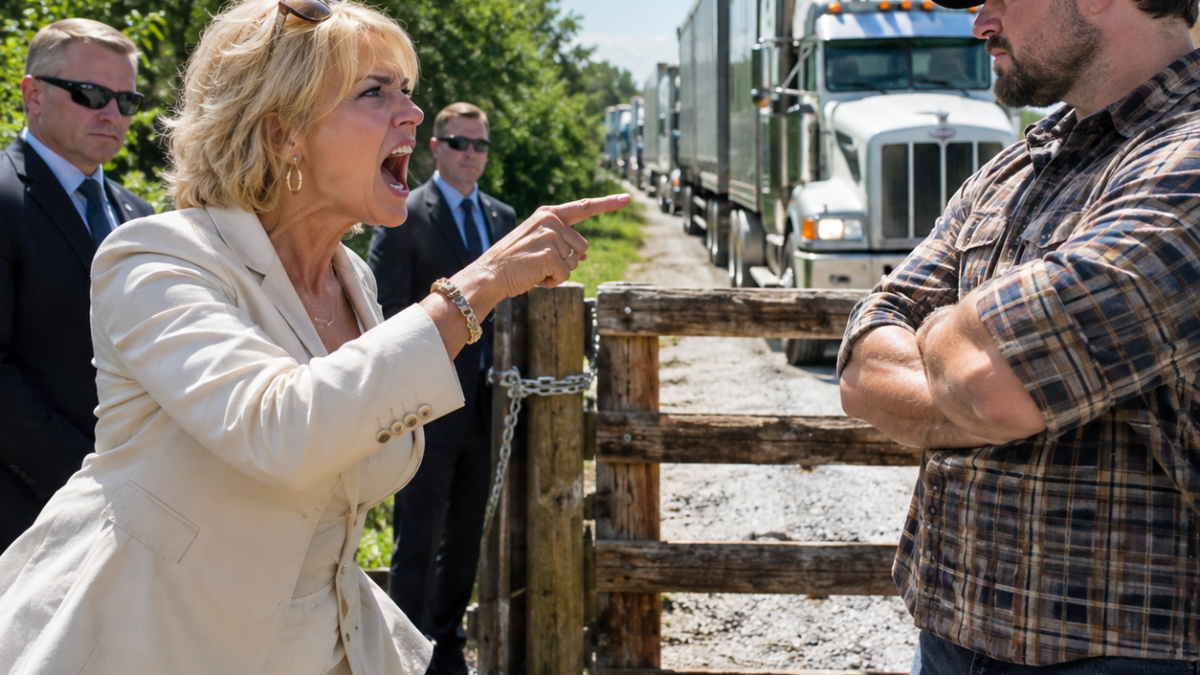
PART 2
I called Piper Rothell.
Piper was the licensed surveyor who had mapped the ranch when I bought it three years earlier. She had a reputation for being brutally direct, which was one of the reasons I liked her.
“What did the HOA destroy?” she asked.
“My entrance fence.”
“Inside your parcel?”
“I believe so.”
“Belief is useless. I’ll be there this afternoon.”
She arrived with the recorded deed, certified survey, and enough equipment to settle any argument Constance wanted to invent. We walked the entire section. Piper checked the markers, measured the road, and finally spread the documents across my truck’s tailgate.
“Every foot of the fence was yours.”
“I knew that.”
“Then why did you call me?”
“To hear it from somebody who can testify.”
That earned a small smile.
She tapped the survey.
“Your gravel road runs approximately four hundred twenty feet inside the property before it reaches the interior ranch network. Stonebrook owns none of it. No easement. No recorded right of way. No shared access.”
“Anything historical?”
“One thing.”
She showed me a county file from 2019. The previous owner had given a Stonebrook maintenance crew permission to cross once so they could mow a strip of grass where the properties met.
“One time?”
“One time.”
“Could they claim that created an easement?”
“No. The letter specifically calls it temporary courtesy access.”
“So Constance has nothing.”
“She has confidence.”
“That isn’t nothing.”
Piper folded the survey.
“In court, it is.”
I asked her to restake the boundary, photograph every damaged footing, and prepare a formal report. If this ended up before a judge, I wanted the ground, the records, and the photographs saying the same thing.
While Piper worked, Constance started telling Stonebrook residents that I was sabotaging their community event. By late afternoon, people I barely knew were calling. One man asked whether I understood how important the showcase was to property values. A woman I had met twice told me I should “work something out” instead of holding an entire neighborhood hostage. Another resident accused me of demanding an outrageous amount of money from the HOA.
I had demanded nothing.
That was when I realized Constance had understood one thing better than I had.
Whoever speaks first often controls the first version of the story.
Just before sunset, her SUV returned.
Two event committee members were with her.
She walked to the gate carrying a white envelope.
“I’m trying to end this,” she said.
She held it out.
“What is it?”
“Five thousand dollars.”
I stared at her.
“A goodwill gesture.”
“For forty-two thousand dollars in damage?”
“It was an old fence.”
“Eleven years.”
“Old.”
I didn’t touch the envelope. Instead, I handed her a one-page acknowledgement Piper and I had prepared. It stated that Stonebrook representatives had removed my fence without authorization and that the association agreed nobody would enter my land again without written permission.
Constance read half of it and laughed.
“You expect me to sign this?”
“Yes.”
“Five thousand is generous.”
“My fence is forty-two thousand.”
“That estimate is ridiculous.”
I unrolled the survey across her SUV hood.
“And this line doesn’t move because you’re having a party.”
Her expression hardened.
Then she changed tactics.
“We have emergency access authorization.”
“Show me.”
“Our attorney has it.”
“Then your attorney can send it.”
“It predates your ownership.”
“Recorded where?”
“You’ll see it when necessary.”
“No.”
She leaned closer.
“Thirty-six trucks are arriving at dawn Sunday.”
That stopped me.
“Thirty-six?”
“Stages. Exhibition equipment. logistics supplies. Structures. Everything.”
She smiled again.
“You are standing in the way of something worth millions of dollars.”
I looked at the ruined fence.
“You should have thought about that before you tore this down.”
She got into the SUV.
“Those trucks are coming.”
“Then they’d better have somewhere else to go.”
Her smile said she thought I was bluffing.
For the next twenty-four hours, I made sure I wasn’t.
Piper studied the site map Constance had left behind. In the lower corner was a certification reference to an old county survey. The stamp looked real.
The file number did not.
Two digits had been altered.
Worse, the original county notation described the route near my property as a **temporary maintenance path**. On Constance’s version, that language had become **event access road**.
Piper stared at the screen.
“Somebody edited a public record.”
“And put my road on it.”
“Yes.”
I felt the first real chill of the weekend.
This had stopped being an arrogant HOA president assuming I would surrender.
Somebody had prepared documents.
Somebody had planned this.
I spent the next hour researching the Stonebrook Grand Showcase. The public HOA notice called it a community landscape exhibition and sponsor reception.
The event company’s promotional pages told a different story.
Renderings of modern homes.
Investor materials.
Price sheets.
Staged model units.
A launch stage.
A company logo I had never seen:
**Stonebrook Event Ventures LLC.**
Then my phone rang.
The caller was Daphne Griggs, the Stonebrook treasurer.
She spoke so quietly I could barely hear her.
“Mr. Brisco?”
“Clayton.”
“I need to tell you something before tonight.”
“What happens tonight?”
“Emergency board meeting.”
“About me?”
“About the event. About you. Constance intends to make you the reason any problems happen.”
I leaned against the kitchen counter.
“What do you need to tell me?”
“The event budget.”
“What about it?”
“One hundred ninety-six thousand dollars left the HOA reserve fund.”
“To whom?”
“An event company.”
“Stonebrook Event Ventures?”
Silence.
“Yes.”
“What was the money for?”
“Every time I asked, she said logistics.”
“Did the board approve one hundred ninety-six thousand?”
“A budget was approved. We were never given full contracts.”
That night, the clubhouse was packed.
I walked in carrying Piper’s survey. Piper came with me.
Constance was already at the microphone.
She pointed me out before I reached the front.
“That is the outside landowner attempting to sabotage Sunday’s showcase.”
Dozens of heads turned.
Some angry.
Some curious.
I did not argue about whether the event sounded exciting.
I waited.
Then asked one question.
“Can anybody in this room show me the document where I gave Stonebrook permission to remove my fence?”
Silence.
Constance lifted a printed resolution.
“The board approved our logistics plan seven to two.”
Daphne stood from the second row.
“No, we didn’t.”
Every head turned again.
Constance’s face froze.
Daphne continued.
“I attended every board meeting. There was no seven-to-two vote on a resolution allowing entry onto Mr. Brisco’s ranch.”
Another board member rose.
Russell Kemp.
Retired engineer.
“I never saw that resolution either.”
Constance slammed the folder shut.
“This meeting is adjourned.”
People started shouting questions.
She walked out.
In the parking lot, Daphne showed me the payment records.
Transport of model homes.
Temporary foundations.
Real estate advertising.
Investor introductions.
Billboard construction.
I looked at her.
“This is not an HOA party.”
“No.”
“What is it?”
“I don’t know yet.”
Near midnight, she sent me a draft sponsor brochure.
I opened it at my kitchen table.
There it was.
Fourteen acres of Stonebrook common green space transformed into a new private development.
Twelve model homes.
New street.
Marketing pavilion.
Investor launch.
At the edge of the rendering, my fence did not exist.
Neither did my gate.
A landscaped boulevard ran straight across my ranch as if the road had already been transferred.
I sat there staring at the screen.
Constance was not borrowing my entrance for a weekend.
She was rehearsing ownership.
The next morning, I rebuilt the fence.
Exactly where it had been.
Exactly on Piper’s surveyed line.
Nothing on the public road.
Nothing on HOA land.
Nothing beyond my deed.
My attorney, Norah Sheffield, came to the ranch and set up a folding table in the barn while the fencing crew worked. Norah was forty-four, sharp enough to make experienced contractors read documents twice before signing them. She prepared a demand for damages, a formal notice against further trespass, and evidence-preservation letters for the HOA, event company, excavator contractor, and every vendor we could identify.
The fencing crew arrived at seven.
By nine, fresh steel posts stood where Constance had ripped them out.
By noon, new panels were going in.
By afternoon, the entrance looked almost whole again.
The rush cost hurt.
I paid it anyway.
The main gate was rehung.
Heavy chain.
Padlock.
Three temporary cameras covered the approach.
On the gate I bolted a sign:
**PRIVATE PROPERTY — NO HOA ACCESS WITHOUT OWNER AUTHORIZATION**
That was when Constance came flying up the road.
She stepped from her SUV and stared at the rebuilt fence like I had personally insulted her religion.
“What do you think you’re doing?”
I kept measuring a bracket.
“Putting my property back where it belongs.”
“Take it down.”
“No.”
“You are intentionally obstructing a contracted commercial operation.”
“I am closing my private gate.”
“This is bigger than you.”
“So was the excavator. Still didn’t belong here.”
She took out her phone and called somebody.
“Ignore him,” she said loudly. “Do not change one delivery time. The route will be open by morning.”
She hung up.
“I will have the sheriff make you remove it.”
“Good idea.”
Her eyebrows lifted.
I called him first.
Sheriff Franklin Decker arrived within forty minutes. Fifty-seven. County veteran. Calm enough to make arguments sound embarrassing.
He reviewed the survey.
Watched the barn footage.
Looked at the repaired gate.
Then listened to Constance insist that the HOA had approved access.
Finally he said:
“Ms. Ellery, an HOA resolution does not create an easement over somebody else’s land.”
“We have historic authorization.”
“Recorded?”
“Our lawyer—”
“Recorded?”
She did not answer.
He turned to me.
“If trucks arrive tomorrow, make sure they can safely turn around without blocking the public road.”
“Already planned.”
Piper and I had marked a turnaround on the public shoulder. A commercial staging lot sat a quarter mile away.
I did not want to trap thirty-six drivers.
They had not torn down my fence.
I wanted them off my property.
That evening, my phone rang again.
Elise Bramwell.
Director of the event company.
She sounded irritated at first.
“Mr. Brisco, I’m calling regarding the access cancellation.”
“I didn’t cancel anything.”
There was a pause.
“The land-use agreement.”
“What land-use agreement?”
“The one authorizing convoy access across your ranch.”
“I never signed one.”
Another pause.
Longer.
“Mr. Brisco, your name, address, and approval signature are on all thirty-six delivery orders.”
Everything inside me went still.
“Send me a copy.”
“I need to speak to legal.”
“You do that.”
I spent almost no time sleeping.
At 4:30 Sunday morning, I was at the gate with coffee.
By 5:20, the eastern horizon had barely begun to gray.
Then I saw headlights.
One pair.
Then another.
Then ten.
Then more.
At 5:47, the lead tractor-trailer rolled toward the gate.
Behind it stretched a convoy big enough to look like a military movement.
Ten tractor-trailers.
Fourteen box trucks.
Twelve flatbeds.
The flatbeds carried prefabricated model homes wrapped in white plastic.
Thirty-six trucks.
As agreed with the sheriff, the convoy used the commercial staging lot instead of stacking across the public highway. Only the lead truck approached my entrance.
The driver climbed down.
Hudson Bell.
Forty-eight.
Convoy coordinator.
He looked at the gate.
Then me.
“We have an access agreement.”
“No, you have somebody’s agreement.”
He frowned.
“We unload beginning at six-thirty.”
“Not here.”
“That is the contracted route.”
“That road is private.”
He opened a tablet.
Scrolled.
Then turned it toward me.
There was my name.
My address.
My property description.
And a signature that vaguely resembled mine.
Hudson held the screen steady.
“Did you sign this?”
“No.”
“You’re sure?”
I looked at him.
“Would you forget signing permission for thirty-six trucks and twelve houses to cross your ranch?”
His jaw tightened.
“No.”
“That isn’t my signature.”
He looked back at the document.
Then raised his radio.
“All units hold. Shut down engines until further instruction.”
One by one, the diesel engines died across the staging lot.
The valley became quiet.
That was the moment Constance arrived.
Her SUV came too fast, tires scattering gravel.
She got out before the vehicle fully settled.
“Open that gate.”
I stayed beside the chain.
“No.”
“We have a contract.”
“You destroyed my fence.”
“We had permission.”
“You forged permission.”
Hudson’s head snapped toward me.
“Forged?”
Constance turned on him.
“He is lying.”
I looked at Hudson.
“I never signed your agreement. I never authorized a road. The HOA owns no easement. They removed my fence while I was away.”
Constance stepped between us.
“Clayton is attempting to extort the association because he discovered how important today is.”
Hudson did not care about her story.
He cared about thirty-six trucks, millions in cargo, and his company’s liability.
He held up the tablet.
“If access is disputed, we do not enter.”
“You were paid to deliver.”
“We were paid to deliver lawfully.”
“The HOA authorized it.”
“You are not the landowner.”
Constance looked at me like she wanted to tear the gate apart with her hands.
“You are sabotaging an event worth millions.”
I waited until she stopped.
“You tore down my fence. You forged my permission. And now you’re angry because I rebuilt what you destroyed.”
Hudson keyed his radio again.
“All vehicles remain staged. Nobody enters the ranch.”
Constance stared at him.
“I am your customer.”
He shook his head.
“You are one customer. I have thirty-six drivers I’m not sending onto disputed private property.”
Then he opened the document history.
His expression changed.
“Interesting.”
“What?” I asked.
The agreement had been electronically verified.
Somebody had certified that my signature was authentic.
The verifier was not a notary.
Not an attorney.
Not an independent service.
It was Constance.
Logged in through an account associated with a private business she controlled.
I looked at her.
“You vouched for my signature?”
Her face tightened.
“That is administrative processing.”
Hudson looked almost offended.
“No. That is access verification.”
“You are not authorized to share those records.”
“My company is required to validate access.”
“It is confidential.”
“It has his name on it.”
The contract went further.
It authorized three days of access.
Friday through Sunday.
It allowed heavy equipment to widen the entrance.
That was how Wade’s excavator crew had been convinced they could remove my fence.
Norah arrived a few minutes after six with a briefcase and thermos.
She reviewed the agreement.
Then formally asked Hudson and his company to preserve the original file, metadata, authentication records, emails, and every user log connected to the agreement.
Piper compared the site map attached to the contract with the certified county records.
“Same altered notation.”
Norah looked at her.
“Meaning?”
“The source document says temporary maintenance path. This says event access road.”
Constance snapped:
“You people are manufacturing technicalities because you want money.”
Norah did not look at her.
“Preserve the records.”
Hudson called his company’s legal director.
Five minutes later, the answer came.
Deliveries suspended.
No truck moved until lawful access could be proven.
Constance lunged toward the folder in Hudson’s hands.
“That document belongs to Stonebrook.”
He pulled it away.
I stepped forward.
“It has my name on it, and I want to know who put it there.”
That was when Sheriff Decker arrived.
No siren.
No drama.
He took statements.
Photographed documents.
Collected contact details.
Constance demanded he arrest me for obstructing a business operation.
The sheriff looked at her.
“Do you have a court order requiring him to open this gate?”
“No.”
“A recorded easement?”
“Our authorization—”
“Recorded easement?”
“No.”
“A land-use agreement signed by him?”
She pointed toward Hudson.
“We have one.”
Hudson answered before she could continue.
“The landowner disputes the signature. Delivery is suspended pending verification.”
The sheriff nodded.
“Then nobody crosses.”
Constance looked like she might explode.
“If those trucks don’t deliver, that company will never see a cent.”
Hudson opened the contract.
“Customer guarantees lawful access. If false access information causes delivery failure, mobilization charges remain payable by the ordering party.”
The color drained from her face.
I had not trapped thirty-six trucks.
Her own contract had stopped them.
Then Daphne arrived.
She carried a thick folder.
Walked past Constance.
Came straight to me.
“You need to see where the money came from.”
Norah spread the records across her car hood.
One hundred ninety-six thousand dollars transferred from Stonebrook’s reserve fund.
Destination:
**Stonebrook Event Ventures LLC.**
Norah opened the state business registry.
Managing member:
**Constance Ellery.**
I looked at Daphne.
“The reserve money went to her company?”
“Yes.”
“Did the board authorize that?”
“Not knowingly.”
Constance shouted from behind us.
“That company was created to administer the showcase.”
Daphne turned.
“You never disclosed that you owned it.”
“It was an administrative vehicle.”
“You transferred homeowners’ reserve money into an entity you personally control.”
“Because none of you understand event logistics.”
Daphne stared at her.
“I understand accounting.”
That might have been the first moment Constance realized the morning was turning into something far worse than a locked gate.
Elise Bramwell arrived after seven.
She listened.
Reviewed the records.
Then told us what the showcase really was.
Not a neighborhood celebration.
Not a landscaping fair.
It was the launch of a real estate project called **Stonebrook Reserve**.
Fourteen acres of HOA common green space.
Twelve model homes.
Investor presentation.
Sponsors.
Potential development.
The modular homes on those flatbeds were not displays for one afternoon.
They were the physical centerpiece of Constance’s pitch.
The main Stonebrook entrance was too narrow for several of the flatbeds.
My ranch road was the only practical route.
That was why she had destroyed my fence.
Not because she was impatient.
Because her entire development scheme depended on crossing land she did not own.
Daphne added another problem.
Constance had signed a long-term agreement involving the fourteen acres without obtaining the level of homeowner approval required by Stonebrook’s own governing documents.
Norah checked the plat.
The land carried a restrictive covenant identifying it as protected common open space.
Constance’s investors might have been buying into a project she had no legal authority to deliver.
By eight o’clock, board members began arriving.
Sponsor representatives too.
Word had spread.
I did not make a speech.
I handed them documents.
Piper’s survey.
The altered county map.
The forged land-use agreement.
The verification log.
The reserve transfer.
Then I stepped back.
Paper does not shout.
It does not need to.
One sponsor representative named Grant Whitfield read his agreement, turned pale, and showed Norah a clause above Constance’s signature.
Personal guarantee.
If the venue could not lawfully be used, Constance had agreed personally to cover certain repayment obligations.
I watched her read his face.
She knew immediately what he had found.
At nine, the contractors announced installation could no longer finish before the scheduled opening unless unloading began immediately.
Constance walked to the fence.
Her composure finally cracked.
“Bring a backhoe.”
The equipment manager stared at her.
“What?”
“Pull that section out.”
He looked at me.
Then the sheriff.
“No.”
“I am paying you.”
“You are asking me to destroy a fence after the property owner has objected and law enforcement is standing here.”
“I take full responsibility.”
“No.”
She turned toward another crew.
“Move those panels.”
Nobody moved.
She shouted:
“I paid for this event!”
I stepped closer until only the fence separated us.
“You paid for an event.”
Her eyes locked on mine.
“You did not buy my land.”
Silence.
Hudson announced that his trucking company would not participate in forced access.
Elise announced all installation work was suspended until lawful venue access could be established.
Constance stormed toward the gate, ripped the private-property sign off its bolts, and threw it into the gravel.
Sheriff Decker moved instantly.
“Back away.”
She froze.
“Do not touch the fence again.”
“This is insane.”
“No. This is somebody else’s property.”
She pointed toward me.
“He is costing people millions.”
The sheriff looked at the broken sign.
“You are the one damaging property while I’m standing here.”
For the first time all weekend, she stepped backward.
Her last plan was to move the convoy through Stonebrook’s residential streets.
It failed almost immediately.
Several turns were too tight for the modular-home flatbeds.
Clearances were inadequate.
Then the county fire marshal reviewed the event layout and found another problem.
The planned crowd size, staging configuration, emergency access, and exit routes had not been properly approved for the event as submitted.
Constance suggested moving the ceremony into the clubhouse.
The clubhouse could barely handle the guest list, much less twelve model homes.
Grant Whitfield did not even respond.
At 9:40, Hudson made the call.
“All units return to freight yard.”
Thirty-six engines started.
I stood beside my gate as drivers climbed back into their cabs.
One tractor-trailer pulled out.
Then another.
Box trucks.
Flatbeds.
The model homes stayed wrapped.
The stage stayed loaded.
The exhibition equipment stayed strapped down.
Constance stood in the gravel watching the convoy she had promised would roll through my ranch begin disappearing down the highway.
The first truck left.
Then ten.
Then twenty.
Sponsor representatives started returning to their cars.
Media crews took down temporary roadside signs.
The VIP entrance led nowhere.
Constance kept telling people this was a delay.
A scheduling issue.
Something she could fix next weekend.
Elise interrupted.
Her company was suspending vendor services.
Then Constance’s phone chimed.
She read an email.
Her face went pale.
Grant’s sponsor group demanded proof of her legal right to use the venue and formally notified her that they intended to seek repayment of advanced sponsorship funds.
The thirty-sixth truck pulled away.
Hudson slowed as he passed the gate.
He looked toward me.
I raised one hand.
He did the same.
Then he was gone.
Not one truck crossed my property.
By afternoon, the showcase was officially cancelled.
Investors who arrived expecting twelve model homes found an empty field, a few banners, and confused staff.
Constance immediately blamed me.
According to her version, I had sabotaged Stonebrook.
She demanded the HOA sue.
This time, nobody rushed to obey.
Monday night, Daphne called an emergency board meeting.
Independent counsel attended.
I was invited because I was the property owner whose fence had been destroyed.
The first numbers landed like rocks.
My fence:
$42,000.
HOA reserve funds transferred through Constance’s company:
$196,000.
Contractor mobilization and cancellation claims:
Approximately $288,000.
Sponsor advances and deposits being demanded back:
Approximately $1.1 million.
Potential total:
Roughly $1.626 million.
Not every dollar had been adjudicated.
Not every contract claim would necessarily survive negotiation.
But the number was big enough to silence the room.
Constance sat at the front with a stack of folders.
“This loss is the direct result of Clayton Brisco’s interference.”
Daphne stared at her.
“You forged his access.”
“That has not been established.”
“The trucking company preserved the authentication logs.”
“Those records are misleading.”
Russell Kemp spoke next.
“Did the board vote seven to two on the access resolution?”
Constance did not answer.
“Did we?”
“I had authority to manage event logistics.”
“That is not what I asked.”
The independent attorney finally intervened.
“Ms. Ellery, you need counsel of your own.”
That sentence changed the room.
For the first time, she was not being spoken to as president.
She was being spoken to as an individual who might have personal exposure.
The board voted to strip her unilateral transaction authority.
Reserve accounts were frozen.
A full three-year audit was ordered.
Two weeks later, Stonebrook held a removal vote using the exact notice procedures in its bylaws.
Ninety-six eligible owners.
Seventy-eight voted to remove Constance.
She lost.
When the result was announced, she stood slowly.
The room was silent.
No applause.
No cheering.
Just exhaustion.
Daphne asked her to surrender account credentials, records, and association files.
Constance walked down the aisle.
Stopped beside me.
Her face looked older than it had Friday morning.
“You ruined everything I built.”
I looked at her.
“No.”
Her jaw tightened.
“I rebuilt what you destroyed.”
Then I said the part she needed to hear.
“Everything else was your decision.”
She walked out.
Later that night, Norah called.
The trucking company had preserved the original digital agreement.
So had Elise’s event firm.
Authentication records.
Approval logs.
Email history.
Document-generation data.
Authorities would investigate the forged signature and movement of HOA funds separately from my civil claim.
For the first time since I found the excavator at my gate, I slept without waking up angry.
Six weeks later, the civil side began settling.
Investigators determined that the access agreement had been generated through systems tied to Constance’s private company using an image of my signature I had never authorized.
The precise criminal consequences were for prosecutors and courts to determine.
I did not need to narrate myself into being judge and jury.
My claim was simpler.
My fence had been destroyed.
My road was mine.
Stonebrook had no easement.
No access right.
No authority to remove anything from my property.
Norah negotiated compensation.
Forty-two thousand dollars for the fence restoration.
Formal recorded recognition that my ranch road belonged exclusively to my parcel.
No HOA easement.
No event access.
No implied right created by the one-time 2019 courtesy.
No future intrusion.
That mattered more than the check.
Constance’s company faced the contractors, event firm, sponsors, and investigators.
Assets were placed under supervision while claims were sorted.
The $196,000 transferred from the HOA reserve fund was ultimately recovered through the legal and financial process surrounding the company’s assets.
Stonebrook abandoned the development plan.
The fourteen acres remained green space.
The residents adopted new rules requiring broader owner approval before major contracts, developments, or transfers involving common property.
Daphne sent me a handwritten letter afterward.
Not typed.
Not HOA letterhead.
Just paper.
She apologized on behalf of residents who had been misled.
She wrote that many of them had believed Constance because they had never imagined their own president would destroy somebody else’s fence for a project they themselves had never fully approved.
I read the letter twice.
Then put it in the same file as the first photograph of the ruined fence.
People sometimes ask whether I hated Stonebrook after that.
I didn’t.
I hated what had been done.
There is a difference.
Most homeowners had not been standing beside the excavator.
They had not forged my signature.
They had not transferred reserve money.
They had not promised investors a road through my ranch.
They had been sold a version of events that made me sound selfish because that version made Constance useful.
Once people saw the documents, most changed.
That mattered to me.
Months later, Hudson Bell stopped by the ranch while finishing paperwork connected to his company’s claim.
He parked outside the gate.
Walked along the rebuilt steel line.
Then laughed.
“I’ve driven through thousands of job sites.”
“Congratulations.”
“I have never seen thirty-six trucks turned around by one forged signature.”
“I didn’t turn them around.”
He looked at me.
“Your gate did.”
“No.”
I tapped one steel post.
“This just marked the line.”
“What turned them around?”
“The fact nobody had permission to cross it.”
Hudson nodded.
Then asked:
“Do you ever regret rebuilding the fence before Sunday?”
I answered immediately.
“Not for a second.”
He looked toward the road his convoy had almost used.
“Good.”
We shook hands.
He drove away.
I walked the fence slowly after he left.
Every post stood on Piper’s surveyed line.
The steel was newer than what Constance had destroyed, but otherwise the boundary looked exactly as it had before.
Across from it, Stonebrook’s fourteen acres remained open grass.
No model homes.
No temporary foundations.
No boulevard cutting across my ranch.
The field was quiet.
That was all I had wanted.
Quiet property.
Clear boundaries.
Respect.
Constance had commanded thirty-six trucks, hundreds of thousands of dollars in contracts, sponsors, vendors, board authority, private companies, and an event designed to make her look like the woman transforming Stonebrook into something bigger.
I had a locked gate.
On paper, that should have been a ridiculous contest.
Except power only works where it has a right to act.
She could command every truck she paid for.
She could not command my land.
The first autumn after everything ended, I replaced the private-property sign she had ripped from the gate.
The new one was heavier.
Steel.
Bolted directly into the post.
It said only:
**PRIVATE RANCH ROAD
NO THROUGH ACCESS**
Nothing about Constance.
Nothing about Stonebrook.
Nothing dramatic.
I did not want my gate to become a monument to her.
I wanted it to become boring again.
That was the victory.
One afternoon Daphne stopped by.
She stood outside the fence until I opened the gate.
That small gesture did not escape me.
“Come in.”
She walked toward the barn.
Stonebrook had elected a new board by then.
Russell joined.
Daphne stayed as treasurer long enough to help clean up the books.
“I wanted you to see something.”
She handed me a copy of the new common-land resolution.
Any major redevelopment required direct homeowner approval.
Private affiliate transactions required disclosure.
Contracts above a certain value needed multiple signatures.
Conflict-of-interest rules.
Independent review.
I read it.
“Looks boring.”
She smiled.
“That’s the goal.”
“Good governance usually is.”
She looked toward the ranch road.
“I’m sorry we believed her.”
“You believed your president.”
“That feels worse.”
“Only if you refuse to learn from it.”
She looked at me.
“You really don’t hate us?”
“I barely know most of you.”
That made her laugh.
Then I added:
“I hated seeing people call me selfish before asking what happened.”
Her smile disappeared.
“Fair.”
“I hated seeing Constance turn your neighborhood into a weapon.”
Daphne nodded.
“So did I.”
We stood in silence.
Then she asked:
“What are you going to do with the forty-two thousand?”
“Pay the company that rebuilt the fence.”
She laughed again.
“Right.”
Nobody becomes rich when somebody destroys something expensive and then reimburses the replacement.
That was another part Constance never seemed to understand.
Money paid after harm is not a prize.
It is an attempt to put something back where it was before you damaged it.
The fence returned.
The hours didn’t.
The weekend didn’t.
The sleepless nights didn’t.
The anger didn’t vanish with a check.
But over time, the ranch became quiet again.
That helped.
The cattle stopped caring almost immediately.
Cattle have excellent priorities.
Feed.
Water.
Shade.
Everything else is human nonsense.
The rebuilt fence weathered through winter.
Then spring.
Wild grass thickened along the posts.
The tire scars disappeared.
One morning I stood where the excavator had been and realized I could barely tell exactly which panels were new without looking closely.
That felt good.
Constance, meanwhile, remained tied up in the consequences of the contracts and records she had created.
I heard things through Norah and public filings, but I stopped chasing updates.
There were civil claims.
Investigative questions about the unauthorized signature.
Financial disputes involving her company.
Sponsor repayment demands.
None of it needed my attention every day.
Norah once asked whether I wanted copies of everything.
“No.”
She looked surprised.
“You kept every photograph.”
“That was when I needed evidence.”
“You don’t anymore?”
“I have my fence.”
She smiled.
“Healthy.”
“Don’t sound shocked.”
“I’m a lawyer.”
Fair.
Stonebrook’s residents held a small community picnic on the fourteen acres the following summer.
Daphne invited me.
At first I said no.
Not because I was angry.
Because walking onto the land where Constance had planned twelve model houses felt strange.
Then Russell called.
“Come for twenty minutes.”
“Why?”
“Because half the neighborhood still thinks you hate us.”
“That’s their problem.”
“Yes.”
A pause.
“Also we have barbecue.”
That was a better argument.
I went.
No VIP entrance.
No investors.
No banners.
No model homes.
Just folding tables.
Kids.
Dogs.
Food.
The same open space Constance had promised to transform into a development was covered in blankets and lawn chairs.
One homeowner approached me awkwardly.
“I called you that weekend.”
“I got a lot of calls.”
“I told you to stop being selfish.”
“I remember you.”
He looked horrified.
“Sorry.”
I smiled.
“I’m kidding. I don’t remember which one you were.”
He laughed nervously.
Then shook my hand.
“I should have asked questions.”
“Yes.”
He blinked.
Most people expect forgiveness to erase accountability.
It doesn’t.
He nodded.
“You’re right.”
That was enough.
A woman with two young children came over later.
She pointed toward the field.
“We didn’t know houses were going here.”
“I figured.”
“My kids play here.”
“They still can.”
She looked toward my ranch.
“Thank you.”
I almost corrected her.
The field remained green because the board, governing documents, sponsors, contractors, investigators, and residents ultimately stopped Constance.
Not because I had performed some heroic act.
But I understood what she meant.
The locked gate had interrupted momentum.
Sometimes interruption is enough.
A bad plan can become inevitable if everybody keeps moving because nobody wants to be the first person to say stop.
My fence said stop.
Hudson said stop.
Piper’s survey said stop.
Daphne’s records said stop.
The sheriff said stop.
The fire marshal said stop.
Eventually the whole structure collapsed because it had been built on assumptions that no longer survived contact with people willing to ask for proof.
Months later, I found the original white envelope Constance had brought with the five thousand dollars.
Empty, of course.
I had handed the cash back.
For some reason the envelope had ended up in my office drawer.
I looked at it and remembered her saying:
“Five thousand is more than enough for an old fence.”
That might have been the moment I understood her completely.
She believed she could assign value to anything.
My fence.
My road.
My cooperation.
The HOA’s reserves.
The green space.
The sponsors’ trust.
The board’s authority.
If a number could be placed beside something, she assumed money could replace consent.
But consent is not a price.
A boundary is not an invoice.
Ownership is not negotiable simply because someone else has a more expensive plan.
That was the lesson behind everything.
The following fall, Piper came out to check another section of the property after heavy rain shifted soil near a drainage area.
We finished early and stood at the main gate.
She looked at the fence.
“Better than the old one.”
“Don’t tell the insurance company.”
“I didn’t say cheaper.”
“It absolutely wasn’t.”
She laughed.
Then pointed toward the post.
“Want to know the funniest part?”
“What?”
“If Constance had come to you three months earlier, offered proper compensation, insurance, road restoration, and a negotiated temporary access license, would you have considered it?”
I thought.
That question bothered me because I knew the answer.
“Yes.”
Piper nodded.
“Exactly.”
Constance had destroyed my fence to avoid asking permission from a man who might have said yes.
Not to the entire development scheme.
I would have had serious questions once I understood what she planned.
But temporary truck access?
Maybe.
With the right protections.
That made the whole thing even more absurd.
Her need for control created the resistance she feared.
If she had negotiated, there might never have been thirty-six trucks idling outside a locked gate.
If she had disclosed the development honestly to Stonebrook residents, maybe the community could have debated it properly.
If she had disclosed her private company, maybe the board could have evaluated the conflict.
If she had respected the open-space restrictions, maybe the project would have died before anybody lost money.
At every step she had choices.
She chose shortcuts.
Then treated every person who questioned them like an enemy.
That was why I never accepted her final accusation that I had ruined everything.
I rebuilt one fence.
She built the rest.
The next time Hudson came through the valley, he called from the highway.
“Gate open?”
“For you?”
“Yes.”
“What are you hauling?”
“Nothing.”
“Then maybe.”
He drove in with a pickup instead of a tractor-trailer.
We drank coffee near the barn.
He told me his company had changed procedures after the Stonebrook mess. Private-land access agreements over a certain scope now required independent verification rather than customer certification.
“So Constance improved your company.”
He grimaced.
“That is a painful way to say it.”
“Still true.”
“Unfortunately.”
He looked toward the gate.
“You know the first driver behind me that morning thought we were going to sit there all day.”
“You almost did.”
“No. Once the signature issue came up, we were done.”
“You decided quickly.”
“I manage drivers, Clayton. My job is getting them home without arrests, lawsuits, damaged equipment, or somebody waving a shotgun because we drove onto the wrong ranch.”
“I didn’t own a shotgun at the gate.”
“I know.”
“You sound disappointed.”
“I’m grateful.”
That mattered.
The story people later told made it sound like I had heroically trapped thirty-six trucks behind my fence.
I didn’t trap anyone.
The trucks had a staging lot.
They had room to turn.
The sheriff had insisted on safe traffic management.
I agreed.
I never wanted innocent drivers caught between me and Constance.
That distinction mattered because revenge without control can become another form of recklessness.
I wanted to stop trespass.
Not create danger.
The dramatic image was thirty-six trucks stopped at my gate.
The important truth was thirty-six drivers got to leave without crossing a line they had no right to cross.
Stonebrook’s new board eventually removed Constance’s old event branding from the clubhouse storage rooms.
Daphne found boxes of banners advertising Stonebrook Reserve.
Twelve model-house brochures.
Sponsor packets.
Investor projections.
One brochure included a rendering of the boulevard through my ranch.
She brought me a copy.
“You want this?”
I looked at it.
My gate erased.
My fence erased.
A landscaped road in their place.
“No.”
“You sure?”
“I know what almost happened.”
She folded it back into the box.
Then I changed my mind.
“Wait.”
She handed it over.
I framed that too.
Not prominently.
It hangs in my workshop beside Piper’s certified survey.
Rendering on one side.
Actual boundary on the other.
A fantasy beside a fact.
Sometimes visitors ask why.
I tell them:
“Plans are easy when the person drawing them doesn’t own what’s underneath.”
That gets a laugh.
But it’s true.
The survey was never dramatic.
Thin lines.
Numbers.
Monuments.
Bearings.
Distances.
Yet that boring paper defeated a glossy development rendering worth millions.
Because appearance does not beat title.
Confidence does not beat consent.
And a board resolution does not beat a deed.
A year later, the fence incident came up at a county landowners’ meeting.
Norah had been invited to speak about easements and private access.
She used my case without naming me at first.
Then somebody in the audience raised his hand.
“This sounds like the thirty-six-truck guy.”
The room laughed.
I was sitting in the back.
Norah pointed.
“He’s over there.”
Every head turned.
I considered leaving.
Too late.
Afterward, three ranch owners approached me with stories about informal roads, handshake access, neighbors assuming rights, utilities crossing old boundaries.
The stories were less dramatic than mine.
That did not make them less important.
One elderly man said:
“My neighbor’s used my south road twenty years. I don’t mind. But I don’t want his kids claiming it later.”
I introduced him to Norah.
Another woman had inherited land with an old gate everybody treated as community access.
Piper ended up surveying it.
I began to see how quickly convenience becomes expectation.
Expectation becomes entitlement.
Entitlement becomes conflict.
Constance was simply the loudest version.
A temporary maintenance courtesy from 2019 had been turned into a permanent event road in a manipulated document because somebody believed history could be rewritten if the new language looked official enough.
That was why I stopped treating paperwork as boring after Stonebrook.
Every ranch has memory.
Some of it lives in fences.
Some in deeds.
Some in survey pins buried under grass.
Some in old letters explaining that a permission was temporary.
When those details disappear, the most confident person often fills the gap.
That weekend taught me to leave fewer gaps.
I recorded the ranch boundaries again.
Updated maps.
Clear signage.
Written access agreements when neighbors crossed for legitimate reasons.
Nothing hostile.
Just clarity.
One neighbor laughed when I asked him to sign a one-page permission before moving hay equipment across a corner of my road.
“Think I’m Constance?”
“No.”
“Then why paper?”
“So neither one of our grandchildren has to argue about what we meant twenty years from now.”
He signed.
Smart man.
The ranch itself changed slowly.
That is the nice thing about land.
It does not care about social-media outrage.
It does not refresh comments.
It does not attend HOA meetings.
Grass grew.
Fence paint dulled.
Calves were born.
Rain cut new channels along the ditch.
The afternoon light moved across the same ridge whether Constance was president or not.
That stability helped me.
For weeks after the event, I had replayed arguments in my head while doing chores.
Things I should have said.
Things I should not have said.
Eventually the cattle made that feel ridiculous.
A cow does not care if you won a debate.
It cares whether the water trough works.
I repaired the trough.
Life moved.
One morning Daphne called.
“Constance’s development company is done.”
“What does done mean?”
“Operations suspended. Claims still being handled.”
“Okay.”
“That’s all?”
“What did you expect?”
“I don’t know. Satisfaction?”
I leaned against the barn.
“I got satisfaction when the fence was restored.”
“Really?”
“No.”
She laughed.
Then I became serious.
“I got satisfaction when the fourteen acres stayed green.”
That was closer.
Constance losing mattered.
The land surviving mattered more.
That was the point I think people miss when they want a story about revenge.
The sweetest ending is rarely the enemy suffering.
It is usually the thing they tried to take remaining yours.
My road remained mine.
The green space remained open.
The homeowners recovered reserve funds.
The gate remained closed when I wanted it closed.
Those were victories.
Everything else was consequence.
Stonebrook held another vote the next year to permanently reaffirm the fourteen acres as common open space.
Daphne invited me to witness it.
I stood at the back.
The resolution passed by an overwhelming majority.
One resident asked whether they should add language about outside vehicle access.
Russell said:
“We already have language. It’s called somebody else’s property.”
People laughed.
I did too.
Afterward a little boy ran across the grass where Constance had planned a model-home street.
His mother chased him.
He dropped a red plastic airplane.
I picked it up and handed it back.
She smiled.
“Better than twelve houses, right?”
“Depends on the houses.”
She laughed.
I looked across the field.
“Yes.”
Better.
The last major legal development involving me came quietly.
Norah called to confirm the recorded agreement recognizing that Stonebrook had no easement over the ranch road had been filed.
“That means what I think?”
“It means future boards inherit the answer.”
“No creative interpretation?”
“People are always creative.”
“Wonderful.”
“But the record is clear.”
That was enough.
I drove to the county office the next week and obtained a certified copy.
It went into the ranch safe.
Beside the deed.
Beside Piper’s survey.
Beside the 2019 courtesy letter.
Not because I expected another Constance.
Because I did not want the next owner of my ranch to have to fight the same battle.
Maybe that is what ownership really becomes after a while.
Not just keeping something for yourself.
Leaving the truth organized for whoever comes after.
One cool afternoon, months after the dust settled, Hudson stopped one last time.
We stood outside the gate.
He looked down the straight steel line.
“Still here.”
“That is generally the goal of a fence.”
“I mean after everything.”
“Where would it go?”
He smiled.
Then asked the question that became the one people repeated most when they heard the story.
“Do you regret rebuilding it before the trucks arrived?”
“Not for a second.”
“Even knowing the chaos?”
“The chaos was coming whether the fence was there or not.”
He nodded.
“The fence just made everyone stop long enough to see it.”
Exactly.
Constance’s plan had momentum.
Money had moved.
Contracts had been signed.
Trucks scheduled.
Sponsors invited.
Model homes loaded.
Investors expected.
Once enough machinery is moving, people become afraid to interrupt because interruption costs money.
That is how bad decisions become disasters.
My fence created a physical pause.
A gate.
A chain.
A line.
It forced Hudson to ask:
“Did you sign this?”
That question did more damage to Constance’s plan than any speech I could have made.
No.
I did not.
Once that answer entered the morning, everything else had to be reexamined.
The road.
The contract.
The map.
The money.
The development.
The board vote.
The company.
The sponsors.
All of it.
Truth rarely arrives as a dramatic explosion.
Sometimes it arrives as a man holding a tablet at 5:47 in the morning asking whether your signature is yours.
And sometimes one honest answer is enough to stop thirty-six trucks.
Hudson shook my hand.
Then drove away.
Dust moved behind his pickup.
I walked the fence alone.
At the far end, beyond Stonebrook’s green space, the sun was dropping behind the valley.
I remembered Friday morning.
Steel in a twisted pile.
Concrete hanging from posts.
Constance pointing with that blueprint.
**Your fence was in the way.**
She had been wrong in more ways than she knew.
The fence was not in the way.
The fence was the line.
The road was the line.
My consent was the line.
The board’s authority had a line.
The HOA’s money had a line.
The protected common land had a line.
Every disaster Constance created began because she thought lines only mattered when they restricted somebody else.
At my ranch, she finally found one she could not move.
I stopped at the main gate.
Ran my hand across the steel.
The repaired panels were cool in the evening air.
On the other side, the field where her million-dollar event had never happened was quiet.
No banners.
No VIP entrance.
No investors.
No twelve model homes.
No thirty-six trucks.
Just grass moving in the wind.
I thought about her telling me that one individual had no right to stand in the way of an entire community.
Maybe she believed that.
But the community had never asked her to destroy my fence.
It had never knowingly asked her to forge my name.
It had never knowingly asked her to move reserve money into her own company.
It had never knowingly approved a housing development on protected green space.
She had confused herself with the community.
That was the root of everything.
Leaders start becoming dangerous when they stop hearing the difference between:
**I want this**
and
**we agreed to this.**
Constance crossed that line long before the excavator crossed mine.
She simply assumed nobody would make her turn around.
I did.
Not with force.
Not with threats.
Not by destroying her property.
I put back what she tore out.
Locked my own gate.
Recorded the truth.
And refused to move.
That was enough.
There is a photograph in my office now.
It was taken from one of the temporary cameras Sunday morning.
The sun is barely up.
My rebuilt fence fills the foreground.
The gate is locked.
Beyond it, down the road, you can see a line of headlights disappearing toward the staging lot.
Thirty-six trucks.
All waiting.
I almost deleted that image after the case ended.
Instead, I printed it.
Not because it reminds me that Constance lost.
Because it reminds me what the fence meant.
Before that weekend, I thought a fence was steel.
Posts.
Concrete.
Hardware.
A property improvement.
Afterward, I understood it differently.
A fence is a question made physical.
Where does your authority end?
Where does mine begin?
Do you ask before crossing?
Do you respect the answer?
Constance’s entire downfall began because she answered those questions for herself.
The photograph hangs beneath one sentence:
**POWER DOES NOT CREATE PERMISSION.**
People sometimes read it and ask whether I came up with that after everything happened.
No.
I learned it because everything happened.
One year after the cancelled showcase, Stonebrook held a neighborhood event on the fourteen acres.
No sponsors.
No investors.
No development company.
No VIP entrance.
They called it Green Space Day.
Terrible name.
Daphne admitted that.
There were food trucks.
Kids’ games.
Native planting.
A small stage.
Everything brought through Stonebrook’s legal roads.
Nobody asked to use mine.
I attended for an hour.
At one point, Russell walked over holding two lemonades.
“Look.”
“At what?”
He gestured toward the field.
“Nothing.”
I smiled.
Exactly.
No model homes.
No street.
No advertising signs.
Nothing except people using the land for what it had always been intended to be.
Common space.
He handed me a drink.
“Worth all the trouble?”
I looked toward my ranch fence.
“Ask Constance.”
He laughed.
Then I answered properly.
“Yes.”
Not because I enjoyed what happened.
Because a bad plan had been stopped before becoming permanent.
Model homes can be moved off trailers.
Once a real development goes in, roads, foundations, utilities, legal fights, and money make reversal much harder.
The fence bought time.
The documents bought truth.
The residents bought the ending by voting for it.
That was the part I respected most.
I could stop trucks at my gate.
Only Stonebrook residents could decide what happened inside their community.
They did.
Months later, I heard that one of the investors had asked Grant Whitfield whether he would ever work with Stonebrook again.
His answer, according to Daphne:
“With the new board? Possibly.”
That surprised me.
Maybe it should not have.
Institutions can survive people who abuse them.
A community is not doomed because one president mistook its resources for personal power.
It changes when the people inside decide to stop allowing it.
That was Stonebrook’s real revenge.
Constance had wanted to build a development that made her important.
Instead, the rules created after her removal made it harder for any future president to become that important again.
That is the kind of reform that matters.
Not replacing one personality with another.
Reducing the amount of damage any one personality can do.
My ranch changed less.
I added one camera permanently at the entrance.
Norah called that paranoia.
I called it affordable documentation.
I replaced the cheap chain with a proper locking mechanism.
Piper helped me install boundary markers that were visible without being ugly.
The old 2019 courtesy letter got scanned.
Every access agreement now went in writing.
I still let neighbors cross when it made sense.
The difference was simple.
They asked.
One spring, Stonebrook needed to repair drainage near the shared edge.
Russell called.
“We may need to bring a small excavator across thirty feet of your south approach.”
I waited.
He laughed.
“I know. I know. Written agreement.”
“Good man.”
They sent one.
Norah reviewed it.
Insurance.
Dates.
Exact area.
Restoration obligations.
I signed.
The crew crossed.
Did the work.
Repaired the tire marks.
Left.
No drama.
That small event meant more to me than anyone understood.
It proved the story had not taught everybody to build higher walls.
It taught us to use doors properly.
Ask.
Agree.
Document.
Respect.
A boundary does not destroy cooperation.
It makes honest cooperation possible.
That was the difference between Russell and Constance.
Same HOA.
Same adjacent ranch.
Same potential need for access.
One asked.
One assumed.
One created a normal maintenance day.
The other created a million-dollar collapse.
Years from now, nobody may remember every number.
Forty-two thousand.
One hundred ninety-six thousand.
Two hundred eighty-eight thousand.
One-point-one million.
One-point-six-two-six million in combined claims and obligations.
Thirty-six trucks.
Twelve model homes.
Fourteen acres.
Two hundred ten feet of fence.
Numbers make the story dramatic.
But the smallest number mattered most.
One signature.
Mine.
Constance thought she could manufacture it.
She thought my name on a document was the same thing as my consent.
It wasn’t.
That single false assumption touched every part of her plan.
Without lawful access, the trucks could not enter.
Without the trucks, the model homes could not arrive.
Without model homes, the showcase collapsed.
Without the showcase, sponsors demanded answers.
Answers exposed the development.
The development exposed the company.
The company exposed the reserve transfer.
The reserve transfer exposed her authority problem.
The authority problem exposed everything else.
That is how systems fail.
Not always from one enormous lie.
Sometimes from one small false document placed at the bottom of a stack nobody expects anyone to examine.
Unfortunately for Constance, Hudson examined it.
Piper examined it.
Norah examined it.
Daphne examined the money.
And I refused to sign reality over to her after the fact.
That was enough.
On the second anniversary of the event, I found myself standing at the gate at almost the exact same time.
5:47 in the morning.
No trucks.
No headlights.
Just dawn.
The ranch was cool.
The road empty.
I had coffee in my hand.
I thought about the first driver hitting his brakes.
Hudson climbing down.
The tablet.
His question.
**Did you sign this?**
I remembered the feeling in my chest when I saw my name beside someone else’s signature.
Violation is a strange feeling.
People think property disputes are abstract.
Lines.
Maps.
Contracts.
But seeing your name forged onto permission to use your own land feels intensely personal.
Somebody has taken your voice and used it to say yes.
That may have been the part I hated most.
More than the fence.
The fence could be rebuilt.
The signature was an attempt to replace me in my own decision.
That was why I fought as hard as I did.
Not to win a dramatic standoff.
To get my voice back.
**No.**
No, I did not sign.
No, you cannot cross.
No, your board vote is not my permission.
No, your event is not more important than my property rights.
No, your deadlines do not become my emergency.
No, money does not erase consent.
Once those answers were allowed to exist, Constance’s entire illusion of control disappeared.
The sky brightened.
A pickup passed on the public road.
The driver waved.
I waved back.
Then I unlocked the gate for myself and drove toward the back pasture.
That ordinary action felt good.
My gate.
My key.
My road.
Not because ownership makes a person powerful.
Because ownership creates responsibility and the right to decide.
Constance had spent months acting like leadership gave her the right to decide for everyone around her.
It did not.
In the end, the most satisfying part of the story was not seeing her removed as president.
It was not watching trucks leave.
It was not hearing sponsors demand repayment.
It was not recovering the forty-two thousand dollars.
It was driving through that gate on a quiet morning and knowing nobody else had the right to open it unless I said so.
Later that year, I replaced one old fence panel near the western pasture.
Not because it was damaged.
Just rust.
I removed it myself.
Set it aside.
Installed the new panel.
No contractors.
No cameras.
No lawyers.
No HOA president.
The job took an hour.
When I finished, I leaned against the post and laughed.
A fence should be boring.
That was what Constance never understood.
She had turned mine into a battlefield because she could not tolerate being told that something she wanted was outside her control.
Now it was boring again.
Steel.
Grass.
Dust.
Boundary.
Perfect.
If you drive past Stonebrook today, the fourteen acres are still green.
Some residents planted native trees along one edge.
Kids play soccer there.
There is a walking path.
No twelve-house development.
No private boulevard.
No luxury investor launch.
If you drive another quarter mile and turn toward my ranch, the gate is still there.
Same line.
Same road.
Newer fence.
And if you look closely at the right post, you will see a small brass plate I added years later.
It does not mention Constance.
It does not mention the showcase.
It says:
**PRIVATE PROPERTY IS NOT A SUGGESTION.**
Piper thought it was too dramatic.
Norah thought it was legally imprecise.
Hudson wanted one for his office.
I kept it.
Because beneath all the contracts, money, trucks, sponsors, audits, lawsuits, and votes, that was the whole story.
Constance ripped out my fence because she thought her plans mattered more than my answer.
I rebuilt it because I knew they didn’t.
She arrived with thirty-six trucks.
I had one locked gate.
And when the truth finally reached that gate with them, thirty-six engines went quiet, one forged signature came apart, a million-dollar event collapsed, a hidden development was exposed, a president lost her power, and an entire neighborhood discovered that the person claiming to act for them had been acting for herself.
I never needed to tear down anything she owned.
I never needed to block a public road.
I never needed to trap a driver, sabotage a truck, or destroy her event equipment.
I simply restored the fence she had no right to remove and stood on the land she had no right to use.
Everything she lost after that came from choices she had already made.
And that is why, whenever I walk that fence line now and remember her standing in the dirt telling me, “Those trucks are coming whether you like it or not,” I can still hear my own answer even though I never said it out loud that afternoon.
Let them come.
The gate will still be here.








