HOA Karen Threatened to Bankrupt Me Over a Shed—Then Her Insurance Company Read the One Clause She Forgot
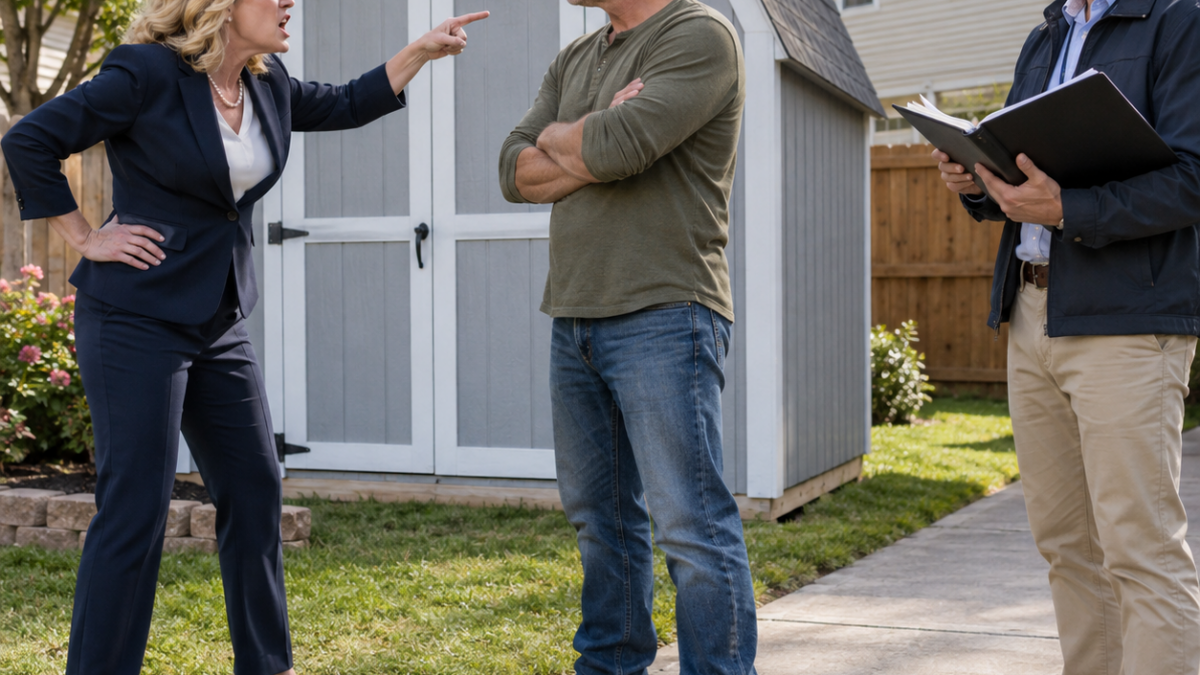
PART 2
Fourteen months earlier, Karen Whitmore had invited me to lunch.
That was how it started.
Not with a threat.
Not with a fine.
Not with an excavator.
Lunch.
The invitation arrived in a cream envelope bearing the embossed logo of Cedar Crest Estates.
The community sat along the eastern boundary of my ranch, an expensive development of stone-front homes, ornamental ponds, manicured entrances, and enough architectural restrictions to regulate the direction the wind was allowed to blow.
My land had been there first.
A little over one hundred forty acres.
Pines.
Pasture.
Creek bottom.
An old ranch house.
Several barns.
One gravel access road.
My grandfather bought the first section in 1957.
My father added acreage in the seventies.
By the time Cedar Crest was developed, our property had already been in the family for generations.
We were not members of their HOA.
Never had been.
There was a recorded boundary, a county road easement, and decades of clean title history making that obvious.
For years, that fact caused no problems.
Then Karen became HOA president.
Cedar Crest residents elected her because she promised professionalism.
At least that was how Owen described it.
“She talks like a bank executive,” he told me.
“Is that good?”
“No.”
Owen Briggs was sixty-one, broad-shouldered, silver-haired, and completely unimpressed by people who confused expensive clothes with competence.
He had managed commercial construction projects before retiring to quieter work.
I hired him initially to supervise repairs while I was traveling.
He became indispensable.
Karen’s lunch invitation said she wanted to discuss “a mutually beneficial infrastructure opportunity.”
I almost threw it away.
Owen read it.
“That means somebody wants your dirt.”
“They can ask.”
“They will.”
Karen received me in the Cedar Crest clubhouse.
Marble floors.
Dark wood.
Huge windows overlooking a golf course.
She sat at a conference table with two attorneys and a man named Richard Hale, vice president of a commercial development company called Westhaven Partners.
Karen smiled broadly.
“Mr. Mercer.”
My name is Daniel Mercer.
Most people call me Dan.
I shook her hand.
“Mrs. Whitmore.”
“Karen, please.”
I remained standing until she gestured toward a chair.
A glossy development map lay on the table.
Richard began.
Westhaven wanted to construct a retail center on property northwest of Cedar Crest.
Grocery store.
Restaurants.
Medical offices.
Boutique retail.
The problem was access.
The existing county road approached from the wrong direction and would require expensive improvements.
The easiest route crossed the southeast corner of my ranch.
They wanted approximately nine acres plus an access corridor.
Richard slid a number toward me.
I read it.
Looked at the map.
Then looked at him.
“No.”
Karen blinked.
Richard smiled professionally.
“Perhaps I should explain how the valuation was calculated.”
“I understand the valuation.”
“This represents a substantial premium over agricultural land prices.”
“I’m not selling.”
Karen leaned forward.
“You haven’t heard the community benefits.”
“I heard enough.”
Her smile stiffened.
“You may want to consider how development around you will affect the future use of your ranch.”
“That sounds like advice.”
“It is.”
“Thank you.”
I pushed the proposal back.
Karen’s attorneys exchanged glances.
Richard tried again.
“We could increase the offer somewhat.”
“No.”
Karen’s tone changed.
“You’re not even going to negotiate?”
“No.”
“Why?”
I looked toward the map.
The proposed road sliced across a wooded rise my father had planted with pines when I was a boy.
Below it was the creek.
Above it sat the old family cemetery.
Seven stones.
Three generations.
I did not owe Karen an emotional explanation.
“It isn’t for sale.”
Karen stared at me.
People like her are comfortable with negotiations because they assume everybody has a number.
A person who simply says no creates a problem.
“I think,” she said slowly, “you may come to regret being inflexible.”
One of her attorneys shifted.
Richard looked down at his papers.
I stood.
“Was that a threat?”
Karen smiled.
“Of course not.”
“Good.”
I left.
Owen was waiting at the ranch when I returned.
“How much?”
I told him.
He whistled.
“And you said no.”
“Yes.”
“Sarah would have said no too.”
That stopped me.
My wife, Sarah, had died five years earlier.
Owen had known her.
She loved the ranch more fiercely than I did.
Selling the southeast corner would have broken the property in a way she would never have accepted.
“I know,” I said.
Owen nodded toward the house.
“You hungry?”
“No.”
“Good. I made chili.”
That was Owen.
The first HOA fine arrived nine days later.
**UNAUTHORIZED AGRICULTURAL EQUIPMENT STORAGE.**
Five hundred dollars.
The violation referred to a tractor parked beside my barn.
I stared at the letter.
Then checked the address.
Cedar Crest Estates Homeowners Association.
I called the management office.
A woman answered.
“I think you mailed me somebody else’s fine.”
She looked up the address.
“No, sir. That is for your parcel.”
“My parcel is not in Cedar Crest.”
“The system shows an enforcement designation.”
“What does that mean?”
“I’m not sure.”
“Then please remove it.”
“I’ll send this to the board.”
Three days later, Karen emailed.
**Your property is within the extended community influence zone and is therefore subject to limited exterior standards affecting Cedar Crest property values.**
I read that sentence twice.
There was no such thing.
Not legally.
Not in our county.
Not in the recorded Cedar Crest documents.
I replied once.
**My ranch is not subject to your covenants. Please do not send further enforcement demands.**
Karen responded:
**That position is under review.**
I should have known.
A week later:
Tall grass.
Then:
Unapproved barn color.
Then:
Commercial equipment visible from community road.
Then:
Improper fence design.
Each notice included fines.
I ignored them.
Karen escalated.
Anonymous complaints began reaching county departments.
Environmental health came out because someone reported chemical dumping.
There was none.
Animal control received a report that livestock were being kept without water.
I didn’t even have livestock at the time.
Code enforcement received photographs of a barn Karen claimed was unsafe.
The barn had passed inspection the previous year.
Each officer who came was professional.
Each complaint closed.
But somebody was spending a lot of energy trying to create inconvenience.
Then survey stakes moved.
Owen noticed first.
He called me at work.
“Dan.”
“What?”
“Our southeast boundary grew legs.”
I was quiet.
“How far?”
“About forty feet.”
“Touch nothing.”
“I know.”
I got home after dark.
We walked the line with flashlights.
New stakes had appeared inside my property.
Bright orange ribbons.
No survey company markings.
One bore a handwritten notation:
**PROPOSED COMMUNITY ACCESS.**
Owen looked at me.
“You still think this is about HOA rules?”
“No.”
The next morning I pulled the security-camera feed.
A pickup had arrived at 2:13 a.m.
Two men got out.
One carried surveying equipment.
Another moved stakes.
They wore jackets with the logo of a private land-consulting company.
I saved the footage.
Made copies.
Then called the county surveyor.
No survey had been authorized through his office.
I also called the company.
Their owner became very quiet after I described the video.
“We were retained for preliminary boundary verification.”
“By whom?”
“I’d need to check.”
“Check.”
He called back two hours later.
Cedar Crest HOA.
I documented everything.
That was when I stopped viewing Karen as merely annoying.
Still, I did not reveal my profession.
That wasn’t a trick.
It was discipline.
My federal position had nothing to do with a civil dispute until evidence crossed into areas relevant to federal law.
I did what any property owner should do first.
Document.
Consult counsel.
Report suspected trespass through normal channels.
Preserve evidence.
A local real-estate attorney sent Cedar Crest a letter demanding the association stop asserting jurisdiction.
Karen did not stop.
She doubled down.
Her next letter contained a new map.
It showed the HOA boundary extending across the southeast corner of my ranch.
The map looked official.
County seal.
Notary stamp.
Survey notation.
Except it was wrong.
I knew the land.
I knew the county map.
And because of my work, I also knew what altered documents often look like.
The fonts were inconsistent.
Line weights changed.
The notary seal looked digitally copied.
I brought the map to the county recorder.
She compared it with the official record.
“That isn’t ours.”
“Could it be an amendment?”
“No.”
“Has anything been filed?”
She searched.
“No.”
The county’s legal department became interested.
So did mine.
Then an unexpected person called.
His name was Thomas Reed.
He was Cedar Crest’s retained attorney.
“I need to speak with you privately.”
“About what?”
“Mrs. Whitmore.”
I said nothing.
“Mr. Mercer, I believe documents are being created using my firm’s name without authorization.”
That changed the temperature immediately.
We met at a diner forty miles away.
Thomas looked exhausted.
He carried a laptop but no briefcase.
“I need to be very clear,” he said. “I am not representing you.”
“Understood.”
“I am counsel to the association, though I am evaluating whether that relationship can continue.”
“Understood.”
He opened his laptop.
“Have you received this?”
The same fake boundary map appeared.
“Yes.”
“My firm did not prepare that.”
“I suspected as much.”
“You suspected?”
“The notary seal is wrong.”
Thomas stared at me.
“What exactly do you do?”
“Government.”
“That’s vague.”
“Intentionally.”
He nodded.
Then showed me payment records.
Cedar Crest dues had been paid to companies I did not recognize.
Whitmore Community Consulting.
Northfield Administrative Services.
CWC Strategic Solutions.
“What are these?”
“I don’t know.”
“You’re association counsel.”
“I handle legal matters. Management handles bookkeeping.”
“Why are you showing me?”
“Because two of these entities share an address connected to Karen’s sister.”
I leaned back.
Thomas continued.
“And because your alleged fines are being booked as receivables even though I advised the board we had no clear covenant authority over your property.”
“Did Karen receive that advice?”
“Yes.”
“In writing?”
Thomas met my eyes.
“Yes.”
That was the beginning of a much larger matter.
I told Thomas he needed independent counsel immediately.
He already had one.
Within weeks, the appropriate financial investigators were contacted.
Records were preserved.
Subpoenas followed.
Thomas ultimately became a cooperating witness.
A forensic accountant named Daniel Reeves began tracing money.
Hundreds of thousands in HOA funds had moved through related entities.
Some payments were disguised as security expenses.
Others as consulting.
Several transfers coincided with deposits into accounts connected to Karen.
Then Reeves found Westhaven Partners.
The developer that wanted my access road.
Payments from a consultant tied to Westhaven had gone into one of Karen’s shell entities.
The amounts increased after I refused the sale.
That was the missing motive.
This had never been an HOA enforcement dispute.
Karen wanted my access corridor because it unlocked a commercial development deal.
And someone was paying her to make the obstacle disappear.
The fake fines were pressure.
The false complaints were pressure.
The boundary manipulation was pressure.
When that failed, Karen escalated toward direct seizure.
The investigation broadened.
Search-warrant affidavits grew thick.
Mail fraud.
Wire fraud.
Money laundering theories.
Extortion.
Document forgery.
Conspiracy.
Misappropriation of association funds.
I did not lead the financial side.
Reeves did.
That mattered.
Because I was also a victim.
Whenever evidence touched my ranch directly, another supervisor reviewed decisions.
We built walls between my personal interest and official authority.
Karen would later claim the case was revenge.
The record showed otherwise.
Independent prosecutors.
Independent agents.
Independent judge.
Independent probable-cause findings.
That was exactly how it needed to be.
Meanwhile, Karen believed she was winning.
Her security contractors began appearing along the property boundary.
Owen photographed them.
One afternoon, their chief, a man named Craig Bell, approached our gate.
“We’ve been hired to enforce temporary community access restrictions.”
Owen laughed.
“On whose land?”
Bell held up paperwork.
Owen didn’t touch it.
“You got a court order?”
“We have association authorization.”
“Then authorize yourselves back onto the road.”
Bell’s expression hardened.
“You’re obstructing lawful enforcement.”
“You’re standing outside my gate talking nonsense in a tactical shirt.”
I watched that exchange later on camera.
Owen became my favorite person all over again.
Karen’s next move was a demand letter.
The HOA claimed I owed more than $190,000 in fines, security expenses, legal charges, and “community impact assessments.”
The number was fictional.
The purpose wasn’t.
She wanted to bankrupt me into negotiation.
That was when the shed entered the story.
The shed itself was boring.
Twenty-four by thirty feet.
Timber frame.
Metal roof.
Set well inside my property.
We needed storage for fencing equipment, irrigation parts, maintenance tools, and seasonal machinery.
County permits were obtained.
Foundation inspected.
No HOA approval required because there was no HOA jurisdiction.
I hired six local contractors.
Owen scheduled concrete.
Karen sent a cease-and-desist notice within forty-eight hours.
**UNAUTHORIZED COMMERCIAL STRUCTURE.**
We ignored it.
Then another:
**FINAL EMERGENCY NOTICE.**
We ignored that too.
What I did not know was that Karen had already approved what she called “direct remedial enforcement.”
Thomas later found the board resolution.
It was extraordinary.
Karen had persuaded three directors to authorize private security and heavy equipment to enter my property and remove “unauthorized community-impact improvements.”
No court.
No sheriff.
No judicial process.
Just their own signatures.
Thomas had not reviewed it.
Neither had their insurer.
The directors later claimed Karen told them counsel had approved it.
She lied.
That resolution became one of the most damaging documents in the entire case.
The morning the federal judge signed the final warrants, I was forty miles away at the field office.
Reeves walked into the conference room carrying a folder.
“We’re good.”
“Everything signed?”
“Yes.”
Searches for the HOA offices.
Karen’s residence.
Two shell-company locations.
Westhaven records.
Arrest warrants for Karen and two associates.
I checked my phone.
A message from Owen had arrived six minutes earlier.
**Karen just showed up with an excavator.**
Then:
**Six armed security contractors.**
Then:
**They’re restraining the crew.**
My stomach dropped.
“What?”
Reeves saw my face.
I showed him.
The operational plan changed in less than two minutes.
Local law enforcement was alerted.
Medical units notified.
The ranch became an active scene.
Our convoy rolled.
Owen called once.
I answered over speaker.
“You safe?”
“For now.”
“Workers?”
“They zip-tied four of them. Two were shoved against the fence.”
“We’re coming.”
“Karen says she has an emergency board order.”
“Does she have a court order?”
“No.”
“Do not physically resist unless necessary to protect life.”
“She’s tearing down the fence.”
I closed my eyes for one second.
“Cameras running?”
“All of them.”
“Good.”
Owen lowered his voice.
“She’s going inside the office.”
“What?”
“I’m watching her walk up the steps.”
“Do not stop her.”
Reeves looked at me.
I knew what he was thinking.
If Karen voluntarily entered, evidence would document whatever she chose to do.
The office cameras covered every angle.
I had also left a particular manila folder on the desk.
Not as bait for a crime.
That distinction mattered.
The folder was a working copy of materials already lawfully obtained through the investigation.
Karen had no reason to touch it.
If she did, that would be her decision.
Owen came back on the phone.
“She had two guards force the door.”
Reeves swore under his breath.
“Stay back,” I told Owen.
“I am.”
“She inside?”
“Yes.”
“Do not follow.”
Then the call ended.
Five minutes later, we reached the valley.
That brought us back to the dust.
The excavator.
My workers bound at the fence.
Karen standing in the middle of my land like she owned it.
The convoy entered fast but controlled.
Agents deployed.
Commands went out.
“FEDERAL AGENTS!”
“HANDS WHERE WE CAN SEE THEM!”
“STEP AWAY FROM YOUR WEAPONS!”
The private security men reacted instantly.
Whatever Karen had told them, they understood the difference between pretending to have authority and encountering agents executing federal warrants.
Hands went up.
One guard dropped to his knees before being ordered.
The excavator operator shut down the engine and raised both hands through the open side window.
Karen did not move.
Her expression was almost impossible to describe.
Not fear initially.
Confusion.
She looked like reality had violated procedure.
Then I stepped from the lead vehicle.
My credentials were visible.
Marshal Service markings across the vest.
Karen stared.
Her eyes moved from my face to the badge.
Back again.
“You?”
That was the first word she managed.
I walked past her.
Straight to the workers.
“Owen?”
“I’m fine.”
One contractor had blood on his wrist where the plastic restraint had cut him.
Another looked furious.
“Everybody okay?”
“My shoulder hurts.”
“Medical team is coming.”
I cut one restraint.
Another agent cut the rest.
“You’re free to leave when cleared,” I told them. “Nobody here has lawful authority to detain you.”
One man looked at Karen.
“She said we were under arrest.”
“I know.”
After everyone was freed, I finally turned toward her.
Karen had recovered enough to become angry.
“This is outrageous.”
I almost admired the consistency.
“Karen.”
“You deliberately concealed that you were federal law enforcement.”
“My employment has no bearing on whether you can enter private land.”
She lifted her binder.
“I have board authorization.”
“For what?”
“Emergency enforcement.”
“Show me the court order.”
“The board resolution is binding.”
“Show me the judicial warrant.”
“You know perfectly well this property impacts our community.”
“That is not a warrant.”
“You cannot intimidate me with your badge.”
“I’m not.”
I kept my voice level.
“You’re under arrest pursuant to a federal warrant signed this morning.”
Her face changed.
“For what?”
An agent stepped closer.
I did not read the full charges myself.
Another deputy handled the arrest.
Again, separation mattered.
Reeves approached beside me.
Karen recognized him from a prior interview request she had ignored.
He held the warrant.
“Karen Whitmore, you are being taken into federal custody.”
She looked around wildly.
“This is because of a shed?”
Reeves actually paused.
“No, ma’am.”
He gestured toward the property.
“The shed may be the least serious thing we discuss today.”
Craig Bell, the security chief, was on his knees nearby.
He began talking immediately.
“She told us this was legal.”
Karen spun.
“Shut up!”
Bell ignored her.
“She said there was a county order.”
“There is!” Karen shouted.
Bell shook his head.
“You showed me an HOA paper.”
“You knew the arrangement.”
“No.”
“Yes, you did!”
That exchange was being recorded.
Bell looked at the agents.
“I have texts.”
Karen froze.
Bell continued.
“She told me to detain the workers if they interfered. I told her we weren’t cops. She said private-property enforcement gave us authority.”
Karen screamed his name.
Bell kept going.
“She paid us through Cedar Crest. I have invoices.”
Reeves looked at another agent.
“Separate him.”
Bell was led away.
Greed-based alliances usually fail the moment consequences become personal.
Then I noticed Karen’s handbag.
Large.
Brown leather.
Pressed tightly under her arm.
One of the office-camera alerts had already hit my phone while we were driving.
I knew what she had done.
Reeves knew too.
He nodded to a female agent.
“Bag is within warrant scope and incident to arrest.”
Karen pulled it tighter.
“You cannot take my personal property.”
The agent secured it.
Karen struggled verbally, not physically.
“That contains privileged HOA documents.”
Reeves looked at me.
I said nothing.
The agent opened the main compartment and removed the manila folder.
Karen’s face collapsed.
There it was.
The packet from my ranch office.
She had taken it after forcing entry.
Reeves held it carefully by the edges.
“What is this?”
Karen’s instinct betrayed her.
“That is association property.”
Silence.
Reeves looked at her.
“What did you say?”
She realized too late.
“Those documents were stolen from Cedar Crest.”
“How do you know what documents are inside?”
Karen’s mouth opened.
Closed.
The folder contained copies of shell-company ledgers, altered land maps, internal emails, and records of the Westhaven kickback arrangement.
Material the investigation already possessed.
Karen had apparently seen them and assumed I had somehow obtained her files privately.
So she took them.
Then claimed ownership.
On camera.
In front of agents.
Reeves did not smile.
Neither did I.
He simply handed the folder to an evidence technician.
“Bag it.”
Karen was advised of her rights.
Handcuffs replaced the leather binder.
She was placed into a transport vehicle.
As the door closed, she looked at me through the glass.
Not furious anymore.
Terrified.
The ranch became an evidence scene for hours.
Local deputies interviewed the workers.
Federal agents photographed the damaged gate.
The destroyed fence.
Excavator tracks.
Forced office door.
Broken lock.
Owen sat on the porch drinking coffee like he had survived a strange weather event.
I sat beside him.
“You okay?”
“Yes.”
He looked toward the fence.
“Need new posts.”
“That’s what you’re thinking about?”
“Posts are expensive.”
I laughed despite myself.
Then he became serious.
“You knew this morning was coming?”
“The warrants, yes.”
“Her showing up?”
“No.”
“She picked the worst possible day.”
“Yes.”
Owen sipped his coffee.
“That woman could fall into a barrel of money and come out owing taxes.”
That might have been the best description of Karen anyone ever gave.
While the ranch was being processed, another team executed the search at Cedar Crest’s clubhouse.
What they found completed the picture.
Server backups.
Deleted emails.
Altered deed images.
The fake notary seal.
Financial ledgers.
Shell-company incorporation documents.
Westhaven communications.
Security invoices.
Private-investigator payments.
And a binder dedicated specifically to my land.
The cover page read:
**SOUTHEAST ACCESS ACQUISITION STRATEGY**
Inside was a timeline.
Pressure through violations.
Boundary “clarification.”
Administrative complaints.
Security escalation.
Construction interference.
Forced access.
Every step documented.
There are crimes committed impulsively.
Then there are people who create binders.
Karen had created a binder.
Thomas Reed, Cedar Crest’s former counsel, reviewed parts of it later with investigators.
He looked physically sick.
“She documented everything.”
Reeves nodded.
“People who think they’re untouchable often do.”
The insurance problem began forty-eight hours later.
Cedar Crest carried multiple policies.
General liability.
Directors and officers coverage.
Crime-related endorsements.
Management liability.
The board assumed insurance would pay for everything.
The injured contractors filed civil claims.
My property company filed notices for destruction, trespass, and business interruption.
Legal defense expenses began climbing.
The directors who had signed Karen’s “emergency enforcement” resolution told each other not to panic.
They were insured.
Then the carrier received the videos.
That changed everything.
The most damaging footage did not show confusion.
It showed intent.
Karen standing beside the excavator.
Her voice clear.
“Proceed with removal.”
Owen asking:
“Do you have a court order?”
Karen replying:
“The board does not require judicial permission to enforce its authority.”
Then:
“Detain everyone until the site is secured.”
Then the excavator striking the fence.
Then Karen ordering deeper excavation.
No accident.
No misunderstanding.
No contractor mistake.
Deliberate action.
The carrier issued a reservation-of-rights letter first.
Then outside coverage counsel reviewed the policies.
Their attorney contacted Cedar Crest’s interim representatives.
The governing documents contained standard exclusions for intentional wrongful acts, criminal conduct, knowing violations, and certain dishonest or fraudulent conduct, subject to the exact wording and applicable law.
The important point was simple.
Insurance exists to cover risks.
It is not a blank check for intentional crimes.
Karen had publicly declared the destruction intentional.
The board resolution helped prove it.
The security invoices helped prove it.
The footage made denial arguments stronger.
The carrier refused to provide indemnity for significant portions of the intentional conduct and reserved or denied coverage for individuals whose actions fell within exclusions.
The board members panicked.
George Talbot, one of Karen’s most loyal directors, called his personal attorney.
“What do you mean they aren’t paying?”
His attorney explained.
“You authorized intentional entry onto land the HOA did not own.”
“Karen said it was legal.”
“Did you ask association counsel?”
“Karen said counsel approved it.”
“Did you see the opinion?”
“No.”
“Did you vote?”
“Yes.”
“Did you sign the resolution?”
George’s silence answered.
The same conversation was happening across Cedar Crest.
For years, Karen had reassured them that the association’s insurance protected board decisions.
That statement was broadly true when directors acted in good faith within policy terms.
It became dangerously false when they knowingly participated in excluded conduct.
Their homes were not immediately “seized.”
Their bank accounts did not vanish overnight.
Reality was slower.
And more frightening.
Lawyers.
Coverage disputes.
Asset-preservation orders in the criminal investigation.
Civil demands.
Possible personal contribution to settlements.
Every signature suddenly mattered.
One board member, Patricia Sloan, drove to Thomas Reed’s office in tears.
“I didn’t understand what I signed.”
Thomas looked at her.
“I warned the board that Mr. Mercer’s ranch was outside Cedar Crest.”
“Karen never showed us that letter.”
“I sent it to all directors.”
Patricia went pale.
She searched her phone.
The email was there.
Unread.
That was the moment she began cooperating.
So did George.
So did another director.
Karen’s kingdom disintegrated not because everyone suddenly became honest.
Because loyalty is cheap when someone else pays the bill.
When the bill becomes personal, people read the fine print.
The workers’ lawsuits hit hard.
Luis Mendoza had suffered a shoulder injury when a guard pushed him into the fence.
Evan Briggs—not related to Owen—had numbness in two fingers from overtightened plastic restraints.
The others had claims for unlawful detention and emotional distress.
I encouraged every one of them to get independent lawyers.
Not mine.
Not the government’s.
Theirs.
Luis called me before filing.
“I don’t want to hurt the homeowners.”
“You aren’t.”
“The HOA money comes from them.”
“Your lawyer will pursue whoever is legally responsible.”
He hesitated.
“My wife says we should sue.”
“Your wife is right.”
“They treated us like criminals.”
“I know.”
Luis eventually settled.
So did the others.
The new Cedar Crest board created a restitution reserve using recovered funds from Karen’s shell entities, corporate settlements, and contributions from former directors.
Homeowners still felt the consequences.
They were furious.
But their anger shifted toward the people who had hidden what was happening.
The commercial developer, Westhaven Partners, initially denied everything.
Then investigators produced emails.
Richard Hale had written to Karen:
**Access remains critical. Apply whatever community pressure is legally available.**
Another message discussed a “success consideration” payable through a consulting entity if access were secured.
Westhaven’s attorneys saw the evidence.
Their tone changed quickly.
Executives cooperated.
The company paid substantial penalties and settlements, terminated involved employees, and abandoned the retail project.
Richard entered his own plea agreement.
Karen lost the one thing that had motivated the entire scheme.
The land was never sold.
No access road.
No shopping center.
No kickback.
Nothing.
The federal indictment against Karen grew.
Fraud counts.
Extortion-related charges.
Money laundering.
Conspiracy.
Document offenses.
The specific charges tied to the ranch invasion included trespass-related state referrals and federal allegations connected to the broader scheme.
False imprisonment claims were also pursued through local and civil channels.
Not every dramatic thing that happened fit neatly into one federal statute.
Real cases are messy that way.
But the evidence was overwhelming.
Karen’s defense became that she believed everything she did was legitimate HOA enforcement.
Then prosecutors showed the jury the attorney warnings.
Thomas testified.
“You advised her the ranch was outside the association?”
“Yes.”
“When?”
“Multiple times.”
“Did she acknowledge receiving your opinion?”
“Yes.”
“What did she say?”
Thomas looked toward Karen.
“She told me I was being timid.”
The prosecutor displayed an email.
Karen had written:
**Authority is meaningless if we are afraid to use it.**
Thomas continued.
“I told her authority does not exist simply because a board votes to create it.”
That sentence became local news.
Owen framed the newspaper clipping.
I told him that was excessive.
He hung it in the ranch office anyway.
The trial lasted weeks.
The footage from the morning raid was devastating.
Karen ordering detentions.
Karen authorizing demolition.
Karen entering the office.
Karen taking the folder.
Karen claiming the documents were hers.
Her attorneys challenged context.
They argued selective editing.
The prosecution played longer clips.
That was worse.
The jury heard Karen tell Craig Bell:
“If they resist, restrain them.”
Then:
“They will understand when the structure is gone.”
Then her declaration to Owen:
“I am the authority here.”
I was sitting behind the prosecution table when that played.
I remembered the first lunch.
The marble clubhouse.
Her disbelief when I said no.
Fourteen months had passed between those two moments.
Every bad decision she made grew from her inability to accept that single word.
No.
Karen was convicted on multiple counts.
Not every charge.
Enough.
Sentencing came months later.
The courtroom was packed.
Residents attended.
Workers attended.
Former board members attended.
Karen wore a dark blue suit.
No leather binder.
No entourage.
Before sentencing, she spoke.
For the first time since I met her, her voice was small.
“I believed I was protecting my community.”
The judge interrupted gently.
“No.”
Karen looked up.
The judge continued.
“You were protecting your control over the community.”
Silence.
“You repeatedly received warnings that you lacked authority over Mr. Mercer’s ranch.”
Karen lowered her eyes.
“You created false documents.”
“You diverted funds.”
“You accepted secret financial benefits.”
“You used private security to enforce claims you knew were disputed.”
“And when lawful process failed to give you what you wanted, you substituted your own authority for the law.”
The judge paused.
“That is not leadership.”
Karen cried.
I felt no satisfaction watching it.
That surprised me.
I had imagined sentencing before.
During the months of harassment, I sometimes pictured Karen finally powerless.
I thought it would feel like victory.
Instead, it felt heavy.
People had been hurt.
Homeowners lost money.
Workers had been terrorized.
Families on the board faced financial ruin because they let Karen think for them.
A commercial project collapsed.
Careers ended.
All because somebody wanted nine acres badly enough to believe rules were obstacles instead of boundaries.
Karen received a substantial prison sentence.
The exact number mattered less to me than the finality.
She would not be returning to Cedar Crest.
Arthur Vance-style theatrical justice wasn’t what happened.
No cheering.
No applause.
Just a federal marshal placing a hand near Karen’s elbow and guiding her toward a side door after the judge finished.
Not me.
Another deputy.
Again, separation.
As she passed, Karen looked toward me.
Our eyes met.
She said nothing.
Neither did I.
The civil aftermath continued another year.
Insurance coverage litigation ended with complicated allocations.
Some negligent acts remained covered.
Intentional criminal conduct did not.
Recovered criminal proceeds helped fund restitution.
Westhaven money helped.
Former directors contributed personally.
Karen’s assets were pursued where legally available.
The lesson for Cedar Crest was brutal.
Having insurance did not mean the board could intentionally commit wrongful acts and expect a corporation to absorb the consequences.
The clause Karen never bothered to understand became famous in the neighborhood.
Intentional acts exclusion.
Owen called it the most expensive paragraph she had ever ignored.
He wasn’t wrong.
The new board election happened six weeks after the arrests.
People who had never attended an HOA meeting packed the clubhouse.
No one wanted power anymore.
That was healthy.
The first person elected president was a retired elementary-school principal named Susan Patel.
She stood before the residents.
“I do not want anyone here to call me powerful.”
A few people laughed nervously.
She continued.
“The board maintains common property, administers contracts, collects dues, and enforces actual covenants on actual member property.”
Then she looked toward the back.
“Nothing more.”
I liked her immediately.
Cedar Crest formally recorded an acknowledgment of my ranch boundary.
No easement.
No jurisdiction.
No access rights.
No enforcement authority.
The agreement was filed with the county so no future board could pretend confusion.
Susan drove out personally with a copy.
Owen answered the door.
He called me.
“HOA president here.”
“Which one?”
“The sane one.”
I came outside.
Susan held out the document.
“I thought you should have the first certified copy.”
I read it.
Clear.
Simple.
Final.
“Thank you.”
She hesitated.
“We owe you more than this.”
“No.”
“Our board—”
“Your board didn’t do it.”
“Our community funded it.”
“That’s different.”
She looked toward the damaged section of fence, still temporarily repaired.
“We’re embarrassed.”
“You should be angry, not embarrassed.”
“At Karen?”
“At the system that let one person operate without review.”
Susan nodded slowly.
“We’re fixing that.”
And they did.
Independent financial audits.
Competitive bids.
Conflict-of-interest disclosures.
Recorded votes.
Outside counsel review for property actions.
No president could authorize private security deployment alone.
Residents could access contracts electronically.
The board created an ethics committee nobody wanted to serve on, which probably meant it was functioning correctly.
Thomas Reed returned as counsel after an independent review cleared him and the membership asked him back.
His first board meeting lasted three hours because every director suddenly wanted every sentence explained.
He called me afterward.
“I preferred them reckless.”
“Why?”
“Meetings were shorter.”
The workers returned to the ranch after the scene was released.
Luis climbed out of his truck and looked at the unfinished foundation.
“You still want the shed?”
“Yes.”
He laughed.
“I thought you might decide it’s cursed.”
“It’s concrete.”
“Concrete can be cursed.”
Owen pointed toward the broken fence.
“Less talking.”
They rebuilt what the excavator damaged.
New posts.
New rails.
Gravel repaired.
Foundation finished.
Then the shed went up.
Timber frame.
Dark metal roof.
Nothing fancy.
The first day we loaded equipment inside, Luis stood in the doorway.
“All this over a shed.”
“No.”
He looked at me.
“What?”
“All this over a road.”
He nodded.
Then looked toward Cedar Crest.
“All this over somebody hearing no.”
That was closer.
When the final civil settlements cleared, each contractor received compensation.
Luis later used part of his money to expand his business.
He bought a new truck.
Every time he came to the ranch, he parked it where Karen’s excavator had torn up the gravel.
“Psychological healing,” he called it.
Owen retired officially the following year.
Then continued showing up four days a week.
“That isn’t retirement.”
“I stopped taking your calls after six.”
“That’s not retirement either.”
“It’s boundaries.”
Karen had taught everyone about boundaries.
Even Owen.
One afternoon, he and I sat on the new shed’s porch step drinking coffee.
The fence stretched cleanly across the property.
No fake survey stakes.
No black-uniformed guards.
No excavator.
Just pasture.
Trees.
Wind.
Owen looked at the shed.
“You know the funniest part?”
“What?”
“It’s ugly.”
I stared at him.
“It is not.”
“It’s a metal-roof storage box.”
“It matches the barn.”
“The barn is ugly too.”
“You’re fired.”
“I retired.”
“Then leave.”
He didn’t.
The ranch became quiet again.
My work eventually changed.
Then I retired.
Real retirement.
No operations.
No warrants.
No emergency calls in the middle of the night.
The first month was harder than I expected.
Sarah used to tell me I wouldn’t know how to stop.
She had been right.
So I worked on the land.
Fence.
Trails.
Creek crossings.
The shed.
I found reasons to use it constantly, perhaps out of spite.
Every tool had a place.
Every shelf labeled.
Owen accused me of turning it into a federal evidence locker.
He wasn’t entirely wrong.
Years after the case, one of Cedar Crest’s younger residents came to see me.
Her name was Emily Carter.
She had been sixteen when Karen was arrested.
Now she was studying public administration.
“My parents still talk about you.”
“That sounds unhealthy.”
She smiled.
“I’m doing a paper about board governance.”
“Also unhealthy.”
She laughed.
Then became serious.
“What made Karen like that?”
I thought about the question.
“Power?”
“Lots of people have power.”
“Fear?”
“She didn’t seem afraid.”
“People rarely do when they’re compensating.”
Emily took notes.
“What was her biggest mistake?”
I could have said forged documents.
Kickbacks.
Trespass.
The stolen folder.
The worker detentions.
The raid.
But none of those were first.
“She stopped believing other people had the right to tell her no.”
Emily looked up.
“That simple?”
“Yes.”
“Then why didn’t anyone stop her sooner?”
Better question.
“Because most of what she did at first was small.”
I looked toward Cedar Crest.
“A nasty letter.”
“A questionable fine.”
“A contract nobody read.”
“A rule stretched a little too far.”
“People tell themselves it isn’t worth the fight.”
“And then?”
“The next thing becomes easier.”
Emily wrote that down.
“So the problem wasn’t just Karen.”
“No.”
That was the truth Cedar Crest eventually had to confront.
Karen was responsible for her crimes.
But unchecked systems create room for people like Karen.
Directors rubber-stamped.
Residents stayed home.
Management processed payments.
Vendors accepted instructions.
Security companies took money.
Everybody assumed someone else had checked.
Then the day came when six workers were zip-tied against my fence.
Institutional failure often looks absurd in hindsight.
At the time, each step seemed just plausible enough to survive.
Until it didn’t.
The insurance company’s denial letter remained one of the documents frequently cited in Cedar Crest training for board members.
Susan eventually showed me the orientation binder.
Page forty-two.
**INSURANCE DOES NOT SUBSTITUTE FOR LAWFUL CONDUCT.**
I laughed.
“Subtle.”
“We tried.”
Below it was a summary:
Coverage may be restricted or excluded for intentional, dishonest, fraudulent, malicious, or criminal acts depending on policy terms and applicable law.
Then, in bold:
**IF YOU DO NOT UNDERSTAND WHETHER THE BOARD HAS AUTHORITY, STOP AND ASK COUNSEL BEFORE ACTING.**
“That one should be page one.”
Susan nodded.
“Probably.”
Karen had threatened to bankrupt me.
In the end, the threat landed backward.
Not because I was richer.
Not because I was a marshal.
Not because federal agents arrived with lights and warrants.
Because Karen had built her own protection around a false assumption.
She believed the HOA’s insurance carrier would stand behind anything she called “board action.”
She believed corporate structure meant personal immunity.
She believed a signed resolution could transform trespass into enforcement.
She believed paying private security could create police powers.
She believed confidence could convert a forged boundary into a real one.
And she believed an insurance company would write checks forever simply because Cedar Crest had paid premiums.
The fine print said otherwise.
Intentional wrongdoing was not what the policy promised to protect.
That clause did not convict Karen.
Evidence did.
It did not sentence her.
A judge did.
It did not compensate every victim by magic.
Lawyers, settlements, restitution, and years of work did that.
But the clause removed the shield Karen had always assumed would protect her from consequences.
For the first time, she could not spend everyone else’s money to defend her own choices.
That changed everything.
Several former directors nearly lost their homes.
Some avoided the worst outcome because they cooperated early and because settlements took account of their individual conduct.
Others paid substantial personal amounts.
One sold an investment property.
Another postponed retirement.
George Talbot came to the ranch years later.
I barely recognized him.
He had lost weight.
His hair was white.
He stood at the gate instead of entering.
“Dan?”
“George.”
“Can we talk?”
I opened the gate.
We sat on the porch.
He looked across the property.
“I hated you.”
“That seems to be a recurring theme.”
He smiled weakly.
“For a while.”
“Why?”
“Because everything collapsed after you said no.”
I waited.
George rubbed his hands together.
“But it didn’t collapse because you said no.”
“No.”
“It collapsed because we wouldn’t accept it.”
I nodded.
He looked toward the shed.
“My wife and I had to sell our lake place.”
“I heard.”
“My retirement account took a hit.”
“I’m sorry.”
He looked surprised.
“You are?”
“Yes.”
“I voted for the raid.”
“You voted for a resolution. Karen misrepresented parts of it.”
“I still voted.”
That distinction mattered to him.
“I didn’t read Thomas’s email.”
“I know.”
“I saw it afterward.”
“I know.”
George looked at the floorboards.
“I kept telling myself board service was volunteer work. That I shouldn’t have to become a lawyer to serve.”
“That’s fair.”
“But I should have read.”
“Yes.”
He nodded.
“I teach that now.”
“What?”
“My church asked me to serve on its finance committee.”
I laughed.
“You accepted?”
“Eventually.”
“And?”
“I read everything.”
“Good.”
He looked toward me.
“Would you ever forgive me?”
I thought about the workers at the fence.
The broken gate.
The excavator.
George’s signature on the resolution.
Then I remembered Karen withholding counsel’s warning.
George admitting fault.
Cooperating.
Paying.
Losing.
Learning.
“Yes.”
His eyes filled.
I hadn’t expected that.
Neither had he.
He stood.
“Thank you.”
“George.”
He turned.
“Forgiveness doesn’t make the vote okay.”
“I know.”
“It means I don’t need to carry it anymore.”
He nodded.
“That’s enough.”
After he left, I sat outside until sunset.
That conversation stayed with me.
During the case, I had believed consequences were the end point.
Years later, I understood consequences were sometimes only the beginning.
People could change afterward.
Communities could change.
Even institutions could.
Cedar Crest became known locally for unusually transparent HOA governance.
That irony amused me.
Residents from other developments attended their public workshops.
Susan gave talks about fiduciary duty.
Thomas created a checklist for enforcement decisions.
Emily Carter graduated and eventually joined the county’s community-association advisory commission.
She called me the day she was appointed.
“I blame you.”
“Good.”
“I’m putting that quote in my office.”
“Which?”
“Other people have the right to tell you no.”
“Make it bigger.”
She did.
Owen eventually died at seventy-nine.
Heart attack.
Quick.
He would have preferred that.
At his memorial, Luis stood beside me.
“You know what I remember?”
“What?”
“Him laughing at Karen’s fake order.”
I smiled.
“He laughed at everything.”
“No.”
Luis shook his head.
“He laughed when people deserved it.”
Owen’s family scattered part of his ashes near the northern fence line.
The good fence.
Not the one Karen destroyed.
I added a small brass plate inside the shed.
OWEN BRIGGS
MANAGER, FRIEND, PROFESSIONAL PAIN IN THE ASS
His daughter approved.
Thomas called it legally risky.
I ignored him.
The shed aged well.
Ten years later, I replaced part of the roof.
Nobody sent a violation.
Nobody appeared with a clipboard.
Nobody threatened bankruptcy.
Susan had retired from the board by then.
A younger man named Caleb served as president.
He drove by one morning while I was on a ladder.
He stopped at the gate.
“Need help?”
“No.”
He looked at the roof.
“Permit?”
“Don’t make me sue you.”
Caleb laughed.
“I had to.”
“Get off my road.”
He waved and drove away.
That was what normal looked like.
An HOA president who understood the joke because he understood the boundary.
The ranch was not theirs.
Cedar Crest was.
And that was enough.
Late in my seventies, I found Karen’s original offer while cleaning my office.
Nine acres.
Access corridor.
Commercial easement.
Lowball price.
The document that started everything.
I sat down and read it.
The proposed road was highlighted in blue.
It crossed the pine rise.
Passed close to the family cemetery.
Cut toward the creek.
I carried the map outside.
The pines were taller now.
The cemetery stones had been cleaned.
Owen’s plaque was inside the shed.
Birds moved through the grass.
Nothing about the scene looked important enough to trigger an empire’s collapse.
That was the strange thing.
The land was quiet.
It had always been quiet.
Karen brought the war to it because she saw only value that could be extracted.
Road access.
Developer money.
Political influence.
Control.
She never understood why I said no because she never understood what I was protecting.
Sarah and I had walked that ridge together.
My father planted trees there.
My grandfather taught me how to track deer along the creek.
There were things money could replace.
That corner wasn’t one of them.
I folded the offer.
For a moment I considered burning it.
Instead, I put it in the evidence file.
Not because I needed proof anymore.
Because someday someone else would own the ranch.
My niece’s son, probably.
He loved the land.
He would inherit clean title, repaired fences, a functioning shed, and an easement agreement that permanently prevented Cedar Crest from asserting access.
I wanted him to understand why those documents mattered.
Not so he would hate Karen.
So he would recognize pressure when it came wearing polite clothes.
That was how Karen started.
Not with armed guards.
With a lunch invitation.
A map.
A low offer.
A smile.
Then a sentence.
“You may regret being inflexible.”
Everything that followed was simply that belief expanding.
She thought refusal justified pressure.
Pressure justified fraud.
Fraud justified coercion.
Coercion justified force.
Eventually she stood on my ranch with an excavator and armed guards, convinced she was still the reasonable person in the story.
That is how abuse of power grows.
Almost never all at once.
By the time Karen realized where she had gone, federal warrants were already signed.
The last time I heard her name publicly was when a reporter called before her release from prison.
“Do you have any comment?”
“No.”
“Do you forgive her?”
“That isn’t news.”
“Do you think she has paid her debt?”
“The court decides her sentence.”
“What would you say if you saw her?”
I looked toward the shed.
“I’d probably say nothing.”
The reporter sounded disappointed.
They wanted a line.
Revenge stories need a final punch.
But real closure is rarely theatrical.
Karen eventually completed her sentence.
She moved somewhere far from Cedar Crest.
I never saw her again.
That was enough.
The workers were compensated.
The ranch was restored.
The fake boundary disappeared.
Westhaven abandoned its project.
Cedar Crest became healthier.
Former board members learned painful lessons.
The insurance carrier rewrote internal procedures for HOA claims involving intentional enforcement actions.
Thomas kept his license.
Emily built a career.
Luis expanded his company.
George learned to read every page.
Owen kept making jokes until the end.
And the shed?
The shed stood.
All that destruction.
All those investigations.
All that money.
All that fear.
Over a building that eventually held fencing tools, irrigation pumps, seed, chainsaws, spare posts, and an embarrassing number of labeled plastic bins.
One winter afternoon, my great-nephew Noah helped me organize it.
He was fourteen.
We spent an hour sorting hardware.
He held up an old zip tie.
Heavy industrial type.
I went still.
“Where’d you find that?”
“In the drawer.”
I took it.
Probably not one from the raid.
Could have been.
Same type.
Noah looked at me.
“You okay?”
“Yes.”
“What happened?”
I told him.
Not the dramatic version.
The true version.
Six workers detained.
Fence destroyed.
Illegal entry.
Arrests.
The financial case.
Insurance denial.
Karen’s conviction.
Noah listened quietly.
When I finished, he asked:
“Were you scared?”
That was not the question adults usually asked.
They asked if I was angry.
If I enjoyed watching Karen arrested.
If I knew all along I would win.
A fourteen-year-old asked if I was scared.
“Yes.”
“Even though you were a marshal?”
“Especially then.”
He looked confused.
“I knew how many things could go wrong.”
“Oh.”
He looked at the zip tie.
“Why didn’t you tell Karen who you were?”
“Would it have mattered?”
“Maybe she would’ve stopped.”
“Maybe.”
“Then why?”
I thought about it.
“Because nobody should have to be a federal marshal to have their property rights respected.”
Noah stared at me.
That was the heart of it.
The story had become exaggerated over the years.
People said Karen “picked the wrong man.”
That made for a satisfying headline.
But it was also the wrong lesson.
She would have been wrong if I were a teacher.
A mechanic.
A farmer.
A retired nurse.
A twenty-two-year-old first-time homeowner.
A widow.
A nobody.
Rights do not become more valuable because the person defending them has a badge.
The badge changed the circumstances of the investigation.
It did not create the boundary.
The deed did.
The law did.
The truth did.
I put the zip tie down.
“Noah?”
“Yeah?”
“If somebody ever tells you they have authority over you, what do you do?”
He smiled.
“Ask to see the paperwork?”
“Good.”
“And read the fine print?”
“Better.”
He pointed around the shed.
“Like Karen’s insurance company.”
I laughed.
“Exactly.”
Karen once threatened to bankrupt me over this building.
She assumed the association would pay her lawyers.
Pay the damages.
Protect the board.
Absorb the consequences.
Then the insurance company read the policy she had apparently never bothered to understand.
Intentional acts.
Fraud.
Criminal conduct.
Excluded.
That clause did not create justice by itself.
But it did something Karen never expected.
It made consequences personal.
For years, every decision she made spent other people’s money.
Residents’ dues.
Association accounts.
Corporate coverage.
Board authority.
Private security paid through community funds.
Lawyers paid through community funds.
The moment those shields disappeared, so did her courage.
That may have been the most revealing part of the entire story.
Karen loved power when somebody else financed it.
She hated accountability when the bill came to her name.
The sun was setting when Noah and I finished organizing.
He locked the shed.
We walked toward the house.
Behind us, the metal roof caught the last orange light.
The repaired timber fence ran straight along the boundary.
Exactly where it had always belonged.
No fake survey stakes.
No security guards.
No excavator.
No Karen.
Just a line.
A simple boundary between my property and somebody else’s.
A line she could have respected fourteen months earlier.
A line that would have cost her nothing.
Instead, she tried to erase it.
And by the time she was finished, she had lost her office, her money, her freedom, her reputation, her allies, and the insurance protection she thought would absorb every consequence.
She had threatened to bankrupt me over a shed.
In the end, the shed remained standing.
The ranch remained mine.
The workers went home free.
And when Karen’s insurance company finally read the fine print, the only person left holding the bill was the woman who had ordered the destruction herself.








