PART 2: HOA karen Stole My Family’s Hot Spring for Her Luxury Spa—So I Legally Cut Off the Water and Turned Her $200K Wellness Center Into a Sauna
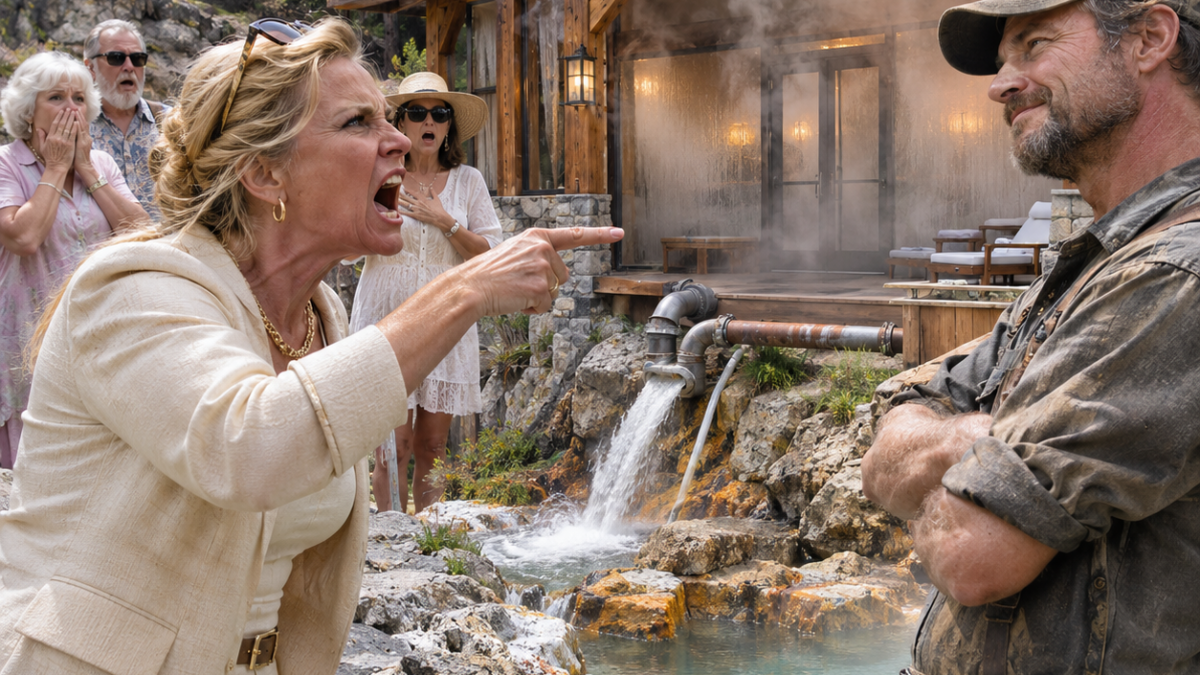
part 2
Summit Ridge Estates went up in 2012 on roughly three hundred acres of former ranch land north of our property.
Three hundred twenty houses.
A small clubhouse.
A gravel walking trail.
Mountain views in nearly every direction.
The original HOA rules were five pages long.
Five.
Most of them could be summarized as:
Don’t burn trash.
Control your dogs.
Don’t make your problems your neighbor’s problems.
Annual dues were eight hundred dollars.
Two board meetings a year.
Forty minutes each.
Nobody hired consultants to determine whether wind chimes were spiritually compatible with the neighborhood.
Then Victoria Prescott and her husband Derek bought the showcase house at the top of the ridge in March 2021.
Four bedrooms.
Three bathrooms.
Wall-to-wall glass.
A deck looking across the valley.
A house designed for someone who wanted an audience even while drinking breakfast coffee.
Victoria was twenty-nine.
Blonde.
Perfectly composed.
Everything about her appeared professionally curated.
Hair.
Clothes.
Makeup.
Voice.
Even irritation seemed rehearsed.
She had spent six years in Denver doing brand strategy for luxury wellness companies.
Boutique spas.
Skin-care lines.
Crystal retreats.
Businesses where a two-hundred-dollar candle became reasonable if the label contained the words intention, sacred, or cellular.
Derek ran Prescott Excavation and Construction.
Grading.
Trenching.
Site preparation.
Utility work.
He knew how to move earth.
Victoria knew how to sell what he built.
That combination should have concerned me earlier than it did.
Victoria ran for HOA president that September.
Nobody else ran.
Her campaign presentation lasted forty-five minutes.
Eleanor attended because she enjoyed anthropology.
She came home holding the brochure.
“Summit Ridge 2.0.”
I looked up from the newspaper.
“What?”
“That’s the title.”
“Of what?”
“Her presentation.”
I took the brochure.
**REDEFINING MOUNTAIN LIVING.**
“She said ‘holistic lifestyle integration’ eleven times,” Eleanor said.
“You counted?”
“Obviously.”
Within three months of taking office, Victoria turned five pages of CC&Rs into thirty-four.
Mailbox colors became restricted.
Not simply black, brown, or gray.
No.
Homeowners could choose from colors Victoria had apparently named herself.
Glacier Whisper.
Pewter Intention.
Brushed Meridian.
Alpine Consciousness.
I still don’t know what consciousness looks like in paint.
Exterior lighting had to meet a specified warmth index.
Firewood visible from the road had to be hidden inside something she called a “design-forward containment vessel.”
Wind chimes required tonal review.
Children were discouraged from front-yard play after six because of the “acoustic wellness perimeter.”
She hired her college roommate as a part-time community aesthetics coordinator for thirty-six thousand dollars a year.
Then hired her Pilates instructor as a sensory-experience consultant.
Four hundred dollars per session.
HOA dues doubled.
And Victoria printed business cards.
Not:
HOA President.
That would have been too ordinary.
Her card said:
**VICTORIA PRESCOTT
CHIEF WELLNESS VISIONARY
COMMUNITY TRANSFORMATION ARCHITECT**
There was a QR code linking to her Instagram.
Eleanor kept one.
“For evidence?”
I asked.
“No.”
She put it on the refrigerator.
“For comedy.”
The first time Victoria came onto our property was October 2021.
I was splitting firewood near the barn.
Her white Range Rover came up the gravel drive.
She stepped out wearing riding boots that looked like they had never come within fifty yards of a horse.
Quilted designer vest.
Dark sunglasses.
She introduced herself and told me she was “connecting with adjacent stakeholders.”
I should have sent her home right there.
Instead, I was polite.
“What do you need?”
“I’d love to understand the energy footprint of the surrounding parcels.”
I looked at the woodpile.
“My energy footprint right now is mostly this axe.”
She laughed.
Not because it was funny.
Because she assumed I was joking in the way old rural men amused city people.
We walked.
Barn.
Fence line.
Meadow.
Then she saw the steam.
She stopped.
The spring lay below us in its stone basin.
Eleanor’s roses spread along the eastern bank.
Water overflowed in a narrow warm creek.
October air made the steam visible.
Victoria stared.
Not casually.
Professionally.
I recognized the look.
I had spent decades sitting across tables from developers.
You can see the instant a landscape stops being land and becomes a project.
Eleanor came down carrying two mugs.
“Coffee?”
She asked Victoria.
Victoria looked at the chipped ceramic mug as though Eleanor had offered her soup in a hubcap.
“No, thank you.”
Then:
“How long has this been here?”
“The spring?”
“Yes.”
“Longer than any of us.”
“And you just use it?”
“What else would we do?”
“You soak in it?”
“Nearly every evening.”
Victoria stared at me.
“Mr. Mercer, do you know what geothermal mineral experiences are worth right now?”
“Not sure I’ve ever had a geothermal mineral experience.”
“You’re sitting in one.”
She pointed.
“People in Bozeman pay three hundred dollars an hour for this.”
I looked at the spring.
“It’s free here.”
“That’s my point.”
“No.”
I smiled.
“That’s mine.”
Her expression changed.
Only briefly.
Then she looked toward the roses.
“Cute.”
Eleanor’s eyebrows lifted.
“Excuse me?”
“The flowers.”
Victoria smiled.
“Very farmers-market.”
She turned.
Walked back toward the Range Rover.
Eleanor watched until the vehicle disappeared.
Then:
“Jack.”
“Yes?”
“That woman is going to be a problem.”
“She’s an HOA president.”
“No.”
Eleanor looked down toward the spring.
“She looked at your grandfather’s water and saw a price tag.”
I shrugged.
“She doesn’t own it.”
“That has never stopped certain people from wanting something.”
As usual, my wife was ahead of me.
Nothing happened immediately.
That probably made us careless.
Victoria continued transforming Summit Ridge.
Newsletters got glossier.
Fees got stranger.
There was a “community sensory audit.”
An “aesthetic resilience initiative.”
A “holistic winter-readiness plan” that appeared to involve changing the approved color of snow-removal marker poles.
I ignored all of it.
Our land was outside the HOA.
Their rules did not apply to us.
The boundary was surveyed.
Recorded.
Old.
I had an adjudicated water right.
What could she realistically do?
That is the kind of question you should never ask about someone with access to an excavation company.
Late April, Eleanor and I drove to Bozeman to visit Emily and the grandchildren.
Ten days.
We locked the house.
Checked the barn.
Spring running normally.
Roses budding.
Creek warm.
Everything exactly where it had been for decades.
We came home Sunday afternoon.
I smelled new concrete before I reached the spring.
If you’ve spent enough time around construction, wet concrete has a particular mineral smell.
Sharp.
Dusty.
Impossible to mistake.
I parked.
Eleanor got out.
Neither of us spoke.
The spring sounded wrong.
That was the first thing.
Normally, you could hear overflow before you reached the patio.
A constant low rush.
Now?
Almost silence.
We walked faster.
The basin had dropped.
The water that once spilled over the lip in a thick curtain now escaped in a thin trickle.
The warm creek was dry.
Not low.
Dry.
Exposed stones.
Cracked mud.
Cottonwoods already showing stress.
Eleanor stopped.
“Jack.”
“I see it.”
Then we looked north.
About sixty feet beyond our fence, on HOA common land where there had been a picnic table ten days earlier, stood a building.
Cedar cladding.
Glass.
River-rock façade.
Flagstone deck.
Two outdoor pools.
Teak loungers.
Stacks of white towels.
A copper sign:
**SUMMIT RIDGE WELLNESS CENTER**
Underneath:
**RESTORE. RENEW. RECONNECT.**
Then another line:
**POWERED BY NATURAL GEOTHERMAL ENERGY**
I remember reading that twice.
Eleanor said:
“Tell me that doesn’t mean what I think.”
“I’m going to find out.”
Inside, someone had built a parody of every expensive wellness resort I had ever seen.
Reclaimed-wood reception desk.
Eucalyptus diffuser.
A bowl of polished stones labeled:
**INTENTION STONES**
A service menu offered things I had trouble reading with a straight face.
Chakra-aligned mineral immersion.
One hundred twenty dollars.
Deep Earth resonance therapy.
Ninety dollars.
Geothermal detox.
Two hundred fifty.
The detox included mineral soaking, cucumber water, and a printed certificate of “cellular renewal.”
I looked at Eleanor.
“They give you a certificate.”
“For what?”
“Apparently your cells.”
“Good. I’ve been worried mine lacked documentation.”
Then I found the pipe.
Second walk around the building.
Twelve-inch PVC.
Barely beneath topsoil.
It ran south.
Toward our property.
I followed it.
Across the property line.
Fifteen feet inside our land.
There, they had tapped the hot spring’s outflow.
Submersible pump.
Diversion assembly.
Nearly all flow captured before it could reach the natural basin.
Our water went into the spa’s two pools.
Steam room.
Treatment rooms.
Hot-stone system.
All of it.
No permission.
No permit that I had signed.
No conversation.
A commercial business had installed a pipe across my property and diverted an adjudicated geothermal water right.
Eleanor wasn’t beside me anymore.
I found her at the east bank.
Kneeling.
Hands in dirt.
The roses.
She looked at me.
“They’re dry.”
“I know.”
“They were fine when we left.”
“I know.”
Those roses had survived Montana winters.
Summer drought.
Deer.
One year when a late freeze killed every first bud.
Eleanor had divided them.
Moved them.
Replanted them.
Fed them.
Thirty years.
Now their warm-water moisture source was nearly gone because somebody wanted a steam room.
Eleanor touched one drooping branch.
“Jack.”
Her voice became very quiet.
“Fix this.”
“I will.”
Victoria arrived twenty minutes later.
Not rushing.
She came up from the spa carrying a stainless-steel bottle with the Summit Ridge logo.
Matching athletic set.
Fresh makeup.
Completely unsurprised.
“Jack. Eleanor. Welcome home.”
I looked at her.
“You built a spa.”
“The board built a wellness center.”
“When?”
“We fast-tracked construction.”
“In ten days.”
“Derek is very efficient.”
“You ran a pipe across my property.”
She waved one hand.
“Through the utility corridor.”
“There is no utility corridor.”
“The community has always maintained subsurface access along—”
“No.”
She paused.
“No what?”
“No easement.”
“It’s in the revised CC&Rs.”
“Your CC&Rs cannot create an easement across land that is not part of your HOA.”
Victoria tilted her head.
A practiced motion.
“Jack, you’re in our community.”
“I am adjacent to your community.”
“Geothermal resources don’t belong to one person.”
“This one does.”
She smiled.
“You cannot own the Earth.”
“I can own an adjudicated water right.”
Her smile weakened.
Eleanor stood.
“How much are you charging?”
Victoria turned toward her.
“Excuse me?”
“The water you stole.”
“Eleanor—”
“How much?”
Victoria’s expression became patient in the way people become patient when they are trying to communicate superiority.
“The Wellness Circle is two hundred fifty dollars monthly.”
“Per person?”
“Yes.”
“Day passes?”
“One fifty.”
“And where does that money go?”
“Prescott Wellness Ventures manages the programming and revenue architecture.”
Eleanor stared.
“Your company?”
“My consulting firm.”
“So HOA residents paid to build a spa, you pipe Jack’s water into it, and your private company keeps the membership revenue.”
Victoria’s jaw tightened.
“That is a very reductive characterization.”
“It’s a very accurate one.”
Victoria looked back at me.
“I’m willing to give you both complimentary Wellness Circle memberships.”
For several seconds, I honestly thought I had misheard.
“You’re offering me permission to pay nothing so I can soak in my own water?”
“A gesture of neighborly synergy.”
Eleanor made a small noise.
I knew that noise.
It meant if I did not end the conversation, she would.
“Thank you for explaining everything,” I said.
Victoria smiled.
“Of course.”
She returned to the spa.
Before going inside, she stopped at the copper sign.
Held up her phone.
Turned slightly toward the mountain light.
Took a selfie.
Eleanor watched.
“I hate her.”
“That was quick.”
“I’ve had two years of preparation.”
That evening we sat on our porch.
Not at the spring.
The basin was too low.
We had coffee anyway.
For thirty years there had been water noise.
That night there was almost none.
The absence was louder than I expected.
Eleanor looked out.
“She’s not going to stop.”
“No.”
“She thinks this is done.”
“Yes.”
Eleanor set down her mug.
“Good.”
I looked at her.
“Good?”
“Let her.”
That was when I started documenting.
Photographs.
Pipe.
Trench.
Pump.
Boundary crossing.
GPS coordinates.
Flow measurements.
Natural flow had fallen to roughly eighteen percent.
I saved every webpage advertising the spa.
Pricing.
Testimonials.
Photographs.
Outside visitors.
Eleanor printed physical copies.
“You know websites can be archived.”
“I know clouds can disappear.”
“They’re not actual clouds.”
“I don’t trust either kind.”
Thursday morning, I went to county code enforcement.
Unauthorized commercial construction.
Unpermitted piping.
Encroachment on private property.
No construction approvals I could locate.
The clerk studied my photographs.
“All of this went up in ten days?”
“Yes.”
“How?”
“Derek Prescott owns an excavation company.”
“That explains speed.”
“Not legality.”
“No.”
She stamped the complaint.
“Inspector will visit.”
Victoria learned about it four days later.
Monday, five certified violation notices arrived from the HOA.
Against us.
The first declared our hot spring an unauthorized recreational water feature.
Fine:
Two hundred dollars per day.
The second targeted Dad’s 1971 stone patio.
Unapproved hardscape.
One hundred fifty per day.
Third:
My bench.
One hundred per day.
Fourth:
Eleanor’s roses.
“Non-approved botanical installation inconsistent with curated landscape palette.”
One hundred per day.
Fifth:
My 2011 Silverado.
Visible from the spa.
Aesthetic impact.
Another hundred fifty.
Total:
Six hundred fifty dollars per day.
Nineteen thousand five hundred a month.
For property outside their HOA.
Eleanor read every page.
Then placed them on the table.
“She fined my roses.”
“Yes.”
“She drained the water that keeps them alive.”
“Yes.”
“Then fined me for the plants she is killing.”
“Yes.”
She looked at me.
“Jack.”
“I know.”
“I want a bigger folder.”
We got one.
Victoria didn’t wait for the inspector.
Three weeks later, Derek’s crews expanded the spa.
Forty percent larger.
Three additional soaking tubs.
Meditation garden.
Thermal yoga pavilion.
Commercial steam generator.
More water.
Our spring dropped below ten percent of normal flow.
The natural basin became a shallow puddle.
The creek disappeared entirely.
Two cottonwoods died.
Then the roses.
All of them.
Thirty years of pink and white clusters turned to brittle brown stems.
Eleanor stood beside them one evening.
She didn’t cry.
That worried me more.
Her mouth formed a narrow line.
Finally:
“Every piece.”
“What?”
“Every piece of evidence you can find.”
She looked at me.
“I want her to lose every single thing she touched.”
That was my wife.
Some people break dishes.
Eleanor builds case files.
While our roses died, Victoria became a minor online celebrity.
@SummitRidgeWellness.
Three posts a day.
Turquoise pools.
Steam.
White robes.
Mountain views.
Captions that sounded like a dictionary had been forced to attend a yoga retreat.
**When the Earth exhales, I inhale purpose.**
**Manifesting hydrothermal abundance one mineral molecule at a time.**
My favorite:
**They said it couldn’t be done. I said, hold my adaptogenic matcha.**
A Seattle travel blogger featured the spa.
A wellness influencer with hundreds of thousands of followers posted a video.
The spa began drawing outside visitors.
They drove past our property to pay Victoria for water coming through our land.
Then the podcast started.
**Thermal Wisdom with Victoria.**
Recorded inside the geothermal grotto.
One episode was called:
**Healing the Masculine: Why Some Men Fear Community Wellness.**
Eleanor played eleven minutes.
Then turned it off.
“That is about you.”
“I gathered.”
“What are you afraid of?”
“Apparently community wellness.”
“Terrifying.”
The spa launched merchandise.
Organic cotton totes.
Water bottles.
Cashmere blankets.
Forty-eight-dollar candles labeled:
**GEOTHERMAL GLOW**
The label said they were inspired by the ancient waters of the Gallatin Range.
Ancient waters coming from Arthur Mercer’s 1948 water right.
Victoria’s HOA website described the valley’s thermal resources as a “shared gift from the Earth.”
The page omitted three things.
Our name.
Our property.
Permission.
That was when I stopped treating it as a property dispute and began working like the hydrologist I had been for thirty-one years.
First:
Water right.
Original filing.
Arthur Mercer.
August 12, 1948.
Adjudicated.
Continuous beneficial use.
Domestic and agricultural flow.
Twelve gallons per minute.
No competing claim.
No abandonment.
No transfer.
No shared community interest.
Under Montana’s prior appropriation system, senior rights matter.
First in time.
First in right.
Victoria could post all the moon-phase graphics she wanted.
The Montana Water Court did not adjudicate based on Instagram engagement.
Second:
Permits.
Wellness center building permit?
None.
Grading permit?
None.
Environmental review?
None.
Commercial certificate of occupancy?
None.
Derek had built a commercial facility faster than some people install a shed and with less paperwork than a food truck.
Third:
Property records.
That was the discovery that changed everything.
Three lots near the spring had been purchased four months before spa construction.
Lots 28, 29, and 34.
Buyer:
Gallatin Thermal Holdings LLC.
Registered agent:
Craig Bower.
Derek Prescott’s business partner.
Prices:
Thirty to forty percent below market.
Why?
I pulled the original engineering reports.
All three parcels sat inside the geothermal influence zone.
Warm saturated soils.
Foundation complications.
Difficult construction.
Expensive stabilization.
Nearly uneconomic at normal conditions.
Unless the geothermal flow changed.
Three weeks after the spa opened, Derek filed applications for three luxury houses.
Project:
**PRESCOTT THERMAL ESTATES**
Combined projected value:
$3.2 million.
I sat at the kitchen table staring at the plans.
Eleanor came in.
“What?”
I turned the map.
She understood almost immediately.
“He needed the ground drier.”
“Yes.”
“So the spa was never only a spa.”
“No.”
“He drains our spring.”
“Yes.”
“Changes the thermal soil conditions.”
“Yes.”
“Builds on those three lots.”
“That appears to be the plan.”
“And Victoria gets to sell the wellness lifestyle around the houses.”
“Yes.”
Eleanor sat down.
“Son of a bitch.”
Then she found the invoice.
HOA transparency portal.
Buried several clicks deep.
Prescott Excavation and Construction.
**Community Wellness Facility Construction and Geothermal Infrastructure Services.**
$182,000.
Paid from HOA funds.
Victoria approved the project.
Derek performed the work.
Derek invoiced the HOA.
Victoria approved payment.
Husband and wife paying their own household through three hundred families’ dues.
Eleanor printed everything.
Set it beside my maps.
“She stole our water to make their land buildable.”
“Yes.”
“And charged the neighborhood to build the thing that did it.”
“Yes.”
She squared the papers carefully.
“Burn her down.”
I raised an eyebrow.
“Legally.”
“Good clarification.”
“And quietly.”
“Obviously.”
Next morning I called Phil Carrian.
Fourteen years together at the USGS Helena office.
Field studies.
Thermal systems.
Water-right disputes.
He retired one year after me but still consulted for Montana DNRC.
I explained.
Phil said nothing for several seconds.
Then:
“Jack.”
“Yes?”
“That is not merely a neighbor dispute.”
“I know.”
“Potential state violations.”
“Yes.”
“Potential fraud.”
“Yes.”
“And if they’ve affected connected waters or misrepresented project approvals, this can get much uglier.”
“I know.”
“Do not touch their pipe yet.”
“I wasn’t planning to.”
“Good.”
“Not without an order.”
“Exactly.”
I hired Cal Whitaker.
Geothermal consultant.
Twenty-six-page report.
The pipe was twelve-inch PVC.
Approximately 230 feet of installed line.
Submersible pumping.
Measured diversion:
About 10.4 gallons per minute.
Roughly eighty-seven percent of the spring’s output.
Cal stood beside the junction.
Shook his head.
“Twenty years doing this.”
“And?”
“Most brazen diversion I’ve seen.”
“They didn’t hide it.”
“No.”
“That’s what bothers me.”
People who hide know rules exist.
Victoria did not seem to believe rules applied.
I filed with DNRC.
County Building Department.
Department of Environmental Quality.
Then waited.
Under the law, I had the right to protect my adjudicated water and stop unauthorized diversion from my property.
But I wanted the government record first.
Victoria found out about the complaints within a week.
Emergency HOA meeting.
Agenda:
**COMMUNITY RESPONSE TO EXTERNAL THREATS AGAINST SUMMIT RIDGE WELLNESS INFRASTRUCTURE**
I was now an external threat.
Hank Dawson called afterward.
Seventy-four.
Retired rancher.
Montana-born.
He had survived forty winters and, by his count, twelve HOA presidents.
“She put on one hell of a show.”
“What kind?”
“Projector.”
“Of course.”
“Printed handouts.”
“Of course.”
“Crystal pitchers.”
“Please tell me not intention water.”
“Jack.”
“No.”
“She called it intention water.”
I closed my eyes.
“What did she say?”
“Forty minutes.”
“About?”
“Protecting our wellness legacy.”
“Our?”
“Apparently all three hundred families manifested the spa together.”
“They manifested it with my water.”
“Your wording is better.”
Then Hank got serious.
“She wants a special assessment.”
“How much?”
“Thirty-two hundred per household.”
I sat forward.
“For legal defense?”
“Yes.”
“Total over a million.”
“Yep.”
“Everyone pays?”
Pause.
“No.”
“Who doesn’t?”
“Victoria and Derek.”
“Of course.”
“Craig Bower.”
I laughed once.
Not because it was funny.
“Three households connected to the project exempt themselves from paying to defend it.”
“That’s what the sheet says.”
“There’s more?”
“She wants to classify your parcel as a community impact zone.”
I stopped.
“What?”
“Says your spring creates geological instability.”
“She wants me condemned.”
“She wants you expensive.”
That sentence was better.
Hank continued.
“Remember the Harpers?”
“No.”
“Woodshop.”
“Vaguely.”
“Brenda—sorry, Victoria—went after them two years ago.”
“Why?”
“Industrial nuisance. Noise. Deliveries. Violations every week.”
“What happened?”
“They sold at a loss.”
“Buyer?”
“Gallatin Thermal Holdings.”
There it was again.
Not an isolated tactic.
A pattern.
Pressure.
Violations.
Expense.
Sale.
Acquire.
Hank sent me Victoria’s five-year wellness road map.
A laminated schedule with lotus-shaped milestones.
Second spa building.
Sound-bath amphitheater.
Cryotherapy chamber somehow “powered by mountain air.”
And:
**PRESCOTT THERMAL LIVING**
Luxury condominiums.
Starting at $1.2 million.
On the same lots Derek’s LLC had bought cheap.
The brochure already existed.
Victoria herself appeared on the cover.
White robe.
Balcony.
Mineral pool.
Gold foil.
**HOME.**
She was not improvising.
The spa was infrastructure for a larger real-estate plan.
Then came Brett Alderman.
Water-rights attorney.
Bozeman.
Four hundred fifty dollars an hour.
The HOA website introduced him as:
**OUR COMMUNITY HYDROLEGAL ADVOCATE**
His letter claimed geothermal energy was a shared subsurface natural resource.
He demanded I withdraw my DNRC complaint.
I read it twice.
Then called Phil.
“Have Western water laws changed since breakfast?”
“No.”
“Just checking.”
“Why?”
“I have a four-hundred-fifty-dollar-an-hour letter suggesting my 1948 adjudicated right is now community energy.”
Phil laughed for eleven seconds.
Then:
“Send it.”
I did.
His reply:
“He knows better.”
“I agree.”
“He’s billing.”
“I agree.”
Victoria escalated publicly.
Magazine interview:
**THE NEIGHBOR WHO WANTS TO SHUT DOWN OUR HOT SPRING**
Our hot spring.
I became a bitter recluse monopolizing nature.
She appeared beside the mineral pool in white linen looking like someone defending a national park.
Petition:
**SAVE SUMMIT RIDGE’S NATURAL HOT SPRING**
Eight hundred forty-seven signatures.
People began treating me differently.
A woman at the gas station told me I should be ashamed of “keeping water from families.”
Someone placed the petition under my windshield wiper.
One HOA Facebook post suggested sending “love” toward our property so the land could “release its attachment to outdated ownership paradigms.”
Victoria shared it with a heart.
I showed Eleanor.
“She wants the land to emotionally surrender title.”
“So it seems.”
“Should we send the deed a therapist?”
Three residents proposed a candlelight vigil at our fence.
It rained.
Nobody came.
One afternoon, a process server delivered another letter.
Before leaving, he told Eleanor:
“Ma’am, the whole community thinks your husband is being selfish.”
Eleanor took the envelope.
“My husband’s family was here before this community existed.”
The man shifted.
“And you can tell Victoria her yoga pavilion is running on borrowed time.”
She closed the door.
I heard from the kitchen.
Couldn’t stop smiling.
The old residents knew better.
Hank.
Margaret Sullivan, who had taught third grade in Cottonwood County for thirty-eight years.
Ray Culvin, whose basement had started taking water after the spring’s flow was disrupted.
One by one, they stopped by.
Not dramatic.
Pickups.
Cookies.
Coffee.
Stories.
Margaret handed Eleanor oatmeal cookies.
“She’ll burn herself out.”
“You think?”
“I taught third grade.”
Margaret shrugged.
“I know her type.”
Then she said something I still remember.
“Women like that build castles out of other people’s things, then act surprised when the real owners show up with a receipt.”
I added that sentence to memory.
We waited.
September.
Thursday morning.
White envelope.
State seal.
DNRC.
Case number.
Two pages.
Finding:
Unauthorized diversion.
Our water right:
Valid.
Current.
Uncontested.
Victoria’s operation:
No legal claim.
Order:
Cease unauthorized diversion.
Restore natural flow within thirty days.
Potential civil penalties for noncompliance.
I read it twice.
Eleanor read it once.
Then:
“Call Cal.”
I picked up my phone.
“Monday?”
“Monday.”
Cal arrived at seven.
Two technicians.
Backhoe.
Materials.
Eleanor brought out coffee.
No champagne.
No ribbon.
No social-media countdown.
Just work.
The plan was simple.
First:
Excavate the unauthorized PVC where it crossed our boundary.
Cap it.
Steel plate.
Concrete seal.
Their pipe ceased functioning in forty minutes.
Second:
Clear the natural overflow channel.
Third:
Install a stone-and-concrete weir directing the spring back into its historic basin and meadow channel.
No pump.
No fancy system.
Gravity.
Bedrock.
Topography.
And seventy-six years of legal priority.
At eleven, the spring began returning.
Not dramatically.
A thin flow.
Then more.
Water entered old cracks in the stone.
Darkened the dry basin edge.
Steam rose.
Within an hour, half the basin had filled.
By afternoon, the water reached the lip.
Overflowed.
Entered the warm creek channel.
Started moving toward the cottonwoods again.
Eleanor sat on Dad’s stone patio.
I brought two cups of coffee.
Neither of us said anything.
We listened.
That sound.
Water over stone.
Low.
Steady.
The background noise of thirty years of marriage.
Eleanor’s eyes were wet.
Mine probably were too.
We didn’t need to discuss it.
Then my phone began vibrating.
Summit Ridge Facebook group.
First post:
**IS ANYONE ELSE’S POOL EMPTY?**
Then:
**STEAM ROOM HAS NO STEAM.**
A woman posted a photograph of herself in a bathrobe standing in an empty pool.
Caption:
**DROVE 45 MINUTES FOR MY CELLULAR RENEWAL SESSION AND THERE’S LITERALLY NO WATER.**
Another member wrote:
**This is an energetic disruption. The Earth is recalibrating. Give her space.**
I read it to Eleanor.
“She’s right.”
“What?”
“The Earth recalibrated.”
I laughed.
The community aesthetics coordinator posted an official statement.
**Summit Ridge Wellness Center is experiencing a temporary geothermal adjustment. We are working with the Earth’s timeline.**
A temporary geothermal adjustment.
I had legally capped an unauthorized pipe.
Apparently the Earth had a timeline.
At 3:15, tires hit gravel.
Fast.
White Range Rover.
Victoria stopped hard in our driveway.
Door opened before the engine fully died.
She came toward us.
No perfect smile.
No curated voice.
No serenity.
“What did you do?”
I held my coffee.
“Redirected my water.”
“You cannot do that.”
“I can.”
“You shut down the spa.”
“I stopped an unauthorized diversion on my property.”
“You had no right.”
“The DNRC disagrees.”
“I will sue you.”
“You’ve already hired a lawyer.”
“I will take everything you own.”
“No, Victoria.”
I looked at her.
“You won’t.”
She was breathing fast.
“Your lawyer knows that too.”
“He—”
“That’s why he wrote letters and didn’t file for an injunction.”
Eleanor stepped onto the porch.
Coffee in hand.
“Victoria.”
Victoria turned.
“Your mineral pools are empty.”
Silence.
“Your geothermal grotto has no geothermal water.”
Victoria stared.
“Your steam room has no geothermal steam.”
“Eleanor—”
“And your two-hundred-thousand-dollar wellness center?”
Eleanor smiled.
“It’s a sauna.”
Victoria’s face changed.
“A very expensive sauna.”
I had married the right woman.
Victoria looked past us.
At the spring.
Steam rising again.
Water flowing.
The roses were dead, but the basin was alive.
“This isn’t over.”
“Yes.”
I said it quietly.
“It is.”
She glared.
“It’s been over since 1948.”
She got back into the Range Rover.
Drove away.
For the first time since meeting her, Victoria did not take a photograph.
County inspectors arrived Monday.
No building permits.
No grading approval.
No certificate of occupancy.
Stop-work order.
Cease operations.
Daily penalties until compliance.
Two days later, the county attorney opened an investigation.
Prescott Wellness Ventures.
Water theft allegations.
Fraud.
HOA-fund misuse.
Unpermitted construction.
The $182,000 payment to Derek’s company became a central issue.
Then investigators followed the spa revenue.
Ninety-three thousand four hundred dollars.
None had entered the HOA’s accounts.
Every dollar went to Victoria’s private company.
Residents had financed construction.
Victoria kept operating revenue.
That detail did more to destroy her support than anything I said.
People will tolerate a surprising amount of nonsense in the name of community.
They become much less spiritual when somebody steals from them personally.
Brett Alderman withdrew from representation.
His notice cited irreconcilable differences over strategy.
Hank read it.
“Translation?”
“He looked at the DNRC order.”
“And?”
“He prefers being licensed.”
The HOA called a special election.
This time people showed up.
Victoria was removed:
271 to 4.
The four votes to keep her came from Victoria, Derek, Craig Bower, and Craig’s wife.
According to Hank, Craig’s wife told somebody afterward she only voted that way because Craig asked and she felt bad for him.
The million-dollar special assessment disappeared.
Community aesthetics coordinator:
Gone.
Sensory consultant:
Gone.
Thirty-four pages of CC&Rs:
Gone.
Replacement rules:
Eight pages.
Mostly:
Don’t burn trash.
Control your dogs.
Don’t make your problem somebody else’s.
Civilization survived.
The spa did not.
It sat empty through winter.
Cedar exterior.
Expensive tile.
Pools collecting rain and leaves.
The geothermal grotto developed mold.
Teak loungers bleached under snow.
The copper sign began coming loose.
By February, one mounting bolt rusted enough that:
**RESTORE. RENEW. RECONNECT.**
hung crooked in the wind.
Eleanor and I walked past once.
She stopped.
“Do not laugh.”
“I’m not.”
“You’re laughing internally.”
“Very loudly.”
The retail corner still contained forty-eight-dollar geothermal candles.
No geothermal water.
Plenty of candles.
The bowl of intention stones stayed on the desk.
The service menu curled at the edges.
The podcast microphone remained on its teak stool in an empty tiled room.
No steam.
No guests.
No thermal wisdom.
Eventually, the new board voted to repurpose the structure.
Not demolish it.
That would have wasted the money residents had already lost.
They removed the pools.
Removed the illegal geothermal plumbing.
Installed folding tables.
A normal coffee machine.
Actual coffee.
The yoga pavilion became a reading room.
Hank donated reclaimed barnwood shelving.
The meditation garden was replanted with native plants.
Indian paintbrush.
Arrowleaf balsamroot.
Montana wild roses.
The roses were Eleanor’s suggestion.
Nobody objected.
Derek took a plea agreement.
Full restitution of the $182,000.
Community service.
Three years’ probation.
Victoria went to trial.
Two fraud convictions.
One embezzlement conviction.
Restitution of the $93,400 in spa revenue to the people who had paid for access to water she never owned.
The three development lots were seized and sold at market value.
Proceeds went back into the HOA reserves.
Prescott Thermal Estates disappeared before a foundation was poured.
Victoria and Derek sold their ridge house.
Moved to Missoula.
Someone later showed me her new social-media biography.
**Pivoting with purpose. New chapter loading. Phoenix energy.**
Eleanor looked at it.
“Same woman.”
“Different zip code.”
“Exactly.”
Then she handed my phone back.
That was the last time I checked.
The spring did not heal instantly.
That mattered.
People like a clean ending.
Pipe capped.
Water restored.
Everything returns.
Nature rarely follows a screenplay.
The source recovered slowly.
Thermal pressure stabilized over seasons.
The creek returned.
The cottonwoods that had survived put out new growth.
The two that died remained dead.
The original roses did not come back.
What disappeared in those months was actually gone.
Eleanor knew that better than I did.
The following April, she ordered Montana roses from a nursery in Helena.
Same variety.
She opened the box on a Saturday morning.
Bare roots wrapped in damp paper.
I stood beside her.
“Need help?”
“No.”
“You always say no.”
“Because you plant too deep.”
“I worked for the USGS.”
“Exactly. Rocks. Water. Not roses.”
She carried the first plant down.
Steam lifted from the basin.
A red-tailed hawk circled the ridge.
Eleanor knelt where the old roses had been.
Dug.
Set the roots.
Pressed the soil.
One.
Then another.
Then another.
I watched.
Thirty years earlier, she had done the same thing.
Different hands now.
Older.
Same patience.
By June, five clusters bloomed.
Not much.
Small.
Pink.
White.
Dew on the petals in morning.
Enough.
Hank came over that afternoon.
He watched Eleanor watering them.
“She’d make a hell of a garden-club president.”
“Don’t give her ideas.”
From the bank:
“I heard that.”
Hank smiled.
“You considering it?”
“No.”
“Why?”
“I already have one institution to supervise.”
She pointed toward me.
“Marriage.”
He laughed so hard he had to sit on Dad’s stone wall.
By the following summer, the spring returned to twelve gallons per minute.
The same flow Arthur Mercer had recorded decades earlier.
The natural basin reached its old depth.
Warm creek moved through the meadow.
Steam rose on cold mornings.
Wild roses began thickening along the bank again.
Not the same roses.
That is important.
Replacement is not restoration in the sentimental sense.
You can replant.
You cannot make a thirty-year-old root system reappear.
But you can decide that destruction does not get the final word.
The new HOA board learned that too.
For years, residents had assumed Victoria’s problem was personality.
Too controlling.
Too expensive.
Too obsessed with appearance.
After investigators opened the books, people realized personality had simply been camouflage.
The real danger was concentrated authority.
One president could hire friends.
Rewrite rules.
Approve construction.
Direct funds to her husband.
Invent special assessments.
Use HOA language to intimidate adjacent landowners.
And because the documents looked official, people obeyed.
The new board changed all of that.
Related-party contracts required disclosure.
Major expenditures required multiple bids.
Recorded votes.
Meeting notice.
Financial statements that did not hide behind something called a transparency portal.
No president could unilaterally approve a six-figure project.
Hank told me:
“Meetings are boring now.”
“Good.”
“Forty-five minutes about snow removal.”
“Excellent.”
“No mood board.”
“Civilization advances.”
Margaret Sullivan joined the finance committee.
She had spent thirty-eight years teaching third graders.
According to her, board members were easier because:
“Children eventually admit when they took the crayon.”
The community center became busy.
Book club.
Potlucks.
Emergency-preparedness workshops.
Actual yoga sometimes.
Nobody charged sixty dollars for the floor being warm.
The old spa pools were filled and converted into sunken seating areas.
Hank called them:
“The only legal deep-Earth resonance installation in Montana.”
Nobody knew what that meant.
Neither did he.
The funny part was that Summit Ridge became a better community after losing its “wellness center.”
People stopped talking about manifesting connection and started connecting.
That seemed healthier.
Eleanor and I remained outside the HOA.
Always.
There was no reason to join.
But relationships repaired.
Not with everyone.
Some residents had spent months calling me selfish.
A few never apologized.
That was fine.
I did not need one hundred apologies.
What mattered was that nobody touched the spring again.
One woman came by with a pie.
She had signed the Save Summit Ridge petition.
She stood on our porch.
“I’m embarrassed.”
“About?”
“The petition.”
“You believed what you were told.”
“I said things online.”
“I don’t read much online.”
“That’s probably wise.”
She looked toward the spring.
“Can I ask something?”
“Sure.”
“Did you really have the water right the whole time?”
“Since my grandfather.”
“And Victoria knew?”
“She was told.”
The woman closed her eyes.
“I paid for a membership.”
“Many did.”
“I thought the water belonged to the HOA.”
“I know.”
She handed me the pie.
“I’m sorry.”
“Thank you.”
Eleanor came out.
“What kind?”
“Apple.”
Eleanor accepted immediately.
Forgiveness becomes much more efficient with pie.
Not every neighbor came.
They didn’t need to.
Over time, the story became ordinary local history.
Arthur Mercer’s spring.
Victoria’s spa.
The pipe.
The DNRC order.
The community-center conversion.
People told it incorrectly.
Some versions claimed I shut the water off during Victoria’s grand-opening ceremony.
I didn’t.
Some claimed the pools drained while she was livestreaming.
Also false.
One story had me dynamiting the pipe.
Absurd.
I capped unauthorized PVC on my own property under a state order.
People find paperwork disappointing.
They prefer dynamite.
But the paperwork was the point.
I did not beat Victoria because I was angrier.
I beat her because her entire plan depended on nobody checking ownership.
She assumed an HOA could create an easement by editing CC&Rs.
It could not.
She assumed geothermal water was free because it came from the Earth.
It was not.
She assumed senior water rights were old-fashioned technicalities.
They were not.
She assumed building fast meant regulators would accept what already existed.
They did not.
She assumed homeowners would keep paying as long as she called expenses “wellness infrastructure.”
They stopped.
She assumed a polished story could survive ugly documents.
It didn’t.
The investigators did not care about her follower count.
The Water Court did not care how many people signed an online petition.
The spring definitely did not care.
Water followed pressure.
Elevation.
Geology.
And once we removed the unauthorized diversion, gravity did the rest.
I spent thirty-one years explaining that sort of thing.
People love pretending water can be negotiated with.
Developers especially.
They call it management.
But water is brutally literal.
Give it a channel.
It moves.
Block it.
Pressure changes.
Pump it.
Another place loses flow.
Victoria’s luxury spa existed because our spring was being emptied.
There was no magic.
No “hydrothermal abundance.”
Just a pump.
Pipe.
And theft.
When the pump lost access, the spa lost its identity.
That simplicity embarrassed her more than any speech could have.
One afternoon, months after the building became a community center, Hank and I were standing near the old spa mechanical room.
Most equipment had been removed.
He pointed at the capped line.
“You ever tempted to reconnect it?”
“No.”
“Not even for community events?”
“No.”
“Why?”
“It would require a lawful agreement.”
“Could make money.”
“Yes.”
“Ever think about it?”
I looked toward our property.
“No.”
Hank nodded.
“Good.”
“Why?”
“I wanted to see if you’d become Victoria.”
I laughed.
“Go home.”
He did.
The water right could have become commercial.
That was the irony.
Victoria was not wrong about the economic value.
A legal geothermal operation might have made substantial money.
But value is not an obligation.
Just because something can be monetized does not mean it should be.
Eleanor and I had enough.
The spring was never wasted because we used it privately.
That concept irritated Victoria.
To her, unused revenue was failure.
To us, an evening with coffee was use.
A marriage is full of things that would make terrible business plans.
Long conversations.
Slow dinners.
Gardens.
Old dogs.
Watching storms.
None produce quarterly growth.
That does not make them worthless.
The spring was one of those things.
For thirty years it had been where we returned to each other after ordinary days.
Good days.
Bad days.
Emily leaving for college.
My retirement.
Parents dying.
Grandchildren being born.
Arguments.
Apologies.
Silence.
We carried mugs down.
Sat in warm water.
Reset.
Victoria saw that and thought:
Three hundred dollars an hour.
That was the difference between us.
After the roses returned, Eleanor started carrying pruning shears down with her coffee.
I told her:
“You’re combining work and relaxation.”
“It’s six dead blooms.”
“Slippery slope.”
“You mapped aquifers on vacation.”
“Once.”
“Seven times.”
“Those were interesting formations.”
“Exactly.”
We were back.
That was the real ending.
Not Victoria leaving.
Not court.
Not restitution.
Us arguing about pruning beside full water.
The spring itself took on a new sound after restoration.
That is probably impossible.
Acoustically, it was the same.
But absence changes how you hear something when it returns.
The creek murmur felt louder.
More specific.
Every evening, I noticed it.
Eleanor did too.
Sometimes we carried coffee down and didn’t talk for twenty minutes.
Just listened.
One night, she said:
“I thought we’d lost this.”
“I didn’t.”
She looked at me.
“You’re lying.”
“Yes.”
“Good.”
“I thought we could get the legal right enforced.”
“That wasn’t what I meant.”
I knew.
“You thought the place would feel different.”
“Yes.”
“It does.”
She looked around.
“Bad?”
“No.”
“Me neither.”
The basin had scars.
Pipe work.
Dead trees farther down.
New roses.
History does that.
Places remember through differences.
We could have reconstructed everything to look exactly like 2021.
We didn’t.
The new roses were allowed to be new.
The dead cottonwood trunks stayed until storms eventually took them.
Dad’s patio remained.
My bench remained.
The natural channel was reinforced where necessary but not landscaped into perfection.
We wanted the spring back.
Not a replica.
Emily brought the grandchildren up that summer.
The youngest had not understood the whole dispute.
He walked down.
Looked at the steam.
“Is this the water that lady took?”
“Yes.”
“All of it?”
“Most.”
“Why?”
“To make money.”
He considered that.
Then:
“Did she give it back?”
“I took it back legally.”
He nodded.
“Can I get in?”
“Yes.”
That was all he needed.
Children are efficient.
He splashed his sister.
Eleanor yelled.
Emily laughed.
For an hour, the spring belonged to exactly what my grandfather had intended without ever writing it down.
Family.
No membership.
No QR code.
No cellular-renewal certificate.
Later, Emily sat on the patio with me.
“Mom told me about the roses.”
“She replanted.”
“I know.”
“She’s okay.”
Emily looked at the bank.
“Are you?”
I thought.
“Yes.”
“You sure?”
“No.”
She smiled.
“Better answer.”
Apparently every woman in my family had developed the same technique.
The legal files stayed in my office for years.
Water-right documents in one drawer.
Spa investigation in another.
Prescott Thermal Holdings.
Invoices.
Photographs.
DNRC order.
Sometimes I opened them for attorneys or regulators who wanted to discuss the case.
Mostly I left them alone.
The 1948 filing was the one document I kept in a fireproof safe.
Arthur’s signature.
Old paper.
Priority date.
Twelve gallons per minute.
There is something humbling about receiving protection from a decision made by a man who died decades before your problem existed.
Granddad did not file that right to defeat a wellness entrepreneur.
He filed it because people in 1948 understood water was survival.
Domestic use.
Animals.
Land.
Family.
He protected it because that was what responsible people did.
The protection waited seventy-six years until I needed it.
That changed how I thought about inheritance.
The most valuable things your family gives you may look boring.
Deeds.
Rights.
Records.
Maintenance.
Good habits.
They do not look like wealth until somebody tries to take what they protect.
Arthur gave us a filing.
Dad gave us the patio.
Eleanor gave us roses.
I suppose my contribution was making sure the next generation still had water to sit beside.
That was enough.
When the new board converted the spa into a community center, they asked whether they could name a room after us.
Eleanor immediately said no.
I agreed.
They asked about Arthur.
“No.”
“The spring?”
“No.”
Hank finally said:
“How about just Meeting Room A?”
“Perfect.”
So the old geothermal grotto became Meeting Room A.
Nothing spiritual.
Folding chairs.
Whiteboard.
Bookshelves.
Coffee.
The sign outside simply read:
**SUMMIT RIDGE COMMUNITY CENTER**
I liked it.
Useful.
Unpretentious.
One afternoon I saw children doing homework where Victoria had once recorded her podcast.
A boy sat on the old teak stool.
His backpack on the floor.
No steam.
No camera.
No $250 package.
That felt like a fitting reuse.
Victoria had tried to turn common life into luxury branding.
The community turned luxury branding back into common life.
Better.
The three seized development lots eventually sold.
Not as Prescott Thermal Estates.
Individual parcels.
Proper disclosures.
Geotechnical requirements included.
No claims of integrated geothermal living.
No woman in a white robe on a balcony.
Just land with limitations.
That is how property should be sold.
Tell people what it is.
Not what your marketing department wishes it were.
The HOA reserves recovered enough to stabilize dues.
The million-dollar legal assessment never happened.
People were furious for a while about the $182,000.
Understandably.
Then they got tired.
Communities heal partly because people eventually want to talk about snowplows instead of fraud.
That is healthy.
Margaret told me at a potluck:
“You know we spent thirty minutes arguing about mailbox replacement last week.”
“Colors?”
“One color.”
“Which?”
“Black.”
“No Glacier Whisper?”
“Don’t say that name in my presence.”
We laughed.
Normal conflict.
Wonderful.
Eleanor’s roses grew.
Second year:
More blooms.
Third:
Thicker stems.
The warm creek stabilized.
New willow growth appeared along the edges.
The surviving cottonwoods recovered.
One spring morning, I saw steam rising through the roses exactly the way it had in 1994.
Not identical.
But close enough to stop me.
Eleanor was behind me.
“You see it?”
“Yes.”
“Take a picture.”
I did.
Then she said:
“No.”
“What?”
“Put the phone away.”
I did.
We stood there.
That was better.
One day a young reporter came from Bozeman.
She wanted an anniversary story.
“Mr. Mercer, people call this the spa revenge case.”
“People need hobbies.”
“Would you call what you did revenge?”
“No.”
“What would you call it?”
“Enforcing a water right.”
She looked disappointed.
“That’s not very dramatic.”
“It was dramatic enough for me.”
“You knew shutting the diversion would empty the spa.”
“Yes.”
“And you waited until the DNRC ruling.”
“Yes.”
“So you timed it.”
“I complied with the order.”
She smiled.
“That sounds carefully worded.”
“I spent three decades around agencies.”
She tried another angle.
“When Victoria arrived in your driveway and saw the spring restored, did you enjoy it?”
“Yes.”
She blinked.
I smiled.
“I’m retired, not dead.”
She laughed.
That quote made the article.
Fair.
I did enjoy it.
There is no virtue in pretending otherwise.
The important difference is that I did not create harm just to enjoy her reaction.
I stopped harm being done to us.
Her business collapsed because it depended on property she never controlled.
That was her design flaw.
Not mine.
Engineers call that a single point of failure.
Her entire spa.
Her brand.
Her expansion.
Three proposed luxury residences.
All depended on one water source.
A source owned by somebody else.
No written agreement.
No valid easement.
No change authorization.
No permit.
Nothing.
If Derek had brought that plan to an engineering review during my USGS years, I would have asked one question:
“What happens when the senior right holder says no?”
Apparently nobody asked.
Or perhaps Victoria believed nobody would.
That was her biggest mistake.
She confused lack of confrontation with lack of rights.
For months, I had not stopped her.
That did not mean I could not.
I was documenting.
Waiting.
Building the record.
She mistook patience for surrender.
People like Victoria often do.
They are used to resistance arriving loudly.
Shouting.
Threats.
Public arguments.
When none of that happens, they assume they’ve won.
But some of the most dangerous words in a dispute are:
“Let me check the records.”
That is what I did.
The records were older than her HOA.
Older than her house.
Older than Derek’s company.
Older than Victoria herself.
1948.
A date does not care about branding.
Sometimes I wonder what Arthur would think.
His little stone depression between granite outcroppings briefly became an online luxury wellness destination.
He would not understand half the terminology.
“What’s chakra alignment?”
I imagine him asking.
“No idea, Granddad.”
“Why are people paying to sit in hot water?”
“Also unclear.”
He would probably stare at the $250 price.
Then at me.
“Are they stupid?”
“Granddad.”
“What?”
He was a practical man.
He shod horses.
Fixed leather.
Filed rights.
Kept receipts.
He would have understood the important part.
Someone took water.
We stopped them.
He might have been less diplomatic than I was.
Dad would have been furious about the patio fine.
That amused me.
The bench violation too.
Dad spent weeks hauling those stones.
If Victoria had told him they violated a curated landscape palette, I doubt the conversation would have ended with certified mail.
Maybe it was good the dispute came to my generation.
Eleanor was enough fire for both of us.
The roses mattered most to her.
Even after restitution.
Even after the spa was gone.
She never talked about the $93,400.
Rarely mentioned the $182,000.
But she remembered the exact place every old rose had grown.
“This one was from 1999.”
“This section came from the plant your mother gave us.”
“This was the one Emily nearly killed with a bicycle.”
New plants went where old ones had stood.
She did not try to pretend they were the same.
She kept the memory and the new growth separate.
I think that was wise.
One evening, while we were soaking, she touched one of the new branches.
“People say they came back.”
“The roses?”
“Yes.”
“They didn’t.”
“I know.”
“These are new.”
“I know.”
She looked at me.
“I like that.”
“Why?”
“Because I don’t want Victoria getting credit for some resilience story.”
I laughed.
“She doesn’t.”
“She killed the old ones.”
“Yes.”
“We planted new ones.”
“Yes.”
“That is not the same thing as saying she made us stronger.”
“No.”
“Good.”
Eleanor leaned back against the stone.
“I hate that sentence.”
“What sentence?”
“Everything happens for a reason.”
“So do I.”
“Some things happen because somebody is an ass.”
I nearly spilled my coffee into the spring.
Thirty years of marriage and she could still surprise me.
The second full summer after restoration, we hosted Emily’s family for a week.
Grandchildren ran through the meadow.
One wanted to know why the old creek channel had newer stones in one section.
I explained.
He asked:
“So this is where the water was supposed to go?”
“Yes.”
“Then why did they move it?”
“Money.”
“That’s dumb.”
“Yes.”
“Could they have asked?”
“Yes.”
“What would you say?”
I thought.
“No.”
“Why?”
“Because Grandma likes the roses.”
He accepted that answer more readily than most lawyers accept prior appropriation.
Maybe Western water law should be written by nine-year-olds.
You own a right.
Someone asks.
You say no.
End.
Of course, adult systems are more complicated.
But not as complicated as Victoria tried to make them.
Her whole defense relied on making ownership feel morally outdated.
Why should one family control geothermal water?
Why should the community be denied access?
Why should wellness belong to a private parcel?
Those questions sound persuasive when you omit facts.
The spring did not supply a town.
We were not withholding drinking water.
Nobody had depended on it before she built a commercial spa.
The “community need” was created by the person who first stole the resource.
That distinction matters.
If someone takes your truck and starts a shuttle service, the passengers do not acquire moral ownership because they enjoy the ride.
Victoria built dependency on top of trespass.
Then used dependency as an argument for continuing trespass.
That strategy nearly worked politically.
Legally, it never had a chance.
Hank once asked if I felt bad for Wellness Circle members who lost prepaid sessions.
“No.”
He looked surprised.
“They got restitution.”
“True.”
“And many attacked you.”
“Also true.”
“But no guilt?”
“I feel bad they were lied to.”
“That’s different.”
“Yes.”
The refunds mattered.
People had paid for something Victoria represented as legitimate.
They deserved their money back.
But they did not deserve my spring.
Nobody did simply because they bought a membership.
Over time, even many of them understood.
One former member approached me at the community center.
She had been in that famous photograph standing in the empty pool.
Bathrobe.
Flip-flops.
Cellular-renewal caption.
“I was furious with you.”
“I remember.”
“I called you selfish.”
“So did many people.”
“I thought you had shut down community property.”
“I know.”
She looked embarrassed.
“Victoria told us the Mercer family had abandoned the water right.”
I had never heard that one.
“She said that?”
“Yes.”
“Interesting.”
“I’m sorry.”
“Thank you.”
She glanced toward Meeting Room A.
“I miss the mineral pool.”
“I’m sure.”
“But I don’t miss paying two-fifty a month.”
“That part I understand.”
She smiled.
Then:
“Your wife’s roses look nice.”
“They’re getting there.”
That was enough.
The conflict did not turn everyone into friends.
It corrected reality.
That is usually enough.
By the third year, Summit Ridge residents used the community center without talking about what it used to be.
Children who moved in later had no idea.
To them, the building had always had books and folding tables.
That is how history fades.
I was glad.
A healthy community should not need to relive its scandal every week.
The old copper sign disappeared eventually.
Someone asked if I wanted it.
Absolutely not.
Hank wanted it for his barn.
“For what?”
“Decoration.”
“No.”
“Target practice.”
“Hank.”
“What?”
“Still no.”
The board recycled it.
Appropriate.
Victoria’s luxury language became metal scrap.
Eleanor did keep one thing.
A geothermal-glow candle.
I found it in a cabinet.
“You bought one?”
“No.”
“Then where?”
“Sheila from the board gave it to me after they cleared inventory.”
“Why?”
“Comedy.”
Same reason she had kept Victoria’s business card years earlier.
One winter power outage, Eleanor lit it.
The label said sage and cedarwood.
It smelled like expensive soap.
We sat at the kitchen table.
I stared at it.
“You know that candle was inspired by our stolen water.”
“I know.”
“You’re literally burning evidence.”
“Case is closed.”
Fair.
The spring steamed outside.
All was well.
Eventually I stopped thinking about Victoria every time I passed the old spa building.
That was important.
During the fight, she had occupied too much mental real estate.
Her posts.
Letters.
Threats.
Invoices.
Court records.
The spa was visible from parts of our property.
Even after she left, the building triggered the whole story.
Then one day I walked past.
Heard children laughing inside.
Kept walking.
No anger.
That was the moment it actually ended.
Not the DNRC order.
Not the election.
Not her conviction.
When the old symbol stopped controlling my attention.
That is a quieter kind of victory.
Eleanor reached it sooner.
She was always better at moving forward.
Her roses required work.
Watering.
Pruning.
Mulch.
She had something alive demanding attention.
I had documents.
Documents are useful.
Plants are better for healing.
She once handed me pruning shears.
“Help.”
“I’m not qualified.”
“You have thirty-one years at USGS.”
“Again: rocks and water.”
“You can identify dead wood.”
“Usually.”
She put the shears in my hand.
“Then start there.”
We worked two hours.
It was good.
There is a metaphor in that if you want one.
Remove what is dead.
Protect what remains.
Make room for new growth.
Eleanor would roll her eyes if I said that aloud.
So I won’t.
The water right eventually passed its next review without issue.
Twelve gallons per minute.
Stable.
Historic use documented.
The new monitoring report noted recovery after unauthorized diversion.
That phrase made me pause.
**Unauthorized diversion.**
Dry.
Technical.
Two words containing months of anger.
Dead roses.
Dry creek.
Pipe trench.
Empty spa pools.
A marriage missing its evening sound.
That is what legal language does.
Compresses life into terms a system can act upon.
Sometimes that is frustrating.
Sometimes it saves you.
“Unauthorized diversion” was enough.
The state did not need to understand what the spring meant to Eleanor and me.
It only needed to understand the right.
That protected everything else.
I came to respect the separation.
Law did not need to validate our sentiment.
It protected the property right that gave us room to keep the sentiment ourselves.
The spring never became public.
Never became commercial.
Never acquired a booking system.
There is still no sign.
No price.
No membership.
No branded towels.
Just old stones.
Bench.
Roses.
Coffee.
Family.
Sometimes visitors ask if they can see it.
If we know them, maybe.
If not, usually no.
That does not make us selfish.
Privacy is allowed.
That was another thing Victoria could never accept.
She believed anything beautiful should become an experience.
Then anything experienced should become a product.
And anything sold should become a brand.
I disagree.
Some things are allowed to remain unoptimized.
My wife’s rose garden.
Granddad’s spring.
An evening.
Silence.
There is freedom in refusing to monetize everything you could.
One autumn evening, Eleanor and I sat in the basin while frost formed on the grass.
Steam rose thick enough to hide the lower meadow.
She had both hands around her coffee.
“You retiring again?”
“I’ve already retired.”
“You’ve spent two years consulting on water cases.”
“That’s different.”
“How?”
“Less work.”
“You flew to Helena last month.”
“One meeting.”
“You were gone three days.”
“Travel time.”
She stared.
“Jack.”
“Yes?”
“Retire.”
I laughed.
“Fine.”
“Really?”
“No.”
She kicked water at me.
The same woman who had once told me to burn Victoria down legally.
Still there.
That was what I wanted most after everything.
Ordinary us.
Eventually my consulting slowed.
I spent more time repairing fences.
Teaching grandchildren where springs come from.
Helping Eleanor with roses badly.
Hank and I occasionally attended HOA meetings when asked about land or infrastructure.
We always left before “new business.”
Dangerous phrase.
One new president joked:
“Jack, want a board seat?”
“No.”
“Adjacent stakeholder advisory role?”
“Absolutely not.”
“Chief hydrolegal community transformation architect?”
I stared at him.
He laughed.
Good.
The neighborhood had learned humor.
That usually means fear has faded.
The old five-page spirit returned.
Eight pages now.
Still reasonable.
Dogs.
Trash.
Road maintenance.
Snow.
Actual problems.
No tonal certificates.
No olfactory consultants.
No holistic mailbox governance.
One afternoon, I passed a house with a bright red mailbox.
I stopped.
Just to appreciate it.
Eleanor asked why.
“Freedom.”
She shook her head.
The biggest financial lesson for Summit Ridge was not Victoria’s theft.
It was how easily she used language to disguise it.
**Community wellness investment.**
**Geothermal infrastructure services.**
**Revenue architecture.**
**Special legal-defense assessment.**
Every phrase sounded sophisticated.
Behind them were simple actions.
Pay husband.
Take water.
Keep revenue.
Buy land cheap.
Develop after altering conditions.
The new treasurer started attaching plain-English notes to major expenditures.
The first year, one line read:
**$14,200 — replace failed clubhouse roof section. Three bids obtained. Lowest qualified bid selected.**
Hank showed me.
“Needs more branding.”
“How?”
“Rain-resilience envelope optimization.”
I nearly choked on coffee.
Plain language became its own reform.
If a board cannot explain an expense without jargon, homeowners now ask why.
Good.
Eleanor had been right from the first afternoon.
Victoria saw a price tag.
I wish I had listened more carefully.
Not because we could have prevented everything.
Maybe.
But because experience teaches you patterns and marriage teaches you whose instincts to trust.
Eleanor saw Victoria in three minutes.
I needed a pipe through my property.
That imbalance has been mentioned occasionally.
By Eleanor.
Repeatedly.
“Remember when I told you?”
“Yes.”
“And you said she was just an HOA president?”
“Yes.”
“Interesting.”
“Are you ever going to stop?”
“No.”
Fair.
Thirty years together earns some privileges.
The summer after full recovery, we had one evening that felt exactly like before.
That was rare.
Not because anything was wrong.
Because once something happens, you know it happened.
But that evening was warm.
Roses blooming.
Creek moving.
No wind.
No community-center noise.
No cars.
Coffee.
Eleanor beside me.
Stars.
For maybe ten minutes, I forgot Victoria had ever existed.
I was just Jack.
She was Eleanor.
The spring was water.
Then Eleanor said:
“You’re thinking.”
“Unfortunately.”
“About her?”
“No.”
She looked at me.
“Good.”
We sat another minute.
Then:
“What?”
“What?”
“You’re still thinking.”
“I was thinking about Granddad.”
“Better.”
“He filed that right seventy-six years before we needed it.”
“We always needed it.”
I looked at her.
“What do you mean?”
“It protected the spring before anyone tried anything.”
That was true.
Protection is often invisible until tested.
The deed.
Water right.
Survey.
Old records.
All boring when life is peaceful.
Essential when it isn’t.
Granddad did not know Victoria.
He knew people.
Enough to file.
Enough to keep copies.
Enough to teach Dad.
Dad taught me.
That is what inheritance looks like when it works.
Not merely receiving property.
Receiving the responsibility to know what protects it.
When Emily eventually asked what would happen to the spring after us, I had an answer.
The water right stays with the property under proper succession.
Records updated.
Survey clear.
No ambiguity.
I would not make the mistake of assuming the next generation could figure it out during a crisis.
Everything is labeled.
Filed.
Digitized.
Eleanor still keeps printed copies.
Of course.
Our grandchildren will someday inherit a folder thicker than the original homestead file.
One page on top says:
**READ THIS BEFORE ANYONE DIGS ANYTHING.**
Eleanor’s contribution.
Good advice.
There is also a photograph.
Arthur beside a horse.
Dad hauling stone.
Me beside the bench.
Eleanor among the roses.
Not legal evidence.
Context.
The right protects water.
The photograph explains why anyone should care.
That distinction matters too.
The final court-related paperwork arrived without drama.
Restitution processed.
Accounts closed.
Liens cleared.
Property sales completed.
The community moved on.
I filed the last document.
Closed the folder.
Eleanor asked:
“Done?”
“Yes.”
“Completely?”
“As completely as legal matters get.”
She pointed toward the spring.
“Then come outside.”
“Why?”
“Coffee.”
It was after dinner.
Of course.
We carried two mugs.
Walked down the stone steps I built in 1994.
Past the new roses.
Steam across the surface.
I lowered myself into 104-degree water.
Eleanor sat beside me.
For a while, we watched the ridge.
Blue.
Then copper.
Then dark.
The creek murmured below.
Stars appeared one at a time.
Same way they had for thirty years.
The spring did not know it had been the center of an HOA fight.
It did not know Victoria had called it geothermal abundance.
Did not know about the podcast.
The candles.
The $250 packages.
The court order.
It came through bedrock because pressure and heat brought it there.
One hundred four degrees.
Twelve gallons a minute.
The same basic flow my grandfather documented in 1948.
Long before Victoria.
Long before Summit Ridge.
Long before Instagram.
Long before anyone thought wellness needed branding.
I looked at the roses.
Five new clusters that first year.
More later.
Not the old plants.
But Eleanor’s hands had put them there.
That mattered.
She took a sip of coffee.
“You know what?”
“What?”
“Our spa is better.”
“We don’t have a spa.”
“Exactly.”
I laughed.
Then she leaned back against the stone.
The steam moved through the roses.
I thought about everything Victoria had tried to turn the spring into.
A revenue stream.
Community amenity.
Marketing hook.
Property-development tool.
Luxury experience.
Brand.
She had been wrong every time.
Arthur found it in 1948 and filed the right because he understood water.
Dad built the patio because he understood family.
Eleanor planted roses because she understood beauty.
I built a bench because I wanted somewhere to sit beside my wife.
Those uses were smaller than Victoria’s vision.
They were also better.
The hot spring is not valuable because somebody could charge three hundred dollars an hour to sit in it.
It is valuable because every evening Eleanor and I carry two cups of coffee down those steps.
Because our grandchildren splash in it.
Because wild roses bloom at its edge.
Because the warm creek feeds the meadow.
Because a grandfather had enough foresight to protect something his grandson would one day need to defend.
Some things should remain exactly what they are.
Not because change is always bad.
Because improvement is not the same thing as monetization.
Victoria never understood that.
Maybe she never will.
I don’t need her to.
The cedar spa walls will eventually weather.
The old copper sign is already gone.
Her LLC can disappear.
Her online brand can change names.
The fashionable words will be replaced by other fashionable words.
But the water will keep coming.
Up through granite.
Warm.
Clear.
Unimpressed.
And as long as Eleanor and I are here, there will be two coffee cups waiting beside it.
That is enough.








