PART 2: HOA Karen Stole 5,400 Tons of My Gravel—So I Tracked 12 Dump Trucks and Stopped Her Midnight Convoy at My Quarry Gate
PART 2
Harlan wanted to catch them immediately.
That was his instinct.
Honestly, it was mine too.
He stood in my office doorway with his arms folded and said,
“Give me one night.”
“For what?”
“I park a pickup near the north pile, turn off the lights, and wait.”
“No.”
“Grant.”
“No.”
“We’re losing material every night.”
“And if six men show up with dump trucks and heavy equipment?”
“I call you.”
“You call me after they see you.”
He frowned.
“I can take care of myself.”
“I know.”
“That doesn’t mean I should let you stand alone in the dark with people stealing hundreds of thousands of dollars.”
Harlan paced once across the room.
“You want to just keep letting them take it?”
“No.”
“Then what?”
“I want whoever is sending them.”
He looked at me.
“Drivers?”
“Drivers are replaceable.”
“So?”
“If somebody organized this, I don’t want twelve men saying they were told it was legal while the person who ordered it deletes every email.”
Harlan said nothing.
I continued.
“We document first.”
That afternoon I filed a report with the sheriff’s office.
Not a dramatic one.
No accusations against Corrine.
No claims I could not prove.
I reported missing inventory, unauthorized access, and suspected organized theft.
Then I upgraded security.
License-plate cameras went up along the internal haul road.
A wide-angle camera covered the northern stockpile.
The side gate got a timestamp logger independent from the normal system.
Every recording backed up offsite.
If somebody found and destroyed my cameras, the footage would already be somewhere else.
Sheriff Dana Kincaid called me after reviewing the report.
She was fifty-one, direct, and uninterested in the feud history between me and Cedar Glen.
“I don’t care who you suspect,” she told me.
“Good.”
“I care what you can document.”
“Even better.”
“You see trucks?”
“I’ll send footage.”
“Do not confront them.”
“I understand.”
“You’re standing around heavy machinery at two in the morning. People get stupid when they’re scared.”
“I understand.”
“No chasing trucks.”
“I’m forty-six, Sheriff, not sixteen.”
“Forty-six-year-old men do stupid things too.”
Fair point.
So I waited.
The first night, 1:36 a.m., my phone alerted me.
Three dump trucks entered through the side gate.
Valid code.
No forced entry.
An outside loader was already waiting near my stockpile.
That detail mattered.
It wasn’t one of my machines.
Somebody had brought equipment.
I sat in my dark office, lights off, watching the camera feeds.
The loader moved into my finished gravel.
Bucket down.
Lift.
Turn.
Dump.
One truck.
Then another.
Then another.
Washed.
Crushed.
Screened.
Commercial product.
Not waste rock.
Not overburden.
Not material anybody could pretend had no value.
My jaw tightened every time the bucket cut into the pile.
Harlan stood behind me.
Neither of us spoke.
When the three trucks left, I recorded every plate and departure time.
The next afternoon, I drove county roads.
I found two of the trucks parked in a staging lot outside Cedar Glen.
Night two brought five trucks.
Night three brought more.
By then I had identified twelve rigs rotating through the operation.
Same hauling network.
Same access pattern.
Same general route.
Then Harlan found something that turned my anger into fear.
The thieves had started cutting into a protective berm near our settling pond.
He called me out there at dawn.
The berm had been engineered as part of our stormwater-control system.
A section had been scooped away.
Harlan stood beside the cut.
“If they keep taking from here and we get a hard rain…”
“I know.”
Water could overflow.
Sediment could move where it shouldn’t.
Environmental compliance problems.
Potential shutdown.
This was no longer just inventory loss.
Whoever was behind the theft was endangering the quarry itself.
I called Dana.
“They’re cutting the berm.”
Her voice changed.
“Send photographs.”
I did.
“Do not repair it yet unless your engineer says it’s an immediate safety issue.”
“Why?”
“Because I want it documented exactly as found.”
I understood.
The next question was who.
That answer began with a company name.
Harlan found an old inquiry in our files.
Harborline Aggregate Services.
They had contacted Dry Creek asking us to confirm the origin of material supposedly supplied to Cedar Glen’s flood-control road project.
We had never sold Harborline one ton.
I looked up the company.
Its listed project address matched one connected to a real estate developer named Miles Vardon.
I knew Miles.
Not personally.
But I had seen him.
Ribbon cuttings.
Cedar Glen functions.
Photos with Corrine.
Always smiling beside her.
The same night, I obtained a frame from a public traffic camera along the county road.
2:56 a.m.
One of the trucks I had recorded inside Dry Creek was moving toward Cedar Glen.
Loaded.
My gravel wasn’t disappearing.
It was being built into something.
Still, I did not call Corrine.
Not yet.
Instead, I found a driver.
Troy Beckett.
Thirty-nine.
I spotted his truck at a highway truck stop late one afternoon.
He was eating alone.
I sat beside him.
He looked over.
“Can I help you?”
I placed a printed photograph on the counter.
His truck.
Inside my quarry.
2:03 a.m.
His fork stopped.
I said,
“I’m Grant Ellery.”
He knew the name.
His face changed.
I pointed at the picture.
“Who gave the order?”
He didn’t answer.
“Troy, I’m not here to threaten you.”
He stared ahead.
“I’ve already given this to the sheriff.”
That got his attention.
“Then why are you here?”
“Because you may have been lied to.”
He looked down at the photograph.
“They told us the quarry owner was paid.”
“I’m the quarry owner.”
Silence.
“Nobody paid me.”
The color left his face.
“That’s not what dispatch says.”
“Show me.”
“I can’t.”
“Then tell me.”
He lowered his voice.
“Harborline is the customer.”
“Every ticket?”
“Yes.”
“What does it say about release?”
“That the material is authorized by Dry Creek.”
“Who signs that?”
“I don’t know.”
“You’ve never met them?”
“No.”
“Have you seen Corrine Wexler?”
His eyes shifted.
That was enough.
“When?”
“Job site.”
“Cedar Glen?”
He nodded.
“What was she doing?”
“Checking trucks.”
“Anything else?”
Troy hesitated.
Then said,
“She told us not to talk about the source.”
“Exact words?”
“Something like, ‘Questions go through dispatch. Nobody discusses quarry arrangements with residents or inspectors.’”
I sat quietly.
Troy rubbed one hand over his face.
“I’ve got a mortgage.”
“I understand.”
“I can’t lose my job.”
“I’m not asking you to.”
“You’re asking me to turn on the company.”
“I’m asking you to keep your documents.”
He looked at me.
“Do not destroy anything. Do not alter anything. If investigators ask, tell the truth.”
He didn’t promise.
I left.
Near midnight, my phone buzzed.
Unknown number.
One image.
A delivery ticket.
At the bottom was an authorization signature.
Mine.
At least, it looked like mine.
But I had never signed the document.
I forwarded it to Dana immediately.
Then I sat at my kitchen table staring at it.
Someone wasn’t just stealing gravel.
They were creating paperwork that made it look purchased.
Two days later, Cedar Glen held its quarterly HOA meeting.
Normally I would rather spend an evening rebuilding a conveyor bearing than sit through an HOA meeting.
But a homeowner named Walt Hendricks contacted me.
He had started questioning the flood-road costs.
He invited me to speak during the open session.
The clubhouse was packed.
Corrine stood beside a projection screen.
On it were glossy renderings of Cedar Glen’s flood-control road.
She called it the greatest accomplishment of her presidency.
Premium materials.
Improved drainage.
Improved safety.
Finished before the rainy season.
Applause.
I stood near the back.
Then someone noticed me.
Corrine did.
Her smile vanished.
“What are you doing here?”
I walked down the aisle.
“I’m trying to find out why your project is using my gravel.”
Silence.
I placed three photographs on the front table.
First:
A dump truck leaving Dry Creek after midnight.
Second:
Same truck.
Same plate.
Dumping at Cedar Glen.
Third:
The delivery ticket with my forged signature.
I looked at Corrine.
“Who signed a purchase agreement with Dry Creek?”
She answered immediately.
“Harborline handled procurement.”
“I have never sold Harborline a single ton.”
Residents started whispering.
Corrine’s expression hardened.
Then she attacked.
“Mr. Ellery has opposed Cedar Glen for years.”
“That’s not an answer.”
“His quarry creates dust, noise, truck traffic—”
“That’s not an answer.”
“He has repeatedly refused to cooperate with community safety initiatives.”
I pointed at the delivery ticket.
“Who bought my gravel?”
She opened a binder.
Pulled out a document.
Held it up.
**EMERGENCY MATERIAL ACCESS AGREEMENT**
She smiled.
“You gave us access.”
I took the paper.
Signature resembled mine.
But the document was strange.
No extraction map.
No payment terms.
No material ownership clause.
No tonnage.
No price.
It looked like a permission document for maintenance-road access, dressed up to imply far more.
I asked,
“Where is the original?”
“In association records.”
“Bring it.”
“Not necessary.”
“It has my signature.”
“Yes.”
“Then produce the original.”
Corrine turned toward security.
“This meeting is not going to become a circus.”
“Corrine.”
“Please escort Mr. Ellery out.”
I didn’t resist.
At the doorway, I stopped.
Turned toward the homeowners.
“If your dues paid for that gravel, ask her why Dry Creek Quarry never received one dollar.”
Several heads turned toward the treasurer.
Eliza Fenwick.
Forty-nine.
Thick binder in front of her.
She looked down.
Didn’t meet my eyes.
I noticed.
Outside, I reached my truck.
Footsteps came behind me.
Eliza.
She looked back at the clubhouse windows.
Then spoke quietly.
“There’s a problem.”
“I gathered that.”
“No.”
She lowered her voice.
“A financial problem.”
I waited.
“The HOA has paid huge amounts for construction material.”
“To Harborline?”
“Yes.”
“How much?”
“I don’t know what I’m allowed to give you yet.”
“Then don’t violate your duties.”
She looked surprised.
I continued.
“Tell the auditor. Tell counsel.”
“I’ve tried asking questions.”
“And?”
“Corrine shuts them down.”
“What questions?”
“Harborline is billing us for far more gravel than I can see on the flood road.”
That landed hard.
“Where does she say it went?”
“She doesn’t.”
Eliza opened her binder.
Pulled a folded copy.
“Contract appendix.”
I read it.
Supply authorization.
Signature at the bottom.
Not mine.
**Harlan Pike.**
I stared at it.
“My foreman cannot sell quarry inventory.”
“I thought so.”
“He didn’t sign this.”
“You’re certain?”
“I’m going to find out.”
I drove straight to Dry Creek.
Harlan was still there.
I placed the document on his desk.
He read it once.
Then again.
“What the hell is this?”
“Did you sign it?”
“No.”
“You sure?”
He looked offended.
“I’ve worked here twenty-seven years. You think I signed away thousands of tons of gravel?”
“I had to ask.”
He stood.
Went to a file cabinet.
Pulled an old equipment receiving form from months earlier.
His real signature.
We put the two side by side.
Same strokes.
Same angle.
Same tiny skip in the final letter.
Identical.
Not similar.
Identical.
Somebody had copied it.
I sent both to Dana.
Even if Harlan had truly signed, he lacked authority to sell company inventory.
But a copied signature told a much uglier story.
Then we solved the gate-code mystery.
The code used every night belonged to an old drainage contractor.
Years earlier, Corrine had coordinated adjacent drainage work with that same company.
She had received access information as part of that project.
Nobody inside Dry Creek was betraying me.
An old code had simply never been disabled.
I killed it immediately.
All credentials were reissued.
But I did not believe that would end the theft.
Because Corrine had already demonstrated something important.
She didn’t stop when challenged.
She escalated.
My attorney, Audrey Pruitt, contacted the county engineering office.
Corrine had repeatedly claimed the county authorized Cedar Glen’s project.
There was a legitimate county file for drainage improvements.
There was absolutely nothing authorizing Cedar Glen to remove material from my quarry.
Not one line.
Audrey explained it simply.
“A right to drive across land isn’t a right to take what’s sitting on it.”
Corrine’s paperwork blurred those two things.
That wasn’t accidental.
Audrey sent formal notices.
To Corrine.
Harborline.
Hauling contractor.
Dry Creek had authorized no extraction.
All hauling had to stop.
Records had to be preserved.
Stolen material had to be returned.
An initial claim for the missing tonnage was included.
Corrine emailed me within the hour.
**You cannot stop a public-safety project simply because you dislike me.**
I replied:
**Public safety does not give you permission to steal private property.**
That should have ended it.
Instead, Corrine ordered the theft accelerated.
Troy sent investigators a screenshot.
All twelve trucks.
One final run.
A message from dispatch included:
**EVERYTHING MUST BE OFF THE QUARRY SITE BEFORE THE AUDIT.**
I read it several times.
Then noticed destination codes.
Not all of the material was headed to Cedar Glen’s flood road.
I called Eliza.
We met at a diner two towns away.
No one from Cedar Glen around.
Troy’s delivery records spread across the table.
Two destinations.
Cedar Glen flood-control project.
And another location.
**THE OVERLOOK.**
Private event venue.
Outside HOA boundaries.
The next morning, I parked on a public road overlooking the construction site.
Binoculars.
Same trucks.
Same plates.
My gravel was being spread across a huge parking lot and internal drives.
The development belonged to Miles Vardon.
Corrine’s favorite ribbon-cutting partner.
The picture became clearer.
Then Eliza gave me the numbers.
The HOA had been invoiced:
$691,200.
For roughly 5,400 tons plus delivery.
Harborline billed about $128 a ton.
Dry Creek’s normal average value?
About $52.
And Harborline hadn’t bought the material at all.
So they had obtained the gravel for zero.
Then billed Cedar Glen at more than double my market price.
Meanwhile, some loads had gone to Miles’s private project.
$344,000 had already been wired.
I sat back.
“Homeowners are paying for gravel stolen from me.”
“Yes.”
“And part of it is going to a private event venue.”
“Yes.”
Eliza looked sick.
“I signed some payment reports.”
“Did you know?”
“No.”
“Did you ask?”
“Yes.”
“What did Corrine say?”
“Stop slowing down a safety project.”
Of course.
We delivered everything to Dana and the HOA’s independent auditor.
Corporate filings connected Harborline indirectly to a company controlled by Miles.
There were hints Corrine might have a financial interest too.
Hints weren’t proof.
I refused to say it publicly.
Audrey agreed.
“We prove the theft first.”
“And the billing.”
“Yes.”
“Then the money.”
“Exactly.”
I did one more thing.
I asked the county construction inspector to review The Overlook.
I provided legal photographs and haul locations.
The inspector found grading and drainage work underway without complete approval.
Formal inspection scheduled.
Miles called Corrine.
Then Corrine panicked.
She ordered the final twelve-truck run.
All remaining material she thought she needed.
Close the Harborline numbers.
Get everything out before auditors could compare records.
That evening, Miles called me.
Smooth voice.
Professional.
“Grant, we should resolve this.”
“I agree.”
“I’m willing to pay you for the material.”
“How much?”
He offered a number far below what had been taken.
I almost laughed.
Then he added,
“In exchange, you confirm in writing that prior deliveries were authorized sales.”
I went silent.
Miles said,
“Grant?”
“You’re not offering to buy my gravel.”
“What?”
“You’re asking me to sign away evidence.”
His voice cooled.
“That’s not what this is.”
“Then buy the gravel without the statement.”
Silence.
Call ended.
I immediately sent Audrey a written summary.
Then Dana.
People do not usually ask you to rewrite history when the original history is harmless.
Near midnight, Troy texted.
**12 trucks assembled. Corrine here personally.**
We had prepared for this.
For days, I had been working with Dana.
The scale area was the safest place.
Wide approach.
Enough room for twelve trucks.
Steel barrier.
Cameras.
No steep grades.
No need for anyone to step in front of moving equipment.
Dana agreed to coordinate once investigators had the evidence and legal authority they needed.
Harlan and I spent the evening preparing.
Stoplight tested.
Barrier tested.
Approach distance measured.
Scale certified.
Equipment shut down.
Loaders locked out.
A waiting area established.
No improvised heroics.
No blocking a road with a bulldozer.
No trapping drivers in a pit.
Just procedure.
Troy had already given a full statement.
He also kept digital copies of dispatch records Corrine wanted returned after the final run.
At 1:12 a.m., cameras caught the first trucks approaching the old side gate.
The code failed.
Of course.
I had disabled it.
Then someone produced bolt cutters.
Chain cut.
Investigators logged everything.
At 1:28, the outside loader began working.
Twelve trucks.
One after another.
At 1:51, all were inside.
Corrine’s black SUV sat near the pit.
Headlights on.
Supervising.
I stood at the scale house with Harlan.
Dana and her team waited in the dark.
Radio traffic came quietly.
Truck one loaded.
Truck two.
Truck three.
Harlan looked at me.
“You sure you want to stand in front?”
“I’m not interfering with Dana.”
“You could stay behind them.”
“I’ve watched six nights of my quarry leaving in the dark.”
He understood.
The convoy formed.
Slow crawl.
Heavy beds.
The lead truck approached the marked stop line.
I triggered the signal.
Green changed to red.
The steel barrier stayed down.
Truck one stopped.
Then two.
Three.
Four.
All the way back.
Twelve.
The ground vibrated.
Diesel engines.
Air brakes.
Lights.
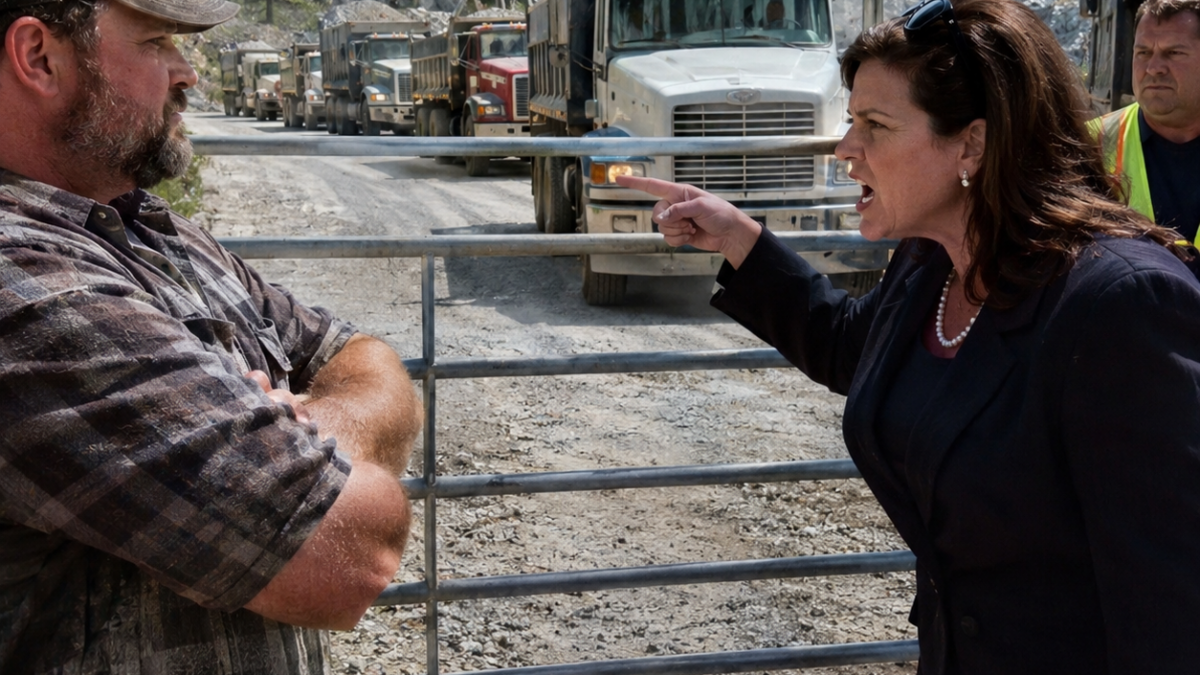
Then Corrine’s black SUV shot out of the line.
She parked on the shoulder.
Got out before the engine fully stopped.
“MOVE THAT GATE!”
I didn’t.
She marched toward me.
“Grant, open it.”
“No.”
“These trucks are operating under an authorized HOA contract.”
I lifted the dispatch sheet.
“Your signature?”
Her eyes dropped.
Recovered.
“Yes.”
“Twelve trucks.”
I pointed.
“Roughly eighteen tons each.”
She said nothing.
“Two hundred sixteen tons of my gravel.”
“Harborline purchased it.”
“No.”
“It’s contracted.”
“No.”
“You have no right to obstruct commercial traffic.”
“They’re on my quarry.”
“Open the barrier.”
I looked toward the line.
Then reached for the loudspeaker.
“All twelve drivers, shut down your engines and remain where you are.”
Corrine spun toward them.
“Do not shut down!”
One engine died.
Then another.
Then another.
The rumble faded truck by truck.
Corrine screamed,
“Keep those trucks moving!”
Silence replaced the engines.
I stepped slightly to the left.
The unmarked pickup beside the scale house became visible.
Doors opened.
Sheriff Dana Kincaid stepped out.
Two investigators beside her.
Corrine froze.
Dana walked forward.
“Evening, Ms. Wexler.”
Corrine’s phone was halfway to her ear.
She lowered it.
“I was about to call you.”
Dana looked down the convoy.
“No need.”
Then at me.
“These the twelve trucks from your report?”
“Every one.”
Corrine immediately began talking.
“This is a contractual dispute.”
Dana held up one hand.
“Drivers remain in place. Documents stay in the vehicles until an investigator asks for them.”
“You cannot seize commercial equipment over a civil disagreement.”
“We’re conducting an investigation.”
“Harborline legally purchased this material.”
I handed investigators Dry Creek’s full sales report.
No Harborline purchase order.
No invoice.
No payment.
Nothing.
Harlan stepped forward.
He confirmed his signature had been copied onto a contract without his permission.
Dana explained that the county had already confirmed there was no extraction authority.
Corrine shifted instantly.
“Then the hauling contractor misunderstood.”
Dana looked at her.
“Why did you direct hauling to continue after receiving written notice from the property owner?”
Corrine opened her mouth.
Nothing.
Investigators moved truck to truck.
Scale operator certified each load.
Total:
About 216 tons.
Then Troy climbed out.
He carried documents.
Corrine saw him.
Her expression changed.
“Troy.”
He didn’t look at her.
He walked to the lead investigator.
Handed over a stack.
Dispatch sheets.
Load quantities.
Pickup times.
Destinations.
Special instructions.
Approval records.
One phrase in bold:
**FINAL CLEARANCE BEFORE FINANCIAL REVIEW**
Attached:
Message from Corrine’s work account.
Investigators compared the loads with HOA invoices.
The destinations did not match.
That was the part Corrine had not expected.
She had tried to use the final convoy to make the physical tonnage line up with what Harborline had billed.
Close the books.
Move the remaining material.
Collect original dispatch sheets.
Erase inconsistencies.
Instead, every original sheet rode straight into a controlled checkpoint.
I looked at her across the barrier.
“You didn’t just steal my gravel.”
She stared at me.
“You made your own neighbors pay for it.”
For the first time since I had known Corrine Wexler, she had nothing to say.
Then headlights appeared on the access road.
Silver pickup.
Fast.
Miles Vardon climbed out.
“What is going on?”
Dana turned toward him.
Miles pointed toward the trucks.
“I need that material released.”
Dana studied him.
“You need it?”
“My project.”
“Which project?”
“The Overlook.”
“If Harborline independently purchased this gravel for HOA work, how did you know twelve trucks were moving tonight?”
Miles stopped.
“How did you know the exact number?”
No answer.
“The time?”
His face changed.
“I’ll have counsel respond to any further questions.”
Smartest thing he had said all night.
Drivers were interviewed separately.
Most looked stunned.
One older driver removed his cap and held it in both hands.
“I have never stolen anything in my life.”
Dana’s investigator said,
“Then tell us exactly what you were told.”
“I was told the quarry owner was paid.”
“Who told you?”
“Dispatch.”
“Did you ever speak with Mr. Ellery?”
“No.”
That distinction mattered.
Dana’s team wasn’t there to turn every driver into a villain.
They wanted the people who knowingly organized the theft.
After the documentation gathered that night was reviewed, Dana approached Corrine.
Her tone remained flat.
Professional.
No triumph.
“Ms. Wexler, you are being taken into custody in connection with the investigation into organized theft of property and falsified documents.”
Corrine’s face went white.
“This is insane.”
Dana continued with the formal instructions.
Corrine looked at me.
“This is your doing.”
I shook my head.
“You sent the trucks.”
“You set me up.”
“I told you to stop.”
“You let them enter.”
“After six formal warnings and a police investigation.”
“You planned this.”
“I documented it.”
A deputy guided her toward the patrol vehicle.
She turned.
“This is not over!”
I looked at the twelve silent trucks.
“For your trucks, it is.”
By sunrise, Cedar Glen knew.
News moved faster through that neighborhood than any dump truck ever had.
Eliza’s report went to every board member.
Residents learned $344,000 had already been wired to Harborline.
They learned Dry Creek had received nothing.
They learned delivery records suggested part of the gravel went to The Overlook.
An emergency HOA meeting filled the clubhouse.
I didn’t attend.
Eliza later told me what happened.
An elderly resident named Ruth Callahan stood with a cane.
She said,
“We paid for a safer road.”
Then pointed at the financial report.
“She used our money to build somebody else’s parking lot.”
That sentence broke whatever loyalty Corrine still had.
Residents shouted.
Board members demanded documents.
People who had defended her for years began asking questions.
Corrine was released later that day pending further proceedings.
Her attorney issued a statement.
Misunderstanding.
Neighbor dispute.
Grudge.
Contract confusion.
It didn’t work.
Too much paper.
Too many witnesses.
Too many homeowners suddenly comparing stories.
For years, Corrine had controlled Cedar Glen through fines, letters, committees, and embarrassment.
People were afraid to challenge her.
Now they talked.
One homeowner remembered a vendor Corrine insisted on hiring.
Another remembered unexplained charges.
Another had emails.
The remaining board froze unpaid Harborline balances.
Independent forensic accountants were hired.
Eliza turned over every record.
Investigators expanded the inquiry to Miles and connected companies.
The county inspected The Overlook.
Improper grading.
Drainage problems.
Stop-work order.
Orange fencing went up.
The parking lot built partly from my stolen gravel sat half-finished.
Miles had already booked events.
Those bookings started canceling.
His lenders heard about the criminal investigation and construction shutdown.
Financing reviews began.
Delay costs grew.
I didn’t celebrate.
I was too busy figuring out how badly Dry Creek had been damaged.
Stopping one final convoy recovered 216 tons.
We were still missing roughly 5,400 tons overall.
I hired an independent surveyor.
Engineering consultant.
Audrey began preparing civil claims.
The protective berm near the settling pond needed major reconstruction.
Estimate:
About $186,000.
Then there was lost inventory.
Lost customer capacity.
Survey costs.
Security upgrades.
Professional fees.
Legal work.
Lost business we could prove.
I told Audrey,
“File against everyone responsible.”
She nodded.
“Not the drivers unless evidence supports it.”
“Agreed.”
“I want the people who organized this.”
“Agreed.”
Cedar Glen scheduled a special vote.
Eighty-one valid ballots.
Seventy-nine voted to remove Corrine.
Two voted to keep her.
The woman who once told me nobody operated near Cedar Glen without her permission was no longer president of Cedar Glen.
The new board took control of her office.
Contracts.
Bank records.
Emails.
Project files.
Outside the clubhouse stood a promotional sign.
Corrine and Miles smiling beneath the words:
**BUILDING A BETTER FUTURE FOR CEDAR GLEN**
The board voted to remove it.
A maintenance supervisor called me.
“You want to watch?”
“Watch what?”
“Corrine’s sign come down.”
I thought for maybe one second.
“No.”
“You sure?”
“Send me the audit.”
That mattered.
Not a sign.
The auditors found something worse.
A private agreement.
Harborline and Miles’s development company.
Profit-sharing clause.
Never disclosed to homeowners.
More months passed.
The financial investigation deepened.
Emails.
Haul tickets.
Statements.
Payment records.
Company filings.
The story became hard to explain away.
Load after load had been taken from Dry Creek without permission.
Harborline had billed the HOA.
Some material went to Cedar Glen.
Some went to The Overlook.
Paperwork had been falsified.
Signatures copied.
Access authority invented.
Prosecutors eventually determined there was sufficient evidence to pursue charges against the people who organized and profited from the scheme.
Corrine could no longer say the hauling contractor acted alone.
The records tied her to continued hauling after written notice.
To final-run instructions.
To the financial cleanup attempt.
To false documents.
The case moved slowly.
Real cases do.
There was no twenty-minute courtroom scene.
No dramatic confession.
No judge pounding a gavel while the audience gasped.
Months of filings.
Lawyers.
Hearings.
Negotiations.
Eventually, Corrine accepted a plea agreement on charges approved in the case.
She was sentenced under that agreement and ordered to satisfy financial obligations imposed by the court.
Miles and others faced consequences tied to whatever conduct was proven against them.
On the civil side, our surveys and expert reports did their job.
Responsible parties were ordered or agreed through settlement to pay damages covering quarry losses, restoration, and related harm.
The total reached hundreds of thousands.
Cedar Glen separately pursued recovery of the $344,000 already wired to Harborline to the extent those payments were proven improper.
Corrine sold property.
Surrendered business interests connected to the scheme.
No HOA presidency.
No financial control.
No profitable development relationship she had once expected.
None of that gave me back the months of stress.
But it mattered.
Eventually, the evidence process released the final twelve loads.
The trucks that remained the lawful property of their owners were returned.
Empty.
My gravel came home.
Harlan supervised the return.
Deputy present.
Loader moving the recovered material back onto the stockpile.
Harlan stood beside his pickup with his arms folded.
Then smiled.
“First time I’ve ever seen stolen gravel come home with a police escort.”
I laughed.
Really laughed.
Probably the first time in months.
Two hundred sixteen tons.
Only a fraction.
But watching those loads come back felt like somebody had put a piece of the world back where it belonged.
We rebuilt the berm.
Engineered properly.
Compacted.
Inspected.
Stormwater controls restored.
I replaced the entire access system.
No permanent contractor codes.
Every credential expired automatically.
Alerts came directly to my phone.
License plates recorded.
Haulers could not load without paperwork verified before a bucket touched stone.
Harlan joked that getting into Dry Creek now required more documentation than entering some countries.
I told him,
“Good.”
Months after the case settled into its slower legal phase, a homeowner from Cedar Glen came to the quarry.
Walt Hendricks.
The man who had invited me to the meeting.
He stood in the office doorway.
“You have a minute?”
“Sure.”
He sat.
“I owe you an apology.”
“For what?”
“I believed Corrine longer than I should have.”
“You invited me to speak.”
“Only after I started questioning the bills.”
“That’s still more than most people did.”
He looked toward the window.
“My wife used to tell me she didn’t trust Corrine.”
“Smart woman.”
“She usually is.”
I smiled.
Walt became serious.
“You know what bothers me?”
“What?”
“We paid her.”
I knew what he meant.
“Every month. Dues. Assessments. Special project money.”
He rubbed his hands together.
“We thought we were paying for roads and drainage.”
I nodded.
“And some of it became leverage over people like you.”
“That wasn’t your decision.”
“But we didn’t look.”
I said nothing.
He continued.
“We were happy as long as the landscaping looked good and property values were up.”
“That’s normal.”
“Maybe it shouldn’t be.”
I understood.
Corrine’s scheme required more than greed.
It required people not asking.
Not checking.
Not opening attachments.
Not comparing invoices.
Not asking why gravel cost $128 per ton.
Not asking where 5,400 tons physically went.
She relied on complexity.
Most people see a construction invoice and stop reading after the total.
She counted on that.
Eliza didn’t.
Eventually.
Neither did Walt.
Neither did the auditors.
One question becomes another.
Then another.
Fraud hates follow-up questions.
A few months later, Eliza visited.
She had become deeply involved in rebuilding the HOA’s financial controls.
She brought me a thick envelope.
“What’s this?”
“New procurement policy.”
“You drove here to show a quarry owner HOA procurement policy?”
She smiled.
“I thought you’d appreciate one section.”
I opened it.
Major material purchases now required direct supplier verification.
Vendor ownership disclosures.
Independent confirmation.
Two signatures.
Delivery reconciliation.
Actual quantity comparison.
I looked up.
“Seems obvious.”
“It does now.”
“How much did it cost Cedar Glen to learn?”
She gave me a tired smile.
“More than anybody wants to say out loud.”
I closed the policy.
“You did the right thing.”
“Eventually.”
“That still matters.”
She looked at me.
“I signed some of those payments.”
“You asked questions.”
“I signed them first.”
“Did you know?”
“No.”
“Did you profit?”
“No.”
“Did you hide evidence?”
“No.”
“Did you turn it over when you understood?”
“Yes.”
“Then learn from it.”
She nodded.
“I intend to.”
The Overlook took much longer to recover.
Miles’s project had financing problems.
Inspection problems.
Legal problems.
Bookings disappeared.
Some construction eventually resumed under different oversight.
I stopped caring about the details.
That surprised me.
Early in the investigation, I wanted to know everything.
Every email.
Every dollar.
Every consequence.
Later, I wanted my quarry back.
That was all.
Morning production.
Customers.
Load tickets.
Dust.
Repairs.
Ordinary arguments about equipment.
Normal problems are underrated.
One afternoon, Harlan came into my office.
“Stockpile numbers match.”
I looked up.
“What?”
“All three.”
“You checked twice?”
“Three times.”
I smiled.
“Good.”
He didn’t move.
“What?”
“You know how long it’s been since I could say that?”
I did.
He had blamed himself.
Never said it directly.
But he did.
He walked those piles every day.
For him, the theft felt like failure.
“Harlan.”
“Yeah?”
“This wasn’t on you.”
He looked away.
“I should’ve noticed sooner.”
“So should I.”
“You’re the owner.”
“Exactly.”
He smiled slightly.
“That supposed to make me feel better?”
“No.”
I stood.
“It’s supposed to remind you that if anybody gets to carry guilt around, I’m first in line.”
He laughed.
“Fine.”
Then he became serious.
“I really thought somebody inside was doing it.”
“Me too.”
“That bothered me more than the gravel.”
“Same.”
We had spent years building trust.
The old gate code being the weakness was almost a relief.
No employee had sold us out.
No loader operator had taken cash.
No scale-house worker had falsified tickets.
Corrine had found a forgotten credential and exploited it.
An old crack.
That changed how I thought about security.
Most big failures don’t begin with some genius attack.
They begin with forgotten access.
Old password.
Old code.
Old account.
Nobody removes it because nothing bad happened yesterday.
Then someone notices.
We changed everything.
Contractors got temporary credentials.
Automatic expiration.
Different access levels.
Real-time alerts.
No shared codes.
No exception because somebody was important.
The next rainy season tested the repaired berm.
Huge storm.
Water hit hard.
Settling pond rose.
Drainage held.
Harlan and I stood under the shop overhang watching rain hammer the yard.
He said,
“If they’d taken another week of material from that berm…”
“I know.”
“Could’ve shut us down.”
“I know.”
That thought still made me angry.
Money was one thing.
Corrine had risked environmental problems at my quarry because stealing finished stock wasn’t fast enough.
That could have affected twenty-three employees.
Families.
Customers.
Permits.
Years of work.
She never thought about them.
Or maybe she did and decided her project mattered more.
That was the pattern.
Her HOA.
Her reputation.
Her relationship with Miles.
Her control.
Other people became obstacles.
That mindset always leaves damage.
A year after the convoy night, I drove to the scale house at 2:17 a.m.
I hadn’t planned it.
Couldn’t sleep.
Same time the quarry had once been filled with unauthorized trucks.
This night, everything was quiet.
Crusher dark.
Conveyors still.
Gate locked.
I parked where I had stood holding the dispatch sheet.
For a few minutes, I just listened.
Wind.
Distant highway.
Nothing else.
Then headlights appeared.
I tensed automatically.
One truck.
Scheduled early customer.
It stopped outside the gate.
Driver used the intercom.
“Morning. Mason County Roads.”
I checked the order.
Paid.
Authorized.
I opened the gate.
Truck rolled to the scale.
Normal.
That simple moment hit me harder than I expected.
For months, a truck at night meant theft.
Now it meant business again.
The system worked.
Ticket printed.
Truck loaded.
Paid gravel left the property.
Exactly how it should.
I thought about Corrine standing under floodlights.
“You can’t stop public work.”
She never understood.
I wasn’t stopping public work.
I was stopping private theft disguised as public purpose.
Those are not the same thing.
Years later, people still tell the story wrong.
They say:
“Grant caught twelve trucks stealing gravel.”
Technically true.
But twelve trucks were just the end.
The important part happened before.
The inventory comparison.
The access log.
The cameras.
The driver who kept a ticket.
The treasurer who asked where the material went.
The signature copied from Harlan’s old form.
The county confirming no extraction rights.
The dispatch message saying everything had to move before the audit.
The financial records linking Harborline to Miles.
The Overlook deliveries.
The original paperwork carried by the final convoy.
Evidence rarely arrives as one dramatic object.
It accumulates.
A little here.
A number there.
A signature that looks too perfect.
One destination that doesn’t match.
One person who finally gets uncomfortable enough to tell the truth.
Corrine thought power meant controlling the story.
But once enough independent records existed, she couldn’t control all of them.
Not my cameras.
Not Troy’s phone.
Not Eliza’s binder.
Not county files.
Not Harborline registrations.
Not scale weights.
Not truck plates.
Not the actual gravel sitting under The Overlook parking lot.
Reality was distributed too widely.
That saved me.
It also taught me something I never forgot:
If somebody wants you to trust only their explanation, start looking for the records they don’t control.
One summer afternoon, I ran into Troy again.
Different hauling company.
Different truck.
He pulled into Dry Creek with a legitimate customer order.
He looked nervous walking into the scale house.
“Grant.”
“Troy.”
“Didn’t know this delivery was here until dispatch gave me the ticket.”
“You’re allowed.”
He smiled awkwardly.
“Good.”
I reviewed the paperwork.
Paid invoice.
Valid customer.
Everything clean.
He waited.
Then said,
“I wanted to thank you.”
“For what?”
“Not coming after every driver.”
“You told the truth.”
“Eventually.”
“Yes.”
He looked down.
“That night at the diner, I almost walked out.”
“I know.”
“I thought maybe I should just quit.”
“Why didn’t you?”
“Mortgage.”
We both smiled.
Then he became serious.
“I kept thinking, if I tell you, Corrine ruins my job.”
“And if you don’t?”
“I’m stealing.”
“That’s the part people forget.”
He nodded.
“The first couple nights, I believed it was paid.”
“I believe you.”
“By the fourth night, I knew something was off.”
“Why?”
“No scale tickets.”
That caught my attention.
“At Dry Creek?”
“Yeah.”
“Why didn’t you ask?”
“I did.”
“What did dispatch say?”
“Special contract.”
I shook my head.
He continued.
“Then Corrine told us not to discuss source.”
“That bothered you.”
“Yes.”
“But you kept hauling.”
“Yes.”
He looked ashamed.
“I’m not proud of that.”
“Good.”
He looked surprised.
“Good?”
“People who are proud of their mistakes don’t learn.”
He nodded.
“I don’t do off-hours private-site loads anymore without owner verification.”
“Smart.”
He handed me the delivery papers.
“Learned that one expensive.”
“Not as expensive as Cedar Glen.”
He laughed.
We processed his load.
For the first time, Troy drove out of Dry Creek with gravel he was legally supposed to have.
That mattered.
People can do wrong things without becoming permanently defined by their worst decision.
Troy helped stop the scheme.
Eliza did too.
Even some board members who had enabled Corrine eventually chose differently.
Corrine never did until choices were taken away from her.
That was the difference.
The final civil resolution took longer than I wanted.
Money moved through judgments and settlements.
Repair costs reimbursed.
Some losses recovered fully.
Some negotiated.
No check could perfectly replace stolen inventory or lost time.
But Dry Creek survived.
That was the only result I truly needed.
We kept every employee.
No layoffs.
No environmental shutdown.
Customers returned.
Production stabilized.
The berm held.
Inventory matched.
And the new security system meant I slept better.
One late afternoon, I sat in my pickup at the main gate.
Legitimate trucks rolled through one at a time.
Scale beep.
Ticket printer.
Barrier up.
Barrier down.
I remembered Corrine in heels years earlier.
“You’ll learn nobody operates beside Cedar Glen without our permission.”
Funny thing.
In the end, Cedar Glen learned the opposite.
Their HOA did not own my land.
Their president did not own my gravel.
An emergency project did not erase property rights.
A contract with a middleman did not create material that middleman never bought.
A copied signature did not create consent.
And a convoy did not become legal because it was large.
Twelve trucks still had to stop at one gate.
Harlan walked over carrying coffee.
He leaned against my pickup.
“Thinking about it again?”
“Little.”
He looked toward the road.
“Two hundred sixteen tons.”
“The last run.”
“She really thought she’d get it out.”
“Yeah.”
“You know what I remember?”
“What?”
“The engines shutting down.”
I smiled.
“Me too.”
“One after another.”
He imitated the rhythm.
“Truck one. Truck two. Truck three.”
I laughed.
“Very dramatic.”
“It was.”
Then he looked at me.
“You ever regret waiting six nights?”
That question had bothered me.
“Sometimes.”
“Why?”
“We lost more material.”
“True.”
“But if we stopped night one…”
“We catch three drivers.”
“Maybe.”
“And Corrine says contractor error.”
“Exactly.”
“No Harborline books.”
“Maybe not.”
“No final dispatch sheets.”
“Maybe not.”
“No Miles connection.”
“Harder to prove.”
Harlan nodded.
“So?”
“I hate that more gravel disappeared.”
“But?”
“But we caught the system.”
He took a sip.
“Worth it?”
I looked across the quarry.
Not a simple answer.
“I wish there had been a way to do both.”
“That’s not an answer.”
“No.”
He laughed.
Some decisions don’t give you clean satisfaction.
That is real life.
People like stories where every right decision feels good immediately.
Often it doesn’t.
Sometimes you watch your property disappear because investigators need a pattern.
Sometimes you say nothing while somebody lies about you publicly because responding would reveal what you know.
Sometimes you let arrogant people believe they are winning because confidence makes them careless.
That is not revenge.
It is patience.
And patience is painful when the thing being stolen belongs to you.
The 216 tons we recovered were spread back into the commercial stockpile.
Harlan insisted on measuring them personally.
“Six nights ago, I would’ve thought seeing this gravel again was impossible.”
“Not impossible.”
“Unlikely.”
“Fair.”
He looked at the pile.
“You want to know the funny part?”
“What?”
“Gravel doesn’t know it was stolen.”
I laughed.
“No.”
“It just sits there.”
“That’s its best quality.”
“Very emotionally stable material.”
I shook my head.
He had finally gotten his humor back.
So had I.
The repaired section near the settling pond got reinforced beyond the original design.
That cost me extra even after reimbursement.
I didn’t care.
I never wanted to stand there after another storm wondering whether somebody’s greed had weakened my environmental protection.
My son visited the quarry one weekend.
He was in his twenties.
He had followed the case from a distance but hadn’t seen the damaged berm until after repairs.
He asked,
“Why would they take gravel from there?”
“Convenience.”
“But wasn’t there a stockpile?”
“Yes.”
“So why the berm?”
“Closer to the loader route once the pile got low.”
He stared.
“They risked shutting the quarry down to save a few minutes?”
“Probably.”
He shook his head.
“That’s insane.”
“It makes sense if your only goal is tonight.”
That became another lesson.
Corrine thought in deadlines.
Before audit.
Before rain.
Before residents asked questions.
Before I noticed.
Before the inspector arrived.
People doing honest work usually plan for what happens after tomorrow.
People hiding things become obsessed with getting through the next forty-eight hours.
That urgency was everywhere in her messages.
**Move everything before the audit.**
That sentence told the story better than any accusation.
A legitimate buyer does not rush to remove material before an audit.
They welcome the invoice comparison.
They show receipts.
They call the owner.
They prove payment.
Corrine ran because proof was the enemy.
The following year, Cedar Glen completed its flood-control project under new management.
This time, they purchased material legally.
Not from me.
Another supplier won the bid.
Some people expected me to be angry.
I wasn’t.
The new board president actually called beforehand.
“We’re bidding aggregate.”
“Okay.”
“We wanted to make sure there were no lingering issues.”
“None.”
“You’re welcome to bid.”
I declined.
“Why?”
“Too much history?”
“Partly.”
“Understandable.”
“Mostly schedule.”
That was true.
My quarry had other commitments.
They used another legitimate supplier.
Paid invoices.
Scale tickets.
Delivery confirmations.
No midnight theft.
No scandal.
No sheriff.
The flood road got built.
That’s what made the original scheme so stupid.
Cedar Glen could have bought gravel.
They had money.
They could have negotiated.
They could have put it out to bid.
They could have called Dry Creek.
Instead, Corrine and Miles saw a way to take material for free, bill homeowners at an inflated price, and redirect part of it toward private development.
Greed often makes complicated crimes out of simple purchases.
A legitimate gravel contract would have been boring.
They wanted profit.
So they created risk.
The last time I saw Corrine in person was after most of the legal process had run its course.
I was leaving the courthouse.
She stood near the steps with her attorney.
We made eye contact.
For a second, neither of us moved.
Then she walked toward me.
Her attorney started to follow.
She waved him back.
“Grant.”
“Corrine.”
She looked different.
No HOA badge.
No binder.
No audience.
“You got what you wanted.”
I stared at her.
“What do you think I wanted?”
“To destroy me.”
“No.”
She laughed bitterly.
“You expect me to believe that?”
“I wanted you to stop stealing.”
Her eyes hardened.
“You enjoyed that night.”
“The convoy?”
“Yes.”
I thought about it.
“The moment the trucks stopped?”
“Yes.”
I answered carefully.
“I was relieved.”
“Relieved.”
“Yes.”
“You stood there like you were waiting for me.”
“I was.”
“That’s enjoyment.”
“No.”
She looked unconvinced.
I continued.
“I had spent six nights watching my livelihood leave in the dark.”
She looked away.
“I wanted it to end.”
“You could’ve called me.”
“I sent formal notice.”
“You could have negotiated.”
“About stolen gravel?”
“You always act like everything was black and white.”
“Did you pay Dry Creek?”
She didn’t answer.
“Did Harborline have a purchase agreement?”
Silence.
“Did you know the HOA attorney had concerns?”
She changed the subject.
“Miles handled supply.”
“Then why were you at the quarry at two in the morning?”
Her jaw tightened.
I knew the conversation was over.
Before I walked away, she said,
“You cost me everything.”
I stopped.
Turned.
“No.”
She stared at me.
“You used my gravel to build somebody else’s future.”
I paused.
“And you used your neighbors’ money to pay for it.”
Then I left.
For a long time afterward, that conversation bothered me.
Not because I doubted the evidence.
Because Corrine still believed consequences came from me.
She saw the gate.
Sheriff.
Audit.
Removal vote.
Court.
She never seemed able to see the decision that came first.
Take what wasn’t hers.
Everything else followed.
That is one reason people repeat mistakes.
If you believe consequences are caused by the person who catches you, you never learn from the action that created them.
Dry Creek became stronger after the theft.
Not because theft was good for us.
It wasn’t.
But crisis exposes weak systems.
Old access codes.
Insufficient inventory reconciliation.
Blind spots along the north road.
We fixed them.
Harlan and I changed stockpile surveys from periodic to more frequent automated measurements.
Scale data synced with production.
Unexpected inventory differences triggered alerts.
Access history got reviewed.
Security footage retention increased.
Not because I became paranoid.
Because I learned what “probably fine” can cost.
A year after the final berm inspection, Harlan retired.
That hit me harder than the court ending.
He stood in the quarry office with a small box of personal things.
Twenty-seven years.
I said,
“You sure?”
“No.”
“Good. Stay.”
He laughed.
“My knees are sure.”
We walked to the north stockpile.
The same place those trucks had loaded.
He looked around.
“Looks bigger than I remember.”
“Because nobody steals from it anymore.”
“Helpful.”
He kicked at the gravel.
“You know, I really did want to wait out here with a thermos that first night.”
“I know.”
“Would’ve caught them.”
“Three trucks.”
“Still.”
“And maybe gotten yourself run over.”
“I’m fast.”
“You’re sixty now.”
“Still faster than you.”
I laughed.
Then he became quiet.
“Thank you.”
“For what?”
“Not thinking it was me.”
That surprised me.
“I never thought that.”
“You wondered about inside access.”
“I wondered about everybody.”
“Different.”
I looked at him.
“Harlan, your signature was forged.”
“I know.”
“You were a victim too.”
He nodded.
“Still bothered me.”
I understood.
I put out my hand.
He looked at it.
Then pulled me into a hug.
Awkward.
Dusty.
Exactly right.
He left that afternoon.
I watched his pickup disappear down Quarry Ridge Road.
For years, I had associated that road with trucks.
After the theft, I associated it with evidence.
After Harlan retired, I remembered something else.
People.
A business is not stockpiles and equipment.
Corrine almost damaged far more than gravel.
She almost made us distrust each other.
That was the part I was happiest to get back.
Years passed.
Cedar Glen changed leadership more than once.
The Overlook eventually reopened under different financial arrangements.
Dry Creek kept producing.
Sometimes new employees hear the old story from veteran operators.
They exaggerate.
According to one version, I personally chased twelve dump trucks with a loader.
Never happened.
Another version says I welded the gate shut.
No.
One says Dana hid inside a gravel pile waiting for Corrine.
Definitely not.
I correct them when I hear it.
“The truth is good enough.”
They usually look disappointed.
But the truth matters.
I did not create a dangerous roadblock.
I didn’t trap innocent drivers.
I didn’t threaten anyone.
I documented.
Coordinated with law enforcement.
Created a safe stopping point.
Let evidence speak.
That is why the ending held up.
If I had acted recklessly, Corrine would have used it.
She tried to paint me as vindictive anyway.
Imagine what she could have done with footage of me swinging a loader bucket at a truck.
Anger feels satisfying for five minutes.
Paperwork lasts longer.
The quarry gate still has the camera above it.
Sometimes I stand there late in the day.
Sun dropping behind the pit walls.
Legitimate trucks leaving.
Every load weighed.
Every invoice paid.
Every destination recorded.
Simple.
Clean.
I think about the final convoy.
Twelve trucks.
Two hundred sixteen tons.
Corrine believed the trucks themselves were power.
She believed numbers intimidated people.
Twelve drivers.
Twelve loads.
Twelve engines.
A whole convoy.
But twelve wrongs do not make one right.
Not even when they arrive together.
The gate only had to say no once.
That was enough.
One autumn afternoon, a Cedar Glen resident I had never met pulled into the office.
Young father.
Two kids waiting in an SUV.
He introduced himself.
“Bought there after everything happened.”
“Okay.”
“I wanted to ask something.”
“Go ahead.”
“Do you hate Cedar Glen?”
The question made me smile.
“No.”
He seemed surprised.
“People talk like there was a war.”
“There was a dispute.”
“A pretty big one.”
“Yes.”
“So you don’t hate us?”
“No.”
“Why?”
“Cedar Glen didn’t drive a loader into my stockpile.”
He laughed.
“Fair.”
I continued.
“An HOA is paperwork. People make choices.”
He nodded.
“I’m on the new roads committee.”
“Condolences.”
He laughed again.
“We’re replacing a drainage section near the county line.”
“Okay.”
“We may need aggregate.”
I waited.
“We want to buy it.”
I smiled.
“That’s usually how it works.”
He brought me bid documents.
A month later, Dry Creek won part of the supply contract.
Paid.
Legal.
Daylight.
Cedar Glen trucks lined up at our scale.
Invoices.
Tickets.
No drama.
The first day, I stood outside.
A dump truck loaded.
Scaled.
Driver handed paperwork through the window.
Everything exactly right.
The young committee member stood nearby.
He said,
“Feels weird buying gravel from you after the history.”
“Feels normal to me.”
“Really?”
“You pay. We load.”
“That simple?”
“That simple.”
He smiled.
“Corrine could’ve done this.”
I looked toward the stockpile.
“Yes.”
That might be the most painful truth of the whole story.
She could have bought the gravel.
Dry Creek sells gravel.
That is literally our business.
If she had called and negotiated a commercial purchase, I would have quoted a price.
Maybe she liked it.
Maybe not.
Maybe Harborline sourced elsewhere.
Normal commerce.
Instead, she chose theft because theft increased somebody’s margin.
Then lies because lies hid theft.
Then pressure because pressure discouraged questions.
Then falsified records because records had to match lies.
Then one final convoy because the audit was coming.
Each choice made the next one necessary.
By the end, she wasn’t managing a flood road.
She was managing a cover-up.
And cover-ups always become harder to run than the original problem.
The final audit report sits in my office.
Same cabinet where I keep quarry deeds.
I don’t read it often.
But one page is marked.
It shows material quantities.
Invoice values.
Destinations.
The numbers are dry.
No drama.
Yet every number contains part of the story.
5,400 tons missing.
$280,800 approximate inventory value at my average rate.
$691,200 invoiced to the HOA for material and delivery.
$344,000 already wired.
216 tons stopped in the final convoy.
$186,000 estimated berm repair.
Numbers don’t scream.
That’s why people underestimate them.
Corrine screamed.
Threatened.
Ordered.
Accused.
The numbers stayed quiet.
And won.
One late evening, I locked the quarry office and drove toward the main gate.
The scale-house lights were glowing.
A final customer truck rolled out.
Ticket paid.
Gate opened.
Truck passed.
I watched its taillights disappear.
Then I closed the barrier.
**Clang.**
Same sound.
Same gate.
Different night.
I thought about the question Harlan once asked.
Was it worth waiting six nights?
I still don’t know how to answer perfectly.
I wish we had lost less.
I wish the berm had never been touched.
I wish Troy had questioned the first load.
I wish Eliza had opened the Harborline invoices earlier.
I wish Cedar Glen homeowners had demanded better oversight before money left their accounts.
Most of all, I wish Corrine had never decided that proximity to my quarry meant entitlement to what was inside it.
But once the theft began, we did what we could.
We found the pattern.
Protected people.
Preserved evidence.
Stopped the convoy safely.
Recovered what could be recovered.
Held responsible people accountable.
Then rebuilt.
That is the ending I care about.
Not Corrine losing office.
Not Miles losing money.
Not headlines.
Rebuilding.
My father used to say a quarry teaches patience because you cannot hurry stone.
You blast.
Crush.
Screen.
Wash.
Stockpile.
Load.
Every step takes the time it takes.
Maybe that is why I survived Corrine.
She believed speed was power.
Move gravel before audit.
Finish road before rain.
Get trucks out before anyone notices.
Push invoices through.
Pressure people before they ask questions.
Everything urgent.
Everything now.
I had spent my life around something that does not care about urgency.
Stone.
Stone sits.
Waits.
Keeps its weight.
Maybe I learned from it.
I waited.
Then weighed everything.
The truth came out the same way.
Heavy.
Slow.
Impossible to move once it landed.
The following morning, I arrived before sunrise.
No alerts.
No missing inventory.
No unauthorized code.
The eastern sky was turning pale.
I opened the gate.
Our first quarry hauler rolled through.
Then another.
Normal operation.
I watched the barrier rise.
For a second, I remembered Corrine standing in headlights.
“Open that gate.”
She believed she was ordering me.
But ownership isn’t measured by who shouts louder.
It is measured by who has the right to say yes.
And just as importantly—
who has the right to say no.
I let our trucks through.
Then closed the gate behind them.
Dry Creek Quarry was still mine.
The stockpiles were still ours.
The road was still ours.
The records matched.
The berm held.
And the people who worked there no longer looked over their shoulders every morning wondering what disappeared while they slept.
That was enough.
More than enough.
Corrine thought twelve trucks could steal my livelihood before sunrise.
Instead, all twelve stopped at my gate.
And when they did, the paperwork she had tried to bury came to a stop with them.
One truck carried stolen gravel.
Another carried a false dispatch record.
Another carried a destination that didn’t match the HOA invoice.
Another carried a driver who had finally decided to tell the truth.
And somewhere in that convoy was the paper trail Corrine believed she could collect and destroy before anybody compared it.
She sent twelve trucks into my quarry to erase the evidence.
She sent the evidence straight to the sheriff.
That was the part people call revenge.
I don’t.
Revenge would have meant I took something from her because she took something from me.
I didn’t.
I took back what was mine.
The truth did the rest.
And if there is one thing I learned from all of it, it is this:
People who steal in the dark usually believe the darkness is protecting them.
It isn’t.
Sometimes the light is already on.
Sometimes the camera is already recording.
Sometimes the driver has already saved the ticket.
Sometimes the treasurer has kept the invoice.
Sometimes the old signature they copied is sitting in a filing cabinet waiting to be compared.
And sometimes, at 2:17 in the morning, twelve loaded trucks arrive at a gate they were certain would open.
Mine didn’t.
It never needed to.
The final truck of the morning disappeared up the quarry road.
I turned the key in the gate control.
The barrier settled into place.
Behind me, the scale printer started on another legitimate ticket.
Ahead of me, the sun rose over Dry Creek.
Nothing dramatic.
Nothing stolen.
Just another day of honest work.
After everything Corrine tried to take, that ordinary morning felt like the best ending I could have asked for.








