HOA KAREN Sold My Lake Cabin and Told the Buyer I Was Dead—Then He Found Me Fishing on My Own Dock
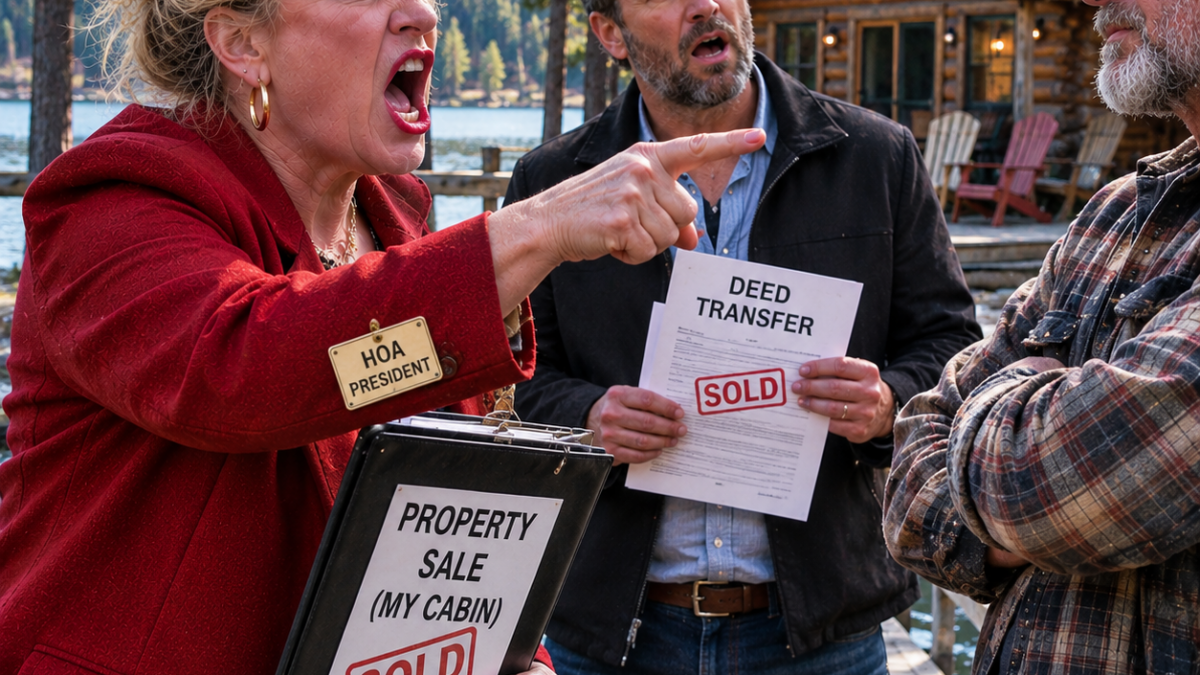
I was sitting on the end of my private dock with a fishing line in the water when a stranger in an expensive jacket walked across my lawn, stared at me like he had seen a ghost, and asked why I was trespassing on the lake cabin he had just bought for $1.8 million. When I told him my name was Nolan Mercer and that the cabin had belonged to my family for decades, he opened a closing folder and showed me a death certificate bearing my name, a deed carrying a near-perfect copy of my signature, and paperwork naming the HOA president as the woman who had arranged the sale. The most frightening part was not seeing myself declared dead on paper—it was realizing, within minutes, that whoever had built the lie had already prepared an explanation for why the living man standing on that dock should be treated as the fraud.
For twelve years, that cabin on Blackthorn Lake had been the only place I truly considered home.
It was not one of the enormous glass-and-stone houses that had appeared along the far shore over the years. Mine had a cedar roof, a porch facing the water, an old wooden dock my father had built plank by plank, and an oak chair he had made with his own hands before his joints got too stiff for woodworking.
My father, Walter Mercer, bought the property in 1988, when the road was still gravel and most of the shoreline was pine and mud.
When he died, I inherited eighteen acres.
I never planned to sell.
The man standing in front of me that Saturday morning apparently had different paperwork.
“My name is Everett Langford,” he said. “I closed on this property yesterday.”
“No, you didn’t.”
His face hardened.
“I wired one-point-eight million dollars.”
“That doesn’t make it mine any less.”
A woman carrying a thick folder stood behind him. She looked from Everett to me and back again.
Everett opened the folder.
“Your name?”
“Nolan Mercer.”
He stopped.
Then slowly turned the first page around.
At the top:
**NOLAN MERCER — DECEASED.**
The listed date of death was three months earlier.
I laughed once.
Not because it was funny.
Because my brain had not yet caught up.
Then I saw the transfer deed.
The signature at the bottom looked like mine.
Whoever had copied it had studied the way I looped the N, the sharp slant of the M, even the little hook I made at the end of the final r.
Everett watched me carefully.
“This is you?”
“That is supposed to be me.”
“You’re saying it’s forged?”
“I’m saying I’m standing here.”
He looked back at the death certificate.
Then at me.
The woman beside him called someone on speaker.
A man answered.
“Preston, we have a problem.”
“What kind?”
“There’s a man at the property claiming to be Nolan Mercer.”
The voice changed immediately.
“Do not engage with him.”
I went still.
Everett frowned.
“Why?”
“Because Nolan Mercer is dead. Whoever is there may be an impersonator attempting to interfere with the estate transfer.”
There it was.
They had already built the second story.
Not only was I dead.
If I appeared alive, I was supposed to be the criminal.
I pulled out my wallet.
“Everett.”
He hesitated.
I handed him my driver’s license.
He studied the photo.
Then my face.
The color drained from his cheeks.
I took out my phone and called Sheriff Grant Hollowell.
Grant had known my family for years.
“Grant, I need you at the cabin.”
“What happened?”
“Somebody sold my house.”
Silence.
“Say that again.”
“They sold my cabin using a death certificate.”
Another pause.
Then Grant said something that took the last trace of humor out of the morning.
“Nolan, county records are showing you as deceased.”
I looked across the lake.
The water was flat and silver.
My fishing line still hung from the dock.
Somewhere behind me, Everett whispered, “Jesus.”
I lowered my voice.
“Grant, this isn’t just a forged sales contract.”
“No.”
“What do you see?”
“I see a recorded death entry, an estate transfer, and a deed filing.”
I gripped the phone tighter.
“Who filed them?”
“I’m finding out.”
Forty minutes later, before Grant arrived, another vehicle came up the dirt road.
White Mercedes.
I recognized it immediately.
Vivian Carrington, president of the Blackthorn Lake Homeowners Association, stepped out wearing a cream coat and sunglasses.
Behind her came Preston Vale.
And an HOA security guard.
Vivian walked toward my dock as if she had been expecting me.
She removed her sunglasses.
“Mr. Mercer,” she said coldly, “I don’t know what game you’re playing, but you have no right to be here.”
I stared at her.
“You just called me Mr. Mercer.”
For half a second, Vivian’s face froze.
And in that half second, I knew the paperwork was only the beginning.
PART 2
Vivian recovered quickly.
People like her usually did.
She shifted her gaze toward Everett and gave him the kind of patient smile someone might use when explaining an unpleasant situation to a confused customer.
“He resembles the former owner,” she said. “That does not establish identity.”
I almost admired the nerve it took.
Almost.
Everett looked at her.
“You told me Nolan Mercer was dead.”
“He is.”
I held up my driver’s license.
“Then somebody should explain this.”
Vivian glanced at it.
“Identification can be fabricated.”
“So can death certificates.”
The security guard took a step toward me.
“Sir, I’m going to need you to leave the dock.”
“No.”
“This property has transferred.”
“No, it hasn’t.”
Vivian’s expression sharpened.
“You are trespassing.”
“I’m fishing.”
“On property you no longer own.”
“I own the dock you’re standing beside.”
The guard took another step.
I looked at him.
“You work for the HOA?”
“Yes.”
“Then you have no police authority.”
“I have authority to remove unauthorized persons from association-controlled property.”
“This isn’t association property.”
Vivian cut in.
“That issue has already been settled.”
“By who?”
“Counsel.”
“Name.”
Preston stepped forward.
“This is not the time.”
“It’s exactly the time.”
Everett turned toward him.
“You arranged the sale.”
Preston’s face tightened.
“Yes.”
“Who represented the estate?”
“An administrator.”
“Name.”
“Marcus Bellamy.”
I had never heard it before.
I looked at Vivian.
“Who appointed him?”
“The court.”
“Which court?”
She did not answer.
That was when Grant’s cruiser turned onto the road.
Dust rolled behind it.
Vivian immediately moved toward him.
“Sheriff, thank God.”
Grant got out slowly.
He was in his late fifties, broad through the shoulders, gray beginning at his temples, and had the habit of letting people talk themselves into trouble before interrupting.
Vivian pointed toward me.
“This man is trespassing on property legally owned by Mr. Langford.”
Grant looked at me.
Then at Vivian.
Then at Everett.
“Everyone stay where you are.”
“He needs to be removed.”
Grant ignored that.
“Papers.”
Everett handed him the folder.
Grant spent several minutes reading.
I watched his expression change.
Not dramatically.
Grant had been sheriff too long for that.
But his jaw tightened when he reached the death certificate.
“You have identification, Nolan?”
I handed it over.
He compared the license.
Then pulled up an older county file on his tablet.
“Date of birth?”
I told him.
“Last four of Social?”
I gave it.
“Father’s full name?”
“Walter James Mercer.”
Grant looked at me.
“Preliminary identity matches.”
Vivian folded her arms.
“A driver’s license doesn’t invalidate recorded documents.”
“No,” Grant said. “But a living man standing in front of a death certificate bearing his name creates a very serious problem.”
Everett spoke.
“I wired one-point-eight million dollars.”
Grant nodded.
“I understand.”
“To whom?”
Everett pointed at the closing file.
Grant read.
Then looked at Vivian.
“Carrington Heritage Holdings?”
“It handled administrative aspects of the estate.”
“Your company?”
“A family company.”
“What administrative aspects?”
“That’s between the parties.”
Grant looked at Everett.
“He’s a party.”
Vivian’s mouth tightened.
Grant turned to me.
“Nolan, nobody changes locks, enters the cabin without agreement, removes property, or alters anything until we sort this out.”
“Fine.”
Everett nodded.
Vivian said, “The buyer has possession rights.”
Grant looked at her.
“Not while ownership is disputed through suspected fraudulent filings.”
“Suspected by him.”
“Suspected by me now.”
That was the first time Vivian’s expression truly changed.
She had come expecting local authority to remove me.
Instead, Grant was opening a case.
She checked her watch.
“I have nothing further to add.”
I watched her turn toward the Mercedes.
“Vivian.”
She stopped.
“Who filed my death certificate?”
She looked back.
“If you are really Nolan Mercer, I imagine you’ll find out.”
Then she left.
Preston followed.
The security guard hesitated, seemed to realize his presence no longer helped anyone, and followed them.
Everett and I remained by the dock.
Grant closed the folder.
“This is going to get ugly.”
“It already is.”
“No.”
He looked toward the road where Vivian’s Mercedes had disappeared.
“I mean legally.”
I understood.
Grant pulled me aside.
“County records really do show you dead.”
“How?”
“I don’t know yet.”
“Can somebody just walk in with a fake certificate?”
“Not that simply.”
“But it happened.”
“Yes.”
“Who verified it?”
“I’m going to find out.”
I lowered my voice.
“Grant, don’t treat this like a property dispute.”
“I’m not.”
“Someone manufactured a death.”
“I know.”
He looked at Everett.
“And somebody moved one-point-eight million dollars based on it.”
Everett heard that.
His face went pale again.
I almost felt sorry for him.
Almost.
Then I reminded myself that he had walked onto my property believing it belonged to him.
But he had been fooled too.
That mattered.
Grant eventually left with copies and instructions.
Everett stayed.
For several minutes neither of us said anything.
Finally he looked toward the cabin.
“I’ve been here three times.”
“When?”
“Before closing.”
My stomach tightened.
“Inside?”
“Yes.”
“Who let you in?”
“Preston.”
“Key?”
“He had one.”
I looked at the house.
My house.
“What did you touch?”
Everett seemed offended.
“Nothing personal.”
“That’s not what I asked.”
He took a breath.
“I walked through. Measured the bedroom. Looked at the fireplace. Sat on the porch.”
I had to look away.
Somebody had been showing strangers through my home while I was alive.
That hit harder than the money.
Harder than the fake certificate.
The cabin had never been a showpiece.
There were photographs of my father in the hallway.
His fishing hat hung on a hook beside the back door.
The oak chair he built sat by the window.
People had walked through all of it believing the man connected to those things no longer existed.
Everett must have seen something in my face.
“I’m sorry.”
“You didn’t know.”
“No.”
He rubbed one hand over his jaw.
“But I should have asked more.”
I looked at him.
“About what?”
“The estate.”
He sat on the dock bench.
“I spent thirty years running a company. I verified every acquisition we made.”
“And this one?”
“I saw a death certificate, court paperwork, recorded title documents, an estate administrator, a broker I was told had handled Blackthorn transactions for years.”
“Any heirs?”
“No.”
“Family representative?”
“Bellamy.”
“You met him?”
“Video call.”
“What did he look like?”
Everett thought.
“Late forties. Maybe fifty. Nervous.”
“Did he know anything about me?”
“He said you had no children and no close relatives.”
That part was mostly true.
My mother had died years earlier.
My father was gone.
No siblings.
No wife.
No children.
Someone had chosen a target who would be easy to declare dead because there was no immediate family likely to storm into an office demanding answers.
That realization sat badly.
Everett looked toward the cabin again.
“My wife died four years ago.”
I did not know what to say.
He continued anyway.
“Margaret.”
His voice changed around her name.
“I bought this because I wanted somewhere quiet. She always wanted a place on a lake.”
I glanced at him.
He gave a bitter laugh.
“I suppose that sounds ridiculous considering the situation.”
“No.”
“It probably does.”
“It doesn’t.”
He looked down at the water.
“I wired nearly two million dollars for a house that belongs to a living man.”
“And I’m trying to prove I’m not dead.”
He looked at me.
For the first time that morning, neither of us felt like the other one was the enemy.
“I won’t enter again,” he said.
“Thank you.”
“I won’t change locks.”
“Good.”
“And I’ll give you everything in the closing file.”
“Better.”
He stood.
“What happens to my money?”
“I don’t know.”
“You investigate real estate fraud.”
“I used to.”
“Then give me your best guess.”
I thought about it.
“If the transfer is fraudulent, title can be challenged. Your purchase funds become a separate recovery issue.”
“So I could lose the cabin and spend years chasing the money.”
“Yes.”
He closed his eyes.
“Perfect.”
“I’m sorry.”
He looked at me.
“You’re apologizing to me?”
“You’re not the person who forged my death.”
“Low standard.”
“It’s been a strange morning.”
He actually laughed.
Then he left.
I did not go fishing again.
I sat at my kitchen table until dark.
Grant had taken copies.
The originals Everett gave me were on the table.
Death certificate.
Transfer deed.
Estate paperwork.
Purchase contract.
Closing statement.
My own name appeared dozens of times.
Dead.
Deceased.
Former owner.
Estate of Nolan Mercer.
I had spent years professionally reviewing fraud from a distance.
I knew what forged documents looked like.
I knew the mistakes people made.
Wrong fonts.
Inconsistent signatures.
Bad recording numbers.
Fake seals.
Dates that did not line up.
This package was better than most.
That frightened me.
Someone had not thrown it together in an afternoon.
I looked at the supposed death date.
Second week of my trip to Colorado.
Six weeks away on a commercial-property audit.
I remembered that night.
Thunderstorms back home.
I had seen weather alerts.
Apparently whoever created the certificate listed my cause of death as a boating accident on Blackthorn Lake during that storm.
Believable.
No body?
The document claimed presumed death based on recovery circumstances.
No named hospital.
No proper coroner attachment.
That was a weakness.
But most buyers never examine death paperwork deeply.
They see a seal.
A signature.
A title company willing to close.
They assume somebody else checked.
At 10:40 that night, I opened my email.
I searched Vivian’s name.
Months of notices appeared.
Dock aesthetic violation.
Driveway surface.
Storage shed.
Exterior maintenance.
All issued by an HOA whose authority over my parcel I had repeatedly disputed.
Then I found the message she had sent just before I left for Colorado.
One sentence.
**You will soon no longer be a problem for this community.**
At the time, I had assumed she meant another legal threat.
Now I printed it.
Added it to the file.
Then I opened the fireproof cabinet beside my desk.
My father had taught me to keep everything.
Deeds.
Surveys.
Receipts.
Old correspondence.
At the bottom was a folder I had not opened in years.
**BLACKTHORN — LAND / ACCESS**
I set it aside.
Not yet.
The next morning, I drove into town and met Tessa Whitcomb.
Tessa specialized in property disputes.
Thirty-nine.
Precise.
Patient.
Almost impossible to intimidate.
We had worked together on a land-use case years earlier.
She listened without interrupting.
Then read for almost an hour.
I sat across from her trying not to bounce my knee.
Finally she looked up.
“Nolan.”
“Yes.”
“This is not a normal fake sales contract.”
“I know.”
“No, you know it’s bad. I’m telling you how bad.”
She turned the deed around.
“The transfer was executed through someone claiming to be your court-appointed estate administrator.”
“Marcus Bellamy.”
“Yes.”
“Never heard of him.”
“I checked court records before you arrived.”
My hand stopped.
“And?”
“No valid appointment under that name connected to your estate.”
“My nonexistent estate.”
“Correct.”
She moved to the death certificate.
“The reference number doesn’t match the state format I’d expect for the date listed.”
“Could be fake.”
“Likely. We’ll confirm.”
“The county has me recorded dead.”
“That means somebody used enough supporting material to get the downstream record changed.”
“How?”
“Could be clerical acceptance of fraudulent documents. Could involve somebody who should have checked more carefully. We don’t know.”
I rubbed my face.
“What first?”
“Emergency civil protection.”
“To stop Everett?”
“To stop everyone.”
She began making notes.
“No further transfer. No demolition. No locks. No development activity. No encumbrance. Title insurer notified. Closing agent notified. Buyer notified. County recorder notified. State vital records notified.”
“Can we erase the death record?”
“Not instantly.”
“That sentence is absurd.”
“I agree.”
She looked at me.
“You need to prove continuous life.”
“I’m sitting here.”
“To people, yes. Records require records.”
“Fine.”
“Where were you during the supposed death?”
“Colorado.”
“Hotel?”
“Yes.”
“Credit cards?”
“Yes.”
“Client?”
“Yes.”
“Security cameras?”
“Probably.”
“Rental car?”
“Yes.”
“Phone records?”
“Yes.”
She started smiling.
“What?”
“You are going to be the easiest dead man I’ve ever represented.”
“That is not comforting.”
“It should be.”
We gathered everything.
Hotel receipts.
Restaurant charges.
Toll records.
A signed consulting contract.
Security footage showing me entering the Colorado office three days after my supposed death.
Video conference records.
Phone location logs obtained through proper request.
Client emails.
One photograph from a job site where I was standing beside a cracked concrete wall holding a measuring laser.
Timestamped.
Alive.
Tessa looked at the photo.
“You look annoyed.”
“The contractor poured the wall wrong.”
“Good. Very lifelike.”
Within two days, the state records office responded.
The death certificate in Everett’s closing package was not authentic.
No valid certificate with that number had been issued.
I stared at the email.
“Then why does the county list me as dead?”
Tessa pointed at the screen.
“Because somebody filed derivative paperwork based on the forged certificate.”
“Who?”
“That is what Grant is tracing.”
My phone buzzed.
Anonymous email.
No subject.
One sentence.
**Don’t just check your cabin. Check every house that changed hands around Blackthorn in the last two years.**
I read it again.
Then showed Tessa.
She stopped moving.
“You know who sent this?”
“No.”
“Could be bait.”
“Yes.”
“Could be genuine.”
“Yes.”
“What are you thinking?”
“That maybe I’m not special.”
That night, I pulled property-transfer records.
Blackthorn Lake had seen dozens of sales.
Most looked normal.
Market price.
Normal title companies.
Recognizable brokers.
Then three caught my attention.
All within two years.
All sold significantly below estimated market value.
All used Preston Vale.
All used the same closing firm.
Two had payments flowing through entities connected to Carrington Heritage Holdings.
I wrote the addresses down.
Underlined them twice.
One belonged to a widow named Elaine Carver.
Another to a retired teacher named Frances Dwyer.
The third had been owned by a couple who moved out of state unexpectedly.
I did not call them.
Not yet.
This was the point where professional instinct mattered.
Patterns are not proof.
I had seen investigators ruin cases by falling in love with theories.
I refused to do that because this one had my name on it.
Everett called the next morning.
“Can we meet?”
“Where?”
“Public place.”
We met at a coffee shop.
He looked like he had not slept.
He carried a thicker folder than before.
“I brought everything.”
“Thank you.”
He slid the closing statement toward me.
I read the distribution.
Escrow.
Taxes.
Broker fees.
Legal services.
Then one transfer stopped me.
**Carrington Heritage Holdings — Estate Coordination / Property Rights Resolution**
Large payment.
Very large.
I looked up.
“She got paid directly.”
“Apparently.”
“How much?”
He named the number.
Enough to make the room seem quieter.
“Who told you Carrington Heritage represented the estate?”
“Preston.”
“Did Vivian ever say it?”
“Not directly.”
“Did you meet her before closing?”
“Twice.”
“Why?”
“She said she was helping because your family had been involved in disputes with the association.”
“My family?”
“She said the estate wanted privacy.”
“I am the estate.”
“I understand that now.”
He looked miserable.
“I asked for verification.”
“What did you get?”
“Death certificate. Administrator papers. Title report. Deed. Association letter confirming there were no outstanding disputes after the sale.”
“Signed by Vivian?”
“Yes.”
That letter mattered.
I read it.
The HOA acknowledged the estate sale.
Confirmed liens and disputes would be released.
Represented that the transfer cleared the way for “future lake access improvements.”
I looked up.
“What did you think that meant?”
“Dock maintenance.”
“Did you receive any development material?”
He hesitated.
“Something.”
He opened another section of the folder.
Map.
My property was shaded red.
Behind it, in block letters:
**PHASE THREE — PRIVATE MARINA ACCESS**
My hand stopped on the page.
The map showed a proposed yacht harbor.
New slips.
Private club.
Service road.
And my land.
My narrow strip between the public road and the lake was the cleanest route.
Not just the cabin.
The access.
I stared at the red line.
Everett said quietly:
“Vivian told me the association had already secured all necessary shoreline rights.”
I looked at him.
“When?”
“Before closing.”
“For what?”
“She said Blackthorn was being upgraded. More exclusive. Better amenities.”
“Did she mention investors?”
“Yes.”
My chest tightened.
“How many?”
“I don’t know.”
“She promised dock rights?”
Everett nodded.
“To a group buying into the marina project.”
I sat back.
There it was.
The motive.
Vivian had not wanted my cabin because she admired the cedar roof.
She needed the ground.
Without it, the marina project had a serious access problem.
And I had refused to sell.
Three months earlier, Vivian had come to my porch smiling.
That memory returned with painful clarity.
She had offered $650,000.
I said no.
A week later, $800,000.
No again.
She had sat in my father’s oak chair while making the second offer.
That still bothered me.
“This land is worth more than sentiment,” she had said.
“It’s worth what I decide it’s worth to me.”
“You’re being emotional.”
“Yes.”
“That isn’t good business.”
“I’m not selling a business.”
Her smile disappeared.
After that, fines began.
$2,500 for the dock.
$4,000 for the driveway.
Shed violation.
Zoning threat.
Foreclosure language.
Every time I asked:
“Show me where my parcel is bound by your covenants.”
No answer.
Just another letter.
Eventually one sentence:
**We have many ways of dealing with owners who refuse to cooperate.**
At the time I kept it because it sounded threatening.
Now it sounded like a preview.
Everett and I sat in the coffee shop for nearly two hours.
Eventually he said:
“I need to ask you something difficult.”
“Go ahead.”
“If the court says the sale is void…”
“It probably will if the title is truly fraudulent.”
“I lose the property.”
“Yes.”
“And maybe my money.”
“Yes.”
He looked out the window.
“I pictured Margaret here.”
“Your wife?”
“Yes.”
I waited.
“She loved water.”
His hand tightened around his cup.
“When she got sick, we kept saying we’d buy a place when treatment ended.”
He gave a short laugh.
“It ended differently.”
I said nothing.
There are griefs you do not improve with words.
He continued.
“I know that doesn’t give me a claim to your home.”
“No.”
“I know.”
He looked at me.
“I want you to understand why I’m angry.”
“I do.”
“You’re not my enemy.”
“No.”
“Neither are you mine.”
That was the moment we became allies.
Not friends yet.
But allies.
We agreed in writing through Tessa.
No occupancy.
No lock changes.
No alterations.
All closing records preserved.
Full cooperation.
Everett would pursue his money from the people who took it.
I would pursue my title.
Neither of us would let Vivian turn us against each other.
That mattered more than I understood at the time.
Vivian called an emergency HOA meeting two nights later.
Official subject:
**Illegal Occupancy and Threats to Blackthorn Property Values.**
I almost did not go.
Tessa insisted.
“If she’s publicly calling you an impostor, you need to hear exactly what she says.”
The clubhouse was packed.
About sixty adults.
Vivian stood at the front beside Preston.
Behind her, a projector showed a photograph of me standing beside my old fishing boat in muddy boots.
Not flattering.
Probably intentional.
Vivian spoke first.
“A person claiming to be the deceased former owner of the Mercer property is interfering with a lawful transaction.”
People turned toward me.
I felt heat rise into my face.
Not fear.
Humiliation.
There is something deeply disorienting about being discussed as though you are not sitting in the room.
Vivian continued.
“We cannot allow fraudulent actors to threaten property values.”
I stood.
“Vivian.”
She stopped.
“Are you telling everyone here that I’m dead?”
“That is what the records show.”
“Which records?”
“The official ones.”
I held up my phone.
“The state vital records office says the certificate used in the sale was never issued.”
Murmurs.
Vivian’s eyes narrowed.
“This is not a courtroom.”
“No.”
I looked around.
“But if you’re going to tell my neighbors I’m impersonating myself, they deserve to know the certificate is fake.”
An older woman stood.
“If it’s fake, how did the house sell?”
Vivian answered sharply.
“The association did not sell the property.”
I looked at her.
“Then why did Carrington Heritage Holdings receive money from the closing?”
Silence.
Preston stepped forward.
“This meeting is becoming inappropriate.”
I looked at him.
“You brokered the sale.”
“The transaction was handled through licensed parties.”
“Who appointed Marcus Bellamy?”
He said nothing.
Vivian tried to move on.
Then the back doors opened.
Everett walked in.
He came down the aisle carrying his closing folder.
Every head turned.
He stopped near the front.
“My name is Everett Langford.”
Vivian’s face changed.
“I am the man who paid one-point-eight million dollars for Nolan Mercer’s cabin.”
Nobody moved.
Everett looked directly at Vivian.
“You told me the owner was dead.”
“I relied on estate documents.”
“You also told me all lake-access rights were secure.”
“That was based on information available at the time.”
He opened the folder.
“Your company received money from my purchase.”
Vivian’s voice hardened.
“For administrative services.”
“What services?”
Preston stepped between them.
“Mr. Langford, counsel has advised—”
“I’m asking her.”
The room erupted into whispers.
People began asking questions.
One woman mentioned an old dock fine.
Another said Vivian had threatened her over shoreline landscaping.
A man in the second row asked whether the association had an ownership interest in Carrington Heritage.
Vivian banged the gavel.
“Enough.”
That word no longer worked.
Certainty only controls a room while people still believe it.
An elderly man approached me afterward in the parking lot.
Thin gray hair.
Brown jacket.
He introduced himself as Warren Pike.
“I used to keep the association books.”
“Used to?”
“Retired last year.”
“What do you want?”
“To sleep better.”
That got my attention.
He glanced toward the clubhouse.
“There was another woman.”
“What woman?”
“Elaine Carver.”
One of the addresses on my list.
My hand tightened around the folder.
“What about her?”
“She was declared unfit to manage her property.”
“By who?”
“Not legally declared. That was how the paperwork started.”
“What happened?”
“She sold.”
“Voluntarily?”
Warren looked away.
“I never believed so.”
I felt the pattern closing.
“You have records?”
“Some.”
“Why?”
“Because Vivian told me to destroy old copies after audits.”
“And you didn’t?”
“No.”
“When can we see them?”
“Tomorrow.”
Warren arrived at Tessa’s office carrying a cardboard banker box.
Inside were financial statements.
Board resolutions.
Invoices.
Copies of payment authorizations.
Some were innocent.
Some were merely sloppy.
Then Carrington Heritage appeared.
Again.
And again.
Fees connected to property transfers.
Settlement consulting.
Estate coordination.
Compliance resolution.
Warren pointed at several.
“These never made sense.”
“Why did you approve them?” I asked.
“I didn’t.”
“Board?”
“Vivian.”
“Board vote?”
“Sometimes.”
“And other times?”
“Emergency authority.”
Tessa leaned forward.
“How much?”
Warren gave us the total across two years.
It was enough to make me whistle.
Then he pulled out a presentation.
**BLACKTHORN MARINA EXPANSION**
Projected value:
Approximately $48 million.
Investors required secured access.
The access route ran directly through my property.
There was the answer.
Not just greed.
Pressure.
Vivian had promised something she did not own.
Every time I refused to sell, her project became more fragile.
Every fine was leverage.
Every threat was leverage.
And when leverage failed, somebody erased me.
That evening I opened my father’s old **LAND / ACCESS** folder.
Inside was a letter from years earlier.
A development company had offered Walter Mercer money for a permanent right-of-way.
He refused.
The company had ties to the Carrington family.
My father’s handwritten note appeared beneath the letter.
**They want the shoreline, not the cabin. Never confuse the two.**
I sat at the kitchen table holding that page.
My father had known.
Not Vivian’s exact plan.
Not the fake death.
But the pressure.
The lake had always attracted people who saw land as a route to something larger.
He had protected the access because he understood that once he surrendered it, somebody else could decide what happened around his home.
I copied everything.
Stored originals off-site.
That was not paranoia.
Someone had already altered my legal existence once.
Tessa notified the marina investors of the title dispute.
We did not accuse anyone beyond evidence.
We simply stated:
I remained alive.
The cabin title was contested because of suspected fraud.
No valid permanent access agreement had been signed by me.
Any representation to the contrary should be independently verified.
Two days later, an investor’s attorney called Tessa.
I was in her office when she put him on speaker.
“Mr. Mercer?”
“Yes.”
“We were told all necessary access rights had been secured.”
“By whom?”
“Carrington project representatives.”
“Did you receive a document with my signature?”
“Yes.”
My chest tightened.
“What document?”
“A dock and access agreement.”
“I never signed one.”
Silence.
Tessa said:
“Send it.”
The document arrived twenty minutes later.
My name.
My signature.
Permanent project access.
Collateral support for financing.
I stared at it.
The fake house sale had not been the end.
It was one layer.
The project financing depended on an access agreement I had never signed.
That meant my false death was being used not only to transfer the cabin.
It was being used to manufacture clean control of the route.
Vivian called me herself the next morning.
Her voice had changed.
No sneer.
No threats.
“We should meet.”
“With Tessa present.”
“Privately.”
“Tessa present.”
“Nolan, this can be resolved.”
“Tessa present.”
She agreed.
Vivian arrived at the law office wearing a gray suit.
No Preston.
No security.
She placed one document on the table.
Settlement offer.
$3 million.
I read it slowly.
In exchange, I would convey the property.
Release civil claims.
Resolve title issues.
Agree to confidentiality to the extent lawfully permitted.
Withdraw objections to marina access.
I looked at her.
“Why is my cabin worth three million today when you offered me six-fifty three months ago?”
“Circumstances changed.”
“Which circumstances?”
“I’m trying to settle this peacefully.”
“Then answer one question.”
Her expression hardened.
“What?”
“Who faked my death?”
Silence.
She looked at Tessa.
“This meeting is about settlement.”
“It’s about my house.”
“Nolan—”
“Who faked my death?”
“I relied on professionals.”
“Which professionals?”
“Preston handled the transaction.”
Tessa slid the closing instructions across the table.
Carrington Heritage officer signature.
Vivian’s company.
She stiffened.
Tessa said:
“Your entity received funds.”
“For legitimate services.”
“What services?”
Vivian’s voice sharpened.
“I am not here to be interrogated.”
I leaned forward.
“You cannot collect money from selling a dead man’s house and then act surprised when the dead man asks questions.”
She stood.
“You are destroying a project that would benefit this entire lake.”
That was the first honest thing she said that morning.
Not about the forgery.
About motive.
I looked at her.
“Build your yacht club wherever you have the right to build.”
“You don’t understand how much money is already committed.”
“That sounds like your problem.”
“This community depends on growth.”
“No.”
I shook my head.
“You depend on a deal.”
Her hand tightened on the chair.
“You think that cabin is worth more than three million?”
“No.”
“Then sell.”
“It isn’t about market value.”
“Everything has a price.”
“That’s your mistake.”
She stared at me.
I continued.
“You keep assuming that because something can be priced, it can be bought.”
Her face went cold.
“You’re going to regret this.”
Tessa spoke.
“Vivian.”
She looked at her.
“You should stop making statements that sound like threats while your client exposure is under investigation.”
Vivian grabbed her bag and left.
I watched through the window as she reached her Mercedes.
She sat behind the wheel for several minutes without starting it.
For the first time, she looked afraid.
That evening, Preston’s attorney contacted Tessa.
Preston wanted to cooperate.
I did not trust him.
Tessa did not ask me to.
“He doesn’t need to be noble,” she said. “He needs to be useful and truthful.”
Preston turned over emails.
Texts.
File-transfer records.
Instructions.
One message came from Vivian’s account.
**Mercer will not be returning. Complete the transfer before the investors arrive.**
I read it several times.
A darker question entered my mind.
What did *will not be returning* mean?
Did she simply assume I would remain in Colorado until the closing was finished?
Or something worse?
I hated myself for wondering.
Grant called the next morning.
“We found evidence your security system was disabled during your trip.”
I sat down.
“By who?”
“Not proven.”
“Tell me what you have.”
“Your main camera system went offline for a defined window.”
“I thought it was a technical fault.”
“Could have been induced.”
“Any outside footage?”
“Neighboring road camera caught a vehicle connected to the HOA’s security contractor.”
“Plate?”
“Partial match.”
“Vivian order it?”
“We cannot say.”
I closed my eyes.
“Grant.”
“Yes.”
“I need you to tell me something.”
“What?”
“If you find evidence she meant more than paperwork…”
“I’ll tell you.”
I stared at the lake through my window.
For the first time since this began, I felt actual fear.
Not fear of losing the cabin.
Fear of how far someone might have gone.
I slept badly.
Every sound outside woke me.
At three in the morning, I walked through the house checking locks.
That embarrassed me.
I had spent years investigating fraudsters who intimidated owners.
I had told clients:
Document.
Preserve evidence.
Do not let fear change your life.
Easy advice when the forged signature belongs to someone else.
Harder when a stranger has been inside your home.
Harder when your cameras were disabled.
Harder when someone has already told the world you are dead.
The next day Tessa came to the cabin.
She found me replacing a lock.
“I thought we agreed not to alter anything.”
“Emergency order is active now.”
“Fair.”
She looked at me.
“You’re scared.”
“No.”
“You are terrible at lying.”
I set the screwdriver down.
“I keep thinking about that message.”
“Mercer will not be returning.”
“Yes.”
“Could mean your scheduled absence.”
“Could mean more.”
“Yes.”
“Does that bother you?”
“Of course.”
She sat on the porch step.
“But we stay with evidence.”
“I know.”
“You taught other people that.”
“I know.”
“Now use it.”
I sat beside her.
The lake was calm.
“I hate being the client.”
“All lawyers do.”
“I’m not a lawyer.”
“You’re acting like one.”
“Insulting.”
“Good.”
The investigation widened.
Marcus Bellamy was located.
He was not a court-appointed administrator.
He was a former paralegal whose license credentials had long since become useless.
Debt.
Tax problems.
Recent deposits.
When investigators confronted him with the financial trail, his story collapsed.
He had been recruited through shell companies.
Given documents.
Told where to sign.
Paid.
No heirs existed.
No court appointment existed.
No legitimate estate existed.
He admitted he never met me.
Never saw a body.
Never spoke to a relative.
He claimed he believed the paperwork was already legally approved.
Investigators would decide how much of that was credible.
The closing agent came under scrutiny too.
Title insurer.
Broker.
Recording process.
Every link had to be examined.
Some people had been careless.
Some potentially complicit.
I refused to lump them together.
That mattered.
There is a difference between fraud and negligence.
Between stupidity and conspiracy.
A strong case does not need exaggeration.
Meanwhile, the HOA board was falling apart.
Members had spent years letting Vivian operate with minimal challenge.
Now financial exposure threatened them.
Dahlia Renner, one of the board members, called me privately.
“I think we need to suspend Vivian.”
“That’s your decision.”
“She’ll say you forced us.”
“I won’t attend.”
“She’s telling people you’re trying to destroy Blackthorn.”
“I’m trying to stay alive on paper.”
Dahlia sighed.
“I know.”
At the next board meeting, Vivian’s executive authority was suspended pending a formal removal hearing.
I did attend that one.
Not to demand her removal.
Because Warren was presenting records.
Everett came too.
Tessa sat beside me.
Vivian stood at the front.
Angry.
Exhausted.
Still fighting.
“This board is betraying the community.”
Warren laid out the payments.
Everett laid out his closing documents.
Tessa confirmed the civil court had issued temporary protection preventing alteration or further transfer of my property.
Then I stood.
My hands were shaking slightly.
I hated that.
I spoke anyway.
“Three months ago, Vivian told me I did not belong here.”
The room was silent.
“Today I am still standing, and she has to explain why my name appears on a fake death certificate used to sell my home.”
Vivian’s face went pale.
Then the doors opened.
Sheriff Grant entered with an investigator.
They were not there for drama.
They had lawful papers.
Search and seizure authorization for specified records and devices connected to the investigation.
Vivian tried to remain composed.
Then Grant named the categories of evidence.
She turned sharply toward Preston.
“What did you give them?”
Preston looked at the floor.
That moment told me more than any speech.
Vivian had thought the people around her would remain loyal because they were implicated too.
She had mistaken shared risk for trust.
Preston broke first.
Later, through records and testimony, I learned why.
He had a mortgage.
A failing marriage.
Financial pressure.
And a growing certainty Vivian would make him the fall guy.
He told himself for months he was “only the broker.”
Moving documents.
Following instructions.
Collecting commissions.
Then he saw me alive.
That apparently changed something.
Not enough to make him innocent.
Enough to make him cooperate.
That evening, I drove home believing we had reached the worst of it.
Tessa called before I reached the cabin.
Her voice sounded different.
“Nolan.”
“What?”
“The investors sent another document.”
“What kind?”
“Financing support.”
“I already saw the access agreement.”
“This is different.”
I pulled onto the shoulder.
“What?”
“A pledge of dock rights tied to project financing.”
“With my name?”
“Yes.”
“My signature?”
“Yes.”
I closed my eyes.
“What does it do?”
“It purports to secure permanent access through your parcel for the marina project.”
“So the fake sale wasn’t just to sell the house.”
“No.”
“It was to clean the title.”
“And lock in the access.”
I looked toward the lake beyond the trees.
“How much financing?”
She told me.
Tens of millions depended on representations that the access rights were already secure.
That was the point when I understood the scale.
Vivian had not simply stolen my cabin.
She had tried to convert my death into collateral.
The civil case accelerated.
So did the criminal investigation.
Months followed.
Not days.
That is the part stories often skip.
The waiting.
Continuances.
Depositions.
Record requests.
Experts.
Forensic document examination.
Title history.
Bank subpoenas.
Motions.
Arguments over admissibility.
People assume truth automatically wins once discovered.
It does not.
Truth still needs paperwork.
Procedures.
Witnesses.
Authentication.
Patience.
I had all of those.
But it was exhausting.
Some mornings I woke before sunrise and forgot for several seconds that I was legally fighting over the house around me.
Then I would see a file box beside the table.
Remember.
Everett became a regular visitor.
At first always for documents.
Eventually sometimes for coffee.
He never entered the cabin without asking.
That mattered.
We sat on the dock.
He told me about Margaret.
I told him about my father.
One afternoon he looked at the oak chair on the porch.
“Walter built that?”
“Yes.”
“You mentioned it before.”
“He made it when I was seventeen.”
Everett ran one hand over the arm.
“I understand now.”
“What?”
“Why you won’t sell.”
I looked at him.
“You didn’t before?”
“I understood the words.”
He sat.
“Not the difference.”
“What difference?”
“Between price and value.”
I smiled.
“Careful. Vivian thinks that’s bad business.”
He laughed.
Then his expression changed.
“I hate her.”
“That’s understandable.”
“Do you?”
I thought about it.
“No.”
Everett looked surprised.
“You’re a better man than I am.”
“No.”
I looked toward the lake.
“I’m too tired to hate her properly.”
That was closer to the truth.
The civil title hearing came first.
Tessa had prepared for months.
The opposing side tried several approaches.
Everett’s purchase was bona fide.
Recorded deed should carry weight.
Reliance.
Administrative regularity.
Mistake rather than intentional fraud.
But the core problem never disappeared.
The person supposedly dead was alive.
The estate administrator had no lawful authority.
The death certificate was false.
My signature was not mine.
There had been no valid conveyance from me.
The court examined authentication carefully.
Forensic signature analysis.
Court records.
State vital records.
My Colorado proof.
Bellamy’s invalid appointment.
Closing instructions.
Bank distributions.
Eventually the judge issued the ruling.
The transfer was void.
Title corrected.
Cabin remained mine.
I sat beside Tessa when she whispered:
“You won the house.”
I looked around the courtroom.
Everett sat several rows behind us.
He had just lost the house he believed he bought.
I did not feel like celebrating.
Afterward, he approached.
“Well.”
“I’m sorry.”
“Stop apologizing.”
“You lost.”
“So did you.”
“What?”
“Months. Money. Sleep.”
He looked toward the courthouse steps.
“I’ll get some of mine back.”
“I hope so.”
He held out his hand.
“I’m glad it stayed yours.”
I shook it.
That was the moment he became my friend.
He pursued recovery against the responsible parties and available insurance mechanisms.
I stayed out of pretending to know exactly how fast that would resolve.
His money case was separate.
Complex.
He deserved his own legal team.
The criminal case took longer.
Evidence had to be tested.
Charges narrowed to what prosecutors believed they could prove.
That mattered to me.
I did not want Vivian convicted for every terrible thing I suspected.
I wanted consequences for what evidence established.
Fraudulent transaction.
Forged records.
Financial transfers.
Communications.
False representations.
Project access documents.
The camera tampering remained more complicated.
Evidence showed a contractor-linked vehicle.
Evidence showed the system was disabled.
But proving Vivian personally ordered it required more.
Prosecutors did not pretend otherwise.
I respected that.
My fear had been real.
That did not make every fear a fact.
At trial, Vivian looked different.
Plain navy suit.
Less jewelry.
No sunglasses.
No entourage.
She was still intelligent.
Still composed much of the time.
Her defense argued she relied on professionals.
Preston.
Bellamy.
Closing personnel.
She was a project organizer, not a document forger.
But the communications were difficult to explain.
The payments.
Carrington Heritage.
Her settlement offer.
Her earlier pressure campaign.
The message:
**Mercer will not be returning. Complete the transfer before the investors arrive.**
The access representations to investors.
The project documents.
The forged chain did not exist in isolation.
It served a financial objective tied to her company.
The jury convicted her on fraud charges the prosecution proved.
Not every allegation.
Not every suspicion.
The proven charges.
She lost the HOA presidency permanently.
The project collapsed.
A significant amount of wealth went into legal costs, restitution obligations, and other consequences imposed through the process.
At sentencing, I was allowed to speak.
I almost declined.
Tessa said:
“You don’t have to.”
“I know.”
“What would you say?”
“I don’t know.”
“Then maybe don’t.”
I thought about that.
Then I decided there was one thing.
I stood in court.
Vivian sat at the defense table.
I looked at the judge.
“I spent my career examining property fraud.”
My voice sounded steadier than I felt.
“I thought I understood what paperwork could do.”
I looked at Vivian.
“I did not understand what it feels like to read your own death certificate.”
Nobody moved.
“I do not want revenge beyond what the law requires.”
Vivian’s eyes lifted.
“But I want the court to understand that this was not only an attempt to take land.”
I paused.
“For months, every bank record, every county entry, every person who trusted the forged file treated me as less real than the papers saying I was gone.”
My throat tightened.
“I had to prove that I was alive.”
That was the sentence I had wanted to say.
Nothing more.
I sat.
Vivian looked at me once before the hearing ended.
I did not smile.
I did not nod.
There was nothing left to communicate.
She turned away first.
The Blackthorn Marina Expansion stopped.
Not because I “destroyed” it.
Because financing and land rights depended on claims that could no longer be relied upon.
Investors withdrew or demanded restructuring.
Permits were reviewed.
Access had to be redesigned.
The $48 million dream Vivian had used to justify everything became an expensive collection of plans.
I felt bad for residents who had supported the project in good faith.
Some expected jobs.
Improved roads.
Higher property values.
A better marina.
They had not asked Vivian to forge anything.
They had simply believed her.
That became an important distinction for me.
I did not sue the entire community into the ground.
I did not close my dock out of spite.
I did not try to punish neighbors for her choices.
The HOA elected new leadership.
Financial controls tightened.
Independent legal review became mandatory for major property transactions.
Residents demanded access to board records.
Warren became popular despite clearly hating attention.
One afternoon he came to my cabin.
“People keep thanking me.”
“Terrible.”
“I hate it.”
“You should have destroyed the records.”
He gave me a dark look.
“Not funny.”
“A little.”
He sat on the porch.
For several minutes we watched the water.
Then he said:
“I should have spoken sooner.”
“You spoke.”
“After she nearly stole your home.”
“Yes.”
“That is not soon.”
“No.”
He looked down.
“I knew things were wrong.”
“How much?”
“Not this.”
“I know.”
“I saw money moving.”
“You questioned it?”
“Not enough.”
“Why?”
He looked ashamed.
“I wanted to keep my job.”
That was honest.
“Then retire quietly.”
“I did.”
“And still came back.”
“Yes.”
I nodded.
“Then let that count.”
He looked at me.
“You forgive people too easily.”
“No.”
“I’ve noticed.”
“I just don’t think guilt is useful unless it changes what you do next.”
He sat with that.
Then said:
“Your coffee is terrible.”
“Get off my porch.”
Everett came by that autumn.
He carried two cups of coffee from town.
Smart man.
We sat on the dock.
Leaves had turned copper along the shoreline.
The lake was almost perfectly still.
He handed me one cup.
“The first time I came here,” he said, “I thought I was looking at a dead man.”
I smiled.
“And I thought you wanted to buy my boat.”
“You were less friendly then.”
“You called me a trespasser.”
“Technically I asked what you were doing on my property.”
“My dock.”
“Your dock.”
We laughed.
Then he became serious.
“My recovery case is moving.”
“Good.”
“I may get most of it back eventually.”
“Good.”
“Title insurance is involved.”
“That helps.”
He looked at the cabin.
“Can I ask something?”
“Sure.”
“Would you ever sell?”
I looked toward the porch.
My father’s oak chair sat where it always had.
“No.”
He nodded.
“I knew that.”
“Then why ask?”
“Wanted to hear you say it.”
He smiled.
“Can I at least fish here?”
“Yes.”
“Free?”
“Don’t push it.”
He laughed.
Later that evening, I opened my father’s folder again.
I had already found the development letter.
The boundary notes.
Old survey.
But there was one final page tucked behind them.
His handwriting.
One sentence.
**Never surrender what matters just because someone powerful tells you it no longer belongs to you.**
I read it several times.
My father had probably written it about the old right-of-way dispute.
Maybe after some developer meeting.
Maybe after an argument I never knew about.
But sitting there after everything, it felt written directly to me.
For months, I had thought I was defending a cabin.
Then a deed.
Then a dock.
Then access.
By the end, I understood the thing Vivian had attacked most deeply was my right to exist inside my own life without asking her permission.
She had tried to make a document stronger than the person it described.
That was what made the fraud so disturbing.
A certificate said I was dead.
A deed said I had sold.
A title record said somebody else owned the cabin.
A project agreement said I had surrendered access.
Every document looked official.
Every one carried language designed to make the next person stop asking questions.
But they all had one weakness.
I was alive.
Not metaphorically.
Not emotionally.
Literally.
Alive.
And evidence of that existed everywhere.
Hotel cameras.
Receipts.
Contracts.
Phone records.
Witnesses.
Clients.
Neighbors.
Sheriff files.
My own body standing on my own dock.
The lie required everybody to stop at the paper.
Truth survived because eventually somebody looked beyond it.
The following spring, I repaired the dock.
Not because it needed major work.
One railing post had loosened.
Two deck boards were beginning to split.
I replaced them myself.
Everett showed up halfway through.
“You know you can hire people.”
“Yes.”
“Then why are you doing that?”
“My father built this.”
“You say that about everything.”
“He built a lot.”
Everett handed me a drill.
“Move.”
“You know what you’re doing?”
“I ran a medical equipment company.”
“That is not carpentry.”
“I owned houses.”
“Also not carpentry.”
He ignored me.
We spent three hours replacing boards.
One was slightly crooked.
I blamed him.
He blamed the lumber.
At lunch we sat on the edge of the dock.
He asked:
“Do people still recognize you as the dead guy?”
“Occasionally.”
“That has to be annoying.”
“A cashier once asked if I was ‘that Nolan Mercer.’”
“What did you say?”
“I said no.”
Everett laughed so hard he nearly dropped his sandwich.
The new HOA president, Marianne Keller, stopped by later that summer.
She stood at the edge of my drive.
Did not enter.
That mattered.
“Nolan?”
“Yes.”
“Can I come down?”
“Sure.”
She walked to the porch.
“I wanted to introduce myself.”
“Marianne Keller.”
“You know?”
“Warren told me.”
She sighed.
“Of course he did.”
“What do you need?”
“Nothing.”
That surprised me.
“We’re reviewing old fines and enforcement actions.”
“All of them?”
“Major ones.”
“Why?”
“Because people stopped trusting our records.”
I nodded.
She continued.
“Your property isn’t in the HOA’s enforceable covenant area the way Vivian claimed.”
“I know.”
“We’re issuing a formal acknowledgment.”
“That’s useful.”
“And refunding certain penalties you paid under protest.”
That surprised me more.
“How much?”
She told me.
Not enormous.
Still meaningful.
“You don’t have to do that.”
“Yes, we do.”
I looked at her.
She smiled.
“Warren says if I make assumptions around you, you’ll ask for the document.”
“He’s learning.”
She handed me a letter.
Clear.
No tricks.
The HOA acknowledged my parcel’s independent status.
No future aesthetic enforcement without demonstrable authority.
Shared matters limited to actual recorded agreements.
I signed only the receipt.
Nothing else.
Marianne looked toward the lake.
“I’m sorry.”
“You didn’t do it.”
“I’m apologizing for the institution.”
“That’s dangerous.”
“Why?”
“Institutions don’t feel embarrassment. People do.”
She smiled.
“Then I’m sorry people in the institution let this happen.”
“That works.”
Over the next two years, Blackthorn settled.
Not completely.
A scandal leaves echoes.
Properties changed hands.
Some residents moved.
Others stayed.
The marina plan was redesigned on a much smaller scale elsewhere.
No route through my land.
No yacht harbor outside my window.
I remained in the cedar cabin.
I kept consulting.
Less than before.
I found it harder to spend weeks away after what happened.
That bothered me at first.
I felt as though Vivian had taken something even after losing—the easy confidence that home would remain untouched while I traveled.
Tessa called that trauma.
I called it being practical.
She rolled her eyes.
Either way, I added better cameras.
Remote alerts.
A second lockbox for records.
Off-site document storage.
Not because I wanted to live afraid.
Because prevention is less expensive than litigation.
One evening, Grant came by.
He brought beer.
We sat on the dock.
“I should have caught the county record sooner,” he said.
“How?”
“The death entry.”
“You personally review every one?”
“No.”
“Then stop.”
“I’m sheriff.”
“Still human.”
“That’s debatable.”
I handed him a beer.
He stared at the lake.
“The county changed procedures.”
“What kind?”
“Additional verification for unusual death-related property transfers. Cross-checks.”
“Because of me?”
“Partly.”
“Good.”
He looked at me.
“You know what scared me most?”
“What?”
“When you called that morning.”
“Why?”
“I knew your voice.”
I waited.
“You weren’t panicked.”
“That scared you?”
“You sound calm when you’re furious.”
I smiled.
“My father did too.”
Grant shook his head.
“Seeing you standing there with a file saying you’d been dead three months…”
He paused.
“Made me wonder how many records we trust because nobody living has walked in to dispute them.”
That question stayed with me.
Not in a paranoid way.
In a professional way.
Systems need trust.
Without trust, nothing functions.
But trust without verification becomes an invitation.
Vivian had not invented that weakness.
She exploited it.
County clerk trusts death certificate.
Closing agent trusts appointment.
Buyer trusts title package.
Investors trust access statement.
HOA residents trust president.
Each person thinks somebody earlier checked.
Eventually nobody has.
That was how a living man became dead on paper.
Years later, Everett finally recovered enough of his money to stop measuring his life by the loss.
He bought a smaller place on another lake.
Not Blackthorn.
He invited me once.
I went.
His porch faced west.
There was a watercolor above the fireplace.
Margaret’s.
“You finally put it up,” I said.
He looked at it.
“Yeah.”
“You like this place?”
“I do.”
“Better than mine?”
He considered.
“No.”
“Good answer.”
He laughed.
Then:
“I almost hate saying this.”
“What?”
“If the fraud had never happened, I’d never have met you.”
“That is a terrible argument in favor of fraud.”
“I knew you’d say that.”
We sat outside.
For a while neither of us spoke.
Then he said:
“I used to think being careful meant checking whether documents existed.”
“What do you think now?”
“Checking whether the documents deserve trust.”
I looked at him.
“That sounds like something I’d charge a consulting fee for.”
“I already paid enough for your cabin.”
Fair.
Back at Blackthorn, I kept my father’s old chair on the porch.
The wood faded.
One joint loosened.
I repaired it.
I thought about replacing it once.
Could not.
Some things are not valuable because they are irreplaceable in a market.
They are valuable because replacing them would remove the marks of the person who made them.
Vivian never understood that until too late.
Maybe she never fully understood it at all.
I learned through public proceedings that she had grown up in a family where land was inventory.
Lots.
Parcels.
Development phases.
Profit.
There was nothing inherently wrong with that.
People build communities.
Sell property.
Create businesses.
The problem came when she stopped recognizing that somebody else’s refusal was allowed to matter.
She saw my “no” as an obstacle.
Then as disrespect.
Then as something to overcome.
Once she reached that point, every next step became easier.
Fine him.
Threaten him.
Pressure him.
Make paperwork around him.
Erase him.
That progression frightened me more than any single forged page.
Cruelty often arrives incrementally.
People rarely wake up and decide to commit the worst act first.
They justify one smaller step.
Then another.
Then the line moves.
By the time they finally cross something obvious, they have been walking toward it for months.
I thought about that often when reviewing fraud cases afterward.
Not to sympathize with people who broke the law.
To recognize the pattern earlier.
A few years after the case, Tessa asked me to speak to a small group of title professionals.
I almost refused.
She said:
“You have a useful story.”
“I hate useful stories.”
“Too bad.”
I agreed.
I did not talk about Vivian as a monster.
I talked about process.
One forged document entering a real chain.
How legitimacy accumulates.
How each stamp makes the next person more comfortable.
How unusual facts need independent verification.
Then somebody asked:
“What was the first clue?”
I thought about it.
“The buyer found me alive.”
They laughed.
I did too.
Then I said:
“But professionally? The first clue was that nobody could answer a simple question.”
“What question?”
“Who appointed the estate administrator?”
The room went quiet.
I continued.
“In fraud, complicated stories often break at simple questions.”
Who signed?
Who verified?
Where was it filed?
What authority?
What date?
What account?
Who benefited?
Vivian had surrounded the sale with documents.
But the moment we asked basic questions, the structure started failing.
Afterward, a young title examiner approached.
“I’m sorry this happened to you.”
“Thank you.”
“I would have approved that file.”
I appreciated the honesty.
“Then now you probably wouldn’t.”
“No.”
“Good.”
That was enough.
One autumn morning, nearly five years after the day Everett appeared, I sat on the dock fishing.
Same spot.
Same thermos.
Different fishing rod.
The lake was flat.
I heard tires on the dirt road.
For one stupid second, my body tensed.
Old reflex.
Then a familiar SUV appeared.
Everett got out carrying coffee.
No folder.
No contract.
He walked down.
“Morning, dead man.”
“Morning, property thief.”
He handed me a cup.
“Catch anything?”
“No.”
“Good.”
“Why good?”
“You’re unbearable when successful.”
He sat.
We fished badly.
Around eight, Marianne walked past on the shoreline trail.
She waved.
Grant’s patrol boat crossed farther out.
Ordinary morning.
Eventually Everett’s phone buzzed.
He looked.
Then smiled.
“What?”
“Calendar reminder.”
“For?”
He turned the screen toward me.
**BLACKTHORN CABIN CLOSING ANNIVERSARY**
I laughed.
“You kept that?”
“My phone did.”
“Delete it.”
“No. It’s funny now.”
“Cost you one-point-eight million dollars.”
“Temporarily.”
“Still.”
He looked at the cabin.
“Worth remembering.”
I shook my head.
Then my own phone buzzed.
Text from him.
I looked over.
“You’re sitting three feet away.”
“Read it.”
The message said:
**Hope I didn’t come to the wrong house this time.**
I laughed.
Typed back:
**No problem. Just don’t bring my death certificate.**
He read it.
Snorted.
For several minutes we sat without speaking.
The sun came higher over the lake.
The cedar roof caught the light.
My father’s chair sat on the porch.
The dock creaked beneath us.
Everything Vivian had tried to turn into an asset for somebody else’s project remained exactly where it belonged.
Not because power had protected me automatically.
Not because paperwork had protected itself.
Because when the paperwork was corrupted, people were willing to examine it.
Grant.
Tessa.
Everett.
Warren.
Investigators.
Judges.
Clerks.
Even Preston eventually, for reasons less noble but still useful.
The truth did not win alone.
People carried it.
That mattered.
I reeled in my line.
Nothing.
Everett looked over.
“Giving up?”
“Coffee.”
“Soft.”
I stood.
At the edge of the dock, I stopped and looked back across Blackthorn Lake.
Years earlier, Vivian had believed she could make me disappear by placing the right pages into the right files.
For a while, she almost did.
Banks believed them.
Buyers believed them.
County records believed them.
Investors believed them.
The HOA believed them.
But the lie had one problem no amount of polished paperwork could permanently solve.
The man it declared dead kept waking up every morning.
I walked toward the cabin.
Everett called after me.
“Nolan.”
I turned.
“You ever going to sell?”
“No.”
“Still?”
“Especially now.”
He smiled.
“Good.”
I looked at the old cedar walls, the porch, the oak chair, and the water beyond him.
For years, I had thought home was something a deed proved.
After everything that happened, I understood the deed was only part of it.
Home was also memory.
Routine.
The place where somebody knew which floorboard creaked.
Where a father’s hand marks still showed faintly in an old chair.
Where a man could sit on a dock before sunrise and know he did not have to justify why he belonged there.
Vivian had tried to turn my home into a project line.
Then a transaction.
Then a dead man’s estate.
She had failed.
The cabin was still mine.
The dock was still mine.
And I was still very much alive.
I went inside for more coffee while Everett stayed on the dock pretending he knew how to fish.
Outside, the lake remained smooth as glass.
No security trucks.
No violation notices.
No strangers carrying my death certificate.
Just water against the pilings and the quiet sound of a house that had finally become home again.
[END OF STORY]








