HOA Karen Sold 7,000 Tickets to My Family’s Battlefield—Then Federal Rangers Walked Through the Gate She Built on My Road
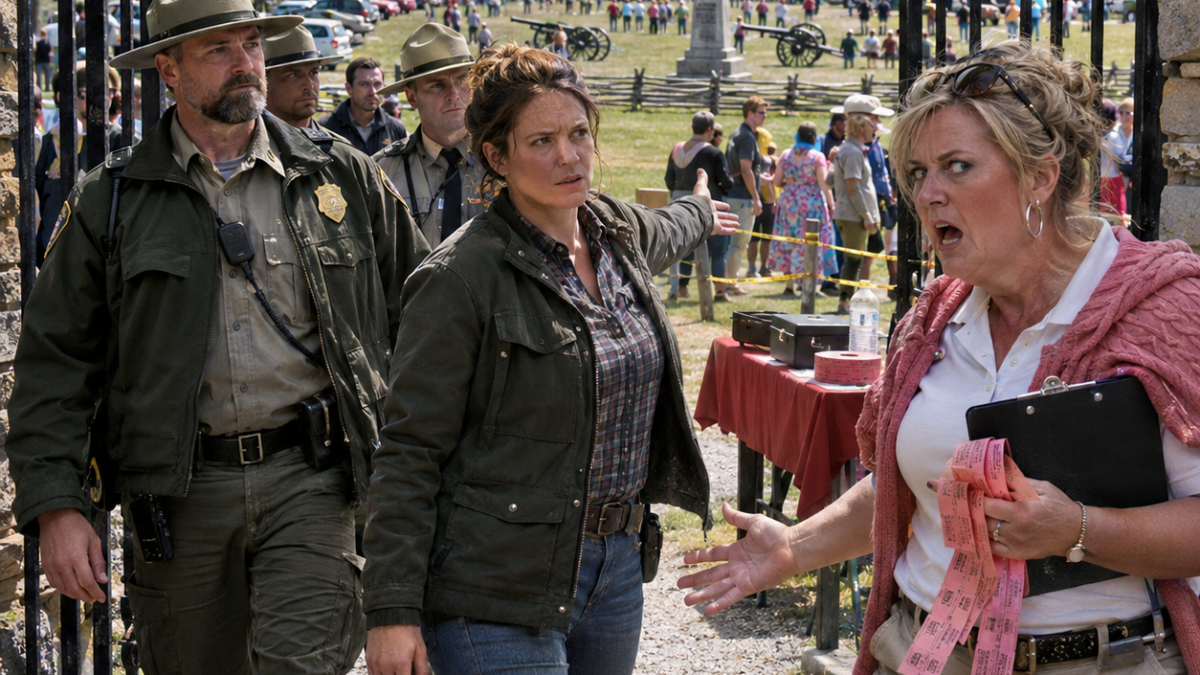
PART 2
Three days earlier, I had no idea how far Lenora had already gone.
The first sign came Wednesday afternoon.
I was in my workshop sharpening a pair of pruning blades when my phone rang.
The woman on the other end introduced herself as an event coordinator.
“Mr. Hale, I’m just confirming the placement of the portable restroom units.”
I stopped working.
“The what?”
“The forty units scheduled near the north field.”
“There are no units scheduled near my north field.”
A pause.
I could hear keyboard clicks.
“Sir, I have authorization here.”
“From whom?”
Another pause.
Then she said the name.
“Lenora Kesler.”
I set the blade down.
“Lenora Kesler does not own my property.”
The woman sounded genuinely confused.
“She’s listed as the property manager.”
“She is not my property manager.”
“I have signed event paperwork.”
“Send me everything you have.”
Within fifteen minutes, an email landed in my inbox.
I opened the attachments.
And that was the moment I realized I was not dealing with one of Lenora’s usual HOA power plays.
There was a site map.
Temporary parking.
Vendor tents.
Portable restrooms.
A reenactment area.
A VIP pavilion.
A large stage.
Bus unloading zones.
Food trucks.
A ticket entrance.
Nearly the entire battlefield had been incorporated into the event design.
My ninety-six acres.
The thirty federal acres.
All of it.
I stared at the screen.
Then I saw a link labeled **TICKET INFORMATION**.
I clicked.
The page looked professional enough to fool almost anyone.
Beautiful photographs.
Historic flags.
Period lettering.
Descriptions of “exclusive battlefield access.”
There were reenactors, lectures, food, premium sunset dinners, and something called the “Founders Experience.”
General admission was $149.
I scrolled to the ticket counter.
**SOLD OUT — 7,000 GUESTS**
Seven thousand.
I did the math twice.
More than a million dollars in general admission alone.
Then I saw the premium packages.
Heritage VIP: $499.
Founders Experience: $999.
My stomach tightened.
The expensive package promised a private dinner on the ridge and a guided walk “through preserved original trenches.”
Those trenches were not an attraction.
Some of them had never even been fully studied.
I kept scrolling.
Near the bottom of the page, written in elegant gold lettering, was a sentence that changed everything.
**Exclusive access granted by the legal owners of Ashford Ridge Battlefield.**
I read it again.
Then again.
I was the legal owner of most of Ashford Ridge.
The rest belonged under federal management.
No one had granted Lenora anything.
I downloaded the entire page.
Screenshots.
Receipts.
Terms.
Maps.
Every advertisement I could find.
Then I noticed the confirmation document issued to ticket buyers.
An official-looking federal seal appeared in one corner.
That frightened me more than the ticket count.
Because pretending to control my land was one problem.
Pretending to have federal approval was another.
The next morning, I went to the Silverbrook Estates clubhouse.
I carried a leather folder containing my certified deed, the recorded survey, screenshots of the ticket page, and a written demand that the event be canceled.
Lenora was conducting an HOA board meeting.
Five directors sat around a polished table.
She saw me standing in the doorway.
And ignored me.
For nearly ten minutes, I stood there while she discussed landscaping expenses as though nothing unusual was happening.
Finally, she set down her paperwork.
“Mr. Hale.”
“Lenora.”
“You interrupted a board meeting.”
“You’re selling tickets to my property.”
Two directors looked at each other.
Lenora smiled.
“Is that why you’re here?”
“That’s exactly why I’m here.”
I put the screenshots on the table.
“Take the ticket page down. Cancel the event. Contact every buyer and refund them.”
She actually laughed.
Not nervously.
Not politely.
She laughed like I had said something ridiculous.
“Your family doesn’t get to control history forever, Weston.”
“History isn’t the issue.”
I opened my deed.
“You are selling admission to land you do not own.”
Her expression did not change.
She slid a glossy brochure toward me.
“Silverbrook Estates has entered a historic development agreement with an investment partner.”
“That does not transfer my property to you.”
“This battlefield is now part of a larger community tourism initiative.”
“No, it isn’t.”
She picked up a remote.
The lights dimmed.
A projector came on.
The first slide showed an aerial photograph of the ridge.
The second showed a colorful development map.
Everything had been shaded green.
My land.
Federal land.
The road.
The grove.
The ridge.
Every acre was presented as part of Silverbrook’s tourism program.
Then the next slide appeared.
My name was across it in large red letters.
**WESTON HALE — OBSTRUCTION TO COMMUNITY PROGRESS**
I looked at Lenora.
“You made a presentation about me?”
“I made a presentation about the problem.”
For the next few minutes, she spoke as though I were not even in the room.
She accused me of “hoarding history.”
She claimed I had prevented economic development.
She said my refusal to cooperate had cost the community jobs.
Two directors nodded.
One applauded.
I waited until she finished.
Then I spread my certified survey across the table.
“This,” I said, “is recorded with the county.”
I pointed to my parcel.
“Ninety-six acres.”
Then the federal section.
“Thirty acres.”
Then Silverbrook.
“And this is you.”
There was a clean boundary.
No overlap.
No shared ownership.
No mystery.
Lenora pushed the survey aside with the back of her hand.
“Your dusty paperwork does not outrank a community development agreement.”
I stared at her.
“A development agreement does not magically convey land.”
She reached into a folder and pulled out another document.
A cease-and-desist letter.
Addressed to me.
It claimed I was interfering with HOA operations.
It warned that if I appeared at the festival, security would remove me.
I almost admired the insanity of it.
“You do understand I am not a member of your HOA?”
“You are adjacent to the community.”
“That isn’t membership.”
“You are interfering with association interests.”
“On my property.”
She leaned back.
“Then try getting past my gate Saturday.”
That sentence told me more than she intended.
I did not argue.
I photographed her maps.
I asked the board secretary, in front of everyone, to preserve the meeting minutes.
Then I handed her a written notice.
“No use of my land is authorized. No construction is authorized. No admission is authorized. No access agreement exists.”
Lenora barely glanced at it.
I left.
My next stop was the county land records office.
The clerk knew me from my surveying days.
I asked her to pull everything tied to my parcels.
Transfers.
Easements.
Leases.
Access rights.
Management agreements.
There was nothing legitimate.
My ownership had never changed.
But as I gathered the documents, the clerk frowned.
“Weston, there is something else.”
She turned her monitor.
A recent filing.
Silverbrook Estates claimed to have received management rights over the historic access road.
I felt my pulse slow.
“Print that.”
She did.
I went directly to the signature page.
At the bottom was my name.
**Weston Hale.**
Signed in blue ink.
I stared at it for a long time.
It looked close.
Someone had studied my signature.
But they had missed something.
For thirty years, whenever I signed my name, the final letter ended with a tiny hooked stroke.
Habit from decades of drafting.
The signature on that agreement was smooth.
Careful.
No hook.
“This isn’t mine.”
The clerk’s face changed.
“Are you sure?”
“I am absolutely sure.”
The document claimed I had signed it on a Tuesday several months earlier at a notary office forty miles away.
I remembered that day.
I had been at a surveying conference in Richmond.
Hotel receipt.
Registration record.
Photographs.
Dozens of witnesses.
Whoever had created the document had picked the worst possible date.
I requested a certified copy.
Then I asked the clerk to preserve the original filing.
From the parking lot, I called the sheriff’s office and reported suspected forgery.
After that, I started following the money.
The festival paperwork listed an accountant named Karine Dabney.
When I reached her, she immediately became guarded.
“I handle accounting. I don’t know anything about the land.”
“I’m not asking you about the land.”
“Then what are you asking?”
“The festival is being advertised as supporting battlefield preservation.”
“Yes.”
“So why are ticket payments being routed through a private event management company instead of a preservation organization?”
Silence.
“Karine?”
“I’m not authorized to discuss that.”
“That wasn’t my question.”
Another silence.
Finally she said, “I was told the event company handles everything.”
“Who owns it?”
“I asked that.”
“And?”
“Lenora told me it wasn’t my concern.”
That evening I researched the company.
Its business address matched a consulting operation connected to Lenora.
Now I understood why she was moving so aggressively.
But I still underestimated the scale.
The million dollars in tickets was not the true prize.
I would not learn that until later.
First, I had to deal with the federal seal.
I sent the ticket confirmation, event map, and supposed permit to the National Park Service office responsible for the protected thirty acres.
Less than an hour later, my phone rang.
“Mr. Hale?”
“Yes.”
“This is Supervisory Law Enforcement Ranger Camille Hartwell.”
Her voice was calm and direct.
“I have reviewed the material you sent.”
“And?”
“No special-use permit has been issued for this event.”
I looked out my kitchen window toward the ridge.
“What about the document?”
“It was not issued by our office.”
That was the first moment I felt the weight of the situation change.
Camille continued.
“Your private property dispute is primarily a county matter. But if commercial activity is occurring on federal land, or if federally protected resources are being damaged, that is our jurisdiction.”
“I understand.”
“Can you provide coordinates for all construction?”
I almost smiled, though there was nothing funny about it.
“That I can do.”
I spent the next several hours working.
Old control points.
Boundary photographs.
Survey records.
Trail-camera footage.
Construction images.
Once I overlaid everything, I discovered something that made my hands tighten around the ruler.
Several boundary stakes had been moved.
Not knocked over.
Moved.
The original event drawings placed the stage mostly on my land.
The actual construction had drifted east.
Toward federal property.
Camille opened the coordinates while we were on the phone.
She became quiet.
“Mr. Hale.”
“Yes?”
“Do you know what is beneath this rectangular excavation behind the stage?”
“No one has ever been authorized to dig there.”
“How deep are they going?”
I checked the construction plans.
“Sixteen feet.”
There was a pause.
Then Camille said, “We need to understand exactly what they may be disturbing.”
I knew someone who could help.
Lucinda Vale had studied Ashford Ridge for more than thirty years.
I found her in the reading room of the local historical society surrounded by battle maps, regimental records, and handwritten letters.
I put the construction map in front of her.
She adjusted her glasses.
Then her face changed.
“What?”
She did not answer immediately.
Instead, she walked to a cabinet and removed a fragile folder.
Inside was a field sketch drawn by a Union officer two days after the 1864 battle.
Her finger moved across the faded paper.
Stopped.
Right beneath Lenora’s proposed stage.
“This is bad,” Lucinda whispered.
“How bad?”
She looked at me.
“According to this account, men were buried here after the fighting.”
I felt the room go very still.
“Confirmed?”
“Not fully. That is why the zone is protected. The burial boundaries were never conclusively mapped.”
She touched the construction plan.
“But this ground was never meant to hold a stage.”
Her voice shook.
“It may still hold soldiers who never made it home.”
That afternoon, Lucinda and I drove to the south service road on my land.
From there, we could legally see the construction site without entering the fenced work zone.
The excavators were still moving.
I flagged down the foreman.
He came over looking irritated.
“I need you to stop work.”
“Talk to Silverbrook.”
“I’m the property owner.”
He frowned.
I showed him the coordinates.
Then my recorded survey.
Then his own construction map.
He compared them.
Once.
Twice.
His irritation disappeared.
“Where did you get these coordinates?”
“I set some of the original control points myself.”
He looked back at the machines.
Then raised one hand.
“Shut it down!”
The excavator stopped.
The drilling rig went silent.
For the first time in days, Ashford Ridge became quiet.
It lasted maybe ten minutes.
Then Lenora’s white SUV came flying up the road.
She got out before the engine had fully stopped.
“What are you doing?”
The foreman lifted his contract.
“We have a boundary issue.”
“No, we do not.”
“He has recorded coordinates.”
“I am paying you to build a festival.”
“He says this is private property.”
“I said keep digging.”
The operators stayed still.
Lenora turned on me.
“You are sabotaging a legitimate business.”
“I am stopping unauthorized excavation.”
“You’re going to cost this community millions.”
“You’re digging where you don’t have permission.”
“I will sue you.”
I pulled out my phone and called Camille.
“Do what you need to do.”
Lenora stepped closer.
“There are seven thousand ticket holders coming Saturday. Do you understand what happens if you interfere?”
“Yes.”
“You can’t stop this.”
I held her gaze.
“You can sue me for stopping your show. You can’t sue history for standing in your way.”
She stormed back toward her SUV.
That should have been the end of the confrontation.
Instead, I noticed a tall tarp behind the stage.
A gap had opened in the fabric.
Two workers came through carrying long wooden crates.
They loaded them into an unmarked box truck.
I did not approach.
I did not touch anything.
I wrote down the plate.
Recorded the time.
Photographed the truck.
Then sent everything to Camille.
That night, Lucinda studied the photographs.
One of the crates had a stenciled marking.
“I’ve seen something similar in conservation inventories,” she said.
“Artifacts?”
“Maybe.”
She held up a hand.
“Maybe. We cannot assume.”
“What else would they be moving from a dig site at dusk?”
“I don’t know.”
Neither of us said the thought aloud.
Two days later, Lucinda obtained information connected with the shipment.
The cargo description read:
**Historical recovery materials — private collection transfer.**
Authorized by:
**Lenora Kesler.**
I read the words twice.
“This can’t be real.”
Lucinda looked sick.
“It is a shipping manifest.”
That Thursday, another piece of the puzzle arrived.
A black luxury SUV entered Silverbrook Estates.
The man who stepped out was Preston Quill, managing partner of a resort development firm known for turning scenic properties into high-end retreats.
I later learned Lenora personally toured him through the site.
The gate.
The stage.
The parking areas.
The bus route.
The VIP zone.
She proudly told him that seven thousand guests had already paid.
Preston asked an intelligent question.
“Does Silverbrook legally control the property?”
Lenora showed him the access agreement.
The one with my forged signature.
And behind the festival, behind the speeches about community and heritage, was an $18 million real-estate and tourism deal.
The agreement depended on Silverbrook proving that it controlled access to Ashford Ridge.
The sold-out festival was not merely a moneymaking event.
It was evidence.
A demonstration for investors.
If Lenora could bring seven thousand people onto the battlefield, charge admission, control the roads, and operate the site without anyone stopping her, she could convince Preston that Silverbrook controlled something worth developing.
The ticket money was bait.
The land was the prize.
And while Lenora entertained Preston, Karine Dabney was sitting in the HOA accounting office staring at numbers that no longer made sense.
A large transfer had moved out of festival funds.
Money ticket buyers believed was supporting historic preservation had gone into a real-estate consulting company.
Karine printed the transaction.
She brought it to Lenora.
“Why is preservation money funding this?”
Lenora did not even pretend to explain.
“You’re an accountant, Karine.”
“Yes.”
“Then count the money.”
Karine stared at her.
“Where did it go?”
Lenora leaned closer.
“Do not question the vision.”
The next morning, Karine discovered she had been locked out of the accounting system.
That frightened her.
Because her credentials were attached to transaction records.
If everything collapsed, she knew exactly who might be blamed.
That night, she called me.
We met at a diner near the interstate.
She arrived carrying a folder.
Before sitting down, she looked through the window twice.
“You followed?”
“No.”
“I feel ridiculous.”
“You’re not ridiculous.”
She sat.
Then pushed the folder toward me.
“I shouldn’t have this.”
I opened it.
An $18 million draft agreement.
Tourism rights.
Development plans.
Hospitality facilities.
Historic destination branding.
The transaction contained one critical condition.
Silverbrook had to demonstrate lawful control over the property and access routes.
Attached was a marketing packet.
The sold-out festival was cited as evidence.
Seven thousand paying customers.
Crowd-management capability.
Admission control.
Commercial viability.
I looked at Karine.
“This was never about the event.”
She shook her head.
“No.”
“It was about proving she could sell my land without owning it.”
Karine looked down at her coffee.
“I think she believed if she acted like she controlled it long enough, everyone else would eventually accept that she did.”
Friday evening, I went to the construction gate.
Deputy Sheriff Dalton Reeves came with me.
He was there to keep the peace and document what happened.
Lenora met us outside.
I handed her a final written notice.
“No activity on my property is authorized. Cancel the festival. Remove the structures. Refund the tickets.”
She read the letter slowly.
Then tore it in half.
Pieces fell onto the gravel.
“Tomorrow morning,” she said, “seven thousand paying customers will prove who controls this property.”
I looked at the pieces of paper at her feet.
Then back at her.
“Tomorrow morning, they’ll learn who you sold it from.”
She smiled.
It was the smile of someone certain that sheer scale had made her untouchable.
Later that night, I sat at my kitchen table talking to Camille over video.
I transferred the surveys.
Coordinates.
Trail-camera images.
Photographs of the moved markers.
Information about the crates.
Copies of the alleged permits.
Everything.
Camille explained that her office and the county sheriff had coordinated their responsibilities.
County deputies would handle my private road, trespass issues, and local enforcement.
Her team would handle federal property and protected resources.
Our immediate concern was safety.
Seven thousand guests could not be allowed around open excavation trenches and heavy machinery while ownership and permitting were in dispute.
Near midnight, my phone buzzed.
A message from Lenora.
**Your name comes off that battlefield tomorrow.**
I looked at it.
Then replied:
**Be at the gate at sunrise.**
At 6:12 the following morning, I stopped in front of that black steel gate.
And forty minutes after Lenora told me to buy a ticket to enter my own land, three National Park Service vehicles appeared at the far end of the county road.
They drove toward us in a line.
The arrowhead emblem was visible on the doors.
Lenora saw them.
So did the guards.
So did several early VIP guests standing near the ticket booth.
Camille stepped out of the lead vehicle.
Two law-enforcement rangers followed her, along with a resource-protection specialist.
Deputy Reeves arrived immediately behind them with two county patrol cars.
Lenora looked at the approaching officers.
Then lifted her microphone.
“This is a private HOA event,” she announced. “Federal officers are not on the guest list.”
Camille did not react.
She walked directly toward the platform.
“Who authorized excavation inside the federal historic site?”
Lenora smiled and pulled a laminated document from her folder.
“This permit.”
Camille took it.
Read it.
Then raised her eyes.
“This permit was not issued by the National Park Service.”
The crowd near the booth became silent.
Lenora’s expression tightened.
“There must be an administrative mistake.”
“There is no permit in our system authorizing this activity.”
“Our legal team approved everything.”
“I am ordering all activity within federal jurisdiction to cease immediately.”
Lenora turned toward me.
“This is your doing.”
I walked to the hood of my truck and unfolded my certified boundary map.
Deputy Reeves stepped beside me.
I pointed to the entrance.
“The steel gate is on my private road.”
Lenora laughed.
“It’s a community access point.”
“No. It’s my road.”
The locksmith I had hired the night before waited near the deputy’s patrol car.
I nodded.
Deputy Reeves watched as he approached the locks.
Lenora stepped down from the platform.
“You cannot touch that gate.”
I answered without looking at her.
“I’m not touching it.”
The locksmith opened the first lock.
Click.
Then the second.
Click.
The twenty-four-foot steel gate slowly swung inward.
The metal groaned across the morning.
I cannot describe how satisfying that sound was.
Lenora rushed in front of me.
“Nobody walks through my gate.”
I stopped one foot away.
“It’s my road, Lenora.”
Then I looked over her shoulder at Camille.
“And you’re blocking federal access.”
I stepped around her.
Camille and the rangers followed.
Deputy Reeves followed them.
Lenora grabbed her radio.
“Security! Close the gate!”
Nobody moved.
She shouted again.
“Close it!”
Deputy Reeves looked toward the guards.
His voice remained calm.
“Anyone who obstructs law-enforcement officers performing their lawful duties is going to create a different problem for himself.”
The guards stared at one another.
One man slowly unclipped his security badge.
He placed it on the ticket table.
Then walked away.
I almost felt sorry for Lenora.
Almost.
She stood in the middle of the open gateway as the organization around her began to dissolve.
Up on the ridge, I spotted the drilling rig.
A worker was climbing toward the cab.
“Camille.”
I pointed.
She immediately signaled her people forward.
Before they reached it, a shout came from the trench.
“STOP!”
Everyone froze.
A construction worker stood near the foundation excavation staring into the dirt.
“There’s something down there!”
Camille moved fast.
We stayed behind the perimeter while her team approached.
A curved piece of corroded metal had appeared in the disturbed soil.
No one touched it casually.
Camille ordered all work stopped.
Tape went up around the trench.
The resource specialist began documenting the site.
Deputy Reeves, with my permission, closed private access so no guests could enter the dangerous construction zone.
The festival operations manager made an announcement.
Entry delayed.
Charter buses redirected.
That was when the real chaos began.
Hundreds of guests started gathering near the entrance.
They had driven for hours.
Some had paid nearly a thousand dollars.
They wanted answers.
Festival workers could not give them any.
People began asking to see the permits.
No one produced a valid one.
And Lenora did what Lenora always did when facts became inconvenient.
She found a microphone.
“This festival is being sabotaged!”
People turned.
“A bitter neighboring landowner has used personal connections to create confusion over property boundaries!”
She pointed directly at me.
“The officers here have been given misleading information!”
I did not grab the microphone.
I did not shout.
I walked to the edge of the public area near Deputy Reeves.
“Lenora.”
She kept talking.
“Lenora!”
She stopped.
I raised my voice enough for the people nearby to hear.
“I have three questions.”
She glared at me.
“Why did you sell tickets to land that belongs to me?”
Murmurs spread through the crowd.
“Why does your advertising include federally managed land?”
More murmurs.
“And who gave you permission to put my signature on your contracts?”
The crowd changed.
It was almost physical.
People who had been angry at me started turning toward her.
Lenora lifted the microphone.
“This community has lawful development rights—”
“That isn’t an answer.”
“We are creating jobs—”
“Not an answer.”
“This site belongs to history, not one selfish individual—”
“Show them the deed.”
Her mouth stopped moving.
By midmorning, two local television crews had arrived.
I gave each reporter copies of my recorded deed and certified boundary survey.
Public records.
Nothing secret.
Nothing theatrical.
One reporter approached Lenora.
“Can you produce a deed showing that Silverbrook Estates owns any portion of this battlefield?”
“We have community development rights.”
“Do you have a deed?”
“Our attorneys—”
“Has Mr. Hale ever transferred ownership?”
She tried changing the subject.
The reporter asked again.
Lenora walked away.
Questions followed her.
Where was the ticket money?
Would refunds be issued?
Why had a federal seal appeared on ticket confirmations?
Why were construction crews digging without valid federal authorization?
Then Karine arrived.
I had not known whether she would come.
She walked through the crowd carrying a folder.
She looked terrified.
But she kept walking.
A representative of the payment-processing company was speaking with the festival operations manager.
Karine approached them.
“My name is Karine Dabney. I handled festival accounting.”
The representative looked up.
Karine swallowed.
“There are financial discrepancies you need to know about.”
Lenora saw her.
“Karine!”
Karine flinched.
For a second, I thought she might turn around.
She did not.
“I have documentation,” she continued. “I am providing it to investigators through the proper channels.”
The payment representative began making calls.
Within an hour, unsettled festival money was placed under a risk review.
That meant a huge portion of the revenue Lenora thought she controlled was suddenly frozen.
Across the VIP tent, Preston Quill received a message.
I watched him read it.
Then he placed his coffee down very carefully.
One of the Founders Experience customers stormed toward the front.
He was older, wearing a pressed sport coat, holding a gold ticket.
“I paid nine hundred ninety-nine dollars for this.”
He pointed toward Lenora.
“Did I pay you to visit a battlefield you don’t own?”
Lenora raised her microphone.
Nothing came out.
The operations manager had cut the main sound feed for safety announcements.
She tapped it.
Still nothing.
For the first time since I had known her, Lenora stood before a crowd and could not control what they heard.
Late that morning, Camille came down from the excavation.
Her expression told me enough.
“What did you find?”
“We have a potential historic artifact.”
I nodded.
“But that is not the primary issue.”
“What is?”
“Part of the stage foundation appears to have been excavated directly into the protected archaeological zone.”
I closed my eyes briefly.
Camille continued.
“This is now a federal investigation.”
By afternoon, the federal portion of the ridge had been secured.
An archaeologist arrived.
Then conservation specialists.
Lucinda came carrying historical records.
Under a ranger canopy, she carefully opened the old field map.
The archaeologist compared it with the excavation.
The corroded object recovered from the soil resembled nineteenth-century military equipment.
They refused to identify it conclusively until analysis.
That was exactly how it should have been.
But the disturbed layers of soil told their own story.
The stage foundation had cut through earth that should never have been disturbed without archaeological supervision.
Lucinda pointed to an old description of rifle trenches and emergency burials.
I looked toward the place where the protective markers should have stood.
And remembered.
Several markers had disappeared weeks earlier.
When I had mentioned it to Lenora, she had called them “old landscape stakes.”
Now a festival sound technician approached Camille.
He held out his phone.
“I think you need to see this.”
On the screen were emails from the setup period.
One message from the construction foreman warned about sensitive ground.
He recommended moving the stage two hundred feet west.
Lenora refused.
Why?
Because moving it would ruin the sightline from the VIP tent.
Another message warned that historic markers were interfering with equipment placement.
Lenora replied with one sentence:
**Remove the old markers. Guests are paying for the view, not a history lesson.**
I read it.
Then again.
Something in me shifted.
Until that moment, anger had carried most of the day.
Now it became sadness.
I found Lenora near the edge of the restricted area.
Deputy Reeves stood nearby.
“You knew.”
She crossed her arms.
“Knew what?”
“That people warned you.”
“They were old stakes.”
“You knew the ground might contain artifacts.”
“That is speculation.”
“You ordered the markers removed.”
She scoffed.
“People paid for an experience.”
I pointed toward the archaeologists.
“Those people in the ground were somebody’s sons.”
Her face remained hard.
“You don’t even know if anyone is buried there.”
“No.”
My voice became quieter.
“That’s why decent people don’t dig first and ask questions later.”
She looked away.
“You didn’t just sell tickets to my property.”
I continued.
“You didn’t just put my name on paperwork.”
“You were willing to destroy the history you were charging people to see.”
She laughed bitterly.
“If they find anything, it’s scrap metal.”
I felt my anger return.
“Their value was never yours to decide.”
Camille joined us.
She told Lenora that evidence concerning the excavation, counterfeit permit, missing markers, and internal emails would be documented for federal investigators.
County authorities would separately address what had happened on my private property.
Lenora’s confidence was gone now.
Not completely.
But cracked.
Then Karine suddenly pointed toward the vendor area.
“That truck.”
A box truck was moving toward the exit.
“What about it?” Reeves asked.
“That’s the truck from the transfer records.”
The one connected with the crates.
Deputy Reeves immediately radioed another unit.
The vehicle was stopped for a lawful inspection based on the developing investigation.
I stayed where I was.
No dramatic chase.
No vigilante nonsense.
Evidence mattered more than spectacle.
Meanwhile, Lenora went searching for Preston.
She found him in the parking lot beside his SUV.
By then his lawyers had reviewed enough public records to understand the problem.
I did not hear their entire conversation firsthand, but later statements and documents made the substance clear.
Preston asked the question Lenora could no longer avoid.
“Why do my investment papers describe land Silverbrook does not own?”
She claimed it was a boundary misunderstanding.
He told her the $18 million deal was suspended immediately.
She begged him to wait.
He opened his car door.
“I came here to buy development rights.”
Then he looked toward the battlefield.
“You offered me someone else’s land.”
He drove away.
By Sunday morning, the festival was officially canceled.
Seven thousand ticket holders wanted refunds.
Vendors wanted payment.
VIP customers demanded reimbursement.
The production company wanted to know who would cover its losses.
The payment processor maintained its hold.
Karine turned over accounting records showing where money had moved through the event company and into a consulting firm connected with Lenora.
By Monday afternoon, Silverbrook Estates was in panic.
And Monday evening, the HOA board called an emergency meeting.
For the first time in years, Lenora did not control the agenda.
I was not inside that meeting.
But its minutes later became part of the record.
Board members demanded to know why Lenora had signed contracts involving land the HOA did not own.
They asked about the forged access agreement.
The ticket accounts.
The consulting company.
The federal permit.
The construction.
The $18 million development proposal.
Lenora said the board had approved everything.
Then the secretary opened the official minutes.
No such approvals existed.
Several directors who had applauded when my name appeared beneath the words **OBSTRUCTION TO COMMUNITY PROGRESS** suddenly discovered how dangerous blind loyalty could be.
I filed my civil complaint that week.
I did not ask for anyone’s house.
I did not ask to bankrupt innocent Silverbrook residents.
Most of them had never known what Lenora was doing.
My demands were specific.
Remove the gate.
Remove unauthorized structures.
Restore the road.
Restore damaged portions of my property.
Replace the survey markers.
Reimburse legitimate surveying, inspection, and restoration costs.
End Silverbrook’s claim to management rights over Ashford Ridge.
Preserve financial records and ticket files.
That was enough.
I wanted restoration.
I wanted accountability.
Revenge was tempting.
But there is a difference between revenge and justice.
Revenge wants everyone near the guilty person to suffer.
Justice identifies who did what and makes them answer for it.
Lenora had spent years treating those ideas as the same thing.
I refused to.
The investigation continued.
Documents were examined.
Signatures were compared.
The date on the fake access agreement was checked against my conference records.
My hotel receipt showed when I checked in.
Conference photographs showed me standing beside other surveyors.
Attendance records showed my name.
Witnesses remembered me.
Handwriting specialists examined the signature.
The conclusions supported what I had said from the beginning.
I had not signed the agreement.
Then investigators found something even worse.
Karine discovered an archived email folder containing a private consulting contract.
She turned it over.
Under its terms, Lenora would personally receive a substantial commission if the $18 million development transaction closed.
That document finally stripped away every excuse she had used.
Heritage.
Community progress.
Economic development.
Historic preservation.
None of it explained the private commission.
When I saw the agreement, I sat quietly for a long time.
Lucinda was beside me.
“She was going to sell access to this place,” I said.
Lucinda shook her head.
“No.”
I looked at her.
“She was going to sell the illusion that she owned it.”
That was worse.
Because she had never possessed the battlefield.
She had possessed confidence.
A forged document.
A polished presentation.
A security team.
A gate.
Seven thousand customers.
And a belief that if enough people accepted the lie, legal ownership would somehow become irrelevant.
As investigators began interviewing people connected with the festival, word reached Lenora.
One afternoon, she loaded two suitcases into her car.
Deputy Reeves encountered her before she left the area and handled the situation according to the authority available to him at that stage.
I was not there.
And despite all the stories people later told, there was no dramatic roadside wrestling match.
No screaming chase.
Real consequences rarely look like movies.
They arrive as paperwork.
Interviews.
Preservation orders.
Bank holds.
Subpoenas.
Forensic comparisons.
Court dates.
Then, after the investigation developed and evidence concerning the forged documents was verified, Lenora was lawfully arrested on charges connected with fraud and forgery.
The news reached Silverbrook before sunset.
I received three calls from residents.
The first apologized.
The second said he had always suspected Lenora.
I did not believe him.
The third was from an elderly woman who lived near the community entrance.
She sounded embarrassed.
“I voted for her.”
I leaned against my kitchen counter.
“A lot of people did.”
“She told us you were trying to keep everyone away from the battlefield.”
“I know.”
“I believed her.”
I said nothing.
Her voice trembled slightly.
“I’m sorry.”
I looked through my window toward the ridge.
“You didn’t forge my signature.”
“No.”
“You didn’t move the markers.”
“No.”
“You didn’t order the digging.”
“No.”
“Then help your neighbors make sure nobody like her gets that much unchecked authority again.”
She was silent.
Then said, “We will.”
That conversation stayed with me.
Because Silverbrook had become easy to hate.
From the outside, people wanted to tell a simple story.
Evil HOA.
Greedy neighborhood.
Arrogant residents.
But life is rarely that clean.
Most residents were ordinary people who paid dues, mowed lawns, raised children, walked dogs, and assumed their elected board president was telling them the truth.
Some had enabled Lenora.
Some had enjoyed her aggression as long as it was directed at someone else.
Some had applauded when she called me selfish.
They had to live with that.
But they had not all committed her crimes.
Eight months passed.
The dispute became local news far beyond anything I wanted.
Reporters called it the “battlefield gate case.”
People argued online.
Some treated me like a hero.
Others called me stubborn.
Neither description interested me much.
The court confirmed what the county records had always shown.
I had never transferred ownership or management of my property.
Forged documents created no rights.
Silverbrook had no lawful claim to run Ashford Ridge.
The $18 million development agreement collapsed.
An independent auditor reviewed HOA finances.
Recoverable funds went toward refunds, restitution, and court-ordered obligations.
Lenora was removed from office.
She was permanently barred from serving on the HOA board under the outcome of the proceedings against her.
Her name, once printed across community newsletters as though she owned the future, became something residents avoided saying aloud.
But the moment I had waited for came on a cool spring morning.
I drove to the entrance with coffee in my cup holder.
Just like I had done on the morning the whole thing erupted.
A work crew was standing beside the black steel gate.
Deputy Reeves was there.
So was a representative responsible for confirming that the restoration order was followed.
The workers removed the electronic locks.
Unbolted the hinges.
Attached lifting equipment.
Then the gate rose.
For several seconds, it hung above the road.
The same gate behind which Lenora had told me I needed to buy a ticket.
The same gate she believed seven thousand customers would transform into proof of ownership.
The workers lowered it onto a flatbed truck.
Another man removed the Silverbrook Estates plaque from the post.
The ticket booth went next.
Then the VIP signs.
The temporary barriers.
The promotional boards.
Piece by piece, Lenora’s imaginary kingdom disappeared.
Deputy Reeves stood beside me.
“Feel like you won?”
I watched a worker fill one of the post holes.
“Not yet.”
“What are you waiting for?”
I looked toward the memorial grove.
“I’ll call it a win when the ground looks like it did before she arrived.”
He nodded.
“That may take a while.”
“History usually does.”
Restoration on the federal land was slower.
It had to be.
Archaeologists documented the disturbed layers.
Recovered objects were cataloged properly.
Conservation specialists stabilized what they could.
No one rushed.
No one sold VIP access.
No one promised guests a dramatic reveal.
The work was careful, quiet, and respectful.
Exactly what the ridge needed.
Lucinda began organizing historical lectures.
She spoke about the men who fought there.
Not as props.
Not as marketing.
As human beings.
Young men writing letters home.
Fathers.
Brothers.
Immigrants.
Farm boys.
Men who had been frightened.
Men who had shown courage.
Men who had died before anyone could ask them how they wanted to be remembered.
One afternoon she showed me a copied letter written by a soldier shortly before the battle.
He told his wife he hoped to be home before winter.
He never was.
I sat with that for a while.
Then I thought about Lenora’s stage.
Her champagne dinner.
Her premium tickets.
Her email saying guests were paying for the view, not a history lesson.
I understood then why the whole thing had made me so angry.
It was not only about ownership.
My deed mattered.
The law mattered.
But underneath everything was something deeper.
There are places that should remind us we are not the center of the world.
A battlefield is one of them.
You stand where people faced the last moments of their lives, and if you have any humility at all, you become quieter.
Lenora had walked onto that ground and seen inventory.
I had walked onto it since childhood and felt responsibility.
That difference caused everything.
Months after restoration began, the Park Service and I worked out safeguards allowing limited historical tours.
Small groups.
No giant stage.
No luxury pavilion.
No busloads pouring across sensitive areas.
No fake ownership signs.
No exaggerated promises.
One afternoon, several people who had originally bought tickets to Lenora’s festival joined one of those tours.
I recognized one of them.
The older man who had held up his $999 Founders Experience ticket.
He came dressed simply this time.
No gold badge.
No VIP wristband.
At the beginning of the tour, he approached me.
“Mr. Hale?”
“Yes?”
“I owe you an apology.”
“For what?”
“I was angry at you that morning.”
“So were a lot of people.”
“I thought you had ruined the event.”
I smiled slightly.
“That was the story you were given.”
He looked across the ridge.
“I wanted spectacle.”
Then he shrugged.
“Turns out I didn’t know what I was asking for.”
We walked the battlefield.
Lucinda explained troop movements.
I showed them the old road.
We stopped near the protected archaeological area but did not enter it.
At the memorial stone, an elderly Army veteran in the group removed his cap.
Everyone became quiet.
After a few moments, he came toward me.
He held out his hand.
“Thank you for standing up for this place.”
I shook it.
“I didn’t save it alone.”
“You started it.”
“No.”
I looked back toward the ridge.
“I just refused to let someone sell what wasn’t theirs.”
When the group left, I stayed behind.
Late sunlight stretched between the trees.
The road was quiet.
No speakers.
No generators.
No ticket scanners.
No security guards asking whether I belonged there.
I walked toward the entrance where the gate had once stood.
One final part of the restoration remained.
I had ordered a small bronze plaque.
Nothing grand.
Nothing self-congratulatory.
No mention of Lenora.
No mention of me.
I mounted it on a stone post beside the road.
The inscription contained one sentence:
**ASHFORD RIDGE — PRESERVED FOR HISTORY, NEVER OWNED BY GREED.**
A young reporter had come to cover the reopening.
She read the plaque.
Then asked me a question.
“Do you ever regret not taking Ms. Kesler’s original partnership offer?”
I almost laughed.
“No.”
“You could have made significant money.”
“I probably could have.”
“Then why not do it?”
I looked down the road.
My grandfather had helped lay that gravel.
My father had walked me across the ridge when I was young.
He had once told me something I did not fully understand until I grew older.
Ownership does not always mean something exists for your pleasure.
Sometimes it means you are responsible for leaving it intact for people you will never meet.
I looked back at the reporter.
“Lenora sold seven thousand tickets to a battlefield she didn’t own.”
The reporter smiled faintly.
“That still sounds unbelievable.”
“It does.”
“What do you think she expected to happen?”
I looked toward the place where the gate had stood.
“I think she believed enough money could turn a lie into a fact.”
“And did you know the federal officers would show up that morning?”
“I knew they were investigating activity on their land.”
“You seemed very calm in the videos.”
“I wasn’t calm.”
“What were you?”
“Angry.”
I thought about it.
“And scared.”
“Scared of her?”
“No.”
I looked toward the protected ridge.
“Scared we were already too late.”
That was the part most people missed.
The videos online showed the satisfying moments.
The locks opening.
The gate swinging inward.
The security guards backing away.
Lenora losing her microphone.
The federal vehicles arriving.
People loved those scenes because they looked like instant justice.
But none of that mattered as much as what had happened beneath the soil.
A gate can be removed.
Money can sometimes be refunded.
A fake document can be exposed.
A liar can be prosecuted.
But once an archaeological site is destroyed, no court can put every layer of earth back exactly where history left it.
That was why I never celebrated Lenora’s downfall the way some people expected me to.
I was relieved.
I believed the consequences were deserved.
But watching a person destroy her own life is not joyful.
Especially when she had countless opportunities to stop.
I had given her one at the board meeting.
She laughed.
I gave her another when the foreman stopped the excavators.
She ordered them to continue.
I gave her one Friday evening.
Cancel the festival.
Refund the tickets.
Remove the structures.
She tore the notice in half.
Even on Saturday morning, she could have stepped aside.
Instead she ordered security to close the gate on federal officers.
At every turn, pride gave her one more chance to make the worst possible decision.
And every time, she took it.
That was the real revenge.
Not something I invented.
Not some trap I built.
I did not destroy Lenora.
I documented her.
I preserved the records.
I called the right authorities.
I refused to move.
Then I let the truth encounter everything she had built.
Her forged signature exposed the false land claim.
Her fake federal approval brought federal scrutiny.
Her excavation uncovered the archaeological violation.
Her sold-out festival gathered thousands of witnesses.
Her investor demanded proof of ownership.
Her own accountant followed the money.
Her own employees saved the emails.
Her own gate created the visual symbol of what she was trying to do.
She wanted seven thousand people there because she believed a massive crowd would make her appear powerful.
Instead, seven thousand customers became seven thousand reasons her story could not quietly disappear.
That was the irony she never understood.
The event designed to prove her control became the event that exposed she had none.
Years of tension between us ended not with some dramatic act of revenge from me, but with something simpler.
An open road.
One morning after the last restoration work had been completed, I drove down the county road before sunrise.
No one else was there.
I parked near the memorial grove.
Took my coffee.
Walked.
Mist hung low over the field.
Birds moved in the trees.
The sun slowly reached the ridge.
I stopped near the area where the VIP stage had once stood.
Grass had begun growing again.
The scars were fading.
Not gone.
But fading.
Lucinda had once told me that preservation is never the same thing as freezing time.
Everything changes.
Trees fall.
Stone erodes.
Documents fade.
People forget.
Preservation means deciding that some things deserve enough effort that forgetting becomes harder.
I finally understood why my grandfather had spent so many weekends repairing that road.
Why my father had made me walk the property lines.
Why I had spent nineteen years checking markers and clearing branches when I could have sold the property and moved somewhere easier.
We were not guarding dirt.
We were guarding a story.
And stories become dangerous when greedy people learn they can rewrite them without opposition.
Lenora tried to rewrite Ashford Ridge.
She printed maps where boundaries disappeared.
She created documents where my permission appeared.
She printed tickets claiming ownership.
She built a gate that physically turned her lie into steel.
For a few days, it almost worked.
Vendors believed her.
Customers believed her.
Board members believed her.
An investor nearly believed her.
Security guards enforced her version of reality.
Then one ordinary thing ruined everything.
The actual boundary.
A line on a recorded survey.
A line she could move on a presentation but not in law.
I finished my coffee and walked back toward the entrance.
The bronze plaque caught the first sunlight.
**PRESERVED FOR HISTORY, NEVER OWNED BY GREED.**
I ran my fingers across the cold metal.
Then I heard a vehicle approaching.
For one instinctive second, my body tightened.
Old habit.
But it was only a family arriving early for one of our small scheduled tours.
A father stepped out.
Then a mother.
Then their adult son.
They waited respectfully near the entrance.
No gate stopped them.
No guard demanded $149.
No banner promised an “exclusive experience.”
They had come because they wanted to learn.
I walked toward them.
“Morning.”
The father smiled.
“Are we too early?”
“A little.”
“Sorry.”
“No problem.”
His son looked toward the memorial.
“Is that where the battle happened?”
“Part of it.”
He became quieter.
“People are still buried here?”
“Possibly.”
He stared across the ridge.
Then lowered his voice.
“So we should be careful where we walk.”
I smiled.
“Yes.”
That one sentence meant more to me than all the marketing language Lenora had ever printed.
We should be careful where we walk.
Not because I owned the ground.
Because people had been there before us.
Because our presence carried responsibility.
I led them down the old gravel road.
The sun climbed behind the trees.
An American flag moved gently above the memorial grove.
And when I looked back toward the entrance, there were no black steel bars behind us.
No Silverbrook sign.
No ticket booth.
No woman on a platform telling me I was trespassing.
Only an open road.
Lenora once believed she could turn Ashford Ridge into an $18 million asset by convincing enough people that it belonged to her.
She sold seven thousand tickets to prove it.
She built a gate to enforce it.
She forged my name to legitimize it.
She ignored warnings to protect it.
And she nearly damaged something money could never replace.
In the end, every piece of power she collected became evidence against her.
The tickets.
The contracts.
The emails.
The accounts.
The gate.
The excavation.
The crowd.
She wanted everyone watching when she proved I had lost control of my own battlefield.
Everyone was watching.
That part, at least, she got exactly right.
They just watched something very different from what she had planned.
They watched a locksmith open the gate she had built on another man’s road.
They watched federal rangers walk through it.
They watched her permits fail.
They watched her investor leave.
They watched her employees talk.
They watched the money freeze.
They watched the truth catch up.
And months later, I watched the gate come down.
If there was satisfaction in any of it, it was not seeing Lenora punished.
It was seeing the ridge become quiet again.
That morning, after the family’s tour ended, I stood alone beside the memorial.
Wind moved through the grass.
I thought of my grandfather.
My father.
Lucinda’s old soldier’s letter.
The men whose names had been recorded.
And those whose names had disappeared.
Then I looked toward the open road.
For years, Lenora had treated every refusal from me as weakness.
She thought because I did not shout, I would eventually surrender.
Because I did not threaten, I could be intimidated.
Because I chose records over rumors, procedure over spectacle, patience over rage, she assumed I had no weapon.
She was wrong.
My weapon was the truth.
And truth does not always arrive dramatically.
Sometimes it sits quietly inside a leather folder.
Sometimes it is a boundary coordinate.
Sometimes it is a hotel receipt proving you were forty miles away when someone claimed you signed a document.
Sometimes it is an email someone forgot to delete.
Sometimes it is a frightened accountant deciding she refuses to become the scapegoat.
Sometimes it is an old field map showing where soldiers may have been buried.
And sometimes it arrives at 6:52 in the morning in three National Park Service vehicles while the person who underestimated it is standing behind a gate she never had the right to build.
I never needed to take Ashford Ridge back from Lenora.
That was the final truth.
She had never owned it.
All I had to do was refuse to let her lie become permanent.
And when the last truck carrying her steel gate disappeared around the bend, Ashford Ridge did not feel like mine again.
It felt like itself again.
That was better.
That was enough.








