HOA Karen Slashed All 4 Tires on My $79,000 Corvette—She Froze When the Police Chief Walked Out of My House
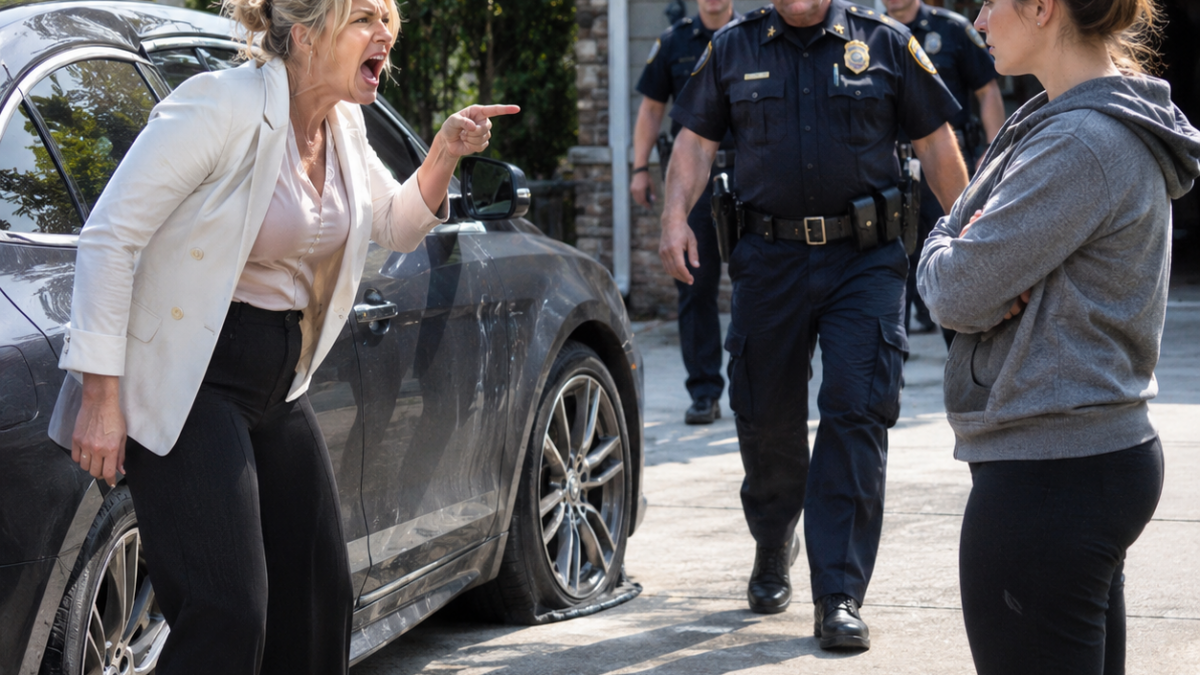
The first tire went flat with a hiss so sharp that I felt it in my chest before I fully understood what she had done.
By the time she moved toward the second wheel, she was smiling, completely certain that no one in the neighborhood had enough power to stop her.
What she didn’t know was that the person sitting inside my house that morning was about to change the meaning of every threat she had made.
At 8:36 on a quiet Saturday morning, I stood on my front porch and watched Blair Weatherford, president of the Willow Ridge HOA, kneel beside my brand-new Corvette with an open folding knife in her hand.
I had owned the car for less than twenty-four hours.
Deep blue.
Chevrolet Corvette Stingray.
Almost $79,000 after everything was finished.
For years, I had told myself I didn’t need it.
I was forty-three, a mechanical engineer, practical by nature, and most of my work involved inspecting damaged vehicles and determining exactly how things had failed.
I understood depreciation.
Repair costs.
Insurance.
Bad investments.
But every once in a while, a person should be allowed to buy something simply because he worked for it.
That Corvette was mine.
No debt to the HOA.
No violation.
No blocked sidewalk.
No fire lane.
It sat entirely on the driveway I owned.
Blair did not care.
“You were warned,” she said.
I held my phone in front of me.
“Put the knife down.”
She barely glanced at me.
The blade pressed into the sidewall.
The second tire hissed.
My stomach twisted.
Not because of the money.
Because she was doing it slowly.
Deliberately.
She wanted me to watch.
“Blair.”
She moved toward the rear wheel.
“Stop.”
“You’re the one who wanted to challenge the parking program.”
“That has nothing to do with my car.”
“It has everything to do with your car.”
She crouched.
Third tire.
Another hiss.
The Corvette settled lower.
My hands tightened around my phone.
Every instinct in my body told me to walk down the driveway and take the knife away from her.
I didn’t.
I knew exactly how fast a situation could change once two people started grabbing for a blade.
And more importantly, I knew Blair.
She would love nothing more than to turn herself from the woman damaging my property into the frightened HOA president attacked by an angry homeowner.
So I stayed ten feet away.
Kept recording.
Kept my voice calm.
“You are being recorded.”
She laughed.
“Good.”
The blade went into the fourth tire.
Air rushed out.
She stood.
Brushed dust from her knees.
Looked at the Corvette leaning on four ruined tires.
Then she smiled at me.
“Now let’s see how far your seventy-nine-thousand-dollar toy gets you.”
For a few seconds, I could hear nothing but my own heartbeat.
Then I said, “I’m calling the police.”
Blair laughed even harder.
“Go ahead.”
She pointed the knife toward me.
“They know who runs this neighborhood.”
That sentence told me how safe she believed she was.
For six years, Blair had ruled Willow Ridge like a private kingdom.
Eighty-six homes.
One clubhouse.
A small HOA board.
And one woman who had gradually convinced everyone that disagreeing with her meant fines, inspections, towing notices, or harassment from private security.
I had spent months challenging her newest plan.
A mandatory parking system.
Every household would eventually be pushed into a paid lot controlled by an HOA partner.
Three hundred forty dollars a month.
Per vehicle.
For families with two cars, that meant more than eight thousand dollars a year just to park near their own homes.
I had asked questions.
Collected signatures.
Read bylaws.
Demanded votes.
Blair hated that.
And now she stood in my driveway with four ruined tires behind her.
Still holding the knife.
Still smiling.
Then my front door opened.
Blair turned.
Police Chief Odessa Whitcomb stepped onto my porch.
Her badge was clipped to her belt.
Her eyes moved from me…
to the Corvette…
to the four collapsing tires…
and finally to the open knife in Blair’s hand.
The smile disappeared from Blair’s face so quickly it was almost frightening.
Odessa walked slowly down the steps.
She did not raise her voice.
She did not need to.
“Mrs. Weatherford,” she said, “did you just destroy this man’s tires?”
Blair straightened.
“I’m the HOA president.”
Odessa looked directly at her.
“That wasn’t my question.”
PART 2
Blair’s entire personality changed in less than three seconds.
The arrogant woman who had just laughed at me became suddenly careful.
Almost wounded.
“Chief, you don’t understand what’s happening.”
Odessa stopped several feet away.
“I understand that you’re holding an open knife beside four damaged tires.”
“This vehicle is in violation of community safety standards.”
“Put the knife on the ground.”
Blair blinked.
“I have authority to—”
“Knife. Ground. Now.”
There was nothing loud about Odessa’s voice.
That made it stronger.
Blair looked at me, then back at Odessa.
For the first time since I had known her, she seemed unsure who was in control.
Slowly, she bent down and placed the knife on the concrete.
Odessa keyed her radio.
“Dispatch, I need a patrol unit at Maplerest Lane. Possible property destruction. Weapon secured on scene.”
Blair’s mouth fell open.
“You’re calling officers on me?”
“I am requesting officers for an incident I personally witnessed.”
“You know who I am.”
“Yes.”
“I work with your department constantly.”
Odessa’s eyes narrowed.
“No, your HOA security company calls my department constantly. That is not the same thing.”
I stood near the porch, still recording.
My hands looked steady on the screen.
They didn’t feel steady.
I had spent years saving for the Corvette.
I had researched it for months.
The night before, I had walked into the garage twice just to look at it.
Now four tires were destroyed.
The car sat low against the driveway like something wounded.
And Blair seemed more offended by police involvement than by what she had done.
Two patrol cars arrived within minutes.
Neighbors started appearing.
Curtains opened.
Garage doors lifted.
People stepped onto porches.
Blair noticed the audience.
That was when she reached into her SUV and pulled out a thick binder.
She marched toward the first officer.
“This is an HOA enforcement matter.”
The officer accepted the binder.
“What exactly are you enforcing?”
“Illegal parking.”
I almost laughed.
My Corvette was sitting in the center of my driveway.
The officer looked at it.
Then at Blair.
“You slashed the tires?”
“It was an enforcement measure.”
Odessa crossed her arms.
“Show us the rule.”
Blair opened the binder.
Pages flipped.
“Section fourteen authorizes us to address unsafe vehicles.”
Odessa said, “Show me the language authorizing intentional damage.”
Blair flipped faster.
“There are broad safety powers.”
“Show me where those powers allow you to destroy somebody’s property.”
Silence.
The officer waited.
Blair kept turning pages.
Nothing.
Eventually, she looked up.
“This is being taken out of context.”
That was Blair’s favorite phrase.
Whenever someone found a fact she could not explain, the fact was “out of context.”
Then she changed tactics.
“He threatened me.”
I stared at her.
Odessa’s expression hardened.
“When?”
“Before I acted.”
I held up my phone.
“I recorded the entire thing.”
Blair looked at the phone.
For the first time, real fear entered her face.
I handed the device to one of the officers.
My garage camera had captured the incident from a second angle.
Odessa had personally witnessed the final tire.
There was no gap for Blair to fill with a new story.
One officer photographed the Corvette.
Another bagged the knife.
I gave a statement.
Then I turned to Odessa.
“I want this handled exactly like any other case.”
She nodded.
“I was going to tell you the same thing.”
“Because you were here?”
“I’m a direct witness. I won’t supervise the investigation.”
That mattered to me.
Odessa had been inside my house that morning for an unrelated but connected reason.
For months, residents had complained that the HOA’s private security patrol was making false or exaggerated police reports.
Blair’s guards routinely told homeowners that Milford police would “back the HOA.”
Odessa had come to review copies of those complaints with me because I had helped organize them.
If she personally ran the tire case, Blair would claim I had used a friendship with the police chief.
So Odessa stepped back.
An independent investigator would take over.
Blair overheard.
Her face turned red.
“I know the city manager.”
No one answered.
“You’re all going to regret embarrassing me.”
An officer said, “Mrs. Weatherford, you need to stop interfering.”
Then Blair did something so stupid that even now I have trouble believing it.
She lunged toward me.
Snatched the phone from my hand.
And started stabbing at the screen.
“Hey!”
Two officers grabbed her.
She twisted.
“I’m deleting my private information!”
“That’s my phone!”
They pulled it away before she managed to erase anything important.
The attempt itself went into the report.
A moment later, Blair was being escorted toward a patrol car.
As they opened the door, she twisted around.
“By Monday, Bennett, you won’t even be allowed to park in your own driveway!”
I said nothing.
She wanted a reaction.
I refused.
The car door closed.
The patrol unit drove away.
I stood beside my Corvette.
Four ruined tires.
The front end lower than it had been an hour earlier.
Odessa came beside me.
For several seconds, neither of us spoke.
Then she said, “I don’t think this is about four tires.”
I looked at her.
“What do you mean?”
“She came prepared.”
“With a knife?”
“With paperwork.”
I remembered the red violation notice.
The timing.
The certainty.
The threat about towing.
Odessa looked toward the end of the street.
“People who lose their temper usually improvise.”
I nodded slowly.
“She didn’t.”
“No.”
After Odessa left, I went inside.
My phone had been returned.
I opened my email.
There was a new message from the HOA.
Subject:
**NOTICE OF VEHICLE REMOVAL**
I frowned.
The message stated that my Corvette had been classified as an inoperable vehicle and was scheduled for towing.
I read it twice.
Then I noticed the approval timestamp.
8:12 a.m.
I checked my video.
Blair had punctured the first tire at 8:36.
I stopped breathing for a second.
Twenty-four minutes.
The HOA had classified my car as “inoperable” twenty-four minutes before Blair made it inoperable.
That was not anger.
That was preparation.
I opened the message header.
Creation time.
Server information.
Approval record.
All of it pointed to the same conclusion.
The towing order had been generated from Blair’s HOA account before she ever walked up my driveway.
I saved screenshots.
Downloaded the original message.
Backed it up in three locations.
Then I wrote the timeline on paper.
**8:12 — Tow authorization approved.**
**8:36 — First tire slashed.**
**8:38 — Fourth tire destroyed.**
I stared at those lines.
My job had taught me something useful.
Mechanical failure is rarely mysterious if you are patient enough to trace what happened first.
Human schemes work the same way.
Find the first event that should not exist.
Then work outward.
The towing company named in the email was Merryweather Recovery.
Owner:
Curtis Merryweather.
I knew the name.
Everyone in Willow Ridge did.
His trucks had become common around the neighborhood after Blair launched what she called the **Secure Streets Initiative**.
Officially, the program was supposed to improve safety.
In reality, it seemed to produce an incredible number of parking violations.
That afternoon, I read the HOA bylaws from beginning to end.
Nothing authorized towing a car from a private driveway under these circumstances.
Nothing authorized destroying tires.
Nothing even remotely supported Blair’s actions.
Around four o’clock, a flatbed tow truck stopped in front of my house.
I stepped outside.
Curtis climbed down.
Two employees followed.
“We’re here for the Corvette.”
I almost smiled.
“Under what authority?”
He handed me a tow order.
Signed by Blair.
I looked at the paperwork.
“Your order is invalid.”
“Not my problem.”
“It becomes your problem if you take a seventy-nine-thousand-dollar car from private property without legal authority.”
Curtis sighed.
“Look, man, I’m just doing the contract.”
“Then we can wait for police to verify it.”
His expression changed.
“You don’t need to do that.”
“I already am.”
I called.
While we waited, Curtis and his employees stood beside the flatbed.
Nobody spoke much.
When an officer arrived, I showed him the driveway.
The HOA documents.
The tow notice.
The officer called dispatch, reviewed the basics, and told Curtis there was no valid basis to remove the vehicle.
Curtis shrugged.
“Fine.”
He waved his workers back.
As he climbed into the cab, he muttered, “She said the car would already be disabled.”
I froze.
“What did you say?”
Curtis looked at me.
His face changed.
“Nothing.”
“Who told you it would already be disabled?”
He slammed the truck door.
The engine started.
He drove away.
I stood in the street watching the flatbed disappear.
The tow order came before the vandalism.
The tow company expected the car to be disabled.
That meant Blair’s knife was not an emotional reaction.
It was a step.
One step in a larger process.
Damage car.
Classify car as unsafe.
Tow car.
Charge owner.
Create violation.
Collect money.
Punish resistance.
I walked back inside.
Opened my laptop.
Created a document.
At the top I typed:
**EVERYTHING THAT HAPPENED**
Then I started writing.
Every time.
Every sentence.
Every email.
Every document.
Every name.
I had a feeling I would need all of it.
The next morning, someone knocked.
A woman stood outside holding a manila folder.
I recognized her.
Phoebe Aldridge.
She lived across the street.
“Can I come in?”
“Of course.”
We sat at my kitchen table.
She placed the folder between us.
“I watched what Blair did yesterday.”
“I figured half the street did.”
Phoebe did not smile.
“Six months ago, my truck had a flat tire.”
I waited.
“I thought it was random.”
“What happened?”
“I came outside before work. Tire was flat. Before I could even call roadside assistance, Merryweather Recovery was already parked down the street.”
My attention sharpened.
“Already there?”
“Yes.”
“Then?”
“I received an HOA notice calling the truck an unsafe vehicle.”
“How fast?”
“Within the hour.”
“What did towing cost?”
Her mouth tightened.
“Almost nine hundred dollars.”
“With storage?”
“Yes.”
She looked down.
“I couldn’t pay immediately. They kept adding daily fees.”
“I’m sorry.”
“I worked two jobs that month.”
Her voice shook.
“When I complained at a board meeting, Blair told me safety had a price.”
Phoebe swallowed.
“Then she said people who couldn’t afford Willow Ridge should consider living somewhere else.”
I leaned back.
That sounded exactly like Blair.
Phoebe opened the folder.
Repair invoice.
Towing bill.
Storage fee.
HOA violation.
A grainy security clip.
“Why are you showing me now?”
“Because I always thought somebody did something to that tire.”
“Do you know who?”
“No.”
“Then we need to be careful.”
“I know.”
That mattered.
Suspicion was not proof.
I refused to become Blair by deciding the conclusion first and hunting backward for facts.
So we built a list.
Not accusations.
Incidents.
By evening, six neighbors were sitting around my kitchen table.
Seven suspicious vehicle cases.
Flattened tires.
Sudden tow orders.
Immediate appearance of Merryweather Recovery.
Every owner had argued with Blair or objected to the new security fees shortly before the incident.
One man named Gregory said, “My tire was punctured the night after I called the parking contract a scam.”
“Did you see anyone?”
“No.”
“Camera?”
“Community entrance camera was offline.”
I wrote it down.
Another owner had received a tow notice describing a damaged rear tire before he had even reported discovering it.
That caught my attention.
“Show me.”
He opened the email.
The description was specific.
**Vehicle disabled due to rear tire damage.**
Timestamp:
6:17 a.m.
He had discovered the tire at 6:42.
I stared at the screen.
There it was again.
Knowledge before discovery.
I built a spreadsheet.
Incident date.
Complaint date.
Vehicle damage.
Tow order creation.
Tow company arrival.
Fee amount.
HOA interaction.
The pattern became difficult to ignore.
Not proof that Blair personally damaged every vehicle.
But enough to justify asking why the towing system seemed to know about problems before homeowners did.
Blair responded the way she always did.
More threats.
A certified letter arrived demanding $2,400.
Disturbance fine.
Vehicle processing fee.
Administrative cost.
Community security charge.
I wrote back.
**Please identify the bylaw authorizing each charge, the date the provision was adopted, the board vote, and the calculation used.**
She did not answer.
Instead, she threatened debt collection.
That was when I understood the psychological side of the system.
Blair did not need to defeat all eighty-six homes.
She needed one homeowner to resist publicly.
Then she needed to destroy that homeowner badly enough that everyone else became afraid.
My Corvette had become a warning.
At least, that was what she intended.
Two days later, Phoebe called me.
Her voice was shaking.
“Bennett, I found something.”
“What?”
“Come over.”
I walked across the street.
She had old security footage open on a laptop.
“Watch.”
Timestamp:
8:21 a.m.
The morning Blair damaged my tires.
A flatbed tow truck rolled onto a side street.
Stopped half a block from my house.
Engine off.
Lights dark.
Waiting.
I leaned toward the screen.
“Merryweather?”
“Yes.”
The truck had arrived fifteen minutes before the first tire was cut.
I sat back.
The towing company was positioned in advance.
Now the timeline looked even worse.
8:12 — tow approval.
8:21 — truck waits nearby.
8:36 — Blair slashes first tire.
That afternoon, I reviewed every HOA contract homeowners were legally entitled to inspect.
One caught my attention.
**SECURE STREETS INITIATIVE**
Merryweather Recovery could receive as much as $18,000 per month.
Patrols.
Parking enforcement.
Vehicle response.
Administrative processing.
Then I found the bonus clause.
The more “safety incidents” recorded, the more compensation the contractor could earn.
I read it twice.
Then a third time.
More unsafe vehicles meant more money.
More towing meant more money.
More incident reports meant more justification for the HOA security surcharge Blair wanted residents to pay.
It was a machine.
But machines need fuel.
In this case, the fuel was homeowner violations.
And if real violations did not exist?
I remembered Blair’s knife.
Then I found another problem.
The meeting minutes did not show a proper vote approving several major contract terms.
Some signature pages looked strangely familiar.
Copied.
Reused.
That was when Dale Fenwick finally approached me.
Dale was sixty-one.
HOA treasurer.
Quiet.
Careful.
The kind of man who avoided arguments even when he knew he was right.
He asked to meet at a coffee shop outside Willow Ridge.
Phoebe came as a witness.
Dale stirred the same coffee for five minutes before speaking.
“The board never saw the final contract.”
I looked at him.
“Secure Streets?”
“Yes.”
“Did you sign it?”
“I signed an earlier financial authorization.”
“Was the bonus structure included?”
“No.”
“Termination penalty?”
“No.”
“Monthly ceiling?”
“Not that version.”
He stared at the door.
“Blair threatened to remove me if I kept asking questions.”
“Do you have records?”
“Yes.”
“Give them to Investigator Duval.”
He looked surprised.
“Not you?”
“I’m a homeowner involved in the complaint. I don’t want people claiming I altered anything.”
Dale nodded.
“There’s more.”
“What?”
“Payments.”
“From the HOA?”
“No.”
He lowered his voice.
“From Merryweather Recovery.”
“To whom?”
“A consulting company.”
“Whose?”
“I’m not making accusations.”
“Good.”
“The company has connections to Blair.”
That night, everything went to my attorney and Malcolm Duval, the independent investigator assigned to the criminal case.
I did not contact Blair.
I did not confront Curtis.
I did not post accusations online.
Blair did enough talking for everyone.
She emailed the neighborhood saying I was conducting a campaign of harassment.
She claimed I had weaponized my “personal relationship” with Chief Whitcomb.
She announced an emergency security committee.
Then she tried banning me from HOA meetings.
The notice arrived three days before a special session.
**Bennett Harlow is prohibited from entering the Willow Ridge Clubhouse due to disruptive conduct.**
No board vote.
No bylaw citation.
Just Blair’s signature.
I went anyway.
Not to force my way inside.
To document what happened.
Two private guards stood at the entrance.
Blair waited inside wearing a white blazer.
“You’re not welcome.”
I held up the ban notice.
“Which bylaw gives you unilateral authority to exclude a property owner from an association meeting?”
“You’re disruptive.”
“Which bylaw?”
“This is private property.”
“Owned collectively by the association I belong to.”
“You are banned.”
“Did the board vote?”
She said nothing.
Dale stood up inside.
“No.”
Everyone turned.
Blair’s face hardened.
Dale swallowed.
“The board did not vote to ban him.”
“Sit down.”
“No.”
The room became noisy.
Phoebe stepped forward.
“I have a question.”
Blair glared.
“Why did Merryweather Recovery arrive near Bennett’s house before his Corvette was damaged?”
“That is ridiculous.”
“We have video.”
“Coincidence.”
From outside the doorway, I raised my voice.
“Then release the original towing orders for every disputed incident.”
Blair stared at me.
“Release the timestamps.”
Silence.
“Let homeowners compare the creation time to the damage reports.”
Her face changed.
Then she announced:
“This meeting is adjourned due to security concerns.”
She walked toward the side door.
Nobody moved.
People stayed in their seats.
Residents began asking questions all at once.
Why had towing fees increased?
Why were security charges rising?
Why had the board never voted on contract terms?
Why were cars being classified as unsafe before owners reported them?
Dale stood again.
“I will cooperate with an independent audit.”
Blair turned toward him.
“You just made the biggest mistake of your life.”
Dale looked at her.
His hands trembled.
His voice did not.
“No.”
He said it quietly.
“I made that when I signed the first check.”
Blair stormed out.
Something changed after that meeting.
For years, Willow Ridge had been eighty-six separate houses.
People waved.
Borrowed tools.
Complained about grass.
But Blair had kept everyone isolated by making every conflict feel personal.
Your fine.
Your tow.
Your violation.
Your problem.
Now residents were comparing experiences.
A retired teacher had paid a towing fee she never understood.
A young father had received a hazard notice the week after challenging the security budget.
Another woman said her son’s car had been removed from her driveway while she was at work.
Different incidents.
Same company.
Same president.
Same pattern.
Dale went home and searched old files.
At the bottom of a box in his garage, he found a digital recorder.
He had used it during a closed board discussion months earlier because he wanted accurate notes.
He pressed play.
Blair’s voice came through clearly.
The meeting had involved the parking program.
She talked about increasing the number of documented safety incidents.
Curtis could be heard asking:
“What if a homeowner hasn’t violated anything?”
There was a pause.
Then Blair answered.
“A car that can’t move becomes a safety problem.”
Dale sat in his garage listening.
The next morning, he took the recording to a lawyer before giving it to investigators.
That was important.
One recording alone could not prove Blair had caused every older vehicle problem.
But the recording did not stand alone.
My driveway video existed.
The pre-damage tow order existed.
The waiting flatbed existed.
The bonus contract existed.
The suspicious timestamps existed.
Now investigators widened the case.
Malcolm Duval obtained records through proper legal channels.
Twenty-three vehicle incident files.
Several contained fees for services with little or no supporting documentation.
Financial reviewers traced tens of thousands of dollars from Merryweather Recovery into a consulting company connected to Blair.
Curtis saw the direction of the case before Blair did.
He hired an attorney.
Then started cooperating.
Blair kept pushing.
She told residents I was under police investigation.
I demanded she stop making unsupported accusations.
Homeowners collected signatures for a special removal meeting.
Enough valid signatures came in to force a vote.
That made me nervous.
Not because I thought Blair would win.
Because cornered people become unpredictable.
I told Phoebe and Dale:
“Do not meet her alone.”
Phoebe nodded.
Dale said, “You think she’d hurt someone?”
“I watched her slash four tires with a knife in daylight.”
That answered the question.
I contacted Odessa through proper channels.
Her advice was simple.
“Keep cameras running.”
“I am.”
“Doors locked.”
“Yes.”
“Don’t try to play detective.”
“I’m not.”
“Good.”
She paused.
“Let the process work.”
Then Curtis gave investigators the message that changed everything.
It had been sent by Blair minutes before she arrived at my house.
**Have your truck ready. I’ll make sure his car doesn’t leave that driveway under its own power.**
I read the message only after it became part of the evidence disclosed through the proper process.
For a long time, I said nothing.
There it was.
No theory.
No interpretation.
No coincidence.
Preparation.
Blair knew the tow truck was waiting.
Blair knew the Corvette would be disabled.
Because Blair intended to disable it.
My four tires were not an angry accident.
They were part of a system designed to manufacture violations.
Punish resistance.
Generate towing.
Generate fees.
Generate fear.
The special meeting took place on a Thursday.
Seventy-one valid owners attended or participated according to the bylaws.
Out of eighty-six homes, that was enormous.
The clubhouse was packed.
Phoebe sat beside me.
Dale sat on the other side.
People lined the walls.
Some held tow receipts.
Some carried violation notices.
Others came with nothing except years of frustration.
Blair sat in the president’s chair.
White suit.
Perfect hair.
Calm expression.
She opened the meeting.
“This community has been divided by one homeowner’s personal vendetta.”
People murmured.
“I have spent six years protecting Willow Ridge.”
Phoebe whispered, “Here we go.”
Blair continued.
“Certain individuals have harassed security personnel, undermined contractors, and damaged our association’s reputation.”
Then she proposed a new rule.
Homeowners who publicly criticized HOA security personnel could be fined for “interference.”
The room exploded.
“No!”
“You can’t do that!”
“What happened to the removal vote?”
Blair banged a gavel.
“Order!”
I stood.
“We have a published agenda.”
She glared.
“Sit down.”
“The purpose of this meeting is the removal vote.”
“You do not control this room.”
“No.”
I looked toward the independent observer.
“The bylaws do.”
That mattered.
Blair had spent years turning herself into the institution.
But an HOA is documents.
Votes.
Members.
Procedures.
A president is temporary.
The observer confirmed that the removal vote had to proceed.
Dale spoke first.
He presented suspicious spending.
Not accusations.
Records.
Payments.
Contracts.
Missing approvals.
Phoebe spoke next.
She described her tow.
Her $900 bill.
The flat tire.
The way Blair humiliated her at the board meeting.
Phoebe’s voice cracked once.
Then steadied.
“I stayed quiet because I was embarrassed.”
She looked around.
“I thought I was the only person this happened to.”
Several people shook their heads.
“You weren’t,” somebody said.
Phoebe nodded.
“I know that now.”
Another owner stood.
Then another.
The stories continued.
Blair kept interrupting.
Finally, I walked to the front.
Connected my laptop to the projector.
“You want to know why we are here?”
I pressed play.
My driveway appeared on the screen.
There was Blair.
Red violation notice.
White SUV.
My Corvette.
People in the clubhouse became completely silent.
On-screen Blair opened the knife.
She crouched.
First tire.
Hiss.
Second.
Third.
Fourth.
Then came her voice.
**Call the police. They know who runs this neighborhood.**
Several people looked down.
A few looked directly at Blair.
Then the video showed my front door opening.
Odessa stepped outside.
Badge visible.
Blair’s expression changed on-screen exactly as I remembered.
The video stopped.
Nobody spoke.
I looked at the room.
“That is what your HOA president chose to do when one homeowner refused an unlawful demand.”
Blair jumped up.
“That video is edited!”
“The original is in evidence.”
“You manipulated it!”
“My garage camera recorded a second angle.”
“You planned this!”
I stared at her.
“I planned you slashing my tires?”
Her face flushed.
Then she lunged toward the projector.
Two board members stepped between her and the table.
“Blair, stop!”
She tried reaching around them.
“Turn that off!”
“It is off.”
“You’re all allowing him to hijack this association!”
Under conflict-of-interest rules, another board member took over as chair.
The vote began.
The independent observer read each number carefully.
Sixty-eight votes to remove.
Three against.
Seventy-one valid ballots.
Blair Weatherford was no longer president.
For several seconds, she simply stood there.
Then she laughed.
“This is invalid.”
No one answered.
“You can’t remove me.”
The new chair said, “The bylaws say otherwise.”
Blair looked around the room.
She was waiting for someone to defend her.
Nobody did.
I looked at her.
“You told me I didn’t belong in this neighborhood.”
She stared at me.
“Tonight, the neighborhood decided you don’t belong in that chair.”
Her face turned dark red.
She grabbed her bag.
At the doorway she turned.
“You think this is victory?”
Nobody moved.
“I signed contracts that will bury this association.”
The room became quiet.
“You terminate them, you’ll owe millions.”
She smiled again.
Not confidently.
Desperately.
“I hope you all enjoy paying for Bennett’s little crusade.”
Then she left.
Somebody began clapping.
Another joined.
Soon half the room was applauding.
I didn’t.
Phoebe noticed.
“You’re not happy?”
“I’m relieved.”
“That looked pretty satisfying.”
“It was.”
I looked toward the door.
“But she’s right about one thing.”
“What?”
“The paperwork matters.”
Blair’s last threat had a basis.
The Secure Streets contract contained a massive early termination penalty.
She believed that clause would force homeowners to reverse course.
The new board hired independent counsel.
They reviewed every page.
And Blair’s weapon began falling apart.
The board had never approved key terms.
There was no evidence Blair had authority to bind the association to some of the largest obligations.
Worse, the contract version Blair circulated to members differed from the one Curtis possessed.
Pages had been substituted.
Signature sections did not match.
Dates were inconsistent.
Nobody could simply declare the entire agreement void.
That would require legal proceedings.
But Blair’s threat of instant financial disaster was no longer unquestioned truth.
Then an auditor found the SUV.
Blair drove a white luxury SUV everywhere.
Almost $96,000.
She called it hers.
The financial records suggested something else.
The vehicle had been acquired through a company she controlled.
Money used in the purchase appeared connected to HOA funds routed through intermediary accounts.
That evidence went to investigators.
Civil attorneys began tracing potentially recoverable assets.
The prosecutor’s office reviewed evidence related to my Corvette and the larger towing operation.
Blair’s world kept shrinking.
Then she came back to my house.
No knife.
No red violation notice.
She carried papers.
I saw her through the camera and walked outside.
She stayed beyond the gate.
“For once,” I said, “you called first?”
“This won’t take long.”
She held out a document.
“What is it?”
“Settlement.”
I did not take it.
“I’ll pay for the tires.”
“You’re already responsible for them.”
“Plus twenty-five thousand dollars.”
I looked at her.
“For what?”
“You withdraw your complaint.”
“No.”
“You stop cooperating with the other homeowners.”
“No.”
“You publicly state this was a personal disagreement.”
“No.”
Her hand tightened around the papers.
“You haven’t even read it.”
“I don’t need to.”
“You’re turning down twenty-five thousand dollars?”
“I’m turning down your attempt to buy silence.”
Her voice shook.
“You ruined my life over four tires.”
That sentence surprised me.
Not because it was unreasonable.
Because I think she genuinely believed it.
I looked at her.
“No, Blair.”
Her eyes filled with anger.
“You destroyed four tires.”
I paused.
“Everything after that was your choice.”
She said nothing.
“You created the tow order.”
Nothing.
“You chose the contract.”
Nothing.
“You threatened residents.”
Nothing.
“You chose every email, every payment, every lie.”
Her face trembled.
“You think you’re better than me?”
“No.”
“Then why are you doing this?”
“I’m not doing this to you.”
She laughed bitterly.
“Of course you are.”
“I wanted to park my car in my own driveway.”
She stared at me.
“That’s all.”
For a moment, I saw something behind the anger.
Fear.
Not fear of me.
Fear of losing control.
Her hands crushed the settlement agreement.
She turned.
Walked back toward the white SUV.
The same SUV she had driven to my house the morning she slashed my tires.
I watched it disappear.
A few months later, formal charges followed where prosecutors believed the evidence supported them.
Property destruction.
Allegations connected to the towing scheme.
Financial matters continued separately.
The civil case moved too.
Some disputed assets were placed under preservation orders.
The new HOA board canceled unsupported fines.
Mine disappeared.
Phoebe’s case was reviewed.
So were many others.
The Secure Streets program was suspended.
The association challenged the disputed towing contract.
Dale helped create a new financial system.
Every significant expense became visible to homeowners.
Phoebe joined an oversight committee elected by residents.
My Corvette received four new tires.
All four wheels were inspected.
Suspension checked.
No structural damage.
No hidden problem.
The first time I drove it again, I took the long way home.
Not because I needed to.
Because I could.
The engine settled into a deep steady sound.
The road curved outside Milford.
Sunlight moved across the hood.
For several miles, I forgot Blair existed.
That was the first real victory.
Willow Ridge began changing.
Slowly.
Not magically.
People still disagreed.
They argued about landscaping.
Pool hours.
Budgets.
Mailbox paint.
Normal neighborhood nonsense.
But people stopped acting afraid.
At the first open board meeting, more than sixty residents attended.
Every major expense was read aloud.
Invoices were available.
Questions were allowed.
No one was threatened for asking them.
A woman who had once been fined over her mailbox stood.
Her voice cracked.
“I didn’t know meetings could feel like this.”
The new president asked, “Like what?”
She smiled.
“Like we’re actually allowed to be here.”
That sentence stayed with me.
Freedom in a neighborhood should not feel revolutionary.
But after years of Blair, basic honesty felt radical.
Then came the final scene almost nobody expected.
I was at the clubhouse one afternoon signing paperwork related to a refund.
My Corvette was parked outside.
Blair arrived in the white SUV.
She had been permitted to retrieve personal belongings from an office she once controlled.
She carried two boxes out.
Put them in the vehicle.
Closed the rear door.
Then a court officer arrived with a legal representative.
Another vehicle followed.
A flatbed.
I looked toward Phoebe.
She whispered, “No way.”
The officer approached Blair.
“Ms. Weatherford?”
She turned.
He handed her documents.
She read the first page.
Her face changed.
“No.”
The officer remained calm.
“The vehicle is subject to the court order.”
“This is my car.”
“The order requires possession to be transferred.”
“You can’t touch it.”
“I’m not debating the order with you.”
Blair looked toward the flatbed.
For one second, I thought she might scream.
Then she did.
“This is theft!”
The officer waited.
“My attorneys will destroy you!”
No response.
“That vehicle belongs to me!”
The flatbed moved closer.
Blair turned.
Saw me standing beside the Corvette.
The hatred in her face was almost physical.
“You.”
I said nothing.
“You did this.”
I shook my head.
“I never touched your car, Blair.”
Her eyes widened.
“That’s the difference between us.”
She stared at me.
There was nothing she could say.
Then Odessa walked out of the clubhouse.
She had been meeting with neighborhood representatives about police contact procedures.
She saw Blair.
Saw the court officer.
Saw the flatbed.
Odessa did not interfere.
She had no role in the civil recovery.
Blair looked from Odessa to me.
The irony was impossible to miss.
Months earlier, Blair had ordered a tow truck to wait near my house before she disabled my Corvette.
Now a flatbed waited beside the clubhouse while lawful officials took possession of the SUV she had used like a badge of power.
The tow operator attached the equipment.
The SUV began moving upward.
Blair stood frozen.
Phoebe whispered behind me, “That is unbelievable.”
I watched quietly.
It would have been easy to smile.
I didn’t.
Because revenge had never been the point.
Blair finally looked at me again.
“You’re enjoying this.”
“No.”
“Liar.”
“I’m enjoying my car.”
I glanced at the Corvette.
“Yours has nothing to do with me.”
The flatbed secured the SUV.
Odessa walked past.
She gave me a small nod.
Nothing more.
No celebration.
No speech.
Then she went to her own vehicle.
Blair stood alone.
For years, her power had depended on everyone around her accepting one basic idea:
Blair gives orders.
Other people obey.
But now there was no board waiting for instructions.
No contractor eager to please her.
No guard blocking a clubhouse door.
No homeowner paying a fine because fighting seemed harder.
No officer pretending an HOA president was above the law.
Nobody.
The flatbed pulled away.
Her white SUV disappeared behind it.
I climbed into the Corvette.
The driver’s seat still smelled faintly new.
I pressed the ignition.
The engine came alive.
Deep.
Steady.
Healthy.
For a moment, I sat there with my hands on the wheel.
I thought about the morning Blair slashed the tires.
The hissing rubber.
Her smile.
Her words.
**Let’s see how far your seventy-nine-thousand-dollar toy gets you.**
I almost laughed.
Then I backed out.
Drove through Willow Ridge.
Past Phoebe’s house.
Past Dale’s.
Past the clubhouse.
At the entrance, a new sign had been installed.
It summarized vehicle enforcement rules clearly.
No unauthorized entry onto private driveways.
No towing without documented legal authority.
No unilateral enforcement by the board president.
Simple rules.
Rules that should never have needed to be written.
I drove beyond the gate.
The road opened in front of me.
For months, people asked me what part felt best.
Was it the police chief walking outside?
Was it Blair being arrested after destroying the tires?
Was it the homeowners removing her?
Was it the towing contract falling apart?
Was it her SUV being taken away?
None of those.
The part that mattered most happened weeks later.
Phoebe knocked on my door again.
No folder this time.
She stood there smiling.
“What?”
She held up her truck keys.
“I got my money back.”
“All of it?”
“Every confirmed improper charge.”
I smiled.
“Good.”
She did not leave.
“What?”
“I wanted to thank you.”
“You did most of the work on your case.”
“I wouldn’t have opened that folder again if you hadn’t stood on your porch and told Blair no.”
I leaned against the doorframe.
“I didn’t exactly plan to inspire anyone.”
“I know.”
She looked across the street.
“For six months, I thought what happened to me meant I was stupid.”
“Why?”
“Because I paid.”
“You were under pressure.”
“I should have fought.”
“You did what you needed to survive the situation.”
Her eyes became wet.
“I worked nights to pay that bill.”
“I remember.”
“My daughter wanted to help me. She was nineteen.”
Phoebe laughed softly.
“I told her no because I was embarrassed.”
“You have nothing to be embarrassed about.”
“I know that now.”
That was when I realized how much damage Blair had really caused.
It was not tires.
Not towing.
Not fines.
Not money.
She had taught people to feel ashamed for being mistreated.
That was how she kept them quiet.
If a homeowner was fined, Blair made it sound like bad citizenship.
If a car was towed, the owner must have been irresponsible.
If someone complained, that person became “difficult.”
If anyone challenged her, she called it harassment.
She transformed victims into problems.
Once the neighborhood understood that trick, her power disappeared.
Dale changed too.
The man who once whispered in coffee shops became almost annoying about transparency.
At board meetings he would say things like:
“Page seventeen. Everybody look at page seventeen.”
Then wait until everyone found it.
One evening I told him, “You’ve become the most dangerous man in Willow Ridge.”
He smiled.
“Why?”
“You discovered spreadsheets.”
He laughed.
“My wife says the same thing.”
Dale never pretended he had been brave from the beginning.
I respected that.
At one meeting, a homeowner asked why he had not exposed Blair earlier.
Dale could have defended himself.
Instead he said:
“Because I was afraid.”
The room became quiet.
“I told myself keeping my position allowed me to protect the association from inside.”
He looked down.
“Mostly, I protected myself.”
Nobody attacked him.
He continued.
“I signed checks I should have questioned harder. That’s why I’m going to keep showing you every check now.”
Honesty like that repairs communities faster than speeches.
Curtis Merryweather’s situation was more complicated.
He cooperated.
That did not erase his choices.
His company had made money from the system.
He had accepted Blair’s instructions.
He had positioned a tow truck near my home before my car was damaged.
He had records he should have questioned much earlier.
Eventually, the disputed towing arrangement ended through the legal process.
Homeowners stopped seeing Merryweather trucks cruising the streets.
The first week they disappeared, nobody commented.
The second week, people noticed.
The third week, the neighborhood felt different.
Less watched.
That was another part of Blair’s system.
Constant surveillance.
Not real security.
Psychological pressure.
Private guards driving slowly past houses.
Violation photographs.
Tow trucks waiting.
Emails written in aggressive red lettering.
Not enough to look criminal individually.
Enough to make people feel observed.
When that disappeared, Willow Ridge became quieter.
One evening, I sat in my driveway cleaning the Corvette.
An older neighbor named Warren stopped while walking his dog.
“Beautiful car.”
“Thanks.”
He nodded toward the tires.
“Those the replacements?”
“Yes.”
He laughed.
“Never thought tires could start a revolution.”
“They didn’t.”
“What did?”
I looked at him.
“People talking to each other.”
He thought about that.
“Fair.”
Then he continued walking.
I kept cleaning the wheel.
He was right in one way.
The tires became a symbol.
But symbols can be misleading.
People liked the dramatic version.
Crazy HOA president slashes Corvette tires.
Police chief steps outside.
Bad woman exposed.
It fit neatly into a headline.
Reality took longer.
Documents.
Meetings.
Audits.
Legal reviews.
Statements.
Witnesses.
Financial trails.
Arguments over bylaws.
Homeowners reading contracts they had ignored for years.
That was what actually broke Blair’s system.
She expected outrage.
Outrage burns fast.
She did not expect organization.
That lasts.
Months after her removal, I received a copy of one of Blair’s legal filings.
Her position remained essentially the same.
She had been trying to protect Willow Ridge.
Everyone misunderstood her.
Curtis betrayed her.
Dale betrayed her.
Phoebe exaggerated.
I manipulated the neighborhood.
Odessa embarrassed her.
Investigators targeted her.
The board turned political.
The court was unfair.
Everyone had a role in Blair’s downfall except Blair.
I read the document.
Then put it down.
That was probably the saddest part.
Even after everything, she still could not say the simplest sentence.
**I did this.**
Maybe that is why people like Blair keep escalating.
If admitting one mistake feels impossible, every new lie becomes easier than the truth.
When she first saw my Corvette, she could have handed me the violation notice and left.
Wrong notice.
Annoying.
Probably invalid.
But fixable.
Instead, she opened a knife.
After the first tire, she could have stopped.
She did not.
After the police arrived, she could have remained quiet.
She tried to delete evidence.
After her release, she could have cooperated.
She sent mass accusations.
When questions arose about the tow contract, she could have opened the books.
She tried to silence meetings.
When homeowners demanded a vote, she could have stepped down.
She threatened financial ruin.
When the evidence grew, she could have accepted responsibility.
She tried to buy me off.
Every exit was available.
She walked past every one.
That is why I never accepted the idea that I “destroyed” her.
You cannot blame the last person who says no for all the doors you already closed yourself.
One year after the tire incident, Willow Ridge held an annual meeting.
No police.
No guards.
No shouting.
Odessa was not there.
She did not need to be.
The board presented expenses.
Residents voted on landscaping.
Someone complained about pool furniture.
A thirty-minute argument broke out over whether holiday decorations could go up before Thanksgiving.
It was ridiculous.
It was wonderful.
Normal problems.
At the end, Phoebe approached the microphone.
“I want to propose something.”
The chair looked nervous.
“What?”
“A homeowner bill of rights.”
People became quiet.
She had written one page.
Nothing dramatic.
Residents could inspect major contracts.
Notice before enforcement.
Right to challenge fines.
No towing from private property without proper authority.
No unilateral sanctions by one board officer.
Financial disclosure.
Protection against retaliation for speaking at meetings.
Dale supported it.
So did I.
The membership approved the policy.
Phoebe sat down.
Her hands were shaking.
I leaned toward her.
“You okay?”
“Yeah.”
“You look terrified.”
“I hate speaking.”
“You did fine.”
She smiled.
“Blair once made me cry in this room.”
I looked around the clubhouse.
“Not anymore.”
“No.”
She looked at the paper.
“Not anymore.”
That mattered more than the Corvette.
More than the SUV.
More than the vote.
Because systems should not depend on hoping the next leader is nice.
Good rules matter most when the next leader is not.
My Corvette eventually became ordinary.
That sounds strange for a car like that.
But it did.
At first, every drive felt special.
Then life happened.
Grocery store.
Hardware store.
Work.
Coffee.
It became my car.
Which was exactly what I wanted.
One Saturday morning, almost a year and a half after the incident, I drove home and parked in the same spot.
I turned off the engine.
Sat for a moment.
Then looked at the concrete beside the front wheel.
I could still remember Blair crouching there.
The knife.
The hiss.
The smile.
But the memory no longer made me angry.
Mostly, it felt distant.
I went inside.
A few minutes later, someone knocked.
It was Odessa.
Off duty.
No uniform.
She was carrying coffee.
“You busy?”
“Depends. Are you about to witness another HOA crime?”
“Hopefully not.”
I laughed.
We sat on the porch.
She looked at the Corvette.
“Still enjoying it?”
“Absolutely.”
“Any tire problems?”
“Very funny.”
For a moment, we sat quietly.
Then I asked something I had wondered for a long time.
“When you opened my door that morning, what did you think?”
Odessa smiled.
“You really want to know?”
“Yes.”
“I thought you two were arguing.”
“Then?”
“I saw the knife.”
“And?”
“I saw the tires.”
She took a drink.
“Then I thought, ‘Please tell me she did not just do what it looks like she did.’”
I laughed.
“She did.”
“Yes.”
“Did you recognize her immediately?”
“Of course.”
“What did you think when she said she was HOA president?”
Odessa shook her head.
“That was the moment I knew it was going to be a long day.”
We both laughed.
Then she became serious.
“You know what bothered me?”
“What?”
“She believed us.”
“Who?”
“The police.”
I understood.
“She believed saying the police supported her would make residents obey.”
“Yes.”
Odessa looked down the street.
“That kind of thing does damage even when it isn’t true.”
“People believed her.”
“I know.”
“Some still did after the video.”
“I know.”
She sighed.
“Trust is hard to build and easy to borrow without permission.”
That sentence stayed with me.
Blair had borrowed authority constantly.
Police authority.
HOA authority.
Safety rules.
Community interests.
Property values.
She wrapped herself in institutions and hoped nobody would separate Blair the person from the power she claimed.
Odessa did that with one sentence.
**That wasn’t my question.**
That was why Blair’s face changed.
She was used to titles ending arguments.
HOA president.
Security committee.
Community safety.
Board authority.
Odessa ignored the title and asked about the act.
Did you destroy the tires?
That was the beginning of the end.
A year later, Phoebe gave me a framed photograph for my birthday.
It showed the Corvette after repairs.
Parked in my driveway.
All four tires intact.
At the bottom she had printed:
**SOME THINGS WORK BETTER WHEN NOBODY ELSE GETS TO DECIDE WHETHER YOU DESERVE THEM.**
I laughed.
“That’s dramatic.”
“You like it.”
“I do.”
I hung it in my garage.
Not because the Corvette was important enough to memorialize.
Because the picture reminded me of the difference between property and power.
Owning something means other people do not get to destroy it because they dislike your decisions.
Living in a community means accepting limits on everyone’s authority.
Including your own.
Blair never understood limits.
That was the root of everything.
She believed leadership meant permission.
Permission to decide.
Permission to punish.
Permission to threaten.
Permission to rewrite rules.
Eventually she believed it meant permission to damage.
But power without limits is not leadership.
It is just control.
And control always requires fear.
Once people stopped being afraid, Blair had nothing left.
A few years earlier, she could walk into the clubhouse and silence a room with one look.
By the final meeting, seventy-one homeowners showed up.
Sixty-eight voted against her.
That was not because they suddenly became brave people overnight.
They realized they were not alone.
That is what ended her reign.
Not me.
Not Odessa.
Not one video.
People discovering each other.
The morning Blair damaged my Corvette, she thought the car represented arrogance.
A homeowner refusing her parking plan.
A visible challenge.
Something she needed to punish.
But the Corvette became something else.
Evidence.
Her knife became evidence.
Her words became evidence.
Her prewritten tow order became evidence.
The truck waiting down the street became evidence.
Curtis’s messages became evidence.
The contract became evidence.
The money became evidence.
Every tool she used for control became part of the record proving what she had done.
That irony never stopped feeling strange.
She had spent years weaponizing paperwork against homeowners.
In the end, paperwork defeated her.
Not shouting.
Not revenge.
Records.
One evening, Dale and I were leaving a board meeting.
He stopped beside my car.
“You know, I still feel guilty.”
“For what?”
“Not speaking sooner.”
“You did eventually.”
“After you had four tires destroyed.”
“True.”
He looked miserable.
I leaned against the Corvette.
“Dale, do you know the most important difference between you and Blair?”
He frowned.
“What?”
“You feel guilty.”
“That’s supposed to make me feel better?”
“A little.”
He laughed.
I continued.
“You looked at what you did and changed.”
He nodded.
“She never did.”
“No.”
“That’s why you’re still here helping.”
Dale looked toward the clubhouse.
“I almost resigned.”
“Why didn’t you?”
“Phoebe told me that would be too easy.”
“That sounds like Phoebe.”
“She said I had to stay and fix the accounting system I helped ignore.”
“Also sounds like Phoebe.”
He smiled.
“She’s terrifying.”
“Only when she has a folder.”
We laughed.
Then he walked home.
I got into the Corvette.
Before starting it, I looked at the dashboard.
Nothing warning me about tire pressure.
For some reason, that still made me smile.
The lawsuits and financial proceedings took longer than neighbors expected.
Real justice is rarely neat.
Some claims settled.
Others took hearings.
Disputed funds had to be traced.
Not every suspicious transaction produced the same legal consequence.
Not every rumor became a proven fact.
That was important too.
After living through Blair’s style of accusation, none of us wanted to become careless ourselves.
The new board insisted on something simple:
If we could prove it, we acted.
If we could not prove it, we did not pretend.
That standard probably disappointed people who wanted dramatic punishment.
But it protected the neighborhood from becoming Blair in reverse.
I respected that.
What was proven was enough.
My car had been intentionally damaged.
The towing plan had been prepared in advance.
Records showed serious problems with the parking program.
Financial transactions required recovery and legal review.
Blair had exercised authority she did not lawfully possess.
That was enough.
I never needed a story bigger than the evidence.
The evidence was already devastating.
Years later, people in Milford still occasionally recognized my Corvette.
At a gas station, a man once asked:
“Is that the HOA tire car?”
I laughed.
“That’s one way to describe it.”
“My wife showed me that video.”
“Sorry.”
“No, it was great.”
He paused.
“Was the police chief really inside your house?”
“Yes.”
“What are the odds?”
“Pretty low.”
He laughed.
“That woman picked the worst driveway in town.”
I smiled.
That was how people told it.
Blair’s bad luck.
Police chief happened to be there.
But I always thought that missed the point.
If Odessa had not been inside, the cameras still existed.
If I had not bought the Corvette, Blair’s system still existed.
If Blair had never personally slashed those tires, other homeowners had already been suffering.
The police chief walking outside made the moment dramatic.
It did not create Blair’s wrongdoing.
The scheme was already there.
That Saturday simply exposed it.
And maybe that was the lesson I kept returning to.
People who abuse power often appear strongest right before they are exposed.
They have confidence because previous intimidation worked.
Blair had threatened homeowners for years.
Most paid.
Most stayed quiet.
So she learned the wrong lesson.
She thought silence meant consent.
She thought fear meant respect.
She thought nobody fighting back meant she was right.
By the morning she came to my house, she felt invincible enough to slash four tires in daylight while I filmed her.
That is how power made her careless.
She thought consequences were things she assigned to other people.
Then Odessa opened the door.
After that, consequences started moving in the opposite direction.
I sometimes wonder what Blair thought during those few seconds.
Knife in hand.
Four ruined tires.
Police chief on the porch.
Maybe she finally understood the difference between being feared and being untouchable.
They are not the same thing.
No one is untouchable when evidence exists.
One Sunday morning, I polished the Corvette and drove toward the old highway.
The weather was clear.
Cool enough to keep the windows down.
I passed the Willow Ridge entrance.
The new board had removed several aggressive warning signs Blair installed.
The gate looked less like a checkpoint.
More like an entrance to a neighborhood.
Phoebe was outside walking.
She waved.
Dale was watering flowers.
He raised a hand.
Normal life.
I drove beyond Milford.
The road opened through trees.
The Corvette accelerated smoothly.
No vibration.
No warning lights.
No damaged sidewalls.
Just the engine.
Wind.
Road.
I thought about the sentence Blair yelled when officers took her away.
**By Monday, you won’t even be allowed to park in your own driveway.**
Monday came.
Then Tuesday.
Then hundreds of days after that.
The Corvette stayed.
Blair did not.
The paid parking plan disappeared.
The towing program disappeared.
The secret fees disappeared.
Her presidency disappeared.
Her power disappeared.
The driveway remained exactly where it had always been.
Mine.
When I returned home, I parked.
Centered perfectly.
Not because the HOA required it.
Because I wanted to.
I got out.
Looked at all four tires.
Then laughed quietly.
Inside the garage hung Phoebe’s framed picture.
I passed it on the way into the house.
That was where the story ended for me.
Not with Blair screaming as her SUV was loaded onto a truck.
Not with a courtroom.
Not with applause.
With something much simpler.
A Saturday afternoon.
My car parked in my own driveway.
Neighbors no longer afraid to speak.
An HOA board forced to show its work.
And no one standing at my gate claiming their title gave them the right to destroy what I owned.
Blair Weatherford thought four slashed tires would teach me who controlled Willow Ridge.
Instead, those four tires became the first visible crack in everything she had built.
The tow orders surfaced.
The contract surfaced.
The payments surfaced.
The old victims surfaced.
The hidden recordings surfaced.
The texts surfaced.
The homeowners finally spoke to one another.
And the woman who had spent six years telling everyone that resistance had consequences finally discovered something she never expected.
So did abuse.
She once looked at my Corvette sitting helplessly on four flat tires and laughed.
Months later, I watched the same kind of flatbed truck carry away the white SUV she used to intimidate the neighborhood.
She looked at me and said:
“You did this.”
I told her the truth.
“I never touched your car, Blair.”
That was the difference between us.
I did not need to.
All I had to do was keep the cameras running, save the paperwork, and refuse to be afraid.
She took care of the rest herself.








