HOA Karen Shut Down My Grain Lab to Hide One Failed Test—By Noon, Three Major Buyers Rejected Every Shipment She Touched
PART 2
Blythe stood across from my desk for several seconds as if she genuinely thought I might correct myself.
Then she tapped the shipping schedule.
“Nolan, seventeen trucks are booked.”
“I can see that.”
“Northline has delivery windows.”
“I know.”
“Prairie Crest has receiving slots.”
“I know.”
“Redstone is sending two procurement people to the festival.”
I folded my hands.
“And one of your corn lots is over the toxin threshold.”
She sighed.
“Your first test is wrong.”
“Based on what?”
“Common sense.”
“That isn’t an analytical method.”
Her mouth tightened.
“We’ve never had this problem before.”
“Then this is the first time.”
“You’re talking about one reading.”
“We ran the test twice.”
“So run it again.”
“I ordered a resample.”
“When?”
“When somebody draws a new sample from the original lot.”
Her eyes narrowed.
“We don’t have time.”
“That doesn’t change the result.”
Blythe moved around my desk.
Her perfume was sharp enough that I could smell it over the faint dusty odor of ground grain.
“Give us a temporary certificate.”
“No.”
“Conditional approval.”
“No.”
“Release it while the retest is pending.”
“No.”
She stared at me.
“You understand what this festival means?”
“I understand what a certificate means.”
“Do you?”
“Yes.”
I picked up the result.
“This says I tested a representative sample and found that the grain met the buyer’s specifications.”
“It probably does.”
“Probably isn’t a laboratory result.”
She leaned toward me.
“The truck schedule collapses if you delay us.”
“Then move the truck.”
“Do you know how much money is involved?”
“No.”
“You should.”
“Why?”
“Because your decision affects everyone.”
I shook my head.
“My decision affects the certificate.”
For the first time, real anger showed on her face.
“You always do this.”
“Do what?”
“Hide behind numbers.”
I almost laughed.
“I run a testing laboratory.”
“You know what I mean.”
“No, Blythe. I really don’t.”
She paced toward the window.
“Silver Ridge has spent months building this program. Farmers are counting on these buyers. Vendors are counting on the festival. The HOA has contracts.”
I looked at the result again.
“The fungus doesn’t know that.”
She turned.
“What?”
“Mycotoxin levels don’t go down because your schedule is inconvenient.”
“That sample could be wrong.”
“Yes.”
She looked relieved.
“That’s exactly what I’m saying.”
“That’s why we resample.”
Her relief vanished.
I continued.
“If a new properly drawn sample passes, I certify the new result.”
“How long?”
“Depends on access to the lot.”
“It’s already at the festival warehouse.”
“Then let my staff draw from the warehouse.”
“No.”
The answer came too quickly.
Tessa was standing in the doorway.
She noticed it too.
I looked at Blythe.
“Why not?”
“Because the warehouse is leased by the festival committee.”
“And?”
“You don’t have authority there.”
“You want me to certify the contents of that warehouse.”
“Yes.”
“But you won’t let me sample the contents.”
“You already have samples.”
“One just failed.”
Her jaw tightened.
“Nolan.”
I waited.
She lowered her voice.
“We can handle the problem lot later.”
“What does that mean?”
“Certify the clean ones.”
I stared at her.
“What?”
“Drop the problem sample. Release the others.”
“You want me to ignore unfavorable data.”
“I want you to stop treating one anomaly like a conspiracy.”
“We also have inconsistent farm profiles.”
Her expression shifted.
“What inconsistencies?”
“Tessa?”
Tessa stepped forward.
“Several moisture and protein readings don’t match the producer histories we have.”
Blythe shrugged.
“Different harvest conditions.”
“Possible.”
“So?”
“Which is why we verify.”
Blythe looked between us.
“You people act like paperwork is more important than the farmers.”
“No.”
I stood.
“The grain is more important than the paperwork.”
She went still.
“The paperwork is only useful if it accurately describes the grain.”
For a moment, nobody spoke.
Then Blythe smiled.
Cold.
Flat.
“You know, your lab sits right in the middle of Silver Ridge.”
“My parcel predates the HOA.”
“That doesn’t make you untouchable.”
“I never said it did.”
“The board could take a very close look at your operations.”
“State agriculture already does.”
“Chemical storage?”
“Inspected.”
“Commercial traffic?”
“Permitted.”
“Waste disposal?”
“Documented.”
That annoyed her.
She picked up her schedule.
“Maybe I’ll find something you forgot.”
I looked at her.
“Is that a threat?”
“It’s advice.”
She turned toward the door.
Before leaving, she said,
“You should think very carefully about whether one test is worth ruining this festival.”
Then she was gone.
Tessa waited until the door closed.
“She’s scared.”
“Of the result?”
Tessa shook her head.
“Of us looking.”
That sentence stayed with me.
That evening, Tessa called me back into the sample room.
She had a bag on the stainless-steel table.
A standard retained sample.
Label.
Lot code.
Collection date.
Seal number.
She pointed at the screen.
“Look.”
The seal number had already appeared in the system.
Three weeks earlier.
Different sample.
Different producer.
Different commodity record.
I frowned.
“Typo?”
“That’s what I thought.”
She brought up the intake photograph.
The physical seal number was visible.
Same number.
Then she opened the new intake photo.
Same number again.
I felt the temperature in the room change.
Single-use security seals do not duplicate themselves.
Either somebody had reused documentation.
Swapped a bag.
Copied a number.
Or worse.
“What codes?”
“Both SRHF26.”
I stared at the screen.
Tessa said,
“That’s not clerical.”
“No.”
“What do you want to do?”
I thought for several seconds.
Then said,
“Freeze every festival certificate that hasn’t already been finalized.”
“All of them?”
“All of them.”
“That’s going to set Blythe on fire.”
“I’m aware.”
“Do we call it fraud?”
“No.”
“Tamp—”
“No accusations.”
She nodded.
“What do we call it?”
“Verification hold.”
I looked at the duplicated seal.
“Until chain of custody is proven.”
The next morning, Blythe returned.
This time she brought two HOA board members and the festival logistics coordinator.
No greeting.
No polite introduction.
“You froze every festival certificate?”
“Yes.”
“Why?”
“The chain of custody is compromised.”
“You have one duplicate number.”
“One physical seal number appears on two different sample bags.”
“Could be a clerical mistake.”
One board member, Walter Briggs, cleared his throat.
He was an older rancher.
Gray hair.
Weathered hands.
He looked more uncomfortable than hostile.
“Nolan, could it be?”
“A clerical error can put the wrong digit in a computer.”
I pointed toward the sample image.
“It does not put the same numbered seal on two physical bags.”
Walter nodded slowly.
Blythe shot him a look.
Then turned to me.
“Certify the clean lots.”
“No.”
“Drop the questionable samples.”
“No.”
“We have commitments.”
“I have standards.”
Her voice sharpened.
“You are going to wreck dozens of farmers because of your ego.”
“Then allow warehouse resampling.”
“No.”
“Why?”
“We’ve been over this.”
“Then the hold stays.”
The festival logistics coordinator looked at Blythe.
“Could we just let them sample?”
She snapped,
“No.”
I saw Walter glance at him.
That moment mattered.
Until then, Blythe’s pressure had been directed at me.
Now her own people were beginning to ask why the easiest solution was the one she refused.
She marched out.
Tessa spent the afternoon reviewing intake data.
At five-thirty, she called me over.
“Seven bags.”
“What about them?”
“Weight.”
She turned the monitor.
The sample bag weights were almost identical.
Not similar.
Nearly identical to the gram.
Seven supposedly separate samples drawn from different bins.
Then she showed me three moisture readings.
Same tenth of a percent.
Three farms.
Different locations.
Possible?
Yes.
Likely in combination with everything else?
No.
Still, I refused to call it fraud.
I marked each one:
**HOLD — VERIFICATION REQUIRED**
The notices went out automatically.
Blythe responded through an HOA email blast.
According to her, Mercer Grain Analytics was deliberately delaying the Harvest Festival.
She described us as “uncooperative.”
“Hostile to community interests.”
“Potentially biased.”
I didn’t reply publicly.
I sent one email.
**No SRHF26 lot will be certified until chain of custody can be verified.**
Nothing more.
That night, our exterior camera recorded an SUV stopping outside the gate.
Festival committee vehicle.
It sat there for twelve minutes.
Nobody got out.
Then it left.
At 4:47 the next morning, my phone rang.
Tessa.
Her voice was tight.
“Nolan.”
“What?”
“Somebody’s at the lab.”
I was out of bed before she finished.
When I arrived, the sky was barely gray.
Three vehicles sat outside.
Two private security guards stood at my entrance.
Blythe stood between them.
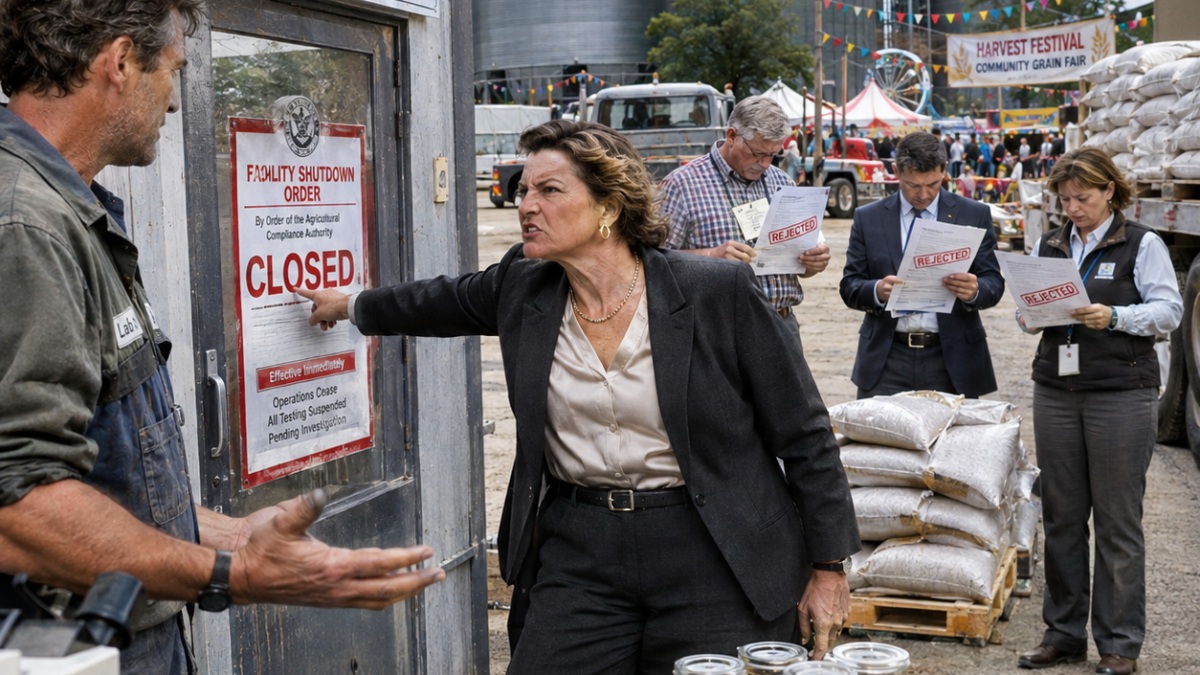
Across my front doors was a bright red placard.
**EMERGENCY CLOSURE
CHEMICAL STORAGE & PUBLIC SAFETY VIOLATION**
A seal-like logo appeared at the top.
Case number.
Inspector name.
Formal language.
It looked official.
That was the point.
Blythe smiled when she saw me.
“This facility is closed pending investigation.”
I stared at the placard.
“By who?”
“The county.”
“What department?”
“Public safety.”
“Which office?”
“Nolan, stop.”
Tessa arrived seconds later.
She saw the lock.
“What the hell?”
Blythe turned to the guards.
“Neither of them enters.”
Tessa walked toward the door.
I caught her arm.
“No.”
She looked at me.
“That’s our lab.”
“I know.”
“Call a locksmith.”
“No.”
Blythe smiled.
Smartest move she thought she had made all week.
I stepped backward.
Pulled out my phone.
Started recording.
Door.
Lock.
Placard.
Guard faces.
License plates.
Time.
Blythe.
Everything.
She said,
“You can film all you want.”
“I know.”
“You were warned.”
I lowered the phone.
Then looked at her.
“From this moment forward, you have compromised custody of every unfinished sample in that building.”
She laughed.
A small dismissive laugh.
And that was when I knew she did not understand what she had done.
A laboratory isn’t trusted because it has expensive machines.
It is trusted because you can prove where a sample was.
Who touched it.
When.
Under what seal.
Under whose control.
Blythe had just taken that control away from me.
I opened my laptop on the hood of my truck.
Tessa looked at me.
“Integrity protocol?”
“Yes.”
Years earlier, I had created a procedure for emergencies.
Fire.
Break-in.
Power failure.
Flood.
Unauthorized entry.
Any situation where we could no longer guarantee sample control.
I activated it.
Every unfinished sample froze in its current status.
No new certificates could be issued.
Pending certificates became unavailable.
Then the system generated client notifications.
I read the language twice before sending.
Not contaminated.
Not unsafe.
Not fraudulent.
Only the truth:
**Chain of custody can no longer be confirmed due to third-party control of the sample storage facility.**
Blythe watched.
“You’re being ridiculous.”
I clicked send.
“You shut down the lab.”
“I temporarily secured a dangerous facility.”
“You took control of samples you need certified.”
“I’ll hire another lab.”
“You can.”
She smiled.
“Good.”
“But they’ll have to resample.”
Her smile weakened.
“What?”
“They cannot use my compromised samples.”
“We have copies.”
“Of results?”
“Yes.”
“Not of custody.”
“I’ll give them the grain.”
“Then they’ll need a representative draw.”
Her expression changed.
Just enough.
The first truck had already left Silver Ridge.
At 8:16 a.m., it arrived at Northline Milling.
The receiving clerk scanned the SRHF26 reference.
A warning appeared.
**CERTIFICATION STATUS SUSPENDED**
The truck went into a holding lane.
A second shipment reached Prairie Crest.
Same result.
Three arrived at Redstone.
Stopped.
Before ten o’clock, all three buyers had called Blythe.
I know because she came storming back toward my gate with her phone in her hand.
“You need to clear the certificates.”
“I can’t.”
“You can.”
“No.”
“Northline is holding trucks.”
“I know.”
“Prairie Crest is refusing unload.”
“I know.”
“Redstone froze three.”
“I know.”
She stared at me.
“You planned this.”
I looked at the red closure notice.
“You closed my laboratory.”
“This is administrative.”
“To a buyer, chain of custody isn’t administrative.”
Her phone rang again.
She answered.
Walked away.
Started with charm.
Then explanation.
Then irritation.
Then anger.
At 10:43, Northline issued a written rejection notice.
Every shipment carrying the festival vendor code would be refused until certification could be independently verified.
Prairie Crest followed.
Redstone froze SRHF26 completely.
Seventeen original trucks now had nowhere to go.
Nine additional bookings were canceled.
The staging yard filled with rigs.
And Blythe came back to tell me I had destroyed her festival.
I pointed toward my front door.
“You shut down the only place that could verify your shipments.”
She ordered the guards to keep me away.
I didn’t care.
All of our records created before the shutdown had been backed up offsite.
Every intake photograph.
Every seal.
Every certificate.
Every audit event.
Every lot number.
Every truck reference.
Then Tessa called my name.
She was sitting in her car with her laptop.
“What?”
“Come here.”
I leaned through the open door.
Two shipment records.
Two buyers.
Same certificate number.
I frowned.
“That’s impossible.”
“I know.”
I opened the certificate history.
The number belonged to a grain lot closed more than a month earlier.
Delivered.
Completed.
Finished.
Yet the same certificate had appeared on two new festival shipments.
This was no longer just a duplicated seal.
Someone was recycling certificates.
I looked toward Blythe.
She was pacing near the guards.
Suddenly, her decision to close my laboratory made more sense.
Maybe she hadn’t been afraid of one failed lot.
Maybe she was afraid of us following the numbers.
That afternoon, Blythe called an emergency festival meeting.
Vendors.
Farm owners.
Sponsors.
HOA board.
She accused me of abusing my testing authority.
Extortion.
Sabotage.
Personal resentment.
I didn’t attend.
Tessa asked,
“You’re just going to let her say that?”
“Yes.”
“Why?”
“Because Northline doesn’t care whether Blythe likes me.”
I sent the buyers data.
Certificate number.
Original issue date.
Original lot.
New invoice.
New truck.
Nothing editorial.
No accusation.
Just comparison.
The buyers did the rest.
Northline found one certificate attached to two trucks with different gross weights.
Prairie Crest found a wheat certificate attached to grain declared under another commodity description.
Redstone found a certificate generated seven weeks earlier attached to an invoice claiming a brand-new sampling date.
By evening, the issue had escalated from temporary hold to:
**REJECT — TRACEABILITY FAILURE**
Every shipment connected to the festival code lost automatic entry.
It was brutal.
But it wasn’t revenge.
Buyers cannot purchase what they cannot identify.
Blythe had insisted months earlier that every festival shipment use the SRHF26 prefix because she wanted brand recognition.
Now that brand code became a net.
Every suspicious shipment was tied together.
Truckers began turning around.
Farmers started calling.
One warehouse owner drove directly to me.
He carried weight tickets.
“My grain is in this mess.”
“Show me.”
We compared his records with festival manifests.
The festival claimed more grain had come from his facility than his records showed leaving.
Not a little more.
A lot more.
I looked at him.
“Could you have missed loads?”
“No.”
“Inventory error?”
“Not like that.”
Tessa built a timeline.
Clean grain arrived at the festival warehouse during the day.
But outgoing loads often became heavier overnight.
I remembered Blythe refusing to let us sample inside that warehouse.
The shape of the answer was becoming clearer.
But a shape isn’t proof.
My phone rang.
Unknown number.
“This Nolan Mercer?”
“Yes.”
“My name is Caleb Dorsey.”
He paused.
“I manage the festival warehouse.”
“What can I do for you?”
“Not on the phone.”
We met at a diner twenty minutes outside Silver Ridge.
Caleb looked like a man who hadn’t slept.
He slid three photocopies across the table.
Loading sheets.
Midnight.
1:17 a.m.
2:42 a.m.
Truck arrivals not shown in festival records.
“Where did these loads come from?”
Caleb pointed.
Another county.
Storage yard.
At the bottom:
**RANSOM AGRICULTURAL HOLDINGS LLC**
I looked at him.
“Ransom?”
He nodded.
“Blythe.”
“What happened to the grain?”
His voice dropped.
“Blended.”
“With?”
“Festival lots.”
I stared at the pages.
“Who ordered it?”
He looked at me.
“You know.”
“I need you to say it.”
“Blythe.”
The diner suddenly felt very quiet.
Caleb wiped his palms against his jeans.
“She said Mercer already tested the clean grain.”
I felt something cold move through me.
“What exactly did she say?”
“Paperwork will cover the rest.”
There it was.
The certificates weren’t being used to describe shipments.
The shipments were being changed after certification.
Clean local grain went in.
It got sampled.
It passed.
Then cheaper outside grain was blended into the lot.
The original clean certificate traveled with the final mixture.
I asked,
“Why are you telling me now?”
Caleb looked out the window.
“Because she called an hour ago.”
“What does she want?”
“Everything moved.”
“Where?”
“I don’t know.”
“When?”
“Before state inspectors show up.”
I sat back.
“Have inspectors contacted you?”
“No.”
“So why does she think they’re coming?”
Caleb didn’t answer.
He didn’t have to.
Blythe knew how serious the problem had become.
I did not chase any truck.
I didn’t stand in front of warehouse doors.
I didn’t threaten drivers.
I called Tessa.
We preserved every lot code Caleb provided.
Thirteen matched duplicated or suspicious certificate references.
Then I sent preservation notices to all three buyers.
Finally, I filed a report with the state Department of Agriculture.
Not an accusation of criminal fraud.
A report of suspected traceability and certification irregularities.
The file landed with Marion Holt.
Marion called me within an hour.
Her voice was flat, professional.
“Mr. Mercer, I’m going to ask you five questions.”
“Go ahead.”
“Who controlled the samples after the laboratory closure?”
“HOA security and whoever they allowed access.”
“Which seals were duplicated?”
I gave her the numbers.
“Which certificates appeared more than once?”
I gave her those too.
“Who ordered the laboratory closed?”
“Blythe Ransom.”
“Which county department issued the order?”
I looked at the photograph.
“Public safety, according to her.”
“Send me the notice.”
I emailed it.
She went silent.
Then asked,
“Who told you this came from the county?”
“Blythe.”
“Only Blythe?”
“Yes.”
Twenty minutes later, Marion called back.
“No county department issued that closure.”
I stood up.
“What?”
“The case number does not exist.”
I said nothing.
“The named inspector transferred departments nearly a year ago.”
I looked across the road toward the lab.
Red notice.
Private guards.
Official-looking seal.
Blythe had not bent a rule.
She had manufactured authority.
Tessa whispered,
“Fake?”
I nodded.
She moved toward the door.
I stopped her.
“Not yet.”
“That notice is fake.”
“I know.”
“That’s our building.”
“I know.”
“Then why are we standing here?”
“Because Marion is coming.”
I wanted every step official.
No damaged lock.
No accusation that I had altered evidence.
No opportunity for Blythe to turn procedure against me.
Meanwhile, the mobile testing crew she had hired arrived at the warehouse.
They encountered another problem.
Original seals were missing.
Some containers had been opened.
Some blended.
The new lab refused responsibility.
Blythe ordered Caleb to replace seals.
He refused.
She fired him.
Probably the worst personnel decision she made that week.
Caleb drove directly to Marion.
He gave her the loading sheets.
Then sat inside her vehicle for nearly an hour explaining the night deliveries.
Outside trucks came with headlights dimmed.
Gate logs stayed blank.
He was sent away from the loading floor.
Two festival coordinators handled blending.
When he asked questions, Blythe told him to focus on logistics.
He admitted he should have stopped it.
Marion didn’t lecture him.
She asked him to write everything down.
Then Blythe tried another move.
New invoices.
New vendor codes.
SRHF26 disappeared.
Same truck weights.
Same trailers.
Same loading times.
New names.
One producer called me.
“Nolan, why did my lot number change?”
“Did the grain come back to your farm?”
“No.”
“Did anyone resample it?”
“No.”
“Then it shouldn’t.”
Prairie Crest compared invoices.
Old versus new.
Identical shipment details.
Different code.
That was worse than leaving the original label.
A changed code after a traceability hold looks like evasion.
All three buyers widened their rejection criteria.
Not only SRHF26.
Any shipment originating from the festival warehouse.
Blythe thought changing the name would break the chain.
Instead, she made the chain obvious.
That afternoon, Marion arrived with two state inspectors.
They didn’t come to my lab first.
They went to the warehouse.
Loading doors were wide open.
Entire floor sections were empty.
Fourteen trucks had left less than an hour earlier.
No one on site could say exactly where they were going.
Marion turned to me.
“Can you identify them?”
“Without the lab?”
“Yes.”
I almost smiled.
“Probably eleven.”
She looked surprised.
“Why?”
“Because we don’t log only lot numbers.”
Mercer Grain Analytics recorded trailer numbers.
Truck plates.
Gross weights.
Sampling times.
Seal sequences.
The invoices could change.
The trucks couldn’t erase their own previous records.
Tessa worked from the backup.
Within an hour, eleven trailers matched earlier festival shipments.
Destinations emerged.
Northline.
Prairie Crest.
Redstone.
Intermediate storage.
Marion sent the trailer numbers to the buyers.
The result was immediate.
Every matching truck that reached a buyer was refused.
Some drivers turned around.
Others waited.
Nobody unloaded.
I made no pressure call.
No threat.
No demand.
Supply-chain departments made their own decisions.
Blythe called me six times.
I didn’t answer.
Then came voicemail.
“You have no idea what you’ve done. The HOA will revoke every privilege you have in Silver Ridge.”
I listened twice.
Then deleted nothing.
Saved it.
The HOA had never granted my business privileges.
Just another threat built on authority she didn’t possess.
By then, Marion was at my lab.
She photographed the fake closure notice.
The county sent written confirmation that it was not authentic.
The private guards heard enough to understand the situation.
One spoke quietly to the other.
They packed up.
No argument.
No heroic stand.
They had been hired to enforce what they believed was an official closure.
Once they learned it wasn’t, they wanted no part of it.
The building was technically accessible again.
I reached for the door.
Marion stopped me.
“Wait.”
I looked at her.
“We document first.”
That was exactly why I liked her.
Every lock photographed.
Every room.
Every cabinet.
Every sample-storage area.
Then we entered.
Nothing looked destroyed.
No computers missing.
No broken equipment.
At first, I felt relief.
Then Tessa stopped in front of the retained-sample cabinet.
“Nolan.”
Door had been opened.
Three SRHF26 bags were out of position.
She picked up one carefully.
Fresh seal.
Wrong style.
She looked at me.
“That isn’t ours.”
My stomach dropped.
Somebody had entered my lab while I was locked out.
And they hadn’t wandered randomly.
They had touched samples tied to the festival.
The exact evidence that might show what the original grain looked like before warehouse blending.
Blythe—or whoever acted for her—had tried to silence the lab and alter the retained samples.
But there was something she didn’t know.
Years earlier, after a buyer dispute nearly cost one of my clients a contract, I changed our retention policy on high-value lots.
We split certain retained samples.
Half stayed at the main laboratory.
Half went into an offsite archive locker.
Separate location.
Separate access.
I looked at Marion.
“There may be originals.”
“Where?”
“Offsite.”
We drove there together.
Three key lots.
Original sealed archive samples.
Untouched.
Marion supervised everything from that point.
Fresh state-controlled testing.
The first result came back.
The archived sample did not match the bag found in my lab.
Different quality profile.
Different enough that ordinary analytical variation could not explain it.
The lab sample had been replaced or altered.
The second comparison was worse for Blythe.
Archive sample:
High-quality grain.
Fresh warehouse sample from the corresponding lot:
Lower quality.
Inconsistent profile.
The pattern fit blending.
Original clean lot tested first.
Cheaper grain introduced later.
Marion asked,
“Who makes money?”
Caleb had the answer.
Price sheets.
Ransom Agricultural Holdings was buying outside grain significantly cheaper.
Blend it.
Sell it under verified Silver Ridge origin.
The margin increased.
Suddenly the Harvest Festival looked very different.
This wasn’t only an event Blythe was trying to save.
It was a commercial machine.
The “verified local” brand increased the value of grain connected to her own company.
And there was still one major shipment sitting in the warehouse.
It had never left.
Because it was scheduled to be displayed at the festival pavilion during the opening ceremony.
Blythe made a decision that stunned me.
She kept the festival open.
Banners remained.
Vendors arrived.
Stage.
Displays.
Rows of grain totes.
Buyer demonstrations.
Her strategy was obvious.
If she canceled, everyone would assume the investigation was real.
If she proceeded, she could keep calling it a personal fight between herself and me.
So festival morning arrived.
I drove there with Marion.
Not as a guest.
Not as a protester.
Just because several lots required identification.
Across the pavilion hung Blythe’s slogan:
**VERIFIED SILVER RIDGE PRODUCERS**
Below that banner sat grain carrying certificate problems.
Marion checked manifests.
Then began attaching state hold notices.
One tote.
Second.
Third.
Blythe appeared.
“What are you doing?”
“Administrative hold.”
“You cannot shut down a private festival.”
“I’m not.”
“You’re tagging our displays.”
“I’m holding specific lots.”
“Based on Nolan’s accusations.”
Marion let her finish.
Then held up a certificate.
“If this grain was properly tested, why does this certificate belong to a shipment delivered six weeks ago?”
Blythe froze.
Representatives from Northline, Prairie Crest, and Redstone were standing nearby.
Perfect witnesses.
Wrong audience for bluffing.
Blythe looked toward me.
“He manipulated his records.”
I had expected that.
I brought audit logs.
Every certificate generated through our system carried a timestamp.
Issuance history.
Internal checksum.
QR reference.
You could copy a PDF.
You could change visible text.
But you couldn’t make the altered PDF match the internal record.
A Northline representative took one certificate.
Scanned the QR code.
His phone displayed a producer name.
He looked at the paper.
Different producer.
He scanned another.
Different lot.
He stared at Blythe.
Nobody called it a clerical error.
Northline withdrew from the commercial festival program on the spot.
Prairie Crest ordered its sponsor banners taken down.
Redstone canceled every buyer meeting scheduled for that day.
I hadn’t requested any of it.
They were protecting themselves.
The festival still had food.
Music.
Craft vendors.
Local families could still walk through.
But the reason Blythe had built the event—the three major purchasing relationships—was disappearing before the opening ceremony.
Vendors noticed.
Farmers noticed.
Sponsors noticed.
Some started packing.
A group of producers gathered around the tagged totes.
One farmer pointed.
“That has my name on it.”
“Your grain?” Marion asked.
“No.”
His face reddened.
“I never sold that quantity.”
Another said,
“That certificate uses my farm.”
Blythe moved through the crowd telling people there had been an administrative misunderstanding.
Every reassurance made things worse.
Then she turned on Caleb.
“You falsified those loading sheets.”
Caleb said nothing.
He handed his phone to Marion.
Messages.
From Blythe.
The first:
**Use the outside grain after the certified bins are sampled.**
The second:
**Do not let Mercer’s people into the warehouse.**
The third:
**Once his certificates are issued, the source no longer matters.**
People close enough to see the screen became silent.
Blythe reached toward it.
Marion stepped between them.
No drama.
No shouting.
Just a physical boundary.
One board member spoke.
“If this blending was an official festival operation, why were the outside supplier invoices going to Ransom Agricultural Holdings?”
Blythe’s face changed.
That question struck where the others hadn’t.
Because “festival emergency” could be framed as desperate management.
Personal profit was different.
She turned.
Walked away.
At first, I thought she was finally leaving.
Tessa was holding a tablet.
She had access to the exterior warehouse camera.
Her eyes widened.
“Nolan.”
“What?”
“Look.”
Blythe’s SUV was at the warehouse.
Someone was loading an industrial printer.
File boxes.
Supplies.
I understood instantly.
“She isn’t leaving the festival.”
“What?”
“She’s removing evidence.”
I didn’t move.
Didn’t chase her.
Didn’t block the SUV.
I told Marion.
She made the calls.
The vehicle was stopped before it cleared the property.
Nobody ripped boxes open in a parking lot.
They documented everything.
Inside the warehouse, inspectors found a small locked office behind the loading area.
Caleb had never been allowed inside.
Only Blythe and two festival coordinators had keys.
The room told the rest of the story.
Label printer.
Blank certificate paper.
Scanned copies of legitimate Mercer Grain Analytics certificates.
Lot lists.
Producer lists.
QR images.
They had never hacked my laboratory.
They didn’t need to.
They copied documents.
Changed visible fields.
Reused certificate designs.
Attached old results to new shipments.
Then I saw the flaw.
Every genuine Mercer certificate had an internal checksum.
Tiny.
Easy to overlook.
Tied to the actual database record.
A counterfeit could look perfect to a human.
It could not generate the correct checksum without our system.
Tessa started checking the stack.
Failed.
Failed.
Failed.
More than thirty forged or altered certificates.
Then inspectors opened a spreadsheet on the warehouse computer.
Column headings:
**CLEAN LOT**
**BLEND LOT**
**CERTIFICATE SOURCE**
**FESTIVAL SHIPMENT**
Nobody had to guess anymore.
High-quality Silver Ridge grain came in.
It was sampled.
Passed.
Then cheaper grain entered from outside.
Blended after sampling.
Clean certificate attached to final shipment.
I looked around the room.
Farmers.
Inspectors.
Caleb.
Tessa.
People were angry.
I said something I wanted everyone to understand.
“Not every shipment in this building is necessarily unsafe.”
Marion looked at me.
I continued.
“That’s not the point.”
I pointed at the spreadsheet.
“The problem is that we can no longer prove which grain is in which shipment.”
Traceability.
Once it dies, buyer trust dies with it.
Even perfectly good grain can be rejected when nobody can prove its origin.
That was the disaster Blythe created.
Not a failed festival.
Not one toxin result.
She made the paperwork meaningless.
Caleb stared at the spreadsheet.
His face drained of color.
“What?”
He pointed.
“These dates.”
Every row marked blend matched nights when Blythe had ordered him away from the loading floor.
His name remained on standard warehouse sheets.
Hers did not.
He realized what that meant.
If the scheme had failed quietly, Caleb might have looked responsible.
He sat down.
“She was setting me up.”
Marion didn’t answer.
She kept reading.
Then she found another folder.
**MERCER ISSUE**
Inside:
Draft closure notice.
County logo image downloaded from the internet.
Photographed inspector signature.
Email.
From Blythe.
To one of the festival coordinators.
**If the lab is inaccessible for 48 hours, the trucks will already be delivered.**
There it was.
The entire closure explained in one sentence.
She never wanted my laboratory permanently gone.
She needed forty-eight hours.
Two days.
Enough time to move the blended shipments through the three buyer gates before I could resample.
But Blythe misunderstood what a laboratory was.
She thought locking the building stopped the truth.
Instead, the closure activated the system designed to protect truth.
Every shipment froze before her forty-eight hours expired.
That evening, the Silver Ridge HOA called an emergency meeting.
Blythe’s authority was suspended.
Unanimously except for her own objection.
She lost control over association accounts.
Contracts.
Festival operations.
Security.
Internal systems.
I thought the story was nearly over.
It wasn’t.
One row in the blend spreadsheet bothered me.
The date.
Nearly two months before the festival vendor program officially launched.
I read it twice.
“Tessa.”
“Yeah?”
“When did SRHF vendor enrollment open?”
She checked.
“September.”
I pointed.
“This is July.”
Marion looked over.
The lot led to a Redstone shipment delivered weeks earlier.
No quality complaint.
No rejection.
Nothing that would have drawn attention.
Certificate number belonged to another producer.
Marion pulled payment records Caleb had provided.
Ransom Agricultural Holdings had been buying cheap out-of-county grain before the festival was even announced.
The model came into focus.
Blythe hadn’t invented the scheme because the festival got into trouble.
She had tested the scheme first.
Small scale.
Buy cheap grain.
Use one clean premium lot as the certification base.
Sell blended shipment under a more valuable origin.
Then it worked.
So she built the Harvest Festival into a larger commercial engine.
Three buyers.
Dozens of trucks.
One verified brand.
One trusted laboratory.
My laboratory.
She needed my signature because the market trusted it.
But she never expected me to look behind the certificate.
The failed toxin test wasn’t the reason she closed Mercer Grain Analytics.
The duplicate seal was.
That duplicate could lead to duplicate certificates.
Certificates led to the warehouse.
Warehouse led to Ransom Agricultural Holdings.
Everything pointed back toward her.
She had seen the chain forming.
So she tried to cut the first link.
Lock the lab.
Move the trucks.
Alter the samples.
Forty-eight hours.
Then the grain would be gone.
Except records move faster than trucks.
All three buyers opened historical reviews.
Every shipment that had ever passed through Ransom Agricultural Holdings came under examination.
Her vendor profile was suspended.
No new grain accepted.
Not one load.
Festival banners began coming down.
There was no cheering.
No victory parade.
Honestly, the sight made me tired.
Farmers were frightened.
People who had done nothing wrong now had grain caught inside a traceability investigation.
That mattered to me.
Several legitimate Silver Ridge producers came to the lab.
One was an older farmer named Daniel Foster.
His family had been growing wheat there for three generations.
He walked into my office holding a binder.
“My name’s on one of those certificates.”
“Sit down.”
“I didn’t blend anything.”
“I know.”
“How?”
“Because your original sample still exists.”
His shoulders dropped.
“Can you prove it?”
“We can prove what your grain looked like when we sampled it.”
“Is that enough?”
“Maybe. Buyer decides.”
He nodded.
“What do I owe you?”
“Nothing.”
“Nolan.”
“Nothing.”
Over the next several days, we helped producers reconstruct records.
Original intake.
Farm ID.
Sample weight.
Test results.
Certificate issuance.
Truck departure where known.
We didn’t promise that every shipment would be cleared.
We didn’t lie to make anyone feel better.
We simply separated known facts from contaminated paperwork.
That transparency mattered.
Northline began lifting holds on farms that could prove independent chain of custody.
Prairie Crest did the same.
Redstone required fresh sampling.
Some producers lost time.
Some lost money.
But they got their names back.
The SRHF26 code never recovered.
It became permanently associated with enhanced review.
The commercial festival program was canceled.
Blythe was removed as HOA president.
The office where she had once held meetings about closing me down was locked to preserve evidence.
State investigators copied records.
The county opened an inquiry into the fake closure notice.
Financial investigators became involved once the commercial records were reviewed.
I didn’t follow every legal development.
That surprises people.
They ask,
“Didn’t you want to know what happened to her?”
Of course.
But there came a point where Blythe’s future belonged to investigators, attorneys, agencies, and courts.
My responsibility was the laboratory.
And the farmers.
One afternoon, I was standing near the warehouse when Blythe approached me.
No red coat.
No clipboard.
No guards.
“You happy?”
I looked at her.
“No.”
She laughed bitterly.
“Don’t pretend.”
“I’m not.”
“You destroyed everything.”
“No.”
“My festival is gone.”
“I know.”
“Three contracts.”
“I know.”
“Vendors lost money.”
“I know.”
“Farmers lost deliveries.”
“I know.”
“And you stand there like this has nothing to do with you.”
I looked toward the trucks being sorted for resampling.
“You want to know what destroyed your festival?”
“You.”
“No.”
Her eyes narrowed.
“Your festival was destroyed the moment you decided the certificate mattered more than the grain behind it.”
She opened her mouth.
I continued.
“If the grain had been what the certificate said, none of this happens.”
“You could have been flexible.”
“That word again.”
“What?”
“Flexible.”
I shook my head.
“Quality control that changes when somebody powerful gets angry isn’t quality control.”
“You think you’re better than everyone.”
“No.”
“You could’ve helped.”
“I offered to resample.”
“You knew we didn’t have time.”
“You had time to blend grain.”
Her face changed.
I regretted saying it the moment I did.
Not because it wasn’t supported.
Because anger had entered my voice.
I took a breath.
Then said quietly,
“You came to me asking for a false certainty.”
“I asked for cooperation.”
“You asked me to sign something I could not prove.”
Her eyes became wet.
Only slightly.
For the first time, I wondered how much of her had once believed her own story.
Maybe she began with ambition.
Maybe she told herself farmers would benefit.
Maybe she convinced herself cheaper grain blended into good grain was harmless.
Maybe the first forged certificate felt temporary.
The second easier.
Then the third routine.
Fraud often grows that way.
One compromise.
One explanation.
One more step.
Until the person doing it starts believing the system is unfair for noticing.
Blythe looked at me.
“You have no idea what I built.”
“I know.”
“No, you don’t.”
Her voice cracked.
“I spent three years making Silver Ridge matter.”
I looked toward the empty festival pavilion.
“Then you should have protected the name.”
She said nothing.
I walked away.
That evening, Marion called.
“Got something.”
“What?”
“Offsite storage search.”
Ransom Agricultural Holdings.
Inspectors found a pallet of unused seals.
Serial numbers.
Same range as the counterfeit seal found on the altered sample in my lab.
That mattered.
Until then, Blythe could still claim festival workers had acted independently.
The seal inventory connected the tampering source back to her own supply operation.
When Marion told me, I sat at my desk for a long time.
Tessa came in.
“What happened?”
I explained.
She sat across from me.
“That’s it, then.”
“What?”
“The link.”
“Yes.”
“You okay?”
I looked around the lab.
I wasn’t sure.
For weeks, I had wanted proof.
Now proof was everywhere.
And somehow it didn’t feel satisfying.
I thought about the legitimate farmers.
Caleb.
The buyers.
My staff.
All the people dragged into one person’s decision to make numbers say what she wanted.
“I’m tired.”
Tessa nodded.
“Me too.”
Mercer Grain Analytics did not reopen the next morning.
I refused.
I wanted every compromised access point reviewed.
Every retained sample touched during the closure reclassified.
Every lock changed.
Equipment inspected.
System access checked.
We sent clients a complete notice.
Which certificates remained valid.
Which samples required recollection.
Which lots needed new testing.
No spin.
No hiding.
Transparency was the only thing that could rebuild confidence.
Three days later, Marion gave us clearance to resume limited operations.
A week after that, full operation.
Tessa stood beside the door when the official clearance notice went up.
The fake red placard was gone.
In its place:
**FACILITY CLEARED TO OPERATE FOLLOWING CHAIN-OF-CUSTODY REVIEW**
She looked at me.
“What started all of this?”
I reached into the evidence-copy folder.
Pulled out the photograph.
Duplicate seal.
One number.
Twice.
I held it up.
“This.”
She smiled weakly.
“One number.”
“One number.”
Blythe had controlled an HOA.
Festival staff.
A warehouse.
Security.
Dozens of shipments.
Hundreds of documents.
Commercial relationships.
Money.
Schedules.
All of it.
And everything unraveled because one serial number appeared twice where it should have appeared once.
That was the thing about data.
Big lies don’t always collapse under big evidence.
Sometimes one tiny inconsistency is enough.
Just before closing that evening, Marion came back.
She placed an evidence summary on my desk.
“One more thing.”
I read it.
The earliest forged certificate.
Months before festival operations.
Trial shipment.
Ransom Agricultural Holdings.
She watched my face.
“So the festival…”
“Wasn’t the beginning,” I said.
“No.”
“It was expansion.”
“That’s our current understanding.”
I leaned back.
Blythe didn’t create fraud to rescue a failing festival.
She created the festival because the earlier scheme worked.
That was harder to accept.
The banners.
The slogans.
The promise of verified local grain.
It wasn’t merely marketing.
It was infrastructure.
A trusted story wrapped around a commercial pipeline.
She needed three things.
Cheap grain.
A premium origin.
And a certificate buyers trusted.
The third thing was me.
Or, more accurately, my signature.
She believed the signature was the value.
She never understood that the value came from my willingness not to sign.
The next morning, a farmer arrived with a fresh sample.
Normal job.
No festival code.
No drama.
Tessa took the bag.
Scanned the seal.
Computer displayed:
**UNIQUE SEAL VERIFIED**
She looked at me through the receiving-room window.
We both smiled.
It was such a boring message.
I had never been happier to see it.
We ran the sample.
Recorded the result.
Issued the certificate.
The farmer left.
Normal life was returning.
Across the road, the festival warehouse remained closed.
Loading doors chained.
No trucks.
No banners.
No late-night arrivals.
One month later, Northline sent me a letter confirming that Mercer Grain Analytics remained an approved independent lab.
Prairie Crest followed.
Redstone did too.
That mattered more to me than any public apology.
Trust is slow to build and very fast to lose.
Blythe had put mine at risk simply by associating forged documents with my name.
The forensic audit protected us.
Our internal checks protected us.
Our refusal to “be flexible” protected us.
One evening, Daniel Foster—the wheat farmer—came back.
He carried two coffees.
“I figured you drink coffee.”
“Dangerous assumption.”
“Do you?”
“Yes.”
He handed me one.
His farm had been cleared.
Fresh testing.
Independent truck records.
Buyer accepted his wheat again.
He stood by the window.
“My wife wanted me to bring you something nicer.”
“This is fine.”
“She said flowers.”
I looked at him.
“Definitely coffee.”
He laughed.
Then became serious.
“I was angry at you.”
“I know.”
“When the shipments were rejected.”
“I know.”
“I thought you shut everything down.”
“I did suspend certificates.”
“Right.”
He looked at the floor.
“But now I understand.”
I waited.
“If Northline had taken my name off one of those fake loads and there had been a problem…”
He stopped.
I finished.
“Your farm would have been attached to grain you didn’t sell.”
He nodded.
“That scared me more than the lost week.”
“That’s why records matter.”
He looked toward the lab.
“Blythe used to say you were stubborn.”
“She wasn’t wrong.”
He smiled.
“No.”
Then he said something I remembered.
“Some jobs need stubborn people.”
After he left, I thought about that.
Maybe.
Not stubbornness for pride.
Not refusing change.
Not pretending rules are sacred because they are rules.
But there are certain lines that cannot become negotiable depending on who is angry.
A laboratory result is one.
You cannot have one standard for a small farmer and another for an HOA president.
One moisture threshold on Monday and another on Friday because trucks are waiting.
One chain-of-custody rule when business is quiet and another when a festival is expensive.
Either the certificate means something or it doesn’t.
Blythe chose the second.
That destroyed her program.
Months passed.
Investigations continued.
I occasionally received requests for records.
Original certificate.
Audit log.
Sample photograph.
Seal inventory.
System history.
We provided what was lawfully requested.
The two festival coordinators obtained attorneys.
Caleb continued cooperating.
The HOA officially removed Blythe from every committee.
New leadership canceled the commercial Harvest Festival program indefinitely.
The following autumn, Silver Ridge still held a harvest gathering.
Much smaller.
Local food.
Music.
Pumpkin stands.
Farm equipment display.
No grand buyer pavilion.
No “verified” banners.
No commercial spectacle.
Tessa asked if I was going.
“No.”
“Why?”
“I have work.”
“You always have work.”
“Exactly.”
She rolled her eyes.
Then she went.
Monday morning, she came into the lab.
“You should’ve gone.”
“Why?”
“It was nice.”
“No drama?”
“None.”
“Then definitely not my kind of event.”
She smiled.
“Farmers actually talked to each other.”
“Terrible.”
“Kids had a corn maze.”
“Dangerous.”
“And nobody forged a certificate.”
I looked up.
“Now you’re overselling it.”
She laughed.
That was the first time we joked about it.
Enough time had passed.
Not enough to forget.
But enough to breathe.
Later that winter, I found the original festival brochure in an old file.
Blythe’s slogan.
**EVERY GRAIN SERVED, DISPLAYED, AND SOLD HERE COMES FROM VERIFIED SILVER RIDGE PRODUCERS.**
I stared at it for a long time.
Then I put it into the records archive.
Not because I wanted a trophy.
Because it was part of the story.
Marketing becomes dangerous when people start treating words as a substitute for reality.
“Verified.”
“Local.”
“Premium.”
“Independent.”
Those terms had value because someone had to prove them.
Blythe wanted the value without the proof.
That was the entire scheme in one sentence.
Several months after reopening, a young analyst joined our staff.
Emily.
Smart.
Fresh out of an agricultural science program.
On her first week, Tessa trained her on sample seals.
“Check every number.”
Emily nodded.
“System won’t let duplicates through, right?”
“Usually.”
“Then why check manually?”
Tessa looked toward me.
I smiled.
She pulled up the famous photo.
Duplicate seal.
Emily read the number.
Then the second.
Her eyes widened.
“Oh.”
Tessa said,
“That one number shut down a festival.”
Emily looked at me.
“Seriously?”
“Not exactly.”
Tessa grinned.
“He’ll give you the philosophical version.”
I stood.
“The number didn’t shut anything down.”
Emily waited.
“It told us where to look.”
That became part of our training.
Not Blythe’s name.
Not the drama.
The lesson.
Never assume because paperwork looks normal that the underlying lot is normal.
Never trust a copied field more than original custody.
Never let urgency become evidence.
And never certify what you cannot prove.
A year after the closure, I arrived early one morning.
Same time.
Around 4:45.
Cold.
Dark.
I parked in front of the lab.
For a moment, the memory hit me.
Three vehicles.
Guards.
Red notice.
Blythe waiting.
I sat in my truck.
Then got out.
Our new lock turned normally.
Door opened.
Lights came on.
I walked into sample storage.
Everything in place.
Seals.
Logs.
Archive references.
Quiet.
I realized something.
For weeks during the investigation, I had thought the most satisfying ending would be watching Blythe lose control.
And yes, she did.
No buyers returned her calls.
No guards followed her orders.
The HOA removed her authority.
Her own festival code became a red flag.
But the real satisfaction was less dramatic.
I could walk into my own laboratory again.
I could sign my own reports.
And the signature still meant what it meant before she tried to use it.
That was enough.
People asked whether I felt sorry for her.
I never had a simple answer.
I felt sorry for the version of Blythe that might have existed before she decided success justified deception.
I did not feel sorry that the deception failed.
Those are different things.
Ambition isn’t evil.
Wanting Silver Ridge farmers to get better contracts wasn’t evil.
Building a festival wasn’t evil.
Buying cheaper grain wasn’t necessarily evil either, if it was sold honestly for what it was.
The wrongdoing came when she changed the story.
Outside grain became Silver Ridge grain.
Blended loads became clean lots.
Old certificates became new ones.
My signature became a tool she believed she could reuse.
A fake government notice became authority.
One lie required another.
Then another.
Until she stood inside a pavilion beneath a banner promising verified grain while state inspectors placed hold tags on the very totes meant to prove her credibility.
No enemy could have designed a more perfect humiliation.
And yet I never planned it.
That’s the strange thing.
Blythe created every condition herself.
She insisted on one shared festival code.
That let buyers identify every related load.
She reused certificates.
That gave us duplicate numbers.
She mixed grain after sampling.
That created analytical differences.
She refused warehouse sampling.
That drew attention.
She closed my laboratory.
That triggered the integrity protocol.
She tampered with samples.
The archive copies defeated her.
She changed vendor codes.
That looked like evasion.
She tried to remove the printer.
That led investigators straight to the back office.
She saved copies of genuine certificates.
The checksum exposed them.
She kept the spreadsheet.
The spreadsheet explained the entire process.
Every attempt to hide the truth created another record.
That was the revenge people wanted me to describe.
But I still don’t call it revenge.
It was consequence.
And consequence is colder than revenge.
Revenge needs anger.
Consequence only needs facts.
One spring afternoon, Caleb came to the lab.
I hadn’t seen him in months.
He looked healthier.
New job at a grain elevator in another county.
“I wanted to say thanks.”
“For what?”
“For not treating me like I was part of it.”
I looked at him.
“You were part of it.”
His face fell.
I continued.
“You also came forward.”
He nodded.
“I should’ve come earlier.”
“Yes.”
“I knew the night loads were wrong.”
“Yes.”
“I just…”
He struggled.
“She controlled my job.”
“I know.”
“I had two kids.”
“I know.”
“I kept telling myself it wasn’t my responsibility to know what grain went where.”
I leaned against the counter.
“What changed?”
“She told me to replace the seals.”
He looked at me.
“That was the moment.”
“Why?”
“Because then I couldn’t pretend I didn’t understand.”
I nodded.
He stared at the floor.
“I almost did it.”
“But you didn’t.”
“No.”
“That matters.”
He swallowed.
“Marion said the same thing.”
“She’s smarter than I am.”
He laughed.
Before leaving, he looked toward the sample room.
“Do you ever think one small decision changes everything?”
“Constantly.”
“For me it was saying no to the seals.”
I thought about Blythe.
“For her too.”
Except Blythe’s no had been different.
No to retesting.
No to warehouse access.
No to independent verification.
Every time reality offered her a way back, she refused.
That might have been the saddest part.
She had many exits.
When the first toxin result failed, she could have delayed the lot.
When we found the duplicate seal, she could have paused the festival shipments.
When I asked to resample the warehouse, she could have opened the door.
When buyers asked for chain of custody, she could have admitted the problem.
When inspectors arrived, she could have cooperated.
Instead, she kept choosing the next lie.
People sometimes imagine scandals happen because nobody has an opportunity to stop.
Usually there are dozens.
The person simply keeps deciding that stopping would hurt more than continuing.
Until continuing becomes catastrophic.
Two years later, Silver Ridge held another agricultural business event.
Different leadership.
Different name.
They approached me months in advance.
The new HOA president, Walter Briggs—the same retired rancher who had once accompanied Blythe into my office—came personally.
“Nolan.”
“Walter.”
“We’re considering a buyer day.”
I raised an eyebrow.
“Brave.”
He laughed.
“Nothing like the old festival.”
“Good.”
“We’d like independent testing available.”
“Okay.”
He slid a written proposal onto my desk.
Sampling procedures.
Warehouse access.
Separate lot IDs.
Buyer audit rights.
No HOA control over lab results.
Clear clause:
**Mercer Grain Analytics retains sole authority over analytical reporting and certificate issuance.**
I read it.
Then looked up.
“You wrote this?”
“Lawyer did.”
“Smart.”
“Expensive.”
“Also smart.”
He smiled.
“Will you work with us?”
“Yes.”
That answer surprised even me.
But the problem had never been Silver Ridge.
The problem had been control.
This time, everybody understood the boundaries before the first sample arrived.
The event went smoothly.
One lot failed moisture.
Nobody threatened me.
Producer dried it.
Resampled.
Passed later.
Another lot came in with questionable identity.
Held.
Investigated.
Resolved.
No fake notices.
No guards.
No drama.
At the end, Walter stopped by.
“Boring.”
I smiled.
“Best kind of quality control.”
“We might actually do this again.”
“Try not to make it exciting.”
He shook my hand.
That night, I stood outside the lab.
The old festival warehouse had been sold.
New company.
Different operations.
No Ransom Agricultural Holdings trucks.
No SRHF26 codes.
Just ordinary commerce moving forward.
Tessa came outside.
“Going home?”
“In a minute.”
She leaned against the railing.
“You know what’s weird?”
“What?”
“If Blythe had just accepted that first failed lot…”
I nodded.
“The rest might never have surfaced then.”
“Eventually?”
“Probably.”
“But not that week.”
“No.”
“She really shut your lab because she thought it would save her.”
“Yes.”
“And that’s what froze everything.”
“Yes.”
Tessa smiled.
“That’s almost poetic.”
“Almost.”
“What do you call it?”
I thought about it.
“Bad quality control.”
She laughed.
Then went inside.
I looked across the road.
The lab windows reflected the evening sky.
For years, I believed my job was testing grain.
It isn’t.
Not really.
My job is protecting the distance between what somebody claims and what the evidence can prove.
Sometimes that distance is tiny.
A tenth of a percent moisture.
A few parts per billion of toxin.
One duplicated seal.
Sometimes that distance is enormous.
A whole festival built on certificates that no longer describe the product behind them.
The instruments don’t know the difference.
They simply measure.
That’s why people fear good records.
Records don’t care who is president.
They don’t care who paid for banners.
They don’t care whose company stands to profit.
They don’t care how many trucks are waiting.
They only remember.
The following morning, a truck pulled up.
Tessa received the sample.
Scanned the seal.
**UNIQUE SEAL VERIFIED.**
I watched from my office.
The farmer waited.
Instrument ran.
Numbers appeared.
Within an hour, the certificate was ready.
I signed it.
One signature.
One lot.
One result we could prove.
That simplicity had nearly been taken from me.
But it survived.
And so did the laboratory.
Blythe once believed closing my doors would silence the data.
Instead, the closure made every buyer listen.
She believed forty-eight hours would be enough to move the grain before anyone caught up.
Instead, by noon of the first day, three buyers had already rejected everything connected to her festival code.
She believed certificates created quality.
They don’t.
They describe it.
She believed a copied signature carried the same trust as a real one.
It doesn’t.
She believed a fake government placard could make her authority real.
It couldn’t.
And she believed the laboratory was just a building she could lock.
That was the mistake that cost her everything she had been trying to control.
Mercer Grain Analytics was never the walls.
It was the chain.
Sample.
Seal.
Record.
Result.
Certificate.
Buyer.
Break one link, and the system stops.
Blythe broke the chain herself.
Then blamed me when the buyers noticed.
Years later, people still occasionally refer to it as the Harvest Festival scandal.
I don’t.
To me, it was always the duplicate seal.
One number where it did not belong.
One small inconsistency that refused to disappear.
One detail nobody powerful enough to manipulate trucks, warehouses, guards, invoices, and an HOA thought mattered.
But facts don’t need to be large.
They only need to be true.
On the last page of the original investigation binder, I keep a photograph of that seal.
Not Blythe.
Not the fake closure notice.
Not the forged certificates.
Not the warehouse spreadsheet.
The seal.
Tessa once asked why.
“Because that’s where we listened.”
“To what?”
“The data telling us something was wrong.”
She nodded.
Then asked,
“And if you hadn’t?”
I looked through the glass at the sample room.
“I don’t know.”
Maybe trucks would have unloaded.
Maybe Northline would have signed a contract.
Maybe Prairie Crest would have purchased another hundred loads.
Maybe Redstone would have built a long-term relationship around grain whose source nobody could guarantee.
Maybe good Silver Ridge farms would eventually have been blamed when bad shipments surfaced.
Maybe Blythe’s program would have grown.
Maybe my own lab’s name would have been attached to every one of those certificates.
That possibility still makes me cold.
People think refusing Blythe was courageous.
It didn’t feel courageous.
It felt ordinary.
A result failed.
I didn’t sign.
A seal duplicated.
I stopped certification.
Chain of custody broke.
I notified buyers.
That’s what the job required.
If doing your job correctly feels heroic, something around you has already gone badly wrong.
I turned off the office light.
Tessa locked the receiving room.
Outside, evening settled over Silver Ridge.
The roads were quiet.
No festival trucks.
No security guards.
No angry president standing in front of my doors.
I locked the lab.
My lock.
My key.
My decision.
Then I looked once more at the official clearance notice still framed inside the entrance.
Not because I needed permission to remember what happened.
Because it reminded me of the difference between real authority and manufactured authority.
Real authority can be checked.
Verified.
Documented.
Fake authority depends on nobody asking questions.
Blythe counted on forty-eight quiet hours.
She never got them.
The first buyer asked a question at 8:16 that morning.
The second asked another.
Then the third.
Then farmers.
Then inspectors.
Then her own board.
And once everyone started asking for proof, the entire structure collapsed.
That was the ending people found satisfying.
Not because a powerful woman lost.
Because the people she tried to use stopped accepting confidence as evidence.
The buyers checked.
The farmers checked.
The board checked.
The state checked.
And eventually, every road led to the same truth.
She had ordered my laboratory closed so the data would stop talking.
She never understood that the data had already said enough.
I got into my truck.
Started the engine.
Across the road, the old festival warehouse sat dark.
Behind me, Mercer Grain Analytics remained exactly what it had always been.
A small lab.
No monument.
No political power.
No giant banner.
Just instruments, records, and people willing to say no when the numbers required it.
That turned out to be enough.








