HOA Karen Said My Police Car Made the Neighborhood “Unsafe”—Then She Set It on Fire
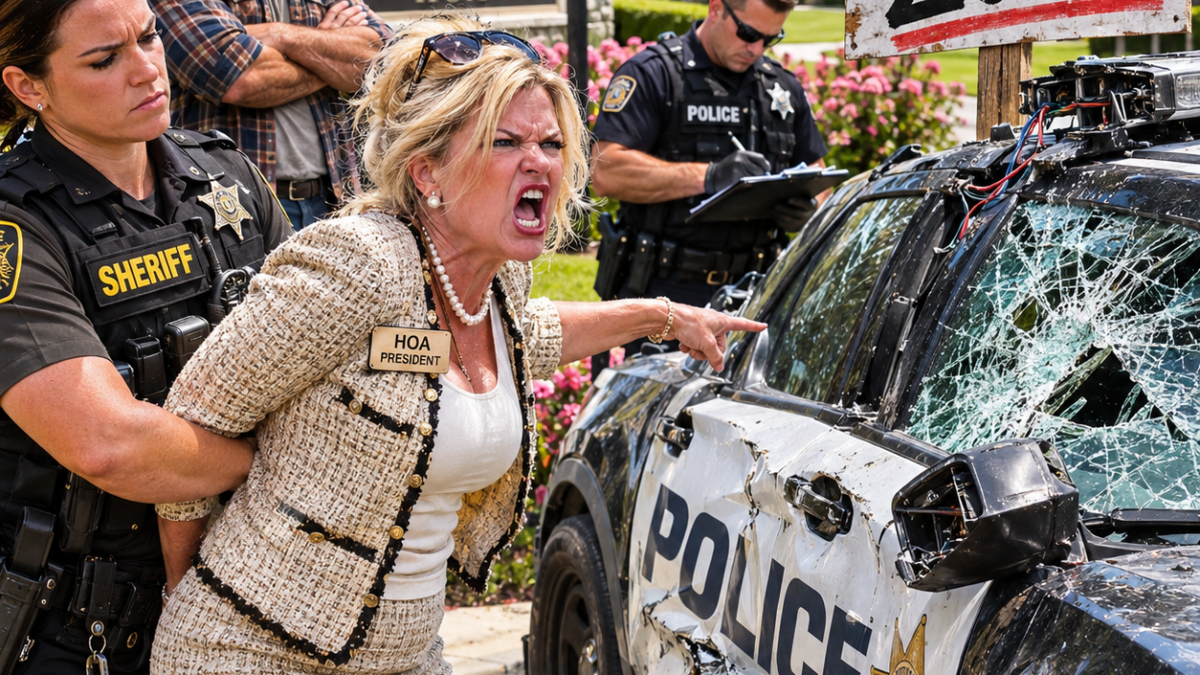
The woman who spent months demanding that I remove my marked patrol car from my own street finally decided HOA fines weren’t enough.
I woke from a dead sleep to an explosion outside my house—and when I ran barefoot into the street, my police vehicle was burning while the HOA president stood nearby filming it like she had just won.
What happened after that started with one word from the fire marshal, and that was the moment her little neighborhood kingdom began to collapse.
When I moved into Silverbrook Estates, I wasn’t looking for a fight.
I was looking for quiet.
After nearly twelve years in law enforcement, quiet had become something I valued in a way I never had when I was younger.
My job was noise.
Radios.
Sirens.
Arguments.
Traffic stops.
People shouting in hallways.
Doors slamming.
Phones ringing at two in the morning.
I had seen people at their best and their worst, sometimes within the same ten-minute call.
So when I started looking for a house, I didn’t care about granite countertops or some designer kitchen.
I wanted a street where my son could ride his bike without me staring out the window every thirty seconds.
I wanted trees.
Sidewalks.
Neighbors who knew each other.
A backyard big enough for a cheap grill and two folding chairs.
Silverbrook Estates looked perfect.
Trimmed lawns.
Hedges.
Flower beds.
Kids drawing with sidewalk chalk.
Older couples walking dogs after dinner.
People waved.
There was an HOA, but that didn’t worry me.
I’d dealt with regulations my entire career.
Rules didn’t bother me when they had a purpose.
I filled out the forms.
Paid the fees.
Signed whatever needed signing.
Then I moved in on a Thursday afternoon after a shift that had run several hours longer than expected.
I parked my marked patrol car along the curb in front of my house.
Same way I had parked at my previous place.
The car belonged to the city.
It was assigned to me.
Department policy allowed me to take it home.
It was legally parked on a public street.
Nothing unusual.
At least, that’s what I thought.
I grabbed a box of dishes from the trunk and carried it inside.
When I came back out, I noticed a curtain move across the street.
Then another.
A woman watering flowers had stopped spraying and was staring directly at the patrol car.
A man who had been talking to his neighbor looked over twice.
I ignored it.
People notice police cars.
Sometimes they’re curious.
Sometimes nervous.
Usually, after a few days, they stop caring.
I spent the rest of the afternoon unpacking.
My son was coming that weekend, and I wanted his room ready.
I assembled a cheap bookshelf.
Moved his bed twice because I couldn’t decide where it looked better.
Hung one of his old baseball posters crooked and decided it was good enough.
By midnight, my back hurt and I barely remembered the people staring outside.
The next morning, someone knocked.
I opened the door.
That was the first time I met Marla Hensley.
Late forties.
Pastel blazer.
Perfect hair.
Perfect nails.
Clipboard tucked under one arm.
She smiled with the kind of enthusiasm that looked rehearsed.
“You must be Daniel.”
“That’s me.”
“I’m Marla Hensley. HOA president.”
“Nice to meet you.”
“Welcome to Silverbrook.”
“Thanks.”
She talked for a few minutes about trash pickup, recycling, landscaping schedules, community meetings.
Normal HOA stuff.
But while she spoke, her eyes kept drifting toward the curb.
Toward my patrol car.
Finally she said:
“That vehicle is yours?”
“Assigned to me.”
Her smile held.
“You’re a police officer.”
“I am.”
“Oh.”
Just one word.
But something about the way she said it made me look at her more carefully.
“Problem?”
“No.”
She smiled wider.
“Of course not.”
Then she glanced at the car again.
“We just like to keep things orderly here.”
I almost laughed.
“I’m a big fan of orderly.”
She didn’t laugh with me.
She left.
I forgot the conversation by lunchtime.
Two days later, I opened my front door and found a bright orange notice taped to it.
**HOA VIOLATION NOTICE**
Unauthorized commercial vehicle parked in a residential area.
I stood there reading it.
Then looked at the patrol car.
Then back at the notice.
I laughed out loud.
I assumed somebody had made a mistake.
Maybe they thought it was a company vehicle.
Maybe the form was automated.
I took it down.
Went inside.
Made coffee.
The next morning, there was another one.
Same violation.
This time the wording was more aggressive.
Immediate compliance requested.
I emailed the HOA.
Polite.
Short.
I explained that the vehicle was city-owned, assigned to me, and legally parked on a public street.
Then I attached a photograph.
I assumed somebody would reply:
Sorry about the mistake.
Instead, Marla answered within ten minutes.
Her email said:
**The presence of a marked law enforcement vehicle is disruptive to the residential character of Silverbrook Estates and may negatively affect property values by creating the impression of elevated criminal activity.**
I read it twice.
Then a third time.
A police car apparently made people think the neighborhood was unsafe.
I sat back in my chair.
That should have been the moment I realized I wasn’t dealing with a misunderstanding.
But I still believed reason would solve it.
That was my first mistake.
PART 2
I replied professionally.
I quoted the relevant HOA section.
The restriction on commercial vehicles applied to privately operated business vehicles stored on private property in ways that violated specific size limits.
My patrol car didn’t qualify.
It was government property.
It sat on a public curb.
The HOA did not control the street.
I attached screenshots.
Then I went one step further.
I contacted my department.
Not because I needed permission.
Because I wanted the issue documented before it became stupid.
My supervisor wrote a short letter confirming that the patrol vehicle was city property, assigned to me under department policy, and legally permitted at my residence.
I sent that too.
Marla’s response:
**The HOA maintains authority to protect the appearance and peaceful enjoyment of the community regardless of technical ownership questions.**
Technical ownership questions.
I smiled when I read that phrase.
Not because it was funny.
Because people reveal themselves in language.
To Marla, the fact that she didn’t own the street wasn’t decisive.
It was technical.
An inconvenience.
The notices continued.
Day four.
Day five.
Then the first fine.
I disputed it.
The board scheduled a review.
I attended.
The meeting room was exactly what you would expect from a suburban HOA.
Fluorescent lights.
Folding chairs.
Coffee that had probably been made by someone angry at coffee.
A long table at the front.
Marla sat in the center.
She smiled when I entered.
I sat in the back until my item came up.
“Mr. Cross,” she said.
Formal now.
“Would you like to address the violation?”
“Yes.”
I stood.
I had printed copies.
“First, this vehicle is not commercial.”
Marla folded her hands.
“It is used professionally.”
“So is a teacher’s car.”
Someone coughed to hide a laugh.
Marla ignored it.
I continued.
“Second, the car is city property.”
“That doesn’t change community standards.”
“It changes jurisdiction.”
“We are not discussing jurisdiction.”
“We should be.”
Her smile tightened.
I handed copies of the bylaws to the board.
“This section does not apply.”
One board member read.
Another looked toward Marla.
She said:
“The board has interpretive authority.”
“Interpretive authority does not create ownership of a public street.”
Her eyes hardened.
“You seem very focused on technicalities.”
I paused.
“Property rights and municipal law aren’t technicalities.”
The room became uncomfortable.
I could feel it.
Most people hate conflict.
Especially polite conflict.
Yelling gives people an excuse to pick a side emotionally.
Calm facts make everyone sit with the problem.
Marla leaned back.
“Residents have expressed concerns.”
“What concerns?”
“The police presence.”
I looked around.
Nobody spoke.
“Specific complaints?”
“They were communicated privately.”
“About what?”
“That your vehicle suggests criminal activity.”
I almost laughed.
“What criminal activity?”
“That is not the point.”
“It seems like exactly the point.”
She stared at me.
I lowered my voice.
“My patrol car doesn’t create crime.”
“That’s your opinion.”
“No.”
I looked around the room.
“That’s reality.”
The board didn’t vote.
Marla moved on.
I thought maybe the absurdity had finally embarrassed them enough to stop.
Three days later, a certified letter arrived.
Remove the patrol vehicle within seventy-two hours.
Or the HOA would take “enforcement action.”
That phrase concerned me.
Not because I believed they had legal power.
Because vague language often means somebody wants freedom to do something stupid.
I went to Marla’s house that evening.
That was one of only two times I confronted her directly before everything exploded.
She opened the door like she had been expecting me.
Same smile.
Same neat clothes.
“Daniel.”
“We need to talk.”
“About?”
“The letter.”
“Oh.”
She leaned against the doorframe.
“What about it?”
“You need to withdraw it.”
“The board issued it.”
“You signed it.”
“As president.”
“The vehicle is government property.”
“We’ve covered this.”
“No.”
I kept my voice calm.
“I want to be very clear about something.”
She stared at me.
“If you tow that vehicle, damage it, disable it, enter it, move it, or direct anyone else to interfere with it, you are touching city property.”
Her eyes narrowed.
“Is that a threat?”
“No.”
“It sounds like one.”
“It’s a warning about the law.”
She smiled.
“There it is.”
“What?”
“The badge.”
I frowned.
“You think being a police officer makes you special.”
“No.”
“You think you can intimidate people.”
“I came here without the badge.”
“You still carry the attitude.”
I looked at her for a long moment.
“Marla, this is simple.”
“No.”
She shook her head.
“You moved here and immediately decided community rules didn’t apply to you.”
“I parked a car.”
“A police car.”
“Yes.”
“You brought state authority into a private neighborhood.”
That sentence surprised me.
“What does that even mean?”
“You don’t understand how people feel.”
“About seeing a police car?”
“Some people don’t want to live under surveillance.”
“The car is parked.”
“It represents surveillance.”
“It represents my job.”
“It represents danger.”
I stared at her.
She continued.
“Criminals see police vehicles. They notice where officers live. They follow them. You are inviting danger into Silverbrook.”
That argument was at least more coherent than property values.
Still wrong.
But coherent.
“If you believe there’s a security concern, bring it to me or the department.”
“We did.”
“No, you sent parking fines.”
“Because the simplest solution is removing the vehicle.”
“I’m not violating the rule.”
“The HOA has its own authority.”
She said it slowly.
Firmly.
As if she believed those words created a separate government.
“And we will use it.”
That was the first moment I felt something colder than irritation.
I looked at her.
Not the clothes.
Not the clipboard.
Not the smile.
Her.
She believed herself.
That mattered.
People who knowingly lie can sometimes be negotiated with.
People convinced they are entitled to power are harder.
I went home.
Opened my laptop.
Created a folder.
**SILVERBROOK HOA**
Every email.
Every notice.
Every certified letter.
Every photograph.
The department letter.
Meeting notes.
Everything.
I made a backup.
Then another.
I adjusted the exterior cameras.
Not because I expected violence.
Because my instincts were bothering me.
Twelve years on patrol teaches you to respect certain feelings.
Not fear.
Pattern recognition.
When behavior escalates despite clear boundaries, document.
Marla escalated.
The emails became longer.
More aggressive.
More people copied.
Words in bold.
Words in capital letters.
**NONCOMPLIANCE.**
**ENFORCEMENT.**
**LIABILITY.**
**BOARD AUTHORITY.**
She wrote about liens.
Fines.
Seizures.
Penalties.
She cited sections that didn’t say what she claimed.
I answered every message the same way.
Boring.
Professional.
Factual.
I cited actual bylaws.
Actual city ordinances.
Actual state law.
I never insulted her.
Never threatened her.
Never wrote anything I would be embarrassed to hear read aloud in court.
At the time, that felt tedious.
Later, it would become one of the smartest things I had ever done.
Because bullies hate boring documentation.
Anger gives them something to use.
Facts give them a wall.
The first sign that Marla had expanded the fight came from Layla.
She lived two houses down.
Single mother.
Two kids.
We had spoken occasionally.
One evening she stopped while I was taking trash cans in.
“Can I ask you something?”
“Sure.”
“Is there some kind of threat?”
I frowned.
“What threat?”
“Because you’re a cop.”
“No?”
She looked embarrassed.
“Marla came by.”
Of course.
“What did she say?”
“That there’s a risk.”
“What risk?”
“She said criminals follow police home.”
I exhaled.
“She said having your patrol car here could attract retaliation.”
“That’s technically possible anywhere.”
“She made it sound like something had happened.”
“Nothing happened.”
“She said there were concerns from the department.”
“There aren’t.”
Layla looked toward Marla’s house.
“She had papers.”
“What papers?”
“I didn’t read them.”
“Did she show you anything from the police department?”
“I don’t know.”
That bothered me.
“What else?”
Layla hesitated.
“She said you were refusing to cooperate.”
I laughed quietly.
“Of course.”
“I’m sorry.”
“Why are you sorry?”
“Because I believed some of it.”
I looked at her.
She looked genuinely uncomfortable.
“That’s why I’m asking.”
I appreciated that.
“Nothing is happening. I’m legally parking my assigned patrol car. That’s the whole dispute.”
Her shoulders relaxed slightly.
“Okay.”
Then she said something that stayed with me.
“She’s going door to door.”
That changed things.
Marla wasn’t enforcing a rule.
She was building a story.
In her version, I wasn’t a homeowner with a legal vehicle.
I was a risk.
Police presence brought crime.
My refusal to remove the car proved arrogance.
My badge made me power-hungry.
She turned the dispute into something emotional.
Fear.
Fear spreads faster than policy.
Within two weeks, neighbors changed.
People who had waved stopped.
Conversations ended when I walked near them.
Parents who used to let their kids bike past my house started calling them back earlier.
My son noticed before I wanted him to.
He came home one Friday afternoon and dropped his backpack near the kitchen.
“Dad?”
“Yeah?”
“Why doesn’t Mason want to come over anymore?”
I stopped washing a plate.
“What?”
“He said his mom doesn’t want him here.”
“Did he say why?”
My son shrugged.
“He said because you’re a police officer.”
That hurt more than anything Marla had sent me.
I dried my hands.
“Come here.”
He sat at the table.
“How do you feel about that?”
“I don’t know.”
He looked down.
“Did you do something?”
“No.”
“Then why are they mad?”
There are questions children ask that adults want desperately to answer with something clean.
I didn’t have one.
“Some adults get scared.”
“Of you?”
“Sometimes of what my job represents.”
“But you help people.”
“I try.”
“So why is that bad?”
“It isn’t.”
He looked toward the window.
“Is our neighborhood dangerous?”
“No.”
“Then why does everyone act weird?”
I sat across from him.
“Because one person started telling a story, and some people believed it before asking questions.”
“Who?”
I didn’t want to put an adult feud on my son.
So I said:
“Doesn’t matter.”
It mattered.
But not for him.
“What matters is you didn’t do anything wrong.”
“Did you?”
I smiled faintly.
“No.”
He nodded.
Then asked:
“Can I still ride my bike?”
“Absolutely.”
He did.
But I watched from the porch longer than usual.
That was the point where Marla stopped being merely irritating to me.
She had taken a parking dispute and made my kid feel like something about his father was shameful.
Anger arrived.
Real anger.
I wanted to go to her house.
Knock.
Tell her exactly what I thought.
I didn’t.
Instead, I opened the folder.
Saved Layla’s account.
Wrote down the date.
Documented.
If Marla wanted to turn this into a war of narratives, I would build a timeline.
The next HOA meeting drew more people.
Word had spread.
People wanted drama.
Marla stood at the front.
She gave a speech.
Rules.
Order.
Community values.
No person above the association.
Some residents nodded.
Others looked uncomfortable.
She never said my name.
She didn’t need to.
When she finished, I stood.
No speech.
I carried three sheets.
“I’d like to read the relevant rule.”
Marla’s expression tightened.
I read the commercial vehicle bylaw.
Then the exception.
Then the municipal ordinance governing public curb parking.
Then the department letter.
No commentary.
No sarcasm.
Just text.
When I finished, the room was silent.
One man said:
“So the car is legal?”
“Yes.”
Marla interrupted.
“Legality isn’t the only issue.”
I looked at her.
“What’s the other issue?”
“Community harmony.”
A woman in the front row asked:
“How does the car hurt harmony?”
Marla replied:
“The constant police presence creates tension.”
I said:
“The car doesn’t move unless I’m working.”
She ignored me.
Another resident spoke.
“I feel safer.”
Marla’s eyes flashed.
“I’m glad you do.”
The woman continued:
“I’m just saying, I don’t understand why we’re spending meeting time on this.”
That was the first public crack.
Small.
But real.
Marla changed tactics.
“It’s not about Mr. Cross personally.”
I almost smiled.
“It’s about precedent.”
“What precedent?” I asked.
“If we allow one resident to disregard vehicle restrictions—”
“The restriction doesn’t apply.”
“You keep interrupting.”
“You keep repeating something the document contradicts.”
The room murmured.
Her smile remained.
Her eyes didn’t.
No vote happened.
Meeting adjourned.
Three days later, another certified letter arrived.
Same demand.
More aggressive language.
**FINAL NOTICE BEFORE ENFORCEMENT.**
That evening I went to her house one last time.
She opened the door.
“Daniel.”
“I’m not here to debate.”
“Then why are you here?”
“To warn you again.”
She laughed.
Actually laughed.
“You think a badge makes you special.”
“I’m not wearing it.”
“This neighborhood belongs to us.”
I stared.
“Us who?”
“The residents.”
“I’m a resident.”
“People who respect community standards.”
There it was.
Belonging was conditional.
Obedience meant belonging.
Questioning meant exclusion.
I said:
“Touch the car and this stops being HOA business.”
Her smile became almost peaceful.
“One way or another, you’re going to learn.”
I walked away.
No reply.
Nothing useful would come from staying.
That night, I checked the cameras.
Good angles.
Driveway.
Front curb.
Part of the street.
The patrol car itself had an integrated dash camera system.
Even while parked, certain triggers could activate recording.
Department systems tracked the vehicle too.
I knew all that.
I still never imagined what would happen next.
Two days later, I worked an early shift.
Started before sunrise.
Finished after lunch.
It had been hot all week.
Heavy summer heat.
The kind that sits over asphalt and makes everything smell baked.
I parked in front of the house.
Locked the patrol car.
Went inside.
My son was with his mother that afternoon.
I planned to pick him up later.
I took a shower.
Ate something.
Closed the blinds.
Lay down on the couch.
I was asleep within minutes.
Then came the boom.
Deep.
Heavy.
Not a car backfiring.
Not fireworks.
Something close.
The windows rattled.
I came awake instantly.
Training does that.
Before I was fully conscious, the car alarm started screaming outside.
I ran to the window.
Black smoke.
My stomach dropped.
I was out the door barefoot.
Heat hit me before I reached the sidewalk.
The patrol car’s hood was burning.
Flames climbed the windshield.
Black smoke rolled upward.
For half a second, every thought in my head stopped.
Then I saw Marla.
She stood a few yards away.
Phone held up.
Recording.
And she was smiling.
Not nervous.
Not shocked.
Smiling.
She shouted:
“That’s what happens when people ignore HOA rules!”
I stared at her.
“What did you do?”
She laughed.
“Enforcement!”
My entire body went cold.
A neighbor yelled from across the street.
Someone else shouted about calling 911.
I ran to my garage.
Fire extinguisher.
Back outside.
Pulled the pin.
I aimed into the engine area.
White chemical cloud exploded against flame.
Heat burned my face.
The car alarm screamed.
Marla’s voice cut through everything.
“Rules matter more than your badge!”
She actually clapped once.
One clap.
That detail stayed with me longer than the flames.
A human being watching a vehicle burn near homes, trees, children—and clapping because she believed she had won an HOA dispute.
I sprayed until the extinguisher emptied.
A neighbor brought another.
We hit the flames again.
Finally, fire dropped to smoldering smoke.
The hood was black.
Windshield cracked.
Paint blistered.
Interior smoke-damaged.
I stood in the street barefoot, breathing hard.
Marla was still filming.
I pulled out my phone.
Called dispatch.
My voice sounded strangely calm.
“Officer Cross. I need units at my residence.”
The dispatcher recognized my number.
“What happened?”
“Marked patrol vehicle attacked. Possible arson.”
Pause.
“Suspect?”
I looked directly at Marla.
“Hostile suspect on scene.”
Her smile finally changed.
I gave the address.
Within minutes, sirens.
Not one.
Several.
Marla looked around.
Neighbors gathered.
Phones out.
Curtains open.
The same street that had whispered about my police car was now filling with police cars.
Two patrol units.
Then another.
Supervisor.
Fire engine.
Fire marshal.
The street transformed.
Yellow tape.
Radios.
Photos.
Evidence markers.
Marla tried to speak over everyone.
“This is HOA jurisdiction!”
An officer told her to step back.
“You don’t understand,” she said.
“Ma’am, step back.”
“He was warned!”
Another officer looked at her.
“About what?”
“Parking!”
I almost laughed.
It would have been hysterical.
Instead, I just stood there.
The fire marshal arrived.
Older man.
Calm.
He inspected the front end.
Looked underneath.
Took samples.
Then crouched near the curb.
He smelled something.
Stood.
One word.
“Accelerant.”
Marla’s face drained.
Not metaphorically.
I watched color leave her.
The investigator looked at her.
“You know something about this?”
“No.”
“But you were filming.”
“I came outside when I heard the noise.”
I spoke:
“She was already standing here when I came out.”
“That’s a lie.”
“Cameras.”
She looked toward my house.
Her expression changed again.
“What cameras?”
I didn’t answer.
The investigator did.
“We’ll look.”
Another officer approached.
“Ma’am, can I see your phone?”
“Why?”
“Because you appear to have recorded the event.”
“That’s private.”
“Did you record the vehicle fire?”
She clutched the phone.
“No.”
I stared.
She had been holding it up.
“I watched you.”
“You were confused.”
The officer said:
“Ma’am, don’t delete anything.”
“I’m not.”
“Put the phone down.”
“This is harassment.”
“Put the phone down.”
She looked around.
Neighbors watching.
Police.
Firefighters.
The board president who once controlled meetings was suddenly one person surrounded by institutions that did not care about her title.
She placed the phone on the hood of a nearby cruiser.
An officer bagged it.
That was when she started shouting.
“You can’t seize that!”
Nobody argued.
They simply continued.
My supervisor walked over.
“You okay?”
“I’m fine.”
“You’re barefoot.”
I looked down.
My feet were dirty.
One had a small cut.
“I didn’t notice.”
“You need shoes.”
For some reason, that almost made me laugh.
The normality.
Shoes.
My patrol car had just been set on fire.
Marla was yelling about HOA authority.
And my supervisor was worried about broken glass in my feet.
“I’ll get some.”
I walked inside.
For the first time since the boom, I was alone.
The house was quiet.
My hands started shaking.
I leaned against the kitchen counter.
Adrenaline.
Anger.
Fear.
Then a thought hit me so hard I had to sit down.
My son.
He could have been there.
He could have been riding his bike.
He could have been standing near the car.
The fire could have spread.
Fuel.
Tires.
Nearby lawns.
Houses.
This wasn’t property damage.
Not emotionally.
It was the moment the fight escaped paperwork and entered the physical world.
I put on shoes.
Went back outside.
An investigator met me.
“We need your camera access.”
“Of course.”
We went inside.
Laptop.
Login.
Exterior cameras.
There it was.
Timestamp.
Marla walking down the street.
She looked around.
Carried something.
A container.
Another angle showed her approaching the patrol car.
Pouring liquid.
My stomach twisted.
She disappeared out of frame briefly.
Then ignition.
Flash.
Flames.
Marla stepped back.
Raised phone.
Recorded.
The investigator said nothing.
Neither did I.
Then:
“That’s pretty clear.”
“Yes.”
My voice barely worked.
He rewound.
Again.
Again.
Different camera.
Then we checked the patrol car system.
The dash camera had captured more.
Audio.
Her voice.
Before ignition.
Talking to herself or the phone.
“This is what happens when you bring police into a no-authority neighborhood.”
Then another phrase.
“Maybe now he’ll listen.”
Then flame.
The investigator paused.
Looked at me.
“Daniel.”
“Yeah.”
“This isn’t ambiguous.”
“No.”
“She’s going into custody.”
I nodded.
Something in me expected relief.
Instead, I felt sick.
They arrested her on the street.
When the officer approached, Marla started shouting immediately.
“You cannot arrest me!”
“Turn around.”
“I am the president of the homeowners association!”
“Turn around.”
“You have no jurisdiction over HOA enforcement!”
An officer actually stopped.
Looked at her.
“Ma’am, this is an arson investigation.”
“You don’t understand.”
“Hands behind your back.”
“This neighborhood has rules!”
The cuffs closed.
That sound.
I had heard it thousands of times.
At work.
Traffic stops.
Domestic calls.
Warrants.
That afternoon it sounded different.
Personal.
Marla turned toward me.
“This is your fault!”
I didn’t respond.
“You brought this here!”
Nothing.
“You wanted this!”
I still said nothing.
An officer guided her toward the cruiser.
She screamed:
“You ruined everything!”
That finally made me speak.
“No, Marla.”
She stopped.
“You did.”
Then the door closed.
The cruiser drove away.
Silverbrook went silent.
Not literally.
Radios still crackled.
Firefighters worked.
Neighbors talked quietly.
But emotionally, something ended.
For months, everyone had been waiting.
Now they knew.
The patrol car had always been framed as the danger.
The symbol of crime.
The thing threatening property values.
Then the person who said that set it on fire.
The investigation moved quickly.
Faster than most cases I had worked.
Because evidence was everywhere.
My exterior cameras.
Dash camera.
Fire marshal samples.
Her phone.
Her emails.
HOA notices.
Meeting recordings.
Certified letters.
The folder I had built.
Everything connected.
Detectives extracted data from her phone.
Messages.
Draft emails.
Notes.
Photos of my car.
Screenshots of my schedule.
That last part made me uncomfortable.
She had been tracking when the car was present.
Emails to board members.
One said:
**If Cross refuses to remove it voluntarily, we need a stronger enforcement response.**
Another:
**People like him only understand power.**
Another:
**Once the vehicle is gone, the neighborhood will calm down.**
One board member had replied:
**What exactly do you mean by stronger enforcement?**
Marla:
**Leave it to me.**
That message caused panic inside the HOA.
Three board members resigned within two days.
Their resignation letters sounded similar.
They had not approved vandalism.
They had not known Marla would commit a crime.
They believed “enforcement” meant fines and legal notices.
Maybe that was true.
Maybe partly true.
I never learned exactly what each person believed.
But they had watched escalation.
They had watched her target me.
They had listened to the speeches.
They had allowed notices without legal basis.
They had not lit the fire.
But they had helped build the stage.
The city became involved.
There were questions about HOA governance.
Legal counsel.
Financial exposure.
External oversight.
Accounts were reviewed and temporarily restricted during the administrative investigation.
Suddenly, the association that had been so confident about its authority became deeply interested in what authority actually meant.
The irony wasn’t lost on anyone.
Layla came to my house two evenings after the arrest.
She brought food.
Lasagna.
Too much lasagna.
“My mom made it.”
“Tell her thanks.”
“She made enough for ten people.”
“That sounds like my mom.”
She stood awkwardly.
Then said:
“I’m sorry.”
“You didn’t do anything.”
“I believed her.”
“Some of it.”
“I told other people.”
That surprised me.
She looked ashamed.
“I said maybe having the patrol car there could attract problems.”
I leaned against the door.
“Well.”
She looked like she expected anger.
“I was wrong.”
“Yes.”
She nodded.
“I know.”
I exhaled.
“Thank you for saying it.”
Her eyes filled slightly.
“Your son okay?”
That question hit me.
“He will be.”
“Mine asked about him.”
“Yeah?”
“She wants to know if he can come over.”
I smiled.
“He’d like that.”
The next weekend, my son came home.
The burned patrol car was gone.
Department tow had removed it.
A dark stain remained near the curb.
He noticed immediately.
“Where’s your car?”
I had already told him part of the story over the phone.
Not all.
“Department took it.”
“Is it destroyed?”
“Pretty bad.”
He looked at the stain.
“Did that lady really do it?”
I hated hearing him say “that lady.”
Because he knew exactly who.
“Yes.”
“Why?”
I thought carefully.
“Because she got so angry about not getting her way that she made a terrible decision.”
“Is she in jail?”
“For now.”
He stood quietly.
Then:
“Does she hate you?”
“I don’t know.”
“Did you hate her?”
That question caught me.
“I was angry.”
“That’s not what I asked.”
Kids are efficient.
I looked at him.
“In the moment? Maybe.”
“Do you now?”
I looked toward Marla’s empty house.
“No.”
“Why not?”
“Because hate doesn’t fix the car.”
He considered that.
“Are you scared?”
Another efficient question.
“A little.”
His eyes widened.
“Police officers get scared?”
“All the time.”
“Really?”
“Being scared tells you something matters.”
He nodded.
Then:
“Can I ride my bike?”
I laughed.
“Yes.”
He did.
I stood on the porch.
Watched him go.
Then forced myself not to follow.
If Marla had taught me anything, it was how quickly fear could become control.
I wasn’t going to turn my son’s life into a security operation because someone else had lost theirs.
The criminal case did not drag for years.
The evidence was overwhelming.
Acceleration samples matched materials linked to Marla.
Video captured the act.
Audio captured her statements.
Her phone contained intent.
Emails showed escalation.
The HOA paper trail established motive.
Her defense attorney had a terrible set of facts.
For months, I avoided following every court update.
I was a witness.
I cooperated.
But I didn’t want to live inside the case.
I had work.
My son.
A house.
Life.
The department assigned me another vehicle temporarily.
The first night I parked it outside, I stood in the driveway longer than I should have.
I looked at the curb.
The street.
Windows.
Nothing.
No Marla.
No notice.
No orange paper taped to the door.
Still, I checked the camera twice before bed.
That irritated me.
Not the camera.
The fact that she had changed my habits.
For weeks, every sound outside woke me.
Car door.
Trash can.
Dog bark.
Delivery truck.
I’d look through the blinds.
Sometimes I caught myself doing exactly what the neighborhood had done to me when I first arrived.
Curtain twitching.
Watching.
Suspicious.
Fear is contagious.
So is vigilance.
The trick is knowing when vigilance stops protecting you and starts owning you.
My department offered counseling.
I went.
Not because I thought I was traumatized.
Because after twelve years on the job, I knew officers are terrible at deciding they don’t need help.
The counselor asked:
“What part bothers you most?”
“The fire.”
“Because you could have been hurt?”
“No.”
I paused.
“My son.”
“He wasn’t there.”
“I know.”
“But you imagine him there.”
“Yes.”
“Anything else?”
“The way she clapped.”
The counselor waited.
“That bothers you.”
“Yes.”
“Why?”
I didn’t have an immediate answer.
Then:
“Because she thought she was right.”
That was it.
If she had acted ashamed.
Hidden.
Run.
Maybe my brain could categorize her as somebody doing something knowingly criminal.
Instead, she stood there celebrating.
She believed destruction was enforcement.
That scared me more than rage would have.
People can justify almost anything once they rename it.
Harassment becomes safety.
Exclusion becomes community standards.
Threats become enforcement.
Arson becomes consequences.
Language can become permission.
I carried that lesson into court.
Months later, the case went before a judge.
I attended.
Marla looked different.
No pastel blazer.
No clipboard.
No HOA president posture.
Plain clothes.
Hair less perfect.
She looked tired.
Human.
For the first time, I saw how much energy it must have taken to maintain the person she had been.
She avoided looking at me.
The prosecutor laid out the evidence.
Meeting threats.
Letters.
Emails.
Video.
Accelerant.
Dash camera.
Phone.
The judge watched footage of the fire.
Then listened to audio.
Marla saying:
“Rules matter more than your badge.”
I felt my stomach tighten.
Her attorney argued that she had experienced escalating stress.
That she had become obsessed with what she considered a threat to neighborhood safety.
That she never intended to endanger residents.
The prosecutor responded:
“She poured accelerant on a government vehicle parked in a residential neighborhood and ignited it.”
Hard to argue around that.
At one point, Marla asked to speak.
The judge allowed it.
She stood.
Her voice shook.
“I was trying to do my job.”
The judge stopped her.
“Your job?”
“Yes, Your Honor. As HOA president, I was responsible for—”
The judge leaned forward.
“Ms. Hensley.”
She stopped.
“Your job did not include arson.”
Silence.
That sentence became the one everybody remembered.
Not because it was poetic.
Because it reduced months of Marla’s justifications to something simple.
You can call yourself president.
You can cite bylaws.
You can claim community duty.
You can talk about property values.
Then you pour accelerant on a car and light it.
The language falls away.
The act remains.
Marla received nine years in state prison, subject to the applicable mandatory minimum before parole eligibility.
Restitution.
Financial penalties.
A lien was placed against her house to satisfy portions of the ordered obligations connected to the vehicle, investigation, and associated damage.
And she was permanently barred from holding an HOA position in the state.
When the sentence was read, she finally looked at me.
I expected anger.
I saw disbelief.
Maybe she had never fully accepted that the system outside Silverbrook would not recognize her authority.
In meetings, she controlled the agenda.
At her door, she controlled the conversation.
In emails, she controlled the tone.
In court, she was simply the defendant.
I didn’t smile.
Didn’t nod.
Didn’t celebrate.
I thought about the first orange notice.
Commercial vehicle violation.
That’s where it began.
A piece of paper.
A parked car.
An argument that should have ended with someone reading a bylaw.
Nine years.
A damaged house.
A ruined reputation.
A community placed under oversight.
A child wondering why friends stopped visiting.
A burned police car.
All because one person could not tolerate being told her authority had limits.
That wasn’t satisfying.
It was sad.
The HOA changed almost immediately after Marla’s arrest.
First because it had no choice.
Then, eventually, because residents wanted it to.
The remaining board members stepped aside or were replaced.
External oversight continued during the transition.
A temporary committee reviewed fines issued under Marla.
Some were withdrawn.
Others refunded.
Policies were rewritten.
The new leadership put something into writing that should never have required clarification:
Vehicles legally parked on public streets were outside HOA enforcement unless municipal law explicitly provided otherwise.
Imagine that.
It took a felony arson case to clarify that the HOA could not regulate city property sitting on a city street.
The first new president was a quiet man named Robert.
Retired engineer.
He spoke slowly.
Read everything before meetings.
No dramatic speeches.
His first meeting as acting president drew almost the entire neighborhood.
People expected tension.
He stood at the front.
“I want to begin with something simple.”
Everyone listened.
“This board is not a government.”
Some people laughed nervously.
Robert didn’t.
“We maintain shared community obligations under a contract. That is all.”
I looked around.
A year earlier, saying that might have started a fight.
Now people nodded.
He continued.
“We are not law enforcement.”
Another pause.
“We are not courts.”
Then:
“And no title within this association gives anyone the right to harass residents.”
Layla looked at me.
I looked down.
Robert announced an independent review.
Clear appeals.
Documented complaints.
No anonymous “community concern” could be used as a basis for punitive action without verification.
There would be limits on executive authority.
Board votes recorded.
Legal review required before enforcement involving public property.
Boring rules.
Beautifully boring.
That was what Silverbrook needed.
Boring.
My son started riding his bike with other kids again.
Not immediately.
Children repeat what adults say, but they also forget faster.
One afternoon I heard laughter outside.
I looked through the window.
My son and Mason were racing bikes past the driveway.
Mason’s mother stood near the sidewalk.
She saw me.
Looked uncomfortable.
Then waved.
I waved back.
That was it.
No apology.
No confrontation.
A wave.
Sometimes healing is embarrassingly ordinary.
A few weeks later she did knock.
I opened the door.
“I owe you an apology.”
“You don’t have to.”
“Yes.”
She took a breath.
“I told Mason he shouldn’t come over.”
“I figured.”
“Marla scared me.”
“I know.”
“She said police vehicles attract people looking for revenge.”
“That can happen.”
“See?”
She looked relieved.
I held up a hand.
“But it doesn’t mean my house is dangerous.”
She looked down.
“I know that now.”
“What changed?”
She laughed sadly.
“Marla set a police car on fire.”
Fair point.
“I realized she created the danger she warned us about.”
That sentence was almost too perfect.
I didn’t say so.
“I’m sorry your son got caught in it.”
“Thank you.”
“Mason likes him.”
“He likes Mason.”
“Can they hang out?”
“Of course.”
She smiled.
Then left.
After she walked away, I sat on the porch.
The irony ran through my mind.
Marla had told people my patrol car would attract danger.
The only person who attacked it was Marla.
She had told people police presence damaged the community.
Her campaign damaged the community.
She had told people I abused authority.
She abused authority.
Projection is easy to see after everything ends.
Harder while you’re living inside it.
The department replaced the damaged car.
Technically, they replaced city equipment.
But when the new patrol vehicle was assigned to me, it felt personal.
Same basic model.
Different year.
Cleaner.
Better electronics.
I drove it home.
Turned onto Silverbrook.
I expected curtains to move.
They didn’t.
I parked in front of my house.
Got out.
Layla was watering flowers.
She looked at the car.
Then smiled.
“Looks nice.”
I laughed.
“Don’t tell the HOA.”
She laughed too.
That joke broke something.
A tension that had been sitting in the street for months.
Other neighbors eventually made their own jokes.
One man said:
“Property values still okay?”
Another:
“Should we issue a warning?”
I laughed because humor meant the fear had lost power.
Marla’s house remained empty for a long time.
Then legal and financial processes moved forward.
I didn’t follow every detail.
The lien.
Restitution.
Eventually changes in ownership.
One afternoon, a real estate sign appeared.
I stood across the street looking at it.
My son came beside me.
“Is that her house?”
“Was.”
“Someone else will live there?”
“Probably.”
He thought about that.
“What if they hate police cars?”
I laughed.
“Then they can hate it quietly.”
He grinned.
That was when I realized he had recovered more than I had.
Children can move forward when adults stop feeding them fear.
The new family arrived months later.
Young couple.
Baby.
They introduced themselves.
Didn’t mention Marla.
I didn’t either.
For them, the house had no political meaning.
It was simply the place they bought.
That helped.
Silverbrook slowly became the neighborhood I thought I had moved into.
Dogs.
Sidewalks.
Kids.
Lawns.
Boring disputes about trash pickup.
Someone complained about Christmas lights.
Someone else complained about dog poop.
Normal.
No wars.
No patrol car crisis.
No president talking about liens like a dictator.
I remained an officer.
The job stayed difficult.
Some nights I came home exhausted.
Sometimes I sat in the patrol car for five minutes before going inside.
That had become a habit.
A small transition between other people’s problems and my own life.
One night, I sat there and looked at the houses.
Porch lights.
Television glow.
Quiet.
I thought about how close I had come to moving.
I had considered it during the worst weeks.
Not seriously at first.
Then more seriously after my son asked why people didn’t want him around.
I looked at listings.
Another neighborhood.
Different school route.
No HOA.
Part of me thought leaving would be easier.
I stayed because I refused to let Marla decide where my son and I lived.
Was that stubborn?
Probably.
But leaving under pressure would have made the neighborhood hers in a way the bylaws never did.
I didn’t want revenge.
I wanted normal.
That became the theme of the entire aftermath.
People expected me to feel victorious.
Coworkers joked.
“Guess she finally learned who had jurisdiction.”
Reporters asked whether I felt vindicated.
Neighbors asked whether watching her sentenced was satisfying.
I never knew what answer they wanted.
Yes, the system worked.
Yes, she faced consequences.
Yes, I was relieved.
But victory?
A burned patrol car isn’t victory.
A kid being isolated isn’t victory.
Neighbors afraid of each other isn’t victory.
Prison isn’t victory.
The victory came later.
The first afternoon my son rode past the house without looking toward Marla’s old property.
The first night I slept through a noise outside.
The first time I saw the new patrol car from my window and felt nothing.
No tension.
No anger.
Just a car.
That was victory.
About a year after the fire, Silverbrook held its annual summer cookout.
I almost didn’t go.
Then my son insisted.
There were burgers.
Cheap folding tables.
Kids throwing water balloons where they weren’t supposed to.
Robert, the new HOA president, stood near the grill wearing an apron.
I walked over.
“Mr. President.”
He groaned.
“Don’t call me that.”
I smiled.
“Trauma?”
“Enough that I may abolish the title.”
“Good policy.”
He handed me a burger.
“Seriously, how are things?”
“Quiet.”
“Best answer.”
We stood watching the kids.
Then he said:
“I went through some of Marla’s old records.”
I looked at him.
“You poor man.”
He laughed.
“She had files on people.”
“I’m not surprised.”
“Color-coded.”
“That sounds like her.”
“She documented everything she thought was noncompliance.”
“Anything criminal?”
“No. Just obsessive.”
He looked at me.
“She had more on you than anyone.”
“I assumed.”
“Pictures of the patrol car. Dates. Times. Copies of your emails.”
“Normal stalker-administrator material.”
He didn’t laugh.
“There were notes about your son.”
My smile disappeared.
“What notes?”
He immediately looked regretful.
“I shouldn’t have said that.”
“What notes?”
“Nothing threatening.”
“What?”
He sighed.
“She wrote things like ‘child outside after 8 p.m.’”
My jaw tightened.
“Why?”
“I don’t know.”
“Violation?”
“No.”
“Then why document it?”
“I don’t know.”
I stared toward my son.
Water balloon in hand.
Laughing.
Robert said:
“We destroyed those files after counsel reviewed them.”
“Good.”
“I’m sorry.”
“Not your fault.”
That old anger returned.
Hot.
Fast.
For a moment, Marla was back in my head.
Watching.
Writing.
Turning my child into an item in a folder.
Then my son threw the water balloon.
It hit Robert directly in the side.
He jumped.
My son froze.
“Oh no.”
Robert looked at him.
Then at me.
Then grabbed a water balloon and chased him.
I started laughing.
Anger vanished.
That moment became one of my favorite memories of Silverbrook.
Not because it was profound.
Because it wasn’t.
That was the point.
Normal life beating obsession simply by continuing.
Later that night, my son asked:
“Did Mr. Robert get mad?”
“No.”
“He chased me.”
“He was playing.”
“I know.”
Then:
“Was Mrs. Hensley always mad?”
I thought about it.
“No.”
“How do you know?”
“I don’t.”
He looked confused.
“Then why’d you say no?”
“Because nobody is one thing all the time.”
That answer surprised even me.
He asked:
“Was she bad?”
“I think she did something very bad.”
“That’s not the same?”
“No.”
He stared at the ceiling.
“So good people can do bad stuff?”
“Yes.”
“And bad people can do good stuff?”
“Probably.”
“That’s confusing.”
“Welcome to adulthood.”
He laughed.
Then became serious.
“Do you forgive her?”
I didn’t answer immediately.
“I don’t know.”
“Do you have to?”
“No.”
That felt important.
Forgiveness is often treated like the mandatory final chapter of every painful story.
It isn’t.
Sometimes the ending is acceptance.
It happened.
She did it.
The system responded.
I moved forward.
I don’t need to pretend what she did was okay to stop carrying her.
That became my version of peace.
Years passed.
My patrol car changed again.
My son got taller.
The little bike became a bigger one.
Then eventually he cared more about friends and phones than riding circles around the block.
Silverbrook changed.
Some residents moved.
New people came.
Many never knew Marla.
Every now and then, someone heard the story.
“You’re the cop whose HOA president set the police car on fire?”
I hated how ridiculous that sounded.
“Yes.”
“She really said it was a no-cop neighborhood?”
“Not exactly.”
I always corrected that.
Because truth matters.
She never had the authority to create some official “no cop zone.”
What she did was argue that police presence was disruptive and dangerous.
Then she acted as though her personal fear gave the HOA powers it did not possess.
The real story was already absurd enough.
It didn’t need exaggeration.
One new neighbor once asked:
“Why didn’t you arrest her yourself?”
I laughed.
“That’s not how any of this works.”
“You’re a cop.”
“I was also the victim.”
“So?”
“So other officers handled it.”
He looked disappointed.
Apparently reality didn’t satisfy his action-movie expectations.
“But she was right there.”
“Yes.”
“Didn’t you want to?”
Want?
That was different.
I thought about Marla clapping beside the burning car.
“Yes.”
“But I didn’t.”
“Why?”
“Because power needs limits.”
He looked confused.
I pointed toward the HOA clubhouse.
“That was literally the entire lesson.”
He laughed.
But I meant it.
The worst thing Marla did was not simply set a car on fire.
The worst thing was convince herself that her role justified escalation.
If I had responded by deciding my badge gave me permission to ignore procedure, I would have repeated the exact logic I hated.
Authority is legitimate because it is bounded.
Rules.
Oversight.
Review.
Evidence.
Consequences.
Marla saw boundaries as obstacles.
My job taught me they were protections.
For everyone.
Including people I dislike.
Especially them.
The nine-year sentence became a neighborhood legend.
Some people thought it was harsh.
Others thought it was deserved.
I stopped debating it.
That was the judge’s decision under the law.
Not mine.
My responsibility was evidence.
Truth.
Testimony.
Then go home.
That division gave me peace.
I didn’t put her in prison.
Her actions put her in a courtroom.
The court did the rest.
There is a difference.
One winter evening, long after the case ended, I found one of the old orange violation notices in a box.
I had been cleaning the garage.
The paper was faded.
**UNAUTHORIZED COMMERCIAL VEHICLE.**
I held it.
My first instinct was to laugh.
My second was anger.
Then sadness.
That tiny sheet represented the beginning of everything.
I considered throwing it away.
Instead, I kept it.
Not as a trophy.
A reminder.
Big disasters rarely announce themselves as big.
They begin small.
An unreasonable notice.
A person unwilling to admit a mistake.
A board too passive to stop escalation.
Neighbors who prefer silence.
A leader who interprets disagreement as disrespect.
Then one boundary crosses another.
Then another.
Until somebody stands next to a burning vehicle and calls it enforcement.
People ask how someone gets that far.
Slowly.
That’s the answer.
Slowly enough that every step can be justified by the one before it.
First:
The police car violates standards.
Then:
Daniel refuses to comply.
Then:
Daniel abuses his badge.
Then:
Daniel threatens community safety.
Then:
Removing the car protects everyone.
Once you accept the first false premise, later steps become easier.
That’s why documentation mattered.
Every time Marla rewrote reality, there was a record sitting beside it.
Her claim.
The actual rule.
Her email.
The city ordinance.
Her threat.
The department letter.
Her action.
The camera.
Truth stayed boring.
Steady.
Unimpressed.
That’s what ultimately beat her.
Not me.
Not revenge.
Evidence.
That lesson made me a better officer.
I became more patient when people challenged me.
Not because every challenge was correct.
But because I understood more deeply how authority looks from the other side.
Someone in a uniform says:
“Do this.”
Maybe there is a reason.
Maybe there is a law.
Maybe there isn’t.
People deserve clarity.
A few years later, I trained a young officer.
Good kid.
Smart.
Too confident.
One afternoon he complained about a driver questioning a traffic stop.
“Guy kept asking why.”
“What did you tell him?”
“That I gave him a lawful order.”
I looked at him.
“That’s not an explanation.”
“He was being difficult.”
“Was the order lawful?”
“Yes.”
“Then explain why.”
He looked annoyed.
“Why should I have to?”
I thought about Marla.
Because I’m the HOA president.
Because we have authority.
Because rules.
Because I said so.
I said:
“Because legitimate authority shouldn’t be afraid of explanation.”
He rolled his eyes a little.
Young officers are excellent at that.
Then I told him part of my story.
Not all.
Enough.
He stopped rolling his eyes.
Sometimes we learn limits only after watching someone else ignore them.
Silverbrook eventually held a vote to reduce the president’s unilateral powers.
It passed easily.
No single officer could authorize major enforcement without board review.
Legal counsel reviewed disputed jurisdiction.
Resident complaints required documentation.
The president became what the role should have been all along.
Administrative.
Not royal.
Robert joked:
“I’ve never been happier to have less power.”
That’s usually a good sign in a leader.
He served two terms.
Then stepped down voluntarily.
Imagine that.
Voluntarily.
His replacement was a school librarian named Denise.
Her biggest controversy involved whether residents could put inflatable holiday decorations out before Thanksgiving.
Nobody went to prison.
Progress.
My son graduated from bike riding to driving.
The first time he parked his used car along the curb in front of our house, I stared at it.
He noticed.
“What?”
“Nothing.”
“You’re doing the dad thing.”
“What dad thing?”
“Looking like you’re about to give a speech.”
I laughed.
“Park straight.”
“That’s the speech?”
“For now.”
He went inside.
I stayed on the porch looking at his car.
Public curb.
Legally parked.
Ordinary.
There was something poetic about that.
A vehicle in front of my house no longer meant anything except somebody lived there.
Exactly how it should be.
Sometimes I think about Marla’s first sentence to me.
“We like to keep things orderly here.”
She probably believed that.
Order wasn’t evil.
Community standards weren’t evil.
HOAs weren’t automatically evil.
The problem was what happened when order became obedience.
When standards became personal preference.
When disagreement became disloyalty.
When power became identity.
Marla needed the neighborhood to obey because being president had become part of who she was.
Every challenge felt personal.
My patrol car was not merely a car.
It was proof there was something she couldn’t control.
That made it intolerable.
The more I calmly cited laws, the more threatened she felt.
Facts didn’t persuade her.
They humiliated her.
Because facts reminded her that her authority had edges.
She couldn’t accept edges.
So eventually she crossed them.
That is what I learned about small power.
Big power gets scrutiny.
Presidents.
Governors.
Chiefs.
Judges.
People watch them.
Small power often operates in blind spots.
Committee chairs.
Supervisors.
Board presidents.
Administrators.
The person with the key.
The person who approves a form.
The person who can fine you fifty dollars.
Most handle it responsibly.
Some discover they enjoy the feeling.
And if nobody pushes back, the role expands inside their own head.
That’s dangerous.
Not because they command armies.
Because they are close enough to ordinary life to make misery intimate.
A notice on your door.
A rumor about your family.
A child suddenly excluded.
A fine.
A threat.
A neighbor staring.
Small tools.
Big effect.
One night, years after the fire, I worked late.
I drove home in another marked unit.
It was after midnight.
Silverbrook was dark.
Porch lights.
Quiet streets.
I parked.
Turned off the engine.
Sat there.
The same curb.
Different car.
For a moment, I could almost see flames.
Memory does that.
Then a porch light came on across the street.
Layla stepped outside in a robe.
She saw me.
Waved.
I waved back.
She went inside.
That simple gesture nearly made me emotional.
The curtains didn’t twitch anymore.
People didn’t whisper.
My car didn’t symbolize danger.
It was just Daniel coming home.
I walked inside.
My son was older by then.
At his mother’s.
The house felt too quiet.
I opened a beer.
Sat on the porch.
I thought about Marla.
Not with hatred.
Not sympathy exactly.
More like distance.
She had once occupied enormous space in my life.
Emails.
Meetings.
Fear.
Anger.
Evidence.
Court.
Then time reduced her.
That’s one of time’s gifts.
People who seem central to your suffering eventually become part of the past.
If you let them.
I wondered whether she regretted it.
Of course she probably regretted prison.
The money.
The house.
The humiliation.
But did she understand the deeper thing?
That nobody took her power.
She destroyed it trying to prove she had more than she did.
I’ll probably never know.
That’s okay.
Closure doesn’t require the other person to understand.
Sometimes closure is unilateral.
You decide the story no longer controls your day.
The city eventually completed all restitution processes connected to the patrol vehicle.
Department procedures changed too.
Officers with take-home vehicles received updated guidance on neighborhood disputes.
Not because of me alone.
But my case became an example.
One lieutenant jokingly called it:
“The HOA Arson Memo.”
I hated the name.
It stuck.
The memo was boring.
Exactly what I liked.
If an HOA challenged city equipment:
Do not engage informally beyond necessary clarification.
Notify command.
Document.
Forward legal questions to municipal counsel.
Avoid personal escalation.
Good policy.
Born from terrible circumstances.
I kept one copy.
Next to the old orange violation notice.
Two papers.
One caused by bad authority.
One created by learning from it.
That seemed fitting.
A reporter contacted me years later for a story about HOA disputes.
I declined.
He asked:
“Don’t you want people to know what happened?”
“They know enough.”
“It’s a powerful story.”
“Maybe.”
“You could help other homeowners.”
That made me pause.
Eventually I gave him one sentence.
“If someone claims authority over you, don’t react to the confidence. Ask for the rule.”
He wanted more.
I didn’t give it.
That was the heart anyway.
Ask for the rule.
Show me the authority.
Show me the jurisdiction.
Put it in writing.
Those questions don’t guarantee justice.
But they make abuse harder.
Marla hated those questions.
Because every answer led back to the same fact.
She did not control the public street.
She did not control city property.
She did not control me.
Her title couldn’t change that.
One afternoon, my son came home from college.
He had grown into a man while I wasn’t paying attention.
Tall.
More confident.
He parked in the driveway.
We sat on the porch.
He asked:
“You remember when people wouldn’t let their kids come over?”
“Yeah.”
“I hated that.”
“I know.”
“You ever think about moving back then?”
“Yes.”
He looked surprised.
“Really?”
“Many times.”
“Why didn’t we?”
“I didn’t want her to decide.”
He nodded.
Then:
“I’m glad.”
“Me too.”
He looked toward Marla’s old house.
Different family now.
Kids’ toys in the yard.
“Do you ever feel bad for her?”
That question again.
Years later.
Still complicated.
“I feel bad that she became the kind of person who could do that.”
“That sounds like a cop answer.”
“It’s a dad answer.”
He laughed.
“Do you forgive her?”
I smiled.
“You asked me that when you were little.”
“What’d you say?”
“That I didn’t know.”
“And now?”
I looked down the street.
“I don’t think about forgiveness much anymore.”
“That mean yes?”
“No.”
“Then no?”
“No.”
He groaned.
“That’s annoying.”
“Welcome to adulthood.”
He laughed.
Same joke.
Years apart.
I said:
“I think forgiveness matters when carrying anger is hurting you.”
“Was it?”
“For a while.”
“And now?”
“No.”
“So you forgave her.”
“Maybe I just stopped carrying her.”
He thought about that.
“I like that better.”
So did I.
The neighborhood held another summer cookout that year.
I stood by the grill with Robert, now just another resident.
He handed me a beer.
“No uniform tonight?”
“Off duty.”
“Good. Property values.”
I laughed.
Old joke.
Safe now.
My son stood with people who had known him as a kid.
Layla’s daughter.
Mason.
Others.
The same children whose parents once whispered about danger.
They were adults.
Some barely remembered.
That fascinated me.
Trauma feels permanent when you’re inside it.
To the next generation, it becomes background.
Maybe that’s healthy.
The world shouldn’t preserve every scar at full intensity.
As the sun went down, porch lights came on.
Music played.
Nobody worried that noise meant falling property values.
Nobody circulated petitions.
Nobody stood with a clipboard.
Silverbrook looked exactly like the postcard I thought I had bought into years earlier.
Not because conflict disappeared.
Because power became boring.
That’s the goal.
Good systems are boring.
They don’t depend on personalities.
They don’t need someone to dominate.
They work.
When one person leaves, they still work.
Marla had built Silverbrook around herself.
That was why everything collapsed with her.
The new structure didn’t need heroes.
That was better.
People sometimes ask if the sentence ruined her.
The title of the old video version would probably say something dramatic:
“She got ruined.”
Maybe.
But I never liked that framing.
She ruined parts of her own life through choices.
The justice system responded.
Those are different ideas.
I didn’t want her destroyed.
I wanted her stopped.
There is an important difference.
Revenge wants suffering.
Accountability wants boundaries restored.
The arrest stopped her.
The trial established responsibility.
The sentence imposed consequences.
The HOA reforms reduced the chance of repetition.
My son’s life returned to normal.
That was enough.
The patrol vehicle was replaced.
The street was repaired.
The dark burn mark faded over time.
Rain.
Heat.
Winter.
Repaving.
Eventually I couldn’t point to the exact spot.
I liked that.
For months, the stain had felt like a monument.
Then it disappeared.
One day I realized I had parked directly over where the fire happened without thinking.
That moment made me smile.
Not remembering can sometimes be progress.
Not forgetting the lesson.
Just forgetting to be afraid.
That distinction mattered.
The final time I saw Marla in person was in court.
Her last look had stayed with me.
Not hatred.
Disbelief.
As if she still couldn’t understand how a parking dispute had become prison.
But it didn’t become prison because of parking.
That’s what people miss when they tell the story.
She wasn’t sentenced for complaining about a police car.
She wasn’t sentenced for HOA fines.
She wasn’t sentenced because she disliked cops.
She was sentenced because she intentionally escalated control into harassment, threats, and ultimately a violent criminal act.
The first step was small.
The last wasn’t.
That difference matters.
I tell my son now:
“Watch people who treat limits as insults.”
He knows what I mean.
Healthy people can hear “no.”
Healthy leaders can hear “you don’t have authority here.”
They might dislike it.
Argue.
Appeal.
But they accept that boundaries exist.
Marla heard boundaries as humiliation.
That was the seed.
Everything else grew from it.
Maybe she started wanting a beautiful neighborhood.
Maybe she truly believed visible police hurt the atmosphere.
Maybe the first notice came from genuine concern.
It doesn’t matter.
Intent doesn’t freeze in time.
At some point, the mission changed.
From protecting Silverbrook.
To defeating me.
That’s where she lost herself.
The patrol car became personal.
Then my refusal became personal.
Then my job.
My son.
My presence.
Eventually the question stopped being:
“What is best for the neighborhood?”
And became:
“How do I win?”
When winning becomes the only goal, people justify almost anything.
That was her real destruction.
Long before prison.
Long before the fire.
She destroyed her own judgment.
One quiet Sunday years later, I washed my patrol car in the driveway.
Off duty.
Hose.
Bucket.
My son was visiting.
He came outside.
“You know, this probably violates something.”
“What?”
“Water runoff.”
“Go inside.”
“Commercial vehicle washing.”
“Go inside.”
“Community standards.”
I sprayed him with the hose.
He yelled.
Grabbed another hose attachment.
For ten minutes, a grown police officer and his grown son had a water fight in the driveway.
Neighbors laughed.
Someone shouted:
“HOA violation!”
Robert yelled from across the street:
“Fine him!”
I laughed so hard I almost dropped the hose.
That might be my favorite ending to this story.
Not prison.
Not the judge.
Not the patrol car.
That.
A neighborhood where the phrase “HOA violation” had become a joke instead of a threat.
A son laughing.
Neighbors laughing.
Water running down the driveway.
A marked police car parked in plain sight.
Nobody afraid.
Nobody controlling.
Nobody whispering.
Just people.
That was what Marla claimed to be protecting.
Community.
She never understood that community isn’t created by forcing everyone into the same shape.
It comes from trust.
Trust needs limits.
Authority needs limits.
Even safety needs limits.
Without them, protection turns into control.
Control turns into fear.
Fear turns into something worse.
I learned that lesson from a woman with a clipboard.
The first day she told me the patrol car was an eyesore, I thought she was ridiculous.
By the end, I understood she was dangerous.
Not because she had more power than me.
Because she believed she did.
That distinction can change everything.
And that’s why, whenever someone asks how I “beat” the HOA president, I correct them.
I didn’t beat her.
I documented her.
I read the rules.
I stayed calm.
I warned her.
I preserved the emails.
I kept the notices.
I let the cameras run.
Then when she crossed the line, the truth was already waiting.
No revenge plan could have been stronger.
No shouting match would have been more satisfying.
She built the case against herself one email, one threat, one notice, and finally one flame at a time.
All I had to do was refuse to let her rewrite what had actually happened.
Today, Silverbrook is quiet.
My son is grown.
The patrol cars have changed models more than once.
The HOA president changes every few years.
Nobody treats the position like a crown anymore.
Marla’s name rarely comes up.
That’s good.
The biggest consequence wasn’t that she became famous in our neighborhood.
It was that eventually she became irrelevant.
She wanted control badly enough to burn a government vehicle.
In the end, the neighborhood kept going without her.
Kids rode bikes.
Lawns grew.
Dogs barked.
Cars parked.
People argued about holiday decorations.
Life continued.
That’s the part people like Marla never understand.
The world does not collapse when they lose control of it.
Sometimes it finally starts breathing again.
And every night when I pull onto my street and park my patrol car in front of my own home, I don’t think about property values.
I don’t think about orange violation notices.
I don’t think about Marla yelling that HOA rules mattered more than my badge.
I just turn off the engine.
Step out.
Lock the door.
And go home.
Exactly what I should have been allowed to do from the beginning.








