HOA Karen Ripped Out My Mailbox—Then a Postal Inspector Walked Into Her Meeting With a Federal Warrant
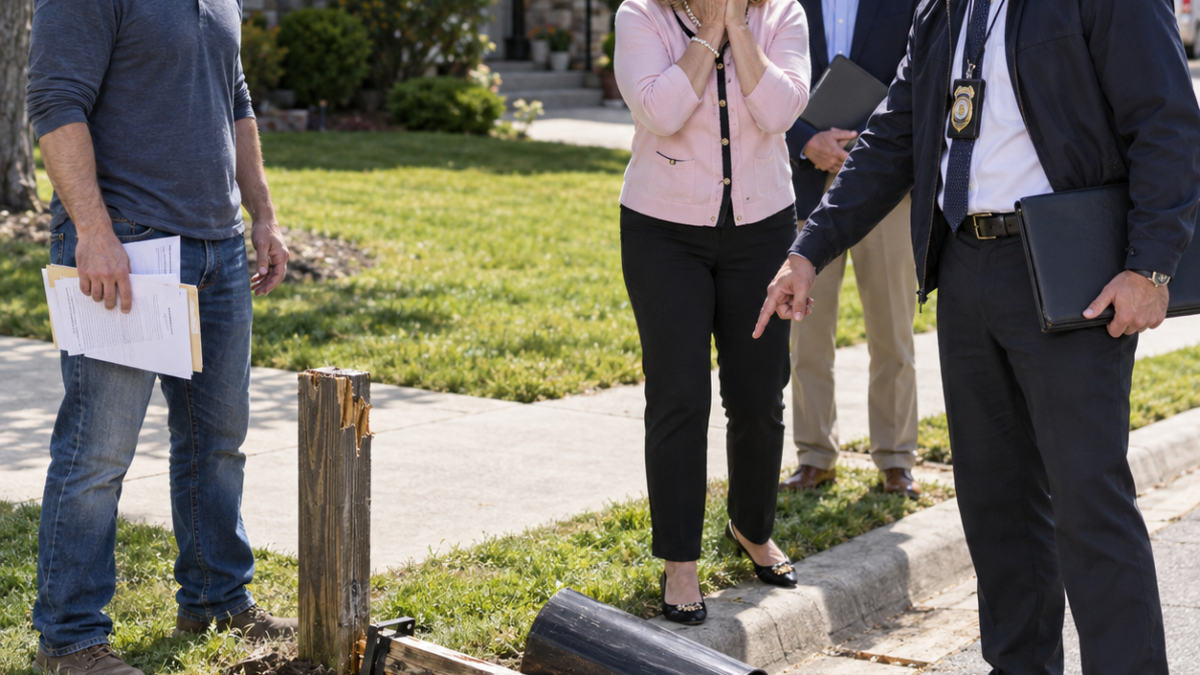
PART 2
My first call was still to the sheriff.
That mattered to me.
I wasn’t interested in playing games with jurisdiction.
I wanted a record.
A deputy arrived about forty minutes later.
Young guy.
Early thirties.
Name tag said MILLER.
He walked across my lawn, saw the broken post, and gave a low whistle.
“That used to be the mailbox?”
“About three hours ago.”
He crouched beside the concrete.
“Pulled clean out.”
“Chain around the post.”
“You see it happen?”
“Most of it.”
I showed him the video.
The truck.
Karen.
The contractor.
The tire tracks.
Deputy Miller watched carefully.
Then he sighed.
That sigh told me more than anything he said afterward.
“I understand why you’re upset.”
“I’m beyond upset.”
“Okay.”
I handed him the HOA notice.
He read it.
“She’s claiming enforcement rights under the covenants.”
“She skipped the mandatory notice procedure.”
“You have proof?”
“I have the bylaws.”
“I believe you.”
He looked toward the road.
“But I need to be straight with you. The sheriff’s office is probably going to treat the underlying dispute as civil.”
“She hired somebody to destroy my property.”
“I understand.”
“That’s vandalism.”
“Potentially.”
“She came onto my lawn.”
“Potential trespass.”
“She prevented mail delivery.”
That finally made him pause.
“The mail part isn’t really us.”
“Exactly.”
He looked at me.
I could tell he knew where my mind was going.
“Mr. Davison, I’m not saying what happened was okay.”
“I’m not asking you to.”
He handed the notice back.
“I’ll write the incident report. You can use it with your attorney.”
“Good.”
“But if you expect me to arrest the HOA president today based on a dispute over covenant enforcement, that’s not happening.”
“Understood.”
He studied me.
“You’re taking this remarkably well.”
“I’m not.”
“You look calm.”
“Different thing.”
He nodded.
Military recognized military even when nobody asked.
“You serve?”
“Marines.”
His eyes dropped briefly toward the framed photograph visible through my office window.
Uniform.
Helmand Province.
A younger version of me.
“My dad was Navy.”
“Sorry.”
He laughed.
That broke the tension.
Before leaving, he gave me the incident number.
“Whatever you do next,” he said, “keep documenting.”
“I intend to.”
If there was one thing two decades in uniform had taught me, it was that people rarely remember events accurately once consequences appear.
Paper remembers better.
Video remembers best.
I spent the next hour organizing everything.
Photographs.
Timestamps.
Video.
HOA notice.
Relevant bylaws.
Incident number.
Then I searched my mail records.
I had USPS Informed Delivery.
Every day’s expected mail showed electronically.
No certified notices.
No tracking references.
Nothing from Sterling Creek concerning the mailbox.
Karen had lied directly to my face.
That changed the issue again.
Not emotionally.
Strategically.
I called the United States Postal Inspection Service.
A woman answered.
Professional voice.
No drama.
I explained exactly what happened.
I did not say Karen was evil.
Didn’t describe her as a tyrant.
Didn’t mention her floral clothes or clipboard.
I said:
“My HOA president hired a private contractor to enter my property and forcibly remove my mailbox. I received no advance notice. Mail delivery was interrupted. I have photographs and video identifying the contractor and the individual who ordered the removal.”
Typing.
Then:
“Sir, was the mailbox installed at the approved delivery location?”
“Yes.”
“Had your carrier been using it regularly?”
“Every day.”
“Was mail unable to be delivered after its removal?”
“Yes.”
My carrier had driven past that afternoon.
I had it on my doorbell camera.
“Do you have video?”
“Yes.”
“Do you know who ordered the removal?”
“Yes.”
“Full name?”
“Karen Masterson.”
“Address?”
I gave it.
“The contractor?”
I gave the company information from the truck.
She asked more questions.
Then came the sentence that shifted everything.
“Mr. Davison, we’re opening an official case.”
I felt my shoulders loosen.
Not because I wanted revenge.
Because somebody finally understood that this wasn’t about mailbox aesthetics.
“An inspector from the regional office will contact you.”
“When?”
“Within twenty-four hours.”
“Thank you.”
“One instruction.”
“Yes?”
“Do not confront Ms. Masterson or the contractor.”
“I won’t.”
“If they contact you, document it.”
“Understood.”
“Do not provoke further interaction.”
“I said I understand.”
There was a tiny pause.
“Military?”
“Is it that obvious?”
“A little.”
I hung up.
Sarah stood in the doorway.
“Well?”
“They opened a case.”
Her eyes widened.
“A federal case?”
“Yes.”
“Over the mailbox?”
“Over interference with mail delivery and destruction of the receptacle.”
She sat down.
“Jesus.”
“Pretty much.”
For the first time since the contractor drove away, Sarah smiled.
Not because somebody might be punished.
Because we weren’t alone anymore.
That distinction mattered.
We had moved into Sterling Creek after my final retirement ceremony.
I had spent most of my adult life expecting plans to change without warning.
Deployment.
Training.
Relocation.
Emergency call.
Another set of orders.
Sarah had absorbed all of it.
Twenty years married to a Marine meant she had learned how to build home out of boxes that might be packed again in three years.
Sterling Creek was supposed to be permanent.
The house wasn’t extravagant.
Three bedrooms.
Brick.
Small office.
Back patio.
Good kitchen.
Enough yard for Sarah’s flowers.
Wide enough street that grandchildren could eventually ride bikes.
When we signed the closing papers, Sarah had squeezed my hand.
“Last move.”
“Promise.”
“You can’t promise.”
“I can try.”
She smiled.
“Last move.”
That’s what Karen had disturbed.
Not just a mailbox.
The sense that nobody could suddenly order our life around anymore.
That night Sarah stood at the front window looking at the empty post.
“It looks weird.”
“I know.”
“I didn’t realize how much a mailbox makes a house look occupied.”
I joined her.
The absence was strange.
Like a missing tooth.
“I’ll put up a temporary one after we talk to the inspector.”
“You think they’ll want it left like that?”
“Maybe for evidence.”
She rubbed her arms.
“This is ridiculous.”
“Yes.”
“All of this because she didn’t like the color.”
“Control rarely needs a good reason.”
She looked at me.
“You sound like you’ve been thinking about her.”
“I have.”
I had spent part of the afternoon searching Karen Masterson.
Fifteen years in Sterling Creek.
Board member for ten.
Recently elected president.
Widowed.
Late husband had owned a construction company.
Money.
Connections.
Contractors.
Then neighborhood complaints.
Public social media posts were careful.
Private resident group was another story.
Screenshots.
Karen complaining about trash cans.
Holiday decorations.
Lawn ornaments.
Basketball equipment.
One family had received three notices because their son left chalk drawings on the sidewalk.
Another homeowner claimed Karen photographed his backyard through a side gate.
A retired couple had been fined for leaving Christmas lights up until January fifth.
The pattern was obvious.
Not just strict.
Personal.
I showed Sarah.
She shook her head.
“Why hasn’t anybody stopped her?”
“Same reason the deputy gave me.”
“What?”
“Each incident is too small.”
A fifty-dollar fine.
A warning.
A mailbox.
A garden hose.
A basketball hoop.
Nobody wants to spend five thousand dollars in attorney fees to win a dispute worth two hundred.
So people pay.
Or comply.
Or move.
Karen understood friction.
She had weaponized inconvenience.
The next morning my phone rang at 8:12.
“Mr. Davison?”
“Yes.”
“Inspector David Miller, United States Postal Inspection Service.”
Same last name as the deputy.
Different man.
His voice was older.
Measured.
“I’ve reviewed your report.”
“Thank you.”
“I’d like to walk through the timeline.”
We did.
Installation date.
Mailbox type.
Mail route.
Carrier use.
HOA communication.
Removal.
Contractor.
Karen’s statements.
I emailed him the video while we spoke.
Then the bylaws.
Then Informed Delivery records.
Then the sheriff incident number.
There was a long silence.
“Mr. Davison.”
“Yes?”
“You document things professionally.”
“Habit.”
“I can tell.”
“Marine Corps.”
“Thought so.”
He asked me not to speculate publicly.
No neighborhood posts.
No threats.
No statements that Karen had committed a crime.
“That’s our job to determine.”
“Understood.”
“We’ll contact the contractor.”
“Good.”
“And Ms. Masterson.”
I looked toward the window.
Karen’s golf cart passed slowly.
She looked at the empty mailbox space.
Then toward my house.
“Inspector?”
“Yes?”
“She just drove by.”
“Don’t engage.”
“I won’t.”
“John.”
First name already.
“People who believe they have authority often become careless when somebody refuses to acknowledge it.”
“You know her type?”
“I know people.”
“Fair.”
“Let her document herself.”
He was right sooner than expected.
That afternoon, certified mail arrived.
Not to the mailbox, obviously.
The carrier brought it to my door.
He recognized me.
“What happened to your box?”
“Long story.”
“HOA?”
I looked at him.
He shook his head.
“I deliver here. I’ve heard things.”
He handed me the envelope.
Sterling Creek Estates.
Karen’s signature.
Inside:
$350 emergency removal fee.
$500 architectural noncompliance fine.
Seven-day deadline for replacement.
Plus notice that daily penalties would begin after that.
I laughed.
I genuinely couldn’t stop myself.
Sarah came into the foyer.
“What?”
I handed her the letter.
She read it.
“They’re billing us for destroying it?”
“Yes.”
“This woman is insane.”
“She mailed proof.”
I scanned everything.
Sent it to Inspector Miller.
Subject:
ADDITIONAL CORRESPONDENCE.
His reply came three minutes later.
Received. Preserve original envelope and contents.
I placed them in a plastic evidence sleeve.
That became Exhibit One in what Sarah jokingly named:
OPERATION MAILBOX.
I preferred MAIL DOMINANCE.
She told me that was exactly why she didn’t let me name pets.
While the federal side moved quietly, I started talking to neighbors.
Not organizing a rebellion.
Not yet.
Just listening.
Mark and Jessica lived two doors down.
Young couple.
Two boys.
I’d watched Karen lecture Mark once because a plastic tricycle sat near their sidewalk.
I found him in his garage sorting tools.
“Hey, John.”
“Morning.”
He glanced toward my yard.
“Saw what happened yesterday.”
“She removed it.”
“I thought maybe you were replacing it.”
“No.”
His expression changed.
“She actually ordered that?”
“Yes.”
“Why?”
“Wrong mailbox.”
He stared.
Then laughed once.
Not because it was funny.
Because absurdity sometimes leaves no other response.
“She gave us a warning because the garden hose wasn’t coiled correctly.”
“What does correctly mean?”
He made a circle with both hands.
“Perfectly circular.”
I waited.
He said:
“Her words.”
Jessica came out carrying laundry.
“What are you two talking about?”
“Karen.”
Her face changed immediately.
“Oh God.”
I told them about the mailbox.
Not the details of the investigation.
Only that an outside agency was reviewing it.
Mark lowered his voice.
“Postal?”
“Yes.”
His eyes widened.
Jessica almost smiled.
Then fear returned.
“Don’t tell anyone we talked to you.”
That sentence disturbed me more than anything else.
“Why?”
She looked toward the road.
“Because she’ll find something.”
“About your house?”
“About anything.”
Mark looked embarrassed.
“She controls the board.”
“No.”
He frowned.
“She runs it.”
“Different.”
“What do you mean?”
“There are a hundred and fifty houses.”
“So?”
“Three board members.”
He followed.
“You think people would vote them out?”
“I think most people don’t know they’re unhappy together.”
That idea stayed with him.
It stayed with me too.
Karen’s authority wasn’t built only on bylaws.
It was built on isolation.
Everyone believed their problem was private.
A hose.
A trash can.
A sign.
A hoop.
A mailbox.
Separate, each looked trivial.
Together, they became governance by intimidation.
Mark gave me two names.
Henderson.
Pennington.
Arthur Pennington lived at the corner.
Seventy-eight.
Retired.
Perfect lawn.
Beautiful flowers.
Ironically, Karen hated his flowers.
Wrong species.
He invited me inside.
His home looked like a library that accidentally contained furniture.
He listened to the mailbox story without interrupting.
Then said:
“Karen Masterson has always mistaken compliance for respect.”
I liked him immediately.
“She’s been bothering you?”
“Bothering implies inconvenience.”
He poured tea.
“She has been conducting a campaign against my garden for eleven months.”
“For what?”
“Nonapproved perennial species.”
I looked toward the window.
His front garden was spectacular.
“That seems dangerous.”
He smiled.
“Apparently my salvia represents moral decay.”
Then I mentioned the federal report.
Arthur raised his eyebrows.
“Postal Inspection?”
“Yes.”
He set down his cup.
“That’s clever.”
“It wasn’t clever. She removed the mailbox.”
“Most people would still hire a civil attorney.”
“The mail changed jurisdiction.”
“Exactly.”
Then he surprised me.
“Do you know what the HOA spends?”
“No.”
“Neither does anyone.”
He disappeared into his study.
Returned with budgets.
Five years.
Highlighted.
“Grounds maintenance.”
$150,000.
“Administrative and legal.”
$75,000.
“Community improvement.”
$90,000 one year.
Little detail.
No vendor breakdown.
“Have you asked?”
“Repeatedly.”
“And?”
“Vendor confidentiality.”
I laughed.
Arthur didn’t.
“I spent forty years with the Internal Revenue Service.”
That explained the paper stacks.
“Forensic accounting.”
Now I understood the smile.
“You think something is wrong.”
“I think secrecy is an invitation to verification.”
“That’s the most IRS sentence I’ve ever heard.”
“Thank you.”
He leaned forward.
“I don’t know if Karen is stealing.”
“Yet.”
“Correct.”
“But if residents are going to challenge her authority, finances matter.”
“They always do.”
We had our second front.
Arthur drafted a records request.
Precise.
Statutory.
Signed initially by twenty families.
Detailed HOA financial statements.
Vendor contracts.
Invoices.
Checks.
Meeting minutes.
Reimbursements.
Legal expenses.
Karen received it by certified mail.
We kept the receipt.
Meanwhile, she escalated.
Mark received a $100 recycling-bin fine.
Arthur received a weed violation.
One weed.
I received another mailbox letter.
Daily fine: $50.
Retroactive.
Total now approaching $1,000.
She had removed the mailbox herself and was fining me each day for not having one.
I sent every letter to Inspector Miller.
No commentary.
Just scans.
One afternoon, Sarah came into my office.
“She’s outside.”
I looked.
Karen sat in her golf cart across the street.
Clipboard on her lap.
Not moving.
Just staring at our house.
“How long?”
“Twenty minutes.”
I checked cameras.
Recording.
“Let her sit.”
Sarah folded her arms.
“I hate this.”
“I know.”
“No, John. I hate being watched.”
I turned.
Her face was different.
Not angry.
Scared.
That hurt.
I had been treating Karen like a tactical problem.
Sarah was experiencing her as a threat inside our home.
I stood.
Put my arms around her.
“She can’t hurt us.”
“You don’t know that.”
“She has paper.”
“She had a contractor.”
Fair.
I held her tighter.
“We’re handling it.”
“I know you are.”
“Then what?”
“I married you after your second deployment.”
I waited.
“I spent twenty years waiting for danger to come from somewhere I couldn’t see.”
Her voice cracked.
“I thought we were done living like that.”
That landed harder than any fine.
I looked out at Karen.
Suddenly my instinct was to walk across the street.
No strategy.
No evidence.
Just make her leave.
Sarah felt me shift.
“No.”
“What?”
“I know that face.”
“She needs to stop.”
“You told me the plan matters.”
“It does.”
“Then don’t let her change you.”
I looked at my wife.
That’s why I married her.
Because when anger narrowed my world, Sarah widened it again.
I took out my phone.
Photographed Karen from inside.
Timestamp.
Duration.
Log.
No confrontation.
Karen eventually drove away.
Two nights later, someone knocked.
The contractor.
He stood on my porch holding a baseball cap in both hands.
I recognized him immediately.
“Mr. Davison.”
“Yes.”
“Can I talk to you?”
I stayed in the doorway.
Sarah stood behind me.
“What about?”
“The mailbox.”
His eyes were red.
Not drunk.
Exhausted.
“A federal inspector came to my shop.”
I said nothing.
“He asked about the work order.”
Still nothing.
“I told him the truth.”
“What truth?”
“Karen called me.”
He swallowed.
“She said it was HOA property. Said you’d ignored notices. Said the board authorized removal.”
“Did you see the notices?”
“No.”
“Board authorization?”
“No.”
“Why do it?”
He stared at the porch.
“She gives me work.”
“How much?”
“A lot.”
“Landscaping?”
“Demo. Fences. Repairs.”
“So you trusted her.”
He laughed bitterly.
“No.”
That surprised me.
“I knew something wasn’t right.”
Sarah shifted behind me.
“Then why?”
He looked at her.
“Because when I questioned her, she told me she’d make sure my company never got another HOA job in Sterling Creek or three neighboring subdivisions.”
His voice broke.
“I’ve got six employees.”
That didn’t excuse him.
But it made him human.
He reached into his pocket.
Cash.
“Three-fifty she paid for removal. Another five hundred for replacement.”
I didn’t take it.
“Keep it.”
He stared.
“What?”
“Get a lawyer.”
“I owe you.”
“You owe the truth.”
“I gave the inspector the signed work order.”
That mattered.
“She signed it?”
“Yes.”
“Keep a copy.”
“I did.”
He nodded.
“I’ll testify if I have to.”
“You probably will.”
He looked miserable.
“I’m sorry.”
I believed him.
Not because he deserved immediate forgiveness.
Because regret has a posture.
Karen never had it.
The contractor walked away.
Sarah closed the door.
“You really didn’t take the money?”
“He needs counsel.”
“He destroyed our mailbox.”
“He also turned over Karen’s signed order.”
She considered that.
“You’re getting soft.”
“Strategic.”
She smiled.
“Sure.”
Karen answered Arthur’s records request exactly as he predicted.
No.
Not technically.
She sent a “summary.”
One page.
Broad categories.
No itemization.
No receipts.
No contracts.
Arthur read the response in my garage.
Mark.
Jessica.
Hendersons.
Several other homeowners.
By then, almost fifty households were involved.
Arthur held up Karen’s letter.
“This is not compliance.”
Someone asked:
“What do we do?”
“Petition.”
“For what?”
“State intervention.”
He explained that homeowners meeting the required threshold could seek legal mechanisms to force financial disclosure and request investigation where evidence suggested mismanagement.
“We need more than suspicion.”
A woman in the back said:
“We have the budgets.”
“Budgets aren’t theft.”
“The fines?”
“Abuse maybe. Not proof of financial crime.”
Mark asked:
“What would count?”
Arthur smiled.
“Follow the vendors.”
That became our homework.
It was Jessica who found Evergreen Landscaping Solutions.
She recognized the name from HOA budget materials while doing design work for a local company.
Evergreen had received huge maintenance payments.
Exclusive contract.
No competitive bids that anyone could locate.
Jessica searched state business records.
Owner:
Frank Miller.
At first, nothing.
Miller was common.
Then social media.
Frank’s wife:
Susan.
Susan’s maiden name:
Masterson.
Karen’s sister.
Arthur looked at the screen.
Then at me.
“There.”
“How much?”
We started comparing invoices residents had.
Enough information existed in old meeting attachments to estimate contract value.
Far above market.
Same company.
Year after year.
Ever since Karen joined the board.
Arthur didn’t call it embezzlement.
Not yet.
He was more disciplined than that.
He called it:
“An undisclosed related-party transaction requiring investigation.”
I called it:
“Bad.”
He accepted that.
Our petition went to the Attorney General.
Signatures.
Affidavits.
Financial summaries.
Karen’s refusal.
Vendor connection.
Harassment pattern.
Everything.
Then Karen threatened a lien against my house.
Ten days.
Pay accumulated mailbox fines or lien proceedings would begin.
I read the letter twice.
Sarah sat across from me.
“This is what I was afraid of.”
“It won’t happen.”
“How do you know?”
“I’ll call Miller.”
The inspector answered.
I described the lien threat.
There was a pause.
Then:
“John.”
“Yes.”
“Preserve the original.”
“I will.”
“The timetable has changed.”
“What does that mean?”
“It means we’re moving.”
“Can you tell me more?”
“No.”
Fair.
Then:
“Be available tomorrow.”
“Why?”
“You’ll know.”
He disconnected.
That night, I slept badly.
Not because I feared Karen anymore.
Because something was coming.
Military life trains you to live inside incomplete information.
You learn to function anyway.
But retirement had softened that muscle.
At three in the morning I got up.
Walked to the kitchen.
Sarah was already there.
“Can’t sleep?”
“No.”
She poured coffee.
“You?”
“No.”
We sat.
She stared at the table.
“Do you regret buying here?”
The question hurt.
“No.”
“Even now?”
I looked around.
Family photographs.
The kitchen she had picked.
The pantry door where our grandchildren’s heights would someday be marked.
“No.”
“What if this gets worse?”
“It probably will before it gets better.”
She nodded.
“That’s a terrible answer.”
“The truth usually is.”
She looked toward the front window.
“Promise me something.”
“What?”
“When this is over, we don’t become these people.”
“What people?”
“People who spend their lives fighting the HOA.”
I smiled.
“Agreed.”
“I mean it.”
“So do I.”
“We retire.”
“We already retired.”
“Properly.”
“Deal.”
The annual HOA meeting was scheduled for Tuesday.
Perfect timing.
Our group had used Karen’s own bylaws to submit two agenda items.
Independent forensic audit.
No-confidence vote.
Required homeowner support:
Ten percent.
We had almost seventy.
Karen omitted both from the distributed agenda.
Classic Karen.
The day before the meeting, Inspector Miller called.
“John.”
“Yes.”
“We have federal authorization to proceed.”
My hand tightened around the phone.
“What does that mean?”
“We’ll be at the meeting.”
“You’re arresting her?”
“I didn’t say that.”
“You didn’t need to.”
“Don’t interfere.”
“I won’t.”
“Run your portion like you planned.”
“How will I know—”
“We’ll know when.”
The line went dead.
I stood in my office for several seconds.
Then Sarah appeared.
“What?”
“They’re coming tomorrow.”
She went pale.
“Federal agents?”
“Yes.”
“Jesus.”
“That keeps coming up.”
The Sterling Creek clubhouse had one hundred folding chairs.
Not enough.
People stood against walls.
Filled hallway.
Some watched through open doors.
Neighbors I’d barely seen in two years were there.
People fear authority individually.
They challenge it collectively.
Karen sat at the front.
Carol to her right.
Bob to her left.
Karen wore a red blazer.
Clipboard.
Gavel.
She surveyed the room like she still owned it.
But I saw the uncertainty.
A tyrant knows crowd size matters.
She struck the gavel.
“This annual meeting of Sterling Creek Estates Homeowners Association is now in session.”
She immediately launched into property values.
Beautification.
Community standards.
Financial stewardship.
The irony nearly hurt.
I waited until she moved to approve the agenda.
Then stood.
“Point of order.”
Karen’s eyes narrowed.
“You are out of order.”
“The agenda must be approved by membership.”
“Sit down.”
“Two valid agenda items submitted with signatures from more than ten percent of homeowners were omitted.”
People murmured.
Karen struck the gavel.
“I said sit down.”
Mark stood.
“I second John’s motion to amend.”
More murmuring.
Karen turned toward him.
“Mr. Lawson—”
Another homeowner stood.
“Let us vote.”
Then another.
“What are you hiding?”
Another.
“We signed those petitions.”
Karen banged the gavel harder.
It stopped meaning anything.
That was the moment she actually lost power.
Before any agent entered.
Before any vote.
When the gavel still made noise but nobody obeyed.
I raised my hand.
The room slowly quieted.
Not because I had authority.
Because people wanted to listen.
“For months, Karen has told each of us that our individual problem is isolated.”
I looked around.
“My mailbox.”
I pointed toward Henderson.
“The basketball hoop.”
Mrs. Gable.
“The visitor.”
Arthur.
“The flowers.”
Mark.
“The garden hose.”
Laughter.
Real laughter.
Karen’s face reddened.
“But they aren’t separate.”
I held up the binder.
“They are a pattern.”
Arthur stood beside me.
“And there is another pattern.”
He opened his financial file.
“Money.”
The room went still.
Arthur spoke like an accountant.
Which is to say without theatrical flair.
That made it devastating.
Annual grounds maintenance:
$150,000.
Vendor:
Evergreen Landscaping Solutions.
No meaningful competitive bid records located.
Owner:
Frank Miller.
Relationship:
Karen Masterson’s brother-in-law.
Karen jumped up.
“This is defamatory!”
Arthur continued.
“I’m not alleging guilt. I’m presenting public business records and asking for an independent audit.”
Karen pointed.
“You have no authority!”
“We are homeowners.”
“This is confidential business information.”
“No.”
Her voice rose.
“I will sue you.”
That was when the clubhouse doors opened.
Two people entered.
Dark suits.
Badge cases.
The room parted without being asked.
I recognized Inspector Miller immediately from the photograph he’d sent with his email signature.
He looked exactly like his voice.
Calm.
Unimpressed.
He walked toward the front.
“Karen Masterson?”
The room became perfectly silent.
Karen looked confused.
“Who are you?”
He opened the badge case.
“United States Postal Inspection Service.”
Her face changed.
Not gradually.
Instantly.
Miller stopped six feet away.
“Karen Masterson?”
She swallowed.
“Yes.”
“We have a federal warrant.”
Somebody gasped.
Karen looked at me.
Pure hatred.
Then at Miller.
“For what?”
His partner, a woman with dark hair pulled into a tight bun, stepped forward.
“You’ll receive the charging documents.”
“This is ridiculous.”
“Ma’am—”
“This is about a mailbox!”
Inspector Miller stared at her.
“It’s about knowingly interfering with authorized mail delivery and related conduct under investigation.”
Karen turned toward the room.
“This man is using federal agents to intimidate your board!”
Nobody responded.
She searched faces.
Carol looked down.
Bob looked sick.
Karen’s voice cracked.
“You all know what I’ve done for this community.”
Mrs. Gable stood.
“Yes.”
One word.
Nothing else.
Karen looked at her.
Mrs. Gable’s voice shook.
“You made me pay three hundred dollars because my daughter stayed with me while I recovered from surgery.”
Karen’s mouth opened.
“My husband collected those garden figures for twenty years.”
People became quiet.
“You called them trash.”
Karen looked away.
Henderson stood.
“You threatened us over our son’s basketball hoop.”
Mark:
“You watched our house because of a garden hose.”
Jessica:
“You fined us while our child had pneumonia because our trash can sat out.”
Stories rose.
Not shouting.
Testimony.
That was worse for Karen.
Every person she’d kept isolated was now speaking where everyone else could hear.
Inspector Miller waited.
He didn’t need to interrupt.
Eventually Karen looked at me.
“You did this.”
I answered quietly.
“No.”
“Yes!”
“You removed the mailbox.”
“You refused to comply.”
“You mailed me an invoice for it.”
“You were in violation!”
“You threatened my home.”
Her breathing became ragged.
“You turned them against me.”
“No.”
I looked around the room.
“You did.”
Miller stepped forward.
“Mrs. Masterson, we need to leave.”
She backed toward the table.
“You cannot arrest me during an HOA meeting.”
His partner almost looked surprised.
“Ma’am, this meeting does not create federal immunity.”
Someone laughed.
Karen turned red.
Then pale.
The agents secured her.
No dramatic struggle.
No shouting after that.
Just the quiet metallic click of handcuffs.
Sarah, sitting near the back, pressed both hands over her mouth.
I didn’t feel triumph.
Not then.
I felt relief.
Deep enough to hurt.
As Karen was led toward the doors, she stopped beside me.
“You ruined me.”
Miller gently moved her forward.
I watched her leave.
I didn’t answer.
There would be time to understand that sentence later.
The doors closed.
Silence.
Arthur looked toward the front table.
Carol and Bob sat frozen.
He cleared his throat.
“I believe we still have an agenda.”
That broke the room.
Laughter.
Nervous at first.
Then stronger.
Mark stood.
“I move for immediate no-confidence votes regarding the remaining board members.”
Dozens of voices seconded.
Carol tried to speak.
Nobody threatened her.
Nobody insulted her.
They simply voted.
Bob too.
Both removed.
Then interim elections.
Mark became president.
He looked terrified.
Good sign.
People who enjoy power too much shouldn’t have it.
Arthur became treasurer.
A legal-aid attorney named Denise Ramirez became secretary.
They asked me to join the board.
I declined.
“Why?” Mark asked.
“I already have enough hobbies.”
Then Sarah called from the back:
“He means yes as advisor.”
The room laughed.
I turned.
“Traitor.”
She smiled.
Best smile I’d seen in months.
First motion under the new board:
Freeze discretionary HOA spending pending audit.
Passed unanimously.
Second:
Invite Attorney General cooperation.
Passed.
Third:
Suspend enforcement of all contested fines from Karen’s administration until independent review.
Passed.
Someone shouted:
“What about the mailbox fines?”
Mark looked at me.
“What mailbox fines?”
Applause.
That almost embarrassed me.
Almost.
The state investigation took months.
No dramatic montage.
Just auditors.
Subpoenas.
Bank statements.
Contracts.
Interviews.
Arthur worked with them.
So did Mark.
So did I when asked.
The financial picture turned out worse than expected.
Evergreen Landscaping had received enormous contracts.
Related-party relationship undisclosed.
Services overpriced.
Some billed work couldn’t be verified.
Other vendors had connections too.
Karen’s personal reimbursements were questioned.
Legal spending lacked approvals.
Eventually investigators calculated more than $700,000 in improperly handled or diverted association funds across years.
I remember Arthur reading the preliminary report.
He took off his glasses.
“Seven hundred thousand.”
I whistled.
“That’s a lot of mulch.”
He didn’t laugh.
“It’s people’s money.”
He was right.
Retirees.
Young families.
People paying dues because they believed the association would insure common areas, maintain landscaping, repair roads, keep reserves.
Instead, too much money had fed a system that benefited insiders.
Federal prosecutors handled the postal matter separately.
I gave testimony.
The contractor cooperated.
He produced Karen’s signed work order.
Phone records.
Emails.
Instructions.
Evidence that she knew she hadn’t completed the required HOA notice process before ordering removal.
The legal details became complicated.
Charges.
Plea negotiations.
State case.
Federal case.
Eventually Karen accepted a plea arrangement.
She received a federal prison sentence connected to the mail-related offenses and significant restitution obligations stemming from the broader financial case.
Her brother-in-law faced charges too.
Karen’s house eventually became part of the restitution process.
When I heard there was a lien involved, I sat quietly.
Sarah noticed.
“What?”
“Nothing.”
“John.”
“The lien.”
She understood.
“The thing she threatened us with.”
“Yes.”
“How do you feel?”
I searched.
“Sad.”
She seemed surprised.
“For her?”
“For everybody.”
I looked toward the street.
“Imagine having enough money, enough respect, enough community standing to live comfortably.”
Sarah waited.
“And then needing control so badly that none of it was enough.”
She sat beside me.
“You’re allowed to be satisfied she faced consequences.”
“I am.”
“And sad.”
“Yes.”
“Both can be true.”
She leaned against my shoulder.
That’s marriage.
Not solving contradictions.
Sitting beside someone while they carry them.
A few weeks after the HOA meeting, Mark called.
“Saturday morning.”
“What?”
“Be outside.”
“Why?”
“You ask too many questions.”
“That’s what started all this.”
“Exactly.”
Saturday at nine, a flatbed truck pulled up.
My first reaction was physical.
For half a second I saw the old contractor.
Chain.
Broken post.
Karen.
Then I noticed the people.
Mark.
Jessica.
Arthur.
Henderson family.
Denise.
About fifteen neighbors.
Shovels.
Concrete.
And a mailbox.
Not some approved beige thing.
Custom fabricated.
Heavy steel.
Powder-coated deep black.
Thicker post.
Reinforced base.
I stared.
Mark grinned.
“What do you think?”
“It’s excessive.”
Arthur nodded.
“Correct.”
“Who paid?”
“Community improvement.”
I looked at Arthur.
He lifted one hand.
“Properly approved. Itemized receipt. Competitive quote.”
“Good.”
Sarah came down the driveway.
“Oh my God.”
Jessica hugged her.
“We thought you deserved something.”
Sarah touched the metal.
“This thing could survive a hurricane.”
The fabricator stepped forward.
“Maybe.”
“Maybe?”
“Depends on hurricane.”
We dug.
All of us.
I wanted to do it myself.
Mark refused.
“That would miss the point.”
He was right.
The first mailbox had been mine.
The second became ours.
We set the post deeper.
Concrete.
Level.
Everybody argued about whether the bubble was centered.
Arthur turned out to be obsessive.
Of course.
When the mailbox finally stood, black against the green lawn, people clapped.
A passing car honked.
Then another.
I felt ridiculous.
Emotional over a mailbox.
But symbols don’t ask permission before becoming important.
That box represented a boundary.
Not HOA versus homeowner.
Power versus accountability.
Fear versus community.
Sarah slipped her hand into mine.
“You okay?”
“Yeah.”
“You’re crying.”
“Concrete dust.”
“Sure.”
The first letter delivered into the new mailbox was from the HOA.
I laughed when I saw the envelope.
Sarah looked horrified.
“Again?”
I opened it.
Formal apology.
Signed by new board.
Every mailbox-related fine canceled.
All removal charges canceled.
Every violation from Karen’s last year under review.
At the bottom, Mark had handwritten:
THE BLACK COLOR IS APPROVED.
I framed that line.
For six months, Sterling Creek changed almost weekly.
The architectural review committee was dismantled.
Not completely abandoned.
Major structural modifications still needed basic review for safety and municipal compliance.
But mailbox color?
Gone.
Flower species?
Gone.
Garden hose geometry?
Definitely gone.
Basketball hoop time limits?
Gone.
Decorations?
Reasonable safety standards only.
Trash-can rules became reminders instead of financial traps.
The philosophy became simple:
Don’t create genuine safety problems.
Don’t damage shared property.
Don’t torment your neighbors.
Otherwise, live.
Arthur rebuilt the accounting system.
Every transaction posted.
Vendor identities.
Contracts.
Bids.
Invoices.
Residents could log in and see where dues went.
He renegotiated landscaping.
Savings were huge.
Security vendor canceled.
No more compliance patrol.
Legal spending dropped.
Within six months, annual dues fell about thirty percent while reserves improved.
I asked Arthur how Karen had justified higher spending for so long.
“Opacity.”
“What?”
“If nobody can see categories clearly, everyone assumes someone else understands.”
“And nobody did.”
“Exactly.”
He adjusted his glasses.
“Bad financial governance doesn’t require everyone to be dishonest. It requires most people to be busy.”
That stuck with me.
People weren’t apathetic.
They had jobs.
Children.
Illness.
Mortgages.
Parents.
Nobody wants to spend Wednesday night reading landscaping invoices.
Karen understood that too.
She counted on normal life.
The new board made transparency automatic so residents didn’t need forensic training to know what was happening.
That was smarter than expecting eternal vigilance.
Mark’s boys played basketball again.
I heard the bouncing ball most afternoons.
At first, each bounce reminded me of the old fines.
Eventually it became background.
Arthur planted whatever he wanted.
His garden got wilder.
More colorful.
He installed a small sign:
BOTANICAL NONCOMPLIANCE ZONE.
Nobody objected.
Jessica painted her front door blue.
Not navy.
Not slate.
Blue.
Mark claimed to hate it.
He didn’t.
Mrs. Henderson’s daughter visited for three weeks the following spring.
No forms.
No visitor notice.
No fine.
Normal life returned in small pieces.
That was the real victory.
Not Karen’s sentence.
Not federal agents.
Not the audit.
Normal life.
Sarah stopped looking through the window every time a car slowed down.
That took longer.
One evening we sat on the porch.
Sunset.
Kids riding bicycles.
Someone grilling.
Music faintly playing.
The new mailbox stood at the end of the drive.
Sarah rested her head on my shoulder.
“You know what I missed most?”
“What?”
“This.”
“The porch?”
“Feeling bored.”
I laughed.
“No, seriously.”
She looked at me.
“I wanted retirement to be boring.”
“I thought you wanted travel.”
“That too.”
“Grandchildren?”
“Eventually.”
“Gardening?”
“Yes.”
“Then not boring.”
“You know what I mean.”
I did.
Safety feels boring when you’ve had it a long time.
Then someone takes it.
You discover boredom is luxury.
The HOA held a neighborhood barbecue that summer.
Potluck.
No caterer.
No $12,000 mysterious event budget.
Arthur proudly showed everyone receipts.
People told him to stop.
He refused.
Mark gave a speech.
Too long.
He thanked residents.
Denise.
Arthur.
Then pointed toward me.
“This all started because John wouldn’t back down over a mailbox.”
Applause.
I wanted to hide behind the grill.
Then he said:
“But John didn’t save Sterling Creek.”
That quieted people.
“We did.”
He looked around.
“The difference is he was the first one who made us realize we didn’t have to be afraid separately.”
That was better.
Because it was true.
I hadn’t rescued anyone.
The residents rescued each other.
I simply got angry first.
After the barbecue, a boy approached me.
Henderson’s son.
The basketball player.
He was ten.
“Mr. Davison?”
“Yes?”
“Is it true the FBI arrested Mrs. Masterson because she broke your mailbox?”
“Postal inspectors.”
“Same thing?”
“No.”
“Cooler?”
I considered.
“Different.”
“My dad says they’re federal cops for mail.”
“Close enough.”
He looked toward my mailbox.
“Was that the old one?”
“No.”
“What happened to it?”
“Destroyed.”
“Can somebody destroy mine?”
“Why would they?”
He shrugged.
“People are weird.”
Fair.
Then he asked something I didn’t expect.
“Were you scared?”
Kids cut through everything.
“Yes.”
His eyes widened.
“You were a Marine.”
“Marines get scared.”
“My dad said Marines aren’t scared.”
“Your dad lies.”
The boy laughed.
“What did you do?”
“When?”
“When you were scared.”
I looked toward Sarah.
She was talking with Jessica.
“Figured out what I could control.”
“Like what?”
“Taking pictures. Saving letters. Calling the right people.”
He nodded.
“Then you weren’t scared?”
“No.”
I smiled.
“I was scared and prepared.”
That answer seemed to satisfy him.
It satisfied me too.
For years, I had treated courage as the absence of hesitation.
Age taught me otherwise.
Courage is often just continuing while your stomach knows every way things can go wrong.
Months later, a postcard arrived.
No return address.
Postmark near a federal correctional facility.
Sunny beach picture.
Three words on the back.
YOU RUINED ME.
I recognized Karen’s handwriting.
Sarah found me standing by the fireplace holding it.
“What is that?”
I handed it to her.
She read.
Her expression hardened.
“She’s still blaming you.”
“Yes.”
“What are you going to do?”
I looked at the card.
Once, I might have saved it.
Evidence.
Trophy.
Proof.
But the case was over.
Karen no longer had power over my home.
I held the corner over the fire.
Flame caught.
Paper curled.
Blue water on the postcard turned black.
The words disappeared last.
Sarah watched.
“No response?”
“No.”
“Good.”
I sat.
“She thinks I ruined her.”
Sarah didn’t answer.
“She hired the contractor.”
“Yes.”
“She lied about notice.”
“Yes.”
“She kept mailing fines after the investigation began.”
“Yes.”
“She hid the contracts.”
“Yes.”
“She chose all of it.”
Sarah sat beside me.
“She probably can’t admit that yet.”
“Maybe never.”
“Does that bother you?”
I thought.
“No.”
And that was true.
For months, I needed Karen to understand.
Needed her to realize she was wrong.
Needed acknowledgment.
Apology.
Something.
By then I didn’t.
Consequences didn’t require her comprehension.
Peace didn’t either.
The contractor returned once.
Nearly a year later.
His business survived.
He had lost several HOA accounts during the investigation, but gained other work.
He rang my doorbell.
“John.”
“Hey.”
He looked older.
Less frightened.
“I wanted to show you something.”
He handed me a photograph.
A mailbox.
Steel.
Black.
Installed at another neighborhood.
“You’re in the mailbox business now?”
He smiled.
“No.”
Then became serious.
“I changed our policies.”
“What kind?”
“No property-removal work without proof of ownership or court authority if disputed.”
“Good.”
“No HOA work order accepted if the homeowner hasn’t been directly notified.”
“Better.”
“And my guys can refuse jobs they think are wrong without getting fired.”
That surprised me.
“You did that because of what happened?”
“I almost destroyed my company.”
“Karen pressured you.”
“I still said yes.”
I nodded.
That mattered.
Responsibility without self-destruction.
“I appreciate you saying that.”
He glanced at the new mailbox.
“That’s a hell of a post.”
“Community project.”
“Want me to remove it?”
I stared at him.
He grinned.
First time I’d seen him joke.
“Get off my property.”
He laughed.
Then left.
That conversation became one of my favorite endings to the whole mess.
Not because everyone became perfect.
Because one person learned.
Maybe that’s all accountability can reasonably ask.
Sterling Creek continued changing.
New residents arrived who didn’t know Karen.
At first, that bothered me.
How could they not know?
Then I realized that’s what recovery looks like.
Eventually history becomes optional.
One new family moved in across from Mark.
Their daughter chalked an enormous rainbow across the sidewalk.
Jessica sent me a picture.
Caption:
KAREN WOULD HAVE EXPLODED.
I replied:
GOOD THING RAIN EXISTS.
The mailbox became neighborhood folklore.
People called it “The Federal Box.”
I hated that.
Mark loved it.
Arthur preferred “Exhibit A.”
Better.
One Halloween, teenagers wrapped crime-scene tape around it.
Sarah laughed for ten minutes.
I pretended to be annoyed.
The following morning, I left the tape up until noon.
Not everything needed dignity.
Years later, I still think about the moment Karen said:
“That’s between you and the postal service.”
If she’d known what followed, she might have chosen different words.
Or maybe not.
That was Karen’s tragedy.
She believed every system existed to extend her authority.
HOA bylaws.
Contractors.
Fines.
Liens.
She assumed the postal system was just another service residents depended on.
She forgot that systems have jurisdictions.
Rules.
Limits.
Accountability.
She thought her clipboard outranked all of them because, inside Sterling Creek, people had acted as if it did.
That illusion survived until it met an institution she could not intimidate.
But even the federal case was only part of what brought her down.
The larger force was neighbors comparing experiences.
For years, Mark thought the garden hose fight was his alone.
Arthur thought the flower dispute was personal.
The Hendersons thought they were uniquely targeted.
Sarah thought the mailbox was our crisis.
The second we put those stories beside one another, Karen’s power changed shape.
Individual shame became collective evidence.
That’s something bullies understand instinctively.
Keep people separate.
Convince each victim they’re unreasonable.
Make them believe everyone else is complying happily.
Isolation does half the work.
So does embarrassment.
People didn’t want to tell neighbors they’d paid $200 over trash cans.
Or $100 over paint.
Or lost a sale because Karen disliked a sign.
Once they talked, embarrassment moved where it belonged.
Onto the person abusing the rules.
Arthur taught me something else.
Financial corruption and petty control often feed each other.
Not always.
Some controlling people are perfectly honest with money.
Some thieves are charming.
But in Sterling Creek, aggressive enforcement generated revenue.
Fines normalized fear.
Fear reduced questions.
Reduced questions made financial opacity easier.
It was an ecosystem.
Remove one piece, the rest became visible.
The mailbox looked trivial.
It wasn’t.
It was the loose thread.
Karen pulled it herself.
Sometimes I wonder what would’ve happened if she’d simply knocked on my door.
“John, your mailbox isn’t on the approved list.”
I would’ve asked why.
She could’ve explained.
We might have compromised.
Maybe submitted an application.
Maybe changed nothing.
Maybe spent ten boring minutes discussing powder-coated steel.
Instead, she chose force.
That’s the difference between governance and domination.
Governance begins with process.
Domination begins with certainty.
Karen was certain.
Certain she was right.
Certain nobody would challenge her.
Certain the contractor would obey.
Certain the sheriff wouldn’t care.
Certain fines would scare me.
Certain neighbors would stay quiet.
Certainty made her reckless.
My military career taught me the opposite.
Always ask:
What am I missing?
What does the other side know?
What jurisdiction applies?
What evidence exists?
What happens if my assumption is wrong?
Good commanders distrust certainty.
Karen worshiped it.
That was why she lost.
A few years after the incident, Mark asked me to run for HOA president.
I laughed.
He wasn’t joking.
“No.”
“Why?”
“You’ve met me.”
“Exactly.”
“I’m not spending retirement arguing about pool hours.”
“We need someone responsible.”
“Find somebody who wants the job less than you do.”
“That’s you.”
“Still no.”
Sarah heard.
“Take it.”
I stared at her.
“You promised boring.”
“I want to watch you approve purple mailboxes.”
“Traitor.”
I never ran.
I stayed advisor for two years.
Then stepped away.
Healthy organizations shouldn’t depend permanently on the people who survived the crisis.
If Sterling Creek needed me forever, we hadn’t fixed it.
Mark served two terms.
Then left voluntarily.
Denise became president.
Arthur retired from treasurer duty at eighty-two after declaring he had “seen enough receipts for one lifetime.”
The new system survived all of us.
That’s the real test.
Not whether good people gain power.
Whether institutions still work when ordinary people take over.
One autumn evening, Arthur and I sat on my porch.
He was eighty-four by then.
Slower.
Still sharp.
He looked at the mailbox.
“Ugly thing.”
“You’re jealous.”
“Deep black violates the spirit of suburban harmony.”
“I can issue myself a warning.”
He smiled.
Then grew serious.
“Do you think we went too far?”
“With Karen?”
“Yes.”
I thought about it.
“The federal case wasn’t ours to decide.”
“No.”
“The state investigation found what it found.”
“Yes.”
“She had due process.”
“Yes.”
“Then no.”
Arthur nodded.
“But?”
“Punishment shouldn’t be entertainment.”
He looked at me.
“Agreed.”
“There were moments people enjoyed it too much.”
“The meeting?”
“Yes.”
“Human nature.”
“I know.”
He sipped tea.
“Justice is rarely pure.”
“No.”
“Still necessary.”
“Yes.”
We sat quietly.
I had learned to separate satisfaction from cruelty.
It was satisfying that Karen could no longer terrorize neighbors.
Satisfying that money was recovered.
Satisfying that fines were rescinded.
Satisfying that children played freely.
I didn’t need to enjoy Karen’s suffering to appreciate those outcomes.
Her consequences mattered because they ended harm.
Not because they hurt her.
That’s where revenge matures into justice.
Sarah says I became philosophical in retirement.
I say she started asking complicated questions.
One spring morning, I found her planting flowers around the mailbox.
“What are you doing?”
“Softening it.”
“It doesn’t need softening.”
“It looks like a gun safe on a pole.”
“Security.”
“It looks hostile.”
“It survived a delivery truck backing into it.”
“Exactly.”
She planted lavender.
Purple flowers around black steel.
I watched.
“You know Karen probably would’ve banned that.”
“Good.”
She stood.
Dirt on her knees.
“Actually, no.”
“What?”
“I don’t want to choose things based on what Karen would’ve hated.”
That stopped me.
She brushed soil from her gloves.
“Then she’s still choosing.”
Simple sentence.
Big lesson.
For years after conflict, you can keep fighting the person who isn’t there.
Organize your life as opposition.
Wear what they’d dislike.
Plant what they’d ban.
Tell the story every chance you get.
But eventually freedom means forgetting to ask what they would’ve thought.
So the lavender stayed because Sarah liked lavender.
Not because Karen hated purple.
That was peace.
The old postcard became ash.
The legal binders moved from my desk to a cabinet.
Then to storage.
Then eventually I scanned everything and kept only originals required.
The broken piece of mailbox post?
I kept that.
For a while.
Then one day my grandson found it in the garage.
“What’s this?”
“Old mailbox.”
“Why’s it broken?”
“Long story.”
“Can I use it for a fort?”
I looked at the wood.
Once evidence.
Then symbol.
Now scrap.
“Sure.”
He dragged it into the backyard.
By evening, it was supporting a blanket fort.
That might be the best thing that happened to any part of the old mailbox.
History doesn’t have to stay sacred forever.
Sometimes children turn it into something new.
The neighborhood barbecue became annual.
Nobody called it Liberation Day.
Mark tried.
We stopped him.
Mostly.
Arthur always brought lemon tea.
The Henderson boy grew tall enough to dunk on the basketball hoop Karen once wanted removed.
The first time he did it, half the street heard his father yell.
Mrs. Gable eventually passed away.
Her daughter moved into the house.
Kept three garden ornaments.
Not because bylaws permitted them.
Because they reminded her of her mother.
That’s what Karen never understood.
Objects carry stories.
Mailboxes too.
My original one had represented practicality.
The broken one became evidence.
The replacement became solidarity.
Eventually it became simply a mailbox again.
That final stage mattered most.
I could check mail without remembering Karen.
Letters.
Bills.
Birthday cards.
Catalogs Sarah never admitted ordering.
Ordinary things.
One afternoon, years later, a new mail carrier stopped me.
“Mr. Davison?”
“Yeah?”
He pointed at the box.
“Is this the famous one?”
I sighed.
“Who told you?”
“Route supervisor.”
“Great.”
“He said postal inspectors arrested an HOA president over it.”
“More complicated.”
“Always is.”
He opened the box.
“Thing’s built like Fort Knox.”
“My neighbors overcorrected.”
He laughed.
Then handed me a package.
As he drove away, I thought about the phrase:
Famous mailbox.
It wasn’t famous.
Not really.
It was just the point where one person’s private abuse collided with a public system strong enough to stop it.
There are probably thousands of similar moments nobody hears about.
A tenant keeps records.
A worker reports fraud.
A homeowner checks a deed.
A parent challenges a school process.
An employee reads the policy.
Not every fight becomes news.
Most shouldn’t.
But accountability often starts the same way.
Someone says:
That doesn’t sound right.
Then checks.
That’s all I did.
Karen showed me a bylaw.
I read the paragraph before it.
She said she sent notices.
I checked.
She removed the mailbox.
I asked who had jurisdiction over mail.
She said residents supported her.
We spoke to residents.
She claimed finances were confidential.
Arthur read the law.
She called Evergreen ordinary.
Jessica checked ownership.
At every stage, certainty met verification.
Verification won.
That’s why documentation matters.
People sometimes hear my story and say:
“You destroyed her over a mailbox.”
No.
That’s backwards.
A mailbox exposed decisions Karen had already been making for years.
I did not invent her financial arrangements.
Didn’t force her to hire family.
Didn’t make her hide records.
Didn’t make her threaten homeowners.
Didn’t make her order illegal removal.
Didn’t make her mail me the bill.
She made choices.
The investigation connected them.
Another thing people say:
“You must’ve felt amazing when agents walked in.”
Not exactly.
I felt my body release fear.
That’s different from joy.
For months, I had controlled my anger because I knew one stupid confrontation could damage the case.
When Miller showed the badge, responsibility shifted.
I didn’t have to hold the line alone anymore.
That was relief.
Maybe that’s why the memory still hits me.
Not the handcuffs.
The badge.
Proof that someone outside Karen’s orbit finally said:
Enough.
People who haven’t lived under petty authoritarian control underestimate how powerful that word can be.
Enough.
Not rage.
Not revenge.
A boundary.
Sarah and I finally took the trip we’d postponed.
Three weeks on the coast.
No HOA meetings.
No files.
No cameras.
First morning, Sarah sat on the balcony with coffee.
“You checking the security feed?”
“No.”
“You want to?”
“Yes.”
“Don’t.”
“I wasn’t going to.”
“Liar.”
I put my phone down.
We watched the ocean.
After ten minutes, I said:
“I wonder if the mailbox is okay.”
She threw a napkin at me.
That trip marked the end.
Not legally.
Emotionally.
We came home.
Everything was fine.
The house hadn’t needed defending.
The neighborhood had continued without us.
That was when I finally believed retirement could begin again.
Years passed.
Inspector Miller sent one Christmas card.
Just one.
No dramatic message.
Inside:
HOPE THE MAILBOX IS HOLDING UP.
I wrote back:
STILL FEDERALLY OPERATIONAL.
Never heard from him again.
Appropriate.
He had done his job.
So had Brenda-like people everywhere, though in this story she wasn’t a clerk but inspectors, auditors, neighbors, prosecutors.
Systems work best when professionals enter, handle their piece, and leave.
Heroes aren’t required.
Competence is.
The final lesson came from Sarah.
We were sitting on the porch on our thirty-fifth anniversary.
She looked toward the mailbox.
“Do you know what I remember most?”
“The agents?”
“No.”
“The contractor?”
“No.”
“Karen yelling?”
“No.”
“What?”
“The night I told you I was scared.”
I remembered.
“And you listened.”
That surprised me.
“I always listen.”
She gave me a look.
“Eventually.”
Fair.
“I thought you were going to turn it into one of your missions.”
“I did.”
“Yes.”
She smiled.
“But you remembered we lived here too.”
I understood.
For me, the fight was evidence.
Strategy.
Jurisdiction.
For Sarah, it was home.
The most important victory wasn’t defeating Karen.
It was not allowing the fight to consume the thing we were trying to protect.
We nearly did.
That is a danger in every just conflict.
You can become so committed to winning peace that you forget to live peacefully.
I try to remember that.
The new Sterling Creek bylaws fit in a much thinner binder now.
Arthur considered that his greatest achievement.
There is still an HOA.
That surprises people when I tell the story.
We didn’t abolish it.
Shared pool.
Entrance landscaping.
Stormwater areas.
Insurance.
Somebody has to manage those things.
The lesson wasn’t that associations are evil.
It was that unchecked authority is.
Our revised rules are deliberately boring.
Major structural construction?
Review.
Dangerous nuisance?
Action.
Chronic damage to common property?
Action.
Mailbox color?
Nobody cares.
Flowers?
Grow them.
Chalk?
Rain handles it.
Garden hose?
Coil it however your soul demands.
Government at its best is boring.
So are good HOAs.
If you’re thinking about them every day, something is probably wrong.
The black mailbox has faded slightly now.
Powder coat losing its shine.
Sarah asked whether I wanted it refinished.
“No.”
“Why?”
“Character.”
“Rust isn’t character.”
“No rust.”
“Yet.”
I looked at it.
“Leave it.”
Time changes symbols too.
The deep black Karen hated has softened.
Lavender grows around the post.
Sometimes bees hover there.
Ordinary.
I like it that way.
One day my granddaughter asked:
“Grandpa, why do people call it the freedom mailbox?”
I groaned.
“Who taught you that?”
“Dad.”
“Your father is banned from storytelling.”
“What happened?”
I gave her the children’s version.
“A lady tried to remove something she didn’t have permission to remove.”
“What did you do?”
“Called people whose job was to help.”
“Then what?”
“They helped.”
She considered.
“Did the bad lady say sorry?”
“No.”
“Why?”
“Some people have trouble admitting when they’re wrong.”
She nodded like this was obvious.
“Then she didn’t learn.”
Maybe.
Or maybe she learned privately.
I hope so.
Not for my sake.
Hers.
Living inside blame is exhausting.
The postcard suggested she was still there then.
Maybe time changed her.
Maybe not.
I don’t need to know.
That’s another form of freedom.
Her life stopped being relevant to mine.
No updates.
No searching her name.
No checking court databases.
Nothing.
For months, I thought accountability meant watching consequences.
Eventually I realized the final consequence was losing my attention.
Karen wanted control over Sterling Creek.
Then control over me.
In the end, she received neither.
I kept the house.
The community kept its voice.
And she disappeared from our daily lives.
That’s enough.
One afternoon I stood beside the mailbox talking to Mark.
He’s gray now.
So am I.
His boys are grown.
One moved away.
The other visits.
Mark looked down the street.
“Remember the meeting?”
“I try not to.”
“Best meeting we ever had.”
“Low standard.”
“You know, if she hadn’t removed your mailbox…”
He didn’t finish.
We both understood.
Maybe no federal investigation.
Maybe no neighborhood organizing.
Maybe no financial audit.
Maybe Evergreen continues.
Maybe fear continues.
One stupid act revealed an entire structure.
I said:
“She thought it was the smallest thing she could control.”
Mark nodded.
“Turned out to be the wrong small thing.”
Exactly.
History sometimes turns on small objects.
Tea.
Documents.
Keys.
A seat on a bus.
A mailbox.
Not because the object is inherently important.
Because the action reveals a larger question.
Who decides?
Under what authority?
With what limits?
And what happens when authority is wrong?
Karen answered:
I decide.
The law answered:
Not always.
The homeowners answered:
Not anymore.
That was the whole story.
The day the old mailbox disappeared, I believed someone had violated my property.
True.
But the deeper violation was the assumption that my consent no longer mattered.
Everything afterward was about restoring it.
Not only mine.
Everyone’s.
Mark’s.
Jessica’s.
Arthur’s.
Henderson’s.
Mrs. Gable’s.
Sarah’s.
The community learned a principle that should’ve been obvious:
Rules exist because people agree to be governed by them.
Leaders administer those rules.
They don’t become the rules.
The difference sounds academic until someone enters your lawn with a chain.
Then it becomes extremely clear.
My office still contains one folder.
Not Operation Mail Dominance.
Sarah deleted that label years ago.
It now reads:
STERLING CREEK — CLOSED.
Inside are only a few things.
Sheriff report.
Postal case closure notice.
New HOA resolution.
One photograph.
The day we installed the new mailbox.
Fifteen people around the post.
Dirty hands.
Concrete.
Shovels.
Sarah beside me.
Arthur pretending not to smile.
Mark pointing at the level.
Kids in background.
No Karen.
That’s the photograph I keep.
Not the broken post.
Not handcuffs.
Not fines.
People building.
That is how I choose to remember it.
Because destruction started the story.
Construction finished it.
Karen sent a contractor to tear something out.
The neighborhood came together to put something back.
Stronger.
Deeper.
Shared.
That’s a better ending than revenge.
My mailbox still receives mail.
That’s its job.
Most days I walk down the driveway around four.
Open the heavy door.
Bills.
Letters.
Catalogs.
Birthday cards.
Sometimes nothing.
I close it.
Walk back.
No adrenaline.
No camera.
No Karen.
Just me.
One afternoon the flag on the box was up.
Inside was a handwritten letter from a new family who had moved into Sterling Creek.
They had heard the story.
The note said:
Thank you for helping make this a neighborhood where our kids can feel at home.
I read it twice.
Then handed it to Sarah.
She cried.
I almost did.
“Worth it?” she asked.
I looked down the street.
Basketball bouncing.
Dog barking.
Garage open.
Purple flowers.
Someone’s recycling bin sitting out too early.
Normal life everywhere.
“Yeah.”
Not because Karen went to prison.
Not because we won votes.
Not because the mailbox survived in a stronger form.
Because people weren’t afraid anymore.
That was worth defending.
Karen once told me my mailbox was a blight on the aesthetic continuity of Sterling Creek Estates.
She had it chained to a truck.
Torn from the ground.
Dented.
Destroyed.
Then billed me for it.
She thought she was teaching one stubborn homeowner what happened when he challenged her authority.
Instead, she exposed herself to an authority she couldn’t control.
The postal inspector came first.
Then the neighbors found their voices.
Then the financial records opened.
Then the contracts.
Then the audit.
Then the criminal cases.
Her empire wasn’t destroyed by me.
It collapsed beneath the weight of its own records.
That’s why, whenever someone asks me how I beat Karen Masterson, I correct them.
I didn’t beat her.
I documented her.
I read the rules she thought nobody would read.
I saved the letters she thought would frighten me.
I kept the video she thought didn’t matter.
I called the agency she assumed would never care.
I listened when my neighbors finally started telling their stories.
And when evidence became larger than fear, the whole neighborhood stood up.
There was never anything magical about it.
No secret legal trick.
No heroic confrontation.
Just patience.
Paper.
People.
And one woman arrogant enough to believe a clipboard made her untouchable.
It didn’t.
The mailbox at the end of my driveway is proof.
Not because it’s black.
Not because it’s steel.
Not because federal agents became involved.
Because every afternoon, the mail carrier stops there.
Opens the door.
Delivers the mail.
And drives away.
No drama.
No fear.
No permission from Karen.
Exactly the way it should be.








