HOA Karen Reported My Father’s Weather Vane to the FAA—She Never Knew I Controlled the Airspace Over Her Own Neighborhood
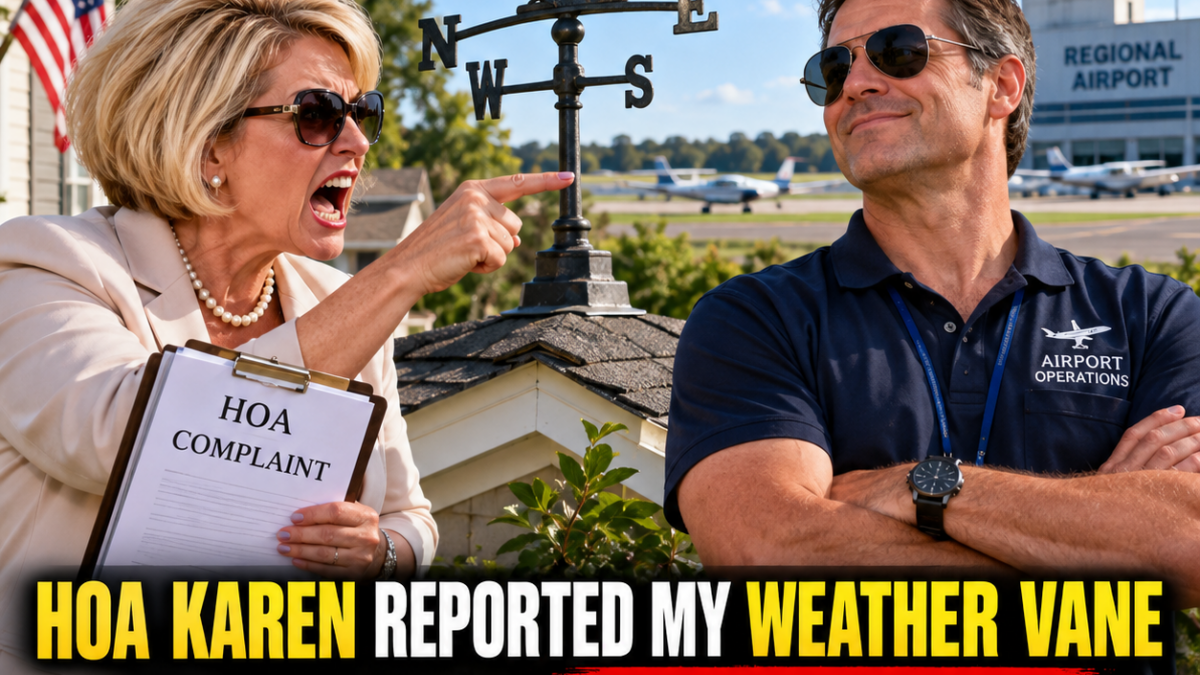
The HOA president gave me twenty-four hours to tear my father’s last gift off my roof, or she promised to have the federal government do it for me. She thought reporting me to the FAA would finally scare me into submission. What she didn’t know was that the complaint she had just filed was about to land in the one place she never imagined.
Karen Peterson stood in the middle of my front lawn with a clipboard pressed against her chest like a badge.
“That thing,” she said, pointing at my roof, “is an unregistered aeronautical obstruction.”
I looked up.
A thirty-inch steel P-51 Mustang weather vane turned slowly in the afternoon breeze.
Then I looked back at Karen.
“An aeronautical obstruction.”
“Yes.”
“To what?”
“Aircraft.”
I waited.
She seemed disappointed that I wasn’t more alarmed.
Karen stepped closer and slapped a violation notice against my chest.
“Twenty-four hours.”
I unfolded it.
Five thousand dollars.
I actually checked the number twice.
“You fined me five thousand dollars for a weather vane?”
“For endangering federal airspace.”
Across the street, Maria Garcia had stopped pulling weeds.
Mr. Henderson stood beside his mailbox.
Two other neighbors were watching from their porches.
Karen loved an audience.
Public embarrassment was part of her enforcement strategy.
“Karen,” I said quietly, “where did this number come from?”
“The board has authority to impose emergency safety penalties.”
“Five thousand dollars?”
“You were warned.”
“I was warned that you didn’t like my weather vane.”
Her face reddened.
“This is beyond aesthetics now. I’ve researched the issue. That metal object could reflect sunlight into a pilot’s eyes. It may interfere with navigation signals. It is directly beneath active airspace.”
That last sentence almost made me smile.
Almost.
Instead, I folded the notice carefully and put it in my pocket.
The weather vane wasn’t decoration to me.
My father had built it.
He had spent most of his life in airplanes—first dusting crops over Nebraska, later flying charter routes and teaching young pilots who thought confidence could replace weather judgment.
The P-51 Mustang had been his favorite aircraft since childhood.
A year before he died, he found a craftsman who forged weather vanes from heavy steel and had one made for me.
“Every house needs something that knows which way the wind is blowing,” he told me.
Dad had been dead eighteen months when I mounted it over our new home in Oak Meadows.
My wife, Sarah, cried when she saw it turn for the first time.
Our daughter Lily called it Grandpa’s airplane.
Karen called it an architectural violation.
The first fine had been fifty dollars.
Then two hundred.
Then administrative charges appeared.
Then late fees.
Every week brought another envelope.
I submitted an application for retroactive approval.
Karen ignored it.
I requested a hearing.
It was postponed.
I quoted the HOA’s own vague architectural language.
She responded with another fine.
That was Karen’s method.
She rarely defeated people by proving she was right.
She simply made resisting her expensive enough that most neighbors eventually surrendered.
Mr. Henderson had paid three hundred dollars because his roses extended two inches over the sidewalk.
The Garcias had spent months fighting over their daughter’s brightly colored swing set.
Another resident had been threatened because her front door was the wrong shade of blue.
Karen did not see these things as cruelty.
That was what made her dangerous.
She believed she was protecting Oak Meadows.
And every person who gave in convinced her that she had been right.
Now she was standing on my lawn threatening to involve federal aviation authorities.
“You’re really reporting this?” I asked.
“I already have.”
That got my attention.
Karen smiled.
“I contacted the FAA this morning.”
For the first time since she arrived, I looked directly into her eyes.
She mistook my silence for fear.
“You should have listened to me from the beginning, Mark.”
I slowly looked toward the P-51 turning above my roof.
Then back at her.
“Karen, you have absolutely no idea what you’ve just done.”
Her smile widened.
“Oh, I think I do.”
She turned, marched back toward the sidewalk and called over her shoulder:
“Twenty-four hours.”
I waited until she disappeared inside her house.
Sarah opened our front door.
“What was that about?”
I handed her the notice.
She read it.
Then looked up.
“Federal airspace?”
“Apparently.”
“Can she do this?”
“No.”
“What are you going to do?”
I pulled out my phone.
For twelve years in the Air Force, and for years afterward at Northwood Regional Airport, I had worked the job where guessing could put hundreds of lives at risk.
I was a certified air traffic controller.
Northwood’s tower and surrounding local traffic environment were my daily responsibility.
The approach paths Karen believed she had discovered on Google were the same ones I worked for a living.
The regulations she was trying to weaponize were the procedures I had spent half my adult life following.
And now she had filed a federal aviation complaint about the house of the man whose professional world began precisely where her understanding ended.
I found my supervisor’s number.
Sarah watched me.
“Who are you calling?”
“Frank.”
“At the tower?”
“Yes.”
She stared at me for a second.
Then her eyes widened.
“Oh.”
I pressed CALL.
Because Karen Peterson wanted the FAA involved.
And unlike every other threat she had made in Oak Meadows, this time I was going to make absolutely certain she got exactly what she asked for.
PART 2
Frank Connelly answered on the fourth ring.
“What did you break, Miller?”
That was Frank’s standard greeting whenever anyone from the tower called him after hours.
He had spent thirty-four years in aviation, the last eleven supervising Northwood Regional’s control tower, and he possessed the exhausted sense of humor of a man who had heard every possible emergency described first as “a small situation.”
“Nothing,” I said.
“That means you broke something expensive.”
“I didn’t break anything.”
“Then why are you calling me on my day off?”
“I need to disclose a possible conflict involving an incoming civilian aviation complaint.”
Silence.
Then:
“What did you do?”
“Again, nothing.”
“Mark.”
“Someone reported a structure on my house as an aviation hazard.”
Another pause.
“What structure?”
“My weather vane.”
Frank didn’t answer.
“A thirty-inch weather vane,” I added.
“Is this a joke?”
“No.”
“Did the weather vane grow overnight?”
“No.”
“Is it on a thousand-foot tower?”
“No.”
“Is your house secretly twelve hundred feet tall?”
“Not last time I checked.”
I heard Frank exhale.
“All right. Start over.”
So I did.
I told him about Oak Meadows.
Karen.
The fines.
The P-51.
The five-thousand-dollar “federal airspace endangerment” penalty.
And finally her proud declaration that she had reported me to the FAA.
Frank knew my father had died.
He also knew the weather vane mattered.
He had actually been at my house the day I mounted it.
When I finished, he was quiet for a few seconds.
Then he asked:
“Did she actually file something, or is she threatening to?”
“She says she filed it.”
“You know we can’t treat it differently because she’s your HOA president.”
“I don’t want it treated differently.”
“What do you want?”
“Everything documented.”
Frank understood immediately.
“All of it?”
“Every word.”
He gave a low laugh.
“You’re angry.”
“No.”
“That answer means you’re extremely angry.”
I walked to the end of my driveway.
Across the street, Karen’s curtains moved.
She was watching.
“I want procedure,” I said.
“That’s worse.”
“For her?”
“For everybody.”
I smiled.
“Frank, if a complaint comes in, I want it logged properly. I want my relationship to the property disclosed. I want the technical claims evaluated. I don’t want anybody dismissing it because it sounds stupid.”
“You want a full paper trail.”
“Yes.”
“You realize the easiest answer is probably three measurements and a paragraph.”
“I know.”
“And you want more than that.”
“I want every allegation she makes answered clearly enough that nobody can rewrite history afterward.”
Frank sighed.
“Fine. I’ll flag the conflict and make sure regional gets it cleanly.”
“Thank you.”
“Mark?”
“Yeah?”
“Do not turn this into an Air Force operation.”
“I don’t know what that means.”
“Yes, you do.”
The call ended.
Sarah was waiting in the doorway.
“Well?”
“If Karen actually filed the complaint, it’ll be reviewed.”
“And?”
“And I cooperate.”
“That’s all?”
“For now.”
Sarah crossed her arms.
“I know that face.”
“What face?”
“The face you had when the contractor installed our kitchen cabinets three-quarters of an inch off level.”
“I didn’t have a face.”
“You measured them seventeen times.”
“Six.”
“Seventeen.”
I smiled despite myself.
Then Lily came running down the stairs.
“Is Grandma Karen making Grandpa’s airplane go away?”
There are sentences children say without realizing how deeply they can cut.
I crouched.
“First, she isn’t your grandma.”
Lily giggled.
“And second?”
“The airplane stays.”
“You promise?”
I looked through the open doorway at the weather vane.
Dad’s Mustang pointed west.
“I promise.”
That promise was where the fight changed for me.
Until then, this had been about a ridiculous HOA dispute.
A fine.
A vague architectural rule.
A woman addicted to control.
I could have paid.
I could have removed the vane, stored it in the garage, and told myself peace mattered more.
Plenty of smart people did exactly that with Karen.
But Lily did not see thirty inches of forged steel.
She saw her grandfather.
So did I.
And I was done allowing Karen Peterson to convert other people’s memories into paperwork she could destroy.
Three days passed.
Then the complaint arrived.
I was working the afternoon shift when Frank came down from the administrative office carrying a folder.
He didn’t say anything.
He just set it beside me during my break.
On the tab was Karen’s name.
“You have got to be kidding,” I said.
“She really filed it.”
I opened the folder.
Karen’s complaint was six pages.
Six.
She had described the weather vane as a “sharpened metallic structure.”
She claimed it was improperly installed.
She claimed its reflective surface could blind pilots.
She suggested it might interfere with navigational systems.
She claimed it was situated “directly within an active commercial flight path.”
And because the vane resembled an airplane, she somehow argued it could cause “visual confusion during low-altitude operations.”
I read that sentence twice.
Frank sat across from me.
“Visual confusion.”
“Yes.”
“So a pilot is going to mistake a weather vane for another aircraft.”
“Apparently.”
“A thirty-inch weather vane.”
“Yes.”
“Sitting on a house.”
“Yes.”
He rubbed his forehead.
“I was going to retire quietly.”
“There’s still time.”
“No. Now I need to know how this ends.”
I turned another page.
Karen had included photographs.
Measurements.
Printed satellite imagery.
A hand-drawn line she believed represented our airport’s final approach course.
The line missed the actual published approach by several miles.
I knew that before checking.
Of course I did.
I had worked aircraft along that approach thousands of times.
At the bottom of her complaint Karen had written:
I request immediate federal intervention before this hazardous structure causes an avoidable aviation accident.
Frank leaned toward me.
“She’s serious.”
“That’s the problem.”
He nodded.
“I’ve already disclosed your connection. Regional wants another technical person to sign the final determination.”
“Good.”
“But because you manage this traffic environment and know the local procedures, they want your factual input.”
“Also good.”
Frank studied me.
“You sound disappointed.”
“I’m not.”
“Mark.”
“I want this clean.”
“It will be clean.”
“No conflict anyone can later complain about.”
“I understand.”
“And every claim answered.”
Frank smiled.
“There it is.”
“What?”
“The cabinet face.”
I ignored him.
The preliminary investigation began.
Not with dramatic agents.
Not with flashing lights.
With coordinates.
That was one of the things Karen never understood about real authority.
The HOA authority she loved was visible.
Violation notices.
Gavels.
Public reprimands.
Threats.
Real aviation authority was usually boring.
Numbers.
Distances.
Published procedures.
Obstacle criteria.
Charts.
Recorded communications.
Documentation.
If the numbers said your argument was wrong, screaming did not improve it.
The first measurement was almost insulting.
The elevation of my property was well known.
My house height was ordinary.
The weather vane added less than three feet above the roofline.
Nearby oak trees exceeded it easily.
So did several chimneys.
One television antenna.
And a decorative cupola on the clubhouse Karen herself had helped approve.
The second issue was location.
Oak Meadows was not directly beneath the final approach path.
Not close.
Aircraft sometimes passed generally near the neighborhood while maneuvering in the area, but Karen’s dramatic line drawn across a printed map had no relationship to the actual published procedures she claimed to understand.
The third allegation concerned glare.
The vane was weathered steel.
It wasn’t a mirror.
It wasn’t a solar concentrating device.
It was less reflective than numerous windows, vehicles, metal roofs and backyard structures around Oak Meadows.
The navigation interference allegation was even weaker.
A passive piece of steel on a residential roof was not transmitting anything.
No radio.
No beacon.
No emitter.
Nothing.
Still, everything was checked.
Because I had asked for procedure.
And because Karen had demanded federal attention.
She was going to receive it.
A week after the complaint arrived, she called the tower administrative office.
Frank answered.
I happened to be in the room.
He put the call on hold.
“You’ll never guess.”
“I can guess.”
“She wants an update.”
“Give her one.”
“She specifically asked who is handling the local technical assessment.”
I looked at him.
Frank smiled.
“Want me to tell her?”
“Please.”
He picked up the phone.
“Ms. Peterson? Thank you for holding.”
I could only hear Frank’s half.
“Yes.”
“No, ma’am.”
“Yes, your complaint is active.”
“No, we cannot prejudge a finding.”
Pause.
“Yes, local airspace procedures are being reviewed.”
Longer pause.
Frank looked at me.
Then:
“The primary local subject-matter expert assigned to provide sector data is Mark Miller.”
Even from three feet away, I heard Karen’s voice explode through the receiver.
Frank pulled the phone slightly away from his ear.
He waited.
“Yes, ma’am.”
More shouting.
“Yes, we are aware Mr. Miller resides at the property.”
Another burst.
“Yes, that relationship has been disclosed.”
Pause.
“No, ma’am, he will not be the sole approving authority on the final technical determination.”
Pause.
“Yes.”
“No.”
“I understand.”
He covered the receiver.
“She wants you removed from the FAA.”
“I’m devastated.”
Frank returned to the call.
“Ms. Peterson, employment complaints are a separate process. Right now we are discussing the aviation complaint you filed.”
I turned away so I wouldn’t laugh.
When the call ended, Frank stared at the phone.
“That woman is exhausting.”
“You’ve known her three minutes.”
“I’d like to transfer.”
The next phase was a site visit.
Regional assigned an aviation safety specialist named Ellen Ruiz to keep the process independent.
That actually pleased me.
Ellen was brutally competent.
She had no connection to Oak Meadows.
No interest in HOA politics.
No patience for exaggeration.
She arrived at my house at 8:30 on a Tuesday morning carrying a tablet and laser rangefinder.
Karen was already outside.
Of course she was.
She stood near the sidewalk with her clipboard.
Ellen looked at me.
“That the complainant?”
“Yes.”
“She always dress for court?”
“Pretty much.”
Karen crossed the street before Ellen could reach my porch.
“Are you from the FAA?”
Ellen held up her ID.
“Yes.”
“I’m Karen Peterson. I filed the complaint.”
“I’m aware.”
“I’d like to show you the hazard.”
Ellen looked up.
The little P-51 rotated lazily.
Then she looked at Karen.
“That?”
“Yes.”
“All right.”
Karen pointed dramatically.
“You can see how sharp the wings are.”
Ellen stared at her.
Then at the roof.
Then back at Karen.
“Mrs. Peterson, how high do you believe arriving aircraft are above this property?”
Karen hesitated.
“Well, low.”
“How low?”
“Very low.”
“Give me an estimate.”
“Maybe a few hundred feet.”
I said nothing.
Ellen did.
“Have you personally observed commercial aircraft within a few hundred feet of the rooftops in this neighborhood?”
Karen’s face tightened.
“I’m not an aviation expert.”
“No, ma’am. That’s why I’m asking what you personally observed.”
“I see airplanes.”
“Everyone near an airport sees airplanes.”
Karen glanced at me.
“He’s manipulating this.”
Ellen followed her gaze.
“Mr. Miller has not said anything.”
“He runs the tower.”
“He works at the tower.”
“He controls what you’re going to write.”
Ellen’s eyebrows rose.
“No, ma’am.”
“You’re coworkers.”
“I work for the regional safety office.”
Karen seemed annoyed that reality had developed another layer she couldn’t command.
Ellen continued.
“Would you like to walk me through each concern in your complaint?”
“Yes.”
That interview lasted an hour.
Karen repeated everything she had written.
Every theory.
Every danger.
Every allegation.
Ellen never mocked her.
That made it worse.
She simply asked questions.
“What evidence supports that?”
“Did you measure it?”
“Did you observe this?”
“Which published flight path are you referencing?”
“What equipment do you believe is being interfered with?”
“How did you determine the source of that interference?”
Karen’s answers became shorter.
Then defensive.
Then angry.
Finally she snapped:
“Why are you questioning me like I’m the problem?”
Ellen answered calmly.
“Because you made the allegations.”
Silence.
“If you report an aviation hazard, we need to know the factual basis.”
Karen crossed her arms.
“The factual basis is obvious.”
“Then it should be easy to document.”
That sentence became one of my favorites.
The physical inspection took less than forty minutes.
Ellen measured.
Photographed.
Recorded coordinates.
Compared roof height with surrounding objects.
She walked to the corner.
Then to Karen’s driveway.
Then back.
Mr. Henderson watched from his porch.
Maria Garcia pretended to clean the same window for twenty minutes.
When Ellen finished, Karen approached again.
“So when will it be removed?”
Ellen looked at her.
“No determination has been made.”
“But you can see it.”
“I can.”
“And?”
“And I complete my work before making conclusions.”
Karen pointed at me.
“He knows it violates the rules.”
Ellen turned toward me.
“Mr. Miller?”
“It doesn’t.”
Karen looked triumphant.
“See? He’s trying to influence you.”
Ellen sighed.
“You asked him a question.”
“I didn’t ask him anything.”
“You stated his position for him.”
Karen’s face flushed.
Ellen packed her equipment.
“You’ll receive written notification when the matter is closed.”
Then she left.
Karen waited until the government vehicle disappeared around the corner.
She turned to me.
“This isn’t over.”
“I know.”
“You think because you know people you can rig this.”
“No.”
“You think you’re smarter than everybody.”
“No.”
“You’ve embarrassed me.”
I almost answered.
Then I realized something.
That was it.
The center of everything.
Not safety.
Not architecture.
Not aviation.
Embarrassment.
Karen had fined me because I had resisted.
Then she escalated because I disputed the fines.
Then she filed the federal complaint because ordinary HOA authority had failed to make me submit.
My refusal felt like humiliation to her.
She needed victory because anything less meant admitting she had limits.
“Karen,” I said, “you are the person who filed the complaint.”
“Because you forced me.”
“No.”
“Yes, you did.”
“No one forced you to do anything.”
“You ignored the board.”
“I disputed you.”
“Same thing.”
There it was.
I stared at her.
“No,” I said. “Those are not the same thing.”
She walked away.
That conversation stayed with me.
That night, Sarah and I sat at the kitchen table after Lily went to bed.
“You look tired,” she said.
“I am.”
“Regretting it?”
“No.”
She waited.
I knew what she was asking.
“Maybe a little.”
“The weather vane?”
“The war.”
“You didn’t start it.”
“I know.”
“But?”
I looked toward the dark kitchen window.
Dad had hated unnecessary confrontation.
People imagined pilots as thrill seekers.
Dad wasn’t.
He believed boring flights were successful flights.
His favorite advice was:
Never let pride fly the airplane.
I had spent my career applying that principle to aircraft.
Now I wondered whether I was failing to apply it to myself.
“What would your dad tell you?” Sarah asked.
I smiled.
“You always do that.”
“Because it works.”
“He’d tell me not to confuse being right with needing to win.”
Sarah nodded.
“Do you need to win?”
I thought about Karen’s face.
The fines.
Lily asking whether Grandpa’s airplane had to come down.
Mr. Henderson afraid of rose bushes.
Maria lowering her voice when Karen walked by.
“No,” I said finally. “But she needs to stop.”
“That’s different.”
“Is it?”
“Yes.”
Sarah reached across the table.
“Make sure it stays different.”
That became my rule.
I did not want revenge that existed only to hurt Karen.
I wanted the system she had built around herself dismantled.
There was a difference.
And over the next two weeks, the neighborhood helped me understand just how badly it needed dismantling.
The first person to come forward was Mr. Henderson.
He knocked on my garage door while I was repairing a lawn mower.
“Got a minute?”
“For you? Sure.”
He held a grocery bag.
Inside were HOA notices.
Dozens.
“You keep all these?”
“My late wife kept everything.”
He smiled sadly.
“Thank God.”
We spread them across my workbench.
Rose bushes.
Door color.
Holiday decorations removed forty-eight hours late.
Bird feeder placement.
Driveway oil stain.
A garden hose visible from the road.
One notice warned that continued “visual disorder” might trigger escalating penalties.
“This one cost me eight hundred dollars,” he said.
I stared at him.
“For a garden hose?”
“For everything stacked together.”
“Why did you pay?”
Mr. Henderson looked embarrassed.
“My wife was sick.”
I stopped.
“Cancer.”
“I’m sorry.”
“She was doing chemo. I was driving her to appointments. Karen kept sending letters.”
His fingers touched one envelope.
“I didn’t have the energy.”
I understood Dale from my previous experiences with HOA bullies, and now I understood Henderson.
Systems like Karen’s rarely defeat people in fair fights.
They wait until life has already made them tired.
A sick spouse.
A new baby.
A demanding job.
Financial trouble.
Grief.
Then another letter arrives.
Another deadline.
Another fee.
Eventually paying becomes cheaper than preserving dignity.
“My wife died six months later,” Henderson said.
His voice cracked.
“Karen sent me a notice the week after the funeral because people parked along the curb.”
I looked up sharply.
“What?”
“She said the gathering created a traffic nuisance.”
I felt something cold move through me.
“Do you still have it?”
He pulled another envelope from the bag.
I read it.
There it was.
Date.
Signature.
Karen Peterson, HOA President.
My anger became very quiet.
“Would you be willing to show this to a lawyer?”
Mr. Henderson studied me.
“You planning something?”
“I’m considering options.”
“I’ve been considering options for four years.”
He gave a tired smile.
“Mine were mostly illegal.”
I laughed.
“Let’s use mine.”
My friend David Chen had been in the Air Force with me.
Back then he had worked in legal operations.
Now he was a civil attorney downtown.
I called him that evening.
“Tell me you crashed an airplane into an HOA clubhouse,” he said.
“Why would you assume that?”
“You only call me when civilians discover your personality.”
“I need legal advice.”
“Billable or friendship?”
“Start friendship.”
“That always becomes billable.”
I explained.
The weather vane.
The fines.
FAA complaint.
Mr. Henderson’s records.
The broader pattern.
Dave stopped joking.
“How many people?”
“I don’t know.”
“Find out.”
“That sounds like legal work.”
“It sounds like neighbor work. Have people bring me documents only if they want representation. Don’t promise outcomes.”
“What are you thinking?”
“I’m thinking Karen may have given you a defensible basis to challenge not only the fines against you, but potentially a pattern of arbitrary enforcement.”
“The board?”
“Depends what they knew.”
“Could they be liable?”
“Again, depends.”
I heard keyboard clicks.
“Mark, do not turn this into your own amateur legal crusade.”
“I’m not.”
“You sound like you’re already labeling binders.”
I looked at the fresh binder on the table.
“No.”
“You’re a terrible liar.”
Over the next week, I did something Karen had accidentally made possible.
I talked to my neighbors.
Really talked.
Karen’s style of rule had isolated everyone.
People complained privately but rarely compared experiences.
Once they did, patterns emerged.
Maria and Carlos Garcia had been fined more than eight hundred dollars over their daughter’s swing set.
The architectural committee had never formally rejected it.
Karen simply declared the colors “visually disruptive.”
A retired teacher named Evelyn Porter had been threatened with a lien after planting pansies where a landscaping guideline recommended—not required—petunias.
A young mechanic named Josh had accumulated weekly nuisance charges because he restored a 1968 Camaro inside his closed garage.
His tools could occasionally be heard during daylight hours.
One couple received a warning over a welcome mat.
Another over Christmas lights.
Another because visiting relatives parked an RV in the driveway for one night.
Every story by itself sounded petty.
Together they looked deliberate.
Control through exhaustion.
Dave began meeting residents individually.
He collected documents.
Statements.
Board correspondence.
Payment records.
He discovered something even more troubling.
Several penalties did not appear to be clearly authorized by the actual recorded governing documents.
Karen had been relying on vague board policies, “administrative schedules” and emergency interpretations that homeowners rarely challenged because legal review cost more than simply paying.
When Dave explained that to me, I felt sick.
“How long?”
“At least three years.”
“How much money?”
“Don’t know yet.”
“Thousands?”
“Almost certainly.”
“And the board?”
“Either asleep or complicit. We’ll figure out which.”
Then he looked at me.
“I need you to understand something.”
“What?”
“This gets ugly once we file.”
“I know.”
“No, you don’t.”
Dave leaned forward.
“Right now Karen thinks this is a fight between you and her. Once we expose the financial history, every homeowner who paid one of these questionable fines becomes involved. Board members will protect themselves. Insurance lawyers will appear. People who privately support you may panic publicly.”
“I’m ready.”
“Sarah?”
That stopped me.
I hadn’t asked.
That night I did.
Sarah listened while I explained everything.
When I finished, she remained quiet.
“You want to sue?”
“Possibly.”
“You want Karen removed?”
“Yes.”
“And this could become public?”
“Yes.”
“She’ll attack you.”
“I know.”
“She’ll attack me.”
My stomach tightened.
“She might.”
“She’ll probably say we’re bad parents. Bad neighbors. That you’re abusing your job.”
“She already says that.”
“And Lily?”
I didn’t answer.
Sarah stared down at her hands.
“I hate that woman.”
I had almost never heard my wife say she hated anyone.
“But I don’t want Lily growing up thinking the answer to a bully is becoming obsessed with destroying them.”
“I don’t either.”
“So what is the goal?”
I thought carefully.
“The weather vane stays.”
“Okay.”
“All invalid fines against us disappear.”
“Yes.”
“The board stops allowing one person to invent punishments.”
“Yes.”
“People who were wrongly charged get a chance to recover their money.”
Sarah nodded.
“And Karen?”
“If she loses her position because people see what she did, that’s her consequence.”
“You’re not trying to ruin her life?”
“No.”
Sarah looked directly at me.
“Promise.”
“I promise.”
That promise mattered later.
Because there were moments when revenge would have been easy.
And satisfying.
But easy satisfaction was exactly the addiction that had created Karen.
The FAA determination arrived two weeks later.
Ellen called me before the letter reached the house.
“Your dangerous fighter aircraft has been evaluated.”
“Casualties?”
“None so far.”
“Miraculous.”
She became serious.
“The structure presents no aviation hazard.”
“I know.”
“I’m required to tell you not to be smug.”
“Is that regulation?”
“It should be.”
“What about the allegations?”
“Unsupported.”
“Navigation interference?”
“No evidence.”
“Glare?”
“Nothing meaningful.”
“Approach path?”
“Not what the complainant represented.”
I leaned against my desk.
“Thank you.”
“Mark.”
“Yes?”
“Don’t misuse this.”
That surprised me.
“What makes you think I would?”
“Because you sound like a man who has been waiting three years to win an argument.”
I was silent.
Ellen continued.
“Our determination means one thing: the structure does not present the aviation hazard alleged. It does not determine your HOA dispute. It does not make every other thing this woman has done illegal.”
“I understand.”
“Good.”
She paused.
“Between us?”
“Yes?”
“I have inspected cell towers, cranes, silos, temporary construction equipment and actual obstructions.”
I waited.
“That was the first time I spent government time discussing whether a thirty-inch weather vane could threaten a regional airport.”
“I apologize on behalf of Oak Meadows.”
“Please don’t make it a tradition.”
The written determination was dry.
Precise.
Beautiful.
No hazard to navigation.
No relevant obstruction issue.
No meaningful interference.
No requirement for aviation marking or lighting.
No support for the emergency claims Karen had made.
I read it once.
Then handed it to Sarah.
She read the first page.
A smile slowly appeared.
“Grandpa’s airplane stays.”
“Grandpa’s airplane stays.”
Lily overheard us.
She ran into the kitchen.
“It stays?”
I picked her up.
“It stays.”
She threw both arms around my neck.
That was the victory I cared about.
Everything after that was accountability.
I emailed the FAA finding to the HOA board with one sentence:
Please confirm that all aviation-hazard-related fines and enforcement actions will be immediately withdrawn.
George Wilkins called me eleven minutes later.
George was the HOA treasurer.
Soft-spoken.
An accountant.
The kind of man who always looked apologetic even when ordering lunch.
“Mark.”
“George.”
“We received your email.”
“I assumed.”
“This is… a problem.”
“For whom?”
Long silence.
“Can we talk privately?”
“No.”
He swallowed audibly.
“Excuse me?”
“If this concerns the HOA, I want it documented.”
“Right. Of course.”
“You can email me.”
“Mark, please.”
Something in his voice made me stop.
“What?”
“We didn’t know she filed the complaint like that.”
“Who is we?”
“The board.”
“You approved the five-thousand-dollar fine.”
“Karen presented it as an emergency safety action.”
“And nobody asked why an HOA was fining a resident five thousand dollars for allegedly endangering federal airspace?”
Silence.
“George.”
“No.”
“You didn’t ask?”
“No.”
“Did you read the authority she cited?”
Another silence.
I closed my eyes.
“You rubber-stamped it.”
“She said counsel had reviewed it.”
“Had counsel reviewed it?”
“We’re trying to determine that.”
I laughed once.
Not because it was funny.
“George, Dave Chen will be contacting the board.”
“Your attorney?”
“Yes.”
“Are you suing us?”
“I’d read your records first.”
He sounded close to panic.
“Mark, I have a family.”
“So do the people Karen has been fining for three years.”
“I didn’t know.”
“That isn’t as comforting as you think it is.”
The lawsuit was filed nine days later.
It was narrower and more defensible than the theatrical version I had fantasized about during angry nights.
Dave was careful.
The claims focused on documented conduct.
Targeted enforcement.
Potentially unauthorized penalties.
Harassing correspondence.
The board’s failure to review Karen’s actions.
My own improper aviation-based fine.
And specific statements Karen had made to residents accusing me of knowingly endangering aircraft even after being told the issue was under formal review.
Mr. Henderson filed separately but coordinated with us.
The Garcias joined another claim seeking reimbursement and declaratory relief over their fines.
Several residents requested an audit.
Once that happened, Karen’s empire started collapsing faster than anyone expected.
Not because of me.
Because paperwork finally met paperwork.
The property management company produced ledgers.
Residents produced notices.
Board minutes surfaced.
Emails surfaced.
Dave compared penalty schedules with actual governing documents.
One fee after another appeared questionable.
Some had been increased without proper notice.
Others had been imposed under policies Karen treated as binding even though the approval process was unclear.
The board members began hiring their own counsel.
George stopped answering Karen’s calls.
Another director, Linda Cho, resigned.
The vice president demanded an emergency legal review.
And Karen?
Karen doubled down.
Her first community-wide email arrived at 6:12 on a Tuesday morning.
SUBJECT: DEFENSE OF OAK MEADOWS COMMUNITY STANDARDS.
She accused “certain disgruntled owners” of launching a coordinated attack.
She claimed outside agitators were attempting to bankrupt the HOA.
She said the weather vane case proved federal agencies could be manipulated.
Then came the sentence that guaranteed the fight would become public:
Mr. Miller’s employment relationship with local aviation authorities creates serious ethical concerns that remain under investigation.
Sarah read it at breakfast.
Her spoon stopped halfway to her mouth.
“Under investigation by whom?”
“No one that I know of.”
“She’s implying your job is in trouble.”
“Yes.”
“Can she do that?”
“She just did.”
Dave called fifteen minutes later.
“I assume you got the email.”
“Yes.”
“Save it.”
“Already printed.”
“Of course you printed it.”
“Three copies.”
“I hate how much I appreciate you.”
“Is this defamation?”
“Potentially. Context matters. Don’t respond.”
“I wasn’t going to.”
“You absolutely were.”
“I had a draft.”
“Delete it.”
The next call came from Frank.
“You’re famous.”
“Good morning to you too.”
“I have two messages asking whether you’re under an ethics investigation.”
“I’m not.”
“I know.”
“One from Karen?”
“No. Residents.”
I rubbed my face.
“Sorry.”
“Don’t apologize.”
Frank’s tone hardened.
“Did she put something in writing?”
“Yes.”
“Send it.”
“Why?”
“Because now she’s making representations about agency employment matters.”
I sent it.
By lunch, Karen had created a second problem for herself.
A federal workplace ethics office confirmed there was no investigation matching what she had implied.
Frank sent me a short written statement confirming that my role in the weather-vane review had been disclosed and the final determination independently approved.
Dave practically purred when he saw it.
“She cannot stop giving us exhibits.”
“I want this over.”
“It will be.”
“When?”
“When the board understands Karen is now more expensive than admitting they were wrong.”
That moment arrived with the insurance letter.
The HOA’s carrier requested immediate disclosure of all pending claims, historical enforcement records and Karen’s communications.
Nobody in Oak Meadows knew the full details.
But everyone understood the important part.
The insurer was concerned.
Karen’s supporters began disappearing.
For three years, she had maintained loyalty through two promises.
Rules protect property values.
And she would protect homeowners from chaos.
Now homeowners were being told those same rules might produce legal bills.
Fear changed direction.
The Kaufmans, who had defended Karen at nearly every meeting, suddenly wanted an independent audit.
A retired banker named Paul started circulating a petition for a special election.
Maria Garcia organized a homeowners’ information meeting in her living room.
Thirty-two people came.
People stood in the hallway.
I didn’t speak much.
Dave did.
He explained what was documented.
What remained disputed.
What homeowners should request.
He was careful not to promise huge payouts.
He did something more powerful.
He showed people their own documents.
Mr. Henderson’s funeral-parking notice made the room go silent.
Maria’s swing-set fines made people angry.
Then Evelyn Porter stood holding a plastic folder.
She was seventy-two.
Tiny.
Silver hair.
Former elementary school teacher.
“I have something.”
Dave invited her forward.
She removed a letter.
“My husband planted those pansies.”
Karen had fined Evelyn after her flower bed deviated from the neighborhood’s “preferred seasonal planting palette.”
At the time Evelyn’s husband had advanced Parkinson’s disease.
Gardening was one of the last activities he could still do independently.
“He chose purple,” Evelyn said.
Her voice shook.
“Because that was my favorite color.”
Nobody moved.
“Karen came to the house and told him they had to come out.”
Maria whispered:
“Oh, my God.”
“He told her no.”
Evelyn held up the letter.
“She fined us.”
“How much?” Dave asked.
“Eventually six hundred dollars.”
“Did you pay?”
“Yes.”
“Why?”
Evelyn looked embarrassed.
“My husband heard me crying over the letters.”
She swallowed.
“The next morning, he tried to pull the flowers himself.”
I felt my throat tighten.
“He fell.”
Sarah reached for my hand.
Evelyn continued.
“He broke his wrist.”
Nobody in the room said anything.
“He died eight months later.”
She looked at Karen’s signature.
“I kept the letter because I wanted to remember that I hated someone.”
That sentence broke something in the room.
This was no longer about my weather vane.
No longer even about money.
It was about what prolonged petty power does to people.
Small humiliations accumulate.
Fear accumulates.
Silence accumulates.
Until a neighborhood full of adults lives like children waiting for a principal’s office summons.
Dave asked Evelyn whether she would provide a sworn statement.
“Yes.”
She looked around the room.
“And I want my six hundred dollars back.”
People laughed through tears.
That became the energy of the rebellion.
Not rage.
Release.
Neighbors began comparing violation letters openly.
A shared spreadsheet appeared.
People volunteered to scan documents.
George quietly provided copies of meeting minutes he believed residents were entitled to review.
The numbers worsened.
Karen had brought in thousands of dollars through aggressively interpreted penalties.
Not enough to make anyone rich.
Enough to create a culture.
That mattered more.
The emergency HOA meeting was scheduled for Thursday at seven.
The agenda contained one item:
BOARD GOVERNANCE AND PENDING LITIGATION.
Karen tried to cancel it.
The other board members refused.
She argued only the president could set emergency agendas.
Their lawyer disagreed.
She threatened to remove George as treasurer.
He refused.
She tried to discipline Linda even though Linda had already resigned.
By Thursday, Karen had lost control of her own board.
She just hadn’t lost the title yet.
The clubhouse held eighty people comfortably.
More than a hundred showed up.
Sarah and I arrived early.
Lily stayed with my sister.
Dave sat beside us.
Mr. Henderson took the seat on my other side.
He wore a suit.
I had never seen him in one.
“Special occasion?” I asked.
“My wife bought this for our fortieth anniversary.”
He adjusted the cuff.
“I figured tonight qualified.”
Maria and Carlos sat directly behind us.
Evelyn Porter carried the flower-bed letter in her purse.
The board table stood at the front.
George.
Two remaining directors.
An empty chair for Karen.
At 6:59, the doors opened.
Karen walked in.
Black pantsuit.
Clipboard.
Perfect hair.
She moved down the aisle as if attending her coronation.
Nobody spoke.
That silence unsettled her more than shouting would have.
She sat.
Placed her clipboard on the table.
Reached for the gavel.
George put his hand over it first.
Karen stared at him.
“What are you doing?”
George’s face was pale.
“Counsel recommended I chair tonight’s meeting.”
“I am president.”
“Yes.”
“Give me the gavel.”
“No.”
You could feel eighty people stop breathing.
Karen leaned closer.
“George.”
He shook his head.
“No.”
It was a tiny word.
But for George, it was a revolution.
Karen pulled back.
“You have no authority.”
George’s hands trembled.
He still didn’t move.
“Our counsel disagrees.”
Karen looked toward the association attorney sitting against the wall.
The attorney did not rescue her.
George called the meeting to order.
The first twenty minutes were legal housekeeping.
Pending claims.
Insurance notifications.
Document preservation.
No admissions.
No conclusions.
Karen interrupted constantly.
Finally George said:
“Karen, please.”
She slammed her palm on the table.
“No. I will not sit here while you allow these people to destroy what I built.”
A voice from the audience said:
“We built it.”
Karen looked toward the crowd.
Carlos stood.
“You didn’t build my house.”
Someone else:
“Or mine.”
Another voice:
“You built the fines.”
Murmurs became applause.
George asked for order.
Karen stood.
“This is exactly what Mark Miller wanted.”
There it was.
My name.
The room quieted.
She pointed at me.
“He couldn’t accept one simple rule.”
I stayed seated.
“So he used his federal position to intimidate this board.”
Dave whispered:
“Do not answer.”
I didn’t.
“He manipulated an investigation.”
Someone shouted:
“That’s been disproven.”
Karen ignored them.
“He recruited residents against me.”
Mr. Henderson stood.
“No, Karen.”
She stopped.
His voice was old but steady.
“You recruited us.”
Karen frowned.
“What?”
“Every letter.”
He held up his stack of notices.
“Every fine.”
He walked toward the aisle.
“You recruited me the day you fined me because people came to my wife’s funeral.”
A ripple moved through the room.
Karen’s face changed.
“That was a parking enforcement issue.”
Mr. Henderson laughed.
I had never heard him laugh like that.
“My wife was in a coffin.”
Silence.
“And you were worried about curb aesthetics.”
Karen looked away.
Maria stood next.
“You recruited me when you made my daughter cry because her swing set was the wrong color.”
Then Josh.
“When you threatened me for working on my car inside my garage.”
Then Evelyn.
She didn’t stand immediately.
She rose slowly.
People made space.
She carried one sheet of paper.
Karen saw her.
For the first time, fear appeared on Karen’s face.
Evelyn walked toward the front.
“My husband planted pansies.”
Karen closed her eyes for half a second.
“He was sick.”
No one moved.
“He wanted to give me something beautiful while he still could.”
Evelyn’s voice cracked.
“You made him feel like a criminal.”
Karen finally spoke.
“Evelyn, I’m sorry your husband was ill, but the standards—”
“No.”
The word came out stronger than anyone expected.
Evelyn straightened.
“No more standards.”
People applauded.
“No more rules.”
The applause grew.
“No more explanations.”
Her hand shook as she held up the fine.
“My husband is dead, Karen.”
The room went silent again.
“And I still have your letter.”
Karen sat down.
Something in her posture collapsed.
Dave stood.
George nodded for him to speak.
“My name is David Chen. I represent Mark and Sarah Miller, as well as several other residents in related matters.”
He held up the FAA determination.
“This document does not decide every dispute in Oak Meadows.”
I appreciated that.
“It decides one.”
He looked around the room.
“The aviation complaint filed against Mr. Miller’s weather vane did not establish the hazard Ms. Peterson alleged.”
Karen stared at the table.
“The structure did not require removal under the aviation concerns asserted.”
A few residents clapped.
Dave raised a hand.
“This is not about celebrating that finding.”
The room quieted.
“This is about what happened afterward.”
He lifted another folder.
“After the allegation failed, your president told residents Mr. Miller was under an ethics investigation. We found no support for that statement.”
Karen shot to her feet.
“He should have been!”
Dave looked at her.
“That is not the same thing as saying he was.”
The crowd reacted.
Karen’s face flushed.
Dave continued.
“We also have documented fines whose authorization is now being challenged, enforcement actions that appear inconsistent, and multiple residents willing to testify under oath regarding retaliatory treatment.”
He looked toward the board.
“You have a governance problem.”
George stared down.
“You have a financial problem.”
One director swallowed.
“And unless this community chooses reform, you will continue having a legal problem.”
Karen laughed bitterly.
“So that’s the threat.”
“No.”
Dave placed the folder down.
“That is the invoice.”
Nobody spoke.
George cleared his throat.
“There is a petition signed by the required number of members requesting a vote to remove Karen Peterson as president and director.”
Karen turned.
“You cannot.”
“Our counsel says we can.”
“I built this board.”
George looked at her.
“No.”
His voice was stronger now.
“You controlled it.”
Karen stared at him.
A homeowner near the rear shouted:
“Vote!”
Others joined.
“Vote.”
“Vote.”
George raised his hand.
“All in favor of proceeding—”
Karen grabbed the microphone.
“No!”
Feedback screamed through the speakers.
Everyone winced.
Karen stood gripping the microphone with both hands.
“You people have no idea what I protected you from.”
Nobody answered.
“Do you think property values maintain themselves?”
Silence.
“Do you think standards enforce themselves?”
Still nothing.
“I spent three years cleaning up your laziness.”
That changed the mood.
People stopped seeing a wounded president.
They saw Karen.
Completely.
She pointed at the crowd.
“You leave garbage cans out.”
At Carlos.
“You painted playground equipment ridiculous colors.”
At Josh.
“You turned your garage into a repair shop.”
At Evelyn.
“You planted whatever you wanted.”
Then me.
“And you.”
Her voice shook.
“You thought because you were some federal employee, you were above all of us.”
I stood.
Dave touched my sleeve.
I looked at him.
He hesitated.
Then released me.
I faced Karen.
“No.”
She laughed.
“That’s exactly what you thought.”
“No.”
I looked around the clubhouse.
“I thought the rules applied to me.”
Karen blinked.
“They do.”
“I paid my dues.”
I looked at George.
“I submitted applications.”
At the residents.
“I answered notices.”
Then back to Karen.
“I disputed fines through the process.”
“You ignored orders.”
“I challenged your interpretation.”
“Same thing!”
Her voice cracked.
And there it was again.
Same thing.
The belief at the center of her world.
Disagreement equaled disobedience.
Appeal equaled attack.
Resistance equaled disrespect.
“No, Karen,” I said quietly. “They are not the same thing.”
She stared at me.
“You reported my father’s weather vane to the FAA.”
“I reported a hazard.”
“You described a thirty-inch piece of steel like it was going to bring down an airliner.”
Some people laughed.
Karen’s mouth tightened.
“You wanted federal review.”
“Yes.”
“You got it.”
Silence.
“You were wrong.”
Her face twisted.
“You rigged it.”
“No.”
“You work there!”
“And I disclosed that.”
“You control the airspace!”
“I work traffic in the local system. That’s exactly why your claims were so easy for qualified people to check.”
“You humiliated me.”
That sentence came out almost as a whisper.
The room changed.
Sarah looked at me.
I understood.
This wasn’t about aviation.
It never had been.
“You humiliated yourself,” I said.
Karen’s eyes filled.
For one second, I regretted the words.
Then she hardened.
“You think this is over?”
George spoke.
“Yes.”
Karen turned.
He lifted the petition.
“We’re voting.”
The procedure took twelve minutes.
It felt like an hour.
Membership eligibility was confirmed.
Proxies counted.
Ballots distributed.
Karen protested every step.
The attorney overruled every objection.
When the ballots were counted, George read the result.
Seventy-nine in favor of removal.
Two opposed.
One abstention.
Karen stared at him.
“No.”
George swallowed.
“The motion passes.”
“No.”
“Karen Peterson is removed as president and from the board.”
“No!”
Her hand struck the table.
The gavel jumped.
“You cannot do this!”
Nobody moved.
“I am this HOA!”
The sentence echoed through the clubhouse.
You could see the moment she heard it herself.
I am this HOA.
Not I served it.
Not I helped it.
I am it.
George looked almost sad.
“No, Karen.”
He slid the gavel away.
“You were supposed to work for it.”
Karen’s face crumpled.
She grabbed her clipboard.
Papers fell to the floor.
For a moment, nobody cheered.
That surprised me.
After everything, the sight of her standing there alone was not triumphant.
It was pathetic.
She looked around the room searching for someone.
A friend.
An ally.
Anyone.
Mrs. Kaufman looked down.
George avoided her eyes.
Even the homeowners who had once defended her remained still.
Karen stepped away from the table.
Then she walked down the aisle.
When she passed Evelyn, she stopped.
Evelyn looked up.
For one second I thought Karen might apologize.
Instead she said:
“You never understood what I was trying to do.”
Evelyn answered softly.
“I understood exactly what you were doing.”
Karen left.
The door closed.
Only then did the room breathe.
Some people applauded.
Others hugged.
Mr. Henderson sat down and covered his face.
Sarah squeezed my hand.
I looked toward the empty chair at the board table.
“Feel good?” Dave asked.
“No.”
“Good.”
I looked at him.
He smiled faintly.
“Means you’re still you.”
The aftermath was harder than the meeting.
Removing Karen did not erase three years of damage.
Records had to be audited.
Policies reviewed.
Fines evaluated.
Legal claims negotiated.
The insurance carrier became deeply involved.
New elections were scheduled.
For two months, Oak Meadows lived inside spreadsheets and attorney letters.
I nearly regretted ever learning what a covenant was.
Then reform started becoming real.
Carolyn Reeves, a quiet retired school administrator, was elected president.
Her first rule was simple:
No enforcement action above one hundred dollars without review by at least two unrelated board members.
The architectural committee was expanded.
Applications received deadlines.
If the committee failed to act within the required period, homeowners could demand automatic escalation rather than wait indefinitely.
Fine schedules were published.
No more invented numbers.
No more emergency penalties created at the president’s discretion.
Appeals were recorded.
Meeting minutes became accessible.
The most important change involved historical fines.
Any homeowner who believed Karen had imposed an unauthorized or selectively enforced penalty could submit the notice for review.
A temporary committee—none of whose members had served under Karen—evaluated them.
The first Saturday, Mr. Henderson and I set up folding tables at the clubhouse.
Residents arrived carrying boxes.
Envelopes.
Old binders.
Photographs.
It looked like a strange tax clinic.
Maria brought coffee.
Carlos brought donuts.
Evelyn arrived holding her pansy letter.
She was the first refund approved.
Six hundred dollars.
When Carolyn handed her the check, Evelyn stared at it.
“That’s it?”
Carolyn smiled.
“That’s your money.”
Evelyn’s eyes filled.
She folded the check carefully.
“My husband would have bought more flowers.”
Nobody knew what to say.
Carlos finally spoke.
“Then we should buy flowers.”
The idea spread.
By afternoon, we had a plan.
The strip of unused ground beside the clubhouse had been barren for years because Karen insisted landscaping there must remain “uniform.”
The new board approved a community garden.
No approved color palette.
No approved flower list.
Residents could plant whatever grew.
When spring came, Evelyn planted the first row.
Purple pansies.
Dozens.
Then Mr. Henderson added roses.
The Garcias planted sunflowers.
Josh installed raised wooden beds.
Sarah and Lily planted lavender.
By May, the garden looked almost defiantly alive.
Nothing matched.
That was the beauty of it.
The legal settlement took longer.
Dave eventually negotiated an agreement with the HOA and its insurer.
My illegitimate fines vanished.
Legal expenses were covered.
Several other homeowners received refunds.
The association agreed to the governance reforms already underway.
Karen resolved her personal exposure separately.
I never learned every number.
I didn’t need to.
She paid enough that consequences became real.
Two weeks after the board vote, a FOR SALE sign appeared on her lawn.
I saw it while leaving for the airport before sunrise.
For three years, Karen had obsessed over what other people put in their yards.
Now the most important sign in Oak Meadows stood in hers.
I expected satisfaction.
Instead I felt tired.
When I came home that evening, she was loading boxes into an SUV.
We hadn’t spoken since the meeting.
I intended to walk inside.
She called my name.
“Mark.”
I stopped.
Sarah watched through our front window.
Karen stood beside the open hatch.
Without the clipboard, she looked older.
“Happy?”
I considered lying.
“No.”
She laughed bitterly.
“Of course you are.”
“No.”
“You got everything.”
“Did I?”
“My position.”
“I didn’t want your position.”
“My reputation.”
“I wanted you to stop.”
“My house.”
“I never asked you to sell.”
“My money.”
“I asked you to withdraw a fine.”
Her face tightened.
“It wasn’t about one fine.”
“I know.”
She looked at my roof.
The P-51 turned in a mild breeze.
“My mistake was involving your agency.”
“No.”
Karen looked at me.
“That wasn’t your mistake.”
“Really?”
“Your mistake was believing every disagreement had to end with someone beneath you.”
She stared.
“You think you’re better than me.”
“No.”
“You’ve always thought that.”
“I think you could have stopped this fifty times.”
Her eyes narrowed.
“When?”
“When I asked for approval.”
Silence.
“When I appealed.”
She looked away.
“When I disputed the first fine.”
Nothing.
“When you learned I worked aviation.”
Her jaw tightened.
“When the federal inspector came.”
I stepped closer, not aggressively.
Just enough that she had to look at me.
“When George asked questions.”
Her eyes glistened.
“When your neighbors told you they were hurting.”
I glanced toward Evelyn’s house.
“You had exits everywhere.”
Karen said nothing.
“You kept choosing the wall.”
For the first time since I had known her, Karen did not defend herself.
She looked up at the weather vane again.
“Was it really your father’s?”
That question hurt more than I expected.
“Yes.”
“He made it?”
“Had it made for me before he died.”
Karen swallowed.
“I didn’t know.”
“You never asked.”
Her face changed.
Not dramatically.
Just enough.
Maybe shame.
Maybe regret.
Maybe only exhaustion.
“He was a pilot?”
“Yes.”
“What kind?”
“Crop dusting when he was young. Charter later. Instructor.”
She nodded.
“My brother wanted to fly.”
I waited.
“My father wouldn’t let him.”
I had no idea why she told me that.
Maybe she didn’t either.
She closed the hatch.
“I’m leaving Friday.”
“I heard.”
“I suppose everyone will celebrate.”
“Some might.”
She flinched.
I could have softened it.
I didn’t.
But I also did not attack.
“Karen.”
She looked at me.
“I hope wherever you go next, you don’t do this again.”
Her expression hardened automatically.
Then relaxed.
“What?”
“You don’t need another neighborhood to prove you matter.”
For several seconds she just stared.
Then she got into the SUV.
I walked home.
Friday morning, Karen Peterson left Oak Meadows.
No cheering.
No crowd.
No celebration.
A moving truck.
An SUV.
An empty driveway.
By noon, she was gone.
Lily asked where she went.
“Somewhere else.”
“Is she still mad about Grandpa’s airplane?”
“I don’t know.”
“Can she take it now?”
“No.”
“Good.”
That was enough for Lily.
Children understand endings better than adults.
Months passed.
The weather vane stayed.
Life became ordinary.
Beautifully ordinary.
The Garcias replaced their old swing set with a bigger one.
Bright red.
Blue slide.
Yellow climbing wall.
No one cared.
Josh finished his Camaro.
The first time he drove it down the street, half the neighborhood came outside.
It was loud.
Carolyn smiled and covered her ears.
Mr. Henderson stopped trimming his roses exactly at the sidewalk line.
Sometimes they extended three inches.
Civilization survived.
Evelyn’s pansies spread.
The HOA still existed.
That surprised people who believed the only alternatives were total control or chaos.
We still had rules.
Real ones.
Cars couldn’t block fire lanes.
Common areas required maintenance.
People couldn’t abandon trash in the street.
Major structural changes required review.
Dues still existed.
Meetings were still boring.
But boring was healthy.
No one should enjoy enforcing a mailbox regulation as much as Karen had.
The biggest change was that people talked before writing notices.
If someone had a problem, Carolyn knocked on a door.
“Hey, can we fix this?”
Usually they did.
Imagine that.
One Saturday, Northwood Regional held its annual community aviation day.
Small airports do those events partly because airports and neighborhoods often misunderstand each other.
People complain about noise.
Pilots complain about development.
Everyone benefits from seeing what the other side actually does.
I invited Oak Meadows.
I expected ten people.
Almost forty came.
Mr. Henderson.
The Garcias.
Evelyn.
George.
Carolyn.
Josh.
Sarah and Lily.
Frank gave tower tours in small groups.
When Mr. Henderson reached the control room, he looked out across the runways.
“So you actually do run the sky.”
I laughed.
“No one runs the sky.”
“That’s not what Karen said.”
“That was part of the problem.”
Frank overheard.
“Mark mostly runs the coffee machine.”
“Badly,” I added.
Lily stood beside the window wearing oversized hearing protection.
She watched a regional jet touch down.
“Daddy?”
“Yes?”
“Can they see Grandpa’s airplane from here?”
“No.”
“Why not?”
“Too far away. Too small.”
She thought about that.
“So it was never dangerous?”
“No.”
She smiled.
“I knew it.”
Frank looked at me.
“Your daughter completed the investigation faster than we did.”
I laughed.
Then Lily asked:
“Can we put a bigger one on the tower?”
Frank nearly choked.
“No.”
“Why?”
“Because that one actually might need paperwork.”
The group laughed.
Later that afternoon, I took Lily to the static display where an old restored P-51 Mustang was parked behind barriers.
Her mouth fell open.
“Grandpa’s airplane!”
“Same kind.”
“It’s huge.”
“Very.”
She stared at it.
“Did Grandpa fly one?”
“No. He just loved them.”
“Why?”
I thought about Dad.
He used to talk about the Mustang’s lines.
Its sound.
Its history.
But beneath all that, he loved what airplanes represented.
Freedom disciplined by responsibility.
You could go anywhere.
But only if you respected the weather, the machine, the airspace and your own limitations.
“Because he thought it was beautiful,” I said.
Lily accepted that.
Kids usually understand beauty better than explanations.
A year after Karen left, Oak Meadows held its first community garden dinner.
Long tables were placed beside the flower beds.
Everyone brought food.
There were children running between houses.
Music.
String lights.
Someone had parked slightly crooked.
No citation was issued.
Sarah sat beside me.
Evelyn approached carrying a tiny metal object wrapped in paper.
“This is for you.”
“What is it?”
“Open it.”
Inside was a small steel flower.
A pansy.
Handcrafted.
I looked at her.
“Josh made it.”
Across the lawn, Josh raised his drink.
Evelyn smiled.
“For your roof.”
I laughed.
“I think one piece of controversial metal is enough.”
“Then keep it inside.”
I turned the little flower over.
On the back, Josh had engraved four words:
LET THINGS GROW FREE.
My throat tightened.
“Evelyn.”
“No speeches.”
She hugged me.
She was stronger than she looked.
Later, after everyone left, I placed the steel pansy on the shelf beneath Dad’s photograph.
His P-51 weather vane turned outside the window.
Those two objects became symbols of the same lesson.
Dad’s airplane represented the boundary Karen tried to cross.
Evelyn’s flower represented everything she had crushed along the way.
Rules were necessary.
But rules without humility become weapons.
Authority was necessary.
But authority without limits becomes ownership.
And no leader should ever mistake being obeyed for being respected.
A few months later, I received a letter.
No return address I recognized.
Inside was a single sheet.
Mark,
I owe you an apology.
I stared at the handwriting.
Karen.
I almost stopped reading.
Instead I sat at the kitchen table.
Sarah saw my face.
“What?”
I handed her the page.
The letter was short.
Karen wrote that she had moved two states away near her sister.
She was not on an HOA board.
She emphasized that twice.
That almost made me smile.
She wrote that for months she had blamed me.
Then George.
Then the lawyers.
Then “ungrateful residents.”
Eventually there were no more people left to blame.
She said she had found an old photograph from her first year as Oak Meadows president.
In it, she was standing beside Mr. Henderson’s wife during a community picnic.
They were smiling.
Karen wrote:
I cannot explain how I became the person who sent him a parking violation after her funeral.
I read that sentence again.
Sarah sat beside me.
Karen continued.
Power did not change me overnight. It rewarded small parts of me that should have been challenged earlier. Every time someone backed down, I told myself I had been proven right. Every time someone complained, I decided their complaint proved rules were necessary. I built a world in which disagreement meant guilt.
My eyes stopped.
That sentence.
She finally understood.
Near the end she mentioned the weather vane.
I should have asked about your father.
I am sorry that I treated something precious to your family as if its meaning did not matter.
There was no request for forgiveness.
No request that I dismiss anything.
Everything had already been settled.
She simply ended:
I hope Lily still calls it Grandpa’s airplane.
—Karen
Sarah wiped her cheek.
“I wasn’t crying,” she said.
“Of course not.”
“Kitchen dust.”
“Very serious problem.”
“What are you going to do?”
“About what?”
“The letter.”
I looked toward Dad’s picture.
“Nothing.”
“You won’t answer?”
I thought about it.
Then I pulled out a sheet of paper.
My reply was three sentences.
Karen,
Lily still calls it Grandpa’s airplane.
It is still on the roof.
I hope you’re doing well.
—Mark
Sarah read it.
“That’s it?”
“That’s enough.”
“Do you forgive her?”
I looked at the letter again.
“I don’t know.”
“That’s fair.”
Forgiveness is another thing people make too dramatic.
Maybe it is not one grand moment.
Maybe it is simply reaching the point where another person no longer occupies space in your head without paying rent.
Karen had occupied mine for too long.
I mailed the letter.
I never heard from her again.
And I was okay with that.
Three years after the original fight, Dad’s weather vane needed maintenance.
Rust had begun forming near the mount.
I climbed onto the roof one Saturday with tools and rust treatment.
Lily, now older and far more fearless than Sarah preferred, stood below holding the ladder.
“Don’t drop Grandpa!”
“I won’t.”
“Mom says you fall off ladders.”
“I have never fallen off a ladder.”
“You almost did at Christmas.”
“That was tactical repositioning.”
Sarah shouted from the patio:
“You screamed!”
“I was warning others!”
Lily laughed.
I removed the P-51.
Held it in my hands.
For the first time in years, the roof was empty.
The vane was heavier than it looked.
Dad had chosen well.
I cleaned it in the garage.
Removed the rust.
Repainted the base.
Lubricated the bearing.
Lily helped.
“Did Grandpa touch this?”
“Yes.”
“Here?”
“Probably.”
She placed her small hand on the wing.
“I wish I remembered him more.”
That sentence broke my heart quietly.
“You were little.”
“I remember his hat.”
“He loved that ugly hat.”
“And his voice a little.”
“That’s good.”
She looked at me.
“What do you remember?”
Everything.
Dad asleep in an airport chair.
Dad checking weather three times.
Dad teaching me never to trust a fuel gauge without verifying.
Dad calling after my first control-tower qualification.
Dad standing at our wedding.
Dad holding newborn Lily with hands that suddenly seemed terrified.
Dad giving me the weather vane.
Every house needs something that knows which way the wind is blowing.
I told Lily stories until the afternoon disappeared.
When the P-51 was ready, we carried it outside.
I climbed the ladder.
Mounted it again.
Tightened everything.
Then stepped down.
The breeze caught the tail.
The Mustang rotated.
West.
Northwest.
West again.
Lily smiled.
“He’s back.”
“He never left.”
That evening, Carolyn walked past with her dog.
She looked up.
“Still FAA approved?”
“Barely.”
“I should call them.”
“Please don’t.”
She laughed.
Then pointed toward the garden.
“You coming to the meeting Tuesday?”
“I thought you liked me.”
“We need someone to review the new playground proposal.”
“Not me.”
“You understand diagrams.”
“I understand radar diagrams.”
“Close enough.”
“No.”
“Seven o’clock.”
“Carolyn.”
“See you there.”
She walked away.
Sarah smiled.
“Congratulations.”
“For what?”
“You escaped one HOA president and got drafted by another.”
“I’m moving.”
“Where?”
“Airport.”
“Too noisy.”
“Hangar.”
“No shower.”
I sighed.
“Fine.”
Tuesday at seven, I went to the meeting.
Because that was another lesson.
Good communities do not stay good automatically.
Reasonable people cannot complain that unreasonable people control organizations if the reasonable people never show up.
The meeting was boring.
Gloriously boring.
Playground drainage.
Budget.
Tree trimming.
One disagreement about fencing.
Nobody screamed.
Nobody threatened federal action.
Nobody fined anyone five thousand dollars.
At 8:14, Carolyn adjourned.
As we left, George caught up with me.
“Mark.”
“Hey.”
He looked older than he had three years earlier.
Maybe we all did.
“I never apologized properly.”
“You did.”
“No.”
He shook his head.
“I went along with her.”
“You weren’t the only one.”
“I knew some fines felt wrong.”
I waited.
“I told myself she understood the bylaws better.”
“That happens.”
“I told myself challenging her would make meetings unbearable.”
“That also happened.”
“I told myself it wasn’t worth the fight.”
I looked at him.
“And?”
“And every time I did that, somebody else had the fight alone.”
That was the most honest thing George ever said to me.
I shook his hand.
“You helped fix it.”
“Late.”
“Still counts.”
We walked into the parking lot.
Above us, a small aircraft turned toward Northwood.
Navigation lights blinked against the dark.
George followed it.
“You working tomorrow?”
“Six a.m.”
“How do you do that job?”
“Coffee.”
“No, seriously.”
I watched the aircraft.
“Rules.”
He laughed.
“After everything, that’s your answer?”
“Yes.”
“Rules caused this mess.”
“No.”
I shook my head.
“Bad use of rules caused the mess.”
He thought about that.
“In the tower, rules keep airplanes separated. They define responsibility. They tell us what we can authorize and what we can’t.”
“So what went wrong here?”
“Karen stopped seeing rules as boundaries on her authority.”
The aircraft continued toward the runway.
“She thought they were proof she had authority over everyone else.”
George nodded slowly.
“That’s the difference?”
“That’s the whole difference.”
He walked to his car.
I stood alone for another minute.
That idea became the final meaning of what happened.
Karen’s mistake was not believing in rules.
I believe in rules.
My career depends on them.
Aviation is built on procedures written in the language of lessons learned painfully.
Altitudes.
Separation.
Checklists.
Readbacks.
Clearances.
Weather minimums.
Rules protect people when they apply consistently, transparently and with a purpose larger than the ego of the person enforcing them.
Karen stripped away the purpose.
She kept only the power.
That was why her system eventually collapsed.
Aviation taught me something else.
If a controller makes a mistake, hiding it can be more dangerous than admitting it.
You identify the error.
Correct the situation.
Learn.
Move forward.
Karen never learned that until losing almost everything.
Her first fifty-dollar weather-vane notice could have ended with:
Sorry. We reviewed it. Keep the memorial.
Done.
Instead she escalated.
Two hundred.
More fines.
Five thousand.
Federal complaint.
Public accusations.
Every escalation existed because the previous one had not produced submission.
She kept adding thrust when what she needed was to reduce power.
My father would have hated that.
Never let pride fly the airplane.
Years later, I still tell new controllers a version of Dad’s advice.
When a trainee makes a bad call and starts defending it instead of correcting it, I say:
“The sky doesn’t care about your ego.”
They usually stare at me.
Then I explain.
An airplane will not move because you are embarrassed.
Weather will not improve because you insist your forecast was correct.
A runway does not get longer because you made the wrong assumption.
Reality has no obligation to protect your pride.
Your job is to see what is true now and act accordingly.
Karen eventually learned that.
Oak Meadows learned it.
So did I.
Because I had my own lesson.
I had been tempted to enjoy her destruction.
There were nights I imagined humiliating her at the clubhouse.
I imagined headlines.
I imagined watching the board abandon her.
When some of those things happened, they did not feel as good as I had expected.
Seeing an abusive system end felt good.
Seeing neighbors breathe again felt good.
Watching Evelyn plant pansies felt good.
Watching Mr. Henderson get his money back felt good.
Watching Karen stand alone after losing everyone did not.
Necessary consequences are not the same as entertainment.
That distinction kept me from becoming what I hated.
The most satisfying day came years later.
Not the board vote.
Not the settlement.
Not the FAA letter.
It was a Saturday morning in June.
I was sitting on my porch drinking coffee.
Sarah was inside.
Lily was riding her bicycle.
Mr. Henderson was trimming roses.
Maria Garcia was helping her daughter repaint the swing set.
The girl had chosen purple.
Extremely purple.
So purple Karen might once have declared a state of emergency.
Josh’s Camaro rumbled somewhere down the street.
Carolyn was placing signs for the annual block party.
Evelyn was in the community garden.
Then a breeze came through Oak Meadows.
Leaves turned.
Wind chimes moved.
And above my house, Dad’s little steel Mustang rotated smoothly until its nose pointed into the wind.
I watched it.
No violation notice appeared.
No one measured it.
No clipboard crossed the street.
No one claimed the sky.
It was simply there.
A memory.
A piece of steel.
A father’s gift to his son.
Lily rode into the driveway and dropped her bike beside me.
“Dad.”
“Yeah?”
“Why does Grandpa’s airplane point into the wind instead of away?”
“Because weather vanes turn toward where the wind is coming from.”
She looked up.
“So it faces the hard part?”
I smiled.
“I guess you could say that.”
“Why?”
“So you know what you’re dealing with.”
She nodded seriously.
Then ran inside for juice.
I stayed on the porch.
For years I thought Dad gave me that weather vane because he loved the P-51.
Maybe that was only part of it.
Every house needs something that knows which way the wind is blowing.
Maybe he had been talking about more than weather.
When pressure comes, you need to know where it comes from.
When someone tries to control you, you need to understand what gives their power force.
When the system fails, you need to know whether to attack it or make it work properly.
And when you finally win, you need to know whether the wind has changed enough to stop fighting.
Karen did not know when to stop.
I almost made the same mistake.
The difference was that I had people around me who told me the truth.
Sarah.
Dave.
Frank.
Ellen.
Even Dad, years after he was gone.
That is why the weather vane still matters.
Not because it defeated Karen.
Not because an FAA finding proved her wrong.
Not because it became famous around Oak Meadows.
It matters because when Lily looks up, she sees her grandfather.
When I look up, I see my father.
And when the wind turns it, I remember that authority, anger, grief and pride all change direction eventually.
You do not have to chase every gust.
You only have to stay anchored.
Karen Peterson once stood on my lawn and told me that a thirty-inch piece of my father’s memory was a threat to every airplane in the sky.
She gave me twenty-four hours to remove it.
She filed a federal complaint because she believed there was no authority larger than the authority she could summon against someone else.
She was wrong about the weather vane.
Wrong about the airspace.
Wrong about me.
But her greatest mistake was believing the rules belonged to whoever shouted them loudest.
They don’t.
Rules belong to everyone they govern.
Authority exists inside limits.
Leadership exists through trust.
And a community is not protected when people are frightened into silence.
It is protected when ordinary people are willing to stand beside one another and say:
Enough.
Karen eventually left Oak Meadows.
The weather vane didn’t.
Mr. Henderson’s roses didn’t.
The Garcias’ colorful swing set didn’t.
Evelyn’s pansies didn’t.
Josh’s Camaro didn’t.
Neither did the HOA.
We didn’t destroy the community.
We took it back.
And sometimes, when I come home from Northwood Regional after spending ten hours directing airplanes through the real airspace Karen once claimed to understand, I park in my driveway and look up.
Dad’s Mustang is still there.
Turning.
Watching the wind.
Pointing steadily toward whatever comes next.








