HOA Karen Rammed My Fence Post Three Times—Camera Footage Cost Her $47K and Her Driver’s License
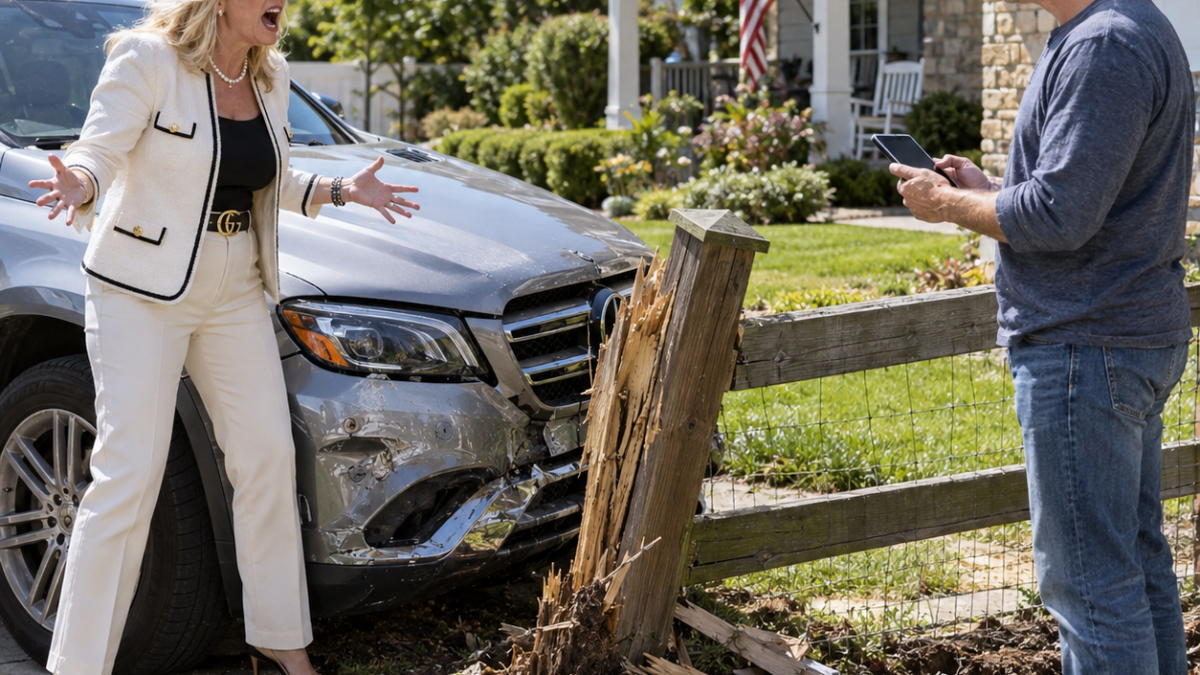
PART 2
I didn’t sleep much that night.
Not because I was afraid of Karen.
What kept me awake was the realization that the fence post had stopped being the real problem.
A fence post could be replaced.
A few hundred dollars in fines could be fought.
Even the damage to my yard was repairable.
What frightened me was what would happen if a person like Karen was allowed to decide there were no consequences for deliberately destroying someone else’s property.
Sarah found me at the dining room table shortly after midnight.
The laptop screen was glowing in the dark.
Valor was stretched across the floor beside my chair, occasionally lifting his head whenever I clicked the mouse.
“What are you doing?” she asked.
“Backing everything up.”
“You already saved the video.”
“I saved it locally.”
I pointed toward an external drive beside the computer.
“One copy here. One encrypted copy in cloud storage. Another one emailed to myself.”
Sarah pulled out the chair opposite me.
She wore the old Army sweatshirt she stole from me years ago and never gave back.
“Do you really think she would try to delete it?”
“I think people who believe rules apply only to other people eventually do things nobody reasonable expects.”
Sarah looked toward the front window.
Karen’s house was three doors down.
Dark.
Quiet.
Normal.
That was the unsettling part.
From the street, Willow Creek Estates looked like the sort of neighborhood real estate agents described with phrases like family-friendly and established.
Trim lawns.
Live oaks.
Mailboxes painted matching shades of white.
A small community clubhouse beside the pool.
Nothing about it suggested that one woman had spent years turning neighborhood regulations into a private enforcement system.
Sarah rubbed her forehead.
“I wanted tomatoes.”
I looked at her.
“What?”
“When we moved here. That’s all I wanted. A little garden. Tomatoes. Basil. Maybe peppers.”
She laughed once, but there was no humor in it.
“And somehow we’re now documenting vehicular attacks on a fence post.”
I reached across the table and took her hand.
“We’re going to fix this.”
“How?”
I looked at the folder on my screen.
“Correctly.”
The next morning, Karen answered my silence.
Three violation notices arrived together.
They were printed on red paper.
The first declared my broken fence post a “hazardous structural condition.”
That would have been funny if Karen herself hadn’t been the person who broke it.
The HOA assessed a $200 fine, plus $100 for every day I failed to remove it.
The second notice accused me of operating an unlicensed commercial auto-repair business from my garage.
Her evidence?
Someone had allegedly heard tools.
I stared at the paper.
I owned one old truck.
It was registered in my name.
I restored it because I liked working with my hands.
Apparently that now made me an illegal mechanic.
Then I read the third notice.
I stopped smiling.
It concerned Valor.
Karen claimed my service dog had demonstrated “aggressive posturing toward a minor” and represented an ongoing safety risk to residents.
The alleged incident had happened the previous Saturday.
I had been standing beside the mailbox with Valor on leash when a little boy named Ethan came running toward us.
Valor stood up.
That was it.
He hadn’t lunged.
He hadn’t barked.
He hadn’t even stepped toward the boy.
Ethan’s mother caught her son by the shoulder because she didn’t want him rushing a dog without permission.
Karen had apparently watched the whole thing from her window.
Her letter demanded that Valor be muzzled whenever he was outside.
Sarah read over my shoulder.
“Oh, no.”
Her voice changed.
It wasn’t anxious anymore.
It was angry.
“She can come after the stupid post. She can complain about the truck. She is not doing this to Valor.”
At the sound of his name, Valor lifted his head.
His ears moved forward.
I scratched him beneath the chin.
“No,” I said. “She isn’t.”
That letter changed something in me.
Until then, I had viewed Karen as an obnoxious HOA president.
A bully.
A nuisance.
But Valor wasn’t a lawn ornament.
He wasn’t a recreational pet Karen could regulate for aesthetic reasons.
He had been trained to recognize the physical signs that I was heading toward a bad episode before I always recognized them myself.
He gave me space when I needed it.
Pressure when I needed grounding.
A reason to step outside when the walls felt too close.
Karen knew he was a service animal.
I had sent the documentation months earlier.
She simply believed her authority mattered more.
That was when I stopped thinking like a homeowner arguing with an HOA.
I started thinking the way I had been trained to think when faced with a complicated threat.
Don’t attack the part you can see.
Understand the system.
Identify the trigger.
Document the components.
Then dismantle it methodically.
I went to an office-supply store and bought the thickest three-ring binder they had.
Sarah raised an eyebrow when I came home carrying sheet protectors, tabs, labels and two reams of printer paper.
“You’re building a case.”
“I’m building memory.”
“What does that mean?”
“People can argue with stories. They have a harder time arguing with dates.”
We began with the fence.
The original architectural request.
Karen’s denial.
My follow-up email showing the cedar had been painted white.
Her second rejection.
The first fine.
Photos of the first damage.
Photos of the pearl-white paint transferred to the wood.
The first confrontation.
Then the second impact.
I printed still images from the video at ten-second intervals.
Navigator approaching.
Navigator reversing.
Steering wheel turning.
Bumper contacting post.
Navigator leaving.
Then the police report.
Then the third video.
I almost didn’t need captions.
The sequence told the story by itself.
I contacted a professional fencing contractor.
He inspected the damage and explained that replacing the post wasn’t simply a matter of pulling out the broken timber.
Karen’s third impact had shifted the concrete footing.
The whole thing would need to be excavated, removed and rebuilt.
Estimate: $1,800.
I added it to the binder.
Next came the truck.
Registration.
Insurance.
Photographs showing it inside my garage.
Receipts proving the parts I bought were personal restoration items.
No customer vehicles.
No business license.
No advertisements.
No customers because there was no business.
Then Valor.
That section was different.
I placed his documentation inside the binder slowly.
His training information.
Medical paperwork supporting my need for him.
Emails proving I had already notified the HOA.
The letter demanding that he be muzzled.
Sarah watched me.
“You okay?”
“Yes.”
She knew I was lying.
I took a breath.
“Actually, no. But that doesn’t matter.”
“It matters to me.”
I looked down at Valor.
He had rested his head on my boot.
“It matters to me too. Which is why she doesn’t get to use him as leverage.”
I contacted Ethan’s mother.
Her name was Rebecca.
I expected defensiveness.
Instead, she apologized before I had finished explaining.
“Mark, I am so sorry.”
“You don’t have anything to apologize for.”
“Karen cornered me by the mailbox. She asked whether I was frightened when Valor stood up.”
“Were you?”
“No. Ethan startled me because he ran toward a dog without asking. That’s why I grabbed him. Valor didn’t do anything.”
“Would you be willing to put that in writing?”
There was a pause.
Then her voice hardened.
“Yes.”
The statement arrived that evening.
Rebecca wrote that Valor had never behaved aggressively, that her son had approached too quickly, and that Karen had repeatedly attempted to characterize the event as dangerous despite Rebecca telling her otherwise.
I printed three copies.
One went into the binder.
The second went into a backup folder.
The third I mailed with my response.
I wrote three letters.
Professional.
Specific.
Emotionless.
For the fence, I informed the HOA that Karen was personally responsible for deliberate property damage documented on video and already reported to law enforcement and insurance.
For the truck, I demanded the immediate withdrawal of the false allegation that I was operating a business.
For Valor, I demanded that the HOA cease interference with my service animal and retract the accusation of dangerous behavior.
I referenced the evidence.
I referenced the relevant protections.
And most importantly, I sent every letter by certified mail.
Karen could ignore me.
She could insult me.
She could lie about conversations.
She could not claim she never received something she signed for.
The green receipt cards returned a week later.
Karen’s looping signature appeared on every one.
Sarah held one up.
“You know she hates this.”
“Why?”
“Because you’re not fighting her.”
“I’m absolutely fighting her.”
“No. You’re documenting her.”
I smiled.
“Exactly.”
Karen responded two days later.
She hand-delivered an official-looking notice announcing that because I had failed to “cure” the broken fence-post violation, the HOA would enter my property the following Monday and remove the structure at my expense.
A $500 “abatement fee” had already been added to my account.
I read the notice twice.
Then I called David, my insurance agent.
“She plans to remove the damaged property before your company finishes the claim investigation.”
His voice changed immediately.
“Send me that letter.”
I did.
He called back twenty minutes later.
“Mark, put up no-trespassing signs.”
“Already thought about it.”
“Good. Make them obvious. Photograph them after installation. If a contractor comes onto the property after receiving clear notice, call law enforcement. Do not physically confront anybody.”
“Understood.”
That afternoon, Willow Creek gained four bright new NO TRESPASSING signs.
One by the driveway.
Two along the side yard.
One directly in front of the broken post.
Sarah stood on the porch admiring them.
“They’re ugly.”
“I know.”
“Karen must hate them.”
“I know.”
Sarah smiled.
“Then maybe they’re growing on me.”
Monday morning arrived bright and cloudless.
I made coffee.
Then I sat at the kitchen table watching my security-camera feed.
At 9:02, an old white work van stopped across the street.
Two men climbed out.
Work boots.
Faded jeans.
No company logo.
One smoked while the other made a phone call.
At 9:09, Karen’s Navigator appeared.
She parked behind them.
Apparently the suspension of common sense had not yet reached her driver’s license.
Karen stepped out wearing a lime-green pantsuit.
Even from fifty yards away, she looked furious.
She pointed at the broken fence post.
Then at my house.
Then at the post again.
One of the men noticed the sign.
He pointed toward it.
Karen waved dismissively.
The man shook his head.
Karen’s arms began moving faster.
I watched without sound, but the conversation didn’t require subtitles.
Go onto the property.
No.
I’m the HOA president.
Still no.
I authorize you.
That sign says the owner doesn’t.
After ten minutes, both men climbed into their van.
Karen stood in the road as they drove away.
I took a drink of coffee.
Sarah leaned beside me.
“Did a twenty-dollar sign just defeat her?”
“Looks that way.”
Karen turned toward our house.
For one moment, she stared directly at the camera.
Then she got back into her Navigator.
An hour later, I received another fine.
$1,000 for “obstruction of official HOA business.”
I printed it.
Hole punched it.
Placed it behind the others.
Sarah laughed.
“What?”
“You’re enjoying the binder.”
“I’m developing a relationship with the binder.”
“That worries me.”
“It should worry Karen.”
That evening, Valor and I went for a walk.
Not because I needed exercise.
Because I needed information.
I had started wondering how many other residents had stories like mine.
Karen’s confidence didn’t feel newly acquired.
People don’t become that comfortable abusing authority after one argument over a fence post.
They become comfortable because it has worked before.
Valor and I passed basketball hoops.
Flower beds.
Patios.
A row of nearly identical mailboxes.
Then I noticed an older man trimming roses outside a brick house near the cul-de-sac.
He looked up.
“Beautiful shepherd.”
“Thanks.”
Valor sat beside me.
The man wiped his forehead with a glove.
“You’re Mark Turner, aren’t you?”
“That depends.”
He smiled.
“The fence-post guy.”
“Then yes.”
He laughed.
“George Miller.”
We shook hands.
George was seventy-one, retired, and had the careful demeanor of someone who preferred numbers to drama.
He nodded toward the roses.
“My wife grew these.”
“They’re impressive.”
“They won a regional gardening award five years ago.”
“Congratulations.”
“Karen fined us for them the week after.”
I thought he was joking.
He wasn’t.
“She said they were a noncompliant species.”
“You’re serious?”
“Six months of appeals. More than a thousand dollars in fines before she got distracted by somebody else.”
He clipped a dead bloom.
“That woman doesn’t enforce rules, son. She collects surrender.”
The sentence stayed with me.
I asked George whether he had ever served on the board.
His expression changed.
“One year.”
“What happened?”
“I quit.”
“Why?”
“She controlled everything. Meetings. Proxies. Records. Money.”
“Money?”
George glanced toward Karen’s house even though it wasn’t visible from where we stood.
“She handles most of the finances.”
“Does the board review statements?”
“In theory.”
“And in practice?”
“In practice, Karen decides what people see.”
That was the first moment I realized the fence post might be attached to something much larger.
“How much money does the HOA collect every year?”
“Enough.”
“Where does it go?”
George gave a dry laugh.
“That is an excellent question.”
I told him I intended to request the association’s financial records.
George stopped trimming.
“You know you have inspection rights?”
“I’ve been reading.”
His face brightened.
“Mark, I was an accountant for thirty-eight years.”
“I was hoping you’d say something like that.”
For the first time since moving into Willow Creek, I felt the balance shift.
Karen had allies.
Now I had one too.
And mine understood spreadsheets.
The following morning, I mailed another certified letter requesting several years of HOA bank statements, invoices, credit-card records, contracts and ledgers.
Then I waited.
The request did something my earlier letters hadn’t.
It made Karen nervous.
I could tell because the harassment changed.
The fines still arrived, but they became less theatrical.
No handwritten notes.
No personal remarks.
Just formal-looking notices.
It was as if someone had warned her that the man with the cameras had started looking at the money.
George and I met almost every evening.
He brought old board minutes.
Archived newsletters.
Budgets from the years he served.
Copies of amendments.
And stories.
Lots of stories.
A couple fined for leaving a child’s plastic slide in their yard.
A widow billed hundreds of dollars because her mailbox post faded unevenly.
A family charged “emergency landscaping fees” after a storm blew branches onto their lawn.
An elderly couple who lost their house after disputed fines grew into liens and legal costs.
“Who?” I asked.
“The other Millers.”
“No relation?”
“No.”
George’s voice dropped.
“Harold and Linda Miller. Harold had a stroke. They fell behind. Karen pushed enforcement hard.”
“What happened to the property?”
“The HOA hired contractors to maintain it before it was sold.”
“Which contractors?”
George went silent.
Then he stood.
“I still have some of the paperwork.”
He returned the next evening carrying a battered banker’s box.
We spread everything across my dining room table.
Sarah made coffee.
Valor settled beneath the window.
At 10:17 p.m., George froze.
“Mark.”
He pointed at an invoice.
The company was called Gulf Star Property Services LLC.
We found another.
Willow Landscape Management LLC.
Different names.
Same mailing address.
A post-office box.
George frowned.
“Kowalski.”
“What?”
“Karen’s maiden name is Kowalski.”
We searched Florida corporate registrations.
Both businesses listed the same registered agent.
Gerald Kowalski.
George leaned back.
“That’s her cousin.”
Sarah stared at the screen.
“You’re telling me the HOA fines homeowners, hires her cousin’s companies to perform the work, then bills the homeowners?”
“That’s what it looks like,” George said.
I pulled out my own $500 abatement notice.
Suddenly two unmarked laborers arriving to remove a fence post made a lot more sense.
“What if the inflated fees aren’t accidental?” I asked.
Nobody answered.
We didn’t need to.
Ten days after Karen received my financial-records request, she emailed me a one-page “summary.”
Administrative expenses.
Grounds maintenance.
Legal services.
Community improvements.
No statements.
No invoices.
No source documents.
George almost laughed.
“She thinks this is financial disclosure?”
“She thinks this will make us go away.”
I forwarded everything to Jessica Hayes, the attorney David had recommended.
Jessica called me the following morning.
Her voice was crisp.
“You requested source records?”
“Yes.”
“And she sent you a homemade summary?”
“Yes.”
“Good.”
“Good?”
“Very good.”
I heard typing.
“I’m sending a formal demand to the HOA and its attorney. Forty-eight hours.”
“What happens after forty-eight hours?”
“If they comply, we inspect the records.”
“And if they don’t?”
“We ask a judge to make them.”
Karen did not comply.
Jessica filed.
A hearing was scheduled.
And suddenly Karen’s private kingdom had acquired something it had never had before.
Outside oversight.
Then came the emergency covenant hearing.
Karen had summoned me to the clubhouse to answer for my violations.
The irony was so ridiculous that Sarah almost framed the notice.
Karen expected a trial.
I planned a presentation.
Sarah organized the evidence.
George contacted neighbors.
I built slides.
The first showed my fence post before the damage.
The second showed the first impact.
The third showed the second.
The fourth contained video.
The fifth contained the third impact and Karen’s confession.
Then came the false business accusation.
The attack on Valor.
The abatement company.
Gerald Kowalski.
The Miller foreclosure.
Corporate records.
Invoices.
Connections.
I kept the slides plain.
No dramatic graphics.
No accusations I couldn’t support.
Facts were dramatic enough.
Tuesday evening, I walked into the Willow Creek clubhouse with Sarah on one side and Valor on the other.
Then I stopped.
The room was packed.
Thirty people.
Maybe more.
George had done his job.
Rebecca was there.
The young couple with the plastic slide.
Neighbors I barely recognized.
And near the back sat a woman in blue scrubs.
George leaned toward me.
“Miller daughter.”
The woman looked exhausted.
Angry.
Sad.
She had driven more than an hour after learning that the companies involved in her parents’ foreclosure might be connected to Karen.
At seven sharp, Karen struck the table with a wooden gavel.
“This emergency hearing of the Willow Creek Covenant Enforcement Committee is now in session.”
She sat between Carol and Bob, two board members who looked like they would rather be undergoing dental surgery.
Karen read my list of alleged offenses.
Fence violation.
Failure to cure.
Obstruction.
Illegal business.
Dangerous animal.
She saved the lien threat for last.
“We are prepared,” she said, “to pursue all available collection remedies.”
I looked toward the Miller daughter.
Her jaw tightened.
Karen continued.
“Mr. Turner, before the committee votes, you may make a brief statement.”
I stood.
“I have more than a statement.”
Karen frowned.
“I have evidence.”
Her eyes narrowed.
“I’ll need the projector.”
“No.”
George stood.
“Under the hearing rules, he’s entitled to present evidence.”
“I said no.”
“Then hold a vote.”
Karen stared at him.
George stared back.
Someone seconded his motion.
Hands rose around the room.
Karen lost overwhelmingly.
I connected my laptop.
The projector flickered on.
My undamaged cedar post filled the wall behind her.
“This,” I said, “is what the original dispute was supposedly about.”
Click.
Damage.
“This is the first impact.”
Click.
More damage.
“The second.”
Click.
Video.
Karen’s Navigator appeared on the screen.
The room went silent.
The SUV reversed.
Turned.
Struck the post.
Drove away.
Gasps moved through the room.
Karen shot to her feet.
“That is edited.”
I clicked again.
The third video began.
This one was worse.
Her vehicle stopped.
Reversed.
Adjusted.
Paused.
Then accelerated.
The sound of wood splitting came through the clubhouse speakers.
Someone whispered, “Oh my God.”
The Navigator moved forward.
Karen climbed out.
Walked toward my door.
And then every person in Willow Creek heard her own recorded voice:
“If I have to knock it down with my car to get you to comply with the bylaws, then that’s what a dedicated HOA president does.”
Nobody moved.
Not for several seconds.
Karen’s face lost its color.
“That—”
I raised one hand.
“I’m not finished.”
The next slide showed Karen’s letter concerning Valor.
Beside it were the protections I had previously sent the HOA.
Rebecca stood.
“My son was never attacked by that dog.”
Karen pointed at her.
“You told me you were frightened.”
“I told you I was frightened because Ethan ran toward a dog without permission!”
“You’re changing your story.”
“No, Karen. You changed it for me.”
The room erupted.
Karen pounded the gavel.
“Order!”
I advanced the presentation.
Corporate registration records appeared.
Gulf Star Property Services.
Willow Landscape Management.
Gerald Kowalski.
Karen’s cousin.
Then invoices.
Then records from the Miller property.
The woman in blue scrubs stood slowly.
“Those are the companies that billed my parents?”
George nodded.
Karen looked toward the exit.
The daughter’s voice cracked.
“My father had a stroke.”
The entire room quieted.
“My mother thought they were going to die in that house. They were terrified of your letters. Every week there was another fee.”
Karen said nothing.
The woman stepped forward.
“My parents lost their home.”
Tears ran down her face now.
“And your cousin made money from it?”
Karen started talking about contracts and board authority.
Nobody listened.
I looked around the clubhouse.
For the first time, people weren’t lowering their eyes when Karen spoke.
Fear had left the room.
That was the exact second her reign ended.
She just didn’t know it yet.
The meeting dissolved.
Residents shouted questions.
Bob stared at the table.
Carol whispered frantically into her phone.
Karen screamed that the evidence was fabricated.
I unplugged my laptop.
Jessica had warned me not to debate.
Present.
Document.
Leave.
Outside, the Miller daughter approached me.
“My name is Susan.”
“Mark.”
“I know.”
She wiped her eyes.
“Thank you.”
“You don’t owe me thanks.”
“Yes, I do.”
“No. If these records show what we think they show, your parents should never have gone through that.”
She looked toward the clubhouse doors.
“My dad thought losing that house meant he failed my mother.”
That sentence hit me harder than anything Karen had said.
“He didn’t fail her.”
“I know that now.”
A woman holding a phone approached us.
“Mr. Turner?”
“Yes?”
“Maria Sanchez, Channel Eight.”
I looked at George.
He gave me an innocent expression that fooled nobody.
Maria asked whether I would speak on camera.
I gave her one sentence.
“We want transparency, lawful treatment and accountability from the people entrusted with managing our community.”
That was enough.
The story aired at ten.
Security footage.
Karen’s confession.
Homeowners shouting.
Susan crying outside the clubhouse.
By breakfast the next morning, everyone in Willow Creek knew.
So did thousands of people outside it.
And once Karen lost control of the story, she lost control of everything else.
Bob called me that afternoon.
“Mark, Carol and I are calling an emergency board meeting.”
“For what?”
“To remove Karen.”
I leaned back.
“Does she know?”
“Not yet.”
“You’re sure you have authority?”
“We checked the bylaws.”
I almost laughed.
For once, those documents were working against her.
“What changed, Bob?”
Silence.
Then:
“I saw the video.”
“You were sitting five feet from her.”
“I know.”
“And?”
“I realized if she could do that to you and then sit beside me pretending you were the problem, I don’t know what else she’s lied about.”
That was probably the most honest thing Bob ever said to me.
The emergency board meeting lasted forty-three minutes.
Karen was excluded from the portion concerning her removal.
Carol introduced the motion.
Bob seconded.
They cited misconduct, misuse of authority and exposure of the association to legal liability.
The vote was unanimous.
Karen Kowalski was no longer president.
The board then voted to commission a forensic audit.
George was appointed interim president.
He looked horrified when they nominated him.
“You wanted transparency,” I whispered.
“I did not want another job.”
Sarah smiled.
“Congratulations, Mr. President.”
He groaned.
News traveled house to house.
By the weekend, Willow Creek felt different.
The plastic slide returned to the young couple’s yard.
Rebecca let Ethan throw a tennis ball for Valor while I supervised.
Mrs. Gable announced that she planned to expand her roses.
But I knew Karen losing the presidency wasn’t the ending.
Power had protected her.
Now the records would tell us what she had done with it.
My court hearing on the financial documents came first.
Karen sat beside her attorney, Fletcher, wearing a black suit and the expression of somebody deeply offended that a judge expected her to follow rules.
Jessica stood beside me.
The judge read our filings.
Then she looked at Fletcher.
“Your client received a lawful records request?”
“Yes, Your Honor, however—”
“And responded with a summary?”
“There were significant privacy issues—”
“Whose privacy?”
Fletcher hesitated.
“The association’s financial—”
“The association is owned by its members.”
The judge leaned forward.
“Your client is a fiduciary. She does not get to conceal corporate records because disclosure is inconvenient.”
Karen whispered something.
The judge looked at her.
“Mrs. Kowalski, would you like to address the court?”
Karen sat straighter.
“I have served my community without compensation for years.”
“That was not my question.”
“I have protected property values.”
“Still not my question.”
A sound escaped George that may have been a cough.
The judge ordered the HOA’s records produced for independent examination.
Then she awarded my legal costs related to the records dispute.
Karen looked stunned.
For years, she had threatened other homeowners with attorneys.
Now she was paying for mine.
Outside the courtroom, Jessica touched my arm.
“Do not celebrate yet.”
“I’m not.”
“Good. The audit is where this gets serious.”
She was right.
It got serious quickly.
The forensic accountant discovered invoices to Gerald Kowalski’s businesses that were dramatically higher than comparable market rates.
He found repeated no-bid contracts.
Questionable reimbursement checks.
HOA credit-card expenses at restaurants that had no apparent connection to community business.
Department-store purchases recorded under administrative supplies.
Travel expenses.
Personal services.
And transfers connecting Gerald’s company to Karen.
George called me after the preliminary review.
His voice sounded sick.
“Mark.”
“How bad?”
“Worse than I thought.”
“How much?”
“We don’t know yet.”
“Give me the version you do know.”
He exhaled.
“She wasn’t just abusing the rules. She appears to have been making money from them.”
I sat down.
Sarah watched my face.
George continued.
“The auditor found contracts issued to Gerald’s companies after homeowners were fined. Inflated abatement work. Property-maintenance charges. And Karen appears to have received money from his businesses.”
“How much?”
“More than thirty thousand in direct transfers that they can see so far.”
I closed my eyes.
The fence post had cost $1,800 to repair.
That stupid piece of cedar had opened a door into years of alleged self-dealing.
“What happens now?”
“The auditor finishes.”
“And then?”
“We turn it over.”
“To whom?”
“Everybody who needs to see it.”
The report eventually estimated that more than $92,000 would need to be repaid to the association.
Criminal investigators became involved.
The insurance company handling my fence claim pursued Karen personally because the third impact clearly appeared intentional.
Then came the letter concerning her driving privileges.
Karen had struck my property repeatedly.
Left after previous impacts.
And finally used her Navigator deliberately enough that the video left little room to misunderstand what she was doing.
The administrative process moved separately from my civil lawsuit.
At the hearing, she tried to argue that the incidents happened on or beside private residential property.
It didn’t save her.
Her license was revoked for a year.
When George told me, I didn’t cheer.
I walked outside instead.
The Navigator sat in Karen’s driveway.
Pearl white.
Huge.
Motionless.
Valor followed me onto the porch.
Sarah stepped beside me.
“You okay?”
“I keep thinking about what would have happened without the camera.”
She understood.
Karen could have said I damaged the post myself.
She could have claimed an accident.
She could have accused me of threatening her.
Maybe people would have believed the HOA president over the new guy with the old truck.
But cameras don’t care who has the title.
Sarah leaned against me.
“You put that camera up because she lied about the first impact.”
“Yeah.”
“So in a strange way, she created the evidence against herself.”
I looked at Karen’s useless Navigator.
“That sounds about right.”
Jessica filed my civil case against Karen personally.
The lawsuit included the repair costs, improper fines, emotional damages stemming from the targeted harassment and punitive damages based on the deliberate nature of her conduct.
Fletcher contacted Jessica almost immediately.
Settlement.
The first offer barely covered the fence.
I rejected it.
The second was larger.
Still no.
Jessica asked what number I wanted.
“I want accountability.”
“That isn’t a number.”
“I know.”
“Trials are uncertain.”
“I know.”
“They’re expensive.”
“I know.”
She studied me.
“Then tell me what you need from this.”
I thought about Sarah’s garden.
Valor.
Susan’s parents.
George’s roses.
Every red notice.
Every threat.
Every person who had paid because fighting felt harder.
“I need what happened to be part of the record.”
Jessica nodded.
“Then we prepare for trial.”
Discovery was ugly.
Karen denied almost everything.
The videos were misleading.
The bookkeeping problems were mistakes.
Gerald’s companies were selected because they offered good service.
The transfers from his company were personal family matters.
The fines were legitimate.
Valor had been dangerous.
I was aggressive.
She was the victim.
Then Jessica deposed her.
Eight hours.
I sat through part of it.
Watching Jessica question Karen was like watching someone dismantle a machine one screw at a time.
No yelling.
No insults.
Just documents.
“Mrs. Kowalski, did you strike Mr. Turner’s fence post with your vehicle?”
“I may have accidentally contacted it.”
Jessica displayed the second video.
“Is this your vehicle?”
“Yes.”
“Are you driving?”
“Yes.”
“Did you report the collision?”
“It was minor.”
“That wasn’t my question.”
“No.”
Then the third video.
Karen’s jaw tightened.
“Did you strike the post here?”
“Yes.”
“Accidentally?”
“I was attempting to demonstrate a safety concern.”
“With your Lincoln Navigator?”
“I believed the post was improperly positioned.”
“Was pressing the accelerator necessary to communicate that?”
Fletcher objected.
Jessica moved on.
Then came the financial records.
A cruise charge classified as conference travel.
Luxury purchases categorized as administration.
Transfers from Gerald’s company.
At one point, Karen refused to answer on advice of counsel.
Jessica simply marked the exhibit.
The courtroom would eventually see it anyway.
The civil trial began months after the third impact.
By then, the new fence post had not yet been installed.
I had deliberately waited.
The broken original was evidence.
Its replacement could come after judgment.
Sarah and I arrived early.
George joined us.
Susan sat behind him.
Across the aisle, Karen sat beside Fletcher.
Nobody sat behind her.
That surprised me.
For years, she had surrounded herself with people who laughed when she laughed, voted when she told them to vote and looked away when she targeted somebody.
Power creates crowds.
Consequences reveal friendships.
The judge entered.
Jessica presented our case chronologically.
The violation.
The first impact.
The second.
The third.
The confession.
The retaliatory fines.
The false commercial-business allegation.
Valor.
The attempted abatement.
The financial records.
The related-party companies.
The audit.
She never exaggerated.
She didn’t need to.
Then she played the video.
Even after seeing it dozens of times, I felt my chest tighten.
The Navigator reversed.
Lined up.
Moved.
CRACK.
Karen walked toward my front door.
Her recorded voice filled the courtroom.
“If I have to knock it down with my car to get you to comply with the bylaws, then that’s what a dedicated HOA president does.”
The judge looked over her glasses.
Fletcher didn’t move.
Then Jessica called me.
I described our move to Willow Creek.
Why we chose the house.
What peace meant after fifteen years of military service.
I talked about Sarah’s garden.
My truck.
Valor.
The citations.
The way our home slowly stopped feeling like somewhere we could relax.
Jessica asked whether I hated Karen.
“No.”
Karen looked surprised.
“What do you feel toward her?”
I thought carefully.
“I think she mistook authority for ownership.”
“What do you mean?”
“She was elected to help manage a neighborhood. Somewhere along the way, she began acting like the people in it belonged to her.”
Jessica nodded.
“What did you want when you first challenged the fence-post fine?”
“To keep my fence post.”
A few people smiled.
“And after the third impact?”
“I wanted her to stop.”
“And now?”
I looked toward Susan.
Then George.
Then Sarah.
“I want nobody else to believe they have to surrender just because someone with a title threatens them.”
Fletcher cross-examined me.
He suggested I was combative.
I admitted I had refused to remove the post.
He suggested I disliked HOAs.
I told him I disliked rules being enforced dishonestly.
He asked whether I had deliberately recruited neighbors against Karen.
“I spoke to my neighbors.”
“About my client.”
“About their experiences.”
“You built a coalition.”
“I discovered I wasn’t alone.”
He changed subjects.
The forensic accountant testified next.
Numbers replaced emotion.
Contracts.
Invoices.
Transfers.
Charges.
Dates.
Dollar amounts.
He explained the patterns calmly.
Fletcher tried to separate the financial conduct from my fence-post case.
Jessica argued that it established motive and a broader pattern of using enforcement authority for personal purposes.
The judge allowed relevant portions.
Then George testified.
He told the court about his year on the board.
His requests for records.
The roses.
The proxy votes.
The culture of fear.
Susan testified about her parents.
That was the hardest part.
“My father spent his life believing that if he paid his bills and took care of his family, his home was safe,” she said.
Her voice trembled.
“When the fines started, he was already sick.”
She described stacks of letters.
Late fees.
Legal charges.
Her mother crying.
Her father apologizing because he thought he had failed.
Susan looked at Karen.
“My father died still ashamed of losing that house.”
The courtroom became completely silent.
Karen stared at the table.
Then it was her turn.
Fletcher tried to present her as a committed volunteer who had made mistakes under pressure.
Karen testified that Willow Creek had been deteriorating when she became president.
She said homeowners expected strong enforcement.
She insisted she had acted to preserve property values.
For twenty minutes, she almost sounded reasonable.
Then Jessica stood.
“Mrs. Kowalski, why did you hit Mr. Turner’s fence post?”
“It violated community standards.”
“That was not my question.”
“It was located improperly.”
“That was not my question either.”
Karen shifted.
Jessica approached the monitor.
She displayed a still image from the third video.
“Why did you strike it with your vehicle?”
“I was frustrated.”
“Why?”
“Because he refused to comply.”
“So you damaged his property because he challenged your interpretation of the rules?”
“No.”
“What did you mean when you told him, ‘If I have to knock it down with my car to get you to comply, then that’s what a dedicated HOA president does’?”
Karen’s face reddened.
“I was upset.”
“Were those your words?”
“Yes.”
“Were you driving the vehicle?”
“Yes.”
“Did you deliberately back into the post?”
Fletcher stood.
“Asked and answered.”
The judge looked at Karen.
“You may answer.”
Karen gripped the sides of the witness stand.
“He was defying me.”
Jessica waited.
Karen continued.
“He acted like the rules didn’t apply to him.”
“Did that anger you?”
“Yes.”
“Enough to use your SUV to damage the post?”
“He kept challenging everything!”
Her voice rose.
“You don’t understand what it was like. People watched him. Once one homeowner starts ignoring the board, everybody thinks they can.”
Jessica said nothing.
Sometimes silence is the best cross-examination.
Karen filled it.
“That post became a symbol.”
“A symbol of what?”
“Disrespect.”
“For you?”
“For the association.”
“Or for you?”
Karen slammed one palm against the witness rail.
“He needed to learn that he couldn’t just tell me no!”
Fletcher closed his eyes.
Jessica returned to counsel table.
“No further questions.”
The case was over in that moment.
We all knew it.
The judge took time before ruling.
When she returned, her decision was methodical.
Karen was liable for the damage to the fence.
$1,800.
She was ordered to repay the improper fines assessed against me.
$2,350.
The court awarded $10,000 connected to the targeted harassment and its effect on my household.
Then came punitive damages.
The judge looked directly at Karen.
“Community associations function only when authority is exercised in good faith.”
Karen stared forward.
“You were entrusted with limited authority to serve your neighbors. The evidence demonstrates that you repeatedly used that authority as a personal weapon.”
Nobody moved.
“The deliberate destruction of the plaintiff’s property was not an enforcement mechanism. It was retaliation.”
Karen’s lips pressed together.
“The financial evidence further shows conduct inconsistent with the fiduciary duties you repeatedly invoked when it benefited you.”
Then came the number.
“Punitive damages are awarded in the amount of thirty thousand dollars.”
Fletcher lowered his head.
The judge continued.
Karen would also pay the legal fees and court costs attributable to the litigation.
$12,850.
Jessica wrote the numbers on a legal pad and turned it toward me.
$1,800.
$2,350.
$10,000.
$30,000.
$12,850.
TOTAL: $57,000.
I stared at it.
Fifty-seven thousand dollars.
Over a fence post that Karen could have simply left alone.
The judge closed her file.
“This judgment is entered for the plaintiff.”
That was it.
No cinematic music.
No applause.
Just paper.
A ruling.
A woman who had spent years weaponizing documents finally defeated by one.
Outside the courthouse, sunlight felt almost too bright.
Sarah hugged me.
George shook my hand, then ignored the handshake and pulled me into a hug.
Susan cried.
I stood there feeling something I hadn’t expected.
Not triumph.
Relief.
Deep, exhausting relief.
“It’s finished,” Sarah whispered.
“Almost.”
The financial investigation remained.
So did Karen’s restitution issues.
And because Jessica immediately secured the judgment, Karen could not simply ignore what she owed.
Eventually, her house went onto the market.
I never celebrated that.
I remembered Susan’s parents.
Losing a home is not funny.
Even when the person selling it has caused tremendous harm.
But consequences are different from cruelty.
Karen had choices at every stage.
She could have stopped after the first fine.
After the first impact.
After the second.
After receiving my letters.
After the police report.
After the financial-record request.
After being removed from office.
Instead, she kept choosing escalation.
Her house sold.
The judgment was paid from the proceeds.
When the check arrived, I left it on the kitchen table for nearly an hour before opening it.
Sarah finally asked, “Are you scared of the envelope?”
“No.”
“You’ve walked past it six times.”
“I’m thinking.”
“About?”
“What to do with money I never wanted.”
We eventually decided.
Part went toward organizations that helped homeowners obtain legal guidance when facing abusive association practices.
Part went to help Susan with care expenses connected to her mother.
Susan initially refused.
I told her it wasn’t charity.
“It’s money that came from what happened.”
She shook her head.
“Mark—”
“Your family paid a price before mine ever did.”
Her eyes filled.
Finally, she accepted.
Another portion went into a community improvement fund controlled by the reformed Willow Creek board under transparent accounting rules.
George hated every second of being called President Miller.
That made him perfect for the job.
He instituted open financial reviews.
Multiple signatures for large expenditures.
Competitive bidding.
Published minutes.
Clear appeal procedures.
And one rule he repeated at nearly every meeting:
“If we’d be embarrassed to show it to every homeowner, we shouldn’t be doing it.”
The audit ultimately established more than $92,000 in funds requiring restitution.
Karen resolved the criminal case through a plea agreement.
She avoided incarceration but received probation, extensive community-service requirements and a restitution order.
She was also barred from returning to a fiduciary board role.
And her driver’s license remained revoked for a year.
The Navigator disappeared from her driveway before the house was sold.
I never learned whether they sold it or took it with them.
I didn’t care.
The object itself had never mattered.
What mattered was that she could no longer use it—or her HOA office—to intimidate people.
Willow Creek changed gradually.
That was the part I loved most.
Not the courtroom.
Not the check.
Not Karen losing her title.
Small things.
Rebecca stopped looking over her shoulder before letting Ethan leave his bike near the driveway.
The young couple’s plastic slide stayed outside.
Mrs. Gable planted three new rose varieties.
George’s wife entered hers in another gardening competition.
Nobody measured Sarah’s vegetable garden.
By summer, we had more tomatoes than two people could eat.
Sarah left baskets on neighbors’ porches.
The same garden Karen had once called an unauthorized agricultural installation became a neighborhood joke.
A sign appeared beside it one morning.
WILLOW CREEK ILLEGAL TOMATO DISTRIBUTION CENTER.
George denied responsibility.
Nobody believed him.
Even I laughed.
Months after the trial, I finally replaced the fence post.
I chose cedar again.
Eight feet.
Thicker than the original.
Sarah found me loading it into the truck.
“You’re not going with approved vinyl?”
“Absolutely not.”
She smiled.
“Rebel.”
“Cedar lasts longer.”
“Sure. That’s why.”
I dug out the old concrete.
The shattered remains of the original post were still embedded inside.
For a moment, I held one broken piece in my hand.
The wood carried scratches.
White paint.
A deep compression mark where the Navigator struck it.
That fragment had started everything.
Or maybe it hadn’t.
Maybe Karen had started everything years earlier when enough people decided paying her was easier than confronting her.
Maybe George’s roses had started it.
Maybe the Millers losing their house.
Maybe every homeowner who had quietly folded a violation notice and written a check because they didn’t have the time, money or energy to fight.
I set the broken wood aside.
Then I lowered the new cedar post into the hole.
Leveled it.
Mixed concrete.
Checked the plumb.
Valor sat in the shade watching me.
He was getting gray around the muzzle.
When I finished smoothing the concrete, he walked over and rested his chin against my knee.
“Inspection?” I asked him.
His tail moved once.
George appeared carrying two cold beers.
He studied the post.
“Looks noncompliant.”
“Get off my property.”
“You can’t talk to the HOA president like that.”
“I have video cameras.”
George laughed.
He handed me a bottle.
We stood there quietly.
Across Willow Creek, sprinklers clicked.
A lawn mower hummed.
Children shouted near the pool.
Somebody was grilling.
Ordinary sounds.
Exactly what I had wanted when Sarah and I moved here.
George raised his beer toward the cedar.
“To the most expensive fence post in Florida.”
I shook my head.
“No.”
“No?”
I looked at the houses around us.
At the roses.
At the plastic slide two yards away.
At Sarah walking toward us with tomatoes in the hem of her shirt.
Then at Valor.
“To the last one she ever hit.”
George nodded.
“I’ll drink to that.”
That evening, after everyone went home, Sarah and I sat on the porch.
The new post stood white and straight at the corner of the yard.
“You know what I keep thinking?” she asked.
“What?”
“If she had apologized after the first time, none of this would have happened.”
“She didn’t know how.”
“She could have learned.”
I thought about that.
Karen had believed strength meant never backing down.
But the strongest people I had known understood when to stop.
When to listen.
When to admit they were wrong.
Karen had mistaken stubbornness for authority.
Fear for respect.
Control for leadership.
And eventually, she had driven straight into something she couldn’t bully.
Evidence.
The cameras mattered.
The binder mattered.
Jessica mattered.
George mattered.
The neighbors mattered.
But more than anything, the truth mattered.
Because bullies survive by convincing everyone their version of reality is the only one available.
The moment people start comparing notes, that power begins to disappear.
Sarah leaned against my shoulder.
Valor slept at our feet.
For the first time since moving into Willow Creek, I realized I hadn’t checked the security-camera app once that entire day.
I didn’t need to.
Nobody was circling the block.
Nobody was measuring our lawn.
Nobody was photographing the garden.
No red violation notice waited in the mailbox.
Our house finally felt like our house.
The fence post was only cedar and concrete.
But every time I passed it, I remembered Karen standing on my porch, proudly admitting she had used a two-ton SUV to teach me a lesson.
She believed the lesson was supposed to be mine.
She was wrong.
Her three trips into that fence eventually cost her a $57,000 civil judgment, a year without her driver’s license, her HOA presidency, tens of thousands more in restitution obligations, and the authority she had spent years abusing. The source story’s final court judgment and later consequences are described in the supplied material.
But that still wasn’t the part I remembered most.
I remembered Susan finally understanding that her father had not failed his family.
I remembered George watching his wife’s roses bloom without waiting for a violation letter.
I remembered Rebecca’s son throwing a ball for Valor.
I remembered Sarah setting baskets of tomatoes on neighbors’ porches.
And I remembered the first quiet Saturday morning when nothing happened at all.
No threats.
No hearings.
No certified letters.
No confrontation.
Just sunlight.
A dog asleep in the grass.
My wife laughing in the garden.
And one perfectly straight cedar post standing at the corner of property that finally felt like home.
Karen had tried three times to knock it down.
In the end, all she really knocked down was the system that had protected her.
And when the dust settled, the post came back stronger.
So did the neighborhood.
So did we.
The judgment should have felt like the end.
It didn’t.
When the judge announced the final amount—$57,000—Karen sat perfectly still, staring toward the front of the courtroom as if somebody had turned her into stone.
For months, she had threatened homeowners with fines, liens, attorneys, inspections, and foreclosure notices. She had built her authority on the assumption that everyone else had more to lose than she did.
Now the numbers were aimed at her.
$1,800 for the fence damage.
$2,350 in improper fines.
$10,000 for the harassment my family had endured.
$30,000 in punitive damages.
And $12,850 in legal fees and court costs.
Fletcher leaned toward her and whispered something.
Karen didn’t answer.
The woman who once couldn’t stand ten seconds of silence had nothing left to say.
Sarah squeezed my hand under the table.
I looked at her.
Her eyes were wet.
Not because of the money.
Because we were finally going home without wondering what Karen would do next.
Outside the courthouse, George was waiting beside Susan, the Millers’ daughter.
The Florida sun hit me the moment the doors opened.
I stopped on the courthouse steps.
For months, every day had been evidence, meetings, letters, phone calls, legal arguments, camera footage, and anticipation.
Suddenly there was nothing I had to prepare for that afternoon.
No hearing tomorrow.
No HOA deadline.
No emergency notice waiting in my mailbox.
Sarah wrapped both arms around me.
“It’s over,” she whispered.
I looked across the parking lot.
Karen was walking toward Fletcher’s car.
Her own Navigator wasn’t there.
With her driver’s license revoked for a year, the vehicle she had used as a weapon now sat useless at home.
“Not completely,” I said. “But our part is.”
Susan approached slowly.
She had cried during the ruling.
Now she held herself together with the exhausted dignity of someone who had waited years to hear another person say what happened to her parents was wrong.
“My father should have been here,” she said.
George lowered his head.
Susan looked at me.
“He died believing he had failed my mother. He thought losing that house was his fault.”
I didn’t know what to say.
Sometimes saying something just because silence feels uncomfortable makes the moment worse.
So I let her speak.
“She kept telling him those fines were legitimate. That he had brought everything on himself. He believed her.”
Her voice broke.
I stepped closer.
“Your father didn’t fail.”
“I know.”
She wiped her eyes.
“I finally know.”
That mattered more to me than the judgment.
A few weeks later, Karen’s house went on the market.
When George told me, I didn’t celebrate.
I remembered Susan’s parents.
There was nothing funny about someone losing a home.
But Karen was not losing hers because someone had invented violations and buried her beneath fabricated fees.
She was selling because a court had entered a lawful judgment against her and because the financial investigation had uncovered obligations she could no longer ignore.
Those were consequences.
There was a difference.
The judgment lien meant she couldn’t sell the property and simply disappear with the money.
My award had to be satisfied first.
The house sold faster than anyone expected.
Willow Creek had already begun changing, and apparently people noticed.
One Saturday morning, a thick envelope arrived from the closing attorney.
I placed it on the dining room table.
Sarah found me twenty minutes later.
“You haven’t opened it?”
“No.”
“Why?”
I looked at the envelope.
Because I knew what was inside.
A check.
A large one.
Money created by months of anger and stress.
Sarah sat across from me.
“This was never about money for you.”
“No.”
“But pretending the money doesn’t exist won’t change where it came from.”
She was right.
I opened it.
The amount looked unreal.
I had spent most of my life earning money through work—slowly, predictably, paycheck by paycheck.
This felt completely different.
George came over that evening.
We sat around the same dining room table where Operation Iron Fence had begun.
The binders were still stacked on a shelf nearby.
“I don’t want to buy anything with it,” I said.
George nodded.
“Then don’t.”
“I want it to mean something.”
Sarah leaned forward.
“What if we use Karen’s consequences to repair some of the damage she caused?”
That became our plan.
A portion went to a legal-aid organization that helped homeowners deal with abusive association enforcement.
Another portion went to Susan to help with care expenses for her mother.
She refused at first.
Absolutely refused.
“This is yours,” she said.
“No,” I told her. “Some of this came from exposing what happened to families before mine. Your family paid for this long before a judge ever wrote my name on a judgment.”
She looked at the check for a long time.
Then she hugged Sarah.
After that, George proposed something else.
A community improvement fund.
Not controlled by one president.
Not hidden inside vague accounting categories.
Every expenditure would be posted.
Every contract above a certain amount would require multiple bids.
Every significant payment would need two signatures.
“Transparency,” George said, “is much cheaper than another Mark Turner.”
I laughed.
“Put that in the bylaws.”
“I might.”
His first major community project was a new playground.
Karen had rejected upgrades for years, claiming there wasn’t enough money.
The forensic audit had answered where a good portion of that money had actually gone.
When construction started, the young couple who had once been fined for leaving a plastic toddler slide in their yard brought their little boy to watch.
The child stood behind the temporary fence every afternoon asking workers when the playground would be finished.
The day it opened, nearly every family in Willow Creek showed up.
George gave a speech.
It lasted forty seconds.
That was another reason people liked him.
He hated speeches.
“This belongs to all of you,” he said. “Which is how this neighborhood should have been managed all along.”
Then he handed the scissors to Susan.
She cut the ribbon.
People applauded.
I looked around and realized something strange.
Willow Creek had never really lacked community.
It had lacked trust.
Karen had kept everyone isolated.
If residents compared stories, they might notice the pattern.
So people had been taught to feel embarrassed about their fines.
To think they were the difficult homeowner.
The careless neighbor.
The troublemaker.
Once people started talking, Karen’s greatest weapon disappeared.
Secrecy.
The criminal investigation continued after my civil case ended.
The forensic audit had identified more than $92,000 that investigators believed had to be repaid to the HOA.
Between inflated contracts, questionable charges, related-party payments, and other transactions, Karen’s problems were much larger than my broken cedar post.
Eventually, her attorney negotiated a plea agreement.
She pleaded guilty to a felony theft-related charge.
She avoided jail, partly because she had no previous criminal record, but the sentence was far from painless.
Five years of probation.
Five hundred hours of community service.
Full restitution.
And a permanent prohibition against serving in a fiduciary board role again.
When George told me, we were standing beside my driveway.
“So that’s really it,” he said.
“For her?”
“For the whole thing.”
I looked toward the corner of my yard.
The broken post was still there.
I had left it untouched through the litigation.
Part evidence.
Part stubbornness.
“Not yet.”
The next Saturday, I drove to the hardware store.
I bought another cedar post.
Eight feet long.
Thicker than the original.
A bag of high-strength concrete.
New hardware.
And white exterior paint.
Sarah watched me unloading everything.
“You’re painting it white?”
“I’m not trying to start another war.”
She smiled.
“Very mature.”
“Don’t sound so disappointed.”
I spent most of the afternoon digging.
The old footing had cracked badly from the final impact.
Removing it was harder than expected.
Eventually, I exposed the shattered base of the original cedar post.
I pulled out one broken section and sat back on my heels.
White paint still marked one side.
A deep dent ran across the wood.
For months, I had thought of that piece of timber as evidence.
Now it just looked small.
It was strange that something so ordinary had triggered so much.
But maybe it hadn’t triggered anything.
Maybe it had simply exposed what was already there.
Karen’s need for control.
The financial scheme.
The frightened homeowners.
The hidden resentment.
The families who had already been hurt.
The post didn’t create the problem.
It gave the problem somewhere visible to crack.
I tossed the broken wood onto the grass.
Then I installed the replacement.
I measured twice.
Set it perfectly plumb.
Mixed the concrete.
Packed the footing.
Valor watched from beneath the oak tree.
His muzzle had more gray in it now.
When I finished, he walked over and pressed his shoulder against my leg.
I scratched behind his ears.
“What do you think?”
His tail thumped against the grass.
“I’ll take that as approval.”
“Absolutely not.”
I looked up.
George was walking across the lawn carrying two bottles of beer.
He studied the post.
“Gross violation.”
“Of what?”
“Article George, Section George, Subsection George.”
“That sounds legally questionable.”
“I’m president. I make the rules.”
“Get off my property.”
He laughed.
“You know, Karen would have fined you for saying that.”
“You know what happened to Karen.”
“Excellent point.”
He handed me a beer.
Sarah came out of the garden carrying tomatoes in the bottom of her shirt.
The same vegetable garden Karen had once called an “unapproved agricultural installation” had become so productive that Sarah gave produce to half the street.
Someone—almost certainly George—had placed a small wooden sign beside it.
WILLOW CREEK ILLEGAL TOMATO DISTRIBUTION CENTER.
Sarah had refused to remove it.
A child rode past us on a bicycle.
Two houses down, another child was playing on the infamous plastic slide.
Mrs. Gable’s roses were blooming along her walkway.
The neighborhood looked ordinary.
That was the victory.
Not Karen losing her house.
Not the license revocation.
Not the judgment.
This.
People living without fear of an envelope appearing because someone had decided their flowers were wrong.
That evening, Sarah and I sat on the porch.
Valor slept between us.
The new post stood at the corner of the yard, clean and straight.
“You know the strangest part?” Sarah said.
“What?”
“She could have stopped everything with one apology.”
I nodded.
After the first impact, Karen could have apologized.
After the second, she could have paid for the damage.
After receiving my certified letters, she could have backed away.
After the financial-record request, she could have cooperated.
At every stage, she had been offered an exit.
She chose escalation every time.
She believed backing down meant weakness.
But refusing to admit you’re wrong isn’t strength.
It’s just another kind of prison.
I looked toward the post.
Karen had tried three times to knock it down.
Those three impacts eventually helped cost her $57,000 in my civil case, a year without her driver’s license, her HOA presidency, enormous restitution obligations, and the position she had spent years abusing.
But the punishment wasn’t the most satisfying part.
Susan’s father wasn’t a failure anymore in his daughter’s memory.
George’s wife could grow roses without permission.
Rebecca’s son could play with Valor without somebody turning it into evidence.
Sarah could grow tomatoes.
Families could use the playground their own HOA money should have provided years earlier.
And I could finally sit on my porch without watching the road.
For months, I had checked the security cameras constantly.
That night, I realized I hadn’t opened the camera app all day.
I didn’t need to.
Nothing was coming.
No Navigator.
No violation officer.
No contractor.
No confrontation.
Just crickets.
Sprinklers.
Children laughing somewhere near the clubhouse.
Sarah rested her head against my shoulder.
I reached down and touched Valor’s back.
The life we had wanted when we moved to Willow Creek had finally arrived.
Quiet.
Ordinary.
Ours.
George called the new post a monument.
He was joking.
But sometimes, when I passed it, I understood what he meant.
It reminded me that bullies depend on isolation.
They depend on people believing resistance is too expensive.
They depend on nobody keeping records.
Nobody asking questions.
Nobody comparing stories.
Karen believed her greatest power was the HOA presidency.
She was wrong.
Her greatest power had always been everyone else’s silence.
Once that disappeared, everything she had built began collapsing.
And the strangest part was that she started the collapse herself.
With a white SUV.
A cedar post.
And one sentence she never realized the camera had recorded.
She wanted to teach me what happened when someone told the HOA president no.
Instead, Willow Creek learned something much more important.
A title doesn’t make someone untouchable.
A rule doesn’t become lawful because a bully quotes it.
And sometimes the strongest form of revenge isn’t destroying the person who tried to destroy you.
It’s documenting the truth, holding your ground, protecting the people beside you—
and then living peacefully in the place they tried to make you abandon.
Karen knocked my fence post down.
We built it again.
Stronger.
And this time, an entire neighborhood was standing behind it.








