HOA Karen Poisoned My Family Lake to Stop People Fishing—Then Her Own Sprinklers Pumped That Water Into Every Luxury Yard
part 2
Denise Prescott had been living in Lakeridge Estates for less than three years when she decided Holloway Lake was a flaw in the view she had purchased.
Not the lake itself.
She loved the water.
From her back deck, it looked exactly the way luxury real-estate brochures wanted water to look: smooth in the morning, gold at sunset, framed by pine trees, with enough mist to make every photograph feel expensive.
What Denise disliked were the people.
Old pickup trucks.
Folding chairs.
Plastic coolers.
Kids running down the bank.
Families laughing loud enough for sound to travel across forty-five acres of water and reach the decks on the ridge.
She had spent eighteen years marketing luxury homes in Dallas before moving to East Texas, and she carried that profession into everything she did. In Denise’s world, beauty wasn’t something that happened naturally. Beauty had a target demographic.
Anything that didn’t fit the demographic needed to be hidden.
Her first official letter arrived in March.
Lakeridge Estates letterhead.
Embossed heron logo.
Three paragraphs about “aesthetic degradation,” “waterfront congestion,” and “sightline disruption.”
She wanted me to plant visual screening along the lake.
A wall of vegetation tall enough that homeowners on the ridge wouldn’t see fishermen.
She also wanted fishing limited to weekdays.
I read that sentence twice.
Weekdays.
When children were in school.
When working parents were at their jobs.
When most families couldn’t come.
It wasn’t subtle.
I folded the letter and placed it in a file.
**PRESCOTT.**
Twenty-nine years in environmental enforcement had taught me that people who send one unreasonable letter almost always send another.
Denise didn’t disappoint me.
Eleven days later, envelope number two arrived.
This time she included photographs.
Long-lens photographs.
Taken from somewhere on the ridge.
One picture showed a little red wagon beside the dock.
Some family had used it to haul a tackle box, snacks, and a small cooler.
Denise had circled it in yellow marker and labeled it:
**UNAUTHORIZED STRUCTURE.**
Another photograph showed Bud Tillman’s aluminum lawn chair.
She had labeled that:
**PERMANENT INSTALLATION.**
Bud’s chair weighed maybe four pounds.
He carried it in every Saturday.
Carried it out every Saturday.
Calling it permanent was like calling a parked bicycle a transportation terminal.
The third letter complained about bait smell.
The fourth complained about tire tracks in gravel.
The fifth referred to children making “excessive recreational noise.”
That one made me angry.
Not because of the wording.
Because of Ellen.
During her last year, when treatment was no longer working and we both knew time was short, she used to sit on the dock listening to children laugh across the lake.
Once I apologized because a family nearby was being especially loud.
She squeezed my hand.
“Don’t you dare.”
“What?”
“Tell them to be quiet.”
“You’re trying to rest.”
“I can rest later.”
Then she closed her eyes.
“That sound means life is happening somewhere.”
I remembered those words while reading Denise’s letter about excessive recreational noise.
I put that letter in the file too.
Then she stopped writing to me and started calling government offices.
## **SHE TRIED TO TURN MY LAKE INTO A VIOLATION**
The county zoning office came first.
Denise claimed I was operating an unlicensed commercial recreation business.
The administrator who visited was named Patricia Robles.
She arrived on a Wednesday afternoon with a clipboard, sensible boots, and the exhausted patience of somebody who had already spoken to Denise on the phone more than once.
“So people pay you to fish?”
“No.”
“Membership dues?”
“No.”
“Reservations?”
“No.”
“Boat rentals?”
“No.”
“Food sales?”
“No.”
Patricia looked toward Bud sitting near the pine.
“What exactly happens here?”
“People fish.”
“For free?”
“Yes.”
She stared at me for a moment.
Then toward the lake.
“Okay.”
She spent perhaps forty minutes walking the property.
Two days later she issued a written determination that there was no commercial recreational operation requiring a county permit.
Denise appealed.
Denied.
She appealed again.
Denied again.
Next came the health department.
She claimed dead fish were creating a biohazard.
The inspector found no dead fish.
He found an extremely healthy lake.
Then Texas Parks and Wildlife received a complaint alleging invasive species and unmanaged fish populations.
A game warden inspected the lake.
He complimented the fishery.
Denise complained about his methodology.
Then she tried federal authorities by claiming the dam interfered with a navigable waterway.
Piney Creek could barely carry a canoe through parts of the year.
That complaint went nowhere too.
Each agency told her some version of the same thing.
The lake was healthy.
The property was private.
The weekend fishing was legal.
The dam wasn’t her jurisdiction.
And the people she disliked seeing from her deck had every right to be there because the landowner—me—had invited them.
Most people would have stopped.
Denise didn’t interpret rejection as an answer.
She interpreted it as evidence that she hadn’t found the right argument yet.
## **THE SATURDAY MORNING VISITS**
When official complaints failed, Denise began walking down from Lakeridge Estates herself.
Always on Saturday.
Always when families were present.
The first time, she approached Bud.
Bud had been fishing our lake since 1987.
He was nearly seventy and had mastered the art of remaining completely motionless while making another person increasingly uncomfortable.
Denise stopped behind him.
“Sir?”
Bud kept looking at his line.
“Sir, I need to verify your fishing authorization.”
Nothing.
She tried again.
“I’m speaking to you.”
Bud slowly turned.
“Yes, ma’am?”
“I need to verify that you’re legally permitted to fish here.”
“Wade says I can.”
“I represent the homeowners association.”
“Congratulations.”
Her mouth tightened.
“The lake is under environmental review.”
Bud looked at the water.
“No, it ain’t.”
“You don’t know that.”
“I know Wade.”
“That doesn’t make you qualified.”
Bud studied her.
Then looked back at his line.
“I spent forty years working live electrical distribution.”
Denise blinked.
“All right?”
“I learned something.”
“What?”
“When you see something that doesn’t look right, you don’t touch it.”
He glanced at her.
“So I’m gonna stop this conversation right here.”
I heard about that one from three people before lunch.
But the encounter that bothered me most involved Mai Nguyen.
Denise approached her family and announced that the lake had tested positive for harmful algae.
It hadn’t.
No such test existed.
No sample had shown anything dangerous.
But Mai was young enough to believe an adult wearing expensive clothes and carrying a clipboard.
That evening, her mother called me.
Mai was crying.
“She wants to know if the fish are dying.”
I closed my eyes.
“They’re not.”
“She keeps asking about Lieutenant Whiskers.”
Lieutenant Whiskers was one of the fish in her notebook.
“She thinks she hurt them by catching them.”
“Tell her she didn’t.”
Lynn Nguyen was quiet.
Then she said, “I know this sounds silly.”
“It doesn’t.”
“She cares about those fish.”
“I know.”
Three families stopped coming that month because they were worried Denise might be telling the truth.
That was the first time I stopped thinking of her as merely irritating.
Lying about environmental danger is different.
I had spent most of my career dealing with the aftermath of people who treated contamination like a public-relations problem.
Water doesn’t care about public relations.
Either it is safe or it isn’t.
Either the evidence exists or it doesn’t.
Denise had started lying about water because she wanted a prettier view.
I documented everything.
Dates.
Letters.
Witnesses.
Agency determinations.
Statements.
I did not know yet how valuable that file would become.
## **THE SILENCE BEFORE THE SPRAY BOAT**
Then, unexpectedly, Denise stopped.
No letters.
No Saturday confrontations.
No new agency complaints.
For almost two months, I heard nothing.
At first I thought perhaps one of the rejection letters had finally penetrated.
Then Phil Braddock called me.
Phil was the facilities manager for Lakeridge Estates and one of the quieter HOA board members.
“Mr. Holloway?”
“Phil.”
“I probably shouldn’t be calling.”
“That’s usually how useful calls start.”
He exhaled.
“Denise has something on the board agenda.”
“What?”
“Lake stewardship.”
I almost laughed.
“Whose lake?”
“Yeah.”
That told me everything.
“What is she proposing?”
“I don’t know all the details yet.”
“Phil.”
“She wants some kind of treatment.”
My stomach tightened.
“What kind?”
“Aquatic vegetation control.”
“Chemicals?”
“I think so.”
“Has anybody contacted me?”
“I asked that.”
“What did she say?”
“That the HOA has authority as a community stakeholder.”
I stood up from my desk.
“Phil, listen carefully. The HOA has an irrigation easement. That easement allows you to draw water. It does not give the association authority to chemically treat the source.”
“I know.”
“Does Denise?”
“She thinks she does.”
“No.”
I looked through my office window toward the lake.
“She has decided she does.”
That was worse.
## **THE LAKE STEWARDSHIP INITIATIVE**
The board presentation happened in September.
Phil later gave me a copy.
Twenty-two pages.
Beautifully designed.
Teal and cream.
Satellite photographs.
Charts.
Stock photos of algae blooms from completely unrelated lakes.
Red circles around healthy native aquatic vegetation in Holloway Lake.
Denise called it the **Lakeridge Estates Lake Stewardship Initiative.**
She described pondweed that had grown there for decades as biological contamination.
She talked about proactive environmental management.
Community health.
Water-quality protection.
She repeated those phrases until something reckless sounded responsible.
Then came the proposal.
An outside aquatic-management contractor.
A full treatment program.
Fourteen thousand dollars.
Paid from the HOA landscaping reserve.
Phil asked the only question in the room that mattered.
“Do we have permission from the property owner?”
Denise answered:
“The lake is a shared community resource.”
Phil tried again.
“That isn’t what I asked.”
She looked directly at him.
“We have an obligation to protect the water that serves our community.”
Four board members voted yes.
Phil voted no.
Nobody called me.
Nobody sent a letter.
Nobody asked for the deed.
And somehow nobody opened the irrigation easement sitting in the HOA’s own files.
If they had, they would have seen the language describing the intake.
**Source: Holloway Lake. South Shore.**
One lake.
One intake.
One entire luxury development dependent on that water.
But Denise was too focused on removing the thing she hated from her view to think about where the pipes went.
## **THE CALL**
The spray boat arrived on a Tuesday morning in October.
I was in town buying fencing material when Bud called.
Bud rarely called me.
He believed phones existed mainly for emergencies and weather reports.
His voice sounded flat.
“There’s a boat out here.”
“What boat?”
“Spray rig.”
I stopped walking.
“What?”
“Two men spraying something on the lake.”
Everything in me went cold.
“Are you sure?”
“I’ve been staring at water longer than you’ve been alive.”
Fair point.
“I’m coming.”
The drive normally took twenty minutes.
I don’t remember most of it.
I remember telling myself not to speed.
I remember gripping the steering wheel.
I remember thinking about Dad.
Ellen.
Mai.
Bud.
Decades of people.
When I reached the ridge road, I could already see the boat.
Twenty-foot aluminum hull.
Tank.
Pump.
Spray boom.
A pale mist hung over part of the water.
The surface looked wrong.
Not dramatically wrong.
That was almost worse.
Contamination often doesn’t look like movies.
Sometimes water still looks beautiful while something terrible is happening inside it.
A contractor truck was parked near the southern bank.
The company name was painted on the door.
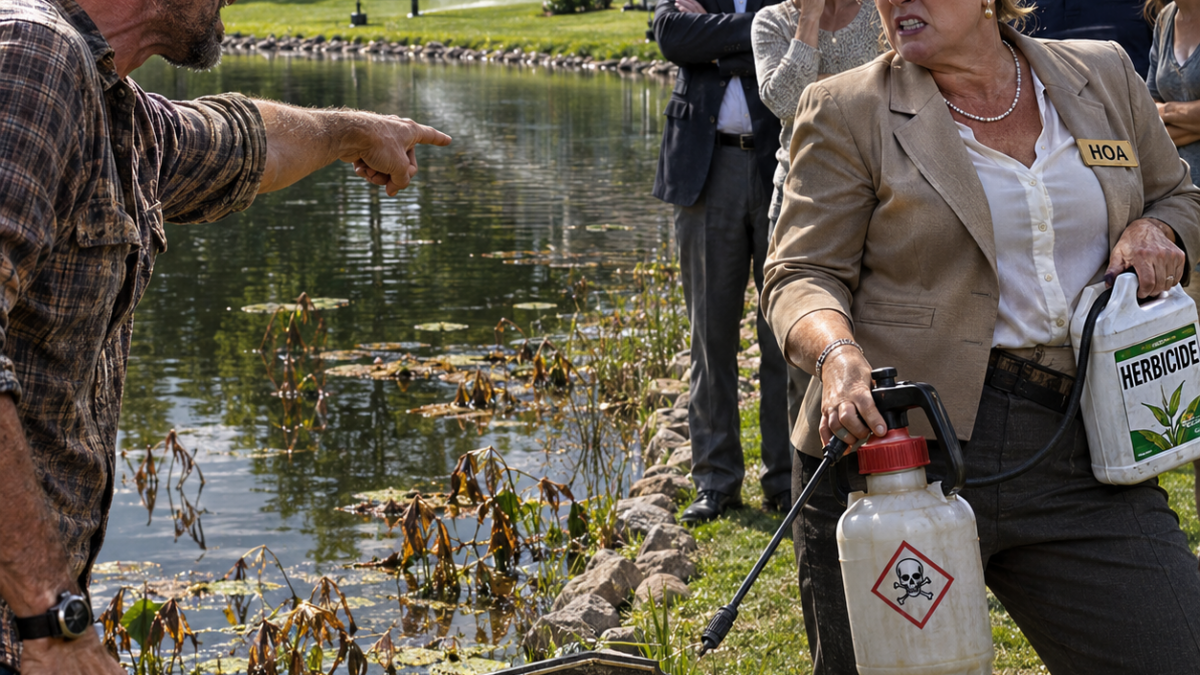
And above the shoreline, watching the operation, stood Denise.
Sunglasses.
Clipboard.
Phone.
She was filming.
I parked.
Called the sheriff.
Called the state environmental hotline.
Then walked down to the bank.
“STOP THE SPRAY!”
The foreman turned.
I shouted again.
“SHUT IT DOWN!”
The pump stopped.
The boat drifted.
The foreman, a weathered man named Dale Burkhart, looked confused.
“Sir, what’s the problem?”
“This is private water.”
“We’re contracted by Lakeridge.”
“They don’t own the lake.”
His expression changed.
He looked toward Denise.
Then back at me.
“Sir, we were told—”
“I know what you were told.”
Denise descended partway down the slope.
She didn’t hurry.
People like Denise don’t hurry when an audience is present.
“Mr. Holloway.”
“Did you authorize this?”
“The board authorized a water-quality treatment.”
“Did you authorize this?”
“Yes.”
“On my lake?”
“This is water serving our community.”
“That doesn’t make it yours.”
Her smile appeared.
Small.
Controlled.
“We can discuss jurisdiction later.”
“No.”
I pointed toward the spray boat.
“We’re discussing it now.”
“You’ve refused every reasonable request.”
“What does that have to do with chemical treatment?”
“We have an obligation to address the vegetation problem.”
“There is no vegetation problem.”
“That is your opinion.”
“It’s also the opinion of every agency you complained to.”
She tilted her head.
“You are emotional.”
That sentence almost made me laugh.
People say you’re emotional when the facts are no longer useful to them.
I took one step closer.
“I spent twenty-nine years investigating water contamination.”
“I’m aware of your background.”
“Then you should understand how serious this is.”
“This product is approved for aquatic management.”
“That isn’t the question.”
She sighed.
“Then what is the question?”
“Who gave you permission?”
Her silence lasted maybe one second.
Then:
“The board.”
“The board does not own the lake.”
“The HOA has rights.”
“To withdraw irrigation water.”
Her smile faded.
“Not to chemically treat the source.”
Behind me, Dale called from the boat.
“Ma’am?”
Denise looked toward him.
“You told us you had management authority.”
“I do.”
I said, “Show him.”
She ignored me.
“Show him the deed.”
Nothing.
“Show him written authorization from the landowner.”
Nothing.
A sheriff’s cruiser appeared on the road.
Then another vehicle from the state environmental office.
For the first time since I had known Denise Prescott, I saw uncertainty reach her face before she could hide it.
## **WHAT THE SPRAY HAD ALREADY DONE**
The crew had covered most of the lake.
That was the part I couldn’t undo.
I could stop the remaining application.
I couldn’t pull what had already entered the water back into the tanks.
The first dead bass appeared that evening.
Four pounds.
Healthy fish.
Floating near the dam.
Then another.
By morning, there were dozens.
Later, hundreds.
Bass.
Crappie.
Bluegill.
Catfish.
Some species proved more resilient than others, but the shock to the lake was obvious.
Native vegetation browned and collapsed.
The water lost its clarity.
The smell changed.
I walked the bank photographing everything.
I had done that professionally for decades.
Fish kills.
Chemical spills.
Industrial discharges.
Agricultural runoff.
But I had never photographed one on the lake my father built.
Near the spillway, I found a large scarred catfish that the kids had nicknamed Old Judge.
Nobody knew exactly how old he was.
Children had been trying to catch him for years.
Mostly they saw him move in the shallows and told increasingly exaggerated stories about his size.
Now he floated motionless.
I stood there longer than I should have.
Then took the photograph.
That was when anger finally broke through.
Not the loud kind.
I didn’t smash anything.
I didn’t call Denise.
I didn’t threaten anyone.
I just stood beside my father’s dying lake and realized that somebody had poisoned a place because families with inexpensive coolers interfered with her view.
Then my phone rang.
Phil.
I answered.
“Mr. Holloway?”
“Yes.”
“Something’s wrong with the irrigation.”
I looked toward the southern intake.
The sentence took a second to register.
“What?”
“The landscaping. Brown patches everywhere.”
Then I remembered.
The pump.
The HOA intake.
The underground network.
Hundreds of sprinkler heads.
“Phil.”
“Yes?”
“Shut down the entire irrigation system.”
“What?”
“NOW.”
## **SIX O’CLOCK**
The system had started automatically at six that morning.
Same schedule as always.
Nobody had changed it.
Why would they?
The board had treated the lake as though it were an isolated decorative feature.
But the lake was the source feeding their irrigation network.
For hours, pumps had drawn water from the same chemically treated lake and distributed it through Lakeridge Estates.
Lawns.
Flower beds.
Shrubs.
Common areas.
The entrance landscaping.
The decorative fountain.
Every connected zone did exactly what it had been designed to do.
Move lake water.
Phil shut the system down as fast as he could.
Not fast enough.
By noon, damage was visible.
Leaves curled.
Flowers wilted.
Patches of turf changed color.
The rose garden Denise photographed constantly began collapsing.
Crepe myrtles showed stress.
Residents started calling.
Then something far more serious surfaced.
Some recreational water features had connections nobody on the board had properly considered when approving the treatment.
Children had been exposed to water circulated through affected infrastructure.
That changed the entire case.
Until then, Denise might have tried to describe the disaster as an expensive property dispute.
Now people’s health was involved.
County officials issued emergency instructions.
Stay off treated lawns.
Keep pets away from affected areas.
Stop all irrigation.
Avoid contact with residue.
Residents who had been exposed were advised to seek medical evaluation when appropriate.
Several children were examined.
Some developed irritation.
One elderly resident who had spent part of the morning gardening developed painful skin symptoms.
I remember seeing one mother outside the clinic.
She looked exhausted.
Not angry yet.
Fear comes before anger when children are involved.
She recognized me.
“Mr. Holloway?”
“Yes.”
“Was the lake dangerous yesterday?”
I thought carefully before answering.
“Not before the treatment.”
She closed her eyes.
“My son was in the water feature.”
“I heard.”
“He asked me why the water hurt.”
There are sentences you carry.
That became one of mine.
She looked at me.
“We voted for that project.”
“You voted based on what you were told.”
“I should’ve asked questions.”
I didn’t say anything.
She was already punishing herself enough.
Then she said:
“Denise told us it was about community safety.”
That was when fear became anger.
Not just hers.
The entire neighborhood’s.
## **THE VIEW FROM THE RIDGE**
By Wednesday evening, Holloway Lake looked wounded.
Lakeridge Estates did too.
From Denise’s deck, she could see both.
The lake below.
The damaged landscaping around sixty-eight homes.
Brown sections where green had been.
Flower beds collapsing.
Crepe myrtles dropping leaves.
The carefully designed entrance garden losing color.
Everything she had controlled for appearance now revealed the cost of her control.
There was a terrible irony in it.
Denise had wanted the lake quieter.
Cleaner, according to her version.
She wanted families gone.
She wanted fishermen removed from her view.
Now no families were fishing.
The bank was empty.
The lake was under emergency review.
The neighborhood had shut down its irrigation.
The view from her expensive deck was finally as empty as she had wanted.
I wondered whether she felt victorious.
I learned later that she didn’t stay on the deck long.
Investigators arrived that evening.
## **DENISE HAD DOCUMENTED EVERYTHING**
Most environmental investigations take time because intent is difficult to establish.
People lose documents.
Contractors blame subcontractors.
Officials misremember conversations.
Everybody says somebody else approved something.
Denise had done the opposite.
She had documented herself with astonishing thoroughness.
Board resolution.
Meeting minutes.
Presentation.
Signed contractor agreement.
Payment authorization.
Emails.
Photographs.
Social-media posts.
Video of the spray boat.
The contractor preserved his communications too.
Dale Burkhart cooperated.
He told investigators he had asked more than once about property authorization.
He had been assured the HOA had authority.
Denise had apparently provided a document with an official-sounding title describing some type of environmental stewardship power over the lake.
The problem was simple.
You cannot write yourself ownership over somebody else’s property.
A document doesn’t become law because the font looks professional.
As a former regulator, I had rarely seen a case where the central figure created so much of the evidentiary trail personally.
When an investigator visited me, I put the Prescott file on the table.
Letters.
Agency complaints.
Denials.
Photographs.
Timeline.
“I kept everything.”
He opened the folder.
“This goes back how far?”
“Over a year.”
He flipped through the first letters.
“She wanted you to stop public fishing?”
“Yes.”
“Before environmental concerns?”
“Long before.”
He read the letter about visual screening.
Then the one describing children as excessive recreational noise.
Then the photographs she had annotated.
He looked up.
“This helps establish motive.”
“I figured it might.”
“Your background is environmental enforcement?”
“Twenty-nine years.”
He smiled faintly.
“That explains the file.”
## **THE BOARD TURNS ON HER**
The emergency HOA meeting happened two days later.
I didn’t attend at first.
Phil called afterward and told me what happened.
More than fifty homeowners showed up.
Denise opened by describing the event as an “unanticipated irrigation interaction.”
That phrase became famous around Lakeridge.
Unanticipated irrigation interaction.
As though hundreds of sprinkler heads somehow developed independent judgment.
A homeowner stood.
“You knew the neighborhood irrigation comes from Holloway Lake.”
Denise answered:
“The treatment was represented as safe.”
Another resident:
“Safe for what?”
Denise looked irritated.
“Approved aquatic use.”
“Was it approved for our lawns?”
Silence.
Someone else:
“Was it approved for the fountain?”
No answer.
“Did you ask?”
Denise tried to redirect.
“We need to focus on remediation rather than blame.”
That didn’t work.
Phil finally stood.
“I asked whether we had permission from the lake owner.”
Denise turned toward him.
“You voted against the proposal.”
“Yes.”
“Then you share responsibility as a board member.”
“No.”
That one word changed the room.
Phil continued.
“I voted no because you could not produce authorization.”
Residents started shouting questions.
Where was the deed?
Who approved the contract?
Why wasn’t the irrigation intake discussed?
Why were they told the lake had an environmental problem after multiple agencies had found none?
Why had fourteen thousand dollars been spent without contacting the property owner?
Denise kept trying to regain order.
But authority is fragile once people stop believing the person holding the gavel knows more than they do.
By the end of that meeting, several board members had retained their own lawyers.
Not HOA counsel.
Personal lawyers.
That tells you everything.
## **THE INVESTIGATION**
Laboratory testing documented contamination consistent with the treatment.
Environmental officials began assessing the fish kill and vegetation damage.
The neighborhood’s soil and irrigation infrastructure had to be evaluated.
Medical records documented exposure complaints.
The contractor’s records showed what had been ordered and applied.
The HOA records showed who authorized payment.
Denise’s communications showed she understood ownership had been disputed long before the treatment.
That last point mattered.
This wasn’t a situation where somebody accidentally treated the wrong pond because boundaries were confusing.
She had sent me letters.
I had told her the lake was mine.
County offices had dealt with her complaints.
Government agencies had repeatedly refused to support her claims of authority.
Phil had specifically questioned whether the board had property-owner permission.
And still she proceeded.
When I was interviewed formally, one investigator asked:
“Did Ms. Prescott ever ask you to authorize vegetation management?”
“No.”
“Did she ask to sample the water?”
“No.”
“Did she ask to conduct a biological survey?”
“No.”
“Did she request permission for contractor access?”
“No.”
“Did you know about the scheduled treatment?”
“No.”
“When did you learn about it?”
“When Bud called me while the boat was already spraying.”
He stopped writing.
“So the first notice you received was during application?”
“Yes.”
He shook his head slightly.
Then resumed writing.
## **THE FIRST CLEAN WATER**
For weeks, nobody fished.
That hurt more than I expected.
Saturday morning arrived and the gate remained closed.
Bud still came.
He parked under the loblolly.
Didn’t take out his cane pole.
Just sat.
I walked over.
“Morning.”
“Morning.”
He handed me coffee.
It was awful.
Exactly the way he liked it.
We sat without talking.
Finally he looked toward the lake.
“Your daddy would be mad.”
“Yeah.”
“But he’d fix it.”
I nodded.
“That’s what we’re doing.”
Bud looked at me.
“You gonna get tired?”
“Probably.”
“Quit?”
“No.”
“Good.”
That was Bud’s entire motivational speech.
It worked.
Environmental restoration began with patience.
Clean spring flow continued entering the lake.
That mattered.
Fresh water moved through.
Contaminated material had to be assessed.
Damaged vegetation would need restoration.
Fish populations could not simply be replaced all at once without thinking about ecological balance.
I understood that professionally.
Emotionally, I wanted trucks full of fish arriving tomorrow.
Science doesn’t care what grief wants.
So we waited.
Measured.
Tested.
Restored.
Exactly the way Dad had built the lake in the first place.
Slowly.
## **MAI’S NOTEBOOK**
The Nguyen family stopped by one afternoon even though fishing was still closed.
Mai carried her spiral notebook.
The one full of fish names.
She stood on the dock and stared at the water.
Then she opened the notebook.
I saw pages covered in purple writing.
Lieutenant Whiskers.
Princess Bubbles.
The General.
Old Judge.
Dozens more.
She had drawn a line through many names.
Not violently.
Just one careful line each.
I sat beside her.
“You okay?”
“No.”
Fair answer.
She looked at me.
“Did they hurt?”
I hated the question.
“I don’t know.”
“Did Old Judge know?”
“Know what?”
“That something was wrong.”
“I don’t know, honey.”
She closed the notebook.
“Are there going to be fish again?”
“Yes.”
“You promise?”
Children make promises dangerous.
They believe them.
I thought of every environmental case I had worked.
Every variable.
Every uncertainty.
Then I looked at her.
“Yes.”
That was the moment restoring the lake stopped being a project.
It became a promise.
## **DENISE’S DEFENSE**
Denise hired an expensive Houston attorney.
Her public position became that she had acted in good faith.
She believed the HOA possessed management authority.
She believed treatment was necessary.
She believed the contractor was responsible for proper application.
She believed the board shared responsibility.
She believed the resulting irrigation contamination was unforeseeable.
That word appeared repeatedly.
Unforeseeable.
I heard about it and thought of the intake pipe.
Four inches wide.
Installed openly.
Pump house visible from the south shore.
Easement in HOA files.
Miles of irrigation pipe.
Hundreds of sprinkler heads.
It wasn’t hidden infrastructure.
It was simply infrastructure Denise had never cared to understand because it wasn’t part of the visual presentation.
She knew what color the flower beds were supposed to be.
She apparently didn’t know where the water feeding them came from.
That became the central symbol of everything.
She managed appearance.
She ignored systems.
But systems don’t disappear because you don’t understand them.
## **THE GRAND JURY**
By December, the case had become criminal.
I will not pretend I celebrated.
Prison is not entertainment when real families were hurt.
But accountability had moved beyond an HOA dispute.
Children had been exposed.
Private property had been chemically treated without authorization.
A lake ecosystem had been damaged.
Government complaints and prior warnings established history.
The grand jury returned multiple charges related to unlawful environmental conduct, property damage, false statements, trespass, and endangerment.
When the news reached Lakeridge Estates, Denise resigned as president.
Technically, the board accepted her resignation.
In reality, she had no board left.
Several members had already distanced themselves.
Residents demanded records.
Some wanted the HOA dissolved.
Others wanted every decision Denise had made reviewed.
Phil became acting facilities contact.
He called me.
“I’m sorry.”
“You voted no.”
“I should’ve pushed harder.”
“Maybe.”
He went quiet.
I continued.
“But four adults voted yes. A contractor asked questions. I wasn’t contacted. Responsibility belongs where it belongs.”
“I keep thinking if I’d called you earlier.”
“You did call.”
“Not soon enough.”
“No.”
That truth hurt.
But I wasn’t going to comfort him with a lie.
He accepted it.
Then he said:
“We’re disconnecting the lake intake.”
“For now?”
“Permanently, probably.”
“Where will irrigation come from?”
“Municipal connection.”
“Expensive.”
“Very.”
I looked toward the dead sections of shoreline vegetation.
“Sometimes education is expensive.”
Phil laughed once.
Without humor.
“That should be engraved on the clubhouse.”
## **THE TRIAL**
The trial lasted only several days, but the story behind it stretched across almost two years.
I testified.
Dale testified.
Phil testified.
Residents testified about the board presentation.
Environmental specialists explained what happened to the lake.
Medical evidence addressed the people exposed.
The prosecutor showed Denise’s presentation.
Her signed contract.
The payment.
Her emails.
The contractor communications.
The social-media post celebrating the treatment.
Then they showed the letters she had sent me months earlier complaining about fishermen.
That was powerful.
Because the environmental explanation suddenly had context.
Before she claimed the lake needed chemical management, she had spent months trying to remove people from her view.
Her lawyer argued she sincerely believed the treatment served the community.
Maybe she did believe parts of that by the end.
People can turn personal desire into moral justification with remarkable speed.
But belief does not create ownership.
Confidence does not create expertise.
And an HOA vote does not transform private property into association property.
The jury returned guilty findings on the charges before them.
Denise stood very still.
I watched from several rows back.
I expected to feel something dramatic.
I didn’t.
Mostly, I thought about the lake.
The sentence included years of incarceration, substantial restitution obligations, and permanent restrictions preventing her from holding similar HOA leadership positions again.
Money was ordered toward remediation and the harm caused.
I was awarded compensation related to property damage and the extended harassment.
People congratulated me afterward.
I didn’t know what to say.
Nobody had won.
The best version of events would have been Denise sitting on her deck, watching families fish, deciding she didn’t like it, and then learning to live with a view she didn’t control.
Instead, a lake had died.
Children had gone to doctors.
Families had lost landscapes.
A woman went to prison.
That isn’t victory.
That is the cost of refusing to stop when reality tells you no.
## **THE END OF Lakeridge AS DENISE BUILT IT**
Without Denise, the HOA changed rapidly.
Residents voted to dismantle much of the system she had centralized around herself.
Some association functions remained where legally necessary, but the culture collapsed.
The elaborate entrance landscaping was replaced with native plants requiring less irrigation.
The decorative fountain was removed.
Nobody missed it.
The old lake intake was disconnected.
Lakeridge Estates connected its irrigation needs to municipal infrastructure.
The bill was enormous.
Hundreds of thousands of dollars.
Residents paid through assessments.
I didn’t enjoy that.
Most of them had never met me before the disaster.
Some had voted for Denise’s proposal because she told them it was routine environmental maintenance.
They had been careless.
But carelessness and malice are not the same thing.
People started coming to my property to apologize.
The first was an elderly man named Robert.
He stood at my gate holding his hat.
“I voted yes.”
I nodded.
“I figured.”
“I didn’t read anything.”
“Most people didn’t.”
“I trusted her.”
“I know.”
He looked toward the lake.
“I’m sorry.”
That was enough.
Not because an apology repaired anything.
Because it meant somebody had learned something.
## **RESTORING HOLLOWAY LAKE**
The springs ran continuously.
Dad had chosen that valley partly because of them.
Cold, clean water moved through limestone and into Piney Creek.
Slowly, water quality improved.
Vegetation restoration began.
Native plants went back into shallow areas by hand.
Root by root.
Not decorative plants selected for appearance.
Plants that belonged there.
Plants that provided habitat.
Plants that stabilized shoreline.
Fish restocking happened carefully.
Bluegill first.
Foundation species.
Then crappie.
Later bass.
The catfish needed less help.
Bud was delighted by that.
“Catfish don’t believe in extinction.”
“That’s not scientifically accurate.”
“Neither is half the stuff people say before breakfast.”
Fair.
The dock needed work too.
I replaced old decking with cypress.
Kept the original posts where I could.
The first board Dad had nailed down decades earlier was long gone.
That used to bother me.
After Ellen died, I wanted everything connected to memory to remain unchanged.
But wood rots.
Metal rusts.
People die.
Keeping something alive doesn’t mean freezing it.
It means rebuilding without forgetting what it was for.
## **THE FIRST SATURDAY BACK**
When testing finally showed the lake was ready for limited fishing again, I reopened the gate.
Saturday morning.
Seven o’clock.
Bud arrived first.
Of course.
Same truck.
New lawn chair.
This one had a cup holder.
I pointed at it.
“What happened to the old chair?”
“Wore out.”
“You upgraded.”
“Don’t start.”
He carried it under the same loblolly.
Sat.
Poured coffee.
Rigged his cane pole.
For almost forty minutes, neither of us caught anything.
Then his float moved.
Bud lifted the pole.
A small bluegill flashed in the water.
He brought it in.
Looked at it.
Then at me.
“Fish are back.”
Three words.
That was all.
I had spent months reading lab reports, remediation plans, species counts, water-quality data, and restoration schedules.
Bud summarized all of it better.
Fish are back.
## **THE NGUYENS RETURN**
Sunday brought the Nguyen family.
All four kids.
Mai ran ahead.
She was older now.
Still carrying the notebook.
She went straight to the dock.
Knelt.
Looked into the water.
For a long time, she didn’t speak.
Then she opened the notebook to the pages of crossed-out names.
Turned past them.
Found a clean page.
At the top, in purple ink, she wrote:
**NEW FRIENDS**
Ten minutes later, she caught a bluegill.
Small.
Healthy.
Perfect.
She held it at eye level.
Studied it with total seriousness.
Everybody waited.
Finally she announced:
“Captain Comeback.”
Bud nodded from across the lake.
“Good name.”
Mai released the fish.
It disappeared.
I turned away for a second.
Not because I was embarrassed to cry.
I just wanted one private moment with Ellen.
She would have loved it.
The children.
The noise.
The badly tied knots.
Bud pretending not to care.
Families returning to a place somebody had tried to sterilize into scenery.
## **ANGER WORKS LIKE CONTAMINATION**
For months, people asked whether I hated Denise.
I did for a while.
I won’t pretend otherwise.
When I found Old Judge floating near the spillway, I hated her.
When I heard about children exposed through community water features, I hated her.
When I watched my father’s lake turn cloudy, I hated her.
When Mai crossed out fish names, I hated her.
But anger behaves strangely.
You tell yourself it protects what you love.
Sometimes it does.
For a while.
Then if you leave it sitting inside you long enough, it starts killing other things.
Sleep.
Patience.
Relationships.
Joy.
In that sense, anger is a lot like contamination.
You have to stop the source.
Then you have to let clean things move through.
Work.
Time.
People.
Honesty.
I let the springs clean the lake.
And eventually, I let ordinary life clean me.
Bud complaining about coffee.
Kids shouting when they caught fish.
Phil calling to ask whether native grasses would work near the new entrance landscaping.
Residents stopping at the gate to say thank you.
Those things pushed poison out slowly.
## **THE LETTER FROM A MOTHER**
One envelope arrived almost a year after the trial.
No return address I recognized.
Inside was a handwritten letter from the mother whose son had been exposed.
She wrote that he was doing well.
Then:
**I spent months being angry at Denise, then I realized I was also angry at myself because I voted for the project without reading anything. I believed presentation instead of asking basic questions. I want my son to grow up knowing that being responsible means admitting when you helped create a bad decision, even if somebody else led you there.**
I read that paragraph several times.
Then:
**He wants to fish when he’s old enough. If you’ll allow it.**
I wrote back.
**The gate is open Saturday morning.**
That boy caught his first fish the following spring.
A bluegill.
His mother cried harder than he did.
## **THE RIDGE CHANGES**
Lakeridge Estates looks different now.
Less polished.
Better.
The entrance isn’t lined with expensive ornamental beds anymore.
Native grasses move with the wind.
Wildflowers appear at inconvenient times.
Nobody color-matches them.
The crepe myrtles that survived have recovered.
Some were replaced.
Residents plant more drought-tolerant landscaping.
Water use dropped.
Property values did not collapse.
That surprised some of them.
Turns out a neighborhood can survive without maintaining every blade of grass like a golf green.
Some families even started walking down toward the lake.
Not to complain.
To fish.
The first time I saw three Lakeridge homeowners sitting near Bud, I laughed.
Bud looked annoyed.
“What?”
“Nothing.”
“Say it.”
“You realize those are the people Denise wanted the lake cleared for.”
He looked toward them.
Then shrugged.
“They brought decent coffee.”
That was apparently enough for forgiveness.
## **PHIL AND THE PIPE**
One afternoon, Phil and I stood near the old pump house.
The intake had been permanently disconnected.
The pipe remained.
He put his hand on it.
“Hard to believe this did all that.”
“The pipe didn’t do anything wrong.”
“You know what I mean.”
“I do.”
He looked toward the neighborhood.
“I walked past this pump house twice a week.”
“Probably.”
“Never thought about it.”
“That was the problem.”
“I knew water came from the lake.”
“Knowing and understanding aren’t the same.”
He nodded.
Then said:
“Denise knew too.”
“She knew there was an irrigation easement.”
“But she never traced it.”
“No.”
We stood quietly.
Then I said:
“She managed the brand.”
Phil looked at me.
“She never learned the plumbing.”
He laughed.
“That should be on her tombstone.”
“No.”
“Why not?”
“Too much attention.”
He nodded.
Fair.
## **MY FATHER’S RULE**
Dad had one rule about Holloway Lake.
Don’t lie about water.
When I was a kid, I thought he meant don’t pretend the lake was deep when it was shallow, or don’t tell somebody the fishing was good when it wasn’t.
Later I understood.
Water exposes lies.
If a factory claims nothing harmful left the property, test downstream.
If a rancher says runoff isn’t entering the creek, sample after rain.
If a company says contamination is contained, follow groundwater.
Water moves.
Connections reveal themselves.
Denise tried to treat Holloway Lake as one isolated visual object.
A surface.
A view.
Something she could manage from a PowerPoint.
But water was connected to the springs.
To fish.
To plants.
To families.
To an intake.
To a pump.
To miles of pipe.
To hundreds of sprinkler heads.
To lawns.
To gardens.
To common areas.
To people.
Her mistake wasn’t merely ordering treatment she had no right to order.
Her mistake was thinking anything involving water happens in isolation.
## **ELLEN’S DOCK**
Years after the case, I added a small brass plaque to the dock.
Nothing elaborate.
Ellen hated elaborate memorials.
It reads:
**SIT A WHILE.**
That was her favorite instruction.
Whenever I worked too much, worried too much, talked too much, she would pat the dock beside her.
“Sit a while.”
No inspirational quote.
No dates.
Just that.
Families notice it.
Sometimes strangers sit there.
That feels right.
One evening, Mai—no longer little—sat beside me.
“You ever miss how it was before?”
“Before Denise?”
“Yeah.”
I thought about it.
“Sometimes.”
“Would you undo everything?”
That surprised me.
“Of course I’d undo the damage.”
“No. I mean if you could make it so none of it ever happened.”
I looked toward Lakeridge.
Native grasses along the ridge.
No decorative fountain.
No private-lake marketing signs.
People from the neighborhood fishing beside county families.
Phil working with conservation volunteers.
Children who had learned what environmental responsibility actually meant.
“I don’t know.”
Mai nodded.
“Me neither.”
She opened the old notebook.
The first half held names of fish that were gone.
The second half was full again.
Captain Comeback had been joined by Mayor Gill, Big Linda, Sir Splashington, Auntie Blue, and approximately forty others.
She smiled.
“I think remembering the bad part makes the new fish more important.”
Kids grow up inconveniently wise.
## **THE LAST TIME I SAW DENISE**
Years later, after she had served part of her sentence and the legal process had moved on, I saw a photograph of Denise in a newspaper follow-up.
I almost didn’t recognize her.
Not because her appearance had changed dramatically.
Because context had.
No perfect deck.
No HOA podium.
No branded presentation.
No ridge above my lake.
Just a person.
That was the truth underneath everything.
Denise had spent years building authority through appearance.
Take away the title, the board, the followers, the PowerPoint, the controlled room, and what remained was a human being who had made terrible choices.
I didn’t feel satisfaction looking at the photograph.
I felt distance.
That was better.
The opposite of love isn’t always hate.
Sometimes it’s finally not giving someone space inside you.
## **A QUESTION FROM A NEW KID**
One Saturday, a boy I had never met asked:
“Are you the owner?”
“Of what?”
He pointed toward the water.
“The lake.”
“Yes.”
He looked confused.
“Then why do we get to fish?”
Because children ask the questions adults complicate.
I crouched.
“My dad built it so families could enjoy it.”
“So it’s ours?”
“No.”
His face fell slightly.
I smiled.
“But you’re welcome here.”
He thought about that.
“What’s the difference?”
That was the whole story.
“Something can belong to somebody and still be shared.”
He nodded slowly.
“Okay.”
Then ran toward the dock.
I stood there thinking about Denise.
She had never understood that sentence.
She believed shared meant ownerless.
Then she decided ownerless meant hers to control.
But generosity doesn’t erase ownership.
Ownership doesn’t require selfishness.
Healthy boundaries make generosity possible.
## **THE OPEN GATE**
The gate remains open every Saturday and Sunday morning.
Same tradition Dad started.
No charge.
No reservation.
No HOA registration.
People park under the pines.
Children carry tackle boxes.
Bud’s spot remained Bud’s until he eventually got too old to come regularly.
The first Saturday he missed, I kept looking toward the road.
The second too.
Eventually his nephew drove him down.
Bud moved slowly.
Used a cane now.
I offered to carry the chair.
He refused.
“I’m old, not decorative.”
We reached the pine.
He sat.
Watched the water.
“You done good.”
“With what?”
He waved vaguely.
“All this.”
Coming from Bud, that was almost emotional.
I looked at him.
“Dad started it.”
“Your daddy ain’t here.”
“No.”
“You are.”
I didn’t know what to say.
So I poured him coffee.
Bad coffee.
The correct kind.
## **THE SECOND GENERATION OF THE LAKE**
Children who once came with their parents now bring children of their own.
That’s how I measure time.
Not birthdays.
Fishing generations.
One man arrived with his daughter and said:
“My dad taught me to cast right over there.”
He pointed near the willow.
“When?”
“1998.”
I did the math.
“You were probably one of the kids Ellen used to feed sandwiches to.”
He laughed.
“She did.”
“My wife.”
His face changed.
“I remember her.”
Those words still catch me.
People remember Ellen.
Not cancer.
Not the hospital.
Her.
Sandwiches.
Coffee.
Laughing on the dock.
Telling children to throw little fish back.
That means more than any plaque.
## **THE OLD PRESENTATION**
Phil once found a printed copy of Denise’s Lake Stewardship presentation in storage.
“Want it?”
“No.”
“You sure?”
“Absolutely.”
He held it up.
Twenty-two pages.
Teal and cream.
Professional typography.
Charts.
Stock photographs.
“Feels historic.”
“So does mold.”
“What should I do with it?”
“Recycle it.”
He laughed.
“Appropriate.”
A week later, the paper was gone.
I kept none of it.
I had spent enough years preserving evidence.
Once the case ended, I no longer needed to live inside it.
## **THE MOST EXPENSIVE LESSON IN Lakeridge**
People sometimes calculate the cost.
Lake restoration.
Landscape replacement.
Medical monitoring.
Legal bills.
Municipal water connection.
Assessments.
Property repairs.
Restitution.
Millions when everything is counted broadly.
But money wasn’t the biggest cost.
Trust was.
Residents stopped automatically believing the board.
At first that made meetings harder.
Then healthier.
Every proposal got questions.
What does it cost?
Who owns the property?
Where does the water come from?
Has an engineer reviewed it?
Do we have permission?
What happens downstream?
Is this actually necessary?
Some people complained that meetings had become tedious.
Good.
Democracy should occasionally be tedious.
Tedious questions prevent spectacular disasters.
## **THE SIX A.M. LESSON**
I still wake early.
Around six most mornings.
Sometimes I stand on the porch and hear Lakeridge sprinklers starting in the distance.
They’re on municipal water now.
The sound is ordinary.
Click.
Hiss.
Water across grass.
Most residents probably never think about it.
I do.
Because one Wednesday morning, hundreds of sprinkler heads taught an entire neighborhood the same lesson my father had taught me as a child.
Water connects everything.
You can ignore the connection.
You can forget it.
You can fail to read the easement describing it.
The connection still exists.
That is true of pipes.
It is also true of people.
Denise wanted to remove fishermen from her view without understanding that some of those fishermen had been coming to the lake longer than her neighborhood existed.
She treated them like visual clutter.
But community isn’t landscaping.
You don’t trim people until the view looks expensive.
## **THE FAMILY PICNIC**
For the fiftieth anniversary of Dad opening the lake to public weekend fishing, we held a picnic.
Nothing formal.
No stage.
No speeches planned.
People brought food.
Someone brought a smoker.
Kids fished.
Former Lakeridge board members came.
Phil came.
Nadine—who had helped with some of the later financial reviews—came from out of town.
The Nguyen family came.
Bud came in a folding wheelchair and complained about everyone making a fuss.
Near sunset, somebody asked me to say something.
I refused.
Then everyone stared at me until refusing became more uncomfortable than speaking.
So I stood near the dock.
Looked at the lake.
Then at the crowd.
“My dad built this because he thought families needed somewhere they didn’t have to buy their way into.”
That was all I had planned.
Then I saw Ellen’s plaque.
**SIT A WHILE.**
So I continued.
“A few years ago, somebody tried to turn this place into something controlled by money, appearance, and authority. A lot of damage came from that.”
People quieted.
“But the lake is still here.”
I looked toward Mai’s children—yes, eventually she brought nieces and nephews, then later her own family.
“The important part isn’t that we won.”
I paused.
“The important part is that we came back.”
That was enough.
## **WHAT I WOULD CHANGE**
If I could redo one thing, I would have taken Denise seriously earlier.
Not because her first letters deserved respect.
They didn’t.
Because escalation often announces itself quietly.
People think danger begins when the spray boat arrives.
It rarely does.
It begins when somebody decides other people’s rights are inconvenient.
Then when nobody stops them, inconvenience becomes entitlement.
Entitlement becomes authority.
Authority becomes action.
The spray boat was only the final step in a chain that began with a letter complaining about children in the view.
I know that now.
## **THE THING ABOUT BEAUTIFUL PLACES**
People assume beauty is fragile.
Sometimes it is.
But Holloway Lake taught me something else.
Beauty can also be stubborn.
The water cleared.
Plants returned.
Fish spawned.
Birds came back.
Children returned.
Laughter carried across the surface again.
The ridge that once looked down at us with suspicion became part of the community surrounding the lake.
Nature is not invincible.
Damage can be permanent.
But when restoration is possible, the work is worth doing.
Dad spent four years building the lake.
Denise damaged it in days.
Repair took much longer than destruction.
That feels unfair.
It is also true of most things worth protecting.
## **THE FINAL MORNING**
The morning I finally stopped thinking of it as Denise’s disaster, I was sitting alone on Ellen’s dock.
Mist over the water.
Coffee in my hand.
Sun beginning behind the pines.
A truck came down the road.
Then another.
Doors opened.
Children spilled out.
One carried a red plastic wagon.
Almost identical to the wagon Denise had once photographed and labeled an unauthorized structure.
I laughed when I saw it.
The father looked confused.
“Something wrong?”
“No.”
I shook my head.
“Perfect.”
The little girl pulled the wagon toward the water.
Tackle box rattling.
Crackers inside.
Probably juice boxes.
Exactly the kind of ordinary clutter Denise had wanted hidden.
She parked it beside the dock.
Then ran to join the others.
A few minutes later, Bud’s nephew arrived.
Phil came with his grandson.
The Nguyens showed up.
Voices spread across the shoreline.
A child shrieked because a worm touched her hand.
Another shouted that he had caught a monster, which turned out to be a bluegill smaller than my palm.
I sat there.
Listening.
Life happening somewhere.
Ellen’s words.
I looked toward the eastern ridge.
Lakeridge Estates still stood.
Homes still expensive.
Decks still had the same view.
But now when residents looked down, they saw what had always been there.
Not a design flaw.
Not visual pollution.
Not strangers ruining their property value.
People.
Families.
A lake that existed before their subdivision and would, I hoped, remain long after all of us were gone.
Dad used to say water tells the truth because it always finds where things are connected.
He was right.
The springs connected to the lake.
The lake connected to the intake.
The intake connected to the sprinklers.
The sprinklers connected Denise’s decision back to the very neighborhood she claimed she was protecting.
But that wasn’t the most important connection.
The lake connected generations.
My grandfather’s land.
My father’s work.
Ellen’s memory.
Bud’s cane pole.
Mai’s notebook.
Children who hadn’t been born when Dad first opened the gate.
Even Lakeridge, eventually.
Denise wanted to turn a living place into a clean view.
She failed.
And I’m grateful she failed.
Because the best view from that ridge was never an empty lake.
It was children learning to cast.
Old men sitting under pines.
Parents opening coolers.
Fish breaking the surface.
People belonging somewhere without having to prove they could afford it.
I finished my coffee.
A little boy waved from the shoreline.
“Mr. Holloway!”
“What?”
“I got one!”
I stood.
“How big?”
He stretched his hands ridiculously far apart.
“This big!”
“Sure it is.”
He laughed.
I walked toward him.
Behind me, the water reflected morning light exactly the way Ellen used to describe it.
Like somebody had melted pennies across the surface.
For a moment, I could almost hear her telling me to sit a while.
But there was a child with a fish tangled in his line and nobody else close enough to help.
So I kept walking.
That was the ending I wanted.
Not Denise in a courtroom.
Not the dead rose garden.
Not the ruined landscaping.
Not even the moment the neighborhood realized the same water they allowed her to poison was flowing through their own pipes.
The ending was clean water.
New fish.
An open gate.
A red wagon beside the dock.
And a lake that once again belonged to my family in the legal sense, but belonged to everyone in the only way my father had ever cared about.
They were welcome there.
Not because an HOA declared it.
Not because somebody paid a fee.
Not because a marketing brochure promised a lifestyle.
Because the person who owned it chose to share it.
That is the difference Denise never learned.
Control demands.
Generosity invites.
And water, sooner or later, carries both back to the people who put them into the world.








