HOA Karen Planted Kudzu to Destroy My Fence—Five Years Later, It Swallowed Her Own Garage
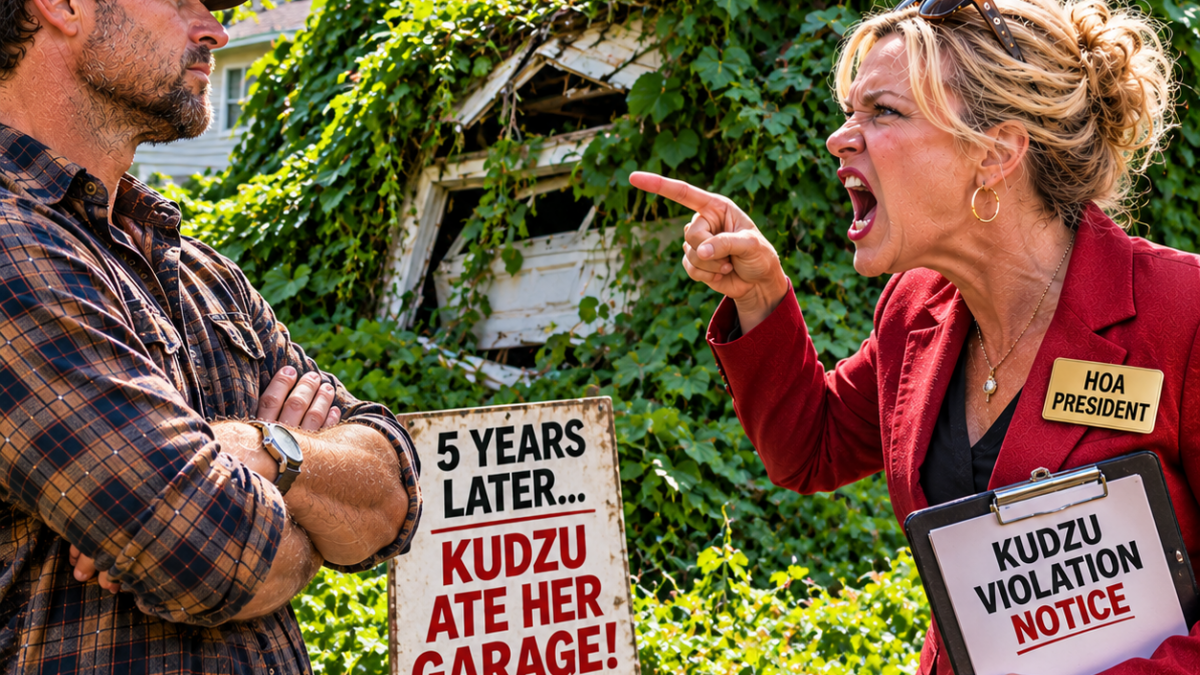
Karen smiled at the first green vine curling around the bottom of my brand-new cedar fence and told me I should have painted the whole thing beige when she gave me the chance.
She spoke like she had already won, as if a few innocent-looking leaves were enough to teach a retired Army engineer what happened when he refused to obey the woman who ran our HOA like a private kingdom.
I didn’t argue with her that morning, because something about the way those vines had appeared in a perfect line along fifty feet of fence told me this wasn’t a gardening accident—and before I touched a single leaf, I wanted to know exactly what she had put in the ground.
My name is Jack Riley.
For twenty-two years, I served with the Army Corps of Engineers.
By the time I retired, I had spent enough of my life around concrete barriers, temporary bases, damaged roads, bad weather, and places where every problem seemed to begin with somebody saying, “It’ll probably be fine.”
I wanted quiet.
My wife, Sarah, wanted a neighborhood where we could know the people next door.
Our daughter, Emily, wanted a street where she could ride her bike without us worrying every five minutes.
Oakwood Preserve looked like exactly that place.
Mature trees.
Walking trails.
A community pool.
A wooded greenbelt behind the houses.
For the first year, it really was peaceful.
The HOA president back then was Harold, a retired accountant who believed rules should solve actual problems. If someone left a broken refrigerator on the curb for three weeks, he sent a letter. If somebody’s grass grew a little high because they were sick, he knocked on the door and asked if they needed help.
Then Harold moved away.
Karen Miller replaced him.
Everything changed.
She won a low-turnout election and immediately treated the presidency like a promotion to governor.
The HOA handbook went from ten pages of common-sense rules to more than a hundred pages of microscopic restrictions.
Grass height.
Trash-can hours.
Porch decorations.
Holiday colors.
Mailbox finishes.
Approved landscaping.
She even fined the Garcia family two hundred dollars because their seven-year-old daughter drew a rainbow in sidewalk chalk on their own driveway.
Karen called it an “unapproved architectural modification.”
That told me almost everything I needed to know about her.
My personal fight started with a fence.
Our backyard faced the greenbelt, and I wanted something that actually matched the woods behind us.
Natural cedar.
Strong posts.
Clean lines.
Nothing extravagant.
I submitted the plan.
Both of my immediate neighbors approved it in writing.
Karen rejected it.
The architectural rules, she informed me, required a prefabricated non-organic fence in a specific shade of beige.
Not just beige.
Pantone 7527C.
I looked it up.
It was the color of surrender.
I filed a variance request.
Denied.
I cited the original community charter.
Ignored.
I asked for a hearing.
Karen chaired the committee and denied me again.
So I built the cedar fence.
I spent weekends setting posts, checking alignment, trimming boards, and making sure every section was level.
When I finished, Sarah stood beside me in the backyard and smiled.
“That looks like it belongs here.”
That was exactly what I wanted.
Two weeks later, the vines appeared.
Not one.
Not two.
A whole row.
Freshly planted along the greenbelt side of my fence.
Perfect spacing.
Fifty feet.
That morning I found Karen walking behind the houses in a bright pink tracksuit.
She stopped when she saw me inspecting the plants.
Her smile made my stomach tighten.
“You should’ve just painted your fence beige.”
I stood up slowly.
“What are these?”
“Plants.”
“I can see that.”
“Maybe nature agrees your fence is ugly.”
I looked down the line again.
The soil around each vine had been recently disturbed.
Somebody had planted them deliberately.
I looked back at her.
“Did you put these here?”
She gave me a small shrug.
“Community greenbelt. Community landscaping.”
“That isn’t an answer.”
“It’s the only one you’re getting.”
Then she smiled.
“Looks like you have a real problem now, Major.”
She walked away.
I stayed there, staring at those heart-shaped leaves.
I had spent too many years around engineering failures to ignore the first sign that something was wrong.
So I took out my phone.
Photographed every plant.
Every leaf.
Every stem.
Every fresh patch of soil.
Then I sent the pictures to an old friend who knew far more about plants than Karen ever would.
If she wanted to turn a fence dispute into something bigger, I was going to make sure I understood exactly what she had started before I made my next move.
PART 2
His name was Dave.
We had known each other since Fort Bragg.
After leaving the service, he went back to school, earned a doctorate in agricultural science, and eventually took a job with the state agricultural extension.
I expected an email.
Instead, my phone rang forty-five minutes after I sent the pictures.
“Jack.”
His voice was different.
Not casual.
“What?”
“Where exactly did you find this?”
“Behind my house.”
“How many plants?”
“Maybe twenty. Spread over fifty feet.”
“Did you plant them?”
“No.”
“Who did?”
“I have a pretty good idea.”
There was a pause.
Then:
“You need to take this seriously.”
I looked through the kitchen window toward the fence.
“Dave, it’s a vine.”
“No.”
His voice hardened.
“It’s kudzu.”
I said nothing.
I knew the name.
Anyone who had spent enough time in the South knew it.
I had seen old telephone poles disappear beneath it.
Trees smothered.
Barns turned into green mounds.
Whole slopes buried.
“The vine that ate the South?” I asked.
“The same.”
I walked outside while he talked.
Suddenly the heart-shaped leaves looked different.
More sinister.
“How fast?”
“In ideal conditions? Fast enough that you’ll think you’re imagining it.”
“Can I pull it?”
“You can pull what you see.”
“That didn’t sound encouraging.”
“It wasn’t supposed to.”
He explained the root systems.
The crowns.
How persistent established plants could become.
How a small problem could turn into a years-long fight if ignored.
Then he asked:
“You said this was planted?”
“Yes.”
“On HOA common property?”
“The greenbelt.”
“And the HOA president was standing there making jokes about your fence?”
“Yes.”
Dave was silent.
Then:
“Jack, do not treat this as some stupid neighborhood prank.”
“I wasn’t planning to.”
“This can become everybody’s problem.”
I looked down the greenbelt.
My property wasn’t the only one backing onto it.
Bill and Mary Henderson lived next door.
The Garcia family farther along.
Then another dozen homes.
And approximately a hundred yards down—
Karen.
Her own backyard ended at the same strip of woods.
I almost laughed.
I didn’t.
Not yet.
“Send me something in writing,” I said.
“Identification?”
“Everything.”
“You building a case?”
“I don’t know yet.”
Dave knew me too well.
“That means yes.”
—
Sarah found me at the dining room table that evening.
Printed photographs spread around me.
Dave’s preliminary email open on the laptop.
“What did he say?”
“Kudzu.”
She stopped.
“The bad stuff?”
“The very bad stuff.”
She looked toward the backyard.
“Can it damage the fence?”
“Yes.”
“The trees?”
“Yes.”
“The houses?”
“Potentially.”
Her expression changed.
“Jack.”
“I know.”
“No, I mean really. What are you going to do?”
I leaned back.
Twenty-two years in the Army had taught me how to think when people around me wanted immediate action.
Sometimes the fastest way to lose control of a problem is to touch it before you understand it.
“First, document.”
Sarah sighed.
“Of course.”
“You married an engineer.”
“I married a man who once made a spreadsheet for Christmas lights.”
“They were drawing too much current.”
“They were Christmas lights.”
“Electricity doesn’t respect holidays.”
She almost smiled.
Then glanced toward the fence again.
“Do you really think Karen planted it to ruin the fence?”
“I think she wants me to believe she did.”
“That isn’t the same thing.”
“No.”
“So?”
“So I want proof.”
—
The next afternoon, I bought trail cameras.
Three.
Motion activated.
High resolution.
Cloud backup.
I positioned them where they could capture the greenbelt side of my fence without pointing toward anyone’s private living space.
One camera recorded video.
Two captured periodic images.
Then I started a logbook.
Black cover.
Numbered pages.
Date.
Time.
Weather.
Observations.
Expenses.
Every communication with Karen.
Every HOA notice.
Dave’s identification.
Photographs.
The cameras.
I taped a copy of Dave’s email inside the front cover.
Emily came home from college that weekend and saw the book.
“What is this?”
“Documentation.”
She flipped through it.
“You titled it Kudzu Incident Log.”
“That’s what it is.”
“You’re such a dad.”
“I’m your dad.”
“No, I mean professionally.”
I took the book back.
“Mock me all you want.”
She looked through the window.
“So Karen really planted an invasive vine because she hates a fence?”
“We don’t know that.”
“You know that.”
“I suspect it.”
“Same thing.”
“No.”
I tapped the logbook.
“This is the difference.”
—
I controlled the growth reaching my side of the fence as carefully as I could.
Cutting.
Targeted treatment.
Constant inspection.
I did not march into the common greenbelt and start tearing up landscaping I didn’t own.
Karen would have loved that.
She would have turned the story immediately.
**DISGRUNTLED HOMEOWNER DESTROYS HOA PROPERTY.**
No.
I was not giving her that.
Instead, I waited.
A week later, at 7:42 in the evening, one camera sent an alert.
I opened the footage.
There she was.
Karen.
Gardening gloves.
Watering can.
A bag in her other hand.
She knelt beside the vines.
Watered them.
Moved to the next.
Then the next.
She sprinkled something around several plants.
Tended them carefully.
This wasn’t neglect.
This wasn’t accidental spread.
She was cultivating them.
I watched the clip twice.
Then once more with Sarah.
She covered her mouth.
“My God.”
“Yeah.”
“You were right.”
“I wish I wasn’t.”
I saved the original.
Copied it to an encrypted drive.
Copied it again.
Cloud archive.
Then entered:
**Exhibit A — Karen Miller actively tending planted kudzu along greenbelt boundary.**
Sarah read over my shoulder.
“Exhibit A?”
“Yes.”
“What happened to quiet retirement?”
I looked at the video frozen on Karen’s face.
“She happened.”
—
I could have exposed her then.
Part of me wanted to.
Send the footage to the whole neighborhood.
Call an emergency meeting.
Put Karen on a projector screen watering the plant she claimed was “nature.”
But Dave advised caution.
“The important thing isn’t embarrassing her,” he said.
“It would be enjoyable.”
“Jack.”
“I know.”
“You need remediation.”
“Yes.”
“And if she’s using HOA property to do this, the board needs to address it responsibly.”
“That board does whatever she says.”
“Then document that too.”
He was right.
Besides, I had another problem.
Karen’s behavior wasn’t happening in isolation.
The more I looked around Oakwood Preserve, the more I saw the same pattern.
Not vines.
People.
—
Bill Henderson lived next door.
Late seventies.
Retired postal worker.
His yard had once been full of bird feeders.
I noticed they were gone.
One Saturday I caught him edging the driveway.
“Morning, Bill.”
He straightened.
“Morning, Major.”
“Jack.”
“You’ll always be Major to me.”
“Then I’m calling you Postmaster.”
“Fair.”
I glanced toward his empty feeder pole.
“What happened?”
He followed my eyes.
His expression changed.
“Karen.”
Of course.
“She decided feeders attract pests.”
“Birds?”
“Apparently flying criminals.”
“What did she fine you?”
“Hundred dollars.”
“And?”
“I argued.”
“Bad move?”
“Another hundred.”
He leaned on the edger.
“Mary told me to pay it.”
“Why?”
“We’re too old for this garbage.”
His voice softened.
“I know it’s stupid.”
“It isn’t.”
“I used to sit out here every morning with coffee. Cardinals. Blue jays. Chickadees.”
He looked at the empty yard.
“My dad got me into birds when I was six.”
That was when I understood.
Karen hadn’t removed feeders.
She had removed a ritual.
Something that made retirement feel like life instead of waiting.
“She stole that from you,” I said.
Bill shrugged.
“Not worth a war.”
I looked at my cedar fence.
Maybe.
Maybe not.
—
I told him about the kudzu.
Not everything.
Just enough.
His eyebrows rose.
“She planted that?”
“I have video of her tending it.”
“Jesus.”
“I’m documenting.”
“You going after her?”
“I’m protecting my property.”
“That wasn’t what I asked.”
I smiled.
“Not yet.”
A week later, Mary appeared at our door with lemon meringue pie.
Bill stood behind her looking embarrassed.
“Bill told me what you’re doing,” she said.
“I’m mostly taking pictures.”
“You’re standing up.”
She pressed the pie into my hands.
“About time somebody did.”
—
Then Maria Garcia.
Her daughter’s chalk rainbow had cost the family two hundred dollars.
I found Maria at the playground.
Her little girl, Sofia, was on the swings.
I introduced myself.
She knew who I was.
Everybody did by then.
“The fence guy.”
“Apparently.”
I asked about the sidewalk chalk.
Her face changed instantly.
“Two hundred dollars.”
“For chalk?”
“She said it altered the visual presentation of the property.”
Her voice tightened.
“We had to take it from our grocery budget that month.”
That made my jaw clench.
“Why did you pay?”
Maria looked toward her daughter.
“We rent.”
I understood.
“You thought she could cause trouble with your landlord.”
“She said continued violations could affect the property owner.”
Fear again.
Karen knew exactly where to press.
I told Maria what was happening behind my fence.
Her eyes widened.
“She planted kudzu?”
“That appears to be what happened.”
“On purpose?”
“I have evidence she’s maintaining it.”
Maria looked furious.
Then scared.
“What do you need?”
“Nothing today.”
“If you fight her, I want to know.”
“You sure?”
She looked toward Sofia.
“My daughter stopped drawing outside.”
That was her answer.
—
The stories accumulated.
Trash cans.
Welcome signs.
Basketball nets.
Holiday decorations.
Flowerpots.
Grass.
Children’s toys.
One homeowner had been photographed through his front window because Karen wanted evidence of an unapproved curtain color.
Another had been fined because visitors parked overnight during a funeral.
Different rules.
Same method.
Make the infraction feel official.
Make resistance feel expensive.
Make each resident believe they were alone.
So I built something Karen never anticipated.
A private email group.
Bill suggested calling it:
**People Who Are Sick of Karen.**
Maria suggested something less legally discoverable.
We settled, half jokingly, on:
**Oakwood Liberation Front.**
OLF.
Ridiculous.
But people joined.
First five.
Then twelve.
Then twenty.
We shared notices.
Photographs.
Meeting minutes.
Appeals.
Not gossip.
Evidence.
That rule was mine.
If you couldn’t document it, we labeled it rumor.
I wasn’t interested in becoming what we were fighting.
—
Meanwhile, kudzu grew.
And grew.
And grew.
I spent Saturdays fighting it at my fence.
At first, an hour.
Then two.
Some weekends longer.
Cutting back new runners.
Treating growth where legally appropriate on my side.
Inspecting posts.
Clearing anything attempting to root inside my yard.
Receipts went into the file.
So did labor hours.
Every bottle.
Every replacement tool.
Every damaged board.
Every photograph.
Karen kept appearing on camera.
Not weekly.
But often enough.
Checking.
Watering in dry weather.
Clearing competing vegetation near established crowns.
Once she stood with her hands on her hips, staring toward my fence as though admiring a painting.
Sarah watched that footage beside me.
“She enjoys this.”
“Yes.”
“That is deeply disturbing.”
“Yes.”
“Can’t we just report her now?”
“We could.”
“Then why aren’t we?”
I looked at the footage.
“Because if the board protects her, we’ll be back where we started.”
“So what are you waiting for?”
“For enough people to stop being afraid.”
—
Year one became year two.
My fence stayed standing.
Karen seemed irritated by that.
She sent a violation for discoloration near the base of several boards.
I laughed when I opened it.
The discoloration came from years of fighting the vine she had planted.
Her letter demanded I restore a “uniform natural finish.”
I filed an appeal.
Attached photographs.
Receipts.
Dave’s identification.
Dates.
Her board denied it.
I logged the denial.
Year three.
More kudzu.
The greenbelt began changing.
Native shrubs disappeared beneath thick leaves.
Young trees vanished.
Large trunks became wrapped.
From a distance, the area remained green.
That was the deceptive part.
People saw green and thought healthy.
But underneath, diversity was disappearing.
The forest was being replaced by one plant.
Karen called it lush.
Dave called it ecological strangulation.
—
By year four, Bill had kudzu reaching the back of his yard.
That changed him.
He came to my house holding a vine like evidence in a murder trial.
“This is it?”
“Yes.”
“Same stuff?”
“Yes.”
His jaw tightened.
“That woman.”
He filed a written complaint with the HOA.
No response.
Then another.
The Garcias reported growth behind their rental.
Another homeowner complained about vines reaching a shed.
Karen’s official explanation?
Aggressive native vegetation.
Dave almost choked when I sent him that phrase.
“Native?”
“No.”
“Not even close.”
“Can you put that in a formal statement?”
“With pleasure.”
Now we had expert documentation.
Homeowner complaints.
Time-lapse footage.
Board inaction.
Karen’s cultivation.
Expenses.
Four years.
The coalition grew.
Thirty households.
Then thirty-five.
Karen didn’t know how much resentment existed because people still smiled when she passed.
Fear teaches good acting.
—
By year five, the greenbelt no longer looked like woodland.
It looked like somebody had thrown an enormous green blanket over everything.
Tree shapes remained underneath.
Ghosts.
The kudzu climbed high, crossed branches, pulled at weakened limbs.
Property owners began talking about values.
Insurance.
Tree damage.
Drainage.
Karen finally stopped bragging about how “natural” it looked.
Because the vine had reached her house.
More specifically:
Her detached two-car garage.
It sat behind the main home.
Maybe twenty feet from the greenbelt.
Early spring growth reached the rear wall.
Karen cut some of it back.
The camera caught her.
Two weeks later it returned.
By late spring, half the wall disappeared.
Then the roof edge.
Then one gutter.
I watched from my property.
No celebration.
Not yet.
Because kudzu damaging Karen’s garage still meant we had a neighborhood-wide disaster.
But I would be lying if I said the irony escaped me.
—
One morning, Sarah handed me coffee and pointed through the upstairs window.
Karen’s garage looked like a green hill with a door.
“She finally painted something a color other than beige.”
I nearly spit out my coffee.
“Sarah.”
“What?”
“That was cruel.”
“I’ve had five years.”
Fair.
—
The damage accelerated.
Vines worked under loose roofing.
Gutters sagged.
Moisture followed.
A window disappeared behind leaves.
Then Karen sent a community-wide email.
**URGENT GREENBELT VEGETATION ISSUE**
No mention of kudzu.
No mention of origin.
No mention of five years of complaints.
According to her message, Oakwood Preserve had recently experienced an “unexpected invasive-growth event.”
Recently.
I read it aloud.
Bill was sitting at our kitchen table.
He laughed so hard he coughed.
“Recently?”
“Apparently five years is recent.”
Maria shook her head.
“She’s going to pretend she didn’t do it.”
“Yes.”
Bill looked at me.
“You’re not going to let her.”
“No.”
For five years I had been patient.
Now patience had completed its purpose.
—
Arthur Vance came recommended by an old commanding officer.
Retired Marine JAG.
Semi-retired attorney.
HOA litigation.
Silver hair.
Dark suit.
Calm eyes.
The kind of man who didn’t need to raise his voice because he enjoyed watching other people realize they should have listened earlier.
I brought one logbook.
Not all three.
And the hard drive.
After two hours, he leaned back.
“Let me summarize.”
“Okay.”
“HOA president dislikes fence.”
“Yes.”
“She deliberately plants kudzu on common property beside the fence.”
“Video appears to show that.”
“She cultivates it.”
“Yes.”
“For years.”
“Yes.”
“Board receives complaints and does nothing meaningful.”
“Yes.”
“You personally spend thousands controlling growth originating from common property.”
“Yes.”
“And now the president’s garage is being eaten by the plant she introduced.”
“Yes.”
Arthur took off his glasses.
“Major.”
“Retired.”
“In thirty years of doing this…”
He smiled.
“…this may be the most beautifully documented act of self-destruction I’ve ever seen.”
—
I expected him to file suit immediately.
He didn’t.
“Court is last.”
“Why?”
“Because your HOA already gave us weapons.”
He opened Karen’s 110-page rulebook.
“For once, let us appreciate her work.”
I laughed.
We read.
Buried inside:
**Duty to Maintain Common Areas.**
The association was responsible for hazards originating from common property.
Another section:
**Hazardous Conditions.**
Homeowners could formally report hazardous conditions.
Board had thirty days to provide a remediation plan.
Arthur tapped the page.
“She wrote this?”
“Under her administration.”
“Delicious.”
Then state law.
Noxious weeds.
Kudzu specifically regulated.
Potential liability for knowingly spreading or maintaining prohibited invasive vegetation depended on the applicable statute and facts, but Arthur believed the evidence justified immediate official review.
That was enough.
We did not need theatrical legal claims.
We needed pressure supported by documented facts.
—
The Oakwood Liberation Front now represented forty-three households.
Arthur drafted the notice.
Professional.
Dry.
Terrifying.
Hazardous vegetation on common property.
Five-year history.
Expert identification.
Property damage.
Documented mitigation.
Failure to act.
Demand for professional remediation plan within thirty days.
Then my expenses.
Materials:
More than seven thousand dollars.
Labor:
Five hundred documented hours.
At fifty dollars an hour:
Twenty-five thousand.
Total:
Thirty-two thousand dollars.
I stared at the number.
Sarah did too.
“Five hundred hours?”
“Across five years.”
“That’s twelve and a half workweeks.”
“I know.”
“You gave up twelve weeks of your life because Karen hated a fence.”
Put that way, it hurt.
Emily had gone from teenager to young adult during those years.
How many Saturdays had I spent behind the fence with a sprayer instead of with her?
That angered me more than the money.
You can reimburse a receipt.
You cannot refund time.
—
Arthur added an evidence notice.
Video.
Time-lapse photographs.
Expert opinion.
Logbooks.
Witness statements.
Certified complaints.
We sent the package to every board member individually.
Not just Karen.
Certified.
Signature required.
Also:
HOA management company.
Association counsel.
No interception.
No disappearing documents.
Three days later:
All signed.
Clock started.
—
Nothing happened.
One week.
Two.
Karen walked through the neighborhood like nothing had changed.
But her confidence looked different.
Too deliberate.
Too upright.
Arthur called it:
“Someone pretending not to smell smoke.”
Then George phoned.
Board member.
Accountant.
Career enabler.
Eleven at night.
“Jack?”
“Yes.”
“It’s George.”
“I know.”
“We got the letter.”
“I know.”
“My wife looked up the weed law.”
“Smart woman.”
“Can we really be personally liable?”
“I’m not your attorney.”
“Karen says you’re bluffing.”
“Then ask your attorney.”
Silence.
“Did she really plant it?”
I almost felt sorry for him.
“George, I have video.”
“How clear?”
“Clear enough that you can recognize the watering can.”
Another silence.
“She told us it was native.”
“She lied.”
Heavy breathing.
Then:
“She called an executive session.”
“When?”
“Tuesday.”
“For landscaping.”
“This is not landscaping, George.”
“I know.”
For the first time, he sounded awake.
—
Before hanging up, I said:
“You have a decision.”
“What?”
“You can protect Karen.”
“Or?”
“Protect the homeowners who trusted you.”
“That’s not fair.”
“No.”
I looked toward the black outline of the infested greenbelt.
“Neither were the last five years.”
—
The executive meeting was private.
So I didn’t attend.
I didn’t need to.
We had another move.
Public information.
Not rumors.
Evidence.
I built a simple private webpage.
No insults.
No memes.
No cartoon crown on Karen’s head.
Just documents.
At the top:
A three-minute compilation.
First clip:
Karen five years earlier watering young kudzu plants.
Second:
Time-lapse.
Green spreading.
Trees vanishing.
Fence under pressure.
Third:
Current greenbelt.
Fourth:
Karen’s garage.
Half swallowed.
Roofline sagging beneath vines.
No dramatic narration.
The images did enough.
Below:
Dave’s plant identification.
Timeline.
HOA complaints.
Relevant bylaws.
Formal demand letter.
I emailed the link to forty-three households.
Password:
**Pantone7527C**
Sarah stared.
“That’s petty.”
“Yes.”
“I approve.”
—
Within one hour, more than one hundred views.
By morning:
Hundreds.
Someone forwarded it.
Then someone else.
Oakwood Preserve woke up.
Phones.
Sidewalk conversations.
Angry emails.
Questions on the HOA page.
Homeowners demanded:
Who planted it?
When did the board know?
Why were complaints ignored?
How much will removal cost?
Who pays for damage?
Karen’s control depended on information traveling through her.
For the first time, it traveled around her.
She couldn’t stop it.
Truth spread faster than kudzu.
—
The board announced an emergency community meeting.
Three days.
Clubhouse.
Attendance requested.
Usually twenty people attended.
That night nearly two hundred showed up.
People lined walls.
Hallway.
Doors.
Bill sat beside me.
Maria on the other side.
Sarah and Emily behind us.
On my lap:
One binder.
Five years compressed into paper.
Karen sat at the front.
Navy suit.
Gavel.
Other board members pale.
George wouldn’t look at me.
Karen called the meeting to order.
“As everyone is aware, we have recently experienced an aggressive growth of a native vine—”
Someone shouted:
“It’s not native!”
Another:
“You planted it!”
Noise erupted.
Karen hammered the gavel.
“These malicious accusations will stop!”
I stayed seated.
Arthur had told me:
Let her speak.
Every lie becomes useful once evidence follows it.
She continued.
Multi-year remediation study.
Committee.
Consultants.
Potential phased response.
Anything except:
I did this.
Then she made the mistake.
“The claim that any board member deliberately introduced this vegetation is defamatory.”
I stood.
The room quieted.
“Karen.”
She glared.
“My name is Jack Riley.”
“I know who you are.”
“So does everyone else now.”
I walked forward.
Placed the binder down.
“You just called me a liar.”
“I said the accusations are defamatory.”
“Good.”
I turned toward the residents.
“Then let’s look at evidence.”
—
Mr. Garcia operated the projector.
First image:
My cedar fence.
New.
Clean.
No vines.
Date stamped.
Second:
Freshly planted kudzu.
Third:
Close-up leaves.
Fourth:
Dave’s identification.
Karen interrupted.
“This proves nothing.”
“Agreed.”
Next slide.
Video.
Karen appeared.
Watering can.
Gloves.
Moving plant to plant.
The room gasped.
She froze.
Nobody needed me to narrate.
The woman on-screen knelt beside the vines.
Sprinkled fertilizer.
Stood.
Looked toward my fence.
Walked away.
Five years younger.
Same Karen.
When the clip ended, nobody spoke.
I let the silence work.
Then:
“That was year one.”
Next:
Time-lapse.
The greenbelt disappearing.
Trees swallowed.
Shrubs gone.
Next:
Damage to my fence.
Next:
Bill’s property.
Garcia boundary.
Other homes.
Then Karen’s garage.
A slow sequence across five years.
Bare wall.
First vine.
Half wall covered.
Roofline buried.
Gutter pulled loose.
Structure sagging.
Her own weapon reaching home.
When the lights came back up, Karen’s face was white.
—
I looked at the community.
“For five years, I have spent weekends containing this plant at my property line.”
I lifted the logbook.
“Five hundred documented labor hours.”
Another binder.
“More than seven thousand dollars in materials.”
Then:
“Forty-three households joined a formal hazard complaint three weeks ago.”
I turned toward the board.
“You received it.”
George looked down.
“You were given thirty days under the bylaws your board enforces against everyone else.”
Karen stood.
“He violated HOA property by installing cameras!”
Arthur rose from the side of the room.
“Careful.”
She stopped.
He introduced himself.
Counsel.
Former JAG.
Representing me concerning the claim.
“We are not litigating tonight.”
His calm voice was more threatening than shouting.
“But all original recordings, metadata, correspondence, expert materials, and notices have been preserved.”
Karen sat.
Slowly.
—
Bill stood next.
His hands shook slightly.
He was not a man who enjoyed public speaking.
That made it more powerful.
“Five years ago,” he said, “Karen made me remove my bird feeders.”
A few people murmured.
“I let her.”
He swallowed.
“Because I didn’t want trouble.”
Mary watched from the second row.
Bill continued:
“I’ve regretted it ever since.”
Then he looked directly at Karen.
“You thought because we were quiet, we agreed with you.”
Karen looked away.
“We were quiet because you made disagreement expensive.”
That sentence changed the room.
Maria stood.
“My daughter drew a rainbow.”
She held up a copy of her old fine.
“Two hundred dollars.”
Her voice cracked.
“That was grocery money.”
Someone whispered:
“Oh my God.”
Maria looked around.
“My little girl stopped drawing outside because she thought she had done something bad.”
She turned toward Karen.
“She was seven.”
No one defended Karen after that.
—
Then the stories came.
One after another.
Trash cans.
Welcome signs.
Grass.
Flowers.
Basketball hoops.
Funeral guests.
Decorations.
Bird feeders.
The kudzu had brought them there.
But Karen’s real infestation had been fear.
Five years of resentment came out in less than twenty minutes.
Then Bill raised his hand.
“I move for the immediate removal of Karen Miller as HOA president for cause.”
Maria said:
“I second.”
Karen shot up.
“You can’t!”
George finally spoke.
“Yes.”
She turned toward him.
His face was pale.
“We can.”
“You spineless little—”
“You lied to us.”
That hurt her.
I saw it.
George continued:
“You told us Jack planted the vine.”
Gasps.
I hadn’t known that.
Karen pointed at him.
“Watch yourself.”
“No.”
For the first time, George’s voice strengthened.
“I should have said that years ago.”
—
Karen’s control broke completely.
She looked at the room.
At people she had fined.
Shamed.
Threatened.
Photographed.
Controlled.
Nobody lowered their eyes.
She screamed:
“I built this community!”
No one answered.
“I wrote those rules!”
Bill said quietly:
“That was the problem.”
Karen grabbed the gavel.
“You want ugly fences?”
She pointed at me.
“You want chalk drawings? Tacky decorations? Bird crap everywhere?”
Bill’s jaw tightened.
“You want to live like animals?”
Someone laughed.
Not because it was funny.
Because she had finally said the quiet part aloud.
Karen looked around.
Then shouted:
“Fine! I quit!”
She threw the gavel.
It hit the table.
Bounced.
Landed on the floor.
Then she stormed toward the exit.
People moved aside.
No one stopped her.
No one begged her to reconsider.
At the doorway, she turned once.
Maybe she expected somebody to follow.
Nobody did.
She left.
Silence.
Then one person clapped.
Another.
Then the whole room erupted.
I didn’t clap.
Neither did Sarah.
She squeezed my hand.
“You okay?”
I watched the empty doorway.
“Ask me tomorrow.”
—
Bill became interim president.
His first official action:
Hire a professional environmental remediation company.
Second:
Suspend punitive aesthetic enforcement pending review.
Third:
Apologize.
Not privately.
Publicly.
The email went to the entire community.
It acknowledged the board’s failure to investigate complaints.
Apologized to affected homeowners.
Apologized specifically to my family for allowing a personal vendetta to become a community liability.
I read it twice.
Then sent Bill one message.
**Good start.**
He replied:
**Bird feeders next.**
—
The remediation estimate arrived.
More than one hundred fifty thousand dollars.
People nearly choked.
Years of uncontrolled invasive growth had created an enormous cleanup problem.
Heavy equipment.
Root removal.
Repeated treatment.
Tree work.
Monitoring.
Restoration.
Damage.
The association’s attorney advised pursuing Karen personally for documented conduct attributable to her.
Karen hired counsel.
Then reality landed.
Video.
Expert identification.
Five years of evidence.
Witnesses.
Board records.
Her own communications.
Her garage standing as a giant leafy exhibit.
The fight drained out of her quickly.
—
Her house went on the market.
A lien connected to the association’s claims was recorded through the legal process.
I took no pleasure watching the sign go up.
That surprised Sarah.
“You waited five years for this.”
“No.”
I looked at the greenbelt.
“I waited five years for that stuff to stop coming through my fence.”
“You don’t feel vindicated?”
“I do.”
“Then?”
“There’s a difference between wanting consequences and enjoying someone losing their home.”
Sarah leaned against me.
That distinction mattered.
Karen had done cruel things.
She deserved accountability.
But I didn’t need to become cruel to appreciate justice.
—
The moving truck arrived on a Thursday.
Karen came outside several times.
Thin.
Tired.
No clipboard.
No HOA badge.
At one point she looked down the street toward our house.
I was standing near the fence.
Our eyes met.
Five years earlier she had stood in a pink tracksuit and told me the vine was my problem.
Now the vine covered the detached garage behind her.
She looked away.
I didn’t wave.
I didn’t smile.
I didn’t need to.
She left two days later.
No goodbye.
—
New owners bought the house.
Young couple.
They negotiated aggressively because of the garage.
An inspection concluded the detached structure was too damaged to justify saving.
When demolition day came, Sarah and I stood in our backyard with coffee.
An excavator rolled in.
The garage was almost invisible beneath vines.
The machine’s claw reached down.
Metal groaned.
Roof broke.
Wood cracked.
The green mass collapsed with it.
Sarah whispered:
“That feels symbolic.”
“It is.”
I watched one entire roof section disappear into the machine’s grip.
Karen had planted the kudzu to attack a fence.
Five years later, the structure it destroyed most dramatically belonged to her.
I didn’t believe in karma as an engineering principle.
But I understood structural loads.
Eventually, weight finds weakness.
—
The new homeowners cleared the site.
Later, they planted native wildflowers there.
No garage.
Just color.
Butterflies.
Bees.
The first summer, Dave visited.
We walked the recovering greenbelt.
He inspected new growth.
Native saplings.
Grasses.
Young shrubs.
“They did good work.”
“Will it come back?”
“Monitoring matters.”
“So that’s a yes.”
“It’s invasive vegetation, Jack. There are no victory parades in invasive-plant management.”
“That sounds depressing.”
“It’s science.”
We reached the spot behind Karen’s old property.
Wildflowers moved in the breeze.
Dave smiled.
“You know what used to be there?”
“Unfortunately.”
“Quite the unintended consequence.”
I looked at the silvering cedar fence.
“Maybe the lesson is simpler.”
“What?”
“Don’t mess with an engineer’s fence.”
He laughed.
—
The association reimbursed my documented mitigation claim.
Thirty-two thousand dollars.
The check came in a plain envelope.
Taped to it was a note from Bill.
**Thank you for holding the line when the rest of us were too tired to fight.**
That note meant more than the check.
I used part of the money to take Sarah and Emily on vacation.
A real one.
Two weeks.
No HOA email.
No logbooks.
No herbicide.
No trail cameras.
Emily chose somewhere near the ocean.
First morning, she caught me looking at landscaping around the hotel.
“Dad.”
“What?”
“If you identify one invasive vine, I’m taking your phone.”
“I wasn’t.”
“You were.”
“I was admiring the irrigation.”
She looked at Sarah.
“Help.”
Sarah smiled.
“You inherited him.”
—
The neighborhood changed quickly once Karen disappeared.
Bill won the next election.
Not because he wanted the job.
Which was exactly why people trusted him.
The first board meeting under his leadership took place outside.
Picnic tables.
Coffee.
Donuts.
Kids playing nearby.
No podium.
No gavel.
Bill held up Karen’s 110-page rulebook.
“We have a proposal.”
Someone called:
“Burn it!”
Laughter.
“Tempting.”
Instead, a committee had rewritten it.
Ten pages.
Safety.
Shared property.
Reasonable maintenance.
Clear appeals.
Transparent fines.
No Pantone numbers.
No wall of shame.
No three-month notarized holiday-decoration application.
The lawn section became:
**Please keep lawns reasonably maintained.**
The holiday section:
**Please be considerate of neighbors and remove seasonal decorations within a reasonable period.**
Bill read it.
People laughed.
Then approved it unanimously.
Common sense had somehow become revolutionary.
—
First visible change?
Bird feeders.
Bill put his back up the next morning.
I watched from my driveway.
He filled it carefully.
Then brought out a folding chair.
Coffee.
Sat.
For twenty minutes, nothing came.
He looked impatient.
I called across:
“Maybe Karen scared them off.”
“Shut up, Jack.”
Then a cardinal landed.
Bill froze.
Didn’t move.
The bird hopped to the feeder.
Then another.
Mary came outside.
She put one hand over her mouth.
Bill looked toward me.
He didn’t say anything.
Didn’t have to.
Some victories are too small for newspapers and too large for words.
—
Maria’s daughter drew a dragon on their driveway.
Huge.
Purple.
Green.
Orange flames.
Took almost the whole driveway.
I stopped while walking past.
Sofia looked up.
“Mr. Riley, do you like it?”
“It’s visually chaotic.”
Her face dropped.
Maria stared at me.
Then I smiled.
“That’s why it’s perfect.”
Sofia laughed.
Maria threw a piece of chalk at me.
Deserved.
—
The wall of shame disappeared from the HOA website.
Old fines were reviewed.
Many refunded.
The Garcia family got their two hundred dollars back.
Maria showed me the check.
“Guess where this is going?”
“Groceries?”
“No.”
She bought Sofia a giant box of sidewalk chalk.
Excellent investment.
—
My fence stayed.
Natural cedar.
No beige.
Years of weather softened it from warm red-brown to silver-gray.
I loved it more that way.
Near the base were darker stains from five years of fighting kudzu.
Sarah suggested sanding them.
“No.”
“Why?”
“History.”
“You’re sentimental about herbicide stains?”
“I’m complex.”
“You’re ridiculous.”
Probably.
But I left them.
Perfection had been Karen’s obsession.
Scars were proof that something survived.
—
I built Bill a birdhouse.
Cedar.
Of course.
When I carried it over, he ran his hand across the wood.
“Not approved beige.”
“Report me.”
He laughed.
Then his eyes watered.
“Jack.”
“Don’t.”
“No.”
He cleared his throat.
“You gave me something back.”
“I made a birdhouse.”
“You know that isn’t what I mean.”
I did.
He hung it near the feeder.
Within a month, birds nested there.
Mary made another lemon meringue pie.
Fair trade.
—
Oakwood Liberation Front dissolved.
We considered holding a final formal meeting.
Nobody wanted one.
So we had a barbecue.
Burgers.
Beer.
Kids.
Fireflies.
The Garcias.
The Hendersons.
George came too.
That surprised me.
He stood near the grill looking uncomfortable.
Finally he approached.
“I owe you an apology.”
“For?”
“You know.”
“I want you to say it.”
He nodded.
Fair.
“I enabled her.”
“Yes.”
“I voted for fines I knew were stupid.”
“Yes.”
“I told myself keeping her happy was easier.”
“Yes.”
“I should have stopped it.”
I waited.
He looked ashamed.
“I’m sorry.”
I shook his hand.
“Do better next time.”
“That’s it?”
“That’s all I’ve got.”
He laughed nervously.
Then stayed for dinner.
Accountability works better when people are allowed to become better afterward.
—
Emily graduated.
Started her career.
Moved out.
The quiet house Sarah and I had originally wanted finally arrived.
Ironically, by then we had learned to enjoy the noise.
Neighbors stopping.
Bill yelling about squirrels stealing birdseed.
Sofia and her brother riding bikes.
Weekend barbecues.
Community.
Not Karen’s version.
Real community.
Messy.
Colorful.
Sometimes loud.
No Pantone number required.
—
One evening Emily visited and found my three kudzu logbooks in the workshop.
“You still have these?”
“Yes.”
“Why?”
“Records.”
“The case is over.”
“Historical records.”
She opened volume one.
Saw the first photograph.
Tiny green leaves.
Then volume three.
Photograph of Karen’s buried garage.
“Wow.”
“What?”
“It’s weird seeing it like this.”
“How?”
“It starts so small.”
That was true.
I sat beside her.
A few leaves.
One petty decision.
One woman wanting revenge over a fence.
Five years later:
Trees damaged.
Garage destroyed.
Community divided.
Hundreds of thousands of dollars in consequences.
“It’s always small at the beginning,” I said.
“What is?”
“Bad decisions people refuse to admit were bad.”
Emily closed the book.
“That sounds like something from the Army.”
“No.”
I smiled.
“That’s from being married.”
Sarah yelled from inside:
“I heard that!”
—
Years passed.
The greenbelt healed.
Not perfectly.
Nature rarely does anything perfectly.
But native growth returned.
Birds.
Saplings.
Wildflowers.
The new owners of Karen’s former house became friends with Bill.
They knew the story.
Everyone eventually did.
One afternoon, the husband approached my fence.
“Jack?”
“Yeah?”
“I want to build a detached workshop.”
I looked toward where Karen’s garage used to stand.
He immediately said:
“Bad choice of topic.”
I laughed.
“What do you need?”
“Your opinion on drainage.”
That was how neighbors were supposed to work.
Ask.
Discuss.
Respect.
No clipboard.
No threats.
I helped him plan it.
The new structure went farther from the greenbelt.
Better drainage.
Good foundation.
No kudzu.
We considered that last specification particularly important.
—
Arthur Vance visited once after everything settled.
He stood in the backyard staring at the fence.
“So that’s it.”
“What?”
“The famous fence.”
“Disappointed?”
“A little.”
“It’s wood, Arthur.”
“For the legal fees it nearly generated, I expected marble.”
He walked along the boards.
Then pointed at the scars.
“You going to refinish those?”
“No.”
“Good.”
“Why?”
“Jurors love scars.”
“There’s no jury.”
“Old habits.”
We sat on the porch.
He drank coffee.
“Do you know how lucky you were?”
“With what?”
“The cameras.”
“I planned those.”
“Not that.”
He looked toward the greenbelt.
“That enough people eventually stood with you.”
I nodded.
“You can have perfect evidence and still lose years of your life if everyone else chooses silence.”
I thought of Bill.
Maria.
George.
Forty-three families signing the letter.
The packed clubhouse.
He was right.
Evidence defeated the lie.
People defeated the system protecting it.
—
Karen faded from conversation.
That took time.
For the first year:
Remember when Karen…
Karen would have fined that…
Karen never allowed…
Then less.
New families moved in.
Some had never met her.
One asked me why everyone laughed when somebody mentioned beige.
I told him:
“Long story.”
He looked at my fence.
“This involved that, didn’t it?”
“Unfortunately.”
He nodded toward the wildflower garden where the garage used to stand.
“And that?”
“Very unfortunately.”
“Beer?”
“Absolutely.”
—
Bill eventually stepped down as president.
He had done exactly what good leaders should do.
Fixed what needed fixing.
Then left.
At his final meeting, people gave him a plaque.
It read:
**BILL HENDERSON — HE BROUGHT THE BIRDS BACK**
He cried.
Denied it.
Mary confirmed it.
I enjoyed that immensely.
The new president was a school librarian named Denise.
Quiet.
Organized.
First thing she said after election:
“If any of you ask me to measure grass, I resign.”
Unanimous applause.
Oakwood had learned.
—
The most meaningful moment came one spring morning.
I was building shelves in the workshop when I heard tapping outside.
Bill.
He pointed toward the fence.
Cardinal.
Perched on the top post.
Bright red against weathered cedar.
We stood there.
Neither spoke.
The bird sang.
Then flew toward Bill’s yard.
He looked at me.
“Worth it?”
“Five years?”
“Yes.”
I thought about Saturdays lost.
Money.
Stress.
Arguments.
Cameras.
Letters.
Karen.
Then Sofia’s sidewalk dragon.
Bill’s feeders.
The restored greenbelt.
Neighbors laughing together.
“Ask me another day.”
He laughed.
Fair answer.
—
Justice is easy to romanticize after the fact.
People tell the story like I sat back for five years waiting for Karen’s garage to collapse.
I didn’t.
Those years were exhausting.
There were mornings I wanted to cut the fence down myself.
Just end it.
Install beige composite.
Let Karen win.
Sarah knew.
One Saturday during year three, she found me sitting on the back steps.
Sprayer beside me.
Gloves off.
I was tired.
“I’m done.”
She sat next to me.
“With what?”
“All of it.”
“You want to move?”
I didn’t answer.
That scared her.
“You do?”
“I don’t know.”
She looked at the cedar fence.
“Would that make you happy?”
“No.”
“Would beige?”
I laughed despite myself.
“No.”
“Then you’re not done.”
“I’m tired.”
“That’s different.”
She took my hand.
“You don’t have to win today.”
That sentence kept me going.
You don’t have to win today.
Sometimes you just have to make sure you’re still standing tomorrow.
—
I wrote it inside the front cover of volume two.
**You don’t have to win today. Stay standing.**
Sarah pretended she didn’t know.
She did.
—
Years after Karen left, Emily asked why I never sued her personally for more.
Arthur said we had options.
Costs.
Damages.
Potential claims.
But by then the association was remediating the problem and pursuing appropriate recovery.
I had been reimbursed.
Karen had lost the position she abused.
The cleanup was underway.
The garage was gone.
“What would more do?” I asked Emily.
“Punish her.”
“She’s punished.”
“Not enough?”
I looked at my daughter.
“Enough for what?”
She didn’t answer.
“Revenge needs an ending,” I said.
“Otherwise it becomes another job.”
That was something I learned late.
Karen had spent years making control her job.
I wasn’t going to spend mine making hatred a hobby.
—
The wildflower garden on her former property became beautiful.
Native species.
Pollinators.
Colors Karen never would have approved.
Purple.
Orange.
Yellow.
Red.
The new owners never called it anything special.
The neighborhood did.
Somebody jokingly named it:
**Karen’s Garden of Consequences.**
Denise, the librarian HOA president, politely requested we stop calling it that in official communications.
Unofficially?
It stuck.
I admit nothing.
—
The 110-page rulebook?
At one community barbecue, Bill brought a shredder.
Not a bonfire.
Insurance concerns.
Responsible leadership.
People took turns feeding copied pages through it.
Pantone 7527C requirement.
Shredded.
Sidewalk chalk regulation.
Shredded.
Bird feeder prohibition.
Shredded.
Welcome sign dimensions.
Shredded.
Wall of shame policy.
Shredded.
Sofia threw in the chalk rule herself.
Everyone applauded.
Then she drew a rainbow on the clubhouse sidewalk.
No fine.
—
I kept one page.
Fence specification.
Pantone 7527C.
Framed it in the workshop.
Below it:
A photograph of my cedar fence.
Sarah saw it.
“You are unbelievably petty.”
“Historical display.”
“You put museum lighting on it.”
“It improves interpretation.”
She walked away laughing.
—
Dave returned several years later.
The greenbelt looked nearly normal.
Not identical to before.
Some mature trees had been lost.
That hurt.
They take decades to replace.
But young native trees were coming up.
Dave crouched.
Inspected soil.
Looked around.
“This is good.”
“Good as in actually good?”
“Yes.”
I exhaled.
Funny.
After everything, that might have been the moment I finally felt the war was truly over.
Not Karen leaving.
Not the meeting.
Not the garage demolition.
The land recovering.
That was the original harm.
Everything else had grown around it.
—
Dave looked at my fence.
“You know cedar weathers beautifully.”
“Thank you.”
“Beige composite would’ve been easier.”
I stared at him.
He started laughing.
“Get off my property.”
—
That night, Sarah and I sat outside.
Emily and her husband were visiting.
Kids from the neighborhood chased fireflies.
Bill told another story about delivering mail in a snowstorm that got worse every time he told it.
Mary served pie.
Maria and her family came over.
Sofia was older now.
She remembered the rainbow fine.
Barely.
To her, Karen was something adults joked about.
That was good.
Children shouldn’t have to carry our battles forever.
I looked around.
This was the quiet life I thought I wanted.
Funny thing:
It wasn’t quiet.
People laughed.
Music played softly.
Someone dropped a plate.
A dog barked.
Sarah leaned toward me.
“Worth it?”
Everybody kept asking that.
I looked at the cedar fence.
Then Bill’s birds.
The greenbelt.
Wildflowers.
Sofia laughing.
My daughter.
My wife.
“Yes.”
This time I meant it without hesitation.
—
Karen wanted one thing.
Compliance.
She believed if she made disobedience uncomfortable enough, eventually everybody would surrender.
Paint beige.
Remove bird feeder.
Erase chalk.
Hide trash can.
Take down sign.
Stop questioning.
Pay fine.
Smile.
And for a while, it worked.
The vines changed that.
Not because kudzu was magical.
Because her act was so malicious, so absurd, and ultimately so destructive that people finally saw the pattern clearly.
The vine became visible proof of what her leadership had always been doing socially.
Spreading.
Smothering.
Replacing variety with one thing.
Taking over whatever no one defended.
Once people saw that, they couldn’t unsee it.
—
There was poetic justice in her garage.
Of course there was.
I won’t pretend otherwise.
The very plant she used to attack me turned around and destroyed the structure closest to it on her property.
But if the story ended there, it would be smaller than what actually happened.
Karen losing was satisfying.
Oakwood healing was better.
Bill getting his cardinals back was better.
Maria getting grocery money refunded was better.
Sofia drawing dragons was better.
The trees returning was better.
Sarah getting her Saturdays with me again was better.
Emily seeing her father as something other than a man permanently bent over a fence with a sprayer was better.
That was the real ending.
—
One afternoon I finally opened the old logbooks.
Volume one.
First photograph.
Tiny vines.
Karen smiling in the background.
Volume two.
Damage.
Receipts.
Complaints.
Volume three.
Garage.
Legal letters.
Community meeting.
Final reimbursement.
I closed them.
Put all three into a storage box.
Not the trash.
I’m still me.
But no longer on my desk.
Sarah noticed immediately.
“Retirement?”
“From active kudzu duty.”
“Ceremony?”
“No.”
“Medal?”
“Coffee.”
She brought me one.
We sat in the workshop.
I looked at the empty shelf where the books had been.
It felt good.
—
Then I built another cedar project.
A bench.
For the greenbelt path.
I submitted it to the new HOA because it would sit on common property.
Denise replied:
**Natural cedar approved. Looks great.**
I printed the email.
Sarah caught me.
“Why are you printing it?”
“Records.”
“Jack.”
“Habit.”
We donated the bench.
Bill and Mary sat on it often.
A small brass plate read:
**FOR EVERYONE WHO HELPED OAKWOOD GROW BACK.**
No names.
Not mine.
Not Karen’s.
That felt right.
—
Five years after the meeting—ten years after the first kudzu plants appeared—I walked the path alone.
Morning.
Cool air.
The woods were alive again.
Not pristine.
But alive.
Sun came through leaves.
Birds moved overhead.
I passed the bench.
Then my fence.
Silver cedar.
Straight posts.
Still standing.
At the base, one old dark stain remained.
I ran my hand over it.
Some people would have replaced the board.
I never did.
Because scars don’t always mean something is ruined.
Sometimes they mean it held.
—
I thought about Karen standing there all those years before.
“You should have painted it beige.”
She believed the vine was punishment.
Something that would slowly wear me down until I surrendered.
Instead, every runner I cut made me more determined.
Every receipt became evidence.
Every hour became part of a record.
Every neighbor she had bullied became somebody willing to speak.
Every rule she wrote became a tool we eventually used to hold her board accountable.
Every attempt to isolate me created another conversation.
And the kudzu?
It did what kudzu does.
It did not respect Karen’s plan.
Did not know which fence she hated.
Did not care whose garage sat closest.
You cannot release something destructive and expect it to understand loyalty.
Eventually, it reaches you too.
—
That was Karen’s mistake.
She thought consequences were directional.
Point them at someone else.
Control them.
Keep yourself outside the blast radius.
Life rarely works that way.
Cruelty spreads.
Fear spreads.
Neglect spreads.
But so does courage.
So does truth.
So does community.
She planted one of those things.
Without meaning to, she helped grow the others.
—
When I got home, a cardinal was sitting on my fence.
Same bright red flash that always made me think of Bill.
I stood there until it flew away.
Then I opened the gate.
Sarah was in the backyard with coffee.
“You’ve been walking?”
“Yeah.”
“Thinking?”
“Unfortunately.”
She handed me a cup.
I looked across the fence.
Native trees.
Wildflowers.
A glimpse of the new workshop on Karen’s former property.
No kudzu.
No sagging garage.
No pink tracksuit.
No Karen.
Just neighbors.
“Remember why we moved here?” Sarah asked.
“Quiet street. Workshop. Yard.”
“Emily riding her bike.”
“Yeah.”
She smiled.
“We got there eventually.”
I laughed.
“Took the scenic route.”
—
Later that afternoon, Bill came by.
Older now.
Slower.
Still sharp.
He brought a photograph.
A cardinal on his cedar birdhouse.
“Mary took it.”
“Nice.”
He handed it to me.
“For your workshop.”
“I built the birdhouse.”
“I know.”
“So why do I need a picture?”
“Because you’re sentimental.”
“I’m not.”
“You kept three volumes about a weed.”
Fair.
I put the photograph beside the framed beige-fence rule.
Perfect contrast.
One was about control.
The other was about something returning after control disappeared.
—
If Karen had just ignored my fence, none of this would have happened.
She would probably have remained HOA president much longer.
Bill might never have put his feeders back.
Maria might never have challenged those fines.
The 110-page rulebook might still be sitting in every homeowner’s kitchen drawer like a threat.
Karen’s downfall didn’t begin when her garage collapsed.
It began the moment she decided another person’s harmless choice was an attack on her authority.
Everything after that was momentum.
—
My fence was never really the issue.
Neither was beige.
Neither was kudzu.
The real issue was whether living in a community meant surrendering your right to be treated with reason and respect.
Karen believed community meant conformity.
I learned the opposite.
A healthy community survives differences.
Cedar and composite.
Blue wind chimes.
Bird feeders.
Sidewalk rainbows.
Wildflowers.
Children.
Noise.
People.
The rules should protect that life.
Not bleach it out.
—
I still live in Oakwood Preserve.
Same house.
Same workshop.
Same fence.
The cedar is weathered now.
Beautifully.
Emily once suggested replacing it.
I stared at her.
“Kidding.”
Good.
Because that fence isn’t just lumber anymore.
It reminds me of five years I would never willingly repeat.
But it also reminds me of what came afterward.
Neighbors finding voices.
A frightened board member finally saying no.
A seventy-year-old man bringing cardinals back to his yard.
A little girl covering a driveway in color.
A community replacing fear with common sense.
And a patch of native wildflowers growing exactly where the woman who demanded beige perfection once kept a garage strangled beneath her own invasive vine.
—
Karen tried to plant something that would make me surrender.
Instead, she planted the evidence that ended her reign.
She wanted my cedar fence gone.
It is still standing.
She wanted Oakwood Preserve beige.
It is more colorful than ever.
She wanted everyone afraid of her.
Most new residents barely know her name.
And the garage that she once parked beside while lecturing neighbors about property maintenance?
Gone.
Not because I touched it.
Not because I sabotaged anything.
Because the thing she deliberately unleashed eventually reached the one property she assumed would always be protected from the consequences.
Her own.
—
Sometimes people call that revenge.
Maybe part of it was.
But revenge would have ended with watching the excavator tear down her garage.
Justice lasted longer.
Justice was the greenbelt growing back.
Justice was the refunded fines.
Justice was reasonable rules.
Justice was the birdhouse.
Justice was the rainbow.
Justice was Sarah and me sitting outside without wondering whether another violation notice was waiting in the mailbox.
Justice was the fact that Karen became irrelevant.
That was the victory I liked best.
—
One summer evening, I sat on the cedar bench beside the restored greenbelt.
Kids played nearby.
Somebody had drawn chalk flowers along the walking path.
Technically common property.
Nobody cared.
Denise walked past.
Looked down.
“Architectural modification?”
I raised an eyebrow.
She smiled.
“Looks approved to me.”
We both laughed.
Then she kept walking.
I leaned back.
Sunlight moved through the trees.
A cardinal called somewhere near Bill’s house.
The world felt ordinary.
After everything, ordinary was magnificent.
—
Karen once told me I had a real problem.
She was right.
I did.
The problem was never my cedar fence.
The problem was a leader who believed power meant never having to hear the word no.
It took five years, thousands of dollars, hundreds of hours, three logbooks, dozens of neighbors, one retired JAG attorney, an agricultural scientist, and a plant stubborn enough to eat a garage before Oakwood Preserve finally understood that.
But we understood it.
And once we did, we never went back.
The cedar stayed.
The kudzu went.
The birds returned.
The chalk returned.
Color returned.
And for the first time since Karen took office, Oakwood Preserve finally became what the brochure had promised all those years ago.
A community.
Not a kingdom.
And as I looked across the recovering woods at the wildflowers growing where Karen’s garage once stood, I realized something that made me smile.
She had spent years trying to force every living thing around her into one approved shape.
But nature had delivered the final answer.
You can control a rulebook.
You can bully a board.
You can fine a neighbor.
You can even plant something destructive and convince yourself you’ve aimed it at only one person.
But once you put that kind of ugliness into the world, you don’t always get to decide where it grows.
Karen learned that lesson five years too late.
The rest of us never forgot it.








