HOA Karen Planted 20 Trees on My Property—My Surveyor Proved It, and She Paid Every Dollar
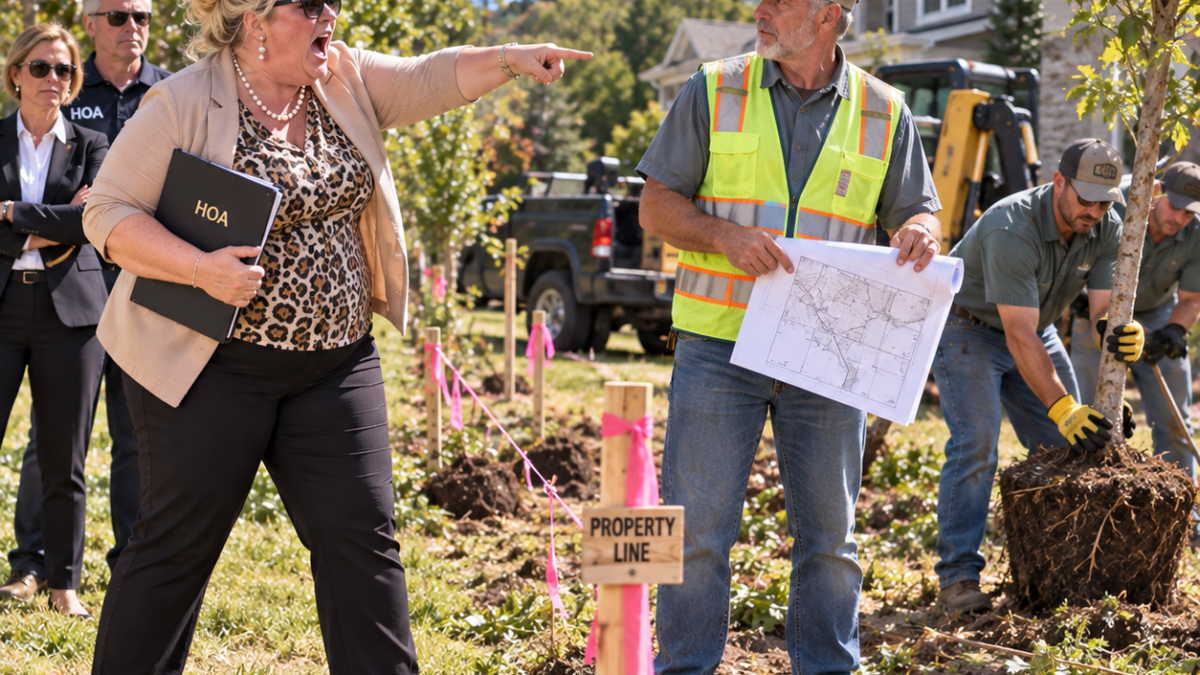
Karen planted twenty trees across my front yard before sunrise, then stood ten feet from my porch and announced that the land had “always belonged to the HOA.”
She blocked the farm stand I had built after twenty years in the Army, fined me for objecting, and threatened to tear the stand down if I refused to accept her new version of the property line.
What she didn’t know was that one rusted piece of metal buried beneath three inches of soil had been waiting there since 1988—and when the right man came looking for it, her entire story was going to collapse.
“This is HOA property now.”
Karen pointed at the nearest Leyland cypress sapling as though she had personally redrawn the county map overnight.
It was barely seven in the morning.
I still had a watering can in my hand.
Twenty young trees ran in a neat line across the front of my property, each one freshly planted, each surrounded by dark circles of torn soil.
Behind them sat my farm stand.
Or what little of it you could still see from the road.
Three months earlier, I had built that stand from reclaimed barn wood after retiring from the Army Corps of Engineers. Sarah and I had spent years talking about what we wanted civilian life to look like once I finally stopped moving from base to base.
A garden.
A workshop.
Enough land to breathe.
Fresh tomatoes on summer mornings.
Neighbors stopping to buy produce without anyone making a federal case out of it.
That was the plan.
Karen had other ideas.
“You will also remove that illegal commercial structure,” she said, pointing at the stand. “Immediately.”
I put the watering can down.
“My stand is permitted.”
“Not by this association.”
“I submitted the drawings.”
“You never received approval.”
“Your bylaws say failure to respond within thirty days constitutes approval.”
Her face tightened.
Karen hated people who read paperwork.
Especially her paperwork.
She had become president of Serenity Meadows by convincing homeowners that only strict enforcement could protect their investments. Under her leadership, mailbox paint became a crisis, lawn height became morality, and the wrong color front door became evidence of neighborhood decline.
But my property was different.
I owned five acres.
Only the front acre containing the house fell under limited HOA restrictions because of an old grandfathered subdivision arrangement.
The remaining four acres were county agricultural land.
The farm stand sat near the dividing area, legally permitted and carefully placed.
More importantly, the strip where Karen had planted those twenty trees was not HOA common land.
It was mine.
I had known that from the day we bought the property.
I had studied the deed.
The plat.
The subdivision survey.
The legal description.
After twenty years working around engineering plans, land documents, and construction boundaries, I did not buy acreage without knowing where it began and ended.
“Karen,” I said quietly, “you are standing on my property.”
She laughed.
“No, Jack. You’re confused.”
“I’m not.”
“This strip is common area.”
“No.”
“The HOA has maintained it for years.”
“The county survey says otherwise.”
She folded her arms.
“Then your survey is wrong.”
I stared at her.
She hadn’t seen my survey.
That was Karen’s special gift.
Certainty without information.
“You planted these trees without permission.”
“I don’t need permission to improve HOA property.”
“And you’re blocking my business.”
“I’m restoring the visual character of the neighborhood.”
“You mean hiding the stand.”
“If that is a beneficial side effect, so be it.”
There it was.
The truth.
She didn’t care about a boundary.
She wanted my stand gone.
I looked down the line of saplings.
They were small now, but Leyland cypress grew fast. In a few years, they would become a dense green wall between the road and the stand.
Karen had not planted landscaping.
She had built a blockade.
“I want them removed,” I said.
Her mouth twisted into a smile.
“You have no authority to remove HOA landscaping.”
“They’re on my land.”
“We disagree.”
“Then we won’t disagree verbally.”
That seemed to confuse her.
“What does that mean?”
“It means the next conversation will involve documents.”
She rolled her eyes.
“Don’t threaten me with paperwork, Sergeant.”
“I’m not threatening you.”
I picked up the watering can.
“I’m telling you how this ends.”
Karen climbed back into her golf cart, leaving twenty saplings behind like flags planted by an occupying army.
Sarah came outside after Karen disappeared.
Her nursing scrubs were already on.
She stared at the trees.
“Oh my God.”
“She got an early start.”
“What are we going to do?”
I looked toward the place where I remembered the original property pin had been set decades earlier.
Then I went inside.
Pulled a three-inch binder from the cabinet.
And called the one surveyor in the county whose name appeared on the original 1988 subdivision plat.
When he answered and I told him where I lived, he laughed.
“Serenity Meadows?”
“Yes.”
“Let me guess.”
He paused.
“Karen Miller?”
That was when I realized I wasn’t the first person she had tried to push around.
And by Thursday morning, she was going to discover exactly how far across my property line she had gone.
PART 2
His name was Bob Petrov, and he had been surveying land in the county since before most of Serenity Meadows existed.
Bob was one of those men whose reputation made introductions almost unnecessary. Contractors trusted him. County engineers knew his work. Lawyers used his surveys in boundary disputes. Judges had seen his signature enough times that opposing counsel rarely wasted energy questioning his competence. He had the kind of practical authority that came not from a title printed on letterhead but from decades of putting physical truth into coordinates, pins, bearings, measurements, and maps that could survive a courtroom.
He listened while I explained the trees.
“How many?”
“Twenty.”
“Species?”
“Leyland cypress.”
“How big?”
“Five or six feet.”
“Line?”
“Straight. Parallel with the road.”
“Where do you think the boundary is?”
“About three feet beyond them toward the road.”
Bob was quiet.
Then he chuckled.
“You’re talking about the old Callahan edge parcel.”
“You know it?”
“I helped survey the subdivision.”
That stopped me.
“You personally?”
“1988.”
I sat down.
“My name is on the original plat.”
“I’ve got a copy.”
“Then you’ve probably noticed PLS 2468 near your corner.”
“I have.”
“That’s me.”
For a moment I simply stared toward the window.
Outside, Karen’s line of cypress saplings cut across the morning view.
Bob continued.
“The developer wanted a ten-foot common strip along the roadway, but the geometry around the old farm parcel was strange. Your deed takes more frontage than people think. If that original pin is still there, we’ll settle this quickly.”
“When can you come?”
“Thursday. Seven.”
“What do you need?”
“Coffee.”
“I can provide that.”
“And don’t touch the trees.”
“I wasn’t planning to.”
“Good.”
Sarah came into the kitchen after work that evening and found me photographing the front yard.
Every tree.
Every root ball.
Every patch of disturbed grass.
Wide shots from the porch.
Measurements from fixed points.
Views from the road.
Close photographs showing tire tracks from the landscaping equipment.
Then the farm stand partially hidden behind the row.
“You’re documenting.”
“Yes.”
“You have your Army face.”
“I don’t have an Army face.”
“You absolutely do.”
“What does it look like?”
“Like you’re about to organize socks by operational priority.”
I lowered the camera.
“That would be useful.”
She smiled.
Then looked toward the road.
“You really think she’ll keep pushing after a survey?”
“Yes.”
“You don’t even know what the survey says yet.”
“I know what the deed says.”
“And if you’re wrong?”
“Then I’ll apologize.”
That answer surprised her.
“Seriously?”
“Of course.”
Sarah studied me.
“You’re very confident.”
“I’m confident enough to pay someone qualified to prove whether I should be.”
That mattered.
Karen’s mistake was not being wrong.
Everyone is wrong sometimes.
Her mistake was believing certainty made evidence unnecessary.
I wanted evidence.
The following morning I assembled everything I already had.
Deed.
Title policy.
County parcel map.
Original subdivision plat.
The HOA declaration.
Architectural guidelines.
Farm stand permit.
My courtesy submission to the board.
Certified-delivery receipt showing they received it.
The bylaw provision stating that architectural requests not answered within thirty days were deemed approved.
The stand itself had never been my biggest concern, but Karen had tied the tree issue to it, which meant the entire file belonged together.
Then I drafted a cease-and-desist letter.
I kept it simple.
No insults.
No speculation.
No accusations about motives.
The HOA had caused trees to be installed on land I claimed as private property. I requested that no additional landscaping be installed until the boundary was professionally verified. I asked for removal and restoration if the installation was found to be on my side.
Certified mail.
Return receipt.
Copies to the management company.
Copies to every board member.
Sarah read it.
“You’re giving her a chance to fix this.”
“Yes.”
“Do you think she will?”
“No.”
“Then why bother?”
“Because later, nobody gets to say they weren’t told.”
She shook her head.
“You really do enjoy paper trails.”
“They are honest.”
“Paper isn’t honest.”
“Good paper is.”
Karen received the letter.
Seven days later, three envelopes arrived.
The first fined me $500 for operating an unapproved commercial structure.
The second fined me $250 because the freshly disturbed soil around Karen’s saplings supposedly violated lawn-aesthetic standards.
The third accused me of damaging HOA landscaping.
I stood at the mailbox reading that one twice.
She had installed trees on the disputed land.
The installation tore up my grass.
Then she fined me because the grass around her trees was damaged.
Sarah watched me come inside.
“That bad?”
I handed her the stack.
She read the second notice.
Her mouth fell open.
“She fined us for the holes they dug?”
“Yes.”
“That woman is clinically—”
“Don’t finish that sentence.”
“I was going to say creative.”
“No, you weren’t.”
Then we reached Karen’s personal note.
Mr. Callahan, your purported cease-and-desist demand is frivolous and without merit. The association has long recognized the landscaped strip adjacent to Old Farm Road as common property. The recently installed trees are part of a duly authorized beautification initiative. We suggest you familiarize yourself with the governing documents you agreed to upon purchase before making further baseless allegations.
All fines are due within thirty days.
I read the sentence again.
Duly authorized.
That phrase became important later.
At the time, I simply placed the letter into a clear sleeve.
Exhibit A.
First fine.
Exhibit B.
Second.
Exhibit C.
Karen’s written claim of authority.
Thursday morning, Bob arrived at 6:59.
Not seven.
6:59.
I liked him immediately.
His pickup looked like an archaeological dig had been conducted inside it. Tripods. Rods. Cases. Orange paint. Flags. Boots. Field books. A magnetic locator.
He climbed out wearing a faded cap and flannel shirt.
“You Jack?”
“Yes.”
He looked toward the cypress line.
Then toward the farm stand.
Then the road.
“She planted all those?”
“Yes.”
“Without surveying?”
“As far as I know.”
Bob grunted.
“That’s confidence.”
“That’s one word for it.”
His assistant began unloading equipment.
Bob walked slowly along the frontage.
“Don’t tell me where you think the pin is.”
“Why?”
“I don’t want you influencing me.”
Fair.
He set up his total station.
They established reference points.
Measured angles.
Checked bearings.
Compared the original 1988 plat with current county records.
Cars slowed.
Neighbors watched.
At 7:35 I saw Karen’s bedroom curtain move across the road.
At 7:47 it moved again.
At 8:06 her front door opened slightly.
Closed.
Bob ignored all of it.
Eventually he pulled out the magnetic locator.
The device began clicking.
Then beeping.
He moved slowly.
Back.
Forward.
Stronger.
He stopped approximately three feet inside the line of trees.
The tone became sharp.
“There.”
He knelt.
Used a narrow trowel.
Three inches down, metal clicked.
He cleared the soil.
A yellow plastic cap appeared.
PLS 2468.
Bob smiled.
“Hello, old friend.”
I crouched beside him.
“That’s yours?”
“I set it in 1988.”
“You’re sure?”
He looked at me.
“My license number is on it.”
Fair point.
He took photographs.
Measurements.
Then they marked the property line.
Bright fluorescent paint circled the pin.
Pink flags appeared every ten feet.
One after another.
Straight down the frontage.
The visual result was devastating.
Every single cypress stood on my side.
Not inches.
Not a confusing corner.
Roughly three feet.
Twenty trees.
One hundred fifty feet.
All private property.
Bob stood beside me drinking coffee.
“Well?”
“How ugly is it?”
“For her?”
“Yes.”
He smiled.
“Pretty.”
He completed field notes and handed me a preliminary report.
“Official plat Monday.”
“Would this survive court?”
He gave me a mildly offended look.
“It’ll outlive both of us.”
As his truck pulled away, Karen’s front door flew open.
She crossed the street fast enough that her sandals slapped against the pavement.
Phone already recording.
“What did you do?”
“Good morning.”
“Do not ‘good morning’ me. What are those flags?”
“Survey markers.”
“You vandalized common land.”
“No.”
“You sprayed paint!”
“The surveyor did.”
“That doesn’t make it legal.”
“He found the original pin.”
Karen pushed closer.
“Paid by you.”
“Yes.”
“So he told you what you wanted.”
I stared at her.
“Bob Petrov?”
She hesitated.
“You know him?”
“Everyone knows him.”
“Then you know accusing him of falsifying a survey is probably unwise.”
Her expression sharpened.
“The HOA has maps.”
“Good.”
“Those maps show this strip belongs to the association.”
“Then show them to Bob.”
“I don’t answer to your surveyor.”
“No.”
I pointed toward the pink flags.
“You answer to the boundary.”
Karen lifted her phone.
“I’m recording your admission that you altered community property.”
“I haven’t altered anything.”
“What do you call this?”
“Evidence.”
Her face turned plum-colored.
Then she pointed at the farm stand.
“That illegal structure is still coming down.”
“We can discuss that after Monday.”
“What happens Monday?”
“Official survey.”
“You think a piece of paper changes anything?”
“Yes.”
I let the word sit there.
Then went inside.
Karen issued another fine the next day.
One hundred dollars.
Unauthorized marking of HOA common area.
Exhibit D.
Monday I drove to Bob’s office.
The official survey was beautiful.
Precise.
Signed.
Sealed.
Notarized.
My parcel.
The road.
The HOA strip.
The farm stand.
The cypress trees.
Distances.
Coordinates.
Legal descriptions.
The conclusion required no interpretation.
All twenty trees had been installed on the Callahan parcel.
I drove straight to Arthur Vance.
Arthur was a retired corporate attorney who lived three doors away.
I had met him during one of my evening walks after this fight began.
He hated petty authority with the passion some men reserve for rival football teams.
He spread the survey across his dining table.
“Oh, this is magnificent.”
“Bob said you’d enjoy it.”
“I do.”
“You understand that normal people don’t react this way to property maps?”
“Normal people don’t retire from litigation.”
He read Karen’s emails.
The fines.
The cease-and-desist.
Then tapped the survey.
“She has one exit.”
“What?”
“Admit error. Remove the trees. Repair the turf.”
“She won’t.”
“I know.”
He looked almost cheerful.
“Which is why we make the exit very clear.”
The demand letter went to the whole board.
Not just Karen.
That was deliberate.
It said the HOA had inadvertently installed twenty trees on private land.
Inadvertently.
Arthur chose the word because it gave them room to save face.
Then:
The Association is hereby requested to remove its landscaping materials and restore Mr. Callahan’s lawn within fifteen calendar days.
Failure would constitute continuing willful trespass.
Copies:
Survey.
Photos.
Original cease-and-desist.
Delivery receipts.
No lawsuit threat.
Not yet.
We simply gave them a deadline.
Day one passed.
Day two.
Day three.
Then Karen emailed me directly.
Mr. Callahan, the board has received your fraudulent survey and will not be intimidated by your tactics. The trees are part of an approved community enhancement initiative and will remain. Any further correspondence should be directed to association counsel.
Arthur called within three minutes of receiving my forwarded copy.
“You understand what she just did?”
“Put it in writing.”
“She admitted receipt of the survey.”
“Yes.”
“She admitted she knows the trees remain.”
“Yes.”
“She refused removal.”
“Yes.”
“You’re ruining retirement for me.”
“How?”
“This is too much fun.”
Then something unexpected happened.
Tom, the HOA treasurer, approached me while I weeded peppers.
He stayed near the fence.
Nervous.
“Mr. Callahan?”
“Jack.”
“Right.”
He looked toward Karen’s house.
“She’s not home.”
“That seems relevant to you.”
Tom rubbed the back of his neck.
“I got your survey.”
“You all did.”
“I want you to know the board never voted to plant those trees.”
I kept my face neutral.
“What?”
“Karen handled it.”
“She said they were duly authorized.”
“She has discretionary maintenance authority up to a certain amount.”
“Amount?”
“Fifteen hundred dollars.”
Interesting.
“How much were the trees?”
“I don’t know.”
“Did you approve taking property?”
“No.”
“Did anyone verify the boundary?”
“I assumed Karen did.”
There it was.
The most dangerous sentence in organizational life.
I assumed.
Tom continued.
“She said the farm stand was hurting neighborhood appearance.”
“So you knew the purpose.”
“We knew she disliked it.”
“But not where she was planting.”
“No.”
“Tom.”
He looked at me.
“The board has twelve days left.”
“I know.”
“I want those trees removed by you, not me.”
He swallowed.
“Couldn’t you move your stand?”
I almost admired the desperation.
“No.”
“A few feet?”
“No.”
“This could become expensive.”
I smiled slightly.
“Yes.”
He walked away.
Arthur and I began collecting resident statements.
Not because they were necessary to prove the boundary.
Bob’s survey did that.
But the tree dispute was exposing something broader.
Mr. Henderson, eighty-two, had been fined the week after his wife died because his grass grew half an inch too tall.
The Garcias had received four warnings about a blue front door.
A single mother named Rachel had been threatened over a plastic slide in her backyard.
Another resident had received weekly letters because his work van remained visible while his garage was repaired.
Twelve signed affidavits in three days.
Karen’s pattern.
Control through exhaustion.
A $50 fine here.
$100 there.
Compliance was cheaper than resistance.
Until she trespassed on actual land.
That changed the math.
Day fifteen arrived Friday.
No crew.
No response from counsel.
No removal.
The trees remained.
I called Precision Land Clearing.
A man named Hector answered.
“I need twenty young Leyland cypress removed tomorrow.”
“Your trees?”
“Not exactly.”
He laughed.
“What does that mean?”
“They belong to an HOA.”
“And they’re on your land?”
“Yes.”
“Survey?”
“Yes.”
“Notice?”
“Yes.”
“Expired?”
“Yes.”
“All right.”
Then I called the sheriff’s non-emergency line.
I explained the dispute.
Certified survey.
Notice.
Deadline.
Landscaping removal scheduled.
Potential confrontation.
The dispatcher made a note.
“You’re not requesting an officer now?”
“No. Just creating a record.”
“Understood.”
Saturday morning was beautiful.
Clear sky.
Still air.
Eight o’clock.
Then the truck arrived.
Behind it:
A commercial chipper.
Hector stepped out.
He was wiry, maybe fifty, with the grin of a man who enjoyed jobs containing machinery and legal documentation.
“Morning.”
“Morning.”
I gave him the survey.
He studied the flags.
“So everything house side?”
“Yes.”
“All twenty?”
“Yes.”
“Roots too?”
“Yes.”
“Save them?”
I thought about it.
“No.”
He raised one eyebrow.
“Chipper.”
“Chipper.”
“Loud?”
“Within legal hours.”
Hector smiled.
“You want loud.”
“I want efficient.”
“Sure.”
Then he handed me an invoice.
Not his.
Original planting invoice.
“You might like this.”
I looked.
Precision Land Clearing had planted Karen’s trees too.
Twenty Leylands.
$59.99 each.
Delivery.
Labor.
Total:
$1,475.80.
Bill to:
Serenity Meadows HOA.
Authorized by:
Karen Miller.
Cash payment.
I looked at Hector.
“You remember this?”
“My guys did it.”
“Who showed them where?”
“That lady across the road.”
“Karen.”
“Yep.”
“Did she claim it was HOA land?”
“Yep.”
“Any survey?”
“Nope.”
“Why didn’t your company check?”
“Customer tells us they own a strip, usually we assume they know.”
He shrugged.
“Lesson learned.”
I added the invoice to the binder.
Then the chipper started.
The sound was enormous.
Neighbors came outside.
Mrs. Garcia stood on her porch holding coffee.
Mr. Henderson appeared at a window.
A teenager started filming.
The first tree came out.
Roots.
Soil.
Hector’s crew carried it toward the chipper.
Gone.
Second.
Gone.
Third.
Then Karen’s door opened.
Pink robe.
Fuzzy slippers.
Hair not yet organized into public office.
She stared.
Then screamed.
“STOP!”
The chipper kept running.
She crossed the street.
“What are you doing?”
I raised my voice just enough to be heard.
“Removing abandoned landscaping from my property.”
“You’re destroying HOA property!”
“You were notified.”
“That survey is fraudulent!”
“The deadline expired yesterday.”
She pulled out her phone.
“I’m calling the police.”
“Please do.”
That stopped her for half a second.
“I already notified them.”
Her expression changed.
Then rage returned.
She marched toward Hector.
“Stop this equipment!”
I stepped between them.
“Karen.”
“Move.”
“No.”
“This is HOA property.”
“You’re trespassing.”
“Don’t you dare—”
“You’ve been asked to leave.”
Then the sheriff’s cruiser arrived.
Perfect timing.
Not dramatic.
No siren.
No lights.
Deputy Miller got out.
Karen ran toward him.
“Officer! Thank God. He is destroying association property.”
The deputy looked at me.
I pointed toward the farm stand.
“Everything is posted there.”
Three documents sat inside a clear bag.
Survey.
Removal demand.
Karen’s refusal email.
The deputy read them.
Then inspected the line.
Pink flags.
Survey pin.
Tree locations.
Hector shut the chipper down temporarily.
The neighborhood became strangely quiet.
Deputy Miller walked back.
“Ma’am, this survey appears to establish the property line.”
Karen pointed toward the road.
“Our HOA map says the strip is ours.”
“Do you have a licensed survey?”
“Our map is official.”
“Official from whom?”
“The association.”
He nodded slowly.
“The notarized land survey is stronger evidence of the property boundary than an HOA landscaping map.”
Karen’s mouth opened.
“These trees belong to us.”
“Yes.”
The deputy looked toward me.
“And the owner gave notice requesting that the HOA remove them?”
I handed him the certified receipt.
“Yes.”
He read Karen’s email.
Then looked at her.
“You refused?”
“I disputed his claim.”
“Understood.”
He pointed toward where she stood.
“Right now you are on the side identified by the survey as Mr. Callahan’s private property.”
Karen looked down.
As if geography might change under her feet.
“He has asked you to leave.”
“I am HOA president.”
“That doesn’t give you a right to remain on private land.”
“I am inspecting adjacent community property.”
“You’re standing approximately twenty feet inside his parcel.”
She went silent.
Then:
“I want him arrested.”
“For what?”
“Destruction of HOA landscaping.”
Deputy Miller glanced toward the removed trees.
“Civil dispute. Based on the documentation here, I don’t see a basis for arresting him.”
Karen’s face went pale.
“I want his crew stopped.”
“No.”
“You’re allowing vandalism.”
“I’m keeping the peace.”
His voice hardened slightly.
“And at the moment, you are the person refusing to leave private property.”
That was enough.
Karen walked back across the street.
Slowly.
Humiliated.
The chipper restarted.
Twenty trees became mulch.
By 9:30, Hector’s crew had removed every root ball, repaired the disturbed areas, raked the lawn, and seeded the bare soil.
The farm stand was visible again.
The road looked exactly as it had before Karen’s invasion.
Except for one pile of shredded cypress.
Hector pointed.
“You keeping that?”
“Yes.”
“Garden?”
“Absolutely.”
He handed me the final bill.
$1,500.
I paid.
Then I went inside.
Sarah already had the calculator out.
“You’re smiling.”
“No.”
“You are.”
“We’re totaling damages.”
“That makes you happy?”
“Accuracy makes me happy.”
We laid everything out.
Bob’s survey:
$2,500.
Tree removal and restoration:
$1,500.
Original trees Karen bought with HOA money:
$1,475.80.
Lost farm-stand revenue:
I had sales records.
Before trees.
During trees.
Average decline roughly sixty-five percent.
Conservative loss:
$850.
Then Arthur’s time.
He had told me his work was pro bono.
I called anyway.
“How many hours?”
“Jack.”
“How many?”
“Ten, maybe.”
“Rate?”
“No.”
“Arthur.”
“My normal rate is obscene.”
“Discounted.”
He sighed.
“Two-fifty.”
$2,500.
Grand total:
$8,825.80.
Sarah stared.
“All because she didn’t want to see tomatoes.”
“Apparently.”
Arthur drafted the reimbursement demand.
This one was different.
Firm.
Itemized.
Thirty days.
Full payment.
Otherwise we would file suit seeking the documented losses, additional damages, and court costs.
Every receipt attached.
Every photograph.
Survey.
Invoices.
Sales figures.
Correspondence.
Karen’s email.
The original landscaping invoice.
Certified packets went to every board member and the management company.
Then something changed in Serenity Meadows.
Before, Karen’s behavior had been emotional.
Annoying.
Petty.
Abstract.
Now it had a number.
$8,825.80.
People understood numbers.
Especially numbers that could come from HOA reserves.
The story traveled.
“The tree guy sent Karen a nine-thousand-dollar bill.”
“That isn’t Karen’s money.”
“Exactly.”
“They’re going to assess us.”
“Why should we pay for trees she planted illegally?”
Questions spread faster than Karen could answer them.
The HOA budget was public.
Residents checked.
Reserves were not huge.
A nearly nine-thousand-dollar unplanned expense hurt.
Then came another fact.
Tom told two other board members the tree installation had never received a formal vote.
Carol confronted Karen.
Dave, another director, asked for invoices.
Suddenly everybody wanted documents.
Karen’s favorite weapon.
Paperwork.
Turned around.
The monthly meeting drew more than fifty residents.
Normally twelve.
Sarah and I sat front row.
Arthur beside us.
Binder at my feet.
Karen sat behind the folding table at the front.
Tom looked sick.
Carol looked angry.
Dave looked tired.
Karen struck the gavel.
“Meeting is now in session.”
Minutes.
Treasurer report.
Landscaping.
Someone shouted from the back:
“What about Callahan’s nine-thousand-dollar bill?”
Karen’s face changed.
“This is pending legal business.”
Another voice:
“It’s our money.”
Applause.
She banged the gavel.
“Order.”
Arthur stood.
Calm.
“Madam President.”
“You are out of order.”
“I have not said anything yet.”
“You intend to.”
Laughter.
Arthur continued.
“Residents are entitled to understand significant financial liabilities incurred by their corporation.”
Karen leaned toward the microphone.
“This is confidential attorney-client material.”
“No.”
Arthur held up my reimbursement demand.
“The existence of a demand against the association is not privileged merely because it is unpleasant.”
Karen’s face reddened.
“Our counsel is reviewing it.”
Arthur looked at Tom.
“Was the board asked to approve planting trees on Mr. Callahan’s property?”
Karen interrupted.
“Do not answer that.”
Every person in the room noticed.
Tom stared at his hands.
Arthur repeated.
“Tom?”
Karen hissed:
“This is a board matter.”
Tom finally looked up.
“No.”
The room erupted.
Karen spun toward him.
“What?”
“We didn’t vote.”
“You received the email.”
“That wasn’t a vote.”
“You never objected.”
“I didn’t know where the trees were being planted.”
“You knew the project.”
“I knew you said you were handling landscaping near the farm stand.”
Arthur asked:
“Did the board approve refusal of Mr. Callahan’s survey-backed removal demand?”
Tom shook his head.
“No.”
Carol spoke.
“I didn’t even see his demand until I got it at home.”
Karen stared.
“That’s not true.”
Carol opened a folder.
“Certified mail.”
The room laughed.
Karen’s authority cracked visibly.
I stood.
No microphone at first.
Then Arthur handed me one.
“I’m not here to ask anyone to dislike Karen.”
That quieted them.
“I’m here because the association caused twenty trees to be planted on my property.”
I held up the survey.
“A licensed surveyor found the original 1988 pin.”
I unfolded the map.
“Every tree was roughly three feet inside my boundary.”
Then the demand.
“The HOA received fifteen days to remove them.”
Then Karen’s email.
“Mrs. Miller refused.”
Then the tree invoice.
“The planting cost HOA members $1,475.80.”
Murmurs.
Then removal invoice.
“It cost me another $1,500 to undo it.”
Then survey.
“$2,500.”
Then lost revenue.
“$850.”
Then legal consultation.
“$2,500.”
I looked at the room.
“Total $8,825.80.”
No shouting.
Just silence.
Then:
“I do not want your money.”
People looked confused.
“I want the association to reimburse losses caused by the association. If the association determines those costs should ultimately be recovered from the person who acted without board authority, that is your internal decision.”
Karen shouted:
“You’re extorting these people.”
“No.”
I faced her.
“I gave you the cheapest option first.”
“What?”
“Remove the trees.”
Silence.
“You refused.”
Arthur stood.
“He is correct.”
Karen pounded the table.
“This is a coordinated attack.”
Mrs. Garcia rose.
“No.”
Her hands trembled.
“This is what you always say when somebody disagrees.”
Karen rolled her eyes.
Mrs. Garcia continued.
“You sent us four warnings about our blue front door.”
Someone laughed softly.
“We repainted it because we were scared you would keep increasing the fines.”
Then Mr. Henderson stood with his cane.
“My wife died last March.”
The room quieted.
Karen looked away.
“The week after her funeral, my grass grew too high.”
He held up the notice.
“You fined me two hundred dollars.”
His voice cracked.
“I had spent forty-eight years with that woman.”
No one moved.
“I forgot to mow.”
Karen said quietly:
“The rules apply equally.”
That was the wrong answer.
Mr. Henderson stared at her.
“No.”
He shook his head.
“Decency should too.”
Then Rachel stood.
“My children’s slide.”
Another homeowner.
“My work van.”
Another.
“Holiday lights.”
Another.
“Mailbox.”
One after another.
The twelve affidavits became people.
Faces.
Voices.
Stories.
Karen tried to gavel them down.
Nobody obeyed.
Carol turned toward her.
“You told us these were routine compliance matters.”
“They were.”
“You never told us people were being threatened with liens over this stuff.”
“Those were enforcement tools.”
Dave, the fourth board member, looked at Tom.
Then Carol.
Then the room.
“I move for a vote of no confidence in the president.”
Karen froze.
“What?”
“Second,” Carol said.
“Second!” half the room echoed.
Arthur opened the bylaws.
“Quorum is present.”
Karen pointed at him.
“You planned this.”
“No.”
He smiled.
“You did.”
The vote was nearly unanimous.
Karen lost the presidency in the same room where she had spent years ruling by fear.
She sat at the front table after the result.
For the first time, her shoulders sagged.
Tom became interim president.
He cleared his throat.
“Mr. Callahan.”
“Yes.”
“I want to apologize.”
Karen snapped:
“Don’t you dare.”
Tom looked at her.
Then back at me.
“On behalf of Serenity Meadows, I apologize.”
Applause.
“We will vote now on reimbursement.”
Karen stood.
“This is insane.”
Tom ignored her.
Motion.
Second.
Approved.
Full $8,825.80.
Three days later, a courier delivered the check.
I stood at my kitchen counter holding it.
Sarah read the amount.
“Every penny.”
“Yes.”
“You won.”
I thought about it.
“No.”
She smiled slightly.
“Not yet?”
I shook my head.
“It isn’t finished until the board changes how it operates.”
That took months.
Karen’s removal opened records.
The new board reviewed enforcement files.
Not every fine was wrong.
Some were reasonable.
Safety hazards.
Neglected common property.
Unpaid dues.
But dozens of aesthetic violations depended on Karen’s personal interpretation.
They were rescinded.
Residents got refunds in some cases.
Other balances were cleared.
The architectural committee was rebuilt.
Written standards replaced subjective preferences.
Appeal hearings became real hearings.
No president could authorize expenditures above $1,000 without board approval.
Landscaping on edge parcels required boundary verification.
That rule became known unofficially as the Callahan Rule.
I hated that name.
Naturally, everyone used it.
Karen attended one more meeting after her removal.
She sat in the back.
No red blazer.
No gavel.
When residents voted to eliminate several of her favorite aesthetic provisions, she stood.
“You’re destroying property values.”
Tom looked at her.
“Do you have data?”
Silence.
That question would never have been asked six months earlier.
Karen sat down.
Two weeks later:
FOR SALE.
Her sign appeared directly across from my property.
Same spot where she had once stood saying:
This is HOA property now.
The irony wasn’t subtle.
She sold in less than a month.
Neighborhood gossip said she accepted less than asking.
I never verified it.
Didn’t need to.
The last time I saw her, movers were loading boxes.
I was opening the farm stand.
She crossed the road.
Stopped at the edge.
This time she did not step onto my grass.
Growth.
“Jack.”
“Karen.”
She looked toward the stand.
Customers had already begun arriving.
Mrs. Garcia was buying peppers.
Mr. Henderson sat in a folding chair drinking coffee Sarah had brought out.
Children rode bicycles nearby.
Karen stared.
“This place looks ridiculous.”
I smiled.
“Probably.”
“You turned the neighborhood against me.”
“No.”
“Of course you did.”
“I showed them the survey.”
“That started it.”
“No.”
I looked at her.
“The survey only proved where the land was.”
She crossed her arms.
“You embarrassed me.”
“You planted trees on my property.”
“I was trying to improve the entrance.”
“You were trying to hide my stand.”
“It looked commercial.”
“It is commercial.”
Her eyes narrowed.
“Exactly.”
“With a county permit.”
“It doesn’t fit.”
“With what?”
“The neighborhood.”
I looked around.
Mrs. Garcia’s front door was now bright yellow.
Mr. Henderson’s grass was slightly taller than Karen would have tolerated.
Rachel’s children had a red-and-blue slide.
A work van sat in a driveway.
The world had not ended.
“Maybe the neighborhood was too small in your head.”
Karen stared at me.
For a second, something softer moved through her expression.
Then vanished.
“You always think you’re right.”
“No.”
I shook my head.
“That’s why I hired Bob.”
She had no answer.
A moving worker called her name.
Karen turned.
Before leaving, she looked toward the cypress mulch spread around my tomato beds.
“Those are my trees?”
“They were.”
Her mouth tightened.
“You mulched them.”
“Yes.”
“That’s petty.”
“Very.”
She almost laughed.
Almost.
Then walked away.
Her car left that afternoon.
We never saw her again.
The trees, however, remained.
Not as trees.
As mulch.
I spread shredded cypress around tomatoes.
Peppers.
Cucumbers.
Squash.
That season’s garden produced more than any previous year.
Sarah called it coincidence.
I called it poetic horticulture.
At the farm stand I made a small handwritten label for one tomato basket:
GROWN WITH PREMIUM LOCALLY SOURCED MULCH.
Sarah removed it.
“You are not starting another war.”
“It doesn’t name anyone.”
“Jack.”
“Fine.”
The farm stand flourished.
The controversy had given it visibility.
People came from outside Serenity Meadows after hearing the story.
Not hundreds.
Enough.
They bought tomatoes.
Sweet corn.
Beans.
Cucumbers.
Honey from a neighbor.
Sarah started baking sourdough on Saturdays.
That became more popular than my vegetables.
I pretended not to resent it.
The stand changed from business into gathering place.
Neighbors lingered.
Coffee appeared.
A bench appeared.
Nobody remembered who brought it.
Children stopped after school.
Mr. Henderson became an unofficial greeter.
He rarely bought anything.
He also never left.
One morning Tom came by.
No board binder.
Just jeans.
He bought tomatoes and Sarah’s bread.
“Jack.”
“Tom.”
He looked around.
“This is what she was afraid of.”
“What?”
“People gathering.”
I hadn’t thought of that.
“She liked order.”
“She liked control.”
“Same thing to her.”
Maybe.
Tom continued.
“She always said uncontrolled activity causes problems.”
I looked at Mrs. Garcia laughing with Rachel near the stand.
“Looks dangerous.”
Tom smiled.
Then became serious.
“I should have stopped her earlier.”
“You didn’t know.”
“I knew enough.”
“What do you mean?”
“I knew she was difficult.”
“So did everyone.”
“I let her handle things because I didn’t want meetings to run long.”
That was brutally honest.
“She volunteered for everything. We let her.”
He looked toward her former house.
“Then when she pushed too far, we all acted surprised.”
I understood.
Karen had responsibility.
So did a system that rewarded apathy.
“Then don’t do that again.”
“We won’t.”
The next board election proved it.
Eight candidates.
Actual competition.
Statements.
Questions.
Budgets.
Transparency.
Nobody ran unopposed.
Tom won another term but limited himself to one year as president.
Carol remained.
Mrs. Garcia joined the board.
Arthur refused nomination.
“Never give power to a lawyer who admits enjoying revenge,” he said.
He was probably right.
The management company contract was renegotiated.
Residents received online access to meeting minutes, invoices, enforcement policies, and budgets.
The HOA didn’t disappear.
It became boring.
That was success.
Mowing contracts.
Pool maintenance.
Stormwater.
Insurance.
Reserve studies.
Real work.
Not measuring door colors.
One evening Arthur and I sat outside his house drinking iced tea.
“You know what your mistake was?” he asked.
“My mistake?”
“Yes.”
“I won.”
“That doesn’t mean you didn’t make one.”
“All right.”
“You assumed evidence wins.”
“Eventually it did.”
“No.”
Arthur shook his head.
“Evidence only works when people are willing to look.”
I thought about Karen.
The survey.
The pin.
The map.
The receipts.
“She wasn’t.”
“Exactly.”
“So what won?”
“Cost.”
That was blunt.
He continued.
“Residents tolerated her behavior when it cost them emotionally.”
He tapped the table.
“Then your case created a bill.”
$8,825.80.
“Suddenly everyone understood.”
I didn’t like that answer.
It was true anyway.
“People shouldn’t need a price tag to recognize abuse.”
“No.”
Arthur sipped his tea.
“But price tags are excellent translators.”
He had a point.
Years passed.
Bob Petrov retired.
Before he did, I visited his office.
He had the original field book from 1988 open on his desk.
“You kept this?”
“I keep everything.”
He pointed to a line of handwritten bearings.
“That’s your frontage.”
Then a note.
SET REBAR PLS 2468.
I smiled.
“That little pin caused a lot of trouble.”
“No.”
Bob looked at me.
“The woman caused trouble.”
He tapped the page.
“The pin ended it.”
I asked if I could photograph the entry.
“Already made you a copy.”
He handed it to me.
I framed it.
Sarah hated that.
“You framed survey notes.”
“It’s history.”
“It looks like algebra written by a farmer.”
“Exactly.”
It hung in my office beside the notarized plat.
Our grandchildren eventually learned the story.
Not from me.
From neighbors.
Stories grow.
By then, according to local legend, Karen had planted fifty trees.
Bob had arrived with a helicopter.
The sheriff arrested her.
I had sued for a million dollars.
None of that happened.
Truth was better.
Twenty trees.
One pin.
One surveyor.
One ignored deadline.
One chipper.
One check.
My grandson asked:
“Did you really grind her trees up?”
“Yes.”
“Cool.”
Sarah glared.
“Not cool.”
He whispered:
“Still cool.”
I agreed privately.
Then he asked:
“Why didn’t you just pull them out the first day?”
That was a good question.
“I could have.”
“Then why wait?”
“Because I needed to know I was right.”
“You already knew.”
“I believed.”
“What’s the difference?”
“Belief is inside your head.”
I pointed toward the framed survey.
“That is proof someone else can examine.”
He nodded slowly.
“So Bob won?”
“Basically.”
I thought about what happened after.
Proof didn’t only protect me.
It restrained me.
If the survey had shown Karen was right, I would have had to accept it.
That is the part bullies hate about neutral evidence.
It can rule against everyone.
Including you.
The farm stand expanded.
Not physically much.
We added shelves.
Coolers.
A chalkboard.
Still no giant sign.
The county renewed the business permit annually.
The HOA never challenged it again.
Eventually they added language acknowledging grandfathered mixed-use edge parcels.
My strange property stopped being a loophole.
It became understood.
The first acre remained subject to certain association standards.
Back four remained agricultural.
We lived with that.
Compromise works when rules are clear.
One summer the board actually cited me.
Lawn too high near the front drive.
I measured.
They were right.
Sarah laughed for ten minutes.
“What are you going to do, Sergeant?”
“Mow.”
“No binder?”
“No.”
“No surveyor?”
“No.”
“No federal court?”
“I hate you.”
She kissed me.
I mowed.
That became one of my favorite parts of the story.
Accountability cuts both directions.
The new HOA wasn’t afraid to enforce real rules.
I wasn’t afraid to comply when they were legitimate.
That is what Karen never understood.
Resistance wasn’t rebellion.
I didn’t hate all authority.
I hated authority without boundaries.
A few months after Bob retired, one of the new homeowners stopped at the farm stand.
Young guy.
Software engineer.
He pointed toward the survey pin.
“Is that the famous one?”
“Unfortunately.”
He crouched.
“Can I see it?”
“It’s a piece of rebar.”
“I know.”
I showed him.
Yellow cap.
Faded.
Still visible.
He took a picture.
“You should put a plaque here.”
“No.”
“Seriously.”
“No.”
“KAREN STOPPED HERE.”
“No.”
“PROPERTY LINE OF FREEDOM.”
“Absolutely not.”
Sarah loved that one.
We compromised by doing nothing.
The pin stayed what it should be.
Quiet.
Functional.
Accurate.
The same could not be said for the story.
Every year someone new asked.
Every year someone exaggerated.
I corrected them.
Karen wasn’t arrested.
The sheriff did not threaten handcuffs.
The HOA did not lose a million dollars.
Nobody went bankrupt.
Reality was less cinematic.
It was also more useful.
Karen abused discretionary authority.
The board failed to supervise.
Residents tolerated it.
She escalated.
A survey established the truth.
Notice created a legal record.
The board ignored it.
I mitigated damages.
Costs were documented.
Residents saw the financial consequence.
Leadership changed.
Policies changed.
That was enough.
Justice doesn’t always require ruin.
Sometimes it requires reimbursement.
Sometimes an apology.
Sometimes a vote.
Sometimes letting the neighborhood watch twenty unauthorized trees disappear into a wood chipper at eight in the morning.
I admit that part helped.
Years later, Mr. Henderson died.
He was ninety.
His daughter visited after the funeral.
She found me at the farm stand.
“He loved sitting here.”
“I know.”
“He talked about you.”
“That worries me.”
She smiled.
“He said you gave him permission to stop being afraid.”
I looked toward his empty folding chair.
“I didn’t.”
“He thought you did.”
She handed me his old lawn ruler.
The one he used during Karen’s presidency.
Wooden.
Marks at three inches.
Three and a half.
Four.
“He wanted you to have this.”
I held it.
That hit me harder than I expected.
For years, Karen had reduced Mr. Henderson’s home to measurements.
Grass.
Edges.
Dates.
Fines.
Then after her removal, the ruler became a joke.
He still kept it.
Maybe as proof of how absurd fear can become when authority looks official enough.
I mounted it inside the farm stand.
No explanation.
People who knew understood.
The neighborhood continued changing.
Children grew.
Families moved.
New families arrived.
Rules evolved.
The bright yellow Garcia door eventually needed repainting.
They painted it yellow again.
Approved unanimously.
Rachel’s plastic slide disappeared when her kids outgrew it.
Nobody ordered it removed.
Tom stepped down.
Mrs. Garcia eventually became president.
Her first announcement:
“If you call me Madam President, I will fine you personally.”
Everyone laughed.
No fines followed.
Arthur grew older and slower.
Still dangerous.
One afternoon we sat near the farm stand.
He pointed toward the cypress mulch, long since decomposed into the soil.
“Do you regret anything?”
“Yes.”
He looked surprised.
“What?”
“I should have saved one tree.”
“For what?”
“Christmas.”
Arthur nearly spilled his drink.
Sarah heard and yelled from the stand:
“No.”
That was our life.
Normal.
Messy.
Peaceful.
The kind of peace I wanted after the Army.
Not silence.
Not perfect lawns.
Not agreement.
Room.
Room to grow tomatoes.
Room to build.
Room to disagree.
Room for people to be different without receiving a certified notice.
That was the irony.
Karen called Serenity Meadows peaceful because people were quiet around her.
They weren’t peaceful.
They were cautious.
Real peace arrived after they stopped being afraid to speak.
The farm stand became proof.
People argued there.
Politics sometimes.
Sports constantly.
Tomatoes rarely.
Nobody issued fines.
One Saturday, a woman from another subdivision drove over after hearing the tree story.
She brought a folder.
Her HOA claimed three feet of her backyard.
“What should I do?”
I looked at the folder.
“Hire a surveyor.”
“That’s it?”
“That’s step one.”
“I thought you’d tell me how to fight.”
“Don’t fight before you know where the line is.”
“But I know.”
“You believe.”
She stared.
I smiled.
“Trust me.”
Months later she returned.
The survey showed the HOA was right.
She laughed when she told me.
“I almost went nuclear.”
“Exactly.”
“So the lesson isn’t stand your ground?”
“No.”
“What is it?”
“Know your ground.”
That became the sentence I remembered most.
Know your ground.
Literal.
Legal.
Moral.
Karen never did.
She assumed.
She asserted.
She planted.
Then made everyone else pay for her certainty.
The most satisfying part of the ending wasn’t her moving away.
It wasn’t losing the presidency.
It wasn’t the check.
It wasn’t even the wood chipper.
It was what came after.
Systems improved.
People participated.
I complied when rules were valid.
The board admitted mistakes.
Residents stopped mistaking conflict avoidance for harmony.
Nobody had to become fearless.
They became informed.
That is stronger.
A decade after the original dispute, Serenity Meadows held an anniversary picnic.
Not of Karen.
Of the neighborhood.
Thirty years since incorporation.
Old photographs were displayed inside the clubhouse.
Construction.
First pool.
Original entrance sign.
Storm damage.
Holiday parties.
Then someone included a picture of my farm stand blocked by twenty cypress trees.
Below it:
THE BOUNDARY DISPUTE — 20XX.
I stared.
Mrs. Garcia came beside me.
“You hate it?”
“Yes.”
“Good.”
“Why is this neighborhood determined to memorialize my paperwork?”
“Because it changed things.”
She pointed to another picture.
Residents packed into the recall meeting.
Another.
The new board.
Another.
Community cleanup day.
History.
Not heroic.
Not neat.
But ours.
I stopped complaining.
Later that afternoon, my grandson asked me to tell the story again.
I refused.
“You know it.”
“Your version.”
“You’ve heard it.”
“Yeah, but Mom says you leave out the funny parts.”
“What funny parts?”
“Karen in fuzzy slippers.”
I smiled.
That part stayed.
So I told it.
I told him about the Tuesday morning trees.
The binder.
Bob.
The pin.
Karen accusing him of fraud.
The deadline.
Hector.
The chipper.
Deputy Miller.
The bill.
The meeting.
The vote.
Then I ended where I always did.
Not with Karen leaving.
With the stand.
Neighbors coming.
Tom buying bread.
Mr. Henderson sitting nearby.
The property feeling like mine again.
My grandson listened.
Then said:
“Still think you should’ve kept a tree.”
“For Christmas?”
“Yeah.”
I looked toward Sarah.
She was close enough to hear.
“No,” she said.
Some disputes never end.
Now the original survey pin sits beneath a small removable cap I installed only to protect it from lawn equipment.
No plaque.
No sign.
No arrows.
Most people walking past would never notice.
Three feet from where Karen’s cypress wall once stood, a few tomato vines grow every summer.
The mulch is long gone.
Its nutrients probably moved through years of vegetables.
I like that.
Something intended to block the stand became part of the soil that fed it.
That is almost too perfect.
Karen tried to hide my future.
Instead, she fertilized it.
Her twenty trees are gone.
My stand is still there.
The board changed.
The rules changed.
The community changed.
And if there is one thing I learned from all of it, it is this:
Bullies depend on uncertainty.
They want you wondering whether they might be right.
Wondering whether resistance is worth it.
Wondering whether anyone will stand beside you.
Wondering whether the paperwork is too complicated.
Certainty does not come from shouting louder.
It comes from facts.
Measurements.
Receipts.
Dates.
Surveys.
Signatures.
Witnesses.
Process.
Karen had a title.
Bob had coordinates.
In the end, coordinates won.
That is why, whenever I see someone arguing over property lines online, I don’t tell them to fight.
I tell them to stop.
Hire the surveyor.
Find the pin.
Read the deed.
Then decide what battle actually exists.
Mine turned out to be three feet wide.
That narrow strip changed an entire neighborhood.
Karen planted twenty trees there because she thought nobody would make her prove ownership.
I made her prove it.
She couldn’t.
Then she made the second mistake.
She refused to correct herself.
That cost $8,825.80.
It cost her the presidency.
Eventually it cost her the community’s trust.
But the biggest cost was impossible to invoice.
People stopped believing her authority was absolute.
Once that illusion disappeared, everything else followed.
The trees came out first.
The fear came out next.
And years later, when I stand behind the farm stand on a Saturday morning and watch people talking beneath the same open sky Karen tried to block with cypress, I understand that the boundary Bob marked was never only about land.
It was the line between authority and ownership.
Between rules and abuse.
Between peace and silence.
Between standing your ground and actually knowing where that ground begins.
Karen crossed the line because she thought no one would challenge her.
Bob found the pin.
Arthur found the language.
The residents found their voices.
And I got my yard back.
Every inch of it.
For a while after Karen moved away, I expected the neighborhood to snap back to its old habits. Fear has a way of lingering long after the person who created it is gone, and for years Serenity Meadows had operated on a simple unwritten rule: don’t attract attention. Keep the grass cut. Keep the trash cans hidden. Keep your opinions to yourself. If a letter came from the management company, fix whatever they complained about and move on. Nobody wanted to become Karen’s next project. Even after she lost the presidency, even after the survey proved she had planted twenty trees three feet inside my property, even after the HOA reimbursed every dollar her mistake had cost me, I could still see that hesitation in people. Neighbors would begin a sentence with, “Are we allowed to…” and then catch themselves halfway through. They were so accustomed to asking permission for ordinary life that freedom felt strangely irresponsible.
The new board understood that changing rules would be easier than changing instincts. Tom called the first community workshop two weeks after Karen’s house sold. Instead of sitting behind a folding table like judges, the board arranged the chairs in a circle. No gavel. No elevated platform. No printed photographs of somebody’s alleged violation taped to foam board. Tom stood in the center with a legal pad and said, “Before we talk about changing anything, I want to hear what made living here difficult.”
Nobody spoke.
That silence lasted almost a full minute.
Then Mrs. Garcia raised her hand.
“Do you really want to know?”
“Yes.”
“All of it?”
Tom gave a tired smile.
“That’s why we’re here.”
She told them about the blue door. Not just the four notices. She described the Saturday she and her husband spent repainting it while their children watched from the driveway. The kids had helped choose that blue when they moved into the house. Their youngest daughter called it ocean blue because she had seen the Atlantic for the first time that summer. Karen called it “visually aggressive.” Mrs. Garcia said she cried while rolling beige paint across it because she felt foolish for caring so much about a door, yet somehow the whole experience made their house feel less like theirs.
Mr. Henderson spoke next.
He brought the grass-height notice from the week after his wife’s funeral.
“I kept this because I wanted to remind myself how stupid fear can make you,” he said. “Mary had been dead six days. I had family sleeping on couches. I had flowers everywhere. I had casseroles from people whose names I couldn’t remember. And when this arrived, I went outside and mowed.”
His voice became rough.
“I mowed because I was afraid the fine would become another fine, then another, and I didn’t have the energy to fight anybody.”
The room was silent again, but this time the silence wasn’t fear. People were listening.
Rachel talked about her children’s slide. A man named Dennis described hiding his work van behind his house every evening because Karen considered commercial lettering incompatible with residential aesthetics, even though he was a plumber and that van paid the mortgage on the very house she was supposedly protecting. An elderly woman named Helen admitted she had stopped putting Christmas lights around her front windows because she once left them up until January fourth and received two violation notices in three days.
Then people started laughing.
Not because the stories were funny when they happened, but because once spoken aloud together, Karen’s system looked absurd.
Tom wrote everything down.
At the end of the meeting, he said, “I owe all of you an apology.”
Someone told him Karen had been the problem.
Tom shook his head.
“She could only do what the board allowed her to do.”
That sentence mattered.
He continued.
“I was treasurer. I saw expenses. I saw fines. I saw how often we were using the management company for enforcement. I kept telling myself Karen was difficult but effective. The truth is I didn’t want to challenge her because challenging her meant more meetings, more conflict, more work.”
He looked directly at me.
“And eventually that laziness helped her plant twenty trees on another man’s property.”
I respected him for saying it.
Accountability rarely sounds heroic.
Usually it sounds uncomfortable.
The board spent the next three months reviewing every enforcement policy. Arthur volunteered to help, although he repeatedly reminded everyone that retired attorneys should never be trusted around bylaws because “we get bored and start editing things.” He eliminated vague phrases wherever possible. “Harmonious appearance” became specific standards. “Unsightly condition” disappeared unless the condition could be objectively defined. Fines required written notice, a cure period, evidence, and appeal. Any lien action required review by independent counsel and a recorded board vote.
The biggest change was financial.
Karen had been able to use discretionary funds because the old rules gave the president broad authority over “routine maintenance and community enhancement.” Nobody had imagined that phrase could include planting a living barricade on private property.
Now anything over a thousand dollars required board approval.
Anything involving land boundaries required a licensed survey if the line was disputed.
Anything involving property outside the HOA required written confirmation of jurisdiction before the board acted.
When Tom presented that last provision, everyone looked at me.
“No,” I said.
He smiled.
“You haven’t heard the name.”
“If you call it the Callahan Rule, I’m leaving.”
The room laughed.
Mrs. Garcia raised her hand.
“I move we officially call it the Callahan Rule.”
“Second,” Arthur said immediately.
“Arthur.”
“Democracy is painful.”
The motion passed.
For the next year I had to listen to neighbors say things like, “Better check the Callahan Rule before you touch that fence.”
I deserved none of it.
Bob deserved more credit than I did.
Without his original survey pin, none of my confidence would have mattered.
So one Saturday I invited him to the farm stand.
By then, he was close to retirement and moved a little slower than when he had first walked my frontage with the magnetic locator.
He arrived in the same dusty pickup.
I poured him coffee.
He looked around at customers gathering beside the stand.
“This is bigger than I remember.”
“Sarah’s bread did that.”
“Smart woman.”
“She married me.”
“Temporary lapse.”
We stood near the property line.
The little yellow survey cap remained beneath the grass.
Bob crouched and brushed away soil.
PLS 2468.
Still there.
“You know,” he said, “people think property lines are fences.”
“Aren’t they?”
“No. Fences are opinions.”
He tapped the pin.
“This is evidence.”
I liked that.
He explained how many disputes he had seen over the years because somebody assumed mowing patterns, hedges, old fences, or neighbor habits established ownership. Sometimes they did matter. Sometimes they didn’t. The only responsible starting point was research.
“Most boundary wars,” Bob said, “begin with somebody saying, ‘Everybody knows the line is here.’”
“That sounds familiar.”
He laughed.
“Karen wasn’t unique.”
“No.”
“She was louder than most.”
“Yes.”
Before leaving, Bob gave me a photocopy from his original 1988 field notebook.
It showed the bearing for my frontage and the notation where he had set the iron pin.
I framed it in my office.
Sarah stared at it.
“You framed a surveyor’s notebook page.”
“Yes.”
“People frame wedding photos.”
“We already have wedding photos.”
“Normal people don’t rank boundary evidence above family.”
“I don’t.”
She pointed.
“That frame is larger than our wedding picture.”
I replaced it with a smaller one the next day.
Marriage also has boundaries.
The farm stand became busier after the story spread outside Serenity Meadows. I never advertised myself as the man who beat the HOA, but customers did it for me. Someone would arrive and ask, “Is this the place where the lady planted all the trees?”
Then another customer would correct them.
“Twenty trees.”
Another would add:
“Three feet inside his property.”
Then someone inevitably exaggerated.
“I heard she planted fifty.”
“No.”
“I heard the sheriff arrested her.”
“No.”
“I heard you sued her for a million dollars.”
“Definitely no.”
Eventually I made a small sign behind the counter:
THE TREES ARE GONE. THE TOMATOES ARE REAL. PLEASE BUY SOMETHING.
Sarah approved that one.
Saturday mornings developed their own rhythm. She baked sourdough before sunrise. I picked vegetables while the dew was still on the leaves. Around eight, Mr. Henderson arrived with his folding chair. By nine the Garcias usually appeared. Children bought peaches one at a time with quarters. Neighbors traded gossip. People who had once hurried inside when Karen’s golf cart approached now stood around openly disagreeing about everything from football to school funding.
That was when I began understanding what Karen had really damaged.
Not property values.
Not aesthetics.
Trust.
She had trained people to treat one another as potential informants.
If your grass got too high, maybe a neighbor reported you.
If your trash can stayed visible, maybe somebody complained.
If your child’s bicycle sat in the driveway, somebody might photograph it.
People stopped talking because familiarity felt dangerous.
The farm stand reversed that slowly.
It gave everyone a neutral place.
No agenda.
No minutes.
No board authority.
Just tomatoes and coffee.
One Saturday Tom stopped while I was stacking corn.
He watched the crowd for a minute.
“You know what Karen would hate most about this?”
“The parking?”
“That too.”
He smiled.
“She’d hate that nobody is in charge.”
I looked around.
He was right.
People came and went.
Some bought things.
Some didn’t.
Arthur sat beside Mr. Henderson arguing about baseball statistics.
Rachel’s kids drew with chalk near the driveway.
Mrs. Garcia was explaining a recipe to Sarah.
Nobody needed permission.
“Maybe that was always her problem,” I said.
“What?”
“She thought order required somebody controlling it.”
Tom nodded.
“And now?”
I handed him a tomato.
“Now we accept risk.”
He laughed.
“Radical.”
A few months later, the board finally dealt with reimbursement. The HOA had already paid my $8,825.80 from reserves, but members wanted to know whether Karen herself should reimburse the association because she had acted without full approval.
That question made me uncomfortable.
I attended the meeting but refused to advocate either way.
Carol asked why.
“Because you already paid me.”
“But she caused the loss.”
“Yes.”
“Don’t you think she should be personally responsible?”
“That’s your corporate issue.”
“You’re being unusually diplomatic.”
“I’m trying.”
Arthur recommended mediation instead of litigation. Karen had already moved, and chasing her through court could cost more than the amount at stake.
Eventually the HOA reached a private settlement with her. I never learned the exact number.
I didn’t ask.
That surprised some neighbors who assumed I wanted maximum punishment.
I didn’t.
I wanted the trees removed.
My land restored.
My losses covered.
The abuse stopped.
All of that happened.
Anything beyond that risked turning justice into appetite.
There is a point where making someone accountable can quietly become enjoying their suffering.
I had no interest in crossing that line.
The “Karen tax” became another neighborhood legend anyway. The board needed to rebuild reserves, so every homeowner received a temporary assessment of roughly $176.
People hated paying it.
But instead of blaming me, most blamed the old system.
Several residents wrote “KAREN TAX” on the memo line of their checks.
Tom begged them to stop because the accountant had to record everything properly.
That only encouraged them.
Arthur paid his assessment in pennies as a joke.
The bank refused the deposit.
He remains proud of this.
Karen’s former house sold to a young couple named Brian and Melissa.
They had two children and knew almost nothing about the neighborhood drama when they moved in.
The first time Brian came to the farm stand, he looked nervous.
“I think we bought Karen’s house.”
“You did.”
“Is that bad?”
“The plumbing works?”
“As far as I know.”
“Then you’re fine.”
He laughed.
“We heard there was some dispute.”
“Ancient history.”
“My wife wants to paint the front door green.”
I stared at him.
He froze.
Then I smiled.
“You’re asking the wrong man.”
“The HOA?”
“No.”
“Who?”
“Your wife.”
He laughed harder.
They painted it green.
The board approved it.
No property values collapsed.
A year after Karen left, I finally removed the last visible evidence of the tree battle.
The disturbed strip had healed.
Grass grew evenly again.
The fluorescent survey paint had faded.
The pink flags were long gone.
Only the iron pin remained.
I stood over it one afternoon thinking about whether I should cover it permanently.
Bob’s voice echoed in my head.
Never bury evidence you may need later.
So I installed a small protective cap flush with the ground.
Nothing decorative.
No plaque.
No sign.
Just protection.
Sarah found me kneeling there.
“What are you doing?”
“Protecting the pin.”
“From what?”
“Lawn equipment.”
She shook her head.
“That little piece of metal matters more to you than most people.”
“It defended the farm.”
“You defended the farm.”
“No.”
I stood.
“The pin didn’t have emotions.”
“What does that mean?”
“I could have been wrong.”
She waited.
“If Bob had located the boundary on Karen’s side of the trees, I would’ve had to accept that.”
Sarah smiled.
“Would you?”
“Yes.”
“Eventually.”
“Immediately.”
She gave me the look wives develop after decades of knowing exactly where a husband’s self-image exceeds reality.
“Within forty-eight hours.”
“Fine.”
That lesson stayed with me.
Evidence isn’t valuable because it proves you right.
Evidence is valuable because it has the power to prove you wrong.
Karen never understood that.
To her, documents were tools for confirming decisions already made.
To me, documents were supposed to establish reality before decisions.
That difference explained almost everything.
Years later, another boundary question arose at the opposite side of Serenity Meadows. Two neighbors argued over a fence.
One insisted the fence followed the property line because it had been there twenty years.
The other claimed an online parcel map showed it was two feet off.
The old neighborhood might have produced threats, complaints, and board letters.
The new board did one thing.
They hired Bob’s successor.
Survey.
Pin.
Answer.
The fence was eighteen inches wrong.
Both homeowners agreed to move it.
No lawsuit.
No shouting.
No chipper.
Tom called me.
“Boring.”
“Beautiful.”
“That survey cost us eight hundred dollars.”
“Cheaper than war.”
“Everything reminds you of war.”
“Twenty years in the Army will do that.”
He laughed.
“You realize the board now budgets for surveys?”
“Good.”
“We have a line item.”
“Excellent.”
“Boundary verification.”
“I’m proud of you.”
“Don’t be. Residents named it.”
I knew what was coming.
“The Callahan Fund.”
I hung up.
He called back laughing.
Time softened the story.
Mr. Henderson’s lawn grew however fast nature wanted until he died at ninety.
At his funeral, his daughter gave me the little wooden ruler he had once used to measure grass height under Karen’s regime.
Three inches.
Three and a half.
Four.
The marks were worn.
“He wanted you to have it.”
I held it and suddenly remembered seeing him years earlier bent over his lawn, terrified a blade of grass might cost fifty dollars.
“I don’t know what to say.”
“He said you taught him he didn’t have to be scared.”
That hurt.
Because I hadn’t taught him.
Karen had.
I had merely been the person who finally created a moment where people discovered fear was shared.
I mounted the ruler inside the farm stand.
Not as a trophy.
As a reminder.
Rules can become ridiculous gradually.
One extra restriction.
One extra fine.
One extra assumption that compliance is easier.
People rarely wake up inside tyranny.
They adapt to it in tiny increments.
That sounds dramatic for an HOA.
Maybe it is.
But scale doesn’t change the pattern.
Authority without challenge expands until something stops it.
Sometimes the thing that stops it is a court.
Sometimes an election.
Sometimes twenty illegally planted Leyland cypress trees and a seventy-year-old surveyor who remembers exactly where he drove a piece of rebar in 1988.
On the fifth anniversary of the tree removal, Hector drove past the farm stand and stopped.
I hadn’t seen him in years.
He looked older.
Still had the same gold flash in his smile.
“You still got my mulch?”
“In the tomatoes.”
He looked at the garden.
“Trees finally did something useful.”
“Careful.”
“Lady still around?”
“No.”
“Good.”
He bought tomatoes.
Before leaving, he said:
“That was one of my favorite jobs.”
“Because of the chipper?”
“Because she paid us to plant them and you paid us to remove them.”
I stared.
Hector laughed.
“Best customer lifecycle in company history.”
I had forgotten that detail.
The same company had profited twice from Karen’s mistake.
I told Sarah.
She said:
“Capitalism found closure.”
Years passed.
The farm stand became less important financially and more important socially.
We could have shut it down.
I didn’t.
There was something satisfying about keeping the exact thing Karen tried to hide.
Every Saturday the shutters opened.
Every Saturday people stopped.
Every Saturday sunlight fell across the place where the cypress wall had stood.
Nothing blocked the view.
One morning my grandson, now old enough to drive, helped me set out baskets.
He pointed toward the road.
“Mom says this whole thing started because someone planted trees right there.”
“Yes.”
“Why didn’t you just move the stand?”
“Because it was legal where it was.”
“That’s not an answer.”
It was.
But I understood his question.
“Moving it would have solved the immediate problem.”
“So why not?”
“Because then Karen would have learned that inventing a boundary worked.”
He thought.
“So it was about principle.”
“Partly.”
“What else?”
“Home.”
That word surprised him.
I looked over the property.
“When you spend twenty years moving because somebody else tells you where your family lives, owning a place matters differently.”
He listened.
“I didn’t buy five acres because I needed five acres.”
“Why?”
“I wanted somewhere nobody could casually move me.”
He looked toward the survey pin.
“And she tried.”
“Yes.”
“Three feet.”
“Three feet can matter.”
He nodded.
Then smiled.
“So if somebody plants a tree three feet into my yard someday—”
“Hire a surveyor.”
“Then chip it?”
“No.”
He laughed.
“After the survey?”
“Give them notice.”
“Then chip it?”
“Maybe.”
“Grandma says you enjoyed that too much.”
“Your grandmother has many theories.”
She shouted from the stand:
“I can hear you.”
Some things never change.
By then, Serenity Meadows had become almost boringly normal.
That was the greatest success.
People still argued.
Dues increased once.
Nobody liked it.
The pool needed repairs.
A committee meeting became heated over parking.
Mrs. Garcia lost reelection one year.
She congratulated her opponent.
Nobody formed factions.
Nobody drove a golf cart around measuring lawns.
The HOA became what it should have been all along.
A dull mechanism for maintaining shared property.
Not a government of personal taste.
When newcomers asked about Karen, older residents sometimes told stories.
I usually walked away.
I had no desire to let her remain the main character forever.
That would give her too much.
The better story was what the neighborhood became without her.
Mr. Henderson sitting at the farm stand.
Children riding bikes.
Green doors.
Yellow doors.
Gardens.
Work vans.
People attending meetings because participation mattered, not because they feared punishment.
The best revenge against someone obsessed with control is not destroying them.
It is proving life works better without their control.
That was what happened.
Karen planted twenty trees because she believed ownership followed authority.
She believed saying “HOA property” made land HOA property.
She believed letterhead made claims true.
She believed fines made people wrong.
She believed silence meant agreement.
Every belief failed.
A survey defeated the first.
Evidence defeated the second.
The meeting defeated the third.
The residents defeated the fourth.
And time defeated the rest.
My land remained mine.
The stand remained open.
The trees were gone.
Every cost was paid.
But the part I value most cannot be reduced to the $8,825.80 check.
People learned to ask questions.
Who authorized this?
Where is the vote?
What does the deed say?
Show us the rule.
What is the appeal process?
Why are we spending this money?
Those questions became normal.
Karen would have hated them.
Good leadership welcomes them.
One late summer evening, Sarah and I sat on the porch after closing the stand.
The fields behind us were green.
Crickets started.
Cars passed occasionally.
I could smell tomatoes from the baskets we had forgotten to bring inside.
Sarah rested her feet on the railing.
“You ever miss the excitement?”
“No.”
“Liar.”
“Absolutely not.”
“You liked winning.”
“I liked being right.”
“Worse.”
I smiled.
Then she asked:
“If you could go back to that first morning, what would you do differently?”
I thought about Karen pointing at the sapling.
“This is HOA property now.”
My anger.
The binder.
Bob.
Arthur.
The chipper.
The deputy.
The meeting.
The check.
“Nothing.”
Sarah looked at me.
“Really?”
I reconsidered.
“I’d make coffee before she arrived.”
She laughed.
Then we sat quietly.
The front yard looked ordinary.
That was the beauty of it.
Nobody driving past would know a fight had taken place there.
No scars.
No monuments.
No victory sign.
Just grass.
A farm stand.
A small survey cap hidden near the edge.
Sometimes justice looks like that.
Not dramatic forever.
Just restored normality.
Karen’s trees had been intended as a permanent wall.
They lasted three weeks.
The property pin she dismissed as meaningless had already been there for decades.
It remains.
That difference still makes me smile.
Power can be loud.
Truth often isn’t.
Truth may be a rusty pin underground.
A forgotten plat in a county office.
A receipt in a drawer.
A certified-mail signature.
A line measured by a man who knows exactly what he’s doing.
You may not notice any of it until somebody crosses the line.
Then suddenly those quiet things become everything.
Karen crossed mine.
I documented it.
Bob measured it.
Arthur explained it.
The sheriff respected it.
The HOA paid for it.
And the neighborhood learned from it.
That was enough.
More than enough.
Every now and then I still kneel beside that little survey marker and clear away the grass.
PLS 2468.
The numbers are fading.
The metal is older.
Bob is retired.
Arthur moves slowly.
Sarah and I have more gray hair than we admit.
But the line hasn’t moved.
Neither has the stand.
And every Saturday morning, when I open those wooden shutters and sunlight reaches straight across the yard with no wall of cypress blocking the road, I remember the simplest lesson of the whole ridiculous battle.
If somebody tells you they own your ground, don’t shout.
Don’t guess.
Don’t threaten.
Find the pin.
[END OF FULL STORY]








