HOA Karen Ordered Me to Tear Down My Stone Chimney—She Didn’t Know I Built the Fireplaces in Half Her Neighborhood
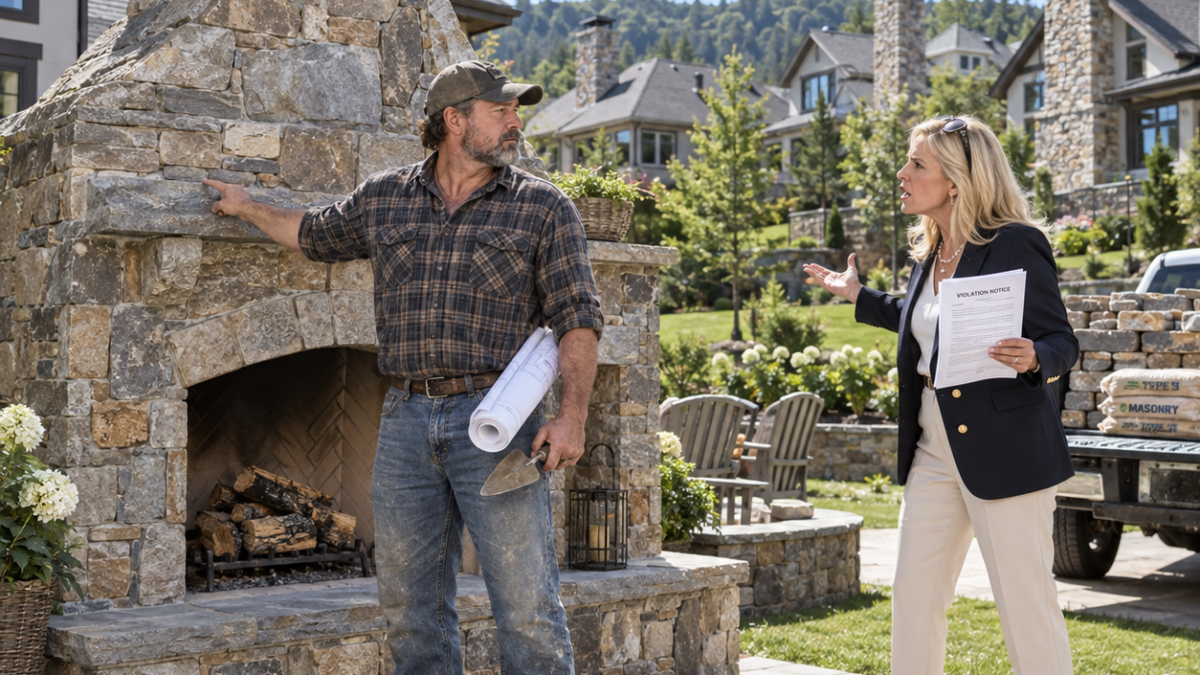
The first time Karen Miller pointed at the stone chimney I had spent three months building for my late wife and called it “an abomination,” I was standing beneath the last thing Sarah had ever designed for our home, holding a violation notice that could have buried me under thousands of dollars in HOA fines. Karen gave me ten business days to submit a demolition plan, warned that she would place a lien on my property if I refused, and smiled as if tearing down a widower’s memorial were nothing more than correcting the color of a mailbox. What she did not know was that ten years earlier, when Oakwood Estates was still a construction site, I had been the mason Prestige Homes hired to build fifty-seven of the stone fireplaces and exterior features she now claimed represented the community standard.
“That thing comes down by Friday.”
Karen stood halfway up my walkway wearing a floral pantsuit, oversized sunglasses, and a laminated badge that read **HOA PRESIDENT**.
She pointed at the chimney as though it were leaking toxic waste into the neighborhood.
“It violates architectural harmony.”
I looked behind me.
Granite.
River stone.
Limestone accents.
A reinforced flue.
County permit approved.
Final inspection passed.
Every course had been laid by my hands.
“What exactly violates harmony?”
“The scale.”
“It matches the house.”
“The materials.”
“They match half the fireplaces in Oakwood.”
“The overall appearance.”
I almost laughed.
“That isn’t a standard.”
Karen’s smile vanished.
She held out the notice.
The first line said:
**UNAPPROVED EXTERIOR MODIFICATION.**
The second line hurt more.
**INITIAL FINE: $5,000.**
Below that:
**CONTINUING PENALTY: $500 PER DAY.**
I read it twice.
“You’re fining me five thousand dollars?”
“You built without Architectural Review Committee approval.”
“I have a county permit.”
“County approval is not HOA approval.”
That part, unfortunately, could matter.
Sarah and I had owned this property before Oakwood Estates existed.
When the development grew around us, our old post-and-beam house became an island surrounded by beige stucco and landscaped cul-de-sacs.
For years, we stayed outside the HOA.
Then Sarah got sick.
Cancer has a way of rearranging priorities brutally.
Medical bills piled up.
We refinanced.
The bank wanted our parcel formally integrated into the development’s valuation structure.
We joined Oakwood.
I signed the papers in a hospital waiting room while Sarah slept against my shoulder.
I barely read the architectural section.
That mistake belonged to me.
But the chimney belonged to Sarah.
Years earlier, she had sketched it on the back of a restaurant napkin during one of our mountain trips.
“Someday,” she had said, drawing an absurdly tall stone stack beside a square little house, “I want a fireplace that looks like the mountain grew through the living room.”
I kept the napkin.
After she died, I found it inside her cookbook.
So I built it.
Not cheaply.
Not carelessly.
Proper footing.
Engineering calculations.
Fire-rated clearances.
Inspection at every required stage.
The granite came from the quarry where Sarah and I used to hike.
Three months of work.
Three months in which grief finally had somewhere to go besides the empty side of our bed.
Karen looked at the finished chimney and saw a violation.
I saw my wife.
“You’re not tearing it down,” I said.
Her smile returned.
“That isn’t your decision anymore.”
I looked at her.
“Excuse me?”
“You agreed to HOA governance.”
“Yes.”
“Then you agreed to comply with architectural standards.”
“Show me the decision.”
She blinked.
“What?”
“The Architectural Review Committee decision.”
“I am informing you of it.”
“No. I want the committee vote, minutes, roster, and the standard they applied.”
Karen’s mouth tightened.
“You are being deliberately difficult.”
“I’m asking for records.”
“You have ten business days.”
She turned toward her minivan.
Then stopped.
“And Jack?”
“Yes?”
“Do not use the fireplace until this is resolved. Unapproved masonry can be dangerous.”
That was the moment I knew something was wrong.
Not because she disliked my chimney.
People have bad taste every day.
Because she had just questioned work she had no idea she was already living with.
I watched her drive away.
Then I went inside, opened the old steel filing cabinet in my workshop, and pulled out a box labeled:
**PRESTIGE HOMES — OAKWOOD ESTATES — 2012–2014.**
Inside were contracts.
Blueprints.
Material schedules.
Photographs.
Inspection sign-offs.
And my own handwritten notes from building the fireplaces Karen’s neighbors had been admiring for a decade.
I laid Sarah’s napkin sketch beside them.
Then I started reading the HOA bylaws.
Not because I wanted revenge.
Not yet.
I wanted to know whether Karen Miller actually had the authority she was threatening me with.
And before sunrise the next morning, I had already found the first problem.
PART 2
The Architectural Review Committee was supposed to have between three and five members.
Not optional.
Not advisory language.
The bylaws said members were elected for two-year terms and that decisions had to be recorded in minutes available to homeowners.
I read that section four times.
Then I searched every Oakwood email I had received since joining.
No election notice.
No candidate list.
No minutes.
No committee roster.
Nothing.
At six in the morning, I made coffee and kept reading.
The architectural rules themselves were less helpful.
Any exterior addition visible from common areas required written approval.
Technically, Karen had a point there.
I had obtained county permits but had not submitted an HOA application.
I could not pretend otherwise simply because the chimney meant something to me.
But the bylaws also required a review process.
And the fine schedule Karen cited did not clearly authorize a five-thousand-dollar initial penalty.
That required board approval under a separate enforcement policy.
I requested everything.
Committee roster.
Minutes.
Fine schedule.
Board authorization.
Architectural standards.
Correspondence concerning my property.
Any engineering or safety report supporting Karen’s order to stop using the fireplace.
I mailed the request certified.
Then I emailed a copy to every board address I could find.
Afterward, I walked outside.
Morning light touched the stone.
Sarah would have loved it at that hour.
I had designed the fireplace opening around an old cast-iron screen she found at an estate sale years earlier.
She made me haul that thing through two states because she insisted:
“One day, you’ll thank me.”
I never got to tell her she was right.
I put one hand against the granite.
Cold.
Solid.
That helped.
The second HOA letter arrived nine days later.
No committee minutes.
No roster.
No engineering report.
Instead:
**Outstanding Balance: $8,500.**
Karen had added daily fines.
The letter also threatened a lien if I did not submit a demolition plan.
At the bottom:
**Requests for internal committee records are irrelevant to your continuing violation.**
That was the sentence that changed everything.
Not because it proved fraud.
It didn’t.
But it told me Karen did not want me looking at the process.
I called my old friend Mike “Gunny” Miller.
No relation to Karen.
Gunny had served with me in the Marines and later opened a licensed investigative firm.
He answered with:
“If this is about finding your golf clubs, I’m busy.”
“I don’t play golf.”
“Exactly. Suspicious.”
“I need public business records.”
“What kind?”
“HOA vendor.”
I gave him the name I had seen repeatedly in Oakwood newsletters:
**Miller’s Quality Contracting.**
Karen promoted them often.
Approved fountains.
Mailbox posts.
Exterior stone repair.
Patio resurfacing.
Approved paint services.
I wanted ownership records, licensing status, public corporate filings, liens, lawsuits—nothing private or shady.
Gunny could pull that legally.
“You fighting your HOA?”
“Yes.”
“I always knew retirement would break you.”
Then I started talking to neighbors.
Sarah used to make oatmeal-raisin cookies everybody loved.
I still had her recipe.
Mine came out uglier.
Taste was close.
I put them on paper plates and went next door to Eleanor Vance.
Eleanor was seventy-six.
Widowed.
Tiny woman with white hair and a back straight enough to make Marines jealous.
Her front yard was perfect.
Not sterile.
Perfect because she loved it.
I noticed an empty circle near the walkway.
“What happened there?”
“My birdbath.”
“What happened to it?”
“Karen.”
Of course.
Eleanor invited me inside.
The birdbath had belonged to her husband.
Simple cast stone.
Nothing gaudy.
Karen cited a rule prohibiting “unapproved freestanding decorative structures.”
Eleanor applied retroactively.
Denied.
Why?
Karen recommended replacing it with an approved fountain sold by Miller’s Quality Contracting.
Three thousand dollars.
The birdbath had cost eighty.
“I paid the fine,” Eleanor said.
“Why?”
She looked embarrassed.
“I got tired.”
There was that word again.
Not afraid.
Tired.
Systems like Karen’s did not always beat people through legal superiority.
They beat them through exhaustion.
A fifty-dollar fine.
Then another.
Then a hearing.
Then certified mail.
Then attorney fees.
At some point, ordinary people decided peace was cheaper.
My next stop was the Rodriguez house.
Their front door was beige.
Every other part of the home had warmth.
Flowers.
Children’s chalk drawings.
Wind spinner.
The door looked like oatmeal.
Maria Rodriguez laughed when I asked.
“We wanted blue.”
“What happened?”
“Denied.”
“Why?”
“Aesthetically disruptive.”
“You submitted samples?”
“Three.”
“Three blues?”
“Two blues and one green.”
“Processing fee?”
“Fifty dollars each.”
“Paid to the HOA?”
“Yes.”
Her husband Daniel appeared behind her.
“We finally picked beige because that’s what Karen said would pass.”
“Committee decision?”
Daniel laughed.
“She is the committee.”
Interesting.
More neighbors.
A veteran cited for a flag size.
A family fined because a portable basketball hoop remained visible overnight.
A gardener forced to remove roses that were not on an approved plant list.
In multiple cases, Karen’s recommended cure involved Miller’s Quality Contracting.
Two days later, Gunny called.
“Karen Miller’s maiden name is Peterson.”
“Okay.”
“Miller’s Quality Contracting is owned by Richard Peterson.”
“Brother?”
“Yep.”
I stared at the chimney through my office window.
“Any issue with the business itself?”
“Registered. Licensed for several categories. Small operation.”
“Bankruptcies?”
“Owner has prior business failures. That isn’t illegal.”
“Contracts with HOA?”
“You’ll need HOA records.”
“Anything showing Karen disclosed the relationship?”
“Not in public filings.”
That did not prove wrongdoing.
Family businesses can legally work for associations if properly disclosed and approved.
But if Karen was directing homeowners to her brother without disclosure, that was a governance problem.
Potentially a serious one.
I called Arthur Kensington.
Arthur lived three streets over.
Retired corporate attorney.
Seventy-eight.
The kind of man who still wore a jacket to pick up his mail.
I had repaired a cracked hearth for him years earlier.
He invited me over.
I brought everything.
Karen’s letters.
Bylaws.
My records request.
Gunny’s public-company research.
Eleanor’s notice.
Rodriguez applications.
Arthur read silently for almost an hour.
Finally he said:
“You have two different disputes.”
“Chimney and corruption?”
“Not corruption yet.”
He tapped the papers.
“Chimney and governance.”
I nodded.
“Your chimney may indeed have required advance architectural approval.”
“I know.”
He looked mildly surprised.
“Good. Never lie to yourself because you dislike your opponent.”
“Marine rule.”
“Lawyer rule too.”
He continued.
“But an association still has to use the procedures in its governing documents and applicable law.”
“ARC?”
“Exactly.”
“If the committee doesn’t exist?”
“Then we need counsel familiar with state HOA law before claiming every decision is automatically void. Real life is rarely that neat.”
I appreciated that.
Arthur pointed toward Miller’s Quality Contracting.
“This interests me more.”
“Self-dealing?”
“Potential conflict. We prove the facts before choosing the label.”
Then he looked at the lien threat.
“And this?”
“Karen says she’ll record one.”
“If the underlying fine is invalid, a lien could create substantial liability. But again—we proceed carefully.”
I smiled.
“You want in?”
Arthur smiled back.
“I’ve been retired eight years.”
“That wasn’t my question.”
He leaned back.
“I despise badly governed corporations.”
Good enough.
The next person we recruited was Mike Chen.
Thirty-two.
Software engineer.
Worked from home.
Had been fined because a small brass plaque beside his front door said **Chen Systems Consulting**, which Karen classified as prohibited commercial signage.
Mike built us a private resident website.
Nothing clandestine.
Nothing illegal.
A secure place for homeowners to upload their own notices, invoices, decisions, and meeting records.
We called it **Oakwood United**.
Within one week, forty-three households joined.
The stories multiplied.
And something important happened.
Not every complaint made Karen look bad.
One resident had been fined for leaving construction debris in his driveway for five months.
The HOA had given repeated warnings.
Reasonable.
Another blasted music after midnight.
Reasonable nuisance enforcement.
We left those out of our challenge.
That decision earned trust.
Arthur said:
“If you call everything tyranny, nobody will believe you when actual abuse appears.”
The pattern we documented was narrower.
Architectural decisions without identifiable committee process.
Processing fees.
Selective standards.
Pressure toward Karen’s brother’s company.
Retaliatory-looking enforcement after appeals.
We still needed financial records.
Arthur filed a formal request.
The board delayed.
Then produced partial statements.
Then more after Arthur sent a second letter.
Miller’s Quality Contracting had received more than forty thousand dollars over two years.
Not all from homeowner-direct purchases.
HOA funds too.
Entrance repairs.
Fountain maintenance.
Landscape hardscape.
Stone work.
Some prices looked high.
That alone did not prove fraud.
Then we found something more concrete.
Board conflict policy required disclosure when a director or close family member had a financial interest in a vendor.
We searched the minutes.
No disclosure for Richard Peterson.
No recusal by Karen.
That was real.
Then we requested Architectural Review Committee minutes.
The association finally responded:
**No separate ARC minutes exist because architectural matters have been handled administratively by the board president under delegated authority.**
Arthur read the sentence twice.
“Delegated where?”
We requested the delegation.
No response.
That was when we hired a lawyer.
Not Arthur.
He had been retired too long and wanted to remain a witness and homeowner.
Our attorney was Rebecca Sloan.
Fifty.
HOA and real-estate litigation specialist.
She did not grin when she read the file.
Good lawyers rarely celebrate until they understand risk.
Her first question:
“Did you seek HOA approval before construction?”
“No.”
“Why?”
“I assumed the county permit was enough.”
“That hurts.”
“I know.”
“Was the chimney within architectural guidelines?”
“That’s part of the irony.”
I opened the old Prestige Homes box.
Developer contract.
**Caldwell Masonry.**
Material specifications.
Blueprints.
Photographs.
Fifty-seven upgraded fireplaces.
Rebecca stared at me.
“You built these?”
“Yes.”
“In Oakwood?”
“Yes.”
“Karen knows?”
“No.”
“Do not tell her yet.”
That surprised me.
“Why?”
“Because evidence works best when presented at the right time, not the most satisfying time.”
I liked her.
She examined my chimney plans.
The new chimney was larger than the old development models.
Better stone.
More elaborate cap.
But stylistically related.
Rebecca said:
“This doesn’t make you automatically compliant.”
“I know.”
“But it destroys any argument that the material itself is somehow incompatible with Oakwood’s stone aesthetic.”
“Exactly.”
Then she looked at Karen’s fine.
“Five thousand initial penalty is aggressive. I want the adopted fine schedule.”
“There isn’t one in my documents.”
“We’ll request it.”
The association’s attorney responded.
No adopted schedule was produced.
Instead, he referenced “board discretion.”
Rebecca became very quiet.
I had learned quiet lawyers are dangerous.
She sent a formal notice disputing the debt and demanding that no lien be recorded while the validity of the fine and process remained under challenge.
Karen recorded one anyway.
Seventeen thousand dollars.
Fine.
Daily penalties.
Administrative charges.
Attorney fee.
I found out when Rebecca called.
“She did it.”
I sat at the kitchen table.
My first reaction was fear.
Not anger.
A lien is paper.
But paper can interfere with refinancing.
Sale.
Credit.
Title.
The home Sarah and I built.
The place she died.
Clouded by Karen’s signature.
“How bad?”
Rebecca answered honestly.
“Fixable. But serious.”
“What now?”
“Now we file.”
Suit seeking declaratory relief regarding the lien.
Challenge to enforcement procedure.
Injunction against escalating charges.
Breach-of-fiduciary-duty allegations only where supported.
Records claims.
We did not accuse Karen of embezzlement.
Not yet.
We had no proof.
Oakwood United exploded after residents learned the lien had been filed.
George Patterson, the HOA treasurer, called me.
Nervous voice.
“Jack, I didn’t know she was recording that.”
“You’re treasurer.”
“I handle bookkeeping.”
“You’re a director.”
“I know.”
“Did you vote?”
Silence.
“No.”
“Was there a meeting?”
“No.”
“Did the board authorize the lien?”
“She said counsel approved collection.”
“Did you see that approval?”
“No.”
I sat back.
“George, I’m not asking you to take my side.”
“I know.”
“I’m asking whether your own board followed its rules.”
Long silence.
“I don’t think we did.”
That was the first crack from inside.
Then local reporter Brenda Walsh called.
Someone had sent her public records and our filed complaint.
Mike denied being the one.
I never asked twice.
Rebecca coached me before the interview.
“Facts.”
“Yes.”
“No calling her corrupt.”
“Yes.”
“No fraud accusation.”
“Yes.”
“No Marine metaphors.”
“That feels excessive.”
“Jack.”
“Fine.”
The news segment showed my chimney.
Eleanor’s missing birdbath space.
The Rodriguez beige door.
The recorded lien.
The corporate filing showing Karen and the vendor owner were siblings.
Brenda said clearly:
“There is no criminal finding against Miller or her brother. Homeowners allege the relationship was not disclosed as required by association policy.”
Accurate.
Karen declined comment.
Then she made the mistake of sending a community-wide email.
She accused “outside agitators” of attacking Oakwood.
I lived there.
Arthur lived there.
Eleanor lived there.
Rodriguezes lived there.
Mike lived there.
The supposed outsiders were the community.
Three board members demanded an emergency meeting.
George later told me Karen shouted for forty minutes.
When asked about the ARC, she said:
“I handle it because nobody else will.”
When asked about her brother:
“He gives us preferred pricing.”
When asked why the conflict wasn’t disclosed:
“Everyone knows Rick is my brother.”
George replied:
“I didn’t.”
Neither did two other directors.
Annual meeting notice went out.
Arthur gathered enough signatures under the bylaws to place a board-conduct review on the agenda.
The event moved to the larger hall.
The night of the meeting, nearly every seat was full.
I saw veterans from my old VFW post.
I told them not to come as protesters.
They came as friends.
Eleanor sat beside Maria Rodriguez.
Mike controlled the projector.
Rebecca sat near the back, there only as my attorney and observer.
Karen entered at seven.
Dark red jacket.
Hair perfect.
Jaw tight.
No floral pantsuit.
The meeting began normally.
Minutes.
Budget.
Pool maintenance.
Then:
“Special agenda item.”
Karen stared directly at me.
“Mr. Caldwell has requested time to address his architectural violation.”
I stood.
Walked to the podium.
“My name is Jack Caldwell.”
I looked around.
Most people knew me now.
“I did not apply for HOA approval before building my chimney.”
The room became quiet.
Karen looked surprised.
Good.
“I should have.”
Some people shifted.
I continued.
“That does not mean the process used afterward was legitimate.”
First slide.
Bylaws.
**ARCHITECTURAL REVIEW COMMITTEE: THREE TO FIVE ELECTED MEMBERS.**
“Who currently serves?”
No answer.
George looked at Karen.
Karen said:
“Architectural responsibilities were delegated.”
I turned.
“Where is the written delegation?”
Her face tightened.
Next slide.
Association response:
**NO SEPARATE ARC MINUTES EXIST.**
Next.
Fines.
Not only mine.
Dozens.
I did not say they were automatically void.
I said:
“These decisions deserve independent review because the process described in our governing documents does not appear to have been followed.”
That was stronger because it was true.
Then Eleanor.
She spoke about her husband Robert.
The birdbath he bought after she retired.
How she removed it because fighting felt exhausting.
Maria Rodriguez showed photographs of the blue door samples.
Mike described his consulting plaque.
A veteran named Paul spoke about his flag.
Then Arthur addressed governance.
No theatrical accusation.
Just fiduciary principles.
Conflict disclosure.
Records.
Board oversight.
Procedure.
Then came the vendor records.
Richard Peterson.
Karen’s brother.
Forty thousand dollars-plus in association payments.
No disclosure found in minutes.
Karen stood.
“This is slander.”
Arthur replied:
“These are the association’s own records.”
“My brother is qualified.”
“No one said he isn’t.”
“Then what is the issue?”
“The issue is that board policy requires disclosure.”
“He gave us discounts.”
“Then disclose and document them.”
Karen grabbed the microphone.
“You people have no idea how hard it is to run this neighborhood.”
Someone called:
“Then why wouldn’t you let anyone else serve on the ARC?”
Noise spread.
Karen banged the gavel.
I waited.
Then I clicked to the final section.
A photograph of my chimney filled the screen.
Karen’s face hardened.
“This structure is the reason this entire circus began.”
“Yes.”
I let that sit.
“She called it an abomination.”
A few people laughed.
Karen said:
“It violates the established style.”
I clicked again.
Original Prestige Homes blueprint.
**OPTIONAL STONE FIREPLACE — MODEL B.**
Caldwell Masonry stamped in the subcontractor block.
Next slide.
Photographs.
House after house in Oakwood.
Stone fireplaces.
Exterior stone accents.
Chimneys.
Then a photo from 2013.
Me.
Ten years younger.
Standing on scaffolding beside the fireplace in what was now Karen’s house.
The room went completely silent.
I turned toward her.
“Ten years ago, Prestige Homes’ original masonry subcontractor failed midway through this development.”
I looked around.
“They hired my company.”
Another slide.
Contract.
Fifty-seven upgraded fireplaces and related exterior stone installations.
“I built many of the fireplaces in this room’s homes.”
A man near the front whispered:
“No way.”
I pointed toward Karen.
“Including the fireplace in President Miller’s house.”
Her face went white.
I did not smile.
That mattered.
“The stonework she has lived with for years was built by the same hands she now describes as unsafe and aesthetically incompatible.”
Then I clarified the point.
“That does not excuse my failure to submit an application for my own chimney.”
Karen’s attorney was not there, but Rebecca gave me a small nod from the back.
I continued.
“I am prepared to submit a retroactive application to a properly constituted review committee.”
Murmurs.
“But I will not accept invented penalties, a questionable process, a lien imposed without transparent board authorization, or a system where one person chooses the standard, issues the violation, recommends her relative’s company, and then refuses to produce the records that are supposed to justify any of it.”
That landed.
Karen stood.
“You are manipulating these people because your wife died.”
The room froze.
So did I.
There are moments when anger feels physical.
Heat behind the eyes.
Pressure in your hands.
Sarah had been dead two years.
I had learned to survive people saying the wrong thing about grief.
But that sentence came with intent.
I gripped the podium.
Then I remembered Sarah’s voice.
**Build something, Jack. Don’t break things just because you’re hurting.**
I breathed.
Then said:
“My wife has nothing to do with whether you followed the bylaws.”
Karen opened her mouth.
I raised one hand.
“But since you brought her into this, I’ll tell you why the chimney exists.”
I showed Sarah’s napkin sketch.
The crooked little house.
The exaggerated stone chimney.
Her handwriting:
**Someday.**
No one spoke.
“She drew this years before she got sick.”
I looked at the screen instead of Karen.
“She never got to see it finished.”
My voice nearly broke.
I let it.
No performance.
No shame.
“I built it because promises still matter after the person you made them to is gone.”
Then I looked back at Karen.
“But sentiment doesn’t give me special rights.”
Another pause.
“And your title doesn’t give you special rights either.”
That was the moment the room changed.
Not because I destroyed Karen.
Because people stopped fearing her.
Arthur stood.
He made a properly noticed motion under the bylaws requesting recall proceedings against Karen and an independent financial audit.
Not an instant improvised removal.
Rebecca had insisted we follow procedure exactly.
The petition threshold was reached that night.
A special recall meeting was scheduled for two weeks later.
Independent association counsel supervised.
Ballots mailed.
Eligibility verified.
No shortcuts.
Karen spent those two weeks campaigning.
She accused us of trying to destroy property values.
She distributed flyers showing photographs of houses in run-down neighborhoods unrelated to Oakwood.
**THIS IS WHAT HAPPENS WHEN STANDARDS DISAPPEAR.**
Mike posted a response on Oakwood United:
**Nobody proposed eliminating standards. We proposed following them.**
That sentence became our unofficial motto.
The recall meeting lasted four hours.
Karen spoke first.
She reminded people of every good thing she had done.
And she had done good things.
Storm cleanup.
Negotiated pool repairs.
Christmas events.
Entrance landscaping.
She had spent years volunteering.
That complicated the story.
People rarely become monsters in one step.
Karen had started as someone willing to do work others avoided.
Then responsibility became authority.
Authority became identity.
And identity became entitlement.
George spoke next.
He did something I respected.
“I failed.”
The room quieted.
“I let Karen handle architectural matters because it was easier.”
He looked at homeowners.
“I signed checks without asking enough questions. I assumed if something was in front of me, somebody else had verified it.”
He swallowed.
“I am responsible for that.”
Karen stared at him.
George continued.
“I don’t believe every decision Karen made was malicious.”
Good.
“I do believe our board stopped functioning as a board.”
Better.
“And I believe residents deserve new leadership.”
The vote:
72 percent to remove Karen.
28 percent to keep her.
Not unanimous.
Not everyone hated her.
That made the result more believable and, to me, more meaningful.
Karen lost the presidency and board seat.
No cheering at first.
Just exhalation.
Then applause.
Karen collected her bag.
At the door, she looked at me.
“You destroyed me over a chimney.”
I answered quietly.
“No.”
She stopped.
“I challenged a fine over a chimney.”
I looked toward George.
Arthur.
Eleanor.
Maria.
“You lost the rest when people started reading the paperwork.”
She left.
The new interim board appointed an independent management company while elections were organized.
Arthur refused the presidency.
For three days.
Then Eleanor cornered him at the mailbox.
He accepted a six-month interim term.
George remained treasurer only after agreeing to work with an outside CPA.
A teacher named Natalie Brooks joined the board.
Retired nurse Linda Harris took another seat.
They did not immediately erase every fine Karen issued.
They commissioned a review.
Some fines were upheld.
Noise complaints.
Blocked sidewalks.
Actual unapproved structural work.
Others were canceled because procedure had not been followed or standards were too vague.
My chimney case went before a properly constituted Architectural Review Committee after I filed a retroactive application.
Three residents.
None on the main board.
They reviewed:
County permits.
Engineering details.
Fire inspection.
Materials.
Sight lines.
Architectural compatibility.
My old development plans.
The committee approved the chimney unanimously, subject to one minor condition:
Install a spark arrestor model consistent with updated fire guidance.
I did it that weekend.
No argument.
Good rule.
Real reason.
That approval meant more to me than simply having Karen’s fine canceled.
The process worked.
That was what we had been fighting for.
The lien took longer.
The new board’s counsel filed a release.
My title company confirmed it was cleared.
I held the recorded release in my hands for a long time.
Sarah and I had signed the mortgage papers together years earlier.
The house was not merely an asset.
It was thirty years of us.
I put the lien release in the same steel cabinet as her napkin.
Not as a trophy.
As closure.
Then came the audit.
This is where rumor and reality separated.
Oakwood had not lost hundreds of thousands of dollars.
Karen had not purchased yachts or vacations with HOA funds.
What investigators found was less sensational but still serious.
Miller’s Quality Contracting had received repeated no-bid work.
Conflict disclosures were missing.
Several prices exceeded comparable contractor estimates.
Some homeowner “remediation” charges were routed through the vendor after Karen denied applications.
There were questionable reimbursements.
And the board had paid legal fees that partly related to Karen’s personal exposure after the vendor relationship became a dispute.
Independent counsel referred parts of the matter to the state consumer-protection office and local prosecutors.
The prosecutor did not immediately charge Karen.
Months passed.
Records were reviewed.
Richard Peterson cooperated.
Some invoices were entirely legitimate.
Others showed inflated labor or materials.
Investigators eventually developed evidence that Karen had received indirect financial benefits connected to certain vendor payments.
Not every rumor became a charge.
Specific transactions did.
Karen and Richard were eventually charged with theft-related and falsified-record offenses tied to those transactions.
Karen fought the charges.
Richard reached an agreement first.
He pleaded to reduced charges, agreed to restitution, and cooperated.
Karen later entered her own negotiated plea rather than face trial.
No dramatic twenty-year sentence.
She received a custodial sentence measured in months, followed by probation and restitution obligations.
Oakwood pursued civil recovery separately.
Her directors-and-officers insurer disputed portions involving intentional misconduct.
The HOA itself recovered some funds through settlements.
Nobody became rich.
Homeowners got accountability.
That was enough.
Karen sold her house before reporting to custody.
I learned because Eleanor called.
“Moving truck.”
“Okay.”
“You’re not coming outside?”
“No.”
“Jack.”
“I have mortar curing.”
“You are the least curious person I know.”
False.
I was extremely curious.
I simply did not want Karen’s final day in Oakwood to become another performance.
At four that afternoon, my doorbell rang.
Karen.
No clipboard.
No badge.
Jeans.
Sweater.
She looked older than she had a year earlier.
I opened the door but did not invite her inside.
She looked past me.
The chimney was visible through the living room.
“I’m leaving tomorrow.”
“I heard.”
“Of course you did.”
She rubbed her hands together.
Cold day.
“I wanted to say something before I go.”
I waited.
She looked toward the stone.
“I still think it’s too large.”
That surprised a laugh out of me.
Karen almost smiled.
“Of course you do.”
Then her expression changed.
“I was wrong about the committee.”
I said nothing.
“I convinced myself that because nobody volunteered, I could just handle it.”
“You could’ve appointed one under the rules.”
“I know.”
“Or asked.”
“I know.”
She swallowed.
“I started doing more because things got done faster.”
That sounded familiar.
Military units can make the same mistake.
One competent person takes over every task.
Initially, efficiency improves.
Then everybody stops questioning them.
“That doesn’t explain your brother,” I said.
“No.”
She looked at the walkway.
“Rick needed work.”
“That wasn’t your money.”
“I thought his prices were fair.”
“Sometimes they weren’t.”
“I know that now.”
“You should’ve disclosed it.”
“Yes.”
No excuses.
That was new.
Then she looked at me.
“I hated you.”
“Why?”
“Because you weren’t intimidated.”
I almost smiled.
“Not a great reason.”
“You made me feel…”
She stopped.
“What?”
“Small.”
I did not answer.
Maybe because I understood.
Karen had built identity around being necessary.
People called her.
Asked permission.
Waited for decisions.
Then a retired Marine showed up asking for minutes.
Records.
Authority.
Karen did not experience that as procedure.
She experienced it as an attack on who she was.
“That wasn’t my intention at first,” I said.
“At first?”
“I wanted the chimney left alone.”
“And later?”
I answered honestly.
“Later, I wanted you removed.”
She nodded.
“Did you enjoy it?”
The question was uncomfortable.
“Yes.”
Her eyes lifted.
“For a while.”
“At least you admit it.”
“I’m not proud of every feeling I had.”
Karen looked toward the house.
“Was your wife really the reason?”
“The chimney?”
“Yes.”
I stepped aside.
“Come in.”
She hesitated.
Then entered.
The living room had changed after Sarah died.
But some things remained.
Her books.
Photographs.
The old wool blanket over the chair.
The fireplace occupied one entire wall.
Stone rising two stories.
Karen stood before it.
The flames were low.
I had lit them that morning.
I showed her the napkin sketch in a frame beside the mantel.
She read Sarah’s handwriting.
**Someday.**
“She drew that?”
“Years ago.”
Karen looked up the chimney.
For a long time, neither of us spoke.
Then:
“I shouldn’t have called it an abomination.”
“No.”
“I didn’t know.”
“You didn’t ask.”
She closed her eyes briefly.
“That seems to be a theme.”
“Yes.”
I could have been gentler.
But truth did not require cruelty or comfort.
She looked at a photograph of Sarah and me in the mountains.
“Cancer?”
“Breast cancer.”
“I’m sorry.”
“Thank you.”
Then Karen said:
“I’m not asking you to forgive me.”
“Good.”
That startled her.
“Forgiveness is complicated.”
“Yes.”
“I don’t know you well enough to forgive your whole life.”
She looked at me.
“But I don’t need you punished forever either.”
Her face tightened.
“I am being punished.”
“That’s different.”
I pointed toward the chimney.
“You’re facing consequences for things you did.”
She nodded slowly.
“I used to think those were the same.”
She left ten minutes later.
At the porch, she stopped.
“You built my fireplace?”
“Yes.”
“You’re sure?”
“Lot 38. Model B upgrade. You have the darker Tennessee fieldstone blend.”
She actually laughed.
“All these years.”
“All these years.”
She shook her head.
“Goodbye, Jack.”
“Goodbye, Karen.”
Her house sold to a young family named the Turners.
Their first architectural request under the new committee was for a dark blue front door.
Approved in eight days.
Maria Rodriguez was furious.
“What?”
“They got blue immediately!”
“You fought for this.”
“I know, but I suffered.”
Her own door had been blue for months by then.
Oakwood changed.
Not into an anything-goes mess.
The architectural committee still denied bad plans.
One homeowner wanted to build a twelve-foot illuminated sports logo on his roof.
Denied.
Correctly.
Another wanted to replace most of his front lawn with gravel that would have worsened drainage onto neighboring lots.
Modified.
Good governance is not saying yes.
It is being able to explain why the answer is yes or no.
The new committee published standards.
Material lists.
Color ranges.
Application timelines.
Written reasons for denials.
Appeal procedure.
And conflict rules.
If a committee member had a financial interest in a vendor, disclosure and recusal were mandatory.
The HOA accounting portal went online under George.
Every resident could see budgets, contracts, and major invoices.
George transformed.
The timid treasurer who once signed whatever Karen placed in front of him became almost irritatingly careful.
Arthur once waited three weeks for reimbursement of twenty-eight dollars because George wanted a missing receipt.
“I created a monster,” Arthur told me.
“A transparent monster.”
“Still a monster.”
Eleanor became head of the social committee.
Her first act was to reinstall a birdbath.
Not from Miller’s Quality Contracting.
I helped her choose stone.
We built a simple one together.
When we finished, she ran her fingers along the rim.
“Robert would’ve liked this.”
I looked toward a cardinal sitting in her maple tree.
“I think someone already does.”
She cried.
So did I.
Grief recognizes grief.
The Rodriguez family painted their door blue.
Bright blue.
Tasteful.
Their children helped.
The youngest smeared paint onto his father’s shorts.
Maria sent me a picture.
**HOA APPROVED. HUSBAND NOT APPROVED.**
Life became funny again.
That mattered.
The chimney became a neighborhood story.
Not because I wanted it to.
New residents heard about “the fireplace that took down the president.”
Ridiculous.
Stone does not overthrow anyone.
Paperwork did.
Neighbors did.
Karen’s own decisions did.
The chimney simply forced everyone to look.
People also started asking me to do masonry jobs again.
I had mostly retired.
But grief had left me with too much empty time.
I accepted a few.
A patio for the Turners.
Stone steps for Eleanor.
A retaining wall for Mike.
Then one Saturday, a young couple named Ben and Alyssa Harper knocked.
“We want a small stone wall around our flower bed.”
“How small?”
“Two feet.”
“What stone?”
“We don’t know.”
That answer terrified me.
I walked to their house.
Spent an hour explaining drainage, frost movement, footing depth, stone selection.
They offered to pay.
“No.”
“Really?”
“Really.”
A week later, I helped them lay the first course.
Mike came over.
Then Daniel Rodriguez.
Then George.
By noon, seven neighbors were there.
Someone brought sandwiches.
Kids carried small stones.
Eleanor supervised from a chair despite knowing nothing about masonry.
When we finished, the wall was slightly imperfect.
A joint near the corner was wider than I would have allowed professionally.
Ben looked worried.
“Should we redo it?”
I stared.
Then remembered Sarah.
“No.”
“You sure?”
“People will know you built it.”
He smiled.
“So that’s good?”
“It’s better.”
That little wall taught me something the giant chimney hadn’t.
For most of my life, craftsmanship meant control.
Perfect courses.
Level lines.
Correct mortar.
Measured joints.
Then I grew older.
Some things became more valuable because other hands touched them.
Oakwood’s community garden was one.
The new board built it on unused common land.
Raised beds.
Tomatoes.
Peppers.
Herbs.
Eleanor ran the planting schedule like a field marshal.
Children did most of the watering badly.
Nobody died.
The first harvest dinner happened in late August.
Long tables.
Food made from garden vegetables.
I brought bread.
Arthur brought wine.
Mike set up lights.
George complained they exceeded the event budget by forty-three dollars.
People booed him.
He smiled.
Under Karen, community events had felt like staged displays.
Perfect decorations.
Approved vendors.
Everything controlled.
This was messier.
Better.
A child spilled lemonade onto Arthur’s pants.
He declared it assault.
The neighborhood finally felt inhabited instead of managed.
Two years after Karen left, a letter arrived.
Her name.
Different state.
I knew she had completed her sentence and was living with relatives.
I almost threw it into the fire unopened.
Then I stopped.
Not because she deserved access to me.
Because I no longer feared what her words could do.
I opened it.
Jack,
I thought prison would make me understand what happened.
It did not.
For a long time I blamed you.
Then Arthur.
Then George.
Then my brother.
I told myself everyone used me because I was willing to make decisions.
Some of that may even be true.
But eventually I had to answer a question no one else could answer for me.
Why did I keep choosing decisions I knew I would have hated if someone else made them about my house?
I don’t have a good answer.
I suppose that is the answer.
I knew better and convinced myself being in charge made me different.
I am sorry for the lien.
I am sorry for involving your wife’s memory in the meeting.
I am sorry I treated the community like it belonged to me.
I still think your chimney is enormous.
Karen.
I laughed.
Actual laughter.
Sarah would have loved that last line.
I carried the letter to the fireplace.
For a moment, I considered burning it.
The old version of me might have.
Instead, I folded it.
Put it in the steel cabinet beside the lien release.
Not because Karen deserved preservation.
Because the story did.
People can change.
Sometimes late.
Sometimes incompletely.
Sometimes only enough to recognize their own damage.
That is still better than nothing.
I wrote back.
Karen,
The chimney is enormous.
Sarah designed it that way.
Thank you for the letter.
I hope the next chapter of your life is quieter than the last one.
Jack.
We never corresponded again.
Arthur died five years later.
Eighty-four.
Heart failure.
He left instructions for the memorial service that included:
**No excessively sentimental speeches by Caldwell.**
So naturally, I spoke.
I told everyone Arthur’s greatest talent had not been law.
It had been making frightened people feel procedural.
That got a laugh.
Then I explained.
“When people were angry, Arthur asked what the bylaws said.”
“When people wanted revenge, he asked what remedy was actually available.”
“When people were afraid, he showed them which meeting to attend.”
That was civic courage.
Not shouting louder.
Helping others understand the rules well enough to stop fearing them.
Oakwood named the community garden after him.
He would have hated that.
Perfect.
Eleanor lived into her late eighties.
When she died, her daughter asked whether I wanted the birdbath.
“No.”
“Mom said you would say that.”
“What did she want?”
“For it to stay with the house if the next owner agrees.”
They did.
Years later, I still saw cardinals there.
The Rodriguezes’ children grew.
Their blue door was repainted eventually.
Still blue.
Mike married.
His secure website became the official Oakwood resident portal.
The board paid him fairly under a disclosed contract after obtaining competitive quotes.
That detail pleased George immensely.
The veterans’ flag dispute produced a clear flag policy consistent with applicable law and sensible placement standards.
No ruler appeared after Karen.
That was important.
Communities sometimes remove one domineering leader only to replace them with another.
We worked hard not to.
Terms limits.
Rotating committee appointments.
Published minutes.
Resident comment periods.
Independent annual financial review.
No board president could act as sole architectural authority.
Oakwood became boring.
Beautifully boring.
I aged too.
My hands began stiffening.
Stone that once felt manageable grew heavier.
At sixty-eight, I could still lay a wall.
At seventy-five, I needed help lifting the biggest pieces.
At eighty, I stopped pretending.
A young mason named Luis Ortega had worked with me for years.
Quiet.
Patient.
Better eye than I had at his age.
I taught him everything.
Footings.
Bond patterns.
Mortar ratios.
Flashing.
Drainage.
And the thing my father taught me:
“Never force a stone into the wrong place just because you want it there.”
Luis once asked:
“Is that masonry advice?”
“Yes.”
“And life?”
“I charge extra for philosophy.”
He eventually bought Caldwell Masonry.
I kept a small consulting role.
Mostly annoying him.
The last fireplace I helped build professionally was in the Turner home.
Karen’s old house.
That irony was not planned.
The Turners wanted an outdoor fireplace on the patio.
Luis designed most of it.
I reviewed.
We applied to the ARC.
Proper application.
Plans.
Materials.
Setbacks.
Drainage.
Approval in twelve days.
I insisted we follow every step.
Luis laughed.
“You afraid they’ll fine you?”
“I am living evidence.”
The fireplace turned out beautiful.
Different from Karen’s interior fireplace.
More contemporary.
Still stone.
The Turner children roasted marshmallows there.
One evening, I stood looking at it.
Mr. Turner asked:
“Feels weird working on her house?”
“Whose?”
He stared.
Then smiled.
“That’s probably healthy.”
It was.
Karen had become background.
Oakwood was no longer “her neighborhood.”
My house was no longer “the place with the chimney dispute.”
It was home.
That may have been the greatest victory.
Time eventually softened the sharp edges of grief too.
Sarah remained everywhere.
Not as pain every minute.
As presence.
The old sketch.
Her cookbook.
A scarf in the upstairs closet I could never throw away.
The way late-afternoon light hit the living-room floor.
The chimney most of all.
Every winter morning, I lit a fire.
Sometimes I spoke to her.
Not full conversations.
I had standards.
Usually:
“Too cold.”
Or:
“You would hate what they did to that house.”
Or:
“The chimney still looks good.”
One January, almost fifteen years after she died, a storm knocked out power across Oakwood.
Ice covered roads.
Utility crews warned restoration might take two days.
Houses got cold quickly.
Modern gas furnaces needed electricity for controls.
Some residents had fireplaces.
Many of the ones I had built decades earlier.
Working fireplaces.
Proper chimneys.
Suddenly my old job mattered again.
Neighbors checked on one another.
Luis and I walked from house to house inspecting fireplaces people had not used in years before they lit them.
Clear dampers.
Check flues.
Keep combustibles back.
Use screens.
At my house, the enormous chimney Karen once wanted demolished drew perfectly.
The living room stayed warm.
Eleanor was gone by then, but the young family living in her house lost heat.
They came over with two children and a sleepy Labrador.
Then another elderly couple.
Then Mike and his wife when their power bank failed.
By night, twelve people sat around Sarah’s fireplace.
Children on blankets.
Coffee.
Soup heated over the gas stove.
Someone found cards.
The house was full.
Not silent.
Not grieving.
Alive.
I sat in Sarah’s old chair.
Watched flames move behind her cast-iron screen.
Mike looked up the chimney.
“Imagine if Karen won.”
The room went quiet for a second.
I smiled.
“She didn’t.”
That was enough.
But later, after everyone slept, I remained beside the fire.
The storm pressed against the windows.
I touched the stone.
I finally understood something I had missed when I built it.
I thought the chimney was a monument to Sarah because it was permanent.
Stone.
Mortar.
Weight.
Something death could not erase.
I was wrong.
Its permanence wasn’t the point.
Its purpose was.
Warmth.
Shelter.
Gathering people.
The thing Sarah wanted when she sketched a ridiculous mountain fireplace was not a monument.
She wanted a hearth.
A heart.
I had spent years treating it like sacred architecture.
She probably would have laughed at me.
The next morning, children toasted bread beside it.
One spilled hot chocolate on my rug.
Sarah would have considered that perfect.
When power returned, everyone went home.
The house became quiet again.
But not empty.
That distinction matters.
Years later, the HOA asked if I would allow photographs of the chimney in Oakwood’s fiftieth-anniversary booklet.
I said yes.
They wrote a caption:
**THE CALDWELL CHIMNEY — BUILT BY ORIGINAL OAKWOOD MASON JACK CALDWELL.**
No mention of Karen.
No mention of the lien.
No mention of the fight.
At first, I thought they should include it.
Then I changed my mind.
The chimney deserved an identity separate from conflict.
So did I.
The booklet also featured blue doors.
Community garden.
Veterans’ flags.
Birdbaths.
Stone walls.
Families.
Oakwood looked nothing like Karen’s beige vision.
It looked better.
Not because standards disappeared.
Because people were allowed to live inside them.
When I turned eighty-two, Luis brought apprentices to my house for a lesson.
Four young masons.
They stood beneath the chimney.
One asked:
“You really built this alone?”
“Mostly.”
“How long?”
“Three months.”
“Why so long?”
“I was old.”
“You were sixty-something.”
“I repeat myself.”
They laughed.
I showed them the joints.
Flashing.
Cap.
The hidden reinforcement.
Then one young man pointed at a stone near the mantel.
It was slightly irregular.
“Why’d you leave that?”
I smiled.
Sarah had chosen that stone years before at the quarry.
She picked it up and said:
“This one looks stubborn.”
I had kept it.
When building the chimney, I placed it where I would see it from my chair.
“My wife liked it.”
The apprentice nodded.
“That’s it?”
“That’s enough.”
He ran his hand lightly across the surface.
“You know what my dad says?”
“What?”
“Perfect work looks like a machine made it.”
“Your dad’s smart.”
“He’s a plumber.”
“Nobody’s perfect.”
The apprentices laughed.
After they left, Luis stayed.
“You ever going to sell the house?”
“No.”
“That was quick.”
“Why?”
“Big place for one man.”
“It’s my place.”
He nodded.
Then:
“What happens after?”
I knew what he meant.
I had no children.
Sarah and I never did.
For years, I avoided estate questions.
The house felt inseparable from us.
Eventually, I created a plan.
A local veterans’ nonprofit would receive a substantial portion of my estate.
The house?
I decided to place it into a small trust with instructions that it be sold normally after my death, not turned into a museum.
The proceeds would support trade scholarships for veterans transitioning into masonry, carpentry, electrical work, and other skilled trades.
I wanted the chimney protected from immediate demolition if practical.
But not forever.
That surprised Luis.
“You’re letting someone change it someday?”
“Yes.”
He stared.
“Who are you?”
I smiled.
“Temporary caretaker.”
I had learned that from watching neighborhoods.
Nothing remains exactly as we leave it.
Not houses.
Not organizations.
Not reputations.
Not grief.
The best you can do is build well enough that what comes next has a solid foundation.
At eighty-five, climbing the front steps became annoying.
Oakwood’s board offered to let me install a handrail under expedited approval.
I laughed when the email arrived.
Not because of the accommodation.
Because the architectural committee chair personally wrote:
**Jack, please do not make me explain to the community how we fined the man who built our fireplaces because he installed a handrail.**
I approved of her survival instincts.
Luis built the rail.
Stone anchors.
Black steel.
Simple.
I submitted the application.
Of course.
The ARC approved it.
Of course.
Then they waived the fee.
I objected.
“Rules.”
The chair said:
“Community volunteer exemption.”
I checked the policy.
It existed.
I paid nothing.
I was proud of them.
One cold evening not long after, I sat beside the fire.
Sarah’s napkin sketch rested in its frame.
Karen’s first violation notice remained in my file cabinet.
Her apology letter too.
Not displayed.
Never destroyed.
They were part of the story, not the center.
Outside, Oakwood settled into night.
Blue doors.
Wind chimes.
Garden plots.
Flags.
Children.
Different tastes.
Shared roads.
A community nobody controlled completely.
I looked at the chimney.
Karen once said it didn’t belong.
That word had defined our whole conflict.
Belong.
Who decides what belongs?
What design belongs?
What person belongs?
What grief belongs in public?
What difference belongs inside a neighborhood?
Karen’s answer had been simple:
Whatever fits the standard she preferred.
Sarah’s answer would have been better.
If it is built with care, harms no one, respects its neighbors, and makes a home feel like home—maybe there is room for it.
That principle outlasted every fine.
The fire settled lower.
I added one split log.
Flames rose.
Smoke disappeared cleanly up the flue.
Same as always.
I thought about the younger version of myself standing in the driveway while Karen threatened to tear everything down.
He believed the fight would end when Karen lost.
He was wrong.
The real ending came years later when nobody needed to hate her anymore.
When Oakwood could enforce a rule without frightening people.
When a blue door was simply a blue door.
When Eleanor’s birdbath became someone else’s favorite place to watch cardinals.
When George could question an invoice without fear.
When young tradespeople stood inside my house learning how to build something that might outlive them.
When Sarah’s chimney stopped being a symbol of defiance and became what she had wanted from the beginning.
A place where people gathered when it was cold.
That was the ending worth having.
Not Karen leaving.
Not criminal charges.
Not canceled fines.
Warmth.
Neighbors.
Work done right.
A promise kept.
I leaned back in my chair.
Above me stood thousands of pounds of stone Karen once demanded I demolish.
It had survived her.
But more importantly, Oakwood had survived what she turned it into.
So had I.
The fire cracked.
I looked at Sarah’s sketch one last time before turning out the lamp.
Her handwriting remained beneath the crooked little chimney.
**Someday.**
I smiled.
“Yeah,” I whispered.
“We got there.”
And as the room filled with the low orange light of the hearth, I understood that the strongest thing I had ever built was never the chimney.
It was everything that gathered around it after the fight was over.
Years passed, and the chimney kept doing exactly what Sarah had imagined when she drew it on that napkin.
It gathered people.
At first, I thought that was coincidence.
A winter storm.
A neighborhood power outage.
Friends stopping by.
Young masons asking questions.
But somewhere along the way, my house became the place people came when they needed warmth that had very little to do with temperature.
One December afternoon, I was splitting kindling beside the garage when a pickup pulled into my driveway.
A young man climbed out.
Maybe twenty-seven.
Work boots.
Canvas jacket.
Nervous expression.
I recognized him after a moment.
“Evan?”
He smiled.
“Been a while.”
Evan Brooks.
The boy whose wheelchair ramp Karen had once treated like an architectural inconvenience.
Except he wasn’t a boy anymore.
He transferred himself from the truck into a sleek power chair, then rolled toward me.
“What brings you back?”
“Work.”
“Here?”
“County planning department.”
I blinked.
“You became a planner?”
“Accessibility specialist.”
I laughed.
Of course he had.
“Your mother know you’re working with government?”
“She says it’s revenge.”
“Smart woman.”
He looked up at the chimney.
“That’s the famous thing?”
“Unfortunately.”
“Mom showed me the news story years ago.”
“I’m sorry.”
“She cried.”
That stopped me.
“Why?”
“She said someone finally made Karen answer questions.”
We went inside.
I built a fire.
Evan positioned his chair near the hearth.
For a while, he watched the flames.
Then he told me why he had come.
Oakwood’s clubhouse was due for renovation.
Not cosmetic.
Real upgrades.
Restrooms.
Door widths.
Entry slopes.
Parking.
Emergency access.
The new board wanted to exceed minimum accessibility requirements where practical.
Evan was advising them.
“They asked me to review plans.”
“That must feel strange.”
“It does.”
“You going to do it?”
“I already did.”
He smiled.
“They actually listened.”
That sentence meant more than he knew.
Years earlier, his family had been treated like a design problem.
Now Oakwood was paying him for expertise.
Not charity.
Not apology.
Expertise.
“How’s your mom?”
“Good.”
“Still angry?”
“At Karen?”
“Yes.”
“At the neighborhood?”
He thought.
“Less.”
Then he looked around my living room.
“She told me something I didn’t understand when I was younger.”
“What?”
“That sometimes the place isn’t the people who hurt you.”
I nodded.
“That’s true.”
“She still won’t move back.”
“She shouldn’t if she doesn’t want to.”
“I know.”
He rolled closer to the fireplace.
“Can I ask something?”
“Sure.”
“Did you really think Karen was going to take your house?”
The question carried no drama.
Just curiosity.
I sat across from him.
“Yes.”
“Even though the fine was ridiculous?”
“A ridiculous claim can still create a real problem when somebody files paperwork.”
“The lien?”
“Yes.”
He looked at the fire.
“Mom used to panic every time an HOA envelope came.”
That hurt.
“People shouldn’t have to feel that way about their own homes.”
“No.”
Evan stared at the stone.
“That’s why I do this.”
“Planning?”
“Accessibility.”
He touched the joystick.
“A bad doorway tells you something.”
“What?”
“Whoever designed it forgot somebody existed.”
I looked at him.
That was one of the best definitions of bad design I had ever heard.
Masonry taught me something similar.
A wall fails where somebody forgot to think about water.
A chimney fails where somebody forgot heat.
A community fails where somebody forgets the people rules are supposed to serve.
“Sarah would’ve liked you,” I said.
Evan smiled.
“I wish I’d met her.”
“You would’ve lost arguments.”
“Mom says that about you too.”
Fair.
When the clubhouse renovation finished the next summer, the board held a small reopening.
I almost skipped it.
Too many ceremonies turn ordinary responsibilities into self-congratulation.
Evan convinced me.
The new entrance had a broad, gradual ramp built into the landscape.
Not hidden.
Not sent around the back.
Integrated.
Stone retaining walls bordered the approach.
Luis’s company built them.
I had helped review the stone pattern.
Nothing dramatic.
Local fieldstone.
Clean joints.
Good drainage.
Evan rolled beside me.
“Looks good.”
“You sound surprised.”
“You criticized my first drawings.”
“They needed work.”
“You used the phrase structurally optimistic.”
“It was accurate.”
The plaque beside the entrance did not mention Karen.
It did not mention the Brooks family.
It simply said:
OAKWOOD COMMUNITY CENTER
ACCESSIBLE TO ALL NEIGHBORS
That was enough.
Later, Evan’s mother arrived.
Sarah Brooks had more gray hair.
Same eyes.
She hugged me.
“Jack.”
“Sarah.”
She stepped back and looked at the entrance.
For a moment, emotion crossed her face.
Not triumph.
Something gentler.
“He would have been able to come through the front.”
“Yes.”
She nodded.
“That matters.”
I understood.
Sometimes restitution is not undoing what happened.
It is making sure the same cruelty does not become tradition.
Years moved faster after that.
Luis expanded Caldwell Masonry.
He hired apprentices.
Two were former Marines.
One had spent years drifting between jobs after leaving service.
Another was a young woman named Dana who could set stone faster than any apprentice I had ever trained.
The first week, she asked why every apprentice had to spend an entire day learning drainage before touching decorative work.
“Because water always wins.”
“That sounds pessimistic.”
“It’s masonry.”
“What does water have to do with a chimney?”
“Everything eventually.”
She rolled her eyes.
Six months later, she came to me after repairing a wall built by someone who had ignored drainage.
“You were right.”
“I usually am.”
“Luis says never tell you that.”
“Luis is disloyal.”
The trade scholarship funded through my estate planning started before I died.
I decided waiting for death was inefficient.
Oakwood’s board contributed voluntarily.
So did several local contractors.
We created the Sarah Caldwell Skilled Trades Scholarship.
I argued against using her full name.
Luis ignored me.
“You don’t get every vote.”
“It’s my money.”
“Not all of it.”
Annoying.
The first recipient was a nineteen-year-old named Marcus Reed.
His father had died when he was twelve.
His mother worked two jobs.
Marcus wanted to become an electrician.
At the award dinner, he stood behind a podium wearing a borrowed suit.
“I thought trades were what people did if college didn’t work out.”
The room went quiet.
“My high school counselor changed that.”
He looked toward us.
“So did people here.”
I glanced at Luis.
Sarah would have loved him.
The scholarship grew.
Electricians.
Carpenters.
Plumbers.
Masons.
HVAC technicians.
Welders.
Every recipient received one additional thing.
A copy of Sarah’s napkin sketch.
Not because they needed to build enormous chimneys.
Because beneath the drawing we printed one sentence:
Build something worth keeping.
That became the program’s motto.
I wish I could claim I wrote it.
Eleanor’s granddaughter did.
Better than anything I would have chosen.
At eighty-seven, my health began narrowing my world.
Not dramatically.
No terminal diagnosis.
Just accumulation.
Heart medication.
Arthritis.
A hip that complained about stairs.
Doctor appointments appearing more frequently on the calendar than masonry jobs.
Luis visited one afternoon.
He found me asleep in Sarah’s chair.
I woke when he put wood beside the fireplace.
“You breaking in now?”
“You gave me a key.”
“Bad judgment.”
“You need more firewood.”
“I have wood.”
“You have enough for three days.”
“That’s enough.”
“For someone planning to die Thursday.”
I stared at him.
He smiled.
“Exactly.”
He began stacking.
I hated accepting help.
There is vanity in self-reliance.
People praise independence so much that eventually you forget allowing someone to carry something can also be an act of trust.
Sarah had understood that long before me.
Cancer forced it on her.
I learned late.
Oakwood learned late too.
The old version of the neighborhood treated help as weakness.
Need a ramp?
Hide it.
Need flexibility?
Denied.
Need understanding?
Read the rules.
The new version had learned something better.
Rules could create structure without erasing mercy.
One winter morning, I received an HOA notice.
I laughed before opening it.
Old reflex.
Inside:
COMMUNITY FIREPLACE AND CHIMNEY SAFETY PROGRAM
The board had partnered with the fire department to encourage inspections for older homes.
Voluntary.
Discounted chimney sweeping.
Carbon-monoxide detector checks.
I stared at the page.
Then started laughing.
Luis was in the kitchen.
“What?”
I handed it over.
He read.
“Seems reasonable.”
“It’s about chimneys.”
“Yes.”
“You don’t understand.”
“I do.”
He grinned.
“Going to comply?”
“My chimney does not need inspection.”
“Jack.”
“I built it.”
“Twenty-five years ago.”
“I know exactly—”
“Jack.”
I stared.
He folded the paper.
“Good rules, remember?”
I hated him.
I scheduled the inspection.
The fire inspector was twenty-six.
Maybe.
He climbed onto the roof.
Checked the cap.
Inspected flashing.
Used a camera inside the flue.
I followed him like an anxious parent.
Finally he said:
“Looks great.”
“Of course.”
“Minor mortar wear near the cap.”
I froze.
“Where?”
He showed me.
Hairline deterioration.
Normal weathering.
Easy repair.
Luis nearly died laughing.
“Say it.”
“No.”
“Say the inspector found something.”
“Leave my house.”
We repaired it.
That tiny crack became another lesson.
Even good foundations require maintenance.
That applied to stone.
Marriage.
Communities.
Institutions.
Trust.
Oakwood’s new governance worked not because we created perfect rules after Karen.
It worked because people kept checking them.
New residents questioned policies.
Boards rotated.
Financials were reviewed.
Committee members changed.
When someone asked:
“Why do we do it this way?”
Nobody answered:
“Because we always have.”
That question saved us from becoming comfortable enough to repeat history.
At the twenty-year anniversary of Oakwood United, Mike organized a neighborhood archive.
Emails.
Meeting minutes.
Photographs.
Old newsletters.
Not to shame Karen.
To preserve institutional memory.
He asked permission to include my original violation notice.
I agreed.
The exhibit displayed it beside the final ARC approval of my chimney.
No commentary needed.
One document said:
DEMOLITION REQUIRED.
The other:
APPROVED — SUBJECT TO SPARK ARRESTOR INSTALLATION.
Same chimney.
Different process.
That was the lesson.
One evening, a new homeowner stood beside the display.
Young woman.
Maybe thirty.
She asked:
“Why didn’t you just tear it down?”
I looked at her.
“Because it was safe.”
“But you hadn’t applied.”
“No.”
“So technically you were wrong too.”
I smiled.
“Yes.”
She seemed surprised.
“People tell the story like Karen was completely wrong and you were completely right.”
“Stories like clean sides.”
“Real life doesn’t?”
“Rarely.”
I pointed toward the approval.
“I should have applied.”
Then the violation.
“She should have used the process.”
Then the lien release.
“She should never have escalated a disputed fine into a property lien without clear authority and oversight.”
Then the audit.
“The board should’ve supervised its president.”
She nodded.
“So what made it blow up?”
“Everybody stopped correcting small mistakes.”
That was it.
My missing application.
Karen bypassing a committee.
Board members not asking questions.
Residents paying because fighting was tiring.
A vendor conflict nobody disclosed.
Small shortcuts.
Until one day the shortcuts formed a road nobody remembered choosing.
Bad systems are rarely built overnight.
They grow through tolerated exceptions.
Good systems require the opposite.
Small acts of attention.
That evening, I returned home.
The chimney caught the last sunlight.
Stone colors shifted as shadows moved.
I had seen it every day for decades.
Still beautiful.
Still oversized.
Karen had been right about that one thing.
Sarah had wanted oversized.
I lit a fire after dinner.
The room warmed slowly.
On the mantel stood two photographs.
Sarah laughing beside a mountain stream.
Arthur pretending not to smile at the Oakwood garden dedication.
Below them, the napkin.
Someday.
I sat.
Listened to flames.
Thought about all the things I once believed the chimney represented.
Grief.
Defiance.
Victory.
Integrity.
Community.
In the end, maybe symbols become what we need at different times.
To Sarah, it had been a dream.
To me, after she died, a promise.
To Karen, a violation.
To Oakwood, eventually, a turning point.
To strangers during the storm, warmth.
To young masons, craftsmanship.
To scholarship students, a story about building.
One structure.
Many meanings.
That was another thing Karen had never understood when she first arrived in my driveway.
She saw only appearance.
Standards.
Compliance.
Whether something fit the visual pattern she preferred.
But homes are full of invisible architecture.
Memories.
Promises.
Losses.
Routines.
People.
You can regulate setback distances.
You cannot standardize meaning.
The fire dropped lower.
I stood slowly.
My hip complained.
Added one final log.
Then I walked outside.
Cold air.
Clear sky.
Oakwood lights glowed along the streets.
Some homes still had fireplaces I had built almost thirty years earlier.
A thin ribbon of smoke rose from one.
Then another.
Then mine.
Dozens of separate homes.
Different families.
Shared neighborhood.
I remembered Karen telling me:
This is my community.
That had been her deepest mistake.
Communities do not belong to presidents.
They do not belong to boards.
They do not even belong exclusively to the people currently living there.
They are borrowed from the people before us and shaped for the people who come next.
Just like craftsmanship.
Just like a house.
Just like time.
I went back inside.
Before bed, I touched the stone beside Sarah’s screen.
Warm.
Not hot.
Exactly right.
“You won,” I once imagined telling her.
Years later, that sounded wrong.
There had been no victory Sarah would have cared about in seeing Karen punished.
Sarah would have cared about Eleanor’s cardinals.
The Rodriguez children.
Evan entering the clubhouse through the front door.
Marcus getting his electrical apprenticeship.
Luis teaching younger masons.
Neighbors sleeping in my living room during a storm.
That was what survived.
Not the fight.
What grew after it.
I turned off the lamp.
The fire still cast moving light against the stone.
Above the mantel, Sarah’s handwriting remained visible.
Someday.
I looked at it.
Then at the room she never got to see completed.
The house was quiet.
But it had not been lonely in years.
“Someday took a while,” I whispered.
The chimney answered the way stone always does.
By standing there.
Strong.
Imperfect.
Maintained.
Still doing the work it was built to do.
And I finally understood that was enough.
[END OF STORY]








