HOA Karen Ordered Me to Tear Down My Observatory—She Had No Idea a Former NASA Administrator Was Tracking Asteroids Inside
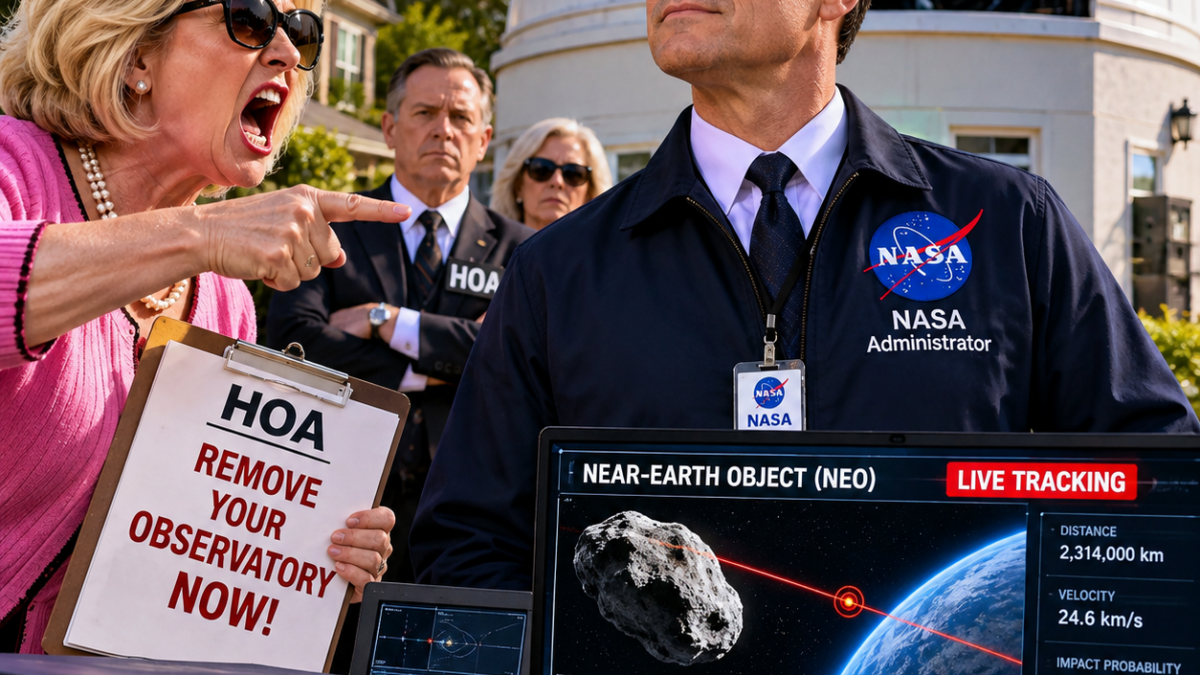
PART 2
I didn’t say another word before leaving the clubhouse.
That was deliberate.
People often mistake silence for surrender because they need noise to recognize resistance. In my experience, the most important decisions are usually made quietly.
Outside, the desert air had cooled. Stars were beginning to appear above the rooftops, faint at first and then sharper as the last light drained from the western horizon.
I stopped beside my truck and looked uphill toward my property.
From where I stood, I could barely see the top of Ariadne above the dark outline of the ridge.
Karen believed the observatory was the problem.
She was wrong.
The observatory had simply exposed the problem.
I drove home, went directly to my office, removed a fresh file folder from the cabinet, and wrote two words across the tab.
**KAREN MILLER.**
Sarah appeared in the doorway.
“You’re making a file?”
“I’m making sure I never have to rely on memory.”
She leaned against the frame.
I could tell she wanted to laugh, but she was worried.
“You have that look.”
“What look?”
“The one you used to get before congressional hearings.”
“I don’t have a congressional-hearing look.”
“You absolutely have a congressional-hearing look.”
That finally got a smile out of me.
Then she grew serious.
“Aris, I don’t want our retirement turning into another war.”
“Neither do I.”
“But?”
“But if somebody threatens our home, I’m going to find out whether she has the authority to do it.”
That was all I intended at first.
I wasn’t trying to remove Karen.
I wasn’t trying to investigate HOA finances.
I wasn’t trying to organize the neighborhood.
I wanted one answer.
Could the HOA legally force me to dismantle Ariadne?
The first certified letter arrived four days later.
The fine had doubled.
Ten thousand dollars.
A second notice announced that additional penalties would accrue daily until the alleged violation was corrected.
Then came the third letter.
**NOTICE OF INTENT TO LIEN.**
Sarah read that one at the kitchen counter.
Her face changed.
A fine is irritating.
A lien feels different.
A lien reaches into the meaning of home. It turns a disagreement into a threat against the place where you sleep, where your wife keeps photographs of your children, where you’ve poured savings and years and plans.
Sarah placed the letter down.
“Could we lose the house?”
“Not from this letter.”
“That isn’t what I asked.”
I looked at her.
“I won’t let it get that far.”
She gave me a tired smile.
“You always say things like you’re still in charge of a mission.”
“This one has a bad project manager.”
She didn’t laugh.
Instead, she touched the corner of the notice.
“What if we painted something on the dome?”
I stared at her.
“A cactus, maybe.”
“Sarah.”
“A tasteful cactus.”
That broke the tension for about three seconds.
Then she said, “I’m serious about the larger point. Is there some compromise?”
I considered it.
The problem was that I no longer believed Karen wanted compromise.
If I painted the dome, she could object to the paint.
If I planted trees, she could object to the trees.
If I hid Ariadne behind a wall, she could cite the wall.
People who care about rules can usually be satisfied by compliance.
People who care about control cannot.
“This isn’t about the observatory anymore,” I said.
Sarah folded her arms.
“I was afraid you’d say that.”
The next morning, I walked two properties down and knocked on Arthur Henderson’s door.
Arthur was seventy-eight, a retired corporate attorney, and one of those men who looked mildly irritated even while enjoying himself.
He opened the door holding a hardcover book.
“Thorne.”
“Arthur.”
“If you’ve come for sugar, I don’t have any.”
“I need a lawyer.”
He stared at me.
“Criminal?”
“No.”
“Divorce?”
“No.”
“Tax?”
“HOA.”
His expression brightened immediately.
“Karen?”
“Karen.”
He stepped aside.
“Come in.”
Four hours later, Arthur’s dining room looked like somebody had overturned a law library.
The original CC&Rs were open beside the bylaws. Amendments were stacked next to meeting minutes. My permits covered half the table. Karen’s certified letters occupied the other half.
Arthur read slowly.
Very slowly.
He would sometimes sit without speaking for two full minutes before turning a page.
I recognized the method.
He wasn’t reading for meaning anymore.
He was reading for weaknesses.
Finally, he tapped one section with his index finger.
“There.”
I leaned closer.
“Article Nine,” he said. “Architectural Review Committee.”
“I’ve read it.”
“Read it again.”
The provision stated that the committee would consist of no fewer than three members appointed by the board.
I looked up.
Arthur smiled.
“How many people are on Karen’s committee?”
“As far as I know, one.”
“Who?”
“Karen.”
He pushed back from the table.
“Then she’s not a committee.”
“That simple?”
“Nothing involving an HOA is simple. But procedurally? This matters.”
At the board meeting, Karen had openly described herself as the chair and sole active decision-maker on architectural requests.
Arthur asked whether that exchange had been recorded in the minutes.
“I don’t know.”
“Were you recording the meeting?”
I pulled my phone from my pocket.
Arthur stared at it.
Then at me.
“You recorded it?”
“I checked the state consent requirements beforehand.”
His grin widened.
“I like you more every day.”
We listened to the recording.
Karen’s voice filled his dining room.
“The Architectural Review Committee doesn’t need anyone else. I’m the chair. I make those decisions.”
Arthur paused the audio.
“Well.”
He took a sip of coffee.
“That’s useful.”
Useful became interesting about an hour later.
Arthur had requested recent financial summaries from the HOA months earlier after questioning a dues increase. He pulled copies from his office.
One line kept appearing.
**VERDANT VISTAS LANDSCAPING.**
The annual totals were substantial.
“Do you know them?” I asked.
“No.”
I searched the business registration.
The registered agent was a man named Gary Miller.
Arthur raised one eyebrow.
We checked further.
Gary was Karen’s brother-in-law.
“That doesn’t automatically mean wrongdoing,” I said.
“No,” Arthur agreed. “Family members are allowed to own companies. Associations are allowed to hire companies owned by relatives, depending on disclosure requirements and governing documents.”
He tapped the statement.
“But now we ask questions.”
So we did.
The landscaping expenses were unusually large.
Some invoices lacked meaningful descriptions.
Several services appeared to have been authorized without competitive bids.
Then Arthur found another vendor.
A catering business.
Same mailing address as Karen’s home.
I leaned back.
“What community events cost this much?”
Arthur flipped through meeting minutes.
“There was supposedly a Fourth of July barbecue.”
“That was a potluck.”
“Exactly.”
He turned another page.
“Holiday reception.”
“I was there. People brought cookies.”
Arthur’s mouth tightened.
“We need records.”
The next morning, he sent a formal homeowner request for seven years of financial documents.
While we waited, I read the bylaws again.
That’s when I found the provision governing disputes.
Before certain enforcement matters escalated into litigation or a property lien, the association was required to offer the homeowner its specified dispute-resolution procedure.
Karen hadn’t offered anything.
No hearing.
No mediation.
No arbitration.
Just fines, daily penalties, and a lien threat.
When I showed Arthur, he removed his glasses and rubbed the bridge of his nose.
“She really believes nobody reads these documents.”
“Apparently.”
“That’s how little kingdoms survive.”
The records request opened a door neither of us expected.
A heavy box arrived at Arthur’s house nine days later.
Bank statements.
Invoices.
Vendor checks.
Expense reports.
Budget reconciliations.
Seven years of paperwork.
Sarah walked into our dining room that night, saw documents covering every available surface, and stopped.
“What happened?”
“Arthur got the records.”
She stared at the paper.
“It looks like you’re investigating organized crime.”
Arthur, without looking up, said, “Too early to rule anything out.”
“Arthur.”
“I’m joking.”
He wasn’t entirely joking.
Over the next week, we built a spreadsheet.
Every payment.
Every vendor.
Every reimbursement.
Every unexplained expense.
The pattern grew.
Verdant Vistas had been paid repeatedly for work supposedly performed on common areas.
Yet some invoices described fencing, mature ornamental trees, irrigation work, and masonry that didn’t seem to exist anywhere in the common spaces.
I drove through the neighborhood photographing every association-owned parcel.
Then I passed Karen’s house.
There was the wrought-iron fence.
There were the mature ornamental trees.
There was the new irrigation system.
Coincidence was still possible.
But the invoices deserved explanation.
The catering company was worse.
Checks had been issued for events homeowners remembered as potlucks or volunteer gatherings.
Arthur found corporate registration documents linking the company directly to Karen.
He sat back in his chair.
“This has gone beyond your observatory.”
I knew it had.
What I didn’t know was how far.
Financial records could show money.
They couldn’t show fear.
For that, I needed neighbors.
The first person I approached was Miguel Garcia.
I’d seen him several times working in his yard. His family lived closer to the center of Val Verde Estates, where houses stood nearer together and Karen’s patrols were more frequent.
He was watering a patch of grass when I walked over.
“Mr. Garcia?”
He shut off the hose.
“Yeah?”
“I’m Aris Thorne. I live on the ridge.”
His expression changed immediately.
“The telescope guy.”
“Apparently that’s my official title now.”
He laughed.
“I heard about the meeting.”
“I wanted to ask you something.”
He became guarded.
That happened often in those first conversations.
People looked over their shoulders.
That should tell you something about any organization.
I nodded toward his backyard.
“Didn’t you used to have a swing set?”
His jaw tightened.
“We did.”
“What happened?”
“Wrong colors.”
I thought I’d misheard him.
“What?”
“Karen said the red and yellow plastic didn’t conform to the neighborhood palette.”
“So you repainted it?”
“She wouldn’t allow that.”
His mouth twisted bitterly.
“She said removal was the cleanest remedy.”
I pictured children watching their father dismantle a swing set because a neighborhood official disliked primary colors.
“Did you appeal?”
Miguel gave me a look that answered the question before he spoke.
“Appeal to who? Karen?”
That sentence followed me home.
The next conversation was with Evelyn Gable, a widow who lived alone except for an elderly terrier and a backyard full of flowers.
Karen had fined her over a bird feeder.
“Undesirable birds,” Evelyn said.
I thought she was joking.
She wasn’t.
“What species?”
“I asked her the same thing.”
“And?”
“She told me not to be difficult.”
Then there was Tyler and Megan Brooks, a young couple who had planted vegetables behind a six-foot privacy fence.
Tomatoes.
Peppers.
Zucchini.
Karen ordered the garden removed because it was “agricultural rather than ornamental.”
Then I met Frank Peterson.
Frank was a retired Marine.
He had a flag mounted beside his front porch.
Karen had cited him because his bracket didn’t match the HOA’s approved freestanding flagpole design.
The approved installation cost nearly eight hundred dollars.
Frank refused.
His fines had climbed into the thousands.
He led me to the porch and touched the folded edge of the flag.
“I carried this one overseas,” he said.
His voice softened.
“Not this exact pole. This flag.”
He looked toward Karen’s side of the neighborhood.
“I’ve obeyed rules my entire adult life, Dr. Thorne. Rules matter. But a rule applied only when somebody wants to punish you isn’t a rule.”
I couldn’t have said it better.
The unfairness became obvious once people started talking.
A board ally had an oversized satellite dish.
No citation.
Another had extended a fence without visible approval.
No citation.
Decorative flamingos stood in a yard despite a prohibition against lawn ornaments.
No citation.
A basketball goal had been ordered removed from one house while a nearly identical one remained untouched two streets away.
The difference wasn’t the object.
The difference was whether Karen liked you.
By the end of the second week, I understood why the clubhouse had been so quiet when she dismissed the NASA letter.
They weren’t indifferent.
They were trained.
Every person in that room had learned the cost of becoming visible.
I went home that evening carrying a notebook filled with stories.
Sarah found me sitting beneath Ariadne with the observatory closed for daylight.
“You look terrible,” she said.
“Thank you.”
“You know what I mean.”
I looked down the hill toward the roofs of Val Verde.
“This place isn’t peaceful, Sarah.”
“It was when we arrived.”
“No. We just weren’t involved yet.”
I told her about the Garcia children’s swing set.
Evelyn’s bird feeder.
Frank’s flag.
The garden.
The selective enforcement.
The vendors.
When I finished, she remained silent for a long time.
Then she looked up at the white dome.
“All because of that.”
“No.”
She glanced at me.
“Because she came after the wrong person?”
I shook my head.
“Because she finally came after someone who had enough time to read everything.”
That Saturday, Sarah and I invited a small group to our house.
We called it a barbecue.
Technically, it was.
There were hamburgers.
There was potato salad.
There were drinks.
There was also a retired attorney carrying a binder.
Frank arrived first.
Miguel and his wife Elena came next.
Evelyn brought brownies.
Two other couples joined us.
People were nervous until they realized everyone around the table had a story.
Then the restraint disappeared.
“I paid six hundred dollars over a mailbox color.”
“She threatened to fine us because our trash cans were visible for an extra hour.”
“She approved an addition for her friend without a hearing.”
“She made us remove our daughter’s chalk drawings from the driveway.”
“She said our Christmas lights stayed up two days too long.”
Arthur let them talk.
That mattered.
People who have been intimidated don’t initially need strategy.
They need confirmation that they aren’t imagining what happened.
Eventually I stood.
“There’s something all of you should see.”
Arthur opened the binder.
He started with the architectural committee.
No fewer than three members required.
Karen had been acting alone.
Then he showed the vendor relationships.
The landscaping company connected to Karen’s brother-in-law.
The catering company tied to her address.
The questionable invoices.
He was careful with his language.
“These documents raise serious questions. They don’t prove every conclusion by themselves. That’s why we’re requesting an independent audit.”
Miguel stared at the checks.
“This is our money.”
“Yes,” Arthur said.
Frank leaned forward.
“What do the bylaws say about removing a board member?”
Everyone became quiet.
Arthur looked at him.
“A recall can be triggered by a petition meeting the required threshold.”
“How many signatures?”
“Twenty-five percent of the ownership to force the special process described here.”
Frank nodded.
“Then we get twenty-five.”
Elena spoke.
“You think people will sign?”
Frank looked around the patio.
“They complain privately because they think they’re alone.”
Evelyn, normally the quietest person in the group, said, “Then we show them they’re not.”
That was the beginning.
We divided Val Verde into sections.
Nobody was instructed to exaggerate.
Nobody was instructed to insult Karen.
Nobody was told to make accusations we couldn’t document.
We carried a one-page summary.
Committee requirements.
Dispute-resolution provisions.
Examples of inconsistent enforcement.
Documented vendor relationships.
The request for an independent audit.
Facts.
That was enough.
The response surprised even me.
At one house, a man signed before I finished explaining.
At another, a woman disappeared inside and returned carrying three years of violation letters.
A retired schoolteacher had saved every email Karen ever sent her.
A young father showed us photographs of play equipment he had been ordered to remove.
Another homeowner had paid nearly four thousand dollars in penalties rather than risk legal action.
Every signature came with a story.
The association wasn’t functioning through consensus.
It was functioning through exhaustion.
People paid because resistance cost time.
They complied because appeals went nowhere.
They remained quiet because quiet people were left alone.
Until now.
Three days into the petition drive, Karen discovered what we were doing.
Miguel called me.
“She came to my house.”
“What did she want?”
“She says you’re trying to steal the HOA.”
I nearly laughed.
“Anything else?”
“She says you don’t want to pay your dues, the NASA thing is fake, and you’re manipulating everyone because you’re rich.”
“I wish somebody would tell my retirement account I’m rich.”
Miguel chuckled nervously.
“What should I do if she comes back?”
“Nothing.”
“Nothing?”
“Be polite. Don’t argue. Don’t threaten. Don’t give her anything she can use.”
“You really think that’s enough?”
“No.”
I looked at the files on my desk.
“But the documents are.”
Karen’s campaign intensified.
She went door to door.
She called longtime homeowners.
She claimed an outsider was trying to destroy property values.
Then she issued several new violation notices to people supporting the petition.
That was a mistake.
A major one.
Homeowners started photographing the notices.
They sent copies to Arthur.
A pattern that had once been anecdotal was becoming timestamped evidence.
Meanwhile, Arthur and I responded formally to the penalties against Ariadne.
The letter was fifteen pages.
I don’t believe Karen read all of it.
Her lawyer probably did.
It challenged the legitimacy of the one-person architectural committee.
It disputed the fines.
It cited the association’s own mandatory dispute procedure.
It demanded that the lien threat be withdrawn.
And at the end, Arthur included the part that mattered most.
A request for a fully independent forensic review of association finances.
We sent it certified mail.
Karen signed the receipt herself.
Ten days later, the association’s attorney responded.
The letter defended the board.
It defended the violation.
It rejected our interpretation of the committee rules.
It insisted the association retained enforcement authority.
It never addressed the audit.
Arthur read the response twice.
Then he placed it on my desk.
“Good.”
“That doesn’t sound good.”
“It is.”
“Why?”
“They had an opportunity to address the financial questions.”
“And?”
“They pretended those questions didn’t exist.”
He smiled without humor.
“We’ve reached the point where sunlight becomes useful.”
At almost exactly the same time, Karen escalated against Ariadne.
She filed a municipal safety complaint.
The city called me on a Tuesday morning.
“Dr. Thorne, we’ve received an allegation regarding an unsafe accessory structure at your address.”
“When would you like to inspect it?”
The official on the phone paused.
“You’re not contesting the inspection?”
“No.”
“Thursday morning?”
“I’ll have the documents ready.”
Thursday arrived bright and cloudless.
The inspector’s name was Daniel Davies.
He pulled into my driveway at nine twenty.
Across the road, Karen was sitting in her SUV.
She hadn’t even tried to hide.
Davies noticed her.
“Neighbor?”
“HOA president.”
His expression suggested that explained more than it should have.
I brought him inside.
On the dining table were the plans.
Structural calculations.
Electrical sign-offs.
Grading permits.
Soil information.
Foundation engineering.
Inspection approvals.
Certificate of occupancy.
He started reading.
Ten minutes became twenty.
Twenty became thirty.
Finally he looked at me.
“You really did all of this for a private observatory?”
“I don’t enjoy rebuilding things twice.”
He gave a short laugh.
“I wish more people had that philosophy.”
We walked outside.
I opened Ariadne.
The dome rotated smoothly.
The telescope sat on its isolated pier beneath the open slit.
Davies looked around.
“This is remarkable.”
“Thank you.”
“What exactly are you observing?”
“Near-Earth objects when conditions and assignments call for it. Asteroids, comets, follow-up measurements. The location gives me useful sky access.”
“You’re doing this for NASA?”
“I retired from NASA. Ariadne can contribute observations to colleagues involved in planetary-defense work.”
His eyes widened.
“You were at NASA?”
“Yes.”
“What did you do?”
I hesitated because I hated that part of these conversations.
People often hear a job title and stop listening to everything else.
“I served as Administrator before I retired.”
Davies stared at me.
Then at Ariadne.
Then back at me.
“And the HOA wants this removed?”
“She dislikes the aesthetic.”
For several seconds he said nothing.
Then he started laughing.
Not mockingly.
The kind of laugh that escapes when reality becomes too absurd to process politely.
“I’ve heard a lot of complaints,” he said. “This is new.”
Back inside, I handed him the letter explaining Ariadne’s scientific role.
He read it carefully.
When he finished, he closed the folder.
“From a city code perspective, I see no basis to condemn this structure.”
“That’s what I expected.”
“Your paperwork is unusually complete.”
“That’s what my wife calls a personality defect.”
He smiled.
Then walked toward his truck.
Karen was out of her SUV before he reached the street.
I couldn’t hear everything.
But I didn’t need to.
Her body language translated perfectly.
She pointed toward my house.
Then toward Ariadne.
Davies shook his head.
Karen stepped closer.
He responded.
She threw both hands into the air.
He said something short and firm.
Then he got into the truck and left.
Karen stood in the road.
For about five seconds, she didn’t move.
Then she turned toward me.
I was standing near my driveway.
“You think you’re clever, don’t you?”
I said nothing.
“You think some government letter makes you better than everyone here?”
“No.”
“You’re embarrassing this community!”
Still I said nothing.
That made her angrier.
“You listen to me, Thorne. I run this neighborhood. I was here before you. That monstrosity will come down if I have to fight you every day for the rest of your life.”
A voice came from behind a hedge.
“Karen.”
She spun around.
Miguel Garcia stood in his yard holding his phone.
The camera was pointed directly at her.
Her face changed.
“You recording me?”
“This is my yard.”
“Turn that off.”
“No.”
She marched toward her SUV.
Miguel lowered the phone only after she drove away.
Twenty minutes later, the video was on my television.
Sarah watched silently.
At the end, she looked at me.
“She really said, ‘for the rest of your life.’”
“Apparently retirement wasn’t going to be boring.”
“This stopped being funny.”
“I know.”
That evening, our group met again.
Frank watched Karen’s recorded tirade twice.
“This is what people need to see.”
Arthur disagreed.
“Homeowners, yes. Publicly? We need to be careful. The financial audit isn’t finished. We shouldn’t turn this into entertainment.”
He was right.
Then the city responded to my earlier public-records request.
The records included multiple complaints Karen had sent to municipal departments during the previous two years.
Parking.
Drainage.
Fences.
Noise.
Permits.
Several complaints had been dismissed.
Some appeared to target homeowners who had challenged her decisions at meetings.
One email was particularly revealing.
Karen described herself to a city employee as possessing “community enforcement jurisdiction” over Val Verde and urged the city to cooperate with her directives.
Arthur read it.
“She thinks the HOA is a branch of government.”
“Apparently.”
He placed the page down.
“Now I think the media may be useful.”
I had known an investigative journalist named Jessica Riley for years.
We weren’t close friends, but we respected each other.
She had covered federal science policy and knew how to separate an interesting story from nonsense.
I sent her a short message.
**You may be interested in this: HOA enforcement dispute involving a permitted asteroid-tracking observatory, disputed fines, questionable association finances, and a recall petition. Documentation available.**
She called forty minutes later.
“Aris?”
“Hello, Jessica.”
“Please tell me your email isn’t a joke.”
“It isn’t.”
“Someone is trying to make you tear down an asteroid observatory?”
“That’s the simplest version.”
“What is the complicated version?”
“It involves a bird feeder, a swing set, a flag, landscaping invoices, a one-person architectural committee, and a woman who told a city inspector she runs the neighborhood.”
There was a long pause.
“I’ll be there Monday.”
Jessica didn’t arrive with a dramatic camera crew.
She arrived with questions.
For two days she interviewed people.
Me.
Sarah.
Arthur.
Frank.
Miguel.
Evelyn.
Other homeowners.
She requested documents.
She verified permits.
She contacted the city.
She contacted the HOA.
She gave Karen multiple opportunities to respond.
That mattered to me.
I didn’t want revenge disguised as journalism.
I wanted facts.
On Wednesday afternoon, Jessica interviewed me beside Ariadne.
“What do you want people to understand about this observatory?”
I thought about it.
“That it isn’t important because I built it.”
She waited.
“It’s important because science works through networks. One instrument is one set of eyes. When an object needs follow-up, additional observations can refine where it’s going. Ariadne is one small piece of that larger system.”
“And the HOA wants it gone.”
“One person within the HOA wants it gone.”
That distinction mattered too.
I had learned enough to understand that Val Verde wasn’t Karen.
It was hundreds of ordinary people who had slowly surrendered control because fighting over every petty decision was exhausting.
Jessica asked, “Why not just move?”
I looked at her.
“Because that’s how abuse becomes permanent.”
The news segment aired Friday night.
I watched it with Sarah.
The opening shot showed Ariadne beneath a darkening desert sky.
Then my interview.
Then the permits.
Then Karen’s fines.
Then Miguel’s swing-set story.
Evelyn’s bird feeder.
Frank’s flag.
Arthur explained the bylaw questions and financial concerns carefully, emphasizing that an independent audit was still required.
Jessica displayed the city inspection result.
Then came Karen’s words from the HOA meeting.
“I don’t care if it tracks Santa Claus.”
Sarah looked at me.
“That sounds worse on television.”
“It sounded pretty bad in person.”
Jessica’s report ended with Karen’s street confrontation and the announcement that homeowners were gathering signatures for a recall meeting.
The story exploded.
Not because of me.
Because everybody understood it instantly.
A telescope tracking asteroids.
An HOA president calling it ugly.
A former NASA administrator getting fined.
A retired Marine fighting over his flag.
A family losing a swing set.
Questionable invoices.
It contained everything people already disliked about unchecked petty authority.
By Saturday morning, television stations in other cities had picked it up.
My phone rang constantly.
I ignored most calls.
One radio producer offered to fly me to New York.
I declined.
A morning television show wanted Sarah and me on set.
We declined.
A podcast asked whether Karen was “the worst HOA president in America.”
I declined.
I didn’t know every HOA president in America, and I had no interest in becoming professionally outraged.
Then somebody created an online fundraiser offering to pay my fines.
It raised thousands of dollars almost immediately.
I contacted the organizer.
“Please close it.”
“But people want to help.”
“I appreciate that. I don’t need the money.”
“What should we do with what’s already been donated?”
“Give it to a STEM education charity if your donors agree.”
Sarah smiled after I hung up.
“That might be the only thing you did this week that wasn’t strategically planned.”
“It was absolutely strategic.”
She laughed.
“There he is.”
The media attention created pressure inside Val Verde.
People who had been afraid to sign the recall petition began appearing at volunteers’ homes.
Within forty-eight hours, we were well beyond the required threshold.
Then we passed fifty percent.
Then sixty.
Frank called me Sunday evening.
“We have enough.”
“How many?”
“Enough that she can’t pretend this is a handful of complainers.”
I sat quietly after the call.
For weeks, I had imagined that moment.
I expected satisfaction.
Instead I felt tired.
Sarah noticed.
“You won.”
“No.”
“You have the signatures.”
“The vote hasn’t happened.”
“You know what I mean.”
I looked at the observatory.
“Karen is going to lose something she has controlled for years.”
Sarah sat beside me.
“And?”
“People get dangerous when their identity depends on control.”
“You think she’ll do something?”
“I think we should assume she might.”
The next morning, I changed access codes for Ariadne.
Installed additional cameras.
Backed up all research data remotely.
Checked locks.
Not because I expected sabotage.
Because preparing for unlikely events had been part of my professional life for too long to stop now.
Two nights later, one of the cameras alerted me.
A vehicle had stopped near the property entrance.
I opened the feed.
Karen’s SUV.
She didn’t come onto the property.
She sat there for nearly ten minutes.
Then drove away.
I saved the video.
The special recall meeting was scheduled for Thursday.
The clubhouse reached capacity forty minutes before the meeting began.
Homeowners stood against the walls.
Others waited in the hallway.
Jessica and a local camera operator stood quietly near the rear.
Karen sat at the board table.
Two members remained beside her.
Bill Gable looked miserable.
Karen’s secretary, Linda Mercer, stared down at her hands.
I sat beside Sarah in the third row.
Frank wore his Marine dress blues.
I hadn’t known he planned to.
When he entered, conversations stopped.
He walked to the front carrying a binder.
The meeting opened badly.
Karen tried to challenge the petition.
Arthur stood.
“Every signature has been verified against the membership roll.”
Karen tried to argue notice had been defective.
Arthur produced the certified-mail receipt.
She questioned whether enough homeowners were present.
The secretary confirmed quorum.
Each escape route closed.
Eventually Frank was recognized.
He stepped behind the podium.
“My name is Frank Peterson. I’ve lived here eleven years.”
His voice was calm.
No shouting.
No theatrical anger.
“I spent twenty-two years in the Marine Corps. During that time I learned something simple. Authority without accountability isn’t leadership.”
Karen rolled her eyes.
Frank continued.
“This recall is not about one telescope.”
He placed the first image on the projector.
Miguel’s old swing set.
“This is about a family ordered to remove children’s play equipment while comparable violations by favored residents were ignored.”
Next slide.
Evelyn’s bird feeder.
Then photographs of unchallenged lawn ornaments.
Then his own flag citation beside evidence of other unenforced exterior violations.
“This is about selective enforcement.”
Next came the bylaws.
The three-member requirement.
The one-person committee.
The dispute procedure.
“This is about following the rules we all agreed to.”
Then the invoices appeared.
A murmur moved across the room.
Verdant Vistas.
Gary Miller.
The catering company.
Karen’s address.
Checks.
Amounts.
Dates.
“This is about money homeowners entrusted to this association.”
Karen stood.
“Those documents are being misrepresented.”
Frank turned toward her.
“You’ll have an opportunity to respond.”
“I’m responding now.”
Arthur said, “The rules provide the petitioner the floor.”
Karen’s face reddened.
She sat.
Frank continued.
Finally, Ariadne appeared on the screen.
“This is the structure the current president tried to force Dr. Thorne to remove.”
He displayed the permit approvals.
Then the city’s inspection result.
Then the scientific letter.
“Whether anyone in this room cares about astronomy is irrelevant. The point is that Dr. Thorne followed the law, obtained the permits, built safely, and attempted to address the HOA respectfully.”
Then Miguel’s recording played.
Karen’s own voice filled the clubhouse.
**I run this neighborhood.**
Nobody whispered now.
Nobody needed to.
Frank allowed the video to finish.
Then he looked at the room.
“That’s why we’re here.”
He closed the binder.
“Not because of an observatory. Because no homeowner should hear those words from somebody elected to serve them.”
For several seconds, the room was silent.
Then applause started.
It grew.
People stood.
Karen slammed her palm onto the table.
“This is not a campaign rally!”
The applause stopped eventually.
Bill Gable reached for his microphone.
“I need to say something.”
Karen turned.
“Bill, don’t.”
He looked at her.
“I should have said it years ago.”
Her face changed.
Bill faced the homeowners.
“I joined this board because I thought I’d help maintain roads and organize landscaping bids.”
A few people laughed softly.
He shook his head.
“I kept telling myself the arguments weren’t my responsibility. Karen handled enforcement. Karen handled architecture. Karen handled vendors. Every time something felt wrong, I told myself I was avoiding drama.”
He swallowed.
“I wasn’t avoiding drama. I was avoiding responsibility.”
Karen whispered, “You coward.”
Bill heard her.
So did the microphone.
He took a breath.
“My resignation is effective immediately.”
The room erupted.
Bill stood.
He walked away from the board table and sat beside his wife.
Karen watched him go as if he had committed treason.
Then it was her turn.
She approached the podium carrying no documents.
That told me enough.
She looked across the room.
“I have given seven years of my life to this community.”
Nobody interrupted.
“I answered calls at midnight. I dealt with contractors. I handled complaints none of you wanted to handle. I protected property values while the rest of you sat at home complaining.”
She pointed at me.
“And then he arrived.”
I remained seated.
“A man with Washington connections and unlimited money.”
Sarah muttered, “Unlimited money would be news to me.”
I squeezed her hand.
Karen continued.
“He built that giant golf ball without my approval. Then, instead of following our rules, he used government contacts and the media to humiliate me.”
Arthur called from his seat, “The permits are in the record.”
“I am speaking!”
The room tensed.
Karen’s voice rose.
“The financial accusations are lies. The landscaping was necessary. The catering was legitimate. Everything I did was for this neighborhood.”
Miguel stood.
“Where was the five-thousand-dollar barbecue?”
Karen pointed at him.
“Sit down.”
“You charged us five thousand dollars for a barbecue we paid for ourselves.”
“Sit down!”
Then Evelyn stood.
“My bird feeder, Karen?”
Karen stared at her.
“What?”
“You made me remove it because you said it attracted undesirable birds.”
Somebody laughed.
Then several people did.
Evelyn didn’t.
“I was afraid of you over a bird feeder.”
That silenced everyone.
Her voice shook.
“My husband died three years ago. Watching those birds every morning was one of the few routines I still had from when he was alive. We used to sit together by the window.”
Karen looked uncomfortable.
“You violated the rules.”
Evelyn nodded.
“That is exactly the problem.”
She sat.
I saw Sarah wipe her eye.
Karen attempted to continue.
But something had changed.
The meeting was no longer about regulations.
It was about what those regulations had done to people.
Miguel’s daughter lost a swing set.
Frank was told how he could display a flag he’d carried through war.
Evelyn lost one of the small rituals connecting her to her husband.
Karen saw objects.
The neighborhood saw lives.
Arthur stood.
“Call the vote.”
Dozens of voices agreed.
The secretary read the recall procedure.
Ballots were distributed so there would be a record instead of a chaotic show of hands.
Karen stood beside the table while homeowners marked them.
For the first time since I had met her, she seemed unsure.
The ballots were counted by volunteers from opposing sides while Arthur observed.
One by one.
The number grew.
When the final total was announced, the result wasn’t close.
Karen had been recalled.
For a second she didn’t react.
Then she leaned toward the microphone.
“You’ll regret this.”
Nobody answered.
She swept papers from the table into her bag.
As she passed me, she stopped.
“This is what you wanted.”
“No.”
“Don’t lie to me.”
“I wanted you to leave my observatory alone.”
Her mouth tightened.
“You destroyed my life over a telescope.”
I stood.
“No, Karen.”
I kept my voice low enough that only the people nearest us could hear.
“You lost this because dozens of neighbors finally compared what happened to them.”
She looked at me with pure hatred.
Then left.
The clubhouse doors closed behind her.
And nobody cheered.
Not immediately.
First there was silence.
The kind that follows years of pressure disappearing all at once.
Then Evelyn started crying.
Miguel hugged his wife.
Bill Gable buried his face in both hands.
Frank released a breath and loosened his shoulders.
Sarah leaned against me.
Only then did the applause begin.
The interim board formed within the limits of the governing documents.
Frank agreed to serve temporarily.
Miguel joined him.
So did Patricia Davis, a retired accountant who had spent most of the conflict quietly checking Arthur’s numbers.
Their first priority wasn’t revenge.
It was stabilization.
Enforcement actions from Karen’s final year were suspended pending review.
My observatory fines stopped.
The lien threat was withdrawn.
Frank’s accumulated flag penalties were frozen.
Families with disputed fines received written notice that their cases would be reconsidered.
Then the new board authorized what Karen had spent weeks trying to avoid.
An independent forensic audit.
Nobody knew exactly what it would find.
For the first time since the conflict started, I returned to Ariadne and did what I had built it to do.
I opened the dome.
The telescope slewed toward a target field.
The tracking motors hummed.
Stars moved slowly across my monitor.
No board packets.
No vendor invoices.
No certified letters.
Just data.
Sarah brought coffee around midnight.
“Miss this?”
“More than I realized.”
She sat beside me.
“Do you regret any of it?”
I thought carefully.
“I regret that it was necessary.”
“Diplomatic answer.”
“Thirty years of government service.”
“Former NASA Administrator answer.”
“Exactly.”
She handed me the coffee.
“Do you think Karen is finished?”
“No.”
Sarah looked at me.
“You’re terrible at comforting people.”
“I promised not to lie to you.”
I was right.
Karen wasn’t finished.
Three days later, a letter arrived from an attorney representing her personally.
It accused several homeowners of defamation.
Arthur read it.
Then read it again.
“Interesting.”
“Bad interesting?”
“No.”
He placed it down.
“Loud interesting.”
He drafted a response requesting identification of every allegedly false statement.
No answer came.
Instead, Karen gave an interview to another television station.
That was a catastrophic choice.
She described herself as the victim of a conspiracy led by a “billionaire astronaut.”
I nearly choked on my coffee when I heard it.
Sarah rewound the clip.
“Billionaire astronaut.”
“Apparently.”
“You hid the billionaire part extremely well.”
“I invested heavily in khakis.”
Karen called Ariadne an “illegal space dome.”
The station immediately followed her statement with city records showing the permits.
She claimed the financial documents had been fabricated.
The reporter displayed copies obtained directly through association records.
She claimed nobody had objected to her leadership until I arrived.
The station interviewed three families who had complained years earlier.
Every claim opened another factual hole beneath her.
The interview circulated nationally.
I hated that part.
Not because it hurt our case.
Because I watched a neighborhood governance problem turn into entertainment.
People who knew none of us made jokes.
Some were harmless.
Some weren’t.
I told our group not to participate.
“No victory laps,” I said.
Miguel looked at me.
“After what she did?”
“Especially after what she did.”
Frank nodded.
“We wanted accountability.”
“Exactly.”
That distinction mattered sooner than any of us expected.
The forensic auditors began their work.
Patricia coordinated document access.
They traced checks, contracts, reimbursements, and vendor relationships.
Weeks passed.
Then one afternoon Patricia called.
“You need to come to the clubhouse.”
“Why?”
“Just come.”
Arthur was already there when I arrived.
So was Frank.
On the table sat a preliminary audit report.
Patricia looked sick.
“How bad?”
She slid it toward me.
The number was higher than Arthur and I had estimated.
More than seventy thousand dollars in expenditures were either unsupported, improperly documented, conflicted, or apparently diverted during Karen’s presidency.
Not every questionable dollar was automatically theft.
The auditors made that distinction clear.
Some might have been poor bookkeeping.
Some might have involved legitimate work inadequately documented.
But several transactions were difficult to explain innocently.
Payments to the catering company.
Payments tied to improvements appearing to benefit Karen’s private property.
Repeated contracts with her brother-in-law.
Reimbursements without supporting receipts.
Frank read the report in silence.
Then he said, “What happens now?”
Arthur answered.
“The board refers it to counsel.”
“And then?”
“If counsel believes the evidence warrants referral to law enforcement, they refer it.”
Miguel looked at me.
“This is the part where we finally get her.”
I shook my head.
“No.”
He frowned.
“This is the part where we hand the evidence to people whose job is to decide what it proves.”
It wasn’t as emotionally satisfying as revenge.
But it was the right answer.
The new board forwarded the audit to its attorney.
The attorney forwarded relevant findings to the appropriate authorities.
Investigators requested records.
More records were produced.
Months later, charges were filed against Karen involving alleged misuse of association funds.
Her brother-in-law’s contracts came under investigation as well.
I did not celebrate.
That surprised some people.
Frank understood.
One evening he joined me outside Ariadne.
“Thought you’d be happier.”
“I wanted her removed from power.”
“She is.”
“I wanted the fines gone.”
“They’re gone.”
“I wanted the neighborhood protected.”
“It is.”
He looked toward the valley.
“But?”
“I never wanted to watch a human being destroy herself.”
Frank nodded slowly.
“That’s the difference between justice and revenge.”
I looked at him.
“You’ve been saving that line.”
“A little.”
We laughed.
Then he became serious.
“She had years to stop.”
“I know.”
“She had people warning her.”
“I know.”
“You offered her paperwork at the first meeting.”
“I know.”
He put a hand on my shoulder.
“Then don’t carry choices that belonged to her.”
That helped.
The neighborhood began changing in smaller ways.
Those mattered more to me than the headlines.
Miguel rebuilt the swing set.
Not because the HOA bought him some extravagant replacement.
Because several neighbors showed up one Saturday morning carrying lumber, tools, and boxes.
I joined them.
So did Frank.
Even Bill Gable came.
Miguel’s daughter stood at the patio door watching us.
When we finished, she ran to the swings before the last toolbox had been closed.
Miguel stood beside me.
“You know what’s crazy?”
“What?”
“It isn’t even about the swing.”
“I know.”
“It was never about the swing.”
Across the neighborhood, Evelyn rehung her bird feeder.
Then somebody gave her a second one.
Then a third.
Within a month her backyard looked like an airport for finches.
She called me one morning.
“You’ve got to see this.”
I came over.
She was standing beside her kitchen window.
Outside, perhaps two dozen birds crowded around the feeders.
“My husband loved cardinals,” she said.
One bright red bird landed on the fence.
Evelyn smiled.
“There.”
I understood.
Some victories make no noise.
Frank replaced his porch bracket.
Not because the old one was illegal.
Because it had rusted.
The board revised the flag policy to make it clear and reasonable.
The garden restrictions were rewritten.
The Architectural Review Committee was rebuilt with five members.
Five.
Not one.
Meetings changed too.
The first few were messy.
People argued.
Proposals took longer.
Budgets were questioned.
Votes weren’t unanimous.
I loved every minute of it.
Healthy communities are sometimes inefficient.
Dictatorships are famously efficient right up until they aren’t.
Patricia began publishing understandable monthly financial summaries.
Contracts over a certain amount required competing bids.
Potential conflicts of interest had to be disclosed.
Appeals went to people who had not made the original decision.
Homeowners could actually speak without being cut off.
The HOA didn’t disappear.
It became boring.
That was the highest compliment I could give it.
One Saturday, Frank approached me after a meeting.
“We need you on the permanent board.”
“No.”
He blinked.
“You didn’t even think about it.”
“I’ve thought about it since you began the sentence.”
“You’d be good.”
“That’s not a reason.”
“We need responsible people.”
“You have responsible people.”
“You started this.”
“Exactly why I shouldn’t finish it.”
Frank frowned.
I explained.
“If I take Karen’s chair after leading the challenge against her, some people will always believe this was about replacing her with me.”
“So?”
“So they’re wrong, and I don’t intend to give the idea oxygen.”
Frank studied me.
“You really just want to look through your telescope.”
“I have wanted that since approximately ten minutes after retirement.”
He laughed.
“Fine.”
I raised a finger.
“I will volunteer for anything involving lighting ordinances.”
“Of course you will.”
Dark skies were serious business.
Three months after the recall, the community held a barbecue.
A real one.
Receipts were published.
The catering invoice existed.
Patricia made a joke about auditing the mustard.
People brought lawn chairs.
Children ran between tables.
Music played at a volume that would have generated at least three violations under Karen’s interpretation of the old rules.
Nobody complained.
Near sunset, Miguel walked onto the small clubhouse stage.
“I have an announcement.”
Everybody groaned theatrically.
“No fines,” he said.
People cheered.
“We’re starting something new. Dr. Thorne has agreed to host a neighborhood astronomy night once a month.”
Every face turned toward me.
I stared at Frank.
He smiled innocently.
Sarah whispered, “You got volunteered.”
Apparently I had.
The first star party was the following weekend.
I had expected maybe twenty people.
Nearly eighty showed up.
We organized groups so nobody crowded the equipment.
Children asked the best questions.
“Can you see aliens?”
“No.”
“Have you ever seen a UFO?”
“I’ve seen objects I didn’t identify immediately.”
“That counts!”
“No, it doesn’t.”
“Can an asteroid hit us tomorrow?”
“Not one we currently expect.”
A little girl stared up at me.
“What if there’s one you don’t know about?”
“That,” I said, “is why we keep looking.”
She seemed satisfied.
When Saturn rose high enough, I centered it.
The first child stepped to the eyepiece.
He gasped.
Actually gasped.
“No way.”
His father laughed.
“What?”
“It has rings!”
“That’s usually what Saturn does.”
Then his father looked.
His expression changed too.
Adults pretend they’re harder to impress.
They aren’t.
One by one, people who had once called Ariadne “the dome” began calling it the observatory.
Eventually somebody made a small plaque for the entrance.
**ARIADNE OBSERVATORY**
Beneath it:
**VAL VERDE COMMUNITY STAR NIGHTS**
I objected to the second line.
Sarah overruled me.
Months passed.
The criminal case involving Karen moved slowly.
Lawyers filed motions.
Hearings were scheduled.
Evidence was reviewed.
I attended only when necessary.
I had no desire to make the courtroom another battlefield.
At one preliminary proceeding, Karen saw me in the hallway.
For the first time since the recall, we were alone.
She looked older.
Not dramatically.
Just tired.
Her attorney was speaking with someone twenty feet away.
She stared at me.
“Happy?”
“No.”
She gave a bitter laugh.
“Don’t insult me.”
“I’m not.”
“You got everything.”
“I got to keep my observatory.”
“You got my position.”
“I refused a board seat.”
That seemed to surprise her.
“You’re lying.”
“Ask Frank.”
She looked away.
People passed us in the corridor.
Finally she said, “You turned everyone against me.”
“No.”
Her jaw tightened.
I could have walked away.
Instead I said what I had wanted to tell her for months.
“They were already angry, Karen.”
She looked back.
“The Garcias were angry before I met them. Evelyn was hurt before I moved here. Frank had been fighting you before Ariadne’s foundation was poured.”
“You organized them.”
“Yes.”
“At least you admit that.”
“I helped them compare notes.”
“Same thing.”
“No.”
Her eyes filled with something I hadn’t seen before.
Not remorse.
Loss.
“I gave seven years to that place.”
“I believe you did.”
She seemed almost offended by the agreement.
“I answered every call. I knew every property. Every contractor. Every rule. Nobody cared until something went wrong, and then everyone wanted me.”
There it was.
For the first time, I understood part of her.
Not enough to excuse anything.
But enough to see the path.
She had probably started by being useful.
Then indispensable.
Then unquestioned.
And somewhere along that progression, service had become ownership.
“You should have had help,” I said.
She scoffed.
“They were useless.”
“Maybe.”
“I was the only one willing to do the work.”
“That doesn’t mean you owned the authority.”
She flinched.
I continued.
“You wanted a neighborhood that couldn’t function without you.”
“You have no idea what I wanted.”
“Maybe not.”
Her attorney called her name.
Karen took two steps away, then turned.
“That telescope will eventually break.”
“Everything eventually breaks.”
For some reason, that answer stopped her.
Then she left.
The case ended months later with legal consequences I won’t pretend brought me pleasure.
Association funds were recovered where possible.
Insurance covered part of the loss.
The board pursued restitution through proper channels.
Karen no longer had any role in Val Verde governance.
Her brother-in-law’s company lost the association’s business and faced its own consequences from the investigation.
The neighborhood moved on.
That was the part nobody on television covered.
There was no dramatic soundtrack for Patricia reconciling the monthly budget.
No national news crew arrived when Miguel volunteered to repair a broken bench.
Nobody went viral because Evelyn organized a garden swap.
Nobody created memes when Frank spent an afternoon helping a teenager install a flag bracket correctly.
But those things were what victory looked like.
It wasn’t Karen losing.
It was everyone else rebuilding.
One night almost a year after she first arrived at my observatory with that clipboard, I was running an automated survey.
Sarah had gone to bed.
The neighborhood below was dark.
Not perfectly dark.
Nothing near civilization ever is.
But dark enough.
Ariadne moved quietly overhead.
The software displayed successive frames.
Stars appeared as fixed points.
Then I noticed a faint object shifting between exposures.
I leaned closer.
Ran the measurement again.
Checked known-object databases.
Nothing obvious matched.
I sent the astrometry for confirmation.
Hours passed.
Other observations came in.
The object was small.
Unremarkable by cosmic standards.
It wasn’t on a dangerous trajectory.
It wasn’t going to become a movie.
It wasn’t going to destroy a city.
It was simply something moving through darkness that had not yet been properly cataloged.
And Ariadne had seen it.
I sat alone in the observatory while morning approached.
For almost a year, this instrument had been treated as the object at the center of a neighborhood war.
Now it was doing what I had always intended.
Looking outward.
Finding something nobody around me could see.
Making its path a little clearer.
Sarah appeared at the door just before dawn wearing a robe and carrying two cups of coffee.
“You never came to bed.”
“Found something.”
Her eyebrows rose.
“A bad something?”
“No.”
“Good.”
She handed me a cup.
“What is it?”
“Small object. Newly observed. More measurements needed.”
She leaned toward the screen.
“That dot?”
“That dot.”
“I expected asteroid discovery to look more dramatic.”
“Science is mostly dots and spreadsheets.”
“That should be NASA’s slogan.”
I smiled.
We watched the point move across the screen.
Eventually the observation received confirmation.
Later, when naming procedures allowed a proposal, I had a choice.
People assumed I would use Sarah’s name.
Sarah threatened to divorce me if I did.
“You already named half your life after mythology,” she said. “Leave me out of space.”
I considered Arthur.
Frank.
Miguel.
Even Ariadne.
Then I thought about the night of the recall.
Evelyn standing up.
Bill resigning.
Neighbors realizing that nobody ruled Val Verde except the people who had agreed to govern it together.
I submitted a name connected to the community.
**Val Verde.**
When the designation was eventually accepted, I printed the confirmation.
At the next HOA meeting, Frank read it aloud.
Everyone applauded.
Miguel stood.
“Does this mean Karen can’t fine the asteroid?”
The room erupted.
Even Arthur laughed.
I framed the confirmation and hung it inside Ariadne.
Not as a trophy.
As a reminder.
Ariadne had been built to track objects whose danger could only be understood if enough people observed them carefully.
That’s what had happened in our neighborhood too.
Karen’s power survived while everyone experienced it separately.
One family saw a swing set dispute.
One widow saw a bird-feeder dispute.
One veteran saw a flag dispute.
I saw an observatory dispute.
Separately, each event looked small.
Together, they formed a trajectory.
A pattern.
And once enough people saw the pattern, it became impossible to ignore.
On the anniversary of our first star party, nearly a hundred neighbors came to the house.
Children lay on blankets across the grass.
Parents drank coffee.
Arthur complained about folding chairs.
Frank pretended not to enjoy himself.
Evelyn brought cookies shaped like stars.
Miguel’s daughter dragged Sarah toward the telescope.
When darkness settled, I opened the dome.
The crowd became quiet as Ariadne rotated.
I told them about near-Earth objects.
About observation.
About how astronomers rarely work alone.
One observatory sees something.
Another confirms it.
More measurements refine the orbit.
Uncertainty shrinks.
The truth becomes clearer because people compare what they see.
Then a boy near the front raised his hand.
“Dr. Thorne?”
“Yes?”
“Is that how you beat the HOA lady?”
A few adults laughed nervously.
I looked toward Frank.
Then Miguel.
Then Evelyn.
“No,” I said.
The boy frowned.
“We didn’t beat the HOA.”
I pointed toward the clubhouse lights in the distance.
“The HOA is us.”
He still looked confused.
So I tried again.
“We learned that a community works when people pay attention together.”
That he understood.
Sarah found me after everyone left.
The grass was littered with paper cups.
The observatory dome remained open.
Above us, the Milky Way stretched across the dark sky.
She slipped her hand into mine.
“You know what’s funny?”
“What?”
“You spent most of your career worrying about threats coming from millions of miles away.”
“I know where this is going.”
“And the most exhausting one showed up carrying a clipboard.”
I laughed.
She leaned her head against my shoulder.
For a long time, neither of us spoke.
Downhill, Val Verde was quiet.
Miguel’s children’s swing set stood in the backyard.
Frank’s flag moved gently beside his porch.
Evelyn’s feeders would be crowded again by sunrise.
The board’s monthly financial report was posted publicly where every homeowner could read it.
And behind us, Ariadne continued following points of light through the darkness.
Karen had once told me that the observatory didn’t belong in her neighborhood.
She had been wrong in two ways.
The observatory belonged there.
And the neighborhood had never belonged to her.
That was the lesson I carried with me after the fines disappeared, after the headlines faded, after the investigators finished their work and the cameras moved on.
Power rarely announces the moment it becomes abuse.
Usually it happens one small surrender at a time.
One person decides fighting a ridiculous fine isn’t worth the trouble.
Another removes something meaningful rather than risk confrontation.
Another stays quiet at a meeting.
Another board member tells himself keeping the peace matters more than asking questions.
Until one day, everyone looks around and realizes one person has been making decisions nobody truly agreed to give them.
Changing that didn’t require threats.
It didn’t require destroying anyone.
It required documents.
Questions.
Neighbors talking to each other.
People willing to stand up publicly after years of staying quiet privately.
And one ridiculous white observatory dome that Karen Miller should probably have left alone.
Late that night, after Sarah went inside, I remained beneath the stars.
Ariadne turned slowly toward its next target.
I thought about the first violation notice.
Five thousand dollars.
Thirty days to dismantle everything.
At the time, it had felt like an attack on the dream I’d spent my retirement building.
Now that paper was framed too.
It hung in my office beside the naming confirmation for Val Verde.
Visitors sometimes asked why.
Because both documents marked discoveries.
One recorded the night our observatory helped find a new object in the sky.
The other marked the moment I discovered what was happening right beneath it.
I switched off the exterior lights and stepped inside the dome.
The telescope settled onto its coordinates.
A field of stars filled the monitor.
Somewhere among them, a tiny object named Val Verde continued along an orbit that mathematics could now predict.
Below it was a neighborhood that had finally learned something similar about human behavior.
Watch carefully.
Keep records.
Compare observations.
Question assumptions.
And when something powerful is headed in the wrong direction, don’t wait for impact before you speak.
I placed my hand on the control console.
The exposure began.
Ariadne watched the darkness.
And Val Verde, at last, was peaceful enough for me to do the same.








