HOA Karen Ordered Me to Tear Down My New Barn—Then the Court Learned Her Neighborhood Was Built on My Land
PART 2
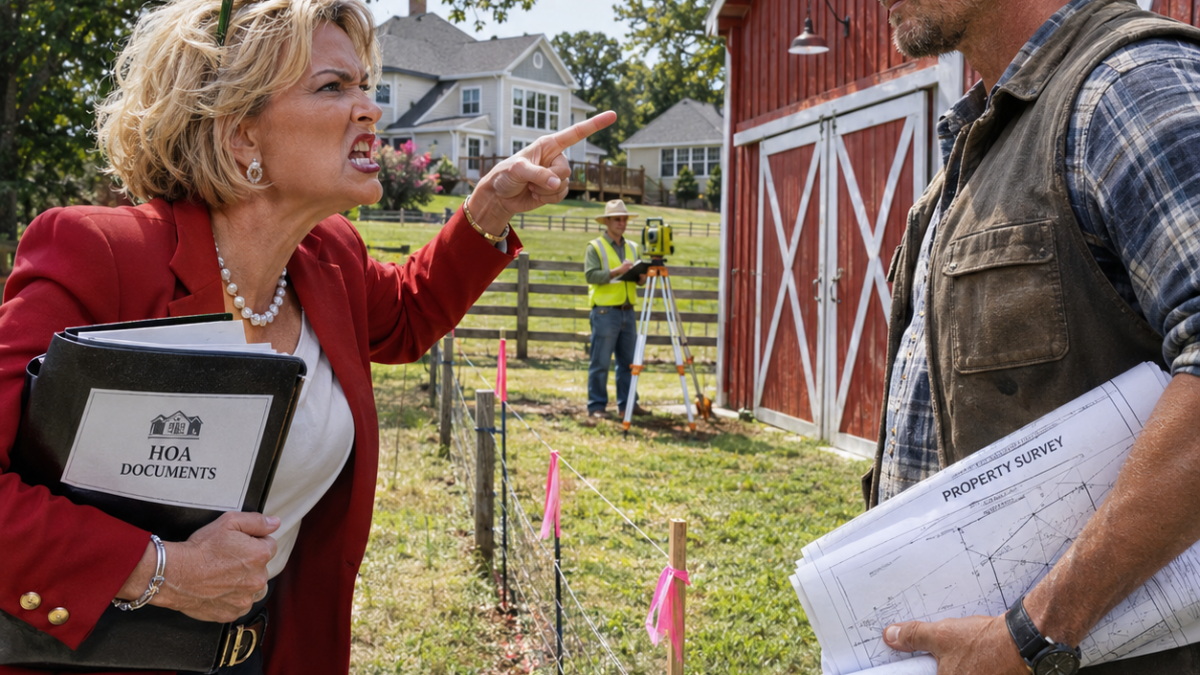
I stared at Victoria’s map.
It was professionally printed.
Colored roads.
Lot numbers.
Green areas marked as common space.
The Hawthorne Ridge logo sat neatly in one corner.
What it did not have was a county recording stamp, surveyor’s seal, deed reference, or anything else I recognized as proving ownership.
Victoria pointed to a thick red line.
“This is the association boundary.”
I looked toward the old fence line.
Then back at the map.
“According to who?”
Her eyebrows rose.
“Excuse me?”
“Who established that line?”
“Our development plans.”
“That’s not what I asked.”
She closed the folder halfway.
“Mr. Reed, I didn’t come here to debate basic facts.”
“Neither did I.”
I pointed toward the barn.
“But you’re telling me part of a building I just spent nearly two hundred thousand dollars on is sitting on property you say belongs to your HOA. So yes, I’m going to ask how you know that.”
“The association map is clear.”
“Is it a recorded survey?”
“It’s the map we’ve used since the development was completed.”
“That still isn’t an answer.”
Her lips tightened.
People who are accustomed to being obeyed have a particular reaction when someone calmly asks them to prove what they’re saying.
They don’t usually become louder at first.
They become colder.
Victoria’s voice changed exactly that way.
“You may want to consider your position carefully.”
“My position is standing right here.”
I pointed toward the ground.
“My family bought this land before Hawthorne Ridge existed.”
“That doesn’t mean your understanding of the boundary is correct.”
“Fair enough.”
That surprised her.
I continued.
“So let’s verify it.”
“There is nothing to verify.”
“Then show me the deed.”
“What deed?”
“The deed giving your association ownership of the ground under my barn.”
She stared at me.
“We don’t carry original deeds door to door.”
“Then email me the recording information.”
“Mr. Reed—”
“Book and page. Instrument number. Parcel description. Whatever document you believe gives you ownership.”
Her expression hardened further.
“You need to stop using the structure until this is resolved.”
I almost laughed.
“No.”
She blinked.
“No?”
“No.”
“You are knowingly occupying association property.”
“I’m standing on my own farm.”
“According to our map—”
“According to a picture in your folder.”
She inhaled sharply.
I kept my voice calm.
“If I’m wrong, prove it.”
“I don’t appreciate your tone.”
“I don’t appreciate someone walking onto my property and telling me I don’t own it.”
For several seconds, neither of us spoke.
Then Victoria pointed toward the barn.
“The board will require removal if the encroachment is confirmed.”
That sentence did something to me.
Until then, the conversation had been irritating.
Now it became serious.
“Removal?”
“Yes.”
“You mean tear it down?”
“If necessary.”
I looked at the barn.
Forty-eight hours earlier, my father had stood beneath those rafters and told me his father would have been proud.
Now a stranger with an HOA map was threatening to have it demolished.
I turned back.
“You need to leave.”
Her eyes widened.
“I’m trying to help you understand—”
“No. You’re making a property claim. I’ve asked you to support it. You can’t. Until you can, you don’t get to order me around on my own land.”
“This is your final opportunity to cooperate informally.”
That sounded rehearsed.
“Then I guess we’re done informally.”
Victoria closed the folder.
“You’ll hear from the board.”
“I’m sure I will.”
She walked toward her SUV.
Then she stopped.
“Mr. Reed?”
I waited.
“People who ignore boundary problems usually regret it.”
I looked toward the barn.
“On that, we agree.”
She drove away.
I watched the SUV disappear toward Hawthorne Ridge.
Then I called a surveyor.
## **Ethan Cole**
Ethan Cole had been surveying property in the county for twenty-six years.
He wasn’t flashy.
He didn’t make dramatic claims.
He was the kind of man who would rather spend two hours checking one coordinate than give you a quick answer he couldn’t defend.
That was exactly who I wanted.
When he arrived two days later, his truck was loaded with more equipment than I expected.
Tripods.
A robotic total station.
GPS receiver.
Metal detector.
Range poles.
Field tablets.
Old plat copies.
He climbed out wearing faded work boots and a wide-brimmed hat.
“You Daniel?”
“That’s me.”
He shook my hand.
“Show me what we’re fighting about.”
I appreciated the wording.
Not *who*.
What.
I led him to the barn.
He walked around it slowly.
“HOA says you’re over?”
“That’s what they claim.”
“How far?”
“They didn’t give me a number.”
“Interesting.”
“What does that mean?”
“It means people who know an encroachment usually know how much of an encroachment.”
I smiled.
“That’s what I thought.”
He asked what records I had.
I told him there was an old survey in my father’s safe.
“How old?”
“Early eighties, I think.”
“Bring it.”
The original deed was even older.
My grandfather had acquired part of the current farm in the late 1960s and added adjoining acreage later.
Some boundaries followed bearings and distances.
Others referenced iron pins and old monuments.
Ethan smiled when he saw the paperwork.
“Now we’re talking.”
“That good?”
“Old doesn’t mean bad.”
He flattened the survey on the hood of his truck.
“This was prepared by Walter Gaines.”
“You know him?”
“Knew of him. He was careful.”
“He’s dead?”
“Long time.”
That wasn’t reassuring.
Ethan noticed my face.
“Daniel, a good survey doesn’t become wrong because the surveyor dies.”
“Fair point.”
He examined the legal description.
Then he compared it with county records he’d already downloaded.
After about fifteen minutes, he pointed to one line.
“This eastern boundary predates the subdivision.”
“By decades.”
“Exactly.”
“So shouldn’t Hawthorne Ridge have built off this?”
“Should have.”
The way he said it made me uneasy.
“You’re saying they might not have?”
“I’m saying I haven’t measured anything yet.”
That was Ethan.
No drama before evidence.
We walked toward the eastern pasture.
He found one old iron pin within half an hour.
The top was buried several inches beneath packed soil and grass.
He used the metal detector first.
Then a small shovel.
When rusted metal finally appeared, he crouched beside it.
“That’s promising.”
“What is it?”
“Could be the monument called for in your survey.”
“Could be?”
“I’ll know after I locate the others.”
He set up the total station.
For the next three hours, he moved across the property.
Measure.
Check.
Recheck.
Log coordinates.
Compare bearings.
He barely spoke.
I tried not to bother him.
Around noon, a familiar black SUV pulled into my driveway.
I muttered something my grandfather would’ve told me not to say in church.
Victoria got out.
She wasn’t alone.
A man in a polo shirt with the Hawthorne Ridge logo climbed out from the passenger side.
Victoria walked directly toward Ethan’s equipment.
“What is happening?”
I stepped between her and the tripod.
“I’m having my property surveyed.”
“You can’t alter boundary markers.”
“We haven’t altered anything.”
She looked at Ethan.
“Who are you?”
He straightened.
“Ethan Cole. Cole Land Surveying.”
“Who authorized you?”
Daniel Reed, I thought.
On Daniel Reed’s land.
But Ethan answered first.
“Mr. Reed retained me.”
Victoria frowned.
“You understand this boundary is under dispute?”
“That’s why I’m measuring it.”
She pulled out her folder.
“I have the HOA map.”
Ethan held out his hand.
“I’d be happy to look.”
For some reason, she didn’t seem prepared for that.
She handed it over.
Ethan studied the map.
He flipped it around.
Looked at the legend.
Then the corner.
Then he handed it back.
“Who surveyed this?”
Victoria hesitated.
“It’s the official association map.”
“That’s not what I asked.”
I nearly laughed.
Apparently Victoria was going to hear that question a lot.
Ethan continued.
“There’s no surveyor’s seal.”
“The developer produced it.”
“Okay. Do you have the recorded subdivision plat?”
“Not with me.”
“I’d like to see it.”
“The county has it.”
“I’ll pull it.”
She narrowed her eyes.
“That map has governed Hawthorne Ridge for years.”
Ethan adjusted his hat.
“Maps don’t govern land.”
“What does?”
“Title records. Recorded plats. Legal descriptions. Original monuments. Depending on the situation, other evidence.”
He pointed toward the glossy paper.
“This is useful, but I wouldn’t stake someone’s property from this.”
Victoria looked offended.
“Are you saying it’s wrong?”
“I’m saying I don’t know yet.”
She turned to me.
“This changes nothing.”
“It changes one thing,” I said.
“What?”
“Now somebody qualified is checking.”
She left ten minutes later.
Ethan watched her SUV disappear.
Then he glanced at me.
“Friendly neighbor?”
“You noticed.”
He smiled faintly.
Then his expression became serious.
“Daniel.”
“Yeah?”
“I need to pull the subdivision plat.”
“Why?”
“The line she’s showing doesn’t make sense with the monument I just found.”
My stomach tightened.
“Good or bad?”
“For your barn?”
He looked toward Hawthorne Ridge.
“Maybe good.”
Then he looked farther down the line.
“For somebody else?”
That was when I started to worry.
## **The Line That Shouldn’t Have Been There**
Ethan returned the following morning.
He had the recorded plat for Hawthorne Ridge.
He also had copies of two older deeds, county GIS records, and a second historic survey.
We spread everything across my kitchen table.
Dad sat with us.
His cane rested beside his chair.
Ethan pointed to the subdivision plat.
“Here’s your problem.”
I leaned closer.
“Which problem?”
“The HOA map Victoria showed me appears to treat this line as the boundary.”
He tapped one line.
“But the recorded subdivision plat references a different control point here.”
He moved his finger west.
“How different?”
“Enough to matter.”
Dad leaned forward.
“How much?”
Ethan looked at him.
“Potentially seventy to a little over one hundred feet in places.”
Silence.
I stared at him.
“That’s not a surveying mistake.”
“No.”
“That’s a strip of land.”
“Yes.”
Dad looked toward me.
“What sits in that strip?”
Ethan didn’t answer immediately.
Instead, he opened an aerial map.
Then he drew a pencil line.
My barn sat clearly west of it.
Fully on our side.
Relief hit first.
Then my eyes followed the line south.
It crossed landscaping.
A drainage feature.
Part of a neighborhood walking path.
Then several backyards.
And farther down—
I leaned closer.
“Is that a house?”
“Part of one.”
Dad whispered, “Good Lord.”
Ethan held up a hand.
“This is preliminary.”
“But?”
“But if my field measurements continue matching the original record evidence, then Hawthorne Ridge’s internal map may be shifted.”
“Toward us.”
“Yes.”
“Meaning they didn’t lose land because of my barn.”
“Correct.”
“They may have built into ours.”
“Potentially.”
I sat back.
For days Victoria had been threatening me with demolition.
Now a much larger problem had appeared.
Dad looked toward me.
“Don’t celebrate.”
I looked at him.
“I’m not.”
“Good.”
He pointed toward the map.
“Those houses belong to families.”
That was my father.
Even after everything Victoria had done, his first thought was the people who might be affected.
“I know.”
He nodded.
“Then remember that.”
I did.
## **The Temporary Stakes**
Ethan spent another week verifying the line.
This time, he worked from multiple directions.
He located more monuments.
Some were easy.
Others took hours.
One had apparently been buried when a drainage project added soil.
Another was near the roots of a huge oak tree that had been referenced in an older survey.
Every new measurement told the same story.
My barn wasn’t over the line.
The HOA’s understanding of the line was.
Ethan placed temporary wooden stakes along the record boundary.
Bright ribbon fluttered from them.
I followed the stakes south.
At first, they crossed open ground.
Then they entered a landscaped buffer that Hawthorne Ridge maintained.
A sprinkler head sat on my side.
Then part of their walking trail.
Then a decorative fence.
Farther down, the line clipped a backyard.
I stopped.
Beyond the fence was a swing set.
Two children’s bicycles lay in the grass.
I felt sick.
This wasn’t funny anymore.
Ethan walked up behind me.
“You okay?”
“Victoria told me she’d make me tear down my barn.”
“I heard.”
“If this line holds, I could make things very ugly for them.”
“You could make things complicated.”
I looked at him.
“Different word?”
“Important difference.”
He pointed toward the house.
“Those homeowners probably didn’t draw the subdivision plat.”
“No.”
“Probably didn’t intentionally build on your land.”
“No.”
“So don’t confuse them with the person who came after you.”
I nodded.
Dad would’ve said the same thing.
## **Victoria Sees the Stakes**
She arrived that afternoon.
This time, two board members came with her.
One was a man I later learned was Robert Gaines, the HOA treasurer.
The other was Susan Bell, who handled architectural approvals.
Victoria got out before the vehicle had fully settled.
“What are those?”
“Survey markers.”
“Remove them.”
“No.”
Her eyes widened.
“They are inside HOA common property.”
“According to your map.”
She marched toward one.
I stepped forward.
“Don’t touch it.”
She stopped.
“Are you threatening me?”
“No.”
“I’m telling you those markers were placed by a licensed surveyor.”
Robert looked uncomfortable.
“Victoria, maybe we should wait until the survey is final.”
She spun toward him.
“The line is obviously wrong.”
“Based on what?”
She pointed toward the neighborhood.
“Because Hawthorne Ridge has been here for twelve years.”
Ethan had arrived behind them.
He answered.
“Age doesn’t move a deed line.”
Victoria glared at him.
“Your work is being challenged.”
“You can hire another surveyor.”
“We will.”
“Good.”
She seemed surprised again.
He continued.
“If I’m wrong, another competent surveyor should be able to explain why.”
Robert walked toward the nearest stake.
“Mr. Cole, where does this line go?”
Ethan pointed south.
Robert followed it with his eyes.
His face changed.
Susan did the same.
She whispered, “That’s inside Lot 14.”
“Potentially,” Ethan said.
Victoria snapped.
“Stop saying that.”
Ethan looked at her.
“Saying what?”
“Implying our neighborhood is on his property.”
“I’m not implying anything. I’m measuring.”
“Your line cannot be correct.”
“Then show me the controlling record I’m missing.”
She had nothing.
Again.
I watched Robert and Susan exchange a look.
That look mattered.
Victoria no longer had an audience willing to accept her confidence as evidence.
## **The Emergency Board Meeting**
The notice arrived two days later.
The Hawthorne Ridge board was holding an emergency session.
The subject line read:
**PROPERTY BOUNDARY DISPUTE — REED PARCEL**
I wasn’t invited.
Then Robert called me privately.
“You should come.”
“Victoria know you’re calling?”
“No.”
“That’s encouraging.”
He sighed.
“Mr. Reed, I joined this board because nobody else wanted to be treasurer.”
“I understand.”
“I didn’t sign up for a land war.”
“Neither did I.”
“Can you bring your surveyor?”
“Ethan’s work isn’t finished.”
“Preliminary is enough.”
I paused.
“Why?”
“Because Victoria told us your barn is more than forty feet inside association property.”
I almost dropped the phone.
“Forty feet?”
“That’s what she said.”
“She doesn’t even have measurements.”
“That’s why I’m calling.”
I attended.
Ethan came with me.
The Hawthorne Ridge clubhouse looked like every HOA meeting room I’d ever imagined.
Neutral walls.
Stackable chairs.
A coffee machine in the corner.
A framed list of community rules near the door.
Victoria sat at the center of the board table.
She looked irritated the moment she saw us.
“This isn’t an open evidentiary hearing.”
Robert spoke.
“I invited them.”
“You didn’t have authority to do that.”
“I’m a board member.”
“We discussed this.”
“No,” Robert said. “You told us what you intended to do.”
The room went quiet.
That was the first crack.
Victoria recovered quickly.
She looked at me.
“Since you’re here, perhaps you can explain why you’ve placed unauthorized markers throughout Hawthorne Ridge.”
Ethan answered.
“I placed temporary survey stakes.”
“On HOA property.”
“That’s the disputed question.”
She pulled out her map.
I was becoming tired of that map.
She placed it on the table.
“This is the association boundary.”
Ethan set down a tube.
Then removed several large sheets.
“This is the recorded subdivision plat.”
He unfolded the first.
“This is Mr. Reed’s deed description.”
Second sheet.
“This is the 1982 Gaines survey.”
Third.
“This is my preliminary fieldwork.”
Board members leaned forward.
Victoria remained still.
Ethan explained how surveyors retrace boundaries.
Not by simply choosing whichever modern line looks convenient.
They evaluate recorded descriptions.
Monuments.
Bearings.
Distances.
Adjoining deeds.
Original plats.
Evidence on the ground.
Then he showed where the HOA’s marketing-style map diverged.
Susan pointed.
“Wait.”
Ethan stopped.
“Yes?”
“According to this, Daniel’s barn is completely west of the line.”
“Correct.”
“How far?”
“At the nearest point, roughly fifty-eight feet.”
Robert looked at Victoria.
“You said forty feet inside ours.”
She straightened.
“According to our map.”
Ethan continued.
“The larger concern is farther south.”
Nobody spoke.
He traced the line.
“This area appears to overlap the Reed legal description.”
One board member leaned forward.
“What area?”
“Landscaping, part of a pedestrian path, portions of several lots, and potentially structural improvements.”
“Structural?”
Ethan hesitated.
“Parts of houses.”
The silence was immediate.
A man at the far end whispered, “Jesus.”
Victoria struck the table with her palm.
“This is irresponsible.”
Ethan looked at her calmly.
“What is?”
“You cannot frighten people with preliminary claims.”
“I didn’t call this meeting.”
“You know exactly what you’re doing.”
“I know exactly what I’m measuring.”
Robert rubbed his forehead.
“Victoria, where did our map come from?”
“The developer.”
“Which survey?”
“The development survey.”
“Which one?”
She stared at him.
For the first time, Victoria Hayes had no answer in front of her own board.
## **The Formal Threat**
I hoped the meeting would make them slow down.
It did the opposite.
Three days later, a certified letter arrived.
The HOA demanded that I:
Cease use of the barn.
Remove all equipment stored inside.
Remove survey stakes from “association-controlled areas.”
And submit a plan for demolishing or relocating the structure within thirty days.
At the bottom:
**Failure to comply will result in legal action.**
I read it at my kitchen table.
Dad sat across from me.
Caleb, my seventeen-year-old son, stood near the refrigerator.
He had been quiet through most of the dispute.
Now he looked angry.
“They’re actually threatening to tear it down?”
“That’s what the letter says.”
“But Ethan proved it’s ours.”
“His final survey isn’t issued yet.”
Caleb shook his head.
“This is insane.”
Dad spoke quietly.
“Anger won’t help.”
Caleb looked at him.
“How are you not angry?”
“I’m furious.”
Dad folded his hands.
“That doesn’t mean I have to act stupid.”
Caleb looked away.
I understood both of them.
That evening, I called a property attorney.
Her name was Laura Mitchell.
She specialized in land use, title, and boundary disputes.
The first thing she asked was simple.
“Do you have title insurance?”
“Yes.”
“Good.”
The second question:
“Has the HOA recorded anything against your parcel?”
“I don’t know.”
“We’ll check.”
Then:
“Do not remove the barn.”
That was the first thing anyone had said all week that made me smile.
## **Laura Mitchell**
Laura had a way of turning chaos into folders.
Within days, she built a timeline.
My grandfather’s acquisition.
Later acreage purchase.
Historic survey.
Hawthorne Ridge development approvals.
Subdivision plat.
My building permit.
Victoria’s first visit.
Every letter.
Every threat.
Every survey stake photograph.
Ethan’s field notes.
She also requested the HOA’s title records.
Then she found something that changed everything.
The glossy map Victoria kept using wasn’t a title map at all.
It was based on a preliminary development concept created before final subdivision approval.
The final recorded plat had changed.
Some drainage layouts moved.
Several lot dimensions were adjusted.
And somewhere between the preliminary concept and later HOA documents, somebody had continued using the old boundary graphic.
Laura stared at the records.
“They may have spent twelve years relying on the wrong exhibit.”
I looked at her.
“How does something like that happen?”
“One person copies an old map. Somebody else assumes it’s correct. It gets included in a packet. Nobody checks because nobody has a reason to.”
“Until they try to tear down somebody’s barn.”
“Exactly.”
“Does that automatically mean all the overlapping land is mine?”
“No.”
That disappointed me.
She noticed.
“Daniel, boundary law gets complicated fast. There can be title questions, reformation claims, adverse possession issues depending on state law, estoppel, developer mistakes, homeowner protections, lender interests—”
“I understand.”
“No, you don’t.”
I smiled despite myself.
“Fair.”
She leaned forward.
“Your barn is the easy part.”
“Easy?”
“Compared with homes potentially affected by a decade-old boundary error? Yes.”
“What do we do?”
“We defend the barn first.”
“And afterward?”
“Then we find out what you actually own.”
## **Victoria’s Confidence**
Victoria hired an attorney named Martin Shaw.
He was far more careful than she was.
His first letter didn’t claim that my barn definitely sat on HOA land.
Instead, it referred to an “unresolved boundary discrepancy.”
Laura noticed immediately.
“Interesting.”
“What?”
“Her lawyer won’t repeat her claim.”
“Meaning?”
“Meaning he has seen enough documents to know there’s a problem.”
Still, Victoria behaved as if nothing had changed.
She told residents I was attempting to “take portions of Hawthorne Ridge.”
She said I was trying to exploit an old technicality.
She claimed my surveyor had “moved the boundary.”
That last one made Ethan angry.
Not visibly.
Ethan’s version of anger was tightening his jaw and speaking even more carefully.
“I didn’t move anything.”
“I know.”
“A surveyor doesn’t create ownership.”
“I know.”
“We locate evidence of where ownership is described.”
“I know, Ethan.”
He took a breath.
“Good.”
Then he went back to work.
## **The Final Survey**
Ethan delivered his signed survey six weeks after Victoria first walked onto my farm.
I remember the exact moment.
He placed it on my kitchen table.
The line was clear.
The red barn sat entirely within my recorded parcel.
There was no encroachment.
None.
Not one inch.
I should have felt nothing but relief.
Instead, my eyes moved south.
The overlap area was worse than we’d initially thought.
The surveyed record line crossed through portions of six residential lots.
Three houses had improvements extending into the disputed strip.
A portion of one garage appeared affected.
Two backyard patios.
Fences.
Part of a walking path.
A drainage basin.
And an HOA landscaping area.
Ethan tapped the map.
“Again, this doesn’t answer every ownership question.”
“But it establishes the record boundary you’re retracing.”
“Yes.”
Dad studied the sheet.
He was quiet for a long time.
Then he pointed to one house.
“Who lives there?”
“I don’t know.”
“You should.”
I looked at him.
“Why?”
“Because they’re about to find out their house might be involved in something they didn’t cause.”
Dad leaned back.
“Don’t let Victoria make you forget they’re people.”
I promised him I wouldn’t.
## **The Courthouse**
The HOA filed first.
They sought an injunction involving the barn and a declaration regarding the boundary.
In some ways, Laura was glad.
“They’ve put the question directly in front of a judge.”
“Is that good?”
“For your barn? Very.”
The hearing took place on a cold Monday morning.
I barely slept the night before.
Caleb wanted to come.
I told him to go to school.
He argued.
Dad intervened.
“Your father’s going to court, not war.”
Caleb muttered, “Same thing lately.”
The county courthouse was an old stone building with tall windows and security officers who looked bored until someone forgot to empty their pockets.
Laura arrived carrying two boxes.
Ethan carried a large survey tube.
Victoria arrived twenty minutes later.
Gray suit.
Pearl earrings.
Perfect posture.
Martin Shaw beside her.
Three HOA board members followed.
Robert was among them.
He wouldn’t meet Victoria’s eyes.
Inside the courtroom, everything felt smaller than the fight had become.
One judge.
Two tables.
A clerk.
A court reporter.
Wooden benches.
No dramatic jury.
No television moment.
Just documents.
Which, I would soon realize, was exactly where Victoria was weakest.
## **The HOA’s Argument**
Martin spoke first.
He was careful.
He described a longstanding boundary understanding.
Historical development reliance.
HOA maintenance.
Community expectations.
He argued that allowing my barn to remain without resolving the line could prejudice the association.
Then Victoria testified.
That’s where things began going wrong for them.
Martin asked:
“Mrs. Hayes, why did the association initially contact Mr. Reed?”
“Because construction had entered association property.”
Laura wrote something.
Martin continued.
“What information supported that understanding?”
“Our official boundary map.”
He showed her the familiar glossy map.
She identified it.
Then Laura’s turn came.
She stood.
“Mrs. Hayes, who prepared this document?”
Victoria paused.
“The developer.”
“Which person?”
“I don’t know.”
“Which surveying company?”
“I don’t recall.”
“Is there a surveyor’s seal on it?”
“I don’t believe so.”
“Recording stamp?”
“No.”
“Legal description?”
“The boundary is illustrated.”
“That wasn’t my question.”
Victoria’s face tightened.
Laura approached with another document.
“Do you recognize this?”
“The subdivision plat.”
“The recorded subdivision plat?”
“Yes.”
“Is the boundary shown on your HOA map identical to the boundary shown on this recorded plat?”
Victoria looked toward Martin.
He couldn’t answer for her.
“I would need an expert to compare them.”
Laura nodded.
“That’s why we’re here.”
## **Ethan Takes the Stand**
Ethan explained surveying in language even I could understand.
He discussed retracement.
Original monuments.
Record evidence.
Coordinate checks.
Historic surveys.
Modern GPS observations.
He explained why a glossy HOA map didn’t override a recorded legal description.
Then Laura displayed his survey.
“Where is Mr. Reed’s barn?”
“Entirely within the Reed parcel as retraced from the available record evidence.”
“Does any portion cross the boundary you located?”
“No.”
“How confident are you?”
“Within the standards applicable to this survey, very confident.”
Martin cross-examined him.
“Mr. Cole, you’re not a judge, correct?”
“No.”
“You can’t determine title?”
“Correct.”
“You can’t determine adverse possession?”
“No.”
“You can’t tell this court whether Hawthorne Ridge may have legal rights arising from long-term use?”
“Correct.”
Martin looked satisfied.
Then Ethan added:
“But none of those questions move the record line I was hired to retrace.”
Martin’s expression changed.
Laura didn’t smile.
She didn’t need to.
## **The Map That Changed the Room**
Then Ethan explained the overlap.
Laura asked:
“Did your work reveal any discrepancy affecting property other than the barn?”
“Yes.”
“Explain.”
Ethan looked toward the judge.
“The record boundary I retraced lies east of the line depicted on the HOA’s informal map in several areas. As a result, improvements associated with the Hawthorne Ridge development appear within the area described by the Reed record title.”
The judge leaned forward.
“What improvements?”
“Landscaping. A trail. Drainage facilities. Portions of residential lots. Potentially portions of residential structures.”
The courtroom became completely silent.
Victoria turned toward Martin.
Robert closed his eyes.
The judge looked at Ethan.
“Residential structures?”
“Yes, Your Honor.”
“How many?”
“Potentially three structures are affected directly, depending on title interpretation and the extent of any improvements. Additional lots are affected.”
The judge looked toward both attorneys.
“Did anyone know about this before litigation?”
Laura answered.
“We discovered it during the survey ordered after the HOA challenged Mr. Reed’s barn.”
Martin stood.
“The association disputes any suggestion that homes are improperly located.”
Laura replied.
“We are not asking the court to decide those broader title issues today.”
The judge looked at the documents again.
“That’s wise.”
Then he looked directly at Martin.
“But if the association is asking me to order this man to remove a barn based on its interpretation of a boundary, I have to know whether that interpretation has any support.”
Martin said nothing.
## **Victoria’s Map Under Scrutiny**
The judge asked Victoria to return to the stand.
“Mrs. Hayes, where did this HOA boundary map come from?”
She repeated that it had been used by the association for years.
“That isn’t what I asked.”
I looked down.
Even the judge was saying it now.
He continued.
“Was it recorded?”
“No.”
“Prepared by a licensed surveyor?”
“I don’t know.”
“Do you have a deed describing the association’s ownership extending to the barn?”
She looked at Martin.
“Counsel?”
Martin stood.
“Your Honor, the association’s position is based on multiple documents and historical use.”
The judge nodded.
“Then show me the recorded instrument.”
Martin reviewed his file.
He produced several documents.
None described ownership beneath my barn.
The judge spent nearly ten minutes reading.
Nobody moved.
Finally, he looked up.
“I’m not seeing it.”
Those four words changed everything.
## **The Ruling on the Barn**
The judge did not declare me owner of every disputed inch that day.
Laura had warned me he wouldn’t.
Too many parties were potentially affected.
Too many homeowners, lenders, title insurers, and legal theories would need review.
But he did rule on the immediate question.
The HOA had failed to establish a legal basis for forcing removal of my barn.
Their request for an injunction was denied.
The judge ordered that the barn could remain in use while broader title issues were addressed through proper proceedings.
Then he said something I will never forget.
“An association’s internal map is not a substitute for proving title.”
Victoria stared straight ahead.
I didn’t celebrate.
I didn’t pump my fist.
I didn’t grin at her.
I just breathed.
For the first time in weeks, I felt like I could breathe.
Outside the courtroom, Ethan shook my hand.
“Barn stays.”
“Barn stays.”
Dad had been waiting at home.
I called him.
“Well?”
I smiled.
“It’s staying.”
There was silence.
Then Dad said softly:
“Your grandfather would be happy.”
That nearly broke me.
## **But It Wasn’t Over**
The barn dispute was settled.
The land dispute wasn’t.
Laura explained the next step.
“We need a full quiet-title and boundary proceeding.”
“Against the HOA?”
“Potentially the HOA, developer interests, affected owners, maybe title insurers depending on what we find.”
I hated the thought.
“Those homeowners didn’t do anything.”
“I know.”
“I don’t want people losing homes.”
“Daniel.”
She looked directly at me.
“A legal boundary problem does not automatically mean somebody loses a house.”
“What does it mean?”
“It means we determine rights and remedies.”
“Which could include?”
“Boundary adjustment. Purchase. Easement. Damages. Title reformation. Insurance claims. Settlement. Many things.”
“And removal?”
“Technically possible in some situations.”
My stomach tightened.
“But?”
“But courts generally understand the difference between protecting ownership rights and creating unnecessary destruction when monetary or equitable remedies can solve the problem.”
That mattered.
I told her my condition.
“I’m not going after families.”
“You’re going after your title.”
“There’s a difference.”
“A big one.”
## **The Homeowners Find Out**
The HOA couldn’t keep the problem quiet.
Letters went to affected homeowners.
One of them came to my farm.
His name was Michael Torres.
He was maybe thirty-eight.
He had his wife with him.
Her name was Elena.
I recognized their backyard from Ethan’s survey.
The swing set.
The bicycles.
Two kids lived there.
Michael stood at the edge of my driveway.
“You Daniel Reed?”
“Yes.”
He looked angry and terrified at the same time.
“We got a letter saying part of our lot may be on your property.”
“I know.”
“My daughter’s bedroom might be involved.”
That hit me.
“I didn’t know that.”
“We bought the house six years ago.”
“I understand.”
“No, I don’t think you do.”
His wife touched his arm.
“Michael.”
He looked at me.
“We didn’t steal your land.”
“I know.”
That stopped him.
“What?”
“I know you didn’t.”
His expression changed.
I continued.
“Your HOA president came after my barn. I hired a surveyor. That’s how this was discovered.”
“So what are you going to do?”
“Figure out the legal boundary.”
“And then?”
“I don’t know yet.”
He shook his head.
“That’s not very reassuring.”
“Then let me be clearer.”
I looked at both of them.
“I’m not going to demand that innocent families tear down their homes just to make a point.”
Elena’s eyes filled with tears.
Michael looked away.
“But,” I continued, “I also can’t pretend the property issue doesn’t exist.”
He nodded slowly.
“Fair.”
That conversation changed the entire dispute for me.
Victoria had made it about power.
I decided mine would be about resolution.
## **What the Developer Had Done**
Discovery uncovered the likely source of the problem.
Years earlier, the developer had purchased land east of ours.
During planning, an early concept map used an assumed boundary line.
Later title work identified a discrepancy.
The final recorded plat corrected portions of the development.
But not every downstream document was updated correctly.
Some construction layout information apparently continued relying on the preliminary line.
The mistakes compounded.
A landscaping contractor used it.
An engineering exhibit used it.
The HOA later adopted a simplified map based on it.
Then, years later, Victoria treated that simplified map like a deed.
Laura summarized it perfectly.
“Nobody woke up one morning and decided to steal a hundred feet of Reed property.”
“So it’s all just a mistake?”
“A series of mistakes.”
“That ended with Victoria threatening my barn.”
“Yes.”
“Does that matter?”
“Oh, absolutely.”
## **The Emails**
Then came the discovery that turned the dispute personal again.
Laura obtained HOA emails.
One was sent by Robert to Victoria shortly after my survey stakes appeared.
It read:
**We should pause enforcement until counsel confirms the boundary. The Reed deed appears older than the development and Ethan Cole has a strong reputation.**
Victoria replied:
**Stopping now makes us look weak. Daniel needs to understand that the association controls this edge of the community. If we let him dictate terms, every owner will question board authority.**
Another board member wrote:
**Do we have title evidence?**
Victoria answered:
**The map is sufficient for enforcement purposes. Counsel can deal with technical issues later.**
I read that sentence three times.
Counsel can deal with technical issues later.
She had known there were unresolved technical issues.
She pursued me anyway.
Then Laura showed me another email.
This one was worse.
It was sent after Ethan’s preliminary measurements suggested HOA encroachment.
Robert wrote:
**If his survey is correct, our exposure could be significant. We need legal review before sending any demand.**
Victoria responded:
**Absolutely not. If we hesitate, Reed will use the survey to leverage the association. Send the removal notice now.**
I looked at Laura.
“She knew.”
“She knew there was a serious dispute.”
“And still threatened demolition.”
“Yes.”
My anger returned.
But this time it had direction.
## **The Counterclaim**
Laura amended our case.
Not to seize houses.
Not to punish residents.
To address damages caused by the HOA’s unsupported enforcement.
Attorney fees where recoverable.
Survey expenses.
Interference with use.
Declaratory relief.
And claims tied to Victoria’s actions if permitted under the applicable facts and law.
The board reacted immediately.
Robert called me.
“Daniel, can we talk privately?”
“With my attorney included.”
“Fair.”
Laura joined the call.
Robert sounded exhausted.
“The board voted to remove Victoria as president.”
I said nothing.
He continued.
“She’s still a homeowner, obviously. But she no longer has authority to act for the association.”
“When?”
“Last night.”
“What was the vote?”
“Five to one.”
I knew who the one was.
“Why now?”
Robert sighed.
“The emails.”
That was enough.
## **Victoria Loses the Board**
The emergency meeting was packed.
I went because affected homeowners asked me to.
Victoria sat in the audience this time.
Not behind the board table.
Robert addressed the room.
He explained that the barn claim had failed.
He acknowledged that the association’s boundary documents were inconsistent.
Then he said:
“The board has determined that enforcement actions were pursued before legal ownership was adequately verified.”
Victoria stood.
“You mean because one farmer hired a surveyor and scared everyone.”
People turned toward her.
Michael Torres was sitting three rows ahead of me.
He stood too.
“That farmer’s survey may be why I know there’s a title problem with my house.”
Victoria looked at him.
“The association will protect you.”
Michael laughed bitterly.
“You were too busy protecting your authority.”
That stung.
She turned toward me.
“This is what you wanted.”
I stood slowly.
“No.”
“Don’t lie.”
“I’m not.”
“You wanted the neighborhood against me.”
“I wanted you to leave my barn alone.”
The room went quiet.
“You came to my farm.”
I continued.
“You claimed my barn sat on HOA property.”
“You knew there was an established boundary—”
“No.”
I raised my voice for the first time.
“You believed there was an established boundary because nobody had challenged your map.”
She stared at me.
“I asked you for a deed.”
Silence.
“I asked you for a recorded survey.”
Silence.
“I asked you to show me anything proving you owned the ground beneath my barn.”
Still nothing.
“Instead, you threatened demolition.”
Victoria’s face reddened.
“You think you’re some kind of hero because an old deed gives you leverage over families?”
That made me angry.
Deeply angry.
But before I could answer, Michael did.
“He already told us he isn’t trying to take our houses.”
Victoria turned toward him.
“You actually believe him?”
Michael stepped into the aisle.
“More than I believe you.”
Nobody applauded.
Nobody needed to.
Victoria sat down.
## **Dad’s Warning**
That night, Dad and I sat inside the red barn.
Rain tapped against the metal roof.
He ran one hand over his cane.
“You got what you wanted?”
“The barn?”
“Victoria.”
“She lost the presidency.”
“Does that feel good?”
I thought about it.
“A little.”
Dad nodded.
“Be careful.”
“Of what?”
“Enjoying it too much.”
I looked at him.
“She tried to destroy something we built.”
“I know.”
“She threatened our land.”
“I know.”
“She knew there was doubt and kept going.”
Dad looked at me.
“And now?”
“Now she gets consequences.”
“Good.”
I was surprised.
He continued.
“But consequences and revenge aren’t the same thing.”
“I know.”
“Do you?”
That irritated me.
“Yes.”
Dad looked around the barn.
“Your grandfather fought with a neighbor once.”
“You never told me that.”
“Boundary fence. Back in 1974.”
“What happened?”
“They spent two years hating each other over eight feet of pasture.”
“Who won?”
Dad smiled sadly.
“Nobody.”
“That’s not helpful.”
“It’s the entire point.”
Rain grew louder.
Dad looked toward the open doorway.
“You defend every inch you’re entitled to.”
Then he looked back at me.
“But don’t become the man who’d burn a village just to prove where his fence belongs.”
I remembered that.
Especially during what came next.
## **The Title Companies Enter**
The homeowners’ title insurers became involved.
So did the developer’s old insurance representatives.
Lawyers multiplied.
Meetings became complicated.
At one mediation, there were so many people around the table that I joked to Laura that we needed a seating chart.
But slowly, a solution began to emerge.
The record boundary favored my family.
However, the developed overlap had existed for years.
Destroying homes made no practical sense.
Everyone had incentives to settle.
The proposal had several parts.
For areas containing occupied residential structures, I would convey or confirm title to the homeowners through boundary adjustment deeds.
For certain yard areas, title would also be corrected.
The HOA would purchase the strip containing its trail, drainage infrastructure, and landscaping.
The association and relevant insurers would fund the transaction.
My survey expenses and substantial legal costs would be reimbursed.
Future plats would be corrected.
Recorded documents would establish the new agreed boundary clearly.
Most importantly to me, the red barn would remain untouched, with a wide buffer entirely inside my undisputed property.
I studied the numbers.
The amount offered for the affected land was significant.
More than I had ever received in one transaction.
Caleb looked at the figure.
“You’re rich.”
I laughed.
“No.”
“Looks rich.”
“After attorney fees, taxes, farm equipment, and your college?”
His smile faded.
“Less rich.”
“Exactly.”
But the money wasn’t what mattered most.
The affected families would keep their homes.
The boundary would finally become clear.
And Victoria’s original claim against my barn would be recorded for what it was.
Unsupported.
## **One Condition**
I had one condition.
The HOA wanted a confidentiality clause.
I refused.
Laura asked why.
“I’m not planning to blast them online.”
“I know.”
“But I won’t sign anything saying I can’t tell the truth about what happened.”
She nodded.
“Fair.”
The HOA pushed back.
We refused again.
Eventually they gave in.
Then I asked for something else.
A written acknowledgment in the settlement record that my barn was not constructed on HOA property.
Their lawyer resisted.
“That’s already implicit.”
“I want it explicit.”
“Why?”
“Because this entire thing started with someone telling me I’d have to tear it down.”
They agreed.
The final language was simple:
**The parties acknowledge that the Reed agricultural barn lies wholly outside the Hawthorne Ridge Homeowners Association property as established by the agreed boundary resolution.**
I read it twice.
Then I signed.
## **Victoria’s Personal Claim**
Victoria wasn’t automatically protected by the broader settlement.
Her role became a separate issue.
Laura explained that we had claims we could pursue based on her actions.
I had to decide how far I wanted to go.
I thought about the letters.
The demolition threat.
The board emails.
Her refusal to stop even after multiple people warned her.
Part of me wanted a courtroom judgment.
I wanted a judge to say what she’d done was wrong.
I wanted the kind of ending people tell at barbecues for twenty years.
Then I looked at Dad.
He didn’t say anything.
He didn’t need to.
So I made Victoria an offer.
She would contribute toward my unreimbursed professional costs.
She would sign a formal statement acknowledging that she had no evidence supporting ownership of the barn site when the final removal demand was sent.
She would agree not to enter my property without permission.
And she would dismiss every remaining claim.
No public humiliation clause.
No forced apology in front of the neighborhood.
No attempt to bankrupt her.
Just accountability.
She refused.
At first.
## **Her Last Gamble**
Victoria believed she could still prove Ethan’s survey wrong.
She hired another surveying firm.
I welcomed it.
So did Ethan.
Their surveyor spent weeks reviewing the same records.
Then their report arrived.
It didn’t help her.
There were technical differences in certain downstream sections.
But the core conclusion remained.
My barn was on my property.
The historic record line did not match the HOA’s informal map.
I asked Ethan how he felt.
He shrugged.
“That’s surveying.”
“You’re not even going to gloat?”
“No.”
“Why?”
“The other surveyor did his job.”
He smiled slightly.
“Victoria just didn’t like the answer.”
With her last technical argument gone, she returned to mediation.
This time she signed.
## **The Statement**
Her statement was longer than I expected.
Most of it was legal language.
But one paragraph mattered:
**I acknowledge that, before issuance of the final demand requiring removal of Daniel Reed’s barn, questions had been raised regarding the accuracy of the HOA boundary map. I further acknowledge that no recorded deed or final survey had been identified establishing HOA ownership of the land beneath the barn.**
I stared at it.
Laura asked:
“Enough?”
I thought about it.
“Yes.”
“You sure?”
“Yes.”
Because that paragraph contained the thing Victoria had refused to admit from the beginning.
She didn’t know.
Yet she’d acted as if she did.
## **My Father’s Last Season**
The legal dispute lasted long enough that Dad’s health declined before everything was finalized.
Nothing dramatic.
Just age.
He became tired more easily.
His hip bothered him.
He stopped driving the tractor.
One October afternoon, I found him sitting inside the red barn.
He had dragged an old wooden chair near the large west door.
Sunlight came through the opening.
“You okay?”
“Fine.”
“You don’t look fine.”
“I’m seventy-three.”
“Fair.”
He looked around.
“Good barn.”
“You’ve mentioned that.”
“Still true.”
I sat beside him.
He glanced toward the eastern field.
“Boundary fixed?”
“Almost.”
“Families keep their houses?”
“That’s the plan.”
“Good.”
“HOA is buying the trail area.”
“Good.”
“Victoria signed.”
He looked at me.
“Also good?”
I laughed.
“Yes, Dad.”
He smiled.
Then his expression became serious.
“You know what your grandfather would be proudest of?”
“The barn?”
“No.”
“The farm?”
“No.”
I waited.
Dad pointed toward Hawthorne Ridge.
“That you didn’t punish those people for her mistake.”
I looked away.
“Wasn’t their fault.”
“Exactly.”
He rested both hands on his cane.
“A man can be right and still be cruel.”
I swallowed.
“He taught you that?”
“No.”
Dad smiled.
“He learned that after the fence fight.”
For some reason, that made both of us laugh.
It was one of the last long afternoons I had with him.
Dad died the following spring.
Quietly.
At home.
The red barn was visible from his bedroom window.
## **The Settlement Closes**
Three weeks after Dad’s funeral, the final boundary documents were recorded.
I almost postponed signing.
Laura told me Dad would’ve hated that.
She was right.
The county clerk recorded the corrected instruments.
The homeowners received clear title adjustments.
The HOA acquired the common-use strip.
My family retained the remaining acreage.
The barn remained exactly where I’d built it.
The financial settlement was enough to pay my legal costs, reimburse the survey, fund long-delayed farm improvements, and leave money for the future.
I used part of it to replace Dad’s old tractor.
Caleb thought I should buy something brand new.
I bought a three-year-old model.
“Dad would’ve approved,” Caleb said.
“Your grandfather would’ve called it wasteful.”
“Also true.”
## **The Red Barn Gets a Name**
A month after the settlement, Caleb helped me hang a small wooden sign above the barn’s side entrance.
I’d had it carved locally.
It read:
**REED FAMILY BARN
EST. 2026**
Underneath, smaller:
**BUILT TO LAST**
Caleb stepped back.
“Little dramatic.”
“You’re seventeen. Everything sincere sounds dramatic to you.”
He laughed.
Then he looked toward the boundary.
“Ever think about putting something there?”
“Like what?”
“A sign.”
“What would it say?”
He grinned.
“HOA ENDS HERE.”
I laughed so hard I had to lean against the barn.
“No.”
“Come on.”
“Absolutely not.”
“PRIVATE PROPERTY?”
“We already have normal signs.”
“VICTORIA WAS WRONG?”
“Caleb.”
He laughed.
I shook my head.
“That would make me exactly the kind of neighbor I don’t want to be.”
He thought about it.
“Fair.”
## **The New Boundary**
The new legal line was professionally marked.
Permanent monuments.
Updated surveys.
Recorded documents.
No guesswork.
No glossy neighborhood map pretending to be something it wasn’t.
Susan Bell eventually became Hawthorne Ridge president.
The first time she needed access near my land for drainage maintenance, she called.
“Daniel?”
“Yes?”
“This is Susan from Hawthorne Ridge.”
“I know.”
“We need to inspect the drainage channel along the new boundary.”
“Okay.”
“Would Thursday work if we need to step onto your side?”
I smiled.
“Sure.”
“Thank you.”
That was all it took.
Ask.
Respect the answer.
Document the line.
No threats.
No folders waved in people’s faces.
No declarations of authority that didn’t exist.
It’s amazing how easy neighbors can be when nobody is trying to rule the other one.
## **Victoria’s Final Visit**
Nearly a year after the settlement, I saw Victoria again.
I was unloading feed.
A gray sedan stopped along the county road.
She stepped out.
She no longer drove the black SUV.
She stayed near the edge of the road.
She didn’t cross the fence.
I appreciated that.
“Daniel.”
“Victoria.”
For a few seconds, neither of us spoke.
She looked at the barn.
“It’s still red.”
I almost smiled.
“Wasn’t planning to repaint it.”
She nodded.
“I heard about your father.”
My expression changed.
“I’m sorry,” she said.
“Thank you.”
“He seemed like a good man.”
“You met him once.”
“At the board meeting.”
I remembered.
Dad had attended one later session but barely spoken.
Victoria looked toward Hawthorne Ridge.
“I moved.”
That surprised me.
“From the neighborhood?”
“Last month.”
I didn’t know what to say.
She continued.
“Too many memories.”
I nodded.
Then she looked at me.
“I hated you for a while.”
“That makes two of us.”
To my surprise, she laughed.
Not the cold laugh I’d heard before.
A tired one.
“I suppose I deserved that.”
I leaned against the truck.
“What do you want, Victoria?”
She looked toward the barn again.
“To tell you something without attorneys in the room.”
I waited.
“You were right the first day.”
“About what?”
“When you asked for the deed.”
She swallowed.
“I should have stopped there.”
I said nothing.
“The truth is, I didn’t know.”
“I know.”
“No.”
She shook her head.
“I don’t think you do.”
She took a breath.
“I didn’t know, but I couldn’t stand saying I didn’t know.”
That was the most truthful thing she’d ever said to me.
“I had spent years being the person everyone came to for answers. The board. Homeowners. Vendors. Contractors.”
She looked down.
“At some point, I started believing not having an answer made me weak.”
“So you made one up.”
“I convinced myself.”
“That’s not much better.”
“No.”
She nodded.
“It isn’t.”
I thought of Dad.
A man can be right and still be cruel.
I didn’t need to be cruel.
“You hurt a lot of people.”
“I know.”
“Not just me.”
“I know.”
“Michael Torres spent weeks thinking somebody might take his daughter’s bedroom.”
She closed her eyes briefly.
“I know.”
“You can’t undo that.”
“No.”
I looked toward the barn.
“But you can learn from it.”
She nodded.
Then she surprised me.
“I’m sorry, Daniel.”
Not “I’m sorry this happened.”
Not “I’m sorry you felt threatened.”
Just:
“I’m sorry.”
I accepted it.
Not because she had earned forgiveness.
Because I didn’t want to carry her around anymore.
“I hope things go better for you.”
She looked almost shocked.
“After everything?”
“After everything.”
She returned to her car.
Before getting in, she looked back.
“Your father was right about something.”
“What?”
“He said that barn would outlast all of us.”
I smiled.
“Sounds like him.”
Then she drove away.
## **The Part People Get Wrong**
Years later, people still tell the story as if I somehow won half an HOA in court.
That’s not what happened.
The truth is more complicated.
My deed and Ethan’s survey exposed a serious boundary discrepancy.
The court rejected the HOA’s attempt to force me to remove my barn because the association couldn’t prove that the barn sat on its property.
The broader dispute required separate legal work.
Homes weren’t bulldozed.
Families weren’t thrown into the street.
We corrected titles.
Adjusted boundaries.
Transferred land where it made sense.
The HOA paid for common areas it had been using.
Insurers became involved.
The records were fixed.
That’s how these things should be handled.
The satisfying part wasn’t taking someone’s house.
It was watching facts replace arrogance.
Victoria came to my farm expecting that the title “HOA president” would end the conversation.
Instead, one question ended her argument:
**Show me the deed.**
She couldn’t.
Everything after that came from her refusal to admit those three words:
**I don’t know.**
## **What the Barn Became**
The farm expanded.
Not dramatically.
Slowly.
The way farms usually do.
We added cattle.
I leased thirty acres nearby.
The red barn became exactly what I’d hoped.
Feed on one side.
Equipment in the center.
Workshop in back.
Caleb went to college.
Agricultural engineering.
I told him he didn’t have to come back.
He told me to stop saying that.
Four years later, he returned anyway.
Not because I pressured him.
Because he wanted to.
One evening, we stood inside the barn repairing a hydraulic line.
He looked toward the rafters.
“Grandpa really loved this place.”
“Yes.”
“He would’ve loved seeing all this.”
“Probably would’ve complained about our electricity bill.”
Caleb laughed.
Then he grew quiet.
“You ever think about what would’ve happened if you’d just believed Victoria?”
“Sometimes.”
“You might’ve torn it down.”
“No.”
He looked at me.
“You sure?”
I thought about the first afternoon.
About her confidence.
About how official the folder looked.
About how easy it would’ve been for someone less familiar with property documents to assume that the HOA president must know what she was talking about.
“Maybe not torn it down immediately.”
“But?”
“I might’ve spent months believing I was wrong.”
That was almost worse.
## **The Lesson Ethan Taught Me**
Ethan retired a few years after the dispute.
I attended his retirement dinner.
During his speech, somebody asked about the strangest boundary case he’d ever handled.
He looked directly at me.
Everyone laughed.
Then he said something I’ll never forget.
“The problem with maps isn’t that maps lie.”
The room quieted.
“People lie. People make mistakes. People misunderstand. Maps just sit there until somebody decides to trust the wrong one.”
He looked around.
“A boundary is not where the loudest person says it is.”
Then he smiled.
“And it isn’t where the newest fence is.”
Everyone laughed again.
“It’s where the best evidence puts it.”
Afterward, I shook his hand.
“You cost Victoria her presidency.”
He shook his head.
“No.”
“You found the mistake.”
“Finding a mistake isn’t what cost her.”
“What did?”
“Refusing to stop when she learned a mistake might exist.”
Exactly.
## **The Stone Near the Barn**
After Dad died, I placed a small stone beneath the oak tree west of the barn.
Not a grave.
Dad was buried beside Mom in the county cemetery.
This was simply a marker.
It read:
**THOMAS REED
HE TAUGHT US TO LEAVE THE LAND BETTER THAN WE FOUND IT**
Underneath:
**1953–2027**
Sometimes I sit there in the evening.
From that spot, I can see the barn.
The eastern field.
Part of Hawthorne Ridge.
The final boundary line isn’t dramatic.
No giant wall.
No hostile signs.
Just ordinary fencing, monuments, and recorded paperwork.
That’s exactly how I like it.
## **The Real Revenge**
People love revenge stories.
They want the moment when the bully loses everything.
They want the arrogant HOA president dragged away.
They want bulldozers tearing down the houses that turned out to be on my land.
None of that happened.
And I’m glad.
Because the best revenge Victoria ever received wasn’t cruelty.
It was reality.
She told me my barn stood on HOA property.
The survey showed otherwise.
She threatened to have it removed.
The court refused.
She insisted her map was unquestionable.
Her own documents contradicted it.
She said I was challenging the neighborhood’s authority.
Her own board discovered she’d ignored warnings.
She tried to use my barn as proof that I had crossed their boundary.
Instead, my barn became the reason their boundary was finally examined.
And that examination revealed the mistake they should have found years earlier.
That was enough.
More than enough.
## **The Day Everything Came Full Circle**
One summer afternoon, nearly five years after the original dispute, I was repairing a gate when a pickup stopped near the barn.
A young couple climbed out.
They looked nervous.
The man introduced himself.
“We’re buying a house in Hawthorne Ridge.”
I smiled.
“Congratulations.”
He glanced at his wife.
“Actually, we wanted to ask you something.”
I already knew.
“The boundary?”
He looked relieved.
“Yes.”
Their house wasn’t one of the original affected properties.
But they had heard the story.
I walked them toward the east side.
“See that monument?”
“Yes.”
“That’s one.”
I pointed farther down.
“Another is near the oak.”
“So everything is settled?”
“Recorded. Surveyed. Settled.”
His wife smiled.
“Good.”
Then the man looked toward my barn.
“Is that *the* barn?”
I laughed.
“Apparently.”
“It’s famous.”
“Don’t tell it that.”
He laughed.
Before leaving, the woman said:
“I’m glad nobody had to lose their house.”
I looked toward Hawthorne Ridge.
“So am I.”
And I meant it.
## **The Barn Was Never the Biggest Thing at Stake**
When Victoria first walked onto my farm, I thought I was defending a building.
I wasn’t.
I was defending something much older.
My grandfather had worked that land.
My father had protected it.
Someday Caleb might do the same.
A property line is only ink and measurements until somebody tries to move it.
Then it becomes history.
Memory.
Responsibility.
That’s why I fought.
Not because an HOA existed next door.
I never hated Hawthorne Ridge.
Most of the people there were decent.
Not because I wanted money.
The settlement helped the farm, but I’d have preferred never paying a lawyer in the first place.
And not because I enjoyed defeating Victoria.
By the end, I mostly felt sorry for her.
I fought because once somebody tells you that something you legally own belongs to them, silence can become surrender.
That doesn’t mean you scream.
It doesn’t mean you threaten.
It means you check the record.
You hire the right professionals.
You keep your documents.
And you don’t let confidence substitute for evidence.
## **The Last Evening With Dad**
There’s one memory I return to more than any court hearing.
It was that October afternoon inside the barn.
Dad was sitting by the open door.
The sun was low.
Dust floated through the light.
He looked smaller than I remembered him as a child.
But when he spoke, he still sounded like Dad.
“Land has a way of outliving arguments,” he said.
I laughed.
“Is that another Grandpa quote?”
“No.”
“Yours?”
“Maybe.”
He looked toward Hawthorne Ridge.
“Those people will move someday.”
Then toward me.
“You’ll move someday.”
Then he tapped the barn floor with his cane.
“This will probably be somebody else’s problem someday too.”
“Comforting.”
He smiled.
“My point is, don’t ruin your life trying to win an argument that the land will survive anyway.”
I didn’t fully understand it then.
I do now.
Victoria lost her presidency.
Years passed.
She moved.
Dad died.
Caleb grew up.
Ethan retired.
Board members changed.
Homeowners sold.
Children who once played behind those disputed fences became teenagers.
But the land remained.
The barn remained.
And the final recorded boundary remained.
That’s why Dad was right.
The land outlived the argument.
## **The Ending I Never Expected**
If someone had told me on the day Victoria first showed me that HOA map how the story would end, I wouldn’t have believed them.
I would’ve expected a quick survey.
Maybe an embarrassed apology.
At worst, a lawyer’s letter.
Instead, one unsupported claim exposed an error buried inside more than a decade of development paperwork.
A barn dispute became a title dispute.
A title dispute became a courtroom fight.
A courtroom fight became a neighborhood crisis.
And somehow, after all of it, we found a solution that protected my family’s land without destroying anybody else’s home.
That matters to me.
Because winning shouldn’t always mean somebody else has to be ruined.
Sometimes winning means the truth finally becomes too clear to ignore.
## **The Final Boundary**
Today, if you walk behind my red barn and follow the fence south, you’ll eventually reach one of the permanent survey monuments Ethan helped establish.
It’s not impressive.
Just metal in the ground.
Most people wouldn’t notice it.
But every time I pass it, I remember Victoria standing beside my barn with her folder.
I remember her pointing.
I remember her saying:
“That building is on HOA property.”
And I remember asking:
“Show me the deed.”
She never could.
Years later, the answer is recorded in the county courthouse.
The barn stands entirely on Reed property.
The HOA’s corrected line begins where the evidence says it begins.
The affected families kept their homes.
The common areas were legally transferred.
The maps were fixed.
And nobody has ever asked me to remove the barn again.
Sometimes, on summer evenings, I slide open the western door and sit where Dad used to sit.
Caleb will be working somewhere nearby.
Cattle move across the pasture.
The red siding catches the last light.
And when I look east toward Hawthorne Ridge, I don’t feel angry anymore.
I feel grateful.
Grateful that I asked questions.
Grateful that Ethan measured instead of guessing.
Grateful that Laura understood the difference between defending property and destroying neighbors.
Grateful that Dad kept reminding me what kind of man I wanted to be.
Victoria tried to make the fight about authority.
The court made it about evidence.
And the evidence did something her folder never could.
It told the truth.
She came onto my land insisting that my new barn had crossed onto hers.
She threatened to have me tear down the building that was supposed to carry my family’s farm into the future.
She told her board I was the problem.
She took me to court believing the association’s map would end the argument.
Instead, the recorded deed forced everyone to look in the opposite direction.
Toward the walking trail.
Toward the landscaped common areas.
Toward the backyards.
Toward the homes Hawthorne Ridge had spent years believing were safely inside its line.
And suddenly the question wasn’t whether my barn had crossed onto their property.
It was how much of their development had crossed onto mine.
I could have turned that discovery into revenge.
I could have made terrified families pay for Victoria’s arrogance.
I could have demanded the harshest remedy available simply because I finally had leverage.
I didn’t.
Because my father had taught me something an HOA manual never could.
**Owning land gives you rights.**
**It doesn’t excuse you from having a conscience.**
So I protected my farm.
I protected my barn.
I forced the HOA to correct its records.
I made them pay for the land they were actually using.
I made sure the families caught in the mistake could keep their homes.
And I made sure Victoria could never again pretend an unofficial map gave her authority over my property.
That’s the ending I’m proud of.
Not that she lost.
Not that I won.
But that when the truth finally put power in my hands, I didn’t use it the way she had tried to use hers.
The red barn still stands today.
Every beam is where I built it.
Every door opens onto land my family legally owns.
And somewhere beneath the grass east of it sits a small metal survey monument that ended an argument louder people had spent months trying to win with threats.
Victoria once believed that if she spoke confidently enough, eventually I would surrender.
Instead, I asked one quiet question she could never answer.
**Show me the deed.**
And in the end, that question didn’t just save my barn.
It exposed the boundary mistake hidden beneath an entire neighborhood.
More importantly, it reminded me of something my father understood all along:
You don’t have to destroy the person who crosses your line.
You just have to know exactly where your line is—
**and be willing to stand on your side of it.**








