HOA Karen Ordered Me to Tear Down My Late Wife’s Scarecrow—Then She Learned What It Was Guarding
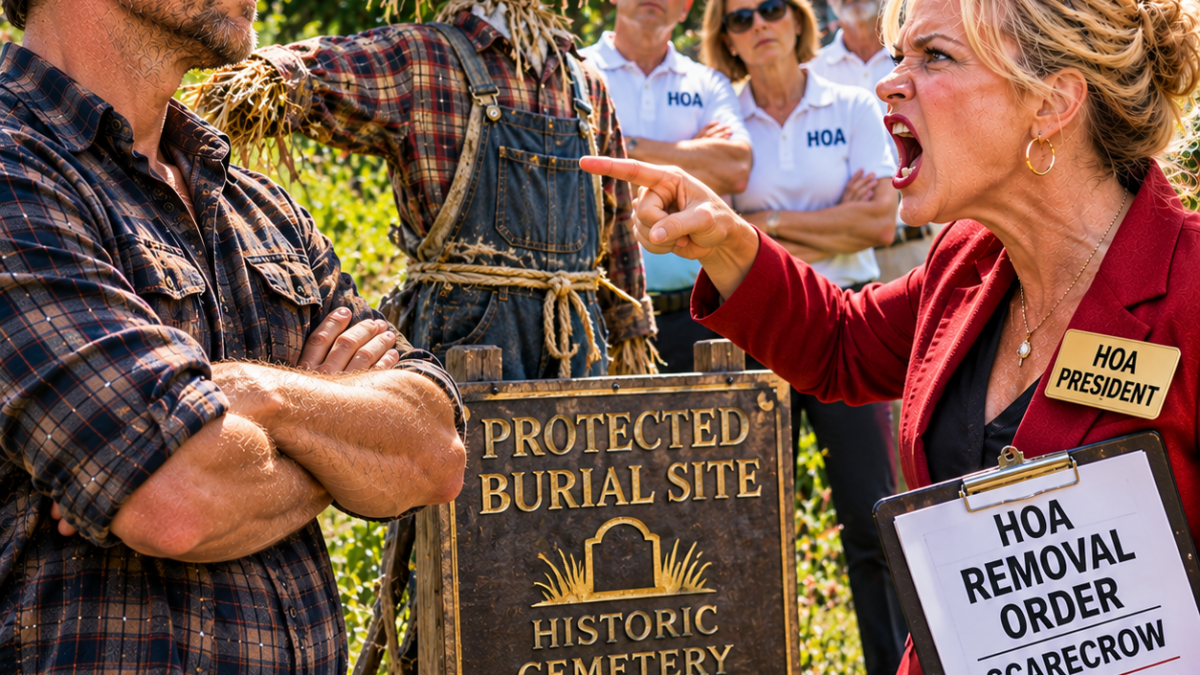
Karen Bishop stood in the middle of my lawn, pointed at the scarecrow my late wife had sewn with her own hands, and told me I had forty-eight hours to tear it down or the HOA would do it for me.
She called Silas a grotesque eyesore, but to me he was the last silly, crooked-smiling piece of Elena still standing exactly where she had asked me to leave him.
What Karen did not know was that the little patch of earth beneath his wooden post had a history neither one of us understood yet—and before this fight was over, that history would become much bigger than her HOA, her lawyers, or me.
My name is Jack Reed.
I spent twenty years in the Army as a combat engineer before coming home to the five acres my grandfather had farmed most of his life.
The property sat beside Creekwood Estates but was never part of it.
Creekwood had manicured entrances, identical mailboxes, decorative streetlights, and rows of expensive houses in slightly different shades of beige.
My place had an old 1950s farmhouse, a vegetable garden, a weathered barn, a restored 1968 Ford F-100, and enough uneven ground to make Karen Bishop visibly uncomfortable whenever she looked across the property line.
Elena loved it.
We bought the land from my grandfather’s estate with my Army retirement savings because, after years of moving from one base to another, we wanted one place that felt permanent.
She was the gardener.
I was labor.
That was our joke.
She decided what went where, and I dug holes, built beds, fixed irrigation lines, and pretended I had any influence over her tomatoes.
Silas started as one of her projects.
Old overalls.
A faded flannel shirt.
Straw stuffed through the sleeves.
And a burlap head with a ridiculous lopsided smile Elena stitched herself one rainy afternoon.
She planted him in the back field to scare crows away from her corn.
He wasn’t particularly good at it.
The birds eventually started using his shoulders as a resting place.
Elena found that hilarious.
When she got sick, we spent more evenings on the porch.
Some days she could walk the garden. Other days, she just sat beside me under a blanket and watched the field.
Her eyes always seemed to find Silas.
One evening she said, “He watches over the quiet places.”
I smiled.
“He loses fights with crows.”
“That isn’t what I mean.”
Then she reached for my hand.
“You make sure he always has a place to stand.”
I promised.
After she died, that promise became one of the small rituals that kept me functioning.
I repaired Silas every spring.
Replaced his straw.
Mended his shirt.
Straightened the post after storms.
Grief rarely makes sense, but when I looked across the field and saw that crooked smile, I could still hear Elena laughing.
Karen saw none of that.
She saw something she had not approved.
Her golf cart had cut two muddy tracks through my newly seeded lawn when she arrived that morning with Gary, one of the HOA board members who followed her around like a nervous shadow.
She pointed toward Silas.
“That grotesque effigy violates Creekwood Estates aesthetic standards.”
“You’re standing outside Creekwood Estates.”
“My board has received complaints.”
“Then tell them to stop looking into my field.”
Gary looked down.
Karen’s face tightened.
“You have forty-eight hours to remove it.”
“No.”
Her mouth opened slightly.
“No?”
“No.”
She shoved a printed violation notice toward me.
“Five hundred dollars for noncompliance. If it remains after forty-eight hours, the association will have it removed and charge you.”
I looked at the paper.
Then at the tire tracks across my grass.
“Karen, your HOA has no jurisdiction over this land.”
“We have authority to protect property values.”
“Not here.”
“That scarecrow is visible from our homes.”
“So is your golf cart. I haven’t tried to remove it.”
Gary coughed into his hand.
Karen turned purple.
“This is an official warning.”
“And this is a trespass warning.”
I pointed toward the gravel drive.
“Get off my property. Both of you.”
For several seconds, nobody moved.
Then Karen snatched the notice back, marched to the golf cart, and shouted, “This isn’t over, Reed. You’ll hear from our lawyers.”
I watched her drive away.
Then I walked to Silas and touched the rough wooden post Elena had chosen years earlier.
“I know,” I whispered.
If Karen wanted to turn a scarecrow into a war, I was going to make sure the first thing I protected was the promise she didn’t even know she was threatening.
PART 2
I found the violation notice lying near the edge of the driveway after Karen left.
Apparently, in her dramatic retreat, she had dropped it.
I picked it up.
The paper was glossy.
Professional logo.
Bold type.
Article numbers.
Threat of fines.
Everything designed to make a person assume that whoever printed it must possess authority.
I had spent enough years reading military orders and engineering contracts to understand the opposite.
A document is only as powerful as the authority behind it.
Karen had none on my land.
I carried the notice into the farmhouse and laid it on the dining room table.
For a moment, Elena’s face came back to me.
Not sick.
Not tired.
The Elena from years earlier, sitting at that same table with burlap spread in front of her and a sewing needle between her fingers.
I had walked past and asked:
“What are you making?”
“A face.”
“That is unsettling.”
“It’s for the scarecrow.”
“Still unsettling.”
She held up the crooked smile.
“You have no artistic appreciation.”
“I married you.”
“Exactly. Questionable taste.”
I laughed at the memory.
Then looked at Karen’s paper.
The laughter disappeared.
—
I downloaded Creekwood Estates’ full covenants that evening.
Five dollars from the county records portal.
Worth every cent.
I made coffee.
Opened a legal pad.
Read.
Karen loved quoting the rules, but I suspected she loved the sound of section numbers more than their actual meaning.
Within thirty minutes, I found the legal description.
Plat number.
Boundary coordinates.
Lots subject to the declaration.
Mine wasn’t there.
Lot 7 of the old McGregor farm survey existed completely outside Creekwood Estates.
No ambiguity.
No easement.
No covenant attachment.
No architectural jurisdiction.
Karen’s violation was fiction.
But I wasn’t satisfied with knowing I was right.
I wanted her to know that I could prove it.
So I drafted a letter.
Not angry.
Never angry on paper.
Date and time of trespass.
Names.
Karen Bishop.
Gary.
Golf cart.
Damage to newly seeded lawn.
Citation of Creekwood’s own boundary provisions.
Formal rejection of the five-hundred-dollar fine.
Notice that future unauthorized entry by HOA officers, agents, or contractors would be treated as trespass.
Then I went outside and photographed the tracks her golf cart had cut through the grass.
A landscaping company estimated repairs at $285.
Topsoil.
Seed.
Labor.
I attached the estimate.
My letter ended with an invoice.
**Amount due: $285.**
That part made me smile.
Sarah would have loved it.
Elena would have loved it more.
—
I mailed copies certified.
Signature required.
Then waited.
For ten days, silence.
Karen continued making her rounds in that golf cart, but she stayed on her side of the line.
I began to think maybe her lawyer had explained reality to her.
That hope lasted until the cream-colored envelope arrived.
**Wilhelm Stone & Associates.**
Law firm downtown.
Expensive paper.
Expensive language.
The letter did something clever.
It did not claim my land was part of Creekwood Estates.
Instead, it cited an alleged 1978 “Declaration of Community Standards” supposedly covering the larger Creekwood Valley.
According to the attorney, that document had created a regional oversight mechanism whose authority had somehow passed to Karen’s HOA.
And under that authority, anything visible from Creekwood common areas could allegedly be regulated for aesthetic compatibility.
Including Silas.
I read that paragraph three times.
Then the threat.
Remove the scarecrow.
Or the HOA would seek an injunction.
Attorney fees charged to me.
Court costs.
Everything designed to make resistance financially frightening.
That was the first moment I felt genuine anger.
Not because of the scarecrow.
Because somebody had taken Karen’s private obsession and dressed it in legal language.
The message was obvious.
You may be right, Jack.
But can you afford to prove it?
—
My answer was simple.
I drove to the county records office.
If a 1978 declaration existed, I wanted to see it.
The records clerk was Howard.
Thick glasses.
Quiet voice.
The kind of man who considered an obscure plat map an exciting afternoon.
When I explained what I needed, he adjusted his glasses.
“Creekwood Valley?”
“Yes.”
“1978?”
“That’s what the letter says.”
“Developer?”
“No name.”
“That helps tremendously.”
I smiled.
“Sorry.”
For two hours, we searched.
Index books.
Microfilm.
Subdivision filings.
Zoning actions.
Easements.
Nothing.
We expanded to 1973 through 1983.
Still nothing.
No declaration.
No regional aesthetic authority.
No predecessor organization.
Nothing remotely matching the law firm’s description.
Howard leaned back.
“Either it was filed under something very unusual…”
“Or?”
“It doesn’t exist.”
I already knew which answer I believed.
—
Since I was there, I decided to pull every historical record connected to my own parcel.
That decision changed everything.
Deeds first.
Mortgages.
Surveys.
Tax maps.
Then an older supplemental survey.
1923.
McGregor farm.
The image was faded enough that I nearly skipped it.
Then I noticed handwriting in one corner.
I zoomed.
A hand-drawn circle marked the back field.
Exactly where Silas stood.
Beside it, a surveyor named Alister Finch had written:
**Series of low mounds noted. Possible Osage burial site. Recommend no deep soil disturbance in this quadrant.**
I stopped breathing for a second.
Read it again.
Possible Osage burial site.
I looked around the quiet records room.
Nobody else reacted.
Why would they?
To everyone else, I was just a retired man staring at microfilm.
But in my head, Elena’s voice returned.
**He watches over the quiet places.**
I had always thought she meant the garden.
Or grief.
Or us.
Now I wasn’t sure.
—
I printed the survey.
High resolution.
Then another copy.
Howard came over.
“What did you find?”
I showed him.
His face changed.
“Oh.”
“Is this what I think it is?”
“It means somebody noticed something there in 1923.”
“Does it prove anything?”
“No.”
That was the right answer.
Not everything old is automatically true.
Not every mound is a grave.
A surveyor’s note was evidence.
Not proof.
I appreciated Howard saying that.
Because I didn’t want fantasy.
I wanted facts.
—
Driving home, I kept glancing at the copy on the passenger seat.
Elena had talked about that part of the field.
Not in mystical terms exactly.
She just liked it.
She would walk there more slowly.
Sit beneath the oak nearby.
Listen to the creek.
Her own family background included Irish and Cherokee ancestry, and she had always been thoughtful about land and history.
But I refused to turn that into some convenient supernatural explanation.
Maybe she sensed something.
Maybe she simply loved the place.
Maybe putting Silas there was coincidence.
I would never know.
What I did know was that a century-old survey suggested people might be buried beneath that field.
That required respect.
Karen suddenly seemed small.
—
My next phone call was not to a lawyer.
It was to the anthropology department at the state university.
I left a message.
Property location.
1923 survey.
Possible burial site.
Threat of unauthorized disturbance.
Then I waited.
While waiting, I started talking to neighbors.
Not to build an army.
At least not yet.
I wanted to understand what Karen had been telling them.
Ben Carter gave me my first answer.
Mid-thirties.
Young family.
House on the Creekwood side of my fence.
I saw him fighting with an old string trimmer and offered him water.
After a few minutes I introduced myself.
“Jack Reed.”
Recognition immediately.
“The scarecrow guy.”
“Apparently.”
Ben grimaced.
“Sorry.”
“For what?”
“You know. Karen.”
“What has she been saying?”
He hesitated.
Then glanced toward the street.
That glance told me more than his answer.
“She says your property is hurting values.”
“Five acres of tomatoes?”
“She says you’re refusing reasonable community standards.”
“I’m not in the community.”
“I know.”
He lowered his voice.
“She does this.”
“What?”
“Finds somebody.”
He pointed toward his fence.
Cedar.
Perfectly normal.
“She fines me two hundred a month because the previous owner installed wood instead of approved vinyl.”
“How long?”
“Eleven months.”
“Why haven’t you fought it?”
“Replacement would cost ten grand.”
“That wasn’t my question.”
Ben gave a tired laugh.
“Because I have two kids and a mortgage and a wife who is tired of hearing Karen’s name.”
I understood.
Then I told him I was documenting everything.
His posture changed.
“You’re fighting?”
“Yes.”
“Seriously?”
“Yes.”
A spark appeared in his eyes.
“You may have more friends than you think.”
—
Two days later, an old station wagon came up my driveway.
Martha Gable stepped out carrying muffins.
She was nearly eighty.
White hair.
Bright eyes.
No fear whatsoever.
“You’re Jack Reed.”
“Yes.”
“I’m Martha Gable.”
“Nice to meet you.”
“Ben is my grandnephew.”
That explained something.
“My family used to own the land where those ridiculous houses are.”
She gestured toward Creekwood.
“Come inside.”
She sat at my table.
Then saw the 1923 map.
Her entire expression changed.
“Where did you get that?”
“County records.”
She leaned closer.
Her finger hovered above the circle.
“My grandmother told us.”
“Told you what?”
“That people were buried on the high ground near the creek.”
I sat across from her.
“She said never plow deep there.”
“Did she say who?”
“Old people. Before our family.”
“Osage?”
Martha thought.
“That name was mentioned.”
My pulse accelerated.
“Are you sure?”
“No.”
Again, the right answer.
“I was a child, Jack. Memory changes.”
She tapped the survey.
“But that note doesn’t come from my memory.”
No.
It did not.
—
The university called while Martha was still there.
Dr. Aris Thorne.
Anthropology department chair.
His voice was energetic but careful.
He wanted to see the map.
I emailed it.
Five minutes later he called back.
“This is significant.”
“Does it prove a burial site?”
“No.”
I was beginning to love professionals.
“But it absolutely justifies non-invasive investigation.”
“What does that mean?”
“Ground-penetrating radar.”
“No digging?”
“None.”
“When?”
“Tomorrow, if you’ll allow us.”
I looked toward the field.
Silas stood in late-afternoon light.
“Come.”
—
Dr. Thorne arrived with a graduate student named Chloe.
Equipment followed.
The radar unit looked like a lawn mower designed by NASA.
Before touching anything, they walked the field.
Thorne studied the old map.
Martha’s oral history.
Topography.
The low rise.
The creek.
Then Silas.
“Interesting location.”
“Elena put him there.”
“Your wife?”
“Yes.”
He didn’t romanticize it.
Good.
“We’ll center the first grid here.”
Orange flags went down at measured intervals.
No soil disturbance.
No digging.
No removal of Silas.
Then they started scanning.
Pass one.
Nothing interesting.
Pass two.
Natural soil.
Third.
More of the same.
I felt stupidly disappointed.
Part of me had begun to believe Elena had somehow known.
I reminded myself that truth mattered more than a beautiful story.
Then Chloe stopped.
“Doctor.”
Thorne moved to her screen.
I came closer.
There was an anomaly.
Rectangular.
Different from the surrounding soil.
They ran the line again.
Same result.
Next grid.
Another.
Then another.
By midday, the mood changed from curiosity to solemn concentration.
The patterns were not random.
Multiple probable grave shafts.
Arranged deliberately.
A curved formation around the high ground.
Near Silas.
—
Dr. Thorne removed his glasses.
“We need to stop for today.”
“Why?”
“Because we have enough to treat this as potentially significant.”
“How many?”
“Fifteen strong anomalies.”
My stomach tightened.
“And additional probable features.”
I looked toward Silas.
“What happens now?”
“Reporting.”
“To whom?”
“State historic preservation authorities first.”
Then he looked at me.
“And tribal historic preservation officials.”
He emphasized that remote sensing did not identify individual people.
It did not magically tell us names.
It did not prove status.
It did not justify anyone calling one grave a chief’s grave because it looked larger.
That distinction mattered.
“These are people,” he said.
“Not archaeological props.”
I respected him immediately for that.
—
Within days, the field entered a formal protection process.
No ground disturbance.
No digging.
No landscaping.
Nothing until the appropriate authorities and tribal representatives had evaluated the site.
Dr. Thorne put me in contact with Joseph Blackfox, a tribal historic preservation officer representing the Osage Nation in the consultation process.
I was nervous before calling.
Not because I expected hostility.
Because I suddenly felt responsible for something I had never asked to possess.
Joseph listened while I explained.
My grandfather.
Elena.
Silas.
Karen.
The survey.
The radar.
When I finished, he was quiet.
Then he said:
“Thank you for calling before doing anything.”
That simple sentence hit me.
“What should I do?”
“Protect the ground.”
“I can do that.”
“And let us lead where our ancestors are concerned.”
“Yes.”
“Good.”
I hesitated.
“My wife put the scarecrow there years ago.”
“I understand.”
“It means something to me.”
“I understand that too.”
“Will it need to come down?”
Another pause.
“Not today.”
That was enough.
—
Karen knew none of this.
At least, not yet.
She did know university vehicles had been on my property.
I saw her watching through binoculars from the edge of Creekwood.
I waved.
She drove away.
Her attorney sent another threat two days later.
I replied with one sentence.
**The scarecrow is staying.**
That was all.
Not because I wanted to bait her.
Because that was the truth.
And because every professional involved had told me not to disturb the site.
Karen interpreted calm as weakness.
Again.
—
Ben called three nights later.
“Jack, you need to hear something.”
“What?”
“Emergency board meeting.”
“About me?”
“About Silas.”
“How do you know?”
“Maria on the board.”
Not my Maria from another story.
This Maria was a Creekwood homeowner who had finally gotten tired of Karen’s tactics.
“She recorded the meeting.”
“Is that legal?”
“She says it is under the circumstances and state rules.”
“I’m not touching that until counsel verifies.”
Good habits.
Ben came over anyway.
We listened after I confirmed what I could with an attorney contact.
Karen’s voice filled my kitchen.
Angry.
Insulted.
Obsessed.
She complained that I had ignored her.
That I was challenging the authority of the HOA.
Then Maria said something important.
Their attorney could not locate the 1978 declaration either.
Karen dismissed the problem.
“Weakness is the problem.”
Then came her plan.
Article 12.
Nuisance abatement.
Hire a landscaping crew.
Enter my property.
Pull Silas out.
Remove the post.
Fill the hole.
Gone in fifteen minutes.
Maria protested.
Trespass.
Lawsuit.
Karen laughed.
“He won’t do anything.”
Then:
“He can’t afford to fight us over a fifty-dollar scarecrow.”
That sentence sat inside me like ice.
Fifty-dollar scarecrow.
To Karen, value existed only if she could price it.
Elena’s hands sewing the smile?
Zero dollars.
My promise?
Zero.
History beneath the ground?
Unknown, therefore irrelevant.
That was her entire worldview.
—
The board voted.
Three to two.
Authorization passed.
I made copies of the recording.
Then called the sheriff’s office.
I explained everything.
Threatened trespass.
Recorded authorization.
Protected archaeological investigation underway.
A deputy agreed to be available if contractors appeared.
Next:
Dr. Thorne.
He was horrified.
The state had already issued temporary restrictions against disturbance.
Then:
Joseph Blackfox.
I hated making that call.
“I’m sorry.”
“For what?”
“For involving you in this nonsense.”
His voice remained calm.
“It stopped being nonsense when somebody threatened the ground.”
He told me representatives would come if necessary.
That was when the fight stopped being mine.
I finally understood that.
Silas belonged to my memories.
The graves did not.
I was their temporary steward because I happened to own the land above them.
Nothing more.
—
Three days later, a landscaping truck appeared at ten in the morning.
A-1 Landscape and Removal.
Karen followed in her golf cart.
I was waiting on the porch with coffee.
Two workers stepped out.
Neither looked comfortable.
Karen pointed toward the field.
“Back there.”
I stood.
“That’s far enough.”
She smiled.
“Save it, Reed.”
“You are trespassing.”
“The HOA authorized nuisance abatement.”
“The HOA has no authority here.”
“You can tell that to the judge.”
She turned toward the landscapers.
“Pull the scarecrow. Post too.”
One worker looked at me.
Then Karen.
“Ma’am, he says this is his property.”
“He’s been warned.”
I took out my phone.
Not threatening.
Recording.
“Gentlemen, I am the owner. I do not consent to your entry or any ground disturbance.”
That stopped them.
Karen snapped:
“Do the job you were paid for.”
Then the sheriff’s vehicle arrived.
Calmly.
No siren.
It parked behind the landscaping truck.
The deputy stepped out.
The workers immediately lowered their tools.
Smart men.
—
Karen walked toward the deputy.
“Officer, thank God. This man is interfering with official HOA business.”
The deputy barely looked at her.
He addressed the workers.
“Put the equipment away and remain by the truck.”
Karen’s face tightened.
Then another vehicle arrived.
Dr. Thorne.
A state historic-preservation attorney named Ms. Albright.
Then another truck.
Joseph Blackfox and another tribal representative.
Karen looked around.
For the first time since I had known her, she had no prepared script.
“What is this?”
Ms. Albright opened a portfolio.
“Karen Bishop?”
“I’m the HOA president.”
Of course that was how she answered.
Not yes.
Her title.
Ms. Albright showed her the protective order.
No unauthorized entry.
No ground disturbance.
No removal.
Karen stared.
“This is a scarecrow.”
Dr. Thorne stepped forward.
“No.”
He gestured toward the field.
“This is an identified burial area under active historic-preservation protection.”
Color drained from Karen’s face.
She looked toward Silas.
Then Joseph.
Then me.
“That’s ridiculous.”
Joseph answered quietly.
“The ground beneath that field contains the graves of people who came before your subdivision, before Mr. Reed’s family, before the roads you drive every day.”
Karen shook her head.
“You can’t know that.”
“We know enough to protect it.”
—
Karen tried one last retreat into bureaucracy.
“The HOA approved removal.”
Ms. Albright said:
“The HOA does not override state protection.”
“Our lawyers—”
“Your lawyers are not here.”
Silence.
The deputy stepped closer.
“Ma’am, you were previously warned not to enter Mr. Reed’s property.”
Karen looked at me.
“You called the police over a scarecrow?”
“No.”
I spoke for the first time.
“I called because you announced you were going to enter private property after being told not to, and remove an object from protected ground after your own board member warned you the entry was illegal.”
Her face changed.
“You have no proof.”
I held up my phone.
“I have the board recording.”
Ms. Albright looked toward me.
“You have what?”
Karen closed her eyes.
Just for a second.
There it was.
The moment she understood.
Not the archaeology.
Not the law.
Evidence.
Something she couldn’t shout over.
—
The landscaping workers gave statements.
They had been hired by Karen.
She directed them.
She identified the object.
She told them to remove the post.
They had no knowledge of a burial site.
Once law enforcement warned them, they stopped.
Nobody blamed them.
Karen received a trespass citation and formal notice that her conduct was under investigation.
She was not dragged away.
No dramatic handcuffs.
No movie ending.
The reality was more humiliating.
She had to climb back onto the same golf cart she had driven onto my property like a queen.
Now every official present had seen exactly what her authority was worth.
Nothing beyond the Creekwood boundary.
She drove away without looking at me.
—
The story exploded anyway.
The board recording circulated.
Then news of the burial site.
Then questions about the nonexistent 1978 declaration.
Residents started asking why their dues had paid a law firm to threaten a neighboring landowner using a document nobody could produce.
That question hurt Karen more than anything I had done.
Money gets people’s attention.
Ben called that evening.
“You’re not going to believe the Facebook group.”
“I’m intentionally not looking.”
“Good call.”
“What’s happening?”
“Civil war.”
“Wonderful.”
“Half the neighborhood wants Karen removed tonight.”
“And the other half?”
“Mostly asking what the hell happened.”
“Better question.”
—
Creekwood called an emergency meeting.
This time, I didn’t attend.
It wasn’t my HOA.
Ben later told me the room was full.
Karen tried to frame everything as a misunderstanding.
According to her, she had merely acted on legal advice.
Maria read portions of the recorded meeting aloud.
The room changed.
Karen had not sounded confused.
She had sounded deliberate.
Then Gary—the man who had ridden onto my lawn beside her during the first confrontation—did something I never expected.
He apologized.
Publicly.
“I knew Jack’s property wasn’t inside the HOA.”
According to Ben, you could hear a pin drop.
Karen stared at him.
Gary continued.
“I told myself we were protecting property values.”
Then:
“But really I was afraid to tell her no.”
That sentence opened the floodgates.
Other board members talked.
Residents talked.
Fines.
Threats.
Public shaming.
Karen’s habit of converting personal preferences into “community standards.”
Finally, a motion of no confidence.
Overwhelming.
Karen was removed.
Not by me.
By the people she actually represented.
That mattered.
—
Her law firm sent me a letter shortly afterward.
A very different letter.
The alleged 1978 declaration could not be substantiated.
All demands concerning Silas were withdrawn.
Any prior claim of regional aesthetic authority was disclaimed.
The HOA also agreed to reimburse the $285 lawn repair.
I deposited the check.
Then used the money to repair the grass Karen’s golf cart had damaged.
Full circle.
—
The historical process took much longer.
As it should.
No rush.
No spectacle.
The Osage Nation’s representatives worked with state preservation officials, Dr. Thorne’s team, and other appropriate experts.
More non-invasive surveying refined the site boundaries.
No graves were opened.
No remains were displayed.
Nothing became a tourist attraction.
Joseph made that point clear.
“These aren’t artifacts.”
“I know.”
“People get excited by discovery.”
“I understand.”
“We’re not discovering people. We’re recognizing them.”
That sentence stayed with me.
The field was eventually placed under formal protective restrictions recognized in the relevant property and preservation records.
I voluntarily agreed to additional protections.
No development.
No excavation.
No deep agricultural work.
No future sale without disclosure of the protected area.
Some attorney warned me those restrictions could reduce my property’s development value.
I laughed.
“I’m not building condos over graves.”
He stopped talking.
—
Silas became a question.
Not for Karen anymore.
For us.
The original post had already been in the ground for years.
Removing it could itself disturb soil.
Leaving it required maintenance.
I told Joseph about Elena.
Not to manipulate him.
Because I needed guidance.
“She asked me to keep him there.”
He listened.
Then asked:
“What does he mean to you?”
“Her.”
“Only her?”
I thought.
“At first.”
“And now?”
I looked across the field.
“Watching.”
Joseph nodded.
“For now, maintain what is already there without new disturbance.”
That was the arrangement.
No digging.
No replacing the post.
Repairs above ground only.
Silas stayed.
But his meaning changed.
—
I stopped calling him a guardian of the burial site in public.
That word felt like claiming something.
He was Elena’s scarecrow.
He happened to stand in a place that deserved protection.
That was enough.
Dr. Thorne later told me he appreciated the restraint.
“People love legends.”
“So did Elena.”
“Legends are fine.”
He smiled.
“Until they replace facts.”
Fair.
So I kept both.
The fact:
Elena placed Silas there years before anyone knew.
The feeling:
Somehow, that mattered to me.
I didn’t need to make it supernatural.
Love is strange enough without adding ghosts.
—
Karen’s legal problems continued separately.
The state investigation focused on the attempted unauthorized disturbance and the false legal pressure surrounding it.
The HOA’s insurer and lawyers asked difficult questions.
The board cooperated.
Karen eventually resolved the trespass-related matters through a plea and civil settlement rather than taking everything to trial.
She paid fines.
Covered a portion of damages and legal expenses.
Agreed to stay off my property.
And, as part of the HOA settlement, gave up any board role.
For good.
Was it the dramatic prison sentence some neighbors wanted?
No.
Did I care?
Also no.
I had never wanted Karen in a cell.
I wanted her away from my field.
Mission accomplished.
—
Creekwood changed after she left.
Not instantly.
People had spent years learning to distrust each other.
That takes time to reverse.
Ben joined the new board reluctantly.
Maria did too.
Gary resigned.
Harold—the old president who had moved years earlier—sent a letter after hearing what happened.
Ben showed me.
It said:
**An HOA should make neighbors’ lives easier where they share responsibilities, not harder where they don’t.**
They framed that sentence in the clubhouse.
Good choice.
—
The first major rules review cut the covenant handbook nearly in half.
No more wall-of-shame posts.
No fines without written evidence and an appeal process.
No individual president deciding aesthetic disputes alone.
Clear property-boundary limitations.
Legal review required before the HOA threatened any adjacent nonmember property.
That last one was informally known as:
**The Jack Rule.**
I hated the name.
Ben loved it.
—
Martha Gable became one of my closest friends.
She visited the farm most Sundays.
Always brought something.
Muffins.
Pie.
Jam.
One afternoon she stood beside the protected-field boundary.
Not inside.
Respect mattered.
She looked toward Silas.
“My grandmother would be happy.”
“You don’t know that.”
She smiled.
“You’re very annoying.”
“Accuracy.”
“She would be happy we listened.”
That I could accept.
Martha grew quiet.
“My family owned all that land once.”
She pointed toward Creekwood.
“We didn’t know enough.”
“About the burial ground?”
“We knew stories.”
“Stories are hard to protect legally.”
“Yes.”
She looked at me.
“But somebody remembered long enough for someone else to write it down.”
The 1923 survey.
One note in a margin.
A few words nearly forgotten.
That was all it took to prevent a very different outcome a century later.
Documentation again.
My whole life seemed to come back to paperwork.
Elena would have found that hilarious.
—
The first anniversary of the discovery was deliberately uneventful.
No media.
No public ceremony.
Representatives from the Osage Nation visited privately.
I followed their lead.
I did not photograph anything unless invited.
I did not post.
I did not turn the day into my story.
At one point Joseph stood with me near the farmhouse.
“You’ve been quieter than usual.”
“I’m learning.”
“That’s dangerous.”
I laughed.
Then he looked toward Silas.
“Your wife made that?”
“Yes.”
“Funny face.”
“She was proud of it.”
“She should have been.”
That simple approval hit me harder than I expected.
—
I went inside later and cried.
Not because of Karen.
Not because of the burial site.
Because for the first time in years, somebody had spoken about Elena’s scarecrow without treating it like evidence.
Just something she made.
Something ridiculous and sweet.
Grief has layers.
You think you are defending a scarecrow.
Then a burial ground.
Then property rights.
Then history.
Underneath all of it, sometimes you are still just a husband who misses his wife.
—
Emily—my daughter—came home that Christmas.
She had known about the conflict, obviously, but living away meant she experienced it through calls and headlines.
We walked to the back field.
She stopped a respectful distance from Silas.
“He looks terrible.”
“He’s aging.”
“He’s stuffed with straw.”
“Show respect.”
She smiled.
Then touched my arm.
“Mom really put him there?”
“Yes.”
“You think she knew?”
There it was.
The question everyone eventually asked.
I looked across the field.
“No.”
Emily seemed surprised.
“You don’t?”
“I think she loved this spot.”
“That’s all?”
“That’s enough.”
She thought about it.
Then nodded.
“Yeah.”
We stood quietly.
After a while she said:
“She would have hated Karen.”
I laughed.
“She would’ve invited her in for tea.”
“Mom?”
“Then destroyed her politely.”
“That sounds more accurate.”
—
Karen moved out of Creekwood the following spring.
Her house sold.
No crowd watched.
No one celebrated in the street.
I heard about it from Ben.
“She’s gone.”
“Okay.”
“That’s all you’ve got?”
“What should I do?”
“Ring church bells?”
“I don’t own any.”
He laughed.
Then became serious.
“She blamed you until the end.”
“That’s her burden.”
“You don’t care?”
I looked toward the field.
“Not anymore.”
That was true.
And that was the moment I knew I had actually won.
As long as you need your enemy to understand why they were wrong, they still occupy part of your life.
Karen could leave believing I ruined her.
Fine.
I knew what happened.
The records knew.
The residents knew.
Most importantly, the field was safe.
—
The new owners of Karen’s house were a couple with two young boys.
One afternoon they knocked on my door.
The father looked nervous.
“Mr. Reed?”
“Jack.”
“We just moved in.”
“I heard.”
He glanced toward the field.
“Our realtor told us there’s a protected historic site near the neighborhood.”
“Yes.”
“We want to make sure the kids understand where they shouldn’t go.”
That question alone made me like him.
I showed him the surveyed boundary.
Explained the restrictions.
No scare stories.
No dramatics.
His older son stared at Silas.
“Is that a ghost?”
“No.”
“A dead person?”
“No.”
“A farmer?”
“Technically unemployed.”
The father laughed.
The boy pointed.
“Why is he there?”
I thought about Elena.
“Because someone I loved put him there.”
The boy nodded like that made perfect sense.
Children are often better at grief than adults.
—
Creekwood installed signage on its own side of the boundary.
Not flashy.
Simple.
**Protected Cultural Site Beyond This Point. Private Property. Please Respect Boundary.**
They paid for it.
Ben asked whether I wanted my name on the sign.
“No.”
“Why?”
“Because it’s not about me.”
Good answer.
Probably Elena’s influence.
—
Silas deteriorated slowly.
His shirt faded.
One sleeve tore.
The burlap head began weakening.
I repaired only what could be repaired without disturbing the post.
Eventually, Joseph and the preservation team agreed that replacing fabric above ground posed no issue.
So Emily and I did it together.
I refused to replace the original smile.
Elena’s stitches were still there.
We carefully removed the burlap head.
Emily held it.
Her hands trembled.
“She touched this.”
“Yes.”
“So did you.”
“Not the same.”
“No.”
She looked at me.
“But still.”
We reinforced the inside.
Preserved as much original fabric as possible.
Then put it back.
The smile remained crooked.
Perfect.
—
I kept Elena’s old sewing box in the workshop.
One night after repairing Silas, I opened it.
Thread.
Buttons.
Needles.
A thimble.
Pieces of fabric.
At the bottom was a photograph I had forgotten.
Elena in the field.
Silas behind her.
She was laughing at something outside the frame.
On the back, in her handwriting:
**Jack says he’s ugly. I say he has character.**
I sat there for a long time.
Then laughed and cried at once.
Grief can make you feel ridiculous.
Maybe that is healthy.
—
Martha died two years later.
Ninety-one.
Peacefully.
At her funeral, Ben spoke about her stubbornness.
Everyone laughed.
Her family gave me a small envelope.
Inside was a copy of a handwritten note she had apparently left with instructions.
**Jack—keep listening to the land, but don’t get too mystical about it. You’re unbearable enough already. —Martha**
I laughed so loudly in the church lobby that people stared.
Exactly what she would have wanted.
Her family also gave historical materials to the county archive.
Stories.
Photographs.
Maps.
More pieces of memory saved from disappearing.
—
Dr. Thorne’s team eventually published academic work on the site.
Carefully.
Without sensationalizing the location.
Sensitive details restricted.
Tribal consultation acknowledged.
I received a copy.
Couldn’t understand half of it.
I called him.
“Did you deliberately write this so normal people can’t understand it?”
“Yes.”
“I knew it.”
He laughed.
Then told me something important.
The site mattered not because it created a dramatic legal trap for an HOA president.
It mattered because intact burial landscapes are fragile.
Development erases context.
Roads.
Utilities.
Foundations.
One careless excavation can destroy information and disturb people who were supposed to remain at rest.
I looked toward Creekwood.
Houses stopped just short of my five acres.
A coincidence of property history had preserved what heavier development might have damaged.
That sobered me.
—
For years, I had thought my grandfather’s refusal to sell the parcel was just stubbornness.
Maybe it was.
He never knew about the graves.
At least, not that I know.
But his decision preserved the land.
Then mine did.
Then Elena’s love of the field kept me emotionally attached to it.
History often survives through people making choices for reasons completely unrelated to history.
That fascinated me.
—
The HOA sent me one final formal apology years after Karen left.
The new president was Ben.
He came personally.
“No certified mail?”
“Trauma response.”
I laughed.
He handed me one page.
It acknowledged:
Improper assertion of jurisdiction.
Trespass.
Legal threats.
Damage to the lawn.
Failure of governance.
Then:
**Creekwood Estates recognizes and respects the independent status of the Reed property and the protected cultural significance of the adjoining landscape.**
I read it.
“Good.”
“That’s all?”
“What do you want?”
“Tears.”
“Get off my porch.”
He smiled.
“Sign acknowledging receipt.”
“Absolutely not.”
He laughed harder.
—
We became friends anyway.
That might have been the strangest consequence.
People from Creekwood began buying vegetables from me.
Tomatoes.
Corn.
Beans.
I never started a formal stand.
Just a table near the driveway with a cash box.
One summer, somebody suggested a neighborhood garden exchange.
Creekwood hosted it.
Not on the burial site.
Not on my back field.
At the community park.
Perfect.
People brought vegetables.
Flowers.
Baked goods.
Children painted rocks.
No architectural approvals required.
—
One little girl painted a rock shaped like Silas.
Crooked smile.
Flannel pattern.
She handed it to me.
“For your scarecrow.”
I almost lost it right there.
“Thank you.”
“Why are you crying?”
“Allergies.”
“There aren’t flowers here.”
“Very specific allergies.”
She accepted that.
I kept the rock on the porch.
—
Years passed.
The field changed with seasons.
Spring grass.
Summer heat.
Autumn gold.
Winter frost.
Silas remained.
Not eternal.
Nothing is.
But maintained.
Respected.
Never touched by Karen’s landscapers.
Never torn down.
Never replaced with some HOA-approved decorative object.
Just Silas.
Elena’s ridiculous scarecrow.
Standing above a place older and more important than either of us knew when she put him there.
—
Sometimes reporters still called.
The story had become local legend.
**HOA Tries to Remove Scarecrow, Discovers Protected Burial Ground.**
They loved the irony.
I hated the simplification.
One reporter asked:
“What was your favorite moment of revenge?”
I told her:
“There wasn’t one.”
She looked disappointed.
“You didn’t enjoy watching Karen get stopped?”
“Of course.”
“So that was revenge.”
“No.”
“What was it?”
“Relief.”
She frowned.
I continued.
“Revenge would have been hurting her because she hurt me. I wanted her prevented from hurting the land.”
“That’s less dramatic.”
“Reality usually is.”
She didn’t use that quote.
Journalists have needs.
—
But I thought about the question later.
Was there satisfaction?
Absolutely.
When the deputy stopped the landscaping crew?
Yes.
When Karen learned her board vote meant nothing on my property?
Yes.
When her invented legal authority collapsed?
Definitely.
When Creekwood removed her?
I slept very well that night.
I am not a saint.
But the most satisfying part came much later.
A spring morning.
No officials.
No attorneys.
No Karen.
A cardinal perched on Silas’s shoulder.
Exactly where crows once did when Elena was alive.
I stood on the porch with coffee.
For one second, time folded.
Elena laughing.
Bird on scarecrow.
Sun over the field.
Nothing needed defending.
That was victory.
—
Joseph visited that afternoon.
He saw the bird too.
“Your scarecrow isn’t very effective.”
“That was established years ago.”
He smiled.
We sat.
He had become a friend, though I always remained aware that our relationship began because his people’s ancestors rested beneath my land.
There was responsibility in that friendship.
Not ownership.
He once told me:
“People say land belongs to them.”
“I’ve said it.”
“Most of us do.”
He looked toward the field.
“But sometimes the better question is who you belong in relationship with because of the land.”
I thought about that for months.
—
Karen thought property was about control.
If she could see it, regulate it.
If it affected her image, change it.
If someone resisted, punish them.
I had also thought ownership meant control.
My five acres.
My field.
My scarecrow.
Then the burial site taught me something uncomfortable.
Ownership has limits too.
Some responsibilities arrive whether you want them or not.
I could legally own the surface and still owe respect to history below it.
That made me a better steward.
Maybe a better neighbor.
Probably a worse HOA candidate.
Thankfully.
—
Creekwood asked me to join its board once.
I laughed for a full minute.
Ben waited.
“You finished?”
“No.”
“Jack.”
“I don’t even live in Creekwood.”
“Advisory seat.”
“Absolutely not.”
“You know governance.”
“I know tomatoes.”
“You were an Army engineer.”
“Exactly. I have suffered enough bureaucracy.”
They stopped asking eventually.
—
Instead, I helped with practical things.
Drainage issue near the community park.
Advice on a retaining wall.
Volunteer veterans’ project.
Ben joked:
“You realize you’re becoming part of the community.”
“Take it back.”
“Too late.”
Maybe he was right.
Not legally.
Never legally.
But socially.
Karen had spent years trying to absorb my land into Creekwood through control.
Ironically, after she left, I became closer to Creekwood because nobody tried to control me.
Funny how respect works.
—
Emily married.
At the reception, she used one of Elena’s old garden photographs on the memory table.
The photograph with Silas in the background.
I stood staring at it.
Emily joined me.
“Mom would’ve loved today.”
“Yes.”
“She’d also be furious you wore that tie.”
“Yes.”
“She hated that tie.”
“I know.”
“You wore it on purpose.”
“I needed her represented accurately.”
Emily laughed.
Then leaned her head against my shoulder.
“You kept your promise.”
I looked at her.
“What promise?”
“Silas.”
My throat tightened.
“He still has a place to stand.”
“Yes.”
That hit harder than anything Karen ever said.
—
Eventually, the farmhouse needed a new roof.
Then plumbing.
Then wiring.
Time wins every fight if you give it long enough.
I repaired things.
Preserved what mattered.
Modernized what needed modernizing.
That balance became my philosophy.
Not everything old is sacred.
Not everything new is progress.
You have to know the difference.
Karen never did.
To her, old farmhouse meant eyesore.
Scarecrow meant junk.
Unmanaged meadow meant neglect.
Uniformity meant value.
But Elena had known better.
So had Grandpa.
So had Martha.
Some beauty requires leaving room for history.
—
One autumn afternoon, I found myself replacing one of Silas’s wooden arms.
Above ground.
Approved method.
No soil disturbance.
Emily was there.
Her son—my grandson—watched.
He was six.
“Why is he called Silas?”
“Your grandmother named him.”
“Why?”
“I never asked.”
“That was dumb.”
“Yes.”
“What does he guard?”
I froze.
That question could have led to a long speech.
Instead:
“A quiet place.”
Elena’s words.
He nodded.
“From birds?”
“Terrible at birds.”
He laughed.
Then helped hand me twine.
Three generations standing there.
Elena absent.
Still present.
Grief does that too.
—
Later, my grandson asked about the people buried there.
I told him carefully.
Not ghost stories.
Not treasure.
Not mystery.
People.
Families.
Ancestors.
A place to leave undisturbed.
“Why?”
“Because everybody deserves respect after they’re gone.”
He thought.
“Like Grandma?”
“Exactly.”
Children understand more when you don’t complicate things.
—
The county eventually added a historical note to public planning maps so future officials would know restrictions existed before issuing permits nearby.
That mattered to me.
A century earlier, one surveyor wrote a note in a margin.
Almost forgotten.
Now the warning would not depend on someone accidentally finding microfilm while fighting an HOA.
Systems can learn.
Slowly.
But they can.
—
I visited Howard at the records office once before he retired.
He remembered me immediately.
“Scarecrow.”
“That’s apparently my legal name now.”
He laughed.
I brought him tomatoes.
“You know,” he said, “that map had probably been opened twenty times in a hundred years.”
“And nobody noticed?”
“Maybe they noticed.”
He shrugged.
“Didn’t matter to them.”
“It mattered to me.”
“Because you needed it.”
Exactly.
Records wait.
Sometimes for generations.
That humbled me.
—
Before Howard retired, I made sure the county archive had properly indexed the supplemental survey with the preservation documentation.
He looked impressed.
“Combat engineer to archivist.”
“Don’t insult me.”
“You love records.”
“I tolerate records.”
“You brought labeled folders.”
“Operational necessity.”
He smiled.
“Elena would laugh at you.”
I stared.
“How do you know about Elena?”
“Small county.”
Fair.
—
Time softened Karen too.
Not her behavior.
My memory of it.
The sharpness faded.
The golf cart became funny.
The absurd violation notice became a story.
Her lawyer’s fictional declaration became a cautionary example.
Anger is heavy.
Eventually you set it down because carrying it no longer proves anything.
I did keep the first violation notice.
Not framed.
Not displayed.
In a file.
Emily found it once.
“Why keep this?”
“History.”
“You keep everything.”
“Not everything.”
She looked toward the field.
“No.”
Her voice softened.
“I guess you don’t.”
Elena.
We both understood.
—
There are losses you cannot document your way out of.
No certified letter defeats cancer.
No property survey brings back a wife.
No court order fixes the empty side of a bed.
Maybe that is why I fought Karen so hard.
Silas was something I could protect.
A promise with a physical form.
Four pieces of wood.
Straw.
Fabric.
A crooked smile.
I couldn’t save Elena.
But I could save the thing she asked me to leave standing.
At least, that is what I believed in the beginning.
By the end, I understood the promise differently.
—
She said:
**Make sure he always has a place to stand.**
I thought she meant Silas.
Maybe she meant the quiet place.
The garden.
The field.
The life we had wanted.
Something untouched by other people’s need to control it.
I’ll never know.
But the field remained quiet.
That was enough.
—
On the tenth anniversary of Elena’s death, I sat on the porch alone.
No ceremony.
No visitors.
Coffee.
Her photograph.
The sun went down behind Silas.
For years, that date had felt like a wound reopening.
That year felt different.
Still sad.
But gentler.
I realized I had spent too long thinking grief meant maintaining things exactly as she left them.
Same scarecrow.
Same garden.
Same farmhouse.
Same routines.
But Elena had loved growing things.
Change was everywhere in her garden.
Seeds became plants.
Flowers died.
Fruit ripened.
Compost returned to soil.
Nothing stayed the same.
Maybe memory didn’t have to either.
—
The next spring I planted something new.
Not in the protected area.
Far from it.
Along the porch.
Elena’s favorite lavender.
I had avoided it for years because the smell was too connected to her.
That year I planted twelve.
When they bloomed, I sat beside them.
Cried.
Then smiled.
Healing can be both.
—
Creekwood held a community picnic later that summer.
Ben invited me.
“No HOA business?”
“Promise.”
“No covenants?”
“None.”
“No beige dress code?”
“Jack.”
“I need assurances.”
I went.
Kids ran everywhere.
Purple house trim visible down one street.
Basketball hoop near another.
Welcome signs.
Gardens.
Ordinary evidence that civilization had survived Karen’s departure.
Gary was there.
Older.
Quieter.
He approached.
“I owe you something.”
“What?”
“An apology.”
He swallowed.
“I rode onto your lawn with her.”
“I remember.”
“I knew we shouldn’t.”
“Yes.”
“I kept nodding anyway.”
“Yes.”
He looked down.
“Cowardice gets comfortable.”
That was a good sentence.
“So does courage if you practice it.”
He looked at me.
“You forgive me?”
I thought.
“Yes.”
He exhaled.
“But don’t drive on my lawn.”
He laughed.
“Understood.”
—
That was another ending Karen would never have understood.
Not defeating people.
Reintegrating the ones willing to change.
A community cannot survive if every former enabler is exiled forever.
Accountability first.
Then possibility.
Gary never joined another board.
Probably wise.
—
Joseph eventually retired.
Before he did, he came one last time in his official capacity.
We walked the boundary.
Documentation updated.
Site stable.
No disturbance.
Silas upright.
At the porch, he shook my hand.
“You did good.”
“High praise?”
“Don’t get used to it.”
I smiled.
Then asked:
“Do you still think I’m the guardian?”
He considered.
“I think you’re a neighbor.”
“To people who’ve been gone for generations?”
“Why not?”
I liked that better.
Guardian sounded heroic.
Neighbor sounded responsible.
—
After he left, I stood beside Silas.
The late-afternoon sun cast his shadow across the grass.
For the first time, I noticed how crooked his shoulders were.
Elena had never built anything square.
I handled construction.
She handled beauty.
Division of labor.
I touched the flannel sleeve.
“Still ugly.”
Wind moved the fabric.
No answer.
Probably for the best.
—
Karen’s name is barely mentioned now.
New residents in Creekwood know the story only because someone eventually tells them why the boundary signs exist.
Sometimes the tale gets exaggerated.
Karen arrived with bulldozers.
Wrong.
Federal agents arrested her on the spot.
Wrong.
Silas marked the grave of a famous chief.
Unverified and disrespectfully speculative.
I correct people.
Facts matter.
The real story is dramatic enough.
A woman tried to enforce HOA rules where they did not apply.
She escalated rather than accept a boundary.
Her escalation threatened a culturally significant protected place.
Evidence stopped her.
That’s enough.
—
And the revenge?
People still ask.
They want the satisfying part.
Karen embarrassed.
Karen removed.
Karen fined.
Karen gone.
Yes.
Those happened in the completed version of my life.
But the revenge that mattered most was quieter.
My field never became her landscaping project.
Elena’s scarecrow never went into a dumpster.
The graves remained undisturbed.
Creekwood learned that authority has borders.
And I learned that holding a line is not the same as hating the person on the other side.
—
One fall morning, I came outside after a storm.
Silas leaned slightly.
My first instinct was to straighten the post.
Then I stopped.
Ground disturbance rules.
I called the preservation contact.
Explained.
Sent photographs.
They approved a non-invasive brace above grade.
Twenty years earlier, I would have laughed at needing permission to repair a scarecrow on my own land.
Now I understood.
Responsibility had changed.
I built the brace.
No digging.
Silas straight again.
My grandson helped.
When we finished, he stepped back.
“He looks better.”
“No.”
“What?”
“He still looks terrible.”
“That’s mean.”
“He knows.”
My grandson laughed.
Somewhere in my memory, Elena did too.
—
That evening we sat on the porch.
My grandson chased lightning bugs.
Emily drank iced tea.
The farmhouse lights glowed behind us.
Across the field, Silas stood.
Beyond him, the protected ground remained exactly what it should be.
Quiet.
No golf cart.
No landscapers.
No threats.
No argument.
Just grass moving under the wind.
Emily looked toward me.
“You okay?”
“Yeah.”
“Thinking about Mom?”
“Always a little.”
She nodded.
Then:
“She picked a strange place for a scarecrow.”
I smiled.
“She picked a good one.”
—
Karen had called Silas grotesque.
Maybe he was.
One eye always sat higher than the other.
His hat never stayed straight.
The stitched smile looked drunk.
But love had made him.
That gave him value no covenant could measure.
And coincidence—or history, or whatever combination of choices brought Elena to that patch of ground—gave him another role none of us expected.
He became the object that forced people to look closer.
At land.
At records.
At boundaries.
At history.
At authority.
At what we preserve and why.
—
If Karen had ignored him, I might never have searched the archives.
The old survey might have remained buried in microfilm.
The site might have stayed undocumented until some future owner decided to build.
That possibility still unsettles me.
I will never thank Karen for what she did.
Intent matters.
She was trying to destroy.
But consequences sometimes escape intention.
Her attack forced discovery.
Discovery created protection.
Protection became permanent.
Life is complicated that way.
—
I keep the 1923 survey in a fireproof archive box now.
Beside Elena’s sewing kit.
Not because the two things are historically connected.
They aren’t.
One is evidence.
One is memory.
But together they explain the story better than any headline.
A map somebody almost forgot.
A smile somebody stitched by hand.
Both survived because someone chose not to throw them away.
—
The first violation notice is there too.
Five hundred dollars.
Remove the grotesque effigy.
Forty-eight hours.
I occasionally take it out.
Not to stay angry.
To remember scale.
Karen once believed that page was power.
Today it is a piece of paper in a box.
Silas is still standing.
The field is protected.
The people beneath it are undisturbed.
Creekwood has moved on.
My family has moved forward.
That is the proper proportion of things.
—
One morning, a cardinal landed on Silas’s shoulder again.
I took a photograph.
Sent it to Emily.
She replied:
**Worst scarecrow ever.**
I wrote:
**Best quiet-place watcher.**
Three dots appeared.
Then:
**Mom would like that.**
I put the phone away.
Sat on the porch.
Listened.
—
For years after Elena died, silence felt empty.
Now it felt different.
Full.
Wind in grass.
Creek water.
Bird calls.
Distant children from Creekwood.
Hammer from somebody fixing a porch.
Life.
Not controlled.
Not uniform.
Not beige.
Alive.
—
I used to think my military career taught me how to win fights.
Maybe.
It taught me planning.
Patience.
Documentation.
Boundaries.
But the most important lesson of the scarecrow war came after retirement.
Not every victory requires destroying an opponent.
Sometimes victory is preserving something fragile long enough for other people to understand why it matters.
Karen wanted Silas removed because she saw no value in him.
She looked at worn overalls and straw and assumed useless.
She looked at my old farmhouse and saw blight.
She looked at five acres outside her jurisdiction and saw a flaw in the map.
She looked at resistance and saw disrespect.
She never stopped to ask what any of it meant.
That was why she lost.
—
Elena always asked.
Why was that tree leaning?
Who planted those daffodils?
How old was the farmhouse beam?
Why did the creek change course there?
What story belongs to this place?
Curiosity made her gentle.
Certainty made Karen destructive.
I think about that often.
—
Years after all of it, Creekwood installed a new entrance sign.
The old one had been replaced during normal maintenance.
Ben sent me a picture.
Tasteful.
Wood.
Stone.
Not beige plastic.
He wrote:
**Karen would hate it.**
I replied:
**Then stop invoking her and enjoy your sign.**
He sent back:
**You’ve gotten wise in your old age.**
I blocked him for twelve minutes.
—
Life continued.
That is the ending people rarely include.
Not verdicts.
Not confrontations.
Life.
Tomatoes ripened.
The truck needed repairs.
My knees hurt.
Emily visited.
Grandson grew.
Creek flooded one spring.
Martha’s old muffin recipe somehow ended up with Sarah’s niece.
Ben lost another HOA election because people decided somebody else deserved a turn.
He was delighted.
Silas required maintenance.
The field remained untouched.
Ordinary things.
Beautiful things.
—
On what would have been Elena’s seventieth birthday, I carried two chairs onto the porch.
One for me.
One empty.
Corny.
I know.
I poured coffee into her old mug anyway.
The one that said:
**GARDENERS KNOW ALL THE DIRT.**
I sat.
Sunrise reached the back field.
Silas appeared first as a dark shape.
Then flannel.
Then burlap.
Then that stupid smile.
I thought about Karen’s first threat.
Forty-eight hours.
So certain.
So temporary.
Then Elena’s promise.
Always.
Not literally, perhaps.
Nothing is always.
But long enough.
Long enough for me.
Long enough for Emily.
Long enough for her son to know why a crooked scarecrow matters.
Long enough for the land beneath him to be recognized and protected.
That felt like keeping the promise.
—
I lifted Elena’s mug.
“To quiet places.”
The breeze moved through the field.
Silas shifted slightly.
I smiled.
For once, no bird was sitting on him.
Maybe after all these years he was finally improving at his original job.
Probably not.
And I wouldn’t have wanted him any other way.
Karen had tried to tear down what she thought was an ugly decoration.
Instead, she forced all of us to discover that some things should never be judged by how they look from a manicured street.
Some land carries history.
Some objects carry love.
Some boundaries protect more than property.
And sometimes the ridiculous old scarecrow everyone wants gone is standing exactly where he needs to be.
Silas stayed.
The graves stayed undisturbed.
Elena’s promise stayed with me.
And Karen?
She became what every bully eventually becomes when people stop being afraid.
A story about someone who once thought she was more powerful than she really was.
That was enough revenge for me.
The rest was peace.








