HOA Karen Ordered Me to Remove My Root Cellar Door—Then She Learned What Was Buried Under It
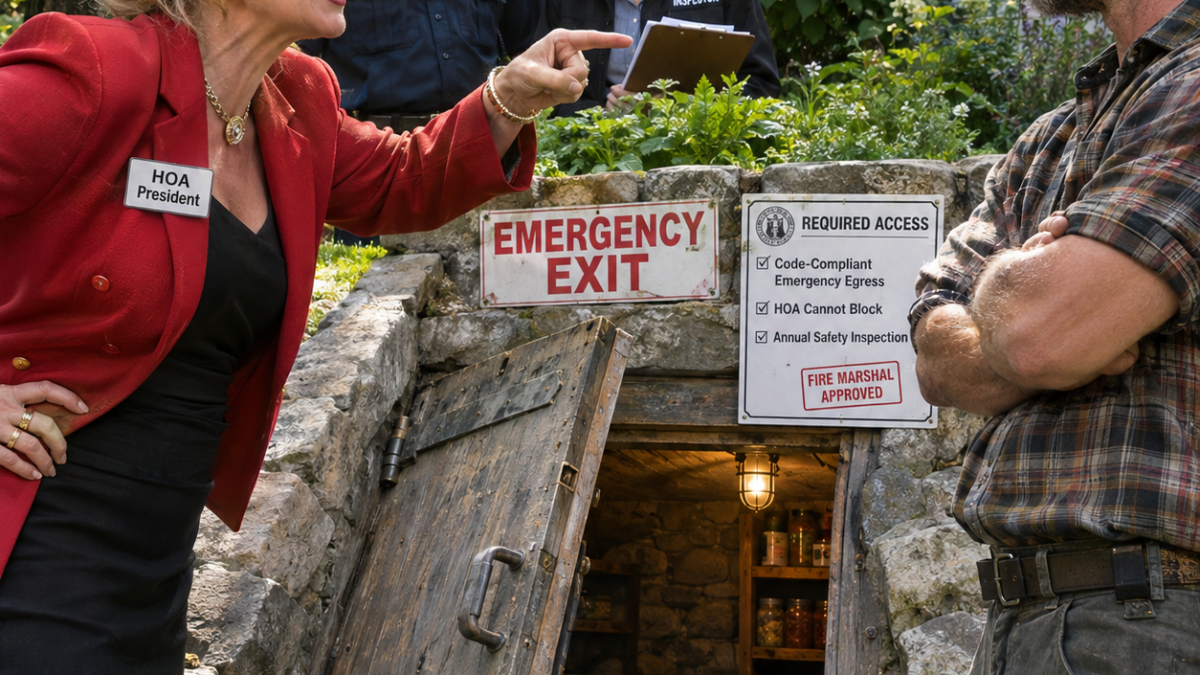
When Karen planted herself in the middle of my front lawn, jabbed one manicured finger toward the weathered steel door of my root cellar, and announced that I had until Friday to rip the “rusty piece of junk” out of the ground or the Oak Meadows HOA would hire a contractor to do it for me, I realized she had already made the most dangerous mistake a person with a little power can make—she had decided what something was worth before bothering to learn what it actually was.
The door had been part of my five-acre farmhouse long before Oak Meadows existed, and after twenty-five years in the Army Corps of Engineers I knew enough about old property records, easements, and buried infrastructure to understand that destroying a structure simply because somebody found it ugly could turn a ridiculous neighborhood argument into something far more expensive than a few hundred dollars in fines.
I could have told Karen to get off my property right then, but the confidence in her voice bothered me more than the threat itself, so instead I asked her to put everything in writing—and three days later, the certified letter she sent me gave me exactly the reason I needed to start digging through a history of my land that neither of us fully understood yet.
My name is Frank Miller.
Sarah and I had bought the old farmhouse a decade before the surrounding acreage was carved into quarter-acre lots and renamed Oak Meadows. I had spent most of my adult life working around structures, utilities, regulations, contractors, and the kind of paperwork people hate until the day they desperately need it. Retirement was supposed to be different.
We wanted five acres, a garden, a workshop, and enough room to live without somebody measuring our shrubs.
The farmhouse had been built in the 1950s. The root cellar sat partly buried into a low rise beside the house, cool even in July, with shelves full of canned tomatoes, beans, peaches, emergency food, tools, and supplies Sarah and I had accumulated over the years. Its exterior entrance was covered by a heavy slanted steel door painted battleship gray.
Pretty?
Not especially.
Useful?
Absolutely.
Karen didn’t care.
“Exterior structures require architectural approval,” she told me.
“This one predates your architectural committee.”
“That doesn’t make it acceptable.”
“It was here before Oak Meadows.”
She crossed her arms.
“So were a lot of things we improved.”
That sentence stayed with me.
I looked at the door, then back at her.
“Send me the violation in writing. Cite the exact covenant.”
Her face tightened.
“You know perfectly well what you’re violating.”
“Then documenting it should be easy.”
She left angry.
Three days later, the certified envelope arrived.
Section 7, Paragraph C.
*Aesthetic harmony.*
Fourteen days to remove the cellar door, fill and landscape the area, and restore the lawn.
Initial fine: $250.
Then $50 per day.
Sarah read the letter twice at the kitchen table.
“She’s serious.”
“So am I.”
“Frank, what if she puts a lien on the house?”
“First she has to establish an enforceable violation.”
I pulled out the CC&Rs.
Section 7, Paragraph C was exactly what I expected: vague language about unsightly structures visible from neighboring properties.
No cellar-door standard.
No metal restriction.
No date establishing when such a rule had been adopted.
Nothing explaining how a structure older than the HOA suddenly became illegal.
I wrote back asking for the Architectural Review Committee minutes, the specific design standard, and the HOA’s records showing whether the cellar entrance had been grandfathered when Oak Meadows was formed.
Then I went downtown.
County clerk’s office.
Old plats.
Original easements.
Utility maps.
I spent nearly two hours working backward through property records until a 1978 plat appeared on the table.
A thick line crossed what was now Oak Meadows.
It ran beneath several lots.
Then beneath mine.
I followed it with my finger until I reached a small square drawn almost exactly where my root cellar sat.
Beside it were three letters.
**EAP.**
I leaned closer.
Then reached for the map legend.
And for the first time since Karen had walked onto my lawn, I stopped thinking about HOA rules altogether.
PART 2
The legend was printed in tiny block lettering along the lower right corner of the old plat.
I ran my finger down the abbreviations until I found it.
**EAP — Emergency Access Point.**
For several seconds I just stared.
The root cellar door was sitting almost directly over the symbol.
That didn’t necessarily prove anything by itself. Old plats are full of markings that change meaning as properties develop, utilities move, and infrastructure gets replaced. I had spent too many years around construction drawings to confuse a clue with a conclusion.
So I asked the clerk for the underlying easement documents.
She disappeared into the back.
Twenty minutes later, she returned with a file thick enough to make Karen’s violation notice look like a grocery receipt.
The original landowner had granted a permanent multi-utility corridor across the property decades before Oak Meadows existed.
Water.
Natural gas.
Telephone lines that had later become part of a fiber network.
The easement ran beneath what was now the subdivision and continued through my five acres.
Then I found Section Four.
I read it once.
Then again.
Any structure constructed at the coordinates designated as the emergency access point had to preserve a clear opening of no less than four feet by four feet for emergency shutoff, inspection, maintenance, and repair of the underground utilities.
The access point was required to remain unobstructed.
Permanent.
Available to utility crews.
I sat back.
The steel cellar door Karen wanted removed wasn’t simply covering shelves of canned vegetables.
Beneath that section of the old cellar was a utility junction.
The door was effectively a hatch over an access chamber built into the original farm structure when the corridor was established.
Removing the door and landscaping over the opening—the exact remedy Karen had ordered—would violate the easement.
I requested certified copies of everything.
Plat.
Easement.
County ordinance.
Historical utility designation.
The clerk looked at the stack.
“Property dispute?”
“You could say that.”
She stamped the last copy.
“Good luck.”
I slid everything into a manila envelope.
“I’m beginning to think I may not need luck.”
On the drive home, I called Sarah.
“You find something?”
“Yes.”
“How good?”
“I’m not sure yet.”
“Frank.”
“Very good.”
“What?”
“I’ll show you when I get home.”
“You enjoy making me wait.”
“Twenty-five years of marriage and you’re just noticing?”
She hung up on me.
When I got home, we spread the documents across the kitchen table.
Sarah read more slowly than I did.
Then she looked toward the cellar door through the window.
“You’re telling me that thing is required?”
“It appears so.”
“By the county?”
“By the original utility easement.”
“And Karen wants it covered with sod.”
“Correct.”
Sarah stared at me.
Then, despite herself, she laughed.
“Does she know?”
“I doubt it.”
“Are you going to tell her?”
“Eventually.”
That answer stopped her laughter.
“Frank.”
“What?”
“You have that look.”
“What look?”
“The one you used to get when some contractor tried to tell you something couldn’t be done.”
“I’m doing research.”
“You’re planning.”
“Research first.”
She pointed at me.
“No war.”
“Documentation.”
“That’s what you call war now.”
She wasn’t entirely wrong.
But I had learned long ago that the fastest way to lose a conflict was to move before you understood the terrain.
Karen had moved first.
Now I was going to understand everything.
The HOA’s response to my first request arrived the following week.
It answered none of my questions.
No Architectural Review Committee minutes.
No grandfathering analysis.
No written cellar-door standards.
Instead Karen wrote that the board was “not required to provide a history lesson regarding plainly visible violations.”
The $250 fine was now due.
Daily fines would follow.
Legal action, including a possible lien, could be pursued.
I read the letter aloud.
Sarah shook her head.
“She actually wrote ‘history lesson’?”
“Yes.”
“She has no idea you spent three days digging through historical records.”
“No.”
“You’re smiling again.”
I was.
Because her refusal mattered.
She had been given specific procedural questions.
She didn’t answer them.
Instead she doubled down in writing.
I paid the $250.
Sarah almost dropped her coffee.
“What are you doing?”
“Preserving the dispute.”
“You’re giving her money.”
“Under protest.”
On the memo line I wrote:
**PAID UNDER PROTEST — VIOLATION DISPUTED.**
Then I wrote another certified letter stating that the HOA’s failure to provide the requested records left me with no factual basis to believe a valid violation existed.
I considered the matter disputed and unresolved.
Any additional penalties without documentary support would be treated as targeted harassment.
Sarah watched me seal it.
“She’ll hate this.”
“She already does.”
“No, I mean the fact that you sound like a manual.”
“That’s a compliment.”
“It wasn’t.”
My next discovery came from the HOA’s own CC&Rs.
Buried near the back was an appendix most homeowners probably never read.
**INCORPORATION OF PRIOR EASEMENTS AND ENCUMBRANCES.**
Oak Meadows formally acknowledged all preexisting recorded utility easements.
That alone was useful.
Then I kept reading.
The association was responsible for ensuring access points affecting common utility corridors remained unobstructed and available.
And once each year, the board was supposed to inspect designated access points and file or maintain certification as required by the county.
I sat completely still.
Karen wasn’t merely trying to remove something the HOA was obligated to protect.
If the records were accurate, the HOA itself had an affirmative duty to inspect the very hatch she called an eyesore.
I went back to the county.
Public works this time.
The clerk behind the counter had the expression of somebody who had already answered too many strange questions that morning.
“I’d like records of annual utility easement inspection certifications filed by Oak Meadows HOA.”
“What years?”
“Ten.”
She typed.
Waited.
Typed again.
Then frowned.
“I don’t see any.”
“Can you search by subdivision parcel?”
She did.
Then by association name variation.
Nothing.
“Ever?”
“Not from what I’m seeing.”
I asked for written confirmation.
She printed a response to my records request.
No certifications on file.
I walked out carrying another document for the folder.
The situation had inverted.
Karen thought she was enforcing a cosmetic rule.
In reality, her administration had apparently ignored a utility-safety obligation for years while threatening to destroy the access point entirely.
The next question was obvious.
Who actually owned the infrastructure below it?
The easement named original providers.
Companies had changed.
Merged.
Sold assets.
I spent an afternoon tracing successors.
Piedmont Gas now controlled the natural gas infrastructure.
Tri-County Water Authority controlled the water system.
OmniCom Fiber had inherited the old telecommunications corridor.
I drafted three letters.
Not complaints.
Notifications.
That distinction mattered.
I introduced myself as the owner of the property containing the designated emergency access point.
I listed the plat number.
Easement number.
Coordinates.
Then:
The Oak Meadows HOA had repeatedly ordered me to permanently remove and landscape over the access hatch.
I attached Karen’s violation notice.
Her second letter.
County plat.
Easement excerpt.
I wrote:
**I am concerned that compliance with the HOA’s directive could obstruct emergency access to infrastructure subject to your easement rights and create safety and regulatory concerns. I am providing this information so your organization may evaluate any interest it has in the matter.**
No demand.
No request that they fight Karen for me.
I simply woke up everyone who had something expensive buried beneath my property.
FedEx.
Signature required.
Then I waited.
The first call came Tuesday.
“Mr. Miller?”
“Yes.”
“My name is David Chen. I’m in-house counsel for Piedmont Gas.”
His voice was calm in the way lawyers sound when they are working hard not to sound alarmed.
“I’m calling regarding your letter.”
“Yes, sir.”
“Can you confirm the association is still directing you to remove the access hatch?”
“The last written instruction says removal is required and daily fines continue until I comply.”
Typing on his end.
“You have not altered the hatch?”
“No.”
“Do not.”
“Wasn’t planning to.”
“Good.”
He paused.
“Mr. Miller, that access point serves a critical part of our gas infrastructure.”
“I suspected as much.”
“It isn’t simply a feature of your home that can be permanently eliminated.”
“I have the easement.”
“I see that.”
Then his voice became more precise.
“Tampering with or obstructing access to regulated utility infrastructure can create significant legal and safety consequences. Our department will be notifying the association of our position.”
“Thank you.”
“No, thank you for notifying us before anything happened.”
Two hours later, Tri-County Water called.
The next morning, a courier delivered a letter from OmniCom.
Same message.
Different corporate language.
Do not obstruct the access.
Their easement rights were non-negotiable.
Interference would prompt immediate legal action.
I showed Sarah.
She read the OmniCom letter.
Then the gas company’s email.
Then the water authority’s response.
“This is over.”
“No.”
“Frank, three utilities just told her no.”
“They haven’t told her yet.”
“You think she’ll keep going?”
I looked toward Karen’s house down the road.
“Yes.”
I knew people like her.
The conflict had stopped being about a door weeks earlier.
Now it was about whether she could force me to obey.
And people obsessed with control rarely retreat because somebody quietly gives them a graceful exit.
They retreat when the cost of continuing becomes larger than the humiliation of stopping.
While the utility companies prepared their own correspondence, I started talking to neighbors.
Not because I needed witnesses for the hatch.
The documents already spoke.
I needed to understand how Karen had accumulated enough power to believe nobody would challenge her.
Dave was first.
Retired Marine.
Two streets over.
His flagpole was easy to spot.
American flag.
Heavy metal pole.
Straight.
Nothing remarkable except that Karen hated it.
I found him polishing his Harley.
“Dave.”
He glanced up.
“Frank.”
“Karen still after your flagpole?”
He groaned.
“That woman has measured it three times.”
“How far off?”
“One foot.”
“Dangerous.”
“Apparently devastating to civilization.”
He wiped his hands.
“What’d she get you for?”
“Root cellar.”
He laughed.
Then realized I wasn’t joking.
“The door?”
“The door.”
“What’s wrong with it?”
“Not sufficiently harmonious.”
He shook his head.
I handed him copies of the notices.
He read the first.
Then the second.
“She’s threatening a lien?”
“Yes.”
“What are you doing?”
“Documenting.”
“That’s it?”
“No.”
I told him about the easement.
The utility access.
The missing inspections.
His eyes narrowed.
“You’re kidding.”
“No.”
“You told Karen?”
“Not all of it.”
Dave grinned slowly.
“I like you.”
“That sounds threatening.”
“You know what she told me last month?”
“What?”
“That veterans need to understand civilian communities have different standards.”
I stared at him.
“She actually said that?”
“Right before telling me the pole my unit gave me was inappropriate.”
He leaned against the bike.
“She doesn’t care about standards, Frank. She cares about obedience.”
Maria lived three blocks away.
Widow.
Small yard.
Flowers everywhere.
Ceramic gnomes.
Karen’s war against them was almost legendary.
I stopped one afternoon when Maria was watering petunias.
She knew who I was.
Everybody apparently knew.
“You’re the cellar man.”
“I’ve been called worse.”
She smiled nervously.
Then I asked about her gnomes.
The smile disappeared.
“My grandchildren bring them when they travel.”
One from Colorado.
One from Maine.
One from Tennessee.
Each had a story.
Karen called them tacky.
Sent notices weekly.
Maria had paid fines because she was terrified of a lien.
“How much?”
“Not much.”
“How much?”
She looked embarrassed.
“Almost nine hundred dollars total.”
Nine hundred dollars because an elderly widow displayed gifts from her grandchildren.
“Do you have the notices?”
“All of them.”
“Keep them.”
“Why?”
“Because paper matters.”
The young couple named Miller were not related to me.
Their crime was a swing set.
Wrong stain.
Not prohibited.
Not unsafe.
Wrong shade.
Twenty-five dollars per day.
They were considering repainting it.
The husband said:
“Honestly, Frank, it’s easier.”
That sentence bothered me.
That was how Karen’s system survived.
Not because she was always right.
Because surrender was usually cheaper than resistance.
I invited Dave, Maria, the Millers, and Arthur Henderson to our house Saturday.
Arthur was a retired corporate lawyer who had spent decades handling litigation.
He sat on our couch with Karen’s letters in one hand and the utility easement in the other.
“My God.”
Sarah brought coffee.
“Good ‘my God’ or bad?”
Arthur looked at her.
“Both.”
He turned to me.
“Frank, if this easement says what I think it says, Karen’s proposed remediation isn’t merely unenforceable.”
He tapped the access requirement.
“It could be extraordinarily dangerous.”
Dave leaned forward.
“How dangerous?”
Arthur glanced around.
“Imagine an emergency gas leak under the development.”
Nobody moved.
“Now imagine the primary shutoff or junction access is under Frank’s cellar and the entrance has been filled with dirt and landscaped because an HOA president thought the door was ugly.”
Maria’s face went pale.
Arthur continued.
“Or water.”
He pointed to the map.
“Or communication infrastructure.”
The Miller husband said:
“Could we all be liable?”
“If the HOA knowingly interferes after being warned, the association’s exposure could be enormous.”
Dave looked at me.
“Does Karen know that?”
“She will.”
Right then my phone rang.
Piedmont Gas.
David Chen again.
“Mr. Miller, we’ve sent formal notice to the HOA.”
“When?”
“This morning.”
“What does it say?”
“In simple terms? Do not touch our access point.”
I glanced around the living room.
Everyone was watching me.
“Anything else?”
“We’ve also requested confirmation of their inspection and maintenance records.”
I almost smiled.
“You may have trouble getting those.”
Silence.
“Why?”
“County says there are no annual certifications on file.”
Another pause.
Longer.
“Mr. Miller.”
“Yes?”
“I may need you to send me that confirmation.”
“I’ll email it immediately.”
When I hung up, Arthur read my face.
“They asked about inspections.”
“Yes.”
“And?”
“I told them.”
He leaned back.
“Well.”
Dave asked:
“What?”
Arthur smiled without humor.
“Karen has just attracted people whose legal departments are larger than our entire HOA.”
The special hearing notice appeared two weeks later.
Bright pink paper on the community bulletin board.
Karen didn’t quietly withdraw the violation.
She escalated.
**SPECIAL EXECUTIVE HEARING — LOT 1, 128 OLD FARM ROAD.**
Persistent willful violation.
Forced remediation.
Lien.
Legal action.
She intended to put my cellar door up for public judgment.
Dave sent me a picture.
**She picked the battlefield.**
Arthur’s message was less dramatic.
**Excellent. Public record. Prepare.**
I called David Chen.
“The HOA scheduled a public vote to authorize forced removal.”
For the first time, the attorney lost his polished calm.
“They’re doing what?”
“Voting.”
“When?”
I gave him the date.
“Location?”
I told him.
“Mr. Miller, Piedmont Gas will have a representative present.”
Tri-County Water said the same.
OmniCom said the same.
Sarah watched me finish the third call.
“Does Karen know they’re coming?”
“No.”
“Are you going to tell her?”
“No.”
“Is that cruel?”
“No.”
She looked at me.
“Frank.”
“They’ve sent her letters.”
That was important.
This wasn’t a trap built on hidden information.
Karen had already been warned.
If she walked into the meeting pretending otherwise, that choice belonged to her.
Arthur helped me prepare.
County plat.
Easement.
CC&R appendix.
County records response.
Utility correspondence.
Relevant statutes.
Potential penalties.
“Don’t lead with the penalties,” Arthur said.
“I know.”
“No, you want to.”
“I don’t.”
“You absolutely do.”
I smiled.
“Maybe a little.”
“Don’t.”
He pointed at me.
“You let Karen talk first.”
“Why?”
“Because she thinks this is about a rusty door.”
“It is, to her.”
“Exactly.”
He leaned closer.
“Let her say that in front of the utility lawyers.”
The night before the meeting, Sarah laminated the key documents.
I watched her feed pages through the machine.
“You nervous?”
“No.”
She raised an eyebrow.
“Really?”
“In the Army, the stressful part was usually preparing.”
“And once things started?”
“You executed the plan.”
She handed me the plat.
“Just remember this is an HOA meeting, not Fallujah.”
“I know.”
“No tactical vocabulary.”
“Fine.”
“No calling Arthur legal artillery.”
“I never said that.”
“You thought it.”
I had.
The Oak Meadows clubhouse smelled like stale coffee and chlorine from the pool.
About two dozen homeowners sat in folding chairs.
Karen was already at the head table.
Red blazer.
Gavel.
Bob and Brenda beside her.
Her two dependable votes.
Sarah sat beside me in the second row.
Dave, Maria, the Millers, and Arthur were scattered through the room.
At the back sat three people Karen had never seen.
David Chen.
Eleanor Vance from Tri-County Water.
Mark Peterson from OmniCom.
Business suits.
Briefcases.
Quiet faces.
Karen didn’t notice them.
She called the meeting to order.
Treasurer’s report.
Landscaping.
Trash cans.
Routine business.
Then her voice changed.
“Now we come to the special executive hearing regarding the persistent violation at Lot One.”
She looked directly at me.
I kept my expression neutral.
Karen unveiled a foam board covered with photographs of my root cellar door.
She had chosen the worst angles possible.
Close-ups of rust.
Weeds.
Gray steel.
Underexposed photos making it look like the entrance to an abandoned bunker.
“This,” Karen announced, “is what Mr. Miller believes is acceptable in a premium residential community.”
A few people shifted.
Nobody said anything.
Karen mistook silence for agreement.
She described months of patience.
My refusal to comply.
The damage my “industrial structure” supposedly did to property values.
Then she read her motion.
Hire a licensed contractor.
Remove the door.
Fill the opening.
Landscape with sod.
Charge me for the work.
Place a lien for the cost, fines, and legal fees.
Brenda immediately seconded.
Karen smiled.
“We have a motion and second.”
Then she looked at me.
“Association procedures require us to allow the homeowner to speak before the vote.”
She leaned back.
“Mr. Miller, do you have anything to say for yourself?”
There it was.
The public humiliation she’d planned.
I stood.
Walked to the front.
Opened my folder.
“I won’t be discussing aesthetics tonight.”
Karen’s smile weakened.
“This hearing is specifically about aesthetics.”
“No.”
I looked toward the residents.
“It’s about public safety, property rights, and a recorded utility easement.”
The room became still.
I placed the county plat on the projector.
The map appeared behind Karen.
“This is the 1978 county plat covering the land where Oak Meadows was later developed.”
Laser pointer.
“This line is a fifty-foot multi-utility corridor.”
I followed it.
Through Oak Meadows.
Toward my property.
Then stopped on the square.
“And this symbol is EAP.”
I looked around.
“Emergency Access Point.”
Karen shifted.
I replaced the plat with the easement document.
Highlighted Section Four.
I read the relevant requirement.
Permanent access.
Minimum clear opening.
Emergency shutoff.
Maintenance.
Repair.
“This opening is located beneath what you know as my root cellar door.”
Murmurs.
Karen raised her hand.
“Mr. Miller—”
I kept going.
“The board’s proposed remedy is to remove the required access cover and landscape over the opening.”
Karen interrupted.
“That is your interpretation.”
“No.”
I changed the slide.
Oak Meadows CC&Rs.
Appendix.
Preexisting easements incorporated.
Association responsibility.
Annual inspection.
“This is your governing document.”
I looked at Bob.
Then Brenda.
“Not mine.”
Next slide.
County records response.
**No inspection certifications on file.**
I let that sit.
“Our own CC&Rs require annual inspection of designated utility access points.”
Someone in the audience asked:
“Have we done them?”
Karen answered too quickly.
“This is administrative minutiae.”
Arthur closed his eyes.
I almost felt sorry for her.
Almost.
I moved to the utility schematic.
“Here’s what’s below that door.”
First:
High-pressure natural gas trunk.
Karen stopped moving.
“Second, the main water isolation infrastructure serving Oak Meadows.”
More murmurs.
“And third, a major fiber trunk serving regional customers.”
I turned toward the homeowners.
“So the board is not voting on whether my door is attractive.”
Then I looked directly at Karen.
“You’re voting on whether to obstruct emergency access to critical infrastructure.”
She stood.
“This is ridiculous fearmongering.”
I didn’t answer.
Instead, I turned off the projector.
“That’s all I have.”
Karen stared.
She had expected a fight.
I gave her documents.
I returned to my seat.
Silence.
Then a chair moved in the back.
David Chen stood.
“My name is David Chen.”
Karen looked toward him.
“I’m with the legal department of Piedmont Gas Company.”
The color changed in her face.
Chen continued.
“Our company holds easement rights over the infrastructure beneath Mr. Miller’s property.”
His voice was calm.
Almost quiet.
That made it more effective.
“The access point under discussion tonight is a critical safety feature.”
Karen opened her mouth.
He raised one hand.
“Please let me finish.”
Nobody had spoken to Karen that way in an HOA meeting before.
She sat.
Chen continued.
“Piedmont Gas notified Oak Meadows in writing that the access must not be obstructed.”
He opened his briefcase.
“I have proof of delivery.”
A few residents turned toward Karen.
She stared at the table.
Chen said:
“If this board knowingly votes to authorize interference after receiving that warning, the company will take immediate steps to protect its infrastructure, including referrals to the appropriate state regulatory and law-enforcement authorities if warranted.”
Someone whispered:
“Criminal?”
Chen didn’t dramatize.
He didn’t need to.
“Interference with regulated gas infrastructure can carry serious civil and criminal consequences.”
The room changed.
Then he added the part nobody expected.
“Piedmont Gas has also learned that required inspection certifications may not have been filed.”
Karen looked up sharply.
Chen continued.
“We will therefore request a comprehensive safety review of the relevant utility corridor.”
A man behind me asked:
“Who pays for that?”
Chen paused.
“That will depend on the findings and applicable agreements.”
Arthur muttered softly:
“Translation: us.”
Then Eleanor Vance stood.
“I’m Director of Operations for Tri-County Water Authority.”
Karen looked as if she were watching reinforcements arrive for the wrong army.
Eleanor said:
“The water valve system below that access point provides isolation capability for this development.”
A resident asked:
“What does that mean?”
“In a serious main break, crews may need access to isolate sections of the system quickly.”
“And if the door is buried?”
Eleanor looked toward Karen.
“Response could be delayed.”
No theatrics.
No threats.
Just the implication of water pouring uncontrolled while crews searched for another route.
Mark Peterson stood next.
“Regional counsel, OmniCom Fiber.”
He didn’t even bother walking forward.
“Our easement is equally clear. The access point is not optional. We will protect it.”
Karen grabbed the gavel.
“This is being blown completely out of proportion.”
Arthur stood.
He had been waiting.
“May I?”
Karen glared.
“This isn’t public comment.”
Dave called out:
“It is now.”
Several people agreed.
Karen looked toward Bob.
Then Brenda.
Neither helped.
Arthur turned toward the residents.
“My name is Arthur Henderson. Some of you know me. I practiced corporate law for thirty-eight years.”
He gestured toward the utility representatives.
“What you have heard tonight is not a debate over whether Frank’s cellar door is attractive.”
He looked at Karen.
“This board was warned.”
Karen said:
“We were given conflicting information.”
David Chen immediately answered.
“No, ma’am.”
Silence.
He held up his letter.
“Our notice was unequivocal.”
Arthur continued.
“And now we also know the HOA may have failed for years to perform inspections required by its own documents.”
Bob finally spoke.
“Karen, were you aware of the gas company’s letter?”
Her face tightened.
“Correspondence comes through the president.”
“That isn’t what I asked.”
There it was.
First crack inside her own board.
“Were you aware?”
“Yes.”
Brenda stared.
“You didn’t tell us.”
Karen’s head snapped toward her.
“It was irrelevant to the aesthetic violation.”
Brenda’s mouth fell open.
Someone behind us said:
“You knew?”
Another:
“She knew.”
Then another voice:
“And she was still going to vote?”
Karen banged the gavel.
“Order.”
Nobody listened.
Questions came from everywhere.
How much could the audit cost?
Were homes at risk?
Why were annual inspections ignored?
Why had the board continued after utility lawyers objected?
Why were members not told?
Karen tried shouting over them.
“This is a coordinated attack by Frank Miller.”
I stayed seated.
She pointed at me.
“He has been manipulating this community for weeks.”
That was when Dave stood.
Retired Marine.
Flagpole victim.
Voice strong enough to cut through the room.
“No, Karen.”
She stared.
“You did this.”
“Sit down.”
“No.”
“Dave—”
“You love the bylaws, right?”
He held up his copy.
“Section Four. Vote of no confidence can be raised from the floor with five seconds.”
Karen’s face went blank.
Dave said:
“I move for an immediate vote of no confidence in President Karen Whitmore—”
“Miller,” someone corrected, and nervous laughter broke through the tension.
Dave didn’t smile.
“Karen Miller, based on concealment of material utility correspondence, reckless exposure of the association to liability, and repeated abuse of enforcement authority.”
“I second.”
The young Mr. Miller stood.
“Second.”
Maria raised her hand.
“Second.”
Another.
Then another.
Five.
More.
Karen’s grip tightened around the gavel.
“This meeting is adjourned.”
Dave’s voice rose.
“Motion is on the floor.”
“You don’t have authority—”
Arthur stepped forward.
“You cannot adjourn simply to avoid a properly made motion.”
Karen looked at Bob.
He stared at his hands.
“Bob?”
He wouldn’t meet her eyes.
Brenda was crying quietly.
Karen had built her authority on certainty.
That certainty was gone.
Dave called the vote.
Hands rose.
Almost every homeowner in the room.
When he called opposition, only Karen and one other hand stayed down.
It was over.
In the same meeting where she intended to authorize the destruction of my cellar door, Karen lost the presidency.
Bob resigned from the board less than five minutes later.
Brenda followed.
She apologized before leaving.
“I should’ve asked questions.”
Karen stood at the table.
For a moment, nobody moved.
Then she picked up her photographs.
The ugly close-ups of the hatch.
One slipped.
Landed face-up on the floor.
The rusty gray door stared back at everyone.
Karen left it there.
She walked out.
Sarah squeezed my hand.
“You okay?”
I exhaled.
“Yeah.”
“You won.”
“No.”
I looked toward David Chen.
Eleanor Vance.
Mark Peterson.
Arthur.
Dave.
Maria.
The Millers.
“We stopped something stupid.”
That felt more accurate.
Then somebody shouted:
“Who runs the HOA now?”
That was when things became complicated.
Removing a bad leader is easier than replacing a functioning organization.
Arthur stood.
“We need an interim board.”
Nominations started.
Arthur.
Dave.
Then, to my horror:
“Frank.”
I turned.
Someone else repeated it.
Then another.
I shook my head.
“No.”
Sarah whispered:
“Why?”
“I don’t want it.”
“You spent your whole life telling people leadership is duty.”
“This is different.”
“How?”
I looked at her.
She smiled.
I hated when she did that.
I agreed to serve temporarily.
Ninety days.
Nothing more.
Arthur.
Dave.
Me.
Interim board.
Our first motion concerned Karen’s cosmetic enforcement.
Any fine based on aesthetic standards lacking a written, objectively adopted guideline would be suspended and reviewed.
Passed unanimously.
Maria started crying.
Her gnomes were safe.
The Millers’ swing-set fines disappeared.
Dave’s flagpole case was closed.
My $250 payment under protest was refunded.
Sarah leaned toward me.
“Still think paying it was smart?”
“Yes.”
“You are impossible.”
Our second motion:
Full cooperation with the utilities.
That decision probably saved Oak Meadows far more money than anything else we did.
The safety audit began the following week.
Trucks appeared everywhere.
Gas engineers.
Water crews.
Fiber technicians.
County inspectors.
Ground-penetrating radar.
Mapping equipment.
Cameras.
Homeowners complained about inconvenience.
Then remembered why the audit was happening and complaints became quieter.
The largest inspection happened at my house.
For the first time since we bought the property, a professional utility team opened the entire access chamber beneath the root cellar.
The old steel door groaned when they lifted it.
Underneath was a concrete collar leading down past the section Sarah and I used for storage.
The original farmhouse had been modified decades earlier so the cellar access and utility chamber shared a protected entry.
An engineer climbed down.
Then another.
Bright work lights turned the darkness white.
They inspected gas controls.
Water isolation hardware.
Fiber conduit.
Ventilation.
Access ladder.
Hours later, Eleanor Vance sat at my kitchen table with several reports.
“Good news first.”
“Please.”
“Primary infrastructure is sound.”
Sarah exhaled.
“And bad?”
“The access system is outdated.”
That made sense.
The ladder had significant corrosion.
Ventilation didn’t meet newer standards.
The hatch wasn’t sufficiently marked for emergency personnel unfamiliar with the site.
“But Karen wanted it gone.”
Eleanor gave me a look.
“Yes.”
“How much?”
“For the upgrades?”
“Yes.”
She gave me the preliminary estimate.
Significant.
Not catastrophic.
The HOA would be responsible for a large share under its maintenance obligations.
Nobody liked that.
But everybody understood something now.
Maintenance costs money.
Ignoring maintenance costs more.
Then came the financial audit.
Arthur insisted.
“If we are going to ask residents for any special assessment, we open the books first.”
Best decision the interim board made.
An independent accountant reviewed Karen’s presidency.
The findings weren’t cinematic.
No secret offshore accounts.
No stolen millions.
Instead, something smaller and uglier.
HOA landscaping funds had paid for unusually extensive work around Karen’s private residence.
Sprinkler upgrades.
Decorative improvements.
Even work associated with a koi pond at her house.
Legal fees had gone almost entirely toward threatening residents over violations Karen personally prioritized.
Administrative expenses included purchases with no reasonable association purpose.
One of them was a subscription to a gourmet food magazine.
Dave stared at that line.
“You’re kidding.”
Arthur shook his head.
“You can’t make this stuff up.”
“How much total?”
A little over fifteen thousand dollars of questionable or improperly allocated spending could be documented strongly enough to demand repayment.
Arthur handled it.
He sent Karen a formal letter.
Repay.
Or the matter would be referred for further legal review and potentially to law enforcement.
Two days later, a certified check arrived.
$15,000 and change.
No note.
Dave held it up during the next board meeting.
“Most expensive magazine subscription I’ve ever seen.”
Arthur gave him a look.
“Don’t.”
The residents still faced part of the utility-upgrade cost.
There was no way around that.
The reserve fund was too depleted.
We approved a special assessment.
I hated it.
So did everyone.
But there was a difference between paying because a president wanted to punish somebody and paying because your buried gas, water, and communication infrastructure needed legitimate safety work.
We held a town hall.
No gavel.
No threats.
We laid out every invoice.
Every estimate.
Every account balance.
People were angry.
They were also informed.
That changed the tone.
One homeowner said:
“So we’re paying because Karen didn’t do inspections?”
Arthur answered:
“Partly. We’re also paying because infrastructure ages whether Karen exists or not.”
Another asked:
“Can we sue her for all of it?”
“Not realistically.”
That disappointed people.
Truth often does.
We could seek recovery for documented misuse.
We had.
We couldn’t transform every maintenance obligation into Karen’s personal debt merely because everyone disliked her.
That was another line worth preserving.
Good governance couldn’t mean replacing her abuse with ours.
Three months later, the permanent election arrived.
I refused nomination.
Sarah laughed when somebody tried anyway.
“Don’t you dare.”
“I wasn’t going to.”
Arthur became president.
Dave joined the board.
Maria was persuaded onto a resident advisory committee.
The Millers helped rewrite the architectural process.
Clear standards.
Written criteria.
Real appeals.
Published minutes.
No secret committee operating according to one person’s taste.
The first architectural question under the new system involved a shed.
Arthur asked:
“Does it meet setbacks?”
“Yes.”
“Safety requirements?”
“Yes.”
“Material restrictions?”
“None applicable.”
“Approved.”
The meeting moved on.
Six minutes.
I almost stood and applauded.
The root cellar changed too.
The utility companies agreed the original door needed replacement.
That part made me laugh.
Karen had, in the narrowest sense imaginable, eventually gotten what she wanted.
The rusty gray hatch came out.
But not because it was ugly.
Because engineers decided modern emergency access should have upgraded hardware, corrosion protection, ventilation, and clear marking.
A professional crew removed the old door carefully.
No sod.
No filled opening.
No landscaping.
They poured a reinforced concrete collar.
Installed a heavy industrial steel hatch.
New locking system accessible to authorized utility personnel.
Safety hardware.
Ventilation.
Then paint.
Bright yellow.
Not beige.
Not earth tone.
Not visually harmonious.
Safety yellow.
It could probably be seen from space.
The brass plaque mounted beside it read:
**CRITICAL UTILITY ACCESS
DO NOT OBSTRUCT**
Sarah stood beside me when the crew finished.
We stared.
She said:
“Karen would’ve hated it.”
“I know.”
“It’s much uglier.”
“Much.”
“More visible.”
“Absolutely.”
She smiled.
“Perfect.”
The HOA paid for the required upgrade under the settlement of its maintenance obligation.
Every year afterward, inspection became an actual line item in the budget.
Not glamorous.
Not controversial.
Just done.
The first time the board filed its certification with the county, Arthur sent me a copy.
Subject line:
**HISTORY LESSON COMPLETE.**
I printed it.
Sarah caught me.
“You’re not making another binder.”
“One folder.”
“Frank.”
“Thin folder.”
She walked away muttering something about retired engineers.
Karen stayed in Oak Meadows for a while.
Long enough to watch the neighborhood continue without her.
That may have been the hardest consequence.
The place didn’t collapse.
Lawns remained neat.
Property values didn’t evaporate.
Children played.
People painted sheds within reasonable standards.
Maria’s gnomes returned.
All of them.
She arranged six across the flower bed.
One held a tiny American flag.
Dave stopped during a walk.
“She’s provoking somebody.”
“Who?”
“Me. That flagpole is out of compliance.”
Maria overheard him.
“You leave my soldier alone.”
Dave saluted the gnome.
The Millers kept the cedar swing set exactly as it was.
No repainting.
Their children eventually wore the grass beneath it bare from use.
No committee measured the color.
The world survived.
What changed most was conversation.
Before Karen’s fall, people whispered.
Afterward, they asked.
“Why is this rule necessary?”
“Where did this expense come from?”
“Who voted?”
“What does the governing document actually say?”
Some board members found the new transparency exhausting.
Good.
A little exhaustion is healthy when you’re spending other people’s money.
The root cellar remained our root cellar.
Sarah still filled shelves with jars every summer.
Tomatoes.
Beans.
Peaches.
Pickles.
But now every time I carried a crate down the steps, I passed that brilliant yellow utility hatch.
The thing Karen had called an affront to the community had become an official safety feature with its own plaque.
One afternoon, David Chen from Piedmont Gas returned for the annual inspection.
He looked at the yellow paint.
“Subtle.”
“HOA approved.”
He laughed.
“Did they?”
“The new board did.”
“Karen?”
“Gone.”
He nodded.
“Probably for the best.”
I asked something I’d wondered for months.
“How serious was it really? If she’d actually covered the access?”
David stopped smiling.
“In a normal week? Maybe nobody notices.”
“And during an emergency?”
“That’s the problem.”
He looked toward Oak Meadows.
“You don’t design emergency infrastructure for normal weeks.”
That line stayed with me.
Karen had evaluated the hatch only by what it looked like on an ordinary afternoon.
Rusty.
Old.
Unnecessary.
But usefulness isn’t measured by how often something saves you.
A fire extinguisher may hang untouched for twenty years.
A shutoff valve may never be turned.
An emergency access hatch may spend decades looking ugly.
Then comes the one day when somebody needs it immediately.
That is the day its value becomes obvious.
Karen never understood systems like that.
She understood visible order.
Paint.
Grass.
Mailboxes.
Gnomes.
But the things holding a community together are often invisible.
Pipes.
Easements.
Emergency plans.
Reserves.
Procedures.
Trust.
Neglect them long enough and eventually something fails.
One Saturday afternoon, a moving truck parked in front of Karen’s house.
Sarah saw it first.
She brought iced tea to the garden where I was turning soil.
“Looks like she’s leaving.”
I followed her gaze.
Karen and her husband moved boxes from the garage.
For-sale sign on the lawn.
I felt less satisfaction than I expected.
Months earlier, I’d imagined wanting to see her defeated.
But defeat is much more dramatic in your imagination than in real life.
In real life, it was just an older woman carrying cardboard boxes out of a house.
“She got what she wanted,” Sarah said.
“What?”
“The old door is gone.”
I looked at the yellow hatch.
I laughed.
“Technically.”
Sarah lifted her glass.
“To Karen’s victory.”
I clinked mine against it.
“May she enjoy it from another neighborhood.”
She smacked my arm.
A week later Karen’s house was empty.
New owners came months afterward.
Nice couple.
Young daughter.
They introduced themselves.
The husband mentioned hearing something vague about an “HOA scandal.”
I didn’t give him the story.
He would hear it eventually.
Neighborhoods preserve gossip better than archives preserve records.
Instead, I pointed toward the yellow hatch.
“If you ever see utility crews there, give them room.”
“That’s under your cellar?”
“Yes.”
“What is it?”
“Emergency utility access.”
His eyebrows rose.
“For us?”
“For a lot of people.”
He looked toward his own house.
Then back.
“Huh.”
That was it.
No battle.
No argument about beauty.
Just new information accepted like a normal adult.
I almost hugged him.
Arthur served two terms as president.
Dave served one.
Neither became Karen.
That mattered.
Sometimes communities remove one difficult leader and accidentally create another because the replacement becomes addicted to being the hero.
Arthur understood that.
At the end of his second term, residents urged him to stay.
He refused.
“Healthy organizations should survive a change in leadership.”
He glanced at me.
“Engineer agree?”
“Absolutely.”
Dave added:
“Marine agrees.”
Arthur said:
“Nobody asked the Marine.”
The permanent board kept the inspection program.
Kept open financial records.
Kept objective architectural standards.
The world became boring.
Beautifully boring.
The most dramatic board debate one year concerned whether the pool should close at nine or ten.
I attended for five minutes.
Left.
Sarah asked why.
“Nothing important.”
She smiled.
“That’s good.”
It was.
I sometimes thought back to the first afternoon Karen walked onto my lawn.
If I had shouted at her, what would have happened?
Maybe she would have shouted back.
Maybe neighbors would have heard two angry people arguing over a rusty door.
Maybe she would have told everyone I was unstable.
Maybe I would have felt better for ten minutes.
Instead, I asked for a written notice.
That one decision shaped everything.
Because once Karen committed her position to paper, I could compare it with other paper.
Her violation notice against the county plat.
Her threat against the easement.
Her authority against the CC&Rs.
Her claims against utility law.
Opinion against record.
The more she wrote, the clearer the difference became.
That didn’t mean paperwork magically solved the problem.
People did.
County clerks who preserved old records.
Utility attorneys who took safety seriously.
Neighbors who found courage.
Arthur bringing decades of legal judgment.
Dave reading the bylaws Karen assumed nobody else would study.
Maria standing up after years of fear.
The Millers finally refusing to repaint a swing set.
Sarah reminding me repeatedly that winning didn’t require becoming obsessed.
And, ironically, Karen herself.
She created the public hearing.
She invited the scrutiny.
She made the motion.
She put her plan on the record.
Nobody forced her to do those things.
That was the most satisfying kind of accountability.
I didn’t need to set a trap with fake evidence.
I didn’t need to humiliate her with personal attacks.
I simply let her push her own argument until it collided with facts she had refused to check.
The utility audit had one long-term benefit none of us anticipated.
Crews found several minor issues elsewhere in Oak Meadows.
Nothing catastrophic.
Corroded fittings.
Old markers.
A drainage problem near one utility box.
Things that would have become expensive eventually.
The audit fixed them early.
Ironically, Karen’s crusade against the hatch improved the entire community’s infrastructure.
Arthur joked:
“We should send her a thank-you card.”
Dave said:
“I’ll buy it if it has a gnome on the front.”
We didn’t send one.
Some jokes are better left as jokes.
The yellow hatch aged.
Slowly.
Weather dulled the paint.
Not much.
Utility crews repainted it as part of maintenance.
The plaque remained shiny.
Every once in a while a delivery driver asked what it was.
I told them.
Occasionally a child asked whether it led to a secret bunker.
“Sort of.”
Sarah hated that answer.
“You’re going to have half the neighborhood kids trying to open it.”
“They can’t.”
“That’s not the point.”
To our grandchildren, the root cellar was magical enough without utilities.
Rows of jars.
Cool air.
Old shelves.
The smell of earth and wood.
One summer our grandson pointed at the hatch.
“Grandpa, what’s under there?”
“Things that keep people’s houses working.”
“Like electricity?”
“Not exactly.”
“Water?”
“Yes.”
“Internet?”
“Some of that too.”
His eyes widened.
“The internet is under your garden?”
“In a manner of speaking.”
He stared at the hatch with more respect than Karen ever had.
Then he asked:
“Why is it yellow?”
“So people don’t forget it’s important.”
That might have been the cleanest answer I’d ever given.
Years after the fight, Maria passed away.
Her grandchildren came to clear the house.
Before selling, one of them knocked on our door.
He held a ceramic gnome.
Tiny.
Blue hat.
“We found a note with this.”
He handed it to me.
Maria’s handwriting.
**For Frank — the one who taught us Karen could be told no.**
My throat tightened.
“I can’t take this.”
“He wanted you to have it.”
“She.”
“Sorry. She wanted you to have it.”
I took the gnome.
Sarah put it near the root cellar.
I protested.
“That is definitely not approved landscaping.”
“Good.”
“It’s tacky.”
“Maria would be proud.”
The gnome stayed.
Dave came by the next day.
Pointed.
“Violation.”
“Get off my property.”
He laughed.
The community did not become perfect after Karen.
That would be fiction.
People still disagreed.
One board made a stupid decision about parking and had to reverse it.
Someone complained about Christmas lights staying up until February.
A resident painted a garage door a color half the neighborhood hated.
Meetings occasionally ran too long.
But disagreement no longer automatically became punishment.
That was the difference.
Rules became something residents could discuss.
Not weapons handed down by one person.
My five-acre lot remained different.
Older house.
Bigger garden.
Root cellar.
Workshop.
More practical than ornamental.
And, eventually, that difference stopped being treated like an insult.
It became part of Oak Meadows.
Not because everything had been forced into harmony.
Because people finally understood communities don’t need every home to look identical to be stable.
The root cellar was the perfect example.
Ugly to one person.
Essential to another.
Critical to utilities.
Useful to Sarah and me.
Historically significant to the property.
All of those things could be true at once.
Authority didn’t simplify them.
Research did.
I kept the original steel door.
Most of it, anyway.
When the contractors replaced it, I asked whether I could keep one small section that wasn’t needed.
They cut a rectangular piece from a damaged edge.
I cleaned it.
Mounted it on the workshop wall.
Sarah saw it.
“Seriously?”
“History.”
“Rust.”
“History can rust.”
Below it I placed two things.
Karen’s first violation notice.
And a photograph of the new yellow hatch.
I did not hang the refund check.
Didn’t keep the angry letters visible.
Just the first accusation and the final result.
Occasionally somebody asked what it meant.
I would tell the short version.
“HOA president thought the old cellar door was ugly.”
“And?”
“Turned out utilities needed it.”
That was enough.
The long version belonged to us.
One autumn evening, several years after everything settled, I was working in the garden when a Tri-County Water truck pulled up.
A young technician walked over.
“Mr. Miller?”
“Yes.”
“We need access to the junction.”
“Everything okay?”
“Routine valve replacement.”
I unlocked the outer cellar entry and showed him the utility access.
He scanned the plaque.
Then smiled.
“This is the famous one?”
I groaned.
“Famous?”
“Our supervisor tells new crews the story.”
“What story?”
“About the HOA trying to bury it.”
“Great.”
He laughed.
“It’s basically a training story now.”
“For what?”
“Always verify easements before changing access.”
I couldn’t argue with that.
Two technicians went below.
Forty minutes later they came out.
Job done.
No emergency.
No crisis.
They thanked me and left.
I stood beside the hatch afterward.
Nothing dramatic had happened.
But that’s the point of infrastructure.
Most days, it just needs to be there.
Ready.
Accessible.
Maintained.
The same could probably be said for good rules.
They’re not supposed to make people feel their presence every morning.
They’re supposed to sit quietly in the background and protect the things that actually matter.
Karen saw rules differently.
To her, a rule was proof that somebody had to obey.
That attitude cost her everything she valued about being president.
Her position.
Her reputation.
Her authority.
Eventually even her place in the neighborhood.
She had looked at a piece of old gray steel and decided it was beneath the image she wanted Oak Meadows to project.
Then she discovered that the entire subdivision depended, in part, on what was beneath it.
I never forgot the irony.
But I stopped enjoying it at her expense.
With time, the story became less about Karen and more about everyone else.
Dave refusing to remove his flagpole.
Maria putting her gnomes back.
The Millers watching their kids use the swing set.
Arthur keeping meetings sane.
Sarah filling the root cellar shelves every summer.
The utility crews filing inspections.
New boards inheriting records that clearly explained why the hatch existed.
That was the real victory.
Not defeating one president.
Making sure the next one couldn’t repeat the same mistake simply because everyone forgot.
On the tenth anniversary of our move into the farmhouse, Sarah and I sat outside at dusk.
The garden was winding down.
Jars of tomatoes waited in the kitchen.
The yellow hatch caught the last sunlight.
Maria’s little blue-hatted gnome sat beside it.
Sarah followed my gaze.
“Still ugly.”
“The hatch?”
“Yes.”
“I like it.”
“You would.”
“It has character.”
“It has industrial paint.”
“Same thing.”
She leaned against me.
After a while she said:
“Do you remember what Karen said?”
“Unfortunately.”
“About ripping it out?”
“Yes.”
“She did get the old door removed.”
I laughed.
“She would appreciate you recognizing that.”
“No, she wouldn’t.”
We sat quietly.
Children were playing somewhere down the street.
A lawn mower shut off.
Someone called a dog.
Ordinary evening.
No gavel.
No violation notices.
No certified letters.
Just life.
I thought about that first day again.
Karen pointing.
Me listening.
The old door between us.
She had believed power meant being able to order someone else to change.
I had spent twenty-five years around real systems of authority.
The Army had plenty of orders.
Plenty of rules.
But even there, authority depended on structure.
Jurisdiction.
Responsibility.
Procedure.
Consequences.
Nobody gets unlimited power because they enjoy giving instructions.
Karen never understood that until the night three utility representatives sat in the back row of her hearing.
By then it was too late.
She had already put the motion on the floor.
She had already received the warnings.
She had already hidden them from the board.
She had already made the issue public.
She built the stage for her own collapse because she believed she could control what happened once everyone entered the room.
But facts don’t care who owns the gavel.
The county plat did not care whether the cellar door matched the neighborhood.
The gas line did not care whether Karen found it attractive.
The water valve did not care about property values.
The fiber trunk did not care about aesthetic harmony.
And the people sitting in that clubhouse stopped caring about Karen’s authority the moment they understood her obsession could cost them their safety, their savings, and potentially their homes.
Her power vanished because its foundation was never law.
It was compliance.
Once people stopped giving it to her, there was nothing underneath.
The root cellar door taught us that in the strangest possible way.
A thing can look old and still matter.
A rule can look official and still be wrong.
A leader can sound certain and still know almost nothing.
And sometimes the ugliest object in a perfectly manicured neighborhood is the one keeping everybody safe.
Years later, the original gray door is gone.
Karen won that tiny technical victory.
In its place stands a larger, heavier, brighter steel hatch.
Safety yellow.
Impossible to hide.
Impossible to mistake for landscaping.
On sunny afternoons, it practically glows beside the garden.
The plaque still reads:
**CRITICAL UTILITY ACCESS. DO NOT OBSTRUCT.**
The HOA pays for its inspection.
The county keeps the certification.
The gas company knows the coordinates.
The water authority knows the route.
OmniCom keeps the easement active.
And every new board member receives a map showing exactly what sits beneath my property and why it must remain accessible.
Nobody ever calls it an eyesore anymore.
One evening my grandson stood beside it, his hand resting on Maria’s little gnome.
“Grandpa?”
“Yeah?”
“Did somebody really try to get rid of this?”
I looked at the hatch.
Then toward Oak Meadows.
“Yep.”
“Why?”
“They didn’t know what it was.”
He thought about that for a few seconds.
Then asked the kind of question children ask because adults have spent too much time making simple things complicated.
“Why didn’t they just ask?”
I smiled.
“That’s a very good question.”
He nodded as if the matter had been settled.
Then ran toward the garden where Sarah was waiting.
I stayed beside the hatch a little longer.
The metal was warm from the evening sun.
Beneath my hand, somewhere under concrete and earth, gas, water, and fiber lines continued doing what they had done for decades.
Quietly.
Reliably.
Invisible until somebody needed them.
Karen had wanted to bury that access because she thought appearances mattered more than purpose.
Instead, her fight forced the entire neighborhood to rediscover the purpose.
She lost her presidency.
The old board collapsed.
The missing inspections were corrected.
Misused money came back.
Arbitrary fines disappeared.
The utilities were upgraded.
And the rusty door she hated became something far more visible than it had ever been.
But none of that was what satisfied me most.
What satisfied me was hearing Sarah laugh in the garden.
Seeing Maria’s gnome beside the hatch.
Watching children play without parents checking the mailbox for another violation.
Knowing the cellar beneath my feet still held jars of food we had canned ourselves.
Knowing that if a pipe ruptured or a gas emergency ever came, utility crews could reach what they needed.
Everything was doing its job again.
The neighborhood.
The board.
The hatch.
And me.
Karen had ordered me to remove my root cellar door because she thought it was ugly.
She never imagined the most important thing about that door wasn’t what anyone could see.
It was what everyone depended on underneath.
[END OF STORY]








